tow MERCEDES-BENZ METRIS 2020 MY20 Operator’s Manual
[x] Cancel search | Manufacturer: MERCEDES-BENZ, Model Year: 2020, Model line: METRIS, Model: MERCEDES-BENZ METRIS 2020Pages: 320, PDF Size: 26.38 MB
Page 277 of 320
!
Secure the tow rope or tow bar to the tow-
ing eye or trailer tow hitch only. Otherwise,
the vehicle could become damaged.
! Do not use the towing eye for recovery,
this could damage the vehicle. If in doubt,
recover the vehicle with a crane.
! Drive slowly and smoothly when towing.
Excessive tractive power could otherwise
damage the vehicles.
! Shift the automatic transmission to posi-
tion i and do not open the driver's or front
passenger's door during towing. The auto-
matic transmission may otherwise shift to
position j, which could damage the trans-
mission.
! You may tow the vehicle for a maximum
distance of 30 miles (50 kilometers). A tow-
ing speed of
30 mph (50 km/h) must not be
exceeded.
For towing distances over 30 miles
(50 kilometers), the entire vehicle must be
raised and transported.
When towing away, you must observe the legal
requirements for the country in which you are
currently driving.
It is better to have the vehicle transported
than to have it towed.
Have the vehicle transported on a transporter
or trailer if it has transmission damage.
The automatic transmission must be in posi-
tion i when the vehicle is being towed away.
If the automatic transmission cannot be shif-
ted to position i, have the vehicle transpor-
ted on a transporter or trailer.
The battery must be connected and charged.
Otherwise, you:
R cannot turn the key to position 2 in the
ignition lock.
R cannot shift the transmission to position i.
Before the vehicle is towed, switch off the
automatic locking feature (Y page 76). You could otherwise lock yourself out of the vehi-
cle when pushing or towing away the vehicle. Installing/removing the towing eye
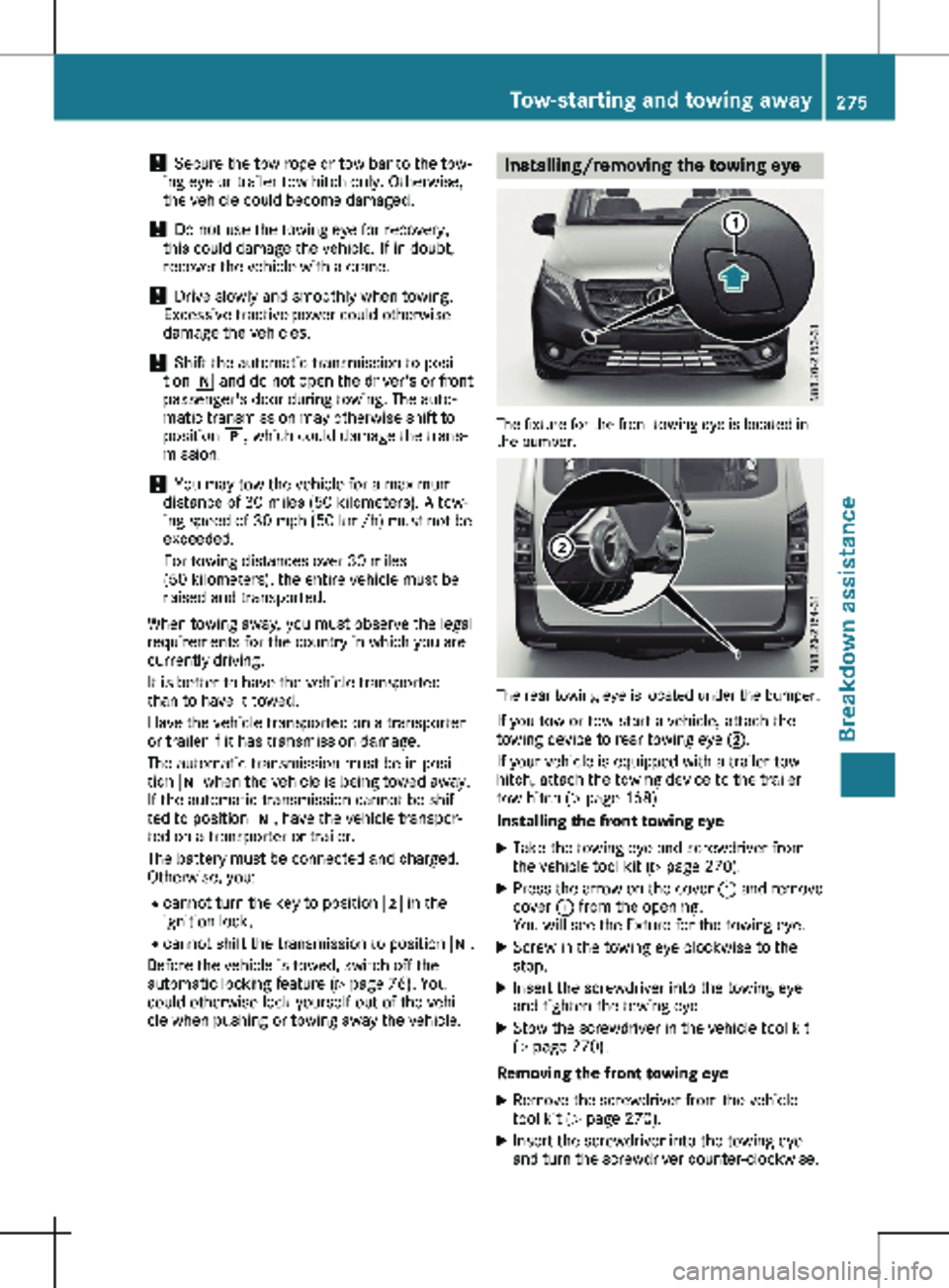
The fixture for the front towing eye is located in
the bumper. The rear towing eye is located under the bumper.
If you tow or tow-start a vehicle, attach the
towing device to rear towing eye
;.
If your vehicle is equipped with a trailer tow
hitch, attach the towing device to the trailer
tow hitch (Y page
168).
Installing the front towing eye
X Take the towing eye and screwdriver from
the vehicle tool kit (Y page
270).
X Press the arrow on the cover : and remove
cover : from the opening.
You will see the fixture for the towing eye.
X Screw in the towing eye clockwise to the
stop.
X Insert the screwdriver into the towing eye
and tighten the towing eye.
X Stow the screwdriver in the vehicle tool kit
(Y page
270).
Removing the front towing eye
X Remove the screwdriver from the vehicle
tool kit
(Y page 270).
X Insert the screwdriver into the towing eye
and turn the screwdriver counter-clockwise. Tow-starting and towing away
275
Breakdown assistance Z
Page 278 of 320
X
Unscrew the towing eye.
X Insert cover : with the lug at the top and
press it in at the bottom until it engages.
X Stow the towing eye and the screwdriver
with the vehicle tool kit (Y page
270).Towing with the rear axle raised
! Vehicles with automatic transmission must
not be towed with the rear axle raised. The
vehicle/trailer combination may otherwise
swerve or even roll over.
! The ignition must be switched off if the
vehicle is being towed with the front or rear
axle raised. Otherwise, ESP ®
may intervene
and damage the brake system.
X Switch on the hazard warning lamps
(Y page
101).
X Turn the front wheels to the straight-ahead
position.
X Release the parking brake.
X If necessary, turn the key in the ignition lock
to position g and remove the key from the
ignition lock.
X Take the key with you when leaving the vehi-
cle.
X Do not exceed the towing speed of 30 mph
(50 km/h
).
Please observe the important safety instruc-
tions when towing your vehicle with the rear
axle raised
(Y page 274). Towing the vehicle with both axles
on the ground
Important safety notes G
WARNING
You can no longer steer the vehicle if the
steering wheel lock has been engaged.
There is a risk of an accident.
Always switch off the ignition when towing
the vehicle with a tow cable or a tow bar.
! Do not exceed the towing speed of
30 mph
(50 km/h). You could otherwise
damage the transmission. Please observe the important safety notes
before towing your vehicle
(Y page 274).
Towing vehicles with automatic trans-
mission X
Turn the key to position 2 in the ignition
lock.
X Depress the brake pedal and keep it
depressed.
X Shift the automatic transmission to position
i.
X Leave the key in position 2 in the ignition
lock.
X Switch on the hazard warning lamps
(Y page
101).
X Release the parking brake.
X Release the brake pedal.
X Do not exceed the towing speed of 30 mph
(50 km/h
). Recovering a vehicle that is stuck
! When recovering a vehicle that has
become stuck, pull it as smoothly and
evenly as possible. If the tractive power is
too high, the vehicles could be damaged.
If the drive wheels get trapped on loose or
muddy ground, recover the vehicle with the
utmost care. This is especially the case if the
vehicle is laden.
Never attempt to recover a vehicle with a
trailer attached.
Pull out the vehicle backwards, if possible,
using the tracks it made when it became
stuck. Transporting the vehicle
! You may only secure the vehicle by the
wheels, not by parts of the vehicle such as
axle or steering components. Otherwise, the
vehicle could be damaged.
The towing eye or trailer tow hitch can be used
to pull the vehicle onto a trailer or transporter
if you wish to transport it. 276
Tow-starting and towing away
Breakdown assistance
Page 279 of 320
X
Turn the key to position 2 in the ignition
lock.
X Shift the transmission to position i.
X Release the parking brake.
If the vehicle is loaded: X Shift the transmission to position j.
X Turn the key to position u in the ignition
lock and remove it.
X Make sure the parking brake is applied.
X Lash down the vehicle. Tow-starting (emergency engine
starting)
General notes !
Vehicles with automatic transmission must
not be tow-started. You could otherwise
damage the automatic transmission.
You can find information on jump-starting
under "Jump-starting“
(Y page 272).Electrical fuses
The fuse allocation chart and important safety
information on the fuses can be found in the
"Fuse allocation chart" supplement. Electrical fuses
277
Breakdown assistance Z
Page 282 of 320
R
Break in new tires at moderate speeds for
the first
65 miles (100 km).
R Do not drive with tires which have too little
tread depth, as this significantly reduces the
traction on wet roads (hydroplaning).
R Replace the tires after six years at the lat-
est, regardless of wear. This also applies to
the spare wheel. Operation in winter
General notes
Have your vehicle winterized at a qualified spe-
cialist workshop at the onset of winter.
Only use wheels with tire sizes approved for
Mercedes-Benz.
Prior to the onset of winter, ensure that snow
chains are stowed in the vehicle
(Y page
281). Snow chains cannot be moun-
ted on all wheel/tire combinations. Observe
the restrictions on the use of snow chains
under "Wheel/tire combinations"
(Y page 302).
Also observe the notes in the "Changing a
wheel" section ( Y page 297).Driving with summer tires
At temperatures below 45 ‡
(+7 †), summer
tires lose elasticity and therefore traction and
braking power. Change the tires on your vehi-
cle to M+S tires. Using summer tires at very
cold temperatures could cause tears to form,
thereby damaging the tires permanently.
Mercedes-Benz cannot accept responsibility
for this type of damage. M+S tires
G
WARNING
Wheel and tire dimensions as well as the
type of tire can vary between the spare
wheel and the wheel to be replaced. When
the spare wheel is mounted, driving charac-
teristics may be severely affected. There is a
risk of an accident. In order to reduce risks:
R you should therefore adapt your driving
style and drive carefully.
R never mount more than one spare wheel
that differs from the wheel to be replaced.
R only use a spare wheel that differs from
the wheel to be replaced for a short time.
R have a spare wheel that differs from the
wheel that has been changed replaced at
the nearest qualified specialist workshop.
You must observe the correct wheel and
tire dimensions as well as the wheel type. G
WARNING
M+S tires with a tire tread depth of less than
ã in
(4 mm) are not suitable for use in win-
ter and do not provide sufficient traction.
There is a risk of an accident.
M+S tires with a tread depth of less than ã
in (4 mm) must be replaced immediately.
Use winter tires or all-season tires at tempera-
tures below 45 ‡ (+7 †). Both types of tire
are identified by the M+S marking.
Only winter tires bearing the i snowflake
symbol in addition to the M+S marking provide
the best possible grip in wintry road condi-
tions.
Only these tires will allow driving safety sys-
tems such as ABS and ESP ®
to function opti-
mally in winter. These tires have been devel-
oped specifically for driving in snow.
For safe driving, use M+S tires of the same
make and tread pattern on all wheels.
Always observe the maximum permissible
speed specified for the M+S tires you have
mounted.
If you mount M+S tires that have a lower maxi-
mum permissible speed than the maximum
design speed of the vehicle, affix a corre-
sponding warning label in the driver's field of
vision. You can obtain this at a qualified spe-
cialist workshop.
Once you have mounted the winter tires:
X Check the tire pressure (Y page
282).
X Restart the tire pressure monitor
(Y page
288).280
Operation in winter
Wheels and tires
Page 285 of 320
to the maximum permissible speed of the vehi-
cle.
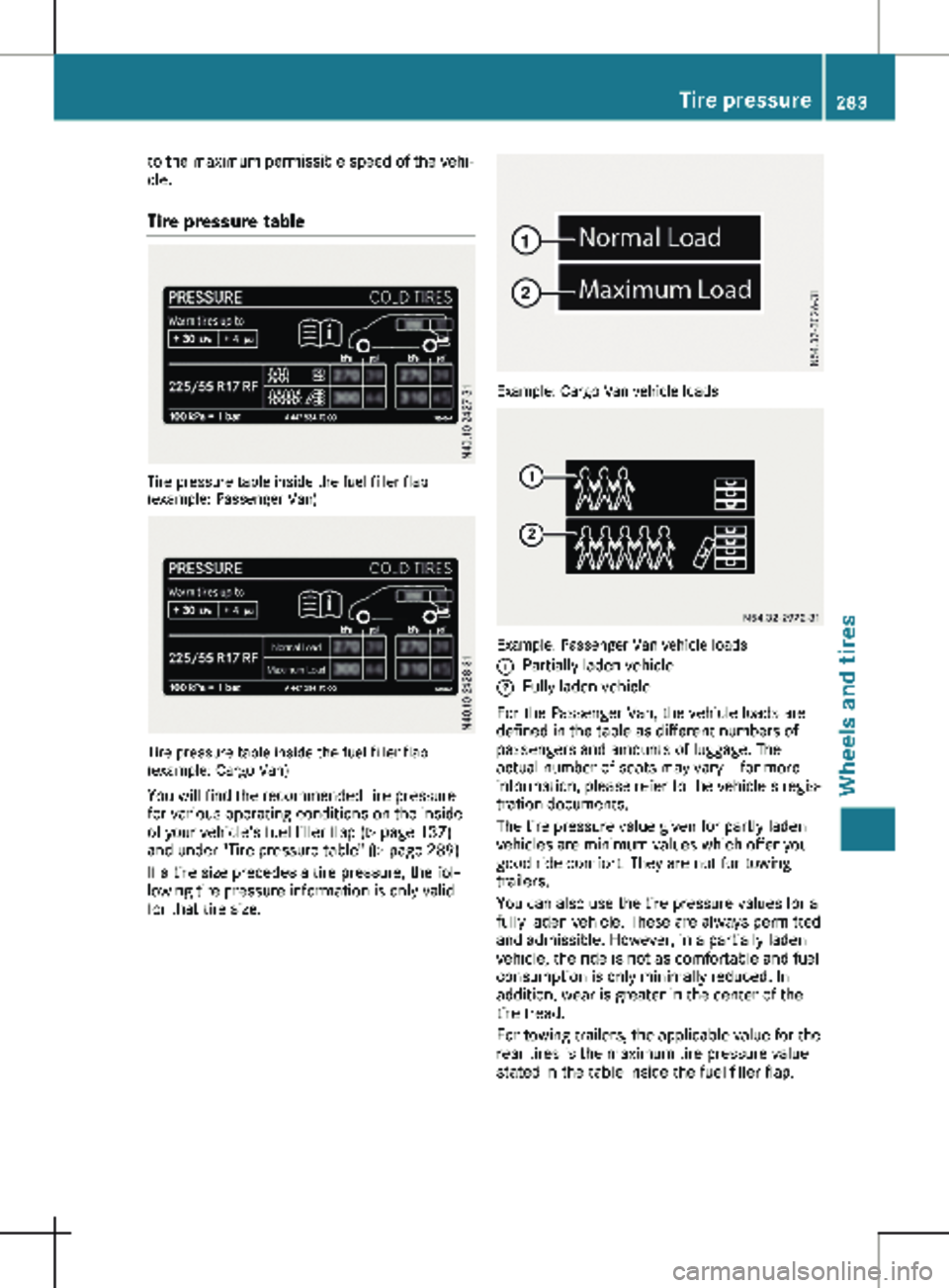
Tire pressure table Tire pressure table inside the fuel filler flap
(example: Passenger Van)
Tire pressure table inside the fuel filler flap
(example: Cargo Van)
You will find the recommended tire pressure
for various operating conditions on the inside
of your vehicle's fuel filler flap
(Y page 137)
and under "Tire pressure table" (Y page 289).
If a tire size precedes a tire pressure, the fol-
lowing tire pressure information is only valid
for that tire size. Example: Cargo Van vehicle loads
Example: Passenger Van vehicle loads
:
Partially laden vehicle
; Fully laden vehicle
For the Passenger Van, the vehicle loads are
defined in the table as different numbers of
passengers and amounts of luggage. The
actual number of seats may vary – for more
information, please refer to the vehicle's regis-
tration documents.
The tire pressure value given for partly laden
vehicles are minimum values which offer you
good ride comfort. They are not for towing
trailers.
You can also use the tire pressure values for a
fully laden vehicle. These are always permitted
and admissible. However, in a partially laden
vehicle, the ride is not as comfortable and fuel
consumption is only minimally reduced. In
addition, wear is greater in the center of the
tire tread.
For towing trailers, the applicable value for the
rear tires is the maximum tire pressure value
stated in the table inside the fuel filler flap. Tire pressure
283
Wheels and tires Z
Page 293 of 320
150 lb passengers in your vehicle, the
amount of available cargo and luggage
load capacity is
650 lbs. (1400 Ò 750 (5 x
150) = 650 lbs.).
(5) Determine the combined weight of lug- gage and cargo being loaded on the vehi-
cle. That weight may not safely exceed the
available cargo and luggage load capacity
calculated in Step 4.
(6) If your vehicle will be towing a trailer, load from your trailer will be transferred to your vehicle. Consult this manual to determine
how this reduces the available cargo and
luggage load capacity of your vehicle.
The vehicle placard named in Step 1 is the Tire
and loading information placard for your vehi-
cle.
Please note that not all vehicles are approved
for trailer operation. Trailer operation is only
permitted when a trailer hitch is installed
(Y page
315). If in doubt, please consult a
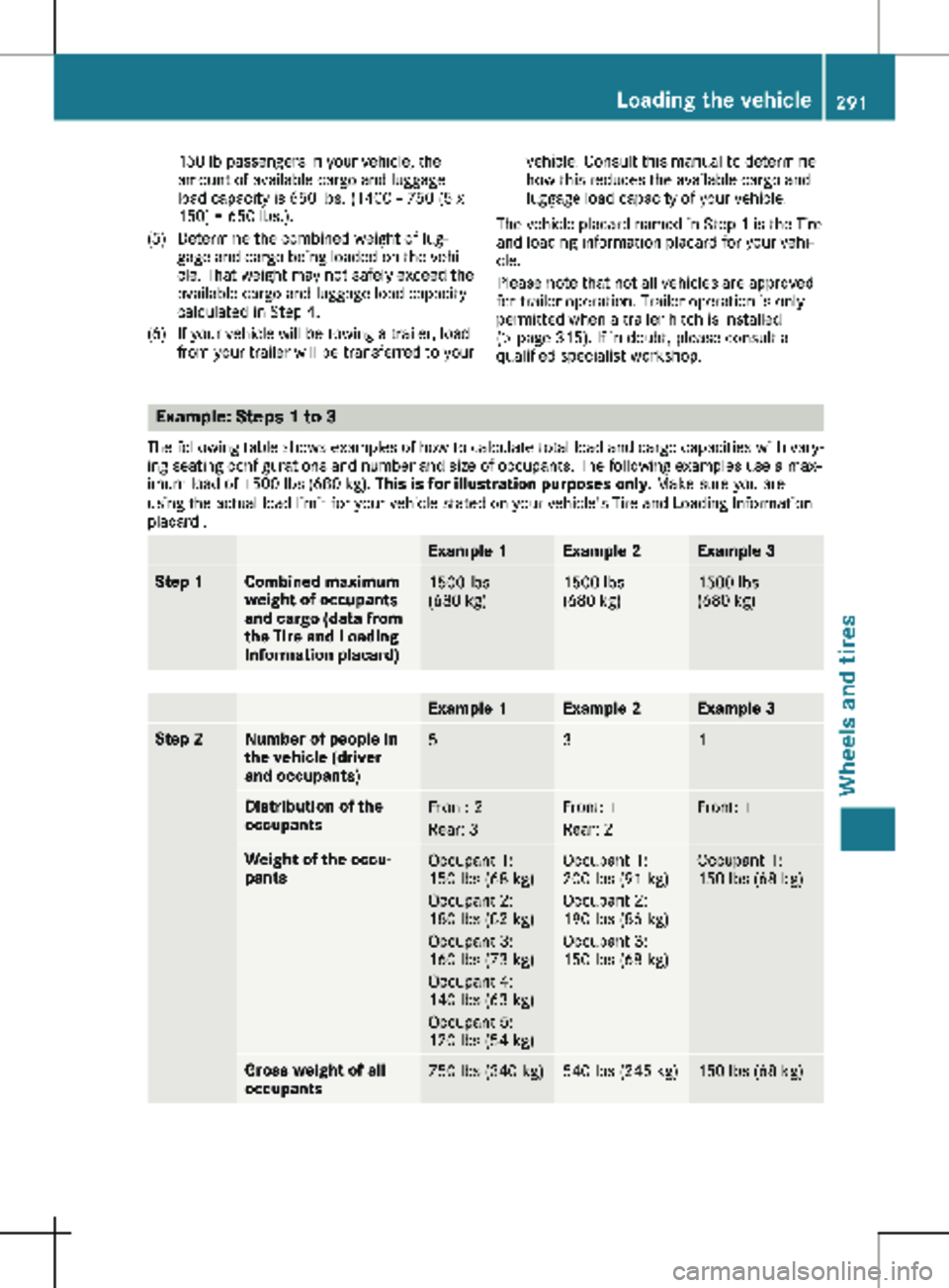
qualified specialist workshop. Example: Steps 1 to 3
The following table shows examples of how to calculate total load and cargo capacities with vary-
ing seating configurations and number and size of occupants. The following examples use a max-
imum load of
1500 lbs (680 kg). This is for illustration purposes only. Make sure you are
using the actual load limit for your vehicle stated on your vehicle's Tire and Loading Information
placard . Example 1 Example 2 Example 3
Step 1 Combined maximum
weight of occupants
and cargo (data from
the Tire and Loading
Information placard)
1500 lbs
(680 kg
) 1500 lbs
(680 kg
) 1500 lbs
(680 kg
) Example 1 Example 2 Example 3
Step 2 Number of people in
the vehicle (driver
and occupants)
5 3 1
Distribution of the
occupants
Front: 2
Rear: 3 Front: 1
Rear: 2 Front: 1
Weight of the occu-
pants
Occupant 1:
150 lbs (68 kg
)
Occupant 2:
180 lbs (82 kg)
Occupant 3:
160 lbs (73 kg)
Occupant 4:
140 lbs (63 kg)
Occupant 5:
120 lbs (54 kg) Occupant 1:
200 lbs (91 kg
)
Occupant 2:
190 lbs (86 kg)
Occupant 3:
150 lbs (68 kg) Occupant 1:
150 lbs (68 kg
) Gross weight of all
occupants
750 lbs (340 kg) 540 lbs (245 kg) 150 lbs (68 kg)Loading the vehicle
291
Wheels and tires Z
Page 294 of 320
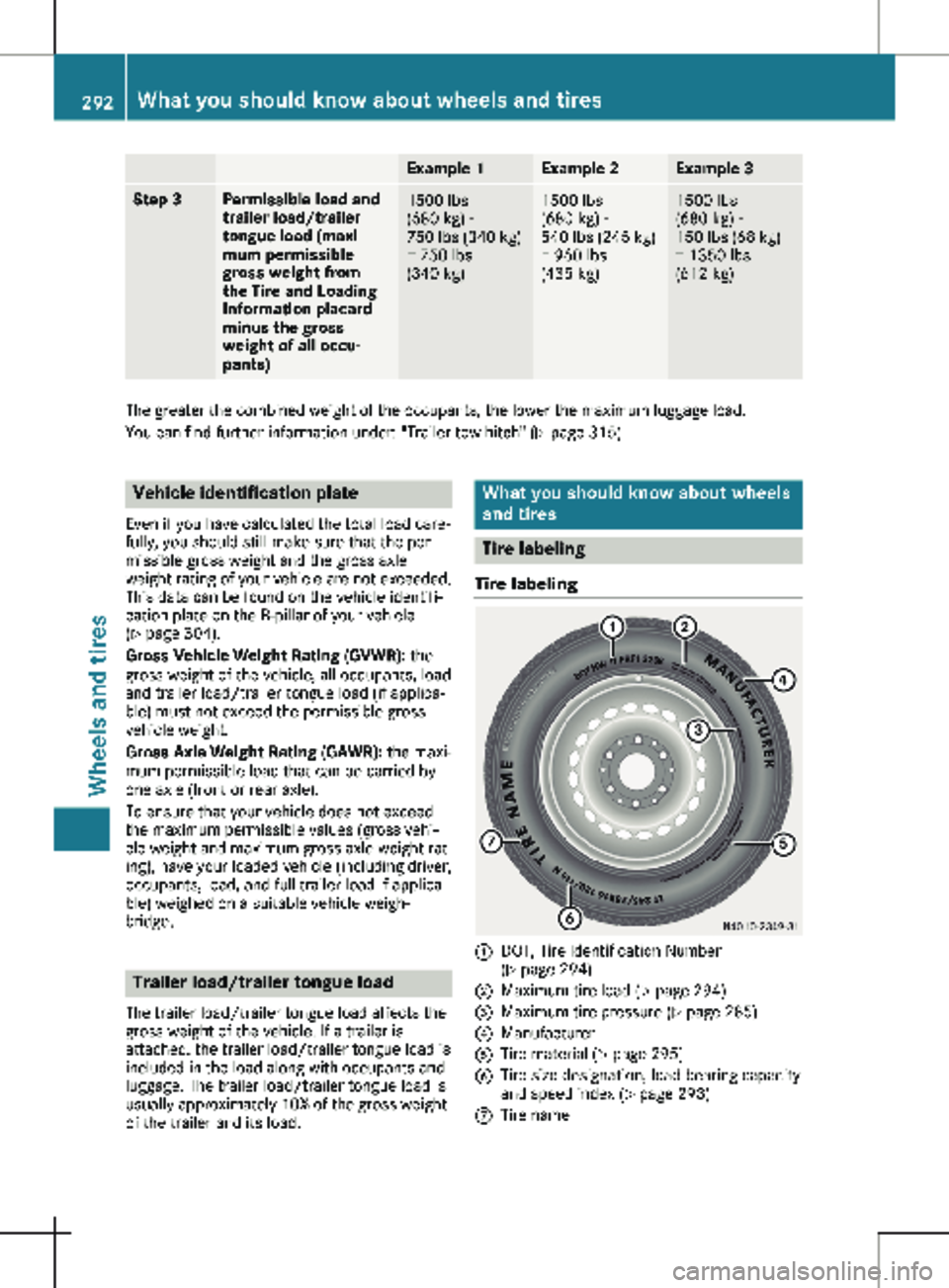
Example 1 Example 2 Example 3
Step 3 Permissible load and
trailer load/trailer
tongue load (maxi-
mum permissible
gross weight from
the Tire and Loading
Information placard
minus the gross
weight of all occu-
pants)
1500 lbs
(680 kg
) Ò
750 lbs (340 kg)
= 750 lbs
(340 kg) 1500 lbs
(680 kg
) Ò
540 lbs (245 kg)
= 960 lbs
(435 kg) 1500 lbs
(680 kg
) Ò
150 lbs (68 kg)
= 1350 lbs
(612 kg) The greater the combined weight of the occupants, the lower the maximum luggage load.
You can find further information under: "Trailer tow hitch"
(Y page 315).Vehicle identification plate
Even if you have calculated the total load care-
fully, you should still make sure that the per-
missible gross weight and the gross axle
weight rating of your vehicle are not exceeded.
This data can be found on the vehicle identifi-
cation plate on the B-pillar of your vehicle
(Y page
304).
Gross Vehicle Weight Rating (GVWR): the
gross weight of the vehicle, all occupants, load
and trailer load/trailer tongue load (if applica-
ble) must not exceed the permissible gross
vehicle weight.
Gross Axle Weight Rating (GAWR): the maxi-
mum permissible load that can be carried by
one axle (front or rear axle).
To ensure that your vehicle does not exceed
the maximum permissible values (gross vehi-
cle weight and maximum gross axle weight rat-
ing), have your loaded vehicle (including driver,
occupants, load, and full trailer load if applica-
ble) weighed on a suitable vehicle weigh-
bridge. Trailer load/trailer tongue load
The trailer load/trailer tongue load affects the
gross weight of the vehicle. If a trailer is
attached, the trailer load/trailer tongue load is
included in the load along with occupants and
luggage. The trailer load/trailer tongue load is
usually approximately
10% of the gross weight
of the trailer and its load. What you should know about wheels
and tires
Tire labeling
Tire labeling :
DOT, Tire Identification Number
(Y page
294)
; Maximum tire load (Y page
294)
= Maximum tire pressure ( Y page
285)
? Manufacturer
A Tire material ( Y page
295)
B Tire size designation, load-bearing capacity
and speed index
(Y page 293)
C Tire name292
What you should know about wheels and tires
Wheels and tires
Page 299 of 320
Tire tread
The part of the tire that comes into contact
with the road.
Tire bead
The tire bead ensures that the tire sits
securely on the wheel. There are several steel
wires in the bead to prevent the tire from com-
ing loose from the wheel rim.
SidewallThe part of the tire between the tread and the
tire bead.
Weight of optional extras The combined weight of those optional extras
that weigh more than the replaced standard
parts and more than 2.3 kg
(5 lbs). These
optional extras, such as high-performance
brakes, a roof rack or a high-performance bat-
tery, are not included in the curb weight and
the weight of the accessories.
TIN (Tire Identification Number) A unique identification number which can be
used by a tire manufacturer to identify tires,
for example for a product recall, and thus iden-
tify the purchasers. The TIN is composed of
the manufacturer identification code, tire size,
tire model code and manufacturing date.
Load bearing index
The load bearing index (also load index) is a
code that contains the maximum load bearing
capacity of a tire.
Traction
Traction is the result of friction between the
tires and the road surface.
TWR (permissible trailer drawbar load)
The TWR is the maximum permissible weight
that may act on the ball coupling of the trailer
tow hitch.
Wear indicator Narrow bars (tread wear bars) that are distrib-
uted over the tire tread. If the tire tread is level
with the bars, the wear limit of á in (1.6 mm)
has been reached. Distribution of the vehicle occupants
The distribution of vehicle occupants over des-
ignated seat positions in a vehicle.
Maximum permissible payload weightNominal load and goods/luggage load plus
68 kg (150 lbs) multiplied by the number of
seats in the vehicle. Changing wheels
Rotating the wheels
! On vehicles equipped with a tire pressure
monitor, electronic components are located
in the wheel.
Tire-mounting tools should not be used near
the valve. This could damage the electronic
components.
Only have tires changed at a qualified spe-
cialist workshop.
Always observe the instructions and safety
notes under "Mounting a wheel"
(Y page
298).
The wear patterns on the front and rear tires
differ, depending on the operating conditions.
Rotate the wheels before a clear wear pattern
has formed on the tires. Front tires typically
wear more on the shoulders and the rear tires
in the center.
If your vehicle's tire configuration allows, you
can rotate the tires according to the intervals
in the tire manufacturer's warranty book in
your vehicle documents. If no warranty book is
available, the tires should be rotated every
3,000 to 6,000 miles (5,000 to 10,000 km) or
earlier if tire wear requires. Do not change the
direction of rotation.
Clean the contact surfaces of the wheel and
the brake disc thoroughly every time a wheel
is rotated. Avoid oily or greasy cleaning
agents.
Check the tire pressure and reactivate the tire
pressure monitor if necessary. Direction of rotation
Tires with a specified direction of rotation have
additional benefits, e.g. if there is a risk of
hydroplaning. You will only gain these benefits
if the correct direction of rotation is observed. Changing wheels
297
Wheels and tires Z
Page 303 of 320

X
Turn the jack back to its out-of-use position.
X Stow the jack and the rest of the tire-
change tool kit in the vehicle again.
X Wheel with hub cap: position the opening
for the tire valve in the hub cap over the tire
valve.
X Push the edge of the hub cap with both
hands against the wheel until it clicks into
place. Make sure the hub cap retaining
catches engage on the steel wheel.
X If included in the vehicle equipment, secure
the faulty wheel in the spare wheel bracket
(Y page
303). Otherwise, transport the
faulty wheel in the cargo compartment.
X Check the tire pressure of the newly moun-
ted wheel and adjust it if necessary.
Observe the recommended tire pressure
( Y page
282).
Vehicles with the tire pressure monitor sys-
tem: all mounted wheels must be equipped
with functioning sensors.
X Retighten the wheel bolts or wheel nuts to
the specified tightening torque after the
vehicle has been driven for
30 miles
(50 km).
When using a wheel/spare wheel with a new
or newly painted wheel rim, have the wheel
bolts/nuts retightened again after approx-
imately
600 to 3,000 miles (1,000 to
5,000 km). Observe the specified tightening
torque. Wheel and tire combinations
General notes
! Retreaded tires are neither tested nor rec-
ommended by Mercedes-Benz, since previ-
ous damage cannot always be detected on
retreaded tires. As a result, Mercedes-Benz
cannot guarantee vehicle safety if retreaded
tires are mounted. Do not mount used tires
if you have no information about their previ-
ous usage.
! For safety reasons, Mercedes-Benz recom-
mends that you only use tires, wheels and accessories which have been approved by
Mercedes-Benz specifically for your vehicle.
These tires have been specially adapted for
use with the driving safety systems, such as
ABS or ESP
®
.
Only use tires, wheels or accessories tested
and approved by Mercedes-Benz. Certain
characteristics, e.g. handling, vehicle noise
emissions or fuel consumption, may other-
wise be adversely affected. In addition,
when driving with a load, tire dimension var-
iations could cause the tires to come into
contact with the bodywork and axle compo-
nents. This could result in damage to the
tires or the vehicle.
Mercedes-Benz accepts no liability for dam-
age resulting from the use of tires, wheels
or accessories other than those tested and
approved.
Further information on wheels, tires and
approved combinations can be obtained
from a qualified specialist workshop.
! Large wheels: the lower the section width
for a certain wheel size, the lower the ride
comfort is on poor road surfaces. Roll com-
fort and suspension comfort are reduced
and the risk of damage to the wheels and
tires as a result of driving over obstacles
increases.
You will find a table with the recommended
tire pressures for various vehicle loads on the
inside of your vehicle's fuel filler flap or under
"Tire pressure tables"
(Y page 289). You can
find further information under "Tire pressure"
( Y page 282).
Check tire pressures regularly and only when
the tires are cold.
Notes on the vehicle equipment – always
equip the vehicle:
R with tires of the same size across an axle
(left/right)
R with the same type of tires on all wheels at
a given time (summer tires, winter tires)
i Not all wheel/tire combinations can be
installed at the factory in all countries. Wheel and tire combinations
301
Wheels and tires Z
Page 305 of 320
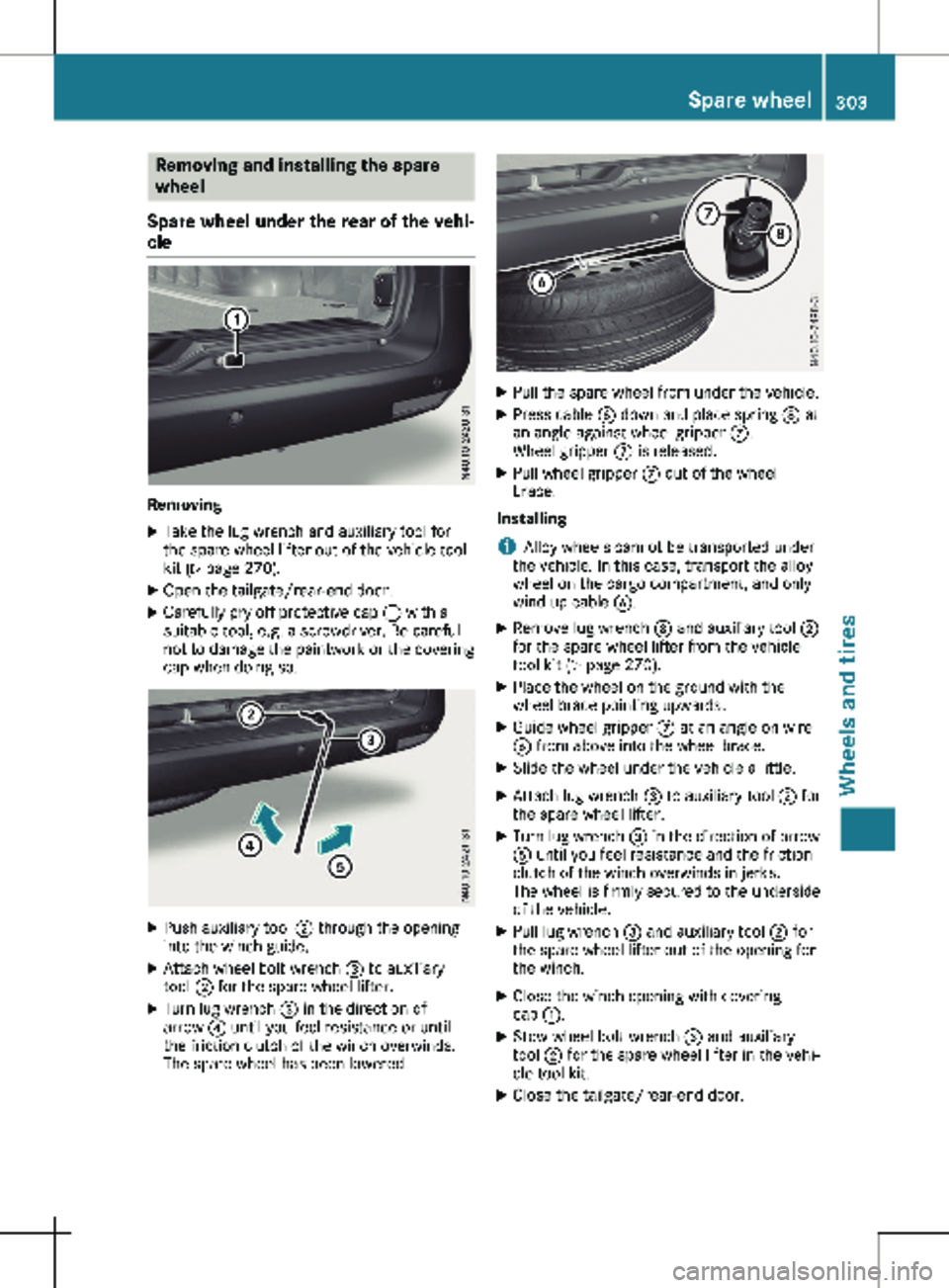
Removing and installing the spare
wheel
Spare wheel under the rear of the vehi-
cle Removing
X Take the lug wrench and auxiliary tool for
the spare wheel lifter out of the vehicle tool
kit
(Y page 270).
X Open the tailgate/rear-end door.
X Carefully pry off protective cap : with a
suitable tool, e.g. a screwdriver. Be careful
not to damage the paintwork or the covering
cap when doing so. X
Push auxiliary tool ; through the opening
into the winch guide.
X Attach wheel bolt wrench = to auxiliary
tool ; for the spare wheel lifter.
X Turn lug wrench = in the direction of
arrow ? until you feel resistance or until
the friction clutch of the winch overwinds.
The spare wheel has been lowered. X
Pull the spare wheel from under the vehicle.
X Press cable B down and place spring D at
an angle against wheel gripper C.
Wheel gripper C is released.
X Pull wheel gripper C out of the wheel
brace.
Installing
i Alloy wheels cannot be transported under
the vehicle. In this case, transport the alloy
wheel on the cargo compartment, and only
wind up cable B.
X Remove lug wrench = and auxiliary tool ;
for the spare wheel lifter from the vehicle
tool kit
(Y page 270).
X Place the wheel on the ground with the
wheel brace pointing upwards.
X Guide wheel gripper C at an angle on wire
B from above into the wheel brace.
X Slide the wheel under the vehicle a little.
X Attach lug wrench = to auxiliary tool ; for
the spare wheel lifter.
X Turn lug wrench = in the direction of arrow
A until you feel resistance and the friction
clutch of the winch overwinds in jerks.
The wheel is firmly secured to the underside
of the vehicle.
X Pull lug wrench = and auxiliary tool ; for
the spare wheel lifter out of the opening for
the winch.
X Close the winch opening with covering
cap :.
X Stow wheel bolt wrench = and auxiliary
tool ; for the spare wheel lifter in the vehi-
cle tool kit.
X Close the tailgate/rear-end door. Spare wheel
303
Wheels and tires Z