ESP MERCEDES-BENZ SPRINTER 2013 MY13 Operator’s Manual
[x] Cancel search | Manufacturer: MERCEDES-BENZ, Model Year: 2013, Model line: SPRINTER, Model: MERCEDES-BENZ SPRINTER 2013Pages: 334, PDF Size: 3.88 MB
Page 46 of 334
Air bags
Important safety notes G
WARNING
To reduce the ris kofinjury when the front air
bags inflate, it is very important for the driver
and co-driver to always be in a properly seated
positio nand to wear thei rrespective seat
belt.
For maximum protection in the event of a
collision always be in normal seated position
with your back against the seat backrest.
Fasten your seat belt and make sure it is
properly positioned on your body.
Since the air bag inflates with considerable
speed and force, a proper seating position
and correct positioning of the hands on the
steering wheel will help to keep you at a safe
distance from the air bag. Occupants who are
not wearing their seat belt, are not seated
properly or are too close to the air bag can be
seriously injured or killed by an air bag as it
inflates with great force instantaneously:
R Sit with the seat belt properly fastened in a
position that is as upright as possible with
your back against the seat backrest.
R Move the driver's seat as far back as
possible, still permitting proper operation
of vehicle controls. The distance from the
center of the driver's chest to the center of
the air bag cover on the steering wheel
must be at least 10 inches (25 cm) or more.
You should be able to accomplish this by
adjusting the seat and steering wheel. If
you have any difficulties, please contact a
qualified specialist workshop.
R Do not lean your head or chest close to the
steering wheel or instrument panel.
R Keep hands on the outside of the steering
wheel rim. Placing hands and arms inside
the rim can increase the risk and potential
severity of hand/arm injury when the driver
front air bag inflates. R
Move the co-driver's seat as far as possible
away from the instrument panel when the
seat is occupied.
R Occupants, especially children, should
never place their bodies or lean their heads
in the area of the door where the side
impact air bag inflates .This could result in
serious injuries or death should the side
impact air bag be deployed. Always sit as
upright as possible, wear the seat belt
properly and use an appropriately sized
infant restraint, toddler restraint, or
booster seat recommended for the size and
weight of the child.
R Children twelve years old and under must
never travel on the co-driver's seat. They
will otherwise be struck by the co-driver's
front air bag when it inflates in a crash. This
could result in serious or fatal injury.
Failure to follow these instructions can result
in severe injuries to you or other occupants.
If you sell your vehicle, it is important that you
make the buyer aware of this safety
information. Be sure to give the buyer this
Operator's Manual. G
WARNING
The air bag parts are hot after the airbag has
been deployed. There is a risk of injury.
Do not touch the air bag parts. Have the
deployed air bags replaced at a qualified
specialist workshop as soon as possible.
i If the vehicle is still in running condition,
have it towed to a qualified specialist
workshop. G
WARNING
If you modify the air bag covers or affix objects
such as stickers to them, the air bags may not
function correctly. There is an increased risk
of injury.
Never modify the air bag covers or affix
objects to them. 44
Occupant safetySafety
Page 47 of 334
The air bag installation locations are
identified by the label SRS/AIRBAG or
AIRBAG.
R
Front air bags (Y page 45)
R Thoraxbags (Y page 45)
R Window curtain air bags (Y page 46)
The air bags are deployed if the air bag control
unit detects the need for deployment. Only in
the event of such a situation will they provide
their supplemental protection.
If the driver and co-driver do not wear their
seat belts, it is not possible for the air bags to
provide their supplemental protection.
In the event of other types of impacts and
impacts below air bag deployment
thresholds, the air bags will not deploy. The
driver and passengers will then be protected
to the exten tpossible by a properly fastened
seat belt. Aproperly fastened seat belti s also
needed to provide the best possible
protection in a rollover.
Air bags provide additional protection, but are
not a substitute for the seat belts. All vehicle
occupants must fasten their seat belts
regardless of whether your vehicle is
equipped with air bags or not.
If an air bag is deployed, you will hear a bang
and a small amount of powder is released
briefly. Only in rare cases will the bang affect
your hearing. The powder emitted is not
generally hazardous to health. The 0008
warning lamp lights up. If it is safe to do so:
X Exit the vehicle immediately.
If you are unable to leave the vehicle:
X Open a window.
You will be able to breathe in fresh air and
avoid respiratory problems.
It is important for your safety and that of any
passengers to have deployed air bags
replaced and to have any malfunctioning air
bags repaired. This will help to make sure the
air bags continue to perform their protective
function for the vehicle occupants in the
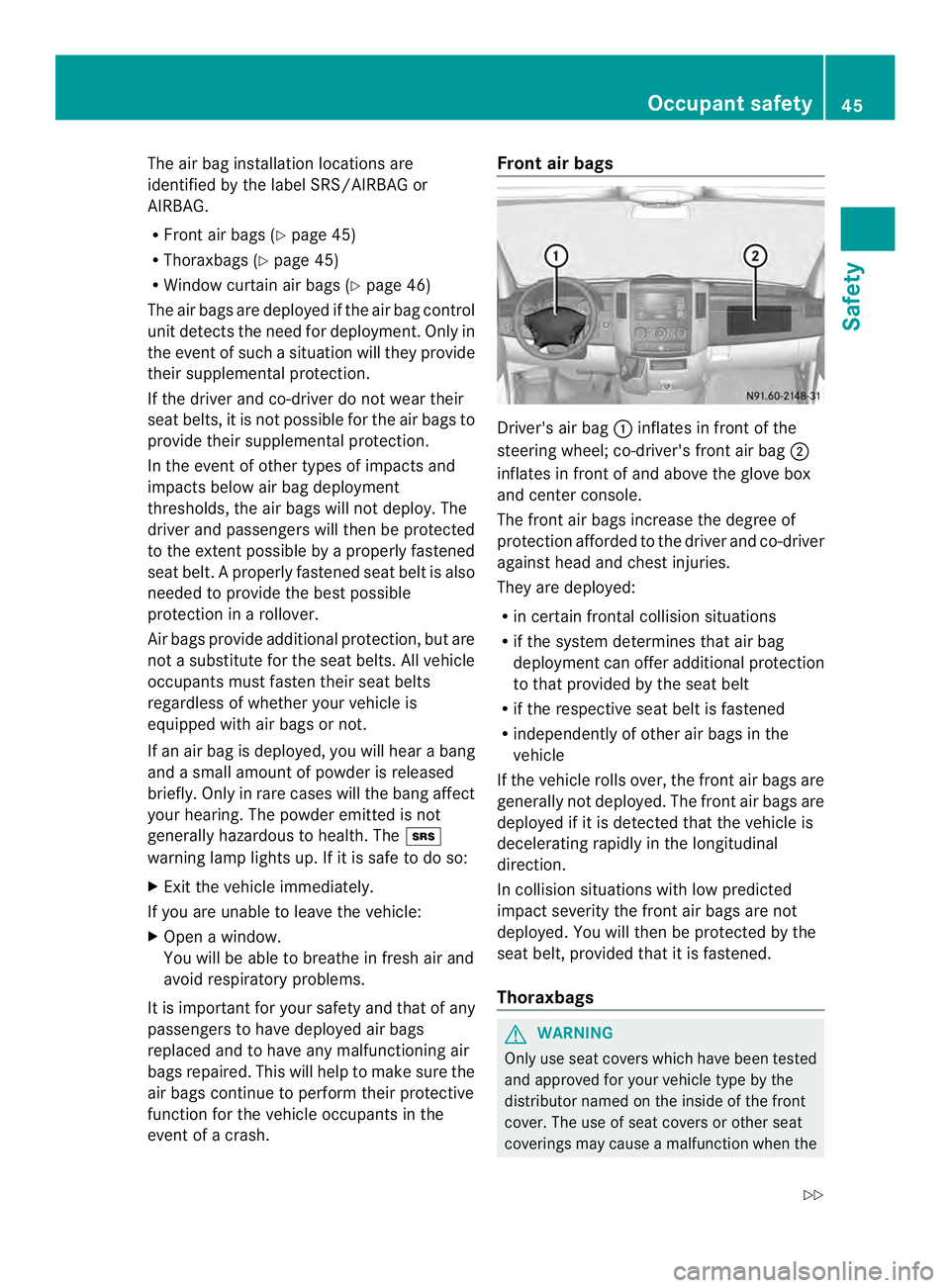
event of a crash. Front air bags
Driver's air bag
0005inflates in front of the
steering wheel; co-driver's front air bag 0006
inflates in front of and above the glove box
and center console.
The front air bags increase the degree of
protection afforded to the driver and co-driver
against head and chest injuries.
They are deployed:
R in certain frontal collision situations
R if the system determines that air bag
deployment can offer additional protection
to that provided by the seat belt
R if the respective seat belt is fastened
R independently of other air bags in the
vehicle
If the vehicle rolls over, the front air bags are
generally not deployed. The front air bags are
deployed if it is detected that the vehicle is
decelerating rapidly in the longitudinal
direction.
In collision situations with low predicted
impact severity the front air bags are not
deployed. You will then be protected by the
seat belt, provided that it is fastened.
Thoraxbags G
WARNING
Only use seat covers which have been tested
and approved for your vehicle type by the
distributor named on the inside of the front
cover. The use of seat covers or other seat
coverings may cause a malfunction when the Occupant safety
45Safety
Z
Page 57 of 334
Child-proof locks for the sliding door/
rear door G
WARNING
If childre nare traveling in the vehicle, they
could:
R open doors, thus endangering other people
or road users
R exit the vehicle and be caught by oncoming
traffic
R operate vehicle equipment and become
trapped
There is a risk of an accident and injury.
Always activate the child-proof locks and
override feature if children are traveling in the
vehicle. When leaving the vehicle, always take
the key with you and lock the vehicle. Never
leave children unattended in the vehicle.
The child-proof locks are in the sliding door
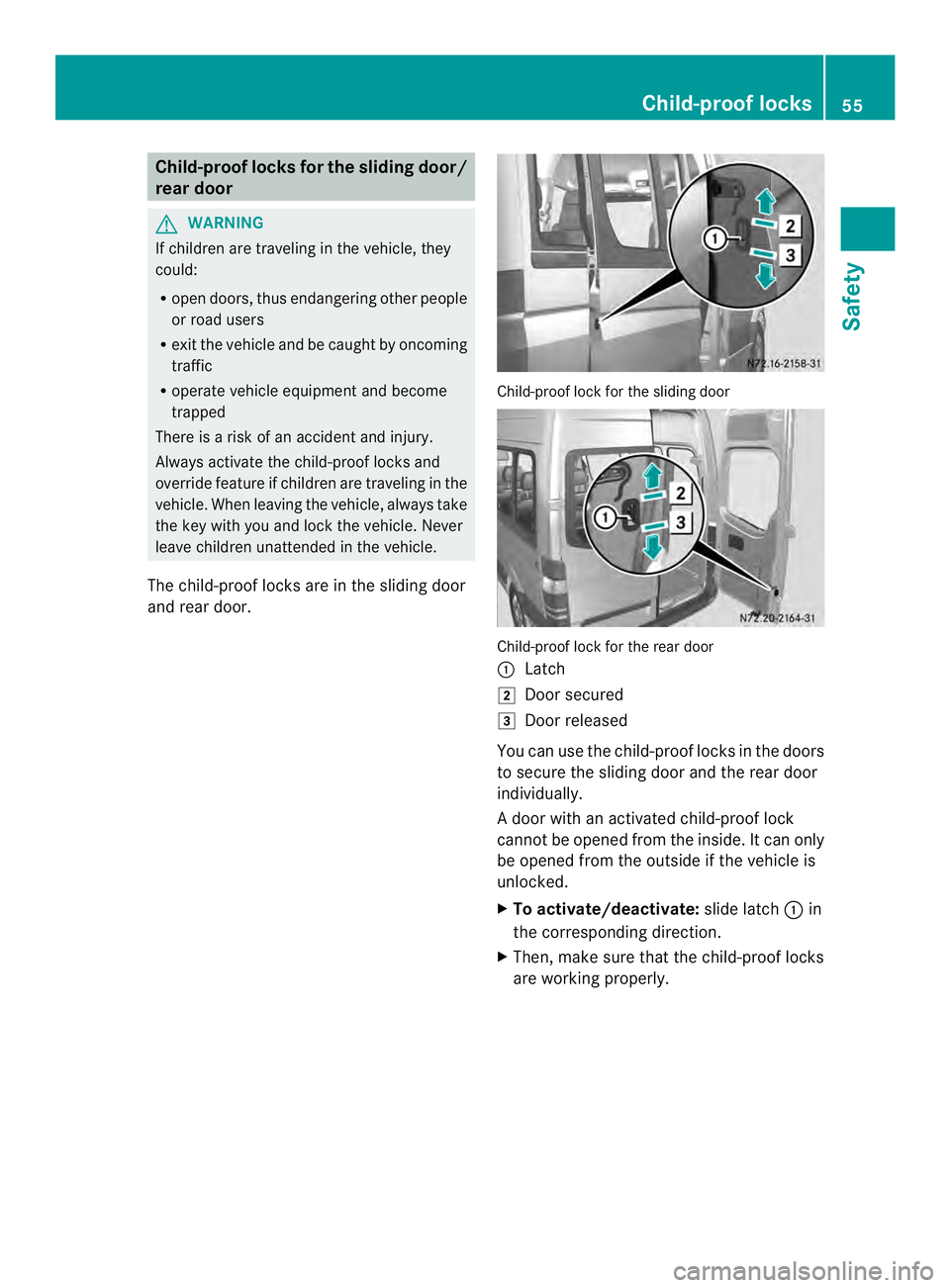
and rear door. Child-proo
flock for the sliding door Child-proof lock for the rear door
0005
Latch
0009 Door secured
000A Door released
You can use the child-proof locks in the doors
to secure the sliding door and the rear door
individually.
Ad oor with an activated child-proof lock
cannot be opened from the inside. It can only
be opened from the outside if the vehicle is
unlocked.
X To activate/deactivate: slide latch0005in
the corresponding direction.
X Then, make sure that the child-proof locks
are working properly. Child-proof locks
55Safety Z
Page 58 of 334
Driving safet
ysystems Driving safety systems overview
In this section, you will find information about
the following driving safety systems:
R ABS ( Anti-lock BrakingSystem)
R BAS ( Brake Assist System)
R ASR (Acceleration SkidControl)
R ESP ®
(Electronic StabilityProgram)
R EBD ( Electronic Brake Force Distribution) Important safety notes
If you fail to adapt yourd riving style or if you
are inattentive, the driving safety systems can
neither reduce the risk of accident nor
override the laws of physics. Driving safety
systems are merely aids designed to assist
driving. You are responsible for the distance
to the vehicle in front, for vehicle speed and
for braking in good time. Always adapt your
driving style to the prevailing road and
weather conditions and maintai nasufficient,
safe distance from other road users. Drive
carefully.
The driving safety systems described can only
attain their maximum effectiveness when
there is optimum contact between the tires
and the road can. Therefore pay special
attention to the information on tires, the
recommended minimum tire tread, etc., in
the "Wheels and tires" section (Y page 274).
In wintry driving conditions, always use winter
tires (M+S tires) and if necessary, snow
chains. Only in this way will the driving safety
systems described in this section work as
effectively as possible. ABS (Anti-lock Braking System)
Important safety notes Note the section on 'Important safety notes'
(Y
page 56). G
WARNING
If ABS is faulty, the wheels could lock when
braking. The steerability and braking
characteristics may be severely impaired.
Additionally, further driving safety systems
are deactivated. There is an increased danger
of skidding and accidents.
Drive on carefully. Have ABS checked
immediately at a qualified specialist
workshop.
If ABS is malfunctioning, other systems will
also fail, including driving safety systems.
Observe the information relating to the 000E
(Y page 210) warning lamp.
ABS regulates brake pressure in such a way
that the wheels do not lock when you brake.
This allows you to continue steering the
vehicle when braking.
ABS acts from a speed of about 5 mph
(8 km/h) upwards, regardless of road surface
conditions. ABS works on slippery surfaces,
even when you only brake gently.
The yellow 000Ewarning lamp in the
instrument cluster lights up when the ignition
is switched on. The lamp goes out when the
engine starts running.
Braking X
If ABS intervenes: continue to depress the
brake pedal with force until the braking
situation is over.
X To make a full brake application:
depress the brake pedal with full force.
If ABS intervenes when braking, you will feel
a pulsating in the brake pedal.
The pulsating brake pedal can be an
indication of hazardous road conditions and
functions as a reminder to take extra care
while driving. BAS (Brake AssistS
ystem)
Note the section on 'Important safety notes'
(Y page 56). 56
Driving safety systemsSafety
Page 59 of 334
G
WARNING
If BAS is malfunctioning, the braking distance
in an emergency braking situation is
increased. There is a risk of an accident.
In an emergency braking situation, depress
the brake pedal with full force. ABS prevents
the wheels from locking.
Vehicles without steering wheel buttons: if
the BAS driving safety system is
malfunctioning, the 000Awarning lamp lights
up while the engine is running (Y page 210).
BAS operates in emergency braking
situations. If you depress the brake quickly,
BAS automatically increases the brake
pressure, thereby reducing the stopping
distance.
The brakes will function as usual once you
release the brake pedal. BAS is deactivated. EBD (electronic brake force
distribution)
Note the section on 'Important safety notes'
(Y page 56). G
WARNING
If EBD has malfunctioned, the rear wheels can
still lock, e.g. under full braking. This
increases the risk of skidding and an accident.
You should therefore adapt yourd riving style
to the different handling characteristics. Have
the brake system checked at a qualified
specialist workshop.
EBD monitors and controls the brake
pressure to the rear wheels. This enables EBD
to improve handling during braking.
Observe the information on warning and
indicator lamps (Y page 210). ESP
®
(Electronic Stability Program)
Note the section on 'Important safety notes'
(Y page 56). G
WARNING
If ESP ®
is malfunctioning it willn ot provide
any vehicle stabilization. There is an increased
risk of skidding or of an accident.
Exercise caution when continuing to drive.
Have ESP ®
checked at a qualified specialist
workshop.
! Only operate the vehicle briefly
(maximum of 10 seconds) on a brake
dynamometer. The key must be turned to
position 1in the ignition lock during this
time. You could otherwise damage the
drive train or the brake system.
! Do not run the vehicle on a roller
dynamometer (e.g. for performance tests).
If you must operate the vehicle on a roller
dynamometer, please consult a qualified
specialist workshop in advance. You could
otherwise damage the drive train or the
brake system.
If you activate or deactivate ESP ®
in a vehicle
with engageable all-wheel drive, ESP ®
will be
deactivated for the duration of the
activation/deactivation process.
If ESP ®
is malfunctioning, the 0002indicator
lamp lights up while the engine is running and
the engine power may be reduced
(Y page 210).
ESP ®
monitors driving stability and detects a
tendency of the vehicle to understeer or
oversteer (skidding) in good time. If ESP ®
detects that the vehicle is deviating from the
direction desired by the driver, one or more
wheels are braked to stabilize the vehicle. The
engine output is also modified to keep the
vehicle on the desired course within physical
limits. ESP ®
greatly assists you when driving
on wet or slippery road surfaces. ESP ®
also
stabilizes the vehicle when braking.
The 000D warning lamp in the instrument
cluster flashes when ESP ®
is intervening. Driving safety systems
57Safety Z
Page 60 of 334
If ESP
®
intervenes:
X Do not deactivate ASR under any
circumstances.
X When driving off, apply as little throttle as
possible.
X Adapt yours peed and driving style to the
prevailing road conditions.
i Only use wheels with the recommended
tire sizes. Only then will ESP ®
function
properly. ASR (acceleration skid control)
General notes Important safety notes
Note the section on 'Important safety notes'
(Y
page 56).
ASR can neither reduce the risk of an accident
nor suspend the laws of physics if the driver
does not pay attention when pulling away or
accelerating. ASR is only an aid. Always adapt
your driving style to suit the prevailing road
and weather conditions.
Vehicles without steering wheel buttons: if
ASR is malfunctioning, the 000Aindicator
lamp lights up while the engine is running and
the engine power may be reduced
(Y page 210).
ASR significantly improves traction, i.e. the
transmission of power from the tires to the
road surface, and thus increases the vehicle's
driving stability. If the driving wheels start to
spin, ASR brakes individual drive wheels and
limits the engine torque. ASR thus
significantly assists you when pulling away
and accelerating, especially on wet or
slippery roads.
If traction on the road surface is not sufficient,
even ASR will not allow you to pull away
without difficulty. The type of tires and total
weight of the vehicle as well as the gradient
of the road also play a crucial role. If ASR intervenes, the
000Dwarning lamp in
the instrument cluster flashes.
Activating/deactivating ASR G
WARNING
If deactivated, ASR will not attempt to
stabilize the vehicle during pulling away and
acceleration. There is an increased risk of
skidding and of an accident.
Only deactivate ASR in the situations
described in the following.
! If you deactivate ASR, ESP ®
will still
intervene to stabilize the vehicle. Frequent
braking automatically triggered by ESP ®
can damage the brake system.
For this reason, deactivate ASR only briefly
and when absolutely necessary. When ESP
®
is intervening and the 000D
warning lamp in the instrument cluster is
flashing, leave ASR on. In this case, only
depress the accelerator pedal as far as
required when pulling away.
X Press the 0006button.
If ASR is deactivated, the 000Dwarning
lamp in the instrument cluster lights up.
ASR is automatically activated when the
engine is started.
It may be best to deactivate ASR briefly in the
following situations:
R when using snow chains
R in deep snow
R on sand or gravel 58
Driving safet
ysystemsSafety
Page 61 of 334
If you deactivate ASR:
R
engine torque is not limited and the drive
wheels are able to spin. The spinning
wheels will then achieve a cutting effect for
better traction.
R traction control remains active through
brake intervention. If a drive wheel attains
its tire traction limitb ecause one side of the
road is slippery, for example, that wheel is
braked. The traction is then increased in
this situation.
R active brake intervention by ESP ®
to
increase driving stability remains active.
The 000D warning lamp in the instrument
cluster flashes when ESP ®
is intervening. Emergency exit
Emergency exit window
G
WARNING
The emergency exit window cannot be locked
in place. You risk injury if you exit the vehicle
through the emergency exit window.
R Make sure that nobody becomes trapped,
both when closing and when opening the
emergency exit window.
R The opened emergency exit window must
be held in place by another person.
Pay attention to traffic conditions. G
WARNING
If the emergency exit window is unlocked
while driving, it could open and slam shut and
consequently fall down. There is a risk of an
accident and injury.
Before starting off, make sure that the
emergency exit window is locked and the
locking pins are undamaged.
! Make sure there is sufficien tclearance
when opening the emergency exit window.
Hold the open window in position. You
could otherwise damage the emergency
exit window. The emergency exit window is intended for
use in an emergency only and must not be
opened unless the vehicle is stationary. The
emergency exit window is the firs
twindow
behind the driver's seat on the driver's side.
It is marked by the "Emergency Exit" label.
X To open: position both handles 0005
vertically. This will break locking pins 0006.
The window is unlocked.
X Swing the window outward by the handles
and hold it in this position. Make sure there
is sufficien tclearance when doing so.
X To close: close the window.
X Position both handles 0005horizontally.
Make sure that the locks 0026are inside in
front of the window frame.
The window is locked.
X Replace locking pins 0006at the lates tbefore
starting on a new journey.
You can obtain information on this at any
qualified specialist workshop.
In an emergency, or after an accident, the
vehicle occupants can exit the vehicle
through the emergency exit window.
Observe the following notes to make sure that
the emergency exit window can be used
safely in the event of an emergency:
R Before beginning a journey, inform the
vehicle occupants of the emergency exit
window and explain how to use it. Make Emergency exit
59Safety Z
Page 66 of 334
Useful information
This Operator's Manual describes all models
as well as standard and optional equipment
of your vehicle that were available at the time
of going to print. Country-specific variations
are possible. Note that your vehicle may not
be equipped with all of the described
functions. This also applies to systems and
functions relevant to safety.
Read the information on qualified specialist
workshops (Y page 26). Key
Important safety notes
G
WARNING
Activate the child-proof door locks if children
are traveling in the vehicle. The children could
otherwise open the doors while the vehicle is
in motion, injuring themselves and others. G
WARNING
Do not leave children unsupervised in the
vehicle, even if they are secured in a child
restraint system .Children could otherwise
injure themselves on parts of the vehicle.
They could be severely or even fatally injured
by prolonged exposure to intense heat or
cold.
If children open a door, they could:
R injure other people
R get out of the vehicle and thereby injure
themselves or be injured by a passing
vehicle
R severely injure themselves by falling down,
in particular due to the vehicle height
Always take the key with you when leaving the
vehicle, even if you are only leaving for a short
time. G
WARNING
If you attach heavy or large objects to the
SmartKey, the SmartKey could be unintentionally turned in the ignition lock. This
could cause the engine to be switched off.
There is a risk of an accident.
Do not attach any heavy or large objects to
the SmartKey. Remove any bulky keyrings
before inserting the SmartKey into the
ignition lock.
Do not keep the key with remote control:
R with electronic devices, e.g. a mobile
phone or another key with remote control
R with metallic objects, e.g. coins or metal
foil
R in metallic objects, e.g. metal cases
This can affect the key's functionality. Key functions of the remote control
General notes The vehicle is equipped with either
2or
4 remote controls with a folding key, or 4
mechanical keys. In this Operator's Manual,
both the mechanical keys and the keys with
remote control are referred to as keys. The
remote control key has a range of up to
32 ft (10 m). Use the remote control of the
key only whe ninimmediate proximity of the
vehicle. This prevents theft.
Remote controls that are not included in the
scope of delivery for the vehicle must be
programmed before use. Further information
can be obtained at any authorized Sprinter
Dealer.
The key's remote control locks/unlocks the
driver's door and/or the following centrally if
the factory settings have not been changed:
R the driver's and the co-driver's door
R the sliding doors
R the rear doors
i If the driver's or co-driver's door is not
closed, the corresponding door is not
locked. If a sliding door or a rear door is not
closed properly, none of the rear doors are
locked. 64
KeyOpening and closing
Page 75 of 334
X
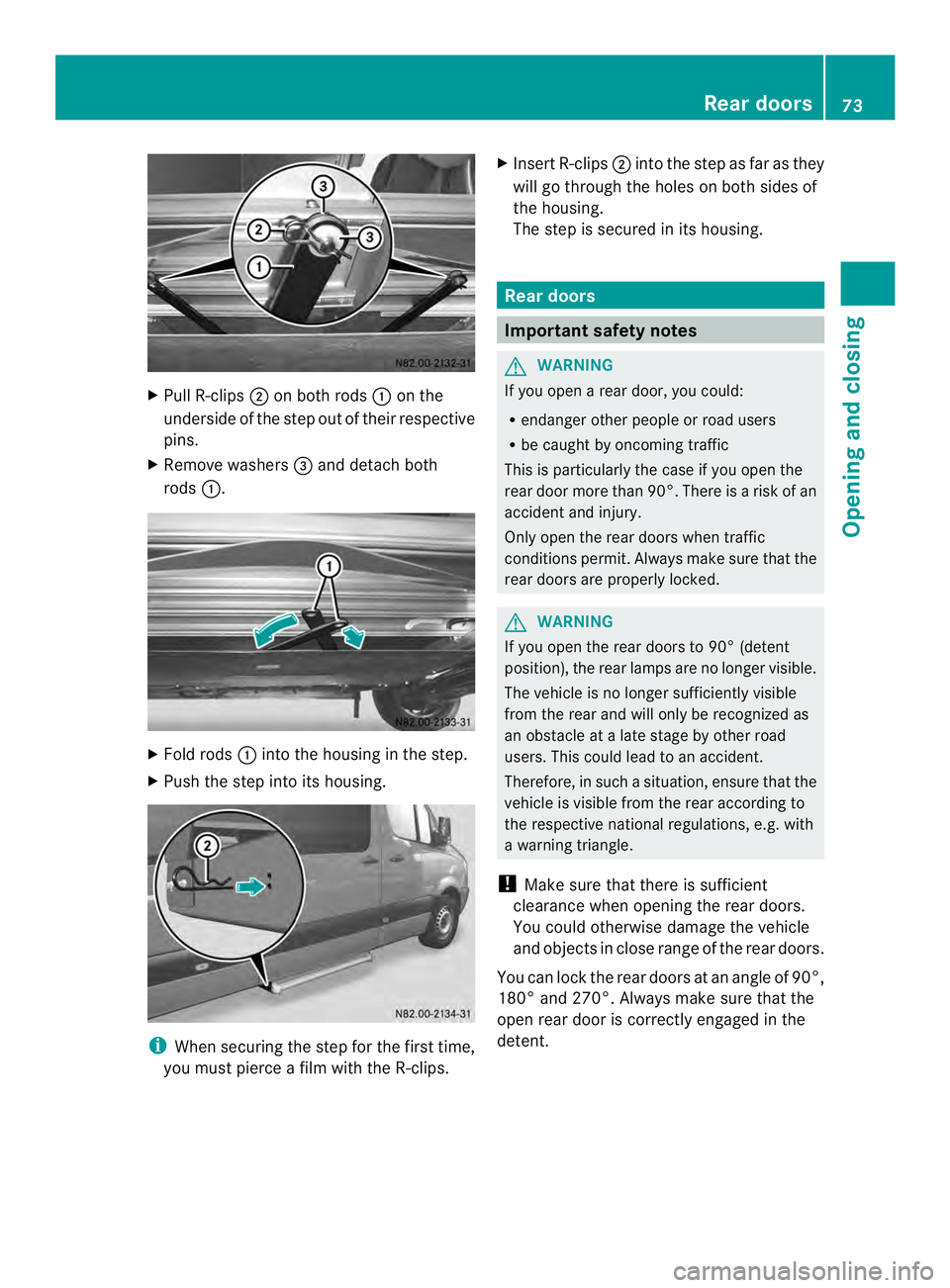
Pull R-clips 0006on both rods 0005on the
underside of the step out of their respective
pins.
X Remove washers 0026and detach both
rods 0005. X
Fold rods 0005into the housing in the step.
X Push the step into its housing. i
When securing the step for the first time,
you must pierce a film with the R-clips. X
Inser tR-clips 0006into the step as fa ras they
will go through the holes on both sides of
the housing.
The step is secured in its housing. Rear doors
Important safety notes
G
WARNING
If you open a rear door, you could:
R endanger other people or road users
R be caught by oncoming traffic
This is particularly the case if you open the
rear door more than 90°. There is a risk of an
accident and injury.
Only open the rear doors when traffic
conditions permit. Always make sure that the
rear doors are properly locked. G
WARNING
If you open the rear doors to 90° (detent
position), the rear lamps are no longer visible.
The vehicle is no longer sufficiently visible
from the rear and will only be recognized as
an obstacle at a late stage by other road
users. This could lead to an accident.
Therefore, in such a situation, ensure that the
vehicle is visible from the rear according to
the respective national regulations, e.g. with
a warning triangle.
! Make sure that there is sufficient
clearance when opening the rear doors.
You could otherwise damage the vehicle
and objects in close range of the rear doors.
You can lock the rear doors at an angle of 90°,
180° and 270°. Always make sure that the
open rear door is correctly engaged in the
detent. Rear doors
73Opening and closing Z
Page 79 of 334
X
Turn the key to position 2in the ignition
lock.
X Press or pull button 0005or0006 until the
corresponding side window has reached
the desired position.
If you press the switch beyond the pressure
point and then release it, the window opens
automatically. To stop the movement, press
or pull the switch again. Resetting the side windows
You must reset the side windows if there has
been a malfunction or an interruption in the
voltage supply.
X Turn the key to position 2in the ignition
lock.
X Pull the two power window switches and
hold for approximately one second after
closing the side window. Problems with the side windows
If you cannot completely open or close a side
window:
If there are no objects or leaves in the window
guide that prevent the sliding sunroof from
closing, there has been a malfunction or the
on-board voltage has been interrupted.
X Reset the side window (Y page 77). Side windows
77Opening and closing Z