change wheel MERCEDES-BENZ SPRINTER 2013 MY13 Operator’s Manual
[x] Cancel search | Manufacturer: MERCEDES-BENZ, Model Year: 2013, Model line: SPRINTER, Model: MERCEDES-BENZ SPRINTER 2013Pages: 334, PDF Size: 3.88 MB
Page 186 of 334
Using the steering wheel buttons
X
Press the 0010or0007 button repeatedly
until the Settings menu appears in the
display.
X Press and hold the 0007reset button for
approximately 3seconds.
You will see a message in the display
prompting you to press reset button 0007
again to confirm.
X Press the 0007reset button again.
The functions in all submenus are reset to
the factory settings.
i If you want to retain the settings, do not
press the 0007reset button a second time.
The Settings menu appears again after
approximately five seconds.
Resetting the functions of asubmenu You can individually reset the functions of
each submenu to the factory settings.
Using the steering wheel buttons
X
Press the 0010or0007 button repeatedly
until the Settings menu appears in the
display.
X Press the 0001button to switch to the
submenu selection.
X Press the 0011or0012 button to select a
submenu.
X Press and hold reset button 0007for
approximately 3seconds.
You will see a message in the display
prompting you to press reset button 0007
again to confirm.
X Press reset button 0007again.
All functions in the submenu are reset to
the factory settings.
i If you want to retain the settings, do not
press reset button 0007a second time. The
Settings menu appears again after
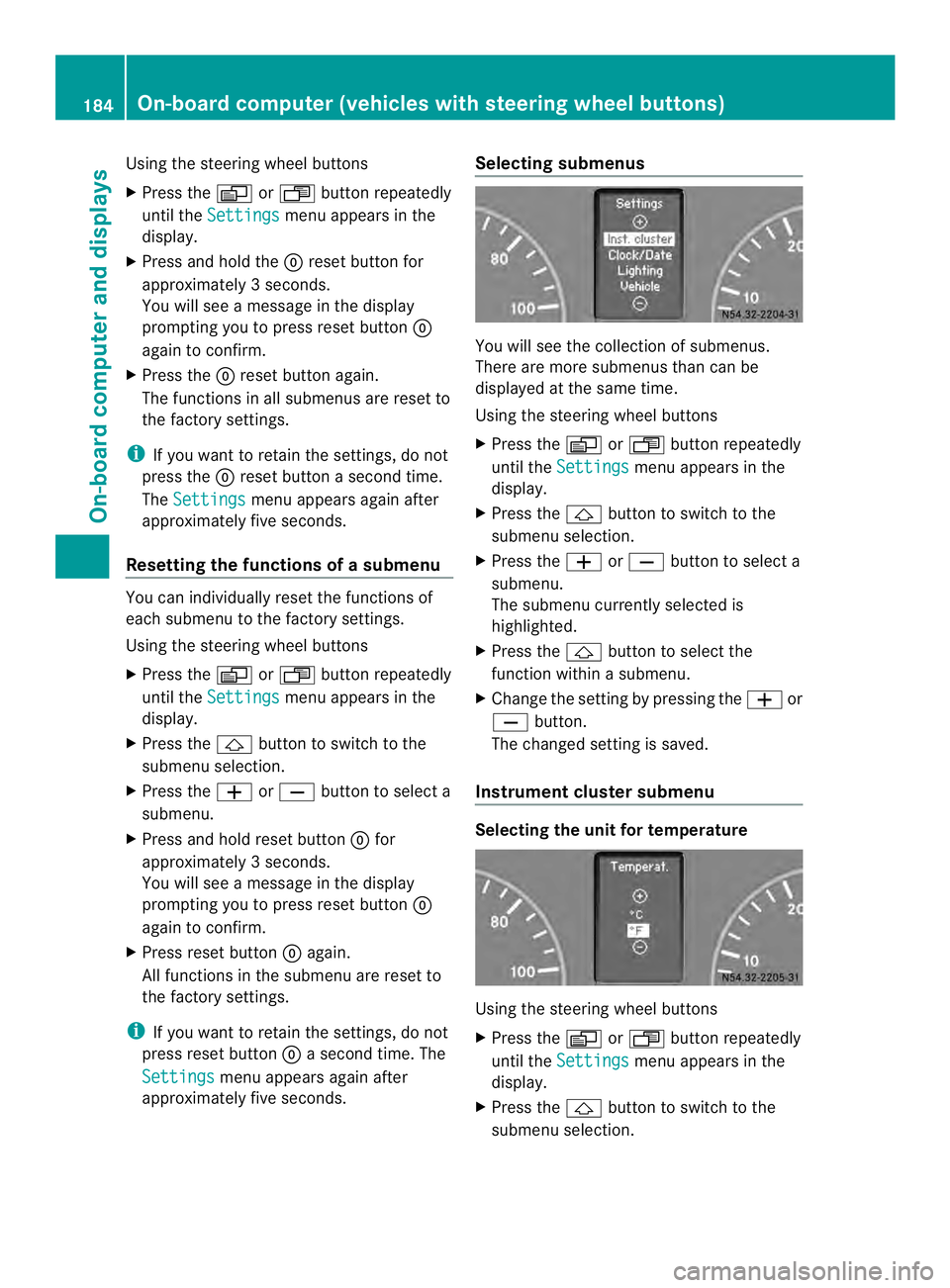
approximately five seconds. Selecting submenus You will see the collection of submenus.
There are more submenus than can be
displayed at the same time.
Using the steering wheel buttons
X Press the 0010or0007 button repeatedly
until the Settings menu appears in the
display.
X Press the 0001button to switch to the
submenu selection.
X Press the 0011or0012 button to select a
submenu.
The submenu currently selected is
highlighted.
X Press the 0001button to select the
function within a submenu.
X Change the setting by pressing the 0011or
0012 button.
The changed setting is saved.
Instrument cluster submenu Selecting the unit for temperature
Using the steering wheel buttons
X
Press the 0010or0007 button repeatedly
until the Settings menu appears in the
display.
X Press the 0001button to switch to the
submenu selection. 184
On-boar
dcomputer (vehicles with steering wheel buttons)On-board computer and displays
Page 189 of 334
Using the steering wheel buttons
X
Press the 0010or0007 button repeatedly
until the Settings menu appears in the
display.
X Press the 0001button to switch to the
submenu selection.
X Press the 0011or0012 button to select the
Clock submenu.
X Press the 0001button to select the
12/24 h function.
The selection marker is on the current
setting.
X Press the 0011or0012 button to select the
12 h or
24 h clock format.
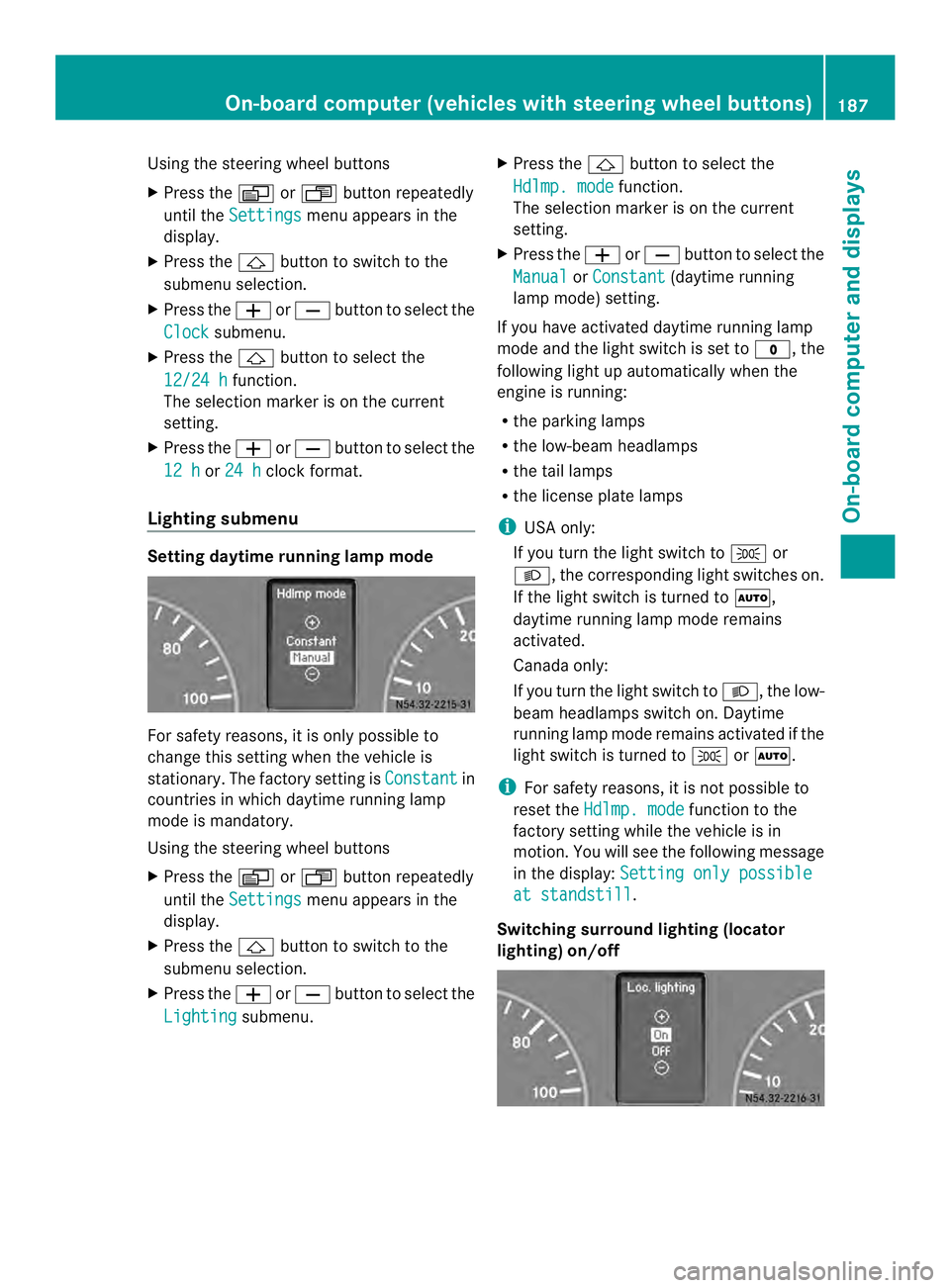
Lighting submenu Setting daytime running lamp mode
For safety reasons, it is only possible to
change this setting when the vehicle is
stationary. The factory setting is
Constant in
countries in which daytime running lamp
mode is mandatory.
Using the steering wheel buttons
X Press the 0010or0007 button repeatedly
until the Settings menu appears in the
display.
X Press the 0001button to switch to the
submenu selection.
X Press the 0011or0012 button to select the
Lighting submenu. X
Press the 0001button to select the
Hdlmp. mode function.
The selection marker is on the current
setting.
X Press the 0011or0012 button to select the
Manual or
Constant (daytime running
lamp mode) setting.
If you have activated daytime running lamp
mode and the light switch is set to 000C, the
following light up automaticallyw hen the
engine is running:
R the parking lamps
R the low-beam headlamps
R the tail lamps
R the license plate lamps
i USA only:
If you turn the light switch to 000Bor
0004, the corresponding light switches on.
If the light switch is turned to 0007,
daytime running lamp mode remains
activated.
Canada only:
If you turn the light switch to 0004, the low-
beam headlamps switch on. Daytime
running lamp mode remains activated if the
light switch is turned to 000Bor0007.
i For safety reasons, it is not possible to
reset the Hdlmp. mode function to the
factory setting while the vehicle is in
motion. You will see the following message
in the display: Setting only possible at standstill .
Switching surround lighting (locator
lighting) on/off On-board computer (vehicles with steering wheel buttons)
187On-board computer and displays Z
Page 190 of 334
Using the steering wheel buttons
X
Press the 0010or0007 button repeatedly
until the Settings menu appears in the
display.
X Press the 0001button to switch to the
submenu selection.
X Press the 0011or0012 button to select the
Lighting submenu.
X Press the 0001button to select the Loc.lighting function.
The selection marker is on the current
setting.
X Press the 0011or0012 button to switch
the surround lighting (locator lighting) On or
Off .
If you switch the surround lighting to On , the
following lamps light up in the dark after you
have unlocked the vehicle using the key:
R the parking lamps
R the tail lamps
R the license plate lamps
R the fog lamps
The surround lighting automatically switches
off after 40 seconds or when you:
R open the driver's door
R insert the key into the ignition lock
R lock the vehicle using the key
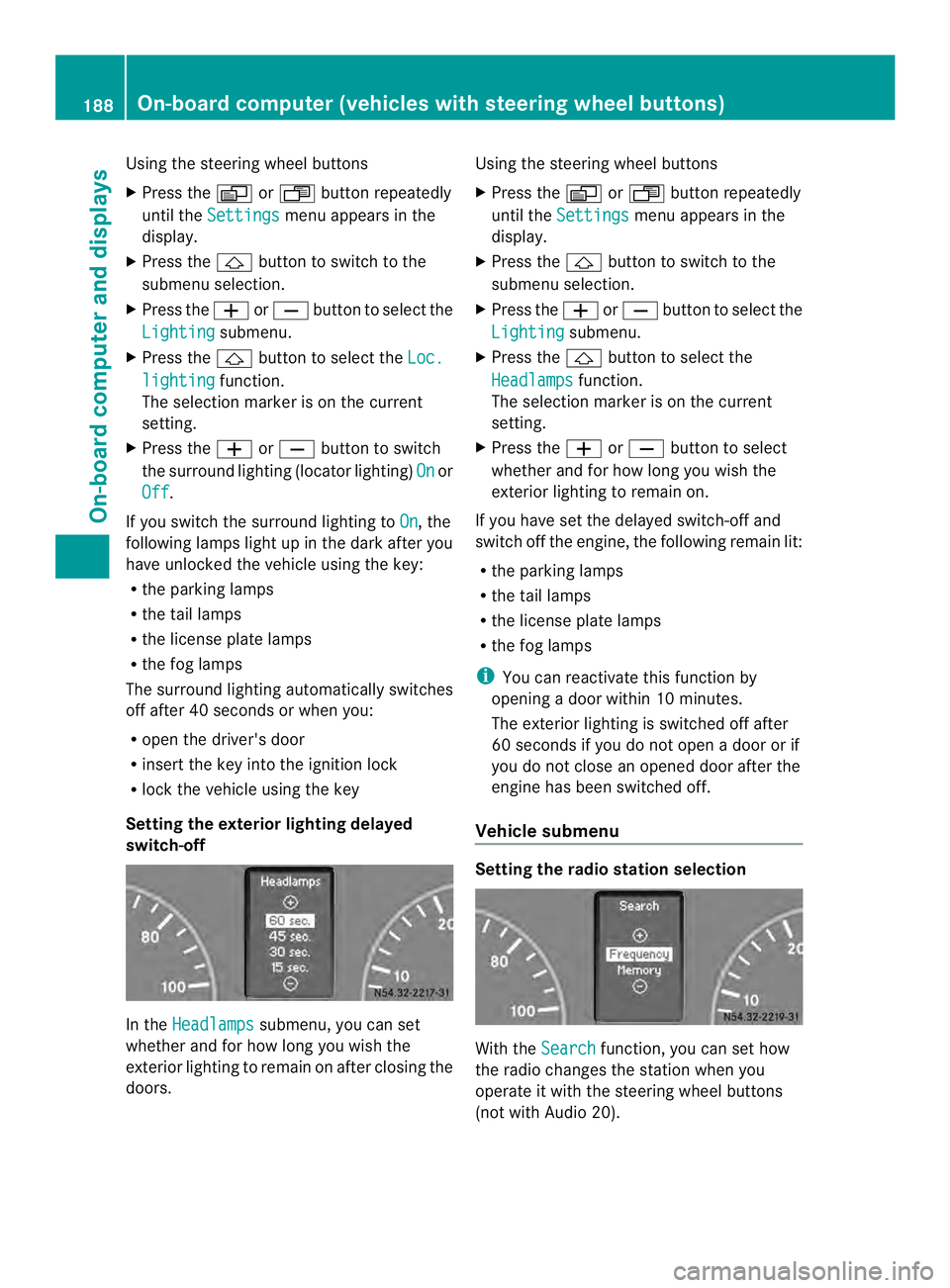
Setting the exterior lighting delayed
switch-off In the
Headlamps submenu, you can set
whether and for how long you wish the
exterior lighting to remain on after closing the
doors. Using the steering wheel buttons
X
Press the 0010or0007 button repeatedly
until the Settings menu appears in the
display.
X Press the 0001button to switch to the
submenu selection.
X Press the 0011or0012 button to select the
Lighting submenu.
X Press the 0001button to select the
Headlamps function.
The selection marker is on the current
setting.
X Press the 0011or0012 button to select
whether and for how long you wish the
exterior lighting to remain on.
If you have set the delayed switch-off and
switch off the engine, the following remain lit:
R the parking lamps
R the tail lamps
R the license plate lamps
R the fog lamps
i You can reactivate this function by
opening a door within 10 minutes.
The exterior lighting is switched off after
60 seconds if you do not open a door or if
you do not close an opened door after the
engine has been switched off.
Vehicle submenu Setting the radio station selection
With the
Search function, you can set how
the radio changes the station when you
operate it with the steering wheel buttons
(not with Audio 20). 188
On-board computer (vehicles with steering wheel buttons)On-board computer and displays
Page 210 of 334
Display messages Possible causes/consequences and
0004 Solutions
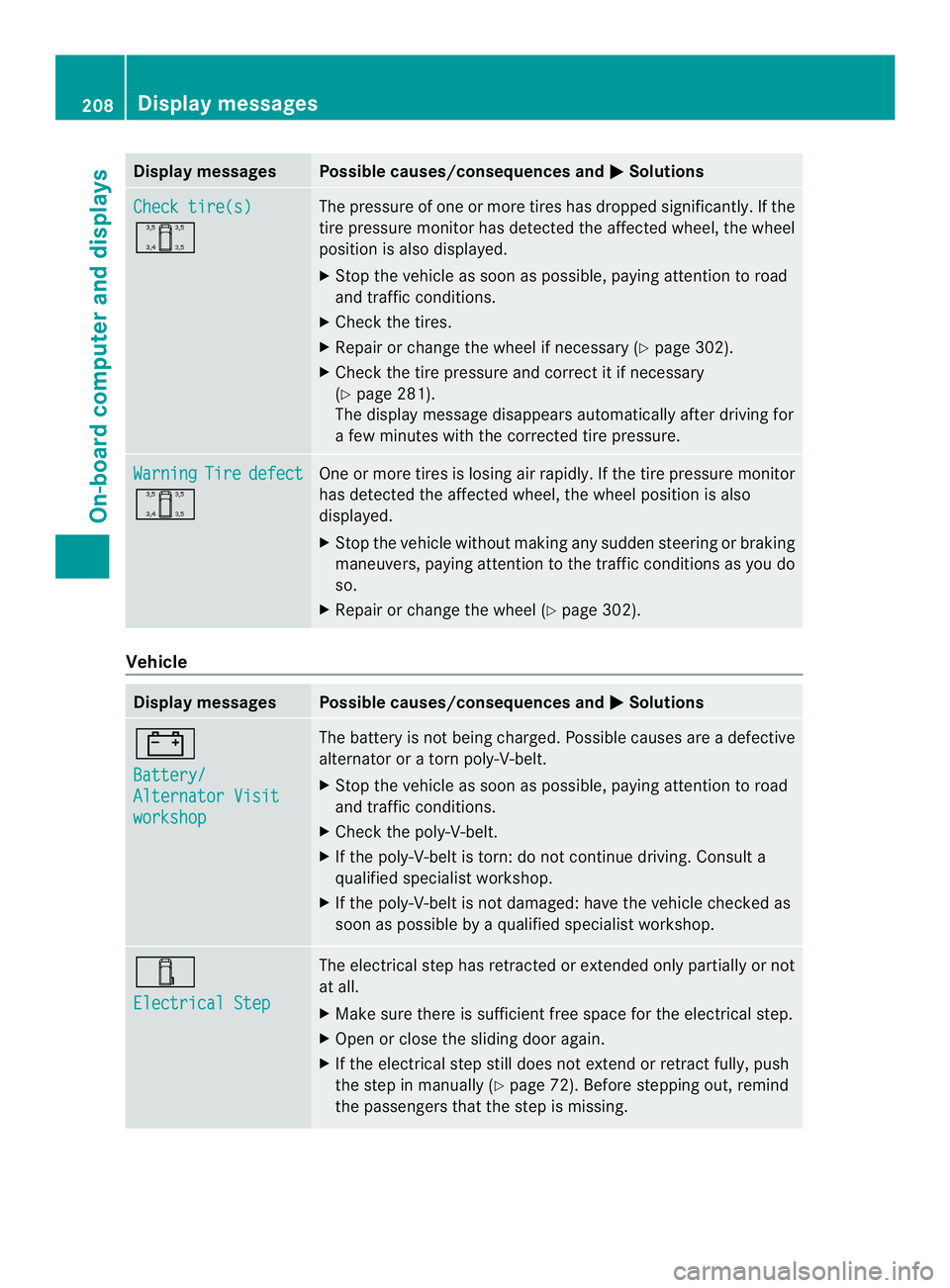
Check tire(s)
0001 The pressure of one or more tires has dropped significantly. If the
tire pressure monitor has detected the affected wheel, the wheel
position is also displayed.
X
Stop the vehicle as soo naspossible, paying attention to road
and traffic conditions.
X Check the tires.
X Repairorc hange the wheel if necessary (Y page 302).
X Check the tire pressure and correct it if necessary
(Y page 281).
The display message disappears automatically after driving for
a few minutes with the corrected tire pressure. Warning Tire defect
0001 One or more tires is losing air rapidly.Ift
he tire pressure monitor
has detected the affected wheel, the wheel position is also
displayed.
X Stop the vehicle without making any sudden steering or braking
maneuvers, paying attention to the traffic conditions as you do
so.
X Repair or change the wheel (Y page 302).Vehicle
Display messages Possible causes/consequences and
0004 Solutions
0010
Battery/
Alternator Visit
workshop The battery is not being charged. Possible causes are a defective
alternator or a torn poly-V-belt.
X
Stop the vehicle as soon as possible, paying attention to road
and traffic conditions.
X Check the poly-V-belt.
X If the poly-V-belt is torn: do not continue driving. Consult a
qualified specialist workshop.
X If the poly-V-belt is not damaged: have the vehicle checked as
soon as possible by a qualified specialist workshop. 0001
Electrical Step The electrical step has retracted or extended only partially or not
at all.
X
Make sure there is sufficient free space for the electrical step.
X Open or close the sliding door again.
X If the electrical step still does not extend or retract fully, push
the step in manually (Y page 72). Before stepping out, remind
the passengers that the step is missing. 208
Display messagesOn-board computer and displays
Page 213 of 334
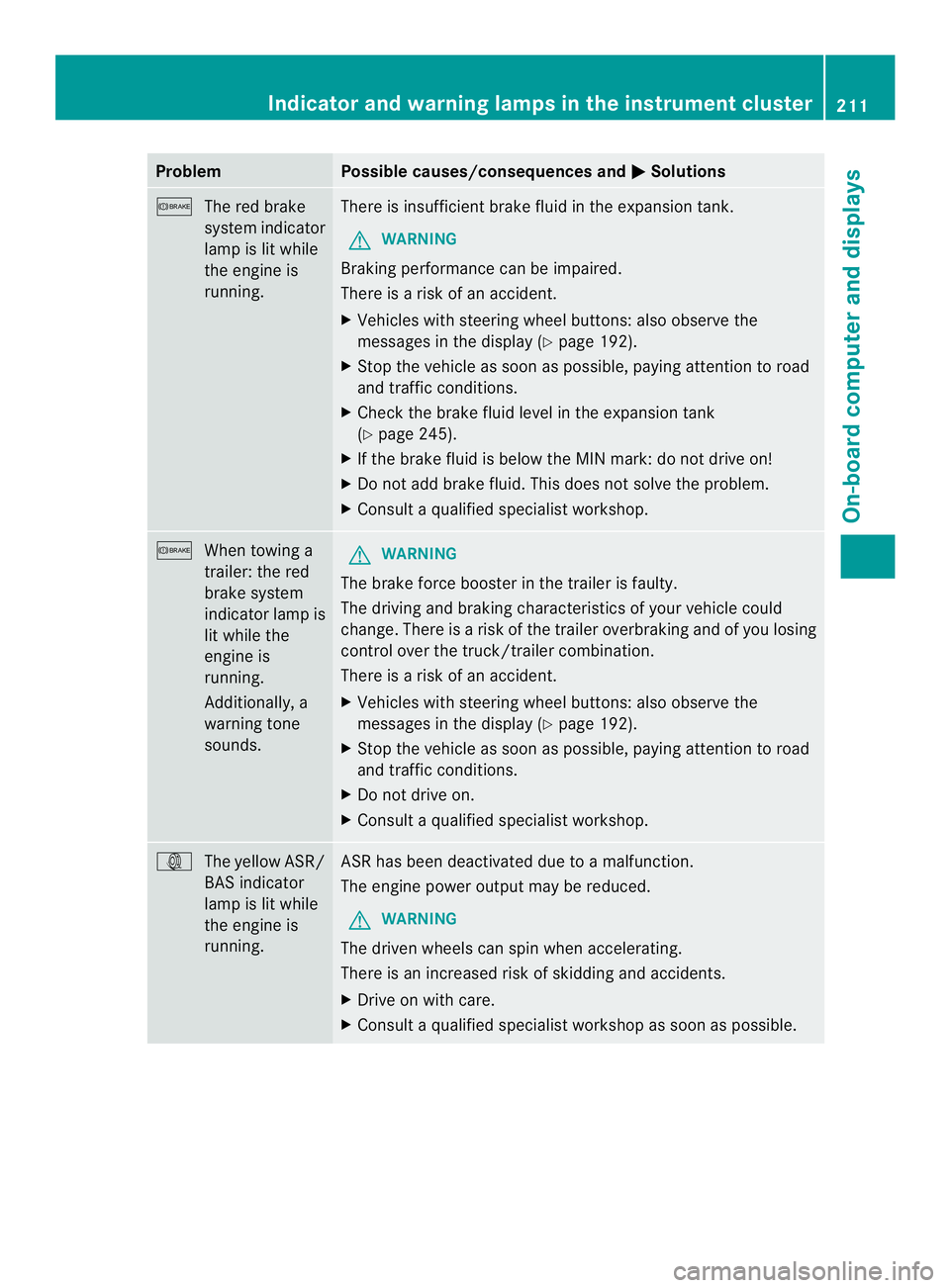
Problem Possible causes/consequences and
0004 Solutions
0008
The red brake
system indicator
lamp is lit while
the engine is
running. There is insufficient brake fluid in the expansion tank.
G WARNING
Braking performance can be impaired.
There is a risk of an accident.
X Vehicles with steering wheel buttons:a lso observe the
messages in the display (Y page 192).
X Stop the vehicle as soon as possible, paying attention to road
and traffic conditions.
X Check the brake fluid level in the expansion tank
(Y page 245).
X If the brake fluid is below the MIN mark: do not drive on!
X Do not add brake fluid. This does not solve the problem.
X Consult a qualified specialist workshop. 0008
When towing a
trailer: the red
brake system
indicator lamp is
lit while the
engine is
running.
Additionally, a
warning tone
sounds. G
WARNING
The brake force booster in the trailer is faulty.
The driving and braking characteristics of your vehicle could
change. There is a risk of the trailer overbraking and of you losing
control over the truck/trailer combination.
There is a risk of an accident.
X Vehicles with steering wheel buttons :also observe the
messages in the display (Y page 192).
X Stop the vehicle as soon as possible, paying attention to road
and traffic conditions.
X Do not drive on.
X Consult a qualified specialist workshop. 000A
The yellow ASR/
BAS indicator
lamp is lit while
the engine is
running. ASR has been deactivated due to a malfunction.
The engine power output may be reduced.
G WARNING
The drive nwheels can spin when accelerating.
There is an increased risk of skidding and accidents.
X Drive on with care.
X Consult a qualified specialist workshop as soon as possible. Indicator and warning lamps in the instrument cluster
211On-board computer and displays Z
Page 234 of 334
Useful information
This Operator's Manual describes all models
as well as standard and optional equipment
of your vehicle that were available at the time
of going to print. Country-specific variations
are possible. Note that your vehicle may not
be equipped with all of the described
functions. This also applies to systems and
functions relevant to safety.
Read the information on qualified specialist
workshops (Y page 26). Loading guidelines
Important safety notes
G
WARNING
As a result of improperly placed or unevenly
distributed loads, the center of gravity of the
load being transported may be too high or too
far back. This can significantly impair handling
as well as steering and braking
characteristics. There is a risk of an accident.
Always make sure that the center of gravity of
the load is:
R between the axles
and
R as low as possible, near the rear axle. G
WARNING
When objects are unsecured or inadequately
secured, they can slip, turn over or be thrown
about, striking vehicle occupants .This also
applies to:
R luggage or loads
R a rear bench seat which has been removed
and is being transported in the vehicle in an
exceptional case.
There is a risk of injury, particularly in the
event of braking maneuvers or abrupt
changes in direction.
Always stow objects in such a way that they
cannot be tossed about. Before traveling,
secure objects, luggage or loads to prevent them slipping or tipping over. If you remove a
rear bench seat, it is advisable to store it
outside the vehicle. G
WARNING
When the permissible wheel loads, axle loads
and/or the maximum permissible gross
vehicle weight are exceeded, driving safety is
compromised. The handling as well as
steering and braking characteristics may be
significantly impaired. Overloaded tires may
overheat, causing them to burst. There is a
risk of an accident.
When transporting a load, always observe the
permissible wheel loads, axle loads and the
maximum permissible gross vehicle weight
for the vehicle (including occupants). G
WARNING
When you load the roof, the center of gravity
of the vehicle rises and the driving
characteristics change. If you exceed the
maximum roof load, the driving
characteristics, as well as steering and
braking, will be greatly impaired. There is a
risk of an accident.
Never exceed the maximum roof load and
adjust your driving style.
! If you are using a roof carrier, observe the
maximum roof load and maximum roof
carrier load.
You will find information about the maximum
roof load in the "Technical data" section
(Y page 327) and information about roof
carriers in the "Carrier systems" section
(Y page 236).
R Do not stack luggage or loads higher than
the backrests.
R Objects to be transported should
preferably be stowed in the cargo
compartment. 232
Loading guidelinesTransporting loads
Page 266 of 334
Useful information
This Operator's Manual describes all models
as well as standard and optional equipment
of your vehicle that were available at the time
of going to print. Country-specific variations
are possible. Note that your vehicle may not
be equipped with all of the described
functions. This also applies to systems and
functions relevant to safety.
Read the information on qualified specialist
workshops (Y page 26). Where will I find...?
Vehicle tool kit
General notes The vehicle tool kit is in the stowage
compartment in the footwell on the co-
driver's side. For vehicles without a spare
wheel, the Premium tire sealant and the tire
inflation compressor are in the stowage
compartment in the right-hand door sill.
The vehicle tool kit consists of:
R a towing eye
R a lug wrench
R 2o pen-end wrenches
R a screwdriver with Torx ,Phillips and slotted
bits
i Vehicles without a spare wheel are not
equipped with the tools needed to change
a wheel when they leave the factory, e.g. a
jack. In the event of a flat tire, these
vehicles are equipped with a tire sealant
and a tire inflation compressor. Country-
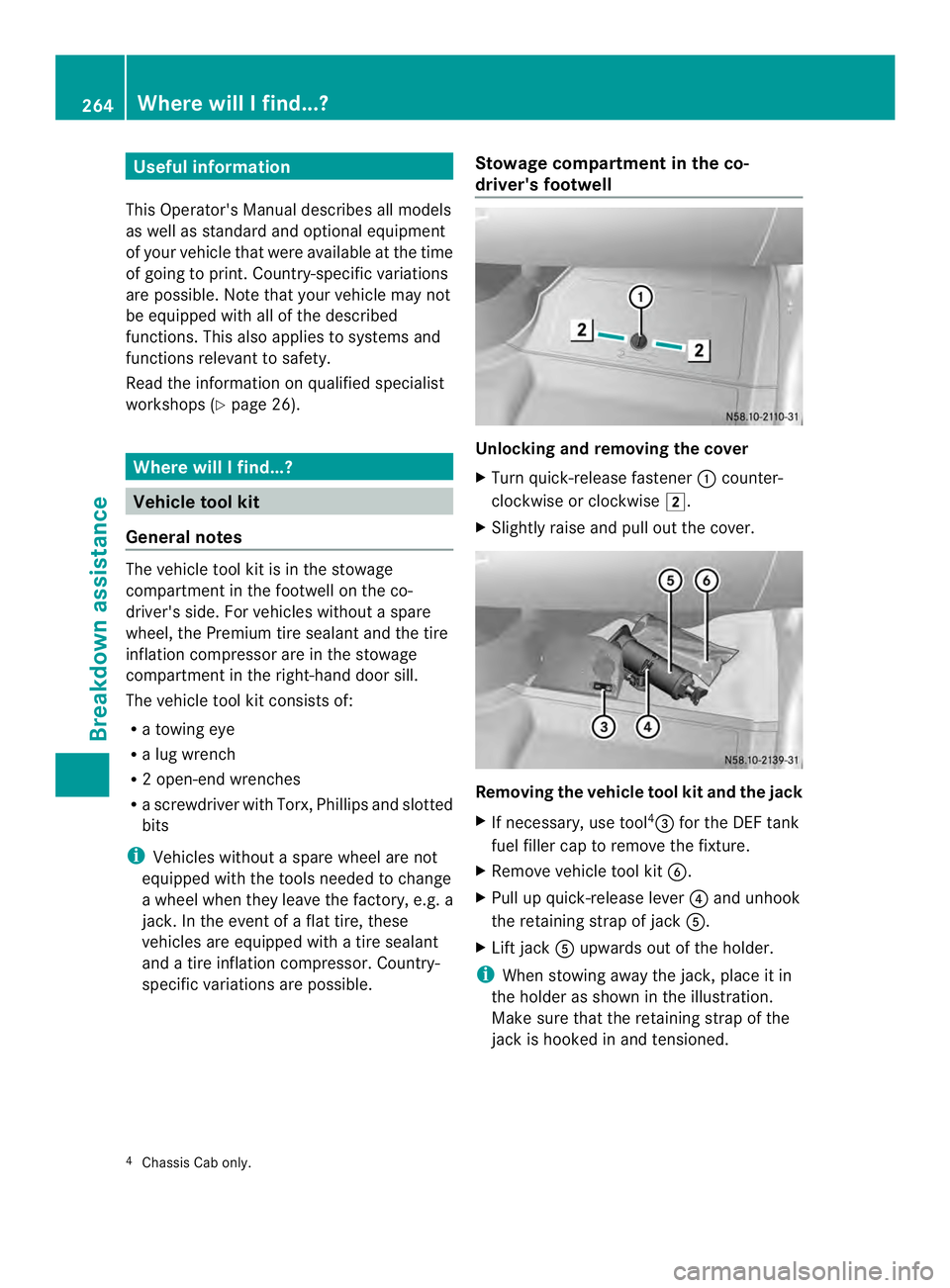
specific variations are possible. Stowage compartment in the co-
driver's footwell Unlocking and removing the cover
X
Turn quick-release fastener 0005counter-
clockwise or clockwise 0009.
X Slightly raise and pull out the cover. Removing the vehicle tool kit and the jack
X
If necessary, use tool 4
0026 for the DEF tank
fuel filler cap to remove the fixture.
X Remove vehicle tool kit 0024.
X Pull up quick-release lever 0025and unhook
the retaining strap of jack 0023.
X Lift jack 0023upwards out of the holder.
i When stowing away the jack, place it in
the holder as shown in the illustration.
Make sure that the retaining strap of the
jack is hooked in and tensioned.
4 Chassis Cab only. 264
Where will I find...?Breakdown assistance
Page 278 of 334
case, the tire is so worn that it mus
tbe
replaced. Selecting, mounting and renewing
tires
R Only mount tires and wheels of the same
type and make.
R Only mount tires of the correct size onto
the wheels.
R Break in new tires at moderate speeds for
the first 65 miles (100 km).
R Do not drive with tires which have too little
tread depth, as this significantly reduces
the traction on wet roads (hydroplaning).
R Replace the tires after 6years at the latest,
regardless of wear. This also applies to the
spare wheel. Operation in winter
General notes
Have your vehicle winterproofed at a qualified
specialist workshop at the onset of winter.
Prior to the onset of winter, ensure that snow
chains are stowed in the vehicle
(Y page 277).
Observe the notes in the "Changing a wheel"
section (Y page 302). Driving with summer tires
At temperatures below 45 ‡(+7 †), summer
tires lose elasticity and therefore traction and
braking power. Change the tires on your
vehicle to M+S tire. Using summer tires at
very cold temperatures could cause tears to
form, thereby damaging the tires
permanently. We cannot accept
responsibility for this type of damage. M+S tires
G
WARNING
Wheel and tire dimensions as well as the type
of tire can vary between the spare wheel and
the wheel to be replaced .When the spare
wheel is installed, driving characteristics may
be severely affected. There is a risk of an
accident.
In order to reduce risks:
R you should therefore adapt your driving
style and drive carefully.
R never install more than one spare wheel
that differs from the wheel to be replaced.
R only use a spare wheel that differs from the
wheel to be replaced for a short time.
R do not deactivate ESP ®
.
R have a spare wheel that differs from the
wheel that has been changed replaced at
the nearest qualified specialist workshop.
You must observe the correct wheel and
tire dimensions as well as the wheel type. G
WARNING
M+S tires with a tire tread depth of less than
000D in (4 mm) are not suitable for use in winter
and do not provide sufficient traction. There
is a risk of an accident.
M+S tires with a tread depth of less than 000D
in (4 mm) must be replaced immediately.
At temperatures below 45 ‡ (+7 †), use
winter tires or all-season tires. Both types of
tire are identified by the M+S marking.
Only winter tires bearing the 0003snowflake
symbol in addition to the M+S marking
provide the best possible grip in wintry road
conditions.
Only these tires will allow driving safety
systems such as ABS and ESP ®
to function
optimally in winter. These tires have been
developed specifically for driving in snow.
For safe driving, use M+S tires of the same
make and tread pattern on all wheels. 276
Operation in winterWheels and tires
Page 280 of 334
Tire pressure
Tire pressure specifications
Important safety notes G
WARNING
Underinflated or overinflated tires pose the
following risks:
R the tires may burst, especially as the load
and vehicle speed increase.
R the tires may wear excessively and/or
unevenly, which may greatly impai rtire
traction.
R the driving characteristics, as well as
steering and braking, may be greatly
impaired.
There is a risk of an accident.
Follow recommended tire inflation pressures
and chec kthe pressure of all the tires
including the spare wheel:
R monthly, at least
R if the load changes
R before beginning a long journey
R under different operating conditions, e.g.
off-road driving
If necessary, correct the tire pressure.
i The specifications shown on the sample
Tire and Loading Information placard and
tire pressure table are examples. Tire
pressure data are vehicle-specific and may
deviate from the data illustrated here. The
tire pressure data applicable to your
vehicle can be found on the Tire &Loading
Information placard or tire pressure plate
of your vehicle. H
Environmental note
Check the tire pressure regularly, at least
every 14 days. General notes You will find information on tire pressure for
the vehicle's factory-mounted tires on the
plates described here.
You will find a table of recommended tire
pressures on the Tire and Loading
Information placard
5
or on the tire pressure
table on the B-pillar on the driver's side of the
vehicle.
Further information on tire pressure can be
obtained at a qualified specialist workshop.
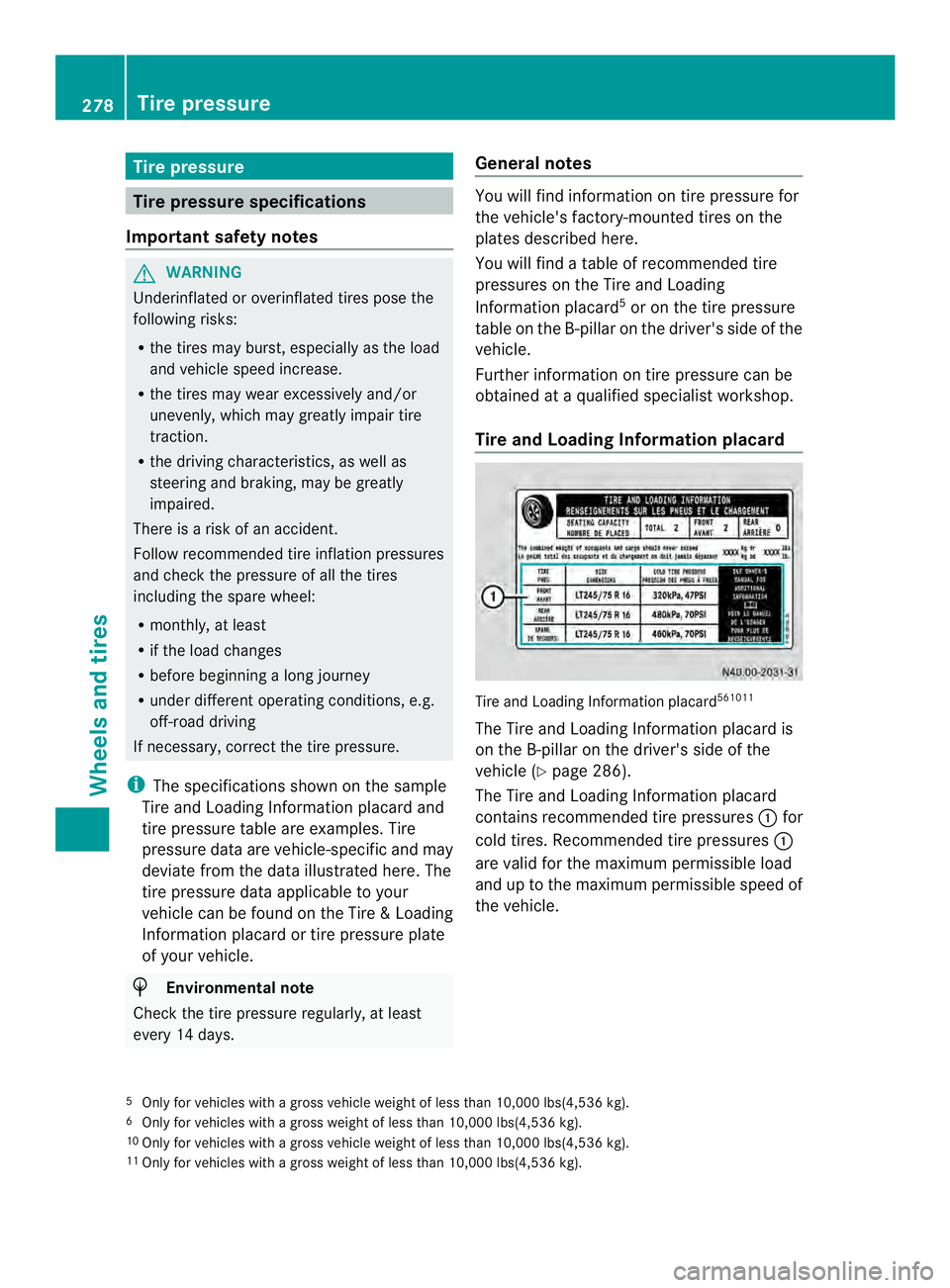
Tire and Loading Information placard Tire and Loading Information placard
561011
The Tire and Loading Information placard is
on the B-pillar on the driver's side of the
vehicle (Y page 286).
The Tire and Loading Information placard
contains recommended tire pressures 0005for
cold tires. Recommended tire pressures 0005
are valid for the maximum permissible load
and up to the maximum permissible speed of
the vehicle.
5 Only for vehicles with a gross vehicle weight of less than 10,000 lbs(4,536 kg).
6 Only for vehicles with a gross weight of less than 10,000 lbs(4,536 kg).
10 Only for vehicles with a gross vehicle weight of less than 10,000 lbs(4,536 kg).
11 Only for vehicles with a gross weight of less than 10,000 lbs(4,536 kg). 278
Tire pressureWheels and tires
Page 281 of 334
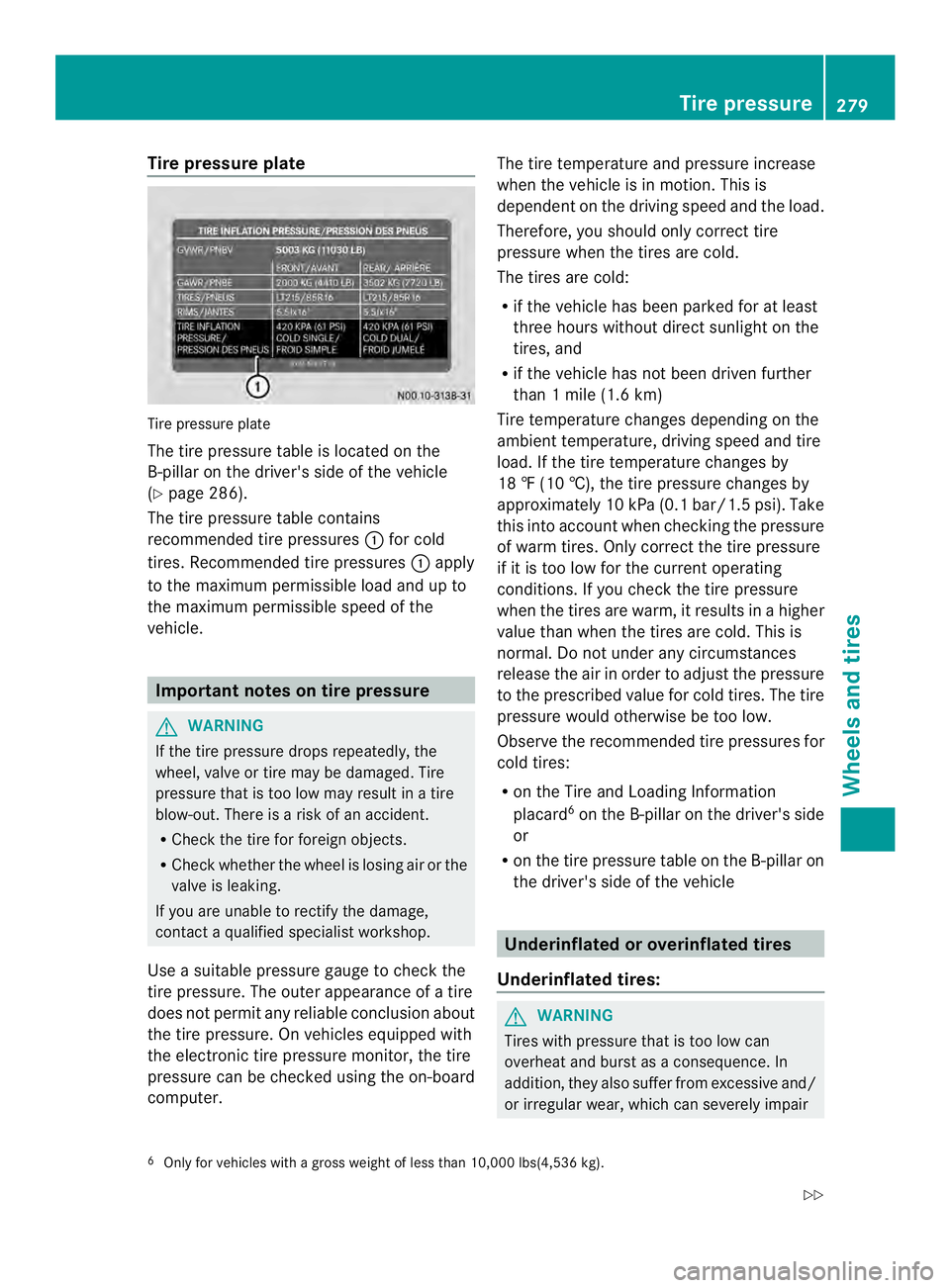
Tire pressure plate
Tire pressure plate
The tire pressure table is located on the
B-pillar on the driver's side of the vehicle
(Y page 286).
The tire pressure table contains
recommended tire pressures 0005for cold
tires. Recommended tire pressures 0005apply
to the maximum permissible load and up to
the maximum permissible speed of the
vehicle. Important notes on tire pressure
G
WARNING
If the tire pressure drops repeatedly, the
wheel, valve or tire ma ybe damaged. Tire
pressure that is too low may result in a tire
blow-out. There is a risk of an accident.
R Check the tire for foreign objects.
R Check whether the wheel is losing air or the
valve is leaking.
If you are unable to rectify the damage,
contact a qualified specialist workshop.
Use a suitable pressure gauge to chec kthe
tire pressure. The outer appearance of a tire
does not permit any reliable conclusion about
the tire pressure. On vehicles equipped with
the electronic tire pressure monitor, the tire
pressure can be checked using the on-board
computer. The tire temperature and pressure increase
when the vehicle is in motion. This is
dependent on the driving speed and the load.
Therefore, you should only correct tire
pressure when the tires are cold.
The tires are cold:
R
if the vehicle has been parked for at least
three hours without direct sunlight on the
tires, and
R if the vehicle has not been driven further
than 1 mile (1.6 km)
Tire temperature changes depending on the
ambient temperature, driving speed and tire
load. If the tire temperature changes by
18 ‡(10 †), the tire pressure changes by
approximately 10 kPa (0. 1bar/1. 5psi). Take
this into account when checking the pressure
of warm tires. Only correct the tire pressure
if it is too low for the current operating
conditions. If you check the tire pressure
when the tires are warm, it results in a higher
value than when the tires are cold. This is
normal. Do not under any circumstances
release the air in order to adjust the pressure
to the prescribed value for cold tires. The tire
pressure would otherwise be too low.
Observe the recommended tire pressures for
cold tires:
R on the Tire and Loading Information
placard 6
on the B-pillar on the driver's side
or
R on the tire pressure table on the B-pillar on
the driver's side of the vehicle Underinflated or overinflated tires
Underinflated tires: G
WARNING
Tires with pressure that is too low can
overheat and burst as a consequence. In
addition, they also suffer from excessive and/
or irregularw ear, which can severely impair
6 Only for vehicles with a gross weight of less than 10,00 0lbs(4,536 kg). Tire pressure
279Wheels and tires
Z