ECU MERCEDES-BENZ SPRINTER 2013 MY13 Operator’s Manual
[x] Cancel search | Manufacturer: MERCEDES-BENZ, Model Year: 2013, Model line: SPRINTER, Model: MERCEDES-BENZ SPRINTER 2013Pages: 334, PDF Size: 3.88 MB
Page 174 of 334
available from the police and local
authorities.
Observe the following when towing a trailer:
R
Practice driving around bends, stopping
and backing up at a place where there is no
traffic. This enables you to gain experience
and get used to the new handling
characteristics.
R Before driving, check:
-that the trailer tow hitch and ball
coupling are secure
- that the safety switch for a braked trailer
is functioning properly
- that the safety chains are secure and not
damaged
- that the electrical connections are
secure
- that the lights are working
- that the wheels are in good order and the
tire pressure is correct
R Adjust the exterior mirrors to provide an
unobstructed view of the rear sectio nofthe
trailer.
R If the trailer has electronically controlled
brakes, pull the vehicle/trailer
combination away carefully. Brake
manually using the brake controller and
check that the brakes are working.
R Secure the load on the trailer according to
the applicable specifications and current
standards on securing loads
(Y page 234).
R When driving with a trailer, check at regular
intervals that the load is secured and that
the brakes and lights are working.
R Bear in mind that the handling will be less
stable when towing a trailer than when
driving without one. Avoid sudden steering
movements.
R The vehicle/trailer combination is heavier,
accelerates more slowly and has a
decreased gradient climbing capability and
a longer braking distance.
It is more susceptible to crosswinds and
requires cautious steering. R
If possible, do not brake suddenly, but
rather moderately at first so that the trailer
can activate its brakes. Then increase the
force on the brake pedal.
R If the automatic transmission repeatedly
shifts between gears when driving on
inclines, restrict the shift range. Select shift
range 4,3,2or 1.
Driving in a low gear and at a low speed
reduces the risk of damaging the engine.
R When driving on a downhill gradient, shift
to a low gear and take advantage of the
engine's braking effect.
Avoid continuous brake application as this
may overheat the vehicle brakes and, if
installed, the trailer brakes.
R If the coolant temperature increases
dramatically while the air-conditioning
system is switched on, switch off the air-
conditioning system.
Coolant heat can also be dissipated by
switching the airflow and the temperature
of the heater/air conditioning to the
maximum level. Open the windows if
necessary.
R When overtaking, pay particular attention
to the extended length of your vehicle/
trailer combination.
Due to the length of your vehicle/trailer
combination you need an additional
distance before you can return to your
original lane. Uncoupling
atrailer G
WARNING
If you uncouple a trailer with the overrun
brake engaged, you could trap your hand
between the vehicle and the trailer drawbar.
There is a risk of injury.
Do not uncouple a trailer if the overru nbrake
is engaged.
! Do not disconnect a trailer with an
engaged overru nbrake. Otherwise, your 172
Towing
atrailerDriving an d parking
Page 175 of 334
vehicle could be damaged by the
rebounding of the overru
nbrake.
X Make sure the selector leve rofthe
automatic transmission is in position P.
X Apply the parking brake of the vehicle.
X Close all doors.
X Apply the parking brake of the trailer.
X In addition, secure the trailer against rolling
away with a wheel chock or similar object.
X Remove the trailer cable and safety chains
and decouple the trailer. Permissible trailer loads and trailer
drawbar noseweights
Weight information !
On vehicles with a permissible gross
vehicle weight of 11030 lbs (5003 kg), the
permissible gross combination weight is
less than the total of the permissible gross
vehicle weight and the permissible trailer
load. Exceeding the permissible gross
combination weight can lea dto damage to
the drivetrain, to the transmission or to the
trailer tow hitch.
If the vehicle or the trailer is fully laden, the
relevant value for the permissible gross
vehicle weight or the permissible trailer
load is therefore lower. In this case, the
trailer or the vehicle may only be partially
loaded.
The gross trailer weight (GTW) is calculated
by adding the weight of the trailer to the
weight of the load and equipment.
The maximum gross vehicle weight is vehicle-
specific and equipment-dependent:
5,000 lbs (2,268 kg) or 7,500 lbs (3,402 kg).
The maximum permissible trailer drawbar
noseweight on the ball coupling is 500 lbs
(227 kg) or 750 lbs (340 kg). The actual
noseweight may not exceed the value given
on the identification plates of the trailer tow
hitch or the trailer. If the values vary, the
lowest value always applies. The gross combination weight rating (GCWR)
is calculated by adding the gross weight of the
trailer to the gross vehicle weight including a
driver's weight of approximately 150 lbs
(68 kg). The permissible Gross Combination
Weight Rating is vehicle-specific and depends
on the equipment level.
When driving with a trailer, you should not
exceed the permitted Gross Combination
Weight Rating (GCWR).
The permissible values, which must not be
exceeded, can be found in your vehicle
documents and on the trailer tow hitch type
plates for the trailer and the vehicle
(Y page 315). The basic values approved by
the manufacturer can also be found in the
"Technical data" section ( Ypage 328). If the
values vary, the lowest value always applies.
Loading atrailer !
Utilize the maximum permissible
noseweigh tas fully as possible.D o not
allow the weight to fall below the minimum
permissible noseweight, otherwise the
trailer may come loose.
R You must distribute the load on the vehicle
and trailer so that the permitted maximum
values for the gross vehicle weight (GVWR),
gross trailer weight (GTW) and gross
combined weight (GCWR) as well as
permitted gross axle loads (GAWR) and
noseweight (TWR) of your vehicle are not
exceeded.
R Add the drawbar noseweight on the ball
coupling (TWR) to the rear axle load. This
will prevent you from exceeding the
permissible gross axle weight (GAWR).
R Add the drawbar noseweight on the ball
coupling (TWR) to the vehicle payload. This
will prevent you from exceeding the
permissible gross vehicle weight (GVWR). Towing
atrailer
173Driving an d parking Z
Page 224 of 334
Useful information
This Operator's Manual describes all models
as well as standard and optional equipment
of your vehicle that were available at the time
of going to print. Country-specific variations
are possible. Note that your vehicle may not
be equipped with all of the described
functions. This also applies to systems and
functions relevant to safety.
Read the information on qualified specialist
workshops (Y page 26). Stowage spaces and stowage
compartments
Important safety notes
G
WARNING
If you do not correctly store objects in the
vehicle interior, they can slip or be flung
around, thus striking vehicle occupants.
There is a risk of injury, especially when
braking or abruptly changing directions.
R Always store objects so that they cannot be
flung around in these or in similar
situations.
R Always make sure that objects do not
protrude from stowage compartments,
parcel nets or stowage nets.
R Close lockable stowage compartments
while driving.
R Stow and secure objects that are heavy,
hard, pointy, sharp-edged, fragile or too
large in the trunk.
In addition, observe the information in the
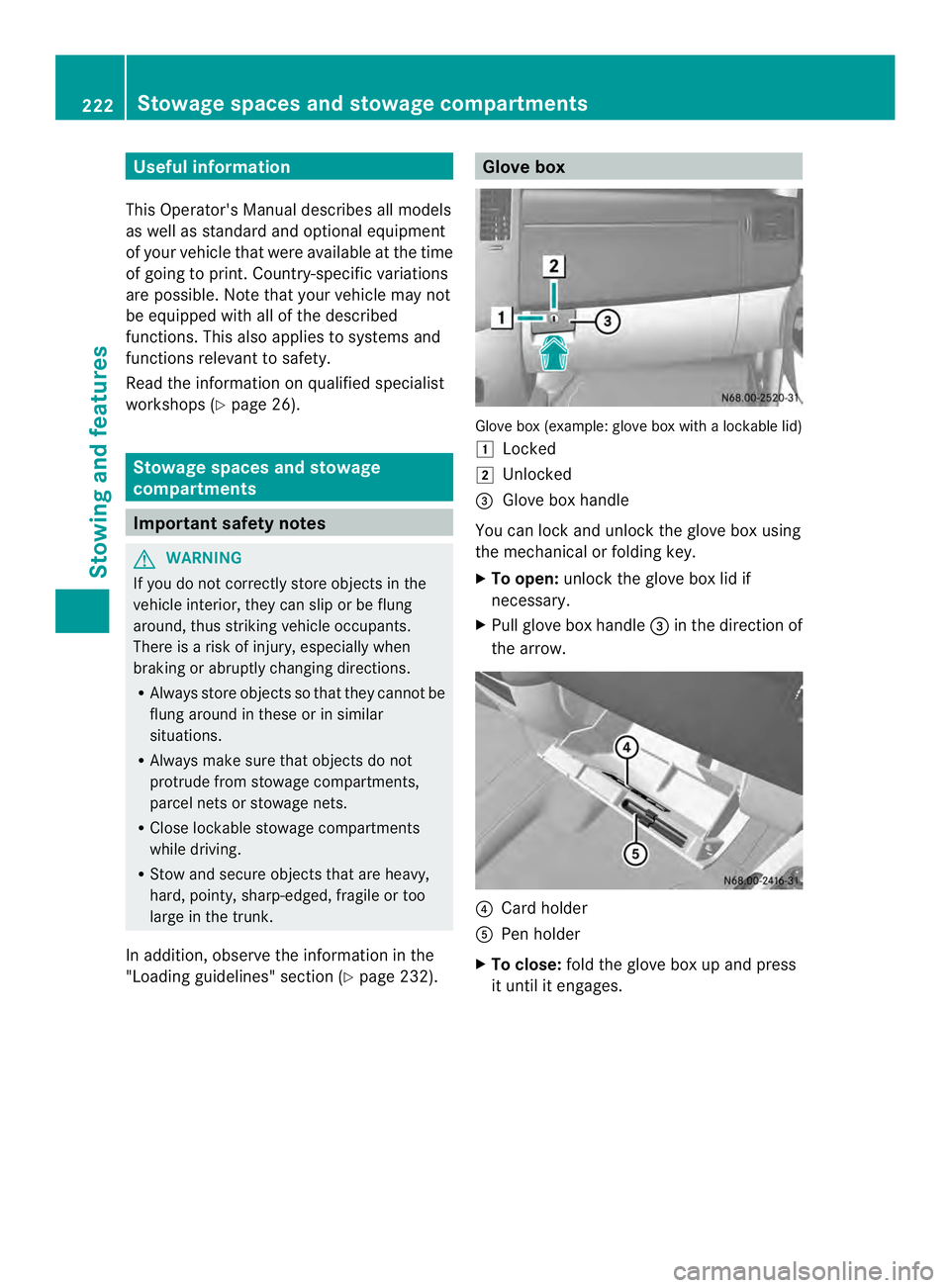
"Loading guidelines" section (Y page 232). Glove box
Glove box (example: glove box with a lockable lid)
0008
Locked
0009 Unlocked
0026 Glove box handle
You can lock and unlock the glove box using
the mechanical or folding key.
X To open: unlock the glove box lid if
necessary.
X Pull glove box handle 0026in the direction of
the arrow. 0025
Card holder
0023 Pen holder
X To close: fold the glove box up and press
it until it engages. 222
Stowage spaces and stowage compartmentsStowing and features
Page 226 of 334
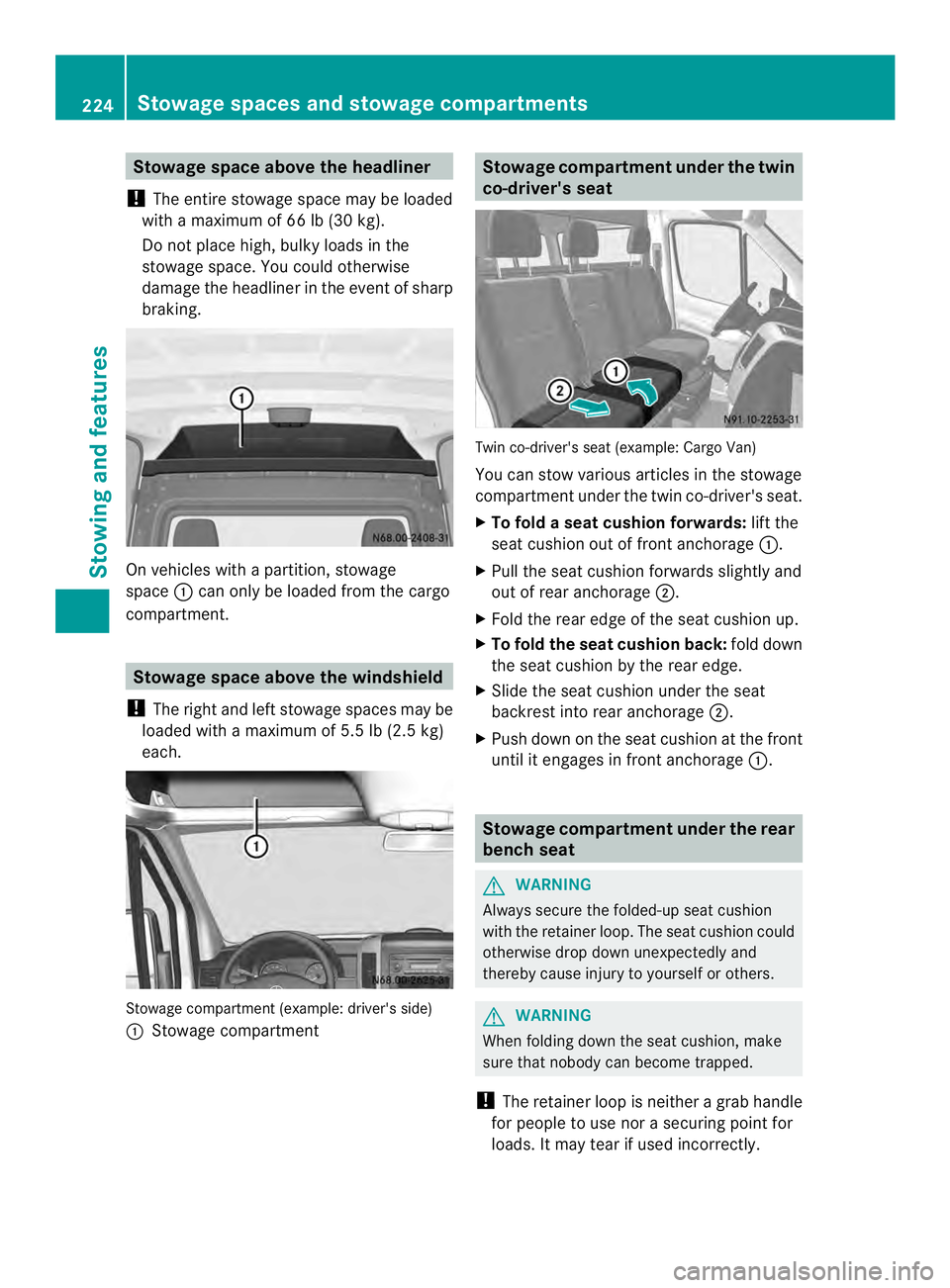
Stowage space above the headliner
! The entire stowage space may be loaded
with a maximum of 66 lb (30 kg).
Do not place high, bulky loads in the
stowage space. You could otherwise
damage the headliner in the event of sharp
braking. On vehicles with a partition, stowage
space
0005can only be loaded from the cargo
compartment. Stowage space above the windshield
! The right and left stowage spaces may be
loaded with a maximum of 5.5 lb (2.5 kg)
each. Stowage compartmen
t(example: driver's side)
0005 Stowage compartment Stowage compartment under the twin
co-driver's seat
Twin co-driver's seat (example: Cargo Van)
You can stow various articles in the stowage
compartment under the twin co-driver's seat.
X
To fold a seat cushion forwards: lift the
seat cushion out of fron tanchorage 0005.
X Pull the sea tcushio nforwards slightly and
out of rear anchorage 0006.
X Fold the rear edge of the seat cushion up.
X To fold the seat cushion back: fold down
the seat cushion by the rear edge.
X Slide the seat cushion under the seat
backrest into rear anchorage 0006.
X Push down on the seat cushion at the front
until it engages in front anchorage 0005. Stowage compartment under the rear
bench seat
G
WARNING
Always secure the folded-up seat cushion
with the retainer loop. The seat cushion could
otherwise drop down unexpectedly and
thereby cause injury to yourself or others. G
WARNING
When folding down the seat cushion, make
sure that nobody can become trapped.
! The retainer loop is neither a grab handle
for people to use nor a securing point for
loads. It may tear if used incorrectly. 224
Stowage spaces and stowage compartmentsStowing and features
Page 227 of 334
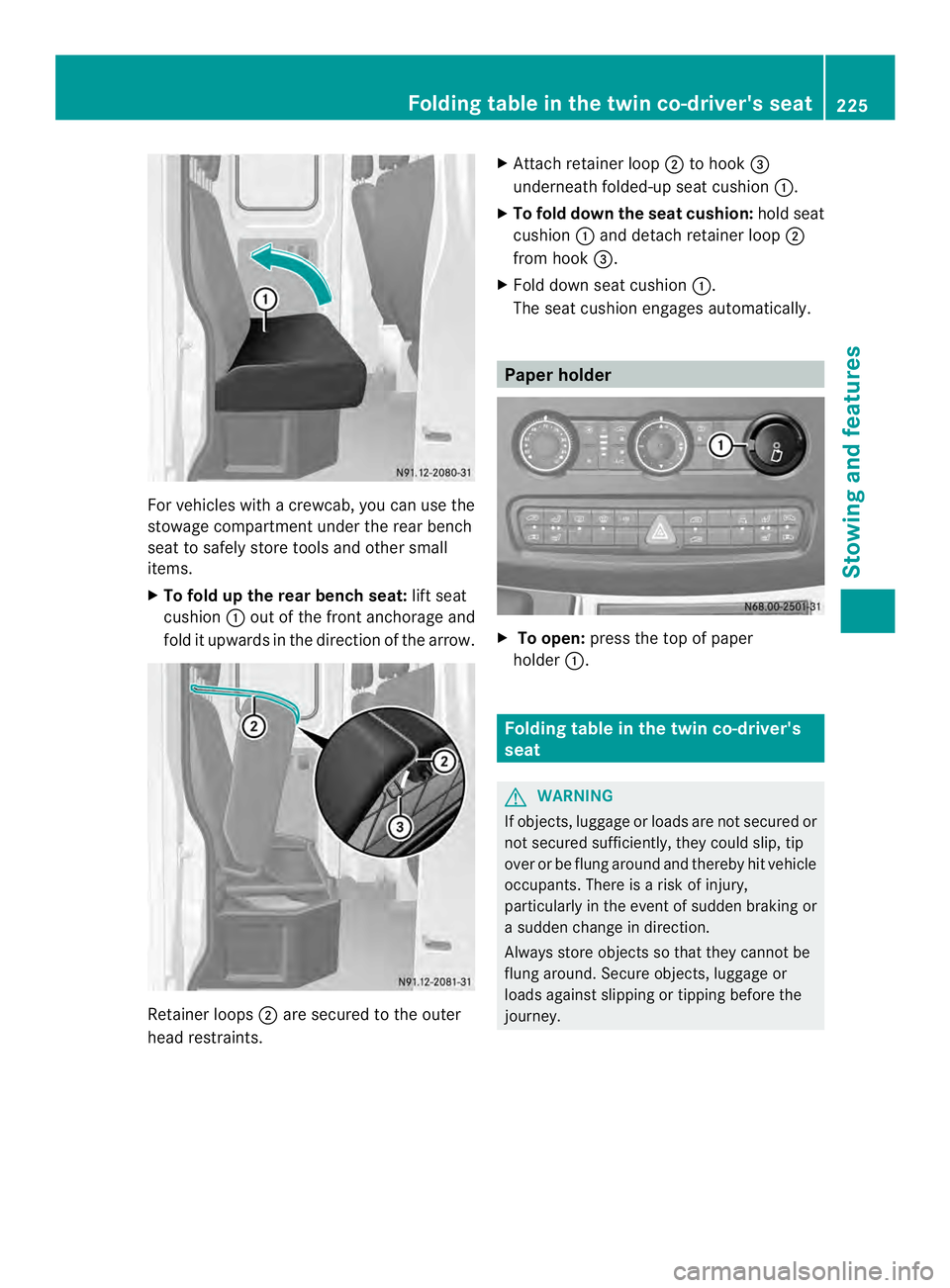
For vehicles with a crewcab, you can use the
stowage compartment under the rear bench
sea tto safely store tools and other small
items.
X To fold up the rear bench seat: lift seat
cushion 0005out of the front anchorage and
fold it upwards in the direction of the arrow. Retainer loops
0006are secured to the outer
head restraints. X
Attach retainer loop 0006to hook 0026
underneath folded-up seat cushion 0005.
X To fold down the seat cushion: hold seat
cushion 0005and detach retainer loop 0006
from hook 0026.
X Fold down seat cushion 0005.
The seat cushion engages automatically. Paper holder
X
To open: press the top of paper
holder 0005. Folding table in the twin co-driver's
seat
G
WARNING
If objects, luggage or loads are not secured or
not secured sufficiently, they could slip, tip
over or be flung around and thereby hit vehicle
occupants. There is a risk of injury,
particularly in the event of sudden braking or
a sudden change in direction.
Always store objects so that they cannot be
flung around. Secure objects, luggage or
loads against slipping or tipping before the
journey. Folding table in the twin co-driver's seat
225Stowing and features Z
Page 228 of 334
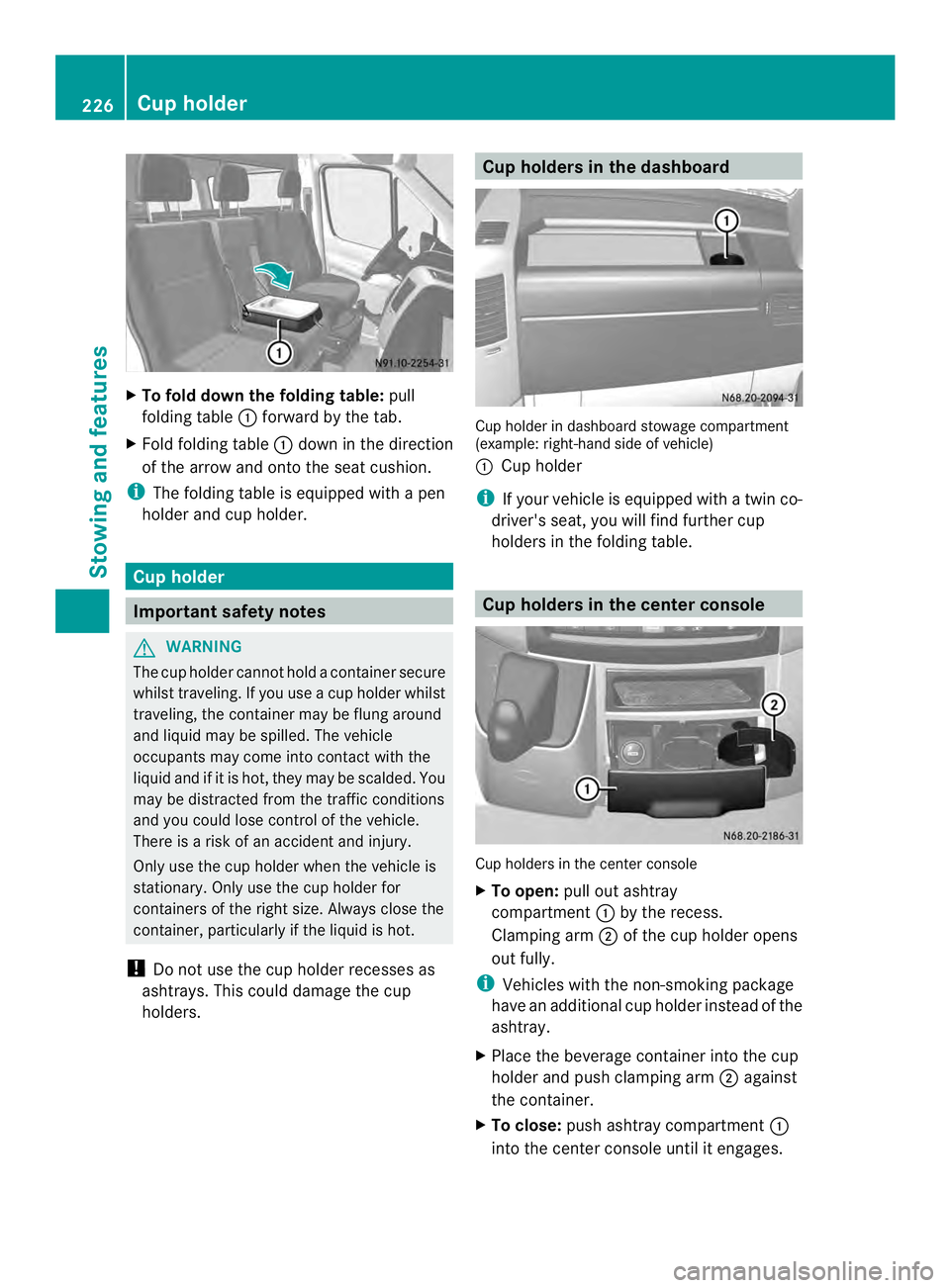
X
To fold down the folding table: pull
folding table 0005forward by the tab.
X Fold folding table 0005down in the direction
of the arrow and onto the sea tcushion.
i The folding table is equipped with a pen
holder and cup holder. Cup holder
Important safety notes
G
WARNING
The cup holder canno thold a container secure
whilst traveling. If you use a cup holder whilst
traveling, the container may be flung around
and liquid may be spilled. The vehicle
occupants may come into contact with the
liquid and if it is hot, they may be scalded. You
may be distracted from the traffic conditions
and you could lose control of the vehicle.
There is a risk of an accident and injury.
Only use the cup holder when the vehicle is
stationary. Only use the cup holder for
containers of the right size. Always close the
container, particularly if the liquid is hot.
! Do not use the cup holder recesses as
ashtrays. This could damage the cup
holders. Cup holders in the dashboard
Cup holder in dashboard stowage compartment
(example: right-hand side of vehicle)
0005
Cup holder
i If your vehicle is equipped with a twin co-
driver's seat, you will find further cup
holders in the folding table. Cup holders in the center console
Cup holders in the center console
X
To open: pull out ashtray
compartment 0005by the recess.
Clamping arm 0006of the cup holder opens
out fully.
i Vehicles with the non-smoking package
have an additional cup holder instead of the
ashtray.
X Place the beverage container into the cup
holder and push clamping arm 0006against
the container.
X To close: push ashtray compartment 0005
into the center console until it engages. 226
Cup holderStowing and features
Page 233 of 334
Useful information
............................232
Loading guidelines ............................232
Load distribution .............................. 234
Securing loads .................................. 234
Carrier systems ................................ 236 231Transporting loads
Page 234 of 334
Useful information
This Operator's Manual describes all models
as well as standard and optional equipment
of your vehicle that were available at the time
of going to print. Country-specific variations
are possible. Note that your vehicle may not
be equipped with all of the described
functions. This also applies to systems and
functions relevant to safety.
Read the information on qualified specialist
workshops (Y page 26). Loading guidelines
Important safety notes
G
WARNING
As a result of improperly placed or unevenly
distributed loads, the center of gravity of the
load being transported may be too high or too
far back. This can significantly impair handling
as well as steering and braking
characteristics. There is a risk of an accident.
Always make sure that the center of gravity of
the load is:
R between the axles
and
R as low as possible, near the rear axle. G
WARNING
When objects are unsecured or inadequately
secured, they can slip, turn over or be thrown
about, striking vehicle occupants .This also
applies to:
R luggage or loads
R a rear bench seat which has been removed
and is being transported in the vehicle in an
exceptional case.
There is a risk of injury, particularly in the
event of braking maneuvers or abrupt
changes in direction.
Always stow objects in such a way that they
cannot be tossed about. Before traveling,
secure objects, luggage or loads to prevent them slipping or tipping over. If you remove a
rear bench seat, it is advisable to store it
outside the vehicle. G
WARNING
When the permissible wheel loads, axle loads
and/or the maximum permissible gross
vehicle weight are exceeded, driving safety is
compromised. The handling as well as
steering and braking characteristics may be
significantly impaired. Overloaded tires may
overheat, causing them to burst. There is a
risk of an accident.
When transporting a load, always observe the
permissible wheel loads, axle loads and the
maximum permissible gross vehicle weight
for the vehicle (including occupants). G
WARNING
When you load the roof, the center of gravity
of the vehicle rises and the driving
characteristics change. If you exceed the
maximum roof load, the driving
characteristics, as well as steering and
braking, will be greatly impaired. There is a
risk of an accident.
Never exceed the maximum roof load and
adjust your driving style.
! If you are using a roof carrier, observe the
maximum roof load and maximum roof
carrier load.
You will find information about the maximum
roof load in the "Technical data" section
(Y page 327) and information about roof
carriers in the "Carrier systems" section
(Y page 236).
R Do not stack luggage or loads higher than
the backrests.
R Objects to be transported should
preferably be stowed in the cargo
compartment. 232
Loading guidelinesTransporting loads
Page 235 of 334
R
When transporting luggage, always use the
cargo tie-down rings and a parcel net, if
present.
R Use cargo tie-down rings and fasteners
which are suitable for the weight and size
of the load.
Always observe the operating instructions of
the respective manufacturer when using
suitable load securing aids or tie downs. In
particular, the information on the end of
service life.
Load securing aids and tie downs may not be
used, for example, if:
R identification marks are missing or illegible
R there are yarn breakages, damage to
bearing seams or other signs of tearing
R there are signs of shearing, deformation,
pinching or other damage
R there is damage to clamping or connecting
elements
Load securing aids and tie downs in this
condition are ready for discard and must be
replaced. If you use load securing aids or tie
downs which are worn out, the load may not
be sufficiently secured and could cause
damage to property.
After an accident, the following must be
checked at a specialist workshop:
R a damaged cargo compartment floor
R a damaged loading area
R the cargo tie-down rings
R the tie downs
Otherwise, the load may not be correctly
secured the nextt ime anything is stowed.
Even if you follow all loading guidelines, the
load increases the risk of injury in the event
of an accident. Observe the tips in the
"Securing a load" (Y page 234) and "Load
distribution" (Y page 234) sections. Before loading
! The anti-slip mats cannot be used for
securing goods and must be replaced when
they show signs of:
R Permanent deformation and crushing
R Crack formation
R Cuts
X Tire pressure: checkthe tire pressure and
correct if necessary (Y page 278).
X Cargo compartment floor: clean the
cargo compartment floor.
The cargo compartmentf loor must be free
fro mo il and dust, dry and swept clean to
prevent the load fro mslipping.
X Place non-slip mats (anti-slip mats) on the
cargo compartment floor if necessary. During loading
! On passenger van versions with
maximum seating layout, the permissible
rear axle load would be exceeded if the full
payload were to be loaded in the cargo
compartment.
X Observe the gross axle weight rating and
permissible gross vehicle weight for your
vehicle.
Take into account that your vehicle's curb
weight is increased if accessories or
optional equipmen tare installed. The
maximu mpayload is thus reduced.
X Observe the notes on load distribution
(Y page 234).
The overall cente rofgravity of the load
should always be as low as possible,
centered and between the axles near the
rear axle.
X Secure the load (Y page 234).
Always observe the relevant country-
specific legal requirements, laws and
regulations. Loading guidelines
233Transporting loads Z
Page 236 of 334
Checks after loading
G
WARNING
Combustion engines emit poisonous exhaust
gases, such as carbon monoxide. If the sliding
door or rear door is open when the engine is
running, exhaust gases can ente rthe vehicle
interior, especially during the journey. There
is a risk of poisoning.
Always switch off the engine before opening
the sliding door or rear door. Never drive the
vehicle when the sliding door or rear door is
open.
X Securing loads: check that the load is
secure before every journey and at regular
intervals during a long journey, and correct
if necessary.
X Doors: close the sliding doors and rear
doors.
X Tire pressure: adjust the tire pressures
according to the vehicle load
(Y page 278).
X Driving style: adapt your driving style
according to the vehicle load. Load distribution
General notes
! Excessive loads on individualp oints of the
cargo floor or on the load surface impair
vehicle handling characteristics and could
cause damage to the floor covering.
The overall center of gravity of the load should
always be as low as possible, centered and
between the axles near the rear axle.
On Cargo Vans/Passenger Vans:
X Always transport loads in the cargo
compartment.
X Always place the load against the backrests
of the rear bench seat.
X Move large and heavy loads as far towards
the front of the vehicle as possible against the rear bench seat. Stow the load flush
with the rear bench seat.
X Always additionally secure the load with
suitable load-securing aids or tie downs.
Observe the following notes:
R Do not stack loads higher than the upper
edge of the backrests.
R Transport loads behind seats that are not
occupied.
R If the rear bench seat is not occupied, insert
the seat belts crosswise into the buckle of
the opposite seat belt. Securing loads
Important safety notes
G
WARNING
If you attach the tie-down incorrectly when
securing the load, the following may occur in
the event of abrupt changes in direction,
braking maneuvers or an accident:
R the cargo tie-down rings may become
detached or the tie-down may tear if the
permissible load is exceeded
R the load may not be restrained.
This may cause the load to slip, tip over or be
tossed about, striking vehicle occupants.
There is a risk of an accident and injury.
Always tension the tie-downs in the proper
manner and only between the described
cargo tie-down rings. Always use tie-downs
designed specifically for the loads. G
WARNING
You may not transport anyone in the cargo
compartment or on the load surface. Never
let more people ride in the vehicle than there
are seat belts available. Make sure everyone
riding in the vehicle is correctly restrained
with a separate seat belt. Never use a seat
belt for more than one person at a time. 234
Securing loadsTransporting loads