air condition MERCEDES-BENZ SPRINTER 2013 MY13 Operator’s Manual
[x] Cancel search | Manufacturer: MERCEDES-BENZ, Model Year: 2013, Model line: SPRINTER, Model: MERCEDES-BENZ SPRINTER 2013Pages: 334, PDF Size: 3.88 MB
Page 216 of 334
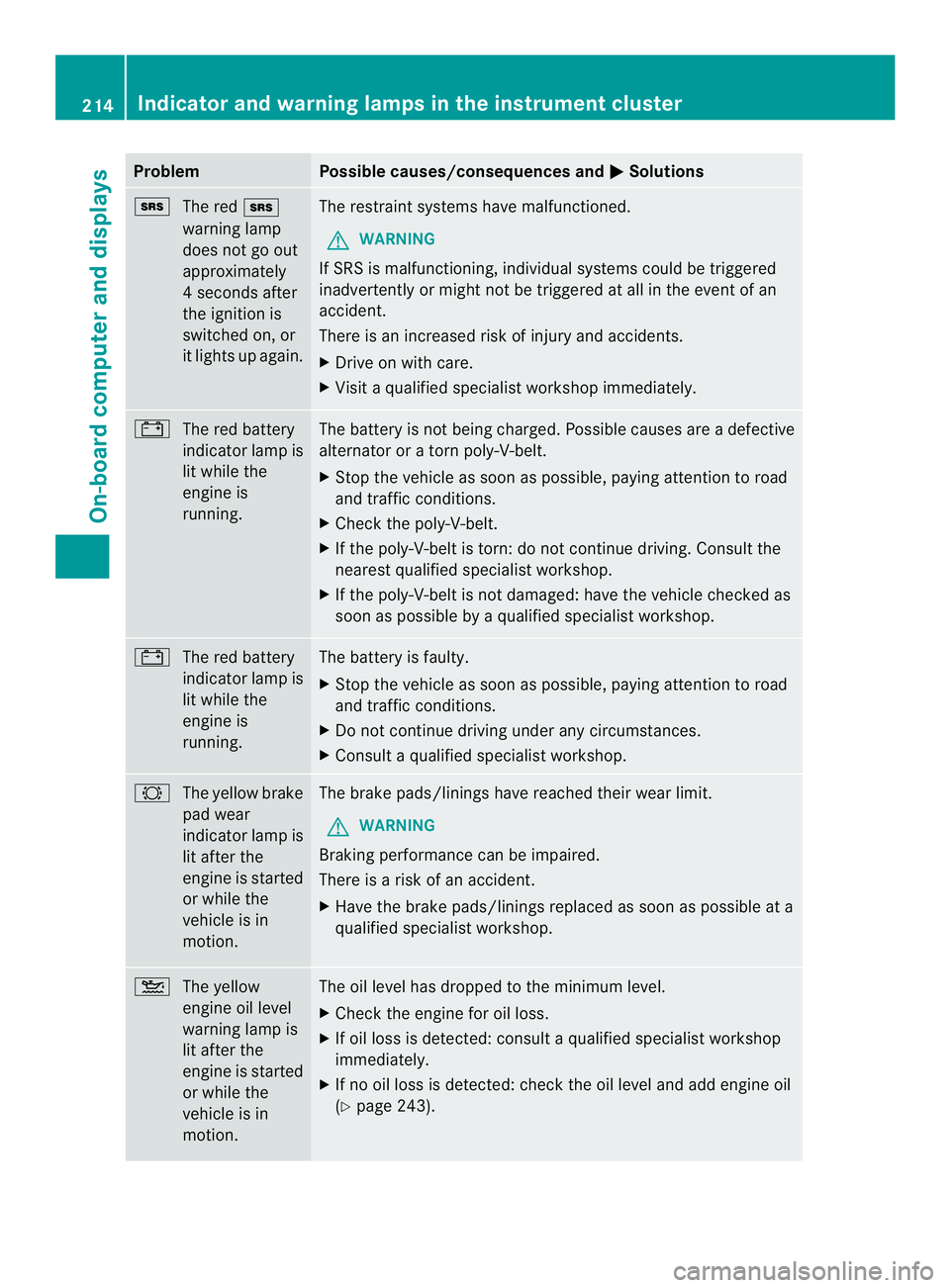
Problem Possible causes/consequences and
0004 Solutions
0008
The red 0008
warning lamp
does not go out
approximately
4s econds after
the ignition is
switched on, or
it lights up again. The restraint systems have malfunctioned.
G WARNING
If SRS is malfunctioning, individual systems could be triggered
inadvertently or might not be triggered at all in the event of an
accident.
There is an increased risk of injury and accidents.
X Drive on with care.
X Visit a qualified specialist workshop immediately. 0010
The red battery
indicator lamp is
lit while the
engine is
running. The battery is not being charged. Possible causes are a defective
alternator or a torn poly-V-belt.
X
Stop the vehicle as soon as possible, paying attention to road
and traffic conditions.
X Check the poly-V-belt.
X If the poly-V-belt is torn: do not continue driving. Consult the
nearest qualified specialist workshop.
X If the poly-V-belt is not damaged: have the vehicle checked as
soon as possible by a qualified specialist workshop. 0010
The red battery
indicator lamp is
lit while the
engine is
running. The battery is faulty.
X
Stop the vehicle as soon as possible, paying attention to road
and traffic conditions.
X Do not continue driving under any circumstances.
X Consult a qualified specialist workshop. 0005
The yellow brake
pad wear
indicator lamp is
lit after the
engine is started
or while the
vehicle is in
motion. The brake pads/linings have reached their wear limit.
G WARNING
Braking performance can be impaired.
There is a risk of an accident.
X Have the brake pads/linings replaced as soon as possible at a
qualified specialist workshop. 001D
The yellow
engine oil level
warning lamp is
lit after the
engine is started
or while the
vehicle is in
motion. The oil level has dropped to the minimum level.
X
Check the engine for oil loss.
X If oil loss is detected: consult a qualified specialist workshop
immediately.
X If no oil loss is detected: chec kthe oil level and add engine oil
(Y page 243). 214
Indicator and warning lamps in the instrument clusterOn-board computer and displays
Page 220 of 334
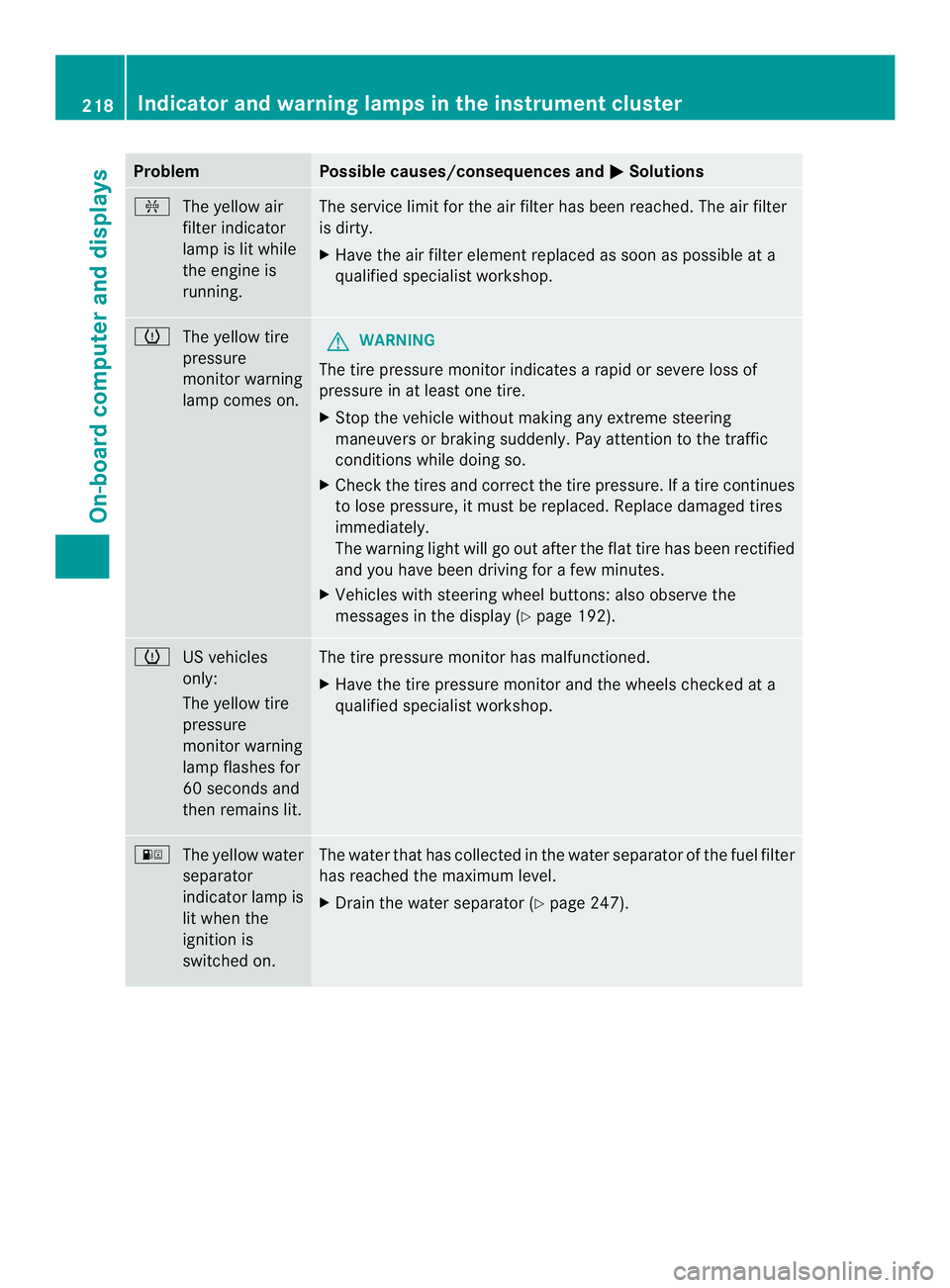
Problem Possible causes/consequences and
0004 Solutions
0013
The yellow air
filter indicator
lamp is lit while
the engine is
running. The service limit for the air filter has been reached. The air filter
is dirty.
X
Have the air filter element replaced as soon as possible at a
qualified specialist workshop. 000A
The yellow tire
pressure
monitor warning
lamp comes on. G
WARNING
The tire pressure monitor indicates a rapid or severe loss of
pressure in at least one tire.
X Stop the vehicle without making any extreme steering
maneuvers or braking suddenly. Pay attention to the traffic
conditions while doing so.
X Check the tires and correctt he tire pressure. If a tire continues
to lose pressure, it must be replaced. Replace damaged tires
immediately.
The warning light will go out after the flat tire has been rectified
and you have been driving for a few minutes.
X Vehicles with steering wheel buttons: also observe the
messages in the display (Y page 192).000A
US vehicles
only:
The yellow tire
pressure
monitor warning
lamp flashes for
60 seconds and
then remains lit. The tire pressure monitor has malfunctioned.
X
Have the tire pressure monitor and the wheels checked at a
qualified specialist workshop. 000E
The yellow water
separator
indicator lamp is
lit when the
ignition is
switched on. The water that has collected in the water separator of the fuel filter
has reached the maximum level.
X
Drain the water separator (Y page 247).218
Indicator and warning lamps in the instrument clusterOn-board computer and displays
Page 250 of 334
Vehicle interior
Air filter for the rear-compartment air
conditioning
! Regularly check the ai rfilters for visible
dirt .Clean or replace a dirty filter mat .The
dirt may otherwise lead to damage to the
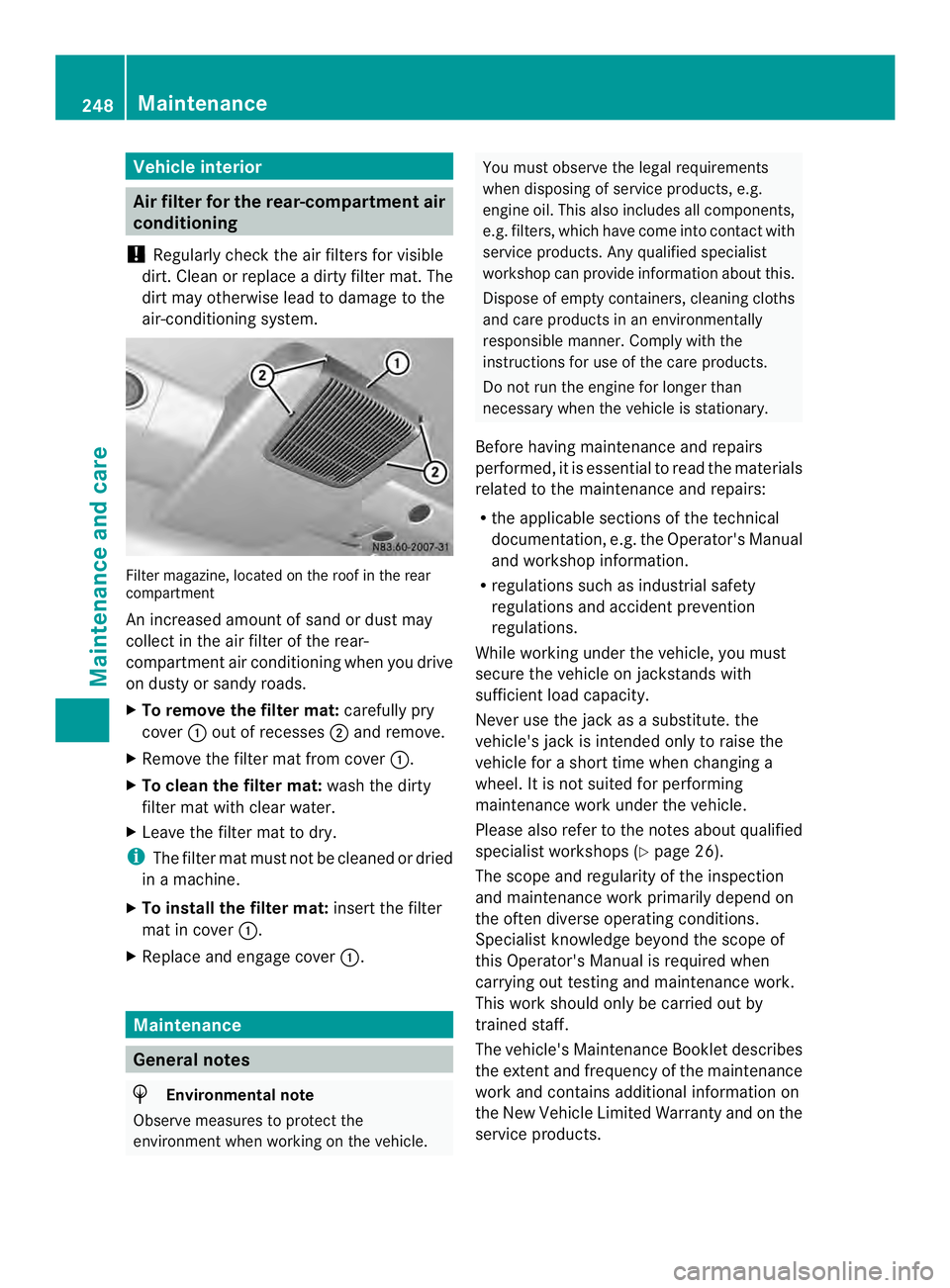
air-conditioning system. Filter magazine, located on the roof in the rear
compartment
An increased amount of sand or dust may
collect in the air filter of the rear-
compartmenta
ir conditioning when you drive
on dusty or sandy roads.
X To remove the filter mat: carefully pry
cover 0005out of recesses 0006and remove.
X Remove the filter mat from cover 0005.
X To clean the filter mat: wash the dirty
filter mat with clear water.
X Leave the filter mat to dry.
i The filter mat must not be cleaned or dried
in a machine.
X To install the filter mat: insert the filter
mat in cover 0005.
X Replace and engage cover 0005.Maintenance
General notes
H
Environmental note
Observe measures to protect the
environment when working on the vehicle. You must observe the legal requirements
when disposing of service products, e.g.
engine oil. This also includes all components,
e.g. filters, which have come into contac twith
service products. Any qualified specialist
workshop can provide information about this.
Dispose of empty containers, cleaning cloths
and care products in an environmentally
responsible manner. Comply with the
instructions for use of the care products.
Do not run the engine for longer than
necessary when the vehicle is stationary.
Before having maintenance and repairs
performed, it is essential to read the materials
related to the maintenance and repairs:
R the applicable sections of the technical
documentation, e.g. the Operator's Manual
and workshop information.
R regulations such as industrial safety
regulations and accident prevention
regulations.
While working under the vehicle, you must
secure the vehicle on jackstands with
sufficient load capacity.
Never use the jac kasas ubstitute .the
vehicle's jack is intended only to raise the
vehicle for a short time when changing a
wheel. It is not suited for performing
maintenance work under the vehicle.
Please also refer to the notes about qualified
specialist workshops (Y page 26).
The scope and regularity of the inspection
and maintenance work primarily depend on
the often diverse operating conditions.
Specialist knowledge beyond the scope of
this Operator's Manual is required when
carrying out testing and maintenance work.
This work should only be carried out by
trained staff.
The vehicle's Maintenance Booklet describes
the extenta nd frequency of the maintenance
work and contains additional informatio non
the New Vehicle Limited Warranty and on the
service products. 248
MaintenanceMaintenance and care
Page 258 of 334
H
Environmental note
Only clean your vehicle at specially designed
wash bays. Dispose of empt ycontainers and
used cleaning products in an environmentally
responsible manner. H
Environmental note
Dispose of empty packaging and cleaning
cloths in an environmentally responsible
manner.
Regula rcare of your vehicle is a condition for
retaining the quality in the long term.
Use care products and cleaning agents
recommended and approved for Sprinter
vehicles. Washing the vehicle and cleaning the
paintwork
Automatic car wash G
WARNING
Braking efficiency is reduced after washing
the vehicle .There is a risk of an accident.
After the vehicle has been washed, brake
carefully while paying attention to the traffic
conditions until full braking power is restored.
! Never clean your vehicle in a Touchless
Automatic Car Wash as these use special
cleaning agents. These cleaning agents can
damage the paintwork or plastic parts.
! Make sure that the automatic car wash is
suitable for the size of the vehicle.
Before washing the vehicle in an automatic
car wash, fold in the exterior mirrors and
remove any additional antennas.
Otherwise, the exterior mirror, antenna or
the vehicle itself could be damaged.
Make sure that the exterior mirrors are fully
folded out again and that any additional
antennas are re-installed when you leave
the automatic car wash. !
Make sure that:
R the side windows and the roof are
completely closed
R the climate control blower is switched off
R the windshield wiper switch is at position
0
The vehicle could otherwise be damaged.
You can wash the vehicle in an automatic car
wash from the very start.
Wash off excess dirt before cleaning the
vehicle in an automatic car wash.
After putting the vehicle through an
automatic car wash, wipe off wax from:
R the rear view camera lens (Y page 259)
R the windshield
R the windshield wiper blades
This will prevent smears and reduce wiping
noises caused by residue on the
windshield.
Washing by hand In some countries, washing by hand is only
allowed at specially equipped washing bays.
Observe the legal requirements for each
individual country.
X
Do not use hot water and do not wash the
vehicle in direct sunlight.
X Use a soft car sponge.
X Use a mild cleaning agent, e.g. a car
shampoo approved for use with Sprinter
vehicles.
X Thoroughly hose down the vehicle with a
gentle jet of water.
X Do not point the water jet directly towards
the air inlets.
X Use plenty of water and rinse out the
sponge frequently.
X Rinse the vehicle with clean water and dry
thoroughly with a chamois.
X Do not let the cleaning agents dry on the
paintwork. 256
CareMaintenance and care
Page 279 of 334
Always observe the maximu
mpermissible
speed specified for the M+S tires you have
mounted.
If you mount M+S tires that have a lower
maximum permissible speed than that of the
vehicle, affix a corresponding warning label in
the driver's field of vision. You can obtain this
at a qualified specialist workshop.
Once you have mounted the winter tires:
X Check the tire pressure (Y page 278).
X Reactivate the tire pressure
monitor*(Y page 283). Snow chains
G
WARNING
If you drive too fast with snow chains
mounted, they may snap. As a result, you
could injure others and damage the vehicle.
There is a risk of an accident.
Observe the maximum permissible speed for
operation with snow chains.
When driving with snow chains mounted, do
not exceed the maximum permissible speed
of 30 mph (50 km/h). Observe the country-
specific laws and regulations for operation
with snow chains.
! Check the snow chains for damage before
mounting them. Damaged or worn snow
chains may snap and damage the following
components:
R wheel
R wheel housing
R wheel suspension
For this reason, you must use only snow
chains that are free of defects. Observe the
manufacturer's mounting instructions.
! Vehicles with steel wheels: if you
mount snow chains on steel wheels, you
may damage the hub caps. Remove the hub
caps from the relevant wheels before
mounting the snow chains. Snow chains increase traction on roads in
wintry conditions.
For reasons of safety we only recommend
using snow chains or traction aids that are
approved for the Sprinter. The snow chains or
traction aids must be of class U or meet the
SAE type U specification. Information on
snow chains is available at any qualified
specialist workshop.
When mounting snow chains, please bear the
following points in mind:
R
You may not mount snow chains on all
wheel/tire combinations. When mounting
the snow chains, note the permissible tire
and snow chain dimensions.
R Mount snow chains only in pairs and only
to the rear wheels. On vehicles with twin
tires, mount the snow chains to the outer
wheels. Observe the manufacturer's
mounting instructions.
R Only use snow chains when the road is
covered by a layer of snow. Remove the
snow chains as soon as possible when you
come to a road that is not snow-covered.
R The use of snow chains may be restricted
by local regulations. Observe the
appropriate regulations before mounting
snow chains.
R When driving with snow chains mounted,
do not exceed the maximum permissible
speed of 30 mph (50 km/h).
R Check the tension of the chains after a
distance of approximately 0.5 miles
(1.0 km).
You can deactivate ASR (Y page 58) when
pulling away with snow chains mounted. This
allows the wheels to spin in a controlled
manner, achieving an increased driving force
(cutting action). Operation in winter
277Wheels and tires
*optional Z
Page 280 of 334
Tire pressure
Tire pressure specifications
Important safety notes G
WARNING
Underinflated or overinflated tires pose the
following risks:
R the tires may burst, especially as the load
and vehicle speed increase.
R the tires may wear excessively and/or
unevenly, which may greatly impai rtire
traction.
R the driving characteristics, as well as
steering and braking, may be greatly
impaired.
There is a risk of an accident.
Follow recommended tire inflation pressures
and chec kthe pressure of all the tires
including the spare wheel:
R monthly, at least
R if the load changes
R before beginning a long journey
R under different operating conditions, e.g.
off-road driving
If necessary, correct the tire pressure.
i The specifications shown on the sample
Tire and Loading Information placard and
tire pressure table are examples. Tire
pressure data are vehicle-specific and may
deviate from the data illustrated here. The
tire pressure data applicable to your
vehicle can be found on the Tire &Loading
Information placard or tire pressure plate
of your vehicle. H
Environmental note
Check the tire pressure regularly, at least
every 14 days. General notes You will find information on tire pressure for
the vehicle's factory-mounted tires on the
plates described here.
You will find a table of recommended tire
pressures on the Tire and Loading
Information placard
5
or on the tire pressure
table on the B-pillar on the driver's side of the
vehicle.
Further information on tire pressure can be
obtained at a qualified specialist workshop.
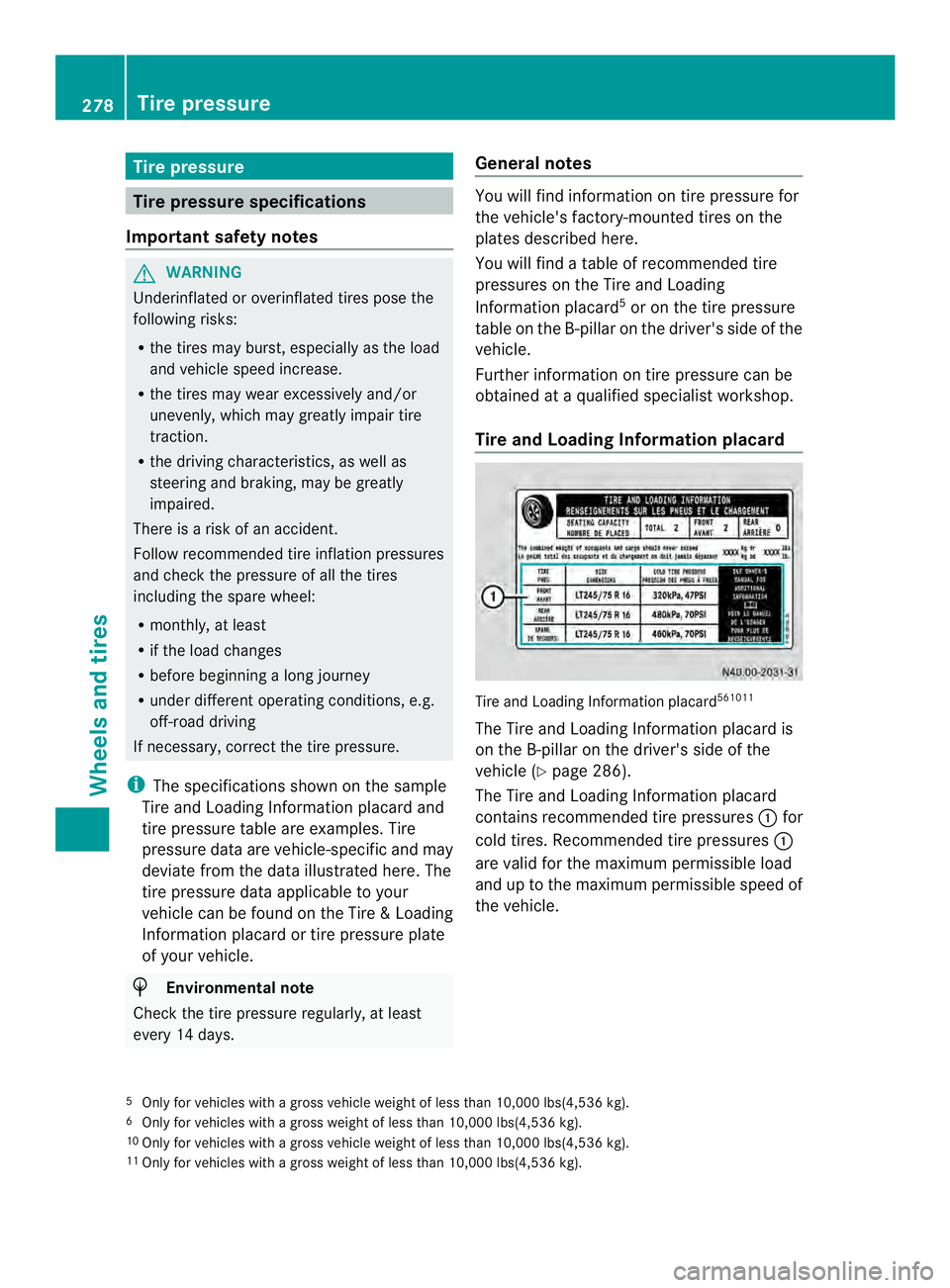
Tire and Loading Information placard Tire and Loading Information placard
561011
The Tire and Loading Information placard is
on the B-pillar on the driver's side of the
vehicle (Y page 286).
The Tire and Loading Information placard
contains recommended tire pressures 0005for
cold tires. Recommended tire pressures 0005
are valid for the maximum permissible load
and up to the maximum permissible speed of
the vehicle.
5 Only for vehicles with a gross vehicle weight of less than 10,000 lbs(4,536 kg).
6 Only for vehicles with a gross weight of less than 10,000 lbs(4,536 kg).
10 Only for vehicles with a gross vehicle weight of less than 10,000 lbs(4,536 kg).
11 Only for vehicles with a gross weight of less than 10,000 lbs(4,536 kg). 278
Tire pressureWheels and tires
Page 281 of 334
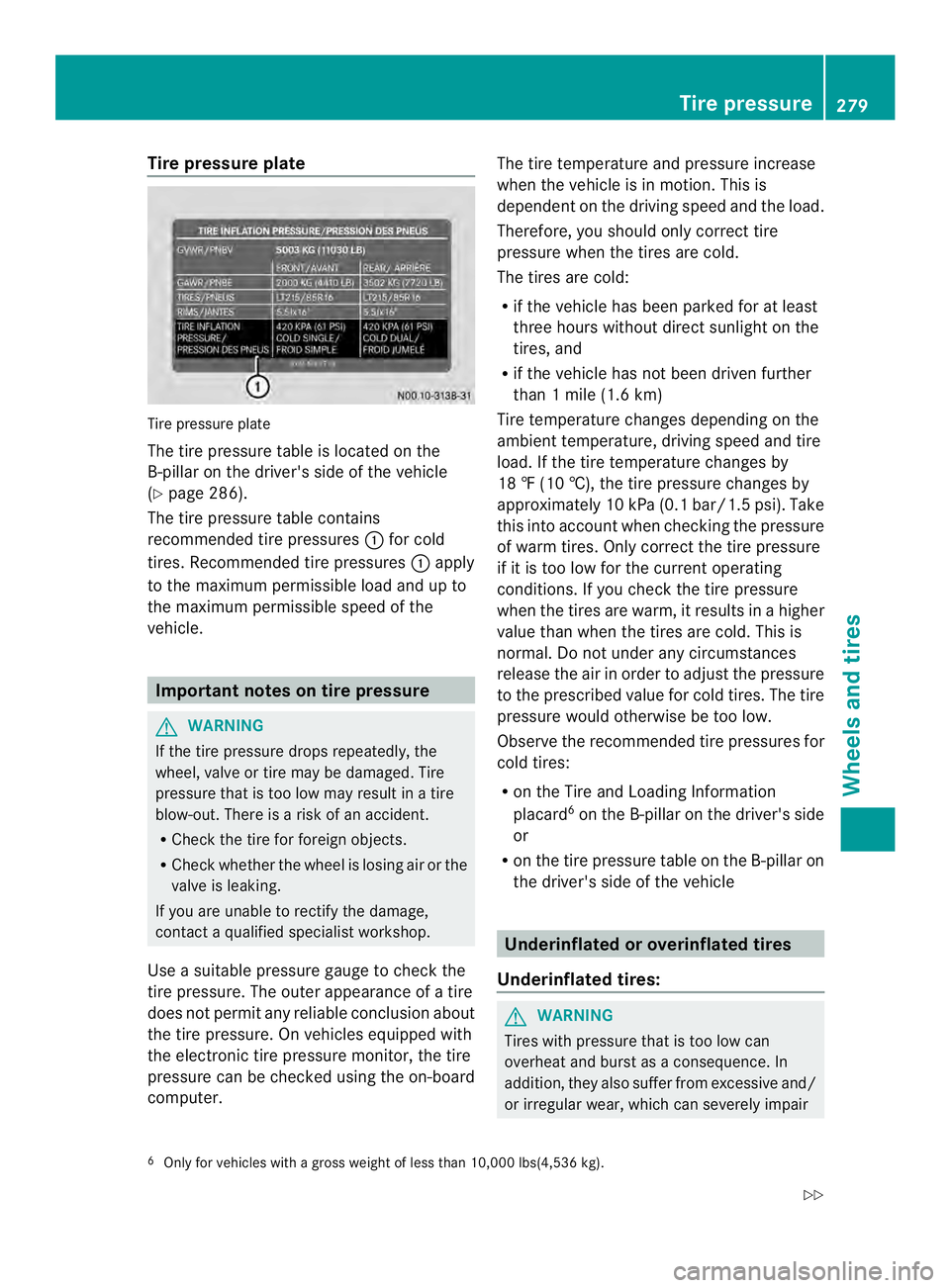
Tire pressure plate
Tire pressure plate
The tire pressure table is located on the
B-pillar on the driver's side of the vehicle
(Y page 286).
The tire pressure table contains
recommended tire pressures 0005for cold
tires. Recommended tire pressures 0005apply
to the maximum permissible load and up to
the maximum permissible speed of the
vehicle. Important notes on tire pressure
G
WARNING
If the tire pressure drops repeatedly, the
wheel, valve or tire ma ybe damaged. Tire
pressure that is too low may result in a tire
blow-out. There is a risk of an accident.
R Check the tire for foreign objects.
R Check whether the wheel is losing air or the
valve is leaking.
If you are unable to rectify the damage,
contact a qualified specialist workshop.
Use a suitable pressure gauge to chec kthe
tire pressure. The outer appearance of a tire
does not permit any reliable conclusion about
the tire pressure. On vehicles equipped with
the electronic tire pressure monitor, the tire
pressure can be checked using the on-board
computer. The tire temperature and pressure increase
when the vehicle is in motion. This is
dependent on the driving speed and the load.
Therefore, you should only correct tire
pressure when the tires are cold.
The tires are cold:
R
if the vehicle has been parked for at least
three hours without direct sunlight on the
tires, and
R if the vehicle has not been driven further
than 1 mile (1.6 km)
Tire temperature changes depending on the
ambient temperature, driving speed and tire
load. If the tire temperature changes by
18 ‡(10 †), the tire pressure changes by
approximately 10 kPa (0. 1bar/1. 5psi). Take
this into account when checking the pressure
of warm tires. Only correct the tire pressure
if it is too low for the current operating
conditions. If you check the tire pressure
when the tires are warm, it results in a higher
value than when the tires are cold. This is
normal. Do not under any circumstances
release the air in order to adjust the pressure
to the prescribed value for cold tires. The tire
pressure would otherwise be too low.
Observe the recommended tire pressures for
cold tires:
R on the Tire and Loading Information
placard 6
on the B-pillar on the driver's side
or
R on the tire pressure table on the B-pillar on
the driver's side of the vehicle Underinflated or overinflated tires
Underinflated tires: G
WARNING
Tires with pressure that is too low can
overheat and burst as a consequence. In
addition, they also suffer from excessive and/
or irregularw ear, which can severely impair
6 Only for vehicles with a gross weight of less than 10,00 0lbs(4,536 kg). Tire pressure
279Wheels and tires
Z
Page 296 of 334
is bar. 100 kilopascals (kPa) are the
equivalen tof1bar.
Load index
In addition to the load bearing index, a load
index can be stamped onto the sidewall of the
tire. It specifies the load-bearing capacity of
the tire more precisely.
Curb weight
The weigh tofavehicle with standard
equipment including the maximu mfilling
capacity of fuel, oil, and coolant. It also
includes the air-conditionin gsystem and
optional equipmen tifthese are installed on
the vehicle, but does not include passengers
or luggage.
Maximum tire load
The maximum tire load in kilograms or
pounds is the maximum weight for which a
tire is approved.
Maximum permissible tire pressure
Maximum permissible tire pressure for one
tire.
Maximum load on one tire
Maximum load on one tire. This is calculated
by dividing the maximum axle load of one axle
by two.
PSI (Pounds per square inch)
Standard unit of measurement for tire
pressure.
Aspect ratio
Relationship between tire height and width in
percent.
Tire pressure
Pressure inside the tire applying an outward
force to every square inch of the tire's
surface. Tire pressure is specified in pounds
per square inch (psi), in kilopascal (kPa) or in
bar. Tire pressure should only be corrected
when the tires are cold. Cold tire pressure
The tires are cold:
R if the vehicle has been parked for at least
three hours without direct sunlight on the
tires, and
R if the vehicle has not been driven further
than 1 mile (1.6 km)
Tire tread
The part of the tire that comes into contact
with the road.
Tire bead
The tire bead ensures that the tire sits
securely on the wheel. There are several steel
wires in the bead to prevent the tire from
coming loose from the wheel rim.
Sidewall
The part of the tire between the tread and the
tire bead.
Weight of optional extras
The combined weight of those optional extras
that weigh more than the replaced standard
parts and more than 2.3 kg (5 lbs). These
optional extras, such as high-performance
brakes, level control, a roof rack or a high-
performance battery, are not included in the
curb weight and the weight of the
accessories.
TIN (Tire Identification Number)
Au nique identificatio nnumbe rwhich can be
used by a tire manufacturer to identify tires,
for example for a product recall, and thus
identify the purchasers. The TIN is composed
of the manufacturer identification code, tire
size, tire model code and manufacturing date.
Load bearing index
The load bearing index (also load index) is a
code that contains the maximum load bearing
capacity of a tire. 294
What you should know about wheels and tiresWheels and tires
Page 304 of 334
and/or valve tool, warning triangle and
warning lamps in the vehicle.
X Pull away immediately.
This enables the tire sealan tto distribute
inside the tire and create a more effective
seal.
X After driving for approximately 3 minutes,
stop the vehicle at a suitable location, e.g.
at a car park or gas station.
X Check the tire pressure again.
The tire pressure must be at least
300 kPa (3.0 bar/43.5 psi). G
WARNING
If the required tire pressure is not reached
after driving for a short period, the tire is too
badly damaged. The tire sealant cannot repair
the tire in this instance. Damaged tires and a
tire pressure that is too low can significantly
impair the vehicle's braking and driving
characteristics. There is a risk of accident.
Do not continue driving. Contact a qualified
specialist workshop.
i The Mercedes-Benz Service24h
telephone numbers can be found on a
sticker in the driver's door entrance area
and in the vehicle Maintenance Booklet.
i If you check the tire pressure with the tire
inflation compressor, connect angled valve
adapter 0006on tire inflation compressor
hose 0026directly to the tire valve. The tire
pressure will increase when you switch the
tire inflation compressor on. You can
reduce the tire pressure by opening the
pressure release screw on pressure gauge
0023.
If the tire pressure is still at least 300 kPa
(3.0 bar/43.5 psi):
X If possible, inflate the tire to the
recommended tire pressure (Y page 278).
X Drive to the nearest qualified specialist
workshop as soon as possible and have the
tire and tire sealant 0019replaced. Changing wheels
Rotating the wheels
G
WARNING
Interchanging the front and rear wheels may
severely impair the driving characteristics if
the wheels or tires have different dimensions.
The wheel brakes or suspension components
may also be damaged. There is a risk of
accident.
Rotate front and rear wheels only if the wheels
and tires are of the same dimensions.
! On vehicles equipped with a tire pressure
monitor, electronic components are
located in the wheel.
Tire-mounting tools should not be used
near the valve. This could damage the
electronic components.
Only have tires changed at a qualified
specialist workshop.
Always observe the instructions and safety
notes in the "Mounting awheel" section
(Y page 303).
The wear patterns on the front and rear tires
differ, depending on the operating conditions.
Rotate the wheels before a clear wear pattern
has formed on the tires. Front tires typically
wear more on the shoulders and the rear tires
in the center.
If your vehicle's tire configuration allows, you
can rotate the wheels according to the
intervals in the tire manufacturer's warranty
book in your vehicle documents. If no
warranty book is available, the tires should be
rotated every 3,000 to 6,000 miles (5,000 to
10,000 km), or earlier if tire wear requires. Do
not change the direction of rotation.
Clean the contac tsurface softhe wheel and
the brake disc thoroughly every time a wheel
is rotated. Check the tire pressure and
reactivate the tire pressure monitor if
necessary. 302
Changing wheelsWheels and tires
Page 316 of 334
Genuine Sprinter parts
! Air bags and Emergency Tensioning
Devices, as well as control units and
sensors for these restraint systems, may be
installed in the following areas of your
vehicle:
R doors
R door pillars
R door sills
R seats
R cockpit
R instrument cluster
R center console
Do not install accessories such as audio
systems in these areas. Do not carry out
repairs or welding. You could impair the
operating efficiency of the restraint
systems.
Have aftermarket accessories installed at
a qualified specialist workshop. H
Environmental note
We supply reconditioned assembliesa nd
parts which are of the same quality as new
parts. The same New Vehicl eLimited
Warranty applies as for new parts.
We tes tgenuine Sprinter parts, as well as
conversion parts and accessories that have
been specifically approved for the type of
vehicle, for:
R reliability
R safety
R suitability
Despite ongoing market research, we are
unable to assess other parts. If individual or
official approval is given, we assume no
responsibility for use in Sprinter vehicles.
In some countries, certain parts are only
officially approved for installation or
modification if they comply with legal
requirements. All genuine Sprinter parts
satisfy these requirements. Make sure that all
parts are suitable for your vehicle. All authorized Sprinter Dealers maintain a
supply of genuine Sprinter parts for required
service and repair work. Also, the
strategically distributed parts delivery
centers provide quick and reliable parts
service.
Always specify the vehicle identification
number (VIN) and engin
enumbe rwhen
ordering genuine Sprinter parts
(Y page 315). Vehicle electronics
Tampering with the engine
electronics
G
WARNING
Always have work on the engine electronics
and related components carried out at a
qualified specialist workshop. Otherwise, the
vehicle's operating safety could be affected.
! Only have engine electronics and the
corresponding parts, such as control units,
sensors or connector leads, serviced in a
qualified specialist workshop. Otherwise,
the vehicle parts may wear more quickly.
This can lead to loss of the New Vehicle
Limited Warranty. Installing electrical or electronic
equipment
G
WARNING
You and others may damage your health due
to excessive electromagnetic radiation. By
using an external antenna, the possible health
risks of electromagnetic fields, which are
under discussion among the scientific
community, should be largely prevented.
Therefore, only have the exterior antenna
installed at a qualified specialist workshop.
Electrical and electronic devices may have a
detrimental effect on both the comfort and
the operating safety of the vehicle. If 314
Vehicle electronicsTechnical data