ignition MERCEDES-BENZ SPRINTER 2013 MY13 Operator’s Manual
[x] Cancel search | Manufacturer: MERCEDES-BENZ, Model Year: 2013, Model line: SPRINTER, Model: MERCEDES-BENZ SPRINTER 2013Pages: 334, PDF Size: 3.88 MB
Page 272 of 334
!
Always use new bolts when installing the
propeller shafts.
Observe the following before towing a vehicle
with a raised front or rear axle:
R the information on towing in the event of
malfunctions (Y page 269) and
R the important safety notes (Y page 268).
If the front axle is damaged, raise the vehicle
at the front axle and if the rear axle is
damaged, raise the vehicle at the rear axle.
Towing If the front axle is raised, the vehicle may be
towed
amaximum of 30 miles (50 km). For a
towing distance of over 30 miles (50 km), you
must remove the propeller shafts to the
drive naxles.
X Turn the key to position 2in the ignition
lock.
X Depress the brake pedal and keep it
depressed.
X Shift the automatic transmission to
position N.
X Release the brake pedal.
X Release the parking brake.
X Turn the key to position 1in the ignition
lock and leave it in this position.
X Switch on the hazard warning lamps
(Y page 93).
X If the front axle is raised, do not exceed the
towing speed of 30 mph (50 km/h) and the
towing distance of 30 miles (50 km). Towing the vehicle with both axles on
the ground
Important safety notes G
WARNING
You can no longe rstee rthe vehicle if the
steering wheel lock has been engaged. There
is a risk of an accident. Always switch off the ignition when towing the
vehicle with a tow cable or a tow bar.
! Do not exceed a towing speed of
31 mph (50 km/h). You could otherwise
damage the transmission.
! Always use new bolts when installing the
propeller shafts.
Before towing the vehicle, observe the
following:
R the information on towing in the event of
malfunctions (Y page 269) and
R the important safety notes (Y page 268).
Towing You may only tow the vehicle a maximum
distance of 30 miles (50 km). For a towing
distance of over 30 miles (50 km), you must
remove the propeller shafts to the driven
axles.
X
Turn the key to position 2in the ignition
lock.
X Depress the brake pedal and keep it
depressed.
X Shift the automatic transmission to
position N.
X Release the brake pedal.
X Release the parking brake.
X Leave the key in position 2in the ignition
lock.
X Switch on the hazard warning lamps
(Y page 93).
X Do not exceed the towing speed of
30 mph (50 km/h) and the towing distance
of 30 miles (50 km). Recovering
avehicle that is stuck
! Pull away smoothly, slowly, and in a
straigh tline when pulling out a vehicle that
has become stuck. Excessive tractive
power could damage the vehicles. 270
Tow-starting and towing awayBreakdown assistance
Page 273 of 334
If the drive wheels get trapped on loose or
muddy ground, recover the vehicle with the
utmost care. This is especially the case if the
vehicle is laden.
Never attempt to recover a vehicle with a
traile rattached.
Pull ou tthe vehicle backwards, if possible,
using the tracks it made when it became
stuck. Transporting the vehicle
! Only lash the vehicle down by the wheels
or wheel rims, not by parts of the vehicle
such as axle or steering components.
Otherwise, the vehicle could be damaged.
The towing eye or trailer tow hitch can be
used to pull the vehicle onto a trailer or
transporter if you wish to transport it.
X Turn the key to position 2in the ignition
lock.
X Move the selector lever of the automatic
transmission to position N.
If the vehicle is loaded:
X Apply the parking brake.
X Move the selector lever of the automatic
transmission to position P.
X Turn the key to position 0in the ignition
lock and remove it.
X Lash down the vehicle. Tow-starting (emergency engine
starting)
Vehicles with automatic transmission !
Vehicles with automatic transmission
must not be tow-started. You could
otherwise damage the automatic
transmission.
Information on "Jump-starting" can be found
at the beginning of the "Breakdown
assistance" section (Y page 267). Electrical fuses
G
WARNING
Only use fuses that have been approved for
your vehicle and which have the correct fuse
rating for the systems concerned. Do not
repair or bypass defective fuses. Acircuit
overload could otherwise cause afire. Have
the cause determined and rectified at a
qualified specialist workshop.
! Only use fuses that have been approved
for Sprinter vehicles and that have the
required fuse rating for the systems
concerned. Components or systems could
otherwise be damaged.
The fuses in your vehicle switch off defective
power circuits. If a fuse blows, all the
components on the circuit and their functions
will cease to operate.
Blown fuses must be replaced with fuses of
the same rating, which you can recognize by
the color and fuse rating.
Observe the information about fuse rating in
the fuse allocation chart.
You can obtain advice fro maqualified
specialist workshop.
The fuse allocation chart and other
information on the fuses can be found in the
"Fuse allocation chart" supplement. Electrical fuses
271Breakdown assistance Z
Page 284 of 334
The tire pressure monitor does not warn you
if a tire pressure is incorrect. Observe the
notes on the recommended tire pressure
(Y page 278).
The tire pressure monitor is not able to warn
you of a sudden loss of pressure, e.g.
following penetration by a foreign object .In
this event, brake the vehicle until it comes to
a standstill. Do not carry ou tany sudden
steering maneuvers.
The tire pressure monitor has a yellow 000A
warning lamp in the instrument cluster for
indicating pressure loss/malfunctions (USA)
or pressure loss (Canada). Depending on how
the warning lamp flashes or lights up, an
underinflated tire or a malfunction in the tire
pressure monitor is displayed:
R if the 000A warning lamp is li tcontinuously,
the tire pressure on one or more tires is
significantly too low. The tire pressure
monitor is not malfunctioning.
R USA only: if the 000Awarning lamp flashes
for 60 seconds and then remains lit
constantly, the tire pressure monitor is
malfunctioning.
Only vehicles with steerin gwheel buttons: the
on-board computer displays information on
tire pressure. After a few minutes of driving,
the current tire pressure of each tire is shown
in the on-board computer.
USA only: if the tire pressure monitor is
malfunctioning, it may be more than
10 minutes before the malfunction is shown.
The 000A tire pressure warning lamp flashes
for 60 seconds and then remains lit. When the
malfunction has been rectified, the 000Atire
pressure warning lamp goes out after a few
minutes of driving.
The tire pressure values indicated by the on-
board computer may differ from those
measured at a gas station with a pressure
gauge. The tire pressures shown by the on-
board computer refer to those measured at
sea level. At high altitudes, the tire pressure
value indicated by a pressure gauge are
higher than those shown by the on-board computer. In this case, do not reduce the tire
pressures.
If radio transmitting equipment (e.g. wireless
headphones, two-way radios) is operated
inside the vehicle or in the vicinity of the
vehicle, this can interfere with the operation
of the tire pressure monitor.
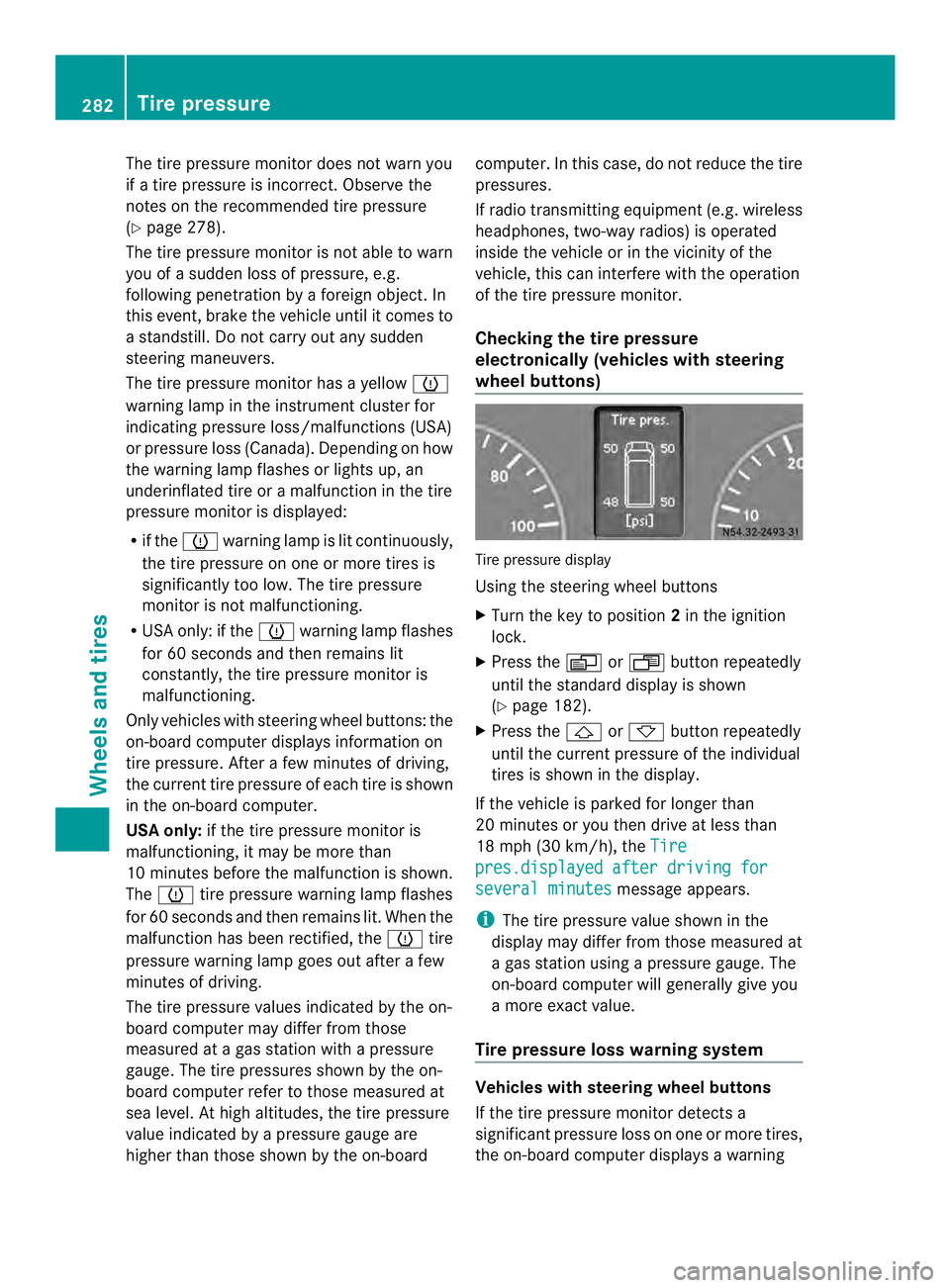
Checking the tire pressure
electronically (vehicles with steering
wheel buttons)
Tire pressure display
Using the steering wheel buttons
X
Turn the key to position 2in the ignition
lock.
X Press the 0010or0007 button repeatedly
until the standard display is shown
(Y page 182).
X Press the 0001or0009 button repeatedly
until the current pressure of the individual
tires is shown in the display.
If the vehicle is parked for longer than
20 minutes or you then drive at less than
18 mph (30 km/h), the Tire pres.displayed after driving for
several minutes message appears.
i The tire pressure value shown in the
display may differ from those measured at
a gas station using a pressure gauge. The
on-board computer will generally give you
a more exact value.
Tire pressure loss warning system Vehicles with steering wheel buttons
If the tire pressure monitor detects a
significant pressure loss on one or more tires,
the on-board computer displays a warning282
Tire pressureWheels and tires
Page 285 of 334
message. The
000Atire pressure loss warning
lamp in the instrument cluster (Y page 218)
lights up.
The tire pressure is show nin2red rectangles.
The pressure of the tire concerned is shown
in one of the two rectangles (Y page 192).
Additionally, a warning tone sounds.
Each tire that is affected by a significant loss
of pressure is highlighted in the pressure
display.
Restarting the tire pressure monitor When you restart the tire pressure monitor,
the currently set tire pressure are taken as
reference values for monitoring.
In most cases, the tire pressure monitor
detects the new reference values
automatically, e.g. after you have:
R changed the tire pressure
R changed wheels or tires
R installed new wheels or tires
However, you can also define reference
values manually as described here.
Before restarting the tire pressure
monitor:
X Set the tire pressure to the value
recommended on the Tire and Loading
Information placard or the tire pressure
table on the B-pillar on the driver's side
(Y page 278).
Observe the notes on tire pressure when
doing so (Y page 278).
X Make sure that the tire pressure is correct
on all four wheels. Restarting the tire pressure monitor
(vehicles without steering wheel
buttons):
X
Turn the key to position 2in the ignition
lock.
X Press the 0004menu button on the
instrument cluster repeatedly until the
display shows the following message:
+CAL- TPMS X
Press the 000Ebutton on the instrument
cluster.
The display shows:
OK TPMS The tire pressure monitor activation
process has begun. The tire pressures
measured for the individual wheels are
stored as the new reference values,
provided that the tire pressure monitor
considers them to be plausible.
If you wish to cancel the restart:
X Press the 000Fbutton or the 0004menu button
on the instrument cluster.
The activation process is canceled
automatically if 30 seconds elapse with no
input.
Restarting the tire pressure monitor
(vehicles with steering wheel buttons):
X Turn the key to position 2in the ignition
lock.
X Press the 0010or0007 button on the
steering wheel repeatedly until the
standard display is shown (Y page 182).
X Press the 0001or0009 button on the
steering wheel repeatedly until the current
pressure of the individual tires is displayed
or the display shows the following
message:
Tire pres. displayed after driving
for several minutes
X
Press the 0007reset button on the
instrument cluster.
The display shows the following message: Tire pressure
283Wheels and tires Z
Page 303 of 334
X
Loosen angled valve adapter 001Dfrom tire
valve 001Cand remove it.
X Screw in the valve core again using the
valve tool and remove the valve tool
through the opening.
i If the valve insert is damaged or lost when
it is unscrewed, you can use the valve insert
from tire sealant bottle 0019after you have
used the tire sealant.
X Unscrew the valve insert from the valve of
tire sealant bottle 0019using the valve
extractor.
X Push angled valve adapter 0006located on
hose 0026of the tire inflatio ncompressor as
far as it will go ontot ire valve001Cand clamp
it in place.
X Press tire inflation compressor switch 0005
to Iand inflate the tire.
If possible, inflate the tire to the
recommended tire pressure. You will find a
table of recommended tir epressure on the
Tire and Loading Information placard 10
or
the tire pressure plate on the B-pillar on the
driver's side of the vehicle (Y page 278).
X Then press 0on tire inflation compressor
switch 0005.
The tire inflation compresso ris
deactivated.
X Screw the valve cap onto tire valve 001C.
X Observe the following notes and
instructions:
R
Tire pressure of 300 kPa (3.0 bar/
43.5 psi) not reached (Y page 301).
R Tire pressure of 300 kPa (3.0 bar/
43. 5psi) reached (Y page 301).
Tire pressure of 300 kPa (3.0 bar/
43.5 psi) not reached G
WARNING
If the specified tire pressure is not reached,
the tire is too severely damaged.T he tire
sealant cannot offer assistance with a flat tire in this case. Damaged tires as well as tire
pressure that is too low can impair the braking
and driving characteristics. There is a risk of
an accident.
Do not drive any further. Notify a qualified
specialist workshop.
i The Mercedes-Benz Service24h
telephone numbers can be found on a
sticker in the driver's door entrance area
and in the vehicle Maintenance Booklet.
Tire pressure of 300 kPa (3.0 bar/
43.5 psi) reached G
WARNING
At ire temporarily sealed with tire sealant
impairs the driving characteristics and is not
suitable for higher speeds. There is a risk of
accident.
You should therefore adapt your driving style
accordingly and drive carefully. Do not exceed
the specified maximum speed with a tire that
has been repaired using tire sealant.
The maximum speed for a tire sealed with tire
sealant is 50 mph (80 km/h).
The "max. 50 mph" (80 km/h) sticker must
be affixed within the driver's field of vision.
X Turn the pressure release screw on
pressure gauge 0023counter-clockwise and
bleed the system.
X Turn the key in the ignition lock to
position 0.
X Pull connector 0024on the tire inflation
compressor out of the 12 V socket.
X Clean the valve core extractor with clean
water.
X Remove angled valve adapter 0006from valve
0018 of tire sealant filler bottle 0019and screw
the valve cap onto valve 0018.
X Stow the tire inflation compressor, tire
sealant bottle 0019with valve core extractor
10 Only for vehicles with a gross vehicle weight of less than 10,000 lbs(4,536 kg). Flat tire
301Wheels and tires Z