ignition MERCEDES-BENZ SPRINTER 2013 MY13 Operator’s Manual
[x] Cancel search | Manufacturer: MERCEDES-BENZ, Model Year: 2013, Model line: SPRINTER, Model: MERCEDES-BENZ SPRINTER 2013Pages: 334, PDF Size: 3.88 MB
Page 218 of 334
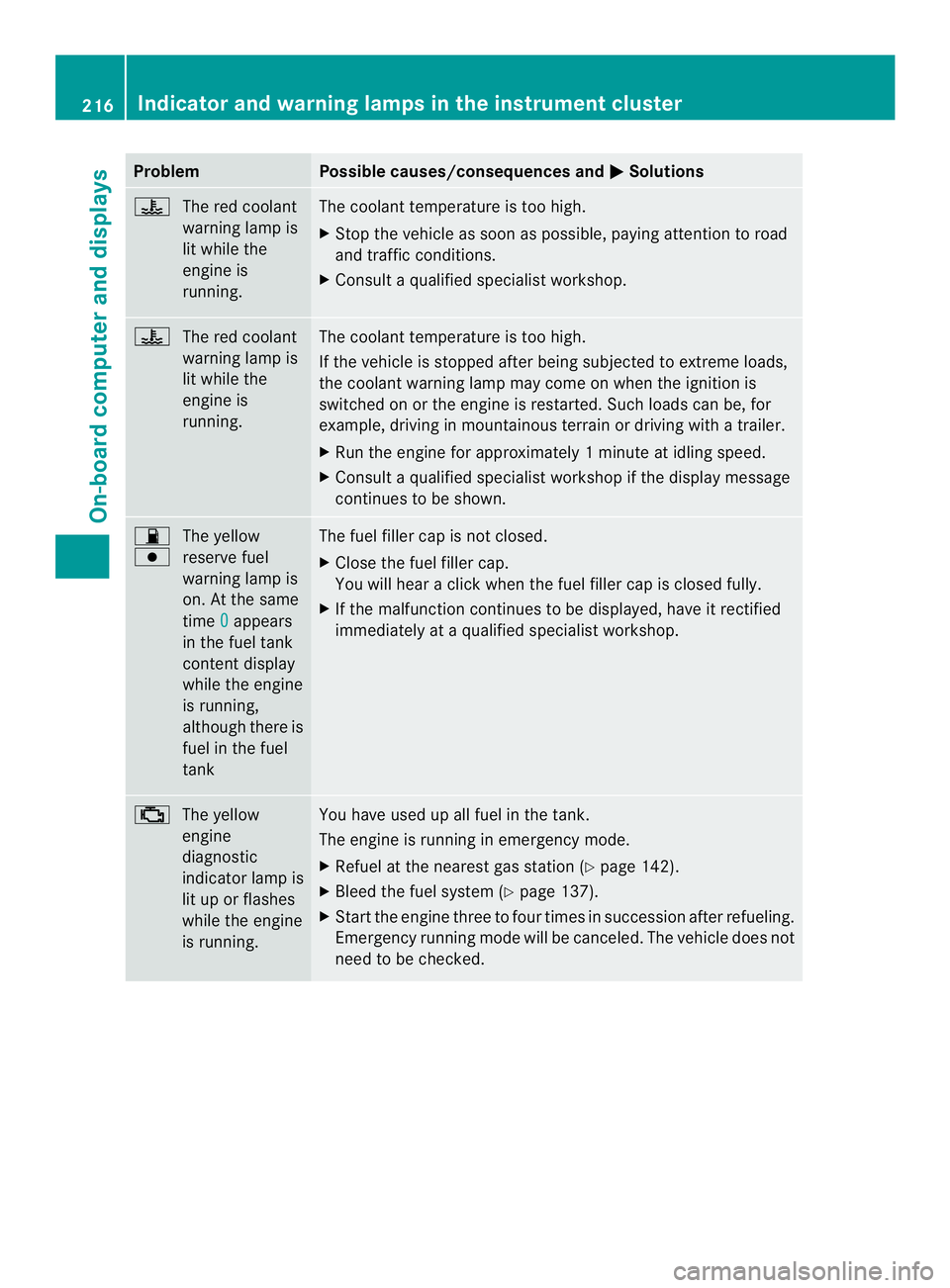
Problem Possible causes/consequences and
0004 Solutions
0014
The red coolant
warning lamp is
lit while the
engine is
running. The coolant temperature is too high.
X
Stop the vehicle as soon as possible, paying attention to road
and traffic conditions.
X Consult a qualified specialist workshop. 0014
The red coolant
warning lamp is
lit while the
engine is
running. The coolant temperature is too high.
If the vehicle is stopped after being subjected to extreme loads,
the coolant warning lamp may come on when the ignition is
switched on or the engine is restarted. Such loads can be, for
example, driving in mountainous terrain or driving with a trailer.
X
Run the engine for approximately 1minute at idling speed.
X Consult a qualified specialist workshop if the display message
continues to be shown. 0016
0006
The yellow
reserve fuel
warning lamp is
on. At the same
time
0 appears
in the fuel tank
conten tdisplay
while the engine
is running,
although there is
fuel in the fuel
tank The fuel filler cap is not closed.
X
Close the fuel filler cap.
You will hear a clic kwhen the fuel filler cap is closed fully.
X If the malfunction continues to be displayed, have it rectified
immediately at a qualified specialist workshop. 0018
The yellow
engine
diagnostic
indicator lamp is
lit up or flashes
while the engine
is running. You have used up all fuel in the tank.
The engine is running in emergency mode.
X
Refuel at the nearest gas station (Y page 142).
X Bleed the fuel system (Y page 137).
X Start the engine three to four times in succession after refueling.
Emergency running mode will be canceled. The vehicle does not
need to be checked. 216
Indicator and warning lamps in the instrument clusterOn-board computer and displays
Page 219 of 334
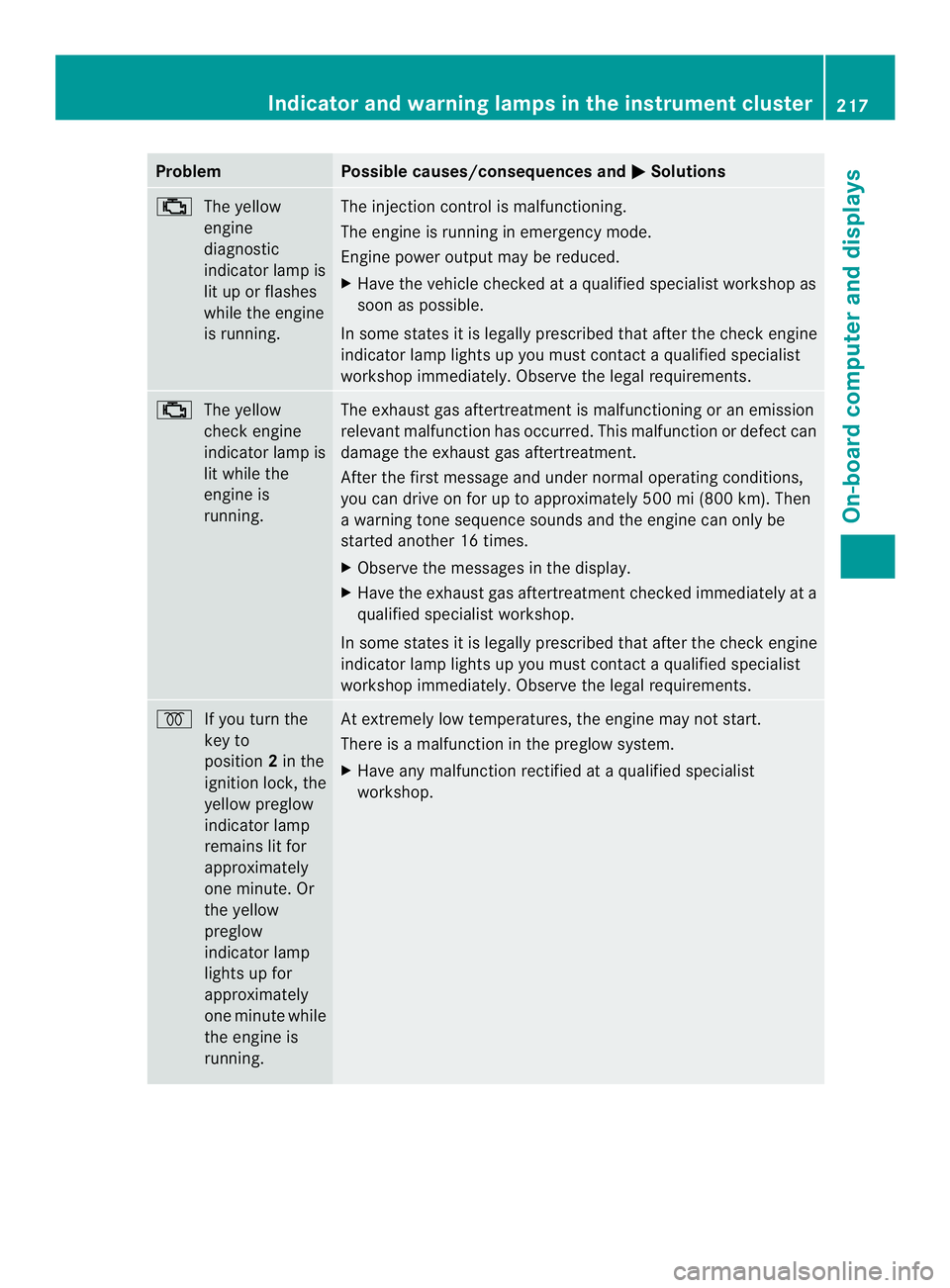
Problem Possible causes/consequences and
0004 Solutions
0018
The yellow
engine
diagnostic
indicator lamp is
lit up or flashes
while the engine
is running. The injection control is malfunctioning.
The engine is running in emergency mode.
Engine power output may be reduced.
X
Have the vehicle checked at a qualified specialist workshop as
soon as possible.
In some states it is legally prescribed that after the check engine
indicator lamp lights up you must contact a qualified specialist
workshop immediately. Observe the legal requirements. 0018
The yellow
check engine
indicator lamp is
lit while the
engine is
running. The exhaust gas aftertreatment is malfunctioning or an emission
relevant malfunction has occurred. This malfunction or defect can
damage the exhaust gas aftertreatment.
After the first message and under normal operating conditions,
you can drive on for up to approximately 500 mi (800 km). Then
a warning tone sequence sounds and the engine can only be
started another 16 times.
X
Observe the messages in the display.
X Have the exhaust gas aftertreatment checked immediately at a
qualified specialist workshop.
In some states it is legally prescribed that after the check engine
indicator lamp lights up you must contact a qualified specialist
workshop immediately. Observe the legal requirements. 000D
If you turn the
key to
position 2in the
ignition lock, the
yellow preglow
indicator lamp
remains lit for
approximately
one minute. Or
the yellow
preglow
indicator lamp
lights up for
approximately
one minute while
the engine is
running. At extremely low temperatures, the engine may not start.
There is a malfunction in the preglow system.
X
Have any malfunction rectified at a qualified specialist
workshop. Indicator and warning lamps in the instrument cluster
217On-board computer and displays Z
Page 220 of 334
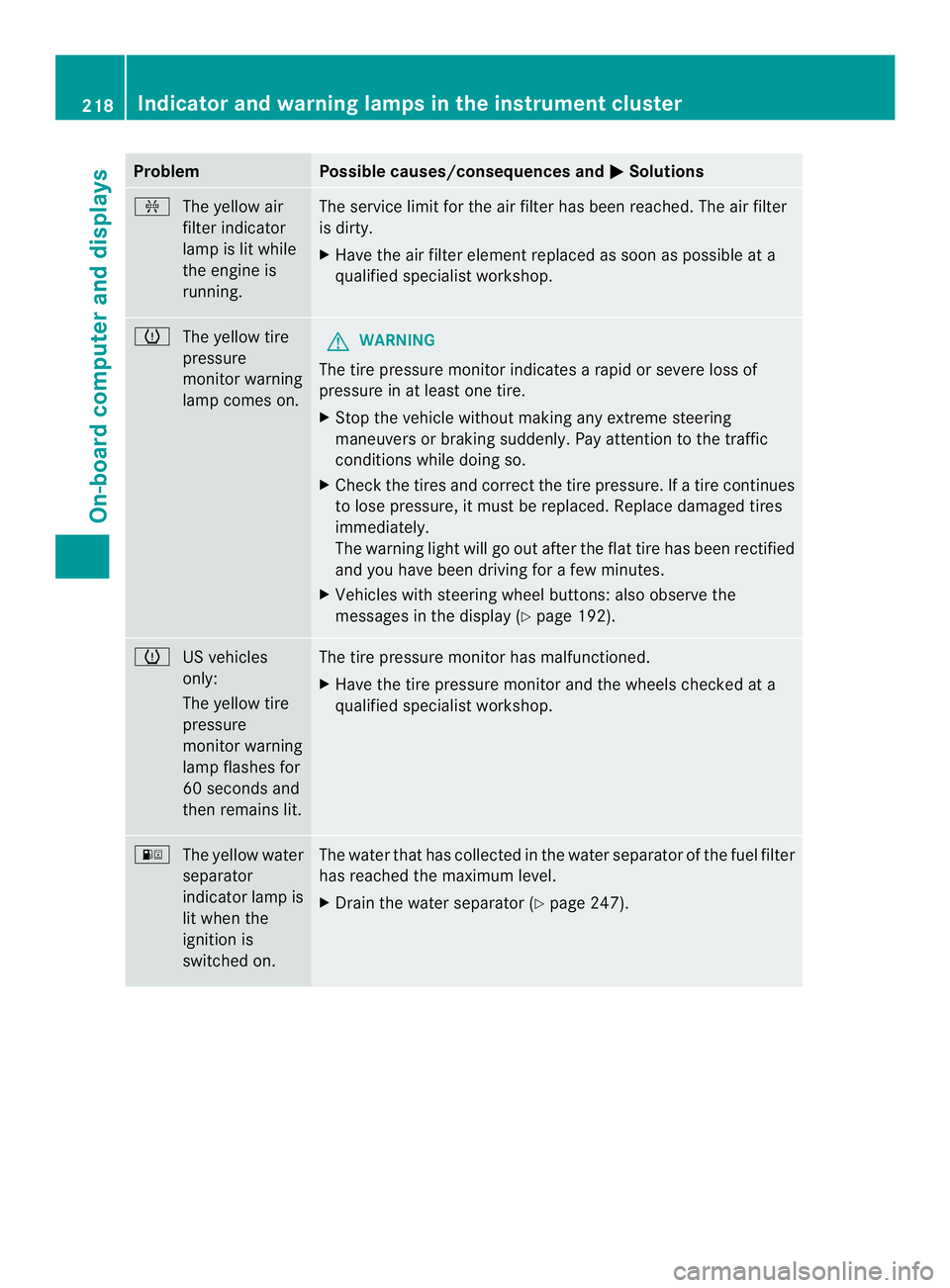
Problem Possible causes/consequences and
0004 Solutions
0013
The yellow air
filter indicator
lamp is lit while
the engine is
running. The service limit for the air filter has been reached. The air filter
is dirty.
X
Have the air filter element replaced as soon as possible at a
qualified specialist workshop. 000A
The yellow tire
pressure
monitor warning
lamp comes on. G
WARNING
The tire pressure monitor indicates a rapid or severe loss of
pressure in at least one tire.
X Stop the vehicle without making any extreme steering
maneuvers or braking suddenly. Pay attention to the traffic
conditions while doing so.
X Check the tires and correctt he tire pressure. If a tire continues
to lose pressure, it must be replaced. Replace damaged tires
immediately.
The warning light will go out after the flat tire has been rectified
and you have been driving for a few minutes.
X Vehicles with steering wheel buttons: also observe the
messages in the display (Y page 192).000A
US vehicles
only:
The yellow tire
pressure
monitor warning
lamp flashes for
60 seconds and
then remains lit. The tire pressure monitor has malfunctioned.
X
Have the tire pressure monitor and the wheels checked at a
qualified specialist workshop. 000E
The yellow water
separator
indicator lamp is
lit when the
ignition is
switched on. The water that has collected in the water separator of the fuel filter
has reached the maximum level.
X
Drain the water separator (Y page 247).218
Indicator and warning lamps in the instrument clusterOn-board computer and displays
Page 221 of 334
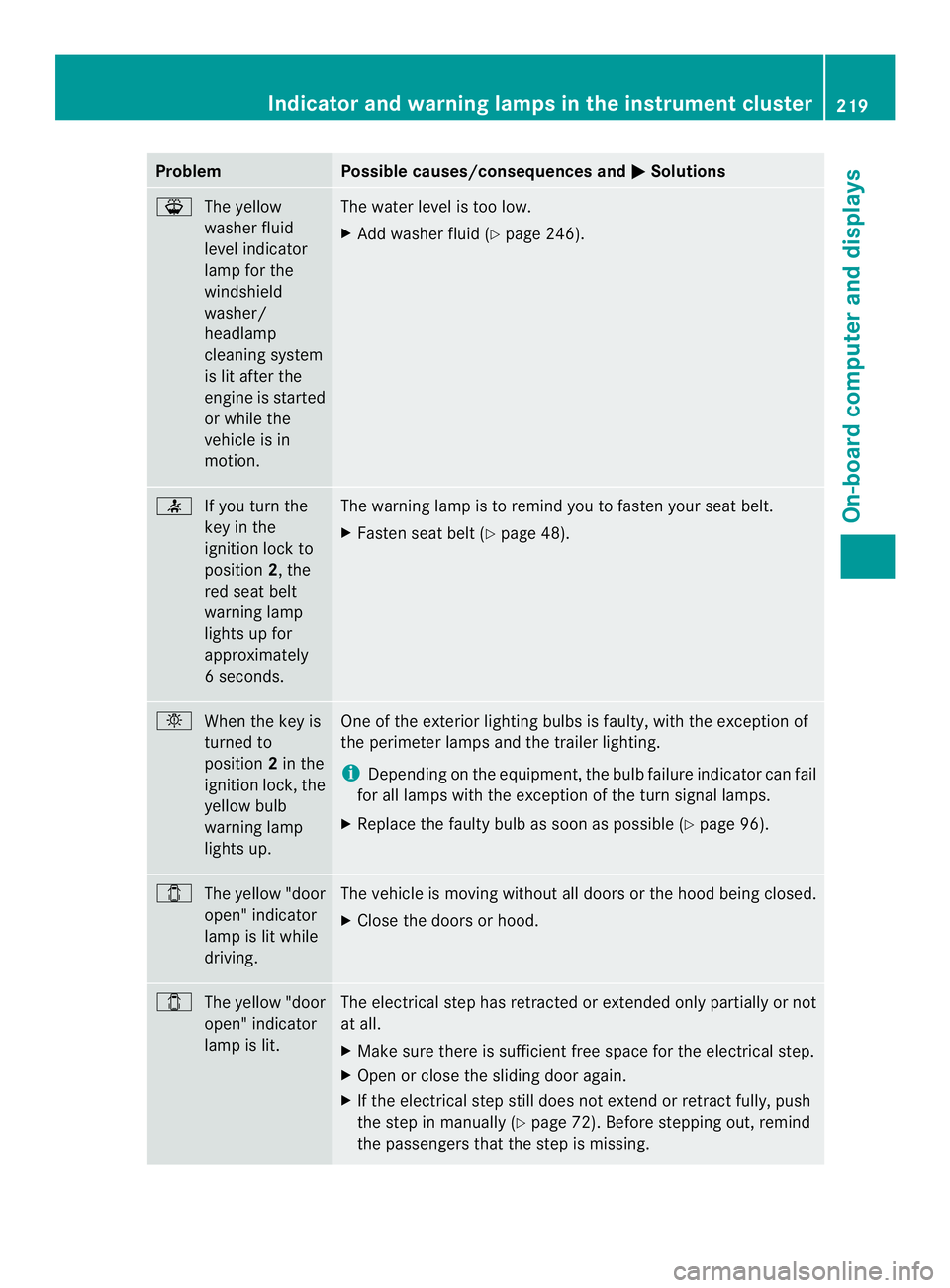
Problem Possible causes/consequences and
0004 Solutions
000F
The yellow
washer fluid
level indicator
lamp for the
windshield
washer/
headlamp
cleaning system
is lit after the
engine is started
or while the
vehicle is in
motion. The water level is too low.
X
Add washer fluid (Y page 246). 0014
If you turn the
key in the
ignition lock to
position 2, the
red seat belt
warning lamp
lights up for
approximately
6s econds. The warning lamp is to remind you to fasten your seat belt.
X
Fasten seat belt (Y page 48). 0002
When the key is
turned to
position 2in the
ignition lock, the
yellow bulb
warning lamp
lights up. One of the exterior lighting bulbs is faulty, with the exception of
the perimeter lamps and the trailer lighting.
i
Depending on the equipment, the bulb failure indicator can fail
for all lamps with the exception of the turn signal lamps.
X Replace the faulty bulb as soon as possible (Y page 96).0004
The yellow "door
open" indicator
lamp is lit while
driving. The vehicle is moving without all doors or the hood being closed.
X
Close the doors or hood. 0004
The yellow "door
open" indicator
lamp is lit. The electrical step has retracted or extended only partially or not
at all.
X Make sure there is sufficien tfree space for the electrical step.
X Open or close the sliding door again.
X If the electrical step still does not extend or retract fully, push
the step in manually (Y page 72). Before stepping out, remind
the passengers that the step is missing. Indicator and warnin
glamps in the instrument cluster
219On-board computer and displays Z
Page 230 of 334
X
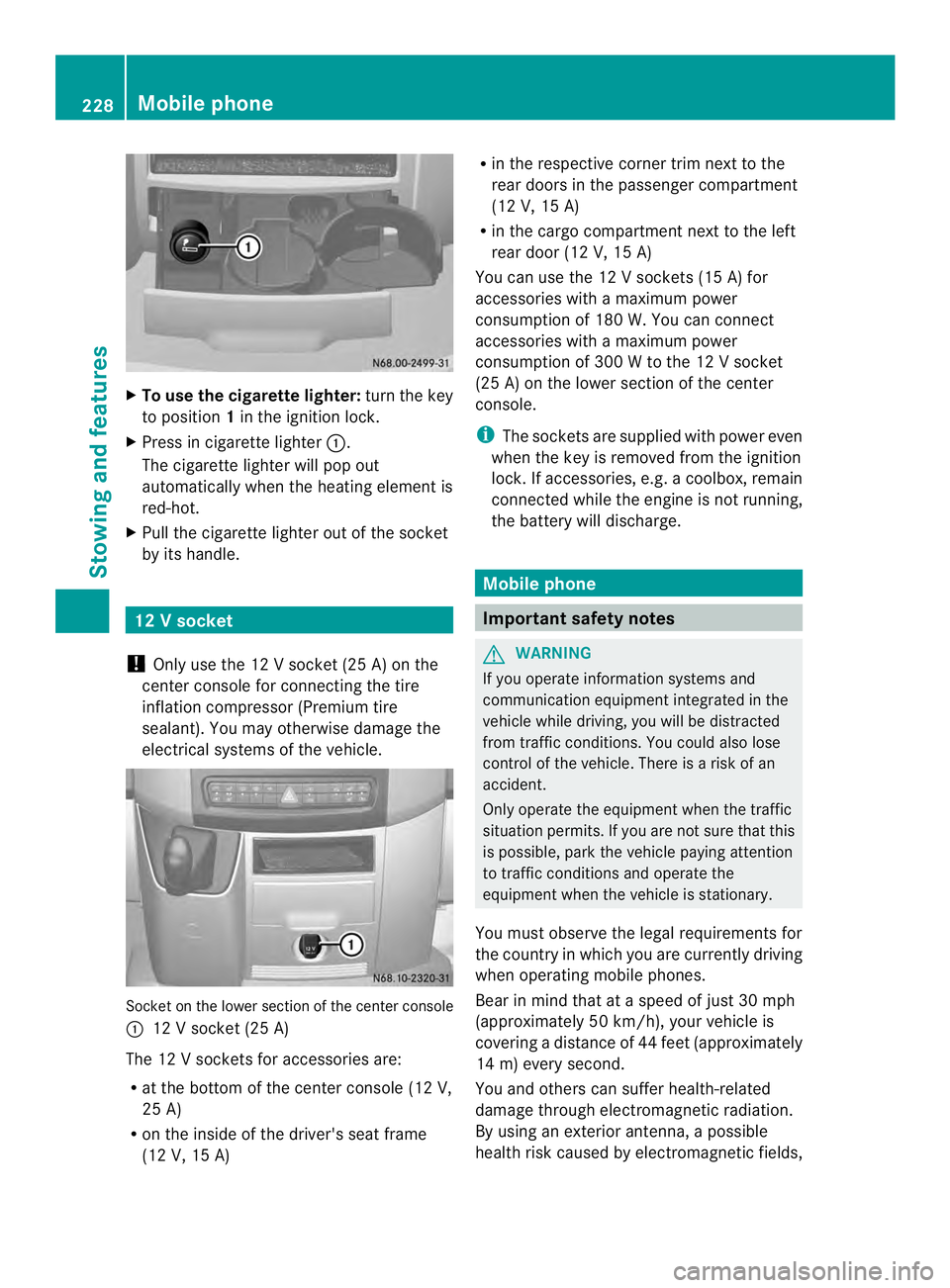
To use the cigarette lighter: turn the key
to position 1in the ignition lock.
X Press in cigarette lighter 0005.
The cigarette lighte rwill pop out
automatically when the heatin gelemen tis
red-hot.
X Pull the cigarette lighter out of the socket
by its handle. 12
Vsocket
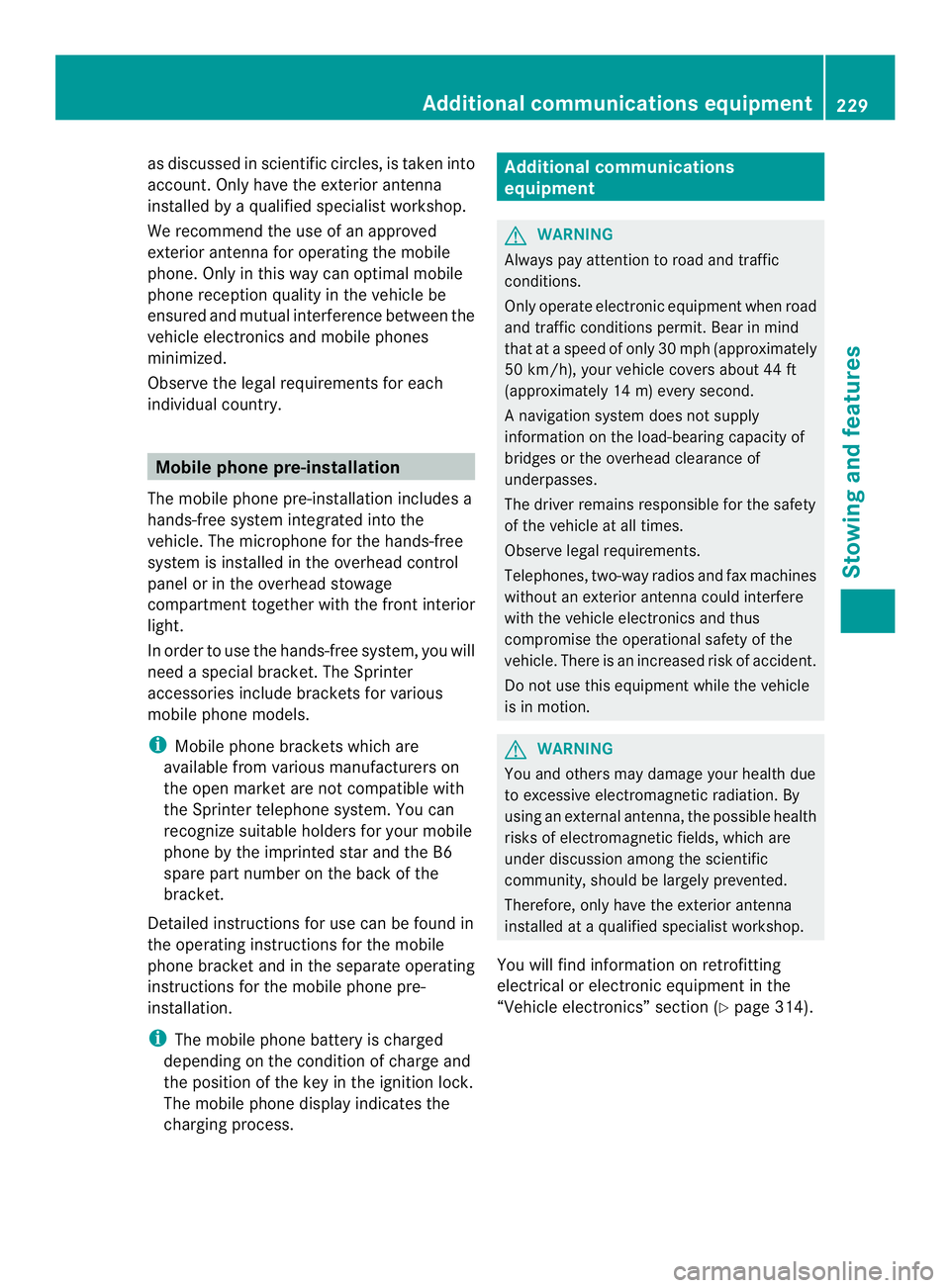
! Only use the 12 V socket (25 A) on the
center console for connecting the tire
inflatio ncompressor (Premium tire
sealant). You may otherwise damage the
electrical systems of the vehicle. Socket on the lower section of the center console
0005 12 V socket (25 A)
The 12 Vsockets for accessories are:
R at the bottom of the center console (12 V,
25 A)
R on the inside of the driver's seat frame
(12 V, 15 A) R
in the respective corner trim next to the
rear doors in the passenger compartment
(12 V, 15 A)
R in the cargo compartment next to the left
rear door (12 V, 15 A)
You can use the 12 V sockets (15 A) for
accessories with a maximu mpower
consumption of 180 W. You can connect
accessories with a maximum power
consumption of 300 W to the 12 V socket
(25 A) on the lower section of the center
console.
i The sockets are supplied with power even
when the key is removed from the ignition
lock. If accessories, e.g. a coolbox, remain
connected while the engine is not running,
the battery will discharge. Mobile phone
Important safety notes
G
WARNING
If you operate information systems and
communication equipment integrated in the
vehicle while driving, you will be distracted
from traffic conditions. You could also lose
control of the vehicle. There is a risk of an
accident.
Only operate the equipment when the traffic
situation permits. If you are not sure that this
is possible, park the vehicle paying attention
to traffic conditions and operate the
equipment when the vehicle is stationary.
You must observe the legal requirements for
the country in which you are currently driving
when operating mobile phones.
Bear in mind that at a speed of just 30 mph
(approximately 50 km/h), your vehicle is
covering a distance of 44 feet (approximately
14 m) every second.
You and others can suffer health-related
damage through electromagnetic radiation.
By using an exterior antenna, a possible
health risk caused by electromagnetic fields, 228
Mobile phoneStowing and features
Page 231 of 334
as discussed in scientific circles, is taken into
account. Only have the exterior antenna
installed by a qualified specialist workshop.
We recommend the use of an approved
exterior antenna for operating the mobile
phone. Only in this way can optimal mobile
phone reception quality in the vehicle be
ensured and mutual interference between the
vehicle electronics and mobile phones
minimized.
Observe the legal requirements for each
individual country. Mobile phone pre-installation
The mobile phone pre-installatio nincludes a
hands-free system integrated into the
vehicle. The microphone for the hands-free
system is installed in the overhead control
panel or in the overhead stowage
compartment together with the front interior
light.
In order to use the hands-free system, you will
need a special bracket. The Sprinter
accessories include brackets for various
mobile phone models.
i Mobile phone brackets which are
available from various manufacturers on
the open market are not compatible with
the Sprinter telephone system .You can
recognize suitable holders for your mobile
phone by the imprinted star and the B6
spare part number on the back of the
bracket.
Detailed instructions for use can be found in
the operating instructions for the mobile
phone bracket and in the separate operating
instructions for the mobile phone pre-
installation.
i The mobile phone battery is charged
depending on the condition of charge and
the position of the key in the ignition lock.
The mobile phone display indicates the
charging process. Additional communications
equipment
G
WARNING
Always pay attention to road and traffic
conditions.
Only operate electronic equipment when road
and traffic conditions permit. Bear in mind
that at a speed of only 30 mph (approximately
50 km/h), your vehicle covers about 44 ft
(approximately 14 m) every second.
An avigation system does no tsupply
informatio nonthe load-bearing capacity of
bridges or the overhead clearance of
underpasses.
The driver remains responsible for the safety
of the vehicle at all times.
Observe legal requirements.
Telephones, two-way radios and fax machines
without an exterior antenna could interfere
with the vehicle electronicsa nd thus
compromise the operational safety of the
vehicle. There is an increased ris kofaccident.
Do not use this equipment while the vehicle
is in motion. G
WARNING
You and others may damage your health due
to excessive electromagnetic radiation. By
using an external antenna, the possible health
risks of electromagnetic fields, which are
under discussion among the scientific
community, should be largel yprevented.
Therefore, only have the exterior antenna
installed at a qualified specialist workshop.
You will find information on retrofitting
electrical or electronic equipment in the
“Vehicle electronics” section (Y page 314). Additional communications equipment
229Stowing and features Z
Page 242 of 334
Useful information
This Operator's Manual describes all models
as well as standard and optional equipment
of your vehicle that were available at the time
of going to print. Country-specific variations
are possible. Note that your vehicle may not
be equipped with all of the described
functions. This also applies to systems and
functions relevant to safety.
Read the information on qualified specialist
workshops (Y page 26). Engine compartment
Hood
Opening the hood G
WARNING
If the hood is unlatched, it may open up when
the vehicle is in motion and block your view.
There is a risk of an accident.
Never unlatch the hood while driving. G
WARNING
Opening the hood when the engine is
overheated or when there is a fire in the
engine compartmen tcould expose you to hot
gases or other service products. There is a
risk of injury.
Let an overheated engine cool down before
opening the hood. If there is a fire in the
engine compartment, keep the hood closed
and contact the fire department. G
WARNING
Certain components in the engine
compartment, such as the engine, radiator
and parts of the exhaust system, can become
very hot. Working in the engine compartment
poses a risk of injury.
Where possible, let the engine cool down and
touch only the components described in the
following. G
WARNING
The engine compartment contains moving
components. Certain components, such as
the radiator fan, may continue to run or start
again suddenly when the ignition is off. There
is a risk of injury.
If you need to do any work inside the engine
compartment,
R switch off the ignition
R never reach into the area where there is a
risk of danger from moving components,
such as the fan rotation area
R keep clothing away from moving parts G
WARNING
The fuel injection system operates with a high
voltage. If you touch the live components, you
could receive an electric shock. There is a risk
of injury.
Never touch components of the fuel injection
system when the ignition is switched on.
The live components of the fuel injection
system are, for example, the injectors.
! Make sure that the windshield wipers are
not folded away from the windshield. You
could otherwise damage the windshield
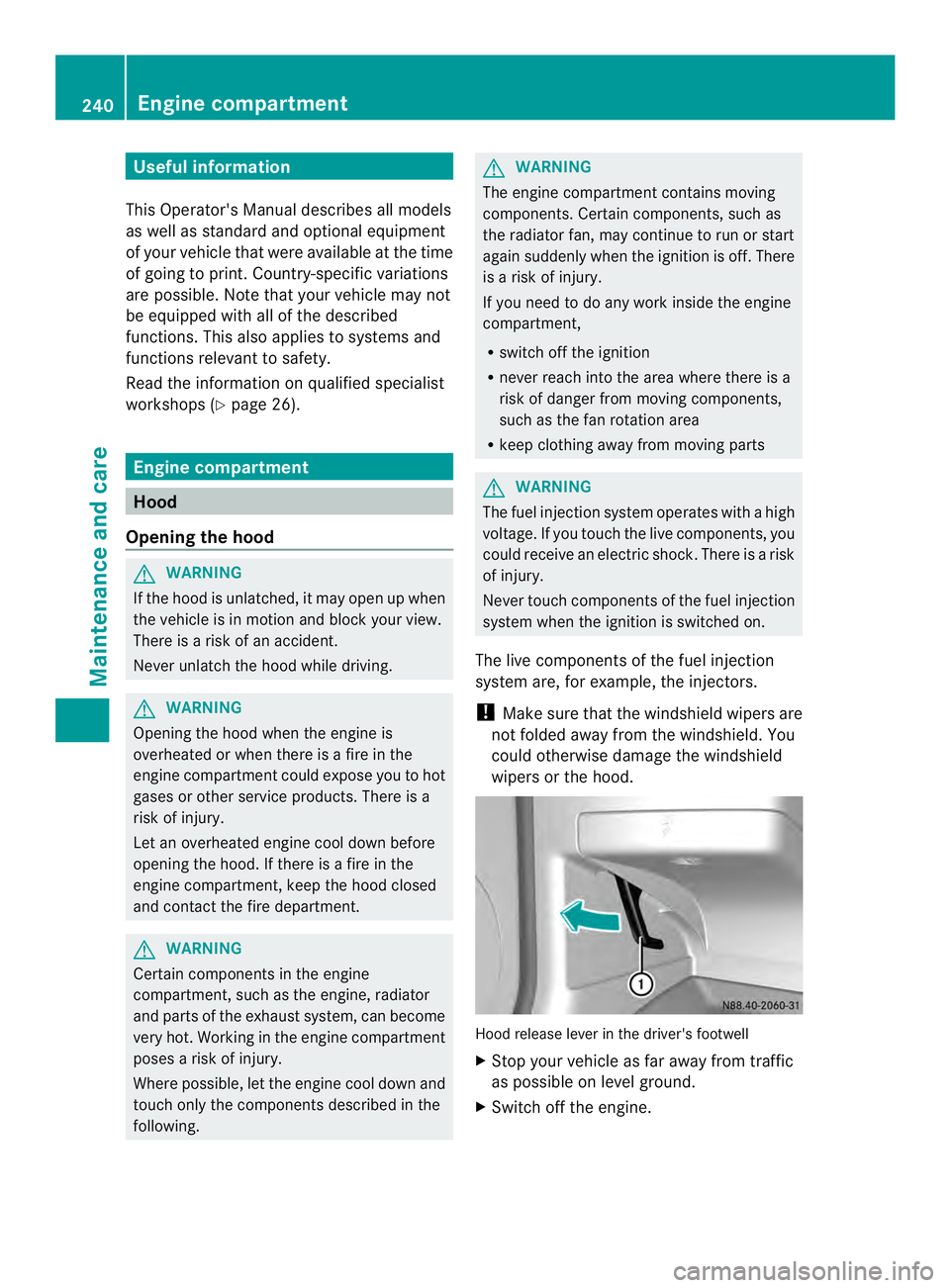
wipers or the hood. Hood release lever in the driver's footwell
X
Stop your vehicle as far away from traffic
as possible on level ground.
X Switch off the engine. 240
Engine compartmentMaintenance and care
Page 244 of 334
0025
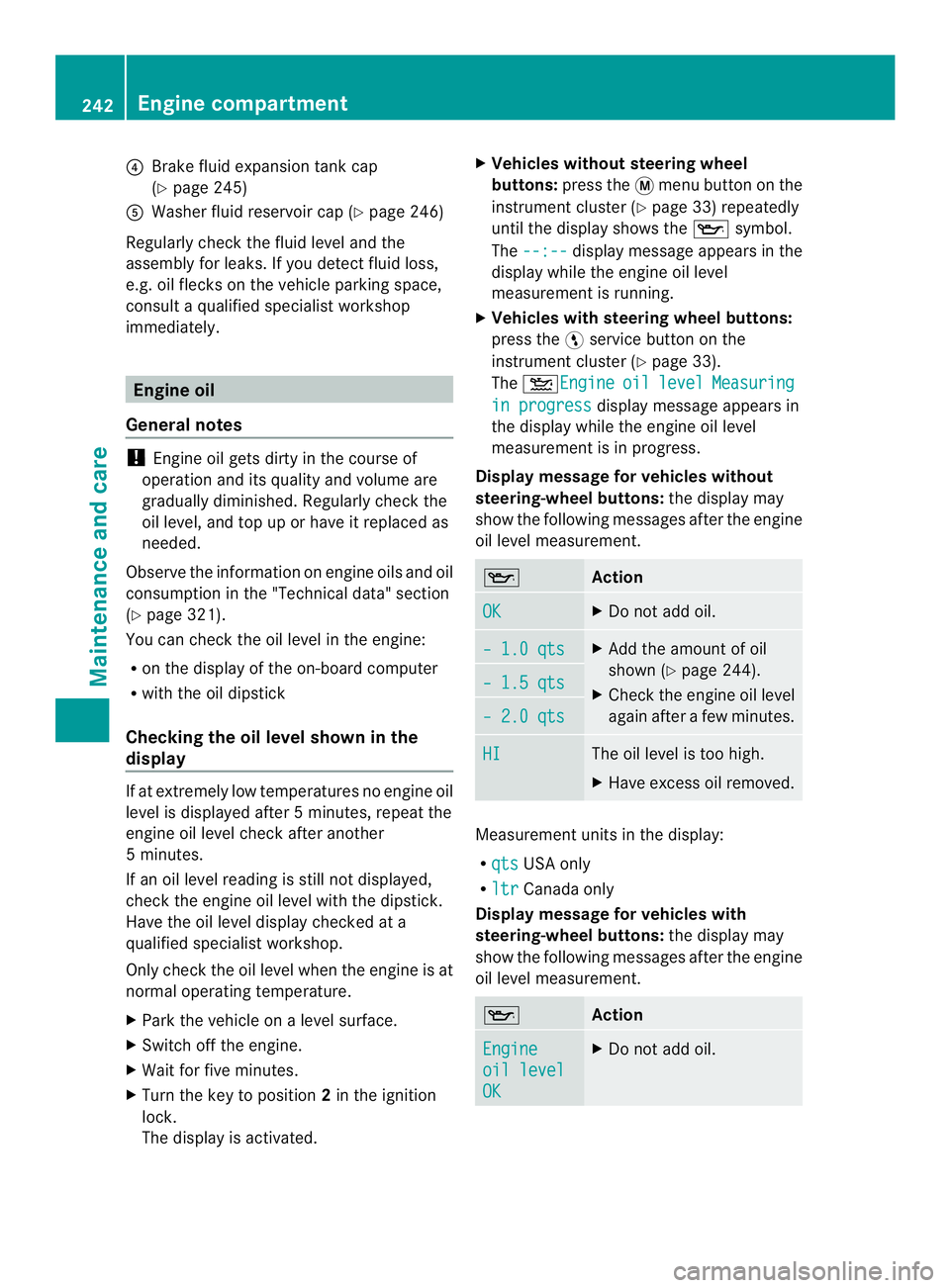
Brake fluid expansion tank cap
(Ypage 245)
0023 Washe rfluid reservoir cap (Y page 246)
Regularly chec kthe fluid level and the
assembly for leaks. If you detect fluid loss,
e.g. oil flecks on the vehicle parking space,
consult a qualified specialist workshop
immediately. Engine oil
General notes !
Engine oil gets dirty in the course of
operation and its quality and volume are
gradually diminished. Regularly check the
oil level, and top up or have it replaced as
needed.
Observe the information on engine oils and oil
consumption in the "Technical data" section
(Y page 321).
You can check the oil level in the engine:
R on the display of the on-board computer
R with the oil dipstick
Checking the oil level shown in the
display If at extremely low temperatures no engine oil
level is displayed after
5minutes, repeat the
engine oil level chec kafter another
5 minutes.
If an oil level reading is still not displayed,
check the engine oil level with the dipstick.
Have the oil level display checked at a
qualified specialist workshop.
Only check the oil leve lwhen the engine is at
normal operating temperature.
X Park the vehicle on a level surface.
X Switch off the engine.
X Wait for five minutes.
X Turn the key to position 2in the ignition
lock.
The display is activated. X
Vehicles without steering wheel
buttons: press the 0004menu button on the
instrument cluster (Y page 33) repeatedly
until the display shows the 0015symbol.
The --:-- display message appears in the
display while the engine oil level
measurement is running.
X Vehicles with steering wheel buttons:
press the 0012service button on the
instrument cluster (Y page 33).
The 001DEngine oil level Measuring
in progress display message appears in
the display while the engine oil level
measurement is in progress.
Display message for vehiclesw ithout
steering-wheel buttons: the display may
show the following messages afte rthe engine
oil level measurement. 0015
Action
OK X
Do not add oil. – 1.0 qts X
Add the amount of oil
shown (Y page 244).
X Check the engine oil level
again after a few minutes. – 1.5 qts
– 2.0 qts
HI The oil level is too high.
X
Have excess oil removed. Measurement units in the display:
R
qts USA only
R ltr Canada only
Display message for vehiclesw ith
steering-wheel buttons: the display may
show the following messages afte rthe engine
oil level measurement. 0015
Action
Engine
oil level
OK X
Do not add oil. 242
Engine compartmentMaintenance and care
Page 245 of 334
Engine
oil Add
1.0quart X
Add the amount of oil
shown (Y page 244).
X Check the engine oil level
againa fter a few minutes. Engine
oil Add
1.5quart
Engine
oil Add
2.0quart
Engine
oil level
Reduce
oil level The oil level is too high.
X
Have excess oil removed. Eng. oil
lev. Turn
ignition
on for
level X
Turn the key to
position 2in the ignition
lock. Observe
wait.
period X
Repeat the engine oil
measurement after about
5 minutes if the engine is
at normal operating
temperature.
X Repeat the engine oil
measurement after about
30 minutes if the engine
is not at normal operating
temperature. Engine
oil level
Not when
eng.
running X
Switch off the engine and
wait for approximately
5 minutes if the engine is
at normal operating
temperature. Then,
perform the engine oil
measurement. Measurement units in the display:
R
qts USA only
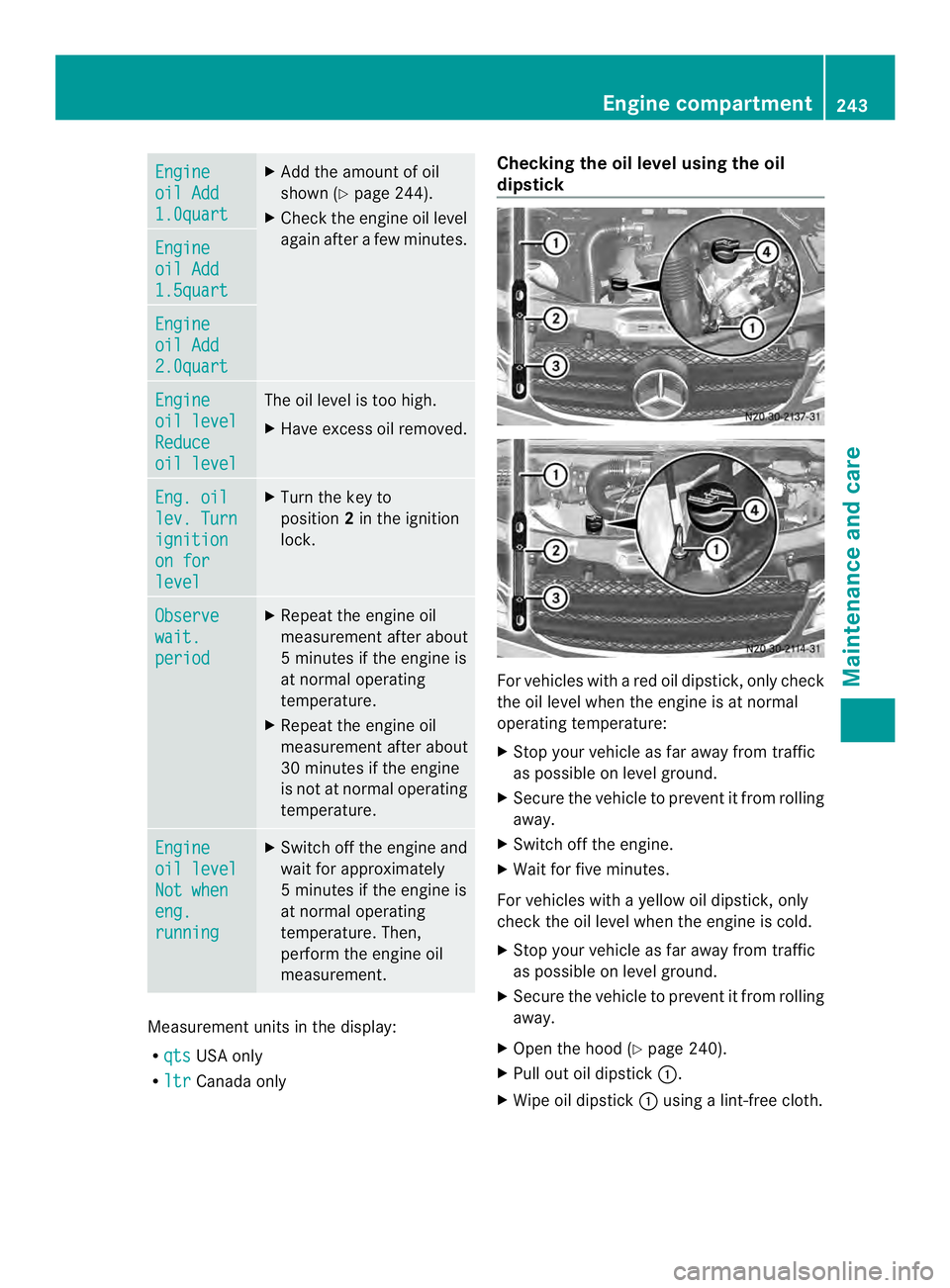
R ltr Canada only Checking the oil level using the oil
dipstick
For vehicles with a red oil dipstick, only check
the oil level whe
nthe engine is at normal
operating temperature:
X Stop your vehicle as far away from traffic
as possible on level ground.
X Secure the vehicle to prevent it from rolling
away.
X Switch off the engine.
X Wait for five minutes.
For vehicles with a yellow oil dipstick, only
check the oil level when the engine is cold.
X Stop your vehicle as far away from traffic
as possible on level ground.
X Secure the vehicle to prevent it from rolling
away.
X Open the hood (Y page 240).
X Pull out oil dipstick 0005.
X Wipe oil dipstick 0005using a lint-free cloth. Engine compartment
243Maintenance and care Z
Page 249 of 334
Adding washer fluid
X
Mix the washe rfluid to the appropriate
mixing ratio in a container beforehand.
X Open the hood (Y page 240).
X Pull cap 0005on the washer fluid reservoir
upwards at the tab.
X Add the premixed washer fluid.
X Press cap 0005onto the filler neck until it
engages audibly.
X Close the hood. Fuel system
Draining the fuel filter G
WARNING
Fuel is highly flammable. Improper handing of
fuel creates a risk of fire and explosion.
Avoid fire, open flames ,smoking and creating
sparks under all circumstances. Switch off the
ignitio nand auxiliary heating before carrying
ou tw ork to the fuel system. Always wear
protective gloves. H
Environmental note
Dispose of the water-fuel mixture in an
environmentally responsible manner.
! When the 000Eindicator lamp lights up,
drain the fuel filter with water separator
immediately. Otherwise, the engine may be
damaged. If the
000E indicator lamp in the instrument
cluster goes on, drain the fuel filter with water
separator 0026immediately.
i We recommend that you have this
maintenance work carried out at a qualified
specialist workshop.
X Park the vehicle safely and secure it from
rolling away.
X Switch off the auxiliary heating system .
X Switch off the engine.
X Open the hood (Y page 240).
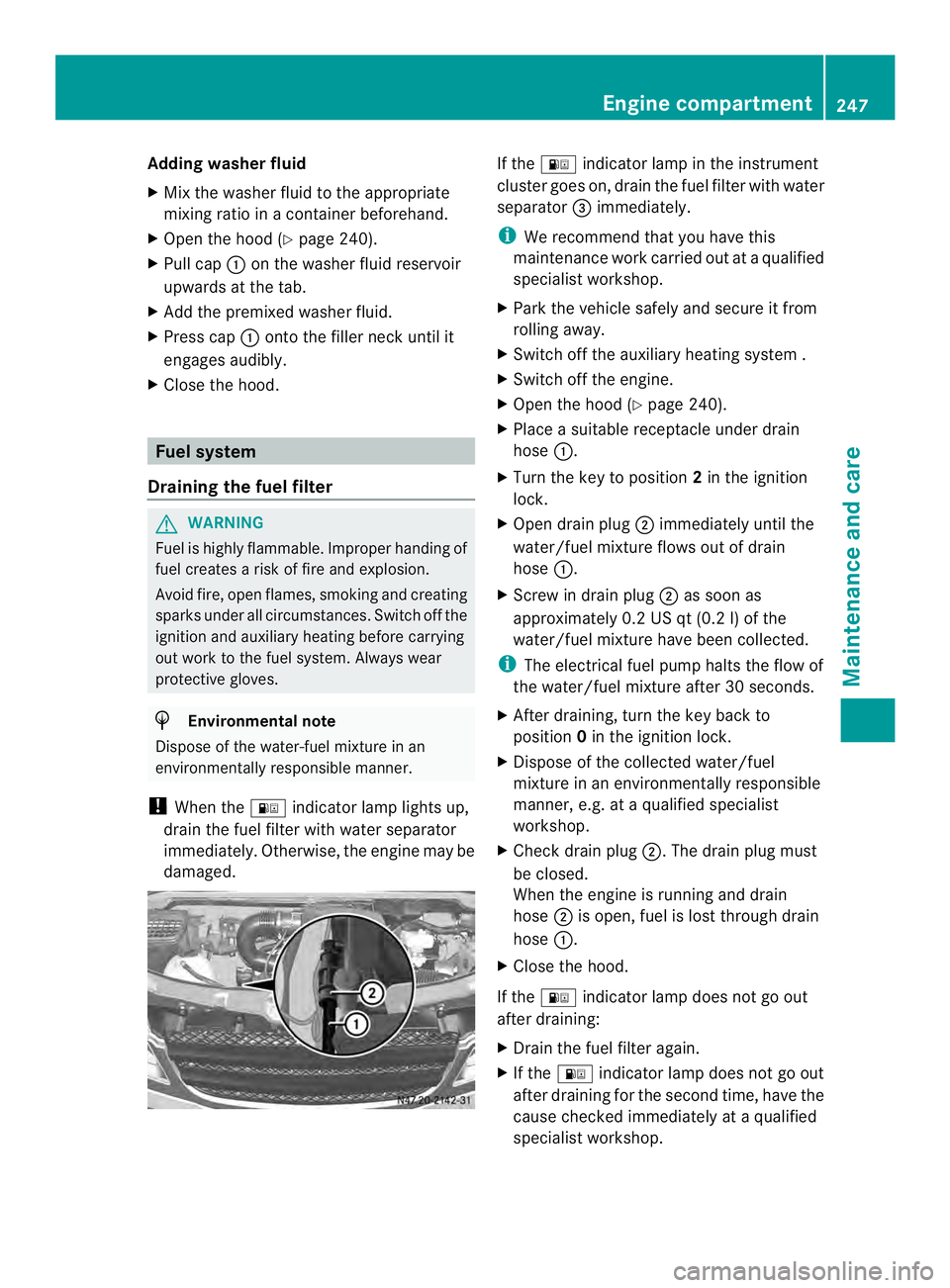
X Place a suitable receptacle under drain
hose 0005.
X Turn the key to position 2in the ignition
lock.
X Open drain plug 0006immediately until the
water/fuel mixture flows out of drain
hose 0005.
X Screw in drain plug 0006as soon as
approximately 0.2 US qt (0.2 l) of the
water/fuel mixture have been collected.
i The electrical fuel pump halts the flow of
the water/fuel mixture after 30 seconds.
X After draining, turn the key back to
position 0in the ignition lock.
X Dispose of the collected water/fuel
mixture in an environmentally responsible
manner, e.g. at a qualified specialist
workshop.
X Check drain plug 0006.The drain plug must
be closed.
When the engine is running and drain
hose 0006is open, fuel is lost through drain
hose 0005.
X Close the hood.
If the 000E indicator lamp does not go out
after draining:
X Drain the fuel filter again.
X If the 000E indicator lamp does not go out
after draining for the second time, have the
cause checked immediately at a qualified
specialist workshop. Engine compartment
247Maintenance and care Z