lights MERCEDES-BENZ SPRINTER 2019 MY19 with 7” screen
[x] Cancel search | Manufacturer: MERCEDES-BENZ, Model Year: 2019, Model line: SPRINTER, Model: MERCEDES-BENZ SPRINTER 2019Pages: 354, PDF Size: 6.15 MB
Page 162 of 354
st
yle to suit the pr evailing road and weather con‐
ditions.
If yo u activate or deactivate the all-wheel drive in
a ve hicle with this option, ASR will be deactivated
fo rth e duration of the activation/deactivation
process.
Ve hicles without steering wheel but tons: if
ASR is malfunctioning, the00E5 indicator lamp
lights up while the engine is running and the
engine output may be reduced (/ page 23).
ASR impr oves traction, i.e. the transfer of po wer
from the tires tothero ad sur face, for a sus tained
period and, thereb y,also impr ovesth e driving
st ability of theve hicle. If the driving wheels start
to spin, ASR brakes individual drive wheels and
limits the engine torque. ASRthus significantly
assists you when pulling away and accelerating,
especially on wet or slippe ryroads.
If traction on thero ad sur face is not suf ficient,
eve n ASR will not allow youto pull away without
dif ficulty. The type of tires and totalwe ight of the
ve hicle as well as the gradient of thero ad also
play a crucial role.
If ASR inter venes, the00E5 warning lamp in the
instrument display flashes. Fu
nctions of ESP ®
(Electronic Stability Pro‐
gr am) &
WARNING Risk of skidding if ESP ®
is
malfunctioning
If ESP ®
is malfunctioning, ESP ®
cannot car ry
out vehicle stabilization. In addition, other
driving saf ety sy stems are switched off. #
Drive on carefull y. #
Have ESP ®
ch ecked at a qualified spe‐
cialist workshop. &
WARNING Risk of skidding if ESP ®
is
deactivated
If yo u deactivate ESP ®
, ESP ®
cannot car ryout
ve hicle stabilization. #
ESP ®
should only be deactivated in the
fo llowing situations. Do not opera
tetheve hicle on a roller dynamome‐
te r (e.g. for a per form ance test). If you ha veto
operate theve hicle on a roller dynamom eter, con‐
sult a qualified specialist workshop beforehand. If
yo u activate or deactivate the all-wheel drive in
a ve hicle with this option, ESP ®
will be deactiva‐
te dfo rth e duration of the activation/deactiva‐
tion process.
If ESP ®
is malfunctioning or deactivated, the
00E5 warning lamp lights up while the engine is
ru nning and the engine output may be reduced
(/ page 23).
% Only use wheels with
there commended tire
sizes. Only then will ESP ®
function properly. Ac
tivating/deactivating ESP ®
(Electronic Sta‐
bility Prog ram) Multimedia sy
stem:
4 © 5
Settings 5
Quick Access
5 ESP
% ESP®
can only be activated and deactivated
via quick access when at least one other
function is available in quick access. Other‐
wise, you can find ESP ®
in theAssistance
menu. #
Select ESP.
A prom ptappears. #
Select Onor00BB Off.
If th e00BB ESP®
OFF warning lamp lights up con‐
st antly in the instrument clus ter,ESP ®
is deacti‐
va ted.
Obser vethe information on warning lamps and
display messages which may appear in the instru‐
ment clus ter. Fu
nctions of ESP ®
Crosswind Assist Crosswind Assist does not
workif ESP ®
is deacti‐
va ted or disabled due toa malfunction.
Crosswind Assist does not react under thefo llow‐
ing conditions:
R The vehicle is subjected tosevere jolts and
vib rations, e.g. as a result of une ven su rfaces
or po tholes.
R The vehicle loses traction, e.g. on snow or ice
or when hydroplaning.
R The driver is per form ing sudden and lar ge
st eering mo vements.
Crosswind Assist is operational again as soon as
th e driving conditions return tonormal.
Crosswind Assi stdetects stro ng crosswind gu sts
th at can impair ability of your vehicle todrive 13 8
Driving and pa rking
Page 164 of 354
#
Always pay careful attention tothe traf‐
fi c situation; do not relyonActive Brake
Assi stalone. Active Brake Assi stis only
an aid. The driver of theve hicle is
re sponsible forke eping a suf ficiently
safe dis tance totheve hicle in front, for
ve hicle speed and for braking in good
time. #
Be prepare dto brake or swer veif nec‐
essar y. Also obser
vethe sy stem limitations of Active
Brake Assi st. The individual subfunctions are
available in
th efo llowing speed ranges:
Distance warning function
The dis tance warning function warnsyo u at
speeds greater than appr oximately 4 mph
(7 km/h), if your vehicle is critically close to a
ve hicle or pedestrian.
An intermittent warning tone sounds and the
00BA distance warning lamp lights up in the
instrument clus ter.
Brake immedia tely or take eva sive action, pr ovi‐
ded it is safe todo so and the tra ffic situation
allo ws th is.
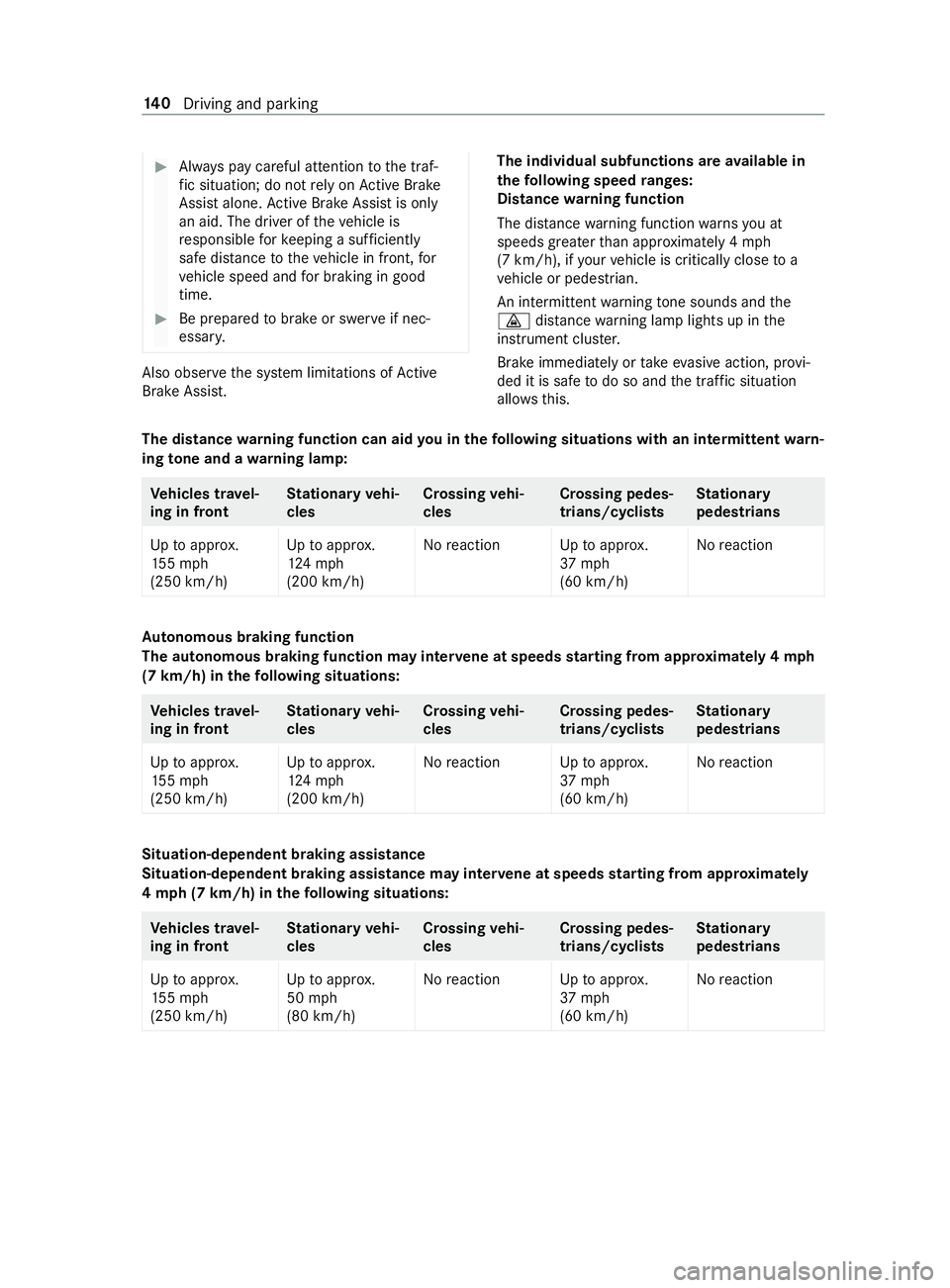
The distance warning function can aid you in thefo llowing situations with an intermit tent wa rn‐
ing tone and a warning lamp: Ve
hicles tr avel‐
ing in front St
ationary vehi‐
cles Crossing
vehi‐
cles Crossing pedes‐
trians/cycli
stsSt
ationary
pedestrians
Up toappr ox.
15 5mph
(250 km/h) Up
toappr ox.
12 4mph
(200 km/h) No
reaction Uptoappr ox.
37 mph
(60 km/h) No
reaction Au
tonomous braking function
The autonomous braking function may inter vene at speeds starting from appr oxima tely 4mph
(7 km/h) in thefo llowing situations: Ve
hicles tr avel‐
ing in front St
ationary vehi‐
cles Crossing
vehi‐
cles Crossing pedes‐
trians/cycli
stsSt
ationary
pedestrians
Up toappr ox.
15 5mph
(250 km/h) Up
toappr ox.
12 4mph
(200 km/h) No
reaction Uptoappr ox.
37 mph
(60 km/h) No
reaction Situation-dependent braking assistance
Situation-dependent braking assistance may inter vene at speeds starting from appr oxima tely
4 mp h (7 km/h) in thefo llowing situations: Ve
hicles tr avel‐
ing in front St
ationary vehi‐
cles Crossing
vehi‐
cles Crossing pedes‐
trians/cycli
stsSt
ationary
pedestrians
Up toappr ox.
15 5mph
(250 km/h) Up
toappr ox.
50 mph
(80 km/h) No
reaction Uptoappr ox.
37 mph
(60 km/h) No
reaction 14 0
Driving and pa rking
Page 177 of 354
sequently enters
the monitoring range di rectly
next toyour vehicle, thewa rning lamp in the out‐
side mir ror lights up red.
% When a trailer is connected,
thera dar sen‐
sor's field of vision may be impaired, thereby
making limited monitoring possible. Alw ays
pay careful attention tothe tra ffic situation
and maintain a safe dis tance at the side of
th eve hicle.
If a vehicle is de tected close to yourvehicle in the
lateral monitoring range and you swit chon the
turn signal indica tor in the cor responding direc‐
tion, a warning tone sounds. The redwa rning
lamp in the outside mir rorflashes. If the turn sig‐
nal indicator remains switched on, all other
de tected vehicles are indicated only bytheflash‐
ing of there dwa rning lamp.
If yo uove rtake a vehicle quickl y,no warning is
given.
Exit warning
The exitwa rning is an additional function of Blind
Spot Assist and warnsve hicle occupants when
leaving theve hicle about any approaching vehi‐
cles. &
WARNING Risk of accident despite exit
wa rning
The exitwa rning reacts nei ther tostationary
objects nor tovehicles approaching you at a
great lydif fere nt speed.
As a result, theex itwa rning cannot warndriv‐
ers in these situations. #
Always pay particular attention tothe
traf fic situation when opening the doors
and make sure there is suf ficient clear‐
ance. %
An
exitwa rning is not issued for sliding doors
and rear-end doors. Overview
When theve hicle is
st ationar y,an object
is de tected from
behind in the monitor‐
ing range. Display in outside mir‐
ror
When theve hicle is
st ationar y,a door on
th ere leva nt side of
th eve hicle is opened.
An object which is
close to yourvehicle
is de tected in the
monitoring range. Vi
sual and audible
wa rning %
This additional function is only
available when
Blind Spot Assist is activated and up to a
maximum of thre e minutes af terth e ignition
has been switched off. The end of theav aila‐
bility of theex itwa rning function is indicated
by a series of flashes in the outside mir ror.
The exitwa rning function is only an aid and is no
substitute forth e attentiveness of theve hicle
occupants. Responsibility alw ays lies with the
ve hicle occupants when opening doors and leav‐
ing theve hicle.
Sy stem limitations
Blind Spot Assist and theex itwa rning function
may be limited in thefo llowing situations:
R ifth ere is dirt on the sensors or the sensors
are obscured
R ifth ere is poor visibility, e.g. due tofog, heavy
ra in, snow or spr ay
R if nar rowvehicles are within the monitoring
ra nge, e.g. bicycles
% St
ationary or slowly moving objects are not
displa yed.
Wa rnings may be issued in er ror when driving
close tocrash ba rriers or similar solid lane bor‐
ders. Warnings may be inter rupte d when driving
alongside long vehicles, forex ample truc ks,fo r a
prolonged time.
Blind Spot Assist is not operational when reve rse
ge ar is engaged.
The exitwa rning function may be limited in the
fo llowing situations:
R when the sensor is bloc kedby adjacent vehi‐
cles in nar rowparking spaces
R when people are approaching Driving and parking
15 3
Page 178 of 354
Ac
tivating/deactivating Blind Spot Assi st
Multimedia sy stem:
4 © 5
Settings 5
Assistance #
Activate or deacti vate Blind Spot Assist . Fu
nction of Drive Away Assist %
Drive
Away Assistis only available forve hi‐
cles with automatic transmission.
Drive Away Assistcan reduce the se verity of an
impact when pulling away. If an obs tacle is de tec‐
te d in the direction of tra vel,th eve hicle's speed
is brief lyreduced toappr ox. 1 mph (2 km/h). If a
critical situation is de tected, a symbol appea rson
th e camera image of the multimedia sy stem. &
WARNING Risk of accident caused by
limited de tection per form ance of Drive
Aw ayAssi st
Drive AwayAssi stcannot al ways clea rly iden‐
tify objects and traf fic situations.
In such cases, Drive AwayAssi stmight:
R Warnyou without reason and limit the
ve hicle speed.
R Not warnyou or not limit theve hicle
speed. #
Always pay careful attention tothe traf‐
fi c situation; do not relyon Drive Away
Assi stalone. #
Be prepared tobrake or swer veas nec‐
essar y,prov ided the tra ffic situation
permits and that it is safe totake eva‐
sive action. Drive
Away Assistis only an aid. It is not a substi‐
tute foryo ur attention tothe sur roundings. The
re sponsibility for safe maneu vering and pa rking
re mains with you. Make sure that no persons,
animals or objects etc. are in the maneuvering
ra nge.
A risk of a collision may arise in thefo llowing sit‐
uations, forex ample:
R Ifth e driver mixes up the accelerator and
brake pedals.
R Ifth e wrong gear is selec ted.
The Drive AwayAssi stfunction is active under the
fo llowing conditions:
R IfPa rking Assist PARKTRONIC is activated. R
Every time thege ar is changed to005E or005B
when theve hicle is at a standstill.
R Ifth e de tected obs tacle is less than appr ox.
3.3 ft(1.0 m) away.
R Ifth e maneuvering assis tance function is acti‐
va ted in the multimedia sy stem.
Sy stem limitations
Drive AwayAssi stis not available on inclines and
when driving with a trailer. Fu
nction of Rear Cross Traf fic Alert The
radar sensors in the bumper are used forthe
sy stem. This wayth e area adjacent totheve hicle
is continually monitored. If thera dar sensors are
obscured byvehicles or other objects, de tection
is not possible.
% Also
read the no tes on Blind Spot Assist
(/ page 152).
Ve hicles with Blind Spot Assis t:drivers can
also be warned of any crossing tra ffic when back‐
ing up out of a parking space. If a vehicle is
de tected, thewa rning lamp in the outside mir ror
on there leva nt side lights up red. If it de tects a
critical situation, a warning tone also sounds.
Ve hicles with Blind Spot Assist and Parking
Assist PARKTRONIC: drivers can also be warned
of any crossing tra ffic when backing up out of a
parking space. If a critical situation is de tected, a
wa rning symbol appears on the camera image of
th e multimedia sy stem. If the driver does not
re spond tothewa rning, theve hicle's brakes can
be applied automatically. In this case, a warning
to ne sounds.
The Rear Cross Traf fic Alert function is acti ve
under thefo llowing conditions:
R Blind Spot Assist is activated.
R Reversege ar is engaged or theve hicle is
backing up at walking pace.
R Ifth e maneuvering assis tance function is acti‐
va ted in the multimedia sy stem.
The Rear Cross Traf fic Alert function is una vaila‐
ble when driving with a trailer. 15 4
Driving and pa rking
Page 184 of 354
#
Shift the selector le verto position 005D. #
Apply theve hicle's parking brake. #
Close all the doors. #
Position the trailer on a le vel sur face behind
th eve hicle.
% The ball head height
changes depending on
th eve hicle's load. In this case, use a trailer
with a height-adjus table trailer dr awbar. #
Couple up the trailer. #
Establish all electrical and other connections
to the trailer. #
Remo veobjects or devices which pr eventthe
trailer from rolling, e.g. wheel choc ks. #
Release the trailer's parking brake.
% The
vehicle harness has a cable connection
to the brake light indicator lamp.
Obser vethe maximum permissible trailer dimen‐
sions (width and length).
Most US states and all Canadian pr ovinces pre‐
scribe thefo llowing points, and you are ur gently
re commended tocomply wi th these:
R Safetych ains between theto wing vehicle and
th e trailer. The chains should be routed in a
criss-cross pat tern under the trailer dr awbar.
They must be connected tothe trailer tow
hitch and not tothe bumper or totheve hicle
axle.
Lea vesuf ficient sla ckinthech ains. This
allo wsforeve n sha rpcornering.
R A separate brake sy stem is requ ired for cer‐
ta in trailers.
R A saf etyfe ature is requ ired for braked trailers.
De term ine the specific requ irements acco rd‐
ing tothere leva nt la ws.
If th e trailer becomes de tach ed from theto w‐
ing vehicle, the saf etyfe ature triggers the
trailer brakes and can thus reduce the danger.
Un coupling a trailer &
WARNING Risk of being crushed and
becoming trapped when uncoupling a
trailer
When uncoupling a trailer wi than engaged
ine rtia-activated brake, your hand may
become trapped between theve hicle and the
trailer dr awbar. #
Do not uncouple trailers with an
engaged overrun brake. Do not uncouple a trailer with an
overrun brake in
a st ate of overrun. Otherwise, there bound of the
ove rrun brake can damage your vehicle. #
Shift the selector le verto position 005D. #
Apply theve hicle's parking brake. #
Close all the doors. #
Apply the trailer's parking brake. #
Secure the trailer against rolling away with a
wheel chock or similar object. #
Remo vethe trailer cables and saf etych ains. #
Uncou plethe trailer. Information about
towing a trailer Operating a trailer is subject
tomany statutory
re gulations such as speed restrictions.
Many states also requ ire an auxiliary separate
functional braking sy stem when towing a weight
th at exc eeds a cer tain limit. Foryo ur saf ety, it is
re commended touse a separate functional brak‐
ing sy stem on any towe dve hicle.
Make sure that your trailer combination meets
local regulations. This not only applies to your
place of residence, but also to your destination.
In fo rm ation on this can be obtained from the
police and local authorities.
Comply with thefo llowing when driving with a
trailer:
R Practice cornering, stopping and backing up
in a traf fic-free location. In this wa y,yo u will
ga in driving experience and become accus‐
to med tothe new handling characteristics.
R Before driving, check thefo llowing:
- that the trailer tow hit chand ball coupling
are secure
- that the saf ety swit chfor braked trailers is
functioning cor rectly
- that the saf etych ains are secure and
undamaged
- that the electrical connections are secure
- that the lights are functioning cor rectly
- the wheels for dama geand cor rect tire
pressure (/ page 232)
R Adjust the outside mir rors so that you ha ve a
clear view of there ar section of the trailer.
R Ifth e trailer is equipped with an individual
braking sy stem, check before each journey
whe ther the brakes are functioning cor rectl y. 16 0
Driving and pa rking
Page 185 of 354
R
Ifth e trailer has electronically cont rolled
brakes, pull away carefully wi th theve hicle/
trailer combination. Brake manually using the
brake controller and check whe ther the
brakes are functioning cor rectly.
R Secu rethe load on the trailer in line with the
re qu irements and rules for load-securing
me thods.
R When driving with a trailer, check at regular
inter vals that the load is secure and that the
lights and brakes are functioning cor rectl y.
R Bear in mind that the handling characteristics
are more uns table when towing a trailer than
when driving without a trailer. Avoid sudden
st eering mo vements.
R The vehicle/trailer combination is heavier,
accelerates more slowl y,has a reduced
climbing ability and an increased braking dis‐
ta nce. It is more susceptible toside winds
and requ ires careful steering.
R If possible, do not brake suddenl y,but rath er
moderately at firs t so that the trailer can acti‐
va te its brakes. Then inc rease the pressure on
th e brake pedal.
R Ifth e automatic transmission shifts between
ge ars on uphill or downhill gradients, restrict
th e shift range. Select shi ftrange 4, 3, 2 or 1.
A lo werge ar and reduced speed decrease the
ri sk of engine damage.
R When driving on a downhill gradient, shift to a
lo we rge ar to use the engine's braking ef fect.
Av oid cons tant braking, as this could cause
th eve hicle brakes and possibly also the
trailer brakes toove rheat.
R Ifth e coolant temp erature increases signifi‐
cantly when the air-conditioning sy stem is
switched on, switch the air-conditioning sys‐
te m off.
Coolant heat can also be dissipated by
switching the air flow and thete mp erature of
th e heater or air conditioning tothe maximum
le ve l. Open the windo wsif necessar y.
R When overtaking, pay particular attention to
th e increased overtaking di stance of your
ve hicle/trailer combination.
Due tothe length of your vehicle/trailer com‐
bination you will requ ire a longer stre tch of
ro ad before swit ching back tothe original
lane. Pe
rm issible trailer loads and trailer dr awbar
nose weights We
ight information &
WARNING Risk of accident due to
unbraked trailer with excessively high
gross weight
If yo uto w a trailer without a separate func‐
tional braking sy stem and a gross trailer
we ight (G TW) of more than 1635 lbs (750 kg),
th en theve hicle brake sy stem may overheat.
This increases the braking dis tance and the
brake sy stem may evenfa il. #
Always use a trailer with a separate
functional braking sy stem when towing
a trailer with a gross trailerweight
(G TW ) of more than 1635 lbs (750 kg). *
NO
TEDama getothe drive train, trans‐
mission or trailer tow hit chdue toexc ess
gross combination weight The permissible
gross combinationweight is
exc eeded.
The drive train, the transmission or the trailer
to w hit chmay be dama ged. #
Comply with the permissible gross com‐
bination weight. Fo
rve hicles with a permissible gross vehicle
we ight of 11030 lbs (5003 kg),th e permissible
gross combination weight is less than the sum of
th e permissible gross vehicle weight plus the per‐
missible trailer load. If either theve hicle or the
trailer is fully laden, the permitted gross vehicle
we ight or the permitted trailer load values are
re duced accordingly. In this case, you may on ly
partially load the trailer or theve hicle.
The gross trailer weight (G TW) is calculated by
adding thewe ight of the trailer tothewe ight of
th e load and equipment. If the trailer is equipped
with a separate braking sy stem, then the maxi‐
mum gross trailer weight is 5000 lbs (2268 kg) or
75 00 lbs (3402 kg).
The maximum permissible trailer dr awbar nose‐
we ight on the ball head is 500 lbs (227 kg) or
75 0 lbs (340 kg). Ho wever,th e actual trailer
dr aw bar nose weight must not exceed theva lue
given on the trailer tow hit chor trailer identifica‐
tion plates. Where theva lues dif fer, th e lo west
va lue alw ays applies. Driving and parking
161
Page 233 of 354
#
Neverto uch the danger zone sur round‐
ing moving component parts, e.g. the
ro tation area of thefa n. #
Remo vejewe lry and watches. #
Keep items of clo thing and hair away
from moving parts. &
WARNING Risk of bu rns from hot com‐
ponent parts in the engine compartment
Cer tain components in the engine compart‐
ment can be very hot, e.g. the engine, the
ra diator and parts of theex haust sy stem. #
Allow the engine tocool down and only
to uch component parts desc ribed in the
fo llowing. If
yo u ha vetocar ryout any workinthe engine
compartment, touch only thefo llowing compo‐
nents:
R Hood
R Engine oil filler opening cap
R Washer fluid reser voir cap
R Coolant expansion reser voir cap #
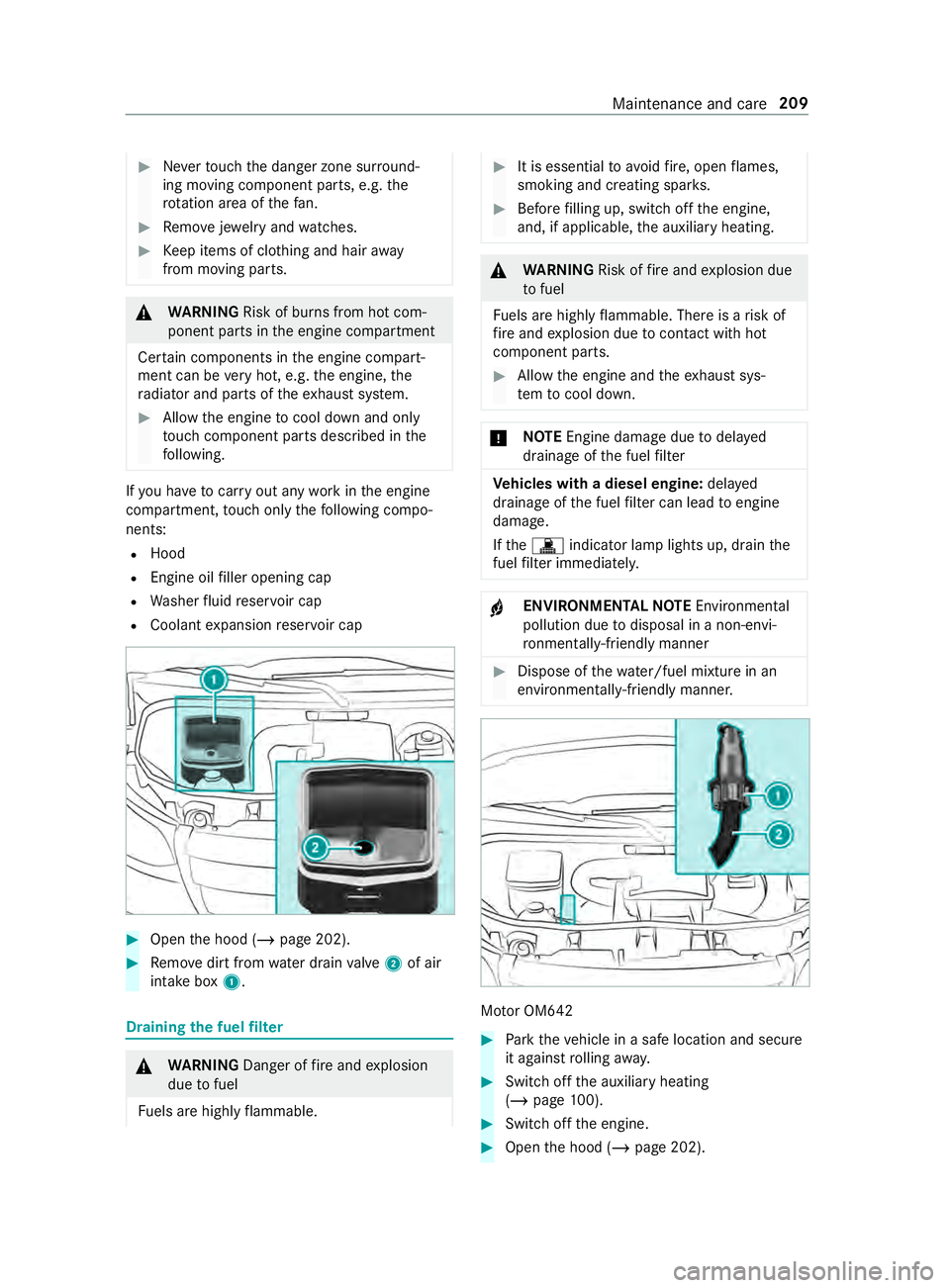
Open the hood (/ page 202). #
Remo vedirt from water drain valve 2 of air
intake box 1. Draining
the fuel filter &
WARNING Danger of fire and explosion
due tofuel
Fu els are highly flammable. #
It is essential toavoid fire , open flames,
smoking and creating spar ks. #
Before filling up, switch off the engine,
and, if applicable, the auxiliary heating. &
WARNING Risk offire and explosion due
to fuel
Fu els are highly flammable. There is a risk of
fi re and explosion due tocontact wi thhot
component parts. #
Allow the engine and theex haust sys‐
te m to cool down. *
NO
TEEngine damage due todela yed
drainage of the fuel filter Ve
hicles with a diesel engine: delayed
drainage of the fuel filter can lead toengine
damage.
If th e003A indicator lamp lights up, drain the
fuel filter immediately. +
ENVIRONMENTAL
NOTEEnvironmental
pollution due todisposal in a non-envi‐
ro nmental ly-friendly manner #
Dispose of thewate r/fuel mixture in an
environmentally-friendly manner. Mo
tor OM642 #
Park theve hicle in a safe location and secure
it against rolling away. #
Switch off the auxiliary heating
(/ page 100). #
Switch off the engine. #
Open the hood (/ page 202). Maintenance and care
209
Page 262 of 354
Re
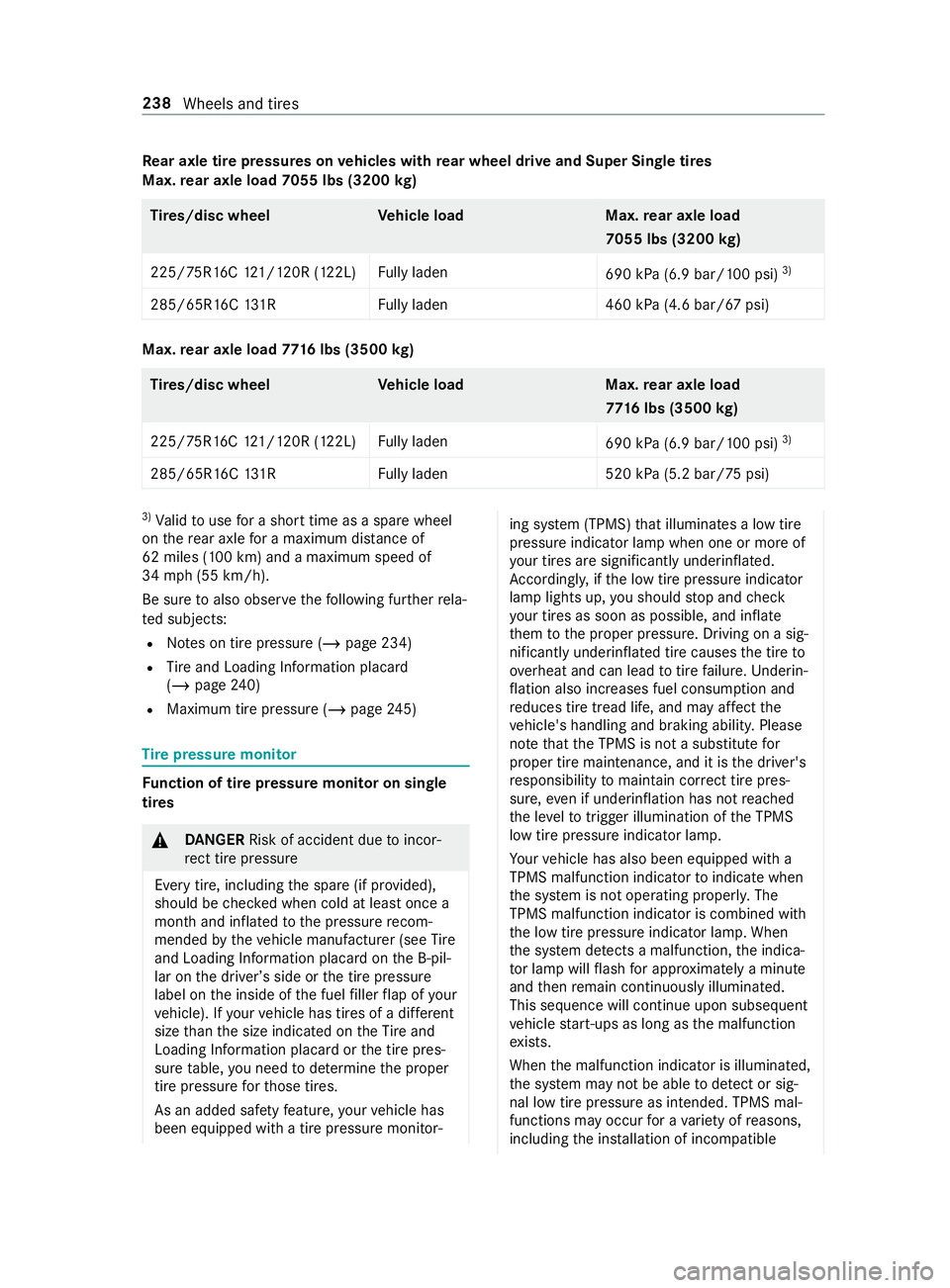
ar axle tire pressures on vehicles with rear wheel drive and Super Single tires
Max. rear axle load 7055 lbs (3200 kg)Ti
re s/disc wheel Vehicle load Max.rear axle load
7055 lbs (3200 kg)
225/75R16C 121/120R (122L) Fully laden
690 kPa (6.9 bar/100 psi)3)
285/65R16C 131R Fully laden 460 kPa (4.6 bar/67 psi)Max.
rear axle load 7716 lbs (3500 kg) Ti
re s/disc wheel Vehicle load Max.rear axle load
77 16 lbs (3500 kg)
225/75R16C 121/120R (122L) Fully laden
690 kPa (6.9 bar/100 psi)3)
285/65R16C 131R Fully laden 520 kPa (5.2 bar/75 psi)3)
Va lid touse for a short time as a spare wheel
on there ar axle for a maximum dis tance of
62 miles (100 km) and a maximum speed of
34 mph (55 km/h).
Be sure toalso obse rveth efo llowing fur ther rela‐
te d subjects:
R Notes on tire pressure (/ page 234)
R Tire and Loading In form ation placard
(/ page 240)
R Maximum tire pressure (/ page 245) Ti
re pressure moni tor Fu
nction of tire pressure monitor on single
tires &
DANG ER Risk of accident due toincor‐
re ct tire pressure
Every tire, including the spare (if pr ovided),
should be checked when cold at least once a
month and inflated tothe pressure recom‐
mended bytheve hicle manufacturer (see Tire
and Loading In form ation placard on the B-pil‐
lar on the driver ’sside or the tire pressure
label on the inside of the fuel filler flap of your
ve hicle). If your vehicle has tires of a dif fere nt
size than the size indicated on theTire and
Loading In form ation placard or the tire pres‐
sure table, you need todeterm ine the proper
tire pressure forth ose tires.
As an added saf etyfe ature, your vehicle has
been equipped with a tire pressure monitor‐ ing sy
stem (TPMS) that illuminates a low tire
pressure indicator lamp when one or more of
yo ur tires are significantly unde rinfla ted.
Ac cording ly, if the low tire pressure indicator
lamp lights up, you should stop and check
yo ur tires as soon as possible, and inflate
th em tothe proper pressure. Driving on a sig‐
nificant lyunde rinfla ted tire causes the tire to
ove rheat and can lead totire failure. Underin‐
fl ation also inc reases fuel consum ption and
re duces tire tread life, and may af fect the
ve hicle's handling and braking ability. Please
no te that the TPMS is not a substitute for
proper tire maintenance, and it is the driver's
re sponsibility tomaintain cor rect tire pres‐
sure, even if underinflation has not reached
th e le velto trig ger illumination of the TPMS
low tire pressure indicator lamp.
Yo ur vehicle has also been equipped with a
TPMS malfunction indicator toindicate when
th e sy stem is not operating properly. The
TPMS malfunction indicator is combined with
th e low tire pressure indicator lamp. When
th e sy stem de tects a malfunction, the indica‐
to r lamp will flash for appro ximately a minute
and then remain continuously illumina ted.
This sequence will continue upon subsequent
ve hicle start-ups as long as the malfunction
ex ists.
When the malfunction indicator is illuminated,
th e sy stem may not be able todetect or sig‐
nal low tire pressu reas intended. TPMS mal‐
functions may occur for a variet y of reasons,
including the ins tallation of incompatible 238
Wheels and tires
Page 302 of 354
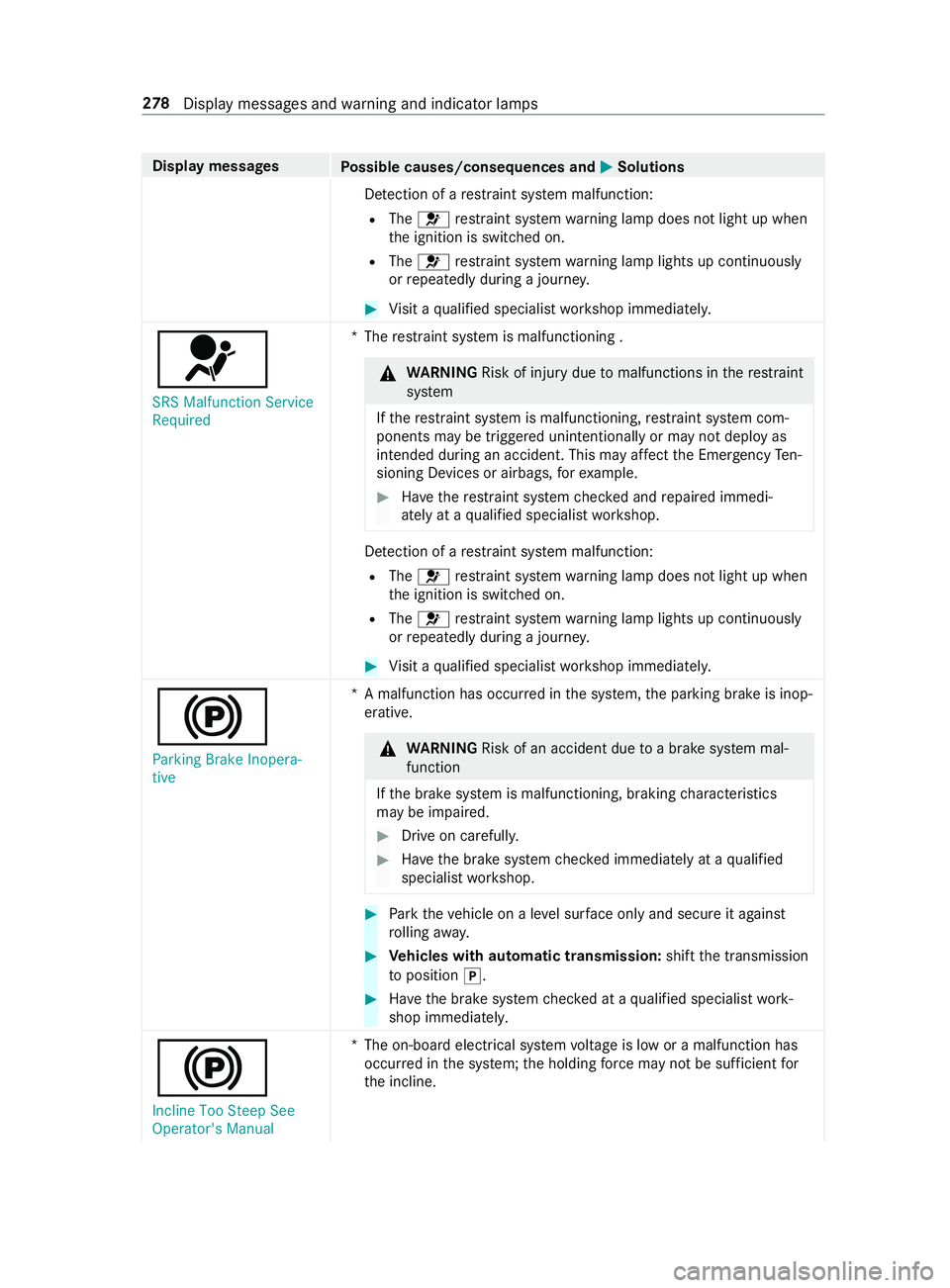
Display messages
Possible causes/consequences and 0050 0050Solutions
De tection of a restra int sy stem malfunction:
R The 0075 restra int sy stem warning lamp does not light up when
th e ignition is switched on.
R The 0075 restra int sy stem warning lamp lights up continuously
or repeatedly during a journe y. #
Visit a qualified specialist workshop immediately.
0075 SRS Malfunction Service
Required *T
herestra int sy stem is malfunctioning . &
WARNING Risk of inju rydue tomalfunctions in there stra int
sy stem
If th ere stra int sy stem is malfunctioning, restra int sy stem com‐
ponents may be triggered unintentionally or may not deploy as
intended during an accident. This may af fect the Emer gency Ten‐
sioning Devices or airbags, forex ample. #
Have there stra int sy stem checked and repaired immedi‐
ately at a qualified specialist workshop. De
tection of a restra int sy stem malfunction:
R The 0075 restra int sy stem warning lamp does not light up when
th e ignition is switched on.
R The 0075 restra int sy stem warning lamp lights up continuously
or repeatedly during a journe y. #
Visit a qualified specialist workshop immediately.
0024 Parking Brake Inopera-
tive *A
malfunction has occur red in the sy stem, the parking brake is inop‐
erative. &
WARNING Risk of an accident due toa brake sy stem mal‐
function
If th e brake sy stem is malfunctioning, braking characteristics
may be impaired. #
Drive on carefull y. #
Have the brake sy stem checked immediately at a qualified
specialist workshop. #
Park theve hicle on a le vel sur face only and secu reit against
ro lling away. #
Vehicles with automatic transmission: shiftthe transmission
to position 005D. #
Have the brake sy stem checked at a qualified specialist work‐
shop immediatel y.
0024 Incline Too Steep See
Operator's Manual *T
he on-board electrical sy stem voltage is low or a malfunction has
occur red in the sy stem; the holding forc e may not be suf ficient for
th e incline. 278
Displaymessa ges and warning and indicator lamps
Page 313 of 354
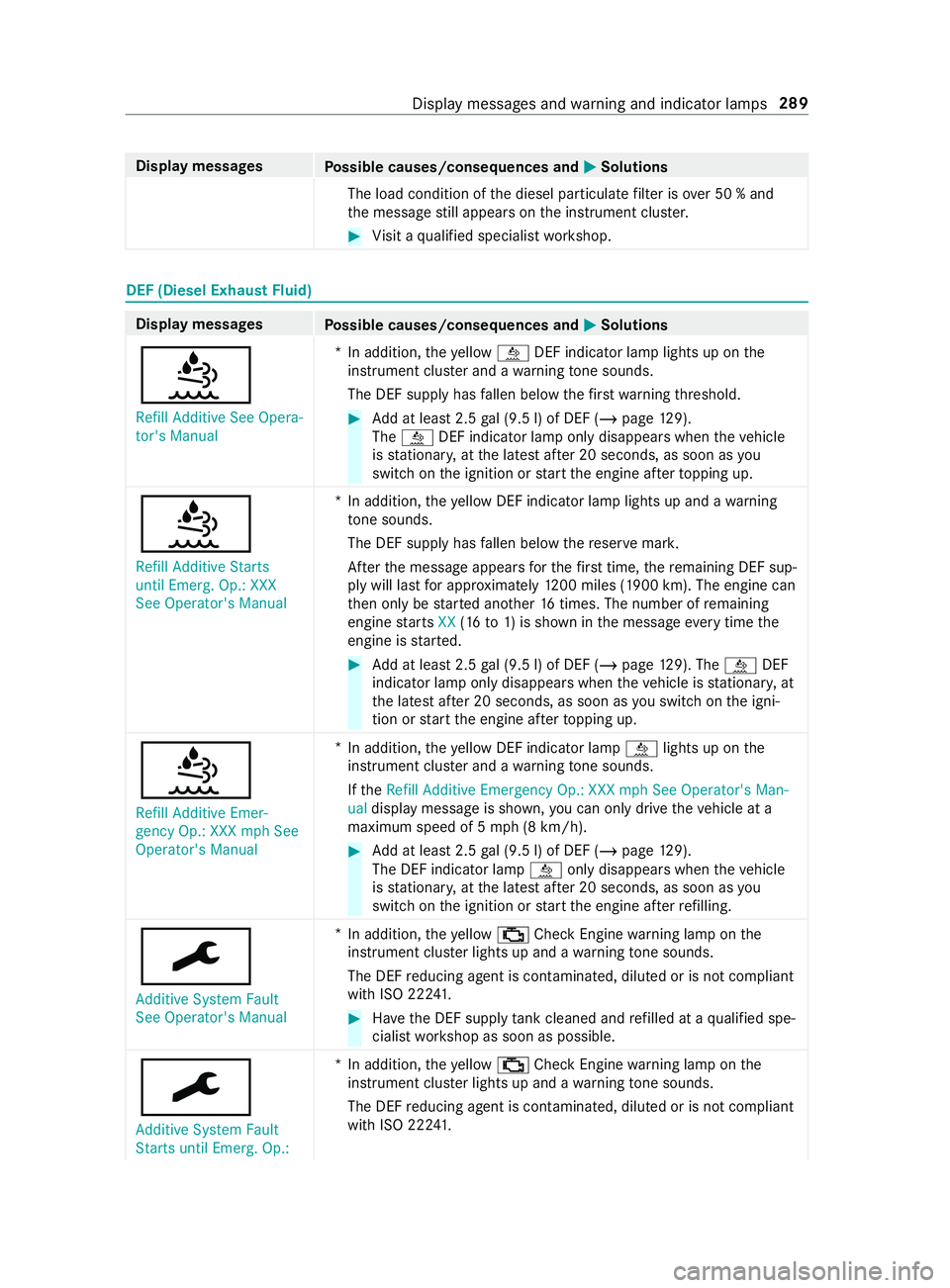
Display messages
Possible causes/consequences and 0050 0050Solutions
The load condition of the diesel particulate filter is over 50 % and
th e message still appears on the instrument clus ter. #
Visit a qualified specialist workshop. DEF (Diesel Exhaust Fluid)
Display messages
Possible causes/consequences and 0050 0050Solutions
00E2
Refill Additive See Opera-
tor's Manual *
In addition, theye llow 00E2 DEF indicator lamp lights up on the
instrument clus ter and a warning tone sounds.
The DEF supply has fallen below thefirs twa rning thre shold. #
Add at least 2.5 gal (9.5 l) of DEF (/ page129).
The 00E2 DEF indica tor lamp only disappea rswhen theve hicle
is stationar y,at the latest af ter 20 seconds, as soon as you
switch on the ignition or start the engine af terto pping up.
00E2
Refill Additive Starts
until Emerg. Op.: XXX
See Operator's Manual *I
n addition, theye llow DEF indicator lamp lights up and a warning
to ne sounds.
The DEF supply has fallen below there ser vemar k.
Af terth e message appears forth efirs t time, there maining DEF sup‐
ply will last for appro ximately 12 00 miles (1900 km). The engine can
th en only be star ted ano ther 16 times. The number of remaining
engine starts XX(16 to1) is shown in the message everytime the
engine is star ted. #
Add at least 2.5 gal (9.5 l) of DEF (/ page129). The 00E2DEF
indica tor lamp only disappea rswhen theve hicle is stationar y,at
th e latest af ter 20 seconds, as soon as you swit chon the igni‐
tion or start the engine af terto pping up.
00E2
Refill Additive Emer-
gency Op.: XXX mph See
Operator's Manual *
In addition, theye llow DEF indicator lamp 00E2lights up on the
instrument clus ter and a warning tone sounds.
If th eRefill Additive Emergency Op.: XXX mph See Operator's Man-
ual display message is shown, you can only drive theve hicle at a
maximum speed of 5 mph (8 km/h). #
Add at least 2.5 gal (9.5 l) of DEF (/ page129).
The DEF indica tor lamp 00E2only disappea rswhen theve hicle
is stationar y,at the latest af ter 20 seconds, as soon as you
switch on the ignition or start the engine af terre filling.
0099
Additive System Fault
See Operator's Manual *
In addition, theye llow 00B9 Check Engine warning lamp on the
instrument clus ter lights up and a warning tone sounds.
The DEF reducing agent is con taminated, diluted or is not compliant
with ISO 222 41 . #
Have the DEF supply tank cleaned and refilled at a qualified spe‐
cialist workshop as soon as possible.
0099 Additive System Fault
Starts until Emerg. Op.: *
In addition, theye llow 00B9 Check Engine warning lamp on the
instrument clus ter lights up and a warning tone sounds.
The DEF reducing agent is con taminated, diluted or is not compliant
with ISO 222 41 . Displ
aymessa ges and warning and indicator lamps 289