lights MERCEDES-BENZ SPRINTER 2019 MY19 with 7” screen
[x] Cancel search | Manufacturer: MERCEDES-BENZ, Model Year: 2019, Model line: SPRINTER, Model: MERCEDES-BENZ SPRINTER 2019Pages: 354, PDF Size: 6.15 MB
Page 122 of 354
#
Vehicles with windshield heating: press
th e button.
#
Close the center air vent (/ page 98) and
air vents forth e headroom (/ page 99) and
re ar compartment (/ page 99).
Misting on the outside of windo ws #
Switch on the windshield wiper (/ page 88).Switching air-recirculation mode on and off
#
Press the0089 button.
The interior air is recirculated.
The ai r-re circulation mode switches off au tomati‐
cally.
% When air-recirculation mode is switched off,
th
e windo wsmay fog up more quickl y.Switch
on ai r-re circulation mode only briefly.
Air-recirculation mode au tomatical lyswitches on
in thefo llowing cases:
R at high outside temp eratures
R while theve hicle is driving in a tunnel (only
ve hicles with 3-zone automatic climate con‐
trol)
R when the windshield wipers are switched on
(/ page 88)
The indicator lamp on the0089 button will not
light up in this case. Af ter a maximum of
30 minutes, outside air is automatically intro‐
duced again. Switching
the windshield heating on and off %
In
theeve nt of high outside temp eratures,
th e windshield heating may not turn on. #
Press the button forth e windshield heating.
If th e indicator lamp lights up, the windshield
heating is switched on.
% The windshield heating switches off automat‐
ically af ter a few minutes.
% If
th e battery voltage is too lo w,it may not be
possible toswitch the windshield heating on.
If th e battery voltage becomes too low while
th e windshield heating is in operation, the
windshield heating will swit choff automati‐
cally. Switching
there ar window defros ter on or off #
Press the006C button.
If th e indicator lamp lights up, there ar win‐
dow defros ter is switched on. Operating air
vents Ad
justing the front-compartment air vents &
WARNING ‑ Danger of bu rns or frostbite
due tobeing too close tothe air vents
Ve ry hot or very cold air can flow from the air
ve nts.
This could result in burns or frostbite in the
immediate vicinity of the air vents. #
Makesure that all vehicle occupants
alw ays maintain a suf ficient dis tance to
th e air vents. #
If necessa ry, direct the air flow to
ano ther area of theve hicle interior. #
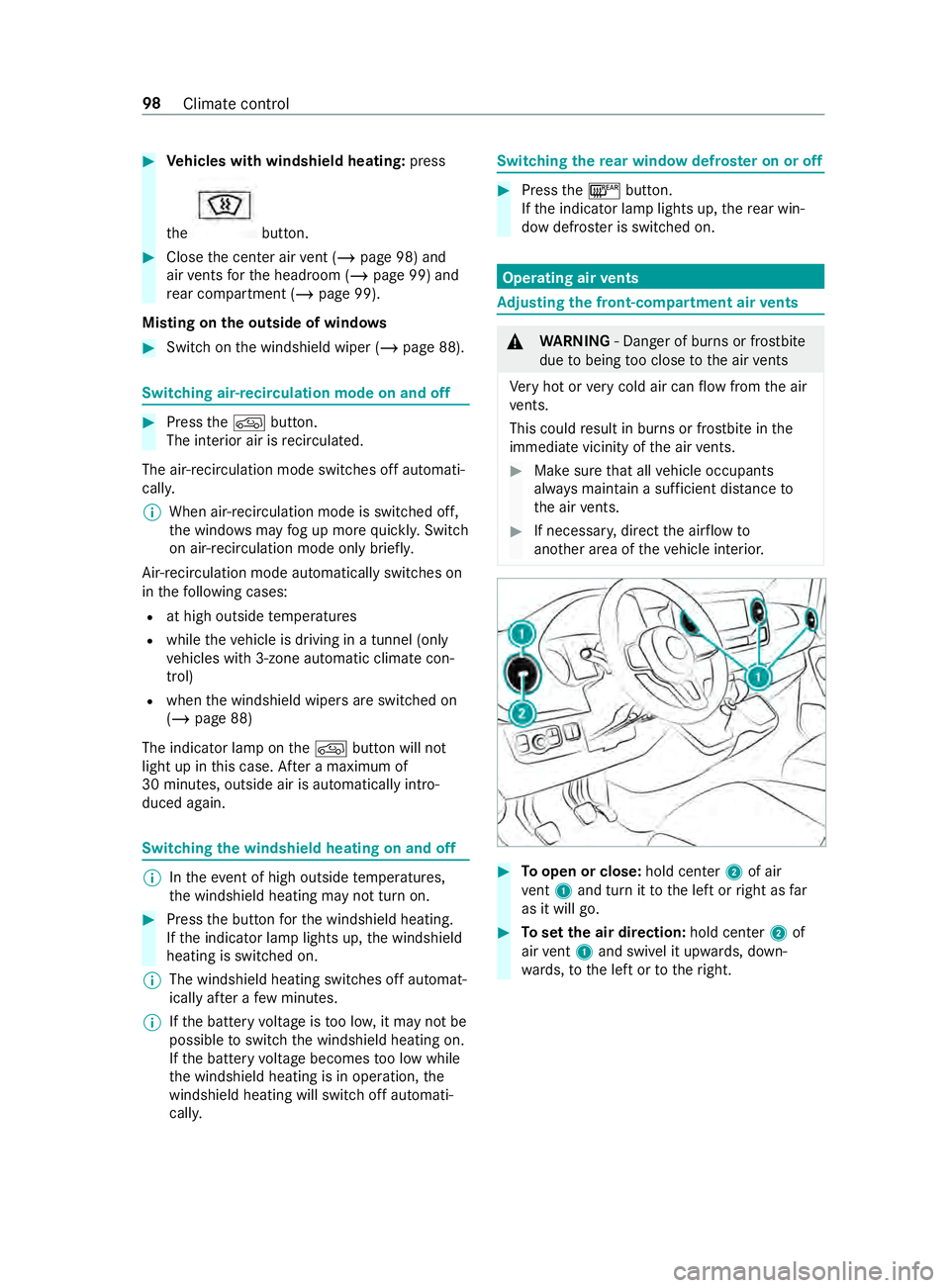
Toopen or close: hold center2 of air
ve nt 1 and turn it tothe left or right as far
as it will go. #
Toset the air direction: hold center2 of
air vent 1 and swivel it up wards, down‐
wa rds, to the left or totheright. 98
Climate control
Page 133 of 354
brakepads
byper form ing a visual inspection to
look for pad material wear.
If yo u are unable tocheck the brakepad wear on
th e inside of the wheels, remo vethe wheels if
yo u possess there qu ired skills, or visit a qualified
specialist workshop.
If th e brakepad material thickness is less than
0. 12 in (3 mm), ha vethe brakepads checked and
re placed at a qualified specialist workshop, if
necessar y.
Do not solely rely on the brakepad wear sensor.
It is also strongly recommended that you ha ve
th e brakepads checked at a qualified specialist
wo rkshop, not only at everyservice displa yedby
th e maintenance inter val displa y,but also prior to
long journe ysand when ever the wheels are
re mo ved.
Ne w brake discs and brakepads
New brakepads and brake discs on lyreach their
optimal braking ef fect af ter appro ximately
10 0 miles (100 kilome ters).
Unti lth en, compensate forth ere duced braking
ef fect by applying greater pressure tothe brake
pedal. For saf etyre asons, Mercedes-Benz recom‐
mends that you only ha vebrakepads and brake
discs which are appr ovedby Mercedes-Benz
ins talled on your vehicle.
Other brake discs or brakepads may compromise
th e saf ety of your vehicle.
Alw aysre place all brake discs and brakepads on
an axle at the same time. Alw ays ins tall new
brakepads when replacing brake discs.
Pa rking brake &
WARNING Risk of skidding or an acci‐
dent bybraking with the parking brake
If yo u ha vetobrake your vehicle with the
parking brake, the braking dis tance is consid‐
erab lylonger and the wheels may loc k.There
is an increased risk of skidding and/or acci‐
dent. #
Only brake theve hicle with the parking
brake if the service brake has failed. #
Inthis case, do not apply the parking
brake with too much forc e. #
Ifth e wheels loc k,immediately release
th e parking brake as much as required
fo rth e wheels toturn again. Ve
hicles with a manual parking brake
When driving on wetro ads or dirt-co vered sur fa‐
ces, road salt or dirt may getinto the parking
brake. This causes cor rosion and a reduction of
braking forc e.
In order topreve ntthis, drive with the parking
brake lightly applied from time totime.
When doing so, drive for a dis tance of appr ox‐
imately 300 ftat a maximum speed of 13mph
(20 km/h).
The brake lights do not light up when you brake
th eve hicle with the parking brake.
Information about driving on wetroads
Hydroplaning &
WARNING Risk of aquaplaning because
tire tread is too low
Depending on the dep thofthewate r onthe
ro adw ay, aquaplaning can occur despite suf fi‐
cient tire tread dep thand low speed. #
Avoid tire ruts and brake carefully. The
refore , in heavy rain or other conditions in
which hydroplaning can occur, drive as follo ws:
R Reduce your speed.
R Avoid tire ruts.
R Brake carefully.
Driving on flooded roads
Bear in mind that vehicles tr aveling in front or in
th e opposite direction create waves. This may
cause the maximum permissible dep thofwa ter
to be exc eeded. These no tes must be obser ved
under all circum stances. Otherwise, you can
damage the engine, electrics and transmission.
If yo u ha vetodrive on stre tches of road on which
wa ter has collected, please bear in mind thefo l‐
lowing:
R The wate r level of standing water may not be
abo vethe lo wer edge of the front bumper.
R You may drive no faster than walking pace.
Obser vethe no tes on ford ing while off- road for
all-wheel drive vehicles (/ page110). Driving and parking
109
Page 137 of 354
This increases
road adhesion, especially on
we tro adw ays.
R Check the wheels and tires and wheel wells
fo r trapped fore ign objects and remo vethem.
Tr apped fore ign objects can damage the
wheels and tires or may be flung out from the
ve hicle when continuing the journe y.
R Check the underbody for trapped branches or
ot her parts of plants and remo vethem.
R Clean the brake discs, brakepads and axle
joints, particularly af ter operation in sand,
mud, grit and gr avel,wa ter or similar lydirty
conditions.
R Check the entire floor assembly, the tires,
wheels, bodywork stru cture, brakes, steering,
suspension and exhaust sy stem for any dam‐
age.
R Check the service brake for operating saf ety,
e.g. car ryout a brake test.
R Ifyo u notice strong vib rations af ter driving
off-road, check the wheels and driv etra in for
fo re ign objects again. Remo veany fore ign
objects which can lead toimbalances and
th us cause vibrations. In theeve nt of damage
to the wheels and the drive train, visit a quali‐
fi ed specialist workshop immediately. ECO display function
The ECO display summarizes
the driving charac‐
te rist ics from thest art of the journey toits com‐
pletion and assists you in achieving the most eco‐
nomical driving style.
Yo u can influence consum ption if you:
R anticipate road and traf fic conditions.
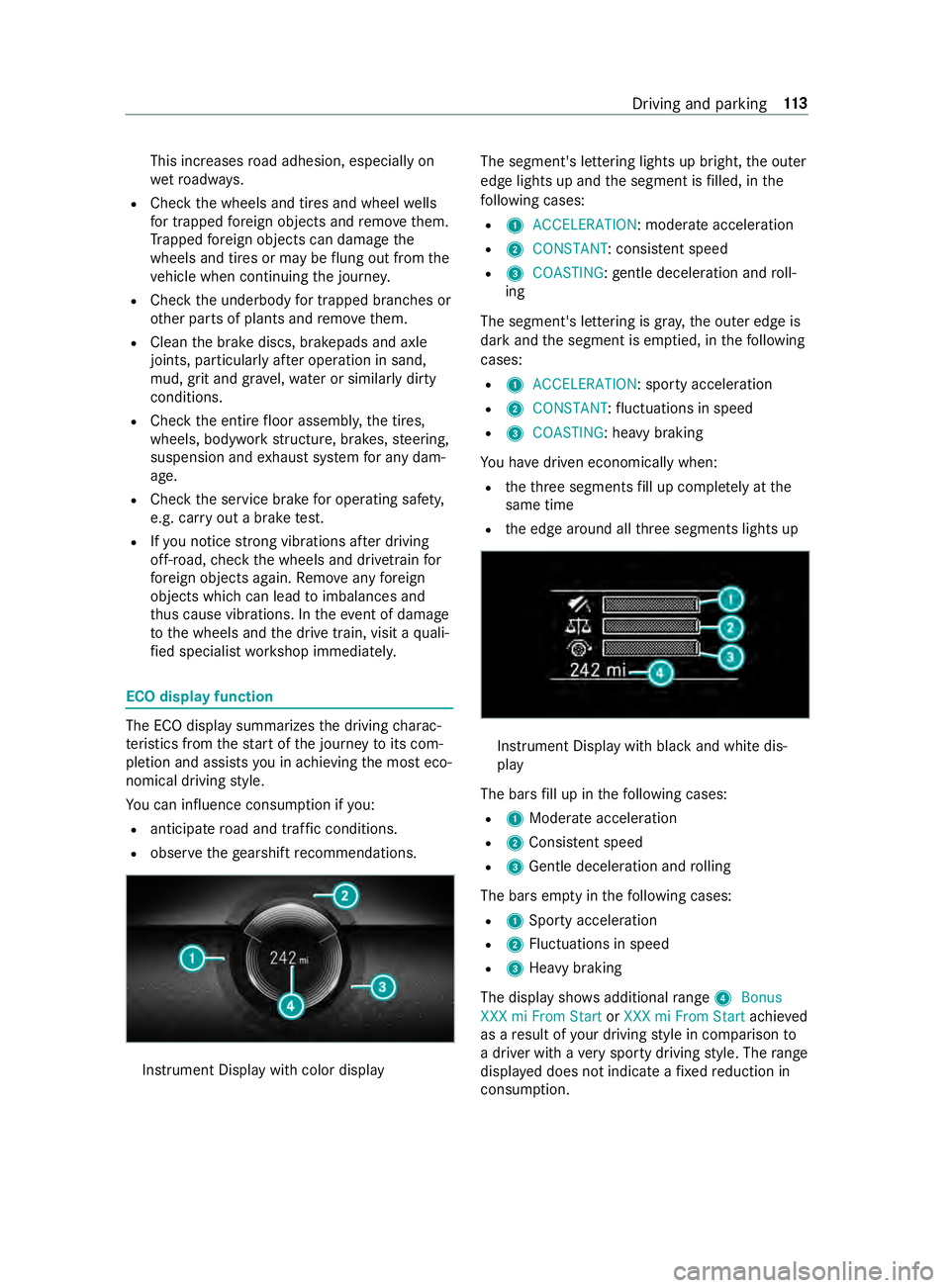
R obser vethege arshift recommendations. Instrument Display wi
thcolor display The segment's lettering lights up bright,
the outer
edge lights up and the segment is filled, in the
fo llowing cases:
R 1 ACCELERATION : moderate acceleration
R 2 CONSTANT: consis tent speed
R 3 COASTING: gentle deceleration and roll‐
ing
The segment's lettering is gray ,th e outer edge is
dark and the segment is em ptied, in thefo llowing
cases:
R 1 ACCELERATION: sporty acceleration
R 2 CONSTANT :fl uctuations in speed
R 3 COASTING: heavy braking
Yo u ha vedriven economically when:
R theth re e segments fill up comple tely at the
same time
R the edge around all thre e segments lights up Instrument Display with black and white dis‐
play
The bars fill up in thefo llowing cases:
R 1Moderate acceleration
R 2Consis tent speed
R 3Gentle deceleration and rolling
The bars em pty in thefo llowing cases:
R 1Sporty acceleration
R 2Fluctuations in speed
R 3Heavy braking
The display sho wsadditional range 4Bonus
XXX mi From Start orXXX mi From Start achieved
as a result of your driving style in comparison to
a driver with a very sporty driving style. The range
displ ayed does not indicate a fixe dre duction in
consum ption. Driving and parking
11 3
Page 143 of 354
If it is not possible
toengage all-wheel drive when
th eve hicle is rolling: #
Vehicles with automatic transmission:
brief lymo vethe selector le verto 005C . Engaging/disen
gaging all-wheel drive *
NO
TERisk of damage tothe transfer
case If
yo ustep on the accelerator pedal while the
all-wheel drive is engaged or disen gage d, the
trans fer case may be dama ged. #
Do not step on the accelera tor pedal
when the indicator lamp in the switch
fo rth e all-wheel drive is flashing. #
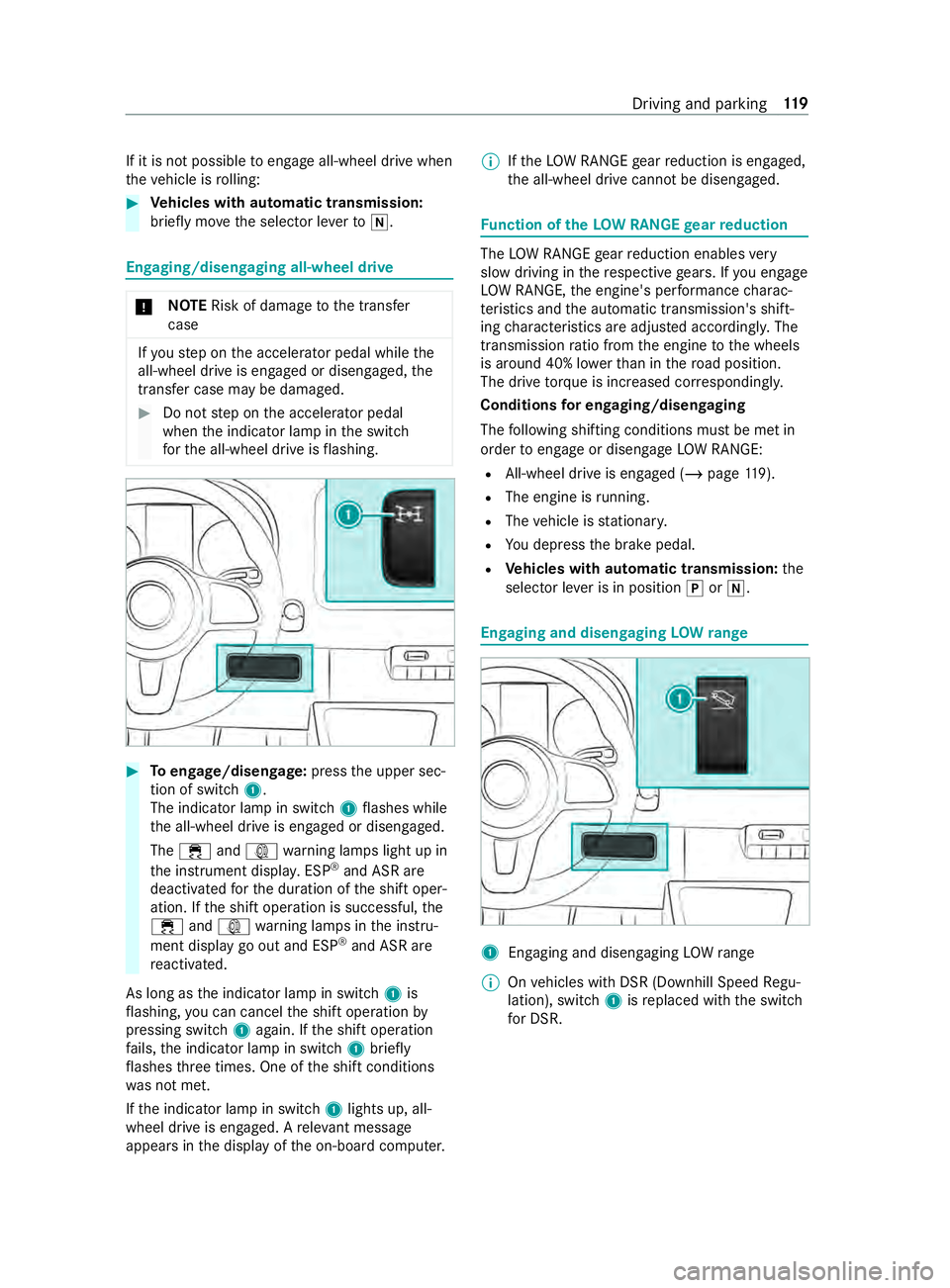
Toengage/disen gage:press the upper sec‐
tion of switch 1.
The indicator lamp in switch 1flashes while
th e all-wheel drive is engaged or disengaged.
The 00E5 and003D warning lamps light up in
th e instrument displa y.ESP ®
and ASR are
deacti vatedfo rth e duration of the shift oper‐
ation. If the shift operation is successful, the
00E5 and003D warning lamps in the instru‐
ment display go out and ESP ®
and ASR are
re activated.
As long as the indicator lamp in switch 1is
fl ashing, you can cancel the shift operation by
pressing switch 1again. If the shift operation
fa ils, the indicator lamp in switch 1brief ly
fl ashes thre e times. One of the shift conditions
wa s not met.
If th e indicator lamp in switch 1lights up, all-
wheel drive is engaged. A releva nt messa ge
appears in the display of the on-board computer. %
If
th eLO W RANGE gear reduction is engaged,
th e all-wheel drive cann otbe disengaged. Fu
nction of theLO W RANGE gear reduction The
LOW RANGE gear reduction enables very
slow driving in there spective gears. If you engage
LO W RANGE, the engine's per form ance charac‐
te rist ics and the automatic transmission's shift‐
ing characteristics are adjus ted according ly. The
transmission ratio from the engine tothe wheels
is around 40% lo werth an in thero ad position.
The drive torque is in creased cor respondingly.
Conditions for en gaging/disengaging
The following shifting conditions must be met in
order toengage or disengage LOW RANGE:
R All-wheel drive is engaged (/ page119).
R The engi ne isrunning.
R The vehicle is stationar y.
R You depress the brake pedal.
R Vehicles with automatic transmission: the
selector le ver is in position 005Dor005C. Engaging and disen
gaging LOW range 1
Enga ging and disengaging LOWrange
% On
vehicles with DSR (Downhill Speed Regu‐
lation), switch 1isreplaced with the switch
fo r DSR. Driving and parking
11 9
Page 144 of 354
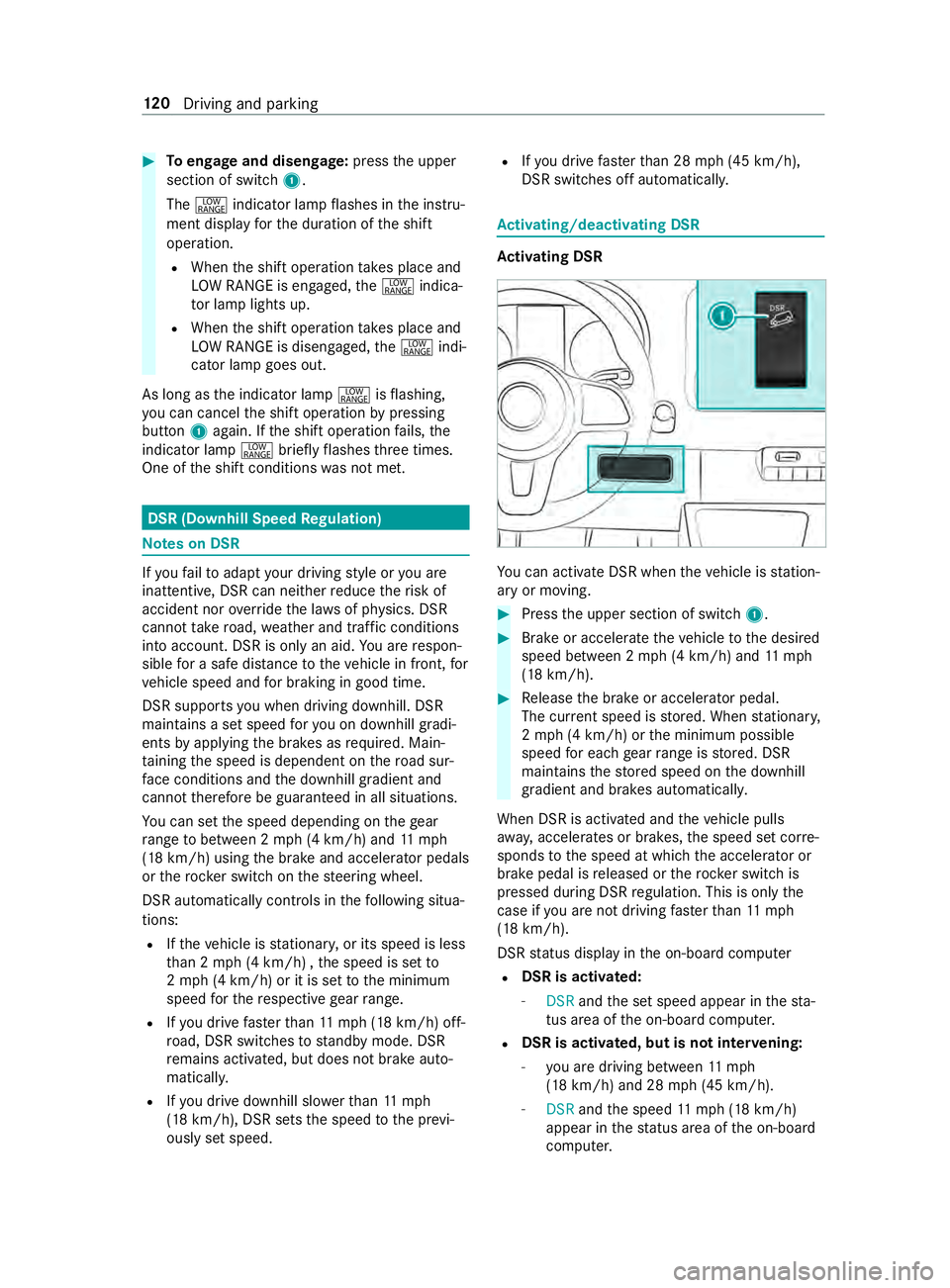
#
Toengage and disen gage:press the upper
section of switch 1.
The 002E indicator lamp flashes in the instru‐
ment display forth e duration of the shift
operation.
R When the shift operation take s place and
LO W RANGE is engaged, the002E indica‐
to r lamp lights up.
R When the shift operation take s place and
LO W RANGE is disengaged, the002E indi‐
cator lamp goes out.
As long as the indicator lamp 002Eisflashing,
yo u can cancel the shift operation bypressing
button 1again. If the shift operation fails, the
indicator lamp 002Ebrieflyflashes thre e times.
One of the shift conditions was not met. DSR (Downhill Speed
Regulation) Note
s on DSR If
yo ufa ilto adapt your driving style or you are
inat tentive, DSR can nei ther reduce therisk of
accident nor override the la wsof ph ysics. DSR
cannot take road, weather and traf fic conditions
into account. DSR is only an aid. You are respon‐
sible for a safe dis tancetotheve hicle in front, for
ve hicle speed and for braking in good time.
DSR supports you when driving downhill. DSR
main tains a set speed foryo u on downhill gradi‐
ents byapplying the brakes as required. Main‐
ta ining the speed is dependent on thero ad sur‐
fa ce conditions and the downhill gradient and
cann ottherefore be guaranteed in all situations.
Yo u can set the speed depending on thege ar
ra nge tobetween 2 mph (4 km/h) and 11mph
(18 km/h) using the brake and accelera tor pedals
or therock er switch on thesteering wheel.
DSR automatically cont rols in thefo llowing situa‐
tions:
R Ifth eve hicle is stationar y,or its speed is less
th an 2 mph (4 km/h) , the speed is set to
2 mp h (4 km/h) or it is set tothe minimum
speed forth ere spective gear range.
R Ifyo u drive fasterthan 11mp h (18 km/h) off-
ro ad, DSR swit ches tostandby mode. DSR
re mains activated, but does not brake auto‐
matical ly.
R Ifyo u drive downhill slo werth an 11mph
(18 km/h), DSR sets the speed tothe pr evi‐
ously set speed. R
Ifyo u drive fasterthan 28 mph (45 km/h),
DSR switches off automaticall y. Ac
tivating/deactivating DSR Ac
tivating DSR Yo
u can activate DSR when theve hicle is station‐
ary or moving. #
Press the upper section of switch 1. #
Brake or accelerate theve hicle tothe desired
speed between 2 mph (4 km/h) and 11mph
(18 km/h). #
Release the brake or accelera tor pedal.
The cur rent speed is stored. When stationar y,
2 mp h (4 km/h) or the minimum possible
speed for each gear range is stored. DSR
maintains thestored speed on the downhill
gradient and brakes automaticall y.
When DSR is activated and theve hicle pulls
aw ay, accelerates or brakes, the speed set cor re‐
sponds tothe speed at which the accelera tor or
brake pedal is released or thero ck er switch is
pressed during DSR regulation. This is only the
case if you are not driving fasterthan 11mph
(18 km/h).
DSR status display in the on-board computer
R DSR is activated:
- DSR andthe set speed appear in thest a‐
tus area of the on-board computer.
R DSR is activated, but is not inter
vening:
- you are driving between 11mph
(18 km/h) and 28 mph (45 km/h).
- DSR andthe speed 11mp h (18 km/h)
appear in thest atus area of the on-board
computer. 12 0
Driving and pa rking
Page 147 of 354
Ra
ising and lo weringtheve hicle le vel Using
there mo tecontrol
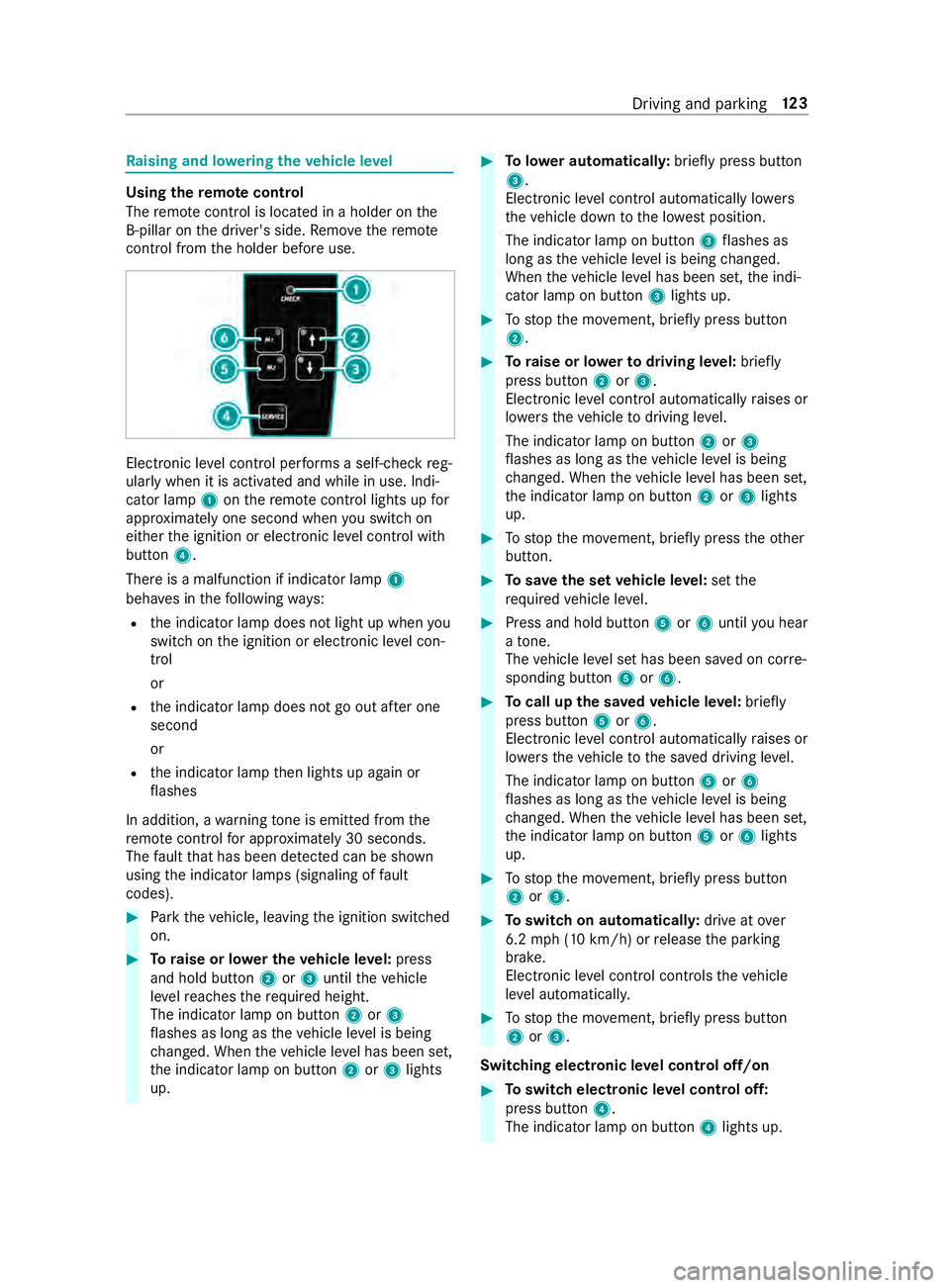
The remo tecontrol is loca ted in a holder on the
B‑pillar on the driver's side. Remo vethere mo te
control from the holder before use. Elect
ronic le vel control per form s a self-check reg‐
ularly when it is activated and while in use. Indi‐
cator lamp 1onthere mo tecontrol lights up for
appr oximately one second when you swit chon
either the ignition or electronic le vel control with
button 4.
There is a malfunction if indicator lamp 1
beha ves in thefo llowing ways:
R the indicator lamp does not light up when you
switch on the ignition or electronic le vel con‐
trol
or
R the indicator lamp does not go out af ter one
second
or
R the indicator lamp then lights up again or
fl ashes
In addition, a warning tone is emitted from the
re mo tecontrol for appro ximately 30 seconds.
The fault that has been de tected can be shown
using the indicator lamps (signaling of fault
codes). #
Park theve hicle, leaving the ignition switched
on. #
Toraise or lo wer the vehicle le vel:press
and hold button 2or3 until theve hicle
le ve lre aches therequ ired height.
The indicator lamp on button 2or3
fl ashes as long as theve hicle le vel is being
ch anged. When theve hicle le vel has been set,
th e indicator lamp on button 2or3 lights
up. #
Tolowe r automatical ly:brie fly press but ton
3 .
Electronic le vel control automatically lo wers
th eve hicle down tothe lo west position.
The indicator lamp on button 3flashes as
long as theve hicle le vel is being changed.
When theve hicle le vel has been set, the indi‐
cator lamp on button 3lights up. #
Tostop the mo vement, brief lypress button
2. #
Toraise or lo werto driving le vel:brief ly
press button 2or3.
Elect ronic le vel control automatically raises or
lo we rstheve hicle todriving le vel.
The indicator lamp on button 2or3
fl ashes as long as theve hicle le vel is being
ch anged. When theve hicle le vel has been set,
th e indicator lamp on button 2or3 lights
up. #
Tostop the mo vement, brief lypress theot her
button. #
Tosave the set vehicle le vel:set the
re qu ired vehicle le vel. #
Press and hold button 5or6 until you hear
a to ne.
The vehicle le vel set has been sa ved on cor re‐
sponding button 5or6. #
Tocall up the sa vedve hicle le vel:briefly
press button 5or6.
Electronic le vel control automatically raises or
lo we rstheve hicle tothe sa ved driving le vel.
The indicator lamp on button 5or6
fl ashes as long as theve hicle le vel is being
ch anged. When theve hicle le vel has been set,
th e indicator lamp on button 5or6 lights
up. #
Tostop the mo vement, brief lypress button
2 or3. #
Toswitch on automaticall y:drive at over
6.2 mph (10 km/h) or release the parking
brake.
Elect ronic le vel control controls theve hicle
le ve l automaticall y. #
Tostop the mo vement, brief lypress button
2 or3.
Switching electronic le vel control off/on #
Toswitch electronic le vel control off:
press button 4.
The indicator lamp on button 4lights up. Driving and parking
12 3
Page 157 of 354

Obser
vethefo llowing points toensure that the
ve hicle is properly secured against rolling away
unin tentionally: #
Always apply the parking brake. #
Vehicles with automatic transmission:
engage transmission position 005D.#
On uphill or downhill inclines: turnthe
front wheels towa rdsth e curb. #
On uphill or downhill inclines: securethe
re ar axle with a chock or an object without
sharp edges.
% Yo
u can operate the side windo wsforfive
minutes af teryo u ha veswitched off theve hi‐
cle. Manual parking brake
Applying/releasing
the handbrake le ver &
WARNING Risk of skidding or an acci‐
dent bybraking with the parking brake
If yo u ha vetobrake your vehicle with the
parking brake, the braking dis tance is consid‐
erab lylonger and the wheels may loc k.There
is an increased risk of skidding and/or acci‐
dent. #
Only brake theve hicle with the parking
brake if the service brake has failed. #
Inthis case, do not apply the parking
brake with too much forc e. #
Ifth e wheels loc k,immediately release
th e parking brake as much as required
fo rth e wheels toturn again. &
WARNING Risk offire and an accident if
th e parking brake is not released
If th e parking brake is not fully released when
driving, thefo llowing situations can occur:
R The parking brake can overheat and cause
a fire
R The parking brake can lose its holding
function #
Comple tely release the parking brake
before driving off. The brake lights do not light up when
you brake
th eve hicle with the parking brake.
Generally, you may only apply the parking brake
when theve hicle is stationar y. #
Toapply the pa rking brake: pull handbrake
le ve r1 up as far as the last possible de tent.
When the engine is running, the0049
and 0024 (USA) or 0024(Canada) indicator
lamps in the Instrument Display light up. If
th eve hicle is in motion, a warning tone
sounds.
% In
vehicles with a folding handbrake le ver,
yo u can then press handbrake le ver1 down
as far as it will go. #
Torelease the pa rking brake: onvehicles
with a folding handbrake le ver,firs t pull hand‐
brake le ver1 up as far as it will go. #
Pull handbrake le ver1 slightly and press
re lease knob 2. #
Guide handbrake le ver1 down toas far as it
will go.
The 0049 and0024 (USA) or 0024(Canada)
indica tor lamps in the Instrument Display go
out.
Fo lding the handbrake le ver up or down (only
in vehicles with a folding handbrake le ver)
Re quirements:
R The handbrake le ver is applied. #
Tofold down the handbrake le ver:push the
handbrake le ver down as far as it will go. #
Toraise the handbrake le ver:pull the hand‐
brake le ver up as far as it will go. Driving and parking
13 3
Page 158 of 354
Pe
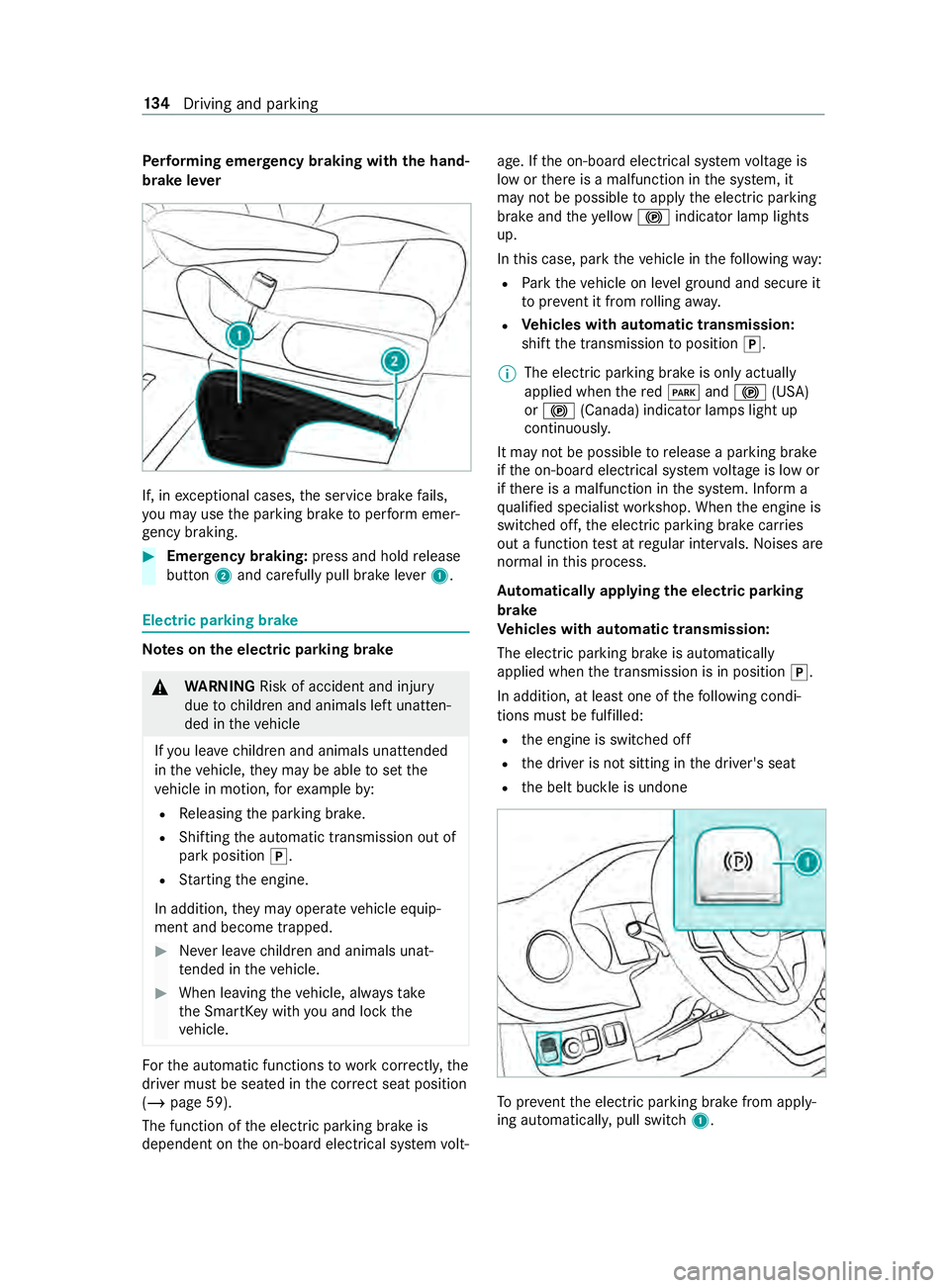
rforming emer gency braking with the hand‐
brake le ver If, in
exceptional cases, the service brake fails,
yo u may use the parking brake toper form emer‐
ge ncy braking. #
Eme rgency braking: press and hold release
button 2and carefully pull brake le ver1. Electric parking brake
Note
s onthe electric pa rking brake &
WARNING Risk of accident and inju ry
due tochildren and animals left unat ten‐
ded in theve hicle
If yo u lea vechildren and animals unat tended
in theve hicle, they may be able toset the
ve hicle in motion, forex ample by:
R Releasing the parking brake.
R Shifting the automatic transmission out of
park position 005D.
R Starting the engine.
In addition, they may operate vehicle equip‐
ment and become trapped. #
Never lea vechildren and animals unat‐
te nded in theve hicle. #
When leaving theve hicle, alw aysta ke
th e SmartK eywith you and lock the
ve hicle. Fo
rth e automatic functions towo rkcor rectl y,the
driver must be seated in the cor rect seat position
(/ page 59).
The function of the electric parking brake is
dependent on the on-board electrical sy stem volt‐ age. If
the on-board electrical sy stem voltage is
low or there is a malfunction in the sy stem, it
may not be possible toapply the electric parking
brake and theye llow 0024 indicator lamp lights
up.
In this case, park theve hicle in thefo llowing way:
R Park theve hicle on le velground and secure it
to prev ent it from rolling away.
R Ve
hicles with automatic transmission:
shift the transmission toposition 005D.
% The electric parking brake is only actually
applied when
there d0049 and0024 (USA)
or 0024 (Canada) indicator lamps light up
continuousl y.
It may not be possible torelease a parking brake
if th e on-board electrical sy stem voltage is low or
if th ere is a malfunction in the sy stem. Inform a
qu alified specialist workshop. When the engine is
switched off, the electric parking brake car ries
out a function test at regular inter vals. Noises are
normal in this process.
Au tomatically applying the electric parking
brake
Ve hicles with automatic transmission:
The electric parking brake is auto matically
applied when the transmission is in position 005D.
In addition, at least one of thefo llowing condi‐
tions must be fulfilled:
R the engine is switched off
R the driver is not sitting in the driver's seat
R the belt buckle is undone To
prev ent the electric parking brake from apply‐
ing automaticall y,pull switch 1. 134
Driving and pa rking
Page 159 of 354
The electric parking brake is also automatically
applied if Active Dis tance Assi stDISTRONIC has
brought theve hicle toast andstill.
In addition, at least one of thefo llowing condi‐
tions must be fulfilled:
R the engine is switched off
R the driver is not sitting in the driver's seat
R the belt buckle is undone
R there is a sy stem malfunction
R the po wer supply is insuf ficient
R theve hicle is stationary for a long time
The red0049 and0024 (USA) or 0024(Canada)
indicator lamp in the instrument display lights up.
The electric parking brake is only actually applied
when there d0049 and0024 (USA) or 0024
(Canada) indicator lamps light up continuousl y.
Re leasing the electric pa rking brake automat‐
ically
Ve hicles with automatic transmission:
The electric parking brake of your vehicle is
re leased when all of thefo llowing conditions are
fulfilled:
R The driver is sitting in the driver's seat.
R The driver is belted.
R The engine is running.
R The transmission is in position 005Bor005E and
yo u depress the accelera tor
or
Yo u swit chfrom transmission position 005Dto
position 005Bor005E. You must also depress the
accelerator if tra veling on steep uphill gradi‐
ents.
R Ifth e transmission is in position 005E,there ar-
end doors must be closed.
App lying/releasing the electric pa rking brake
manually &
WARNING Risk of accident and inju ry
due tochildren and animals left unat ten‐
ded in theve hicle
If yo u lea vechildren and animals unat tended
in theve hicle, they may be able toset the
ve hicle in motion, forex ample by:
R Releasing the parking brake.
R Shifting the automatic transmission out of
park position 005D. R
Starting the engine.
In addition, they may operate vehicle equip‐
ment and become trapped. #
Never lea vechildren and animals unat‐
te nded in theve hicle. #
When leaving theve hicle, alw aysta ke
th e SmartK eywith you and lock the
ve hicle. #
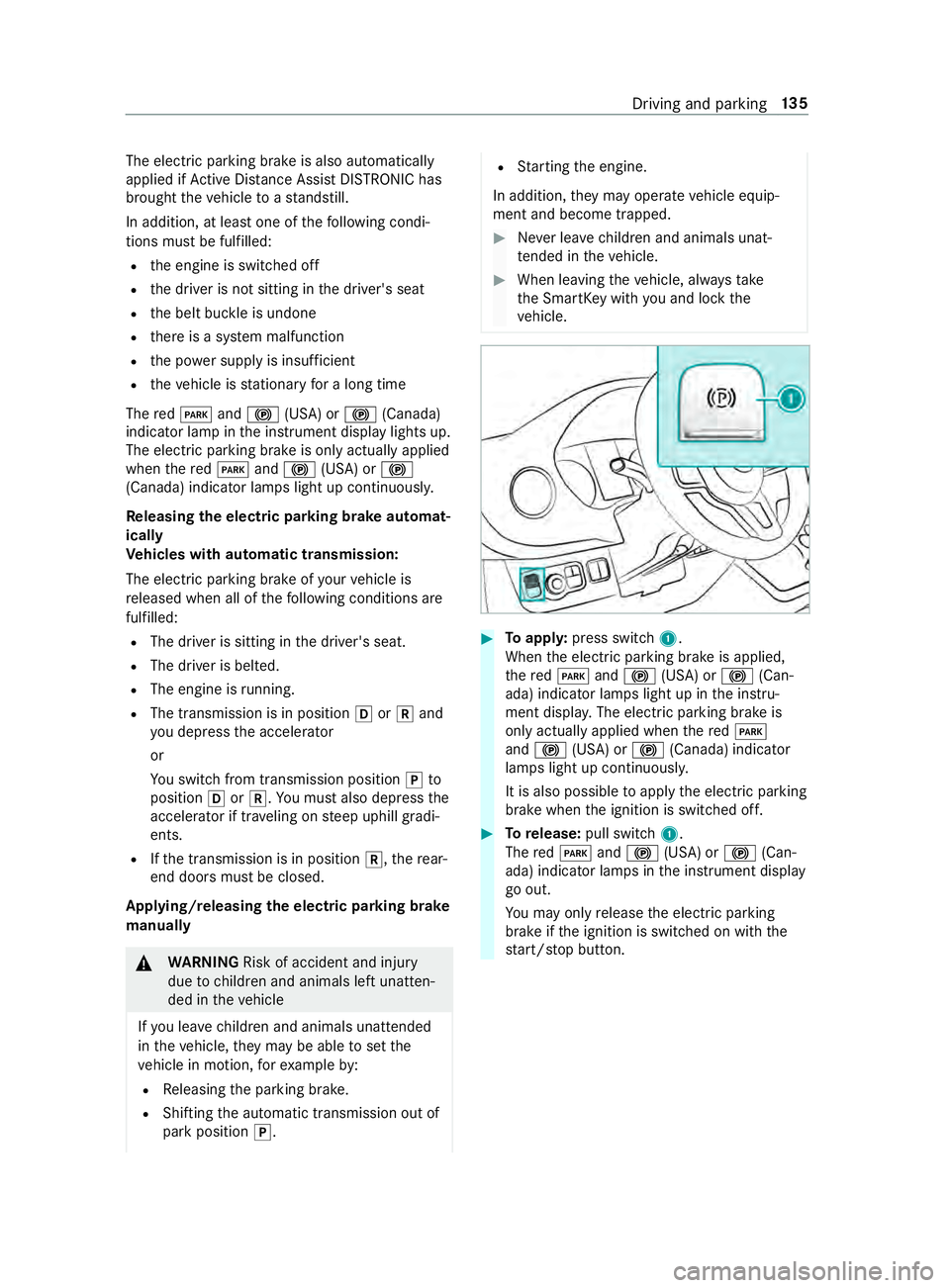
Toappl y:press switch 1.
When the electric parking brake is applied,
th ere d0049 and0024 (USA) or 0024(Can‐
ada) indicator lamps light up in the instru‐
ment displa y.The electric parking brake is
only actually applied when there d0049
and 0024 (USA) or 0024(Canada) indicator
lamps light up continuousl y.
It is also possible toapply the electric parking
brake when the ignition is switched off. #
Torelease: pull switch 1.
The red0049 and0024 (USA) or 0024(Can‐
ada) indicator lamps in the instrument display
go out.
Yo u may on lyrelease the electric parking
brake if the ignition is switched on with the
st art/ stop button. Driving and parking
13 5
Page 161 of 354
Depending on
theve hicle's equipment, thera dar
sensors are integrated behind the bumpers
and/or behind thera diator grill. Keep these parts
free of dirt, ice and slush (/ page212). The se n‐
sors must not be co vered, forex ample bybicycle
ra ck s, overhanging loads or sticke rs. Af ter a colli‐
sion, ha vethe function of thera dar sensors
ch ecked at a qualified specialist workshop as
damage (bo thvisible or non-visible) may ha ve
occur redto the bumper or radiator trim. Fu
nction of driving sy stems and driving
saf ety sy stems In
this section, you will find information about the
fo llowing driving sy stems and driving saf ety sys‐
te ms:
R ABS ( Anti-lock braking system)
(/ page 137)
R ASC (Acceleration SkidControl)
(/ page 137)
R BAS (B rake Assist System) (/ page137)
R ESP ®
(Electronic Stability Program)
(/ page 138)
R EBD ( Electronic Brakeforce Distribution)
(/ page 139)
R Active Brake Assi st (/ page 139)
R Cruise co ntrol (/ page 141)
R Active Dis tance Assi stDISTRONIC
(/ page 143)
R Hill start assist
R HOLD function (/ page145)
R Parking Assist PARKTRONIC ( /page 145)
R Rear view camera (/ page147)
R 360° Camera (/ page149)
R ATTENTION ASSIST (/ page151)
R Blind Sp otAssi st (/ page 152)
R Active Lane Keeping Assist (/ page155) Fu
nctions of ABS (Anti-lock Braking Sy stem) Obser
vethe impor tant sa fety guidelines forthe
driving saf ety sy stem.
ABS cont rols the brake pressure in critical situa‐
tions:
R the wheels are pr evented from lo cking when
braking, e.g. during maximum full-s top brak‐
ing or when there is insuf ficient tire traction. R
thesteerability of theve hicle in term s of
ph ysical possibilities is ensured when brak‐
ing.
R ABS is active from speeds of appr ox. 3 mph
(5 km/h). On a slippery road sur face, ABS
inter venes even if you on lybrake gently.
Sy stem limitations
If th ere is a malfunction and theye llow 0025 ABS
wa rning lamp lights up continuously in the instru‐
ment display af terst arting the engine, ABS may
be impaired or inoperative.
If ABS inter venes, you will feel a pulsing in the
brake pedal. The pulsating brake pedal may be an
indication of hazardous road conditions and func‐
tions as a reminder totake extra care while driv‐
ing.
If ABS in terv enes: keep the brake pedal firm ly
depressed until the braking situation has passed.
To car ryout maximum full-s top braking:
dep ress the brake pedal with full forc e. Fu
nction of BAS (Brake Assist Sy stem) &
WARNING Risk of an accident caused by
a malfunction in BAS (Brake Assi stSys‐
te m)
If BA S is malfunctioning, the braking dis tance
in an emergency braking situation is
increased. #
Depress the brake pedal with full force
in emer gency braking situations. ABS
pr eve nts the wheels from locking. BA
S suppo rts yo u with additional braking forc e in
an emer gency braking situation.
If yo u depress the brake pedal quickl y,BA S is
acti vated:
R BAS au tomatically boosts the braking forc e of
th e brakes
R BAS can sho rten the braking dis tance
R ABS pr events the wheels from locking
When youre lease the brake pedal, the brakes
function as usual again. BAS is deactivated. Fu
nctions of ASR (Acceleration Skid Control) ASR can neither
reduce therisk of an accident
nor override the la wsof ph ysics if the driver does
not pay attention when pulling away or accelerat‐
ing. ASR is only an aid. Alw ays adapt your driving Driving and parking
137