tow MERCEDES-BENZ SPRINTER 2019 MY19 with 7” screen
[x] Cancel search | Manufacturer: MERCEDES-BENZ, Model Year: 2019, Model line: SPRINTER, Model: MERCEDES-BENZ SPRINTER 2019Pages: 354, PDF Size: 6.15 MB
Page 181 of 354
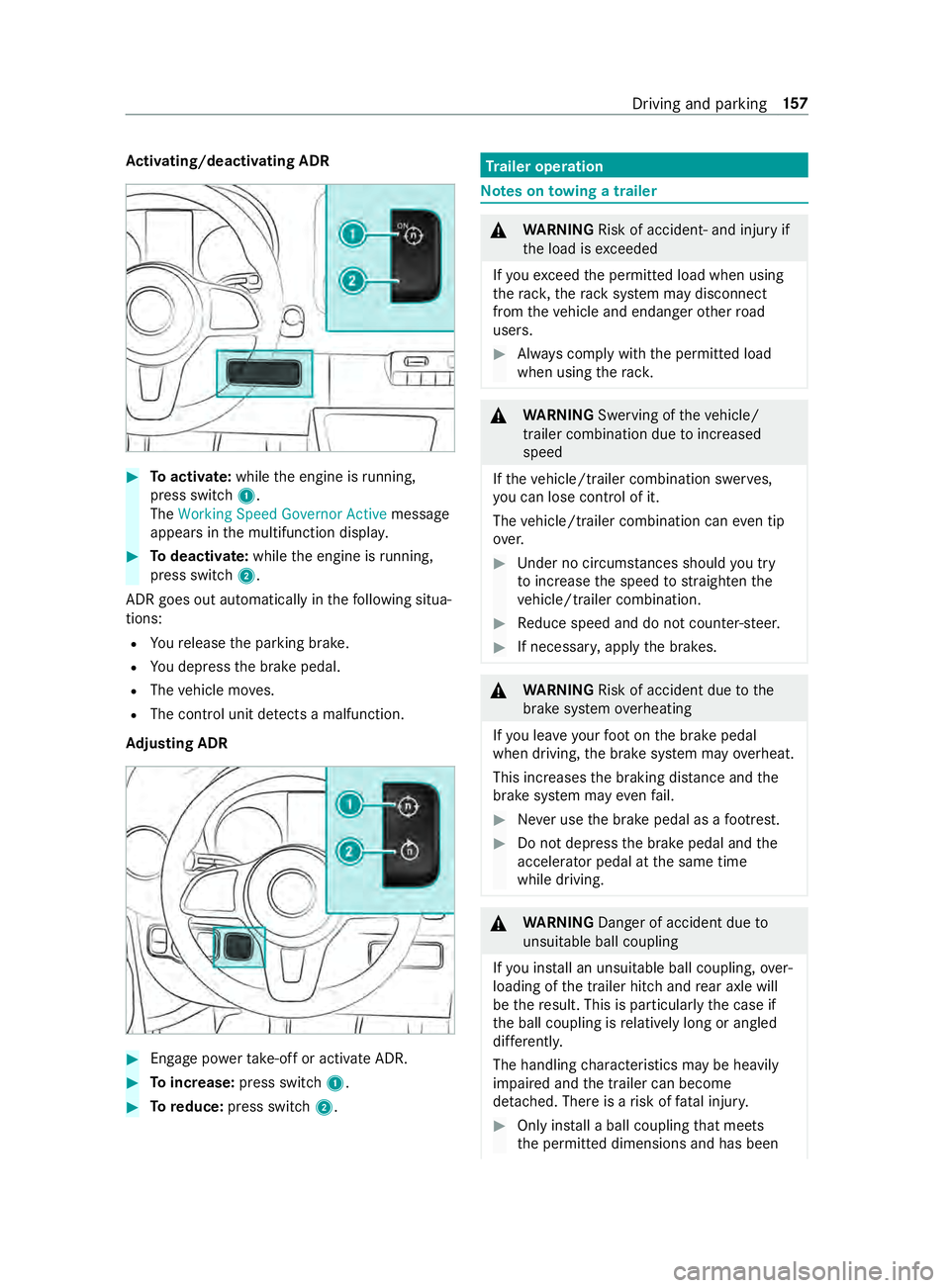
Ac
tivating/deactivating ADR #
Toactivate: whilethe engine is running,
press switch 1.
The Working Speed Governor Active message
appears in the multifunction displa y.#
Todeactivate: whilethe engine is running,
press switch 2.
ADR goes out au tomatical lyin thefo llowing situa‐
tions:
R Youre lease the parking brake.
R You depress the brake pedal.
R The vehicle mo ves.
R The contro l unit detects a malfunction.
Ad justing ADR #
Engage po werta ke -off or acti vate ADR. #
Toincrease: press switch 1. #
Toreduce: press switch 2. Tr
ailer operation Note
s ontowing a trailer &
WARNING Risk of accident‑ and injury if
th e load is exceeded
If yo uexc eed the permitted load when using
th era ck ,th era ck system may disconnect
from theve hicle and endanger other road
users. #
Always comply with the permitted load
when using thera ck. &
WARNING Swerving of theve hicle/
trailer combination due toinc reased
speed
If th eve hicle/trailer combination swer ves,
yo u can lose control of it.
The vehicle/trailer combination can even tip
ove r. #
Under no ci rcums tances should you try
to inc rease the speed tostra ighten the
ve hicle/trailer combination. #
Reduce speed and do not counter-s teer. #
If necessar y,apply the brakes. &
WARNING Risk of accident due tothe
brake sy stem overheating
If yo u lea veyour foot on the brake pedal
when driving, the brake sy stem may overheat.
This increases the braking dis tance and the
brake sy stem may evenfa il. #
Never use the brake pedal as a foot re st. #
Do not depress the brake pedal and the
accelerator pedal at the same time
while driving. &
WARNING Danger of accident due to
unsuitable ball coupling
If yo u ins tall an unsuitable ball coupling, over‐
loading of the trailer hitch and rear axle will
be there sult. This is particularly the case if
th e ball coupling is relatively long or angled
dif fere ntl y.
The handling characteristics may be heavily
impaired and the trailer can become
de tach ed. There is a risk of fata l injur y. #
Only ins tall a ball coupling that meets
th e permitted dimensions and has been Driving and parking
157
Page 182 of 354
designed
forth e trailer operation
re qu irements. #
Do not modify the ball coupling or the
trailer hitch. &
WARNING Risk of accident and inju ry
due toan incor rectly ins talled ball cou‐
pling
If th e ball coupling is not ins talled and
engaged cor rectly, it may become de tach ed
during tr avel and endanger other road users.
There is a risk of fata l injur y. #
Install and secure the ball coupling as
described in the ball coupling manufac‐
turer's ins tallation instructions. #
When the ball coupling has been ins tal‐
led, ensure that it is cor rectly secu red
before every trip. &
WARNING Risk of accident due toan
incor rectly ins talled and secured ball
neck
If th e ball neck is not cor rectly ins talled and
secured, the trailer can become de tach ed. #
Install and secure the ball neck as
described in the ball neck manufactur‐
er's ins tallation instructions. #
When the ball neck has been ins talled,
ensure that it is cor rectly secu red
before every trip *
NO
TEWearing out the brake linings by
continuously dep ressing the brake pedal #
Do not depress the brake pedal continu‐
ously whilst driving. #
Touse the braking ef fect of the engine,
shift toa lo werge ar in good time. Alw
ays comply with the operating instructions of
th e manufacturer of the trailer coupling and the
ball nec k.
Place your vehicle/trailer combination on sur fa‐
ces that are as even as possible and secu reit
against rolling away ( /page 132). Couple and
uncouple the trailer carefully.
When backing up theto wing vehicle, ensure that
th ere is no-one between theve hicle and the
traile r. If
yo u do not connect the trailer totheto wing
ve hicle cor rectly, the trailer may become
de tach ed. Once it has been connected and is
ro adwor thy, the trailer must be in a horizontal
position behind theto wing vehicle.
No tethefo llowing rega rding theto ngue weight:
R Make full use of the maximum tongue weight,
where possible
R Do not exceed or fall below the permitted
to ngue weight
Do not exceed thefo llowing values:
R Perm itted braked or unbraked towing capa‐
city
The maximum permissible towing capacity for
traile rswithout a separate braking sy stem is
1, 653 lbs (750 kg).
R Perm issible rear axle load of theto wing vehi‐
cle
R Perm issible gross mass of theto wing vehicle
R Perm issible gross mass of the trailer
R Perm issible gross towing mass
R Maximum permissible speed of the trailer
The releva nt pe rmitted values, which must not be
exc eeded, can be found in thefo llowing places:
R Inyour vehicle documents
R Onthe identification plate of the trailer hitch
R Onthe trailer's identification plate
R Ontheve hicle identification plate
If th ere are discrepancies between theva lues, the
lo we stone shall appl y.
Before driving off, ensu rethefo llowing:
R The tire pressure on there ar axle of theto w‐
ing vehicle has been set forth e maximum
load.
R The headlamps ha vebeen set cor rectly.
Va lues appr ovedby the manufacturer can be
fo und on the identification plates and in the sec‐
tion forth eto wing vehicle (/ page 235).
Yo ur vehicle will act dif fere ntly wi tha trailer rela‐
tive towithout a trailer:
R The vehicle/trailer combination will be heav‐
ier.
R The vehicle/trailer combination will be
re stricted in its acceleration and climbing
ability. 15 8
Driving and pa rking
Page 183 of 354
R
The vehicle/trailer combination will ha vean
inc reased braking dis tance.
R The vehicle/trailer combination will be more
susceptible tocrosswind gu sts.
R The vehicle/trailer combination will requ ire
more sensitive steering.
R The vehicle/trailer combination will ha ve a
lar ger turning radius.
This may impair theve hicle's driving characteris‐
tics.
When driving with a vehicle/trailer combination,
alw ays adapt your speed tothe cur rent road and
we ather conditions. Drive carefull y.Ke ep a suf fi‐
cient safe dis tance.
Co mply withthe maximum speed of 49 mph
(80 km/h) or 62 mph (100 km/h), even in coun‐
tries in which higher speeds are permitted for
ve hicle/trailer combinations.
Comply with the legally prescribed maximum
speed forve hicle/trailer combinations in forc e in
th e count ry,st ate or Canadian pr ovince in ques‐
tion. Before driving, consult the trailer's vehicle
documents tosee the maximum permissible
speed foryo ur trailer.
At tach only an appr oved trailer hitch to yourvehi‐
cle. Use only a ball neck that has been appr oved
fo ryo ur vehicle. Further information about availa‐
bility and ins tallation of the trailer electrical sys‐
te m is available from any qualified specialist
wo rkshop.
The trailer hitch is one of the most impor tant
ve hicle parts forro ad saf ety. Comply with the
instructions on operating, maintaining and servic‐
ing in the manufacturer's operating instructions.
% Yo
ur vehicle's bumpers are not suitable for
ins talling de tach able trailer tow hit ches.
Do not attach any rented trailer tow hit ches or
any other de tach able trailer tow hit ches tothe
bumpers.
% When using a trailer,
remember that
PA RKTRONIC is available only toa limited
ex tent, if at all.
% The ball head height will
change depending
on theve hicle's load. In this case, use a
trailer with a height-adjus table dr awbar.
Driving no tes
The maximum permissible speed forve hicle/
trailer combinations depends on the type of
trailer. Before driving, consult the trailer's vehicle documents
tosee the maximum permissible
speed foryo ur trailer.
Yo ur vehicle will act dif fere ntly wi tha trailer rela‐
tive towithout a trailer, and will consume more
fuel. In the case of a long and steep descent, you
must select shift range 3,2or 1in good time.
% This also applies if
the cruise cont rol is
switched on.
Yo u will thereby make use of the engine's braking
ef fect and will not ha vetobrake as of tento con‐
trol the speed. This will take some of thest ra in
off the brake sy stem and pr event the brakes from
ove rheating and wearing tooqu ickl y.Ifyo u need
additional braking, depress the brake pedal inter‐
mittently rath er than continuousl y.
Driving tips
If th e trailer sw ays, remember thefo llowing
points:
R Do not accelerate under any circums tances.
R Do not counter steer.
R If necessar y,apply the brakes.
% Yo
u can pr eventthe trailer from sw aying and
rock ingbyretrofitting stabilizer bars or trailer
st ability programs. You can obtain fur ther
information from an authorized Mercedes-
Benz Center.
R Maintain a lar ger dis tance than when driving
without a trailer.
R Avoid braking abruptl y.If possible, brake gen‐
tly firs t of all so that the trailer closes up
behind your vehicle. Then, increase the brak‐
ing forc era pidl y.
R The values given forst art-off gradeability
re ferto sea le vel. When driving in moun tain‐
ous areas, no tethat engine output, and there‐
fo re start-off gradeability, will dec rease with
inc reasing altitude. Coupling/uncoupling a trailer
Coupling a trailer
* NO
TEDama getotheve hicle battery due
to full discharge Charging
the trailer battery using the po wer
supply of the trailer can damage theve hicle
batter y. #
Do not use theve hicle's po wer supply
to charge the trailer batter y. Driving and pa
rking 15 9
Page 184 of 354
#
Shift the selector le verto position 005D. #
Apply theve hicle's parking brake. #
Close all the doors. #
Position the trailer on a le vel sur face behind
th eve hicle.
% The ball head height
changes depending on
th eve hicle's load. In this case, use a trailer
with a height-adjus table trailer dr awbar. #
Couple up the trailer. #
Establish all electrical and other connections
to the trailer. #
Remo veobjects or devices which pr eventthe
trailer from rolling, e.g. wheel choc ks. #
Release the trailer's parking brake.
% The
vehicle harness has a cable connection
to the brake light indicator lamp.
Obser vethe maximum permissible trailer dimen‐
sions (width and length).
Most US states and all Canadian pr ovinces pre‐
scribe thefo llowing points, and you are ur gently
re commended tocomply wi th these:
R Safetych ains between theto wing vehicle and
th e trailer. The chains should be routed in a
criss-cross pat tern under the trailer dr awbar.
They must be connected tothe trailer tow
hitch and not tothe bumper or totheve hicle
axle.
Lea vesuf ficient sla ckinthech ains. This
allo wsforeve n sha rpcornering.
R A separate brake sy stem is requ ired for cer‐
ta in trailers.
R A saf etyfe ature is requ ired for braked trailers.
De term ine the specific requ irements acco rd‐
ing tothere leva nt la ws.
If th e trailer becomes de tach ed from theto w‐
ing vehicle, the saf etyfe ature triggers the
trailer brakes and can thus reduce the danger.
Un coupling a trailer &
WARNING Risk of being crushed and
becoming trapped when uncoupling a
trailer
When uncoupling a trailer wi than engaged
ine rtia-activated brake, your hand may
become trapped between theve hicle and the
trailer dr awbar. #
Do not uncouple trailers with an
engaged overrun brake. Do not uncouple a trailer with an
overrun brake in
a st ate of overrun. Otherwise, there bound of the
ove rrun brake can damage your vehicle. #
Shift the selector le verto position 005D. #
Apply theve hicle's parking brake. #
Close all the doors. #
Apply the trailer's parking brake. #
Secure the trailer against rolling away with a
wheel chock or similar object. #
Remo vethe trailer cables and saf etych ains. #
Uncou plethe trailer. Information about
towing a trailer Operating a trailer is subject
tomany statutory
re gulations such as speed restrictions.
Many states also requ ire an auxiliary separate
functional braking sy stem when towing a weight
th at exc eeds a cer tain limit. Foryo ur saf ety, it is
re commended touse a separate functional brak‐
ing sy stem on any towe dve hicle.
Make sure that your trailer combination meets
local regulations. This not only applies to your
place of residence, but also to your destination.
In fo rm ation on this can be obtained from the
police and local authorities.
Comply with thefo llowing when driving with a
trailer:
R Practice cornering, stopping and backing up
in a traf fic-free location. In this wa y,yo u will
ga in driving experience and become accus‐
to med tothe new handling characteristics.
R Before driving, check thefo llowing:
- that the trailer tow hit chand ball coupling
are secure
- that the saf ety swit chfor braked trailers is
functioning cor rectly
- that the saf etych ains are secure and
undamaged
- that the electrical connections are secure
- that the lights are functioning cor rectly
- the wheels for dama geand cor rect tire
pressure (/ page 232)
R Adjust the outside mir rors so that you ha ve a
clear view of there ar section of the trailer.
R Ifth e trailer is equipped with an individual
braking sy stem, check before each journey
whe ther the brakes are functioning cor rectl y. 16 0
Driving and pa rking
Page 185 of 354
R
Ifth e trailer has electronically cont rolled
brakes, pull away carefully wi th theve hicle/
trailer combination. Brake manually using the
brake controller and check whe ther the
brakes are functioning cor rectly.
R Secu rethe load on the trailer in line with the
re qu irements and rules for load-securing
me thods.
R When driving with a trailer, check at regular
inter vals that the load is secure and that the
lights and brakes are functioning cor rectl y.
R Bear in mind that the handling characteristics
are more uns table when towing a trailer than
when driving without a trailer. Avoid sudden
st eering mo vements.
R The vehicle/trailer combination is heavier,
accelerates more slowl y,has a reduced
climbing ability and an increased braking dis‐
ta nce. It is more susceptible toside winds
and requ ires careful steering.
R If possible, do not brake suddenl y,but rath er
moderately at firs t so that the trailer can acti‐
va te its brakes. Then inc rease the pressure on
th e brake pedal.
R Ifth e automatic transmission shifts between
ge ars on uphill or downhill gradients, restrict
th e shift range. Select shi ftrange 4, 3, 2 or 1.
A lo werge ar and reduced speed decrease the
ri sk of engine damage.
R When driving on a downhill gradient, shift to a
lo we rge ar to use the engine's braking ef fect.
Av oid cons tant braking, as this could cause
th eve hicle brakes and possibly also the
trailer brakes toove rheat.
R Ifth e coolant temp erature increases signifi‐
cantly when the air-conditioning sy stem is
switched on, switch the air-conditioning sys‐
te m off.
Coolant heat can also be dissipated by
switching the air flow and thete mp erature of
th e heater or air conditioning tothe maximum
le ve l. Open the windo wsif necessar y.
R When overtaking, pay particular attention to
th e increased overtaking di stance of your
ve hicle/trailer combination.
Due tothe length of your vehicle/trailer com‐
bination you will requ ire a longer stre tch of
ro ad before swit ching back tothe original
lane. Pe
rm issible trailer loads and trailer dr awbar
nose weights We
ight information &
WARNING Risk of accident due to
unbraked trailer with excessively high
gross weight
If yo uto w a trailer without a separate func‐
tional braking sy stem and a gross trailer
we ight (G TW) of more than 1635 lbs (750 kg),
th en theve hicle brake sy stem may overheat.
This increases the braking dis tance and the
brake sy stem may evenfa il. #
Always use a trailer with a separate
functional braking sy stem when towing
a trailer with a gross trailerweight
(G TW ) of more than 1635 lbs (750 kg). *
NO
TEDama getothe drive train, trans‐
mission or trailer tow hit chdue toexc ess
gross combination weight The permissible
gross combinationweight is
exc eeded.
The drive train, the transmission or the trailer
to w hit chmay be dama ged. #
Comply with the permissible gross com‐
bination weight. Fo
rve hicles with a permissible gross vehicle
we ight of 11030 lbs (5003 kg),th e permissible
gross combination weight is less than the sum of
th e permissible gross vehicle weight plus the per‐
missible trailer load. If either theve hicle or the
trailer is fully laden, the permitted gross vehicle
we ight or the permitted trailer load values are
re duced accordingly. In this case, you may on ly
partially load the trailer or theve hicle.
The gross trailer weight (G TW) is calculated by
adding thewe ight of the trailer tothewe ight of
th e load and equipment. If the trailer is equipped
with a separate braking sy stem, then the maxi‐
mum gross trailer weight is 5000 lbs (2268 kg) or
75 00 lbs (3402 kg).
The maximum permissible trailer dr awbar nose‐
we ight on the ball head is 500 lbs (227 kg) or
75 0 lbs (340 kg). Ho wever,th e actual trailer
dr aw bar nose weight must not exceed theva lue
given on the trailer tow hit chor trailer identifica‐
tion plates. Where theva lues dif fer, th e lo west
va lue alw ays applies. Driving and parking
161
Page 186 of 354
The permissible gross
weight forve hicle-trailer
combinations (GCWR) is calculated byadding the
gross weight of the trailer tothe gross vehicle
we ight including a driver's weight of appr ox‐
imately 150 lbs (68 kg). The maximum permissi‐
ble gross combination weight is vehicle-specific
and equipment-dependent. When driving with a
trailer, you should not exceed the maximum per‐
mitted permissible gross weight forve hicle-trailer
combinations (GCWR).
The permissible values, which must not be excee‐
ded, can be found in your vehicle documents and
on the identification plates of the trailer tow
hitch, the trailer and theve hicle. The values
appr ovedby the manufacturer can also be found
in the "Technical data" section. Where theva lues
dif fer, th e lo west value alw ays applies.
Loading the trailer
Use a dr awbar nose weight that is as close as
possible tothe maximum permissible nose‐
we ight. Do not undershoot the minimum permis‐
sible nose weight. Otherwise, the trailer may
become de tach ed.
R Distribute the load over theve hicle and the
trailer so as not toexceed either the maxi‐
mum permissible values forth e gross vehicle
we ight rating (GVWR) and gross trailer weight
(G TW ),th e permissible gross weight forve hi‐
cle-trailer combinations (GCWR), nor the max‐
imum permissible gross axle weight rating
(GAWR) and trailer dr awbar nose weight (TWR)
of your vehicle.
R Addth ere ar axle load tothe trailer dr awbar
nose weight of the trailer dr awbar on the ball
head (TWR). This will ensure that you do not
ex ceed the permissible gross axle weight rat‐
ing (G AWR).
R Addth eve hicle load tothe trailer dr awbar
nose weight of the trailer dr awbar on the ball
head (TWR). This will ensure that you do not
ex ceed the permissible gross vehicle weight
ra ting (GVWR).
Che cking theve hicle and trailer weight
R Make sure that thewe ights of theto wing
ve hicle and the trailer comply with the maxi‐
mum permissible values. Ha vethe car/t railer
combination weighed on a calibrated weigh‐
ing machine. The car/trailer combination
comprises theto wing vehicle including driver,
passengers and load as well as the laden
trailer. R
Check the maximum permissible gross axle
we ight rating of the front and rear axles
(GAWR), the gross trailer weight (G TW),the
permissible gross weight forve hicle-trailer
combinations (GCWR) and the trailer dr awbar
nose weight rating (TWR). Tr
ailer po wer supply Incor
rect cabling of the connector plug may inter‐
fe re with other electronic sy stems in theve hicle.
Mercedes-Benz therefore recommends that you
ha ve the cabling of the connector plug car ried
out at a qualified specialist workshop.
Yo u can connect accesso ries up toa maximum of
24 0 W tothe permanent po wer supply. Do not
ch arge a trailer battery using the po wer supp ly.
Yo ur vehicle may be equipped with a range of
electrical equipment for trailer operation.
Depending on your trailer, you may need an
adap terfo rth e electrical connection between the
trailer and your vehicle.
The trailer soc ket of your vehicle is equipped with
a permanent po wer supp lyat thefa ctor y.
The permanent po wer supp lyis supplied via
trailer soc ket pin 4.
No tethat the trailer's permanent po wer supp lyis
not switched off when theve hicle's on-board
electrical sy stem voltage is lo w.This could com‐
ple tely dischar geyour vehicle's star ter batter y.
Fu rther information on the electrical equipment
cur rently ins talled on your vehicle, and on ins tal‐
ling trailer elect rics, can be obtained at any quali‐
fi ed specialist workshop. 16 2
Driving and pa rking
Page 196 of 354
In
theeve nt of a breakdown, you will get suppor t:
R Aqu alified Mercedes-Benz tech nician car ries
out repairs on site and/or theve hicle will be
to we dto the nearest authorized Mercedes-
Benz Center.
Yo u may be charge dfo rth ese services.
Yo u can find information on thefo llowing topics:
R activation of Mercedes PRO connect
R operating theve hicle
R nearest authorized Mercedes-Benz Center
R other products and services from Mercedes-
Benz
Data is transmitted during the connection tothe
Mercedes-Benz Cus tomer Center (/ page172). Information on Mercedes PRO connect acci‐
dent management
The Mercedes PRO connect accident manage‐
ment is an extension of the Emer gency Call Sys‐
te m (/ page216).
An emergency call is made tothe Mercedes-Benz
emer gency call center af ter an accident:
R avo ice connection is made toa con tact per‐
son at the Mercedes-Benz emer gency call
center.
R if necessa ry,th e contact person at the
Mercedes-Benz emergency call center for‐
wa rdsth e call toMercedes PRO connect acci‐
dent management.
R if necessar y,theve hicle will be towe dto an
authorized Mercedes-Benz Center.
If th eve hicle de tects a minor accident, a mes‐
sage appea rsinthe multimedia sy stem.
The message is confirmed in the multimedia sys‐
te m:
R avo ice connection is made toa con tact per‐
son at Mercedes PRO connect accident man‐
agement.
R if necessar y,theve hicle will be towe dto an
authorized Mercedes-Benz Center. Tr
ansmitted data during a breakdown assis‐
tance call
In cer tain countries you must con firm the data
transfer. When
you make a breakdown assistance call via
Mercedes PRO connect, data will be trans ferred.
The following data is transfer red if a breakdown
assis tance call is made via Mercedes PRO con‐
nect:
R vehicle identification number
R reason forth e initiation of the call 17 2
Mercedes PRO
Page 197 of 354
Overview and operation
Overview of
the MBUX multimedia sy stem &
WARNING Risk of distraction from infor‐
mation sy stems and communications
equipment
If yo u operate information and communica‐
tion equipment integ rated in theve hicle when
driving, you will be distracted from the tra ffic
situation. This could also cause youto lose
control of theve hicle. #
Only operate this equipment when the
traf fic situation permits. #
Ifyo u cannot be sure of this, stop the
ve hicle whilst paying attention toroad
and traf fic conditions and ope rate the
equipment with theve hicle stationar y. Yo
u must obse rveth e legal requirements forthe
country in whi chyou are cur rently driving when
ope rating the multimedia sy stem.
MBUX stands for Mercedes-Benz User Experi‐
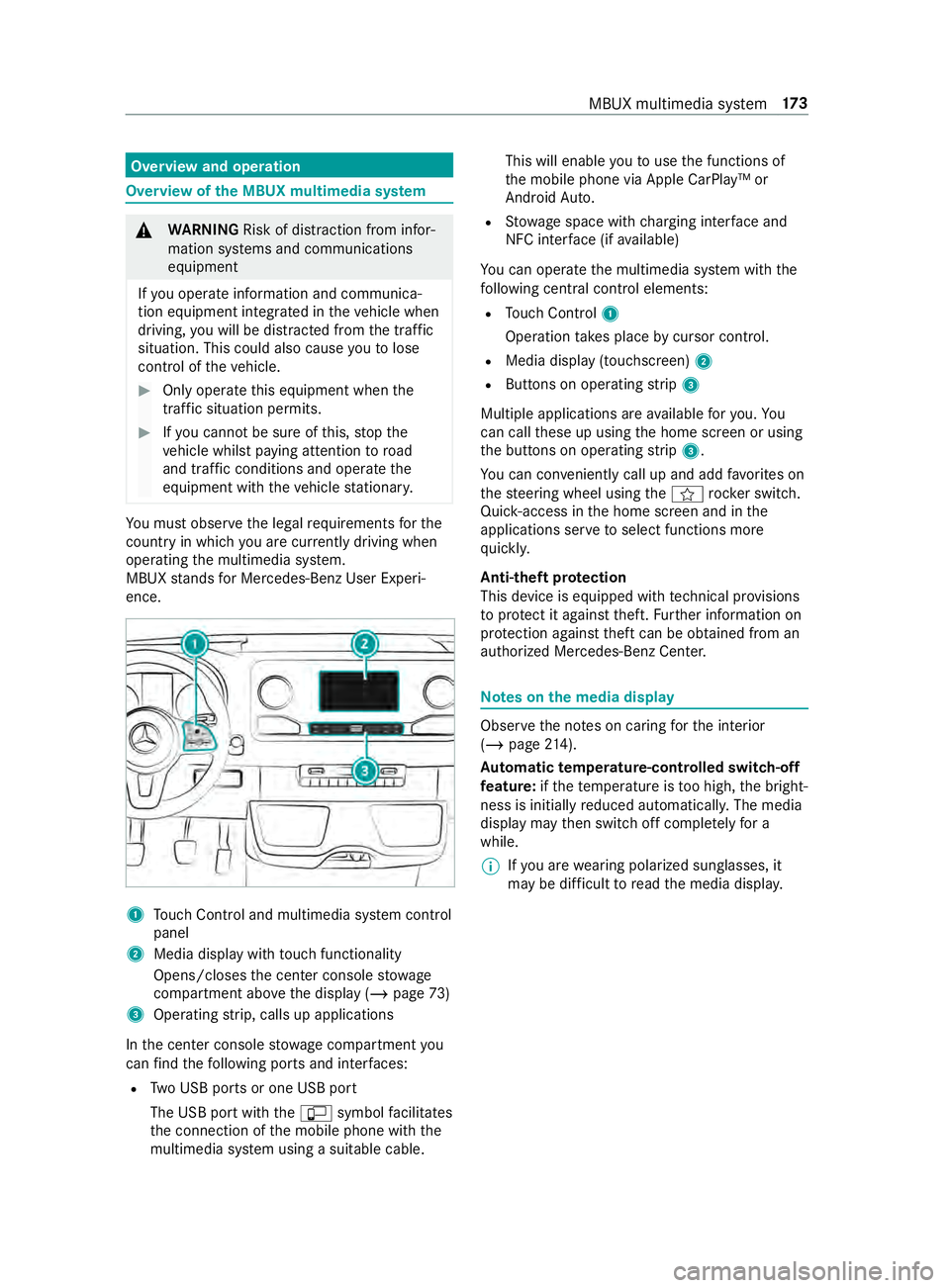
ence. 1
Touch Control and multimedia sy stem cont rol
panel
2 Media display with touch functionality
Opens/closes the center console stowage
compartment abo vethe display (/ page73)
3 Operating strip, calls up applications
In the center console stowage compartment you
can find thefo llowing ports and inter faces:
R Two USB ports or one USB port
The USB port with the00C2 symbol facilitates
th e connection of the mobile phone with the
multimedia sy stem using a suitable cable. This will enable
youto use the functions of
th e mobile phone via Apple CarPlay™ or
Android Auto.
R Stow age space with charging inter face and
NFC inter face (if available)
Yo u can operate the multimedia sy stem with the
fo llowing central control elements:
R Touch Control 1
Operation takes place bycursor control.
R Media display (tou chscreen) 2
R Buttons on operating strip 3
Multiple applications are available foryo u. Yo u
can call these up using the home screen or using
th e buttons on operating strip 3.
Yo u can con veniently call up and add favo rite s on
th esteering wheel using the004B rock er switch.
Quic k-access in the home screen and in the
applications ser vetoselect functions more
qu ickl y.
Anti-theft pr otection
This device is equipped with tech nical pr ovisions
to protect it against theft. Further information on
pr otection against theft can be obtained from an
authorized Mercedes-Benz Center. Note
s onthe media display Obser
vethe no tes on caring forth e interior
(/ page 214).
Au tomatic temperature-cont rolled switch-off
fe ature: ifth ete mp erature is too high, the bright‐
ness is initially reduced automaticall y.The media
display may then switch off comple tely for a
while.
% If
yo u are wearing polarized sun glasses, it
may be dif ficult toread the media displa y. MBUX multimedia sy
stem 17 3
Page 199 of 354
Switching acoustic operating
feedba ckfor
th eTo uch Control on/off
Multimedia sy stem:
4 © 5
Settings 5
System
5 Controls
The function is suppor tedby the selection in a
list. #
Select Acoustic Operating Feedback .#
Set Normal, LoudorOff.
If th e function is activated you will hear a
clicking sound when sc rolling in a list. When
th e beginning or end of the list is reached you
will hear ano ther clicking sound. To
uchscreen Operating
theto uchscreen
Re quirements:
R For the map functions: an iPhone®
is con‐
nected via Apple CarPl ay™ or a mobile phone
is connected via Android Autowith the multi‐
media sy stem.
R A navigation application is available on the
mobile phone.
Ta pping #
Toselect a menu item or entr y:tap on a
symbol or an ent ry. #
Toincrease the map scale: tap twice
qu ickly with one finger. #
Toreduce the map scale: tap with two fin‐
ge rs. #
Toenter characters with theke yboard: tap
on a button.
Single-finger swipe #
Tonavigate in menus: swipe up, down, left
or right.
To uching, holding and moving #
Toset thevo lume on a scale: touch the
to uchsc reen and mo vethefinger tothe left or
ri ght.
To uching and holding #
Tocall up a global menu in the applica‐
tions: touch theto uchsc reen and hold until
th eOPTIONS menu appears. Setting acoustic operation
feedba ckfor the
to uchscreen
Multimedia sy stem:
4 © 5
Settings 5
System
5 Controls 5
Touch Control Sensitivity
The function is suppor tedby the selection in a
list. #
Select Acoustic Operating Feedback . #
Set Normal, LoudorOff.
If th e function is activated you will hear a
clicking sound when sc rolling in a list. When
th e beginning or end of the list is reached you
will hear ano ther clicking sound. Applications
Calling up applications
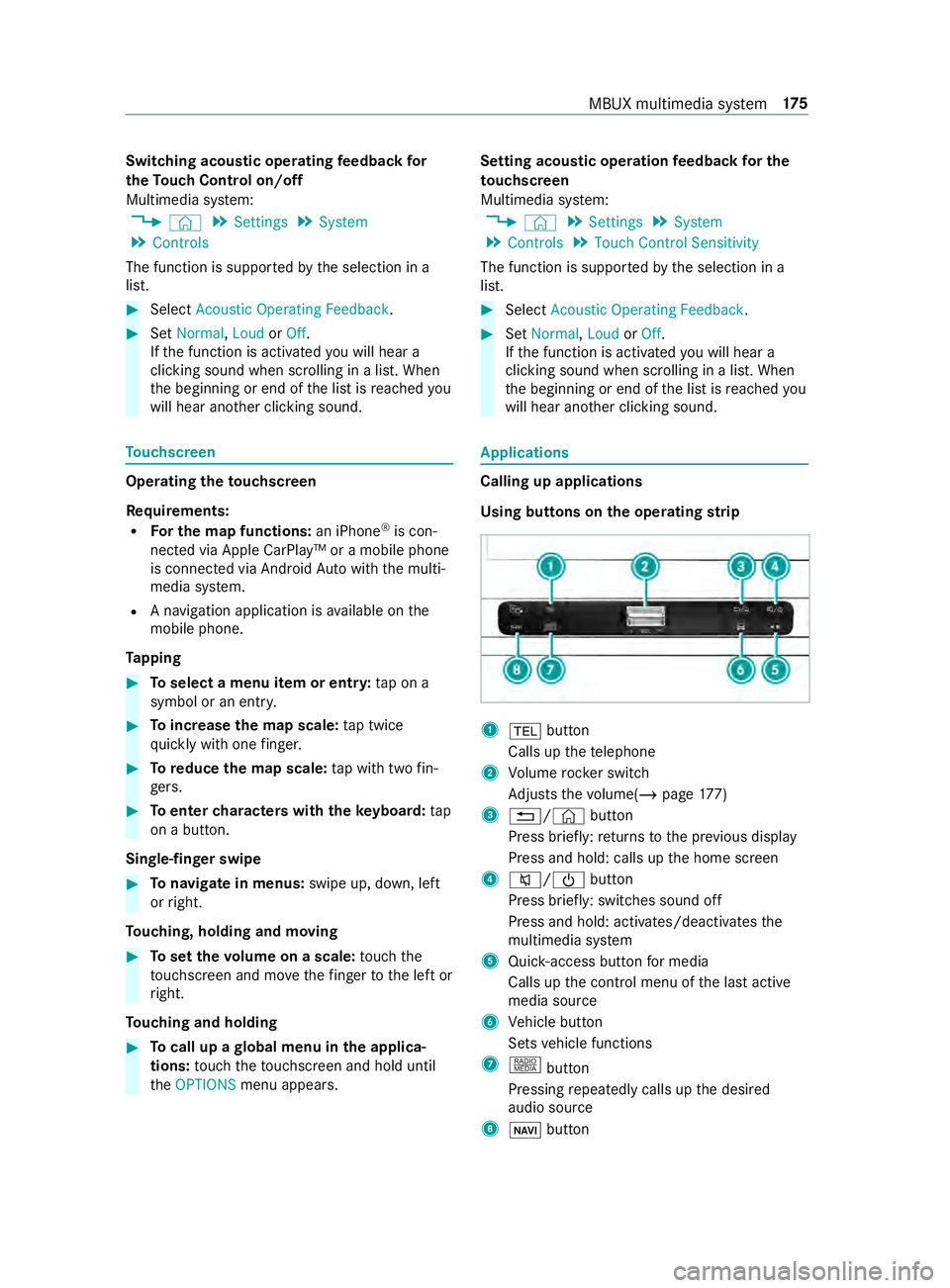
Using buttons on
the operating strip 1
002B button
Calls up thete lephone
2 Volume rocker switch
Ad justs thevo lume(/ page177)
3 0038/ ©button
Press brief ly:re turns tothe pr evious display
Press and hold: calls up the home screen
4 0063/00D0 button
Press brief ly: switches sound off
Press and hold: acti vates/deactivates the
multimedia sy stem
5 Quic k-access button for media
Calls up the cont rol menu of the last active
media source
6 Vehicle button
Sets vehicle functions
7 | button
Pressing repeatedly calls up the desired
audio source
8 00CB button MBUX multimedia sy
stem 175
Page 201 of 354
Ad
justing the volume On
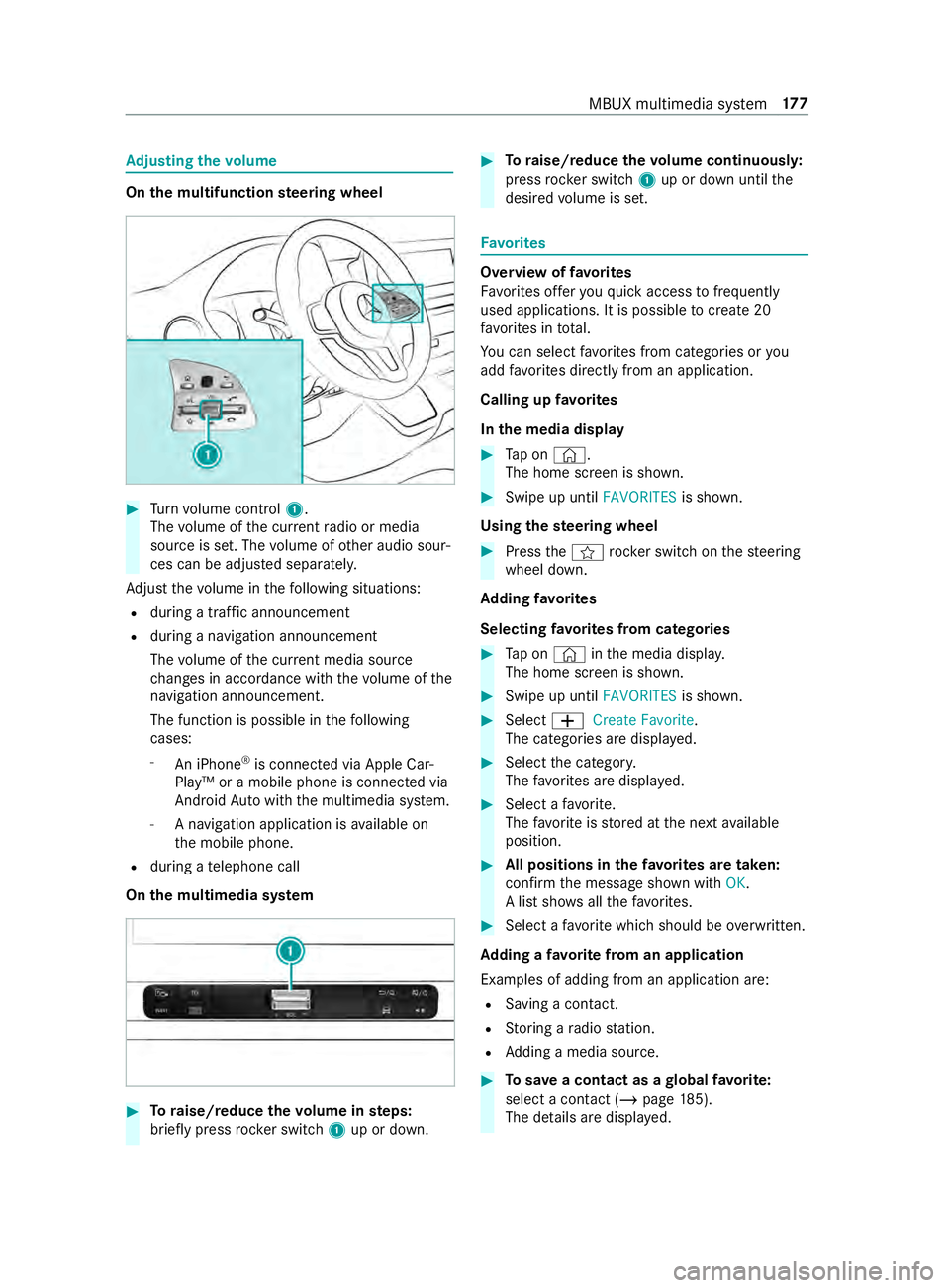
the multifunction steering wheel #
Turn volume control 1.
The volume of the cur rent radio or media
source is set. The volume of other audio sour‐
ces can be adjus ted separately.
Ad just thevo lume in thefo llowing situations:
R during a traf fic announcement
R during a navigation announcement
The volume of the cur rent media sou rce
ch anges in accordance with thevo lume of the
navigation announcement.
The function is possible in thefo llowing
cases:
- An iPhone ®
is connec ted via Apple Car‐
Play™ or a mobile phone is connected via
Android Autowith the multimedia sy stem.
- A navigation application is available on
th e mobile phone.
R during a telephone call
On the multimedia sy stem #
Toraise/reduce thevo lume in steps:
brief lypress rocker switch 1up or down. #
Toraise/reduce thevo lume continuousl y:
press rocker switch 1up or down until the
desired volume is set. Favo
rites Overview of
favo rites
Favo rite s of feryo uqu ick access tofrequently
used applications. It is possible tocrea te20
fa vo rite s in tota l.
Yo u can select favo rite s from categories or you
add favo rite s directly from an application.
Calling up favo rites
In the media display #
Tap on ©.
The home screen is shown. #
Swipe up until FAVORITESis shown.
Using thest eering wheel #
Press the004B rocker switch on thesteering
wheel down.
Ad ding favo rites
Selecting favo rite s from categories #
Tap on © inthe media displa y.
The home screen is shown. #
Swipe up until FAVORITESis shown. #
Select 0081Create Favorite .
The categories are displa yed. #
Select the categor y.
The favo rite s are displa yed. #
Select a favo rite.
The favo rite isstored at the next available
position. #
All positions in thefa vo rite s are taken:
confirm the message shown with OK.
A list sho wsallthefa vo rite s. #
Select a favo rite which should be overwritten.
Ad ding a favo rite from an application
Examples of adding from an application are: R Saving a contact.
R Storing a radio station.
R Adding a media source. #
Tosave a contact as a global favo rite :
select a contact (/ page 185).
The de tails are displa yed. MBUX multimedia sy
stem 17 7