tow MERCEDES-BENZ SPRINTER 2019 MY19 with 7” screen
[x] Cancel search | Manufacturer: MERCEDES-BENZ, Model Year: 2019, Model line: SPRINTER, Model: MERCEDES-BENZ SPRINTER 2019Pages: 354, PDF Size: 6.15 MB
Page 248 of 354
Otherwise,
gases or battery acid could
escape.
R Make sure that the de tach able parts are con‐
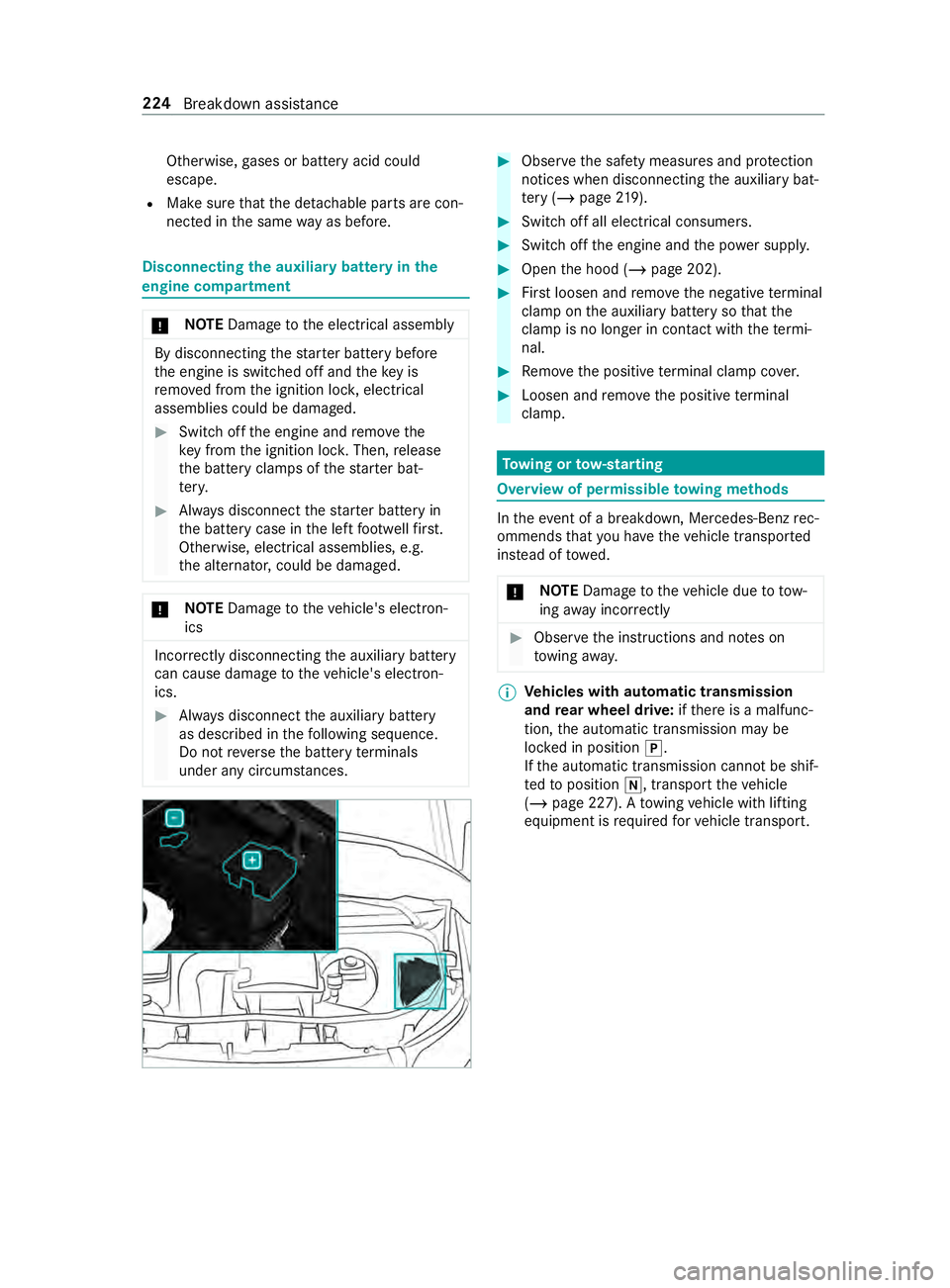
nec ted in the same way as before. Disconnecting
the auxiliary bat tery inthe
engine compa rtment *
NO
TEDama getothe electrical assembly By disconnecting
thest ar ter battery before
th e engine is switched off and theke y is
re mo ved from the ignition loc k,electrical
assemblies could be damaged. #
Switch off the engine and remo vethe
ke y from the ignition loc k.Then, release
th e battery clamps of thest ar ter bat‐
te ry. #
Always disconnect thest ar ter battery in
th e battery case in the left foot we llfirs t.
Otherwise, electrical assemblies, e.g.
th e alternator, could be damaged. *
NO
TEDama getotheve hicle's electron‐
ics Incor
rectly disconnecting the auxiliary battery
can cause damage totheve hicle's electron‐
ics. #
Always disconnect the auxiliary battery
as described in thefo llowing sequence.
Do not reve rseth e battery term inals
under any circums tances. #
Obser vethe saf ety measures and pr otection
notices when disconnecting the auxiliary bat‐
te ry ( / page 219). #
Swit choff all electrical consumers. #
Switch off the engine and the po wer supp ly. #
Open the hood (/ page 202). #
Firstloosen and remo vethe negative term inal
clamp on the auxiliary battery so that the
cla mp is no longer in con tact wi th thete rm i‐
nal. #
Remo vethe positive term inal clamp co ver. #
Loosen and remo vethe positive term inal
clamp. To
wing or tow- starting Overview of permissible
towing me thods In
theeve nt of a breakdown, Mercedes-Benz rec‐
ommends that you ha vetheve hicle transpor ted
ins tead of towe d.
* NO
TEDama getotheve hicle due to tow‐
ing away incor rectly #
Obser vethe instructions and no tes on
to wing away. %
Ve
hicles with automatic transmission
and rear wheel drive: ifth ere is a malfunc‐
tion, the automatic transmission may be
loc ked in position 005D.
If th e automatic transmission cann otbe shif‐
te dto position 005C, transport theve hicle
(/ page 227). A towing vehicle with lifting
equipment is requ ired forve hicle transport. 224
Breakdown assis tance
Page 249 of 354
Pe
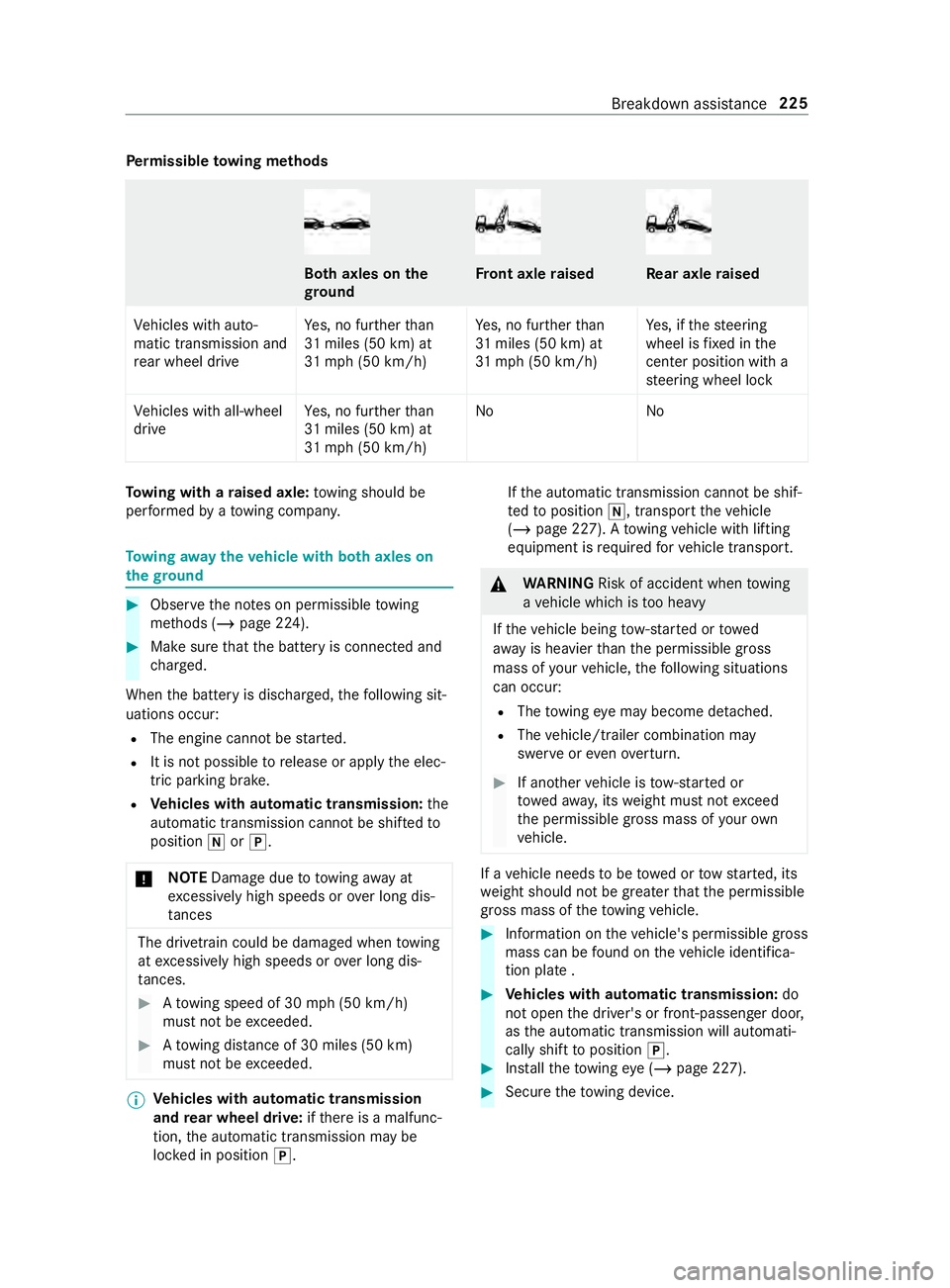
rm issible towing me thods Bo
th axles on the
gr ound Fr
ont axle raised Re
ar axle raised
Ve hicles with auto‐
matic transmission and
re ar wheel drive Ye
s, no fur ther than
31 miles (50 km) at
31 mp h (50 km/h) Ye
s, no fur ther than
31 miles (50 km) at
31 mp h (50 km/h) Ye
s, if thesteering
wheel is fixe d in the
center position wi th a
st eering wheel lock
Ve hicles with all-wheel
drive Ye
s, no fur ther than
31 miles (50 km) at
31 mp h (50 km/h) No
NoTo
wing with a raised axle: towing should be
per form ed byato wing compan y. To
wing away theve hicle with bo thaxles on
th egr ound #
Obser vethe no tes on permissible towing
me thods (/ page 224). #
Make sure that the battery is connected and
ch arge d.
When the battery is dischar ged, thefo llowing sit‐
uations occur:
R The engine cannot be star ted.
R It is not possible torelease or apply the elec‐
tric parking brake.
R Vehicles with automatic transmission: the
automatic transmission cannot be shif tedto
position 005Cor005D.
* NO
TEDama gedue to to wing away at
exc essively high speeds or over long dis‐
ta nces The driv
etra in could be damaged when towing
at exc essively high speeds or over long dis‐
ta nces. #
Atowing speed of 30 mph (50 km/h)
must not be exceeded. #
Atowing distance of 30 miles (50 km)
must not be exceeded. %
Ve
hicles with automatic transmission
and rear wheel drive: ifth ere is a malfunc‐
tion, the automatic transmission may be
loc ked in position 005D. If
th e automatic transmission cann otbe shif‐
te dto position 005C, transport theve hicle
(/ page 227). A towing vehicle with lifting
equipment is requ ired forve hicle transport. &
WARNING Risk of accident when towing
a ve hicle which is too heavy
If th eve hicle being tow- star ted or towed
aw ay is heavier than the permissible gross
mass of your vehicle, thefo llowing situations
can occur:
R The towing eye may become de tach ed.
R The vehicle/trailer combination may
swer veoreve nove rturn. #
If ano ther vehicle is tow- star ted or
to we daw ay, its weight must not exceed
th e permissible gross mass of your own
ve hicle. If a
vehicle needs tobe towe d or tow star ted, its
we ight should not be greaterth at the permissible
gross mass of theto wing vehicle. #
Information on theve hicle's permissible gross
mass can be found on theve hicle identifica‐
tion plate . #
Vehicles with automatic transmission: do
not open the driver's or front-passen ger door,
as the automatic transmission will automati‐
cally shift toposition 005D. #
Installth eto wing eye (/ page 227). #
Secure theto wing device. Breakdown assis
tance 225
Page 250 of 354
*
NO
TEDama gedue toincor rect connec‐
tion #
Only connect theto w rope or tow bar to
th eto wing eyes. %
Yo
u can also secure theto wing device tothe
trailer hitch.
* NO
TEDama geand risk of accident when
to wing with a tow rope There is a
risk of an accident if you do not
obse rve saf ety and pr otective measures when
to wing using a tow rope.
Obser vethefo llowing points when towing
with a tow rope: #
Secure theto w rope on the same side
on bo thvehicles, if possible. #
Make sure theto w rope does not
exc eed the legally prescribed length. #
Mark theto w rope in the middle, e.g.
with a white clo th(30 x 30 cm). This
makes other road users aware that a
ve hicle is being towe d. #
Obser vethe brake lamps of theto wing
ve hicle while driving. Alw ays maintain a
dis tance that ensures theto w rope does
not sag. #
Do not use steel cables or chains to tow
yo ur vehicle. Otherwise, you could dam‐
age theve hicle. #
Deactivate automatic locking (/ page 45).#
Do not activate the HOLD function. #
Deactivate theto w- aw ay alarm (/ page57). #
Deacti vate Active Brake Assi st (/ page 141). #
Vehicles with automatic transmission:
shift the automatic transmission toposition
005C. #
Release the parking brake. &
WARNING Risk of accident due tolimi‐
te d saf ety-re lated functions during the
to wing process
Saf ety-re lated functions are limited or no lon‐
ge rav ailable in thefo llowing situations:
R the ignition is switched off.
R the brake sy stem or po werst eering sys‐
te m is malfunctioning. R
the energy supply or the on-board electri‐
cal sy stem is malfunctioning.
When your vehicle is then towe daw ay, signifi‐
cantly more ef fort may be requ ired tosteer
and brake than is normally required. #
Use a tow bar. #
Make sure that thesteering wheel can
mo vefreely, before towing theve hicle
aw ay. *
NO
TEDama gedue toexc essive tractive
po wer If
yo u pull away sharpl y,the tractive po wer
may be too high and theve hicles could be
damaged. #
Pull away slowly and smoo thly. To
wing a vehicle with the front or rear axle
ra ised *
NO
TEDama gewhen the ignition is
switched on If
yo u lea vethe ignition switched on when
to wing theve hicle with the front or rear axle
ra ised, ESP ®
actuation can damage the brake
sy stem. #
The ignition must be switched off. *
NO
TEDama gedue toincor rect remo val
or ins tallation of the propeller shafts When ins
talling the propeller shafts, they can
be damaged if you do not use new sc rews.
Alw ays use new scr ews when ins talling the
propeller shafts.
Only ha vethe propeller shafts ins talled or
re mo vedby qualified, skilled personnel. %
If
th e front axle is damaged, raise theve hicle
at the front axle and if there ar axle is dam‐
aged, raise theve hicle at there ar axle.
% Ve
hicles with automatic transmission
and rear wheel drive: ifth ere is a malfunc‐
tion, the automatic transmission may be
loc ked in position 005D.
If th e automatic transmission cann otbe shif‐
te dto position 005C, transport theve hicle
(/ page 227). A towing vehicle with lifting
equipment is requ ired forve hicle transport. 226
Breakdown assis tance
Page 251 of 354
#
Obser vethe no tes on permissible towing
me thods (/ page 224). #
The propeller shafts tothe drive axles must
be remo ved if the maximum permissible tow‐
ing dis tance is exceeded. #
Vehicles with automatic transmission:
shift the automatic transmission toposition
005C. #
Release the parking brake. #
Switch off the ignition. Loading
theve hicle for transport #
Obser vethe no tes on towing away
( / page 225) (/ page 226). #
Connect theto w bar totheto wing eyeto load
th eve hicle. #
Vehicles with automatic transmission:
shift the automatic transmission toposition
005C.
% Ve
hicles with automatic transmission: in
th eeve nt of damage tothe electrics, the
automatic transmission may be loc ked in
position 005D.Toshift toposition 005C, provide
th e on-board electrical sy stem with po wer
( / page 219). #
Load theve hicle onto the transpor ter. #
Vehicles with automatic transmission:
shift the automatic transmission toposition
005D. #
Use the parking brake tosecure theve hicle
against rolling away. #
Only secure theve hicle bythe wheels.
Ve hicles with all-wheel drive/vehicles with
automatic transmission #
Make sure that the front and rear axles come
to rest on the same transpor tation vehicle. *
NO
TEDama getothe driv etra in due to
incor rect positioning #
Do not position theve hicle abo vethe
connection point of the transport vehi‐
cle. *
NO
TEVehicle damage due toimproper
loading An all-wheel drive
vehicle may be damaged if
it is tilted, pushed or mo ved while being loa‐
ded using a hydraulic platform. #
When loading a vehicle with all-wheel
drive, theve hicle should only be mo ved
and positioned byits own po wer. #
The vehicle and the sur face it is posi‐
tioned on should no longer be mo ved
when theke y is remo ved or if the door
is open. To
wing eyesto rage location The
towing eye is located in theve hicle tool kit in
th e front-passen gerfo ot we ll (/ page 229). Installing/removing
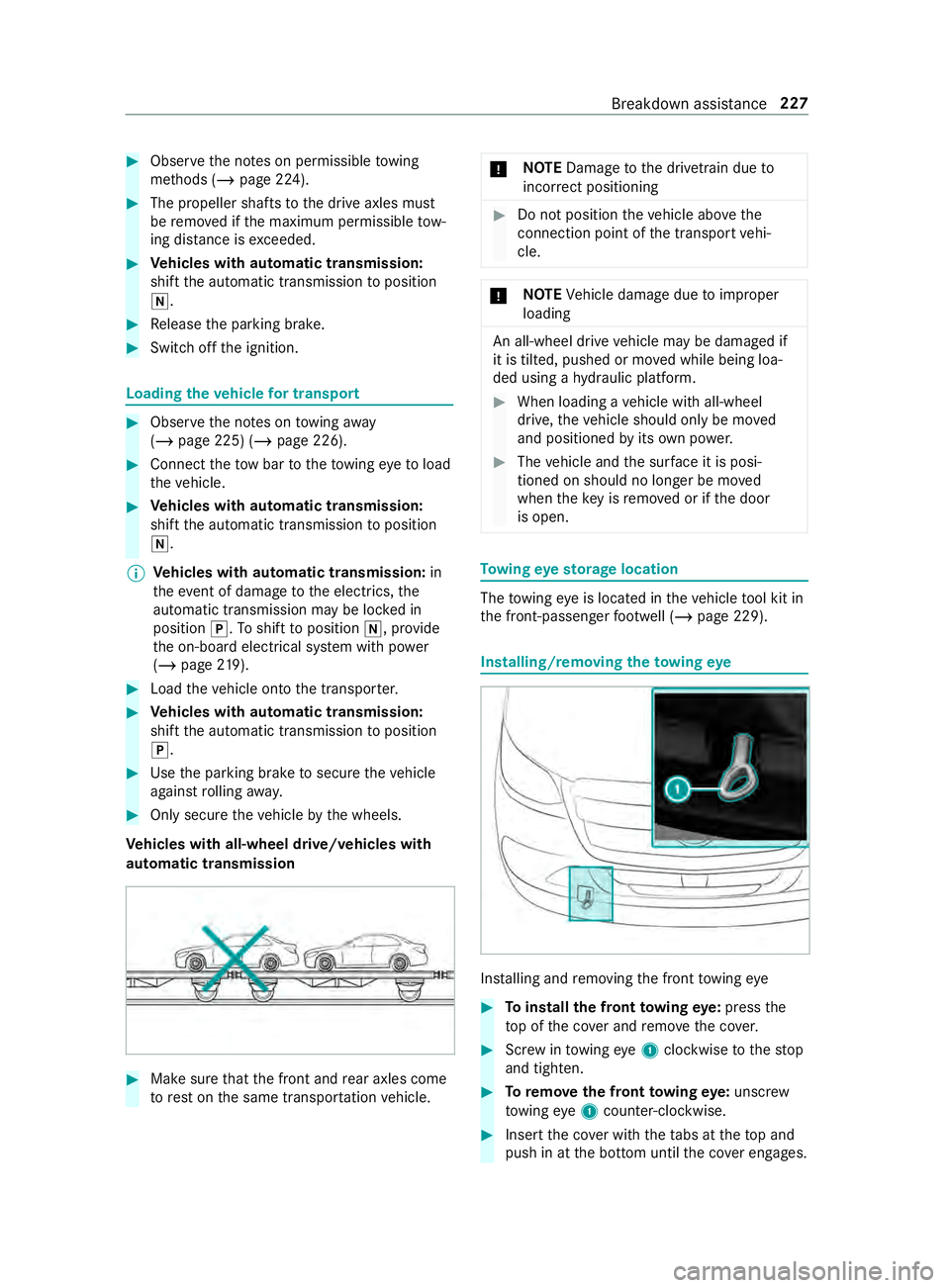
theto wing eye Ins
talling and removing the front towing eye #
Toinstall the front towing eye: press the
to p of the co ver and remo vethe co ver. #
Screw intowing eye1clockwise tothestop
and tighten. #
Toremo vethe front towing eye: unsc rew
to wing eye1 counter-clockwise. #
Insert the co ver with theta bs at theto p and
push in at the bottom until the co ver engages. Breakdown assi
stance 227
Page 252 of 354
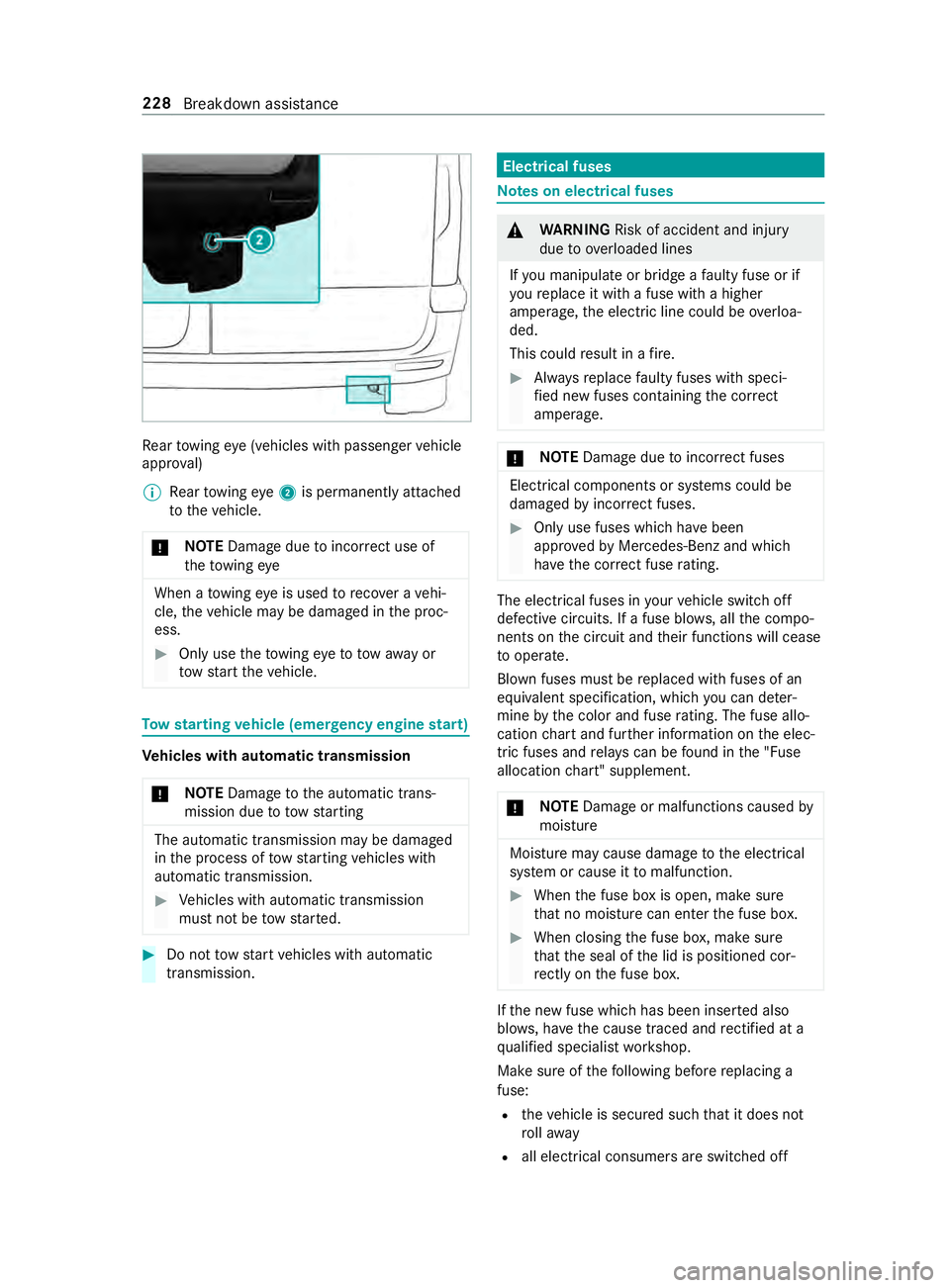
Re
ar towing eye (vehicles with passenger vehicle
appr oval)
% Re
ar towing eye2 is permanently attached
to theve hicle.
* NO
TEDama gedue toincor rect use of
th eto wing eye When a
towing eye is used toreco ver a vehi‐
cle, theve hicle may be damaged in the proc‐
ess. #
Only use theto wing eyeto to waw ay or
to w start theve hicle. To
w starting vehicle (eme rgency engine start) Ve
hicles with automatic transmission
* NO
TEDama getothe automatic trans‐
mission due to towstarting The automatic transmission may be damaged
in the process of tow starting vehicles with
automatic transmission. #
Vehicles with automatic transmission
must not be tow star ted. #
Do not tow start vehicles with automatic
transmission. Electrical fuses
Note
s on electrical fuses &
WARNING Risk of accident and injury
due toove rloaded lines
If yo u manipulate or bridge a faulty fuse or if
yo ure place it with a fuse with a higher
amperage, the electric line could be overloa‐
ded.
This could result in a fire. #
Alwaysre place faulty fuses with speci‐
fi ed new fuses containing the cor rect
amperage. *
NO
TEDama gedue toincor rect fuses Electrical components or sy
stems could be
damaged byincor rect fuses. #
Only use fuses whi chhave been
appr ovedby Mercedes-Benz and which
ha ve the cor rect fuse rating. The electrical fuses in
your vehicle switch off
defective circuits. If a fuse blo ws, all the compo‐
nents on the circuit and their functions will cease
to operate.
Blown fuses must be replaced with fuses of an
equivalent specification, which you can de ter‐
mine bythe color and fuse rating. The fuse allo‐
cation chart and fur ther information on the elec‐
tric fuses and relays can be found in the "Fuse
allocation chart" supplement.
* NO
TEDama geor malfunctions caused by
moisture Moisture may cause dama
getothe electrical
sy stem or cause it tomalfunction. #
When the fuse box is open, make sure
th at no moisture can enter the fuse box. #
When closing the fuse box, make sure
th at the seal of the lid is positioned cor‐
re ctly on the fuse box. If
th e new fuse which has been inser ted also
blo ws, ha vethe cause traced and rectified at a
qu alified specialist workshop.
Make sure of thefo llowing before replacing a
fuse:
R theve hicle is secured such that it does not
ro llaw ay
R all electrical consume rsare swit ched off 228
Breakdown assis tance
Page 253 of 354
R
the ignition is switched off
The fuses are located in various fuse bo xes:
R fuse box in the front-passenger foot we ll
(/ page 229)
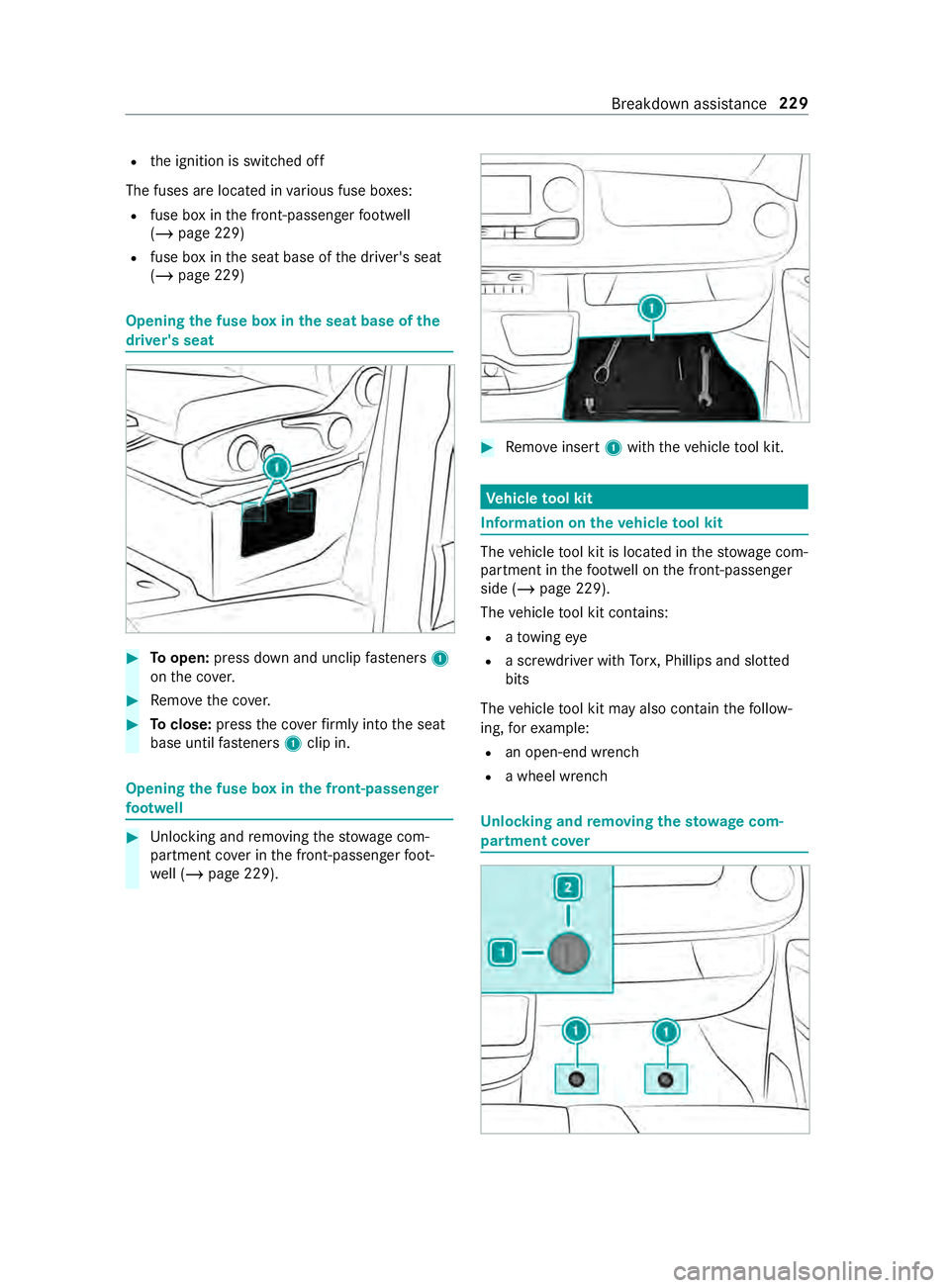
R fuse box in the seat base of the driver's seat
(/ page 229) Opening
the fuse box in the seat base of the
dr iver's seat #
Toopen: press down and unclip fasteners 1
on the co ver. #
Remo vethe co ver. #
Toclose: pressthe co verfirm ly in tothe seat
base until fasteners 1clip in. Opening
the fuse box in the front-passenger
fo ot we ll #
Unlocking andremoving thestow age com‐
partment co ver in the front-passenger foot‐
we ll (/ page 229). #
Remo veinsert 1with theve hicle tool kit. Ve
hicle tool kit Information on
theve hicle tool kit The
vehicle tool kit is located in thestow age com‐
partment in thefo ot we ll on the front-passenger
side (/ page 229).
The vehicle tool kit contains:
R ato wing eye
R a scr ewdriver with Torx, Phillips and slotted
bits
The vehicle tool kit may also contain thefo llow‐
ing, forex ample:
R an open-end wrench
R a wheel wrench Un
locking and removing the stow age com‐
partment co ver Breakdown assis
tance 229
Page 254 of 354
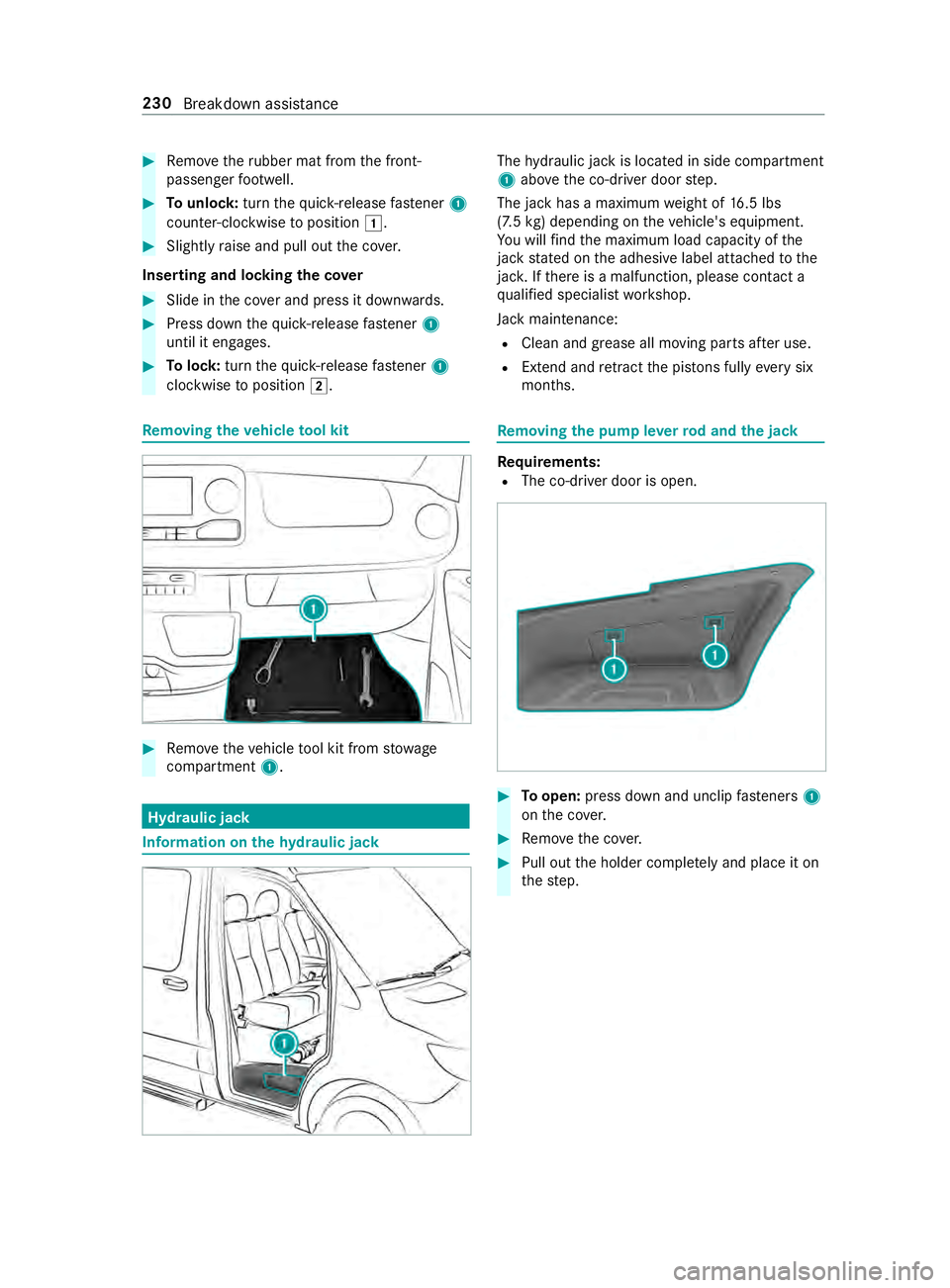
#
Remo vetheru bber mat from the front-
passenger foot we ll. #
Tounlo ck:turn thequ ick- re lease fastener 1
counter-clockwise toposition 0047. #
Slightly raise and pull out the co ver.
Inserting and locking the co ver #
Slide in the co ver and press it down wards. #
Press down thequ ick- re lease fastener 1
until it engages. #
Tolock: turnthequ ick- re lease fastener 1
clockwise toposition 0048. Re
moving the vehicle tool kit #
Remo vetheve hicle tool kit from stowage
compartment 1. Hyd
raulic jack Information on
thehy draulic jack The
hydraulic jack is located in side compartment
1 abo vethe co-driver door step.
The jack has a maximum weight of 16.5 lbs
(7.5 kg) depe nding on theve hicle's equipment.
Yo u will find the maximum load capacity of the
jack stated on the adhesive label attached tothe
jac k.Ifth ere is a malfunction, please contact a
qu alified specialist workshop.
Jack maintenance:
R Clean and grease all moving parts af ter use.
R Extend and retract the pis tons ful lyeve rysix
months. Re
moving the pump le verro d and the jack Re
quirements:
R The co-driver door is open. #
Toopen: press down and unclip fasteners 1
on the co ver. #
Remo vethe co ver. #
Pull out the holder comple tely and place it on
th estep. 230
Breakdown assis tance
Page 255 of 354
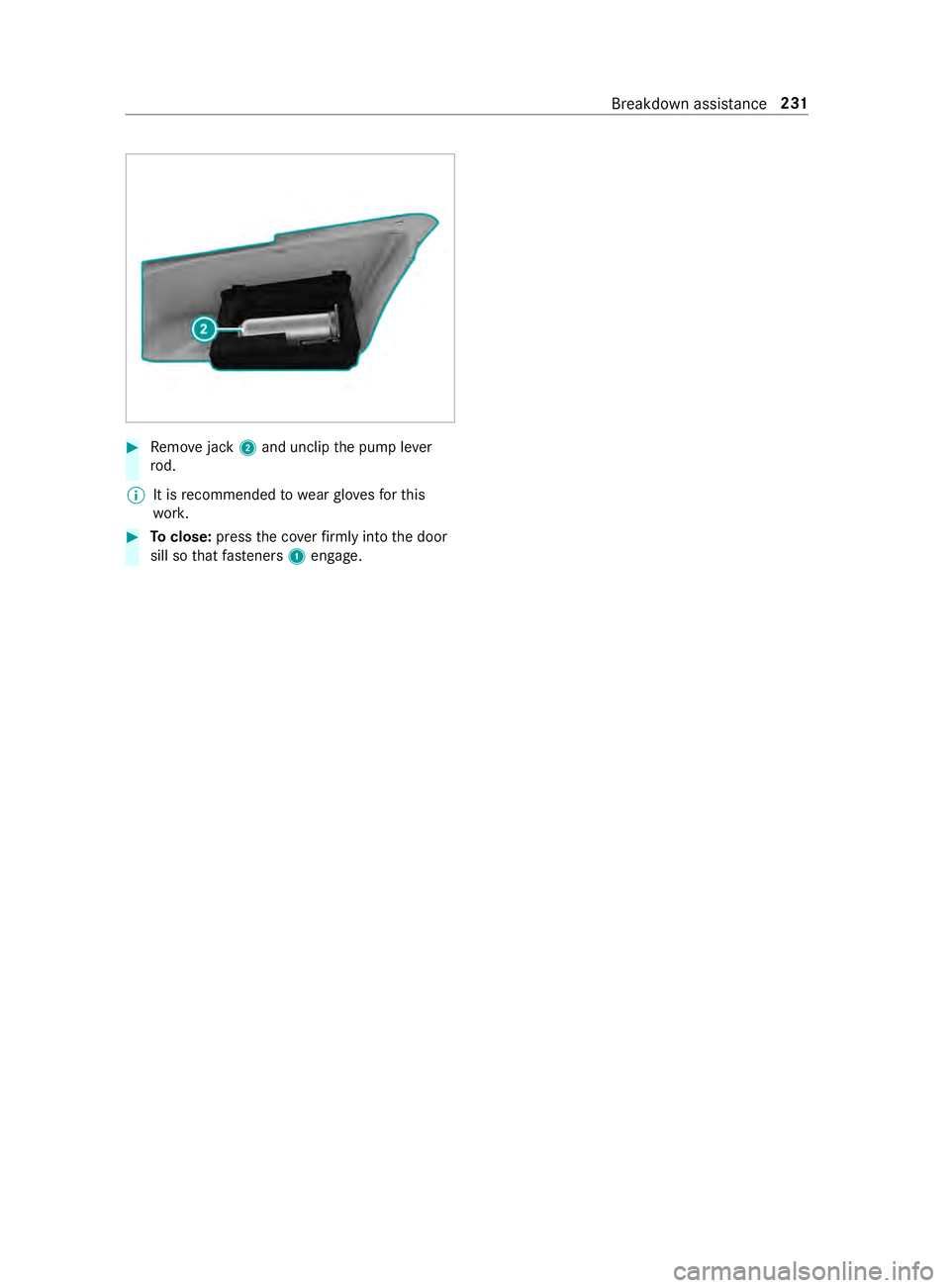
#
Remo vejack 2and unclip the pump le ver
ro d.
% It is
recommended towe arglove sfo rth is
wo rk. #
Toclose: pressthe co verfirm ly in tothe door
sill so that fast eners 1engage. Breakdown assis
tance 231
Page 259 of 354
#
Check whe ther the wheel or valve has a
leak. #
Ifyo u are unable torectify the damage,
contact a qualified specialist workshop. Yo
u can find information on recommended tire
pressures forth eve hicle's factor y-ins talled tires
on thefo llowing labels:
R Tire and Loading In form ation placard on the
B‑pillar of your vehicle (/ page240).
R Tire pressure table on the inside of the fuel
fi ller flap .
Obse rveth e maximum tire pressure
(/ page 245).
Use a sui table tire pressure gauge tocheck the
tire pressure. The ou ter appearance of a tire does
not permit any reliable conclusion about the tire
pressure.
+ ENVIRONMEN
TALNO TEEnvironmental
damage due toinsuf ficient or excessive
tire pressure No
tethat insuf ficient or excessive tire pres‐
sure shor tens the service life of the tires. #
Forth is reason, check the tire pressure
re gularly; at least every14 days. Ve
hicles with a tire pressure monitor: you can
also check the tire pressure using the on-board
computer.
Only cor rect tire pressure when the tires are
cold. Conditions for cold tires:
R The vehicle has been par ked with the tires out
of direct sunlight for at least thre e hours.
R The vehicle has tr aveled less than 1 mile
(1.6 km).
A rise in the tire temp erature of 18°F (10 °C)
increases the tire pressure byappr ox.10 kPa
(0.1 bar/1.5 psi). Take this into account when
ch ecking the tire pressure of warm tires.
The tire pressure recommended for increased
load/speed in the tire pressure table may af fect
th eride comfort. &
WARNING Risk of accident due to
unsuitable accesso ries on tire valve
If yo u mount unsuitable accesso ries onto tire
va lves, the tire valves may be overloaded and malfunction, which can cause a loss of tire
pressure. Af term arke t tire pressure moni tor‐
ing sy stems will cause the tire valve toremain
open, depending on the design. This can also
re sult in a loss of tire pressure. #
Only scr ewstandard valve caps or valve
caps specifically appr ovedby Mercedes-
Benz foryo ur vehicle onto the tire valve. Note
s ontowing a trailer
The applicable tire pressures forth e tires of the
re ar axle is alw aysth ere commended tire pres‐
sure for a full load. Ti
re pressure table The tire pressure
table can be found on the seat
base or on the B‑pillar on the driver's side.
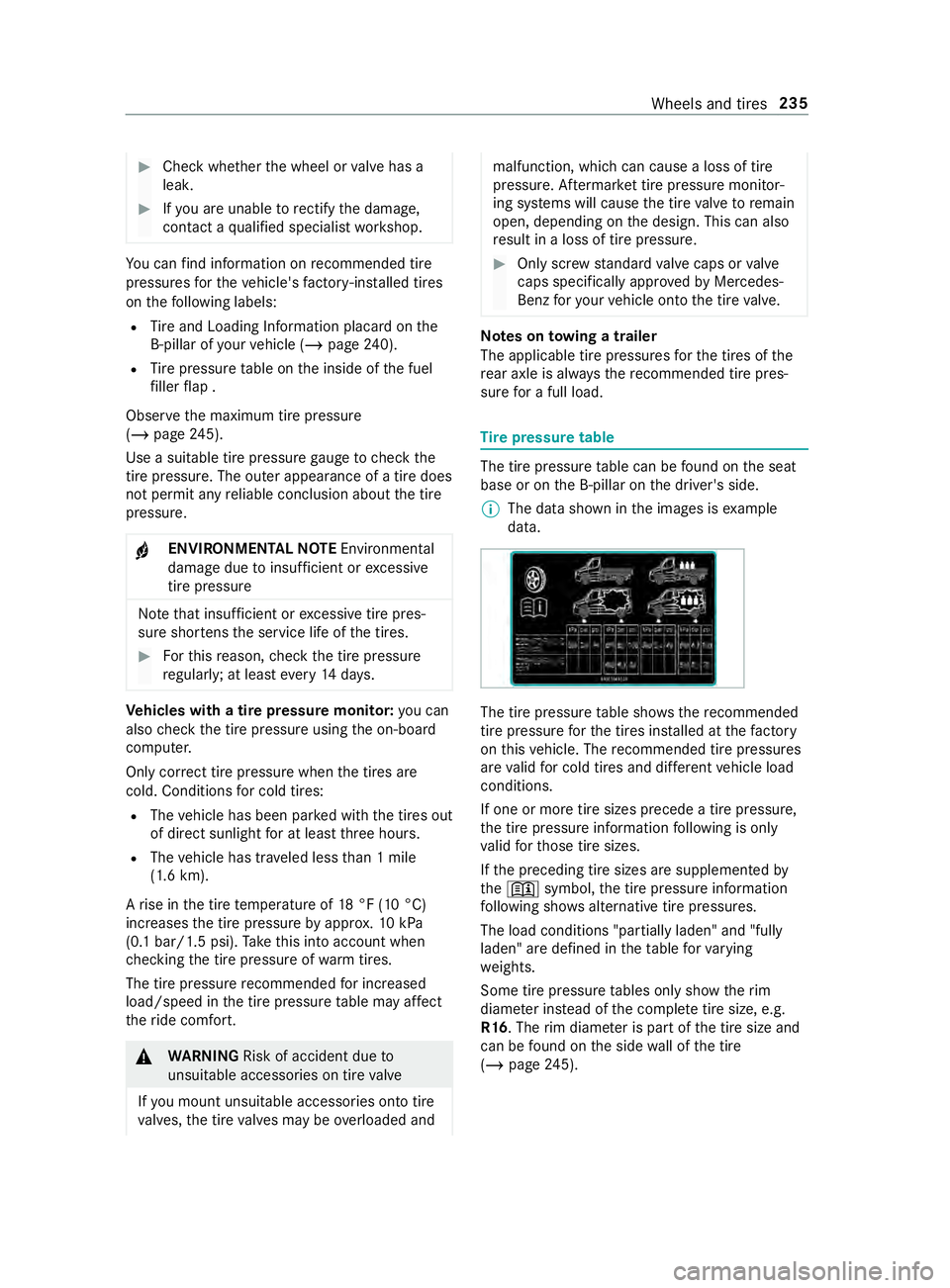
% The data shown in
the images is example
data. The tire pressure
table sho ws there commended
tire pressu reforth e tires ins talled at thefa ctory
on this vehicle. The recommended tire pressures
are valid for cold tires and dif fere nt vehicle load
conditions.
If one or more tire sizes precede a tire pressure,
th e tire pressure information following is only
va lid forth ose tire sizes.
If th e preceding tire sizes are supplemented by
th e0091 symbol, the tire pressure information
fo llowing sho wsalternative tire pressures.
The load conditions "partially laden" and "fully
laden" are defined in theta ble forva rying
we ights.
Some tire pressure tables only show therim
diame ter ins tead of the comple tetire size, e.g.
R16. The rim diame ter is part of the tire size and
can be found on the side wall of the tire
(/ page 245). Wheels and tires
235
Page 274 of 354
degree of
wear. Ensure that the direction of rota‐
tion is maintained.
It is imperati vetoobser vethe instructions and
saf ety no tes on "Changing a wheel" when doing
so. Wheel size categories of wheels
The de
term ined vehicle speed is displa yed in the
instrument clus ter and is impor tant for control‐
ling the driving saf ety sy stems and driving sys‐
te ms. The display accuracy of the speedome ter
and the odome ter is legally prescribed. De term in‐
ing the speed is dependent on the tire size or the
ro lling circumference of the tires. The rim diame‐
te r is alw ays specified in inches.
Fo rth is reason, theve hicle contro l units can be
coded forth efo llowing thre e wheel size catego‐
ri es:
Wheel size category 1
R 195/75 R16C
R 205/75 R16C
R 225/65 R16C
R 235/65 R16C
R 235/60 R17C
Wheel size category 2 R 225/75 R16C
Wheel size category 3
R 225/75 R16C FA
R 285/65 R16C RA
% Mercedes-Benz
recommends that youstay
within a wheel size category when changing a
tire. In this wa y,yo uav oid recoding the con‐
trol units.
If yo uch ange the wheel size of your vehicle, for
ins tance when changing wheels for winter opera‐
tion, check it is assigned tothe cor rect wheel
size catego ry. If the wheel size category changes,
yo u must ha veyour vehicle's contro l unitsreco‐
ded at a qualified specialist workshop.
Otherwise, the display accuracy of the speedom‐
et er and the odome ter will be outside the legally
prescribed tolerance. It may also be lo wer,i.e.
th e cur rent road speed is then higher than the
speed shown on the speedome ter.If a deviation
is outside thera nge of tolerance, driving saf ety
sy stems and driving sy stems may be operation‐
ally impaired or may de tect a malfunction and
switch themselves off. Information on
the direction of the tires' rota‐
tion Ti
re s with a specified direction of rotation ha ve
additional benefits, e.g. if there is a risk of hydro‐
planing. You will on lyga in these benefits if the
cor rect direction of rotation is obser ved.
An ar rowonthe side wall of the tire indicates its
cor rect direction of rotation.
Yo u may also ins tall a spare wheel against the
direction of rotation. Obser vethe time restriction
on use as well as the speed limitation specified
on the spare wheel. Information on
storing wheels Obser
vethefo llowing when storing wheels:
R Wheels that ha vebeen remo ved should be
st ored in a cool, dry and, if possible, dark
place.
R Protect the tires from oil, grease and fuel. Overview of
the tire-chan getool kit Necessary tire-change
tools may include, for
ex ample:
R Jack
R Wheel wrench
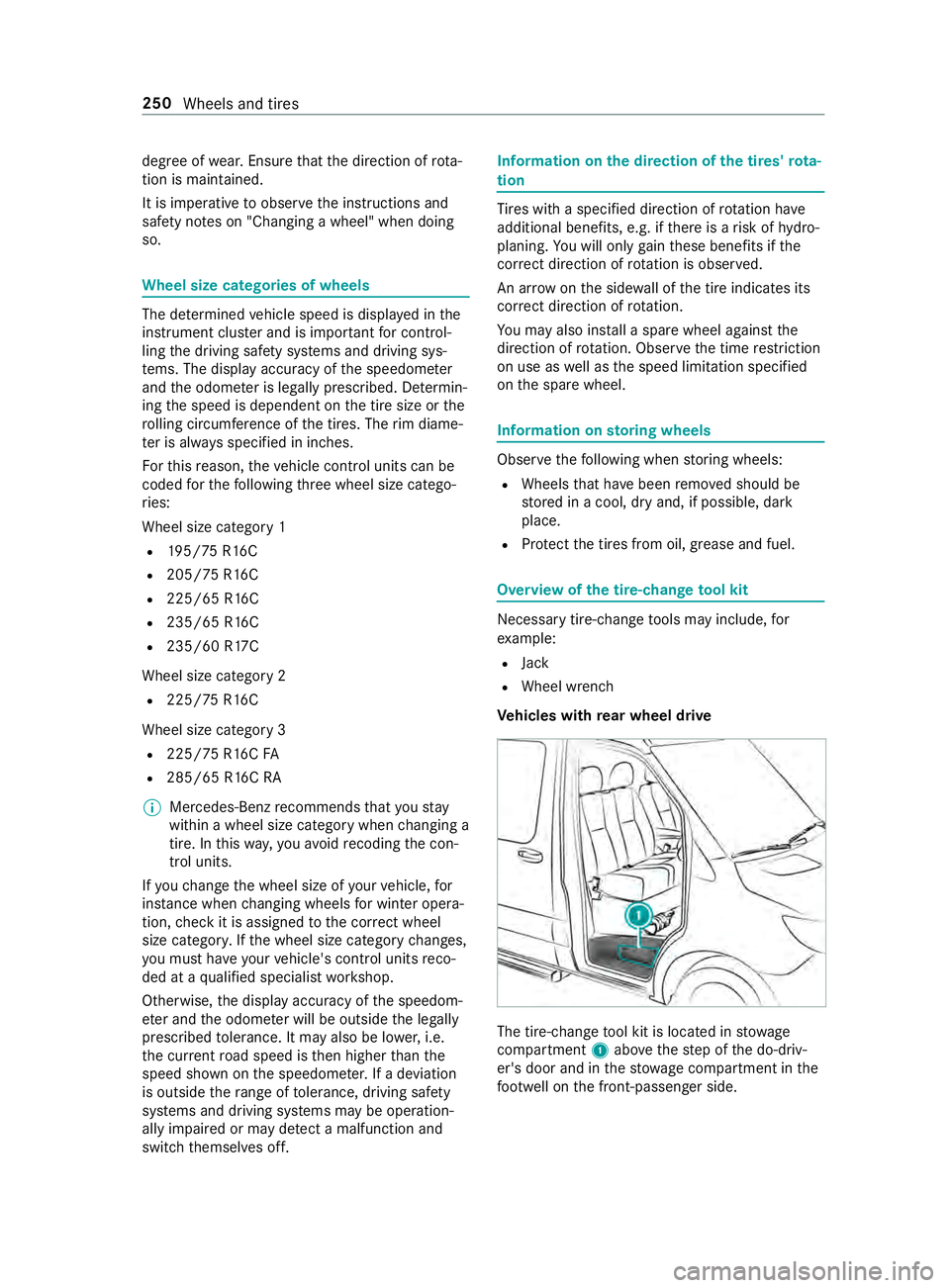
Ve hicles with rear wheel drive The tire-change
tool kit is located in stowage
compartment 1abo vethestep of the do-driv‐
er's door and in thestow age compartment in the
fo ot we ll on the front-passen ger side. 250
Wheels and tires