ECU MITSUBISHI 3000GT 1991 Service Manual
[x] Cancel search | Manufacturer: MITSUBISHI, Model Year: 1991, Model line: 3000GT, Model: MITSUBISHI 3000GT 1991Pages: 1146, PDF Size: 76.68 MB
Page 777 of 1146
![MITSUBISHI 3000GT 1991 Service Manual SERVICE BRAKES - Service Adjustment Procedures35-5514N0171
\\ \ \14NOO98]
14A04013
REAR BRAKE DISC THICKNESS CHECKM35FVA.D1. Remove dirt and rust from brake disc surface.
2. Measure disc thickness at](/img/19/57085/w960_57085-776.png "MITSUBISHI 3000GT 1991 Service Manual SERVICE BRAKES - Service Adjustment Procedures35-5514N0171
\\ \ \14NOO98]
14A04013
REAR BRAKE DISC THICKNESS CHECKM35FVA.D1. Remove dirt and rust from brake disc surface.
2. Measure disc thickness at")
SERVICE BRAKES - Service Adjustment Procedures35-5514N0171
\\ \ \14NOO98]
14A04013
REAR BRAKE DISC THICKNESS CHECKM35FVA.D1. Remove dirt and rust from brake disc surface.
2. Measure disc thickness at 4 locations or more.
Standard value:
Limit:
Replace the discs and pad assembly for both sides left and
right of the vehicle if they are worn beyond the specified
limit.
REAR BRAKE DISC RUN-OUT CHECKM35FWAC
1.Remove the rear brake assembly, and support it by a wire,
etc.
2. Place a dial gauge approximately 5 mm
(.2 in.) from the
outer circumference of the brake disc, and measure the
run-out of the disc.
Limit: 0.08 mm
(.0031 in.) or less
NOTETighten nuts to secure the disc to the hub.
REAR BRAKE DISC RUN-OUT CORRECTIONM35FXAB
1.If the run-out of the brake disc is equivalent to or exceeds
the limit specification, change the phase of the disc and
hub, and then measure the run-out again.
NOTEThe procedures for checking by changing the installation
phase of the disc are the same as those for the front brake
discs. Note, however, that the axial play (limit) in the hub
differs. (Refer to
P.35-53.)Limit:
2.If the problem cannot be corrected by changing the phase
of the brake disc, replace the disc.
1 TSB Revision
Page 779 of 1146
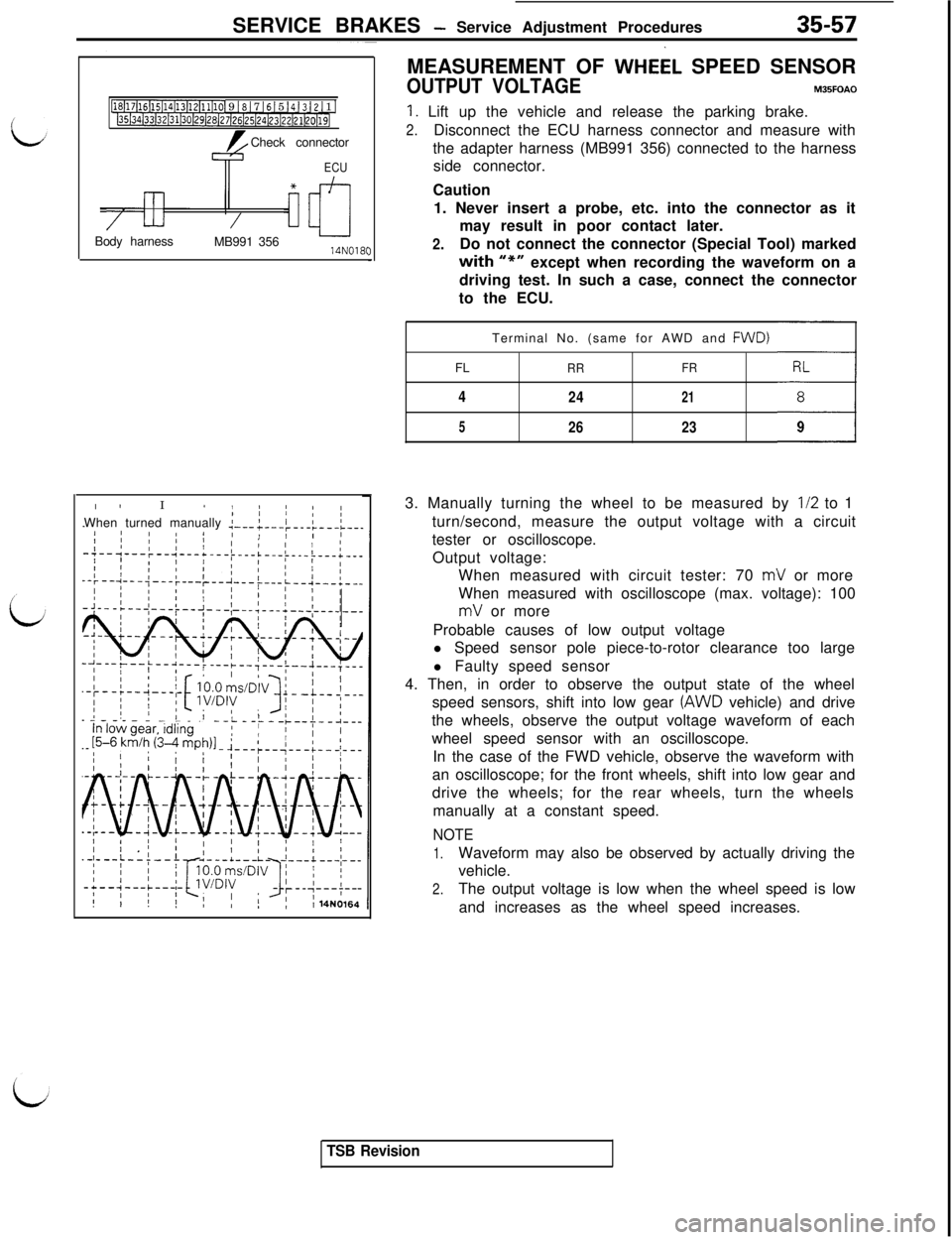
SERVICE BRAKES - Service Adjustment Procedures35-57
i
~18~17~16~15~14~13~12~11~10~ 9 18 I 7 16 I 5 14 13 12 1 1 1[35~34~33~32~31~30~29~28~27~26~25~24~23~22~21~20~19~Check connector
ECU
/m/Body harness
MB991 35614N018(
I I I 2When turned manually
~---~---~-.-~---[--.I 1MEASUREMENT OF
WHEEL SPEED SENSOR
OUTPUT VOLTAGEM35FOAO
1. Lift up the vehicle and release the parking brake.
2.Disconnect the ECU harness connector and measure with
the adapter harness (MB991 356) connected to the harness
side connector.
Caution
1. Never insert a probe, etc. into the connector as it
may result in poor contact later.
2.Do not connect the connector (Special Tool) markedwith “r+”except when recording the waveform on a
driving test. In such a case, connect the connector
to the ECU.
Terminal No. (same for AWD and FWD)
FL
RRFRRL
4
24218
52623393. Manually turning the wheel to be measured by
112 to 1
turn/second, measure the output voltage with a circuit
tester or oscilloscope.
Output voltage:
When measured with circuit tester: 70
mV or more
When measured with oscilloscope (max. voltage): 100
mV or more
Probable causes of low output voltage
l Speed sensor pole piece-to-rotor clearance too large
l Faulty speed sensor
4. Then, in order to observe the output state of the wheel
speed sensors, shift into low gear
(AWD vehicle) and drive
the wheels, observe the output voltage waveform of each
wheel speed sensor with an oscilloscope.
In the case of the FWD vehicle, observe the waveform with
an oscilloscope; for the front wheels, shift into low gear and
drive the wheels; for the rear wheels, turn the wheels
manually at a constant speed.
NOTE
1.Waveform may also be observed by actually driving the
vehicle.
2.The output voltage is low when the wheel speed is low
and increases as the wheel speed increases.
TSB Revision
Page 790 of 1146
35-68
SERVICE BRAKES - Master Cvlinder and Brake Booster
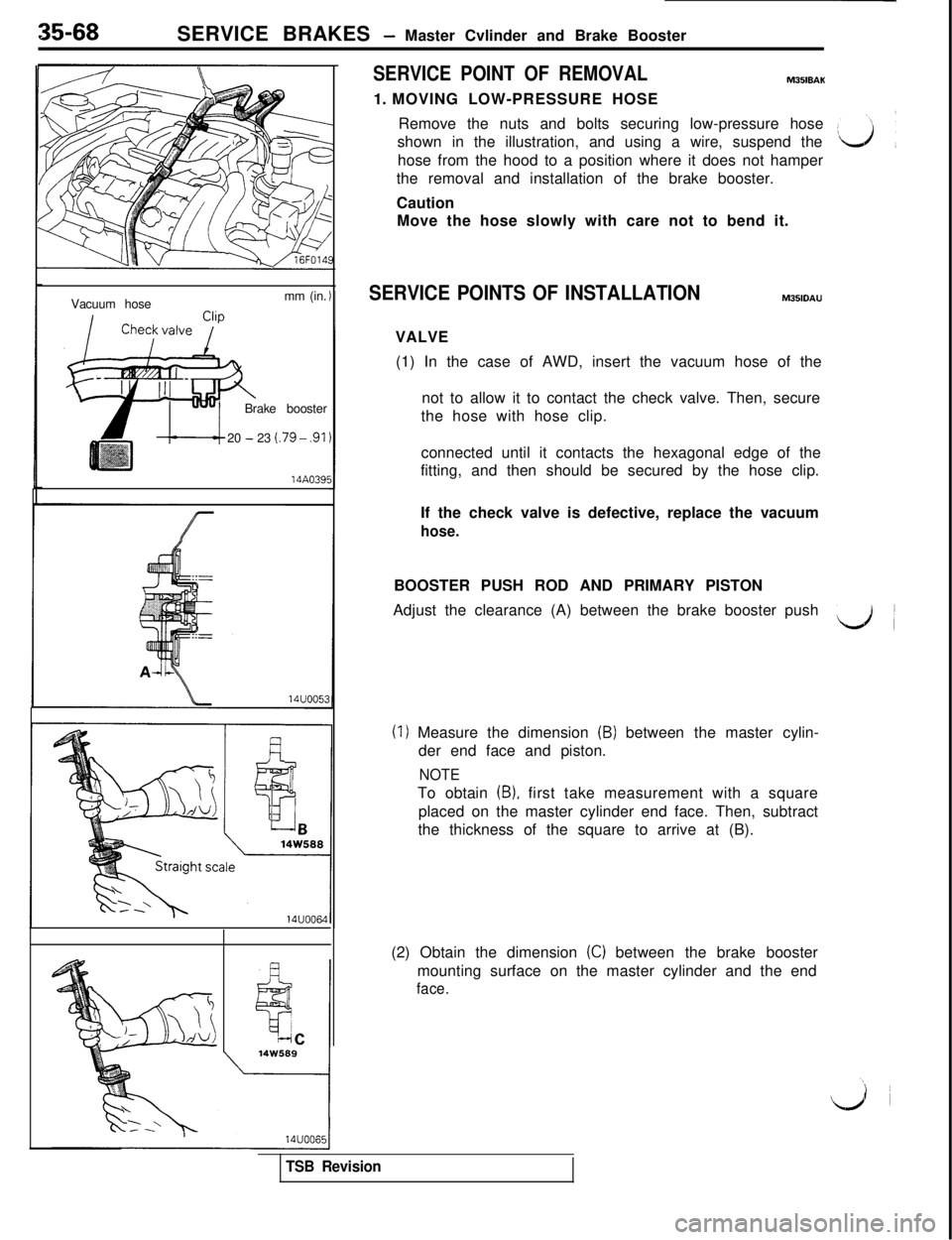
Vacuum hosemm (in.
Brake booster
20
- 23 t.79 - .9114A039i
SERVICE POINT OF REMOVALM35lBAK1. MOVING LOW-PRESSURE HOSE
Remove the nuts and bolts securing low-pressure hose
shown in the illustration, and using a wire, suspend the
hose from the hood to a position where it does not hamper
the removal and installation of the brake booster.
Caution
Move the hose slowly with care not to bend it.
SERVICE POINTS OF INSTALLATIONM35lDAUVALVE
(1) In the case of AWD, insert the vacuum hose of the
not to allow it to contact the check valve. Then, secure
the hose with hose clip.
connected until it contacts the hexagonal edge of the
fitting, and then should be secured by the hose clip.
If the check valve is defective, replace the vacuum
hose.BOOSTER PUSH ROD AND PRIMARY PISTON
Adjust the clearance (A) between the brake booster push
(I) Measure the dimension (B) between the master cylin-
der end face and piston.
NOTETo obtain
(B), first take measurement with a square
placed on the master cylinder end face. Then, subtract
the thickness of the square to arrive at (B).
(2) Obtain the dimension
(C) between the brake booster
mounting surface on the master cylinder and the end
face.
TSB Revision
Page 796 of 1146
35-74
SERVICE BRAKES - Front Disc Brake
INSPECTIONM35LCAEl Check disc for wear. (Refer to
P.35-52.)l Check disc for runout. (Refer to
P.35-52, 53.)Il Check disc for damage.14A040C
(2) After installing the caliper support to the knuckle,
expand the piston, and then install the caliper body.
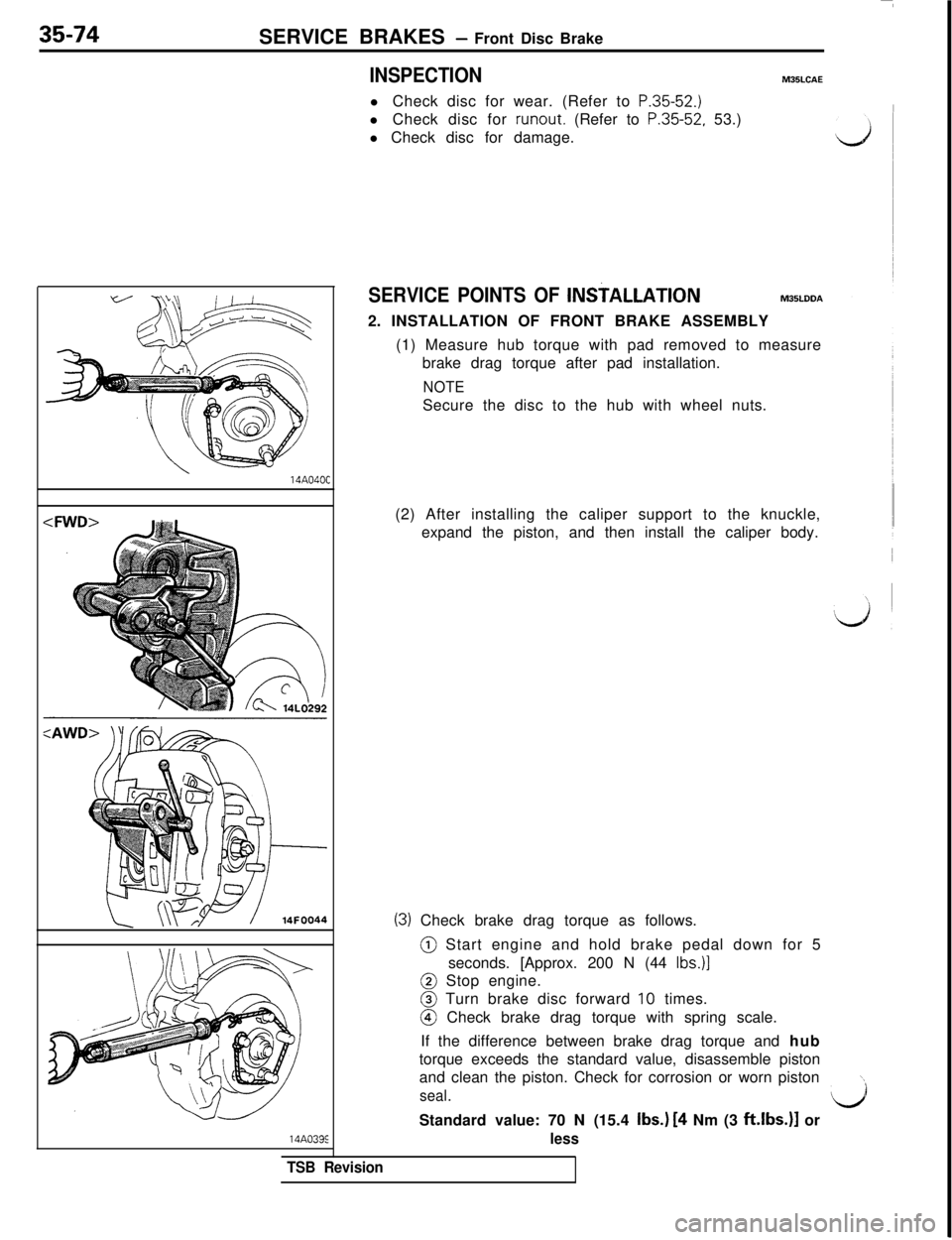
(3) Check brake drag torque as follows.@ Start engine and hold brake pedal down for 5
seconds. [Approx. 200 N (44
Ibs.)]@ Stop engine.@ Turn brake disc forward
10 times.@ Check brake drag torque with spring scale.
If the difference between brake drag torque and hub
torque exceeds the standard value, disassemble piston
and clean the piston. Check for corrosion or worn piston
\\
seal.l/iStandard value: 70 N (15.4 Ibs.)
[4 Nm (3 ft.lbs.)l or14A033E
less
SERVICE POINTS OF lNS?ALLATlONM35LDDA2. INSTALLATION OF FRONT BRAKE ASSEMBLY
(1) Measure hub torque with pad removed to measure
brake drag torque after pad installation.
NOTESecure the disc to the hub with wheel nuts.
TSB Revision
Page 826 of 1146
36-10PARKING BRAKES - Parking Brake
SERVICE POINTS OF REMOVALM36YBALI. REMOVAL OF REAR SPEED SENSOR
Caution
When removing the speed sensor from the knuckle, usei&J 1
care not to hit the pole piece at its tip against the rotorteeth or other parts.
11 FO03814LOOOi
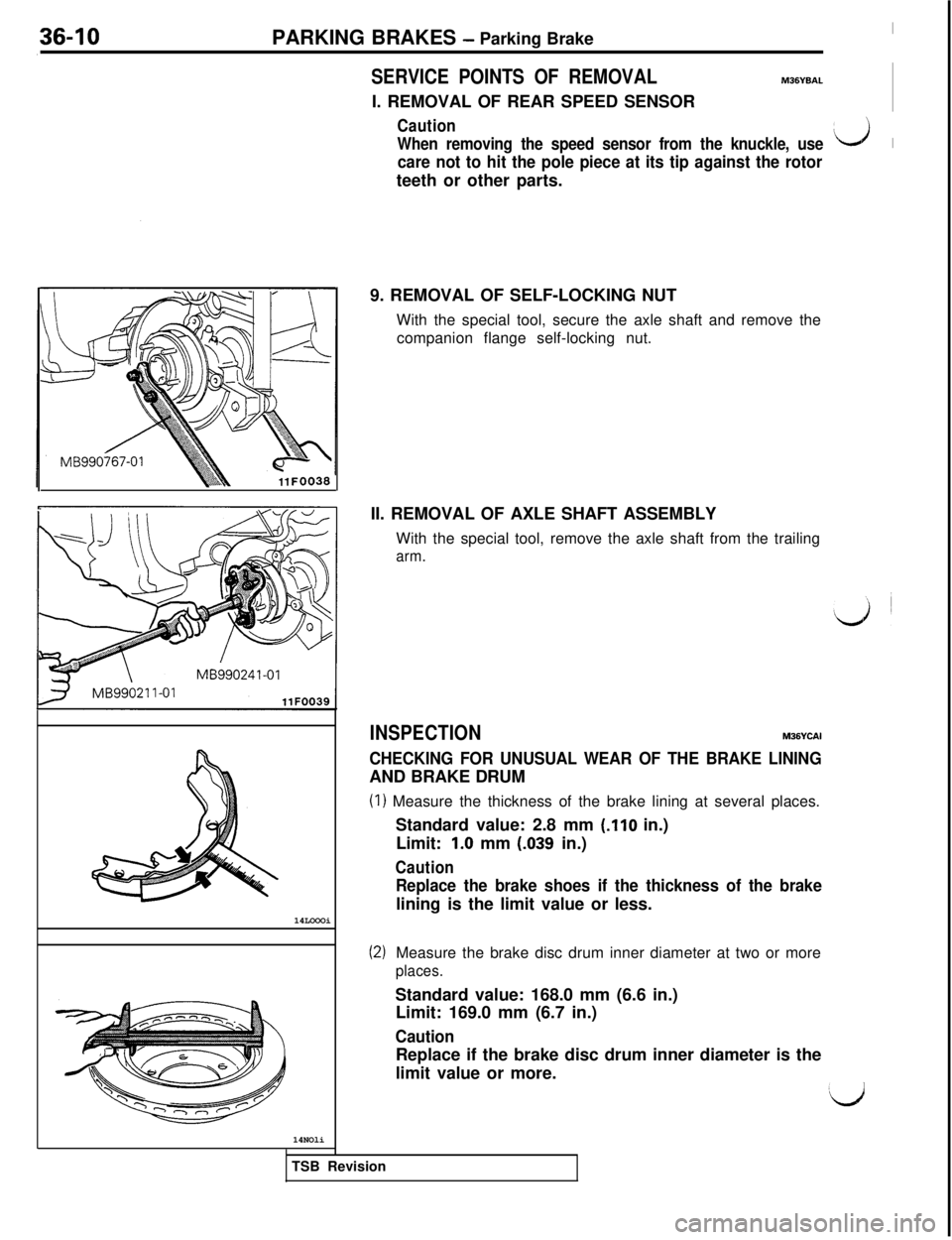
14NOli9. REMOVAL OF SELF-LOCKING NUT
With the special tool, secure the axle shaft and remove the
companion flange self-locking nut.
II. REMOVAL OF AXLE SHAFT ASSEMBLY
With the special tool, remove the axle shaft from the trailing
arm.
INSPECTIONM36YCAI
CHECKING FOR UNUSUAL WEAR OF THE BRAKE LININGAND BRAKE DRUM
(1) Measure the thickness of the brake lining at several places.
Standard value: 2.8 mm
(.I10 in.)
Limit:
1.0 mm (.039 in.)
Caution
Replace the brake shoes if the thickness of the brakelining is the limit value or less.
(2)Measure the brake disc drum inner diameter at two or more
places.Standard value: 168.0 mm (6.6 in.)
Limit: 169.0 mm (6.7 in.)
CautionReplace if the brake disc drum inner diameter is the
limit value or more.
TSB Revision
Page 827 of 1146
PARKING BRAKES - Parking Brake36-11
14N000'
Spindle,
I’_14NOO05
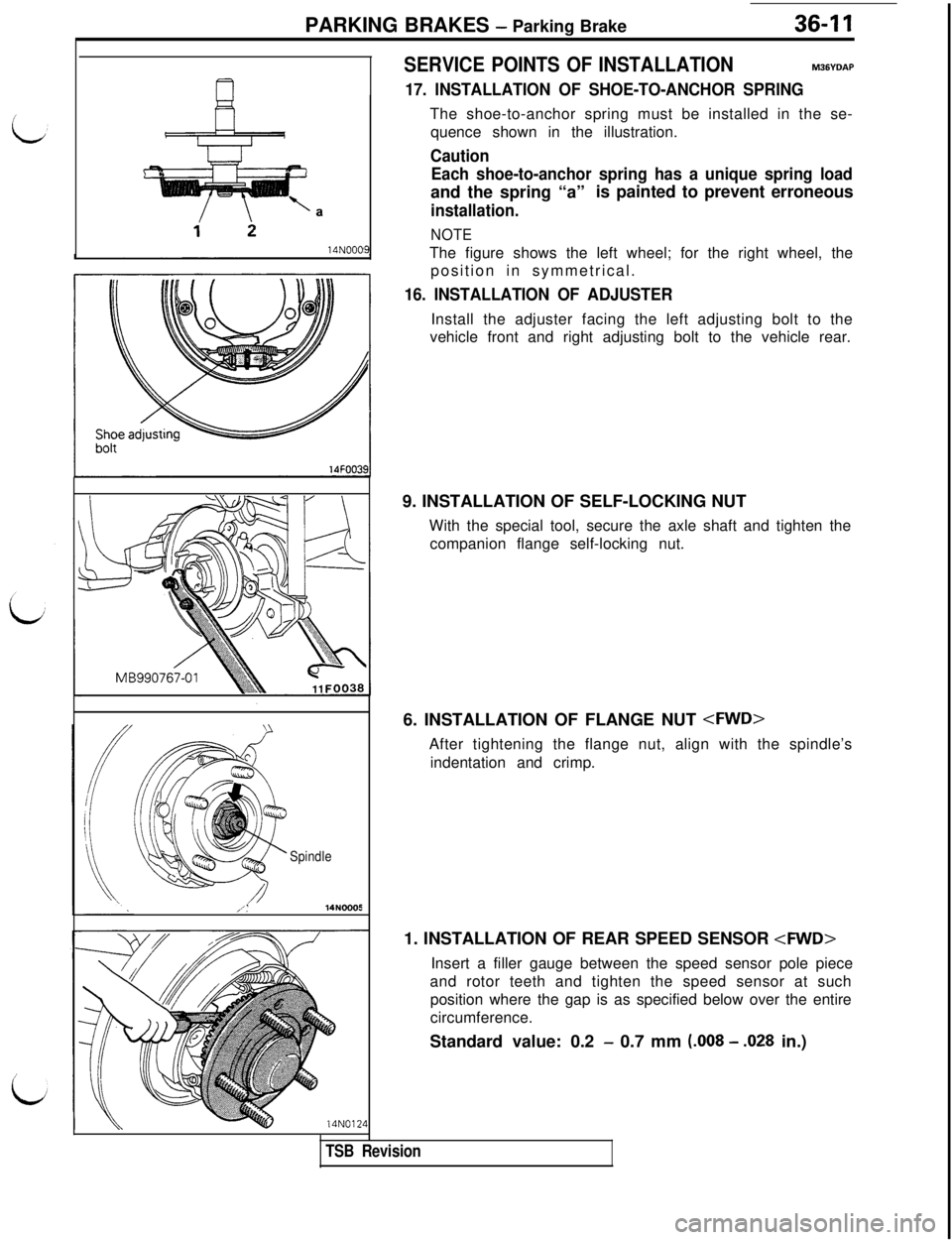
SERVICE POINTS OF INSTALLATIONM36YDAP
17. INSTALLATION OF SHOE-TO-ANCHOR SPRINGThe shoe-to-anchor spring must be installed in the se-
quence shown in the illustration.
Caution
Each shoe-to-anchor spring has a unique spring loadand the spring “a”is painted to prevent erroneous
installation.
NOTEThe figure shows the left wheel; for the right wheel, the
position in symmetrical.
16. INSTALLATION OF ADJUSTERInstall the adjuster facing the left adjusting bolt to the
vehicle front and right adjusting bolt to the vehicle rear.
9. INSTALLATION OF SELF-LOCKING NUT
With the special tool, secure the axle shaft and tighten the
companion flange self-locking nut.
6. INSTALLATION OF FLANGE NUT
indentation and crimp.
1. INSTALLATION OF REAR SPEED SENSOR
and rotor teeth and tighten the speed sensor at such
position where the gap is as specified below over the entire
circumference.
Standard value: 0.2
- 0.7 mm (.008 - .028 in.)
TSB Revision
Page 837 of 1146
STEERING - Service Adjustment Procedures37A-9
LL:13N002E
FluId f[uctuatlon
While
engineWhile engme
runningstopped13uo13:
Return ho
Vinyl hose13AO142
j
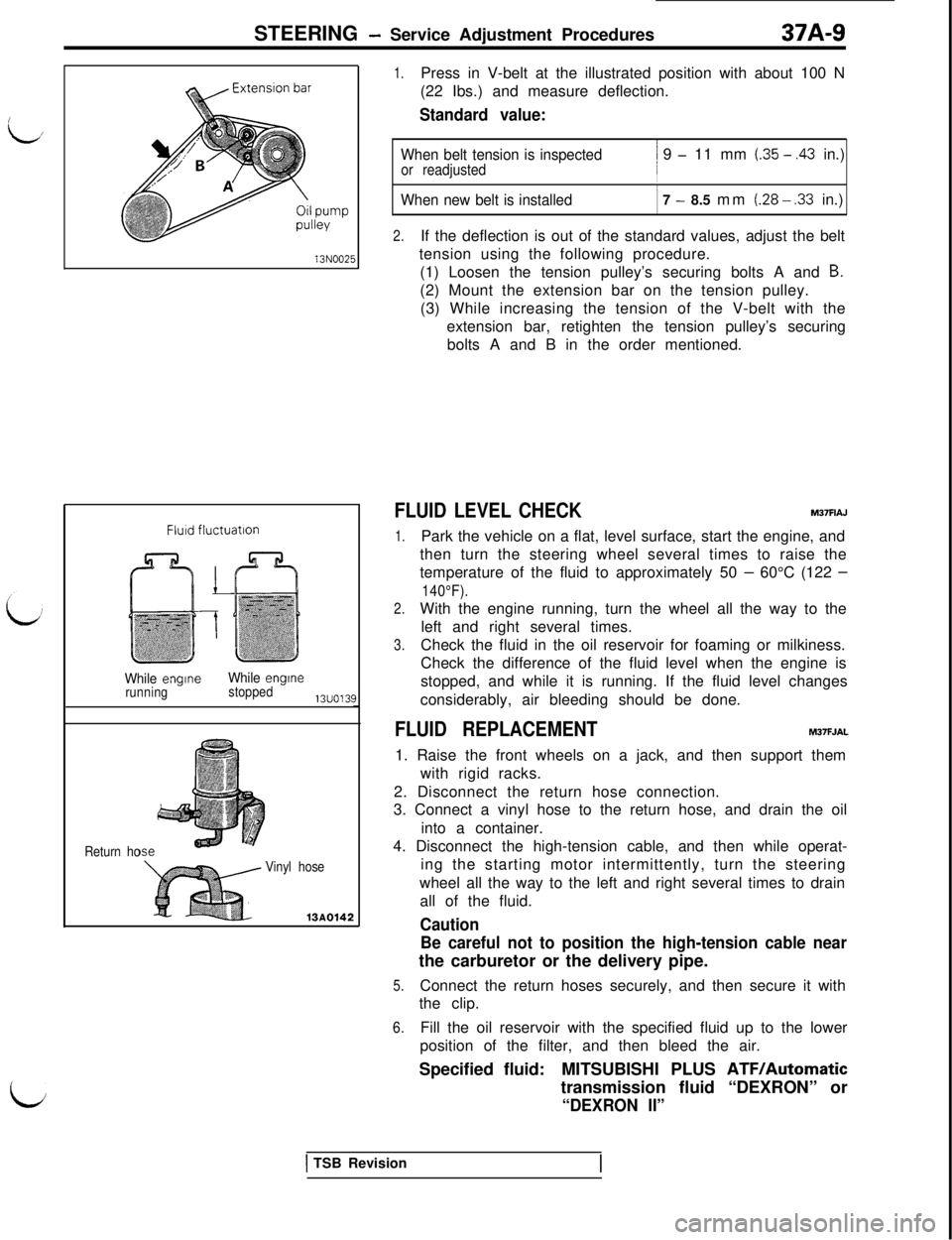
1.Press in V-belt at the illustrated position with about 100 N
(22 Ibs.) and measure deflection.
Standard value:
When belt tension is inspectedor readjusted
When new belt is installed
/ 9 - 11 mm (.35 - .43 in.)
I
’ 7 - 8.5 mm (.28 - .33 in.)
2.If the deflection is out of the standard values, adjust the belt
tension using the following procedure.
(1) Loosen the tension pulley’s securing bolts A and
B.(2) Mount the extension bar on the tension pulley.
(3) While increasing the tension of the V-belt with the
extension bar, retighten the tension pulley’s securing
bolts A and B in the order mentioned.
FLUID LEVEL CHECKM37FlAJ
1.Park the vehicle on a flat, level surface, start the engine, and
then turn the steering wheel several times to raise the
temperature of the fluid to approximately 50
- 60°C (122 -
140°F).
2.With the engine running, turn the wheel all the way to the
left and right several times.
3.Check the fluid in the oil reservoir for foaming or milkiness.
Check the difference of the fluid level when the engine is
stopped, and while it is running. If the fluid level changes
considerably, air bleeding should be done.
FLUID REPLACEMENTM37FJAL1. Raise the front wheels on a jack, and then support them
with rigid racks.
2. Disconnect the return hose connection.
3. Connect a vinyl hose to the return hose, and drain the oil
into a container.
4. Disconnect the high-tension cable, and then while operat-
ing the starting motor intermittently, turn the steering
wheel all the way to the left and right several times to drain
all of the fluid.
Caution
Be careful not to position the high-tension cable nearthe carburetor or the delivery pipe.
5.Connect the return hoses securely, and then secure it with
the clip.
6.Fill the oil reservoir with the specified fluid up to the lower
position of the filter, and then bleed the air.
Specified fluid:MITSUBISHI PLUS ATF/Automatic
transmission fluid “DEXRON” or
“DEXRON II”
1 TSB Revision
Page 854 of 1146
37A-26
STEERING - Power Steerina Gear Box
Apply grease
Approx. 1 mm
l-(Approx. .040 in.)
Tool
13POO76
End plug
Sealant
13K130
’ IEnd plug
r=13K132
MB991 006-01
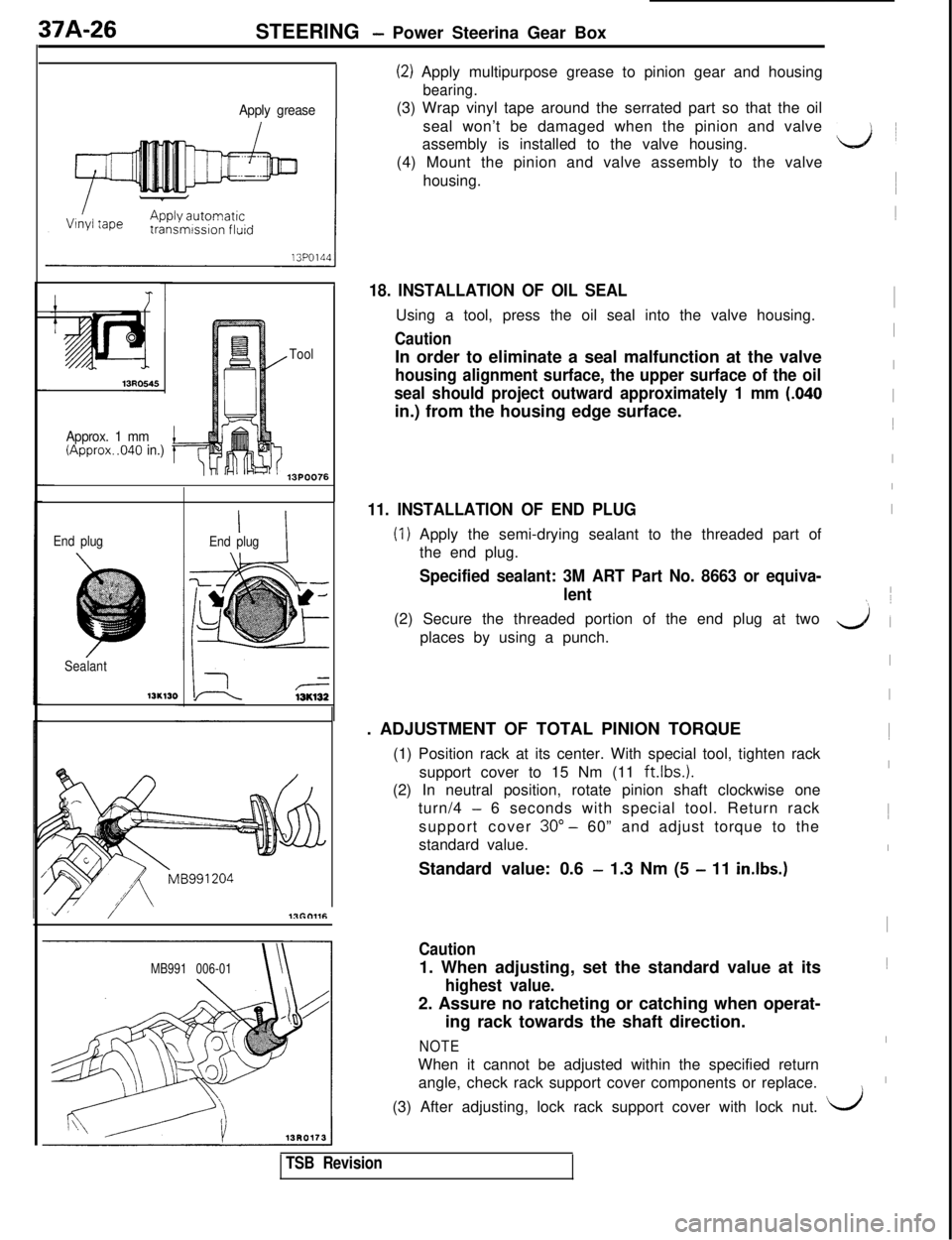
(2) Apply multipurpose grease to pinion gear and housing
bearing.(3) Wrap vinyl tape around the serrated part so that the oil
seal won’t be damaged when the pinion and valve
assembly is installed to the valve housing.
(4) Mount the pinion and valve assembly to the valve
housing.
18. INSTALLATION OF OIL SEALUsing a tool, press the oil seal into the valve housing.
CautionIn order to eliminate a seal malfunction at the valve
housing alignment surface, the upper surface of the oil
seal should project outward approximately 1 mm
(.040in.) from the housing edge surface.
11. INSTALLATION OF END PLUG
(1) Apply the semi-drying sealant to the threaded part of
the end plug.
Specified sealant: 3M ART Part No. 8663 or equiva-
lent(2) Secure the threaded portion of the end plug at two
places by using a punch.
. ADJUSTMENT OF TOTAL PINION TORQUE
(1) Position rack at its center. With special tool, tighten rack
support cover to 15 Nm (11
ft.lbs.1.(2) In neutral position, rotate pinion shaft clockwise one
turn/4
- 6 seconds with special tool. Return rack
support cover 30”
- 60” and adjust torque to the
standard value.
Standard value: 0.6
- 1.3 Nm (5 - 11 in.lbs.)
Caution1. When adjusting, set the standard value at its
highest value.2. Assure no ratcheting or catching when operat-
ing rack towards the shaft direction.
NOTEWhen it cannot be adjusted within the specified return
angle, check rack support cover components or replace.
ii1
I1
I
I
I
I1
I
I
I
I
yl (
I
I1
I1
I
I1
I
I\(3) After adjusting, lock rack support cover with lock nut.
i/
TSB Revision
Page 864 of 1146
37B44-WHEEL STEERING SYSTEM (4WS) -Service Adjustment ProceduresSERVICE ADJUSTMENT PROCEDURES
M37FKAH
BLEEDING,LJ(1) Bleed air from power steering system (Refer to GROUP
37A
- Service Adjustment Procedures.)
(2) Lift up the vehicle.
(3) Start the engine and let it idle.
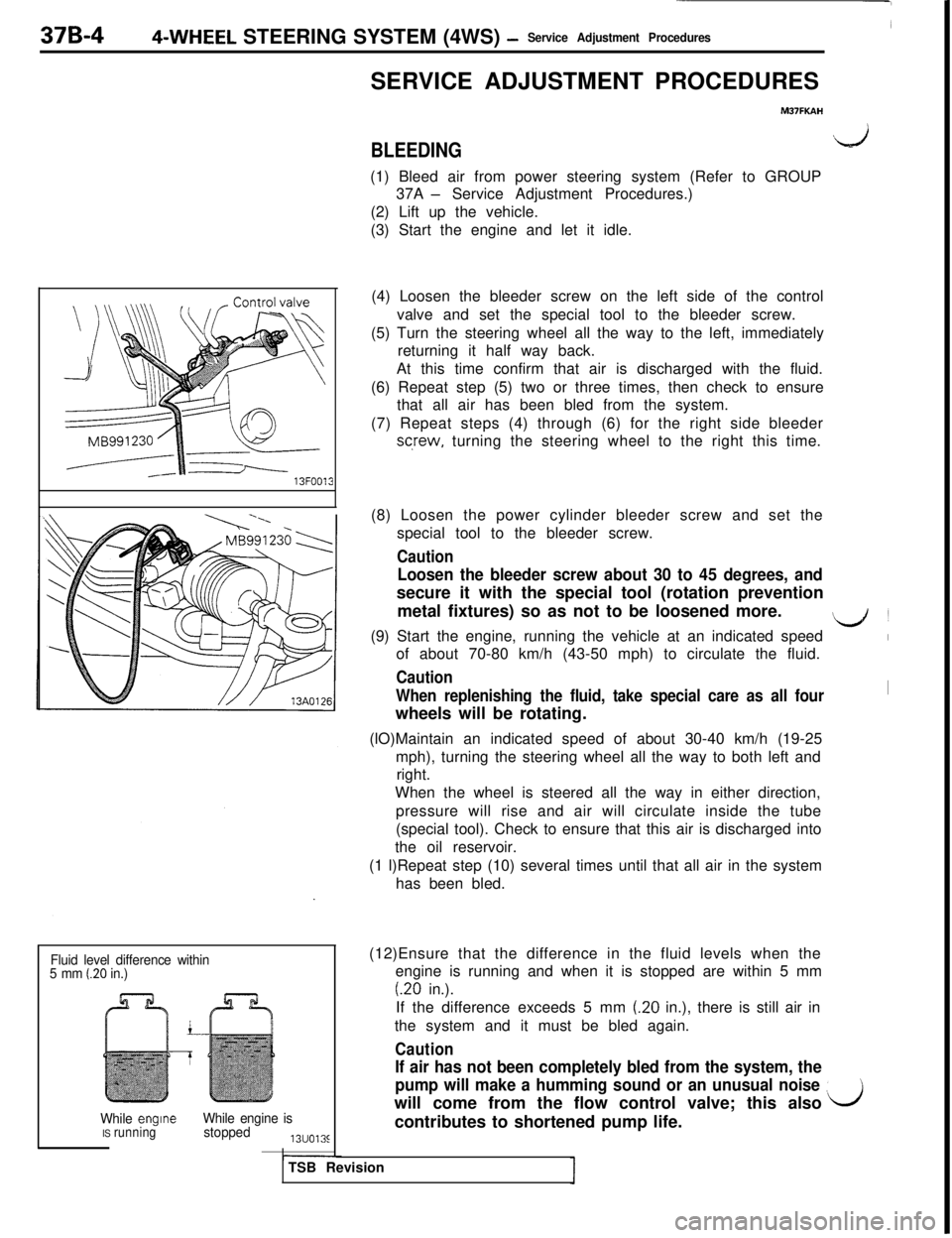
(4) Loosen the bleeder screw on the left side of the control
valve and set the special tool to the bleeder screw.
(5) Turn the steering wheel all the way to the left, immediately
returning it half way back.
At this time confirm that air is discharged with the fluid.
(6) Repeat step (5) two or three times, then check to ensure
that all air has been bled from the system.
(7) Repeat steps (4) through (6) for the right side bleeder
sc,rew, turning the steering wheel to the right this time.
(8) Loosen the power cylinder bleeder screw and set the
special tool to the bleeder screw.
Caution
Loosen the bleeder screw about 30 to 45 degrees, andsecure it with the special tool (rotation prevention
metal fixtures) so as not to be loosened more.
(9) Start the engine, running the vehicle at an indicated speed
I/l1Iof about 70-80 km/h (43-50 mph) to circulate the fluid.
-13FOO13
Caution
When replenishing the fluid, take special care as all fourIwheels will be rotating.
Fluid level difference within
5 mm (.20 in.)
While
engineWhile engine isIS runningstopped13lJO13~(lO)Maintain an indicated speed of about 30-40 km/h (19-25
mph), turning the steering wheel all the way to both left and
right.
When the wheel is steered all the way in either direction,
pressure will rise and air will circulate inside the tube
(special tool). Check to ensure that this air is discharged into
the oil reservoir.
(1 l)Repeat step (10) several times until that all air in the system
has been bled.
(12)Ensure that the difference in the fluid levels when the
engine is running and when it is stopped are within 5 mm(.20 in.).
If the difference exceeds 5 mm
(.20 in.), there is still air in
the system and it must be bled again.
Caution
If air has not been completely bled from the system, the
pump will make a humming sound or an unusual noise ,,
will come from the flow control valve; this also
dcontributes to shortened pump life.
TSB Revision
Page 867 of 1146
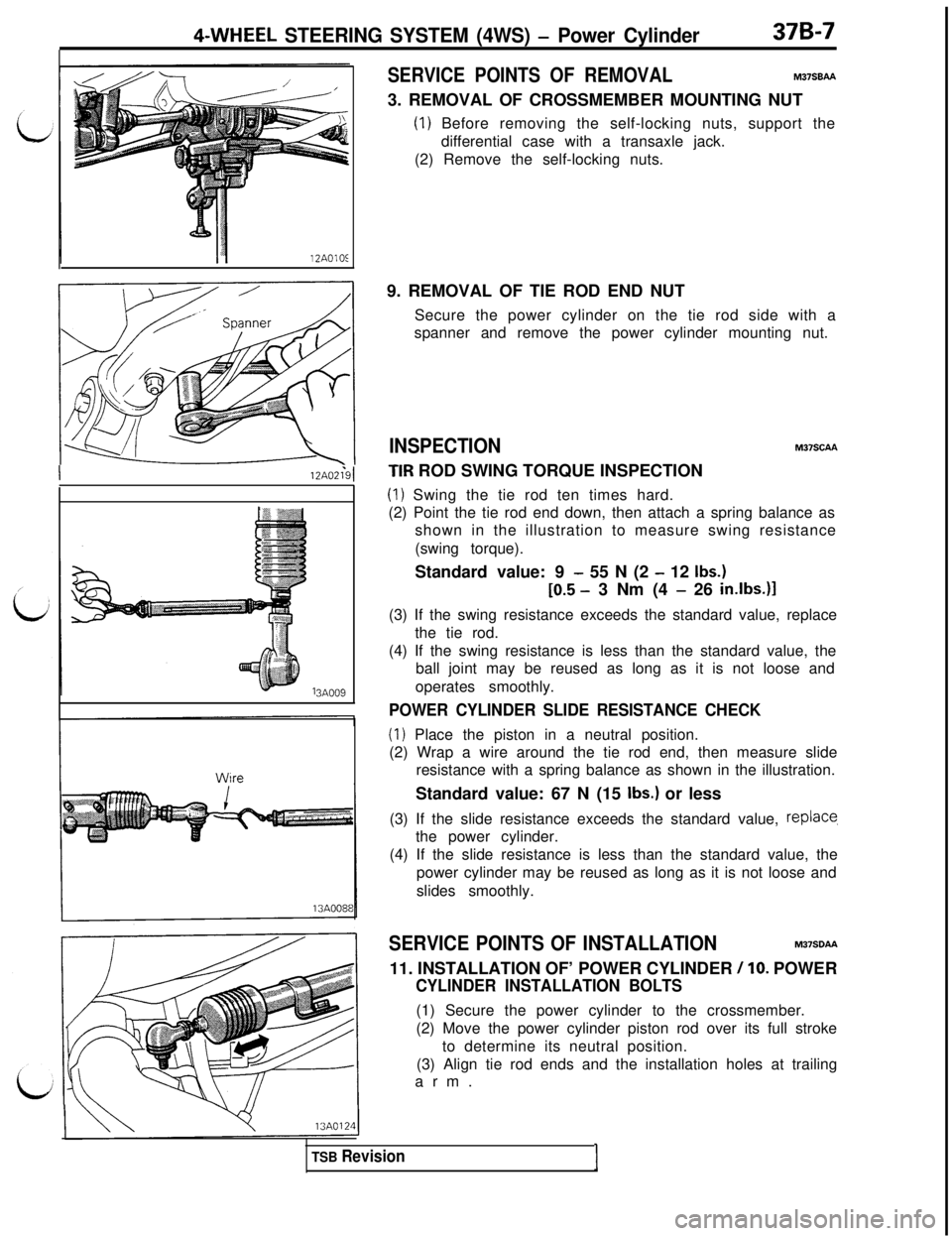
4-WHEEL STEERING SYSTEM (4WS) - Power Cylinder378-712AOlOE
IlZAO2;91
3A009
Wire
SERVICE POINTS OF REMOVALM37SBM3. REMOVAL OF CROSSMEMBER MOUNTING NUT
(1) Before removing the self-locking nuts, support the
differential case with a transaxle jack.
(2) Remove the self-locking nuts.
9. REMOVAL OF TIE ROD END NUT
Secure the power cylinder on the tie rod side with a
spanner and remove the power cylinder mounting nut.
INSPECTIONM37SCM
TIR ROD SWING TORQUE INSPECTION
(1) Swing the tie rod ten times hard.
(2) Point the tie rod end down, then attach a spring balance as
shown in the illustration to measure swing resistance
(swing torque).
Standard value: 9
- 55 N (2 - 12 Ibs.)
[0.5 - 3 Nm (4 - 26 in.lbs.)l(3) If the swing resistance exceeds the standard value, replace
the tie rod.
(4) If the swing resistance is less than the standard value, the
ball joint may be reused as long as it is not loose and
operates smoothly.
POWER CYLINDER SLIDE RESISTANCE CHECK
(1) Place the piston in a neutral position.
(2) Wrap a wire around the tie rod end, then measure slide
resistance with a spring balance as shown in the illustration.
Standard value: 67 N (15
Ibs.) or less
(3) If the slide resistance exceeds the standard value,
replace,the power cylinder.
(4) If the slide resistance is less than the standard value, the
power cylinder may be reused as long as it is not loose and
slides smoothly.
SERVICE POINTS OF INSTALLATIONM37SDP911. INSTALLATION OF’ POWER CYLINDER
/ 10. POWER
CYLINDER INSTALLATION BOLTS(1) Secure the power cylinder to the crossmember.
(2) Move the power cylinder piston rod over its full stroke
to determine its neutral position.
(3) Align tie rod ends and the installation holes at trailing
arm.
TSB RevisionI