check engine MITSUBISHI 3000GT 1991 Service Manual
[x] Cancel search | Manufacturer: MITSUBISHI, Model Year: 1991, Model line: 3000GT, Model: MITSUBISHI 3000GT 1991Pages: 1146, PDF Size: 76.68 MB
Page 768 of 1146
35-46SERVICE BRAKES - Service Adjustment Procedures
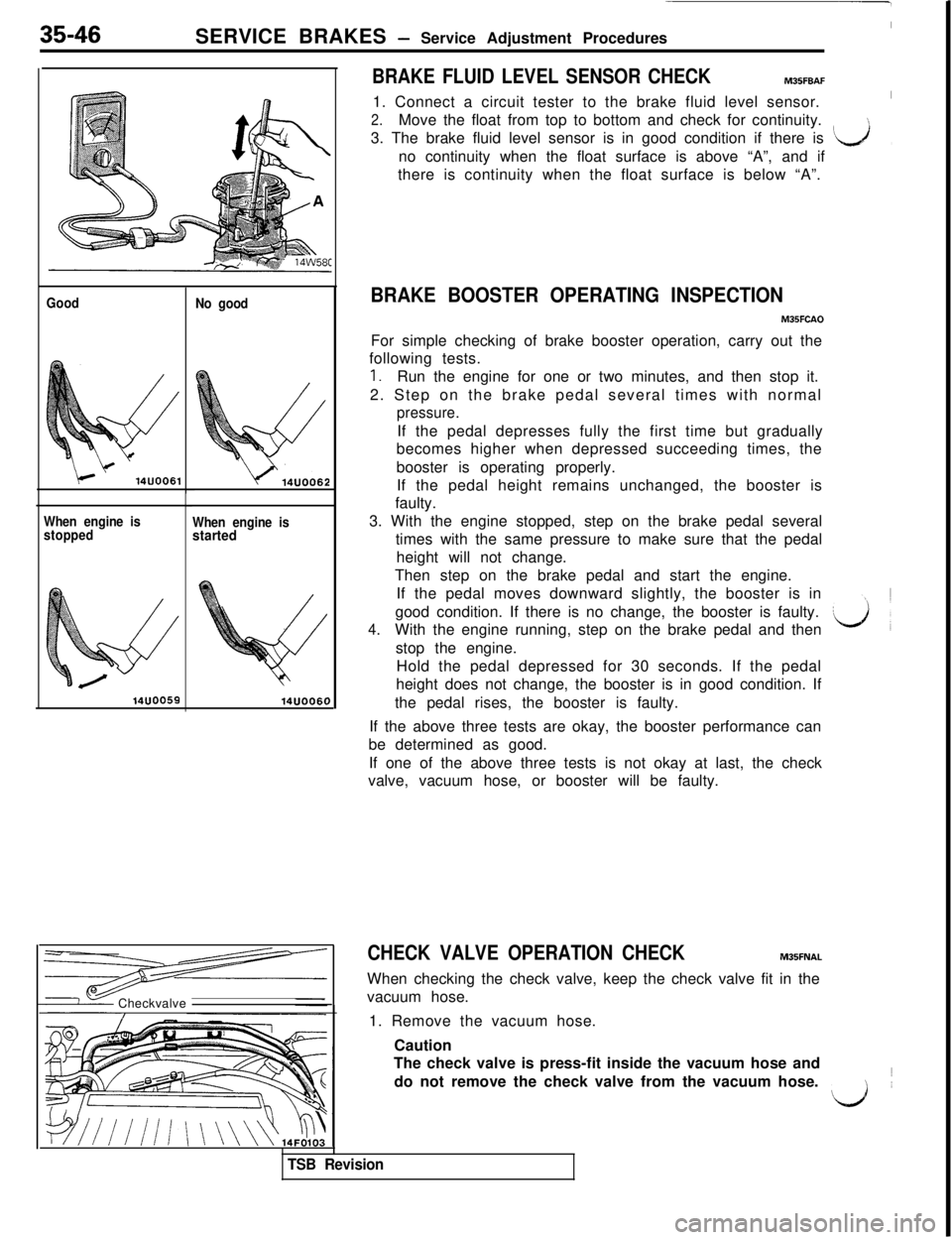
BRAKE FLUID LEVEL SENSOR CHECK
I
MBSFBAF
Good
k‘14UOO61
When engine is
stoppedNo good
When engine isstarted
14UOO6C)Checkvalve/1. Connect a circuit tester to the brake fluid level sensor.
I
2.Move the float from top to bottom and check for continuity.
3. The brake fluid level sensor is in good condition if there is
‘k&Jno continuity when the float surface is above “A”, and if,there is continuity when the float surface is below “A”.
BRAKE BOOSTER OPERATING INSPECTION
M35FCAOFor simple checking of brake booster operation, carry out the
following tests.
1.Run the engine for one or two minutes, and then stop it.
2. Step on the brake pedal several times with normal
pressure.If the pedal depresses fully the first time but gradually
becomes higher when depressed succeeding times, the
booster is operating properly.
If the pedal height remains unchanged, the booster is
faulty.
3. With the engine stopped, step on the brake pedal several
times with the same pressure to make sure that the pedal
height will not change.
Then step on the brake pedal and start the engine.
If the pedal moves downward slightly, the booster is in
good condition. If there is no change, the booster is faulty.
4.With the engine running, step on the brake pedal and then
stop the engine.
Hold the pedal depressed for 30 seconds. If the pedal
height does not change, the booster is in good condition. If
the pedal rises, the booster is faulty.
If the above three tests are okay, the booster performance can
be determined as good.
If one of the above three tests is not okay at last, the check
valve, vacuum hose, or booster will be faulty.
CHECK VALVE OPERATION CHECKM35FNALWhen checking the check valve, keep the check valve fit in the
vacuum hose.
1. Remove the vacuum hose.
Caution
The check valve is press-fit inside the vacuum hose and
do not remove the check valve from the vacuum hose.1
d~
TSB Revision
Page 770 of 1146
35-48SERVICE BRAKES - Service Adjustment Procedures
BLEEDINGCautionM35FYAOUse the specified brake fluid. Avoid using a mixture of the
specified brake fluid and other fluid.
Specified brake fluid: Conforming to DOT314POO3C
1
14A045
When new
When wornWear
indicator
Lrakedisc
indicatorBrake
disc
14FOO4CBLEEDING THE MASTER CYLINDER
If the master cylinder is empty of brake fluid, bleed the cylinder
as follows.
(1) Fill the reserve tank with brake fluid.
(2) Depress and hold the brake pedal.
(3) Let your fellow worker plug the master cylinder outlet with
finger.
(4) Keeping the condition (3), release the brake pedal.
(5) Repeat steps
(2) to (4) three to four times while filling the
master cylinder with brake fluid.
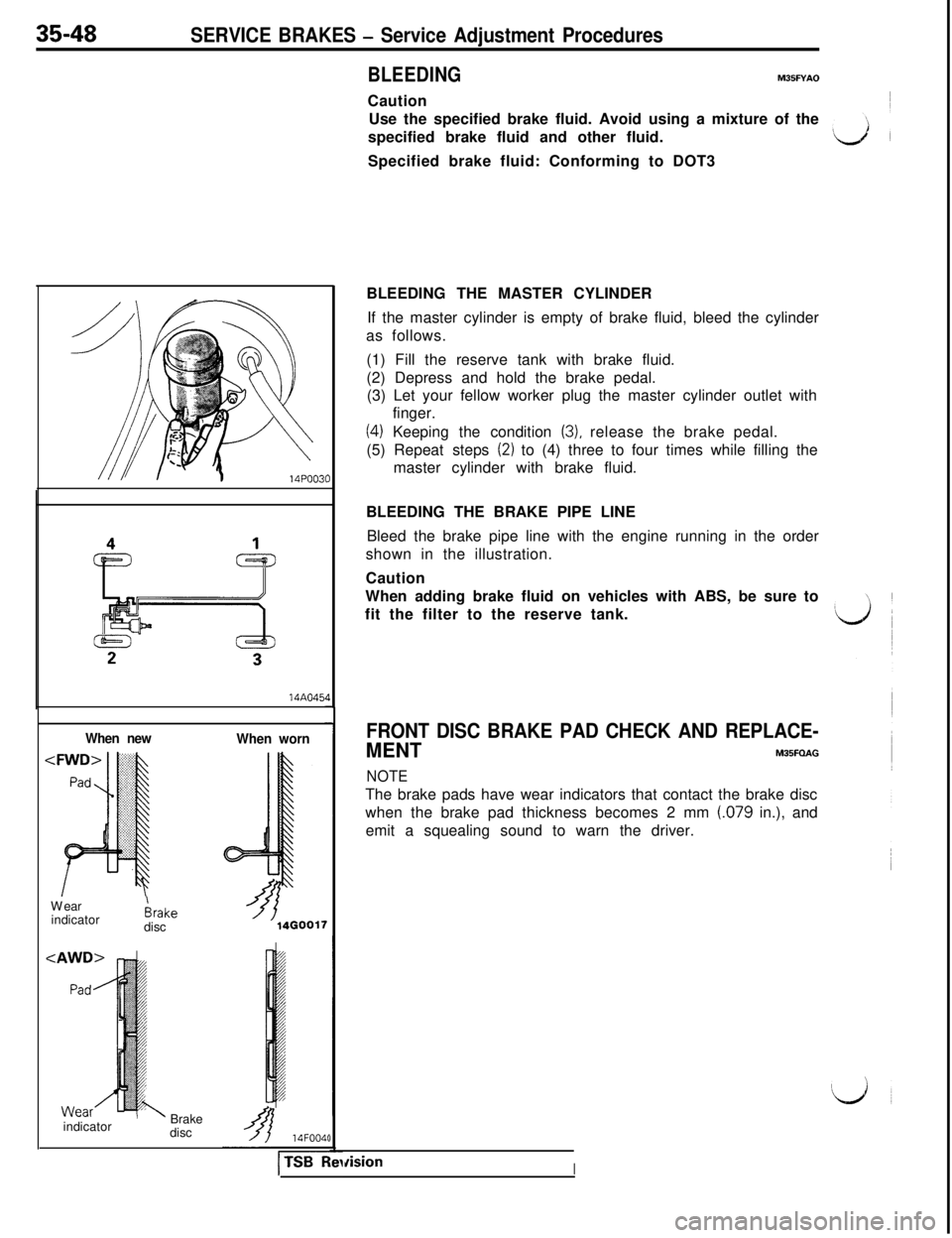
BLEEDING THE BRAKE PIPE LINE
Bleed the brake pipe line with the engine running in the order
shown in the illustration.
Caution
When adding brake fluid on vehicles with ABS, be sure to
fit the filter to the reserve tank.
FRONT DISC BRAKE PAD CHECK AND REPLACE-
MENTM35FQAG
NOTEThe brake pads have wear indicators that contact the brake disc
when the brake pad thickness becomes 2 mm
(.079 in.), and
emit a squealing sound to warn the driver.
&ionI
Page 772 of 1146
35-50SERVICE BRAKES - Service Adjustment Procedures
Pad pin
1 AFnn97
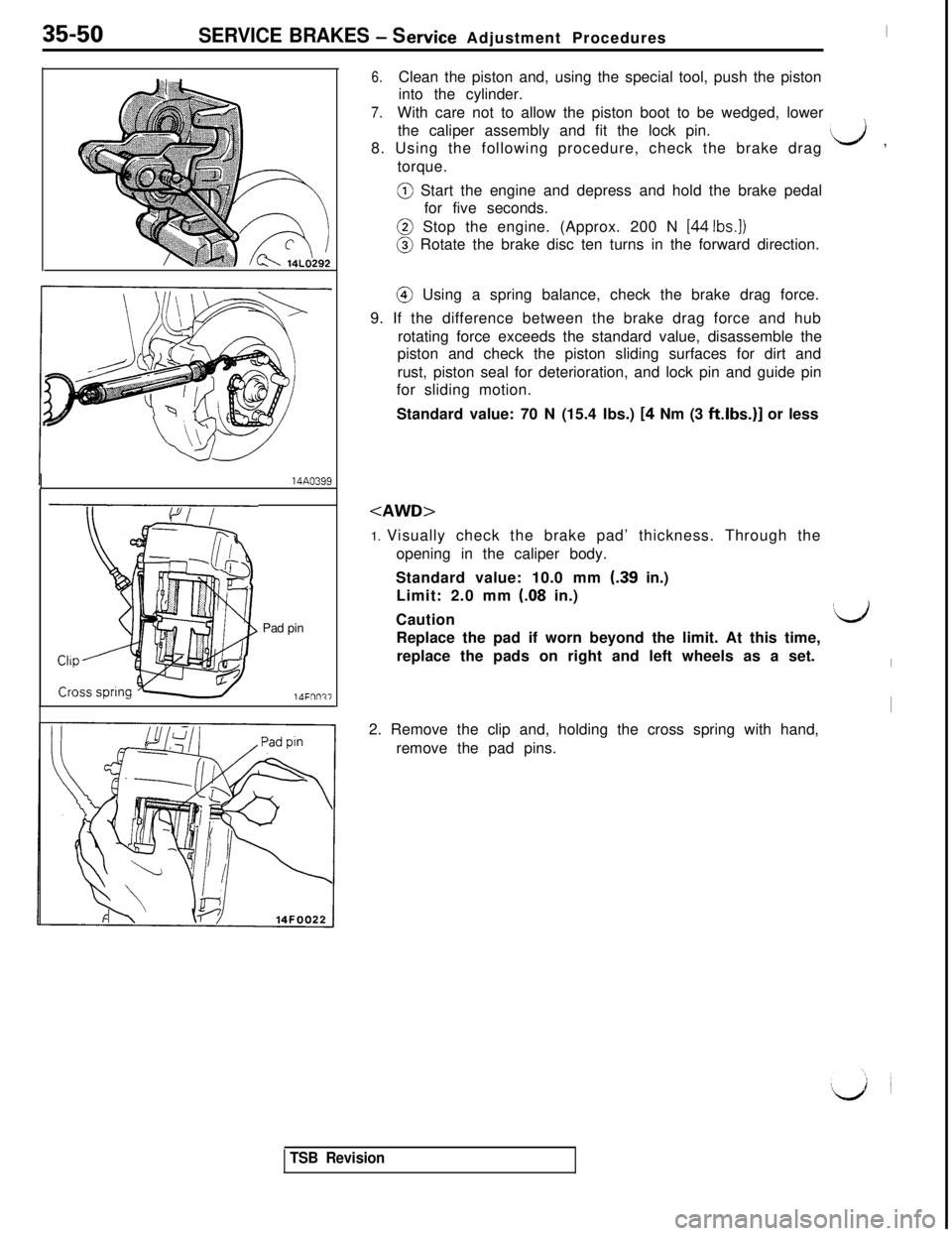
6.Clean the piston and, using the special tool, push the piston
into the cylinder.
7.With care not to allow the piston boot to be wedged, lower
the caliper assembly and fit the lock pin.
8. Using the following procedure, check the brake drag
‘d ,
torque.@ Start the engine and depress and hold the brake pedal
for five seconds.@ Stop the engine. (Approx. 200 N
[44 Ibs.])@ Rotate the brake disc ten turns in the forward direction.@ Using a spring balance, check the brake drag force.
9. If the difference between the brake drag force and hub
rotating force exceeds the standard value, disassemble the
piston and check the piston sliding surfaces for dirt and
rust, piston seal for deterioration, and lock pin and guide pin
for sliding motion.
Standard value: 70 N (15.4 Ibs.)
[4 Nm (3 ftlbs.)] or less
opening in the caliper body.
Standard value: 10.0 mm
(-39 in.)
Limit: 2.0 mm
(.08 in.)
Caution
‘L&iReplace the pad if worn beyond the limit. At this time,
replace the pads on right and left wheels as a set.
I2. Remove the clip and, holding the cross spring with hand,
remove the pad pins.
TSB Revision
Page 774 of 1146
35-52SERVICE BRAKES - Service Adjustment Procedures
14FOO94
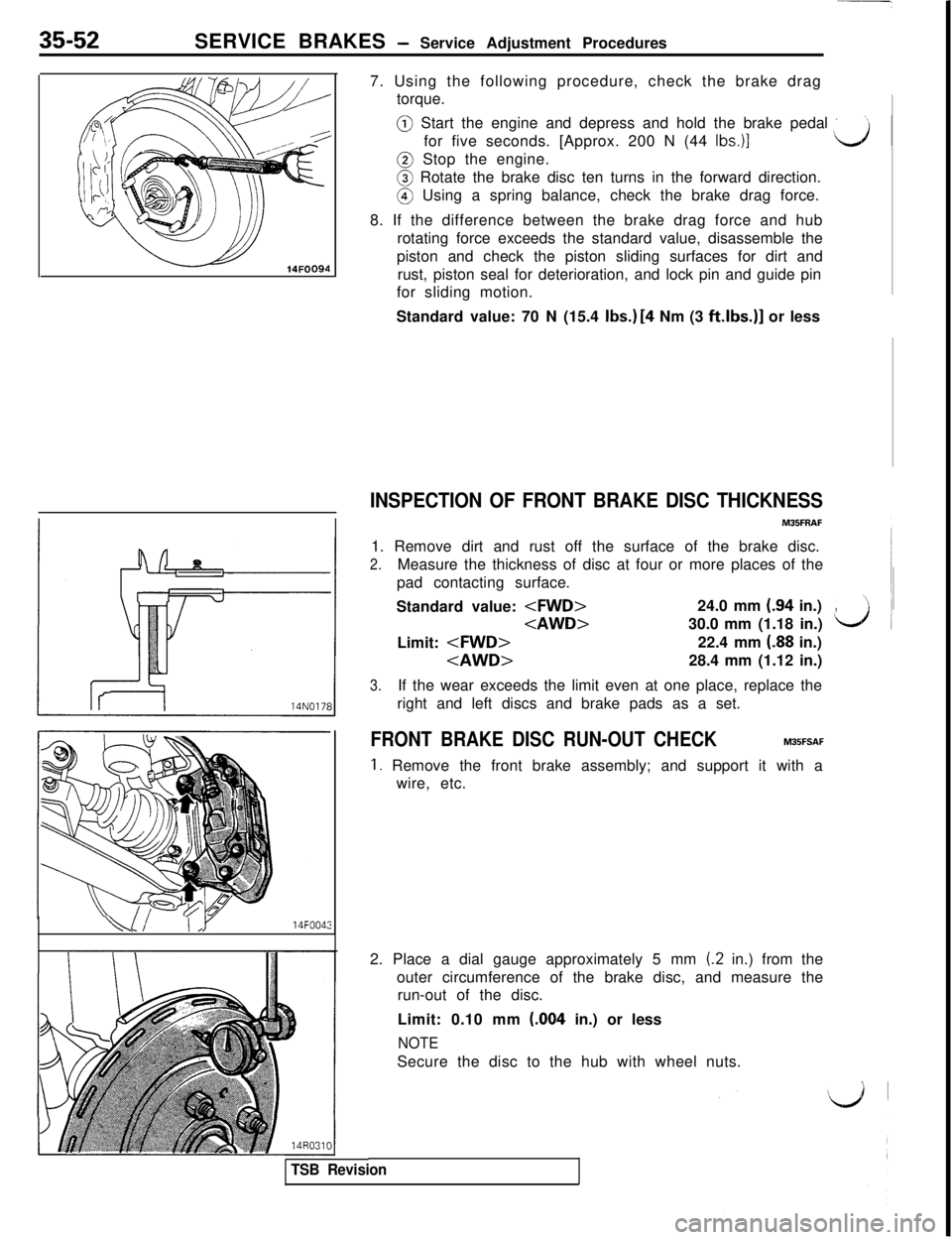
k.!! I14FOO427. Using the following procedure, check the brake drag
torque.@ Start the engine and depress and hold the brake pedal
’for five seconds. [Approx. 200 N (44
Ibs.)]@ Stop the engine.@ Rotate the brake disc ten turns in the forward direction.@ Using a spring balance, check the brake drag force.
8. If the difference between the brake drag force and hub
rotating force exceeds the standard value, disassemble the
piston and check the piston sliding surfaces for dirt and
rust, piston seal for deterioration, and lock pin and guide pin
for sliding motion.
Standard value: 70 N (15.4
Ibs.) [4 Nm (3 ft.lbs.)] or less
INSPECTION OF FRONT BRAKE DISC THICKNESS1. Remove dirt and rust off the surface of the brake disc.
2.Measure the thickness of disc at four or more places of the
pad contacting surface.
Standard value:
,Limit:
3.If the wear exceeds the limit even at one place, replace the
right and left discs and brake pads as a set.
FRONT BRAKE DISC RUN-OUT CHECKM35FSAF
1. Remove the front brake assembly; and support it with a
wire, etc.
TSB Revision2. Place a dial gauge approximately 5 mm
(.2 in.) from the
outer circumference of the brake disc, and measure the
run-out of the disc.
Limit: 0.10 mm (.004 in.) or less
NOTESecure the disc to the hub with wheel nuts.
Page 776 of 1146
SERVICE BRAKES - Service Adjustment Procedures
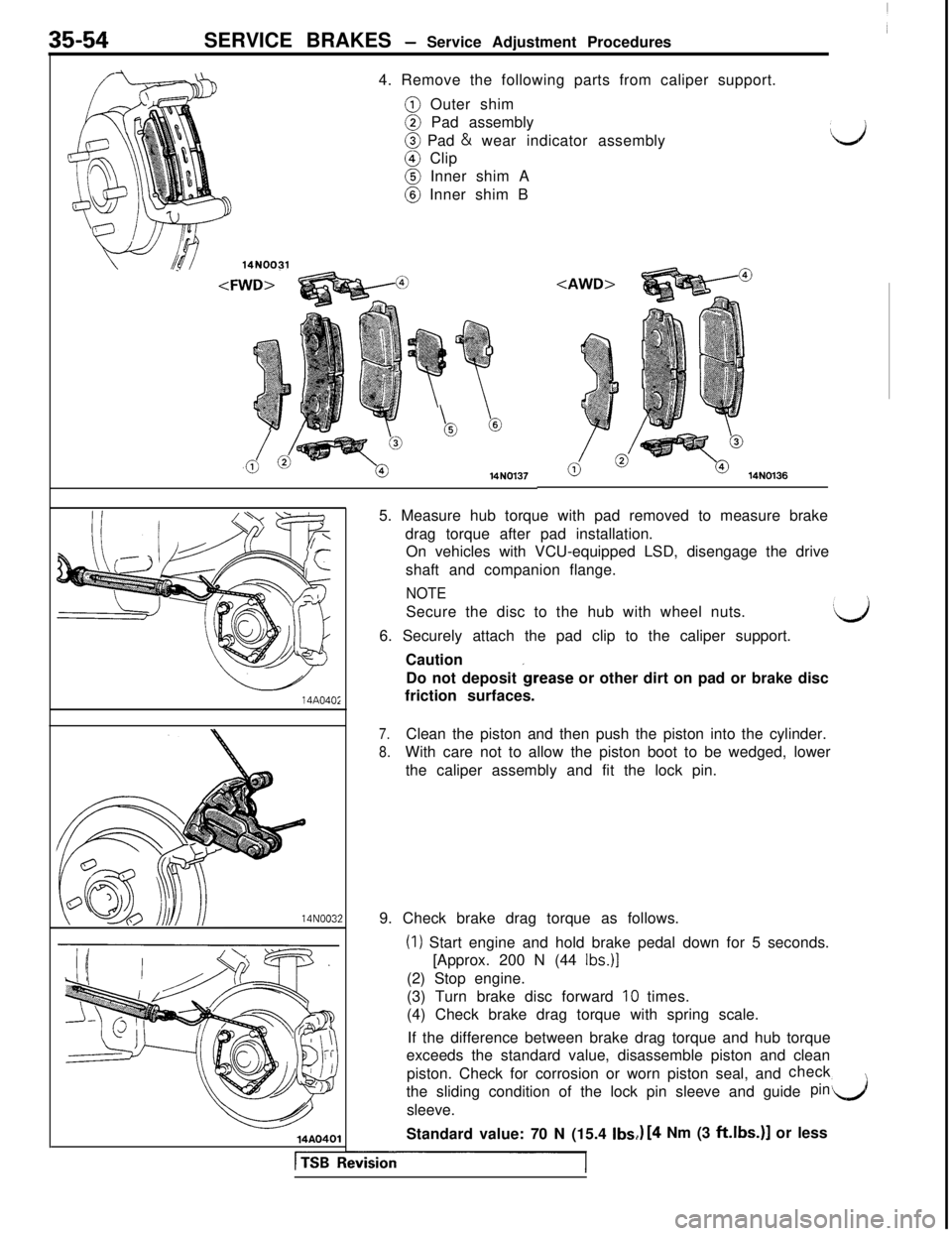
4. Remove the following parts from caliper support.@ Outer shim@ Pad assembly@ Pad & wear indicator assembly@ Clip@ Inner shim A@ Inner shim B
d
14N0031
/0014N013714A040;14N003:
14AO401
l%FLision
14N01365. Measure hub torque with pad removed to measure brake
drag torque after pad installation.
On vehicles with VCU-equipped LSD, disengage the drive
shaft and companion flange.
NOTESecure the disc to the hub with wheel nuts.
6. Securely attach the pad clip to the caliper support.
Caution
Do not deposit
&ease or other dirt on pad or brake disc
friction surfaces.
7.Clean the piston and then push the piston into the cylinder.
8.With care not to allow the piston boot to be wedged, lower
the caliper assembly and fit the lock pin.
9. Check brake drag torque as follows.
(I) Start engine and hold brake pedal down for 5 seconds.
[Approx. 200 N (44
Ibs.)](2) Stop engine.
(3) Turn brake disc forward
10 times.
(4) Check brake drag torque with spring scale.
If the difference between brake drag torque and hub torque
exceeds the standard value, disassemble piston and clean
piston. Check for corrosion or worn piston seal, andcheck
the sliding condition of the lock pin sleeve and guide
pinl/jsleeve.
Standard value: 70 N (15.4
Ibs,,) [4 Nm (3 ft.lbs.)] or less
Page 780 of 1146
35-58SERVICE BRAKES - Service Adjustment Procedures
POINTS IN WAVEFORM MEASUREMENT
Symptom
Too small or zero waveform
amplitudeProbable causes
Faulty wheel speed sensorRemedy
Replace sensor
Incorrect pole piece-to-rotor clearance
Adjust clearance
Waveform amplitude fluctuates
excessively (this is no problem ifAxle hub eccentric or with large runout
Replace hub
the minimum amplitude is
100 mV
or more)
Noisy or disturbed waveformOpen circuit in sensor
Open circuit in harness
Incorrectly mounted wheel speed sensor
Rotor with missing or damaged teethReplace sensor
Correct harness
Mount correctly
Replace rotor
NOTEThe wheel speed sensor cable moves following motion of the front or rear suspension. Therefore, it is likely that it has an
open circuit only when driving on rough roads and it functions normally on ordinary roads. It is, therefore, recommended
to observe sensor output voltage waveform also under special conditions, such as rough road driving,
(ME!991 377)12FOO5i
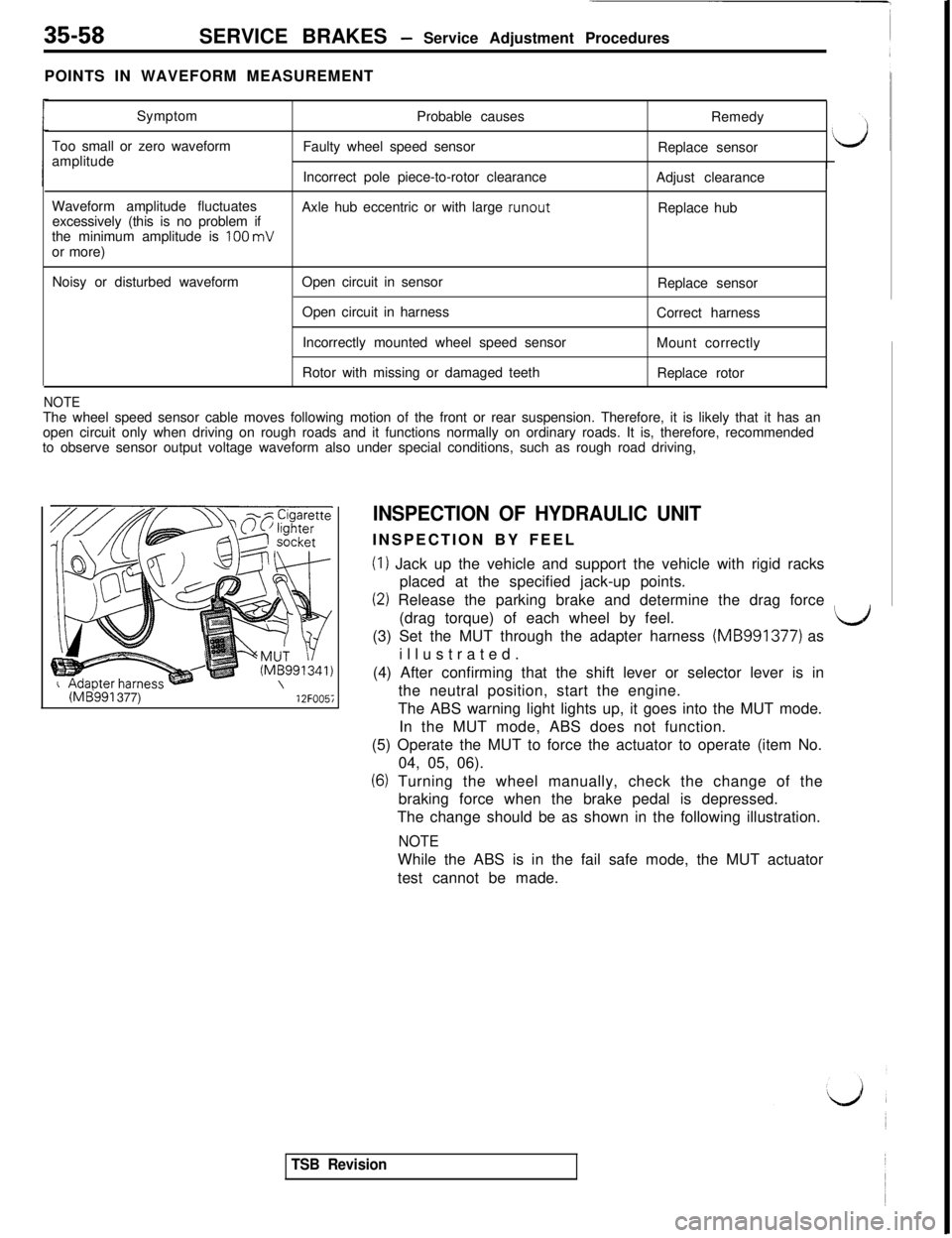
INSPECTION OF HYDRAULIC UNITINSPECTION BY FEEL
(I) Jack up the vehicle and support the vehicle with rigid racks
placed at the specified jack-up points.
(2) Release the parking brake and determine the drag force
(drag torque) of each wheel by feel.
LJ(3) Set the MUT through the adapter harness (MB991377) as
illustrated.
(4) After confirming that the shift lever or selector lever is in
the neutral position, start the engine.
The ABS warning light lights up, it goes into the MUT mode.
In the MUT mode, ABS does not function.
(5) Operate the MUT to force the actuator to operate (item No.
04, 05, 06).
(6) Turning the wheel manually, check the change of the
braking force when the brake pedal is depressed.
The change should be as shown in the following illustration.
NOTEWhile the ABS is in the fail safe mode, the MUT actuator
test cannot be made.
TSB Revision
Page 784 of 1146
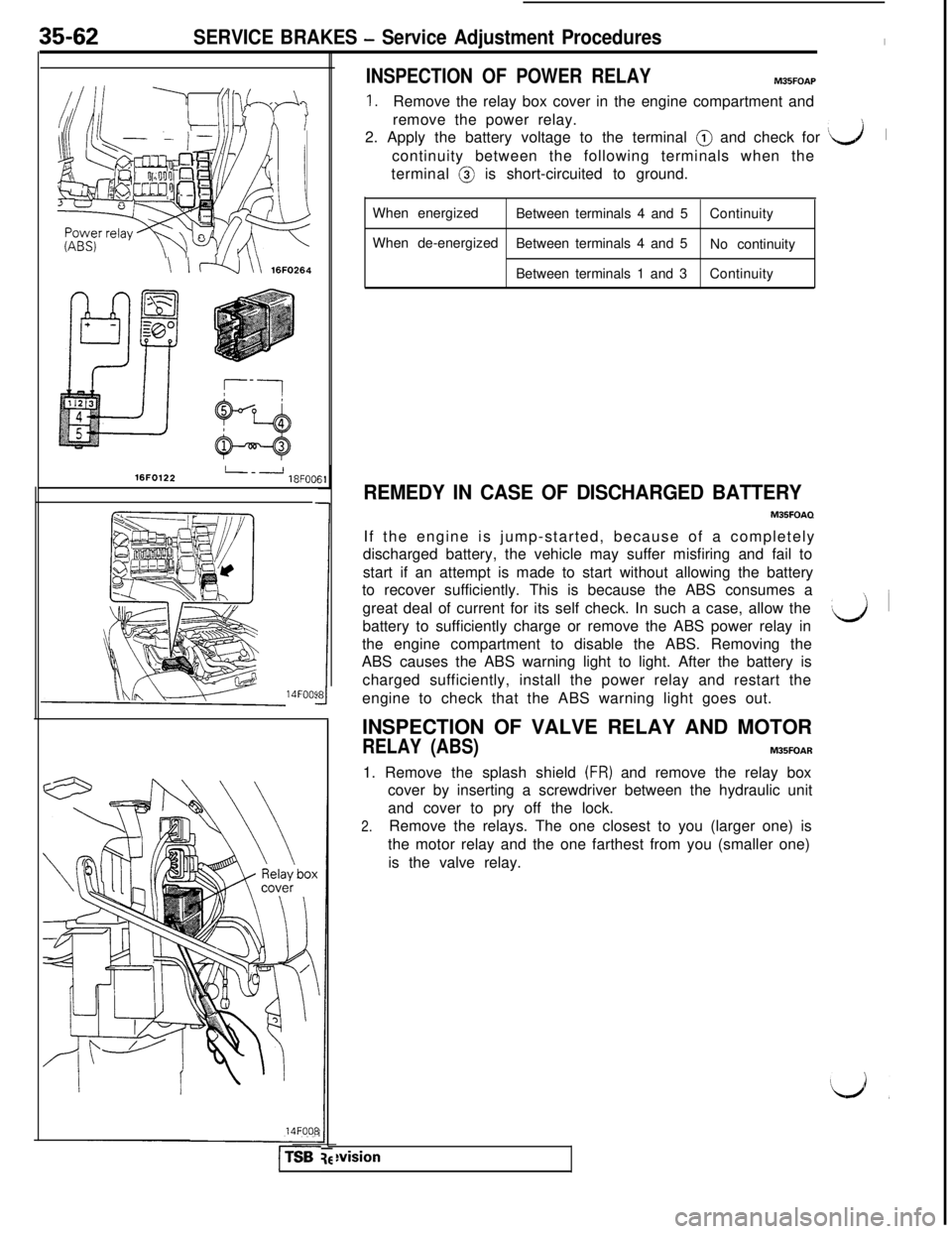
When energized
Between terminals 4 and 5Continuity
When de-energized
Between terminals 4 and 5\i fl \\ 16FO264No continuity
Between terminals 1 and 3Continuity
16FO122L--J18FOCII
SERVICE BRAKES - Service Adjustment ProceduresI
INSPECTION OF POWER RELAYM35FOAP
7
1.Remove the relay box cover in the engine compartment and
remove the power relay.
2. Apply the battery voltage to the terminal @ and check for
‘L-J1
continuity between the following terminals when the
terminal @ is short-circuited to ground.
35-62
14FOOS14FOO8
l-TSB
1
REMEDY IN CASE OF DISCHARGED BATTERY
M35FOAQIf the engine is jump-started, because of a completely
discharged battery, the vehicle may suffer misfiring and fail to
start if an attempt is made to start without allowing the battery
to recover sufficiently. This is because the ABS consumes a
great deal of current for its self check. In such a case, allow the
battery to sufficiently charge or remove the ABS power relay in
the engine compartment to disable the ABS. Removing the
ABS causes the ABS warning light to light. After the battery is
charged sufficiently, install the power relay and restart the
engine to check that the ABS warning light goes out.
INSPECTION OF VALVE RELAY AND MOTOR
RELAY (ABS)M35FOAR1. Remove the splash shield
(FR) and remove the relay box
cover by inserting a screwdriver between the hydraulic unit
and cover to pry off the lock.
2.Remove the relays. The one closest to you (larger one) is
the motor relay and the one farthest from you (smaller one)
is the valve relay.
‘d~ i
wision
Page 796 of 1146
35-74
SERVICE BRAKES - Front Disc Brake
INSPECTIONM35LCAEl Check disc for wear. (Refer to
P.35-52.)l Check disc for runout. (Refer to
P.35-52, 53.)Il Check disc for damage.14A040C
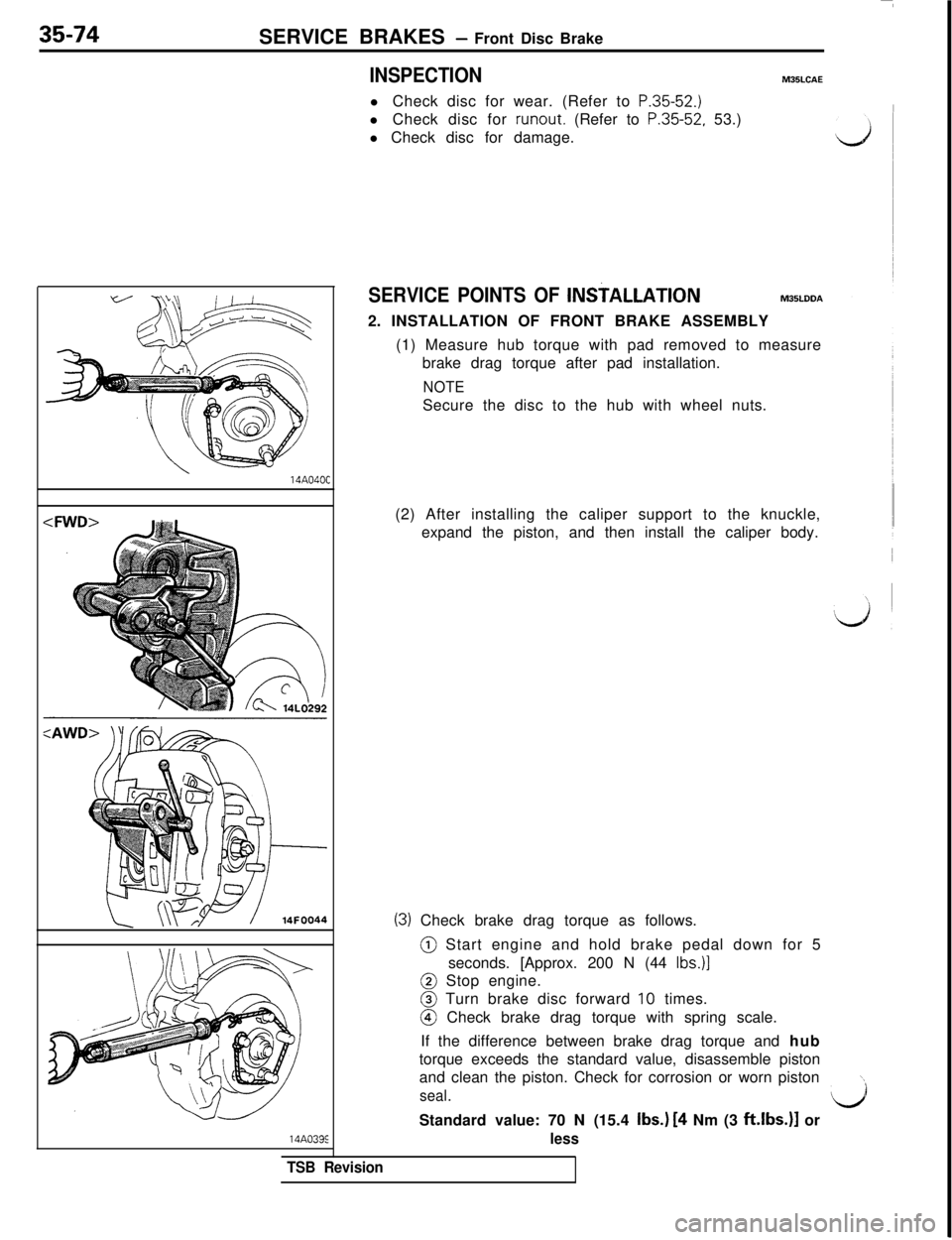
(2) After installing the caliper support to the knuckle,
expand the piston, and then install the caliper body.
(3) Check brake drag torque as follows.@ Start engine and hold brake pedal down for 5
seconds. [Approx. 200 N (44
Ibs.)]@ Stop engine.@ Turn brake disc forward
10 times.@ Check brake drag torque with spring scale.
If the difference between brake drag torque and hub
torque exceeds the standard value, disassemble piston
and clean the piston. Check for corrosion or worn piston
\\
seal.l/iStandard value: 70 N (15.4 Ibs.)
[4 Nm (3 ft.lbs.)l or14A033E
less
SERVICE POINTS OF lNS?ALLATlONM35LDDA2. INSTALLATION OF FRONT BRAKE ASSEMBLY
(1) Measure hub torque with pad removed to measure
brake drag torque after pad installation.
NOTESecure the disc to the hub with wheel nuts.
TSB Revision
Page 833 of 1146
STEERING 2 Service Adjustment Procedures37A-5
13FOOOi13FOOO3SERVICE ADJUSTMENT PROCEDURES
STEERING WHEEL FREE PLAY CHECKM37FABI
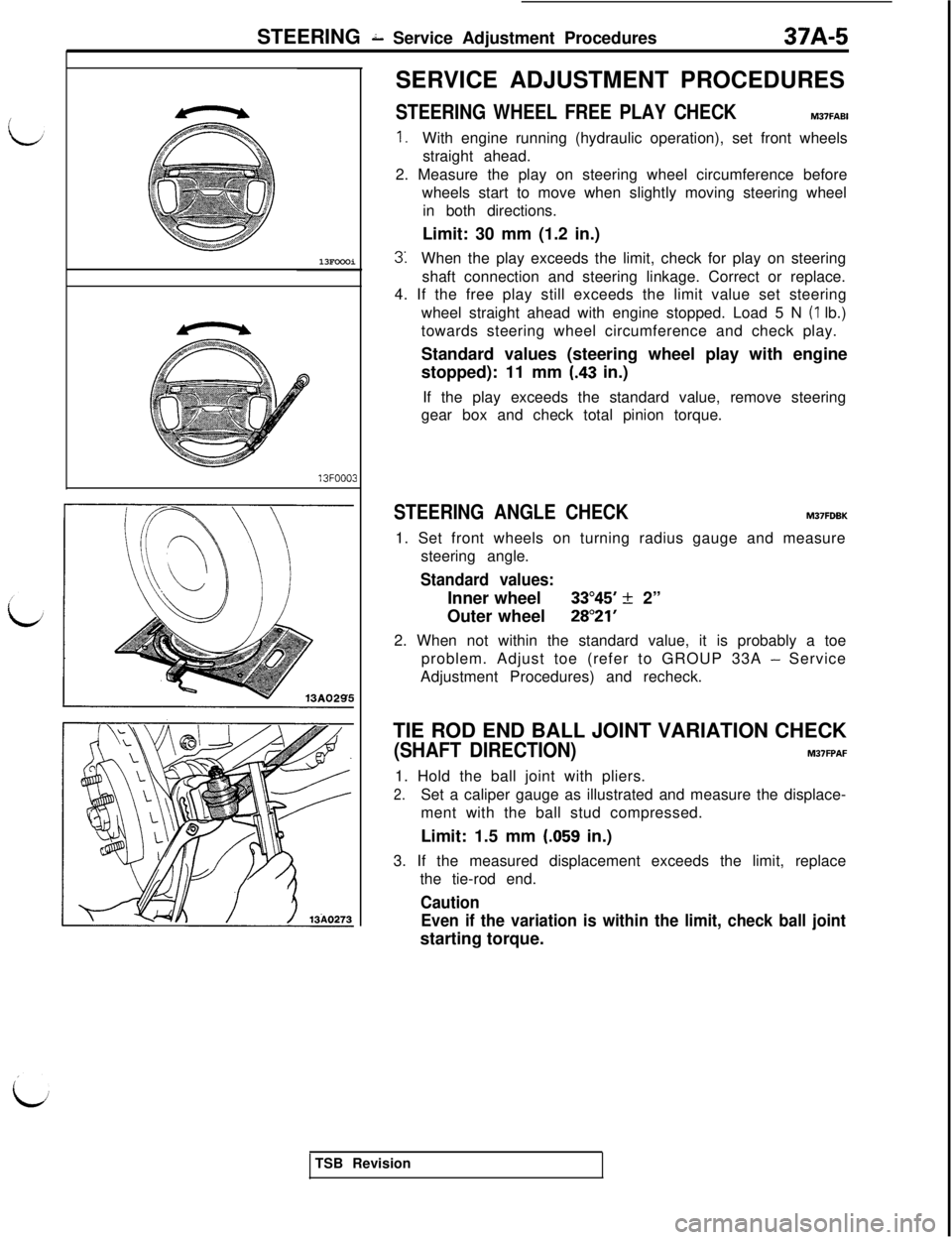
1.With engine running (hydraulic operation), set front wheels
straight ahead.
2. Measure the play on steering wheel circumference before
wheels start to move when slightly moving steering wheel
in both directions.
Limit: 30 mm (1.2 in.)
3:When the play exceeds the limit, check for play on steering
shaft connection and steering linkage. Correct or replace.
4. If the free play still exceeds the limit value set steering
wheel straight ahead with engine stopped. Load 5 N
(1 lb.)
towards steering wheel circumference and check play.
Standard values (steering wheel play with engine
stopped): 11 mm
(.43 in.)
If the play exceeds the standard value, remove steering
gear box and check total pinion torque.
STEERING ANGLE CHECKM37FDBK1. Set front wheels on turning radius gauge and measure
steering angle.
Standard values:Inner wheel
33”45’ k 2”
Outer wheel
28”21’2. When not within the standard value, it is probably a toe
problem. Adjust toe (refer to GROUP 33A
- Service
Adjustment Procedures) and recheck.
TIE ROD END BALL JOINT VARIATION CHECK
(SHAFT DIRECTION)M37FPAF1. Hold the ball joint with pliers.
2.Set a caliper gauge as illustrated and measure the displace-
ment with the ball stud compressed.
Limit: 1.5 mm
(.059 in.)
3. If the measured displacement exceeds the limit, replace
the tie-rod end.
Caution
Even if the variation is within the limit, check ball jointstarting torque.
TSB Revision
Page 836 of 1146
37A-8STEERING - Service Adjustment Procedures13FOOO3
13FOOOl
STATIONARY STEERING EFFORT CHECKM37FFAM
1.With the vehicle stopped on a flat, paved surface, turn the
steering wheel to the straight ahead position.
2. Start the engine and set it to 1,000
+ 100 rpm.d
Caution
After checking the engine speed, there must be a returnto the standard idling speed.
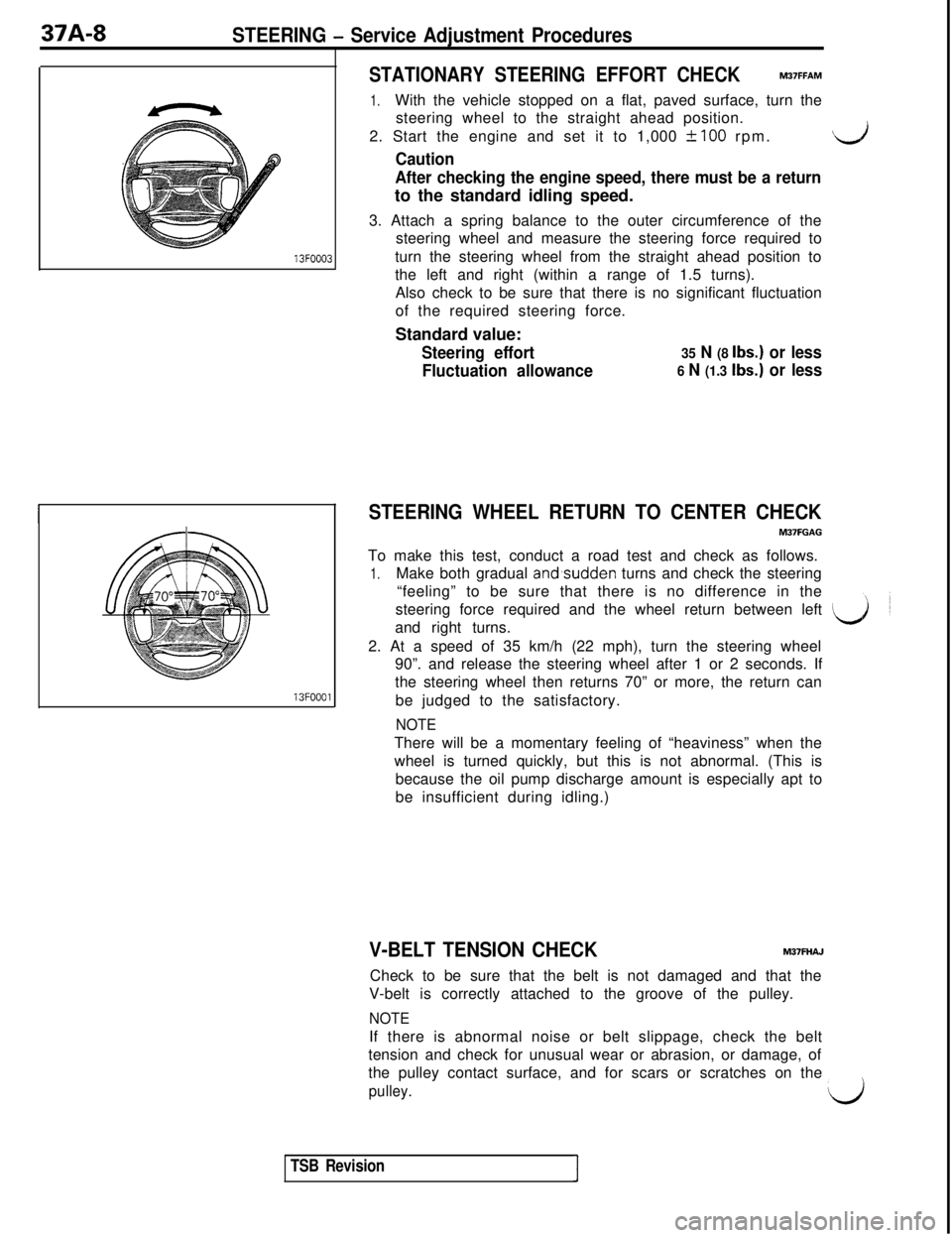
3. Attach a spring balance to the outer circumference of the
steering wheel and measure the steering force required to
turn the steering wheel from the straight ahead position to
the left and right (within a range of 1.5 turns).
Also check to be sure that there is no significant fluctuation
of the required steering force.
Standard value:
Steering effort35 N (8 Ibs.) or less
Fluctuation allowance
6 N (1.3 Ibs.) or less
STEERING WHEEL RETURN TO CENTER CHECK
M37FGACiTo make this test, conduct a road test and check as follows.
1.Make both gradual and,sudden turns and check the steering
“feeling” to be sure that there is no difference in the
steering force required and the wheel return between left
and right turns.
2. At a speed of 35 km/h (22 mph), turn the steering wheel
90”. and release the steering wheel after 1 or 2 seconds. If
the steering wheel then returns 70” or more, the return can
be judged to the satisfactory.
NOTEThere will be a momentary feeling of “heaviness” when the
wheel is turned quickly, but this is not abnormal. (This is
because the oil pump discharge amount is especially apt to
be insufficient during idling.)
V-BELT TENSION CHECKM37FHAJCheck to be sure that the belt is not damaged and that the
V-belt is correctly attached to the groove of the pulley.
NOTEIf there is abnormal noise or belt slippage, check the belt
tension and check for unusual wear or abrasion, or damage, of
the pulley contact surface, and for scars or scratches on the
pulley.d
TSB RevisionI