check engine MITSUBISHI 3000GT 1991 Service Manual
[x] Cancel search | Manufacturer: MITSUBISHI, Model Year: 1991, Model line: 3000GT, Model: MITSUBISHI 3000GT 1991Pages: 1146, PDF Size: 76.68 MB
Page 837 of 1146
STEERING - Service Adjustment Procedures37A-9
LL:13N002E
FluId f[uctuatlon
While
engineWhile engme
runningstopped13uo13:
Return ho
Vinyl hose13AO142
j
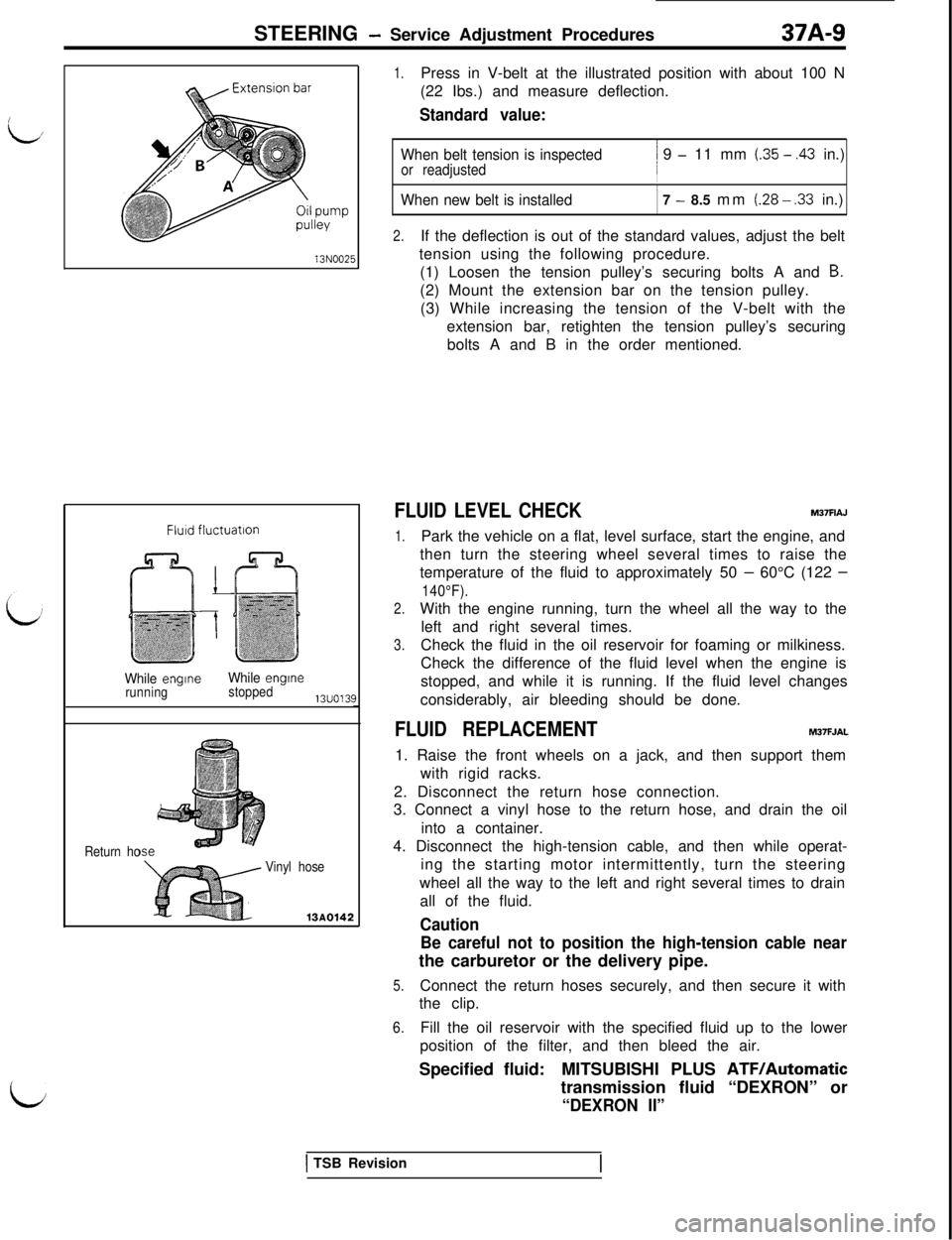
1.Press in V-belt at the illustrated position with about 100 N
(22 Ibs.) and measure deflection.
Standard value:
When belt tension is inspectedor readjusted
When new belt is installed
/ 9 - 11 mm (.35 - .43 in.)
I
’ 7 - 8.5 mm (.28 - .33 in.)
2.If the deflection is out of the standard values, adjust the belt
tension using the following procedure.
(1) Loosen the tension pulley’s securing bolts A and
B.(2) Mount the extension bar on the tension pulley.
(3) While increasing the tension of the V-belt with the
extension bar, retighten the tension pulley’s securing
bolts A and B in the order mentioned.
FLUID LEVEL CHECKM37FlAJ
1.Park the vehicle on a flat, level surface, start the engine, and
then turn the steering wheel several times to raise the
temperature of the fluid to approximately 50
- 60°C (122 -
140°F).
2.With the engine running, turn the wheel all the way to the
left and right several times.
3.Check the fluid in the oil reservoir for foaming or milkiness.
Check the difference of the fluid level when the engine is
stopped, and while it is running. If the fluid level changes
considerably, air bleeding should be done.
FLUID REPLACEMENTM37FJAL1. Raise the front wheels on a jack, and then support them
with rigid racks.
2. Disconnect the return hose connection.
3. Connect a vinyl hose to the return hose, and drain the oil
into a container.
4. Disconnect the high-tension cable, and then while operat-
ing the starting motor intermittently, turn the steering
wheel all the way to the left and right several times to drain
all of the fluid.
Caution
Be careful not to position the high-tension cable nearthe carburetor or the delivery pipe.
5.Connect the return hoses securely, and then secure it with
the clip.
6.Fill the oil reservoir with the specified fluid up to the lower
position of the filter, and then bleed the air.
Specified fluid:MITSUBISHI PLUS ATF/Automatic
transmission fluid “DEXRON” or
“DEXRON II”
1 TSB Revision
Page 838 of 1146
37A-10STEERING - Service Adjustment Procedures
BLEEDINGM37FKAl
1.Jack up the front wheels and support them by using a floor
stand.
2. Manually turn the oil pump pulley a few times.
3. Turn the steering wheel all the way to the left and to the
right several times.
4. Disconnect the high-tension cable, and then, while operat-
ing the starting motor intermittently, turn the steering
wheel all the way to the left and right several times (for 15
to 20 seconds).
Caution1. During air bleeding, replenish the fluid supply so
that the level never falls below the lower position ofthe filter.
2. If air bleeding is done while engine is running, the
air will be broken up and absorbed into the fluid; besure to do the bleeding only while cranking.
5. Connect the ignition cable, and then start the engine
(idling).
6.Turn the steering wheel to the left and right until there are
no air bubbles in the oil reservoir.
7.Confirm that the fluid is not milky, and that the level is up to
the specified position on the level gauge.
8. Confirm that there is very little change in the fluid level
when the steering wheel is turned left and right.
Fluid level change:wlthln 5 mm 1.2 in.)I
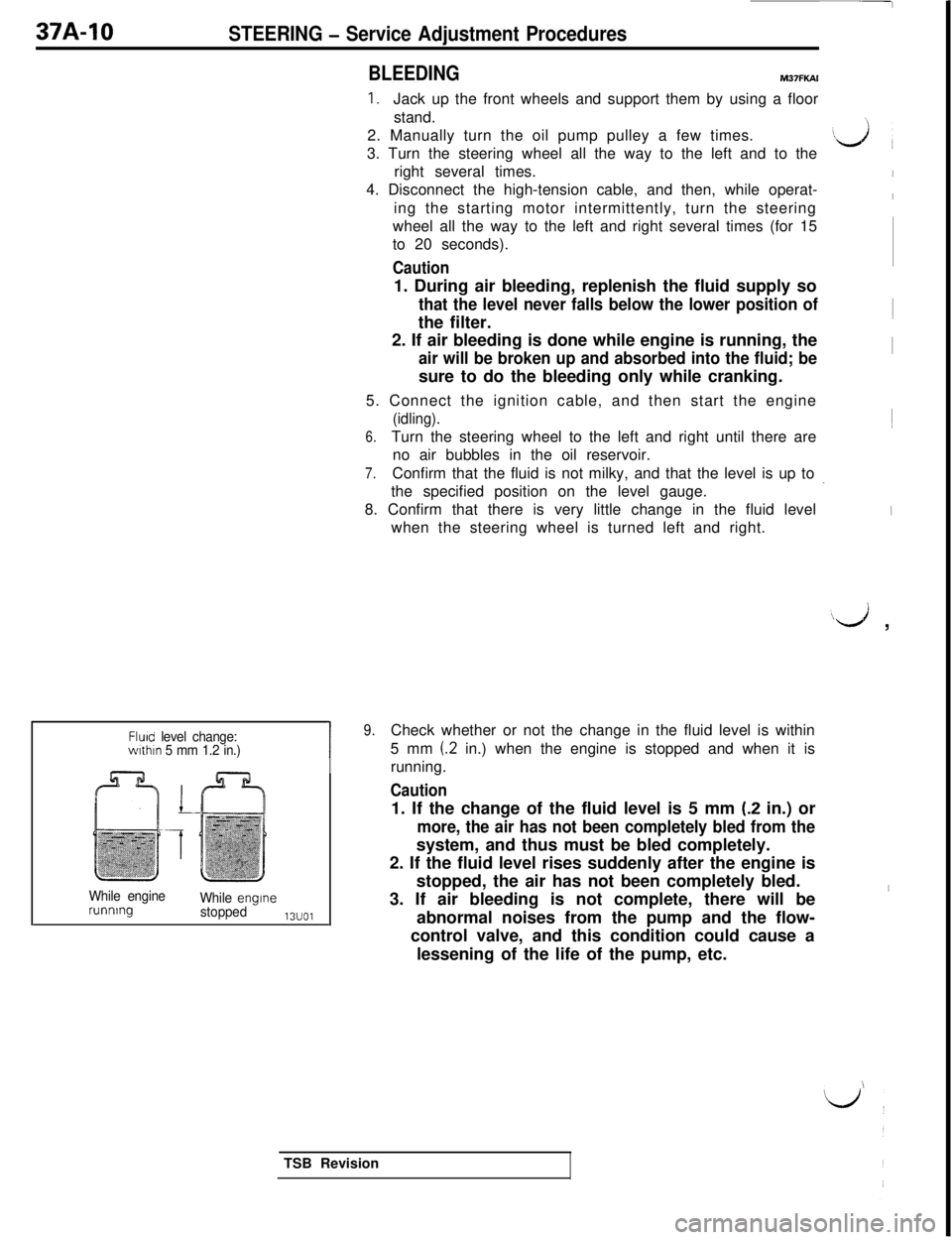
9.Check whether or not the change in the fluid level is within
5 mm
(.2 in.) when the engine is stopped and when it is
Irunning.
Caution
While enginerunningWhile enginestopped13UOl1. If the change of the fluid level is 5 mm
I.2 in.) or
more, the air has not been completely bled from thesystem, and thus must be bled completely.
2. If the fluid level rises suddenly after the engine is
stopped, the air has not been completely bled.
3. If air bleeding is not complete, there will be
abnormal noises from the pump and the flow-
control valve, and this condition could cause a
lessening of the life of the pump, etc.
LJ
I
I~
I~
I
LJ ,
I
\TSB Revision
Page 839 of 1146
STEERING - Service Adjustment Procedures37A-11
Shut-off valve
Pressure gauge(FuW dose)
Temperature
Shut-off valve
OIL PUMP PRESSURE TESTM37FLAl-l
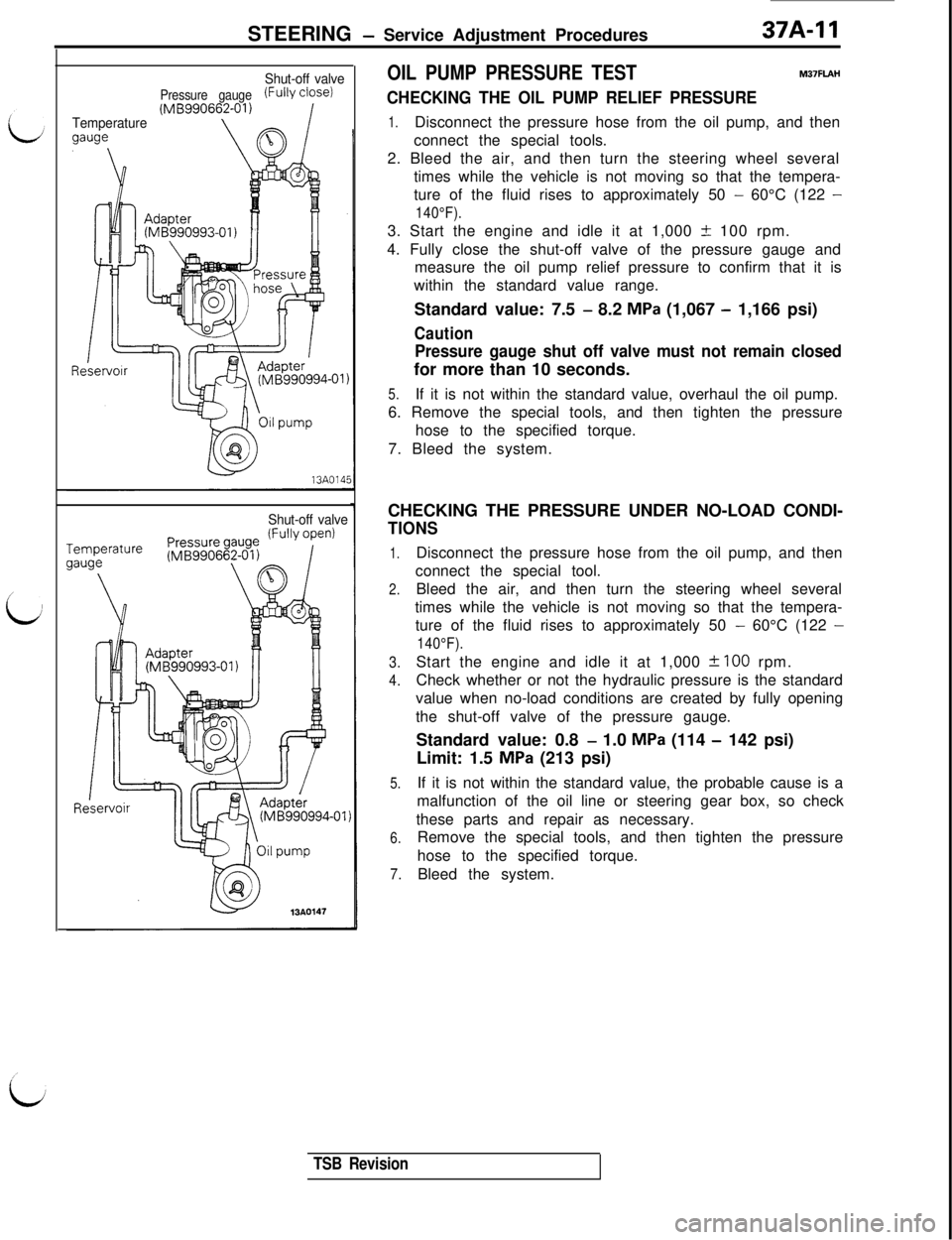
CHECKING THE OIL PUMP RELIEF PRESSURE
1.Disconnect the pressure hose from the oil pump, and then
connect the special tools.
2. Bleed the air, and then turn the steering wheel several
times while the vehicle is not moving so that the tempera-
ture of the fluid rises to approximately 50
- 60°C (122 -
140°F).3. Start the engine and idle it at 1,000
+ 100 rpm.
4. Fully close the shut-off valve of the pressure gauge and
measure the oil pump relief pressure to confirm that it is
within the standard value range.
Standard value: 7.5
- 8.2 MPa (1,067 - 1,166 psi)
Caution
Pressure gauge shut off valve must not remain closedfor more than 10 seconds.
5.If it is not within the standard value, overhaul the oil pump.
6. Remove the special tools, and then tighten the pressure
hose to the specified torque.
7. Bleed the system.
CHECKING THE PRESSURE UNDER NO-LOAD CONDI-
TIONS
1.
2.
3.
4.
5.
6.
7.Disconnect the pressure hose from the oil pump, and then
connect the special tool.
Bleed the air, and then turn the steering wheel several
times while the vehicle is not moving so that the tempera-
ture of the fluid rises to approximately 50
- 60°C (122 -
140°F).Start the engine and idle it at 1,000
+ 100 rpm.
Check whether or not the hydraulic pressure is the standard
value when no-load conditions are created by fully opening
the shut-off valve of the pressure gauge.
Standard value: 0.8
- 1.0 MPa (114 - 142 psi)
Limit: 1.5
MPa (213 psi)
If it is not within the standard value, the probable cause is a
malfunction of the oil line or steering gear box, so check
these parts and repair as necessary.
Remove the special tools, and then tighten the pressure
hose to the specified torque.
Bleed the system.
TSB Revision
Page 840 of 1146
37A-12STEERING - Service Adjustment Procedures
Shut-off valvePressure gaugeTemperature (MB990662-01)(Fully open)I
13AO146
-01)
Shut-off
Adapter
Pressure gaugevalve
(MB990993-01)(MB990662-01) /
\Temperature
1310148
-01)
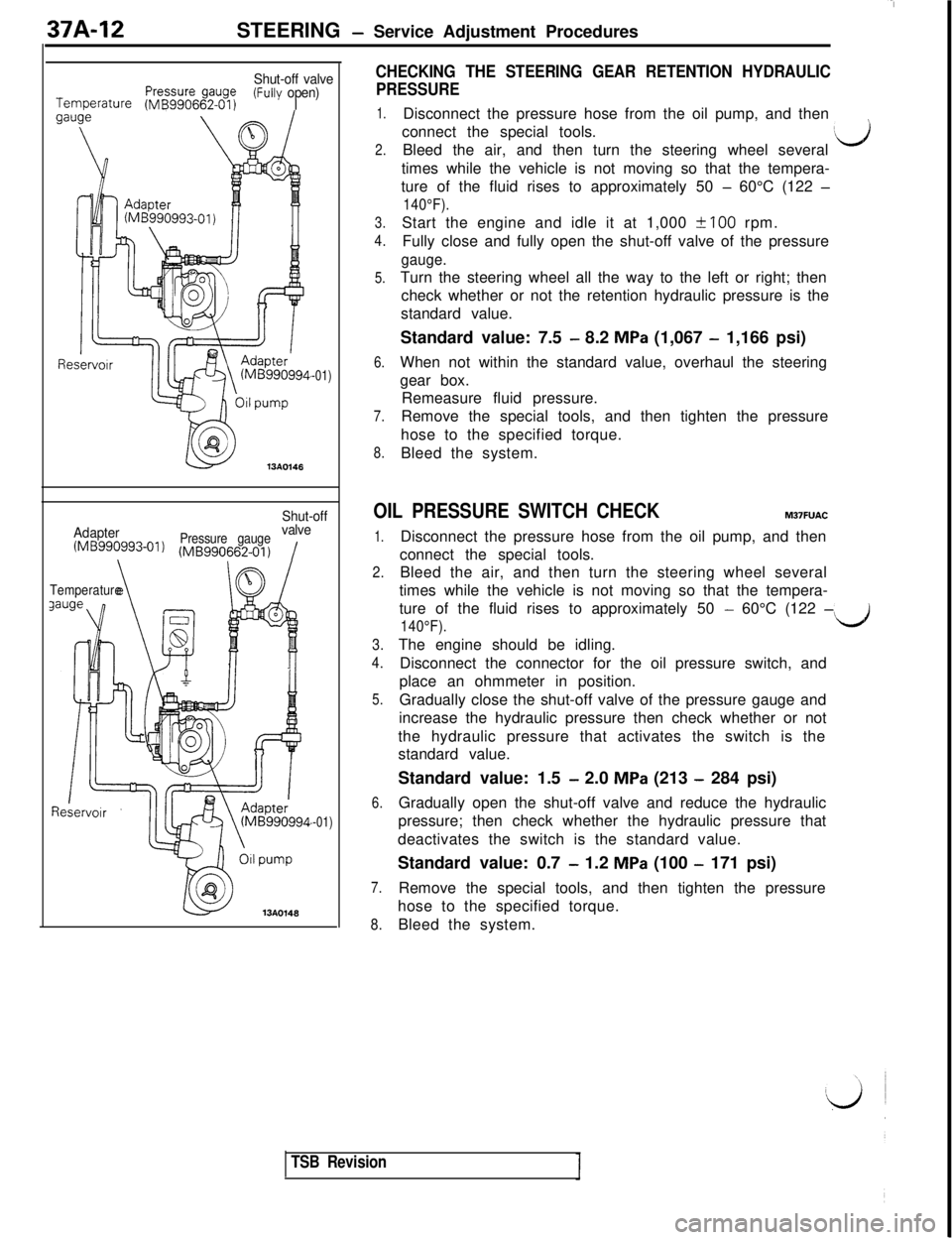
CHECKING THE STEERING GEAR RETENTION HYDRAULIC
PRESSURE
1.
2.
3.
4.
5.
6.
7.
8.Disconnect the pressure hose from the oil pump, and then
/connect the special tools.
Bleed the air, and then turn the steering wheel several
‘dtimes while the vehicle is not moving so that the tempera-
ture of the fluid rises to approximately 50
- 60°C (122 -
140°F).Start the engine and idle it at 1,000
& 100 rpm.
Fully close and fully open the shut-off valve of the pressure
gauge.Turn the steering wheel all the way to the left or right; then
check whether or not the retention hydraulic pressure is the
standard value.
Standard value: 7.5
- 8.2 MPa (1,067 - 1,166 psi)
When not within the standard value, overhaul the steering
gear box.
Remeasure fluid pressure.
Remove the special tools, and then tighten the pressure
hose to the specified torque.
Bleed the system.
OIL PRESSURE SWITCH CHECKM37FUAC
1.
2.
3.
4.
5.
6.
7.
8.Disconnect the pressure hose from the oil pump, and then
connect the special tools.
Bleed the air, and then turn the steering wheel several
times while the vehicle is not moving so that the tempera-
ture of the fluid rises to approximately 50
- 60°C (122 -
140°F).dThe engine should be idling.
Disconnect the connector for the oil pressure switch, and
place an ohmmeter in position.
Gradually close the shut-off valve of the pressure gauge and
increase the hydraulic pressure then check whether or not
the hydraulic pressure that activates the switch is the
standard value.
Standard value: 1.5
- 2.0 MPa (213 - 284 psi)
Gradually open the shut-off valve and reduce the hydraulic
pressure; then check whether the hydraulic pressure that
deactivates the switch is the standard value.
Standard value: 0.7
- 1.2 MPa (100 - 171 psi)
Remove the special tools, and then tighten the pressure
hose to the specified torque.
Bleed the system.
TSB Revision
Page 863 of 1146

4-WHEEL STEERING SYSTEM (4WS) - Troubleshooting
TROUBLESHOOTING
37B-3
M37EMKBefore inspecting, check the following items:
l Oil pump drive belt tension
lEnsure that the suspension has not been mod-@Power steering fluid level, and air in the system
ified
l Engine
Idle soeed and even idle
lTire and wheel size, specifications, air pressure,
l Oil leakage
balance and amount of wear
l Steering wheel type
l Wheel alignment
Malfunction symptom
4WS does not operateMalfunctioning system
Power cylinderInspection item
Tie rod swing torque
Power cylinder slide resistance
Rear oil pump
Flow volume check
Control valve
-
Poor steering feelingSteering gears and linkage
Rack cracks or deformationFeeling of friction in steering
Poor steering return
Steering wheel efforts
excessive
Control valve
Oil leakage from control valve jornt
Rear wheels cannot be
steered
Poor rear wheels return
Hydraulic pressure for rear
wheel is constantly high
Long rear wheel steering
delayPoor steering response
Poor steering returnPower cylinder
Oil lineOil reservoir
Control valve
Power cylinder
Rear oil pump
Power cylinder
Oil leakage from piston rod
Pressure hose breakage
Oil reservoir deformation or oil leakage
Stuck control valve spool
Stuck power cylinder
Relief valve remains open
Excessive power cylinder friction-
Looseness in power cylinder tie rod ball jo.int
Ball joint dust cover cracks
Poor rear wheel steeringresponsePoor rear wheel steeringrange
Poor steerability (extremetire wear)Control valve
Power cylinder
Rear oil pump
Power cylinder
Oil leakage from control valve spool
Oil leakage from power cylinder
Extreme oil pump internal wear
Tie rod length improperly adjusted after toe-inadjustment
[ TSB Revision
Page 864 of 1146
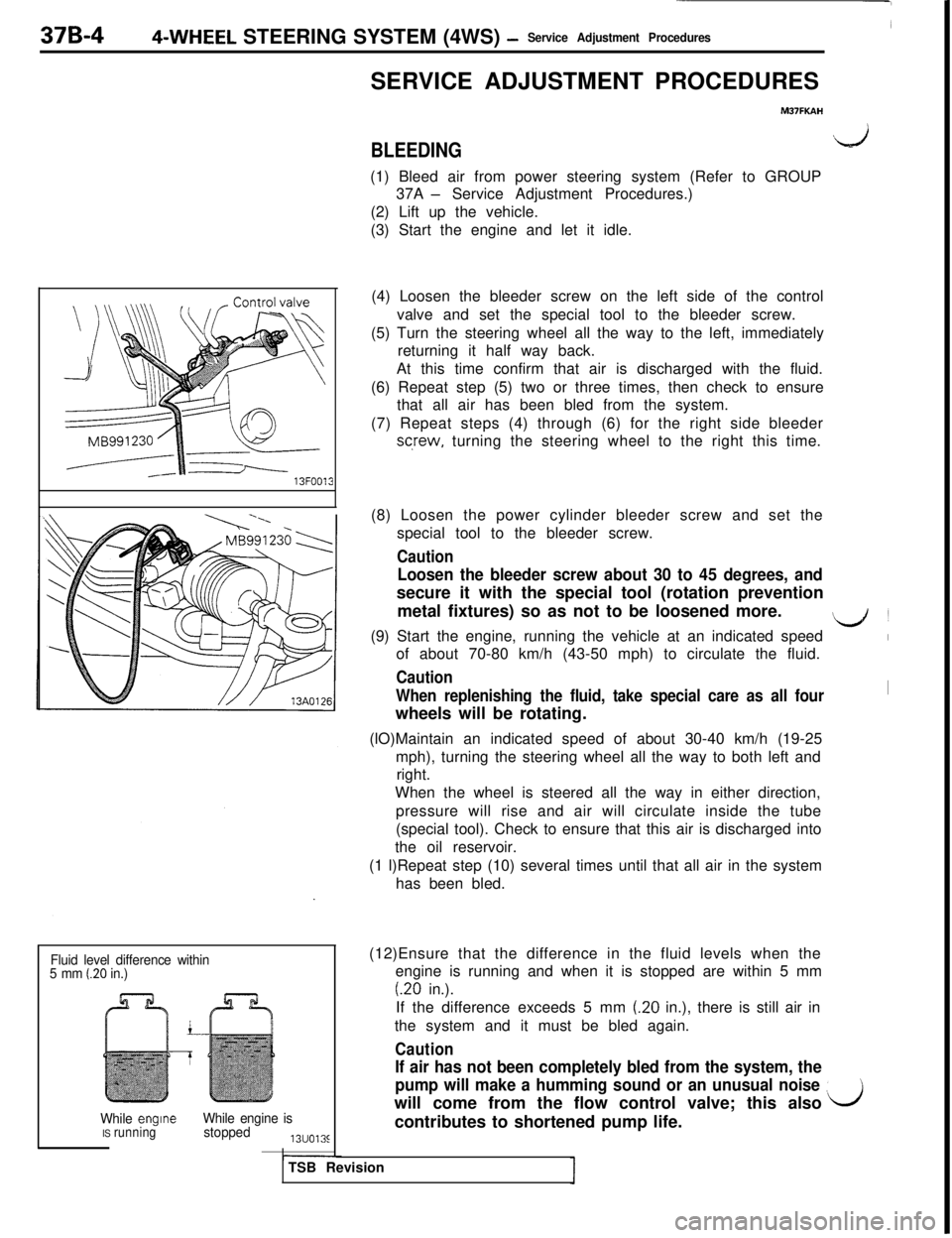
37B44-WHEEL STEERING SYSTEM (4WS) -Service Adjustment ProceduresSERVICE ADJUSTMENT PROCEDURES
M37FKAH
BLEEDING,LJ(1) Bleed air from power steering system (Refer to GROUP
37A
- Service Adjustment Procedures.)
(2) Lift up the vehicle.
(3) Start the engine and let it idle.
(4) Loosen the bleeder screw on the left side of the control
valve and set the special tool to the bleeder screw.
(5) Turn the steering wheel all the way to the left, immediately
returning it half way back.
At this time confirm that air is discharged with the fluid.
(6) Repeat step (5) two or three times, then check to ensure
that all air has been bled from the system.
(7) Repeat steps (4) through (6) for the right side bleeder
sc,rew, turning the steering wheel to the right this time.
(8) Loosen the power cylinder bleeder screw and set the
special tool to the bleeder screw.
Caution
Loosen the bleeder screw about 30 to 45 degrees, andsecure it with the special tool (rotation prevention
metal fixtures) so as not to be loosened more.
(9) Start the engine, running the vehicle at an indicated speed
I/l1Iof about 70-80 km/h (43-50 mph) to circulate the fluid.
-13FOO13
Caution
When replenishing the fluid, take special care as all fourIwheels will be rotating.
Fluid level difference within
5 mm (.20 in.)
While
engineWhile engine isIS runningstopped13lJO13~(lO)Maintain an indicated speed of about 30-40 km/h (19-25
mph), turning the steering wheel all the way to both left and
right.
When the wheel is steered all the way in either direction,
pressure will rise and air will circulate inside the tube
(special tool). Check to ensure that this air is discharged into
the oil reservoir.
(1 l)Repeat step (10) several times until that all air in the system
has been bled.
(12)Ensure that the difference in the fluid levels when the
engine is running and when it is stopped are within 5 mm(.20 in.).
If the difference exceeds 5 mm
(.20 in.), there is still air in
the system and it must be bled again.
Caution
If air has not been completely bled from the system, the
pump will make a humming sound or an unusual noise ,,
will come from the flow control valve; this also
dcontributes to shortened pump life.
TSB Revision
Page 865 of 1146
4-WHEEL STEERING SYSTEM (4WS) -Service Adjustment Procedures37B-5
Rubber hose
13FOOl
Graduated cylinder13FOOllFUNCTION CHECK
_M37FWAA
(1) Raise the vehicle so that all four wheels may turn freely.
(2) Start the engine, running the vehicle at an indicated speed
of about 80
km/h (50 mph).
(3) Turn the steering wheel all the way to left and right and turn
it swiftly, checking to ensure that the rear wheels steer to
the same directions as the front wheels.
REAR OIL PUMP DISCHARGE FLOW VOLUME
CHECKM37FLBA
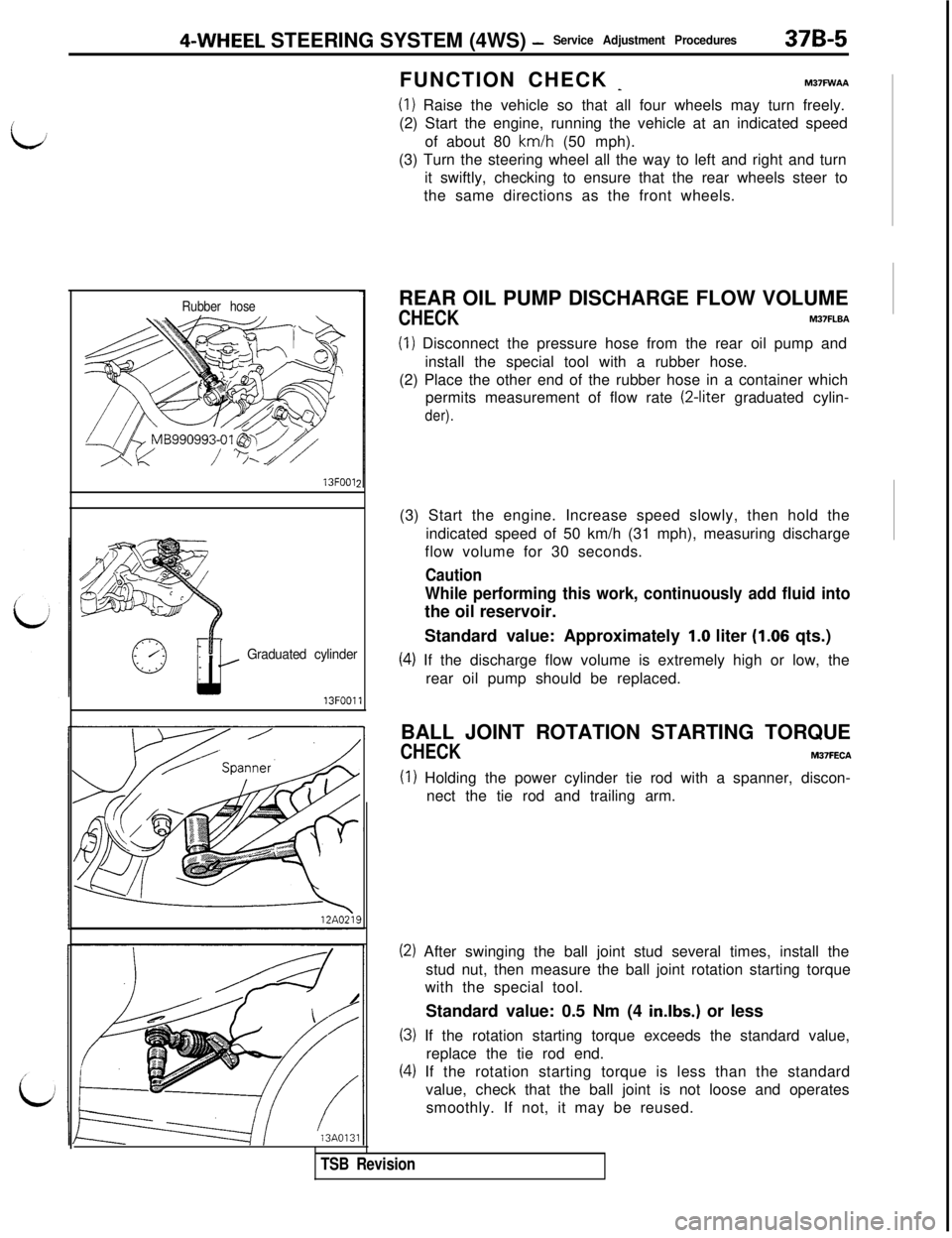
(1) Disconnect the pressure hose from the rear oil pump and
install the special tool with a rubber hose.
(2) Place the other end of the rubber hose in a container which
permits measurement of flow rate (2-liter graduated cylin-
der).(3) Start the engine. Increase speed slowly, then hold the
indicated speed of 50 km/h (31 mph), measuring discharge
flow volume for 30 seconds.
Caution
While performing this work, continuously add fluid intothe oil reservoir.
Standard value: Approximately
1.0 liter (1.06 qts.)
(4) If the discharge flow volume is extremely high or low, the
rear oil pump should be replaced.
BALL JOINT ROTATION STARTING TORQUE
CHECKM37FECA
(1) Holding the power cylinder tie rod with a spanner, discon-
nect the tie rod and trailing arm.
(2) After swinging the ball joint stud several times, install the
stud nut, then measure the ball joint rotation starting torque
with the special tool.
Standard value: 0.5 Nm (4
in.lbs.) or less
(3) If the rotation starting torque exceeds the standard value,
replace the tie rod end.
(4) If the rotation starting torque is less than the standard
value, check that the ball joint is not loose and operates
smoothly. If not, it may be reused.
TSB Revision
Page 873 of 1146
42-1
BODY
CONTENTSM42AA- -
CENTER PILLAR GLASS........................................................32
CENTRAL DOOR LOCKING SYSTEM
................................55
DOOR ASSEMBLY....................................................................40
DOOR GLASS AND REGULATOR
........................................42
DOOR HANDLE AND LATCH
................................................54
DOOR TRIM AND WATERPROOF FILM
............................41
DRIP LINE WEATHERSTRIP....................................................65
ENGINE HOOD........................................................................18
FENDER*....................................................................................23
FUEL TANK FILLER DOOR
....................................................22
LIFTGATE....................................................................................20
LIFTGATE GLASS....................................................................37
LOOSE PANEL
........................................................................24
POWER WINDOW
....................................................................43
QUARTER WINDOW GLASS
................................................33SERVICE ADJUSTMENT PROCEDURES
............................
Door Adjustment................................................................Door inside Handle Play Check............................................Door Window Glass Adjustment........................................Floor Pan inspection............................................................Fuel Filler Door Adjustment................................................Hood Adjustment................................................................Liftgate Adjustment............................................................
SPECIAL TOOLS........................................................................
SPECIFICATIONS....................................................................
General Specifications........................................................Sealants and Adhesives........................................................
ServiceSpecifications........................................................
TROUBLESHOOTING............................................................
WINDOW GLASS....................................................................
WINDSHIELD............................................................................
13
14
16
14
17
14
13
13
4
2
2
3
3
5
25
28
SUPPLEMENTAL RESTRAINT SYSTEM (SRS)
(1)A Supplemental Restraint System (SRS), which uses a driver-side air bag, has been installed in the 3000GT.(2)The SRS includes the following components: impact sensors, SRS diagnosis unit: SRS warning light, air bagmodule, clock spring, interconnecting wiring. Other SRS-related components (that may have to be
removed/installed in connection with SRS service or maintenance) are indicated in the table of contents byan asterisk (*).
WARNING!(1)Improper service or maintenance of any component of the SRS, or any SRS-related component, can lead to
personal injury or death to service personnel (from inadvertent firing of the air bag) or to the driver (from
rendering the SRS inoperative).
(2) Service or maintenance of any SRS component or SRS-related component must be performed only at an
authorized MITSUBISHI dealer.(3) MITSUBISHI dealer personnel must thoroughly review this manual, and especially its GROUP 52B
-Supplemental Restraint System (SRS), before beginning any service or maintenance of any component of the
SRS or any SRS-related component.
Page 891 of 1146
BODY -Engine Hood42-I Y18FOOW
!I
II
INSPECTION
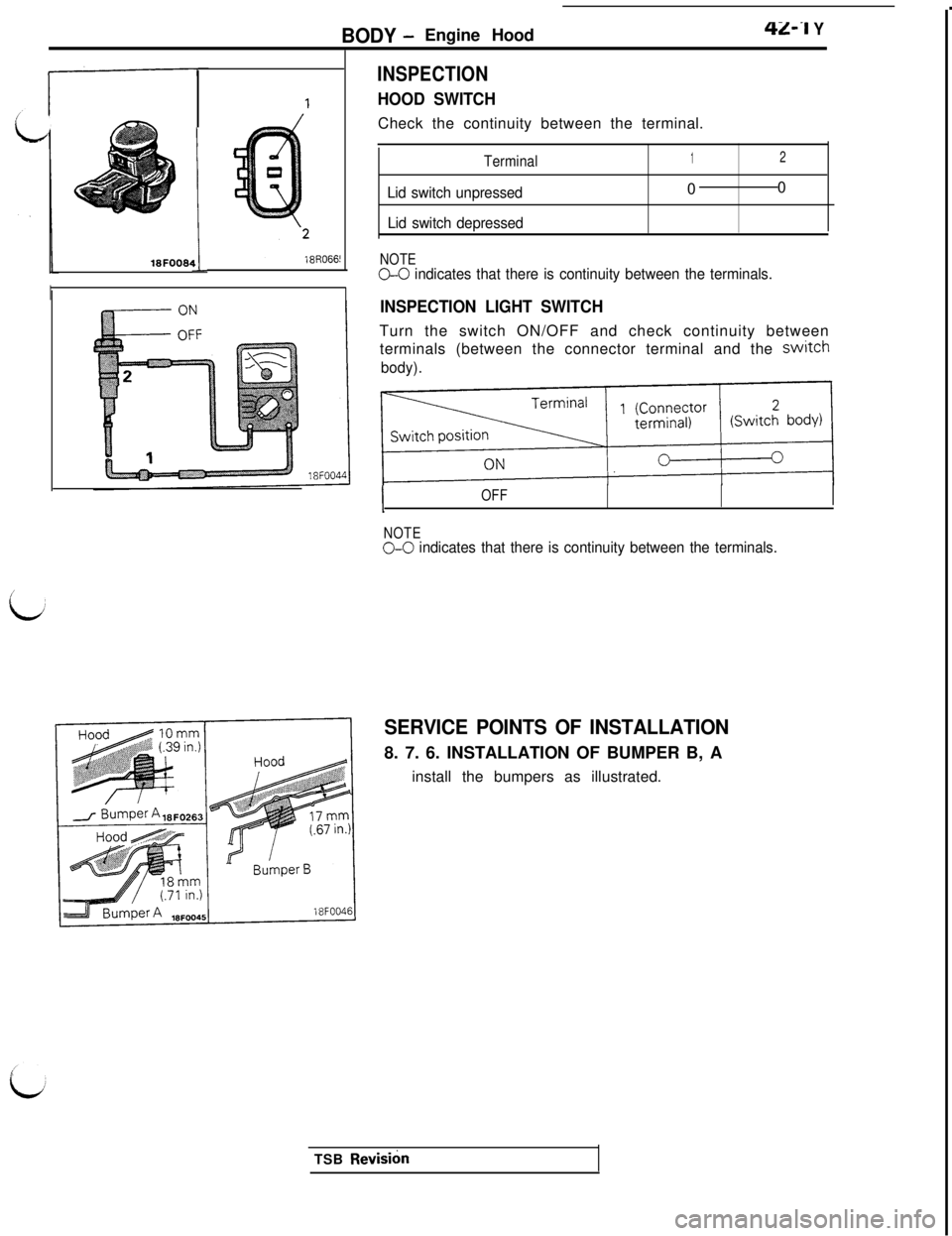
HOOD SWITCHCheck the continuity between the terminal.
Terminal
Lid switch unpressed
Lid switch depressed
1200
NOTEG-0 indicates that there is continuity between the terminals.
INSPECTION LIGHT SWITCHTurn the switch ON/OFF and check continuity between
terminals (between the connector terminal and the
switch
body).
IOFF
NOTE
O-0 indicates that there is continuity between the terminals.
t
SERVICE POINTS OF INSTALLATION8. 7. 6. INSTALLATION OF BUMPER B, A
install the bumpers as illustrated.
TSB
Revish
Page 1027 of 1146
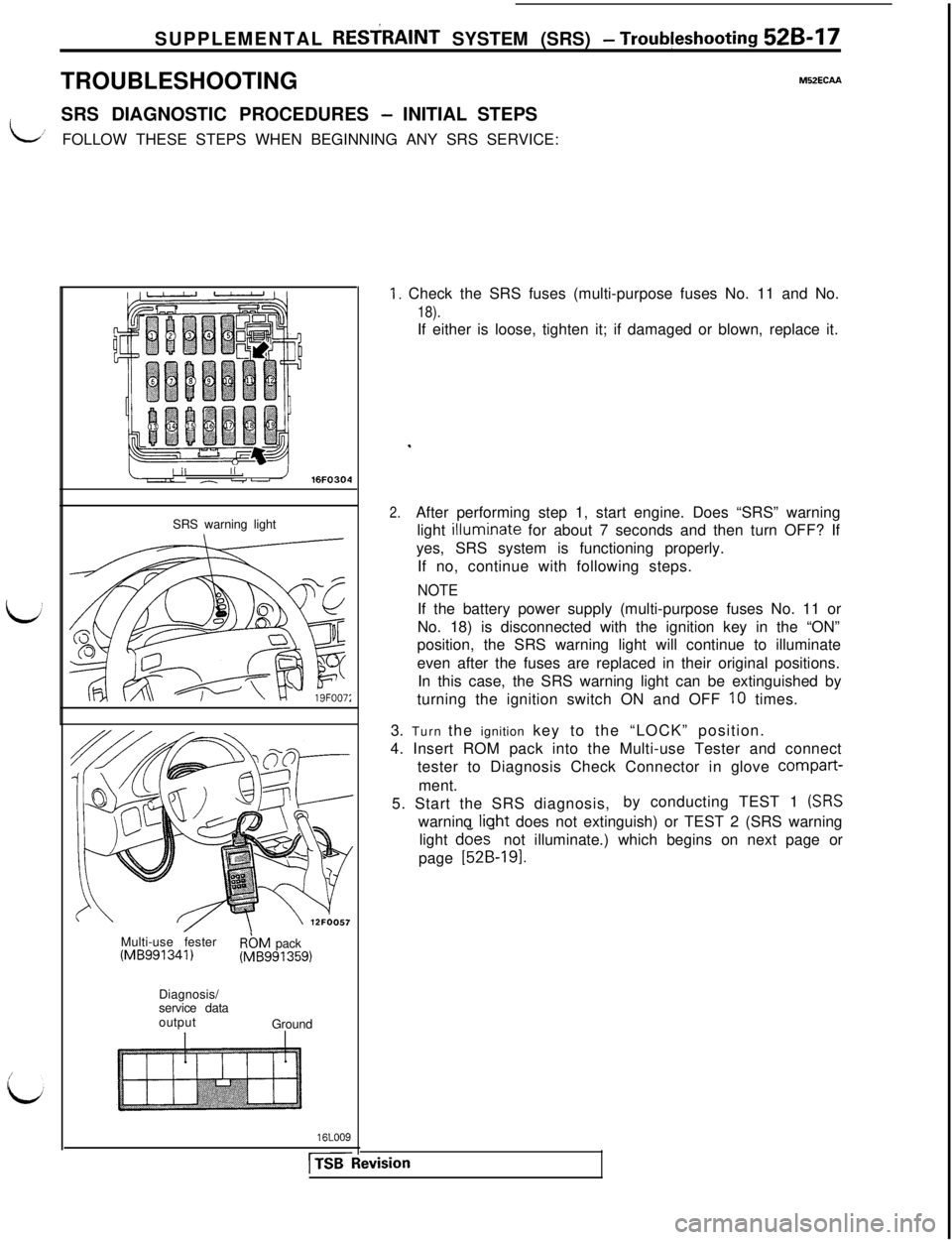
SUPPLEMENTAL RESfRAlNT SYSTEM (SRS) - Troub!eshooting 52B-17TROUBLESHOOTING
M52ECAA
idSRS DIAGNOSTIC PROCEDURES
- INITIAL STEPS’FOLLOW THESE STEPS WHEN BEGINNING ANY SRS SERVICE:
/II/ ,- -u’ 16FO304
SRS warning light
Multi-use fester
(MB991341)RbM pack(MB991359)
Diagnosis/
service data
output
Ground
16LOO9
[TSB
1. Check the SRS fuses (multi-purpose fuses No. 11 and No.
18).If either is loose, tighten it; if damaged or blown, replace it.
.
2.After performing step 1, start engine. Does “SRS” warning
light
illumi.nate for about 7 seconds and then turn OFF? If
yes, SRS system is functioning properly.
If no, continue with following steps.
NOTEIf the battery power supply (multi-purpose fuses No. 11 or
No. 18) is disconnected with the ignition key in the “ON”
position, the SRS warning light will continue to illuminate
even after the fuses are replaced in their original positions.
In this case, the SRS warning light can be extinguished by
turning the ignition switch ON and OFF
10 times.
3. Turn the ignition key to the “LOCK” position.
4. Insert ROM pack into the Multi-use Tester and connect
tester to Diagnosis Check Connector in glove compart-
ment.
5. Start the SRS diagnosis,by conducting TEST 1
(SRSwarninq liqht does not extinguish) or TEST 2 (SRS warning
light does- not illuminate.) which begins on next page or
page
[52B-191.
ivision