check engine MITSUBISHI 3000GT 1991 Service Manual
[x] Cancel search | Manufacturer: MITSUBISHI, Model Year: 1991, Model line: 3000GT, Model: MITSUBISHI 3000GT 1991Pages: 1146, PDF Size: 76.68 MB
Page 364 of 1146
21-6CLUTCH - Service Adjustment Procedures
08YO4Z
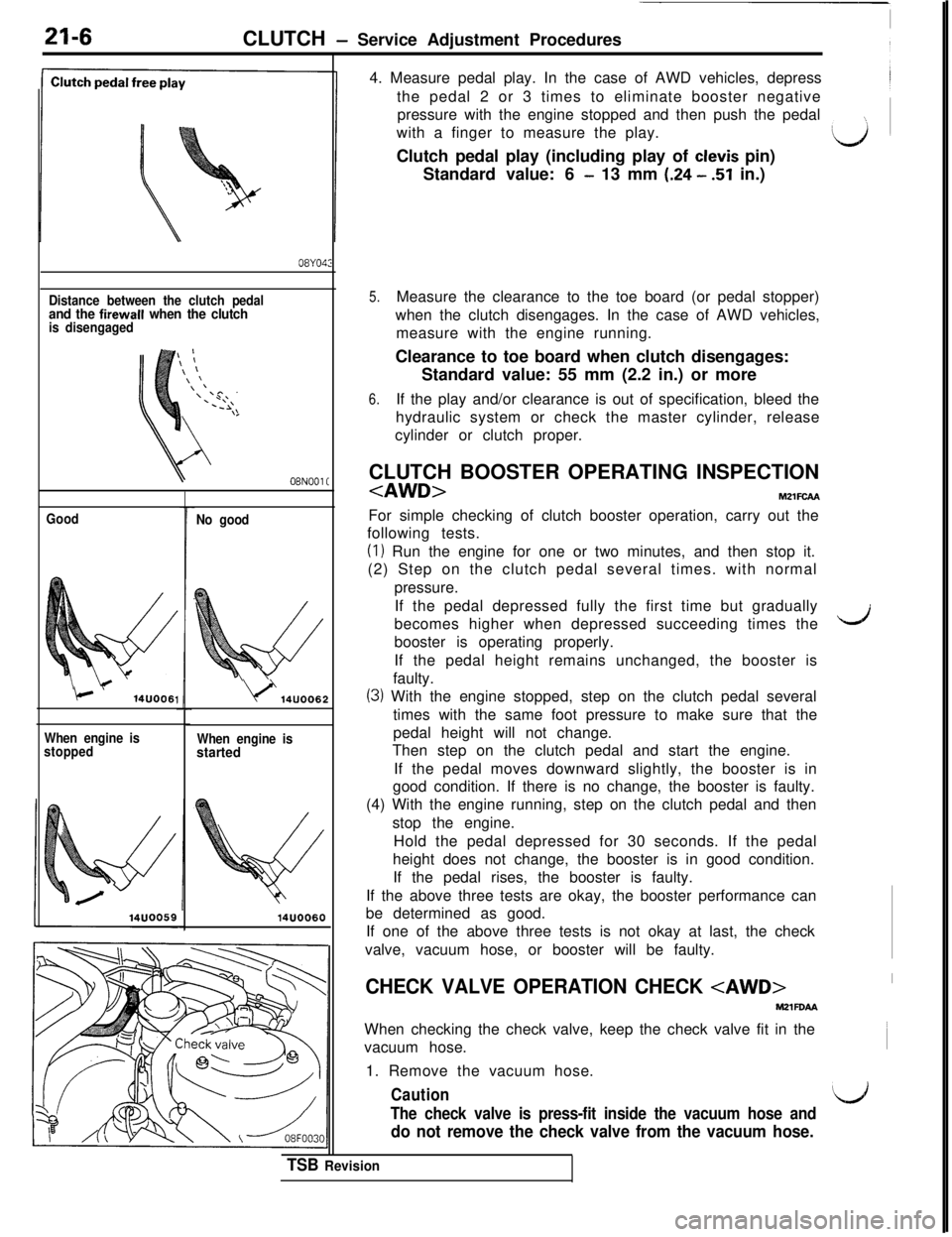
Distance between the clutch pedaland the firewall when the clutchis disengaged
08NOOl C
Good
c1‘14UOO61
When engine is
stoppedNo good
\)‘14UOO6:
When engine isstarted
14UOO604. Measure pedal play. In the case of AWD vehicles, depress~
the pedal 2 or 3 times to eliminate booster negative
pressure with the engine stopped and then push the pedal
with a finger to measure the play.
LJClutch pedal play (including play of clevis pin)
Standard value: 6
- 13 mm (.24 - 51 in.)
2
CHECK VALVE OPERATION CHECK
MZlFOAAWhen checking the check valve, keep the check valve fit in the
vacuum hose.
1. Remove the vacuum hose.
CautionL’The check valve is press-fit inside the vacuum hose and
do not remove the check valve from the vacuum hose.
5.Measure the clearance to the toe board (or pedal stopper)
when the clutch disengages. In the case of AWD vehicles,
measure with the engine running.
Clearance to toe board when clutch disengages:
Standard value: 55 mm (2.2 in.) or more
6.If the play and/or clearance is out of specification, bleed the
hydraulic system or check the master cylinder, release
cylinder or clutch proper.
CLUTCH BOOSTER OPERATING INSPECTION
following tests.
(I) Run the engine for one or two minutes, and then stop it.
(2) Step on the clutch pedal several times. with normal
pressure.
If the pedal depressed fully the first time but gradually
becomes higher when depressed succeeding times the
dbooster is operating properly.
If the pedal height remains unchanged, the booster is
faulty.
(3) With the engine stopped, step on the clutch pedal several
times with the same foot pressure to make sure that the
pedal height will not change.
Then step on the clutch pedal and start the engine.
If the pedal moves downward slightly, the booster is in
good condition. If there is no change, the booster is faulty.
(4) With the engine running, step on the clutch pedal and then
stop the engine.
Hold the pedal depressed for 30 seconds. If the pedal
height does not change, the booster is in good condition.
If the pedal rises, the booster is faulty.
If the above three tests are okay, the booster performance can
be determined as good.
If one of the above three tests is not okay at last, the check
valve, vacuum hose, or booster will be faulty.
TSB Revision
Page 395 of 1146
MANUAL TRANSAXLE
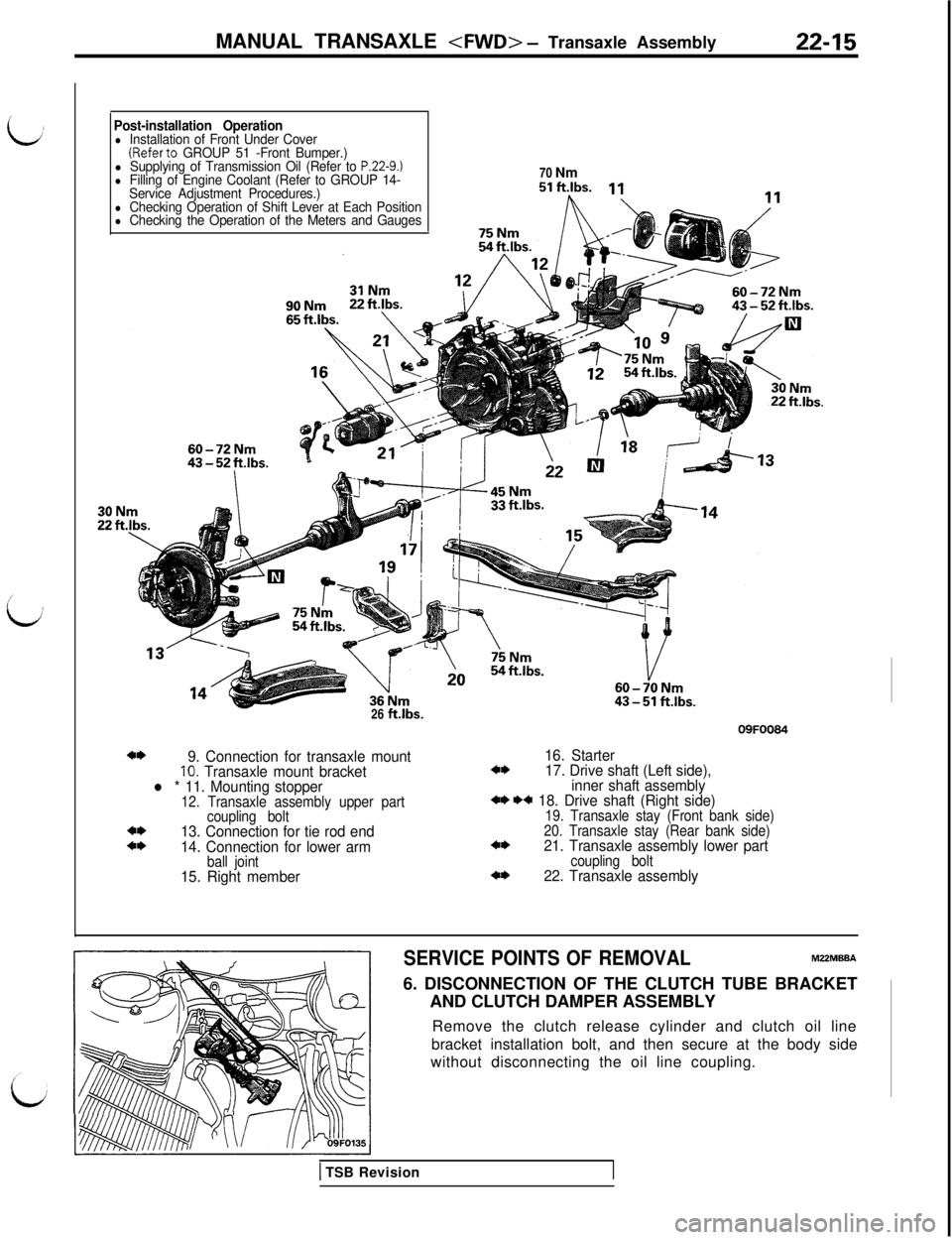
idPost-installation Operationl Installation of Front Under Cover(Referto GROUP 51 -Front Bumper.)l Supplying of Transmission Oil (Refer to P.22-9.)l Filling of Engine Coolant (Refer to GROUP 14-
Service Adjustment Procedures.)70 Nm
l Checking Operation of Shift Lever at Each Positionl Checking the Operation of the Meters and Gauges26
ft.lbs.09FOO84
4*9. Connection for transaxle mount16. Starter10. Transaxle mount bracket4*17. Drive shaft (Left side),
l * 11. Mounting stopperinner shaft assembly12. Transaxle assembly upper part+* ** 18. Drive shaft (Right side)
coupling bolt19. Transaxle stay (Front bank side)4*13. Connection for tie rod end20. Transaxle stay (Rear bank side)4*14. Connection for lower arm4*21. Transaxle assembly lower part
ball jointcoupling bolt15. Right member4*22. Transaxle assembly
SERVICE POINTS OF REMOVALMZZMBBA6. DISCONNECTION OF THE CLUTCH TUBE BRACKET
AND CLUTCH DAMPER ASSEMBLY
Remove the clutch release cylinder and clutch oil line
bracket installation bolt, and then secure at the body side
without disconnecting the oil line coupling.
1 TSB Revision
Page 471 of 1146
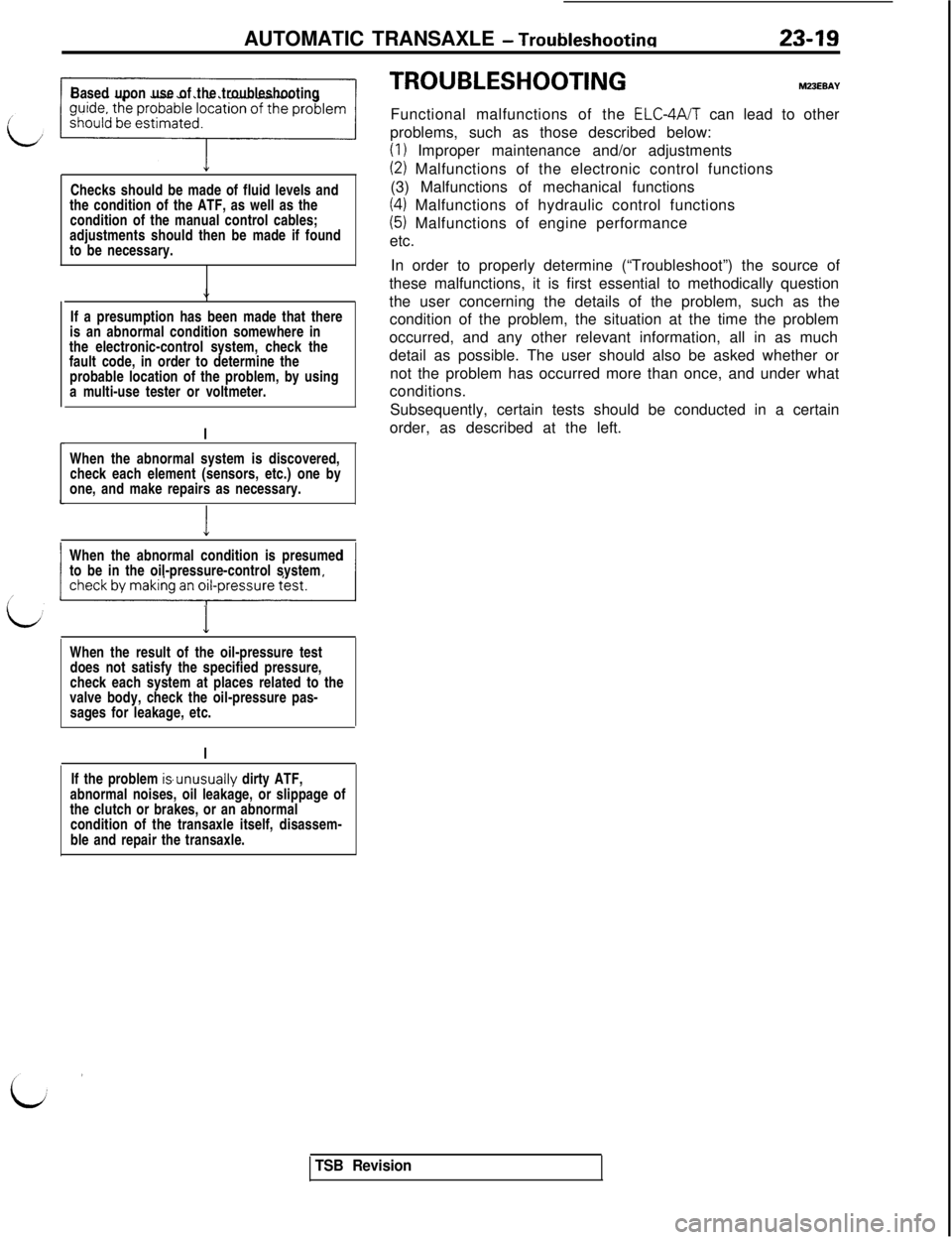
AUTOMATIC TRANSAXLE - Troubleshootincl23-19Based upon use of the troubleshooting
Checks should be made of fluid levels and
the condition of the ATF, as well as the
condition of the manual control cables;
adjustments should then be made if found
to be necessary.
If a presumption has been made that there
is an abnormal condition somewhere in
the electronic-control system, check the
fault code, in order to determine the
probable location of the problem, by using
a multi-use tester or voltmeter.
I
When the abnormal system is discovered,
check each element (sensors, etc.) one by
one, and make repairs as necessary.
IWhen the abnormal condition is presumed
to be in the oil-pressure-control system
When the result of the oil-pressure test
does not satisfy the specified pressure,
check each system at places related to the
valve body, check the oil-pressure pas-
sages for leakage, etc.
I
If the problem isunusually dirty ATF,
abnormal noises, oil leakage, or slippage of
the clutch or brakes, or an abnormal
condition of the transaxle itself, disassem-
ble and repair the transaxle.
TROUBLESHOOTINGM23EEAYFunctional malfunctions of the ELC4A/T can lead to other
problems, such as those described below:(I
) Improper maintenance and/or adjustments
(2) Malfunctions of the electronic control functions
(3) Malfunctions of mechanical functions
(4) Malfunctions of hydraulic control functions
(5) Malfunctions of engine performance
etc.
In order to properly determine (“Troubleshoot”) the source of
these malfunctions, it is first essential to methodically question
the user concerning the details of the problem, such as the
condition of the problem, the situation at the time the problem
occurred, and any other relevant information, all in as much
detail as possible. The user should also be asked whether or
not the problem has occurred more than once, and under what
conditions.
Subsequently, certain tests should be conducted in a certain
order, as described at the left.
TSB Revision
Page 480 of 1146
23-28AUTOMATIC TRANSAXLE - Troubleshooting
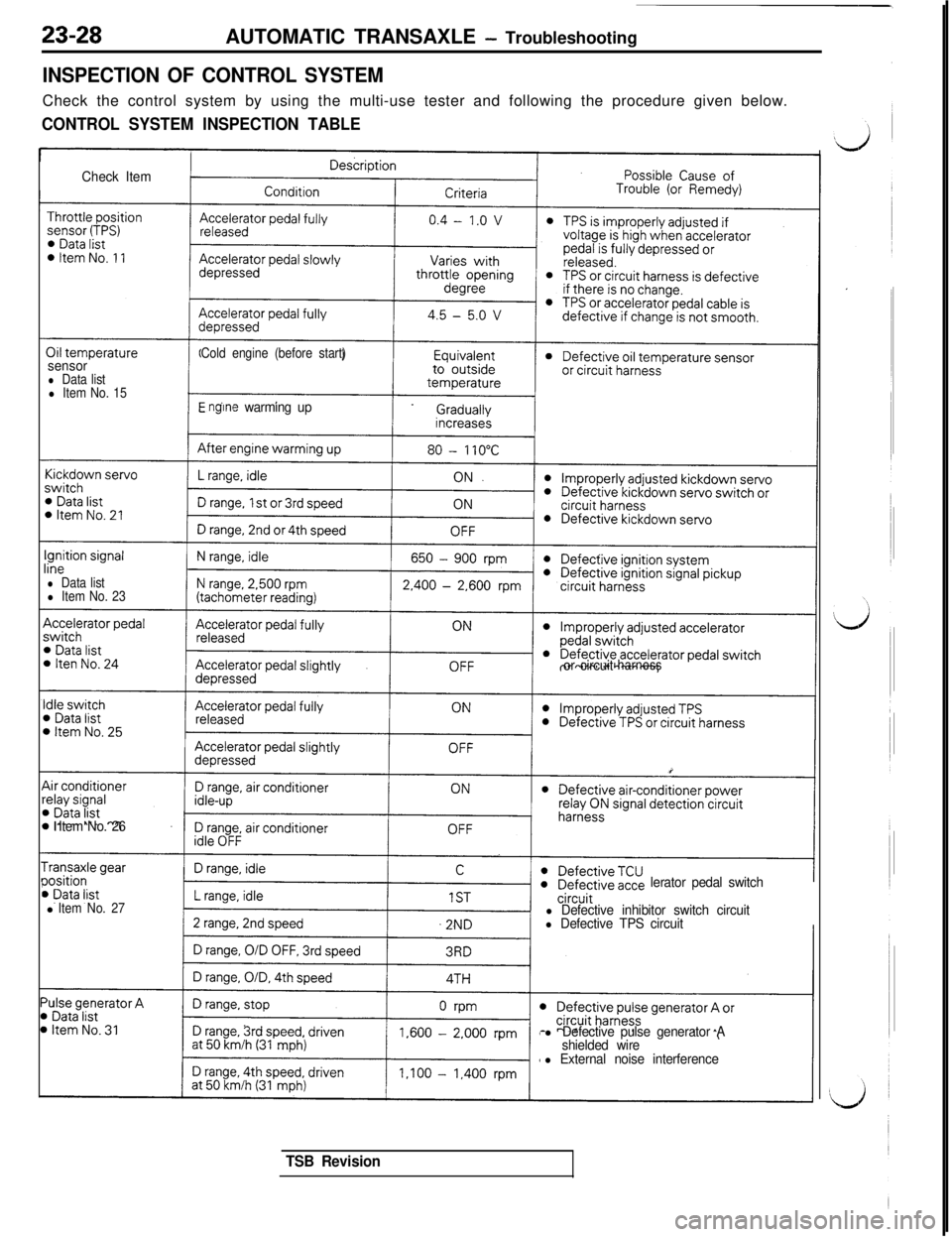
INSPECTION OF CONTROL SYSTEMCheck the control system by using the multi-use tester and following the procedure given below.
CONTROL SYSTEM INSPECTION TABLE
Check Item
sensor
l Data listl Item No. 15Cold engine (before start)nglne warming up
l Data listl Item No. 23
or circuitharness
Item No. 26
lerator pedal switchl
Item No. 27l Defective inhibitor switch circuitl Defective TPS circuitl
Defective pulse generator A
shielded wire
l External noise interference
TSB Revision
Page 484 of 1146
23-32AUTOMATIC TRANSAXLE - Troubleshooting
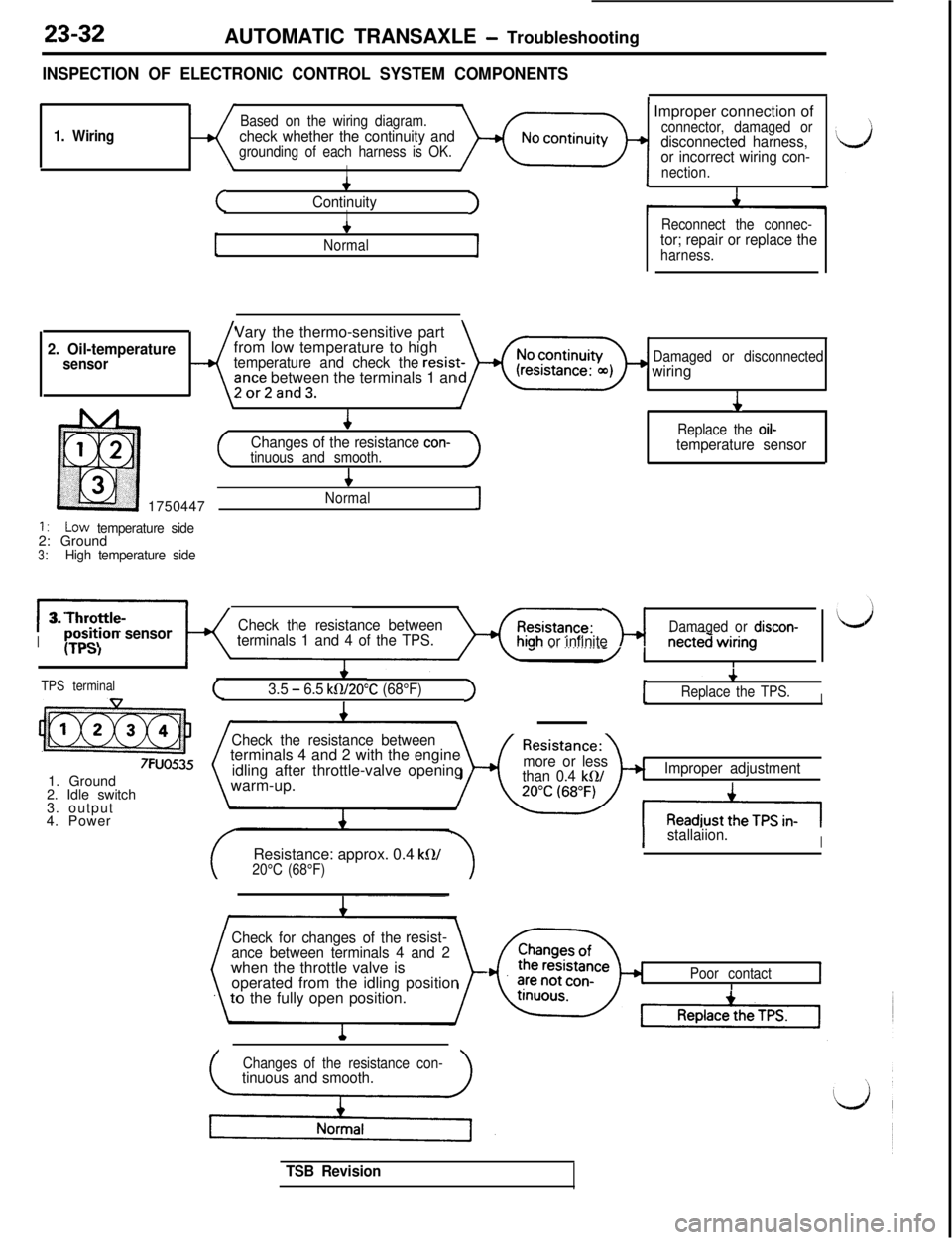
INSPECTION OF ELECTRONIC CONTROL SYSTEM COMPONENTS
1. WiringBased on the wiring diagram.check whether the continuity andgrounding of each harness is OK.
I
(
4
ContinuityII
+
Normal~ Improper connection of
connector, damaged ordisconnected harness,
or incorrect wiring con-
nection.
I
Reconnect the connec-tor; repair or replace theharness.Vary the thermo-sensitive part
2. Oil-temperaturefrom low temperature to highsensortemperature and check theresist-Damaged or disconnected
ante between the terminals 1 anwiring2or2and3.
4
J
Changes of the resistance con-Replace the oil-
tinuous and smooth.temperature sensor
41750447
Normal1
1:LOW temperature side2: Ground
3:High temperature side
I:3. Throttle-
K
Check the resistance between
Ip~~~t,ion sensorterminals 1 and 4 of the TPS.hiah or infinitem- -----inecteciI-
\ IDamaged or discon-..----Awiring
I
c3.5 - 6.5 kW20”C (68°F)t
v
Replace the TPS.I>ITPS terminal
7FUO5351. Ground
2. Idle switch
3. output
4. Power
Check the resistance betweenterminals 4 and 2 with the engine
idling after throttle-valve opening
warm-up.
Resistance: approx. 0.4
kR/20°C (68°F)
Changes of the resistance con-
tinuous and smooth.
/Resistance:\more or less
than 0.4 kQ/Improper adjustment
Istallaiion.I
Check for changes of theresist-ance between terminals 4 and 2when the throttle valve is
operated from the idling position
o the fully open position.
Poor contactII
TSB Revision
Page 485 of 1146
AUTOMATIC TRANSAXLE - Troubleshooting23-33
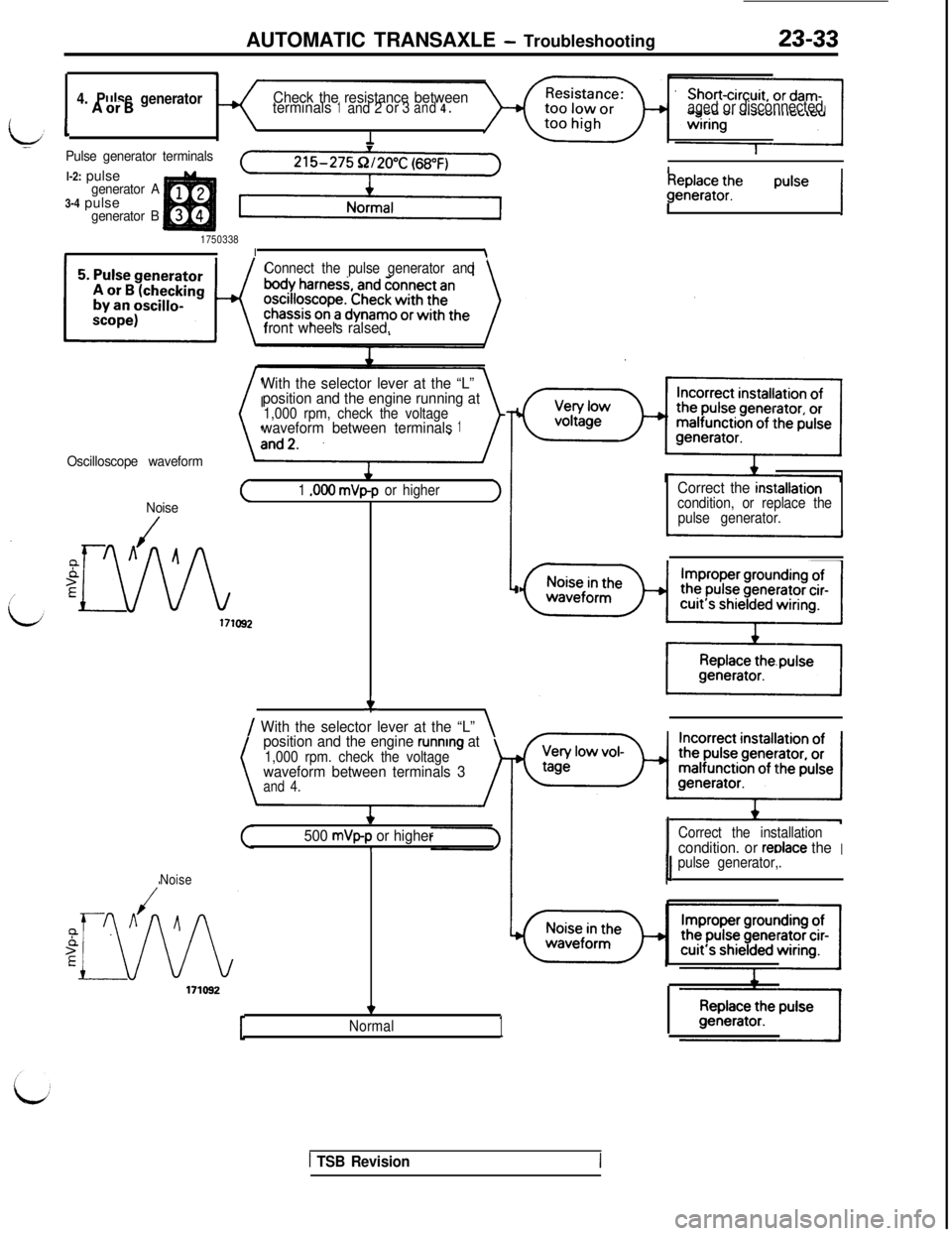
4. Pulse generatorCheck the resistance betweenAorBterminals1and 2or3and4.agedordisconnected
iv1-Pulse generator terminalsl-2: pulse
generator A3-4 pulse
generator B
17503381I\Connect the pulse generator and
front wheels raised.
Oscilloscope waveform
With the selector lever at the “L”
position and the engine running at
1,000 rpm, check the voltagewaveform between terminals1(
1 .OOO mVp-p or higher
Noise>
iJh
171092
f\/ With the selector lever at the “L”\
position and the engine running at1,000 rpm. check the voltagewaveform between terminals 3and 4.
I
1fWWF;tf: pulse /
Correct the inst.allationcondition, or replace the
pulse generator.
L-
*
500 mVp-p or higherI
Noise
ICorrect the installationcondition. or redace theI1 pulse generator,.1
171092
*
Normal1
1 TSB Revision
Page 490 of 1146
23-38AUTOMATIC TRANSAXLE - Troubleshooting
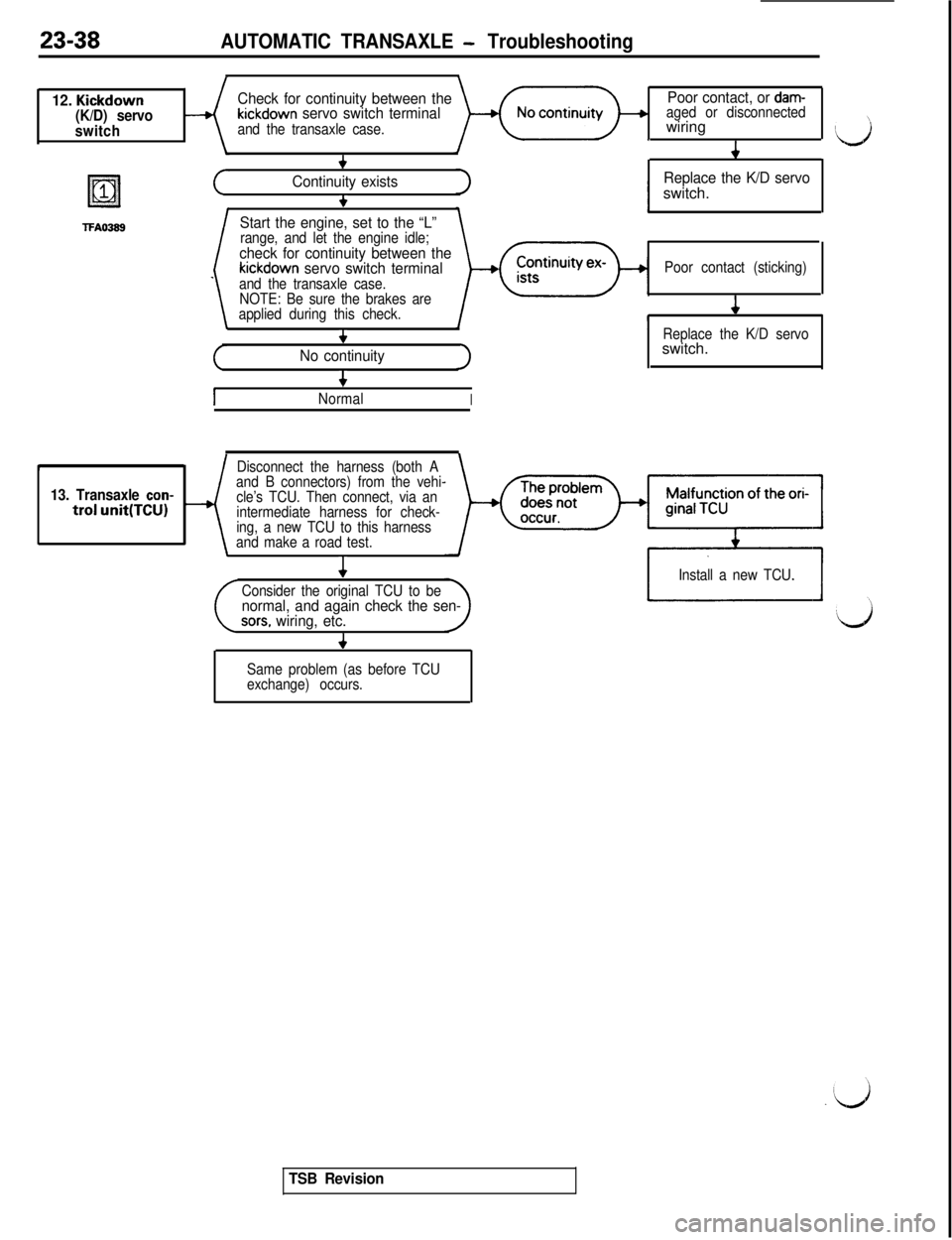
12. Kickdown
(K/D) servo
switch
19=111
TFAO389
Check for continuity between thePoor contact, or dam-
kickdown servo switch terminalaged or disconnected
and the transaxle case.wiring
+c
Continuity existsReplace the K/D servo
+switch.
Start the engine, set to the “L”range, and let the engine idle;check for continuity between thekickdown servo switch terminalPoor contact (sticking)
and the transaxle case.
NOTE: Be sure the brakes are
applied during this check.4
+Replace the K/D servo
No continuityswitch.
+I
NormalIr
Disconnect the harness (both A
13. Transaxle con-and B connectors) from the vehi-
trol unit(TCU)cle’s TCU. Then connect, via an
intermediate harness for check-
ing, a new TCU to this harness
and make a road test.4
Install a new TCU.
Consider the original TCU to be
normal, and again check the sen-sors. wiring, etc.
4
Same problem (as before TCU
exchange) occurs.
TSB Revision
Page 491 of 1146
AUTOMATIC TRANSAXLE - Troubleshooting23-39
//!’ 6Rear@FrontclutchpressureI
@Kickdown brakeoressure (Release)
e
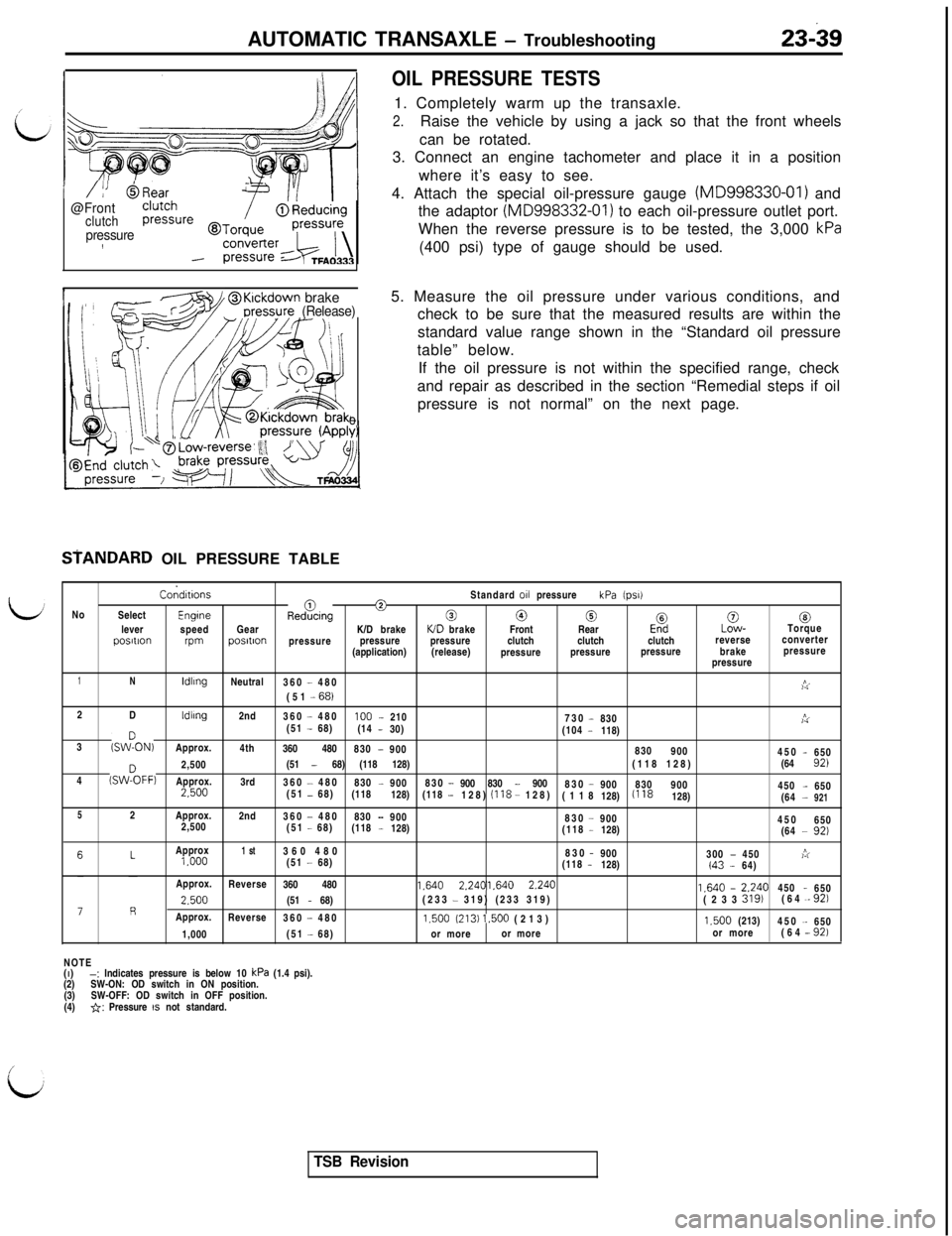
OIL PRESSURE TESTS1. Completely warm up the transaxle.
2.Raise the vehicle by using a jack so that the front wheels
can be rotated.
3. Connect an engine tachometer and place it in a position
where it’s easy to see.
4. Attach the special oil-pressure gauge (MD998330-01) and
the adaptor (MD998332-01) to each oil-pressure outlet port.
When the reverse pressure is to be tested, the 3,000
kPa(400 psi) type of gauge should be used.
5. Measure the oil pressure under various conditions, and
check to be sure that the measured results are within the
standard value range shown in the “Standard oil pressure
table” below.
If the oil pressure is not within the specified range, check
and repair as described in the section “Remedial steps if oil
pressure is not normal” on the next page.
STANDARD OIL PRESSURE TABLECondtttonsStandard
011 pressurekPa (PSI)No
SelectEngme
Red&g@000E%00leverspeedGearK/D brakeWD brakeFrontRearLow-TorqueposItlollvposltlon
pressurepressurepressureclutchclutchclutchreverseconverter
(application)(release)
pressurepressurepressurebrakepressure
pressure
1Nldlmg
Neutral
360 - 4808,(51 - 6812
Dldlmg
2nd
360
- 480100-210
730 -830k(51 - 68)
(14-30)
(104 -118)
3(SWFON,
Approx.
4th
360 480
830
-900
830
900
450-650
2,500(51 - 68) (118 128)(118 128)(64 92)
(SWZFF)Approx.
3rd
360 - 480
830
900830 -900 830 - 900
830 -900830
900
450-4
650-2.500(51 - 68)
(118
128)(118 -128) (118 - 128)
(118
128)(118128)
(64-921
52
Approx.
2nd
360
- 480
830--900
830 -900
450
650
2,500
(51 - 68)
(118-128)
(118 -128)
(64-921
Approx
1 st360 480
830 -900
300-450A1.000(51 - 68)
(118 -128)I43 .-64)
Approx.
Reverse
360 480
1.6402.2401.640 2.2401.640 -2.240450-6502.500(51 - 68)(233 - 319) (233 319)(233 319)(64 ~- 921
Approx.
Reverse
360
- 4801.500(213) 1.500 (213)1.500(213)
450~-650
1,000(51 - 68)or moreor moreor more(64 - 92)NOTE
(I)
-: Indicates pressure is below 10 kPa (1.4 psi).
(2)SW-ON: OD switch in ON position.
(3)SW-OFF: OD switch in OFF position.
(4)
a: Pressure IS not standard.
TSB Revision
Page 495 of 1146
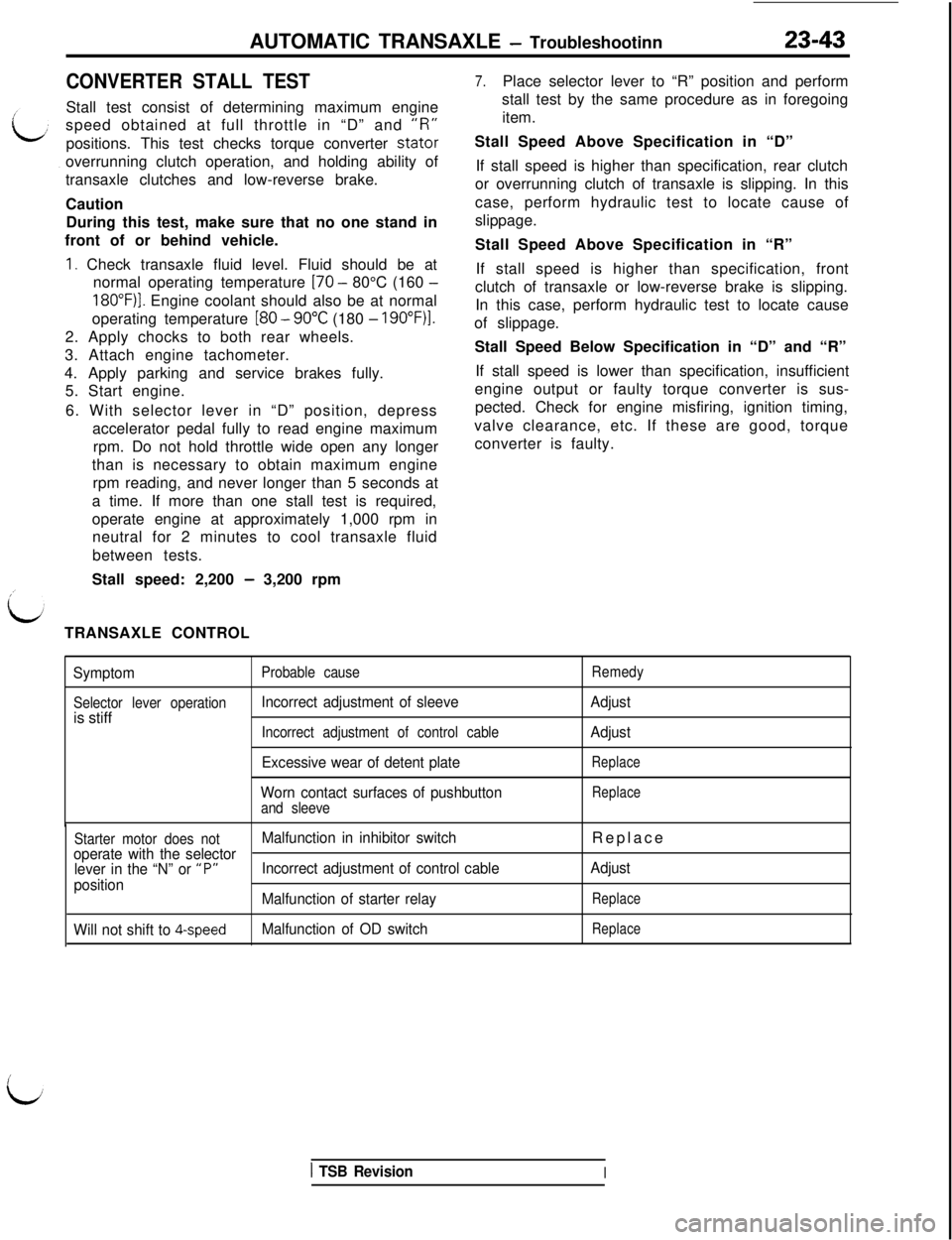
AUTOMATIC TRANSAXLE - Troubleshootinn23-43
CONVERTER STALL TESTStall test consist of determining maximum engine
speed obtained at full throttle in “D” and
“I?”positions. This test checks torque converter
statoroverrunning clutch operation, and holding ability of
transaxle clutches and low-reverse brake.
Caution
During this test, make sure that no one stand in
front of or behind vehicle.
1. Check transaxle fluid level. Fluid should be at
normal operating temperature
[70 - 80°C (160 -
18O”F)I. Engine coolant should also be at normal
operating temperature
[80 - 90°C (180 - 19O”F)l.2. Apply chocks to both rear wheels.
3. Attach engine tachometer.
4. Apply parking and service brakes fully.
5. Start engine.
6. With selector lever in “D” position, depress
accelerator pedal fully to read engine maximum
rpm. Do not hold throttle wide open any longer
than is necessary to obtain maximum engine
rpm reading, and never longer than 5 seconds at
a time. If more than one stall test is required,
operate engine at approximately 1,000 rpm in
neutral for 2 minutes to cool transaxle fluid
between tests.
Stall speed: 2,200
- 3,200 rpm
7.Place selector lever to “R” position and perform
stall test by the same procedure as in foregoing
item.
Stall Speed Above Specification in “D”
If stall speed is higher than specification, rear clutch
or overrunning clutch of transaxle is slipping. In this
case, perform hydraulic test to locate cause of
slippage.
Stall Speed Above Specification in “R”
If stall speed is higher than specification, front
clutch of transaxle or low-reverse brake is slipping.
In this case, perform hydraulic test to locate cause
of slippage.
Stall Speed Below Specification in “D” and “R”
If stall speed is lower than specification, insufficient
engine output or faulty torque converter is sus-
pected. Check for engine misfiring, ignition timing,
valve clearance, etc. If these are good, torque
converter is faulty.
TRANSAXLE CONTROL
Symptom
Selector lever operationis stiff
Probable cause
Incorrect adjustment of sleeve
Remedy
Adjust
Incorrect adjustment of control cable
Excessive wear of detent plate
Worn contact surfaces of pushbutton
and sleeve
Adjust
Replace
Replace
Starter motor does notMalfunction in inhibitor switchReplace
operate with the selector
lever in the “N” or “P”Incorrect adjustment of control cableAdjust
position
Will not shift to
4-speed
Malfunction of starter relay
Malfunction of OD switchReplace
Replace
1 TSB RevisionI
Page 502 of 1146
23-50AUTOMATIC TRANSAXLE - service AdiustmentProcedures
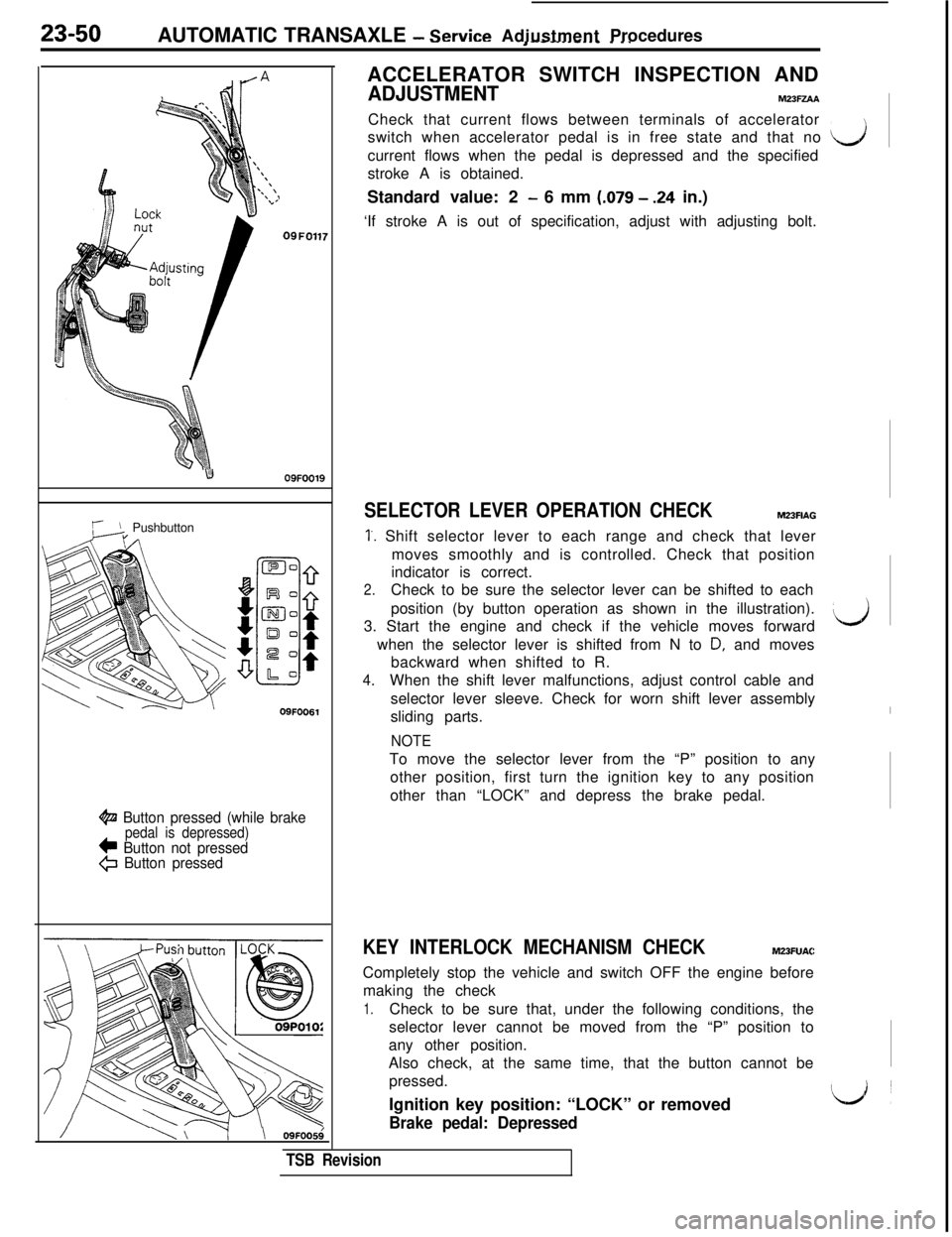
09FO117
m09FOO19
L Pushbuttonv09FOO61
@ Button pressed (while brakepedal is depressed)c Button not pressed@ Button pressed
/\ \\ OSFODdACCELERATOR SWITCH INSPECTION AND
ADJUSTMENTM23FZAACheck that current flows between terminals of accelerator
switch when accelerator pedal is in free state and that no
dcurrent flows when the pedal is depressed and the specified
stroke A is obtained.
Standard value: 2
- 6 mm (.079 - .24 in.)
‘If stroke A is out of specification, adjust with adjusting bolt.
SELECTOR LEVER OPERATION CHECKM23FIAG
1.. Shift selector lever to each range and check that lever
moves smoothly and is controlled. Check that position
indicator is correct.
2.Check to be sure the selector lever can be shifted to each
position (by button operation as shown in the illustration).
3. Start the engine and check if the vehicle moves forward
dwhen the selector lever is shifted from N to
D, and moves
backward when shifted to R.
4.When the shift lever malfunctions, adjust control cable and
selector lever sleeve. Check for worn shift lever assembly
sliding parts.
I
NOTETo move the selector lever from the “P” position to any
other position, first turn the ignition key to any position
other than “LOCK” and depress the brake pedal.
KEY INTERLOCK MECHANISM CHECKM23FlJACCompletely stop the vehicle and switch OFF the engine before
making the check
1.Check to be sure that, under the following conditions, the
selector lever cannot be moved from the “P” position to
any other position.
Also check, at the same time, that the button cannot be
pressed.
Ignition key position: “LOCK” or removed
Brake pedal: Depressed
TSB Revision