check engine MITSUBISHI 3000GT 1991 Service Manual
[x] Cancel search | Manufacturer: MITSUBISHI, Model Year: 1991, Model line: 3000GT, Model: MITSUBISHI 3000GT 1991Pages: 1146, PDF Size: 76.68 MB
Page 300 of 1146
14-6COOLING - Troubleshooting.TROUBLESHOOTING HINTS
1. Neither the radiator fan nor condenser fan
rotate at all.
l Check fusible link No. 5.
2. Only the condenser fan does not operate.
l Check dedicated fuse No. 8.
3. The radiator fan and condenser fan do not
operate in the low speed mode, but operate
otherwise.
(1) The A/C compressor magnet clutch does not
enter the “ON” state.
l Check whether the output of the auto
compressor control unit is available.
NOTEFor troubleshooting of the air conditioner
control unit, refer to GROUP 55.
(2) The A/C compressor magnet clutch enters
the “ON” state.
l Check the resistor.
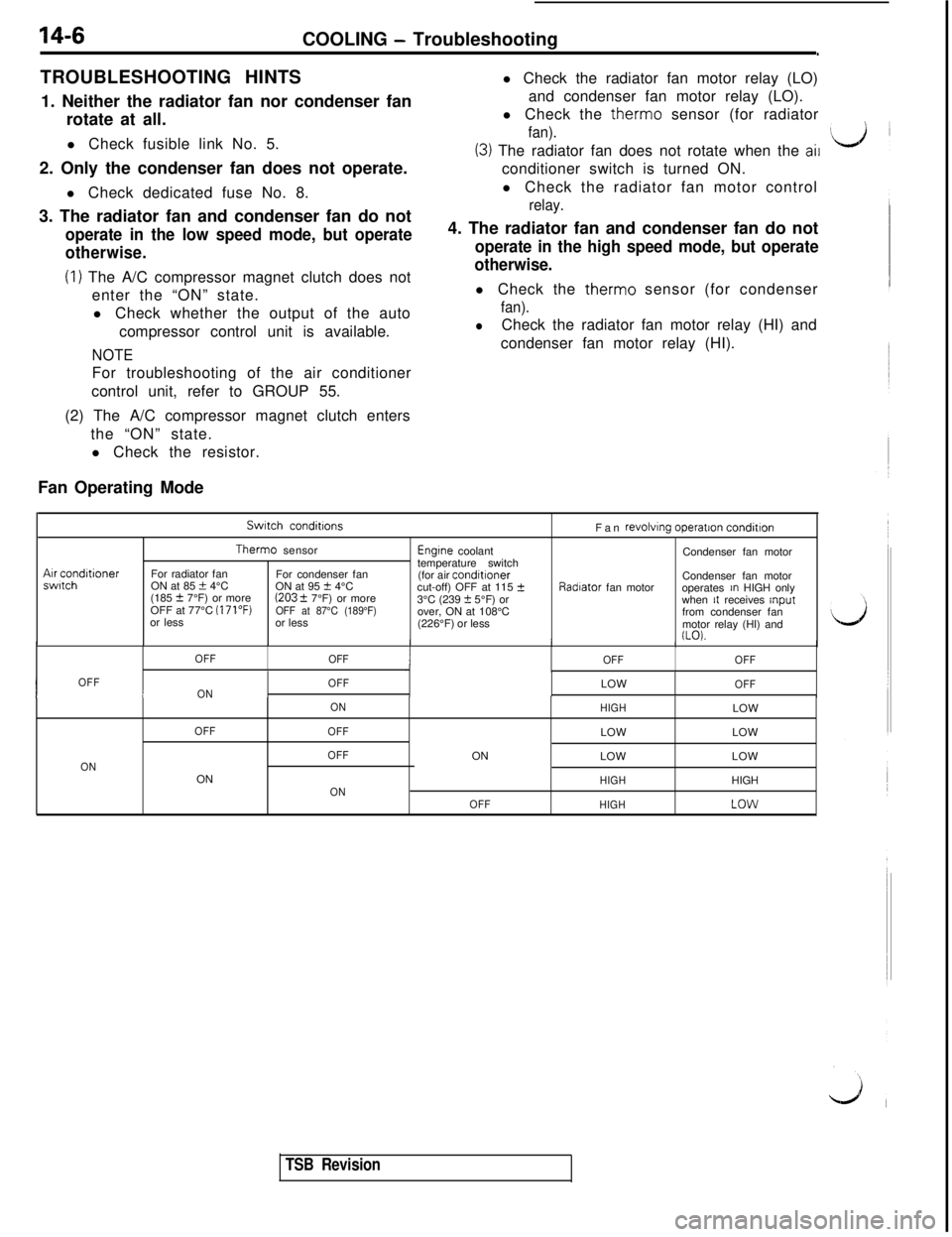
Fan Operating Model Check the radiator fan motor relay (LO)
and condenser fan motor relay (LO).
l Check the therm0 sensor (for radiator
fan).
(3) The radiator fan does not rotate when the ailconditioner switch is turned ON.
l Check the radiator fan motor control
relay.4. The radiator fan and condenser fan do not
operate in the high speed mode, but operate
otherwise.l Check the therm0 sensor (for condenser
fan).
lCheck the radiator fan motor relay (HI) and
condenser fan motor relay (HI).Air
conditionerswitch
Switch conditionsTherm0 sensor
For radiator fan
For condenser fan
ON at 85
k 4°C
ON at 95 t 4°C
(185 f 7°F) or more(203 + 7°F) or more
OFF at 77°C (171°F)
OFF at 87°C (189°F)or less
or lessEngine coolant
temperature switch
(for air conditioner
cut-off) OFF at 115
+3°C (239 2 5°F) or
over, ON at 108°C
(226°F) or lessFan revolving operation
conditionCondenser fan motor
Condenser fan motorRadiator fan motor
operates
In HIGH only
when it receives input
from condenser fan
motor relay (HI) and
U-0).I/I/
OFF
OFF
OFFOFF
IOFFIOFF
ONLOWOFF
ON
HIGHLOW
OFF
OFFLOWLOW
OFF
ONON
LOWLOW
ON
HIGH
ONHIGH
OFF
HIGHLOW
TSB Revision
Page 301 of 1146
COOLING - Service Adiustment Procedures.14-7
SERVICE ADJUSTMENT PROCEDURES
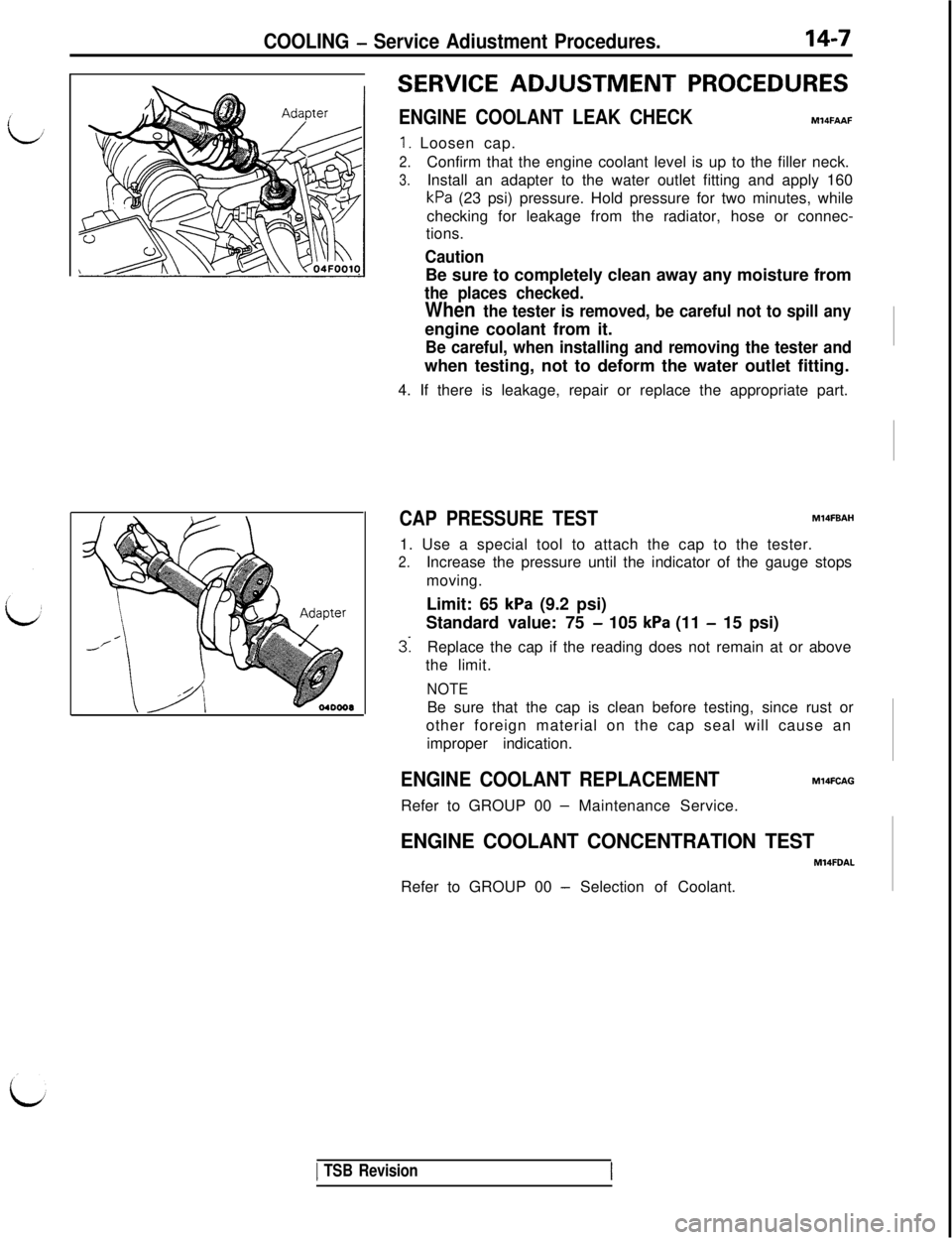
ENGINE COOLANT LEAK CHECKMl4FAAF
1. Loosen cap.
2.Confirm that the engine coolant level is up to the filler neck.
3.Install an adapter to the water outlet fitting and apply 160
kPa (23 psi) pressure. Hold pressure for two minutes, while
checking for leakage from the radiator, hose or connec-
tions.
CautionBe sure to completely clean away any moisture from
the places checked.
When the tester is removed, be careful not to spill anyengine coolant from it.
Be careful, when installing and removing the tester andwhen testing, not to deform the water outlet fitting.
4. If there is leakage, repair or replace the appropriate part.
CAP PRESSURE TESTM14FBAH1. Use a special tool to attach the cap to the tester.
2.Increase the pressure until the indicator of the gauge stops
moving.
Limit: 65
kPa (9.2 psi)
Standard value: 75
- 105 kPa (11 - 15 psi)
3:Replace the cap if the reading does not remain at or above
the limit.
NOTEBe sure that the cap is clean before testing, since rust or
other foreign material on the cap seal will cause an
improper indication.
ENGINE COOLANT REPLACEMENTM14FCAGRefer to GROUP 00
- Maintenance Service.
ENGINE COOLANT CONCENTRATION TEST
M14FDALRefer to GROUP 00
- Selection of Coolant.
1 TSB Revision
Page 304 of 1146
14-10COOLING - Radiator
r-----I
113
EY
4 :
2 :
i.-.-..i
0312161908
Ionnector04FOOO8
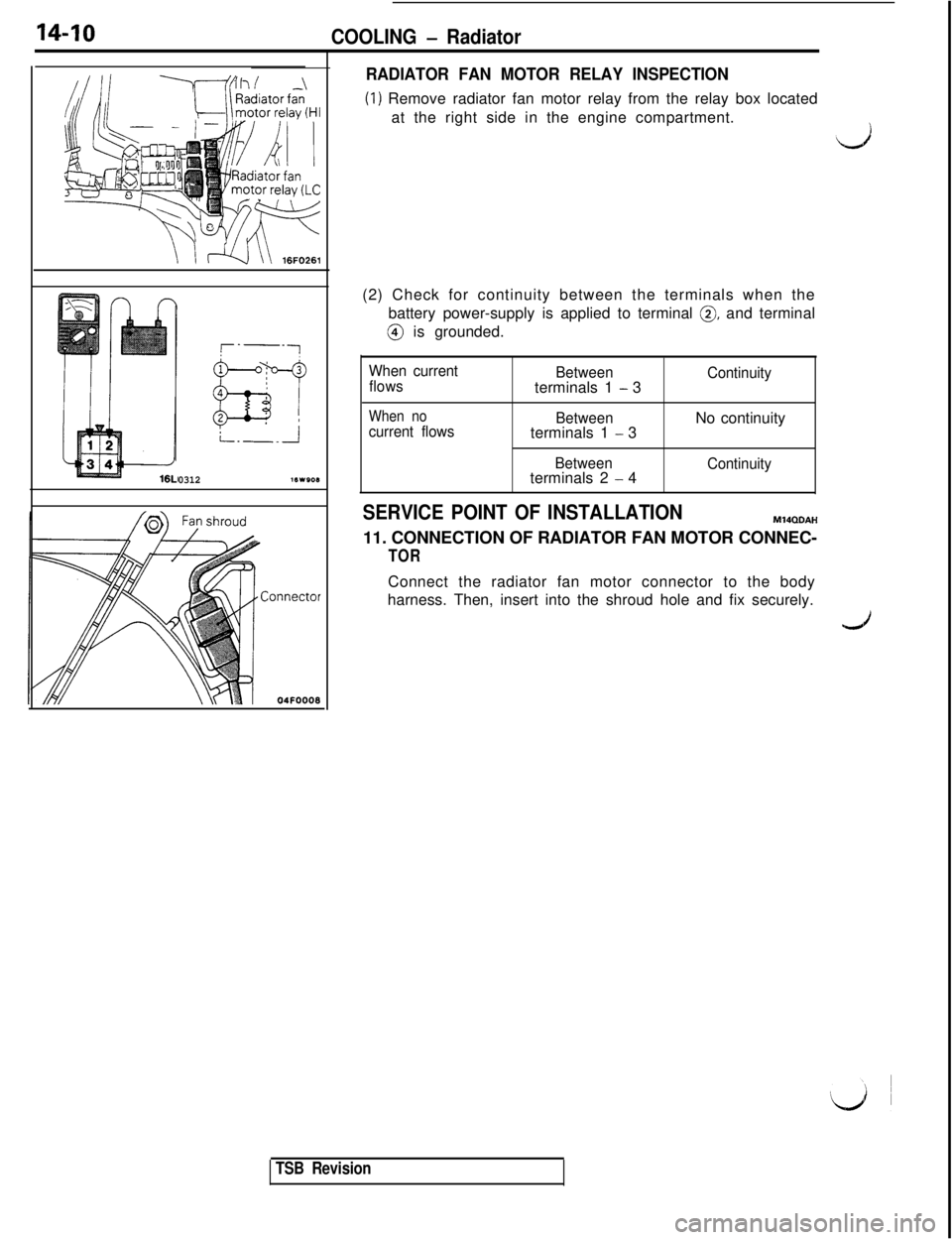
RADIATOR FAN MOTOR RELAY INSPECTION
(1) Remove radiator fan motor relay from the relay box located
at the right side in the engine compartment.
Ll(2) Check for continuity between the terminals when the
battery power-supply is applied to terminal
0, and terminal@ is grounded.
When current
flowsBetweenterminals 1
- 3Continuity
When nocurrent flowsBetweenterminals 1 - 3No continuity
Betweenterminals 2 - 4Continuity
SERVICE POINT OF INSTALLATIONM14QDAH
11. CONNECTION OF RADIATOR FAN MOTOR CONNEC-
TORConnect the radiator fan motor connector to the body
harness. Then, insert into the shroud hole and fix securely.
TSB Revision
Page 310 of 1146
14-16
I
COOLINGEngine Coolant Temperature Gauge Unit, Engine Coolant- Temperature Sensor and Engine Coolant Temperature SwitchI
Air Intake hose B
05FOO2:
ENGINE COOLANT TEMPERATURE SWITCH (Air condition-I
4
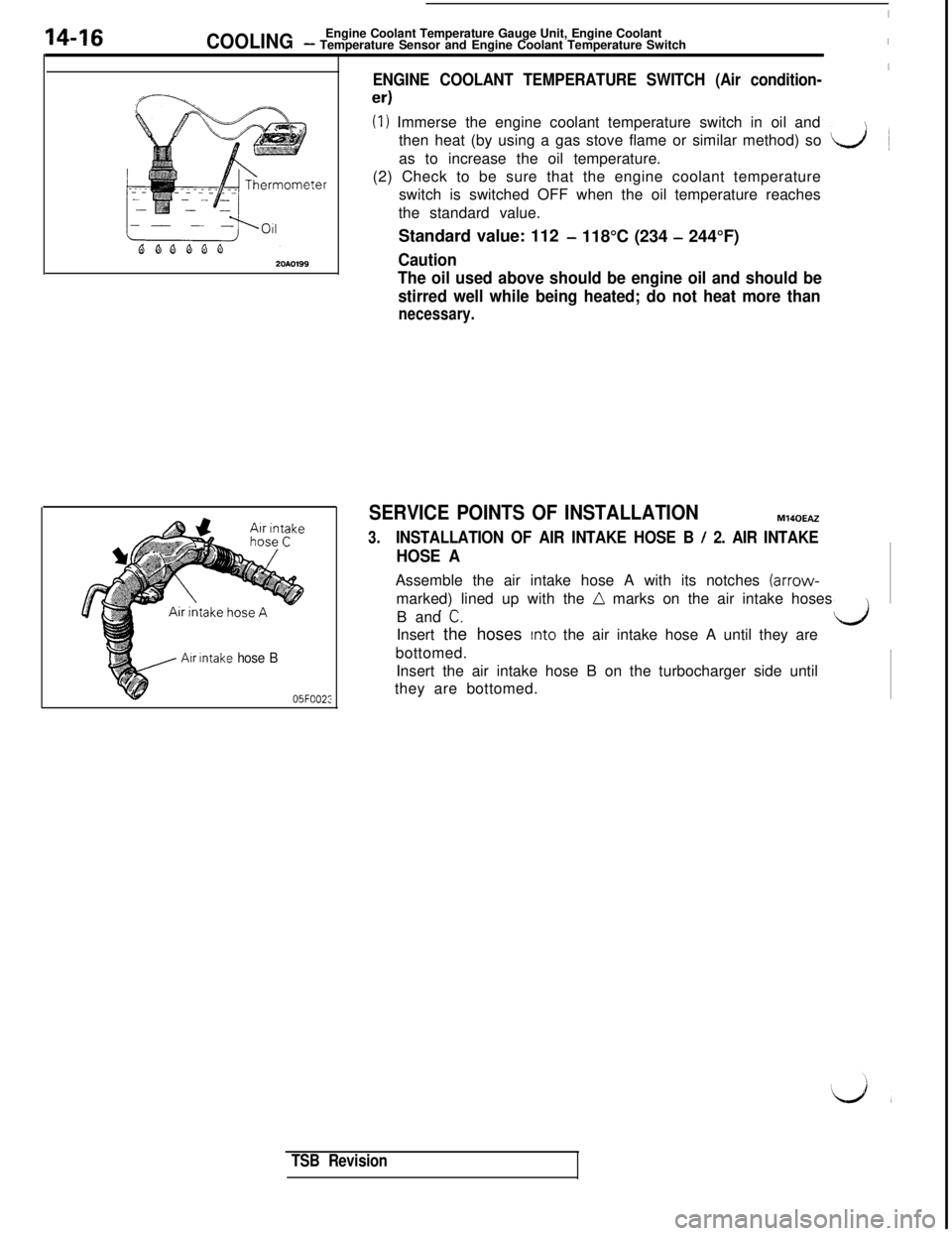
(1) Immerse the engine coolant temperature switch in oil and
then heat (by using a gas stove flame or similar method) so
as to increase the oil temperature.
L.2~(2) Check to be sure that the engine coolant temperature
switch is switched OFF when the oil temperature reaches
the standard value.
Standard value: 112
- 118°C (234 - 244°F)
Caution
The oil used above should be engine oil and should be
stirred well while being heated; do not heat more than
necessary.
SERVICE POINTS OF INSTALLATIONM140EAz
3.INSTALLATION OF AIR INTAKE HOSE B / 2. AIR INTAKE
HOSE AB and L. Assemble the air intake hose A with its notches (arrow-
marked) lined up with the
n marks on the air intake hoses
. -dInsert the hoses Into the air intake hose A until they are
bottomed.
Insert the air intake hose B on the turbocharger side until
they are bottomed.
TSB Revision
Page 315 of 1146
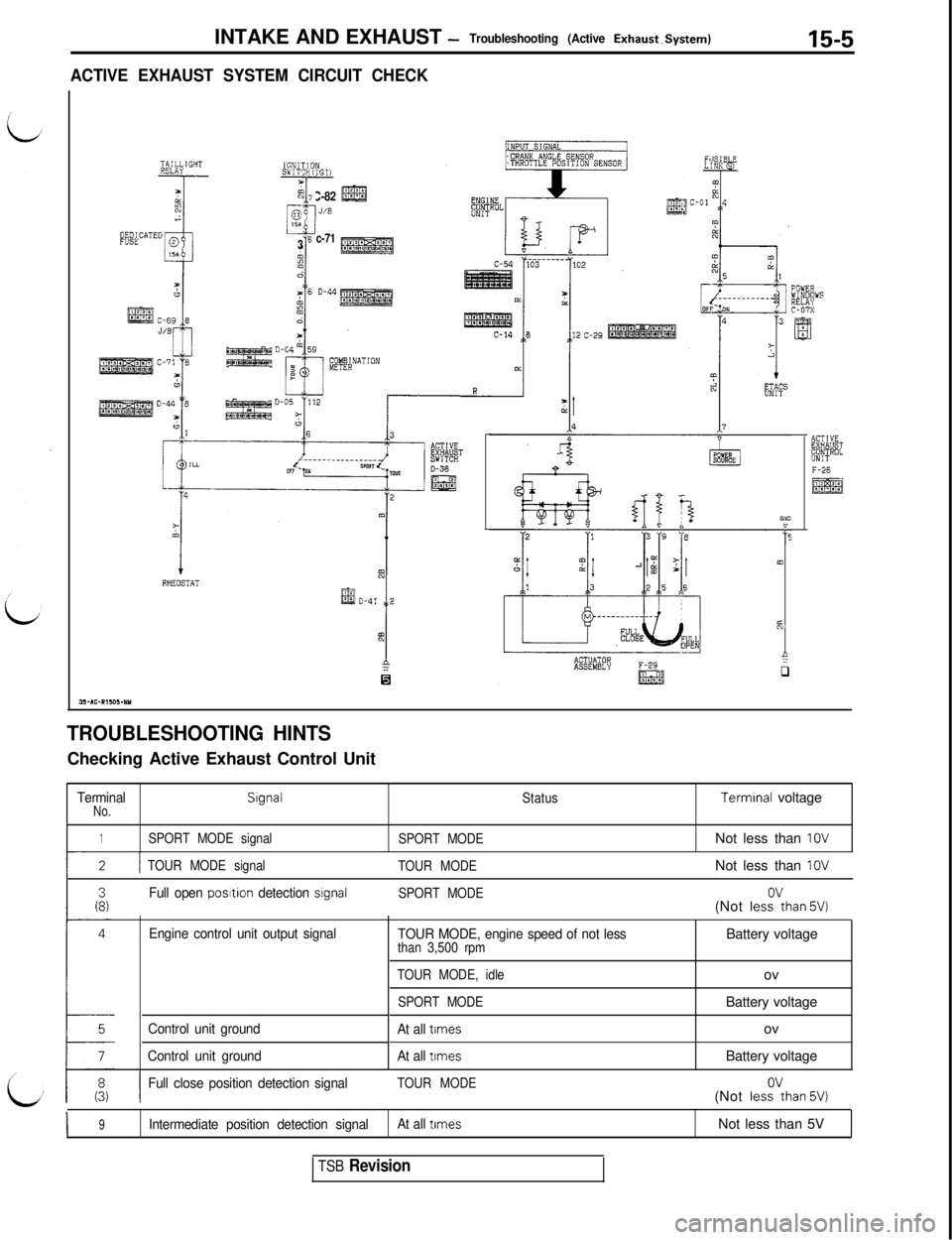
INTAKE AND EXHAUST -Troubleshooting (Active Exhaust.System)15-5
ACTIVE EXHAUST SYSTEM CIRCUIT CHECK
5= i C-82
-i
@g
0J/S1%
‘I
‘6 c-71
3
1
+RHEOSTATmACTUATOR
1::ASSEMBLYF-29
&$jq
ACTlYEFXoQBIlBZ"NIT
TROUBLESHOOTING HINTSChecking Active Exhaust Control Unit
TerminalNo.Signal
StatusTerminal voltage
1SPORT MODE signal
SPORT MODENot less than IOV
I-2 TTOUR MODE signal
TOUR MODENot less than IOV
Full open posrtion detection srgnalSPORT MODE(Not lesi’than 5V)
Engine control unit output signal
Control unit ground
Control unit groundTOUR MODE, engine speed of not lessthan 3,500 rpm
TOUR MODE, idle
SPORT MODE
At all times
At all
trmesBattery voltage
ov
Battery voltage
ov
Battery voltage
IFull close position detection signalTOUR MODE(Not lesk?than 5V)
I9Intermediate position detection signalAt all timesNot less than 5V
TSB Revision
Page 317 of 1146
INTAKE AND EXHAUST - Service Adiustment Procedures15-7
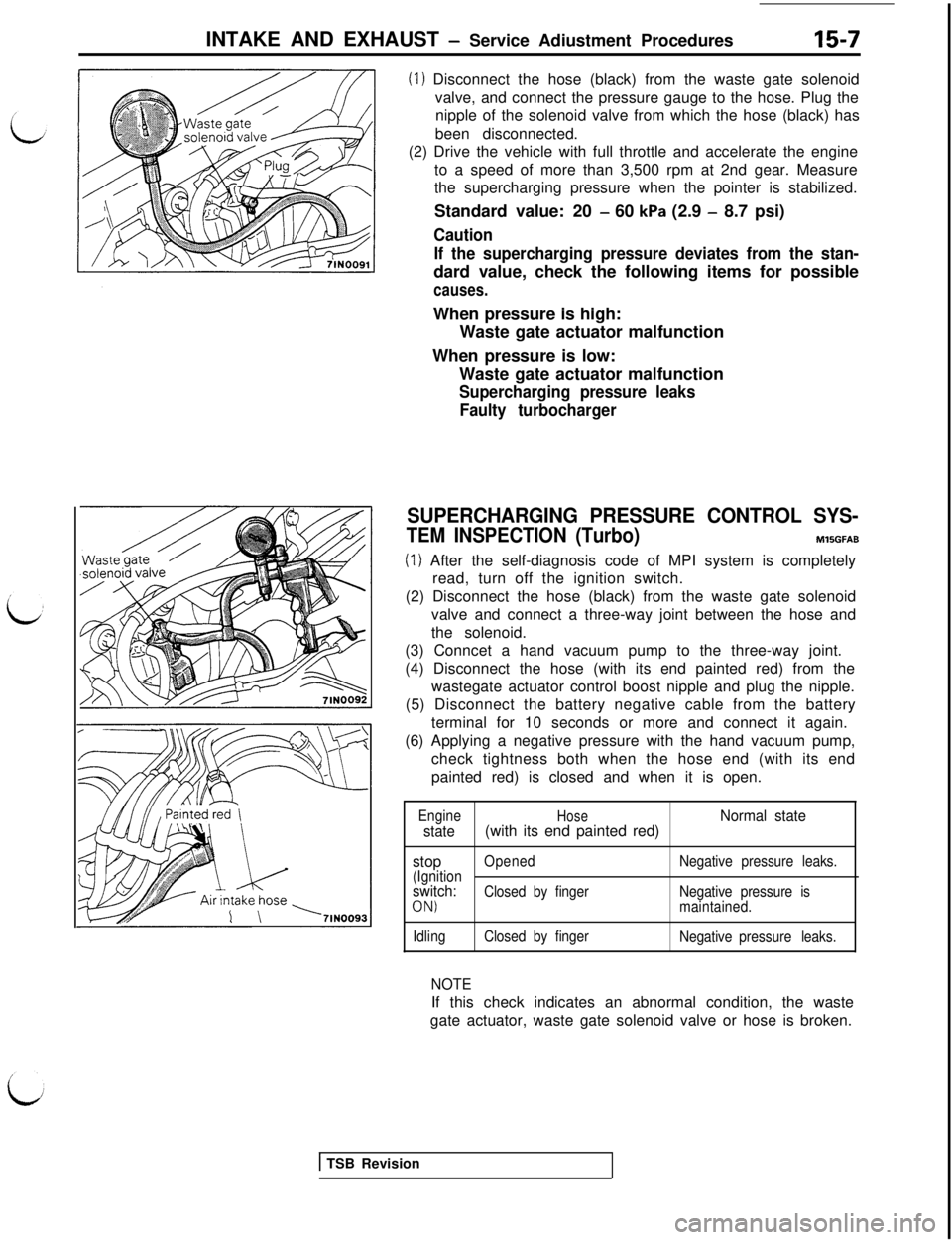
(1) Disconnect the hose (black) from the waste gate solenoid
valve, and connect the pressure gauge to the hose. Plug the
nipple of the solenoid valve from which the hose (black) has
been disconnected.
(2) Drive the vehicle with full throttle and accelerate the engine
to a speed of more than 3,500 rpm at 2nd gear. Measure
the supercharging pressure when the pointer is stabilized.
Standard value: 20
- 60 kPa (2.9 - 8.7 psi)
Caution
If the supercharging pressure deviates from the stan-dard value, check the following items for possible
causes.When pressure is high:
Waste gate actuator malfunction
When pressure is low:
Waste gate actuator malfunction
Supercharging pressure leaks
Faulty turbocharger
SUPERCHARGING PRESSURE CONTROL SYS-
TEM INSPECTION (Turbo)MlSGFAB
(1) After the self-diagnosis code of MPI system is completely
read, turn off the ignition switch.
(2) Disconnect the hose (black) from the waste gate solenoid
valve and connect a three-way joint between the hose and
the solenoid.
(3) Conncet a hand vacuum pump to the three-way joint.
(4) Disconnect the hose (with its end painted red) from the
wastegate actuator control boost nipple and plug the nipple.
(5) Disconnect the battery negative cable from the battery
terminal for 10 seconds or more and connect it again.
(6) Applying a negative pressure with the hand vacuum pump,
check tightness both when the hose end (with its end
painted red) is closed and when it is open.
EngineHoseNormal state
state(with its end painted red)
stop
OpenedNegative pressure leaks.
(Ignition
switch:Closed by fingerNegative pressure is
ON)maintained.
IdlingClosed by finger
Negative pressure leaks.
NOTEIf this check indicates an abnormal condition, the waste
gate actuator, waste gate solenoid valve or hose is broken.
1 TSB Revision
Page 322 of 1146
15-12INTAKE AND EXHAUST - lntercooier
SERVICE POINT OF REMOVALMlSTSAC
13. REMOVAL OF ENGINE OIL COOLERIDisconnect the hose from the engine oil cooler and remove
the engine oil cooler only.
IL)
INSPECTIONMISTCAB
lCheck the intercooler fins for bending, damage, or foreign
matter.
lCheck the intercooler hoses for cracking, damage, or wear.
Air Intake hose B
Air hose
05FOO21
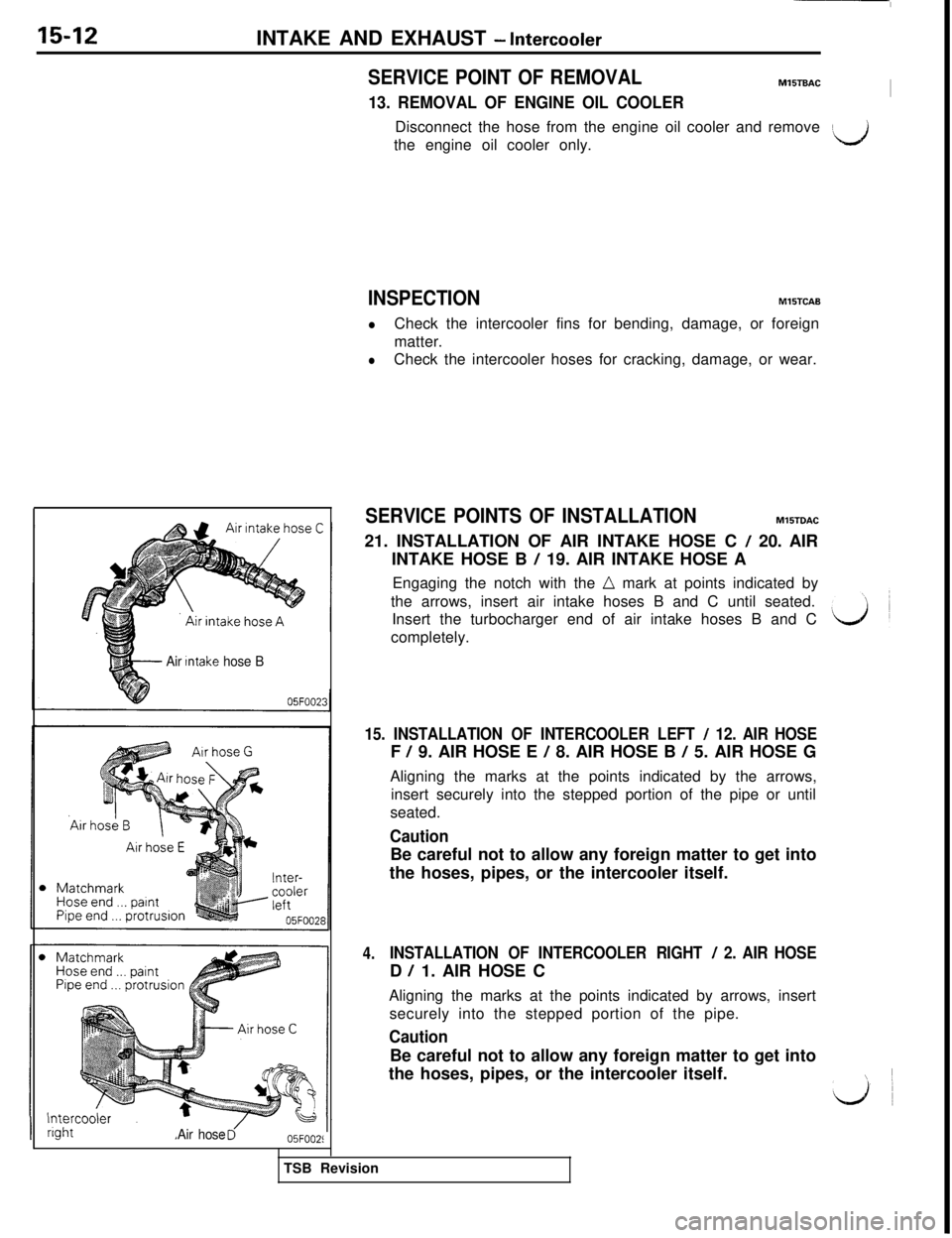
SERVICE POINTS OF INSTALLATIONMlSTDAC
21. INSTALLATION OF AIR INTAKE HOSE C
/ 20. AIR
INTAKE HOSE B
/ 19. AIR INTAKE HOSE A
Engaging the notch with the
n mark at points indicated by
the arrows, insert air intake hoses B and C until seated.
Insert the turbocharger end of air intake hoses B and C
completely.
15. INSTALLATION OF INTERCOOLER LEFT / 12. AIR HOSEF
/ 9. AIR HOSE E / 8. AIR HOSE B / 5. AIR HOSE G
Aligning the marks at the points indicated by the arrows,
insert securely into the stepped portion of the pipe or until
seated.
CautionBe careful not to allow any foreign matter to get into
the hoses, pipes, or the intercooler itself.
4.INSTALLATION OF INTERCOOLER RIGHT / 2. AIR HOSED
/ 1. AIR HOSE C
Aligning the marks at the points indicated by arrows, insert
securely into the stepped portion of the pipe.
CautionBe careful not to allow any foreign matter to get into
the hoses, pipes, or the intercooler itself.
1 ~
LJ~TSB Revision
Page 323 of 1146
INTAKE AND EXHAUST - Air Intake Plenum
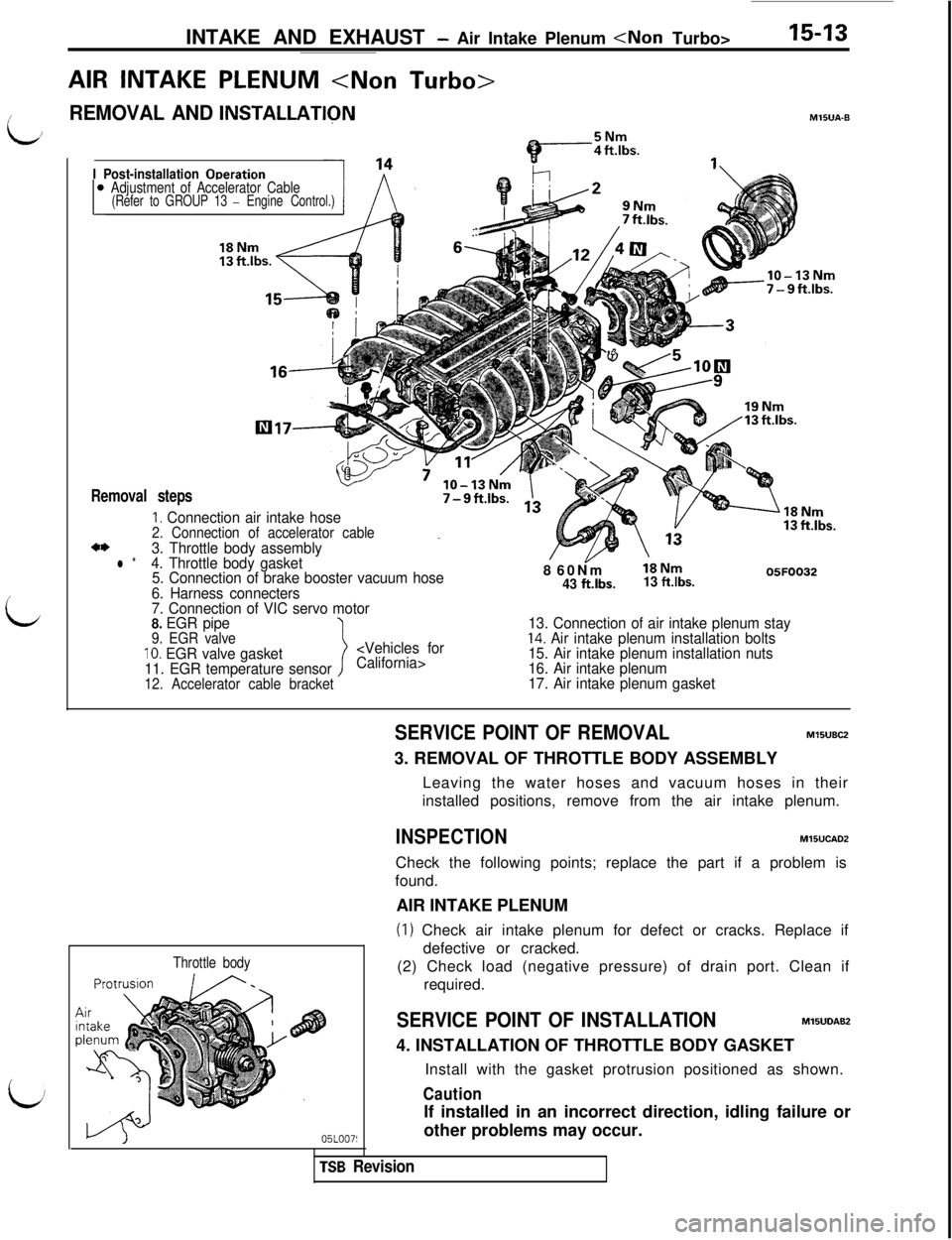
AIR INTAKE PLENUM
/REMOVAL AND INSTALLATIQNMlWA-B
L/
i
I Post-installation ODeration
Adjustment of Accelerator Cable
(Refer to GROUP 13 - Engine Control.)
Removal steps7-9ft.lbs.
I. Connection air intake hose2. Connection of accelerator cable_*I)3. Throttle body assemblyl *4. Throttle body gasket
5. Connection of brake booster vacuum hose
6. Harness connecters8 60Nm;6Nm05FOO32
43 ft.lbs.13 ft.lbs.
7. Connection of VIC servo motor
8. EGR pipe
9. EGR valve
11. EGR temperature sensor
12. Accelerator cable bracket
13. Connection of air intake plenum stay14. Air intake plenum installation bolts
15. Air intake plenum installation nuts
16. Air intake plenum
17. Air intake plenum gasket
Throttle body
SERVICE POINT OF REMOVALM15UBC23. REMOVAL OF THROTTLE BODY ASSEMBLY
Leaving the water hoses and vacuum hoses in their
installed positions, remove from the air intake plenum.
INSPECTIONM15UCAD2
Check the following points; replace the part if a problem is
found.
AIR INTAKE PLENUM
(1) Check air intake plenum for defect or cracks. Replace if
defective or cracked.
(2) Check load (negative pressure) of drain port. Clean if
required.
SERVICE POINT OF INSTALLATIONMl5UDAB2
4. INSTALLATION OF THROTTLE BODY GASKET
Install with the gasket protrusion positioned as shown.
CautionIf installed in an incorrect direction, idling failure or
other problems may occur.
TSB Revision
Page 326 of 1146
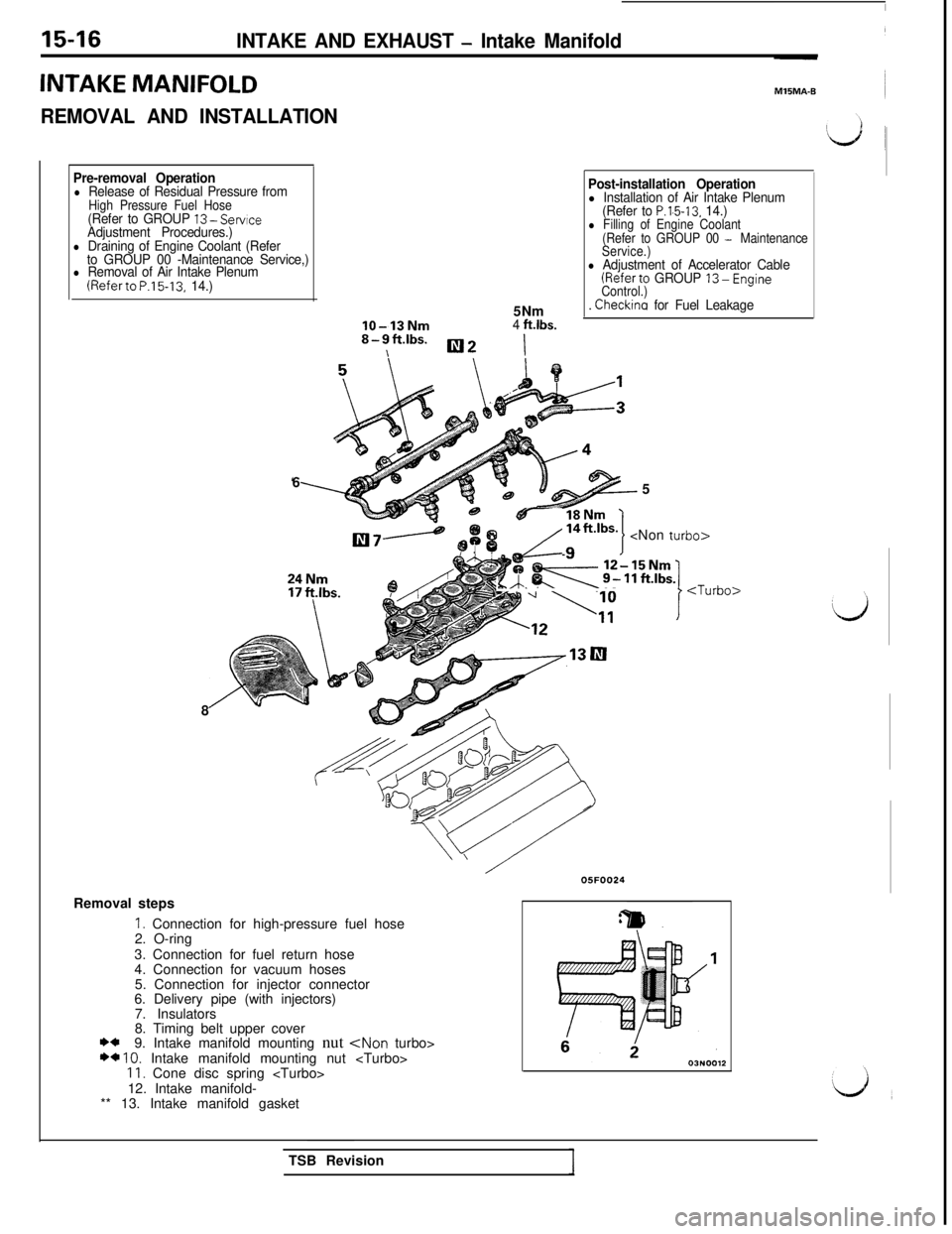
15-16INTAKE AND EXHAUST - Intake Manifold
INTAKE MANIFOLD
REMOVAL AND INSTALLATION
Pre-removal Operationl Release of Residual Pressure fromHigh Pressure Fuel Hose(Refer to GROUP 13-ServiceAdjustment Procedures.)l Draining of Engine Coolant (Refer
to GROUP 00 -Maintenance Service,)
l Removal of Air Intake Plenum(Referto P.15-13, 14.)5Nm
lo-13Nm4 ft.lbs.8-9ftJbs. w2\I
Post-installation Operationl Installation of Air Intake Plenum
(Refer to P.1.5-13. 14.)l Filling of Engine Coolant
(Refer to GROUP 00 - Maintenance
Service.)
l Adjustment of Accelerator Cable(Referto GROUP 13-EngineControl.). Checkina for Fuel Leakage6
5
2 :‘;bs.)
gp,.qgs ~-zt!EJ8OSFOO24
Removal steps
I. Connection for high-pressure fuel hose
2. O-ring
3. Connection for fuel return hose
4. Connection for vacuum hoses
5. Connection for injector connector
6. Delivery pipe (with injectors)
7. Insulators
8. Timing belt upper cover
I)*9. Intake manifold mounting nut
12. Intake manifold-
** 13. Intake manifold gasket
TSB Revision
Page 329 of 1146
INTAKE AND EXHAUST - Turbocharger (Front)15-19
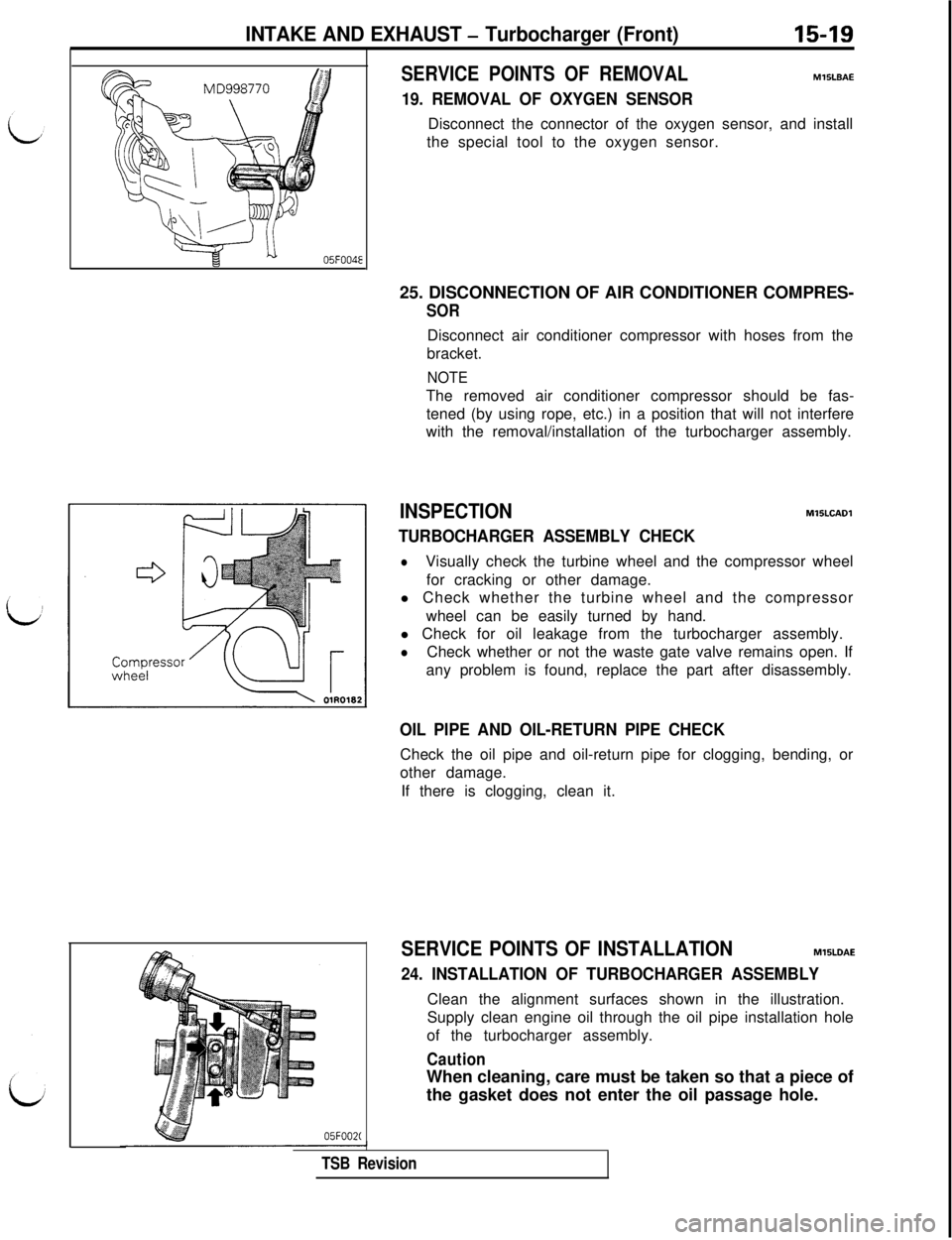
05FOO2(
SERVICE POINTS OF REMOVALM15LBAE
19. REMOVAL OF OXYGEN SENSORDisconnect the connector of the oxygen sensor, and install
the special tool to the oxygen sensor.
25. DISCONNECTION OF AIR CONDITIONER COMPRES-
SORDisconnect air conditioner compressor with hoses from the
bracket.
NOTEThe removed air conditioner compressor should be fas-
tened (by using rope, etc.) in a position that will not interfere
with the removal/installation of the turbocharger assembly.
INSPECTION
TURBOCHARGER ASSEMBLY CHECKMlSLCADl
lVisually check the turbine wheel and the compressor wheel
for cracking or other damage.
l Check whether the turbine wheel and the compressor
wheel can be easily turned by hand.
l Check for oil leakage from the turbocharger assembly.
lCheck whether or not the waste gate valve remains open. If
any problem is found, replace the part after disassembly.
OIL PIPE AND OIL-RETURN PIPE CHECKCheck the oil pipe and oil-return pipe for clogging, bending, or
other damage.
If there is clogging, clean it.
SERVICE POINTS OF INSTALLATIONMllLDAE
24. INSTALLATION OF TURBOCHARGER ASSEMBLYClean the alignment surfaces shown in the illustration.
Supply clean engine oil through the oil pipe installation hole
of the turbocharger assembly.
CautionWhen cleaning, care must be taken so that a piece of
the gasket does not enter the oil passage hole.
TSB Revision