engine MITSUBISHI 3000GT 1991 Service Manual
[x] Cancel search | Manufacturer: MITSUBISHI, Model Year: 1991, Model line: 3000GT, Model: MITSUBISHI 3000GT 1991Pages: 1146, PDF Size: 76.68 MB
Page 491 of 1146
AUTOMATIC TRANSAXLE - Troubleshooting23-39
//!’ 6Rear@FrontclutchpressureI
@Kickdown brakeoressure (Release)
e
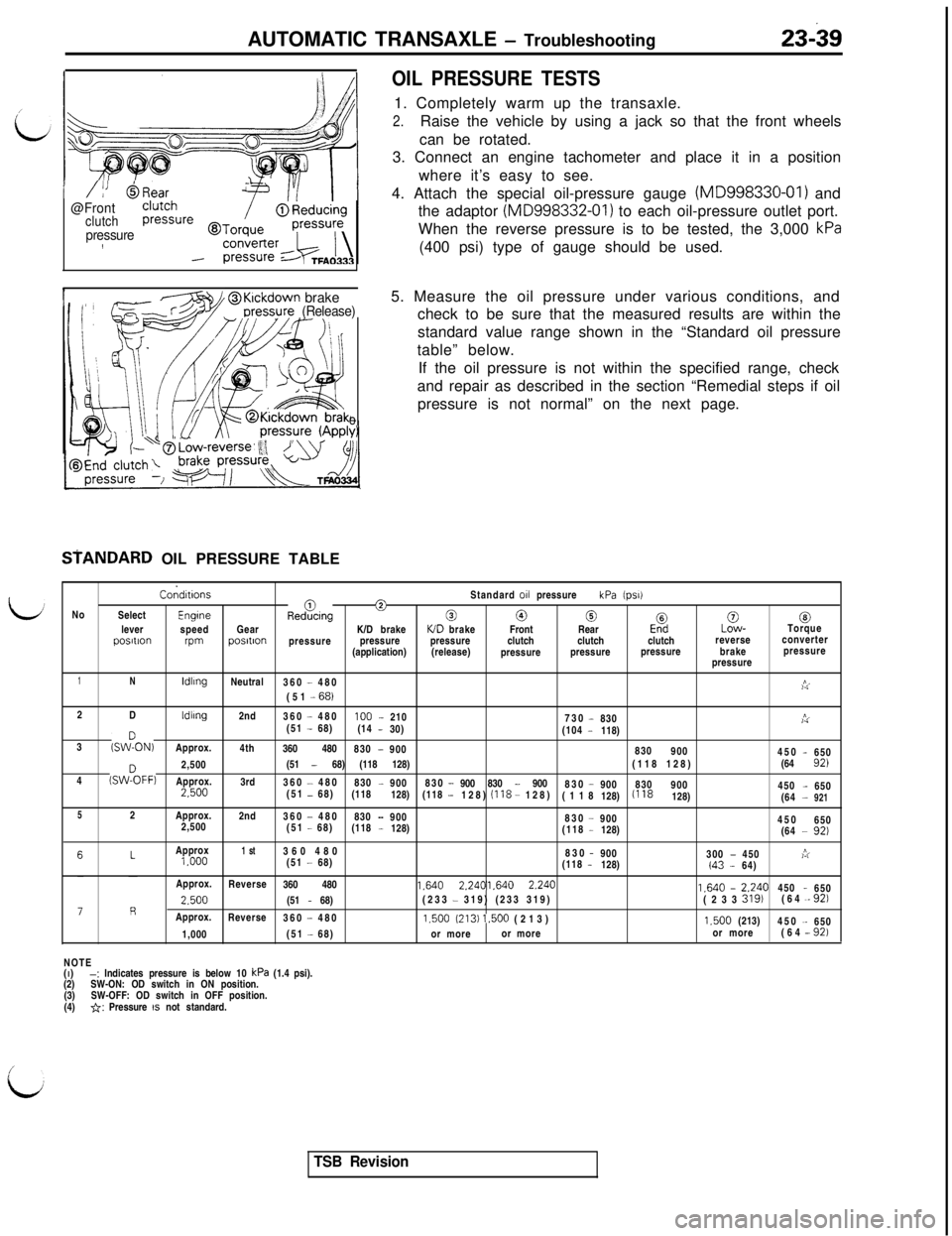
OIL PRESSURE TESTS1. Completely warm up the transaxle.
2.Raise the vehicle by using a jack so that the front wheels
can be rotated.
3. Connect an engine tachometer and place it in a position
where it’s easy to see.
4. Attach the special oil-pressure gauge (MD998330-01) and
the adaptor (MD998332-01) to each oil-pressure outlet port.
When the reverse pressure is to be tested, the 3,000
kPa(400 psi) type of gauge should be used.
5. Measure the oil pressure under various conditions, and
check to be sure that the measured results are within the
standard value range shown in the “Standard oil pressure
table” below.
If the oil pressure is not within the specified range, check
and repair as described in the section “Remedial steps if oil
pressure is not normal” on the next page.
STANDARD OIL PRESSURE TABLECondtttonsStandard
011 pressurekPa (PSI)No
SelectEngme
Red&g@000E%00leverspeedGearK/D brakeWD brakeFrontRearLow-TorqueposItlollvposltlon
pressurepressurepressureclutchclutchclutchreverseconverter
(application)(release)
pressurepressurepressurebrakepressure
pressure
1Nldlmg
Neutral
360 - 4808,(51 - 6812
Dldlmg
2nd
360
- 480100-210
730 -830k(51 - 68)
(14-30)
(104 -118)
3(SWFON,
Approx.
4th
360 480
830
-900
830
900
450-650
2,500(51 - 68) (118 128)(118 128)(64 92)
(SWZFF)Approx.
3rd
360 - 480
830
900830 -900 830 - 900
830 -900830
900
450-4
650-2.500(51 - 68)
(118
128)(118 -128) (118 - 128)
(118
128)(118128)
(64-921
52
Approx.
2nd
360
- 480
830--900
830 -900
450
650
2,500
(51 - 68)
(118-128)
(118 -128)
(64-921
Approx
1 st360 480
830 -900
300-450A1.000(51 - 68)
(118 -128)I43 .-64)
Approx.
Reverse
360 480
1.6402.2401.640 2.2401.640 -2.240450-6502.500(51 - 68)(233 - 319) (233 319)(233 319)(64 ~- 921
Approx.
Reverse
360
- 4801.500(213) 1.500 (213)1.500(213)
450~-650
1,000(51 - 68)or moreor moreor more(64 - 92)NOTE
(I)
-: Indicates pressure is below 10 kPa (1.4 psi).
(2)SW-ON: OD switch in ON position.
(3)SW-OFF: OD switch in OFF position.
(4)
a: Pressure IS not standard.
TSB Revision
Page 495 of 1146
AUTOMATIC TRANSAXLE - Troubleshootinn23-43
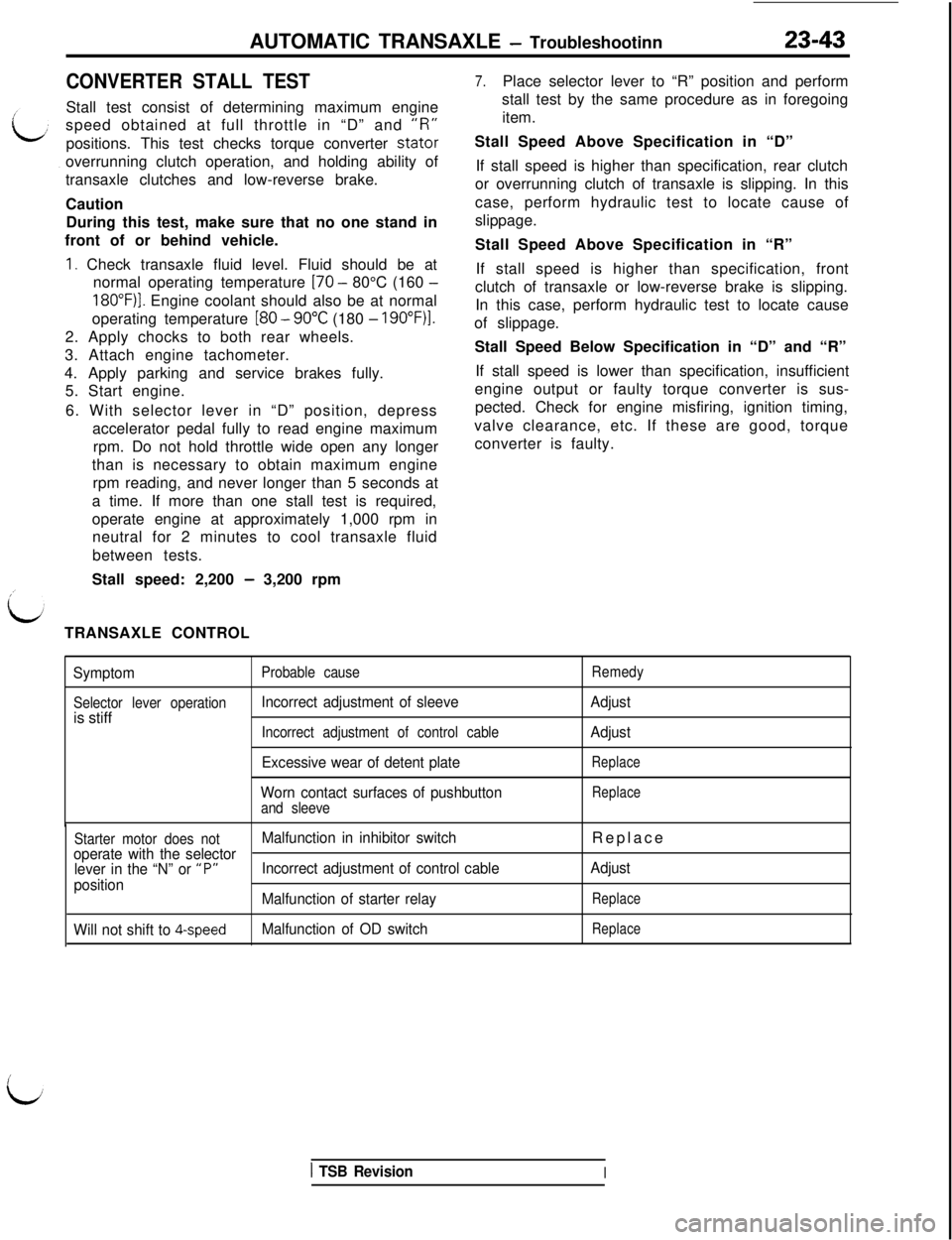
CONVERTER STALL TESTStall test consist of determining maximum engine
speed obtained at full throttle in “D” and
“I?”positions. This test checks torque converter
statoroverrunning clutch operation, and holding ability of
transaxle clutches and low-reverse brake.
Caution
During this test, make sure that no one stand in
front of or behind vehicle.
1. Check transaxle fluid level. Fluid should be at
normal operating temperature
[70 - 80°C (160 -
18O”F)I. Engine coolant should also be at normal
operating temperature
[80 - 90°C (180 - 19O”F)l.2. Apply chocks to both rear wheels.
3. Attach engine tachometer.
4. Apply parking and service brakes fully.
5. Start engine.
6. With selector lever in “D” position, depress
accelerator pedal fully to read engine maximum
rpm. Do not hold throttle wide open any longer
than is necessary to obtain maximum engine
rpm reading, and never longer than 5 seconds at
a time. If more than one stall test is required,
operate engine at approximately 1,000 rpm in
neutral for 2 minutes to cool transaxle fluid
between tests.
Stall speed: 2,200
- 3,200 rpm
7.Place selector lever to “R” position and perform
stall test by the same procedure as in foregoing
item.
Stall Speed Above Specification in “D”
If stall speed is higher than specification, rear clutch
or overrunning clutch of transaxle is slipping. In this
case, perform hydraulic test to locate cause of
slippage.
Stall Speed Above Specification in “R”
If stall speed is higher than specification, front
clutch of transaxle or low-reverse brake is slipping.
In this case, perform hydraulic test to locate cause
of slippage.
Stall Speed Below Specification in “D” and “R”
If stall speed is lower than specification, insufficient
engine output or faulty torque converter is sus-
pected. Check for engine misfiring, ignition timing,
valve clearance, etc. If these are good, torque
converter is faulty.
TRANSAXLE CONTROL
Symptom
Selector lever operationis stiff
Probable cause
Incorrect adjustment of sleeve
Remedy
Adjust
Incorrect adjustment of control cable
Excessive wear of detent plate
Worn contact surfaces of pushbutton
and sleeve
Adjust
Replace
Replace
Starter motor does notMalfunction in inhibitor switchReplace
operate with the selector
lever in the “N” or “P”Incorrect adjustment of control cableAdjust
position
Will not shift to
4-speed
Malfunction of starter relay
Malfunction of OD switchReplace
Replace
1 TSB RevisionI
Page 502 of 1146
23-50AUTOMATIC TRANSAXLE - service AdiustmentProcedures
09FO117
m09FOO19
L Pushbuttonv09FOO61
@ Button pressed (while brakepedal is depressed)c Button not pressed@ Button pressed
/\ \\ OSFODdACCELERATOR SWITCH INSPECTION AND
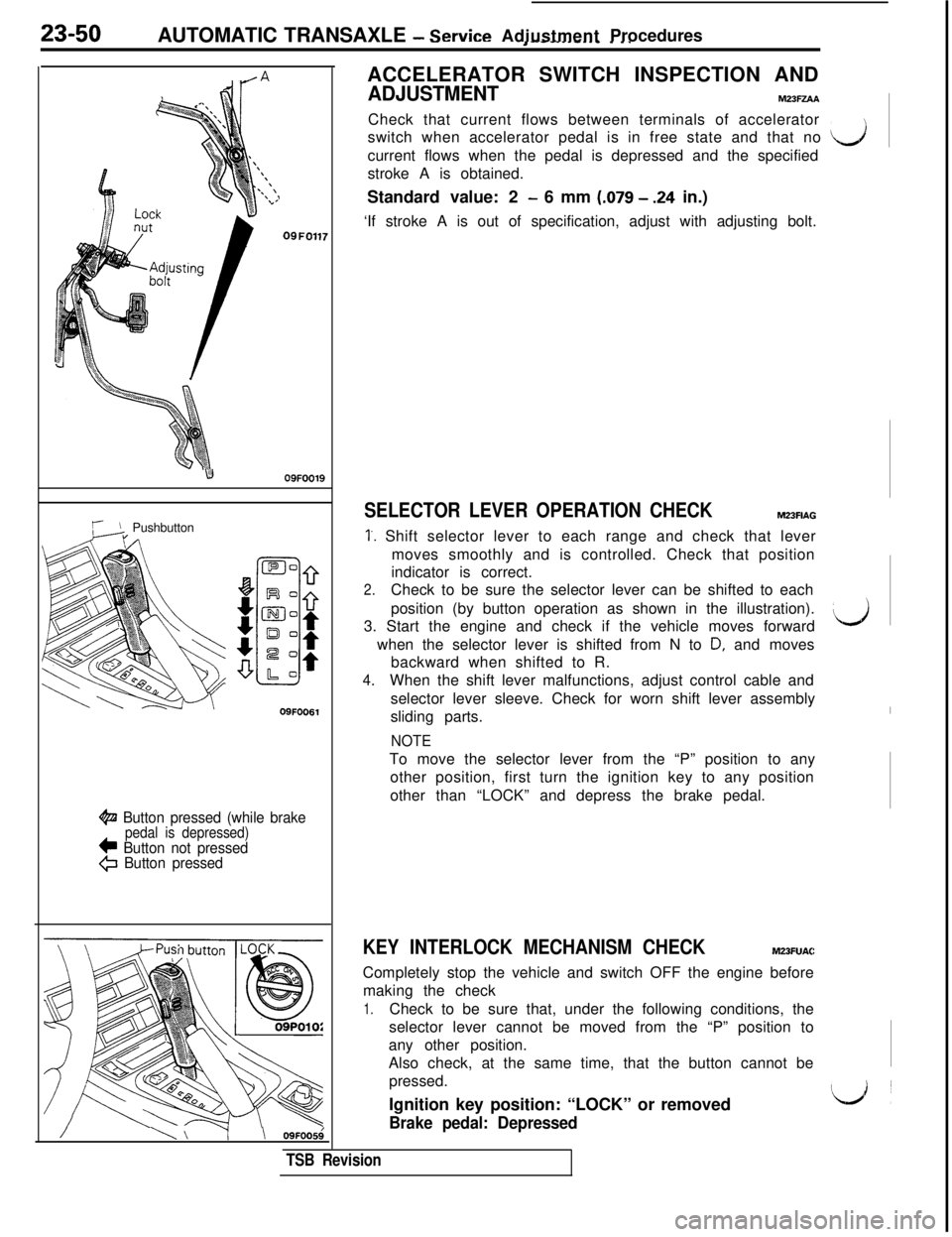
ADJUSTMENTM23FZAACheck that current flows between terminals of accelerator
switch when accelerator pedal is in free state and that no
dcurrent flows when the pedal is depressed and the specified
stroke A is obtained.
Standard value: 2
- 6 mm (.079 - .24 in.)
‘If stroke A is out of specification, adjust with adjusting bolt.
SELECTOR LEVER OPERATION CHECKM23FIAG
1.. Shift selector lever to each range and check that lever
moves smoothly and is controlled. Check that position
indicator is correct.
2.Check to be sure the selector lever can be shifted to each
position (by button operation as shown in the illustration).
3. Start the engine and check if the vehicle moves forward
dwhen the selector lever is shifted from N to
D, and moves
backward when shifted to R.
4.When the shift lever malfunctions, adjust control cable and
selector lever sleeve. Check for worn shift lever assembly
sliding parts.
I
NOTETo move the selector lever from the “P” position to any
other position, first turn the ignition key to any position
other than “LOCK” and depress the brake pedal.
KEY INTERLOCK MECHANISM CHECKM23FlJACCompletely stop the vehicle and switch OFF the engine before
making the check
1.Check to be sure that, under the following conditions, the
selector lever cannot be moved from the “P” position to
any other position.
Also check, at the same time, that the button cannot be
pressed.
Ignition key position: “LOCK” or removed
Brake pedal: Depressed
TSB Revision
Page 514 of 1146
23-62AUTOMATIC TRANSAXLE - Transaxle AssemblyTRANSAXLE ASSEMBLY
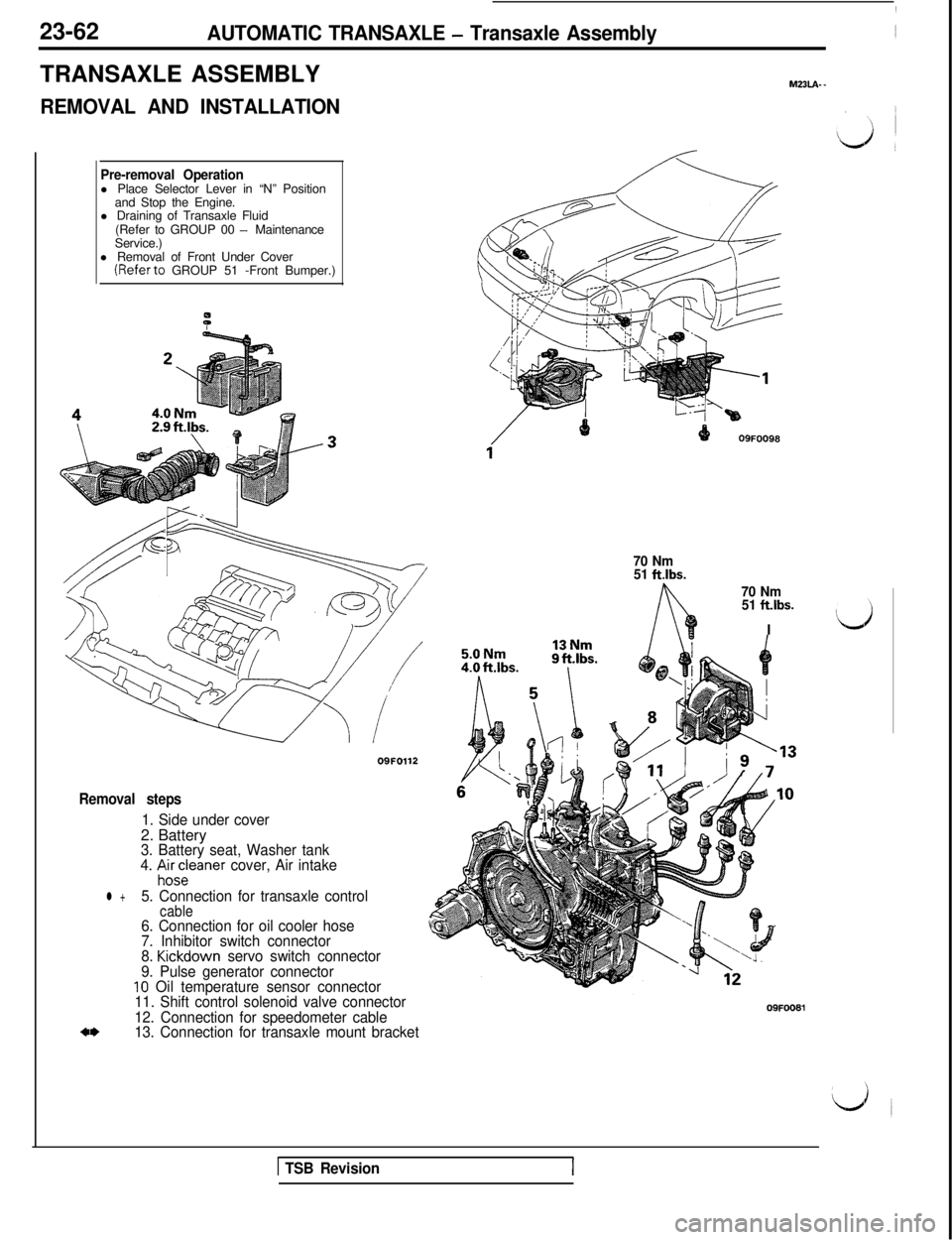
REMOVAL AND INSTALLATION
MZJLA- -
Pre-removal Operationl Place Selector Lever in “N” Position
and Stop the Engine.
l Draining of Transaxle Fluid
(Refer to GROUP 00
- Maintenance
Service.)
l Removal of Front Under Cover
(Referto GROUP 51 -Front Bumper.)09FO112
Removal steps
1. Side under cover2. Battery
3. Battery seat, Washer tank
4. kiorsteaner cover, Air intake
l +5. Connection for transaxle controlcable
4*
6. Connection for oil cooler hose
7. Inhibitor switch connector
8.
Kickdown servo switch connector
9. Pulse generator connector
10 Oil temperature sensor connector
11. Shift control solenoid valve connector
12. Connection for speedometer cable
13. Connection for transaxle mount bracket70 Nm
51
ft.lbs.
70 Nm
51 ft.lbs.I
09FOO81
1 TSB Revision
Page 516 of 1146
23-64
AUTOMATIC, TRANSAXLE - Transaxle Assembly
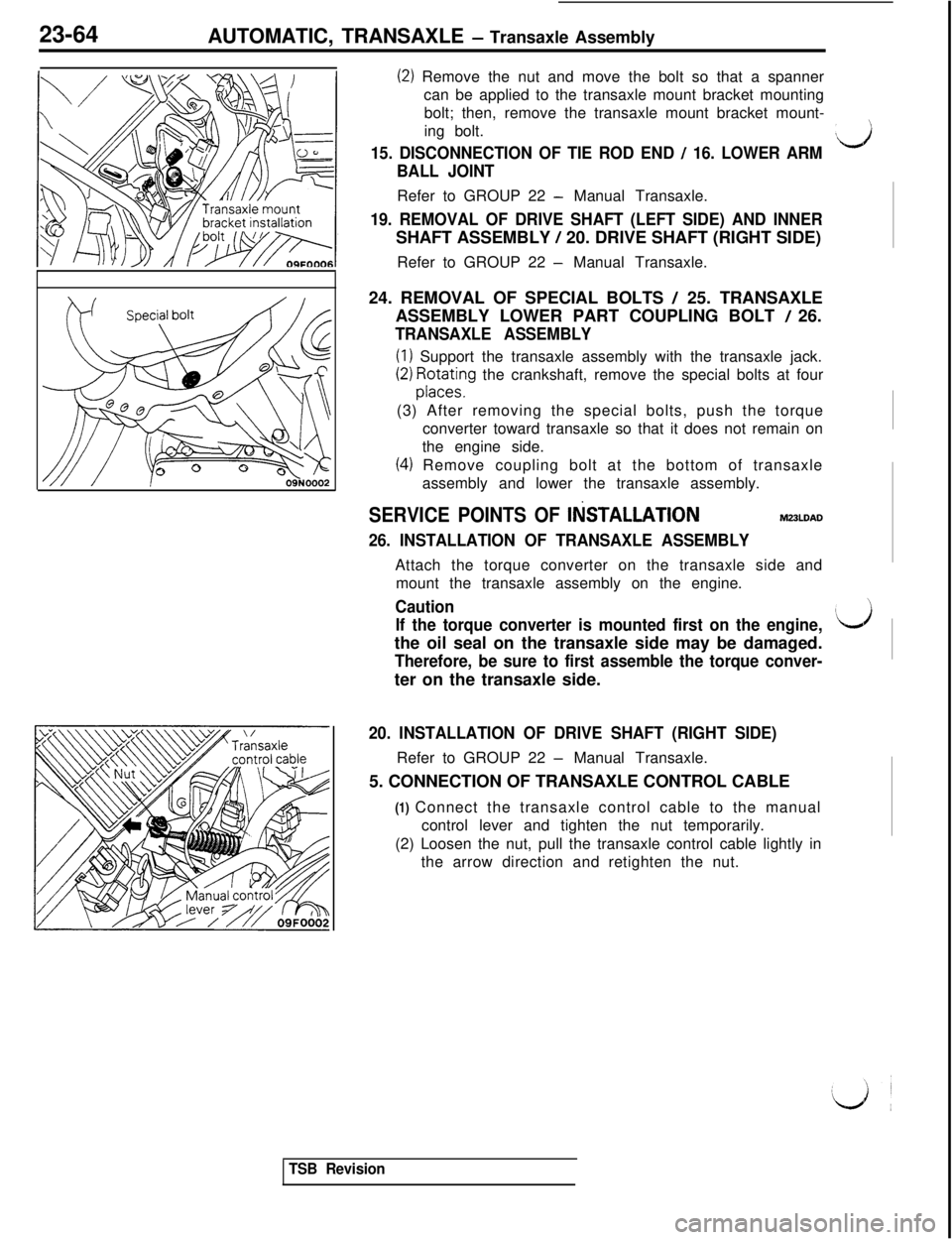
(2) Remove the nut and move the bolt so that a spanner
can be applied to the transaxle mount bracket mounting
bolt; then, remove the transaxle mount bracket mount-
ing bolt.
15. DISCONNECTION OF TIE ROD END / 16. LOWER ARM$3
BALL JOINTRefer to GROUP 22
- Manual Transaxle.
19. REMOVAL OF DRIVE SHAFT (LEFT SIDE) AND INNERSHAFT ASSEMBLY
/ 20. DRIVE SHAFT (RIGHT SIDE)
Refer to GROUP 22
- Manual Transaxle.
24. REMOVAL OF SPECIAL BOLTS
/ 25. TRANSAXLE
ASSEMBLY LOWER PART COUPLING BOLT
/ 26.
TRANSAXLE ASSEMBLY
(1) Support the transaxle assembly with the transaxle jack.
(2) ;;F;ng the crankshaft, remove the special bolts at four
(3) After removing the special bolts, push the torque
converter toward transaxle so that it does not remain on
the engine side.
(4) Remove coupling bolt at the bottom of transaxle
assembly and lower the transaxle assembly.
SERVICE POINTS OF IliSTALLATlONM23LDAD
26. INSTALLATION OF TRANSAXLE ASSEMBLYAttach the torque converter on the transaxle side and
mount the transaxle assembly on the engine.
Caution
If the torque converter is mounted first on the engine,
Idthe oil seal on the transaxle side may be damaged.
Therefore, be sure to first assemble the torque conver-ter on the transaxle side.
20. INSTALLATION OF DRIVE SHAFT (RIGHT SIDE)Refer to GROUP 22
- Manual Transaxle.
5. CONNECTION OF TRANSAXLE CONTROL CABLE
(1) Connect the transaxle control cable to the manual
control lever and tighten the nut temporarily.
(2) Loosen the nut, pull the transaxle control cable lightly in
the arrow direction and retighten the nut.
TSB Revision
Page 607 of 1146
li
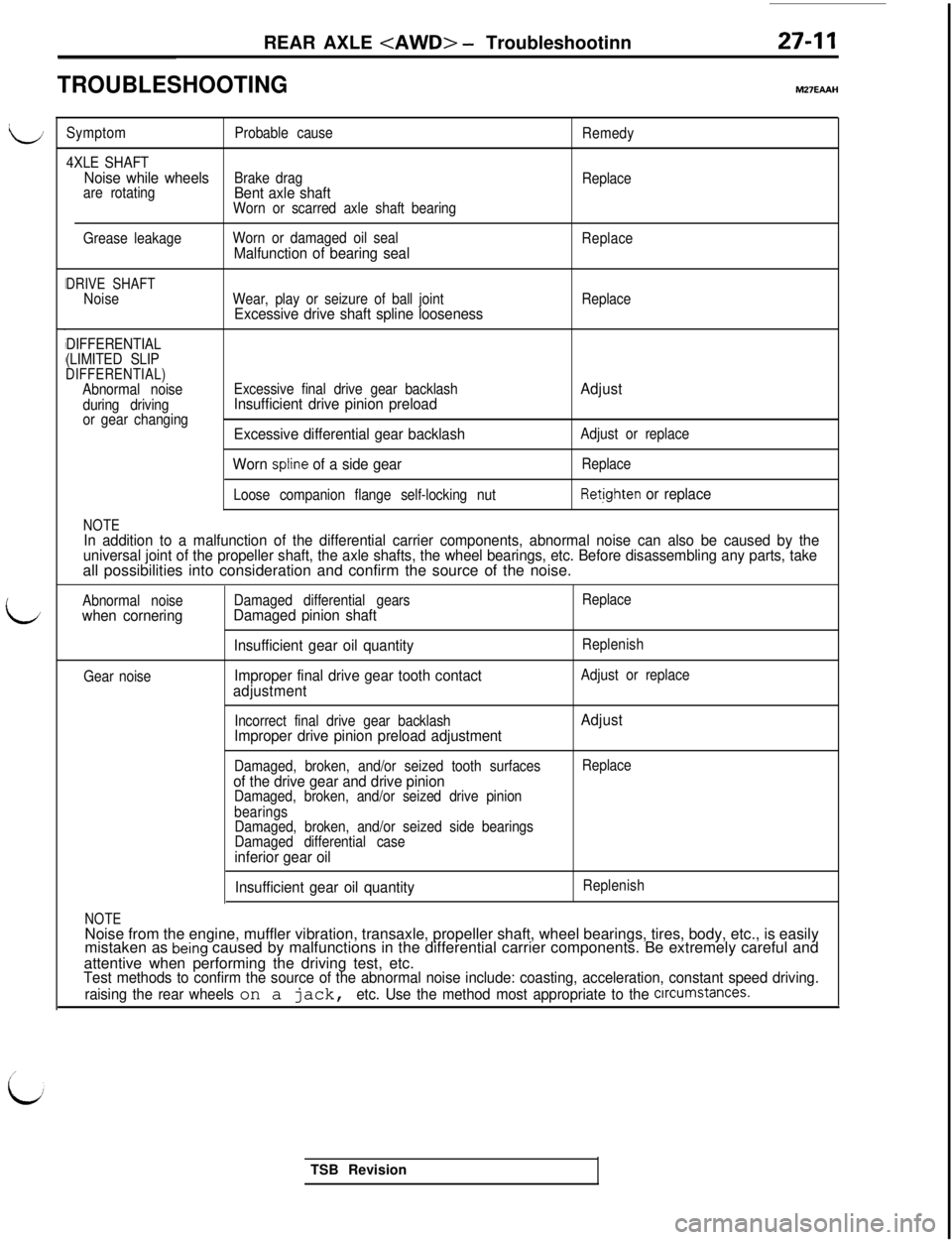
LREAR AXLE
TROUBLESHOOTINGM27EAAH
SymptomProbable cause
Remedy
4XLE SHAFT
Noise while wheelsBrake drag
Replace
are rotatingBent axle shaftWorn or scarred axle shaft bearing
Grease leakageWorn or damaged oil seal
Malfunction of bearing sealReplace
DRIVE SHAFTNoiseWear, play or seizure of ball jointExcessive drive shaft spline loosenessReplace
DIFFERENTIAL
(LIMITED SLIP
DIFFERENTIAL)Abnormal noise
during driving
or gear changing
NOTE
Excessive final drive gear backlashInsufficient drive pinion preload
Excessive differential gear backlash
Worn
spline of a side gear
Loose companion flange self-locking nut
Adjust
Adjust or replace
Replace
Retighten or replace
In addition to a malfunction of the differential carrier components, abnormal noise can also be caused by the
universal joint of the propeller shaft, the axle shafts, the wheel bearings, etc. Before disassembling any parts, takeall possibilities into consideration and confirm the source of the noise.
Abnormal noisewhen cornering
Gear noiseDamaged differential gears
Damaged pinion shaft
Insufficient gear oil quantity
Improper final drive gear tooth contact
adjustment
Replace
Replenish
Adjust or replace
Incorrect final drive gear backlash
Improper drive pinion preload adjustmentAdjust
Damaged, broken, and/or seized tooth surfacesof the drive gear and drive pinionDamaged, broken, and/or seized drive pinion
bearingsReplace
Damaged, broken, and/or seized side bearings
Damaged differential case
inferior gear oil
NOTE
Insufficient gear oil quantityReplenishNoise from the engine, muffler vibration, transaxle, propeller shaft, wheel bearings, tires, body, etc., is easily
mistaken as
being caused by malfunctions in the differential carrier components. Be extremely careful and
attentive when performing the driving test, etc.
Test methods to confirm the source of the abnormal noise include: coasting, acceleration, constant speed driving.
raising the rear wheels
on a jack, etc. Use the method most appropriate to the crrcumstances.TSB Revision
Page 643 of 1146
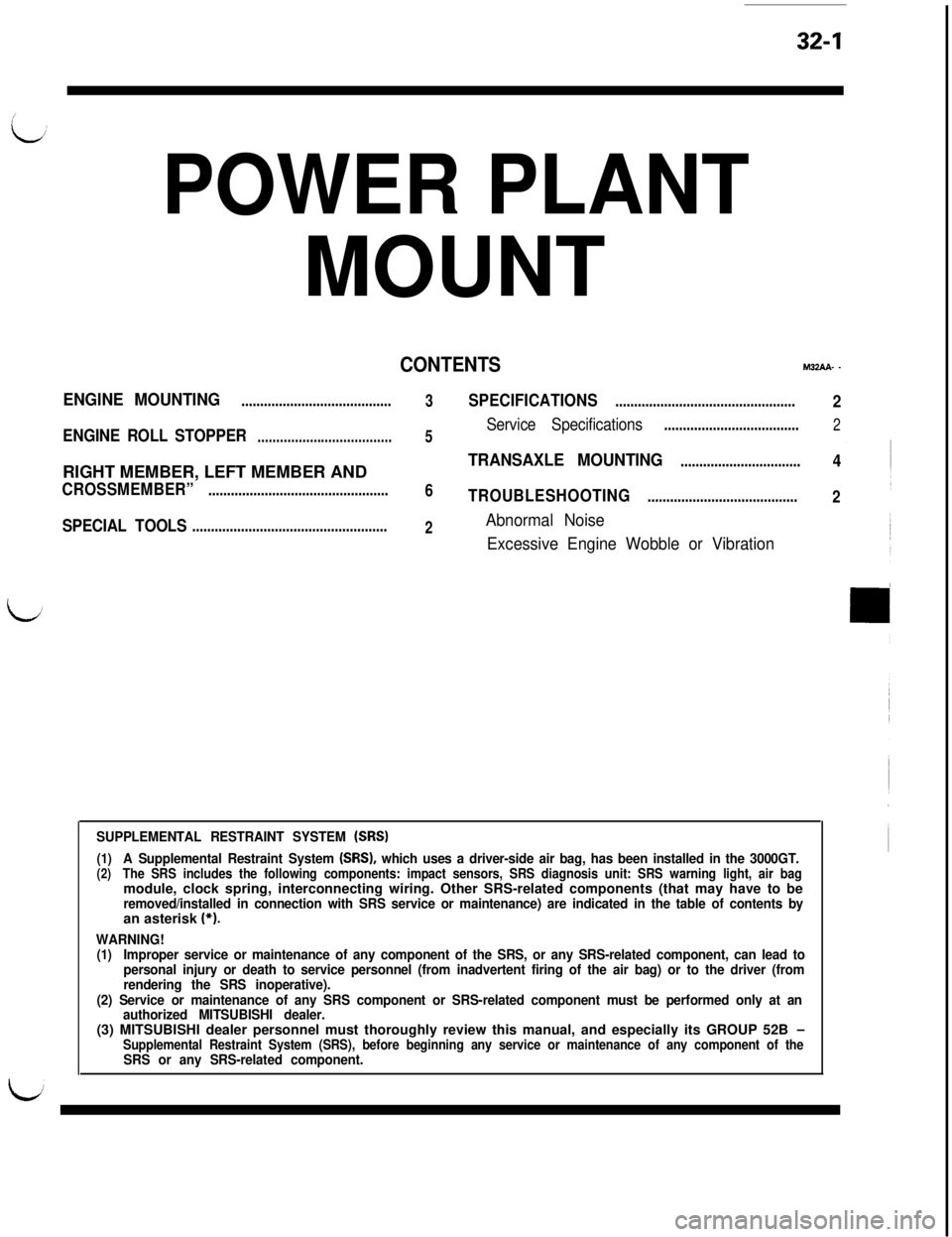
32-1
POWER PLANTMOUNT
CONTENTSMZAA- _
ENGINE MOUNTING........................................
3SPECIFICATIONS................................................2
ENGINE ROLL STOPPER
5Service Specifications....................................2....................................
TRANSAXLE MOUNTING................................4RIGHT MEMBER, LEFT MEMBER AND
CROSSMEMBER”................................................6TROUBLESHOOTING........................................2
SPECIAL TOOLSAbnormal Noise....................................................
2
Excessive Engine Wobble or Vibration
SUPPLEMENTAL RESTRAINT SYSTEM (SRS)
(1)A Supplemental Restraint System (SRS), which uses a driver-side air bag, has been installed in the 3000GT.(2)The SRS includes the following components: impact sensors, SRS diagnosis unit: SRS warning light, air bagmodule, clock spring, interconnecting wiring. Other SRS-related components (that may have to be
removed/installed in connection with SRS service or maintenance) are indicated in the table of contents byan asterisk (*).
WARNING!(1)Improper service or maintenance of any component of the SRS, or any SRS-related component, can lead to
personal injury or death to service personnel (from inadvertent firing of the air bag) or to the driver (from
rendering the SRS inoperative).
(2) Service or maintenance of any SRS component or SRS-related component must be performed only at an
authorized MITSUBISHI dealer.(3) MITSUBISHI dealer personnel must thoroughly review this manual, and especially its GROUP 52B
-Supplemental Restraint System (SRS), before beginning any service or maintenance of any component of theSRS or any SRS-related component.
Page 645 of 1146
POWER PLANT MOUNT - Engine Mounting
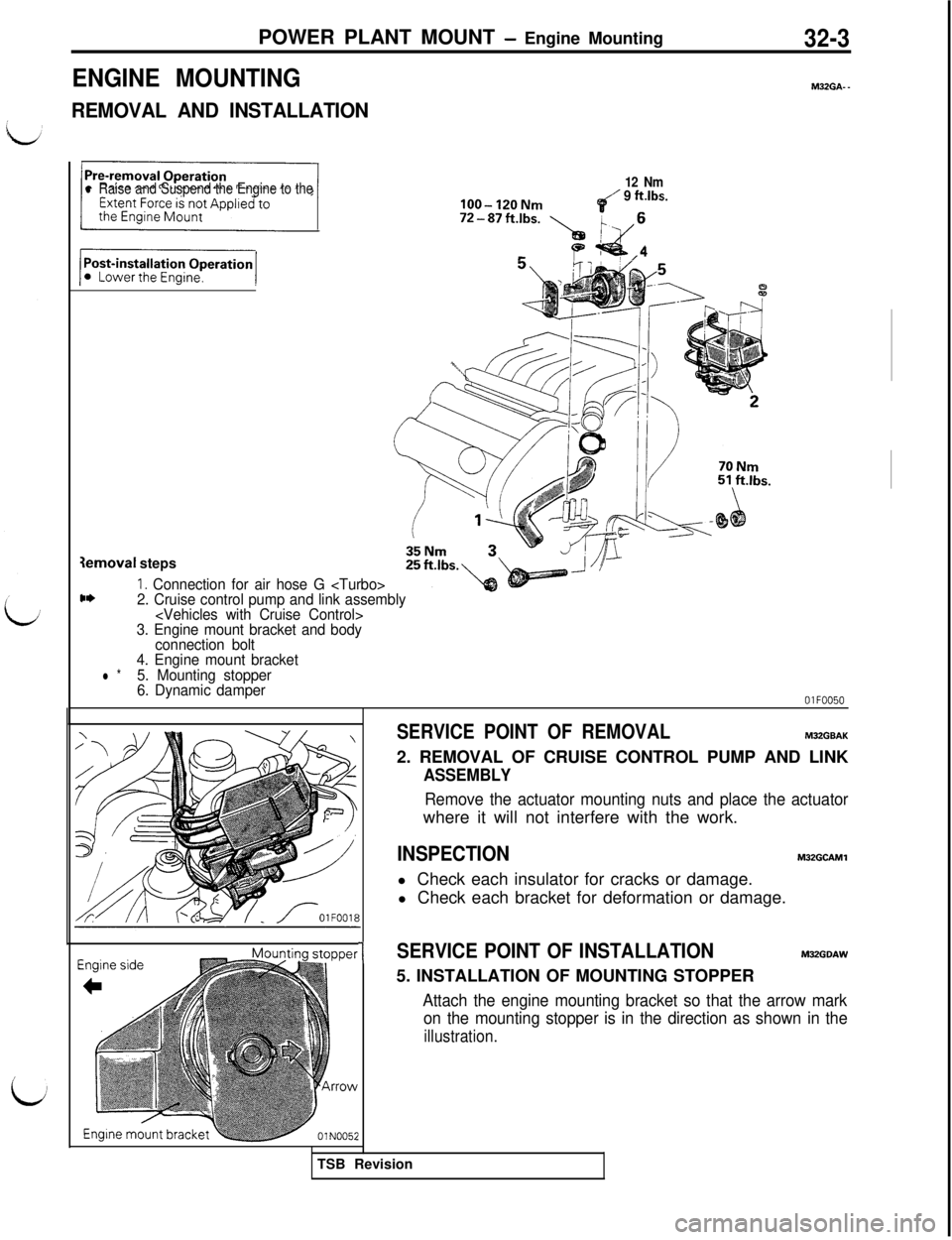
ENGINE MOUNTING
REMOVAL AND INSTALLATION
32-3
l Raise and Suspend the Engine to the12 Nm
lOO-120Nm(9 ftlbs.
72-87ftlbs. > &6
rI’ I/4
c*1. Connection for air hose G
2. Cruise control pump and link assembly
3. Engine mount bracket and body
connection bolt
4. Engine mount bracket
l *5. Mounting stopper
6. Dynamic damperOlFOO50
3emoval steps
SERVICE POINT OF REMOVALM32GBAK2. REMOVAL OF CRUISE CONTROL PUMP AND LINK
ASSEMBLY
Remove the actuator mounting nuts and place the actuatorwhere it will not interfere with the work.
INSPECTIONM32GCAMl
l Check each insulator for cracks or damage.
l Check each bracket for deformation or damage.
1SERVICE POINT OF INSTALLATIONM32GDAW
5. INSTALLATION OF MOUNTING STOPPER
Attach the engine mounting bracket so that the arrow mark
on the mounting stopper is in the direction as shown in the
illustration.TSB Revision
Page 647 of 1146
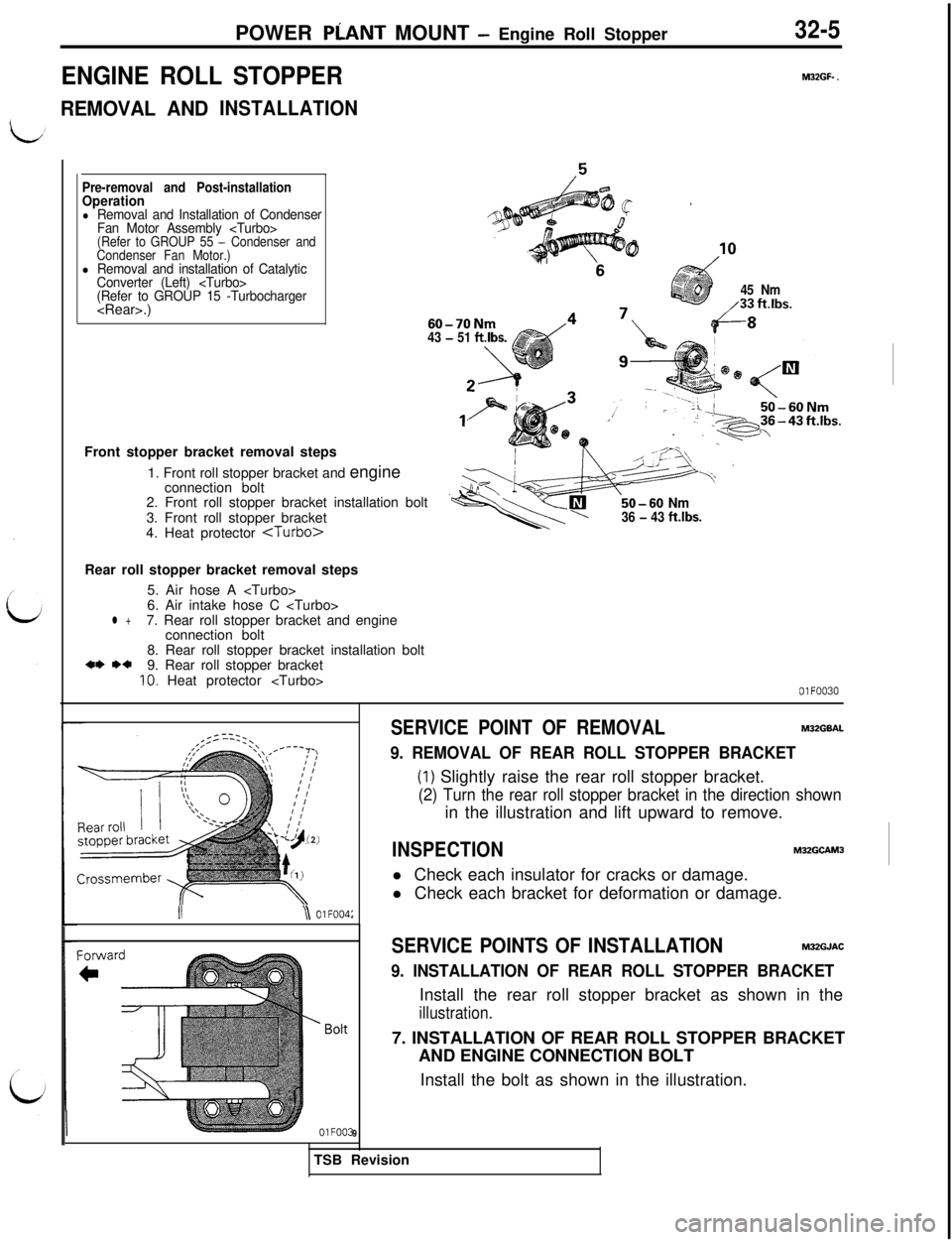
POWER PLANT MOUNT - Engine Roll Stopper
ENGINE ROLL STOPPER
REMOVAL ANDINSTALLATION
32-5
MJZGF- .
Pre-removal and Post-installationOperationl Removal and Installation of Condenser
Fan Motor Assembly
(Refer to GROUP 55 - Condenser and
Condenser Fan Motor.)
l Removal and installation of Catalytic
Converter (Left)
(Refer to GROUP 15 -Turbocharger
45 Nm/33 ft.lbs.
43
- 51 ftlbs.Front stopper bracket removal steps
1. Front roll stopper bracket and engine
connection bolt
2. Front roll stopper bracket installation bolt
3. Front roll stopper bracket
4. Heat protector
50-60 Nm36 - 43 ft.lbs.Rear roll stopper bracket removal steps
5. Air hose A
6. Air intake hose C
l +7. Rear roll stopper bracket and engine
connection bolt
8. Rear roll stopper bracket installation bolt
+* *+9. Rear roll stopper bracketIO. Heat protector
II\ OlFOO4:
SERVICE POINT OF REMOVALM32GEAL
9. REMOVAL OF REAR ROLL STOPPER BRACKET
(1) Slightly raise the rear roll stopper bracket.
(2) Turn the rear roll stopper bracket in the direction shownin the illustration and lift upward to remove.
INSPECTIONM32GCAM3l Check each insulator for cracks or damage.
l Check each bracket for deformation or damage.
9TSB Revision
SERVICE POINTS OF INSTALLATIONM32GJAC
9. INSTALLATION OF REAR ROLL STOPPER BRACKETInstall the rear roll stopper bracket as shown in the
illustration.7. INSTALLATION OF REAR ROLL STOPPER BRACKET
AND ENGINE CONNECTION BOLT
Install the bolt as shown in the illustration.
Page 666 of 1146
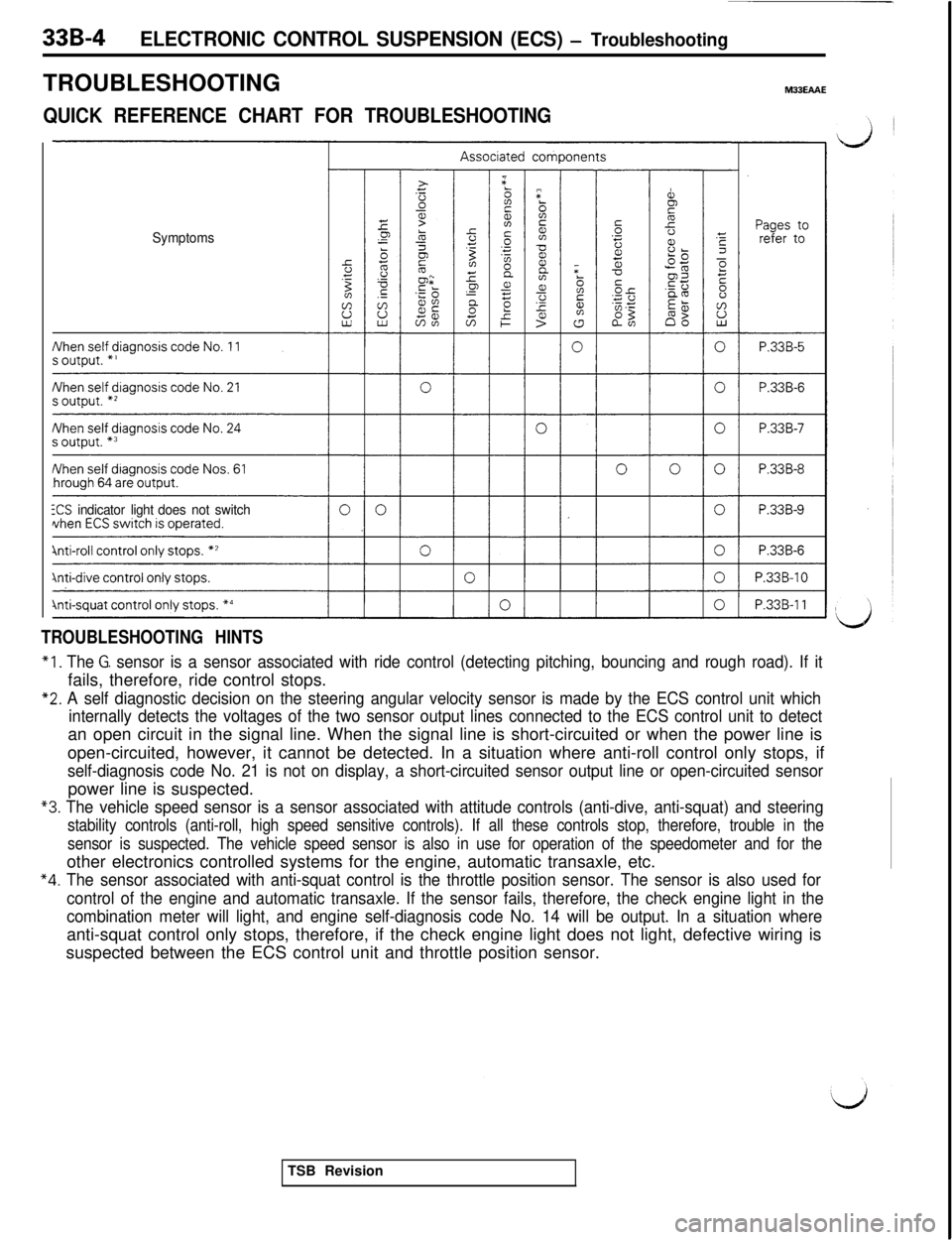
33B-4ELECTRONIC CONTROL SUSPENSION (ECS) - TroubleshootingTROUBLESHOOTING
M33EAAE
QUICK REFERENCE CHART FOR TROUBLESHOOTING
SymptomsXS
indicator lightdoes not switch
TROUBLESHOOTING HINTS
“1. The G. sensor is a sensor associated with ride control (detecting pitching, bouncing and rough road). If itfails, therefore, ride control stops.
“2. A self diagnostic decision on the steering angular velocity sensor is made by the ECS control unit which
internally detects the voltages of the two sensor output lines connected to the ECS control unit to detectan open circuit in the signal line. When the signal line is short-circuited or when the power line is
open-circuited, however, it cannot be detected. In a situation where anti-roll control only stops, if
self-diagnosis code No. 21 is not on display, a short-circuited sensor output line or open-circuited sensorpower line is suspected.
“3. The vehicle speed sensor is a sensor associated with attitude controls (anti-dive, anti-squat) and steering
stability controls (anti-roll, high speed sensitive controls). If all these controls stop, therefore, trouble in the
sensor is suspected. The vehicle speed sensor is also in use for operation of the speedometer and for theother electronics controlled systems for the engine, automatic transaxle, etc.
“4. The sensor associated with anti-squat control is the throttle position sensor. The sensor is also used for
control of the engine and automatic transaxle. If the sensor fails, therefore, the check engine light in the
combination meter will light, and engine self-diagnosis code No. 14 will be output. In a situation whereanti-squat control only stops, therefore, if the check engine light does not light, defective wiring is
suspected between the ECS control unit and throttle position sensor.
TSB Revision