sensor MITSUBISHI 3000GT 1991 Service Manual
[x] Cancel search | Manufacturer: MITSUBISHI, Model Year: 1991, Model line: 3000GT, Model: MITSUBISHI 3000GT 1991Pages: 1146, PDF Size: 76.68 MB
Page 1069 of 1146
SUPPLEMENTAL RESTRAINT SYSTEM (SRS)- SRS Diagnosis Unit (SDU) 52B-59
SRS DIAGNOSIS UNIT (SDU)M52PDBA
Caution1. Never attempt to disassemble or repair the
SRS diagnosis unit. If faulty, replace it.
2.Do not to drop or subject the SRS diagnosisunit to impact or vibration.
If denting, cracking, deformation, or rust are
discovered in the SRS diagnosis unit, replace
it with a new SRS diagnosis unit. Discard theold one.3. After deployment of an air bag, replace the
SRS diagnosis unit with a new one.
4.Never use an ohmmeter on or near the SRS
diagnosis unit, and use only the special testequipment described on
P.!i2B-16.
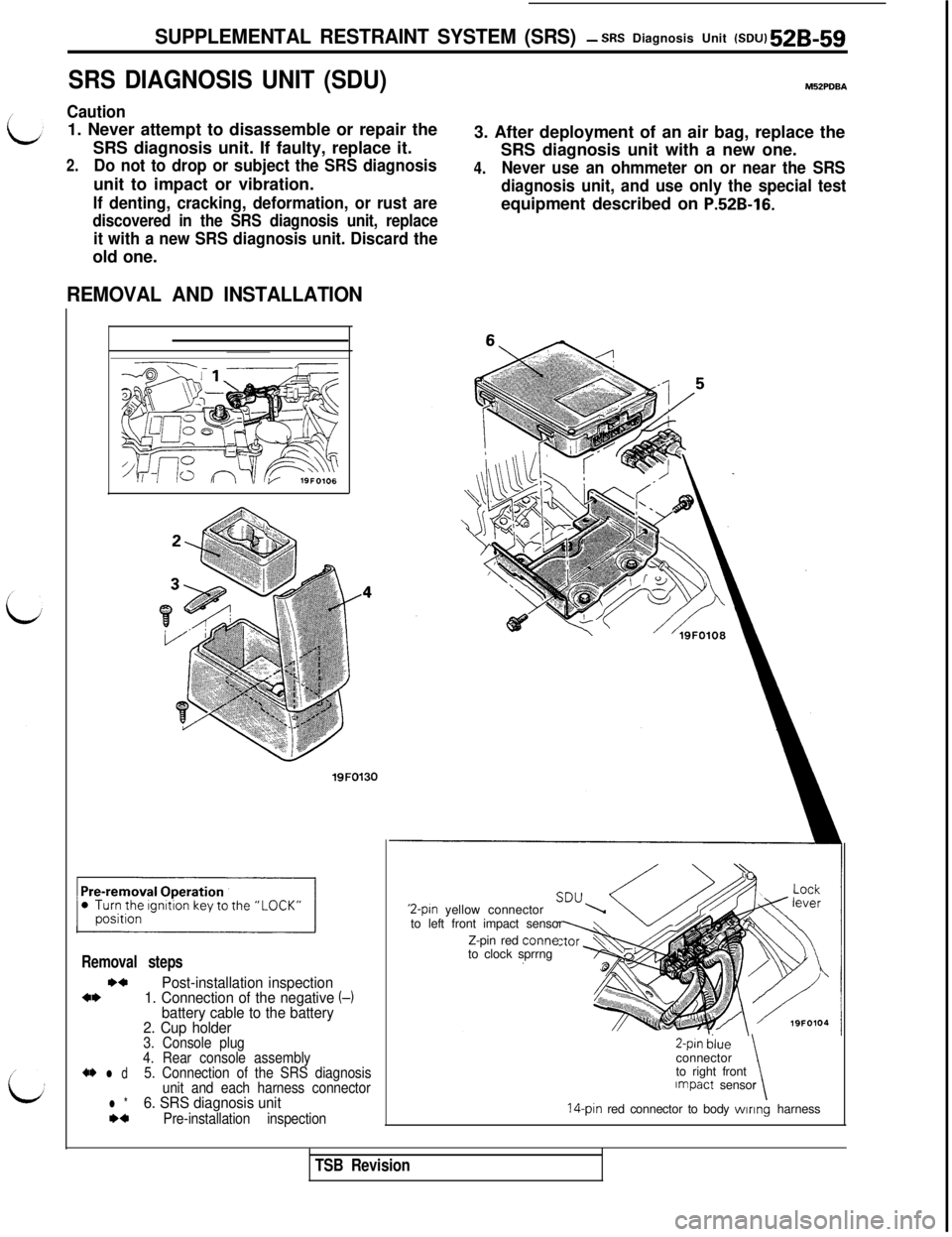
REMOVAL AND INSTALLATION
Removal steps
*aPost-installation inspectionaI)1. Connection of the negative
battery cable to the battery
2. Cup holder
19FO130
t-1
3. Console plug
4. Rear console assembly
a* l d5. Connection of the SRS diagnosis
unit and each harness connector
l *6. SRS diagnosis unit*cPre-installation inspection
2-pin yellow connector
to left front impact sensor
Z-pin red
tonneto clock sprrng
Z-pin dlueconnector
to right front
\Impact sensor14-pin red connector to body wlnng harness
TSB Revision
Page 1070 of 1146
52B-60 SUPPLEMENTAL RESTRAINT SYSTEM (SRS) - SRS Diagnosis Unit (SW
0I/-Battery e
13R0721lSF1072:
SRS diagnosis unitView A13R0704
To front impact sensor
(L.H.)
\To front impact sensor (R.H.1\I
I- - -,I1
\To clock springTo body wiring harness (14-pin)19FOllt
r-TSB I
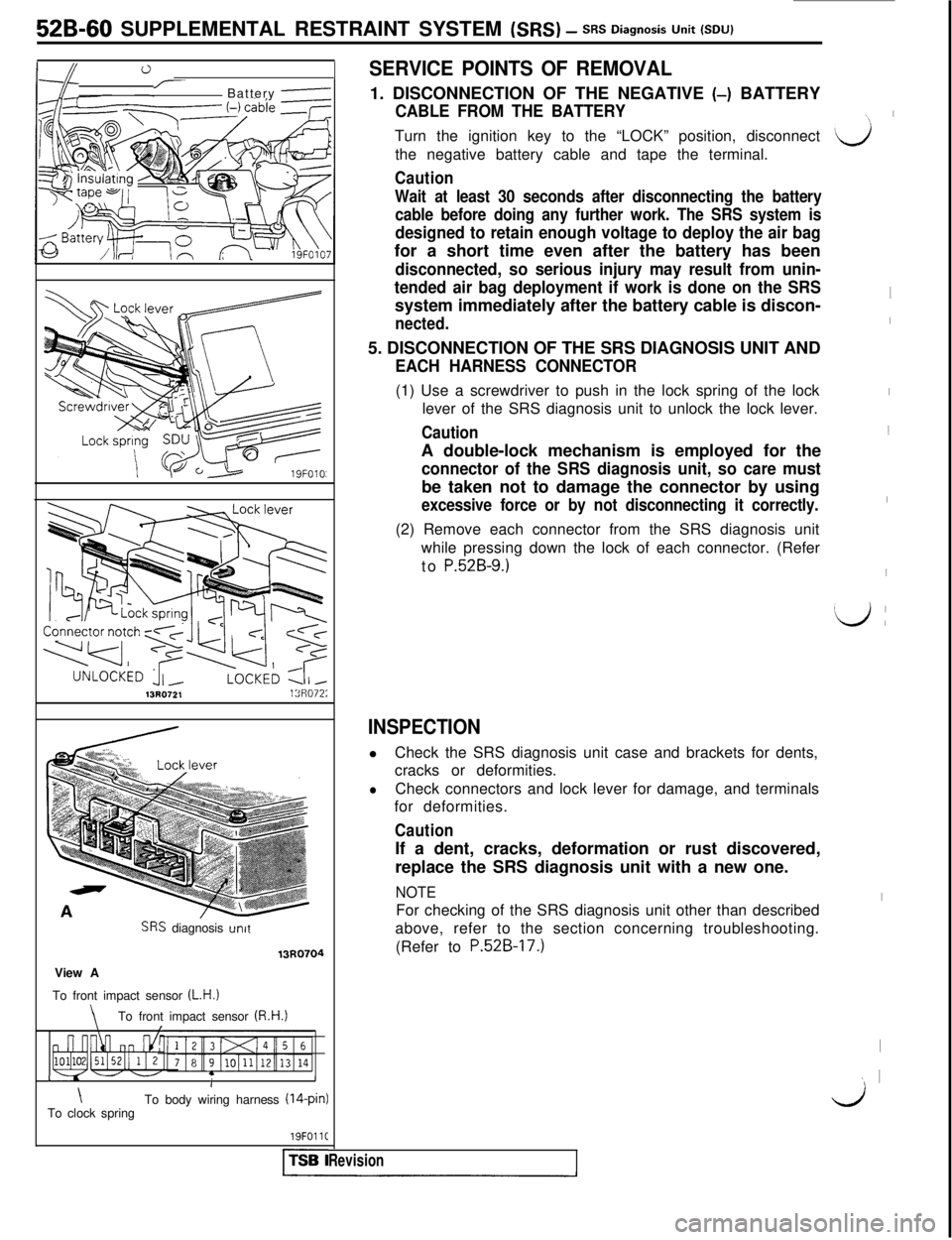
SERVICE POINTS OF REMOVAL1. DISCONNECTION OF THE NEGATIVE
(-) BATTERY
CABLE FROM THE BATTERYTurn the ignition key to the “LOCK” position, disconnect
the negative battery cable and tape the terminal.
Caution
Wait at least 30 seconds after disconnecting the battery
cable before doing any further work. The SRS system is
designed to retain enough voltage to deploy the air bagfor a short time even after the battery has been
disconnected, so serious injury may result from unin-
tended air bag deployment if work is done on the SRSsystem immediately after the battery cable is discon-
nected.5. DISCONNECTION OF THE SRS DIAGNOSIS UNIT AND
EACH HARNESS CONNECTOR(1) Use a screwdriver to push in the lock spring of the lock
lever of the SRS diagnosis unit to unlock the lock lever.
CautionA double-lock mechanism is employed for the
connector of the SRS diagnosis unit, so care mustbe taken not to damage the connector by using
excessive force or by not disconnecting it correctly.(2) Remove each connector from the SRS diagnosis unit
while pressing down the lock of each connector. (Refer
to
P.52B-9.)
INSPECTIONlCheck the SRS diagnosis unit case and brackets for dents,
cracks or deformities.
lCheck connectors and lock lever for damage, and terminals
for deformities.
CautionIf a dent, cracks, deformation or rust discovered,
replace the SRS diagnosis unit with a new one.
NOTEFor checking of the SRS diagnosis unit other than described
above, refer to the section concerning troubleshooting.
(Refer to
P.52B-17.)
Revision
\\I
‘d
I
I
I1
I~
\Lj (
I
I
~ I
kJ
Page 1083 of 1146
55-1
HEATER, AIR
CONDITIONER
AND VENTILATION
CONTENTSM55AA- -
HEATERS AND AIR CONDITIONING................3HEATER UNIT*........................................................................22
SPECIFICATIONS
....................................................................3REFRIGERANT LINE................................................................35General Specifications
........................................................3RESISTOR................................................................................20Lubricants
............................................................................4SAFETY PRECAUTIONS........................................................9Sealant and Adhesive............................................................4
Service Specifications3SERVICE ADJUSTMENT PROCEDURES............................10........................................................
SPECIAL TOOLS4Charging Procedures............................................................11
i
........................................................................Charging the Refrigerant....................................................12Compressor Drive Belt Adjustment....................................11
HEATERS AND MANUAL AIR CONDITIONER5Compressor Noise................................................................16
................................................16
AIR CONDITIONER SWITCH................................................21Handling Tubing andFittings
Idle-up Operation Check....................................................17
BELT LOCK CONTROLLER20Performance Test................................................................15....................................................
BLOWER ASSEMBLYPower Relay Check............................................................17............................................................23Refrigerant Leak Repair Procedure....................................15COMPRESSOR........................................................................
27TestProcedures....................................................................10
CONDENSER AND CONDENSER FAN MOTOR................33TROUBLESHOOTING............................................................5
ENGINE COOLANT TEMPERATURE SWITCH....................
39VENTILATORS (AIR INLET AND AIR OUTLET)................38
EVAPORATOR
........................................................................
25VENTILATORS (INSTRUMENT PANEL)*............................36
HEATER CONTROL ASSEMBLY*
........................................18CONTINUED ON NEXT PAGE
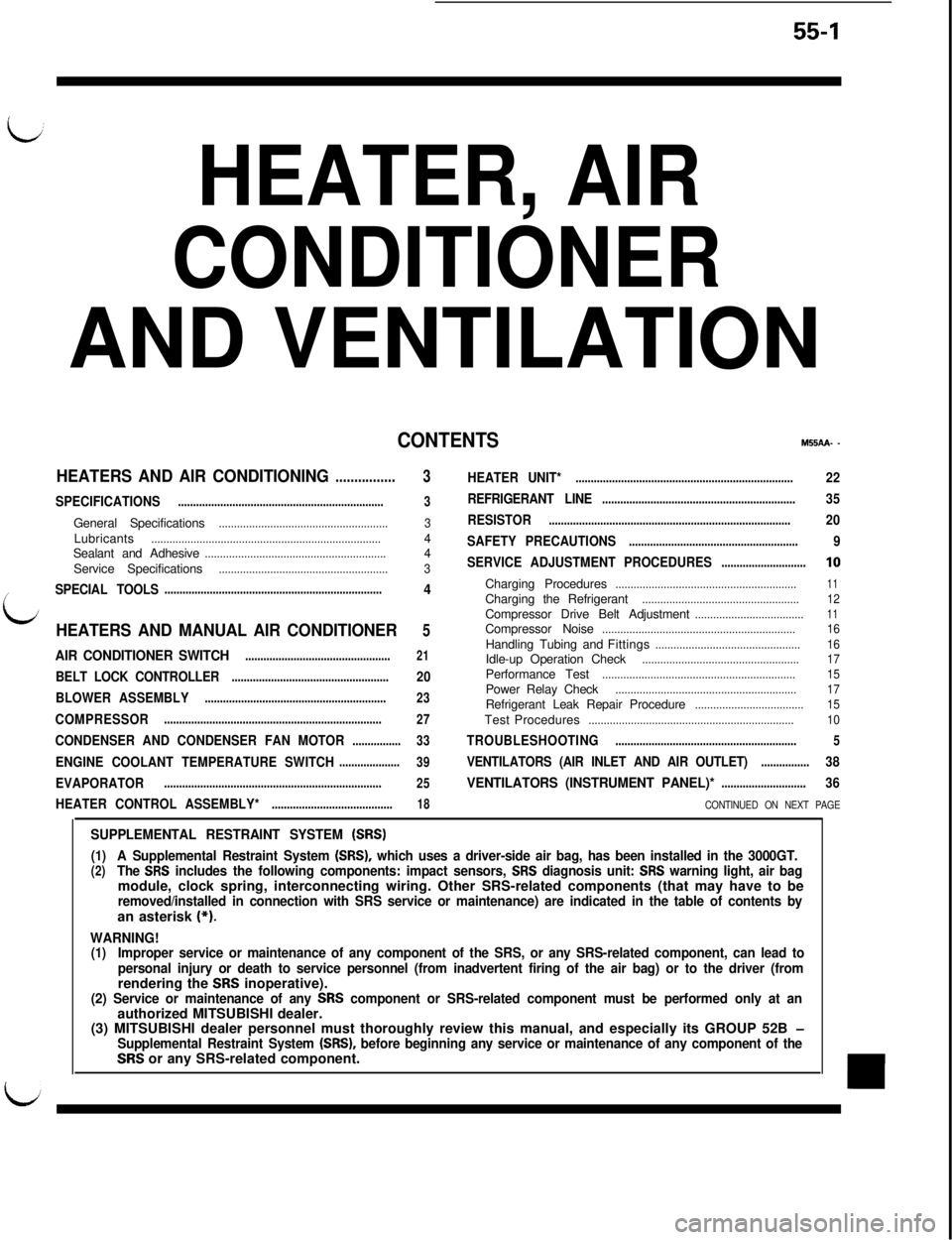
SUPPLEMENTAL RESTRAINT SYSTEM (SRS)
(1)A Supplemental Restraint System (SRS), which uses a driver-side air bag, has been installed in the 3000GT.(2)The SRS includes the following components: impact sensors, SRS diagnosis unit: SRS warning light, air bagmodule, clock spring, interconnecting wiring. Other SRS-related components (that may have to be
removed/installed in connection with SRS service or maintenance) are indicated in the table of contents byan asterisk (*).
WARNING!(1)Improper service or maintenance of any component of the SRS, or any SRS-related component, can lead to
personal injury or death to service personnel (from inadvertent firing of the air bag) or to the driver (fromrendering the
SRS inoperative).(2) Service or maintenance of any SRS component or SRS-related component must be performed only at anauthorized MITSUBISHI dealer.
(3) MITSUBISHI dealer personnel must thoroughly review this manual, and especially its GROUP 52B
-Supplemental Restraint System (SRS), before beginning any service or maintenance of any component of theSRS or any SRS-related component.
Page 1084 of 1146

55-2FULL AUTO AIR CONDITIONER........................40OTHER PARTS........................................................................62
AIR-CONDITIONER CONTROL PANEL*,POWER TRANSISTOR, BELT LOCK CONTROLLER........57
AIR-CONDITIONER CONTROL UNIT*................................56
REFRIGERANT LINE................................................................62
COMPRESSOR
........................................................................62SAFETY PRECAUTlONS........................................................56
CONDENSER AND CONDENSER FAN MOTOR
................
62SENSORS....................................................................................60
DAMPER CONTROL MOTOR ASSEMBLY*........................
58SERVICE ADJUSTMENT PROCEDURES............................56
ENGINE COOLANT TEMPERATURE SWITCH
....................62
TROUBLESHOOTING............................................................40
Page 1085 of 1146
HEATER, AIR CONDITIONER AND VENTILATION - Specifications55-3
HEATER, AIR CONDITIONER AND VENTILATION
LSPECIFICATIONSM55CA. -
/’
L;
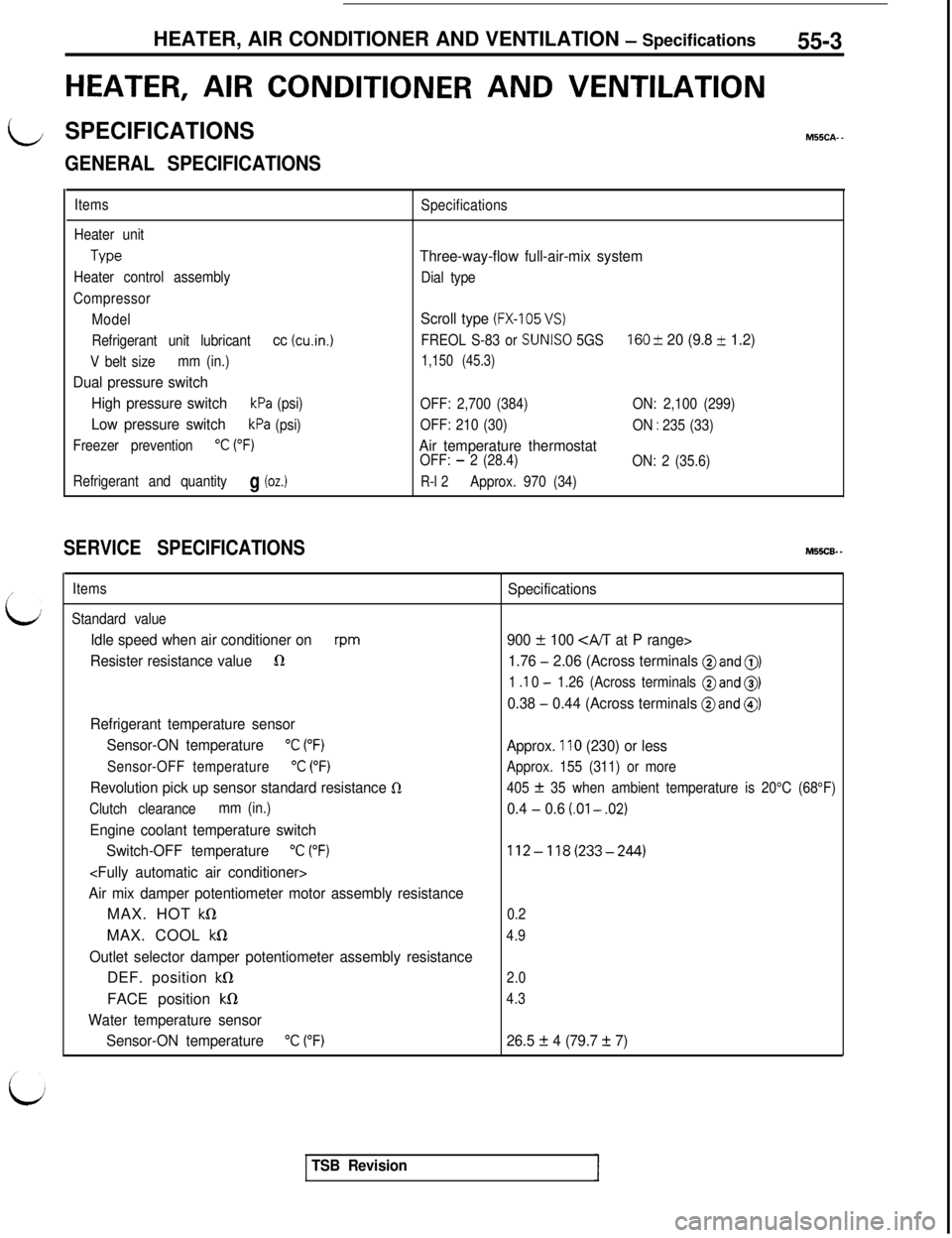
GENERAL SPECIFICATIONS
Items
Heater unit
Type
Heater control assembly
Compressor
Model
Refrigerant unit lubricant
cc (cu.in.1
V belt sizemm (in.)
Dual pressure switch
High pressure switch
kPa (psi)
Low pressure switchkPa (psi)
Freezer prevention
“C (“F)
Refrigerant and quantityg (oz.)
Specifications
Three-way-flow full-air-mix system
Dial type
Scroll type (FX-105 VS)
FREOL S-83 or SUNISO 5GS160 & 20 (9.8 + 1.2)
1,150 (45.3)
OFF: 2,700 (384)ON: 2,100 (299)
OFF: 210 (30)
ON
: 235 (33)
Air temperature thermostatOFF: - 2 (28.4)
ON: 2 (35.6)
R-l 2Approx. 970 (34)
SERVICE SPECIFICATIONSM55CB. -
Items
Standard value
Idle speed when air conditioner onrpm
Resister resistance value1R
Refrigerant temperature sensor
Sensor-ON temperature
“C (“F)
Sensor-OFF temperature“C (“F)
Revolution pick up sensor standard resistance 0
Clutch clearancemm (in.)
Engine coolant temperature switch
Switch-OFF temperature
“C (“F)
Air mix damper potentiometer motor assembly resistanceMAX. HOT
kQMAX. COOL
kS1
Outlet selector damper potentiometer assembly resistanceDEF. position
kS1FACE position
kfl
Water temperature sensor
Sensor-ON temperature
“C (“F)
Specifications
900
f 100 CA/T at P range>
1.76
- 2.06 (Across terminals @and 0)
1 .I 0 - 1.26 (Across terminals @and 0)
0.38 - 0.44 (Across terminals @and @)
Approx. 110 (230) or less
Approx. 155 (311) or more
405
f 35 when ambient temperature is 20°C (68°F)
0.4 - 0.6 (.Ol - .02)
112-118(233-244)
0.2
4.9
2.0
4.3
26.5 f 4 (79.7 + 7)
TSB Revision
Page 1088 of 1146
55-6HEATERS AND MANUAL AIR CONDITIONER - Troubleshooting
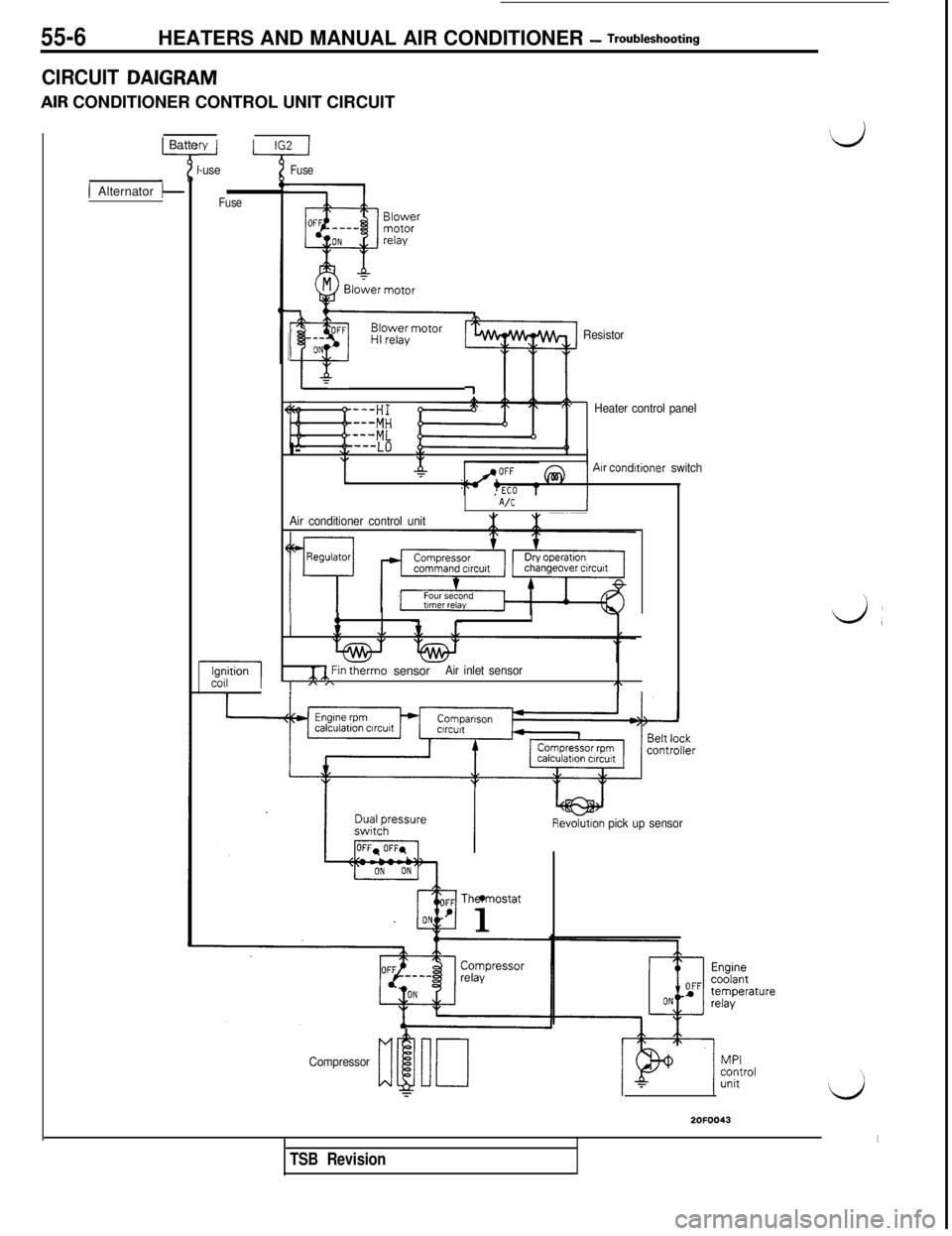
CIRCUIT DAIGRAM
P\IR CONDITIONER CONTROL UNIT CIRCUIT
1 Batte
( Alternator k
2-Jl-
-use
Fuse
-yq
L-l
Fuse
vi ~~o~~;motor ;?IResistor;
r---HI---MH:---ML---I n
IIHeater control panelI-
fI.IAir conditioner switch
1
Air conditioner control unit
A/CI
Regulator
IT
If
I
1II
1 IFin therm0 sensorAir inlet sensor
I” ”I\
Revolution pick up sensori
Compressor
@IDY
vi;
TSB Revision
2OFOO43
I
Page 1089 of 1146
L
2OFOO85HEATERS AND MANUAL AIR CONDITIONER
- Trqubleshooting55-7
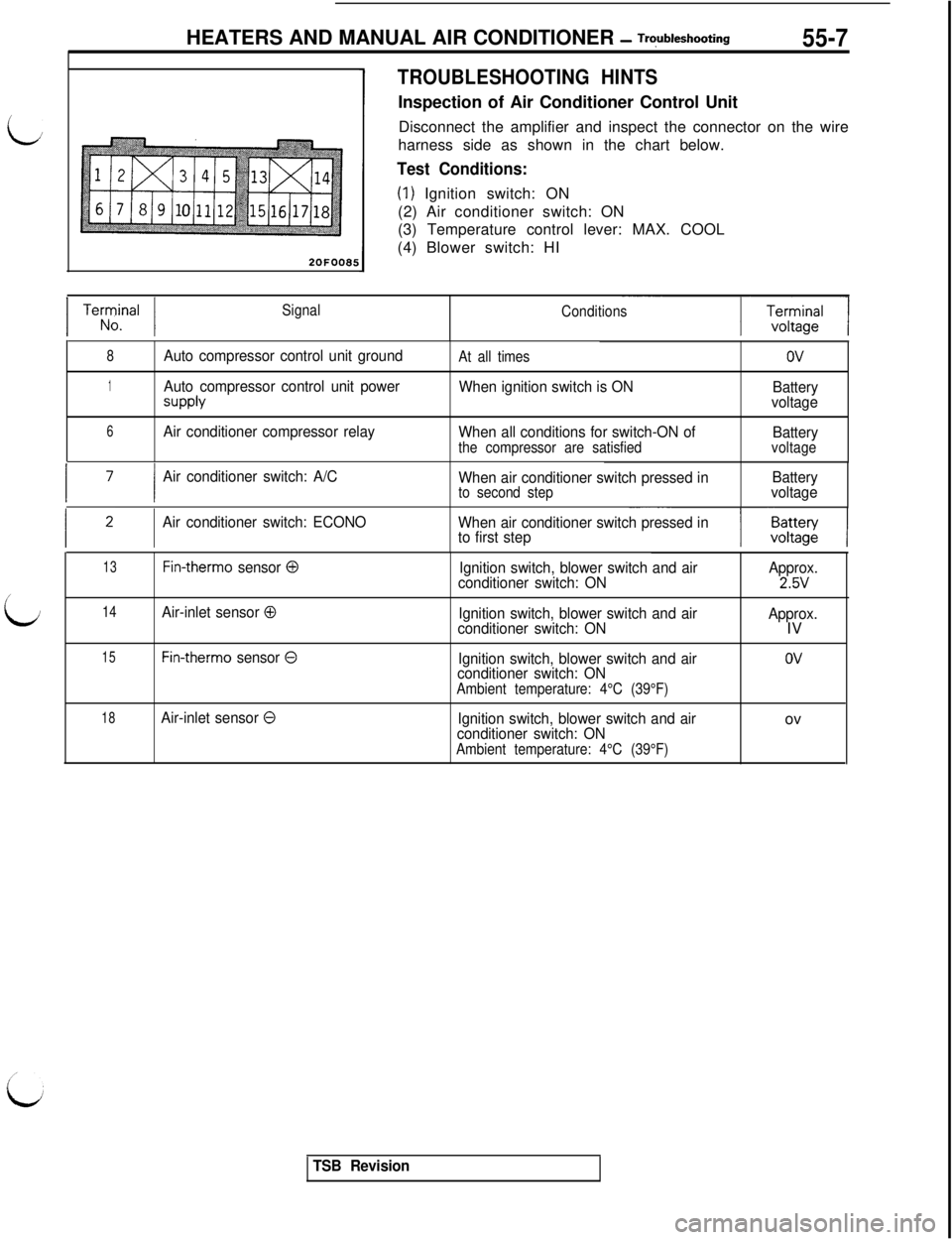
TROUBLESHOOTING HINTSInspection of Air Conditioner Control Unit
Disconnect the amplifier and inspect the connector on the wire
harness side as shown in the chart below.
Test Conditions:
(1) Ignition switch: ON
(2) Air conditioner switch: ON
(3) Temperature control lever: MAX. COOL
(4) Blower switch: HI
1 Terrrnal 1Signal
Conditions
8Auto compressor control unit groundAt all timesov
1Auto compressor control unit power
SUPPlY
When ignition switch is ON
Battery
voltage
6Air conditioner compressor relay
When all conditions for switch-ON of
Battery
the compressor are satisfiedvoltage
I ’I
Air conditioner switch: A/C
When air conditioner switch pressed inBattery
to second stepvoltage
Air conditioner switch: ECONO
When air conditioner switch pressed in
to first step
13Fin-therm0 sensor 0Ignition switch, blower switch and airApprox.
conditioner switch: ON2.5V/
LJ14Air-inlet sensor 0Ignition switch, blower switch and air
conditioner switch: ONApprox.IV
15Fin-therm0 sensor 0Ignition switch, blower switch and air
conditioner switch: ON
Ambient temperature: 4°C (39°F)
OV
18Air-inlet sensor 0Ignition switch, blower switch and air
conditioner switch: ON
Ambient temperature: 4°C (39°F)ov
TSB Revision
Page 1090 of 1146
55-8HEATERS AND MANUAL AIR CONDITIONER - Troubleshooting
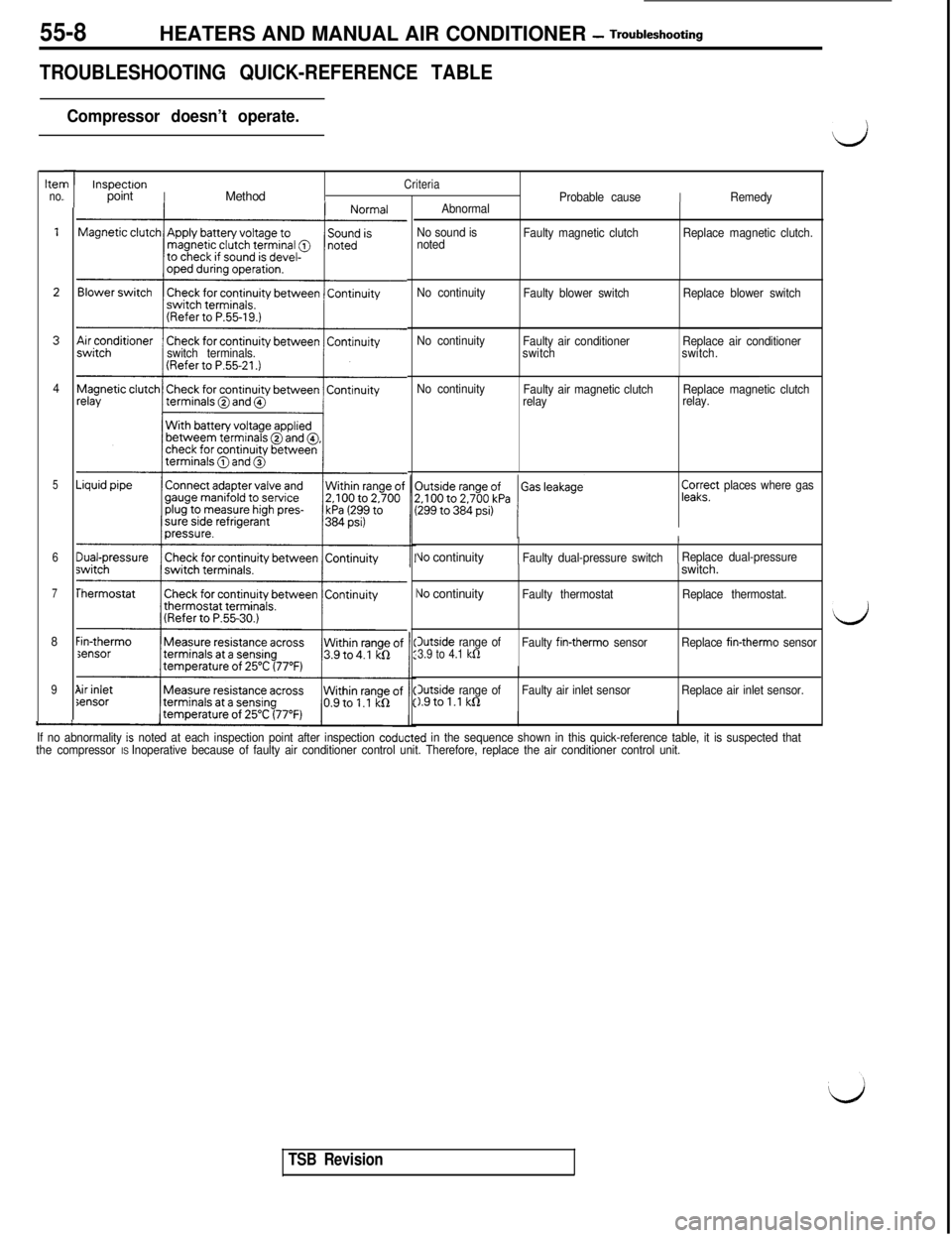
TROUBLESHOOTING QUICK-REFERENCE TABLE
Compressor doesn’t operate.
hen
no.
4
5
6
7
8
9
-
I
I
/
L
switch terminals.
Sensor
”
1
InspectronCriteriapointIMethodProbable causeIRemedy
Abnormal
No sound is
notedFaulty magnetic clutchReplace magnetic clutch.
No continuity
Faulty blower switchReplace blower switch
No continuity
Faulty air conditioner
switchReplace air conditioner
switch.
No continuity
Faulty air magnetic clutch
relayReplace magnetic clutch
relay.
pa;?’ places where gas
II
Vo continuityFaulty dual-pressure switchReplace dual-pressure
\Jo continuityIFaulty thermostatswitch.Replace thermostat.
Outside range of3.9 to 4.1 kfiFaulty fin-therm0 sensorReplace fin-therm0 sensor
3utside range ofFaulty air inlet sensor1.9tol.l kQReplace air inlet sensor.
If no abnormality
is noted at each inspection point after inspection coducted in the sequence shown in this quick-reference table, it is suspected that
the compressor IS Inoperative because of faulty air conditioner control unit. Therefore, replace the air conditioner control unit.
d
d
TSB Revision
Page 1093 of 1146
HEATERS AND MANUAL AIR CONDITIONER -Service Adjustment Procedures 55 1 1
lr In et sensor
UC03xD:c.-;am$2lYXSC0x.x
xa0:: :,:::25 cc,ii 77h>Temperature20A043F
argqse
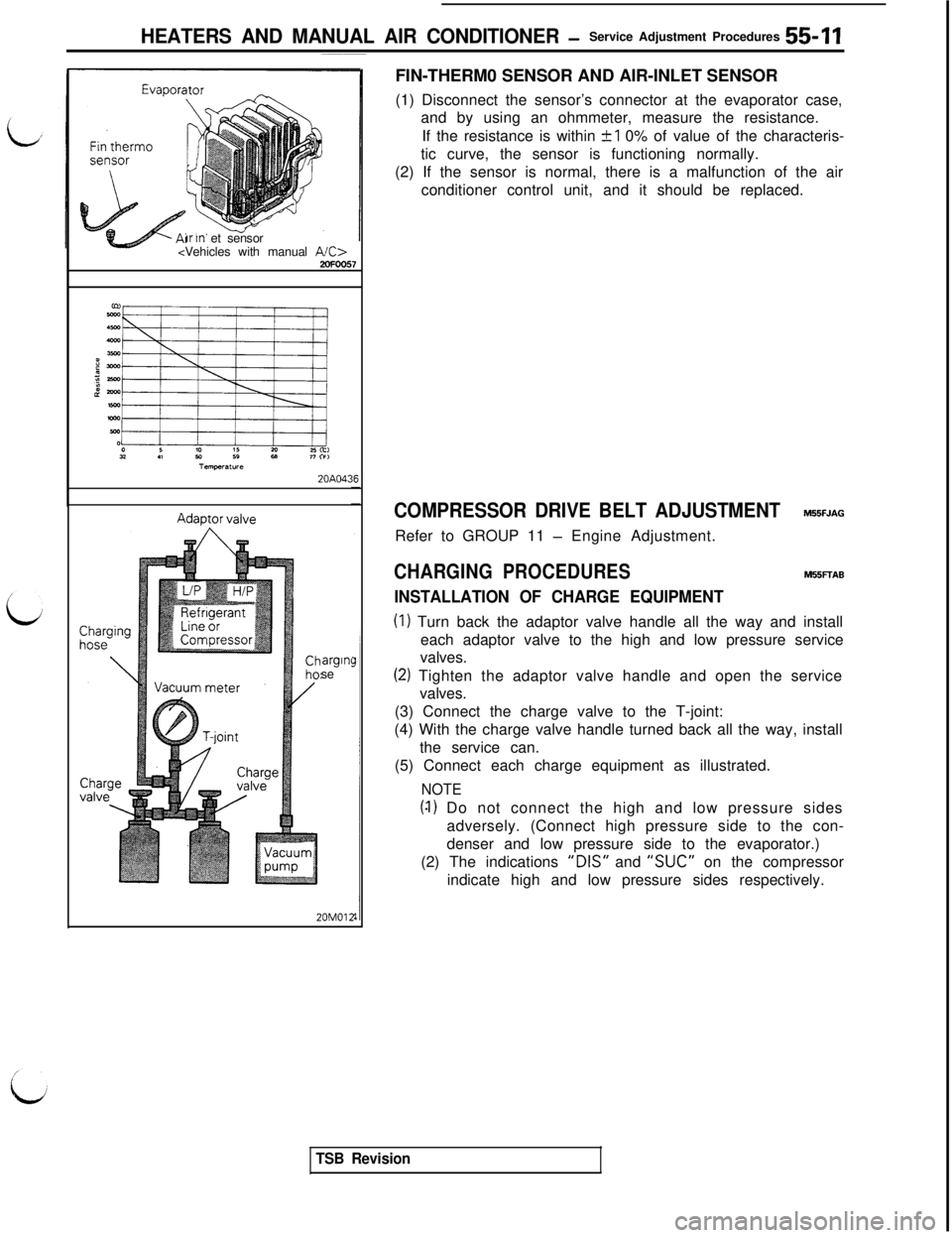
20M012FIN-THERM0 SENSOR AND AIR-INLET SENSOR
(1) Disconnect the sensor’s connector at the evaporator case,
and by using an ohmmeter, measure the resistance.
If the resistance is within
+I 0% of value of the characteris-
tic curve, the sensor is functioning normally.
(2) If the sensor is normal, there is a malfunction of the air
conditioner control unit, and it should be replaced.
COMPRESSOR DRIVE BELT ADJUSTMENTM55FJAGRefer to GROUP 11
- Engine Adjustment.
CHARGING PROCEDURESM55FTAB
INSTALLATION OF CHARGE EQUIPMENT
(I) Turn back the adaptor valve handle all the way and install
each adaptor valve to the high and low pressure service
valves.
(2) Tighten the adaptor valve handle and open the service
valves.
(3) Connect the charge valve to the T-joint:
(4) With the charge valve handle turned back all the way, install
the service can.
(5) Connect each charge equipment as illustrated.
NOTE
(4) Do not connect the high and low pressure sides
adversely. (Connect high pressure side to the con-
denser and low pressure side to the evaporator.)
(2) The indications
“DIS” and “SUC” on the compressor
indicate high and low pressure sides respectively.
TSB Revision
Page 1107 of 1146
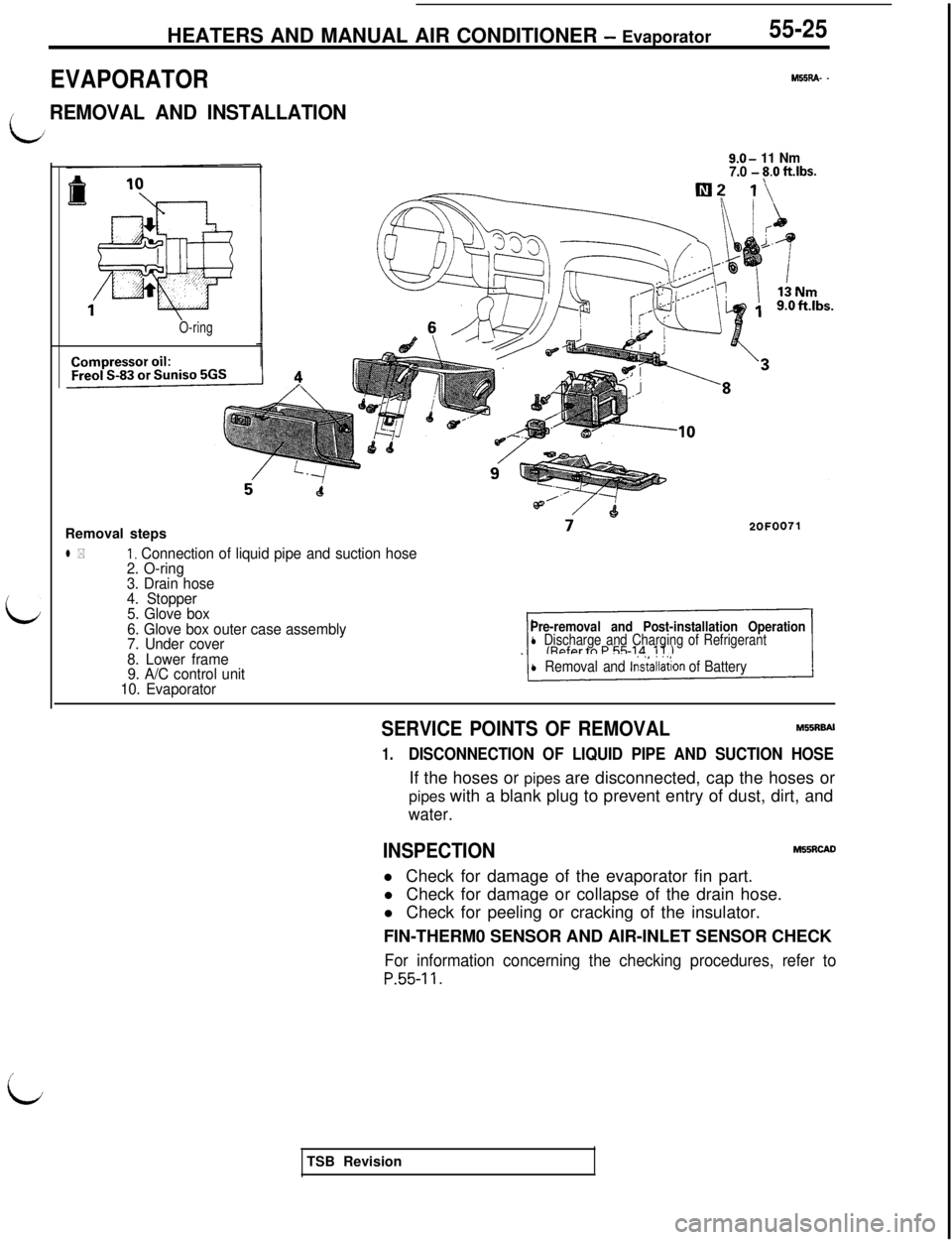
HEATERS AND MANUAL AIR CONDITIONER - Evaporator55-25
EVAPORATOR
M55RA- -
/REMOVAL AND INSTALLATION
9.0- 11 Nm
7.0 - 8.0 ftlbs.
i
O-ringRemoval steps
l *I, Connection of liquid pipe and suction hose
2. O-ring
3. Drain hose
4. Stopper
5. Glove box
6. Glove box outer case assembly
7. Under cover
8. Lower frame
9. A/C control unit
10. Evaporator
Pre-removal and Post-installation Operationl Discharge and Charging of Refrigerant
l Removal and lns~allation of Battery
SERVICE POINTS OF REMOVALM55RBAl
1.DISCONNECTION OF LIQUID PIPE AND SUCTION HOSEIf the hoses or pipes are disconnected, cap the hoses or
pipes with a blank plug to prevent entry of dust, dirt, and
water.
INSPECTIONM55RcADl Check for damage of the evaporator fin part.
l Check for damage or collapse of the drain hose.
l Check for peeling or cracking of the insulator.
FIN-THERM0 SENSOR AND AIR-INLET SENSOR CHECK
For information concerning the checking procedures, refer to
P.55-11.
iTSB Revision