lock MITSUBISHI 3000GT 1991 Owner's Manual
[x] Cancel search | Manufacturer: MITSUBISHI, Model Year: 1991, Model line: 3000GT, Model: MITSUBISHI 3000GT 1991Pages: 1146, PDF Size: 76.68 MB
Page 84 of 1146
II-34ENGINE - Cylinder Head and Valve
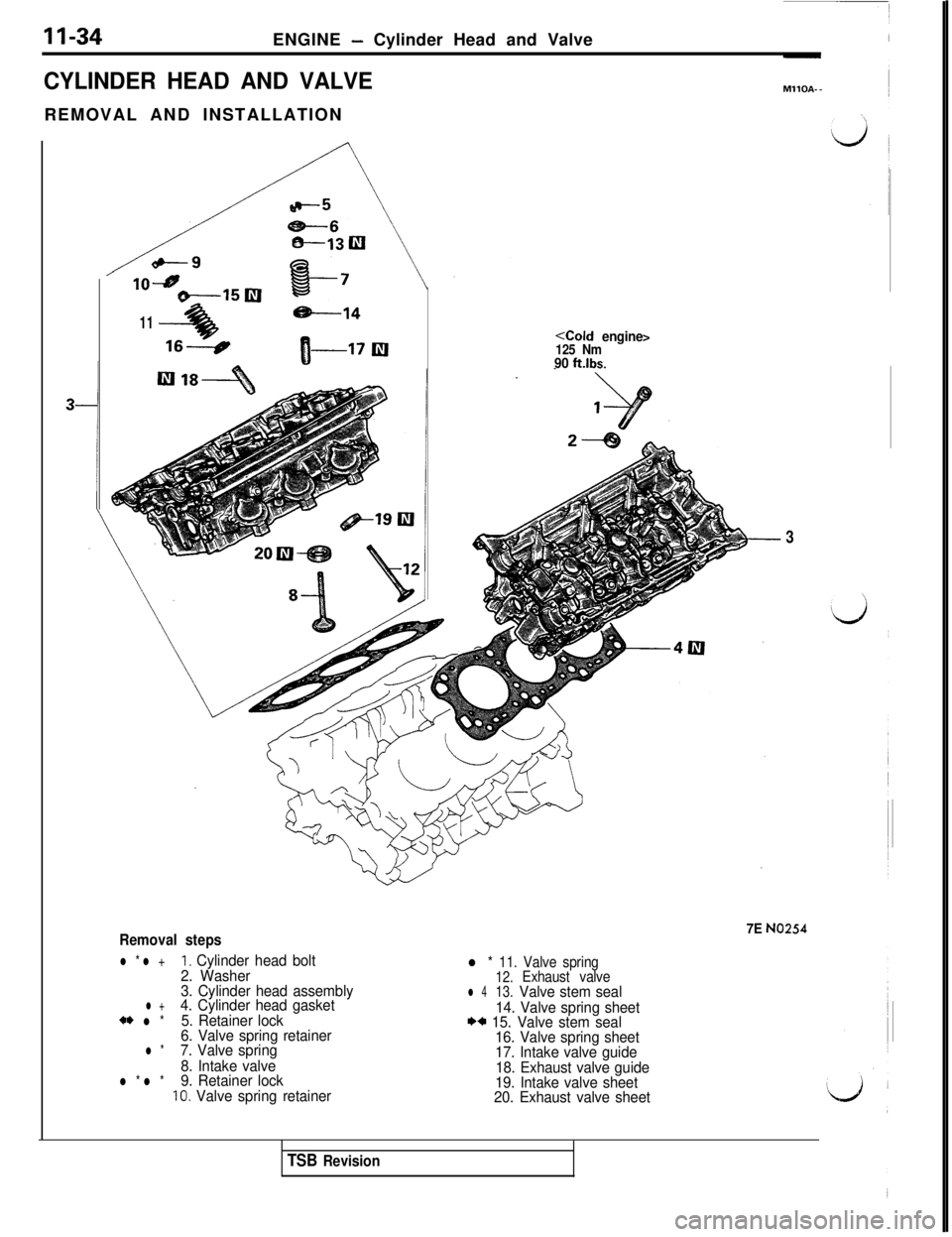
CYLINDER HEAD AND VALVEREMOVAL AND INSTALLATION
’ 104e------1510
11-A16-----P
Removal steps
l * l +I. Cylinder head bolt
2. Washer
3. Cylinder head assembly
l +4. Cylinder head gasket
** l *5. Retainer lock
6. Valve spring retainer
l *7. Valve spring
8. Intake valve
l * l *9. Retainer lock10. Valve spring retainer
7E NO254
l * 11. Valve spring12.Exhaust valvel 413.Valve stem seal
14. Valve spring sheet
I)* 15. Valve stem seal
16. Valve spring sheet
17. Intake valve guide
18. Exhaust valve guide
19. Intake valve sheet
20. Exhaust valve sheet
3
TSB Revision
Page 85 of 1146
ENGINE - Cvlinder Head and ValveII-35SERVICE POINTS OF REMOVAL
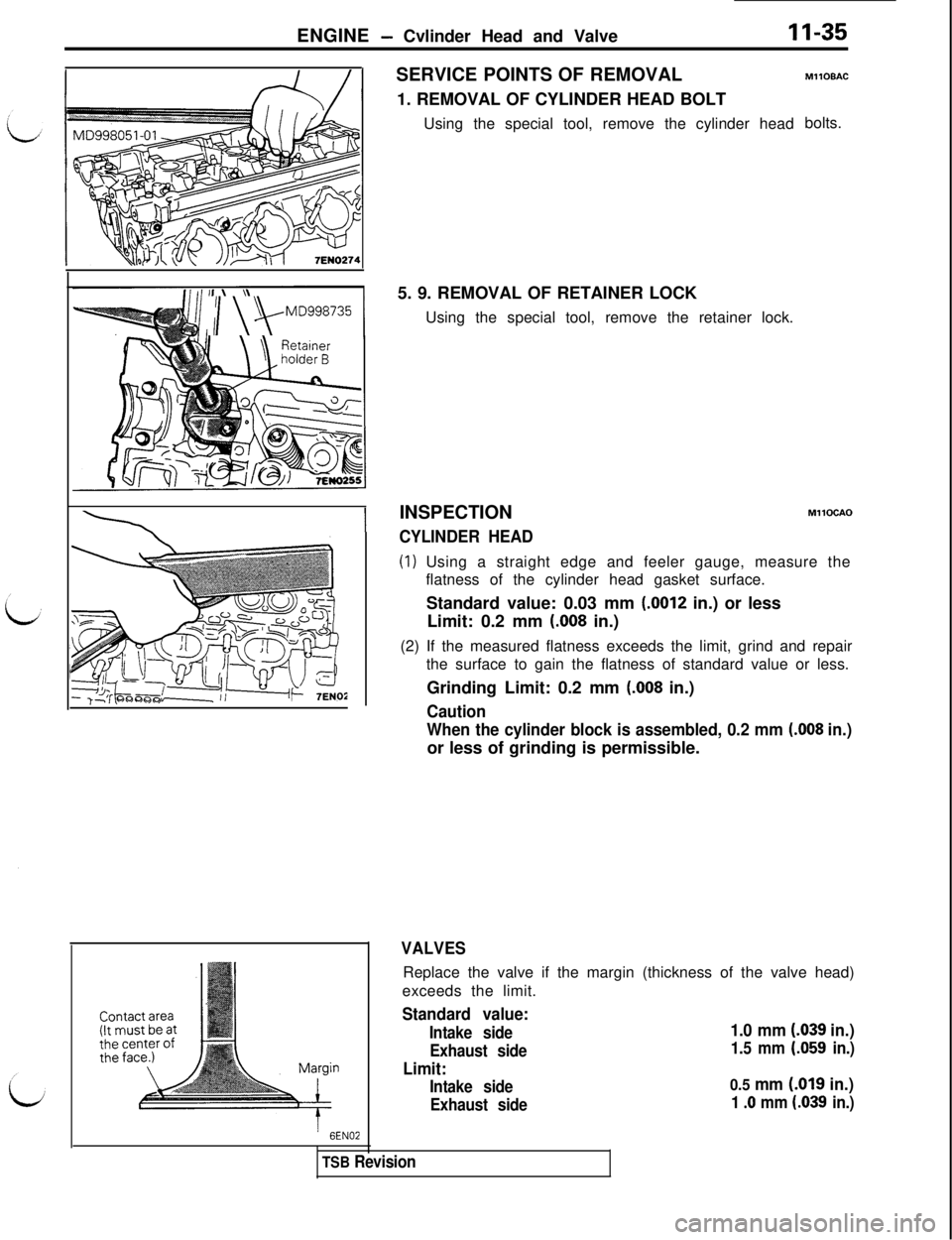
1. REMOVAL OF CYLINDER HEAD BOLT
Using the special tool, remove the cylinder head
u 1 \+-MD998735 15. 9. REMOVAL OF RETAINER LOCK
Using the special tool, remove the retainer lock.
’ 6EN02INSPECTION
CYLINDER HEAD
MllOBACbolts.
MllOCAO
(1) Using a straight edge and feeler gauge, measure the
flatness of the cylinder head gasket surface.
Standard value: 0.03 mm (0012 in.) or less
Limit: 0.2 mm
(008 in.)
(2) If the measured flatness exceeds the limit, grind and repair
the surface to gain the flatness of standard value or less.
Grinding Limit: 0.2 mm
(.008 in.)
Caution
When the cylinder block is assembled, 0.2 mm
(.008 in.)or less of grinding is permissible.
VALVESReplace the valve if the margin (thickness of the valve head)
exceeds the limit.
Standard value:
Intake side1.0 mm (039 in.)
Exhaust side1.5 mm (.059 in.)
Limit:
Intake side0.5 mm (019 in.)
Exhaust side1 .O mm (.039 in.)
TSB Revision
Page 87 of 1146
ENGINE - Cylinder Head and Valve
Oversize I.D.
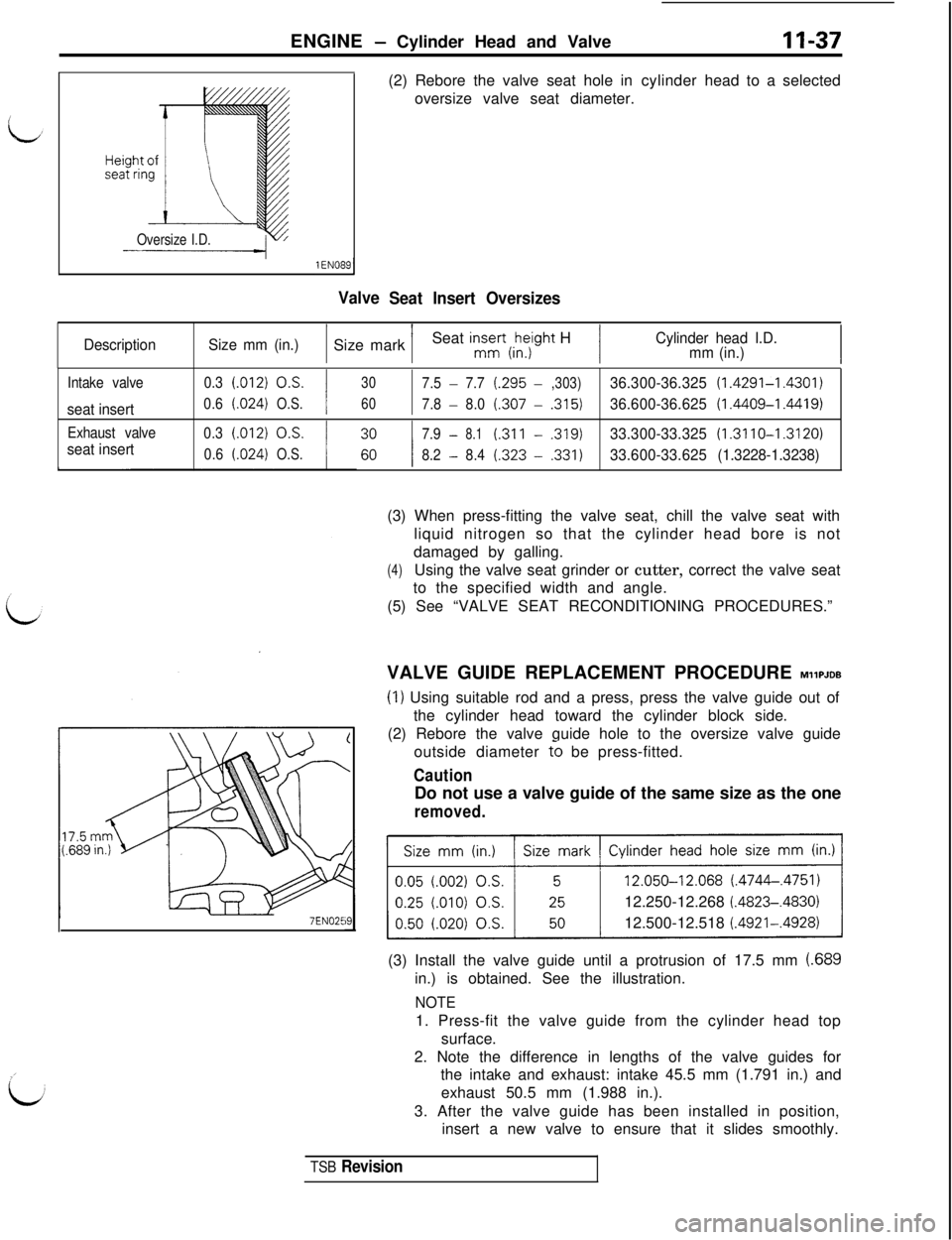
Valve(2) Rebore the valve seat hole in
oversize valve seat diameter.Seat Insert Oversizescylinderhead to a selected
DescriptionSize mm (in.)1 Size mark /Seat insEt(,ke;ght H/Cylinder head I.D.
mm (in.)
Intake valve0.3i.012)0,s.
I
30
I
7.5-7.7(.295-,303)36.300-36.325(1.4291-1.4301)
seat insert
0.6(.024)O.S.607.8-8.0(.307-,315)36.600-36.625(1.4409-1.4419)
Exhaust valve
seat insert
0.3l.012)0,s.7.9-8.1(.311-.319)33.300-33.325(1.3110-1.3120)
0.6(.024)O.S.8.2-8.4t.323-,331)33.600-33.625(1.3228-1.3238)
7EN02E(3) When press-fitting the valve seat, chill the valve seat with
liquid nitrogen so that the cylinder head bore is not
damaged by galling.
(4)Using the valve seat grinder or cutter, correct the valve seat
to the specified width and angle.
(5) See “VALVE SEAT RECONDITIONING PROCEDURES.”
VALVE GUIDE REPLACEMENT PROCEDURE
MllPJDB
(1) Using suitable rod and a press, press the valve guide out of
the cylinder head toward the cylinder block side.
(2) Rebore the valve guide hole to the oversize valve guide
outside diameter
to be press-fitted.
CautionDo not use a valve guide of the same size as the one
removed.12.250-12.268
(.4823-.4830)12.500-12.518
(.4921-.4928)(3) Install the valve guide until a protrusion of 17.5 mm
(.689in.) is obtained. See the illustration.
NOTE1. Press-fit the valve guide from the cylinder head top
surface.
2. Note the difference in lengths of the valve guides for
the intake and exhaust: intake 45.5 mm (1.791 in.) and
exhaust 50.5 mm (1.988 in.).
3. After the valve guide has been installed in position,
insert a new valve to ensure that it slides smoothly.
TSB Revision
Page 88 of 1146
11-38ENGINE - Cylinder Head and Valve
Enamelcoatedside
Springretainer
Stem seal
pring sheet
6EN024SERVICE POINTS OF INSTALLATION
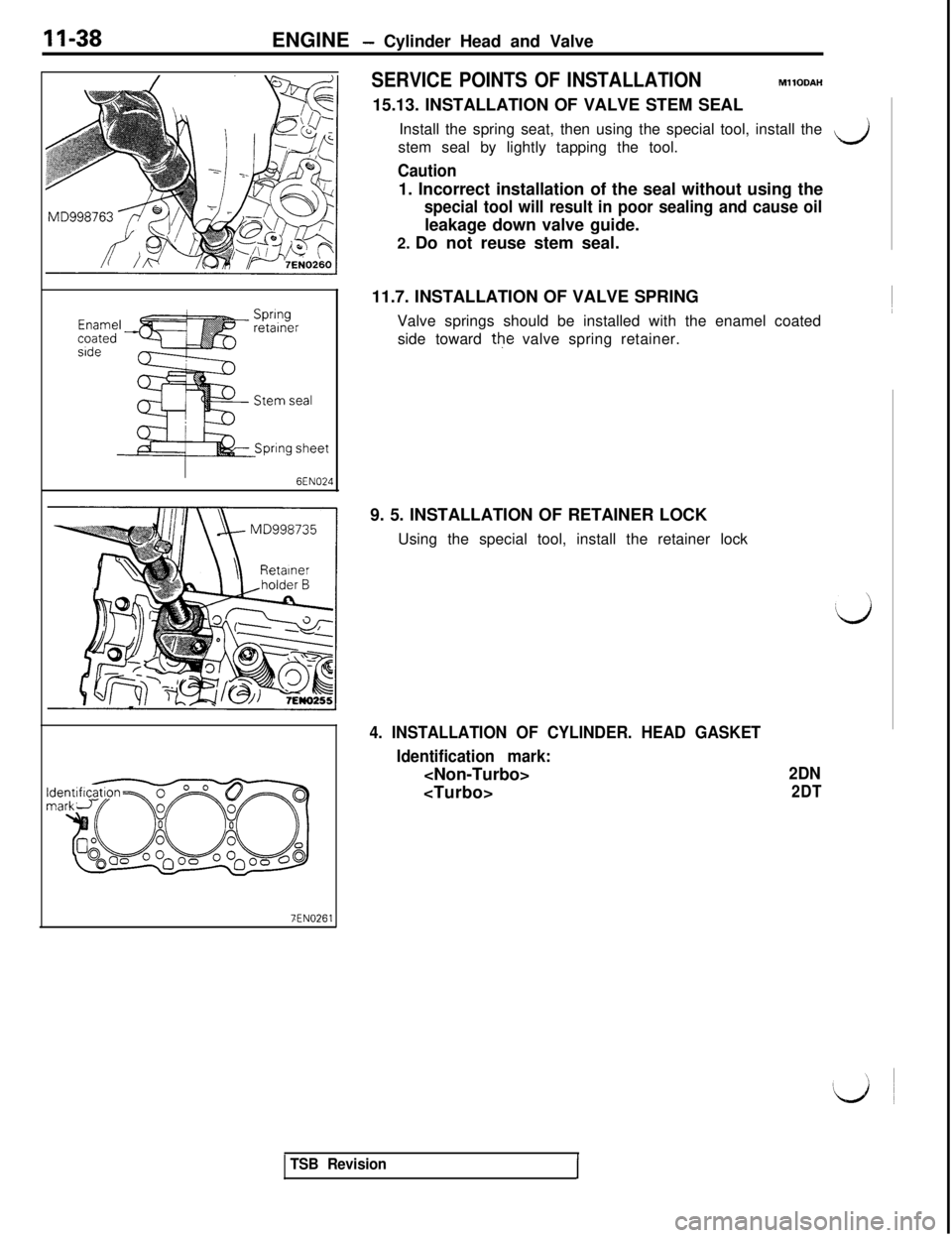
MllODAH15.13. INSTALLATION OF VALVE STEM SEAL
Install the spring seat, then using the special tool, install the
stem seal by lightly tapping the tool.
d
Caution1. Incorrect installation of the seal without using the
special tool will result in poor sealing and cause oilleakage down valve guide.
2. Do not reuse stem seal.
11.7. INSTALLATION OF VALVE SPRING
Valve springs should be installed with the enamel coated
side toward the valve spring retainer.
9. 5. INSTALLATION OF RETAINER LOCK
Using the special tool, install the retainer lock
4. INSTALLATION OF CYLINDER. HEAD GASKET
Identification mark:
2DN
2DT
TSB Revision
Page 91 of 1146
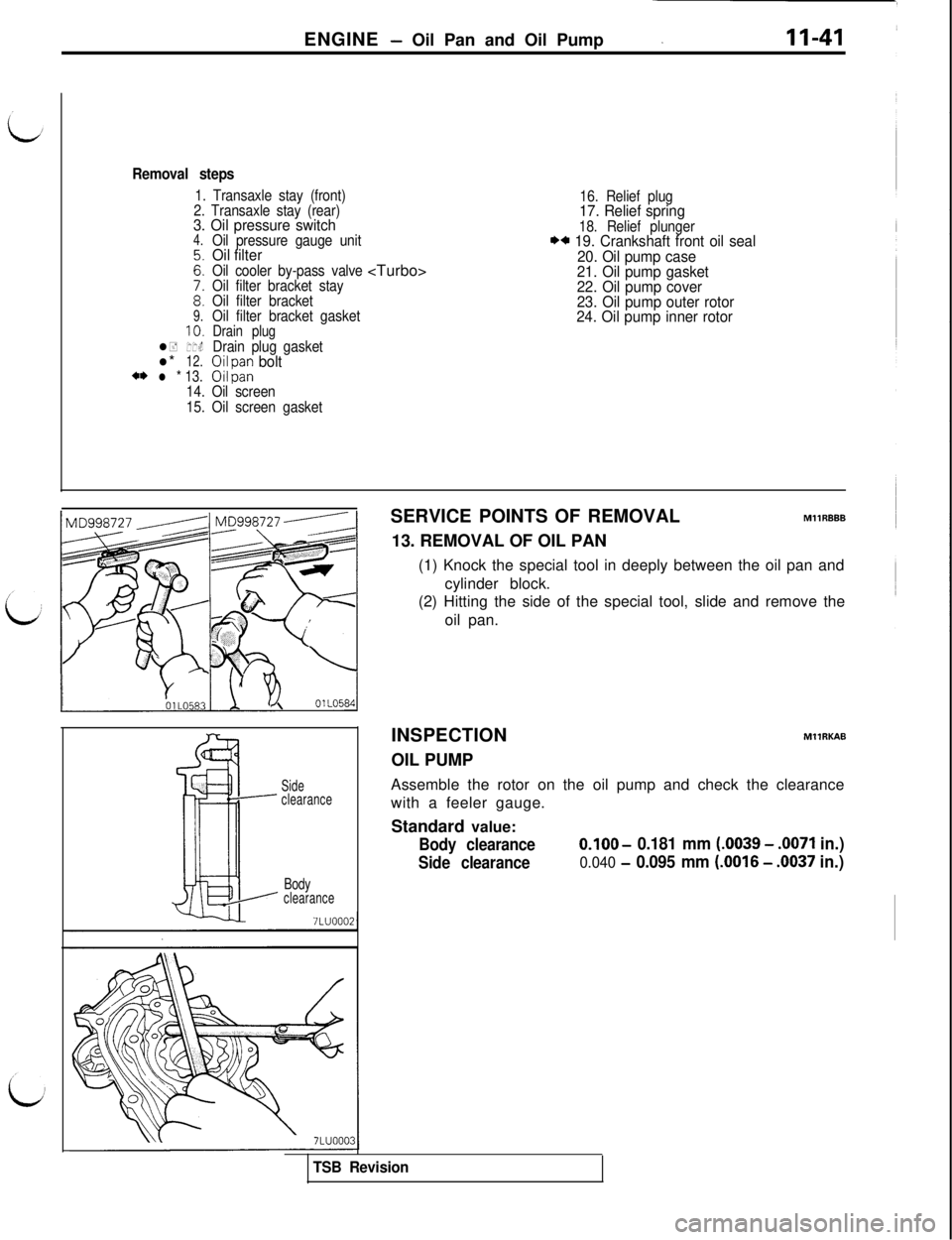
ENGINE - Oil Pan and Oil Pump
Removal steps
1. Transaxle stay (front)
2. Transaxle stay (rear)
3. Oil pressure switch4.
Z:
;:9.10.l+11.l*12.** l * 13.
Oil pressure gauge unitOil filterOil cooler by-pass valve
Oil filter bracket stay
Oil filter bracket
Oil filter bracket gasket
Drain plugDrain plug gasket0; y; boltI
16. Relief plug17. Relief spring18. Relief plunger** 19. Crankshaft front oil seal
20. Oil pump case
21. Oil pump gasket
22. Oil pump cover
23. Oil pump outer rotor
24. Oil pump inner rotor
14. Oil screen
15. Oil screen gasket
Side
clearance
BodyclearanceSERVICE POINTS OF REMOVALMllRBBB
13. REMOVAL OF OIL PAN
(1) Knock the special tool in deeply between the oil pan and
cylinder block.
(2) Hitting the side of the special tool, slide and remove the
oil pan.
INSPECTION
OIL PUMPMllRKAB
Assemble the rotor on the oil pump and check the clearance
with a feeler gauge.
Standard value:
Body clearanceO.lOO- 0.181 mm (.0039 - .0071 in.)
Side clearance0.040 - 0.095 mm (.0016 - .0037 in.)
TSB Revision
Page 98 of 1146
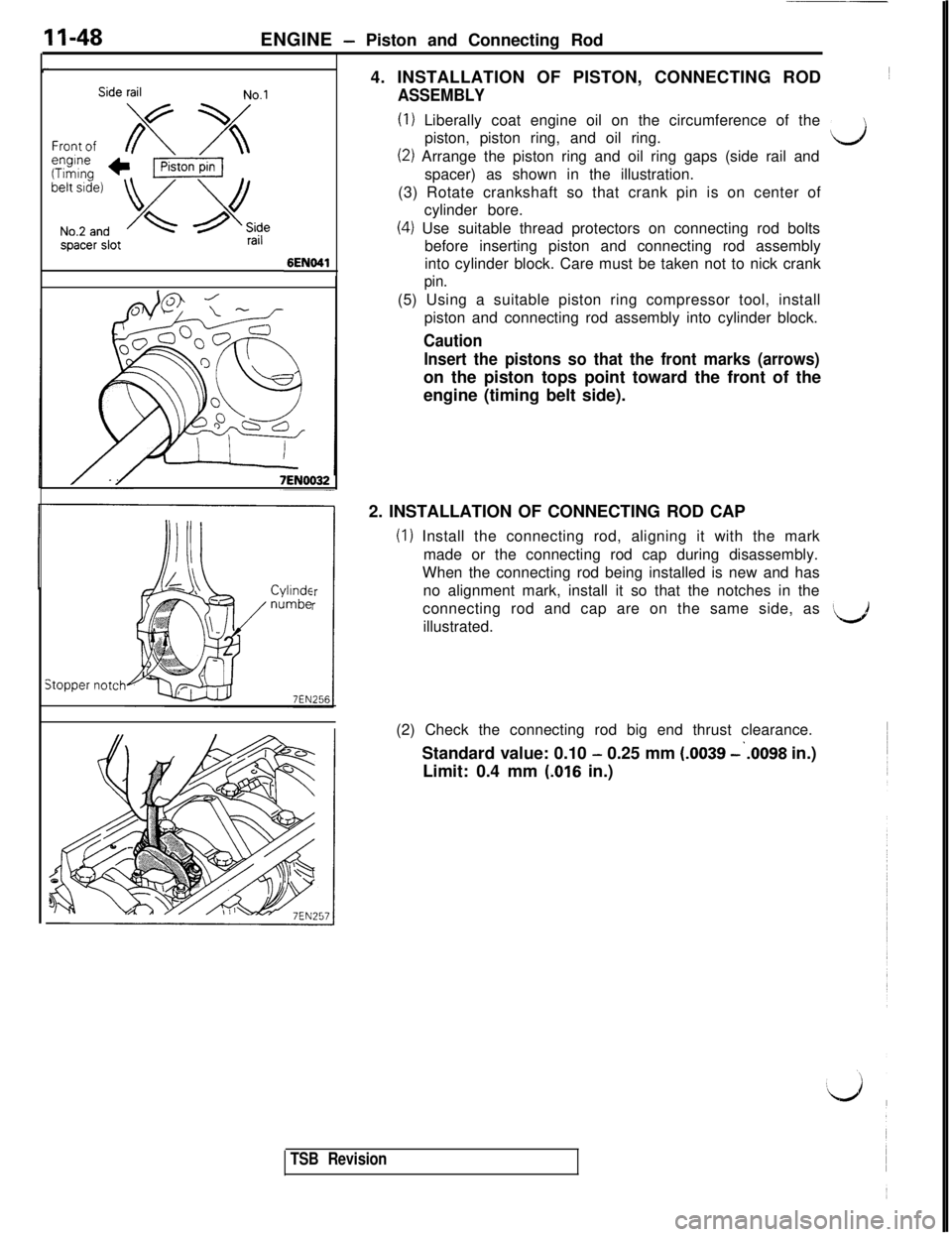
11-48ENGINE - Piston and Connecting Rod
Side railNo.1
spacer slotrail
6ENO41
7EN0032
Cylindcnumbe
Stopper notch4. INSTALLATION OF PISTON, CONNECTING ROD~
ASSEMBLY
(1) Liberally coat engine oil on the circumference of the
piston, piston ring, and oil ring.
d
(2) Arrange the piston ring and oil ring gaps (side rail and
spacer) as shown in the illustration.
(3) Rotate crankshaft so that crank pin is on center of
cylinder bore.
(4) Use suitable thread protectors on connecting rod bolts
before inserting piston and connecting rod assembly
into cylinder block. Care must be taken not to nick crank
pin.(5) Using a suitable piston ring compressor tool, install
piston and connecting rod assembly into cylinder block.
Caution
Insert the pistons so that the front marks (arrows)on the piston tops point toward the front of the
engine (timing belt side).
2. INSTALLATION OF CONNECTING ROD CAP
(1) Install the connecting rod, aligning it with the mark
made or the connecting rod cap during disassembly.
When the connecting rod being installed is new and has
no alignment mark, install it so that the notches in the
connecting rod and cap are on the same side, as
illustrated.
‘d(2) Check the connecting rod big end thrust clearance.
Standard value: 0.10
- 0.25 mm (.0039 -‘.0098 in.)
Limit: 0.4 mm
(-016 in.)
TSB Revision
Page 102 of 1146
11-52ENGINE - Crankshaft, Flywheel and Drive Plate
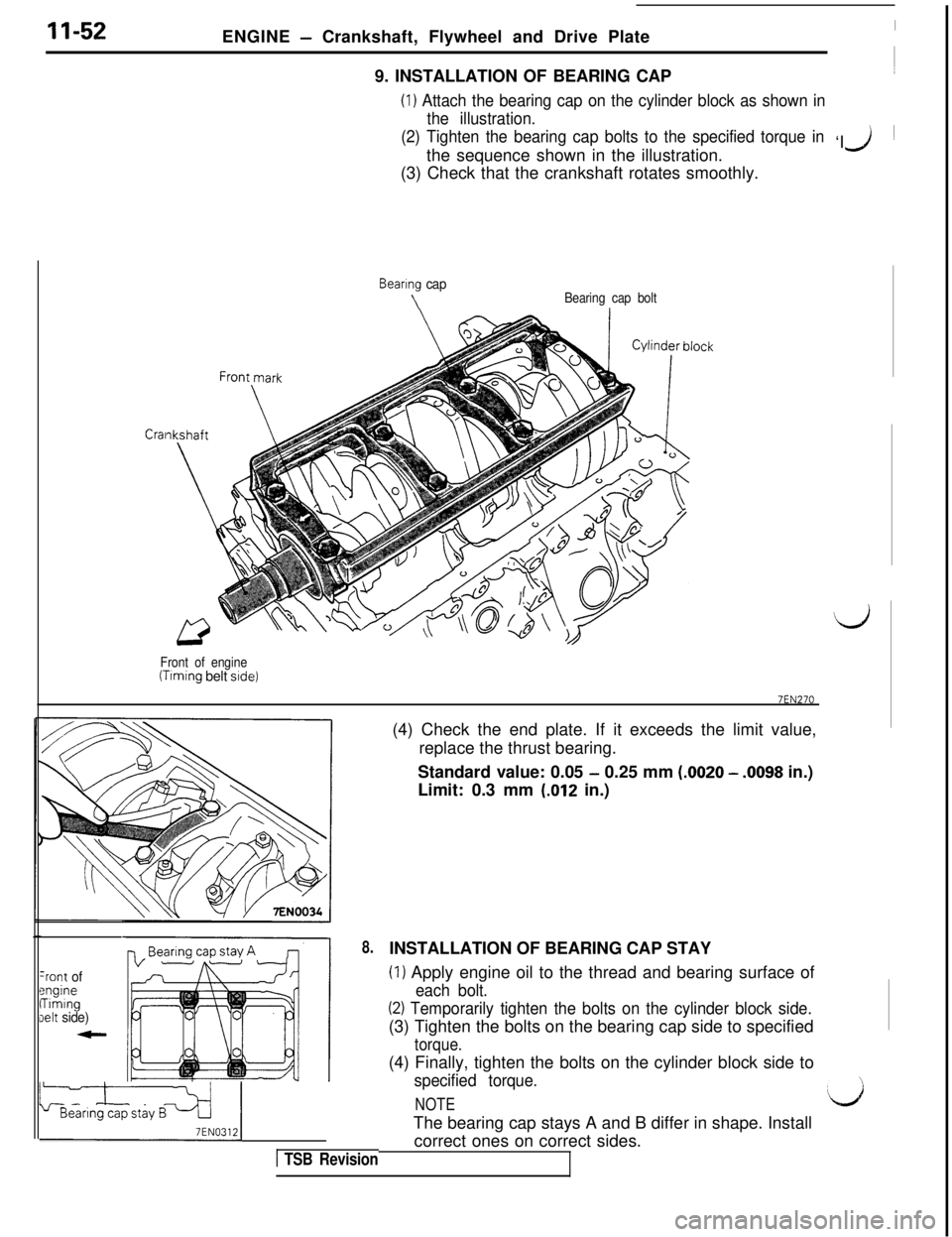
9. INSTALLATION OF BEARING CAP
(1) Attach the bearing cap on the cylinder block as shown in
the illustration.
(2) Tighten the bearing cap bolts to the specified torque in‘I
the sequence shown in the illustration.
J ~
(3) Check that the crankshaft rotates smoothly.
Cral
Bearing cap
\Bearing cap bolt
Front of engine
(Timing belt side)
7EN270(4) Check the end plate. If it exceeds the limit value,
replace the thrust bearing.
Standard value: 0.05
- 0.25 mm (.0020 - .0098 in.)
Limit: 0.3 mm
(.012 in.)
-rent ofengineTimingIelt side)
8.
LLiN03,ij
1 TSB RevisionINSTALLATION OF BEARING CAP STAY
(1) Apply engine oil to the thread and bearing surface of
each bolt.
(2) Temporarily tighten the bolts on the cylinder block side.(3) Tighten the bolts on the bearing cap side to specified
torque.(4) Finally, tighten the bolts on the cylinder block side to
specified torque.
NOTEThe bearing cap stays A and B differ in shape. Install
correct ones on correct sides.d
Page 103 of 1146
ENGINE -Crankshaft, Flywheel and Drive Plate / Cylinder Block11-53
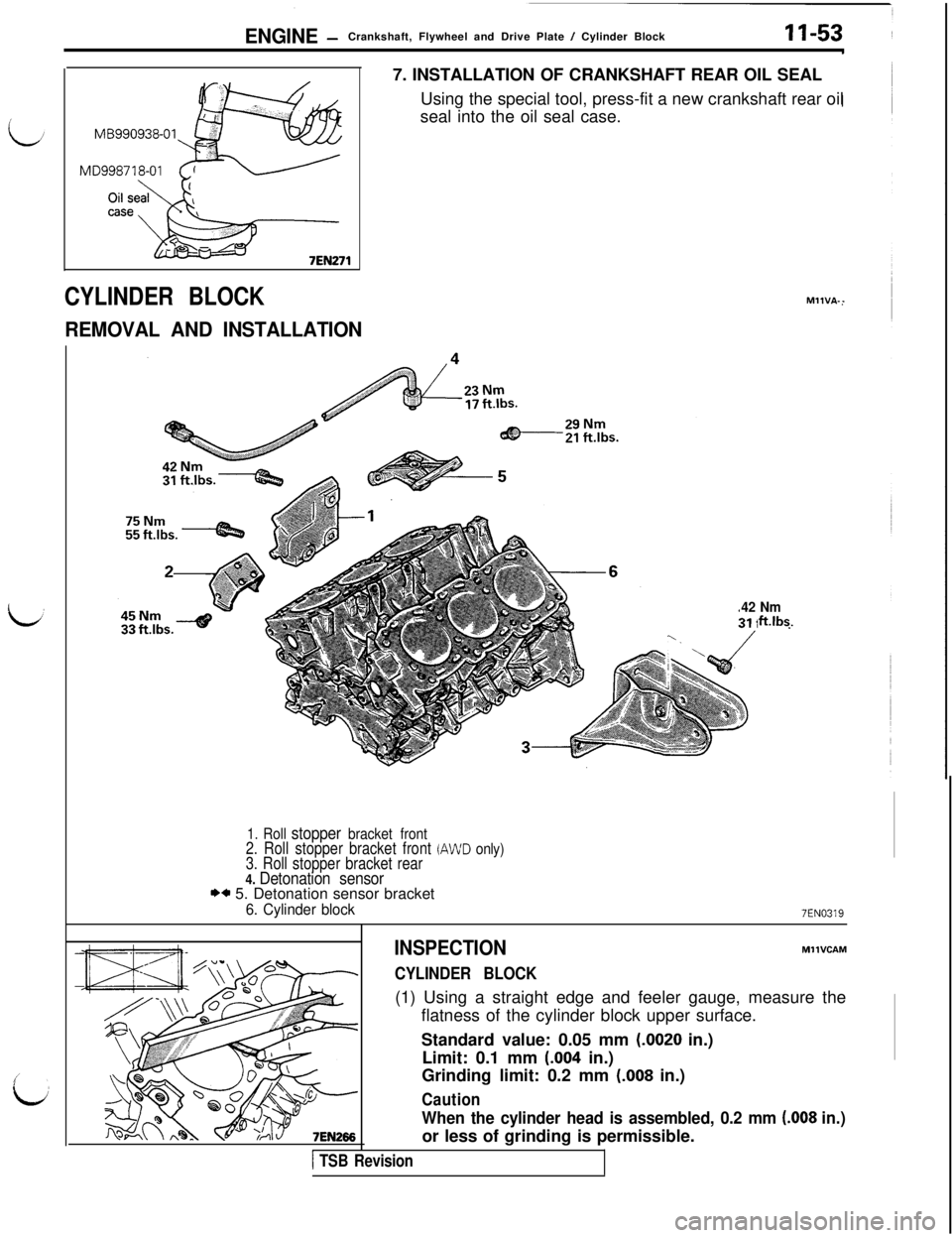
MB990938-01
CYLINDER BLOCK
REMOVAL AND INSTALLATION7. INSTALLATION OF CRANKSHAFT REAR OIL SEAL
Using the special tool, press-fit a new crankshaft rear oil
seal into the oil seal case.MllVA--
42 Nmftlbs.
1. Roll stopper bracket front2. Roll stopper bracket front (AWD only)3. Roll stopper bracket rear4. Detonation sensorI)* 5. Detonation sensor bracket
6. Cylinder block7EN0319
INSPECTION
CYLINDER BLOCK
MllVCAM(1) Using a straight edge and feeler gauge, measure the
flatness of the cylinder block upper surface.
Standard value: 0.05 mm
(-0020 in.)
Limit: 0.1 mm
(.004 in.)
Grinding limit: 0.2 mm
(.008 in.)
Caution
When the cylinder head is assembled, 0.2 mm (.008 in.)or less of grinding is permissible.
1 TSB Revision
Page 104 of 1146
11-54ENGINE - Cylinder Block
I
$jA A@/
,12 mm (.47 in.)
I
t+ ‘: ;I 2 Center -
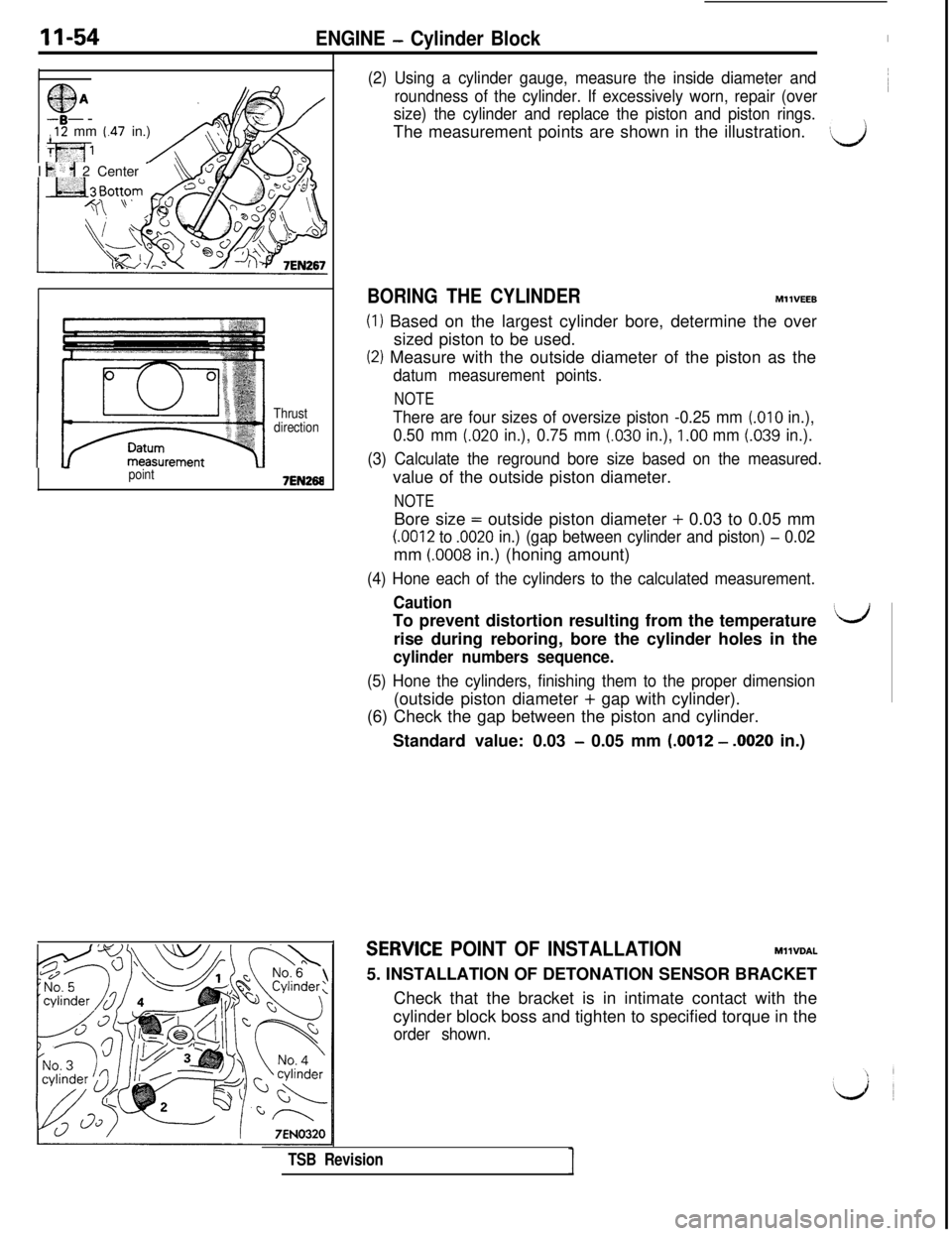
Thrust
direction
-point7EN268
(2) Using a cylinder gauge, measure the inside diameter and
roundness of the cylinder. If excessively worn, repair (over~
size) the cylinder and replace the piston and piston rings.The measurement points are shown in the illustration.
)d
BORING THE CYLINDERMllVEEB
(1) Based on the largest cylinder bore, determine the over
sized piston to be used.
(2) Measure with the outside diameter of the piston as the
datum measurement points.
NOTE
There are four sizes of oversize piston -0.25 mm (.OlO in.),
0.50 mm
(.020 in.), 0.75 mm (.030 in.), 1.00 mm (.039 in.).
(3) Calculate the reground bore size based on the measured.value of the outside piston diameter.
NOTEBore size = outside piston diameter + 0.03 to 0.05 mm
(.0012 to .0020 in.) (gap between cylinder and piston) - 0.02mm (0008 in.) (honing amount)
(4) Hone each of the cylinders to the calculated measurement.
CautionTo prevent distortion resulting from the temperature‘drise during reboring, bore the cylinder holes in the
cylinder numbers sequence.
(5) Hone the cylinders, finishing them to the proper dimension(outside piston diameter + gap with cylinder).
(6) Check the gap between the piston and cylinder.
Standard value: 0.03
- 0.05 mm (.0012 - .0020 in.)
SERWCE POINT OF INSTALLATIONMllVDAL
5. INSTALLATION OF DETONATION SENSOR BRACKET
Check that the bracket is in intimate contact with the
cylinder block boss and tighten to specified torque in the
order shown.
TSB Revision
Page 107 of 1146
FUEL
SYSTEM
CONTENTSM13AA- _
CRUISE CONTROL SYSTEM. . . . . . . . . . . . . . . . . . . . . . . . . . . .158SPECIFICATIONS. . . . . . . .._._....................................................155
CRUISE CONTROL SYSTEM*................................................185
SERVICE ADJUSTMENT PROCEDURES............................178
Cruise Control Cables Inspection and Adjustment........178Cruise Control SystemInspection....................................179individual Parts Inspection....................................................181
SPECIAL TOOLS........................................................................159
SPECIFICATIONS....................................................................158
General Specifications........................................................158Service Specifications........................................................158
TROUBLESHOOTING............................................................159
Check Chart............................................................................163Harness and Components Layout....................................176Preliminary Inspection........................................................159Self-diagnosis Checking........................................................172Troubleshooting Quick Reference Chart............................159
ENGINE CONTROL............................................155
ENGINE CONTROL................................................................157
SERVICE ADJUSTMENT PROCEDURES............................156
Accelerator Cable Inspection and Adjustment................156Accelerator Switch Inspection and Adjustment................156
Service Specifications........................................................
155
TROUBLESHOOTING............................................................
155
Accelerator Cable and Accelerator Pedal........................155
FUEL SYSTEM....................................................3
DETONATION SENSOR........................................................154
FUEL FILTER............................................................................
153
FUEL LINE AND VAPOR LINE................................................151
FUEL PUMP AND FUEL GAUGE UNIT ASSEMBLYAND OVERFILL LIMITER (TWO-WAY VALVE)................149
FUEL TANK.................................................................................146
GENERAL INFORMATION
....................................................
3
MPI System Diagram............................................................3
INJECTOR................................................................................141
ON-VEHICLE INSPECTION OF MPI COMPONENTS........36
Active Exhaust Control Unit
SUPPLEMENTAL RESTRAINT SYSTEM (SRS)
(1)A Supplemental Restraint System (SRS), which uses a driver-side air bag, has been installed in the 3000GT.(2)The SRS includes the following components: impact sensors, SRS diagnosis unit: SRS warning light, air bagmodule, clock spring, interconnecting wiring. Other SRS-related components (that may have to be
removed/installed in connection with SRS service or maintenance) are indicated in the table of contents byan asterisk (*).
WARNING!(I)Improper service or maintenance of any component of the SRS, or any SRS-related component, can lead to
personal injury or death to service personnel (from inadvertent firing of the air bag) or to the driver (from
rendering the SRS inoperative).
(2) Service or maintenance of any SRS component or SRS-related component must be performed only at anauthorized MITSUBISHI dealer.
(3) MITSUBISHI dealer personnel must thoroughly review this manual, and especially its GROUP
528 -Supplemental Restraint System (SRS), before beginning any service or maintenance of any component of theSRS or any SRS-related component.