lock MITSUBISHI 3000GT 1991 Workshop Manual
[x] Cancel search | Manufacturer: MITSUBISHI, Model Year: 1991, Model line: 3000GT, Model: MITSUBISHI 3000GT 1991Pages: 1146, PDF Size: 76.68 MB
Page 251 of 1146
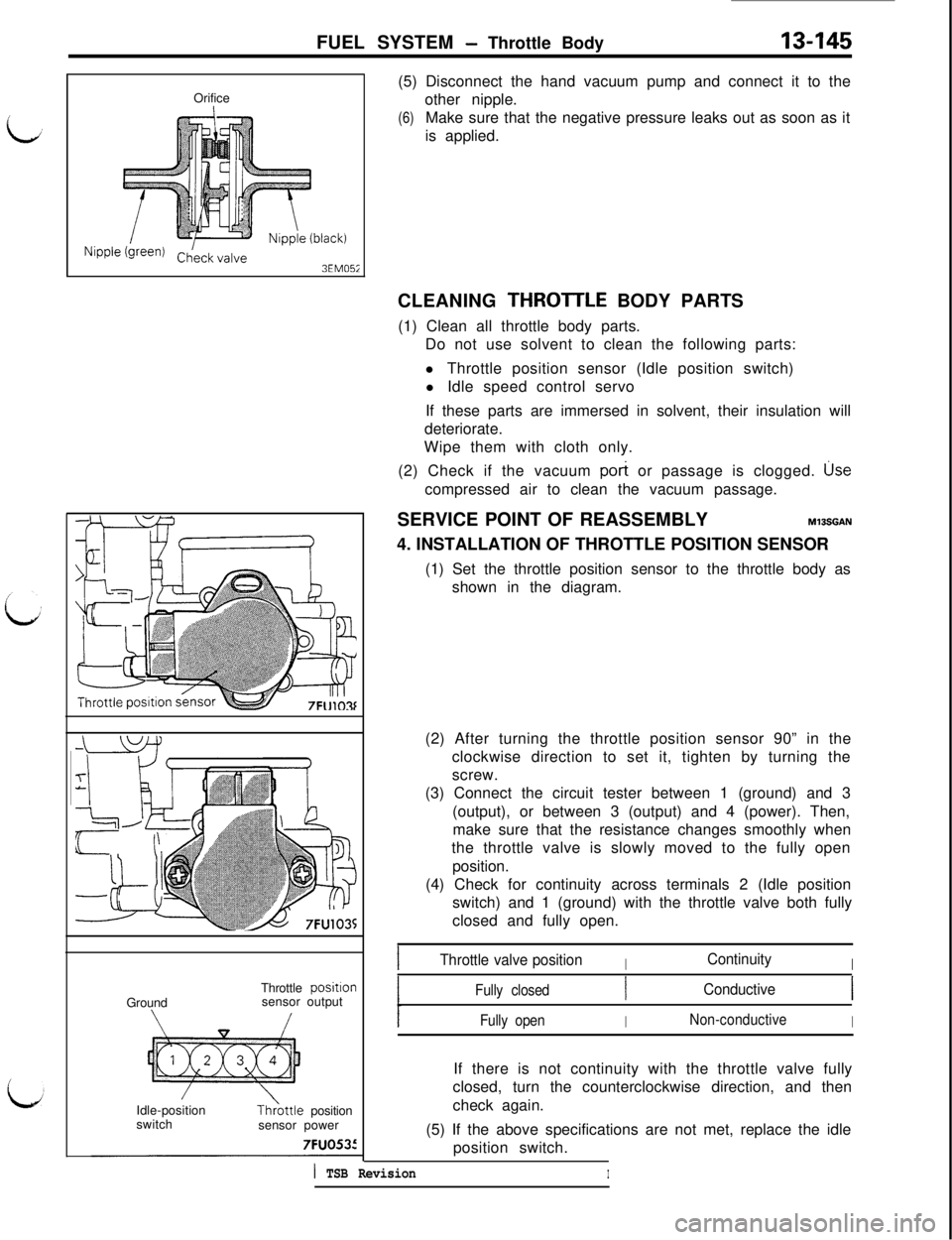
FUEL SYSTEM - Throttle Body13-145Orifice
Nipple (green)3EM05iGroundThrottle
positlonsensor output
Idle-position
switchTh>ottle position
sensor power7FUO535(5) Disconnect the hand vacuum pump and connect it to the
other nipple.
(6)Make sure that the negative pressure leaks out as soon as it
is applied.
CLEANING THROTTLE BODY PARTS
(1) Clean all throttle body parts.
Do not use solvent to clean the following parts:
l Throttle position sensor (Idle position switch)
l Idle speed control servo
If these parts are immersed in solvent, their insulation will
deteriorate.
Wipe them with cloth only.
(2) Check if the vacuum
pot-t or passage is clogged. usecompressed air to clean the vacuum passage.
SERVICE POINT OF REASSEMBLY
M13SGAN4. INSTALLATION OF THROTTLE POSITION SENSOR
(1) Set the throttle position sensor to the throttle body as
shown in the diagram.
(2) After turning the throttle position sensor 90” in the
clockwise direction to set it, tighten by turning the
screw.
(3) Connect the circuit tester between 1 (ground) and 3
(output), or between 3 (output) and 4 (power). Then,
make sure that the resistance changes smoothly when
the throttle valve is slowly moved to the fully open
position.
(4) Check for continuity across terminals 2 (Idle position
switch) and 1 (ground) with the throttle valve both fully
closed and fully open.
IThrottle valve positionIContinuityI
Fully closedConductive
Fully openINon-conductiveIIf there is not continuity with the throttle valve fully
closed, turn the counterclockwise direction, and then
check again.
(5) If the above specifications are not met, replace the idle
position switch.
1 TSB RevisionI
Page 252 of 1146
13-146FUEL SYSTEM - Fuel Tank
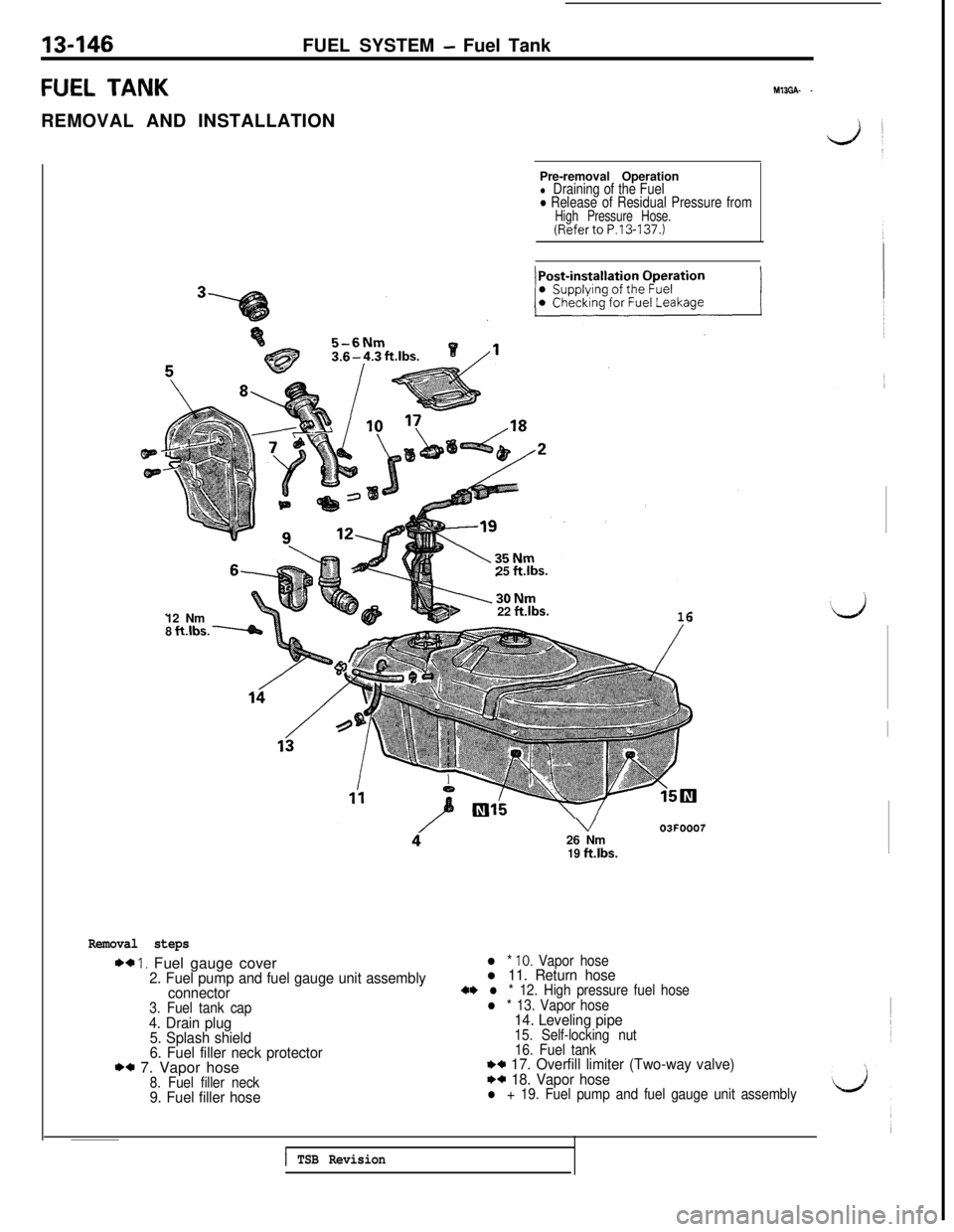
FUEL TANKREMOVAL AND INSTALLATIONM13GA- -12 Nm
8 ft.lbs. WPre-removal Operation
l Draining of the Fuel0 Release of Residual Pressure fromHigh Pressure Hose.(Referto P.13-137.)
5-6Nm25 ft.lbs.
b22 ftlbs.16
V26 Nm
19 ft.lbs.
03FOOO7
Removal steps
** I. Fuel gauge cover2. Fuel pump and fuel gauge unit assembly
connector
3. Fuel tank cap4. Drain plug
5. Splash shield
6. Fuel filler neck protector
** 7. Vapor hose8. Fuel filler neck9. Fuel filler hose
l * IO. Vapor hosel 11. Return hose+* l * 12. High pressure fuel hosel * 13. Vapor hose14. Leveling pipe15. Self-locking nut
16. Fuel tank++
17. Overfill limiter (Two-way valve)I)+ 18. Vapor hosel + 19. Fuel pump and fuel gauge unit assembly
;d
I
1 TSB Revision
Page 275 of 1146
Page 279 of 1146
CRUISE CONTROL SYSTEM - Troubleshooting
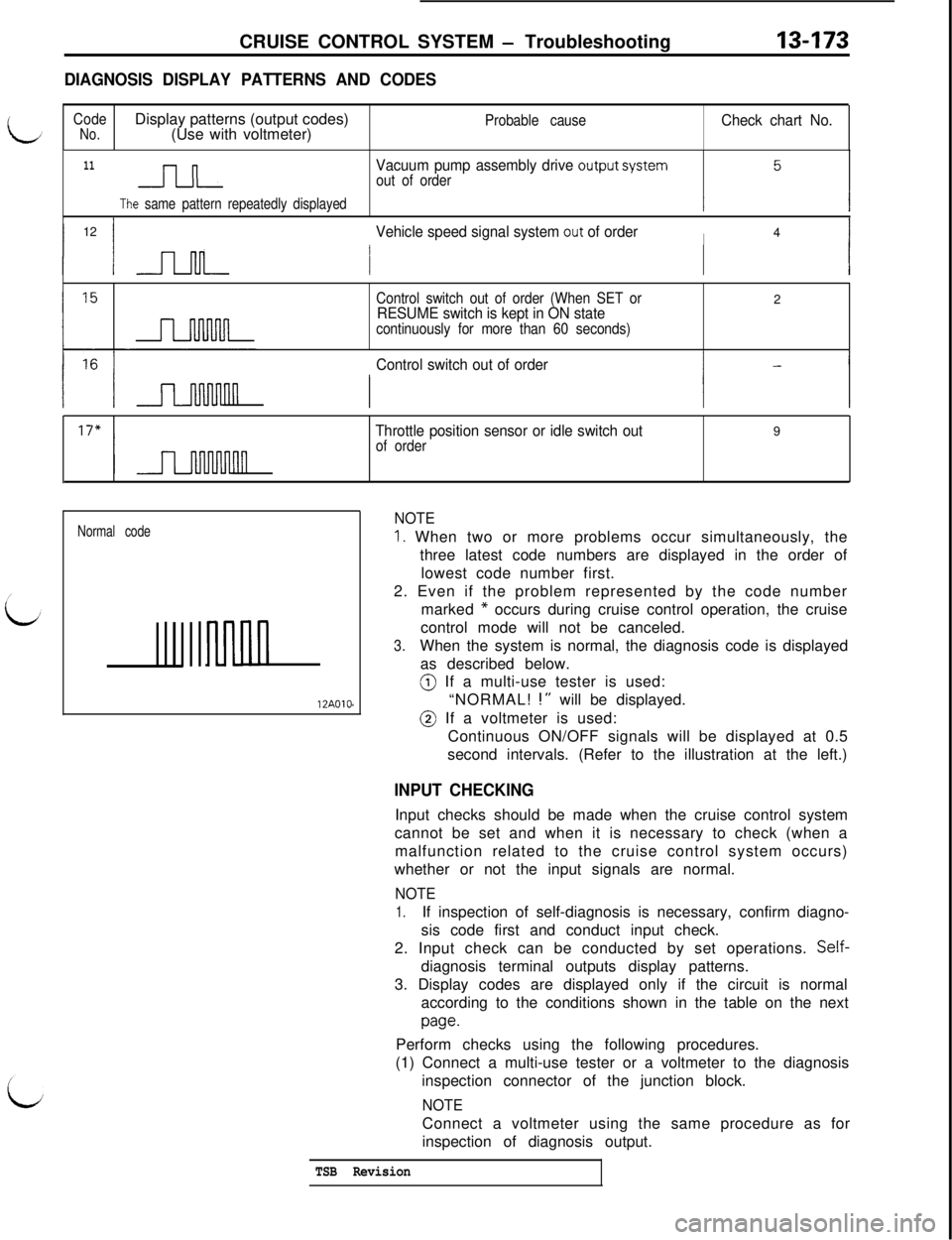
DIAGNOSIS DISPLAY PATTERNS AND CODES
13473
CodeDisplay patterns (output codes)Probable causeCheck chart No.No.(Use with voltmeter)
11l-l n-JILL
The same pattern repeatedly displayed
Vacuum pump assembly drive output systemout of order5
I I12Vehicle speed signal system out of orderI4I
I In
Control switch out of order (When SET or2RESUME switch is kept in ON statecontinuously for more than 60 seconds)
Control switch out of order
Throttle position sensor or idle switch out9
of order
Normal code
12AOlOa
NOTE
1. When two or more problems occur simultaneously, the
three latest code numbers are displayed in the order of
lowest code number first.
2. Even if the problem represented by the code number
marked * occurs during cruise control operation, the cruise
control mode will not be canceled.
3.When the system is normal, the diagnosis code is displayed
as described below.@ If a multi-use tester is used:
“NORMAL!
! I’ will be displayed.@ If a voltmeter is used:
Continuous ON/OFF signals will be displayed at 0.5
second intervals. (Refer to the illustration at the left.)
INPUT CHECKINGInput checks should be made when the cruise control system
cannot be set and when it is necessary to check (when a
malfunction related to the cruise control system occurs)
whether or not the input signals are normal.
NOTE
1.If inspection of self-diagnosis is necessary, confirm diagno-
sis code first and conduct input check.
2. Input check can be conducted by set operations.
Self-diagnosis terminal outputs display patterns.
3. Display codes are displayed only if the circuit is normal
according to the conditions shown in the table on the next
paw.Perform checks using the following procedures.
(1) Connect a multi-use tester or a voltmeter to the diagnosis
inspection connector of the junction block.
NOTEConnect a voltmeter using the same procedure as for
inspection of diagnosis output.
TSB Revision
Page 283 of 1146
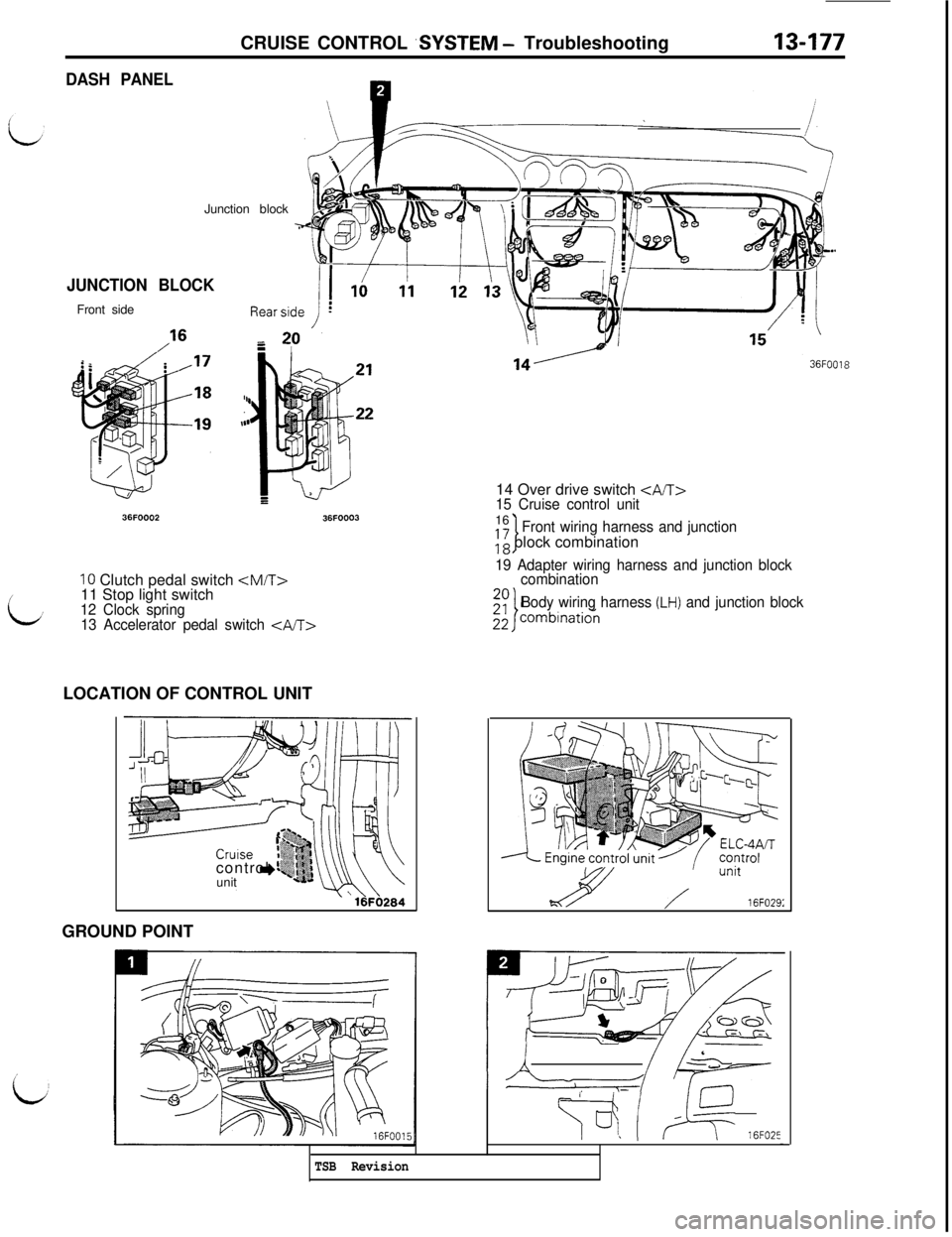
CRUISE CONTROL .SYSTEM - Troubleshooting13-177
DASH PANELJunction block
JUNCTION BLOCKFront side
36FOOO236FOOO3
i
10 Clutch pedal switch
12 Clock spring
13 Accelerator pedal switch
LOCATION OF CONTROL UNIT
E%sQ/I.LIlll-I BCrutse
!tcontrol
unit
GROUND POINT14 Over drive switch
15 Cruise control unit16
l 7
1
Front wiring harness and junctionl 8 block combination
19 Adapter wiring harness and junction block
combination
Body wiring harness
(LH) and junction block
I-\ --*
I d
4tT
-G
1
q\ ($$ 16F02E
36FOO18
TSB Revision
Page 284 of 1146
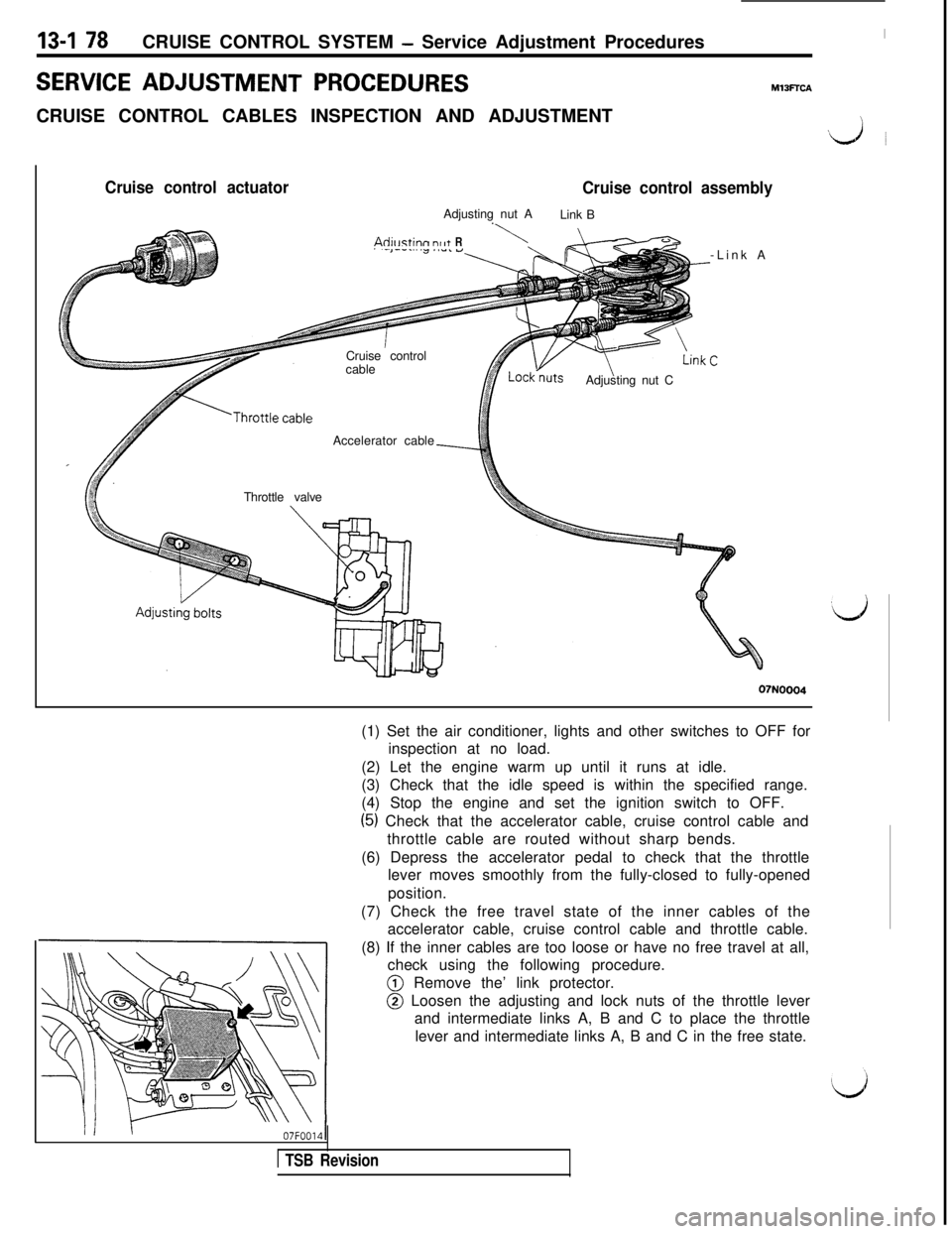
13-I 78CRUISE CONTROL SYSTEM - Service Adjustment ProceduresSERVICE
ADJUSTMENT PROCEDURESCRUISE CONTROL CABLES INSPECTION AND ADJUSTMENT
I
MlSFTCA
‘\J ~
Cruise control actuator
Cruise control assemblyAdjusting nut A
Link B
.
Adillstinn nr~+ R\Cruise control
cable
Adjusting nut C
Accelerator cable
Throttle valve-Link A
07N0004(1) Set the air conditioner, lights and other switches to OFF for
inspection at no load.
(2) Let the engine warm up until it runs at idle.
(3) Check that the idle speed is within the specified range.
(4) Stop the engine and set the ignition switch to OFF.
(5) Check that the accelerator cable, cruise control cable and
throttle cable are routed without sharp bends.
(6) Depress the accelerator pedal to check that the throttle
lever moves smoothly from the fully-closed to fully-opened
position.
(7) Check the free travel state of the inner cables of the
accelerator cable, cruise control cable and throttle cable.
(8) If the inner cables are too loose or have no free travel at all,
check using the following procedure.@ Remove the’ link protector.
@ Loosen the adjusting and lock nuts of the throttle lever
and intermediate links A, B and C to place the throttle
lever and intermediate links A, B and C in the free state.
1 TSB Revision
Page 285 of 1146
CRUISE CONTROL SYSTEM - Service Adjustment Procedures13-179Adjusting nut C
07NOOlELink Blever
07N0019Link
B07NOOlE
y,jj--ww ,03LO122
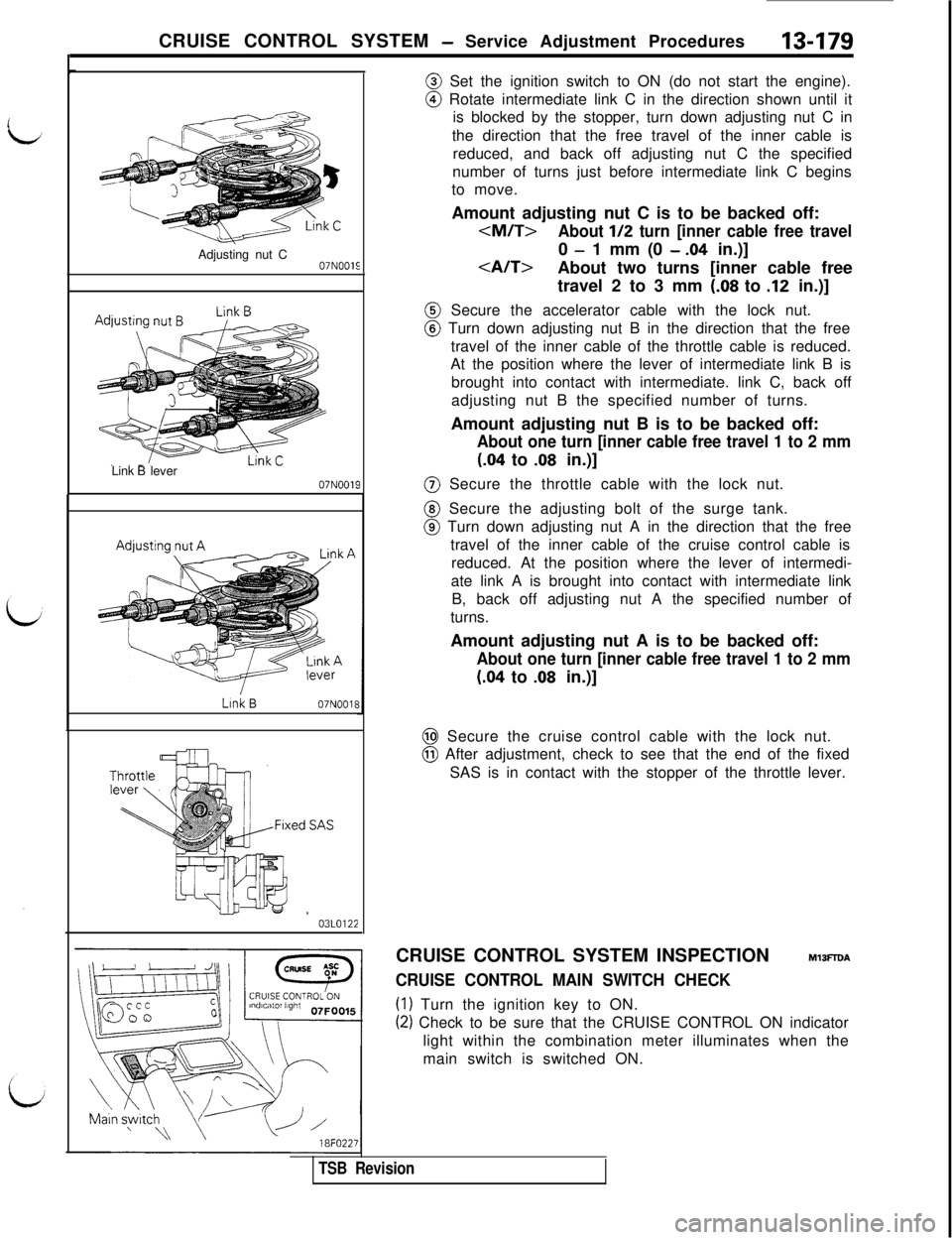
\\ \18FO2.2'@ Set the ignition switch to ON (do not start the engine).@ Rotate intermediate link C in the direction shown until it
is blocked by the stopper, turn down adjusting nut C in
the direction that the free travel of the inner cable is
reduced, and back off adjusting nut C the specified
number of turns just before intermediate link C begins
to move.
Amount adjusting nut C is to be backed off:
- 1 mm (0 - .04 in.)]
About two turns [inner cable free
travel 2 to 3 mm
(.08 to .12 in.)]@ Secure the accelerator cable with the lock nut.@ Turn down adjusting nut B in the direction that the free
travel of the inner cable of the throttle cable is reduced.
At the position where the lever of intermediate link B is
brought into contact with intermediate. link C, back off
adjusting nut B the specified number of turns.
Amount adjusting nut B is to be backed off:
About one turn [inner cable free travel 1 to 2 mm
(.04 to .08 in.)]@ Secure the throttle cable with the lock nut.@ Secure the adjusting bolt of the surge tank.@ Turn down adjusting nut A in the direction that the free
travel of the inner cable of the cruise control cable is
reduced. At the position where the lever of intermedi-
ate link A is brought into contact with intermediate link
B, back off adjusting nut A the specified number of
turns.
Amount adjusting nut A is to be backed off:
About one turn [inner cable free travel 1 to 2 mm
(.04 to .08 in.)]@ Secure the cruise control cable with the lock nut.@ After adjustment, check to see that the end of the fixed
SAS is in contact with the stopper of the throttle lever.
CRUISE CONTROL SYSTEM INSPECTION
MlBFlDA
CRUISE CONTROL MAIN SWITCH CHECK
(1) Turn the ignition key to ON.
(2) Check to be sure that the CRUISE CONTROL ON indicator
light within the combination meter illuminates when the
main switch is switched ON.
TSB Revision
Page 288 of 1146
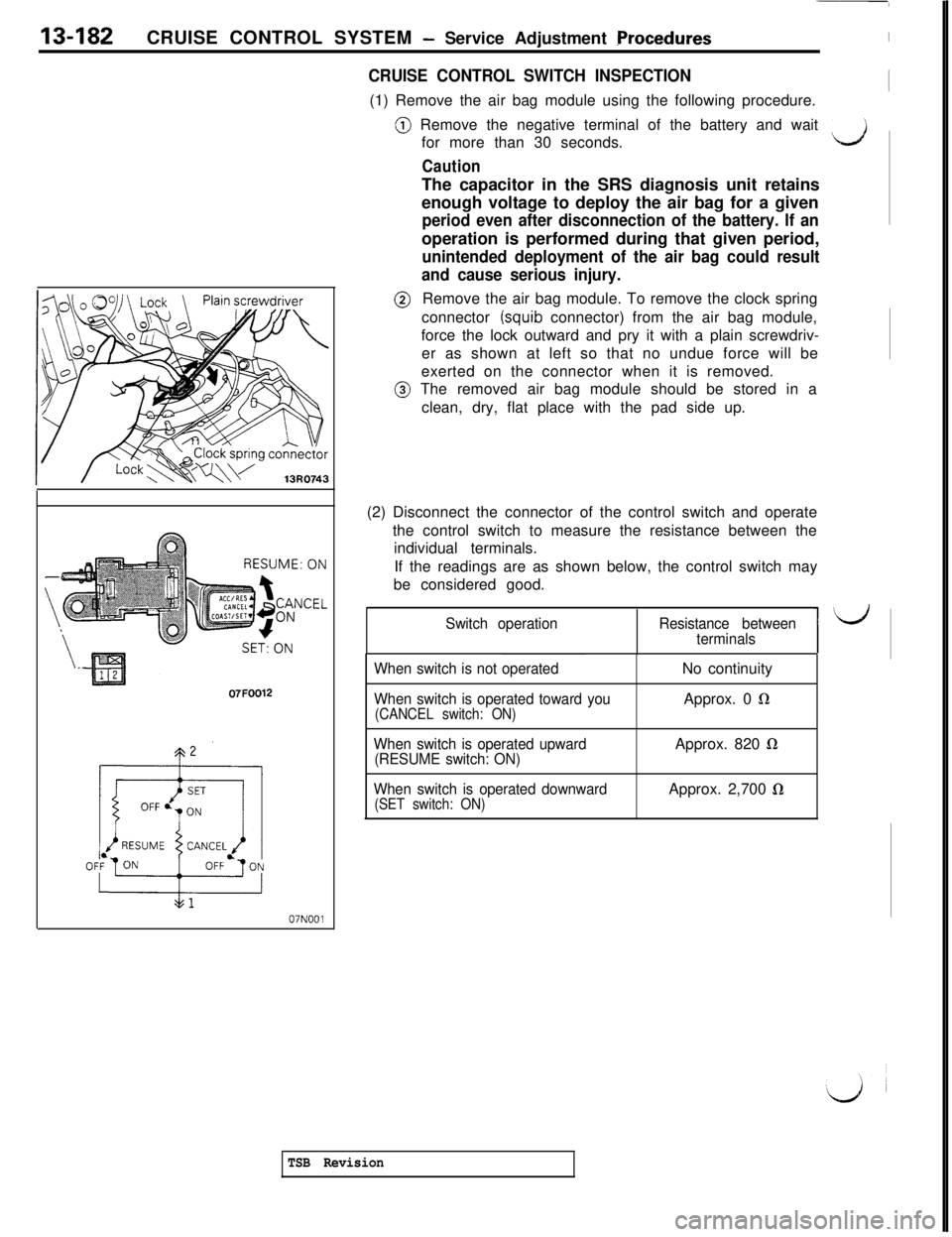
13-182CRUISE CONTROL SYSTEM - Service Adjustment ProceduresI
CRUISE CONTROL SWITCH INSPECTION(1) Remove the air bag module using the following procedure.I07FOO12
07NOOl@ Remove the negative terminal of the battery and wait
for more than 30 seconds.
d
CautionThe capacitor in the SRS diagnosis unit retains
enough voltage to deploy the air bag for a given
period even after disconnection of the battery. If anoperation is performed during that given period,
unintended deployment of the air bag could result
and cause serious injury.@Remove the air bag module. To remove the clock spring
connector
(squib connector) from the air bag module,
force the lock outward and pry it with a plain screwdriv-
er as shown at left so that no undue force will be
exerted on the connector when it is removed.@ The removed air bag module should be stored in a
clean, dry, flat place with the pad side up.
(2) Disconnect the connector of the control switch and operate
the control switch to measure the resistance between the
individual terminals.
If the readings are as shown below, the control switch may
be considered good.
Switch operationResistance between-iJ
terminals
When switch is not operated
When switch is operated toward you
(CANCEL switch: ON)
When switch is operated upward
(RESUME switch: ON)
When switch is operated downward
(SET switch: ON)No continuity
Approx. 0
1RApprox. 820
1RApprox. 2,700
fi
TSB Revision
Page 293 of 1146
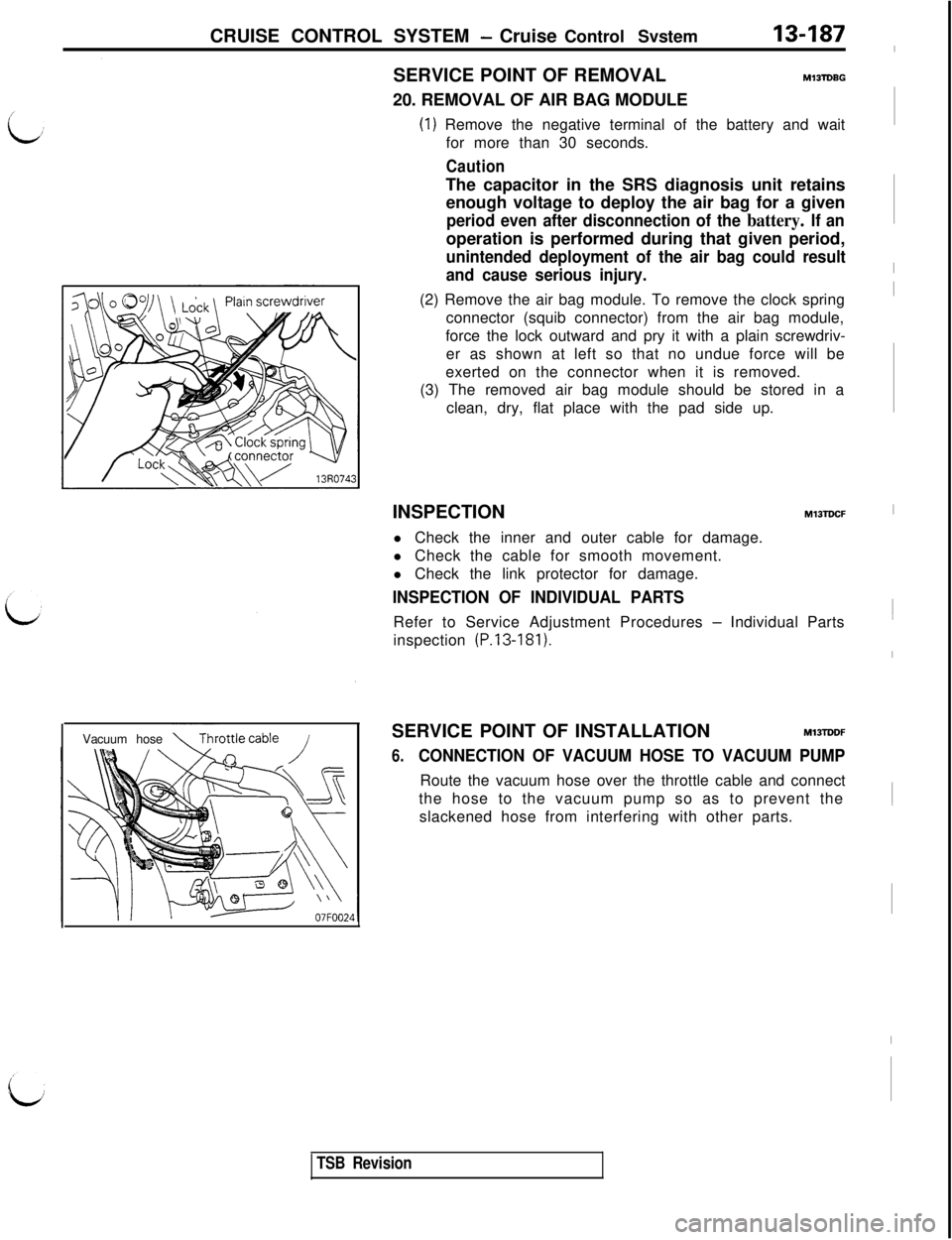
CRUISE CONTROL SYSTEM - Cruise Control Svstem13-187Vacuum hoseSERVICE POINT OF REMOVAL
Ml3lDBG20. REMOVAL OF AIR BAG MODULE
(1) Remove the negative terminal of the battery and wait
for more than 30 seconds.
CautionThe capacitor in the SRS diagnosis unit retains
enough voltage to deploy the air bag for a given
period even after disconnection of the battery. If anoperation is performed during that given period,
unintended deployment of the air bag could result
and cause serious injury.(2) Remove the air bag module. To remove the clock spring
connector (squib connector) from the air bag module,
force the lock outward and pry it with a plain screwdriv-
er as shown at left so that no undue force will be
exerted on the connector when it is removed.
(3) The removed air bag module should be stored in a
clean, dry, flat place with the pad side up.
INSPECTION
MlJTDCFl Check the inner and outer cable for damage.
l Check the cable for smooth movement.
l Check the link protector for damage.
INSPECTION OF INDIVIDUAL PARTSRefer to Service Adjustment Procedures
- Individual Parts
inspection (P.l3-181).
SERVICE POINT OF INSTALLATION
M13TDDF
6.CONNECTION OF VACUUM HOSE TO VACUUM PUMPRoute the vacuum hose over the throttle cable and connect
the hose to the vacuum pump so as to prevent the
slackened hose from interfering with other parts.
TSB Revision
I
I
I
I~
I~~
I
Page 297 of 1146

COOLING - Specifications / Troubleshooting
SEALANT AND ADHESIVE14-3
MMCE- -
/
id
ItemsSpecified sealants and adhesive/
Engine coolant temperature gauge unit
Engine coolant temperature sensor (Engine control)
Engine coolant temperature sensor (Air conditioner)3M Nut Locking Part No. 4171
TROUBLESHOOTING
L
MllEAAL
Symptom
OverheatProbable cause
Insufficient engine coolant
Too high an anti-freeze concentration
Inoperative electric cooling fan
Faulty thermosensor
Faulty electrical motor
Faulty radiator fan relayRemedy
Replenish
Correct anti-freeze concentration
Replace
Damaged or blocked (insufficiently ventilated)
radiator finsCorrect
Water leaks
Damaged radiator core joint
Corroded or cracked hoses
(radiator hose, heater hose, etc.)
Faulty cap valve or setting of spring
Cracked thermostat housing
Loose water pump mounting bolt or leaking
gasket
Replace
Loose bolt or leaking gasket in water outlet
I
Correct or replacefitting
Loose bolt or leaking gasket in water inletfitting
Loose thermostat housing bolts or leakingfrom gasket
Retorque bolts or replace gasket
Faulty automatic transaxle oil cooler operation
Blocked or collapsed hose and pipeReplace
Loose hose and pipe connectionCorrect
Faulty thermostat operationReplace
Faulty water pump operationReplace
Water passage clogged with slime or rust depositClean
or foreign substance
No rise in temperature
Faulty thermostatReplace
( TSB Revision