ESP MITSUBISHI 3000GT 1991 Owner's Guide
[x] Cancel search | Manufacturer: MITSUBISHI, Model Year: 1991, Model line: 3000GT, Model: MITSUBISHI 3000GT 1991Pages: 1146, PDF Size: 76.68 MB
Page 591 of 1146
FRONT AXLE - Drive Shaft26-15
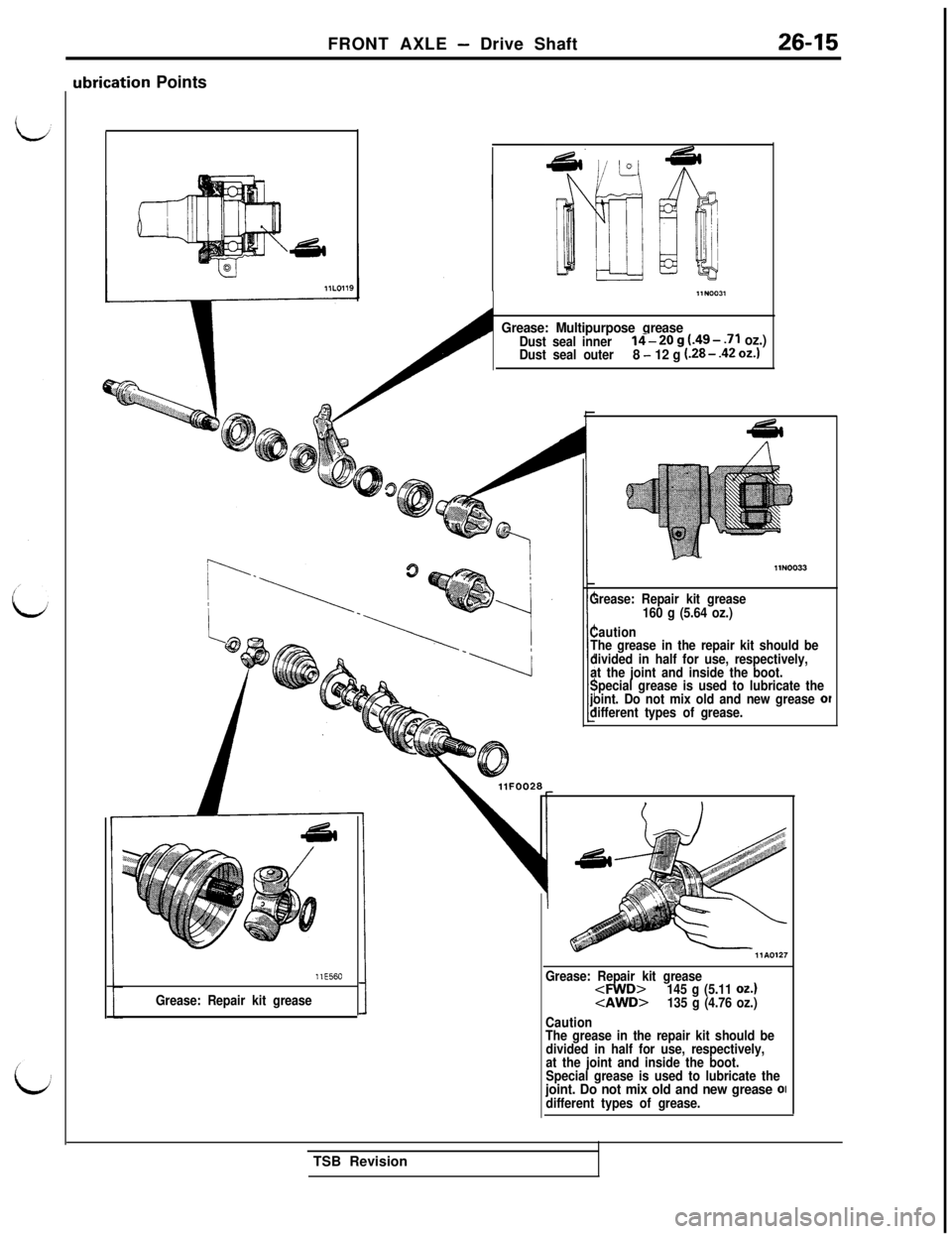
ubrication Points
Grease: Multipurpose greaseDust seal inner14-2Og(.49-.71 oz.)Dust seal outer8 - 12 g (.28- .42 oz.)
llE560
Grease: Repair kit greaseGrease: Repair kit grease
160 g (5.64 oz.)
Caution
The grease in the repair kit should be
divided in half for use, respectively,
at the joint and inside the boot.
Special grease is used to lubricate the
joint. Do not mix old and new grease
ofdifferent types of grease.
Grease: Repair kit grease
145 g (5.11 oz.)
Caution
The grease in the repair kit should be
divided in half for use, respectively,
at the joint and inside the boot.
Special grease is used to lubricate the
joint. Do not mix old and new grease OIdifferent types of grease.TSB Revision
Page 593 of 1146
FRONT AXLE - Drive Shaft26-17
INSPECTIONM26QGDD
l Check the drive shaft for damage, bending or corrosion.
l Check the inner shaft for damage, bending or corrosion.
l Check the drive shaft splines for wear or damage.
l Check the inner shaft splines for wear or damage.
lCheck for entry of water and/or foreign material into B.J.
l Check the spider assembly for roller rotation, wear or
corrosion.
lCheck the groove inside T.J. case for wear of corrosion.
l Check the boots for deterioration, damage or cracking.
l Check the center bearing for seizure, discoloration or
roughness of rolling surface.
l Check the dust cover for damage or deterioration.
SERVICE POINTS OF REASSEMBLYM26QHDF
20. INSTALLATION OF B.J. BOOT
/ 17. T.J. BOOT
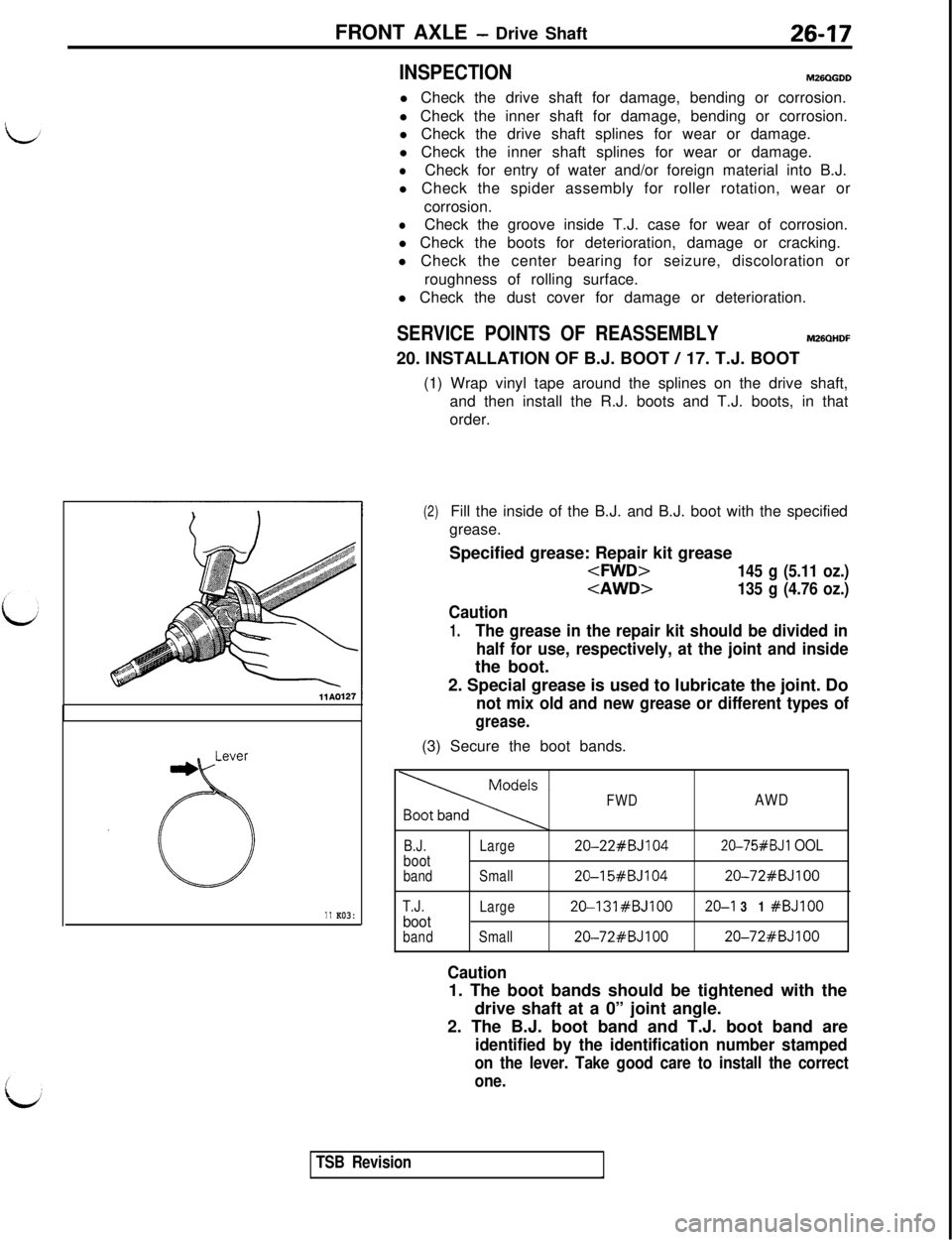
(1) Wrap vinyl tape around the splines on the drive shaft,
and then install the R.J. boots and T.J. boots, in that
order.
11 K03:
(2)Fill the inside of the B.J. and B.J. boot with the specified
grease.
Specified grease: Repair kit grease
Caution
1.The grease in the repair kit should be divided in
half for use, respectively, at the joint and insidethe boot.
2. Special grease is used to lubricate the joint. Do
not mix old and new grease or different types of
grease.(3) Secure the boot bands.
FWDAWD
B.J.bootband
T.J.
bootbandLarge20-22#BJ104
20-75#BJl OOL
Small20-I 5#BJ10420-72#BJlOO
Large20-131#BJlOO20-I 31 #BJlOO
Small20-72#BJlOO20-72#BJlOO
Caution1. The boot bands should be tightened with the
drive shaft at a 0” joint angle.
2. The B.J. boot band and T.J. boot band are
identified by the identification number stamped
on the lever. Take good care to install the correct
one.
TSB Revision
Page 595 of 1146
FRONT AXLE - Drive Shaft26-19MB990934-01
Dust seal outerr -jMB990890-01
ler shaft
I Inner
tshaft‘; assembly
llNOO35T.J. case
w
llN0037
-“’
@Grease
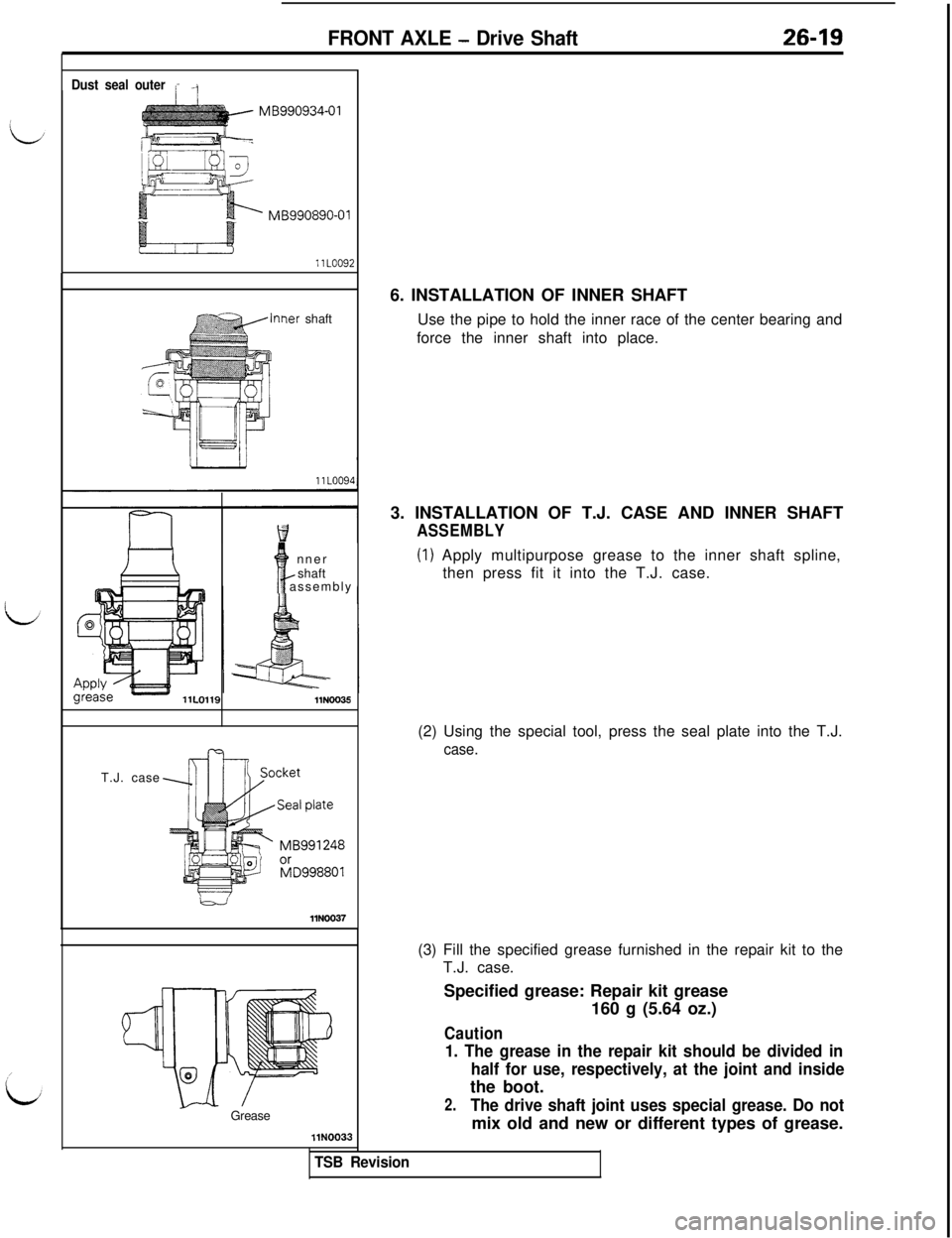
llN00336. INSTALLATION OF INNER SHAFT
Use the pipe to hold the inner race of the center bearing and
force the inner shaft into place.
3. INSTALLATION OF T.J. CASE AND INNER SHAFT
ASSEMBLY
(1) Apply multipurpose grease to the inner shaft spline,
then press fit it into the T.J. case.
(2) Using the special tool, press the seal plate into the T.J.
case.
TSB Revision(3) Fill the specified grease furnished in the repair kit to the
T.J. case.
Specified grease: Repair kit grease
160 g (5.64 oz.)
Caution
1. The grease in the repair kit should be divided in
half for use, respectively, at the joint and insidethe boot.
2.The drive shaft joint uses special grease. Do notmix old and new or different types of grease.
Page 600 of 1146
27-4
REAR AXLE
REAR AXLE HUB
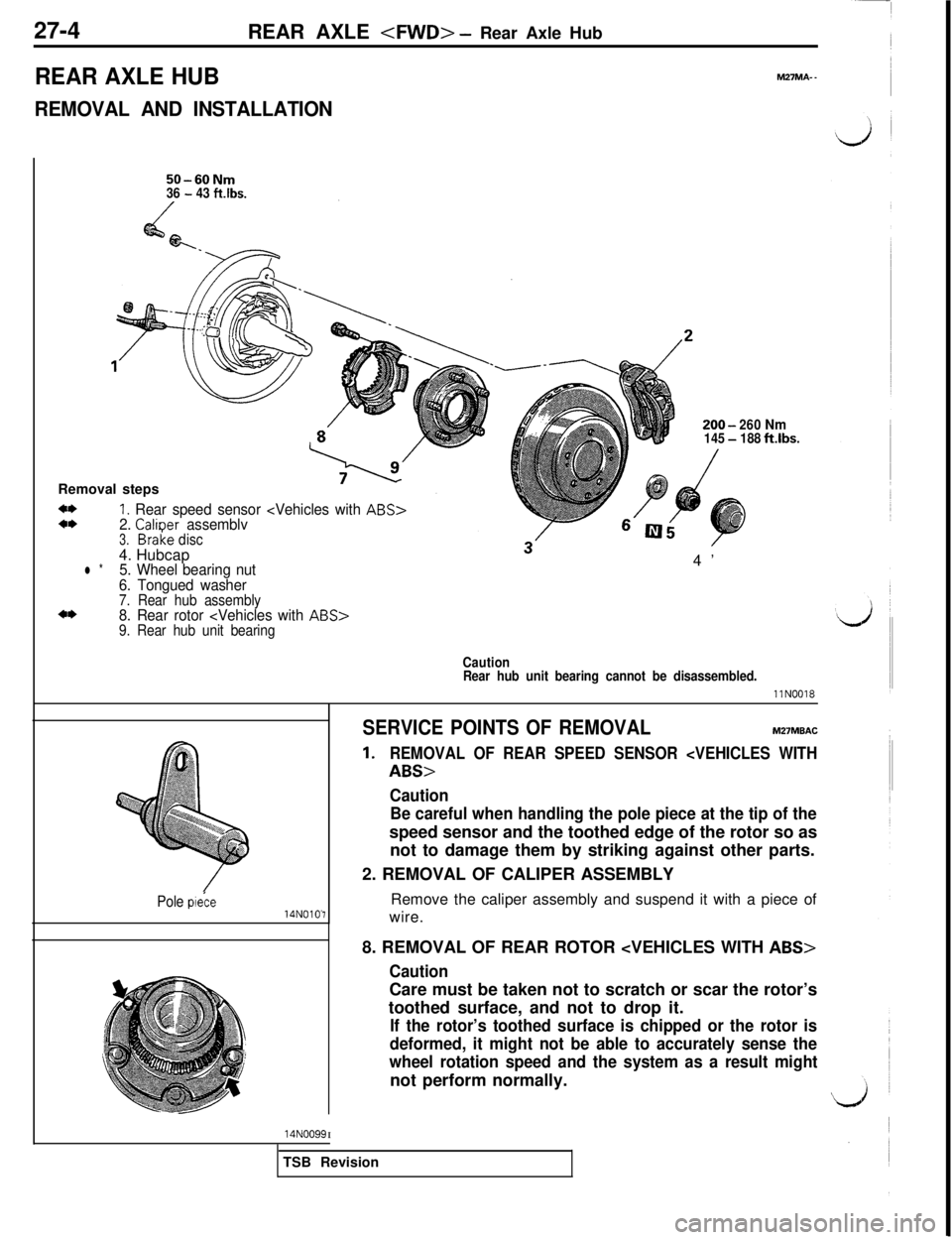
REMOVAL AND INSTALLATION
M27MA- -
50-60Nm36 - 43 ftlbs.
200-260Nm145-188ftibs.Removal steps
4*4*1. Rear speed sensor
l *5. Wheel bearing nut4’6. Tongued washer7. Rear hub assembly4*8. Rear rotor
Caution
Rear hub unit bearing cannot be disassembled.
llN0018
Pole p&e14NOlO-7
SERVICE POINTS OF REMOVALM27MBAC
1.REMOVAL OF REAR SPEED SENSOR
Caution
Be careful when handling the pole piece at the tip of thespeed sensor and the toothed edge of the rotor so as
not to damage them by striking against other parts.
2. REMOVAL OF CALIPER ASSEMBLY
Remove the caliper assembly and suspend it with a piece of
wire.
8. REMOVAL OF REAR ROTOR
CautionCare must be taken not to scratch or scar the rotor’s
toothed surface, and not to drop it.
If the rotor’s toothed surface is chipped or the rotor is
deformed, it might not be able to accurately sense the
wheel rotation speed and the system as a result mightnot perform normally.
14NOO99ITSB Revision
Page 619 of 1146
REAR AXLE
llK008
1Lever
r,.
:I‘)B.J. boot band: 20 - 74 #BJ95
( T.J. boot band: 20 - 75 #BJ95llKl'=-llE560
HP0124
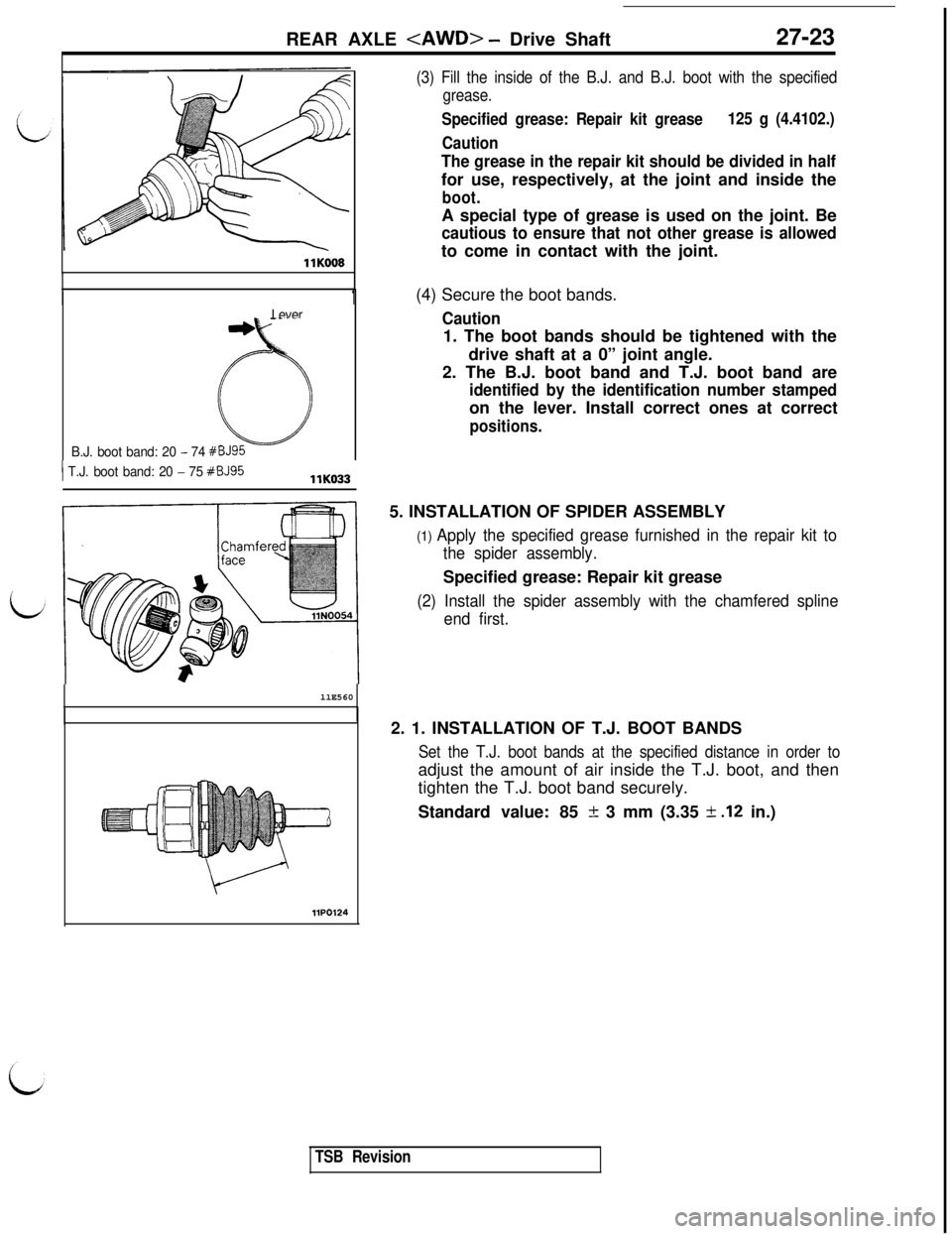
(3) Fill the inside of the B.J. and B.J. boot with the specified
grease.
Specified grease: Repair kit grease125 g (4.4102.)
Caution
The grease in the repair kit should be divided in halffor use, respectively, at the joint and inside the
boot.A special type of grease is used on the joint. Be
cautious to ensure that not other grease is allowedto come in contact with the joint.
(4) Secure the boot bands.
Caution1. The boot bands should be tightened with the
drive shaft at a 0” joint angle.
2. The B.J. boot band and T.J. boot band are
identified by the identification number stampedon the lever. Install correct ones at correct
positions.5. INSTALLATION OF SPIDER ASSEMBLY
(1) Apply the specified grease furnished in the repair kit to
the spider assembly.Specified grease: Repair kit grease
(2) Install the spider assembly with the chamfered spline
end first.2. 1. INSTALLATION OF T.J. BOOT BANDS
Set the T.J. boot bands at the specified distance in order toadjust the amount of air inside the T.J. boot, and then
tighten the T.J. boot band securely.
Standard value: 85 + 3 mm (3.35 +
.I2 in.)
TSB Revision
Page 631 of 1146
REAR AXLE
MB990802-01
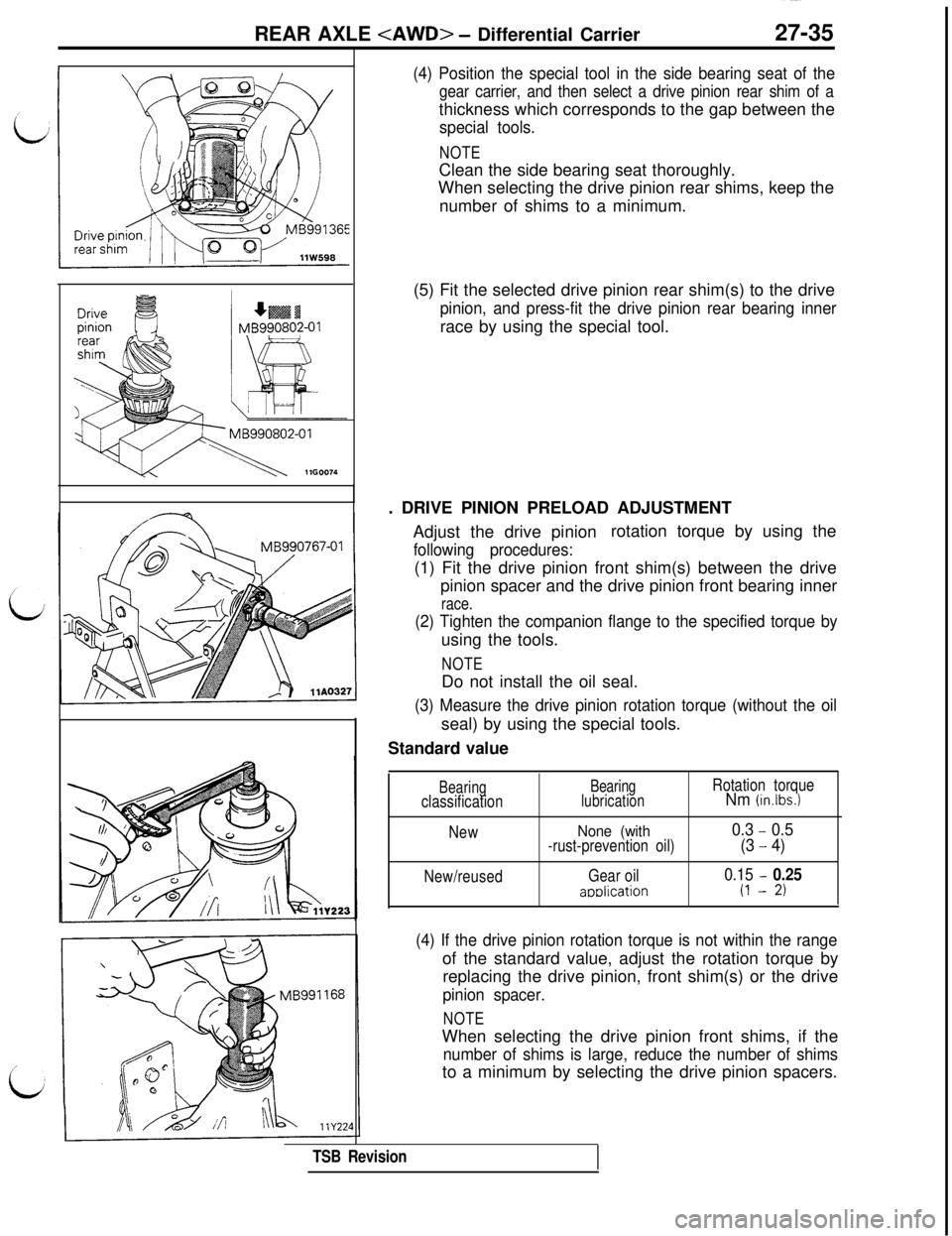
(4) Position the special tool in the side bearing seat of the
gear carrier, and then select a drive pinion rear shim of athickness which corresponds to the gap between the
special tools.
NOTEClean the side bearing seat thoroughly.
When selecting the drive pinion rear shims, keep the
number of shims to a minimum.
(5) Fit the selected drive pinion rear shim(s) to the drive
pinion, and press-fit the drive pinion rear bearing innerrace by using the special tool.
. DRIVE PINION PRELOAD ADJUSTMENT
Adjust the drive pinionrotation torque by using the
following procedures:(1) Fit the drive pinion front shim(s) between the drive
pinion spacer and the drive pinion front bearing inner
race.
(2) Tighten the companion flange to the specified torque byusing the tools.
NOTEDo not install the oil seal.
(3) Measure the drive pinion rotation torque (without the oilseal) by using the special tools.
Standard value
Bearingclassification
New
New/reusedBearing
lubrication
None (with-rust-prevention oil)
Gear oil
amlication
Rotation torqueNm (in.lbs.)
0.3 - 0.5
(3
- 4)
0.15 - 0.25
(I - 2)
(4) If the drive pinion rotation torque is not within the rangeof the standard value, adjust the rotation torque by
replacing the drive pinion, front shim(s) or the drive
pinion spacer.
NOTEWhen selecting the drive pinion front shims, if the
number of shims is large, reduce the number of shimsto a minimum by selecting the drive pinion spacers.
TSB Revision
Page 643 of 1146
32-1
POWER PLANTMOUNT
CONTENTSMZAA- _
ENGINE MOUNTING........................................
3SPECIFICATIONS................................................2
ENGINE ROLL STOPPER
5Service Specifications....................................2....................................
TRANSAXLE MOUNTING................................4RIGHT MEMBER, LEFT MEMBER AND
CROSSMEMBER”................................................6TROUBLESHOOTING........................................2
SPECIAL TOOLSAbnormal Noise....................................................
2
Excessive Engine Wobble or Vibration
SUPPLEMENTAL RESTRAINT SYSTEM (SRS)
(1)A Supplemental Restraint System (SRS), which uses a driver-side air bag, has been installed in the 3000GT.(2)The SRS includes the following components: impact sensors, SRS diagnosis unit: SRS warning light, air bagmodule, clock spring, interconnecting wiring. Other SRS-related components (that may have to be
removed/installed in connection with SRS service or maintenance) are indicated in the table of contents byan asterisk (*).
WARNING!(1)Improper service or maintenance of any component of the SRS, or any SRS-related component, can lead to
personal injury or death to service personnel (from inadvertent firing of the air bag) or to the driver (from
rendering the SRS inoperative).
(2) Service or maintenance of any SRS component or SRS-related component must be performed only at an
authorized MITSUBISHI dealer.(3) MITSUBISHI dealer personnel must thoroughly review this manual, and especially its GROUP 52B
-Supplemental Restraint System (SRS), before beginning any service or maintenance of any component of theSRS or any SRS-related component.
Page 659 of 1146
FRONT SUSPENSION - Lower Arm33A-9
MB991 113-0112R0258
12UOO18
LIPS
Dust
shield
12R0487
MB990799-01
Dust shield
Snap ring12L0295
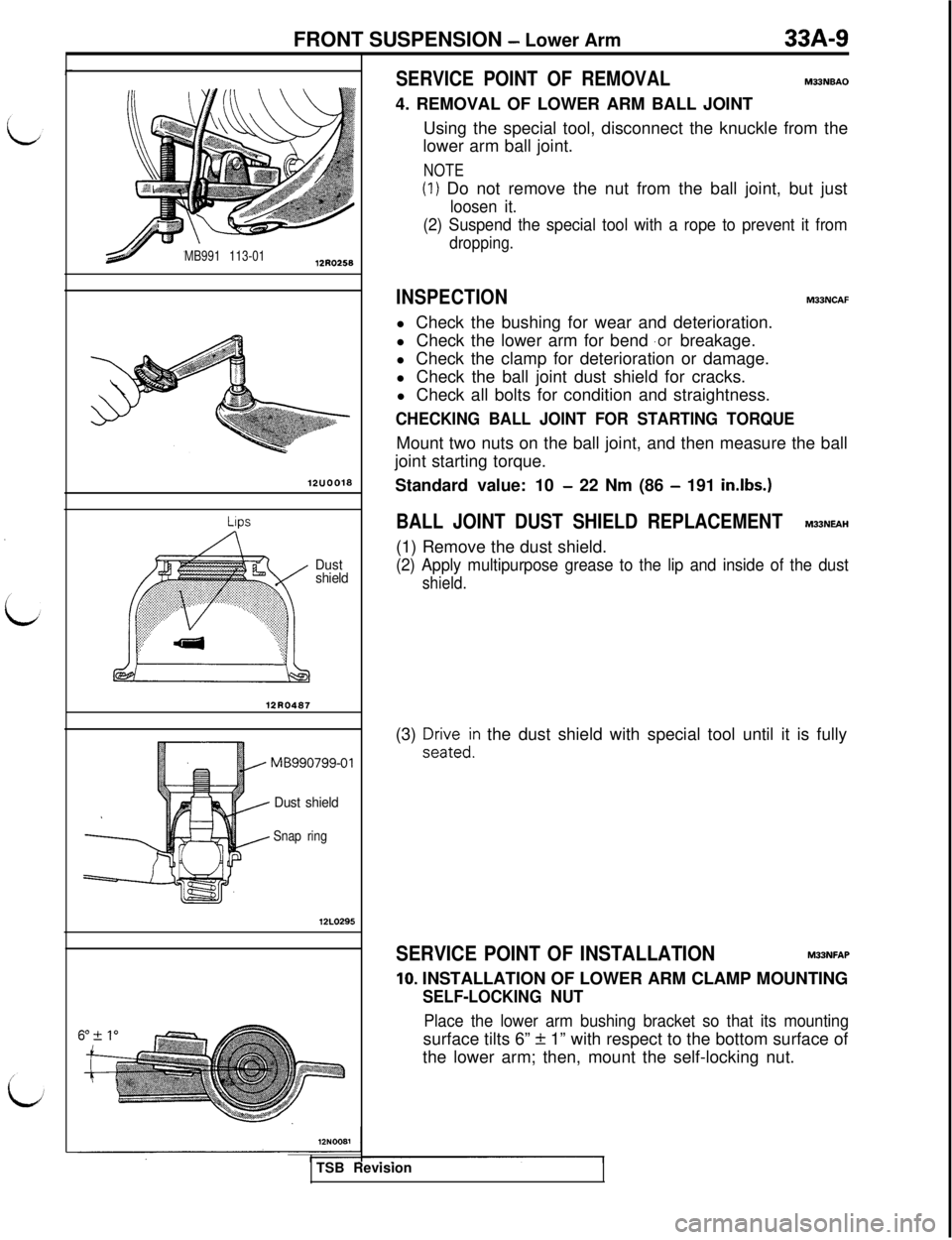
SERVICE POINT OF REMOVALM33NBAO4. REMOVAL OF LOWER ARM BALL JOINT
Using the special tool, disconnect the knuckle from the
lower arm ball joint.
NOTE
(1) Do not remove the nut from the ball joint, but just
loosen it.
(2) Suspend the special tool with a rope to prevent it from
dropping.
INSPECTIONM33NCAFl Check the bushing for wear and deterioration.
l Check the lower arm for bend
,or breakage.
l Check the clamp for deterioration or damage.
l Check the ball joint dust shield for cracks.
l Check all bolts for condition and straightness.
CHECKING BALL JOINT FOR STARTING TORQUEMount two nuts on the ball joint, and then measure the ball
joint starting torque.
Standard value: 10
- 22 Nm (86 - 191 in.lbs.1
BALL JOINT DUST SHIELD REPLACEMENTMJBNEAH(1) Remove the dust shield.
(2) Apply multipurpose grease to the lip and inside of the dust
shield.(3)
C$Fedn the dust shield with special tool until it is fully
TSB Revision
SERVICE POINT OF INSTALLATIONM33NFAP
10. INSTALLATION OF LOWER ARM CLAMP MOUNTING
SELF-LOCKING NUT
Place the lower arm bushing bracket so that its mountingsurface tilts 6”
? 1” with respect to the bottom surface of
the lower arm; then, mount the self-locking nut.
Page 663 of 1146
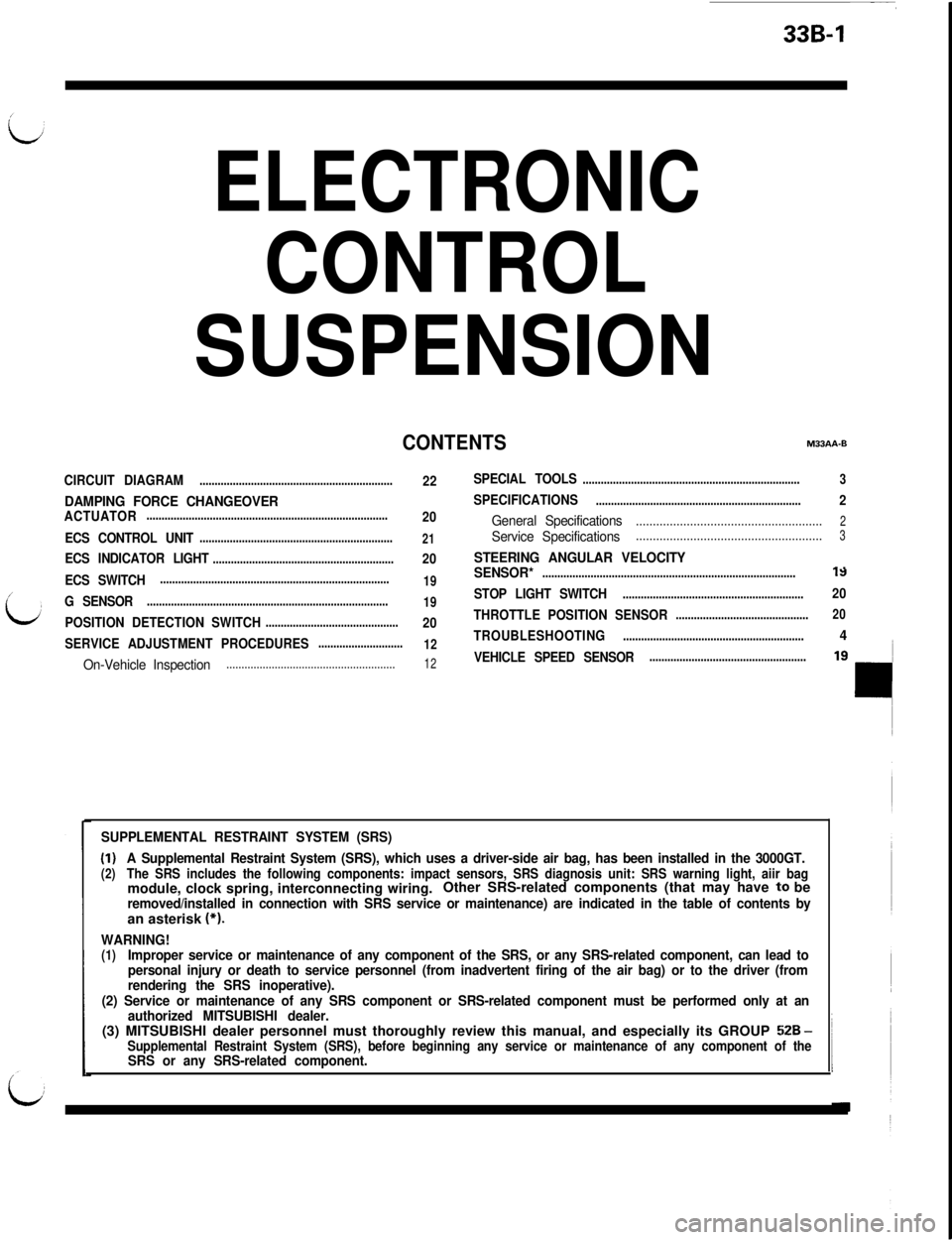
33B-1
ELECTRONIC
CONTROL
SUSPENSION
CONTENTSM33AA-B
CIRCUIT DIAGRAM
22SPECIAL TOOLS........................................................................3
................................................................
DAMPING FORCE CHANGEOVERSPECIFICATIONS....................................................................2
ACTUATOR................................................................................20General Specifications.......................................................2
ECS CONTROL UNIT................................................................21Service Specifications.......................................................3
ECS INDICATOR LIGHT............................................................20STEERING ANGULAR VELOCITYa .
ECS SWITCH............................................................................
19
G SENSOR................................................................................
19
POSITION DETECTION SWITCH............................................20
SERVICE ADJUSTMENT PROCEDURES
............................
12
On-Vehicle Inspection........................................................12
SENSOR*....................................................................................-IY
STOP LIGHT SWITCH............................................................20
THROTTLE POSITION SENSOR
............................................20
TROUBLESHOOTING............................................................4
VEHICLE SPEED SENSOR....................................................
SUPPLEMENTAL RESTRAINT SYSTEM (SRS)
(I)A Supplemental Restraint System (SRS), which uses a driver-side air bag, has been installed in the 3000GT.(2)The SRS includes the following components: impact sensors, SRS diagnosis unit: SRS warning light, aiir bagmodule, clock spring, interconnecting wiring.Other SRS-related components (that may have 1:o be
removed/installed in connection with SRS service or maintenance) are indicated in the table of contents byan asterisk (*).
WARNING!(1)Improper service or maintenance of any component of the SRS, or any SRS-related component, can lead to
personal injury or death to service personnel (from inadvertent firing of the air bag) or to the driver (from
rendering the SRS inoperative).
(2) Service or maintenance of any SRS component or SRS-related component must be performed only at an
authorized MITSUBISHI dealer.(3) MITSUBISHI dealer personnel must thoroughly review this manual, and especially its GROUP
Ei2B -Supplemental Restraint System (SRS), before beginning any service or maintenance of any component of theSRS or any SRS-related component.
Page 678 of 1146
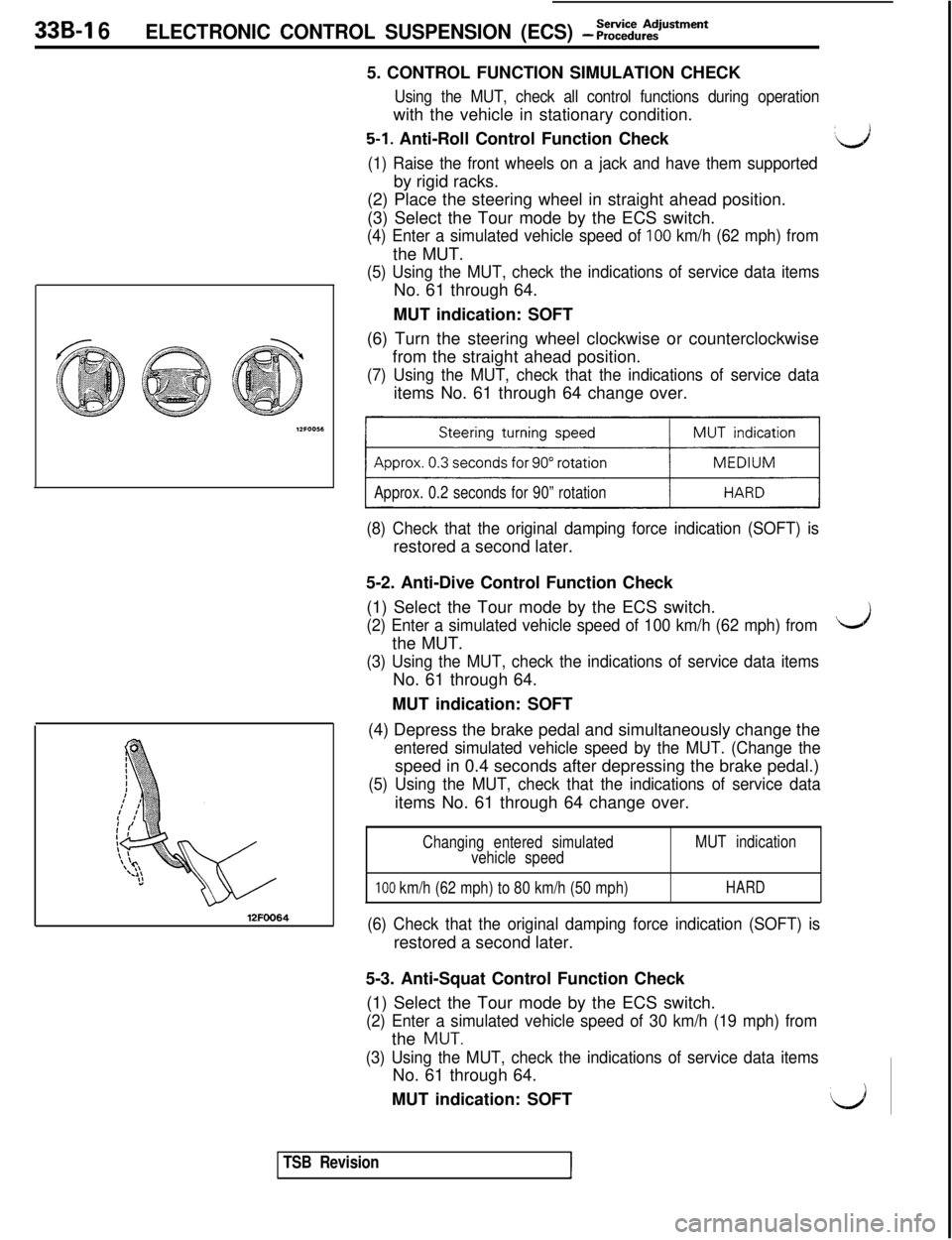
339-l 6ELECTRONIC CONTROL SUSPENSION (ECS) - ;;:%,:?‘Stment5. CONTROL FUNCTION SIMULATION CHECK
Using the MUT, check all control functions during operationwith the vehicle in stationary condition.
5-1. Anti-Roll Control Function Check:d
(1) Raise the front wheels on a jack and have them supportedby rigid racks.
(2) Place the steering wheel in straight ahead position.
(3) Select the Tour mode by the ECS switch.
(4) Enter a simulated vehicle speed of 100 km/h (62 mph) fromthe MUT.
(5) Using the MUT, check the indications of service data itemsNo. 61 through 64.
MUT indication: SOFT
12FOO64(6) Turn the steering wheel clockwise or counterclockwise
from the straight ahead position.
(7) Using the MUT, check that the indications of service dataitems No. 61 through 64 change over.
Approx. 0.2 seconds for 90” rotation
(8) Check that the original damping force indication (SOFT) isrestored a second later.
5-2. Anti-Dive Control Function Check
(1) Select the Tour mode by the ECS switch.
(2) Enter a simulated vehicle speed of 100 km/h (62 mph) fromthe MUT.
(3) Using the MUT, check the indications of service data itemsNo. 61 through 64.
MUT indication: SOFT
(4) Depress the brake pedal and simultaneously change the
entered simulated vehicle speed by the MUT. (Change thespeed in 0.4 seconds after depressing the brake pedal.)
(5) Using the MUT, check that the indications of service dataitems No. 61 through 64 change over.
Changing entered simulated
vehicle speedMUT indication
100 km/h (62 mph) to 80 km/h (50 mph)HARD
(6) Check that the original damping force indication (SOFT) isrestored a second later.
Ls5-3. Anti-Squat Control Function Check
(1) Select the Tour mode by the ECS switch.
(2) Enter a simulated vehicle speed of 30 km/h (19 mph) fromthe
MUT.
(3) Using the MUT, check the indications of service data itemsNo. 61 through 64.
MUT indication: SOFT
l/i
TSB Revision