engine coolant MITSUBISHI 3000GT 1991 Workshop Manual
[x] Cancel search | Manufacturer: MITSUBISHI, Model Year: 1991, Model line: 3000GT, Model: MITSUBISHI 3000GT 1991Pages: 1146, PDF Size: 76.68 MB
Page 351 of 1146
EMISSION CONTROL - Evaporative Emission Control System17-7
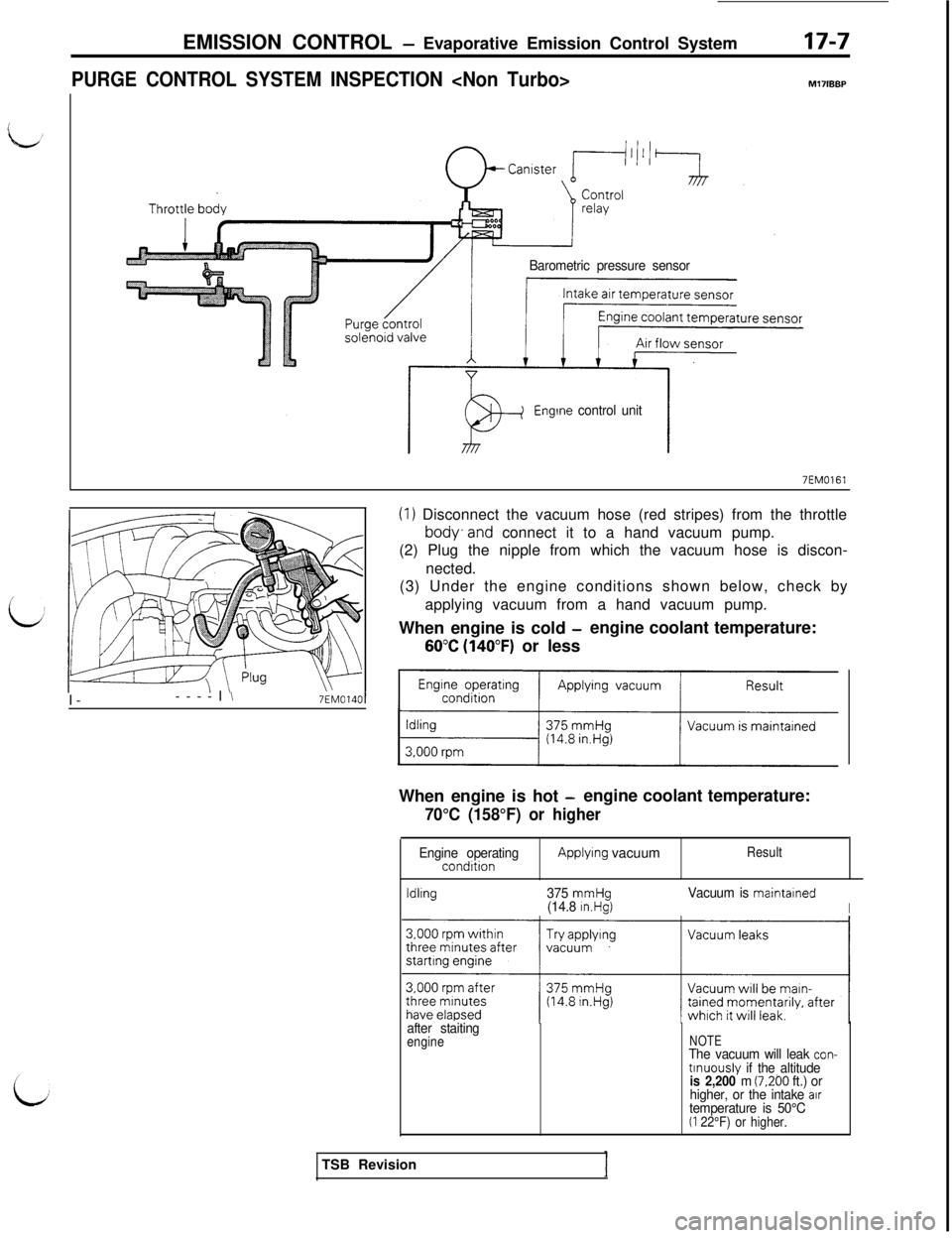
PURGE CONTROL SYSTEM INSPECTION
Barometric pressure sensor
Engine control unit
7EM0161I-----I
\7EM0140t
(1) Disconnect the vacuum hose (red stripes) from the throttle
body,and connect it to a hand vacuum pump.
(2) Plug the nipple from which the vacuum hose is discon-
nected.
(3) Under the engine conditions shown below, check by
applying vacuum from a hand vacuum pump.
When engine is cold
-engine coolant temperature:
60°C (140°F) or less
When engine is hot
-engine coolant temperature:
70°C (158°F) or higher
Engine operatingcondttionApplying vacuumResult
ldllng375 mmHg(14.8 In.Hg)Vacuum is maintalned
I
after staitingengineNOTEThe vacuum will leak con-tenuously if the altitudeis 2,200 m (7.200 ft.) or
higher, or the intake airtemperature is 50°C(I 22°F) or higher.TSB Revision
Page 352 of 1146

17-8EMISSION CONTROL - Evaporative Emission Control System
PURGE CONTROL SYSTEM INSPECTION
Canister
Purge control
valve\
PI IrnQ rnntrnlI.1 I
kXffo~~~~r~~ ’ I I-J
relay
Barometric pressure sensor
Intake air temperature sensor
Engine coolant temperature sensor
II1 I IAir flow sensor
Engine control unit
6EM0215(1) Disconnect the purge air hose from the air intake hose, and
plug the air intake hose. Then, connect the hand vacuum
pump to the purge air hose.
(2) Under the engine conditions shown below, check by
applying vacuum from a hand vacuum pump.
When engine is cold
-engine coolant temperature:
60°C (140°F) or less
Engine operating
conditionApplying vacuumResult
Idling
375 mmHgVacuum is maintained
3,000 rpm(14.8 in.Hg)When engine is hot
-engine coolant temperature:
70°C (158°F) or higher
Engine operating
condition
Idling
3,000 rpm within
three minutes after
starting engine
3,000 rpm after
three minutes
have elapsedafter startingengine
Applying vacuum
375
mmHg(14.8 in.Hg)
Try applyingvacuum
375
mmHg(14.8 in.Hg)
Result
Vacuum is marntained
Vacuum leaks
Vacuum WIII be main-tained momentarily, after
which it will leak.
NOTEThe vacuum WIII leak con-
tinuously if the altitude
is 2,200 m
(7,200 ft.) orhrgher. or the Intake arrtemperature is 50°C(122°F) or higher.
1 TSB Revision
Page 353 of 1146
EMISSION CONTROL - EvaporativeEmission Control System
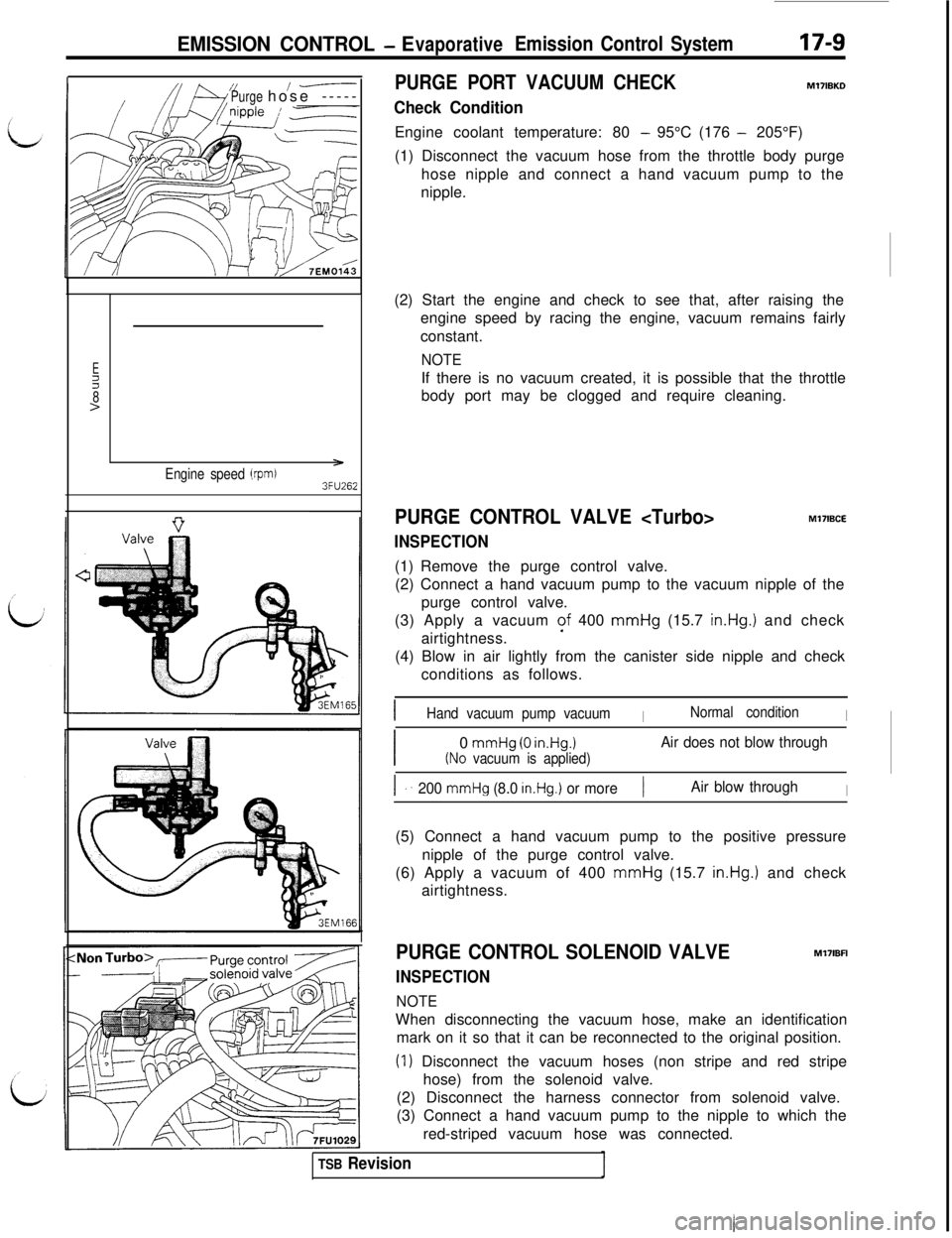
Purge/-----hose -----PURGE PORT VACUUM CHECK
Check Condition
17-9
M17lBKDEngine coolant temperature: 80
- 95°C (176 - 205°F)
(1) Disconnect the vacuum hose from the throttle body purge
hose nipple and connect a hand vacuum pump to the
nipple.
Ez8>
Engine speed (rprd3FU262(2) Start the engine and check to see that, after raising the
engine speed by racing the engine, vacuum remains fairly
constant.
NOTEIf there is no vacuum created, it is possible that the throttle
body port may be clogged and require cleaning.
PURGE CONTROL VALVE
INSPECTIONMl7IBCE
(1) Remove the purge control valve.
(2) Connect a hand vacuum pump to the vacuum nipple of the
purge control valve.
(3) Apply a vacuum of 400 mmHg (15.7
in.Hg.1 and check
airtightness.
(4) Blow in air lightly from the canister side nipple and check
conditions as follows.
IHand vacuum pump vacuumINormal conditionI
I0
mmHg (0 in.Hg.1Air does not blow through
(No vacuum is applied)
I ..200 mmHg (8.0 in.Hg.) or more1Air blow throughI(5) Connect a hand vacuum pump to the positive pressure
nipple of the purge control valve.
(6) Apply a vacuum of 400 mmHg (15.7
in.Hg.1 and check
airtightness.
PURGE CONTROL SOLENOID VALVE
INSPECTION
NOTEMl7lBFI
When disconnecting the vacuum hose, make an identification
mark on it so that it can be reconnected to the original position.
(I) Disconnect the vacuum hoses (non stripe and red stripe
hose) from the solenoid valve.
(2) Disconnect the harness connector from solenoid valve.
(3) Connect a hand vacuum pump to the nipple to which the
red-striped vacuum hose was connected.
TSB Revision
Page 354 of 1146
17-10EMISSION CONTROL - Evaporative Emission Control System
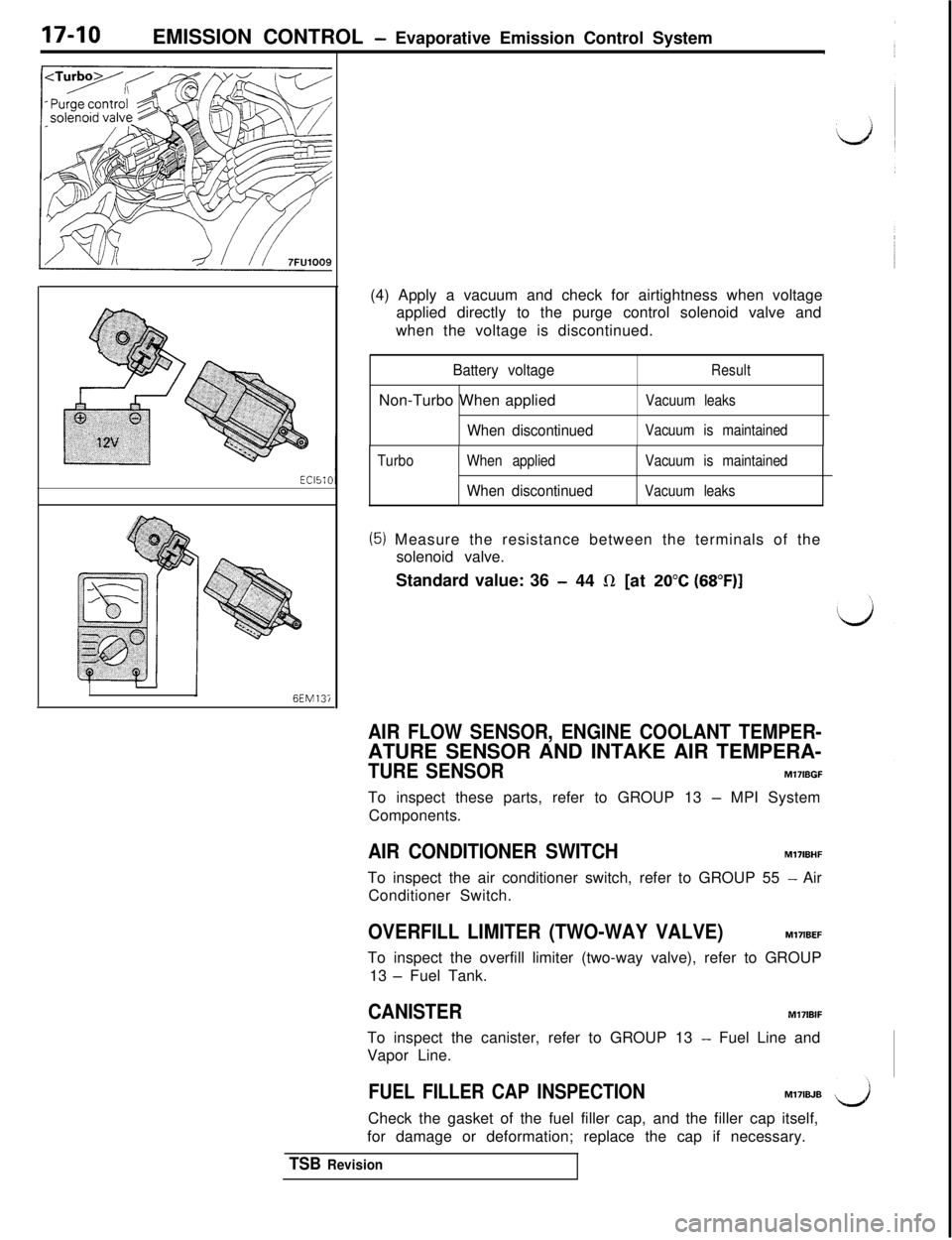
I-6EM13i(4) Apply a vacuum and check for airtightness when voltage
applied directly to the purge control solenoid valve and
when the voltage is discontinued.
Battery voltageResultNon-Turbo When applied
Vacuum leaks
When discontinuedVacuum is maintained
TurboWhen applied
When discontinued
Vacuum is maintained
Vacuum leaks
(5) Measure the resistance between the terminals of the
solenoid valve.
Standard value: 36
- 44 R [at 20°C (68”F)]
AIR FLOW SENSOR, ENGINE COOLANT TEMPER-ATURE SENSOR AND INTAKE AIR TEMPERA-
TURE SENSORM17lBGFTo inspect these parts, refer to GROUP 13
- MPI System
Components.
AIR CONDITIONER SWITCHMl7IBHF
To inspect the air conditioner switch, refer to GROUP 55
- Air
Conditioner Switch.
OVERFILL LIMITER (TWO-WAY VALVE)M17IBEFTo inspect the overfill limiter (two-way valve), refer to GROUP
13
- Fuel Tank.
CANISTERM17lBIFTo inspect the canister, refer to GROUP 13
- Fuel Line and
Vapor Line.
FUEL FILLER CAP INSPECTIONM17IBJBCheck the gasket of the fuel filler cap, and the filler cap itself,
for damage or deformation; replace the cap if necessary.
TSB Revision
Page 356 of 1146
17-12EMISSION CONTROL - Exhaust Gas Recirculation (EGR) System
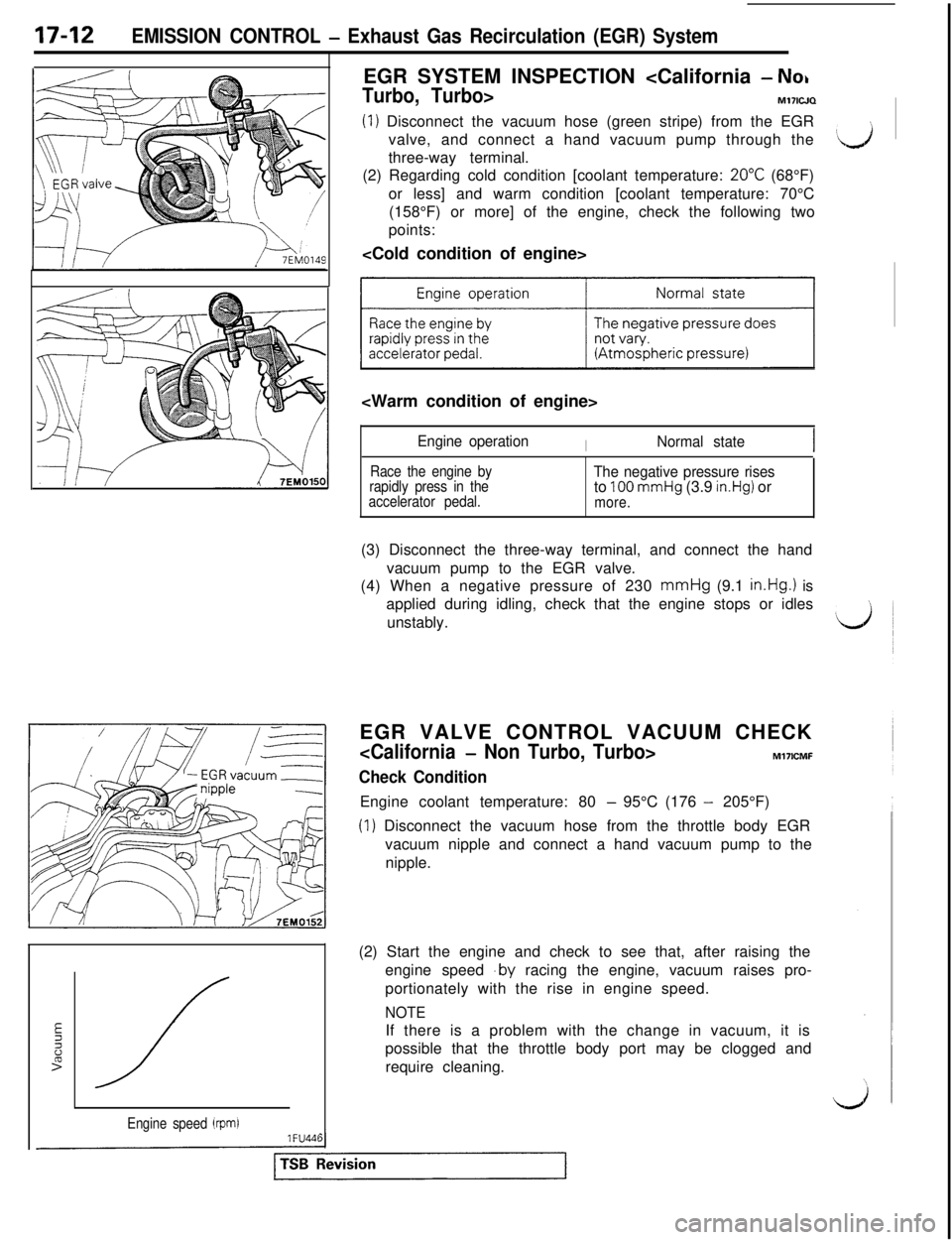
Engine speed (rpm)1 FU44lEGR SYSTEM INSPECTION
Turbo, Turbo>M171WQ
(1) Disconnect the vacuum hose (green stripe) from the EGR
valve, and connect a hand vacuum pump through the
three-way terminal.
(2) Regarding cold condition [coolant temperature:
20°C (68°F)
or less] and warm condition [coolant temperature: 70°C
(158°F) or more] of the engine, check the following two
points:
~1
Engine operationINormal state
Race the engine by
rapidly press in the
accelerator pedal.The negative pressure risesto 100 mmHg (3.9 in.Hg) ormore.(3) Disconnect the three-way terminal, and connect the hand
vacuum pump to the EGR valve.
(4) When a negative pressure of 230 mmHg (9.1
in.Hg.1 is
applied during idling, check that the engine stops or idles
unstably.
EGR VALVE CONTROL VACUUM CHECK
Check ConditionEngine coolant temperature: 80
- 95°C (176 - 205°F)
(1) Disconnect the vacuum hose from the throttle body EGR
vacuum nipple and connect a hand vacuum pump to the
nipple.
(2) Start the engine and check to see that, after raising the
engine speed
.by racing the engine, vacuum raises pro-
portionately with the rise in engine speed.
NOTEIf there is a problem with the change in vacuum, it is
possible that the throttle body port may be clogged and
require cleaning.
Page 395 of 1146
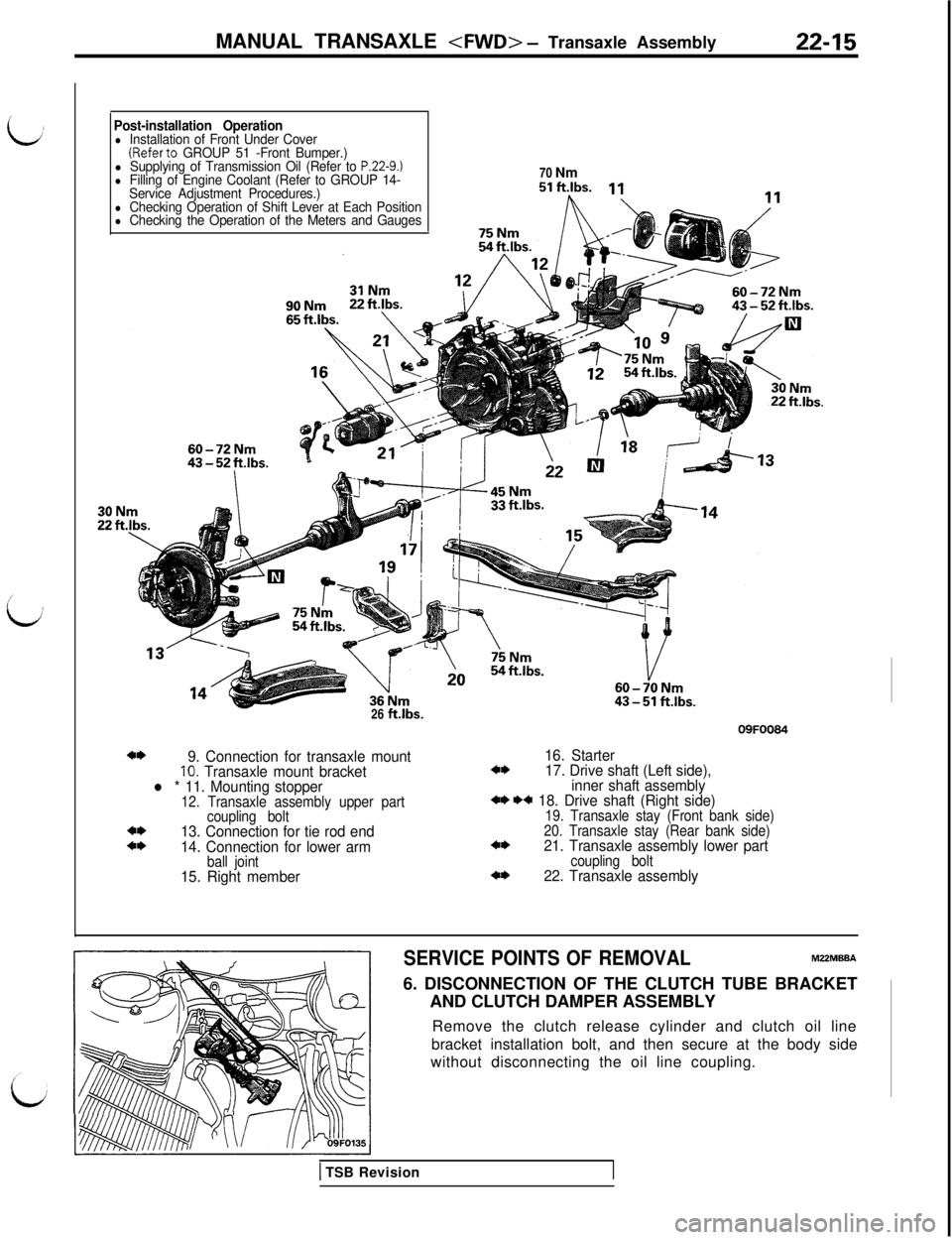
MANUAL TRANSAXLE
idPost-installation Operationl Installation of Front Under Cover(Referto GROUP 51 -Front Bumper.)l Supplying of Transmission Oil (Refer to P.22-9.)l Filling of Engine Coolant (Refer to GROUP 14-
Service Adjustment Procedures.)70 Nm
l Checking Operation of Shift Lever at Each Positionl Checking the Operation of the Meters and Gauges26
ft.lbs.09FOO84
4*9. Connection for transaxle mount16. Starter10. Transaxle mount bracket4*17. Drive shaft (Left side),
l * 11. Mounting stopperinner shaft assembly12. Transaxle assembly upper part+* ** 18. Drive shaft (Right side)
coupling bolt19. Transaxle stay (Front bank side)4*13. Connection for tie rod end20. Transaxle stay (Rear bank side)4*14. Connection for lower arm4*21. Transaxle assembly lower part
ball jointcoupling bolt15. Right member4*22. Transaxle assembly
SERVICE POINTS OF REMOVALMZZMBBA6. DISCONNECTION OF THE CLUTCH TUBE BRACKET
AND CLUTCH DAMPER ASSEMBLY
Remove the clutch release cylinder and clutch oil line
bracket installation bolt, and then secure at the body side
without disconnecting the oil line coupling.
1 TSB Revision
Page 495 of 1146
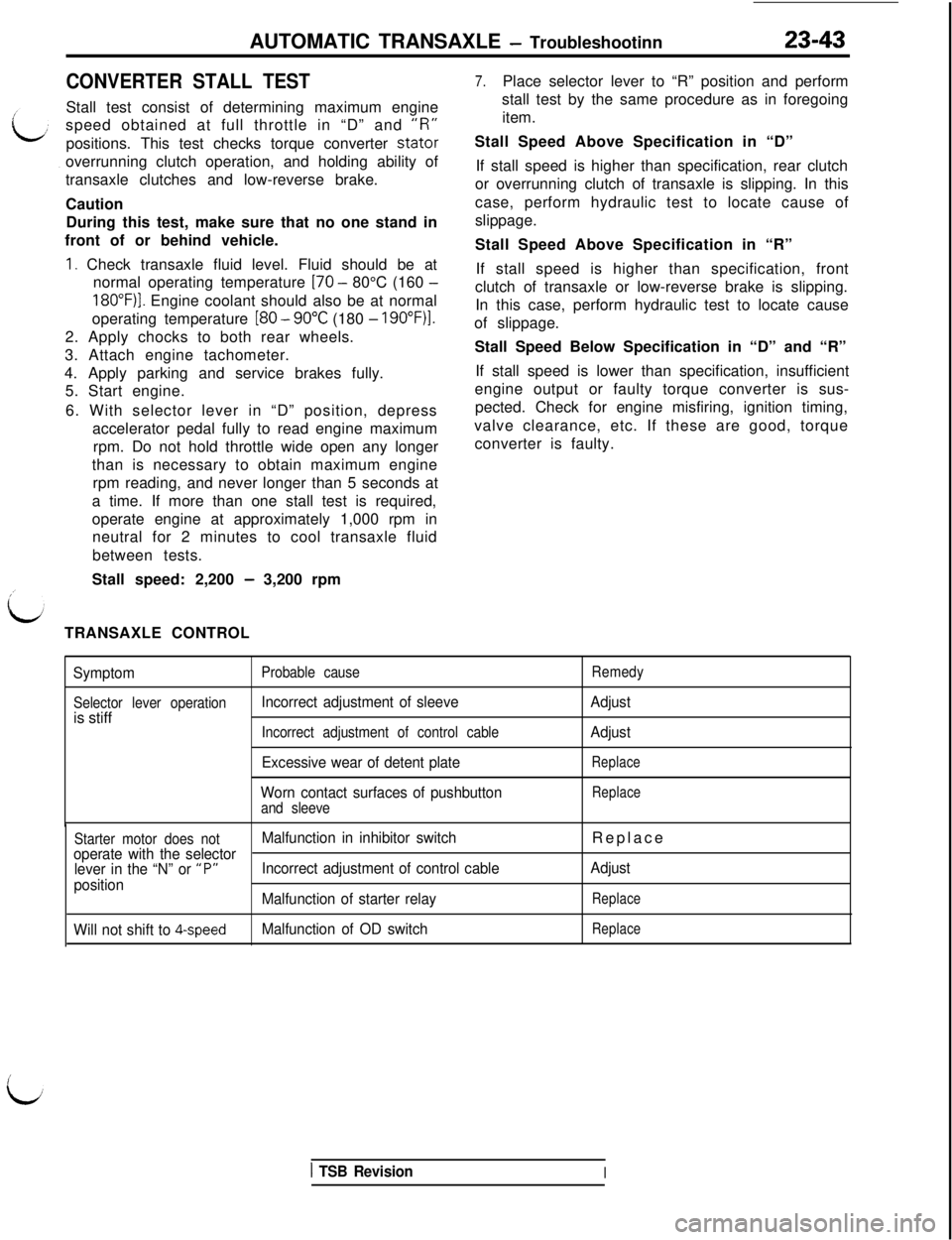
AUTOMATIC TRANSAXLE - Troubleshootinn23-43
CONVERTER STALL TESTStall test consist of determining maximum engine
speed obtained at full throttle in “D” and
“I?”positions. This test checks torque converter
statoroverrunning clutch operation, and holding ability of
transaxle clutches and low-reverse brake.
Caution
During this test, make sure that no one stand in
front of or behind vehicle.
1. Check transaxle fluid level. Fluid should be at
normal operating temperature
[70 - 80°C (160 -
18O”F)I. Engine coolant should also be at normal
operating temperature
[80 - 90°C (180 - 19O”F)l.2. Apply chocks to both rear wheels.
3. Attach engine tachometer.
4. Apply parking and service brakes fully.
5. Start engine.
6. With selector lever in “D” position, depress
accelerator pedal fully to read engine maximum
rpm. Do not hold throttle wide open any longer
than is necessary to obtain maximum engine
rpm reading, and never longer than 5 seconds at
a time. If more than one stall test is required,
operate engine at approximately 1,000 rpm in
neutral for 2 minutes to cool transaxle fluid
between tests.
Stall speed: 2,200
- 3,200 rpm
7.Place selector lever to “R” position and perform
stall test by the same procedure as in foregoing
item.
Stall Speed Above Specification in “D”
If stall speed is higher than specification, rear clutch
or overrunning clutch of transaxle is slipping. In this
case, perform hydraulic test to locate cause of
slippage.
Stall Speed Above Specification in “R”
If stall speed is higher than specification, front
clutch of transaxle or low-reverse brake is slipping.
In this case, perform hydraulic test to locate cause
of slippage.
Stall Speed Below Specification in “D” and “R”
If stall speed is lower than specification, insufficient
engine output or faulty torque converter is sus-
pected. Check for engine misfiring, ignition timing,
valve clearance, etc. If these are good, torque
converter is faulty.
TRANSAXLE CONTROL
Symptom
Selector lever operationis stiff
Probable cause
Incorrect adjustment of sleeve
Remedy
Adjust
Incorrect adjustment of control cable
Excessive wear of detent plate
Worn contact surfaces of pushbutton
and sleeve
Adjust
Replace
Replace
Starter motor does notMalfunction in inhibitor switchReplace
operate with the selector
lever in the “N” or “P”Incorrect adjustment of control cableAdjust
position
Will not shift to
4-speed
Malfunction of starter relay
Malfunction of OD switchReplace
Replace
1 TSB RevisionI
Page 1083 of 1146

55-1
HEATER, AIR
CONDITIONER
AND VENTILATION
CONTENTSM55AA- -
HEATERS AND AIR CONDITIONING................3HEATER UNIT*........................................................................22
SPECIFICATIONS
....................................................................3REFRIGERANT LINE................................................................35General Specifications
........................................................3RESISTOR................................................................................20Lubricants
............................................................................4SAFETY PRECAUTIONS........................................................9Sealant and Adhesive............................................................4
Service Specifications3SERVICE ADJUSTMENT PROCEDURES............................10........................................................
SPECIAL TOOLS4Charging Procedures............................................................11
i
........................................................................Charging the Refrigerant....................................................12Compressor Drive Belt Adjustment....................................11
HEATERS AND MANUAL AIR CONDITIONER5Compressor Noise................................................................16
................................................16
AIR CONDITIONER SWITCH................................................21Handling Tubing andFittings
Idle-up Operation Check....................................................17
BELT LOCK CONTROLLER20Performance Test................................................................15....................................................
BLOWER ASSEMBLYPower Relay Check............................................................17............................................................23Refrigerant Leak Repair Procedure....................................15COMPRESSOR........................................................................
27TestProcedures....................................................................10
CONDENSER AND CONDENSER FAN MOTOR................33TROUBLESHOOTING............................................................5
ENGINE COOLANT TEMPERATURE SWITCH....................
39VENTILATORS (AIR INLET AND AIR OUTLET)................38
EVAPORATOR
........................................................................
25VENTILATORS (INSTRUMENT PANEL)*............................36
HEATER CONTROL ASSEMBLY*
........................................18CONTINUED ON NEXT PAGE
SUPPLEMENTAL RESTRAINT SYSTEM (SRS)
(1)A Supplemental Restraint System (SRS), which uses a driver-side air bag, has been installed in the 3000GT.(2)The SRS includes the following components: impact sensors, SRS diagnosis unit: SRS warning light, air bagmodule, clock spring, interconnecting wiring. Other SRS-related components (that may have to be
removed/installed in connection with SRS service or maintenance) are indicated in the table of contents byan asterisk (*).
WARNING!(1)Improper service or maintenance of any component of the SRS, or any SRS-related component, can lead to
personal injury or death to service personnel (from inadvertent firing of the air bag) or to the driver (fromrendering the
SRS inoperative).(2) Service or maintenance of any SRS component or SRS-related component must be performed only at anauthorized MITSUBISHI dealer.
(3) MITSUBISHI dealer personnel must thoroughly review this manual, and especially its GROUP 52B
-Supplemental Restraint System (SRS), before beginning any service or maintenance of any component of theSRS or any SRS-related component.
Page 1084 of 1146

55-2FULL AUTO AIR CONDITIONER........................40OTHER PARTS........................................................................62
AIR-CONDITIONER CONTROL PANEL*,POWER TRANSISTOR, BELT LOCK CONTROLLER........57
AIR-CONDITIONER CONTROL UNIT*................................56
REFRIGERANT LINE................................................................62
COMPRESSOR
........................................................................62SAFETY PRECAUTlONS........................................................56
CONDENSER AND CONDENSER FAN MOTOR
................
62SENSORS....................................................................................60
DAMPER CONTROL MOTOR ASSEMBLY*........................
58SERVICE ADJUSTMENT PROCEDURES............................56
ENGINE COOLANT TEMPERATURE SWITCH
....................62
TROUBLESHOOTING............................................................40
Page 1085 of 1146
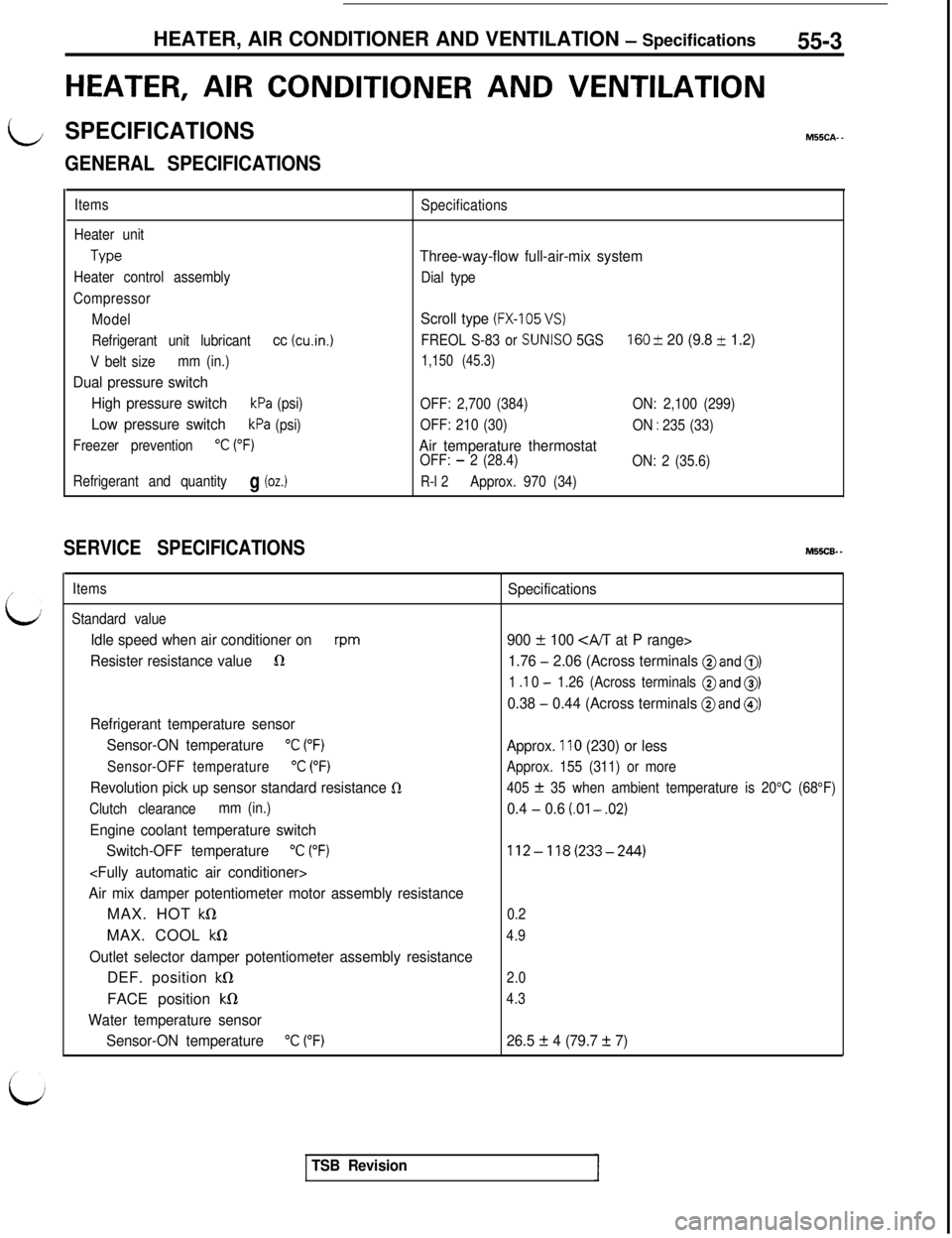
HEATER, AIR CONDITIONER AND VENTILATION - Specifications55-3
HEATER, AIR CONDITIONER AND VENTILATION
LSPECIFICATIONSM55CA. -
/’
L;
GENERAL SPECIFICATIONS
Items
Heater unit
Type
Heater control assembly
Compressor
Model
Refrigerant unit lubricant
cc (cu.in.1
V belt sizemm (in.)
Dual pressure switch
High pressure switch
kPa (psi)
Low pressure switchkPa (psi)
Freezer prevention
“C (“F)
Refrigerant and quantityg (oz.)
Specifications
Three-way-flow full-air-mix system
Dial type
Scroll type (FX-105 VS)
FREOL S-83 or SUNISO 5GS160 & 20 (9.8 + 1.2)
1,150 (45.3)
OFF: 2,700 (384)ON: 2,100 (299)
OFF: 210 (30)
ON
: 235 (33)
Air temperature thermostatOFF: - 2 (28.4)
ON: 2 (35.6)
R-l 2Approx. 970 (34)
SERVICE SPECIFICATIONSM55CB. -
Items
Standard value
Idle speed when air conditioner onrpm
Resister resistance value1R
Refrigerant temperature sensor
Sensor-ON temperature
“C (“F)
Sensor-OFF temperature“C (“F)
Revolution pick up sensor standard resistance 0
Clutch clearancemm (in.)
Engine coolant temperature switch
Switch-OFF temperature
“C (“F)
Air mix damper potentiometer motor assembly resistanceMAX. HOT
kQMAX. COOL
kS1
Outlet selector damper potentiometer assembly resistanceDEF. position
kS1FACE position
kfl
Water temperature sensor
Sensor-ON temperature
“C (“F)
Specifications
900
f 100 CA/T at P range>
1.76
- 2.06 (Across terminals @and 0)
1 .I 0 - 1.26 (Across terminals @and 0)
0.38 - 0.44 (Across terminals @and @)
Approx. 110 (230) or less
Approx. 155 (311) or more
405
f 35 when ambient temperature is 20°C (68°F)
0.4 - 0.6 (.Ol - .02)
112-118(233-244)
0.2
4.9
2.0
4.3
26.5 f 4 (79.7 + 7)
TSB Revision