sensor MITSUBISHI 3000GT 1991 Workshop Manual
[x] Cancel search | Manufacturer: MITSUBISHI, Model Year: 1991, Model line: 3000GT, Model: MITSUBISHI 3000GT 1991Pages: 1146, PDF Size: 76.68 MB
Page 185 of 1146
FUEL SYSTEM - On-vehicle lnwection of MPI ComDonents
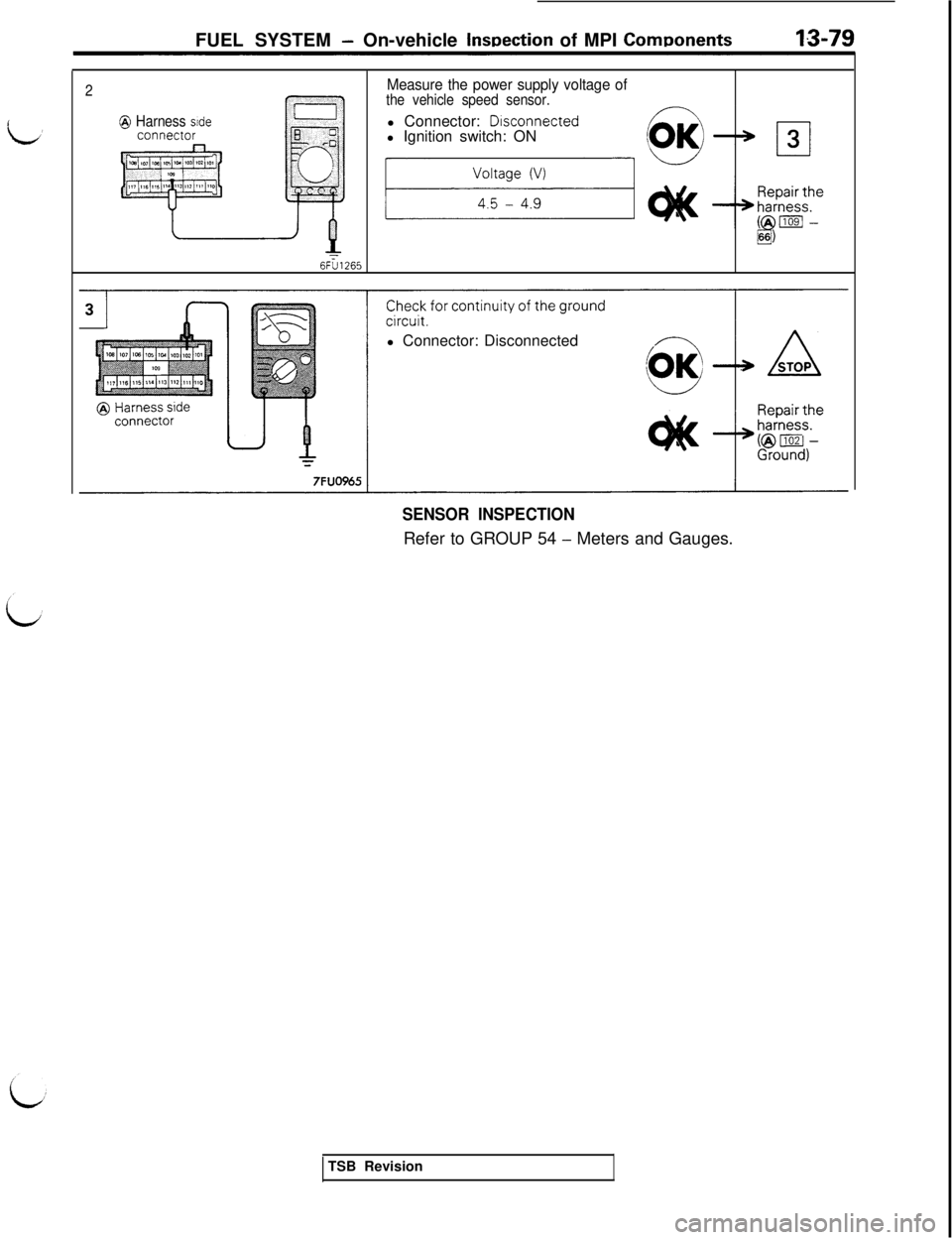
2Measure the power supply voltage ofthe vehicle speed sensor.
@ Harness sidel Connector: Dlsconnectedl Ignition switch: ON
8)
6FU1265l Connector: Disconnected
SENSOR INSPECTIONRefer to GROUP 54
- Meters and Gauges.
TSB Revision
Page 187 of 1146
FUEL SYSTEM- On-vehicle Inspection of MPI Components13-81
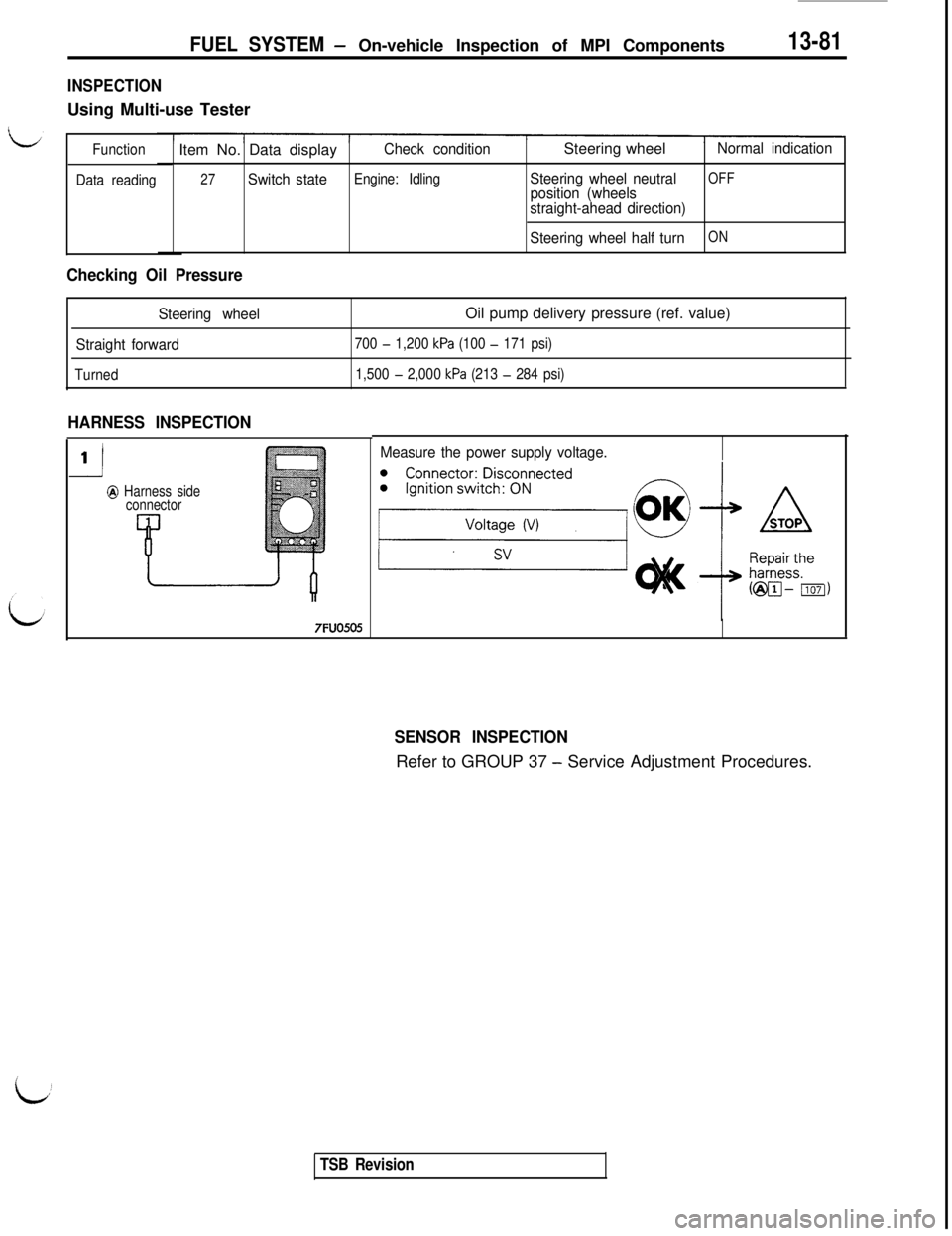
INSPECTIONUsing Multi-use Tester
Function
Data readingItem No. Data displayCheck conditionSteering wheelNormal indication
27Switch stateEngine: IdlingSteering wheel neutralOFFposition (wheels
straight-ahead direction)
Steering wheel half turn
ON
Checking Oil Pressure
Steering wheelOil pump delivery pressure (ref. value)
Straight forward700 - 1,200 kPa (100 - 171 psi)
Turned1,500
- 2,000 kPa (213 - 284 psi)
HARNESS INSPECTION
i1
@ Harness side
connector
Measure the power supply voltage.
SENSOR INSPECTIONRefer to GROUP 37
- Service Adjustment Procedures.
TSB Revision
Page 190 of 1146
13-84FUEL SYSTEM - 0n-vehicle Inspection of MPI Components
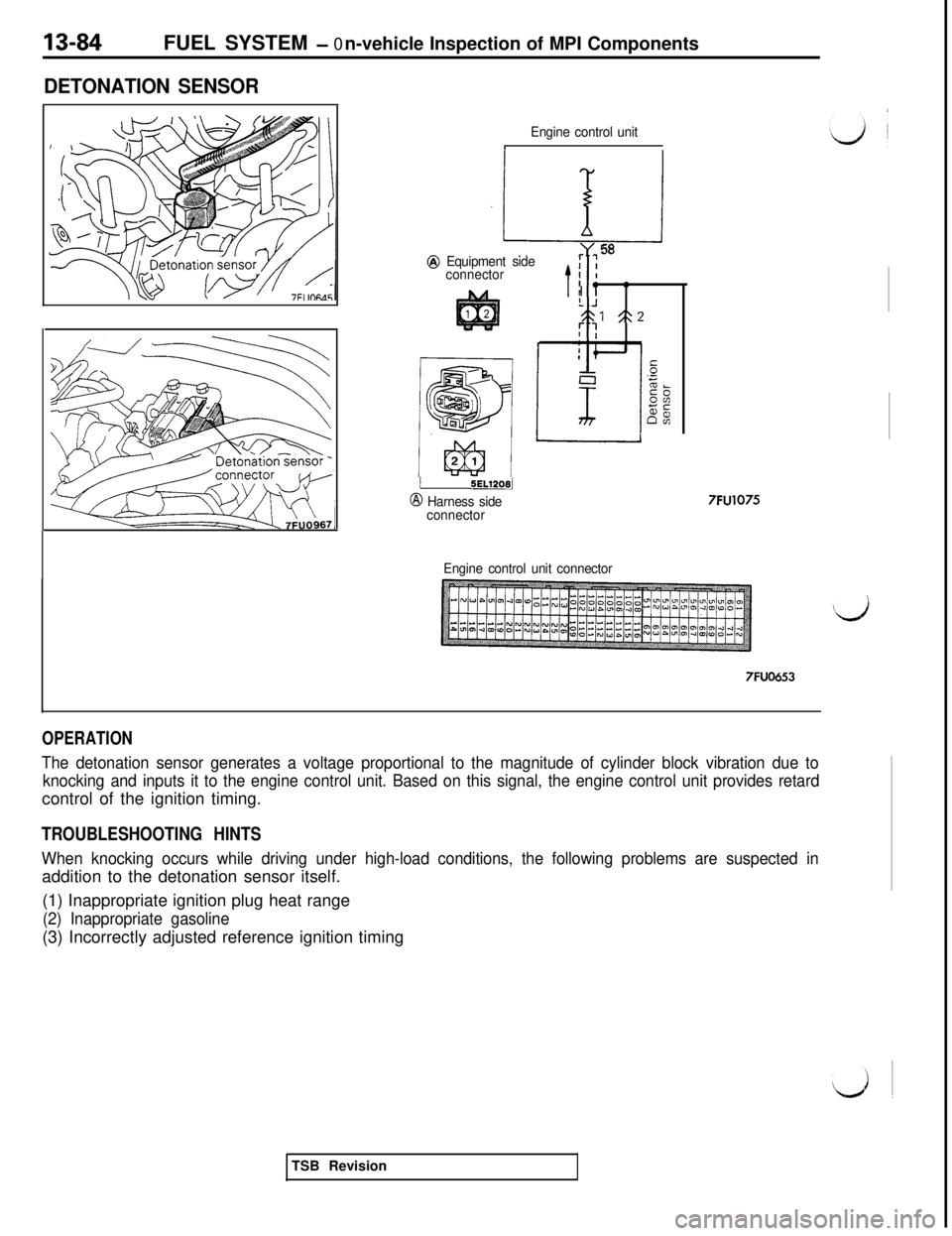
DETONATION SENSOR
Engine control unitN
/J-l
@ Equipment side58: :connectorI I
t- =I IL .J531 5:2::
i SEL1208j
@ Harness side
connector7FU1075
Engine control unit connector
7FUO653
OPERATION
The detonation sensor generates a voltage proportional to the magnitude of cylinder block vibration due to
knocking and inputs it to the engine control unit. Based on this signal, the engine control unit provides retardcontrol of the ignition timing.
TROUBLESHOOTING HINTS
When knocking occurs while driving under high-load conditions, the following problems are suspected inaddition to the detonation sensor itself.
(1) Inappropriate ignition plug heat range
(2) Inappropriate gasoline(3) Incorrectly adjusted reference ignition timing
TSB Revision
Page 196 of 1146
13-90FUEL SYSTEM - On-vehicle Inspection of MPI Components
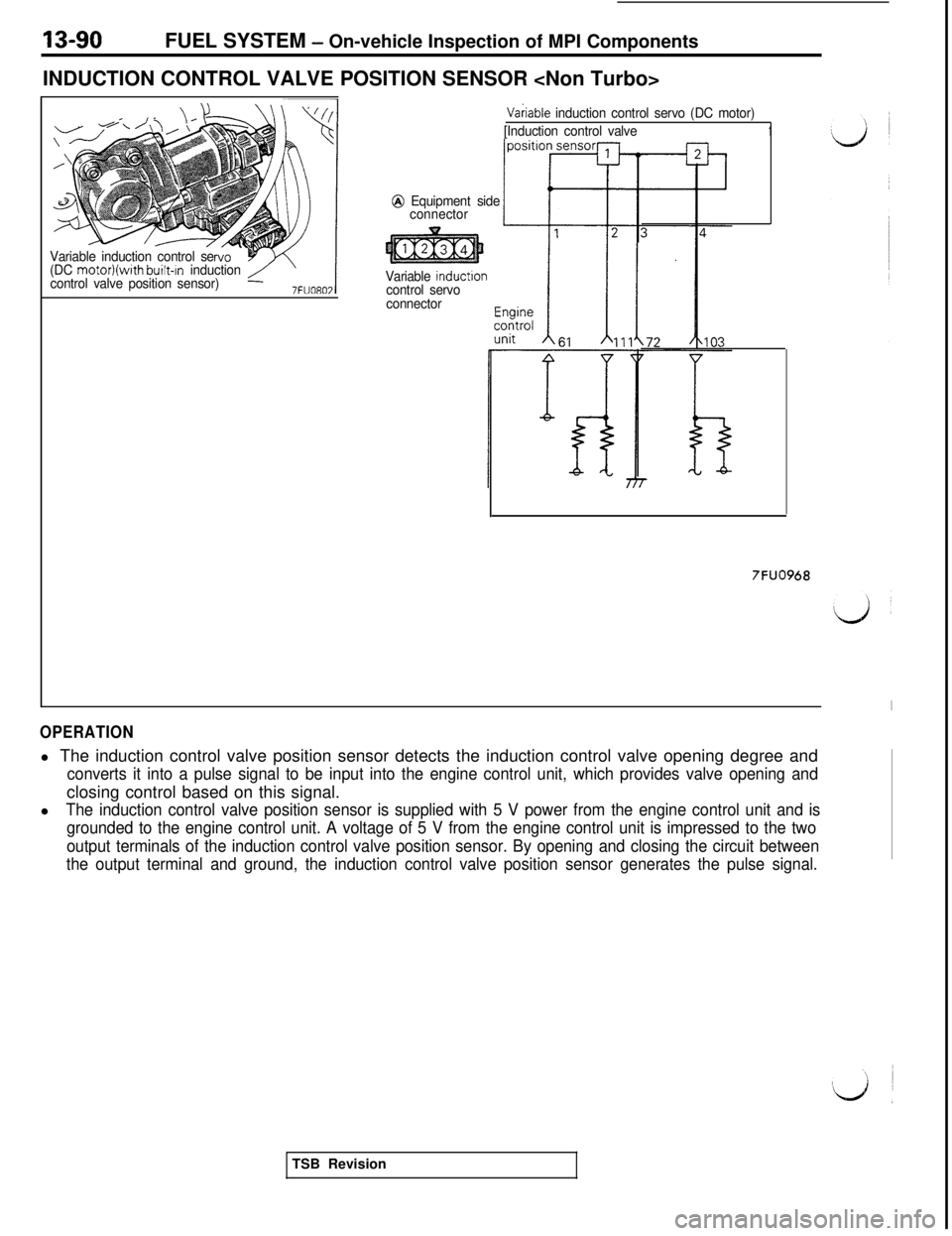
INDUCTION CONTROL VALVE POSITION SENSOR
Variable induction control se
(DC motor)(with built-In induction
control valve position sensor)
Vakiable induction control servo (DC motor)
[Induction control valve
1
@ Equipment side
connector
Variable
inductloncontrol servo
connector
7FUO968
OPERATIONl The induction control valve position sensor detects the induction control valve opening degree and
converts it into a pulse signal to be input into the engine control unit, which provides valve opening andclosing control based on this signal.
l
The induction control valve position sensor is supplied with 5 V power from the engine control unit and is
grounded to the engine control unit. A voltage of 5 V from the engine control unit is impressed to the two
output terminals of the induction control valve position sensor. By opening and closing the circuit between
the output terminal and ground, the induction control valve position sensor generates the pulse signal.TSB Revision
Page 197 of 1146
FUEL SYSTEM - On-vehicle Inspection of MPI Components13-91
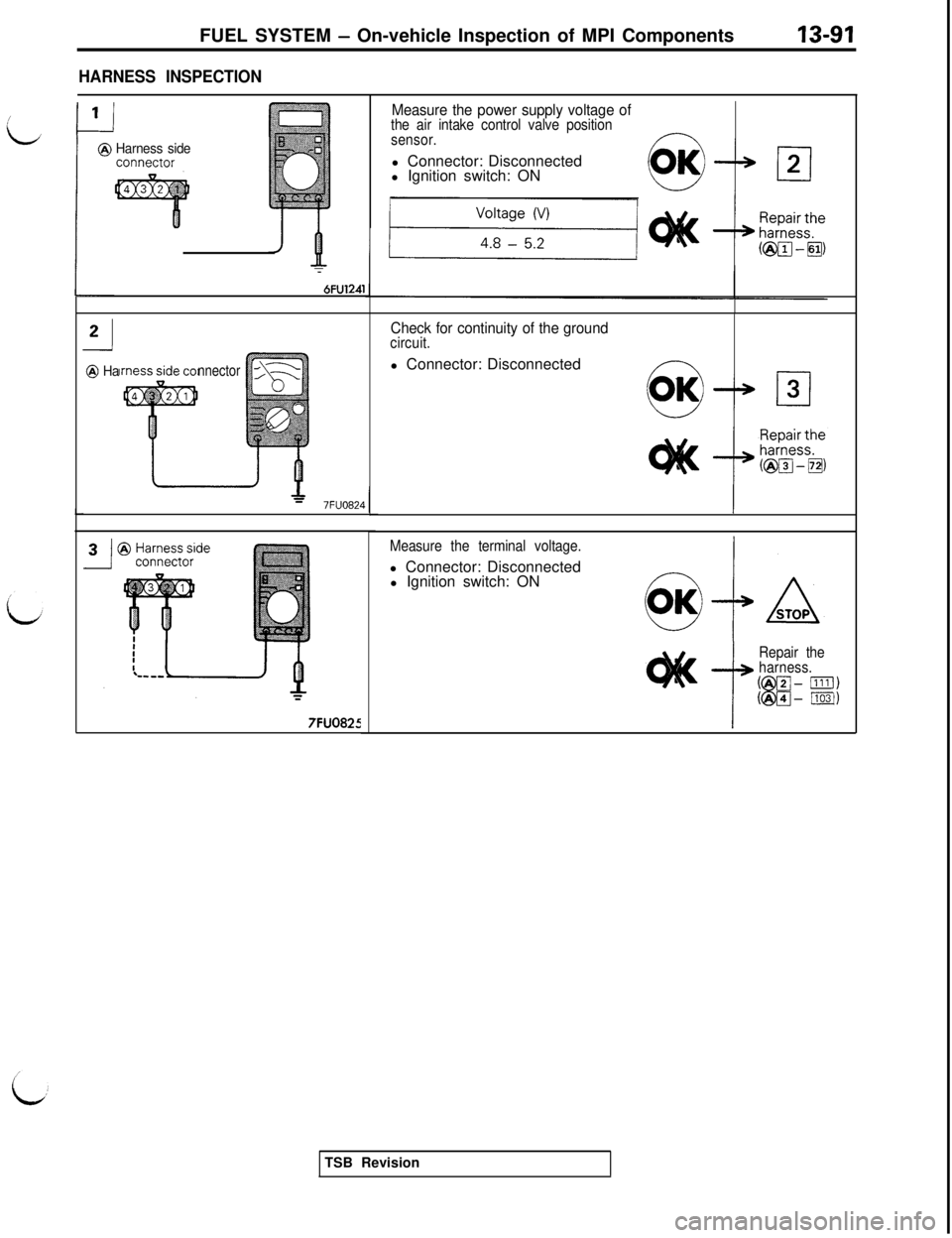
HARNESS INSPECTION
i‘@ Harness side
:
7
6FU1241
Measure the power supply voltage ofthe air intake control valve position
sensor.l Connector: Disconnected
l Ignition switch: ON
@ Hannector
=7FUO824
7FUO825
Check for continuity of the groundcircuit.l Connector: Disconnected
f---Y -
Measure the terminal voltage.l Connector: Disconnected
l Ignition switch: ON
T
Repair the
harness.TSB Revision
Page 198 of 1146
FUEL SYSTEM - On-vehicle Inspection of MPI Components
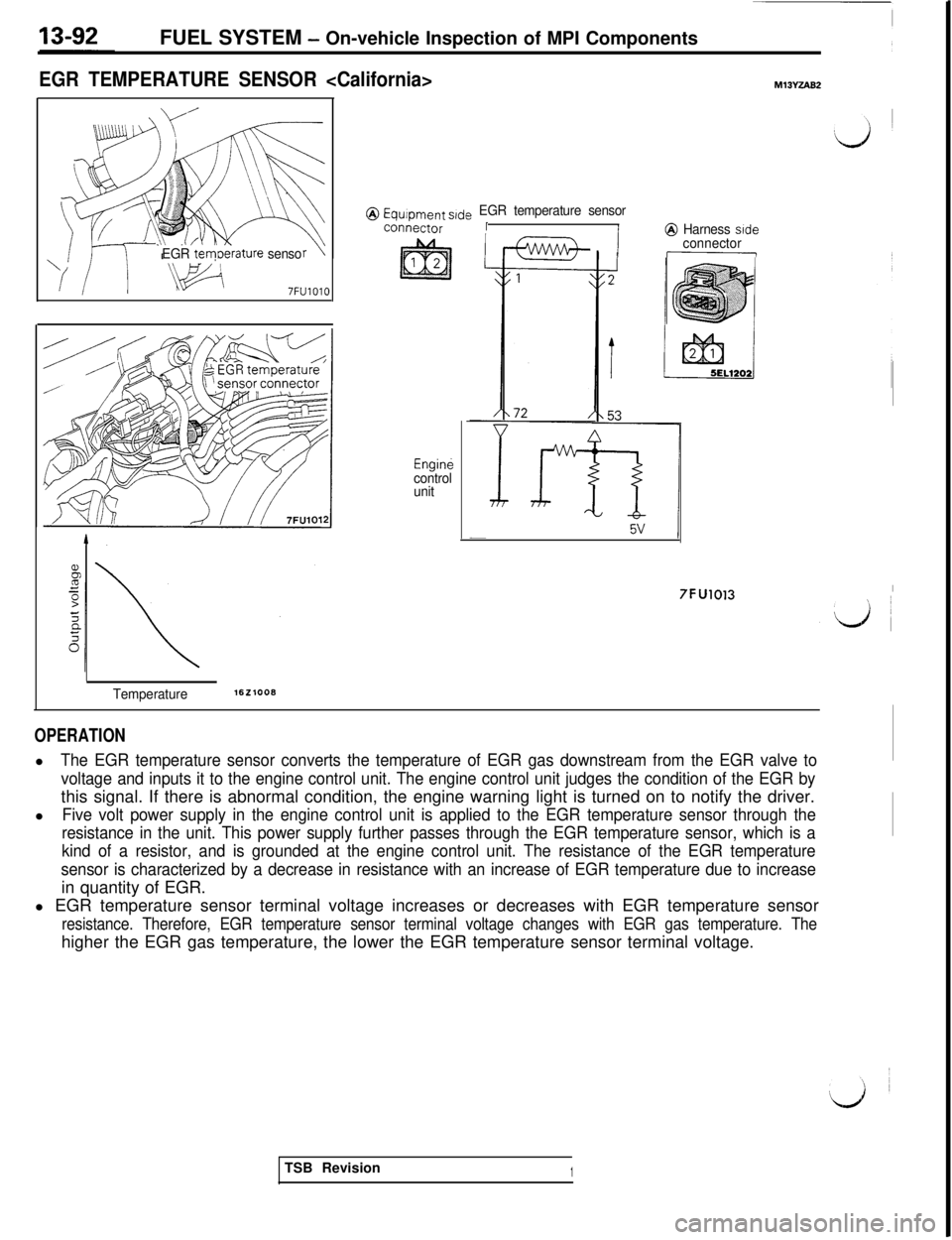
EGR TEMPERATURE SENSOR
EGR tem0erature senso
7FUlOlO
@ Equipment s,de EGR temperature sensor
connectorII@ Harness side
Enginecontrol
unit
I Iconnector
7FU1013I
Temperature1621008
OPERATIONl
The EGR temperature sensor converts the temperature of EGR gas downstream from the EGR valve to
voltage and inputs it to the engine control unit. The engine control unit judges the condition of the EGR bythis signal. If there is abnormal condition, the engine warning light is turned on to notify the driver.
l
Five volt power supply in the engine control unit is applied to the EGR temperature sensor through the
resistance in the unit. This power supply further passes through the EGR temperature sensor, which is a
kind of a resistor, and is grounded at the engine control unit. The resistance of the EGR temperature
sensor is characterized by a decrease in resistance with an increase of EGR temperature due to increasein quantity of EGR.
l EGR temperature sensor terminal voltage increases or decreases with EGR temperature sensor
resistance. Therefore, EGR temperature sensor terminal voltage changes with EGR gas temperature. Thehigher the EGR gas temperature, the lower the EGR temperature sensor terminal voltage.
TSB Revision
1
Page 199 of 1146
FUEL SYSTEM- On-vehicle Inspection of MPI Components13-93INSPECTION
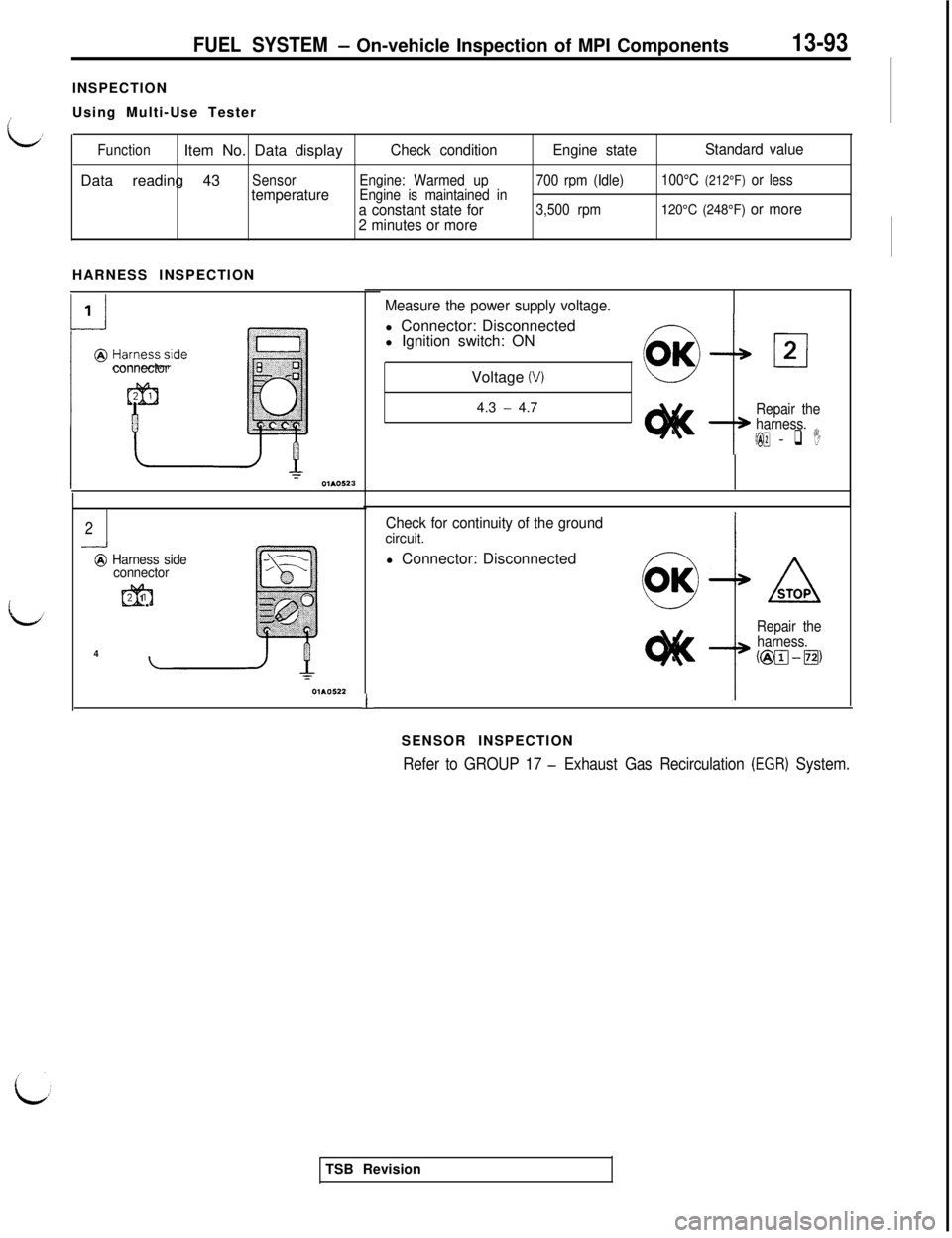
Using Multi-Use Tester
FunctionItem No. Data displayCheck conditionEngine stateStandard valueData reading 43
SensorEngine: Warmed up700 rpm (Idle)100°C (212°F) or less
temperatureEngine is maintained in-
a constant state for3,500 rpm120°C (248°F) or more
2 minutes or moreHARNESS INSPECTION
connector
2-..-I
@ Harness side
connector
m2 1
4
1
Measure the power supply voltage.l Connector: Disconnected
l Ignition switch: ON
Voltage
(V)4.3
- 4.7Repair the
harness.
(@I@ - q I
Check for continuity of the groundcircuit.
l Connector: Disconnected
I
Repair the
harness.@@J-m,
SENSOR INSPECTION
Refer to GROUP 17 - Exhaust Gas Recirculation (EGR) System.TSB Revision
Page 200 of 1146
FUEL SYSTEM - On-vehicle Inspection of MPI Components
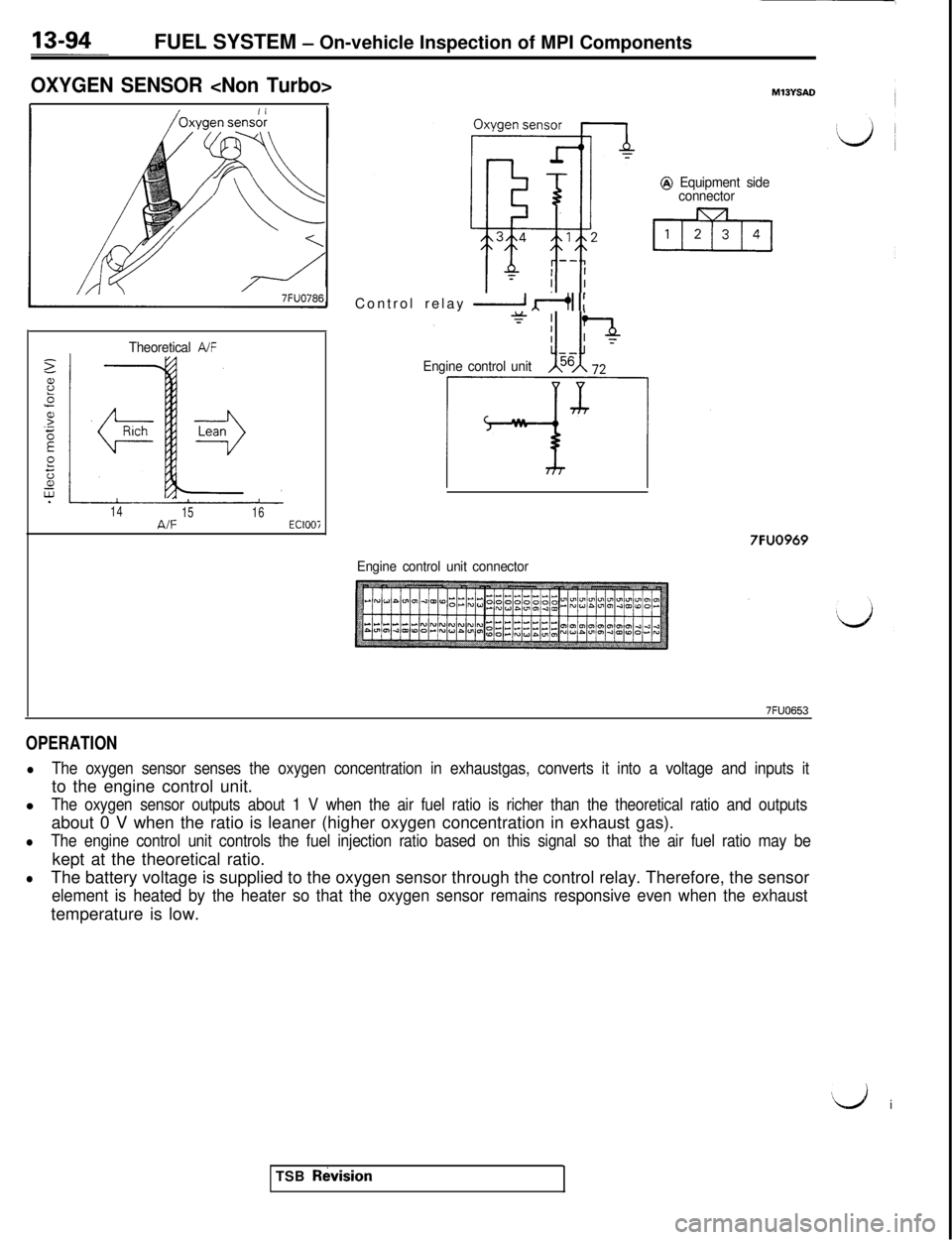
OXYGEN SENSOR
7FUO786
Theoretical A/F
14
1516A/FEClOOiControl relay
2 dI 1:
Engine control unit
@ Equipment side
connector
7FUO969
Engine control unit connector
7FUO653
OPERATION
lThe oxygen sensor senses the oxygen concentration in exhaustgas, converts it into a voltage and inputs itto the engine control unit.
l
The oxygen sensor outputs about 1 V when the air fuel ratio is richer than the theoretical ratio and outputsabout 0 V when the ratio is leaner (higher oxygen concentration in exhaust gas).
lThe engine control unit controls the fuel injection ratio based on this signal so that the air fuel ratio may bekept at the theoretical ratio.
lThe battery voltage is supplied to the oxygen sensor through the control relay. Therefore, the sensor
element is heated by the heater so that the oxygen sensor remains responsive even when the exhausttemperature is low.
‘d i
TSB
RtkisionI
Page 201 of 1146

FUEL SYSTEM - 0
n-vehicle Inspection of MPI Components13-95
TROUBLESHOOTING HINTSHint 1: Poor cleaning of exhaust gas will result if the oxygen sensor fails.
Hint 2:If the oxygen sensor check has resulted normal but the sensor output voltage is out of specification,
troubles of parts related to air fuel ratio control system are suspected.
[Examples]
(1) Faulty injector
(2) Air leaking into the intake manifold through gasket gap, etc.
(3) Faulty air flow sensor, intake air temperature sensor, barometric pressure sensor,’ engine
Data readingcoolant temperature sensor
INSPECTIONUsing Multi-use Tester
FunctionItem No. Data displayCheck conditionEngine stateStandard value
11SensorvoltaceEngine: Warm-upWhen sudden200 mV or lower
(make the mixture leandeceleration from
L
by engine speed reduc-4,000 rpm
tion, and rich by racing)
When engine is600-1,000 mV
suddenly raced
Engine: Warm-up700 rpm (Idle)
400 mV or lower
(using the oxygen sensorsignal, check the air/2,000 rpm,,,5-‘$-$-;3
fuel mixture ratio, and
also check the condition
of control by the engine
control unit)
TSB Revision
Page 202 of 1146
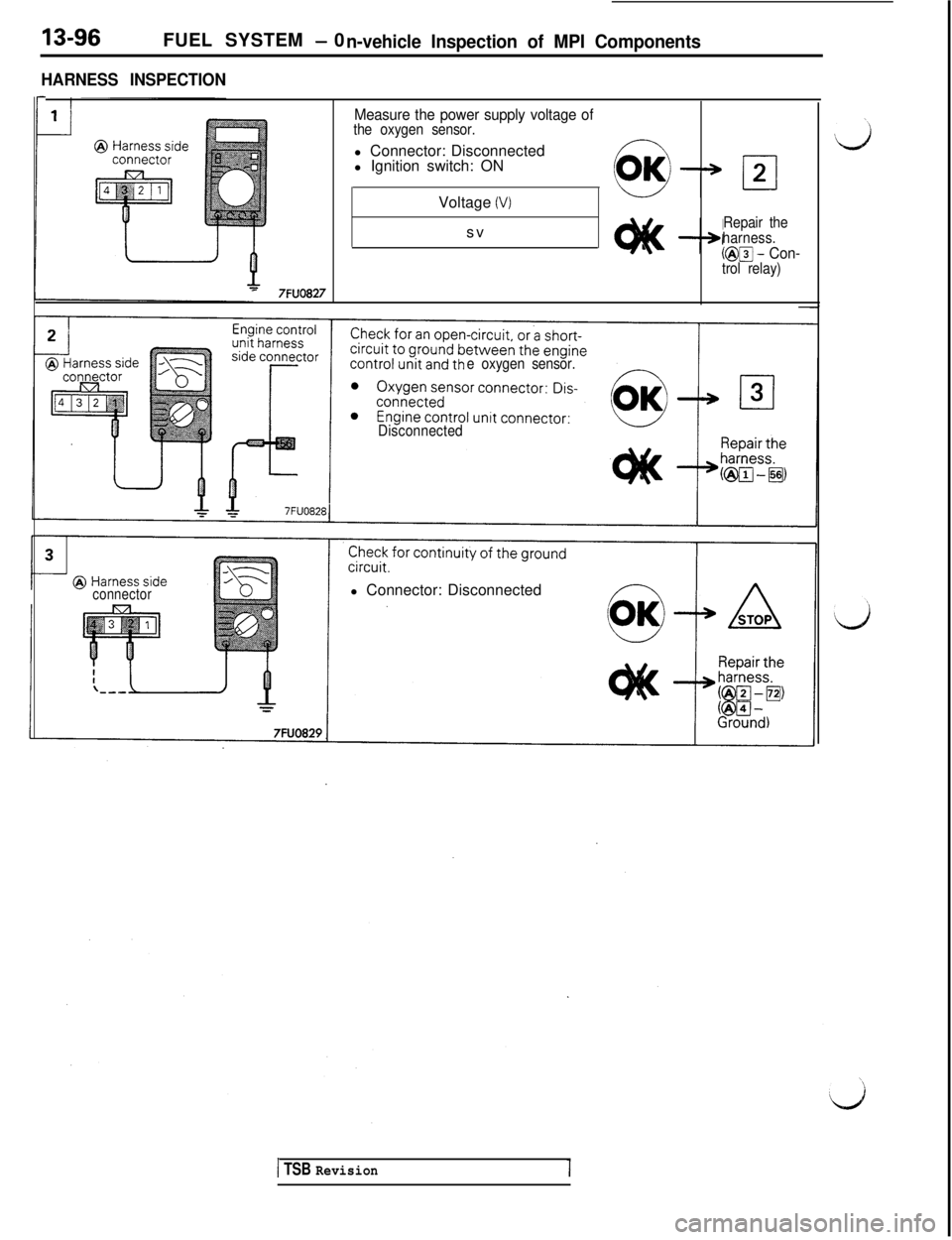
13-96FUEL SYSTEM - 0n-vehicle Inspection of MPI Components
HARNESS INSPECTION
rMeasure the power supply voltage ofthe oxygen sensor.l Connector: Disconnected
l Ignition switch: ON
Voltage
(V)sv
Repair the
harness.
(@m - Con-trol relay)
- 7FUO827
e oxygen sensor.
Disconnected
connectorl Connector: Disconnected
1 TSB Revision