sensor MITSUBISHI 3000GT 1991 Repair Manual
[x] Cancel search | Manufacturer: MITSUBISHI, Model Year: 1991, Model line: 3000GT, Model: MITSUBISHI 3000GT 1991Pages: 1146, PDF Size: 76.68 MB
Page 203 of 1146
FUEL SYSTEM - On-vehicle Inspection of MPI ComDonents13-97
,
7FU1014
7FUlOl5
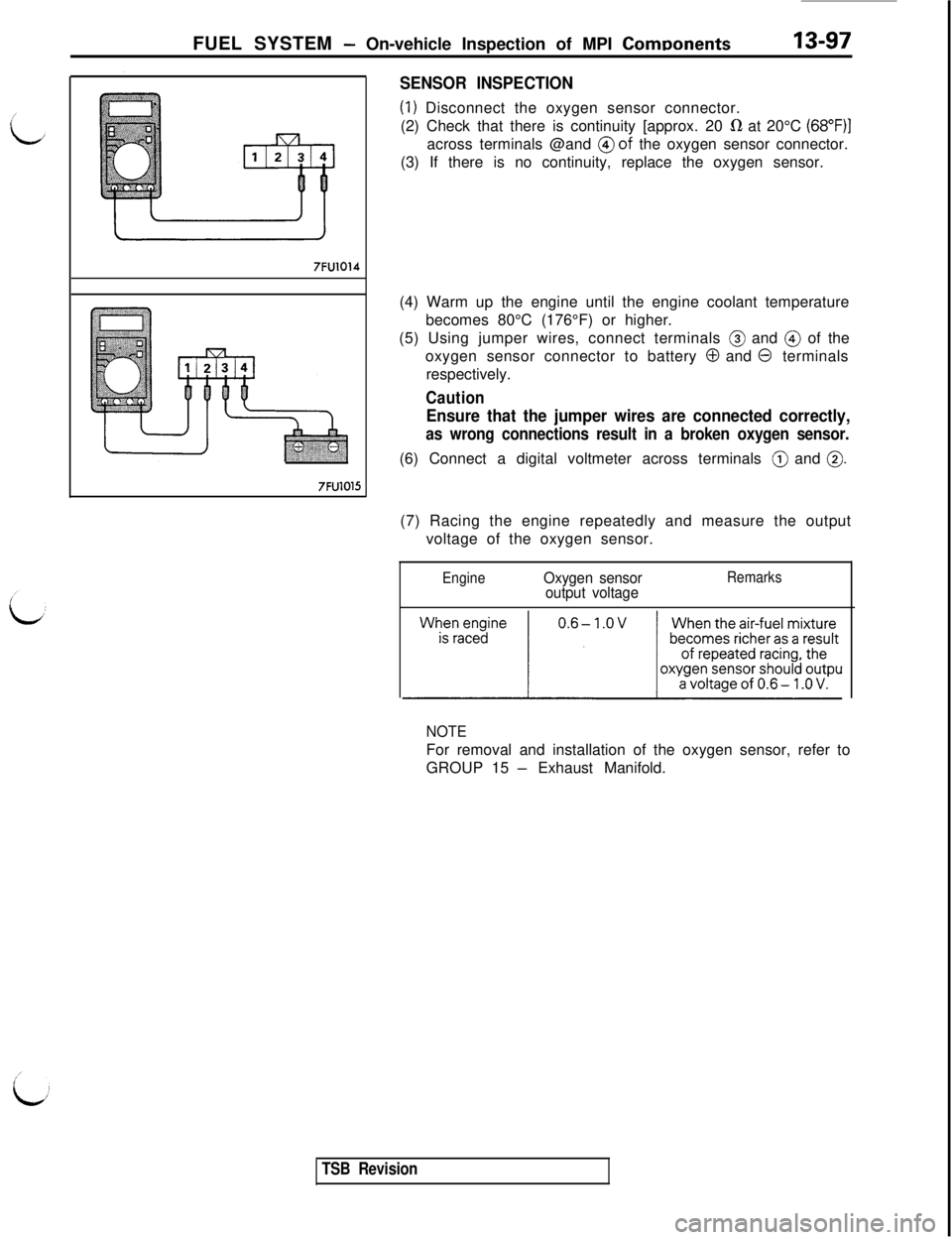
SENSOR INSPECTION
(1) Disconnect the oxygen sensor connector.
(2) Check that there is continuity [approx. 20
IR at 20°C (68”F)jacross terminals @and
@of the oxygen sensor connector.
(3) If there is no continuity, replace the oxygen sensor.
(4) Warm up the engine until the engine coolant temperature
becomes 80°C (176°F) or higher.
(5) Using jumper wires, connect terminals @ and @ of the
oxygen sensor connector to battery
0 and 0 terminals
respectively.
Caution
Ensure that the jumper wires are connected correctly,
as wrong connections result in a broken oxygen sensor.(6) Connect a digital voltmeter across terminals @ and
0.(7) Racing the engine repeatedly and measure the output
voltage of the oxygen sensor.
EngineOxygen sensor
output voltageRemarks
NOTEFor removal and installation of the oxygen sensor, refer to
GROUP 15
- Exhaust Manifold.
TSB Revision
Page 204 of 1146
FUEL SYSTEM - 0
n-vehicleInspection of MPI Components
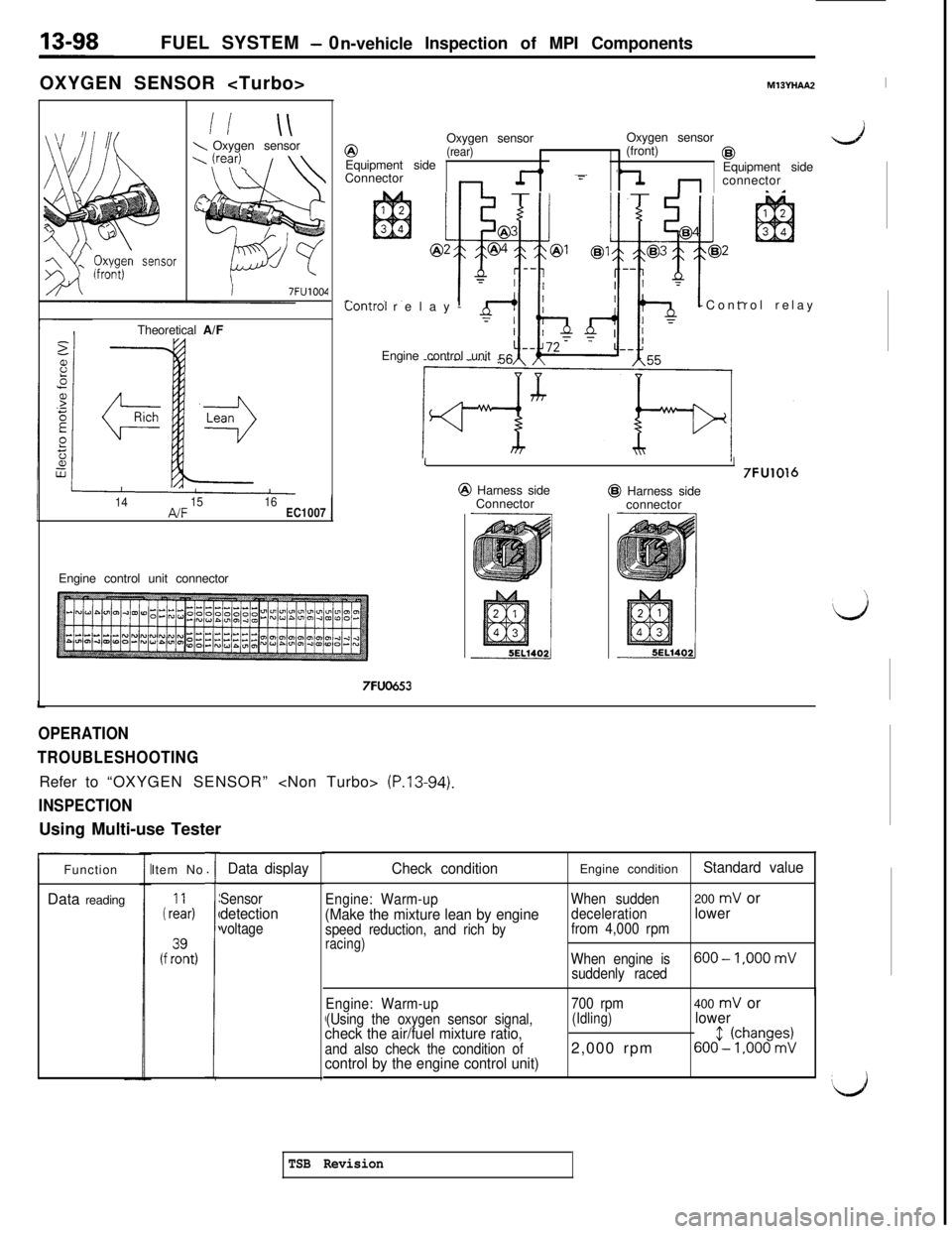
OXYGEN SENSOR
M13YHAA2I
2
2-J
_ Fr;;syn m-wr
li \\\Oxygen sensor
I7FU1004Theoretical A/F@Oxygen sensor
(rear)Oxygen sensor
Equipment side(front)@,ConnectorEquipment side:connectorf-l -1
Lonrrol relay--Control relay
Engine control unit 56
141516PJFEC1007Engine control unit connector
7FUO453
I
I7FU1016@ Harness side@ Harness side
Connector
connector
OPERATION
TROUBLESHOOTINGRefer to “OXYGEN SENSOR”
(P.13-94).
INSPECTIONUsing Multi-use Tester
Function
Data readingItem No.
i rL&
(f fzt,
,
1
Data display
Sensordetectionvoltage
Check condition
Engine: Warm-up(Make the mixture lean by enginespeed reduction, and rich byracing)Engine condition
Standard value
When sudden200 mV or
decelerationlowerfrom 4,000 rpm
When engine is
600-1.000 mV
suddenly raced
./
Engine: Warm-up
(Using the oxygen sensor signal,
check the air/fuel mixture ratio,and also check the condition ofcontrol by the engine control unit)
700 rpm(Idling)2,000 rpm400 mV orlower
6()(f--(~jbaono9~;
‘d
TSB Revision
Page 205 of 1146
1
FUEL SYSTEM- On-vehicle InsDection of MPI ComDonents13-99
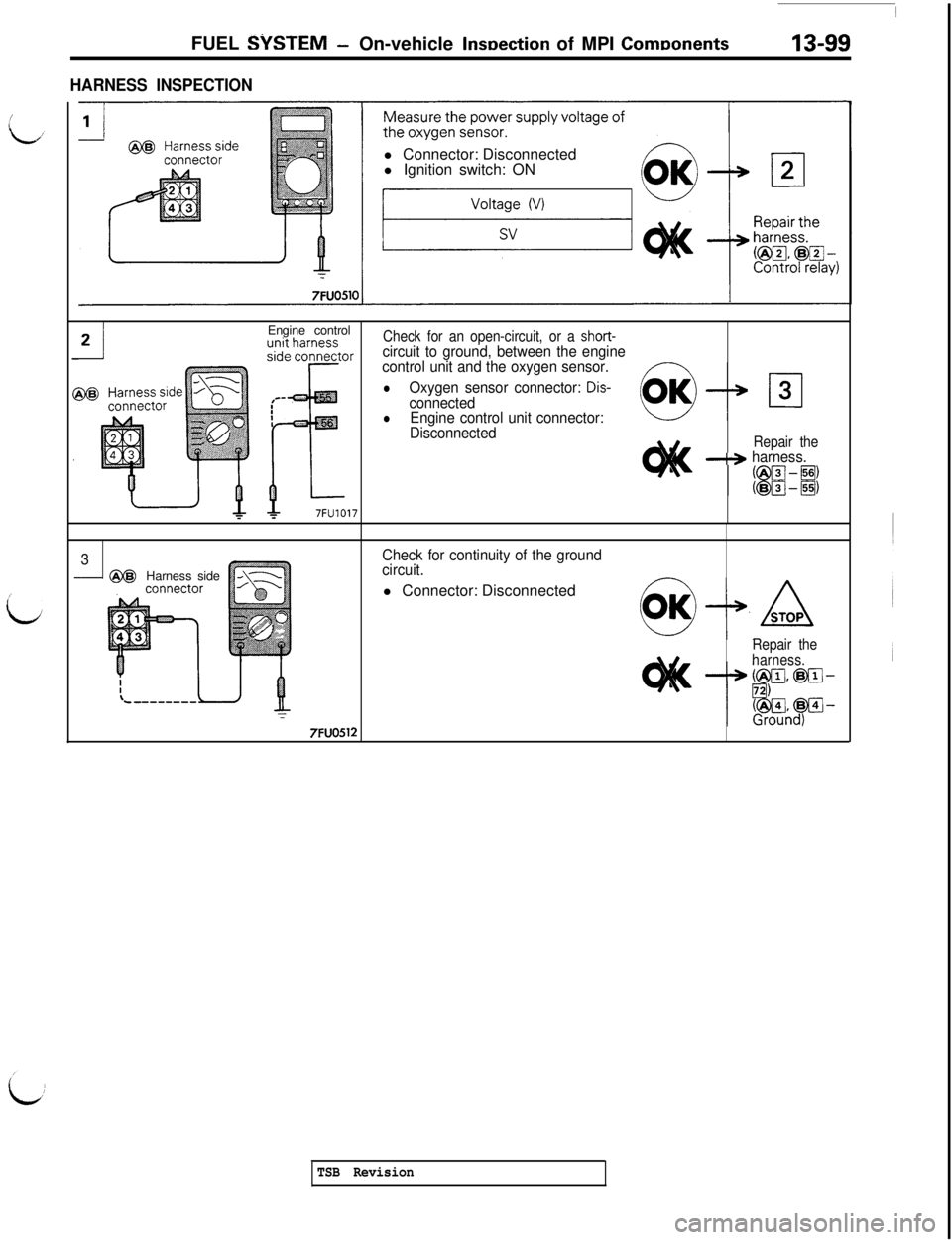
HARNESS INSPECTIONl Connector: Disconnected
l Ignition switch: ON
Engine control
Check for an open-circuit, or a short-circuit to ground, between the engine
control unit and the oxygen sensor.
lOxygen sensor connector: Dis-connectedlEngine control unit connector:
Disconnected
Repair the-+ harness.
3Check for continuity of the ground
- @@
Harness sidecircuit.l Connector: Disconnected
Repair the
harness.
7FUO512
TSB Revision
Page 206 of 1146
13-100FUEL SYSTEM - 0
n-vehicleInspection of MPI Components
SENSOR INSPECTION
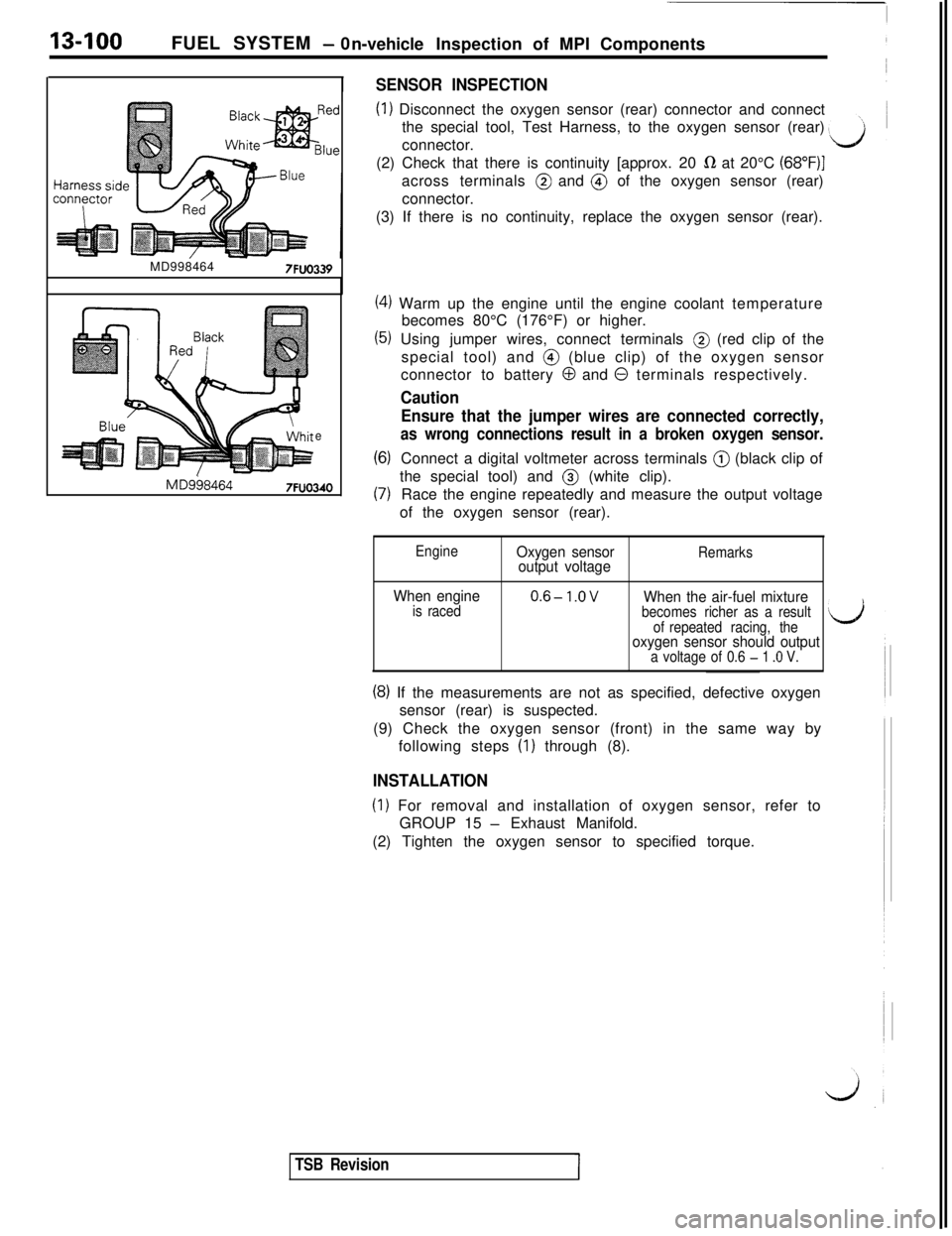
(1) Disconnect the oxygen sensor (rear) connector and connect
the special tool, Test Harness, to the oxygen sensor (rear)
connector.
MD998464
7FUO339
e
MD9584647FUO340(2) Check that there is continuity [approx. 20
R at 20°C (68”F)Iacross terminals @ and @ of the oxygen sensor (rear)
connector.
(3) If there is no continuity, replace the oxygen sensor (rear).
(4) Warm up the engine until the engine coolant temperature
becomes 80°C (176°F) or higher.
(5) Using jumper wires, connect terminals @ (red clip of the
special tool) and @ (blue clip) of the oxygen sensor
connector to battery
0 and 0 terminals respectively.
Caution
Ensure that the jumper wires are connected correctly,
as wrong connections result in a broken oxygen sensor.
(6)Connect a digital voltmeter across terminals @ (black clip of
(7)the special tool) and @ (white clip).
Race the engine repeatedly and measure the output voltage
of the oxygen sensor (rear).
EngineOxygen sensor
output voltageRemarks
When engineis raced0.6-l.OVWhen the air-fuel mixturebecomes richer as a result
of repeated racing, the
oxygen sensor should outputa voltage of 0.6 - 1 .O V.
(8) If the measurements are not as specified, defective oxygen
sensor (rear) is suspected.
(9) Check the oxygen sensor (front) in the same way by
following steps
(I) through (8).
INSTALLATION
(1) For removal and installation of oxygen sensor, refer to
GROUP 15
- Exhaust Manifold.
(2) Tighten the oxygen sensor to specified torque.
TSB Revision
Page 208 of 1146

13-102FUEL SYSTEM - On-vehicle Inspection of MPI Components
TROUBLESHOOTING HINTSHint 1: If the engine is hard to start when hot, check fuel pressure and check the injector for leaks.
Hint 2:If the injector does not when the engine that is hard to start is cranked, the following as well as the
Iinjector itself may be responsible.
(1) Faulty power supply circuit to the engine control unit, faulty ground circuit
\-J
-(2) Faulty control relay
Hint 3:(3) Faulty crank angle sensor, top dead center sensor
If there is any cylinder whose idle state remains unchanged when the fuel injection of injectors is cut
one after another during idling, make following checks about such cylinder.
(1) Injector and harness check
(2) Ignition plug and high tension cable check
(3) Compression pressure check
Hint 4: If the injector harness and individual part checks have resulted normal but the injector drive time is
out of specification, the following troubles are suspected.
(1)Poor combustion in the cylinder (faulty ignition plug, ignition coil, compression pressure, etc.)
(2) Loose EGR valve seating
(3) High engine resistance
INSPECTIONUsing Multi-use Tester
FunctionItem No. Data displayCheck conditionCoolant temperatureStandard valueData reading 41
Drive time”’Engine: Cranking0°C (32”F)*zApprox. 17 ms
20°C (68°F)Approx. 46 ms
8O"C(176"F)Approx. 11 ms
Function
Data readingItem No.Data display
41Drive time*3l Engine coolant tem-perature: 80 to 95°C700 rpm (Idle)2.4-3.0 ms
(176 to 205°F)2,000 rpm2.0-2.6
msl Lamps, electric coolingfan, accessory units:When sharp racing isTo increaseAll OFF
madel Transaxle: Neutral
(P range for vehicle
with A/T)l Steering wheel: Neutral
Check conditionEngine stateStandard value ,
.---NOTE“I : The injector drive time refers to when the supply voltage is 11 V and the cranking speed is less than 250 rpm.*2: When coolant temperature is lower than 0°C (32°F). injection ismade by four-cylinders.---simultaneously.
“3: When the vehicle is new [within initial operation of about 500 km (300 miles)], the injector drive time may be about
10% longer.
Function
Actuator testItem No.
Drive content
Check conditionNormal state
01No. 1 injector shut offEngine: Idling afterIdle state to change
02No. 2 injector shut offwarm-up
(Shut off the injectorsfurther (becoming less
in sequence during afterstable or stalling)
03
No. 3 injector shut offengine warm-up, check
04No. 4 injector shut offthe idling condition)
05No. 5 injector shut off
06No. 6 injector shut off
TSB Revision
Page 237 of 1146
FUEL SYSTEM - On-vehicle lnwection of MPI ComDonents13-131
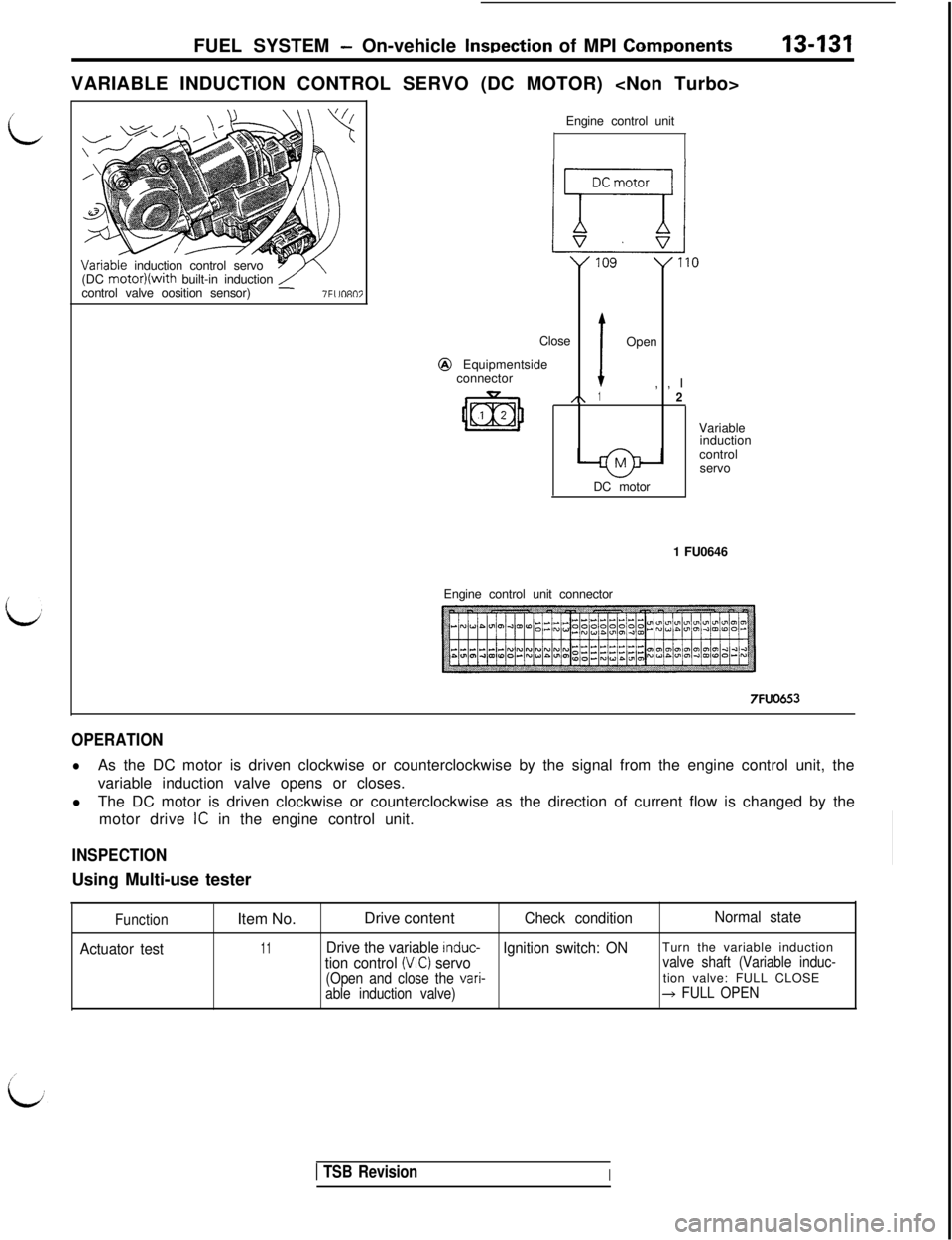
iVARIABLE INDUCTION CONTROL SERVO (DC MOTOR)
Y(DC motor)(with built-in induction/-control valve oosition sensor)-7Fllfl807Engine control unit
Close
connector
,\ IOpen@ Equipmentside1,,I2DC motorVariable
induction
control
servo
1 FU0646
Engine control unit connector
7FUO653
OPERATION
lAs the DC motor is driven clockwise or counterclockwise by the signal from the engine control unit, the
variable induction valve opens or closes.
lThe DC motor is driven clockwise or counterclockwise as the direction of current flow is changed by the
motor drive
IC in the engine control unit.
INSPECTIONUsing Multi-use tester
Function
Actuator testItem No.Drive content
Check conditionNormal state
11Drive the variable induc-Ignition switch: ONTurn the variable inductiontion control (MC) servovalve shaft (Variable induc-
(Open and close the
vari-tion valve: FULL CLOSEable induction valve)+ FULL OPEN
1 TSB RevisionI
Page 250 of 1146
13-144FUEL SYSTEM - Throttle- Body
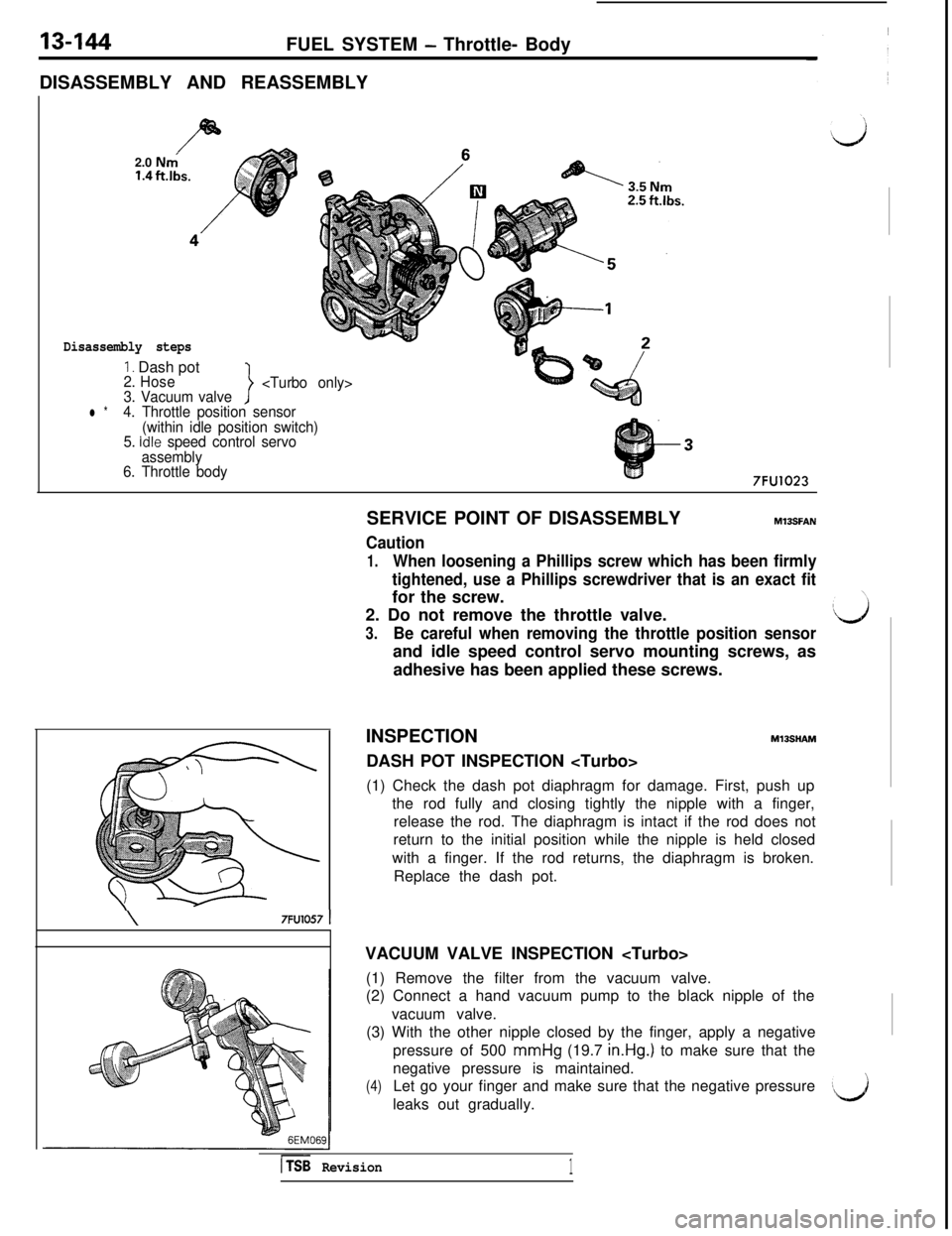
DISASSEMBLY AND REASSEMBLY
2.0
Nni1.4ft.lbs.
/
Disassembly steps
1. Dash pot2. Hose
3. Vacuum valve
>
l *4. Throttle position sensor
(within idle position switch)
5.
Idle speed control servo
assembly
6. Throttle body
7FU1023
\7FU1057 1SERVICE POINT OF DISASSEMBLY
MlBSFAN
Caution
1.When loosening a Phillips screw which has been firmly
tightened, use a Phillips screwdriver that is an exact fitfor the screw.
2. Do not remove the throttle valve.
3.Be careful when removing the throttle position sensorand idle speed control servo mounting screws, as
adhesive has been applied these screws.
INSPECTION
Ml3SHAt.lDASH POT INSPECTION
(1) Check the dash pot diaphragm for damage. First, push up
the rod fully and closing tightly the nipple with a finger,
release the rod. The diaphragm is intact if the rod does not
return to the initial position while the nipple is held closed
with a finger. If the rod returns, the diaphragm is broken.
Replace the dash pot.
VACUUM VALVE INSPECTION
(1) Remove the filter from the vacuum valve.
(2) Connect a hand vacuum pump to the black nipple of the
vacuum valve.
(3) With the other nipple closed by the finger, apply a negative
pressure of 500 mmHg (19.7 in.Hg.) to make sure that the
negative pressure is maintained.
(4)Let go your finger and make sure that the negative pressure
leaks out gradually.
hSB Revision1
Page 251 of 1146
FUEL SYSTEM - Throttle Body13-145Orifice
Nipple (green)3EM05iGroundThrottle
positlonsensor output
Idle-position
switchTh>ottle position
sensor power7FUO535(5) Disconnect the hand vacuum pump and connect it to the
other nipple.
(6)Make sure that the negative pressure leaks out as soon as it
is applied.
CLEANING THROTTLE BODY PARTS
(1) Clean all throttle body parts.
Do not use solvent to clean the following parts:
l Throttle position sensor (Idle position switch)
l Idle speed control servo
If these parts are immersed in solvent, their insulation will
deteriorate.
Wipe them with cloth only.
(2) Check if the vacuum
pot-t or passage is clogged. usecompressed air to clean the vacuum passage.
SERVICE POINT OF REASSEMBLY
M13SGAN4. INSTALLATION OF THROTTLE POSITION SENSOR
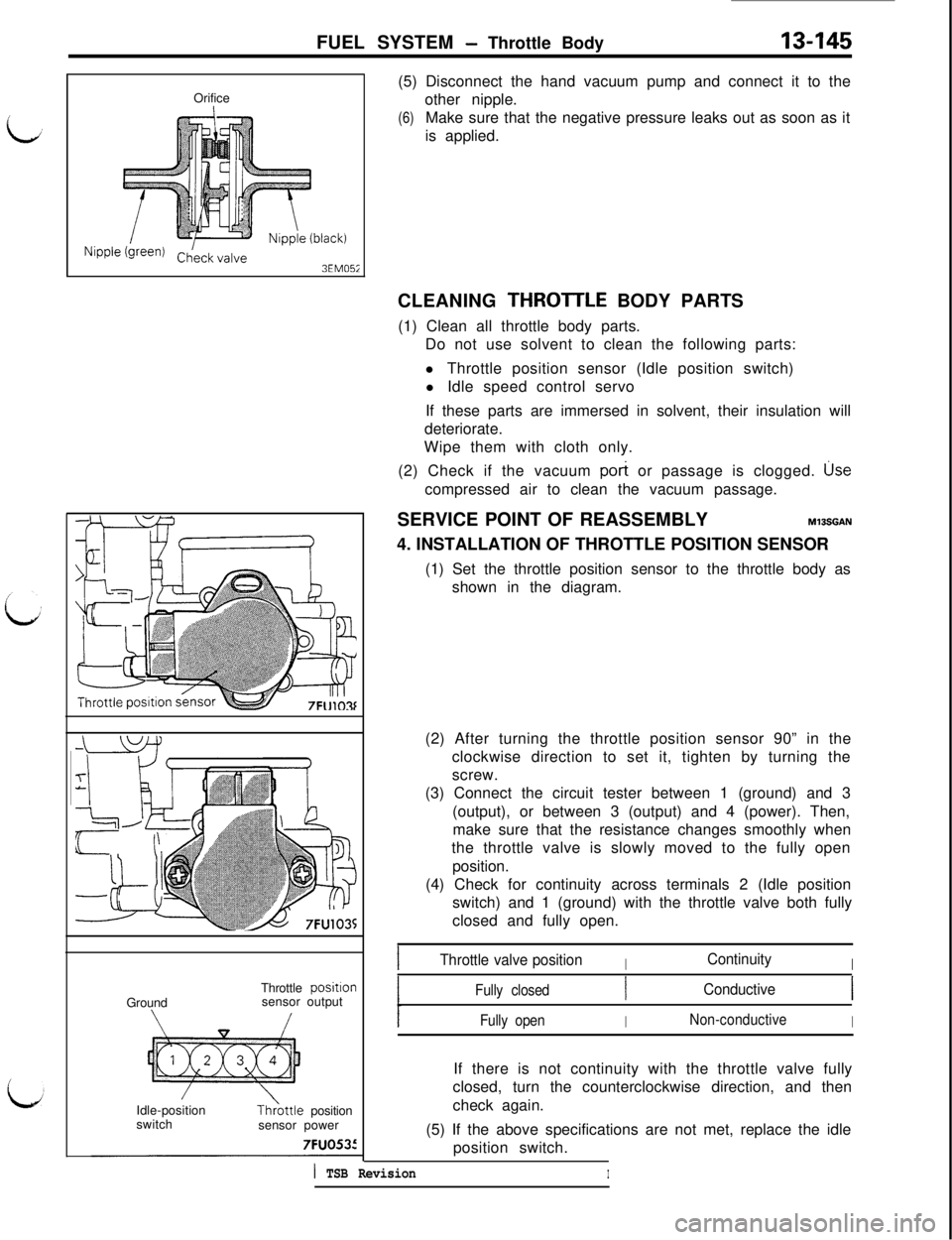
(1) Set the throttle position sensor to the throttle body as
shown in the diagram.
(2) After turning the throttle position sensor 90” in the
clockwise direction to set it, tighten by turning the
screw.
(3) Connect the circuit tester between 1 (ground) and 3
(output), or between 3 (output) and 4 (power). Then,
make sure that the resistance changes smoothly when
the throttle valve is slowly moved to the fully open
position.
(4) Check for continuity across terminals 2 (Idle position
switch) and 1 (ground) with the throttle valve both fully
closed and fully open.
IThrottle valve positionIContinuityI
Fully closedConductive
Fully openINon-conductiveIIf there is not continuity with the throttle valve fully
closed, turn the counterclockwise direction, and then
check again.
(5) If the above specifications are not met, replace the idle
position switch.
1 TSB RevisionI
Page 260 of 1146
13-154FUEL SYSTEM - Detonation Sensor
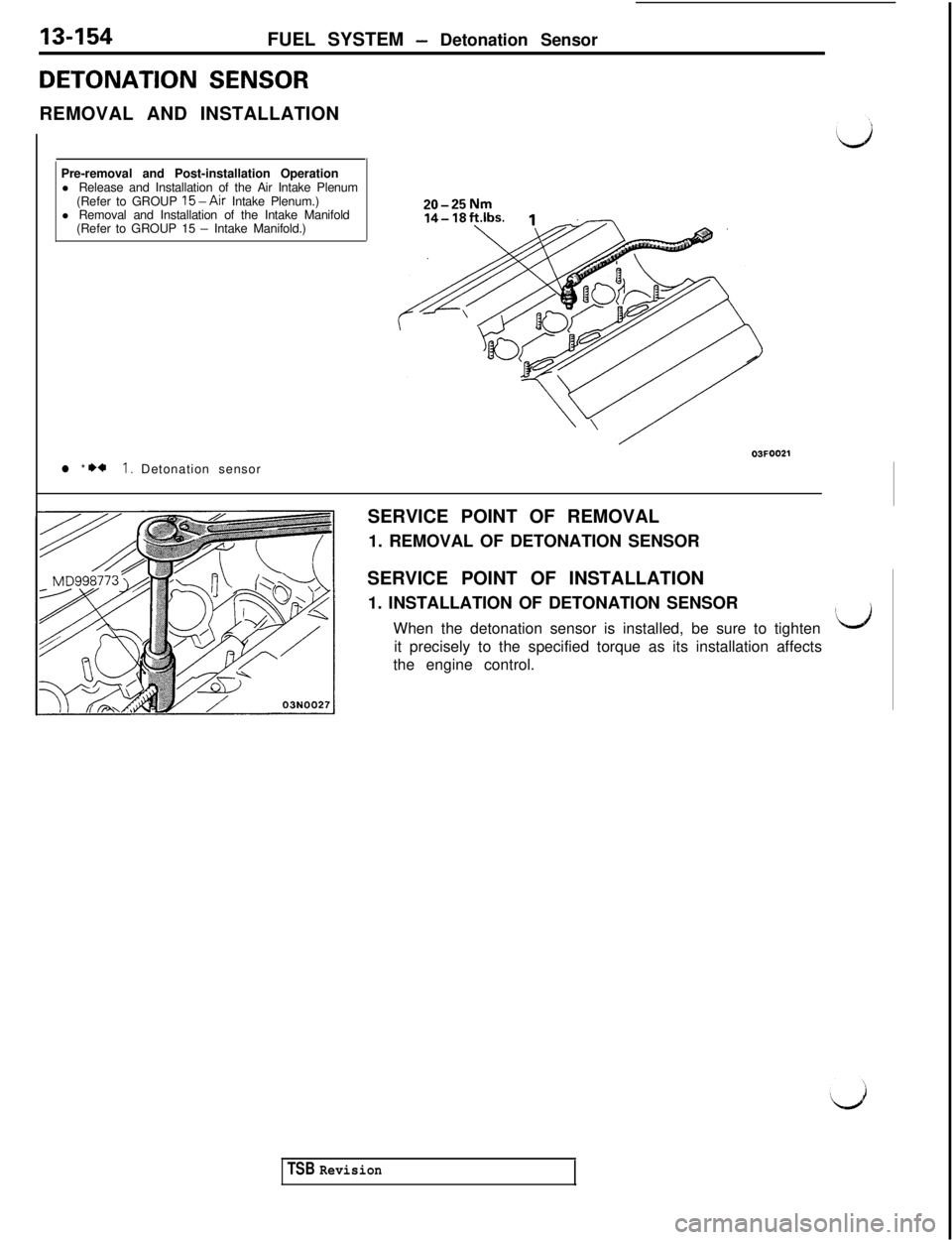
DETONATION SENSORREMOVAL AND INSTALLATION
Pre-removal and Post-installation Operation
l Release and Installation of the Air Intake Plenum
(Refer to GROUP
15-Air Intake Plenum.)
l Removal and Installation of the Intake Manifold
(Refer to GROUP 15
- Intake Manifold.)
l * +*I. Detonation sensor
20-25NmSERVICE POINT OF REMOVAL
1. REMOVAL OF DETONATION SENSOR
SERVICE POINT OF INSTALLATION
1. INSTALLATION OF DETONATION SENSOR
When the detonation sensor is installed, be sure to tighten
Idit precisely to the specified torque as its installation affects
the engine control.
TSB Revision
Page 267 of 1146

CRUISE CONTROL SYSTEM - Troubleshootina13461
Trouble symptom
l The set vehicle speed variesgreatly upward or downward.l “Hunching” (repeated alter-
nating acceleration and
deceleration) occurs after
setting is made.
Probable cause
Check chart No.Remedy
Malfunction of the vehicleNo. 4Repair the vehicle speedspeed sensor circuit
sensor system, or replacethe part.Malfunction of thespeedometer cable orspeedometer drive gear
Vacuum pump assembly
No. 5Repair the actuatorcircuit poor contact
system, or replace thepart.Malfunction of thevacuum pump assembly
(including air leaks from
negative pressure
passage)
The cruise control system is notcanceled when the brake pedal
is depressed.Malfunction of the ECU
-Replace the ECU.
Brake switch (for cruiseNo. 6Repair the harness or
control) malfunction
replace the stop light
(short-circuit)switch.
Vacuum pump assemblyNo. 5Repair the harness ordrive circuit short-circuitreplace the vacuum pump
assembly.
The cruise control system is notcanceled when the clutch pedalis depressed.
-Replace the ECU.
Damaged or disconnected
If the input checkRepair the harness, orwiring of clutch switchcode No. 26 indicatesrepair or replace the clutch
input circuita malfunction.switch.No. 7Clutch switch improper
installation (won’t switch
ON)
Malfunction of the ECU-Replace the ECU.
The cruise control system is notDamaged or disconnectedIf the input checkRepair the harness, or
canceled when the shift lever iswiring of inhibitor switchcode No. 26 indicatesrepair or replace themoved to the “N” position.
input circuita malfunction.inhibitor switch.
(It is canceled, however, when
No. 8
the brake pedal is depressed.)Improper adjustment of
inhibitor switch
Cannot decelerate by using the
SET switch.Malfunction of the ECU
Temporary damaged ordisconnected wiring of
control switch input
circuit
-
No. 2Replace the ECU.
Repair the harness orreplace the control switch
Vacuum pump assemblyNo. 5Repair the harness orcircuit poor contactreplace the vacuum puml:assembly.
Malfunction of thevacuum pump assembly
Malfunction of the ECU
-Replace the ECU.
NOTEECU: Electronic control unit
1 TSB Revision