steering MITSUBISHI 3000GT 1991 Manual Online
[x] Cancel search | Manufacturer: MITSUBISHI, Model Year: 1991, Model line: 3000GT, Model: MITSUBISHI 3000GT 1991Pages: 1146, PDF Size: 76.68 MB
Page 858 of 1146
37A-30STEERING - Power Steering Oil Pump
13R0433
Connector
13K752
Terminal assembly
Side plate613N0059
Suction connector
mounting portion
of oil pump body
13K75313NOOSi
13FOO50
INSPECTIONM37RGAM
l Check the flow control spring for wear.
lCheck the shaft of the pulley for play and round movement.
l Check the groove of rotor vane for “stepped” wear.
l Check the contact surface of cam ring and vanes for
“stepped” wear.
l Check the vanes for breakage.
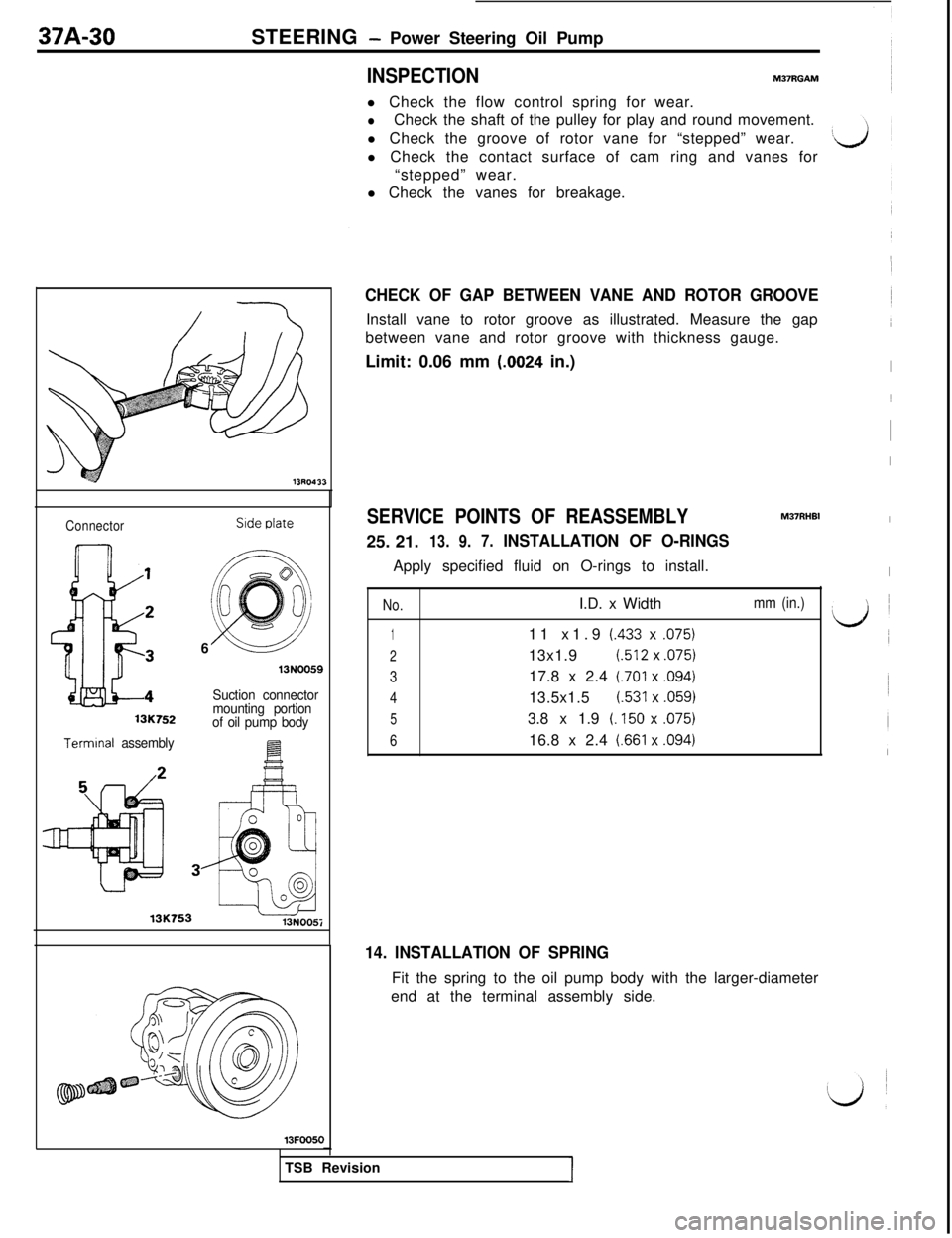
CHECK OF GAP BETWEEN VANE AND ROTOR GROOVEInstall vane to rotor groove as illustrated. Measure the gap
between vane and rotor groove with thickness gauge.
Limit: 0.06 mm
(.0024 in.)
M37RHBISERVICE POINTS OF REASSEMBLY25. 21.
13.9.7.INSTALLATION OF O-RINGSApply specified fluid on O-rings to install.
No.I.D. x Width
111 x1.9 (.433 x ,075)
213x1.9(.512 x ,075)
317.8 x 2.4
(.701 x ,094)
413.5x1.5
(.531 x .059)
53.8 x 1.9 (. 150 x ,075)
616.8 x 2.4
i.661 x ,094)
mm (in.)
I1
I
I
I
I
t i
14. INSTALLATION OF SPRINGFit the spring to the oil pump body with the larger-diameter
end at the terminal assembly side.
TSB Revision
I
Page 859 of 1146
STEERING - Power Steering Oil Pump37A-31 1
Dowel pin
131025i
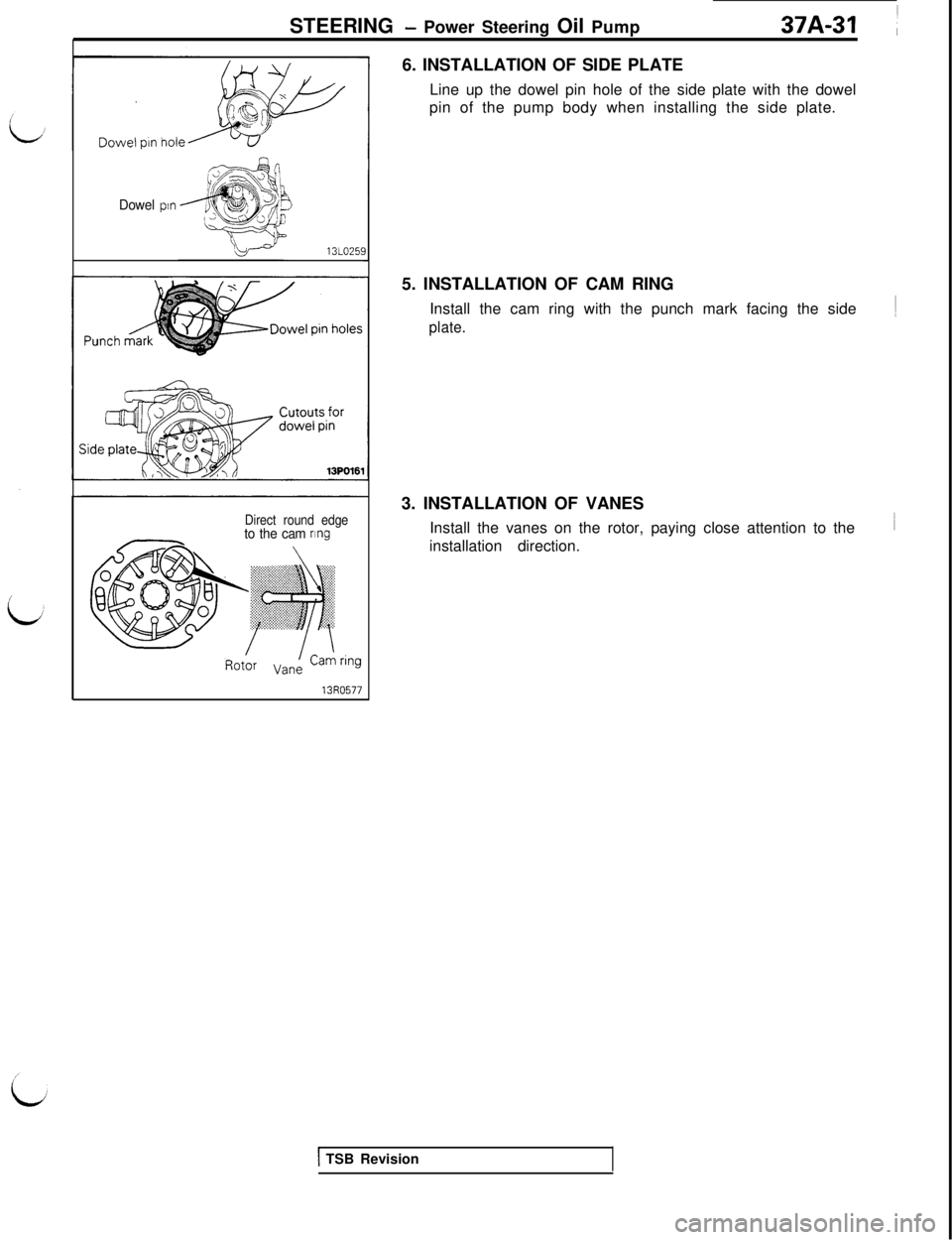
Direct round edgeto the cam nng6. INSTALLATION OF SIDE PLATE
Line up the dowel pin hole of the side plate with the dowel
pin of the pump body when installing the side plate.
5. INSTALLATION OF CAM RING
Install the cam ring with the punch mark facing the side
plate.3. INSTALLATION OF VANES
Install the vanes on the rotor, paying close attention to the
installation direction.
1 TSB Revision
Page 860 of 1146
37A-32STEERING - Power Steering Hoses
POWER STEERING HOSES
REMOVAL AND INSTALLATION
Pre-removal and Post-installation Operation
Il Draining, Supplying, and Bleeding of
the Power Steerina Fluid
(Refer to
P.37A-9,‘iO.)
12 Nm5Nm
8 ftlbs.4 ftlbs.
I12Nm
35Nm
12 Nm25ft.lbs.
8 ftlbs.2
I24 Nm
22 Nm17 f-tlbsad/16 ft.lbs.
11 klbs.
112/Nm8 ftlbs.M37TA.
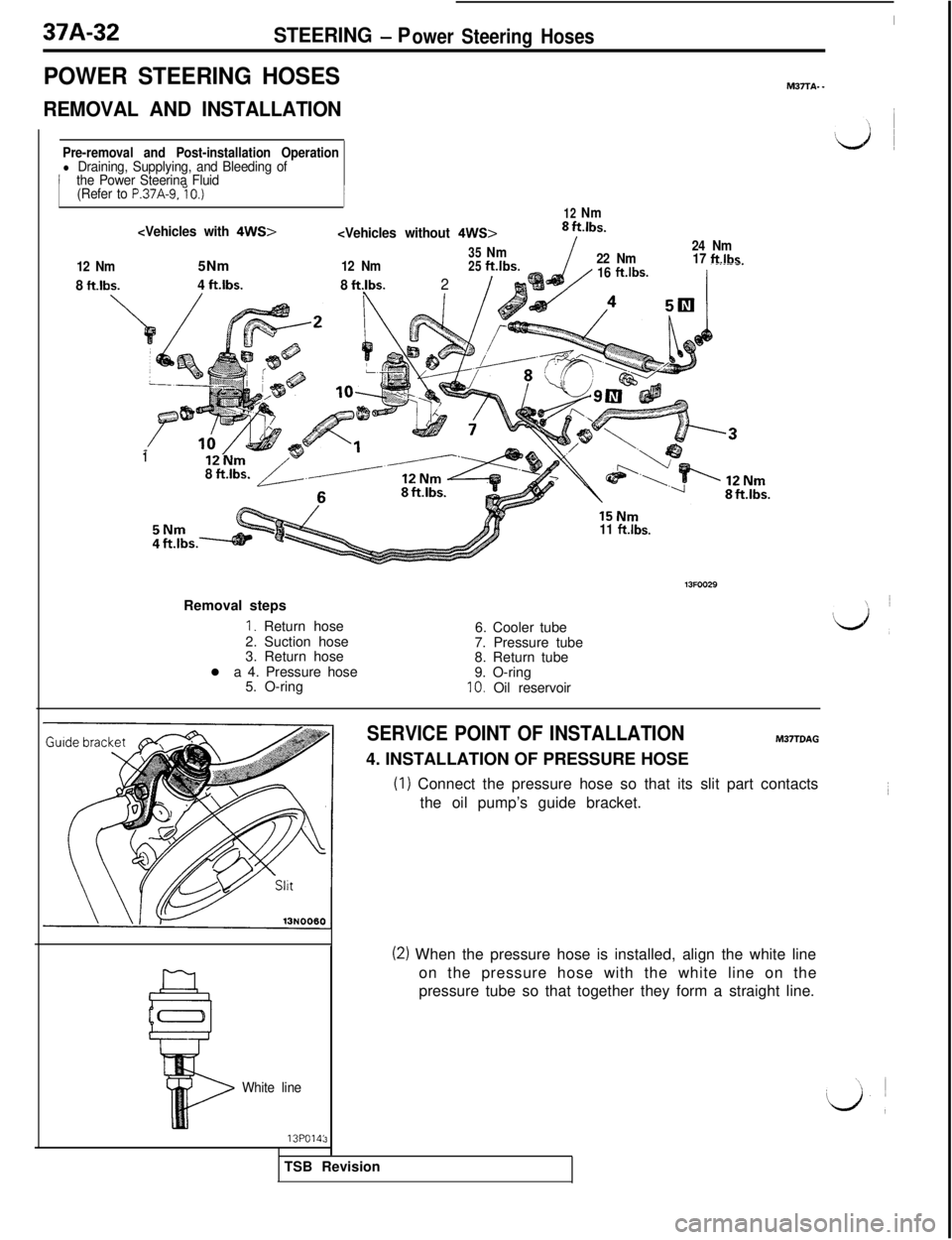
_Removal steps
I. Return hose
2. Suction hose
3. Return hose
l a 4. Pressure hose
5. O-ring6. Cooler tube
7. Pressure tube
8. Return tube
9. O-ring
IO. Oil reservoir
3
White line
13po14:
SERVICE POINT OF INSTALLATIONM3TTDAG
4. INSTALLATION OF PRESSURE HOSE
(1) Connect the pressure hose so that its slit part contacts
the oil pump’s guide bracket.
(2) When the pressure hose is installed, align the white line
on the pressure hose with the white line on the
pressure tube so that together they form a straight line.
TSB Revision
Page 861 of 1146
37B-1
li 4-WHEEL STEERING
SYSTEM (4WS)
CONTENTSMWAA-0
CONTROL VALVE................................................9SPECIAL TOOLS....................................................2
POWER CYLINDER............................................6SPECIFICATIONS................................................2
REAR OIL LINEGeneral Specifications
....................................2....................................................10Lubricants...............................................:............2
REAR OIL PUMP....................................................11Service Specifications....................................2
LJ
SERVICE ADJUSTMENT PROCEDURES . . . . . .4TROUBLESHOOTING. . . . . . . . . . . . . . . . . . . . . . . . . . . . . . . . . .._._._3Ball Joint Rotation Starting Torque Check
. . . .5Bleeding
. . . . . . . . . . . . . . . . . . . . . . . . . . . . . . . . . . . . . . . . . . . . . . . . . .._______._4
Function Check
. . . . . . . . . . . . . . . . . . . . . . . . . . . . . . . . . . . . . . . . . . . . . . . .5Rear Oil Pump Discharge Flow Volume
Check. . . . . . . . . . . . . . . . . . . . . . . . . . . . . . . . . . .._...........................5
Page 862 of 1146
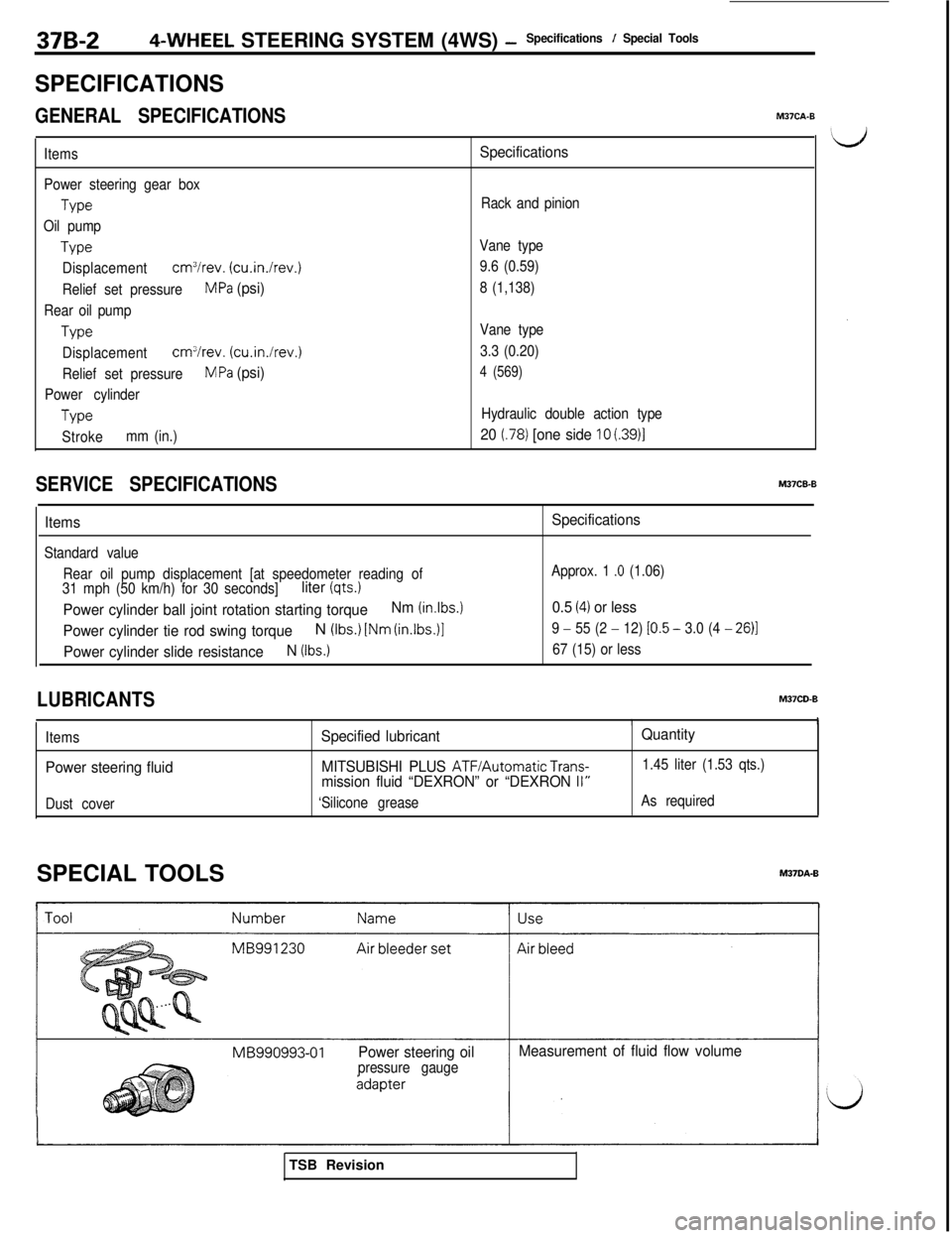
37B-24-WHEEL STEERING SYSTEM (4WS) -Specifications / Special Tools
SPECIFICATIONS
GENERAL SPECIFICATIONSM37CA-B
Items
Power steering gear box
Type
Oil pump
Type
Displacement
cm”/rev. (cu.in./rev.)
Relief set pressure
MPa (psi)
Rear oil pump
Type
Displacement
cm’/rev. (cu.in./rev.)
Relief set pressure
MPa (psi)
Power cylinder
Type
Strokemm (in.)
Specifications
Rack and pinion
Vane type
9.6 (0.59)
8 (1,138)
Vane type
3.3 (0.20)
4 (569)
Hydraulic double action type
20 i.78) [one side 10 (.39)1
SERVICE SPECIFICATIONSM37CEB
Items
Standard value
Specifications
Rear oil pump displacement [at speedometer reading of
31 mph (50 km/h) for 30 seconds]liter (qts.)
Power cylinder ball joint rotation starting torqueNm (in.lbs.)
Power cylinder tie rod swing torqueN (Ibs.) [Nm (in.lbs.)]
Power cylinder slide resistanceN (Ibs.)
Approx. 1 .O (1.06)
0.5 (4) or less
9 - 55 (2 - 12) IO.5 - 3.0 (4 - 26)l
67 (15) or less
LUBRICANTSM37CD.B
,II
Items
Power steering fluid
Dust cover
Specified lubricant
MITSUBISHI PLUS
ATFiAutomatic Trans-mission fluid “DEXRON” or “DEXRON II”
‘Silicone grease
Quantity
1.45 liter (1.53 qts.)
As requiredSPECIAL TOOLS
M37DA-6
MB990993-01Power steering oilpressure gauge
Measurement of fluid flow volumeTSB Revision
Page 863 of 1146
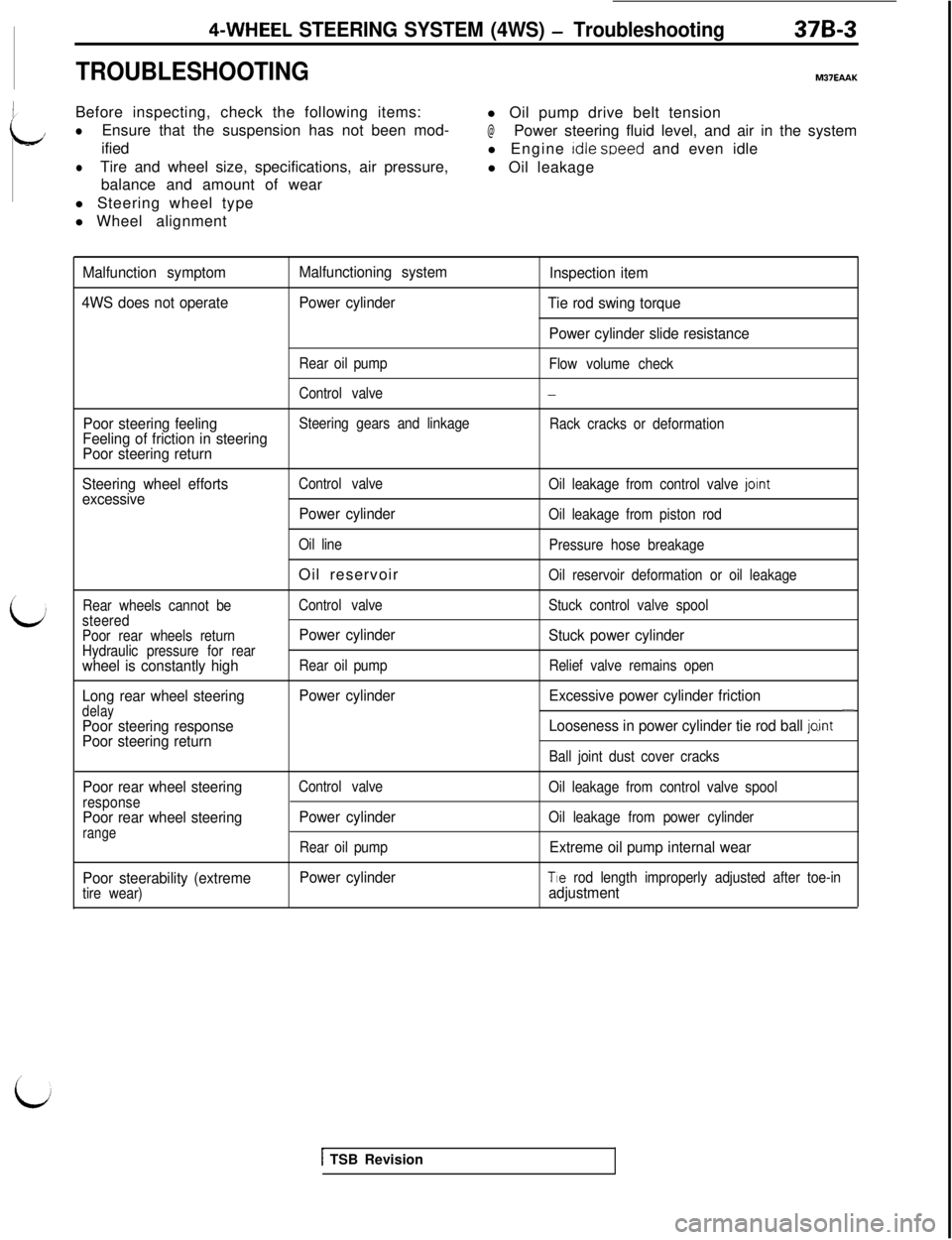
4-WHEEL STEERING SYSTEM (4WS) - Troubleshooting
TROUBLESHOOTING
37B-3
M37EMKBefore inspecting, check the following items:
l Oil pump drive belt tension
lEnsure that the suspension has not been mod-@Power steering fluid level, and air in the system
ified
l Engine
Idle soeed and even idle
lTire and wheel size, specifications, air pressure,
l Oil leakage
balance and amount of wear
l Steering wheel type
l Wheel alignment
Malfunction symptom
4WS does not operateMalfunctioning system
Power cylinderInspection item
Tie rod swing torque
Power cylinder slide resistance
Rear oil pump
Flow volume check
Control valve
-
Poor steering feelingSteering gears and linkage
Rack cracks or deformationFeeling of friction in steering
Poor steering return
Steering wheel efforts
excessive
Control valve
Oil leakage from control valve jornt
Rear wheels cannot be
steered
Poor rear wheels return
Hydraulic pressure for rear
wheel is constantly high
Long rear wheel steering
delayPoor steering response
Poor steering returnPower cylinder
Oil lineOil reservoir
Control valve
Power cylinder
Rear oil pump
Power cylinder
Oil leakage from piston rod
Pressure hose breakage
Oil reservoir deformation or oil leakage
Stuck control valve spool
Stuck power cylinder
Relief valve remains open
Excessive power cylinder friction-
Looseness in power cylinder tie rod ball jo.int
Ball joint dust cover cracks
Poor rear wheel steeringresponsePoor rear wheel steeringrange
Poor steerability (extremetire wear)Control valve
Power cylinder
Rear oil pump
Power cylinder
Oil leakage from control valve spool
Oil leakage from power cylinder
Extreme oil pump internal wear
Tie rod length improperly adjusted after toe-inadjustment
[ TSB Revision
Page 864 of 1146
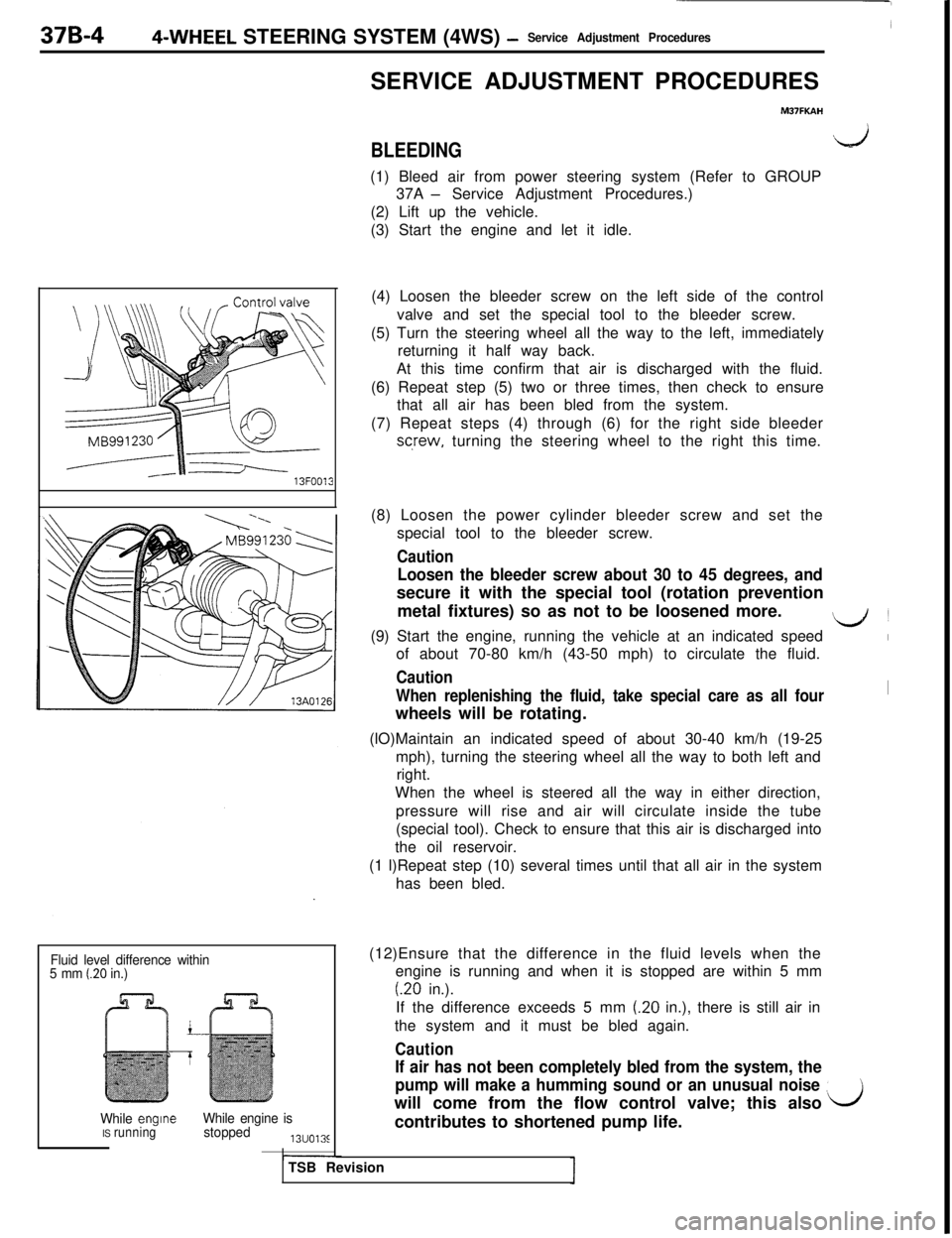
37B44-WHEEL STEERING SYSTEM (4WS) -Service Adjustment ProceduresSERVICE ADJUSTMENT PROCEDURES
M37FKAH
BLEEDING,LJ(1) Bleed air from power steering system (Refer to GROUP
37A
- Service Adjustment Procedures.)
(2) Lift up the vehicle.
(3) Start the engine and let it idle.
(4) Loosen the bleeder screw on the left side of the control
valve and set the special tool to the bleeder screw.
(5) Turn the steering wheel all the way to the left, immediately
returning it half way back.
At this time confirm that air is discharged with the fluid.
(6) Repeat step (5) two or three times, then check to ensure
that all air has been bled from the system.
(7) Repeat steps (4) through (6) for the right side bleeder
sc,rew, turning the steering wheel to the right this time.
(8) Loosen the power cylinder bleeder screw and set the
special tool to the bleeder screw.
Caution
Loosen the bleeder screw about 30 to 45 degrees, andsecure it with the special tool (rotation prevention
metal fixtures) so as not to be loosened more.
(9) Start the engine, running the vehicle at an indicated speed
I/l1Iof about 70-80 km/h (43-50 mph) to circulate the fluid.
-13FOO13
Caution
When replenishing the fluid, take special care as all fourIwheels will be rotating.
Fluid level difference within
5 mm (.20 in.)
While
engineWhile engine isIS runningstopped13lJO13~(lO)Maintain an indicated speed of about 30-40 km/h (19-25
mph), turning the steering wheel all the way to both left and
right.
When the wheel is steered all the way in either direction,
pressure will rise and air will circulate inside the tube
(special tool). Check to ensure that this air is discharged into
the oil reservoir.
(1 l)Repeat step (10) several times until that all air in the system
has been bled.
(12)Ensure that the difference in the fluid levels when the
engine is running and when it is stopped are within 5 mm(.20 in.).
If the difference exceeds 5 mm
(.20 in.), there is still air in
the system and it must be bled again.
Caution
If air has not been completely bled from the system, the
pump will make a humming sound or an unusual noise ,,
will come from the flow control valve; this also
dcontributes to shortened pump life.
TSB Revision
Page 865 of 1146
4-WHEEL STEERING SYSTEM (4WS) -Service Adjustment Procedures37B-5
Rubber hose
13FOOl
Graduated cylinder13FOOllFUNCTION CHECK
_M37FWAA
(1) Raise the vehicle so that all four wheels may turn freely.
(2) Start the engine, running the vehicle at an indicated speed
of about 80
km/h (50 mph).
(3) Turn the steering wheel all the way to left and right and turn
it swiftly, checking to ensure that the rear wheels steer to
the same directions as the front wheels.
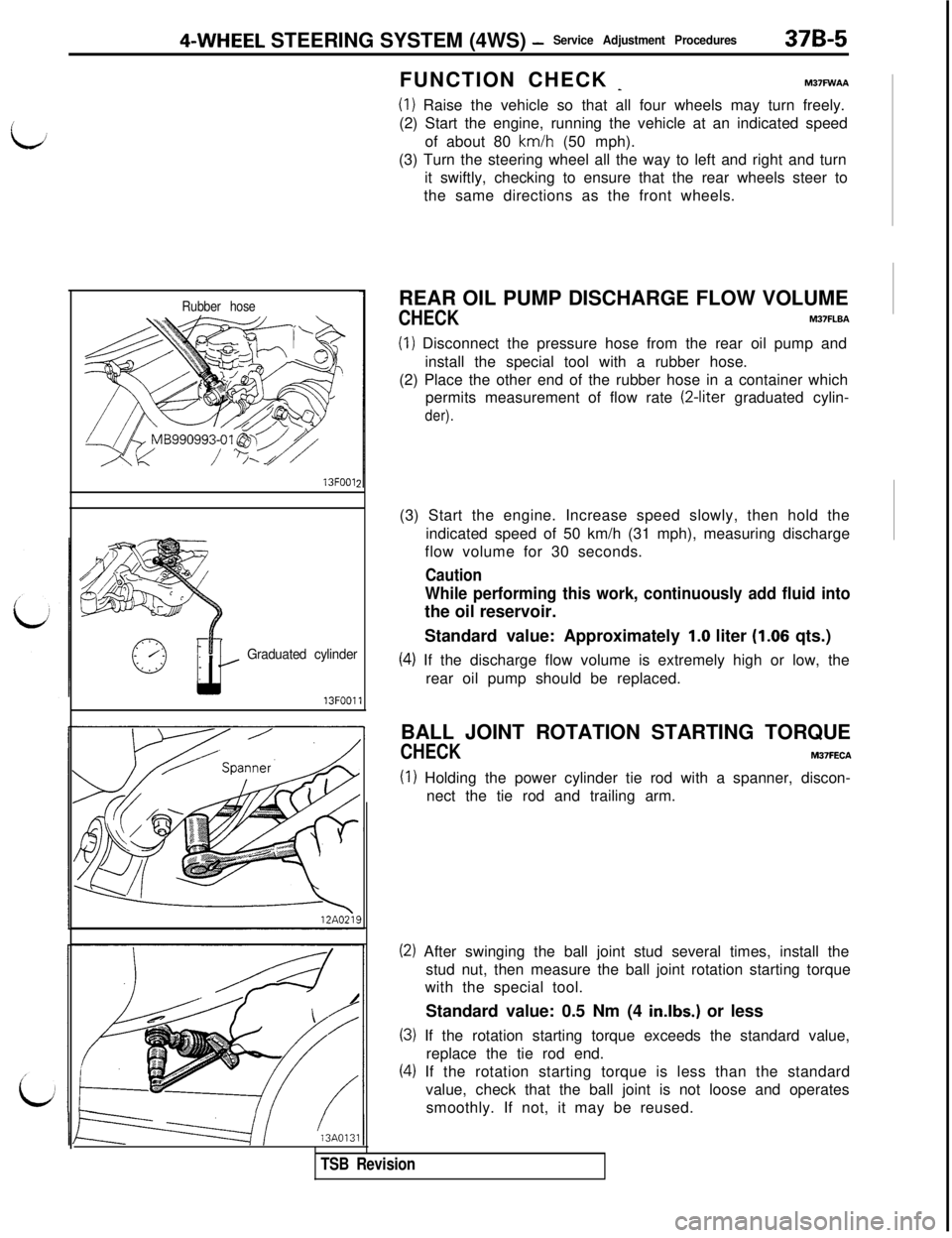
REAR OIL PUMP DISCHARGE FLOW VOLUME
CHECKM37FLBA
(1) Disconnect the pressure hose from the rear oil pump and
install the special tool with a rubber hose.
(2) Place the other end of the rubber hose in a container which
permits measurement of flow rate (2-liter graduated cylin-
der).(3) Start the engine. Increase speed slowly, then hold the
indicated speed of 50 km/h (31 mph), measuring discharge
flow volume for 30 seconds.
Caution
While performing this work, continuously add fluid intothe oil reservoir.
Standard value: Approximately
1.0 liter (1.06 qts.)
(4) If the discharge flow volume is extremely high or low, the
rear oil pump should be replaced.
BALL JOINT ROTATION STARTING TORQUE
CHECKM37FECA
(1) Holding the power cylinder tie rod with a spanner, discon-
nect the tie rod and trailing arm.
(2) After swinging the ball joint stud several times, install the
stud nut, then measure the ball joint rotation starting torque
with the special tool.
Standard value: 0.5 Nm (4
in.lbs.) or less
(3) If the rotation starting torque exceeds the standard value,
replace the tie rod end.
(4) If the rotation starting torque is less than the standard
value, check that the ball joint is not loose and operates
smoothly. If not, it may be reused.
TSB Revision
Page 866 of 1146
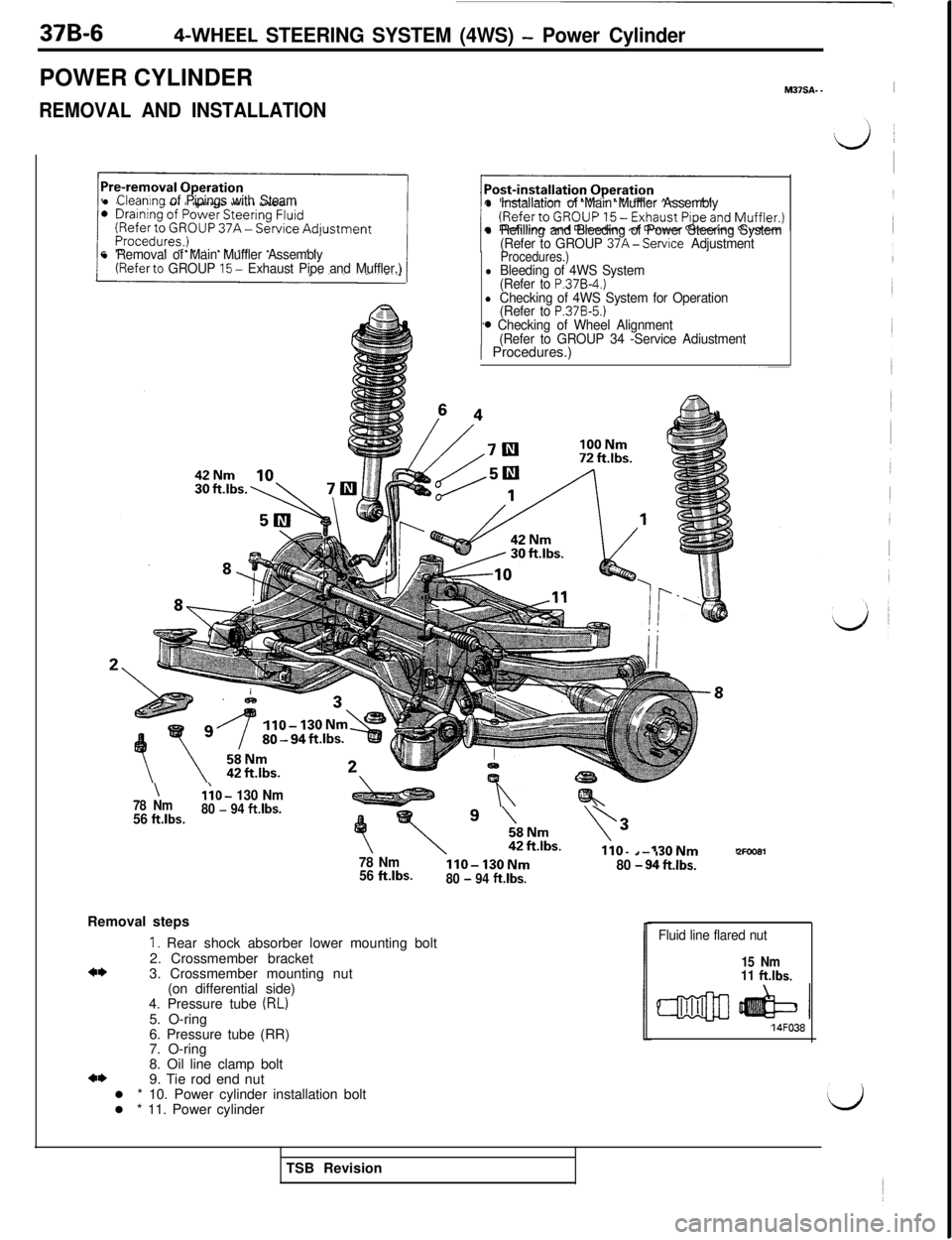
37B-64-WHEEL STEERING SYSTEM (4WS) - Power CylinderPOWER CYLINDER
REMOVAL AND INSTALLATION
M37S&~I
l Cleaning of Pipings with Steam
l Removal of Main Muffler Assembly(Referto GROUP 15- Exhaust Pipe and Muffler.)
Ilo-130Nm
l Installation of Main Muffler Assembly
l Refilling and Bleeding of Power Steering System
(Refer to GROUP 37A-Service Adjustment
\78 Nml;O- 130 Nm
56
ft.lbs.80 - 94 ft.lbs.
Procedures.)l Bleeding of 4WS System
(Refer to P.37B-4.)l Checking of 4WS System for Operation
(Refer to P.37B-5.)‘0 Checking of Wheel Alignment
(Refer to GROUP 34 -Service Adiustment
1 Procedures.)
f @, ’ i%,s. yf ,30Nm,
78 NmIIO-130Nm80 -94 ft.lbs.56 ft.lbs.
80 - 94 ft.lbs.Removal steps
1. Rear shock absorber lower mounting bolt
2. Crossmember bracket
a*3. Crossmember mounting nut
(on differential side)
4. Pressure tube
(RL)5. O-ring
6. Pressure tube (RR)
7. O-ring
8. Oil line clamp bolt
4*9. Tie rod end nut
l * 10. Power cylinder installation bolt
l * 11. Power cylinder
Fluid line flared nut
15 Nm
11 ft.lbs.14FO38
‘dTSB Revision
Page 867 of 1146
4-WHEEL STEERING SYSTEM (4WS) - Power Cylinder378-712AOlOE
IlZAO2;91
3A009
Wire
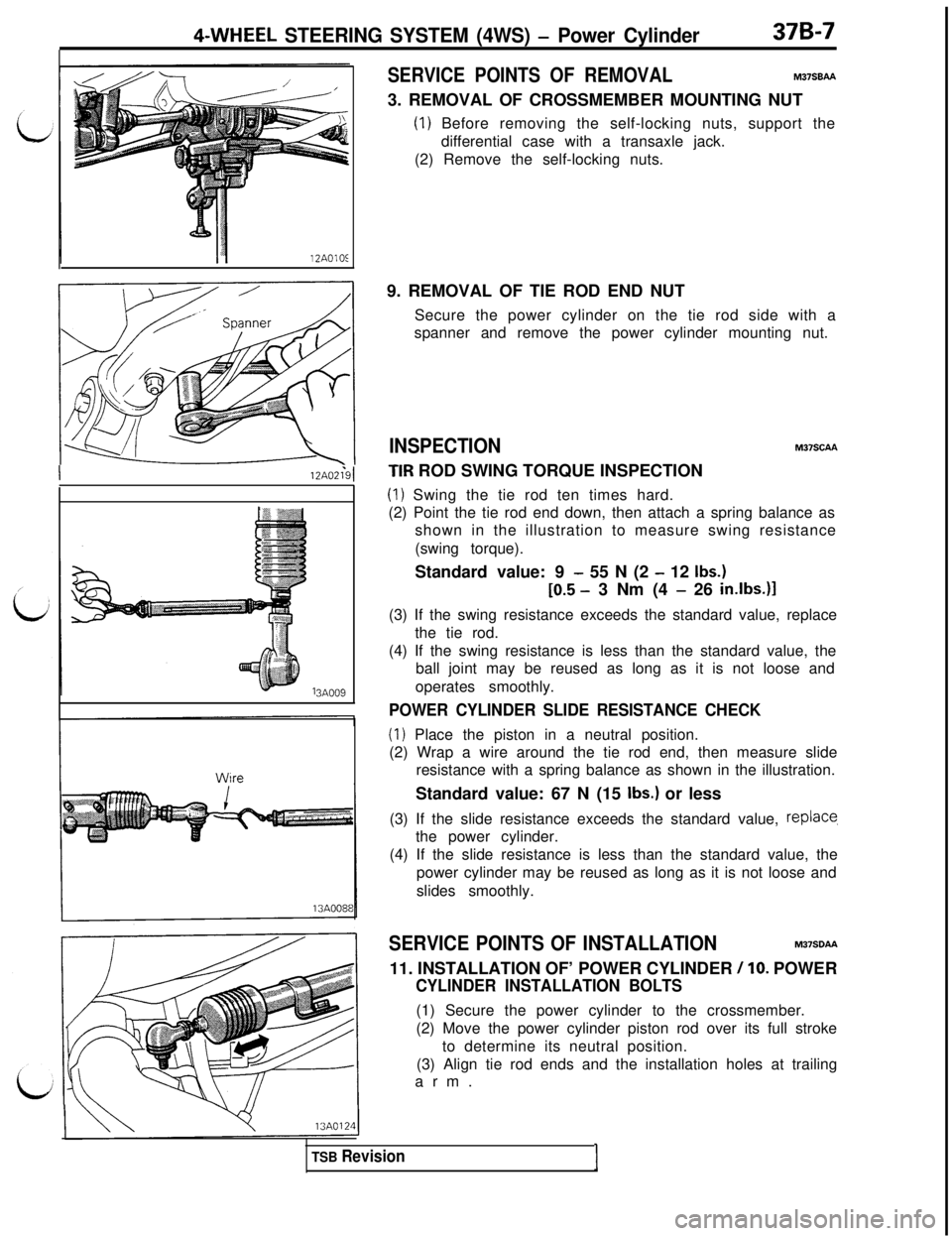
SERVICE POINTS OF REMOVALM37SBM3. REMOVAL OF CROSSMEMBER MOUNTING NUT
(1) Before removing the self-locking nuts, support the
differential case with a transaxle jack.
(2) Remove the self-locking nuts.
9. REMOVAL OF TIE ROD END NUT
Secure the power cylinder on the tie rod side with a
spanner and remove the power cylinder mounting nut.
INSPECTIONM37SCM
TIR ROD SWING TORQUE INSPECTION
(1) Swing the tie rod ten times hard.
(2) Point the tie rod end down, then attach a spring balance as
shown in the illustration to measure swing resistance
(swing torque).
Standard value: 9
- 55 N (2 - 12 Ibs.)
[0.5 - 3 Nm (4 - 26 in.lbs.)l(3) If the swing resistance exceeds the standard value, replace
the tie rod.
(4) If the swing resistance is less than the standard value, the
ball joint may be reused as long as it is not loose and
operates smoothly.
POWER CYLINDER SLIDE RESISTANCE CHECK
(1) Place the piston in a neutral position.
(2) Wrap a wire around the tie rod end, then measure slide
resistance with a spring balance as shown in the illustration.
Standard value: 67 N (15
Ibs.) or less
(3) If the slide resistance exceeds the standard value,
replace,the power cylinder.
(4) If the slide resistance is less than the standard value, the
power cylinder may be reused as long as it is not loose and
slides smoothly.
SERVICE POINTS OF INSTALLATIONM37SDP911. INSTALLATION OF’ POWER CYLINDER
/ 10. POWER
CYLINDER INSTALLATION BOLTS(1) Secure the power cylinder to the crossmember.
(2) Move the power cylinder piston rod over its full stroke
to determine its neutral position.
(3) Align tie rod ends and the installation holes at trailing
arm.
TSB RevisionI