ECU MITSUBISHI COLT 2006 Service Workshop Manual
[x] Cancel search | Manufacturer: MITSUBISHI, Model Year: 2006, Model line: COLT, Model: MITSUBISHI COLT 2006Pages: 364, PDF Size: 11.65 MB
Page 131 of 364

DIAGNOSIS SYSTEM
MULTIPOINT FUEL INJECTION (MPI) <4G1>13B-17
DATA LIST FUNCTION
The data list items are given in the table below
P2122Accelerator pedal position sensor
(main) circuit low inputOpen circuit or short-circuit in
sensor-related circuitsON
P2123Accelerator pedal position sensor
(main) circuit high inputOpen circuit in sensor-related
circuitsON
P2127Accelerator pedal position sensor
(sub) circuit low inputOpen circuit or short-circuit in
sensor-related circuitsON
P2128Accelerator pedal position sensor
(sub) circuit high inputOpen circuit in sensor-related
circuitsON
P2135Throttle position sensor (main and
sub) range/performance problemAbnormal sensor outputON
P2138Accelerator pedal position sensor
(main and sub) range/performance
problemAbnormal sensor outputON
U1073Bus offAbnormality in CAN bus line−
U1102ASC-ECU time-outAbnormality in CAN bus line−
U1106EPS-ECU time-outAbnormality in CAN bus line−
U1108Combination meter time-outAbnormality in CAN bus line−
U 111 0A/C-ECU time-outAbnormality in CAN bus line−
Code No. Diagnosis item Main diagnosis contents Engine
warning lamp
Item No.Inspection itemUnit
11Oxygen sensormV
12Air flow sensorg/s
13Intake air temperature sensor°C
14Throttle position sensor (sub)mV
16Power supply voltageV
18Cranking signal (ignition switch-ST)ON/OFF
21Engine coolant temperature sensor°C
22Crank angle sensorr/min
25Barometric pressure sensorkPa
29Inhibitor switchP or N/D, 2, L, or R
37Volumetric efficiency%
41Injectorsms
44Ignition advance°BTDC
49A/C relayON/OFF
67Stop lamp switchON/OFF
77Accelerator pedal position sensor (sub)mV
78Accelerator pedal position sensor (main)mV
79Throttle position sensor (main)mV
7EVariable valve timing phase angle°CA
Page 133 of 364

DIAGNOSIS SYSTEM
MULTIPOINT FUEL INJECTION (MPI) <4G1>13B-19
Engine-ECU Monitor Item
•Items useful for grasping the engine control condition by the engine-ECU are provided in this monitor item
section.
•Values of these monitor items vary greatly depending on marginal difference of measurement conditions,
difference of the environment, aged deterioration of vehicl es and so on, and it is difficult to show the pre
-
cise specification values. Therefore, check conditions, display range and movement of values are
described.
Item No.Inspection itemDisplay range, numerical value
5AAir-fuel ratio learning value of B zone (Low
speed load)−25 to 25%
5BIdle speed control position learned value−128 to 127STEP
5CIdle speed control position learned value (A/C
load)−128 to 127STEP
6AKnock retardRetards in response to accelerator opening
6BLearned knock retard0 − 100%
6CTarget Idle speedChanges in response to engine coolant
temperature
9BAir-fuel ratio learning value of A zone (Low
speed load)−25 to 25%
9DAir-fuel ratio feedback integration−25 to 25%
B1Waste gate solenoid valve duty0 − 100%
B2Alternator G terminal dutyIncreases
B3Purge control solenoid valve duty0 − 100%
81*Long-term fuel compensation−25 to 25%
82*Short-term fuel compensation−25 to 25%
87*Calculation load value0 − 100%
88*Fuel control conditionChanges depending on driving condition
NOTE: *: This item is not displayed when the data list in check mode is selected.
Page 139 of 364

GENERAL INFORMATION
CONTROLLER AREA NETWORK (CAN)54C-2
GENERAL INFORMATION
M2542000100159
CAN, an abbreviation for Controller Area Network, is
an ISO-certified international standard for a serial
multiplex communication protocol
*1. A communica-
tion circuit employing the CAN protocol connects
each ECU, and sensor data can be shared among,
which enables more reduction in wiring.
NOTE: *1: The regulations have been decided in
detail, from software matters such as the necessary
transmission rate for communication, the system,
data format, and communication timing control
method to hardware matters such as the harness
type and length and the resistance values.
CAN offers the following advantages.
•Transmission rates are much faster than those in
conventional communication (up to 1 Mbps),
allowing much more data to be sent.
•It is exceptionally immune to noise, and the data
obtained from each error detection device is more
reliable.
•Each ECU connected via the CAN communicates
independently, therefore if the ECU enters dam
-
aged mode, communications can be continued in
some cases.
Page 140 of 364
STRUCTURE
CONTROLLER AREA NETWORK (CAN)54C-3
STRUCTURE
M2542000200383
AC204755AC204755AF
Engine-ECU
or
Engine-
CVT-ECUEPS-ECU
M.U.T.-III
ETACS
-ECU
ABS-ECU
or
ASC-ECU
Steering
wheel
sensor G and
yaw rate
sensor
CAN_H
CAN_L Diagnosis
connector
Combination
meter
(incorporating
meter-A/C-ECU)
: Shows sub bus line. : Shows main bus line. Terminal resistor
Terminal resistor Main bus lines
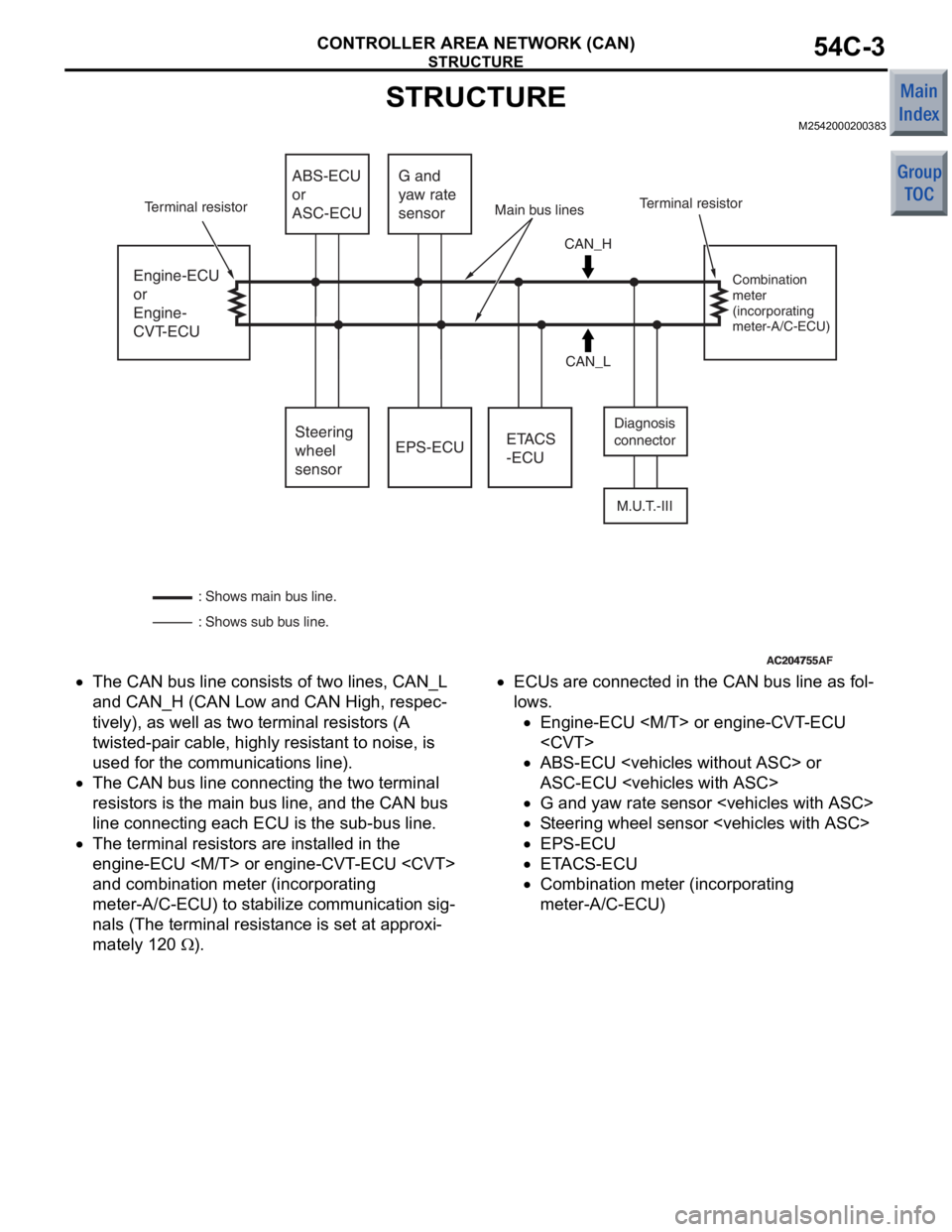
•The CAN bu s line consist s of two lines, CAN_L
and
CAN_H (CAN Low and CAN Hig h , respec
-
tively), as well as two terminal re sistors (A
twisted-p
a ir cable, highly resist ant to noise, is
used for
the communicatio n s line) .
•The CAN bu s line connectin g the two terminal
resist
ors is th e main bus line, an d the CAN bus
line connecting
each ECU is th e su b-bus lin e.
•The terminal resistors are inst alled in the
eng
ine-ECU
and
combin ation mete r (incorpora t ing
meter-A/C-ECU) to st
abi lize co mmunicatio n sig
-
nals (The terminal resist ance is se t at ap proxi-
mately 120 Ω).
•ECUs are conn ected in th e CAN bus line as fo l-
lows.
•En gine -ECU
•ABS-ECU
A
S C-ECU
•G and ya w ra te se nsor
•St e e ring wh eel sensor
•EPS-ECU
•E T ACS-ECU
•Co mbinatio n me ter (in c orpo rating
meter-A/C-ECU)
Page 141 of 364
OPERATION
CONTROLLER AREA NETWORK (CAN)54C-4
OPERATION
M2542000300313
AC206267
ECU-1A
AAA
BBB CCA
B
Interval "a"
Interval "b" Interval "c"
CCC BB
AAA
ECU-1
ECU-2
CAN bus
Data frames
AC206267
AD
Transmission
suspended by
mediation
Re-
transmission
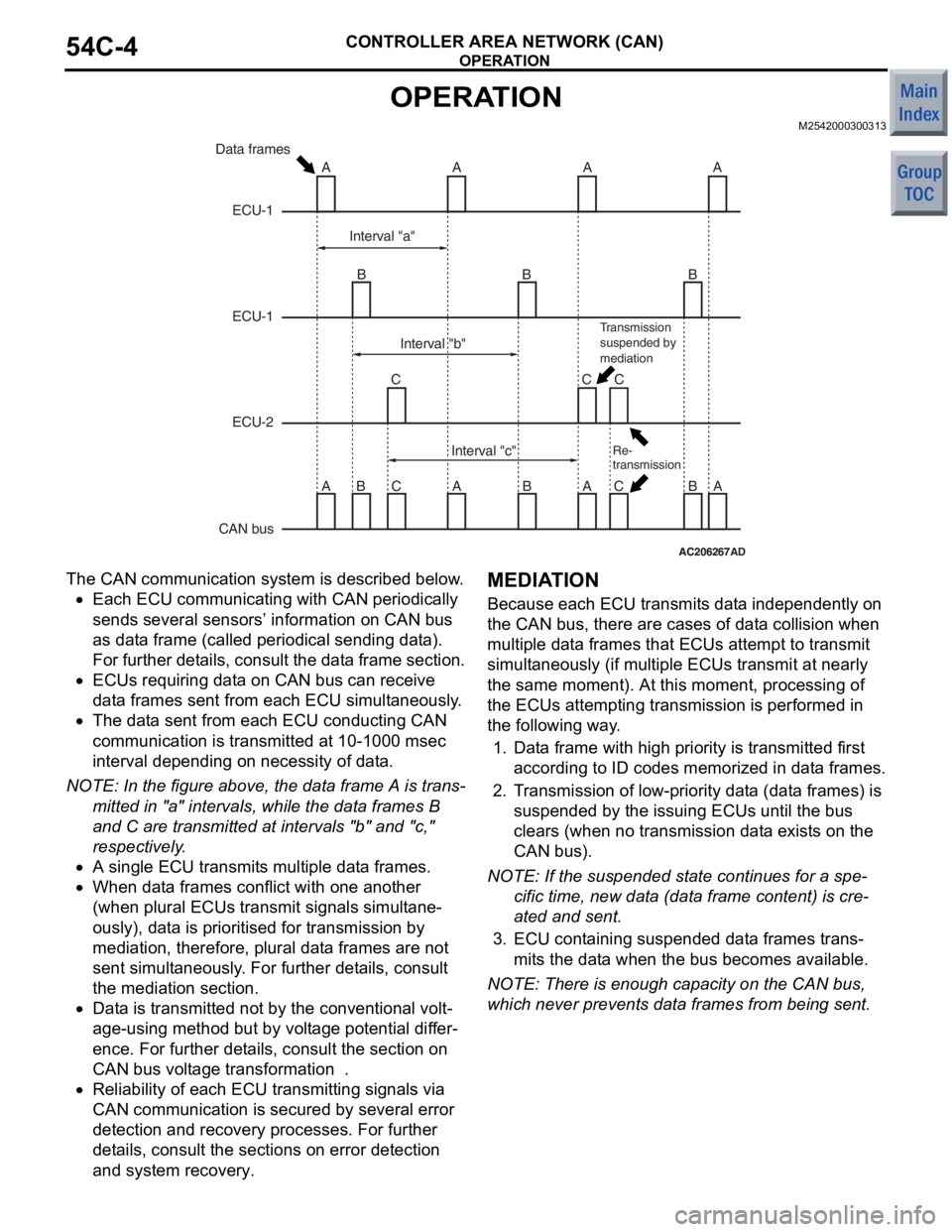
The CAN commun ica t ion system is describe d below .
•Each ECU communicating with CAN pe riodically
se
nds several sensors’ inf o rmation on CAN bu s
as dat
a frame (calle d periodical send ing d a t a ).
For furt
her det ails, co nsult the dat a frame sectio n
.
•ECUs requirin g dat a on CAN bu s can receive
dat
a fra m es sen t from each ECU simult aneo usly .
•The dat a se nt from each ECU condu cting CAN
co
mmunicatio n is transmitted at 10-100 0 msec
in
terva l dep endin g on n e cessity of dat a.
NOTE: In the f i gure ab ove, th e dat a frame A is trans-
mitted in "a" intervals, while the d a t a frames B
and
C are tran smitted at int e rvals "b" and "c,"
respective
ly .
•A single ECU tra n smit s multiple dat a frames.
•When dat a frames conf lict with o ne ano ther
(when
plural ECUs tr ansmit signals simu lt ane
-
ously), data is prioriti sed for transmission b y
mediat
ion, t herefore , plu r al da t a frames are not
se
nt simult aneously . F o r furthe r det ails, consult
the
mediatio n se ctio n
.
•Data is transmitted no t by the conve n tion al volt-
age-using method b u t by volt a ge pot entia l dif f er-
ence. For further det ails, consu l t the section on
CAN
bus volt ag e transformation
.
•Reliability of each ECU transmitting sig nals via
CAN
commun ica t ion is secu red by several error
det
ection and reco very processes. For furth e r
det
ails, consult the sections on error detection
and
sy stem rec o very
.
MEDIA T I O N
Because ea ch ECU transmit s dat a indepe ndently o n
the CAN bus,
there a r e ca ses of da t a collision whe n
multiple dat
a frames that ECUs at temp t to tran smit
simult
ane ously (if mu ltiple ECUs tran smit at n early
the same
moment). At th is moment, p r ocessing of
the ECUs atte
mpting tra n smission is performed in
the followin
g way .
1.Dat a frame with high priority is tra n smitted first
accord ing to ID cod e s memo rize d in dat a frames.
2.T r ansmission of lo w-p r iori ty dat a (dat a frames) is
suspe nded b y the issuin g ECUs until the bus
clears (when no transmission da t a exist s on the
CAN bus).
NO TE: If th e su spen ded st a t e co ntinu e s fo r a sp e-
cific time, new d a t a (dat a frame content ) is cre-
ated and sent.
3.ECU cont aining suspende d dat a fra m es trans-
mits the dat a when t he bus become s available .
NOTE: The re is enou gh ca p a city on t he CAN bus,
wh
ich
neve r prevent s da t a f r ames from being se nt.
Page 142 of 364
OPERATION
CONTROLLER AREA NETWORK (CAN)54C-5
VOLTAGE TRANSFORMATION ON THE
CAN BUS
AC204753
Voltage
transformation
in CAN_L
State:
Logic value:Recessive Recessive
Dominant 3.5 V
2.5 V
1.5 V
0
1
AC
Voltage
transformation
in CAN_H
Dat
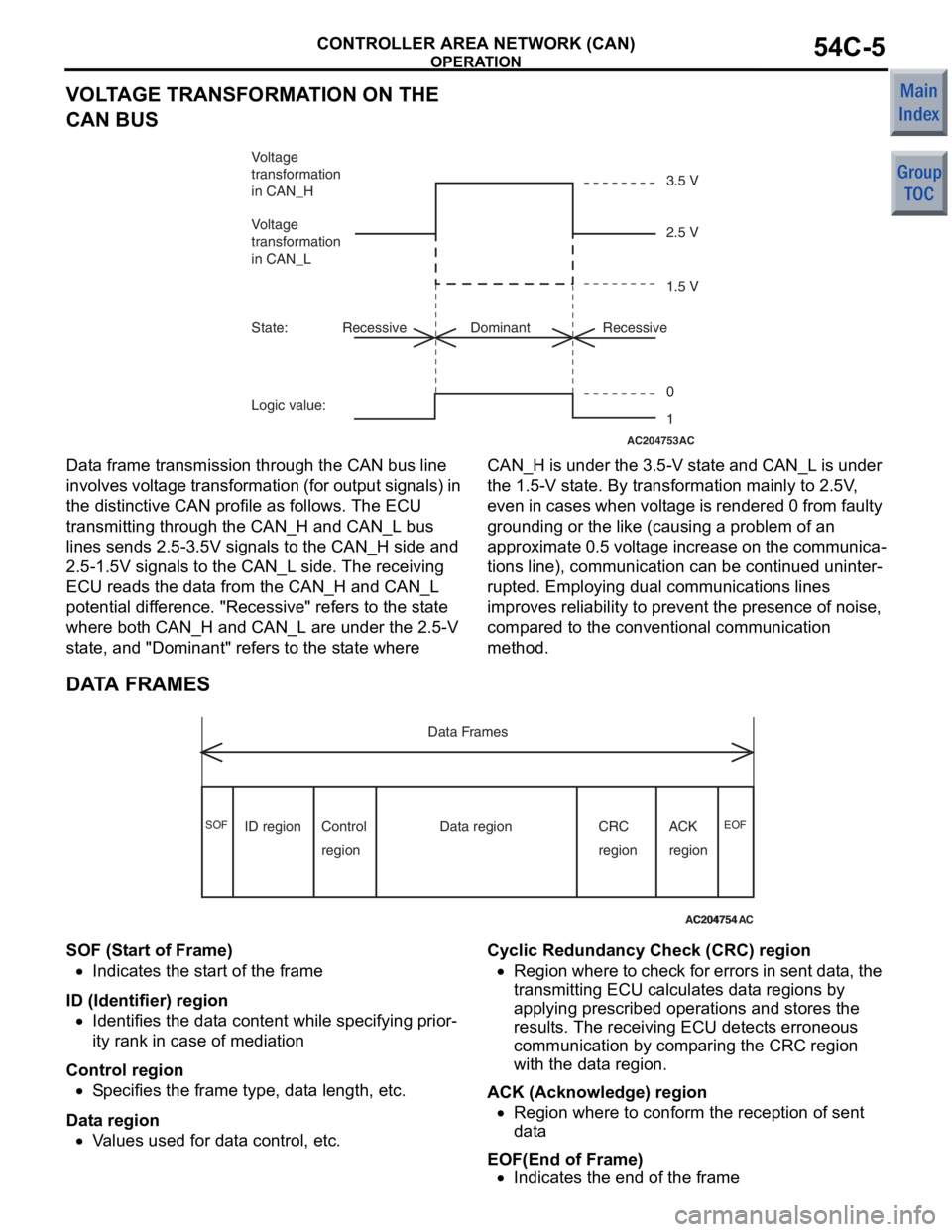
a f r ame t r ansmissio n throu gh the CAN bu s line
i
n vo lve s vo lt ag e tran sfo r ma ti on (for o u t p u t sign al s) in
the distinctive CAN profile a
s follows. The ECU
transmitting th
rough t he CAN_ H and CAN_L bus
line
s sends 2.5-3.5 V sig nals to th e CAN_H side and
2.5-1.5V sign
als to the CAN_L sid e . The receivin g
ECU read
s the dat a from the CAN_H and CAN_L
potential d
i f f e r ence . "Recessive" re fers to the st ate
whe
r e both CAN_H an d CAN_ L are u nder th e 2.5-V
st
ate, an d "Dominant" r e fers to the st ate where CAN_H is u nder the 3.5 - V st a t e and CAN_L is un der
the 1.5 - V st ate. By transforma t ion mainly to 2.5V ,
even in cases when volt age is rend ered 0 from fault y
ground ing o r the like (causing a prob lem of an
approximate 0.5 volt ag e incre a se on the co mmu nica
-
tions line), communication ca n be continued unint er-
rupted. Emplo y in g dua l co mmunicatio n s lines
imp
r oves reliability to pre v en t the pre s ence of noise,
comp
a r ed to t he co nven tion al communication
metho
d .
DAT A FRAMES
AC204754
ID region CRC
regionACK
region
Control
region Data region
Data Frames
AC204754AC
SOF
EOF
SOF (St a rt of Fra m e)
•Indi cat e s th e st art o f the fra m e
ID (I dentifier) regi on
•Iden tifies th e dat a content wh ile specifying prior-
ity rank in case of mediation
Cont rol re gion
•Specifies the frame type , dat a le ngth, e t c.
Data region
•Va lues used for d a t a con t rol, e t c.
Cyclic Redun dancy Che ck (CRC) reg i on
•Region wh er e to che c k fo r e r r o rs in se nt da t a , t h e
t
r a n s m it t i ng EC U ca l c u l at e s da t a re g i on s by
app
lying pre s cribed operations and stores the
result
s. The receiving ECU de tect s e rroneou s
communicatio
n by comp a r ing the CRC regio n
with
the da t a r egion .
ACK (Acknowledge) region
•Region where to co nform the reception of sent
dat
a
EOF(End of Fra m e)
•Indi ca tes th e end of the frame
Page 143 of 364

SELF-DIAGNOSIS
CONTROLLER AREA NETWORK (CAN)54C-6
ERROR DETECTION AND RECOVERY
CAN protocol secures its reliability of communication
by providing several error detection function such as
CRC shown in data frame, and the recovery function
(recovery is performed by resending, from abnormal
state such as transmission errors). If an error is
detected but it is not resolved even after recovery,
communication is stopped. This state is called "Bus
Off."
SELF-DIAGNOSIS
M2542000400280
•CAN self-diagnosis is performed by each ECU
connected to the CAN bus.
•diagnosis codes related to communication are
named with the capital letter U, and are called
"U-codes."
•A summary of the CAN self-diagnosis system is
presented below.
TIME-OUT
Each ECU transmits data frames periodically. If the
data frame is not received within the specified period,
the intended receiving ECU transmits a diagnosis
code indicating communication time-out for the ECU
that failed to transmit.
BUS OFF
Related to a communication error that persists even
after the transmitting ECU attempts recovery for a
specified number of attempts or that persists for a
specified period after recovery, communication is
stopped and this diagnostic code is issued.
FA I L U R E D ATA
When the transmitting ECU detects failure of a sen-
sor directly connected to it, this is the pertinent data
used to inform the ECU.
DATA LENGTH ERROR
When the number of data bytes received is different
from the prescribed number of bytes, this diagnosis
code is issued.
DYNAMIC RANGE ERROR
When the data received is more or less than the pre-
scribed range, this diagnosis code is issued.
CAN BUS DIAGNOSTICS
M2542000500179
As ECUs are connected via CAN bus (including
M.U.T.-III), always diagnose CAN bus to confirm its
normality when inspecting. Simply by performing
M.U.T.-III screen operations, the following inspec
-
tions can be performed automatically, and the result
can be used to verify the CAN bus status.
•Voltage measurement between the CAN_L and
CAN_H and the body earthing terminal
•Resistance measurement between the CAN_L
and CAN_H
•Confirmation of communication of all ECUs
Page 150 of 364
MAIN BODY
BODY42-7
DRIVING STABILITY
AB400932
AB400232AB400233
AB400213A
A
Cowl top lower panel
Spring house
panel
Corner of door opening
Corner of tailgate opening
AB
Section A – A1
2
2
4,5
3
Upper frame to
front pillar brace
Front upper
outer plate
Front upper
frame outer
Cowl top extension lower
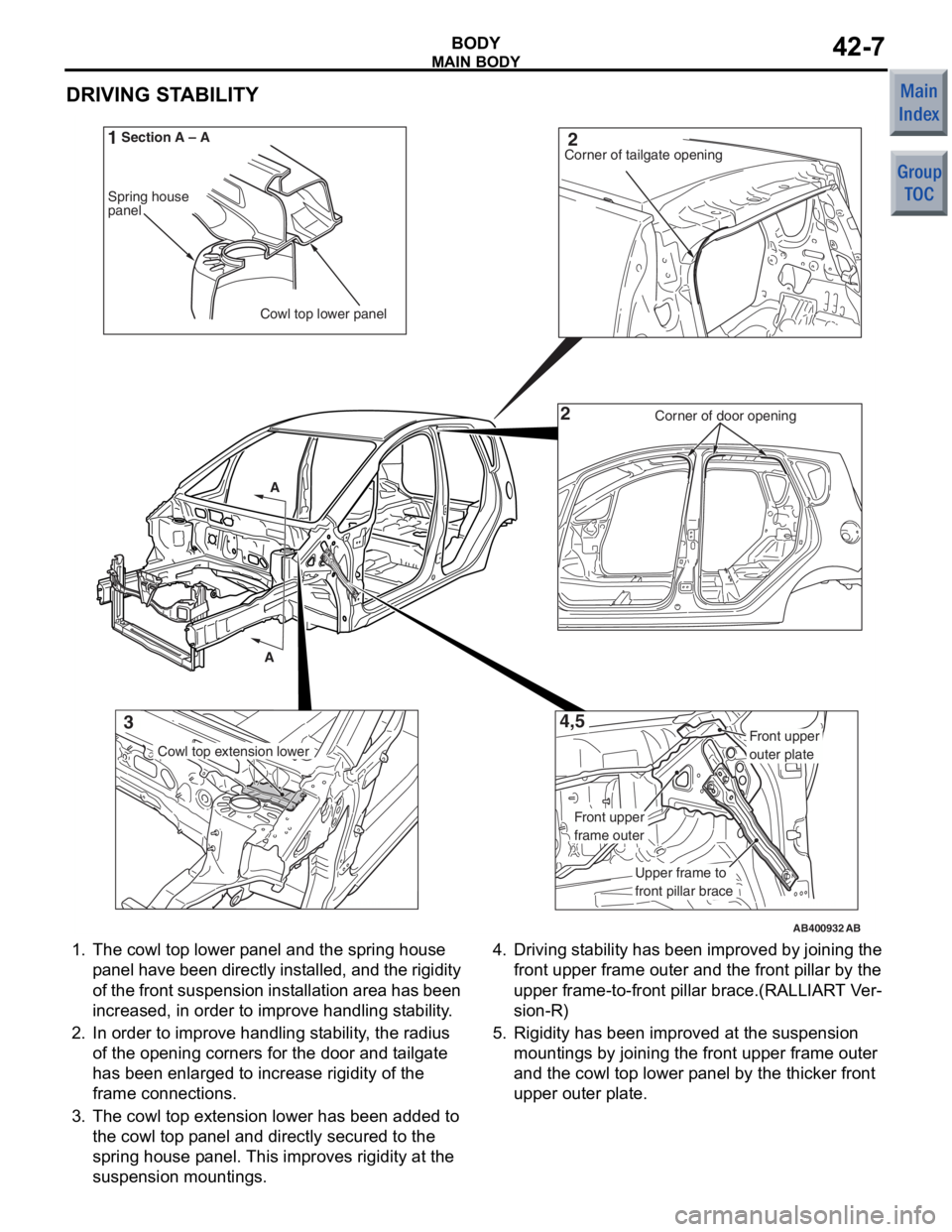
1.
The cowl t op lo we r p a nel a nd the spring ho use
p a n e l h a ve be en dire ct ly inst alled , a n d th e rigidity
of the fro n t suspen sion inst allation area ha s b een
in creased, in orde r to improve han dling st ab ility .
2.In o r der to imp r ove h andling st a b ility , the radius
of t he ope ning corne r s for the do or and t a ilgate
has bee n enlarged t o increase rigidity of th e
frame connection s.
3.The cowl t op extension lower has bee n adde d to
the cowl t op p anel and d i rectly secured t o the
sp ring house p anel. This improves rigidity a t the
su spen sio n mo untin gs.
4.Driving st ability has bee n improved by jo ining the
fron t uppe r frame outer a nd the front p illar by the
upp er frame-to-fro nt pillar b r ace . (RALL I AR T V e r
-
sion-R)
5.Rigidity has been impr ove d at the suspension
mountings b y joining the front u pper fra m e ou ter
and the cowl top lower p a n e l by the t h icker fro n t
upp er oute r plat e.
Page 156 of 364
DOOR
BODY42-13
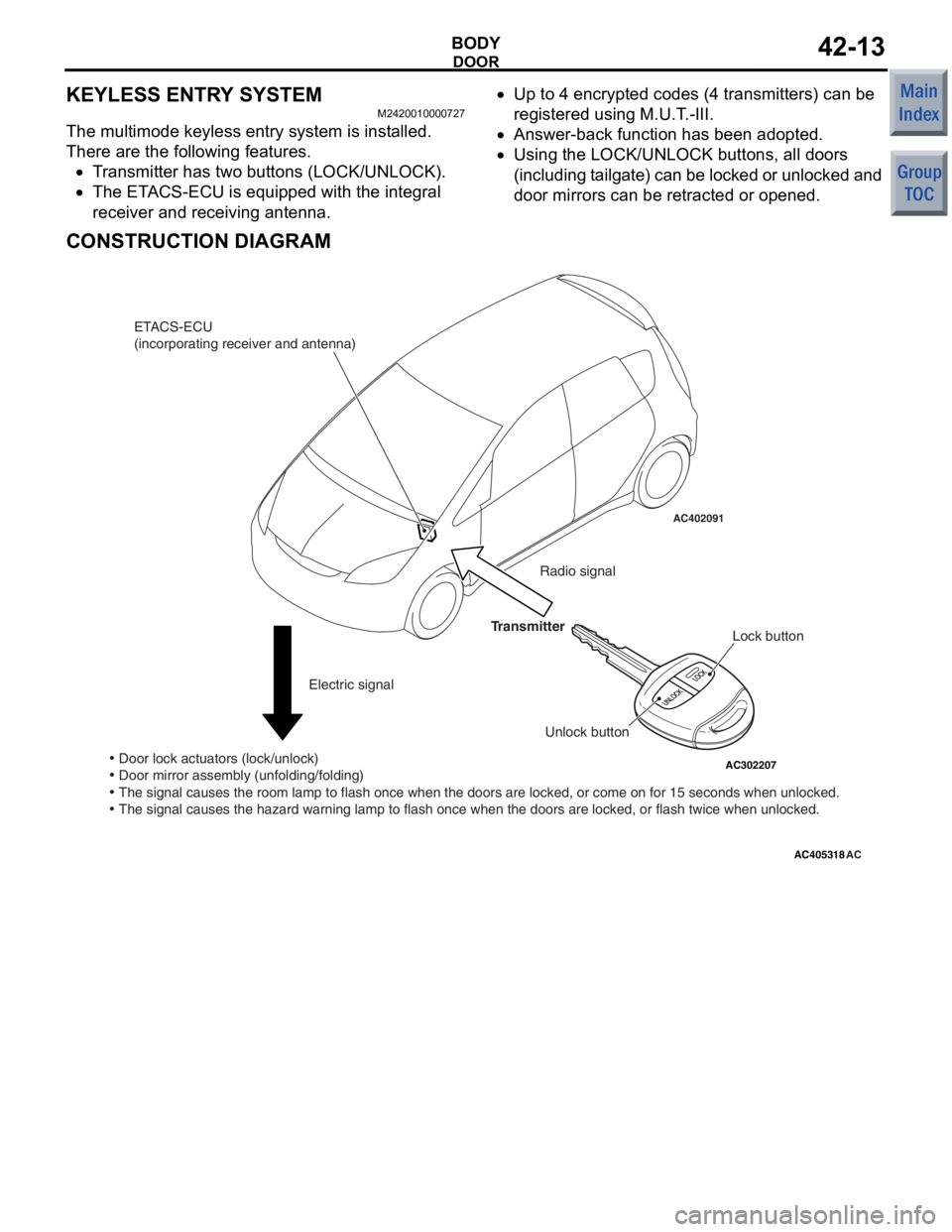
KEYLESS ENTRY SYSTEM
M2420010000727
The multimode keyless entry system is installed.
There are the following features.
•Transmitter has two buttons (LOCK/UNLOCK).
•The ETACS-ECU is equipped with the integral
receiver and receiving antenna.
•Up to 4 encrypted codes (4 transmitters) can be
registered using M.U.T.-III.
•Answer-back function has been adopted.
•Using the LOCK/UNLOCK buttons, all doors
(including tailgate) can be locked or unlocked and
door mirrors can be retracted or opened.
CONSTRUCTION DIAGRAM
AC405318
AC206461
AC302207
AC402091
AC
ETACS-ECU
(incorporating receiver and antenna)
Electric signal Radio signal
Lock button
Unlock button
Transmitter
• Door lock actuators (lock/unlock)
• Door mirror assembly (unfolding/folding)
• The signal causes the room lamp to flash once when the doors are locked\
, or come on for 15 seconds when unlocked.
• The signal causes the hazard warning lamp to flash once when the doors \
are locked, or flash twice when unlocked.
Page 158 of 364
DOOR
BODY42-15
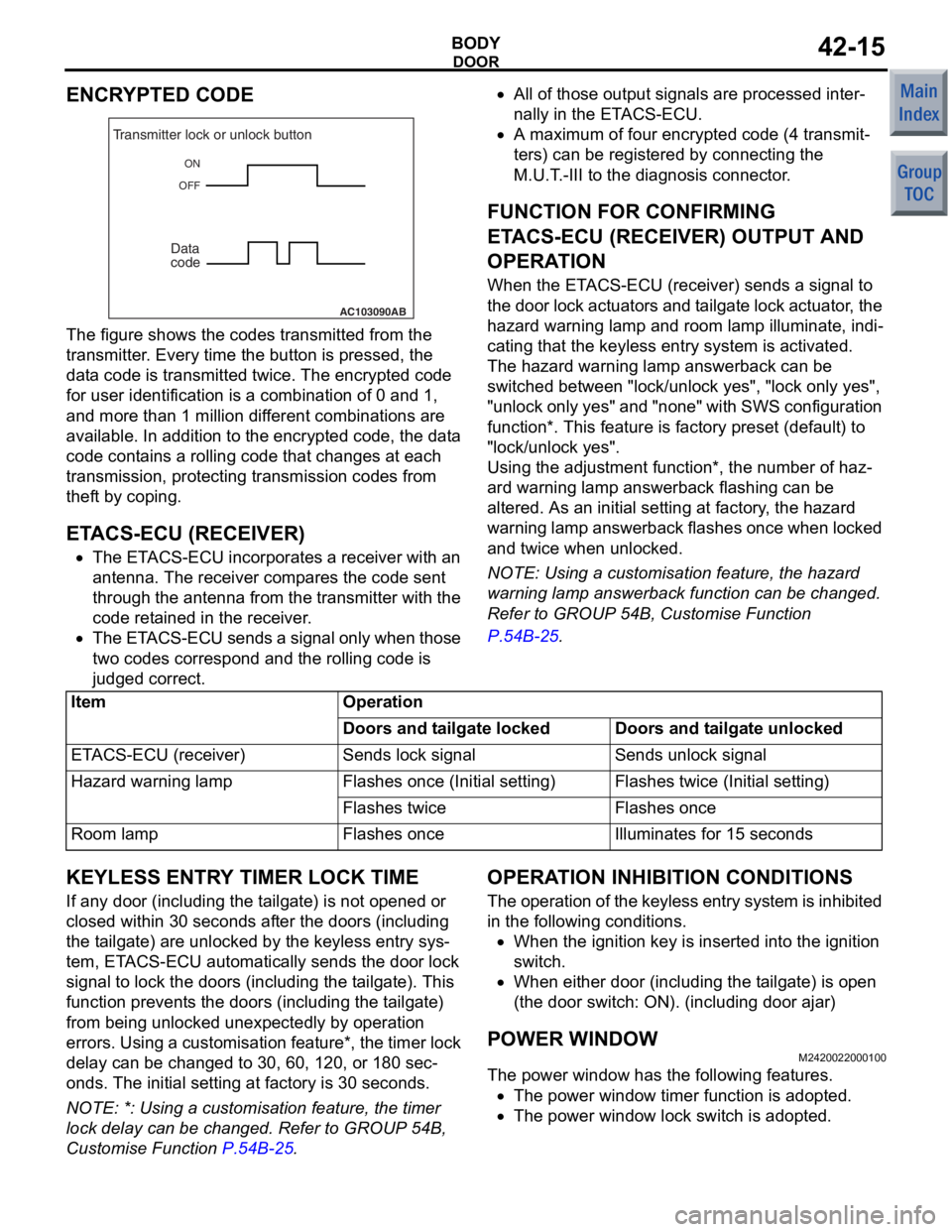
ENCRYPTED CODE
AC103090AB
ON
OFF
Transmitter lock or unlock button
Data
code
The figure shows th e co des transmitte d from the
transmitte
r . Every time the butto n is pressed, the
dat
a cod e is transmitted tw ice. Th e encrypte d co de
for user ide
n tification is a comb ination o f 0 and 1,
and more tha
n 1 million dif f erent comb inations are
available. In a
ddition to t he encrypt ed co de, the dat a
code
cont ains a rolling code t hat change s at e a ch
transmission, prot
ecting tran smission code s from
thef
t by coping.
ETACS-ECU (RECEIVER)
•The ET ACS-ECU incorp orates a receiver with a n
ant
enna. T he receiver co mp ares the code sent
thro
ugh t he an tenna from the transmit t er with the
co
de ret a ined in the re ceiver .
•The ET ACS-ECU send s a si gnal only whe n t hose
two codes corre
spon d and the rollin g co de is
ju
dged correct.
•All of tho s e o u tput sign als are processed inter-
nally in the ETACS-ECU.
•A maximum of fou r encr y pted cod e (4 tran smit-
ters) can be re gistered by co nnecting the
M.U.
T . -III t o the d i agn osis co nnector .
FUNCTION FOR CONFIRMING
ET
ACS-ECU (RECEIVER) OUT P UT AND
OPERA
T ION
When the ET ACS-ECU (receiver) send s a sign al to
the
do or lock actua t o r s an d t a ilga te lo ck actua t or , t h e
haza
r d warnin g lamp an d room lamp illumina te, in di
-
cating that the keyless ent ry syste m is activated.
The hazard warn ing lamp answe rback ca n be
switched b
e tween "lock/unlock yes", "lock o n ly yes",
"unlock o
n ly yes" and "non e" with SW S co nfigurat ion
funct
i on*. Th is f eature is fa ctory preset (de f ault ) to
"lock/unlock ye
s".
Using the ad justment function*, th e number of haz-
ard warning lamp a n swerba ck flashing can be
altere
d. As a n initial set t ing a t factory , the haza r d
wa
rnin g lamp an swerb a ck flashes once wh en locked
and twice when
unlo cke d.
NOTE: Using a cust omisation fea t ure, th e hazard
wa
rning lamp answe rback fun c tio n ca n be change d.
Re
fer to GROUP 54B, Customise Function
P.54B-25.
ItemOperation
Doors and tailgate lockedDoors and tailgate unlocked
ETACS-ECU (receiver)Sends lock signalSends unlock signal
Hazard warning lampFlashes once (I nitial setting)Flashes twice (Initial setting)
Flashes twiceFlashes once
Room lampFlashes onceIlluminates for 15 seconds
KEYLESS ENTR Y TIMER LOCK TIME
If any door (includin g the t a ilgat e) is not op ened or
closed within 3
0 se cond s af ter th e doo rs (in c lu ding
the t
a ilgate) a r e unlocked by the keyless ent ry sys
-
tem, ETACS-ECU aut omatically sen d s th e door lock
sign
al to lock the doors (includ i ng t he t a ilgate). T h is
funct
i on p r even t s the d oors (including the t a ilga te)
from b
e ing unlocke d unex pectedly by opera t ion
errors.
Using a customisa t ion fea t ure*, the timer lock
delay ca
n be chang ed to 3 0 , 60, 120, or 180 sec
-
onds. The initial setting at fa ctory is 30 secon d s.
NOTE: *: Using a custo m isation fea t ure, the timer
lock delay can b e ch anged. Re fer to GROUP 54B,
Customise Function
P.54B-25.
OPERA T ION INHIBITION CONDITIONS
The operation of t he keyless entry system is inhibited
in the
following cond itio ns.
•When the ignition key is inse rted into the ignition
sw
itc h .
•When eit her doo r (including th e t a ilg ate) is ope n
(the
door switch : ON). (includin g doo r ajar)
POWER WI NDOW
M24200220 0010 0
The powe r window ha s the following f eatures.
•The power wind ow timer functio n is adopt ed.
•The power wind ow lock switch is adopte d .