oil MITSUBISHI ECLIPSE 1990 User Guide
[x] Cancel search | Manufacturer: MITSUBISHI, Model Year: 1990, Model line: ECLIPSE, Model: MITSUBISHI ECLIPSE 1990Pages: 391, PDF Size: 15.27 MB
Page 34 of 391
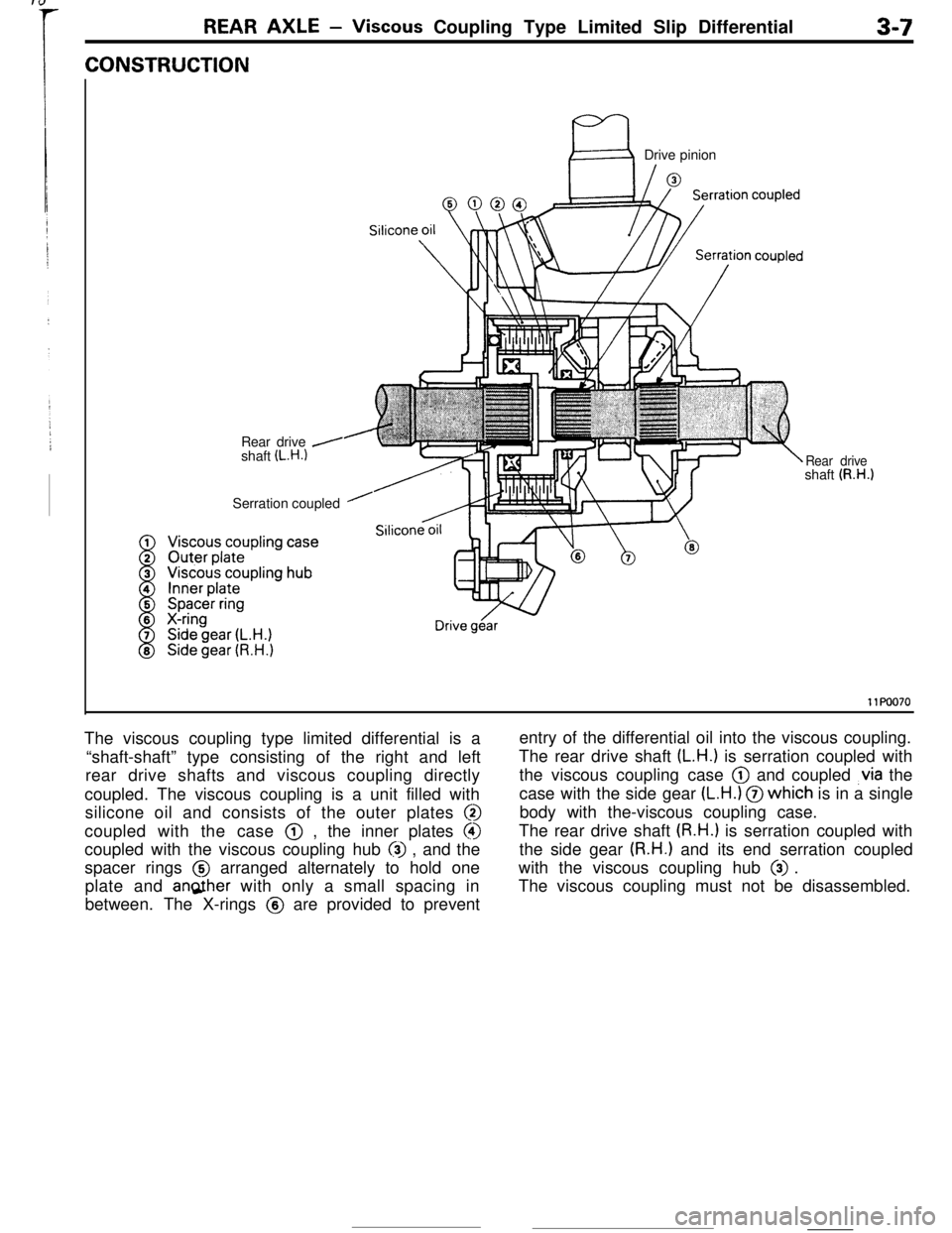
REAR AXLE -Viscous Coupling Type Limited Slip Differential3-7CONSTRUCTION
Rear drive
/shaft (L.H.)Serration coupled
ElDrive pinion
Rear driveshaft (R.H.1
11Po070The viscous coupling type limited differential is a
“shaft-shaft” type consisting of the right and left
rear drive shafts and viscous coupling directly
coupled. The viscous coupling is a unit filled with
silicone oil and consists of the outer plates @
coupled with the case @ , the inner plates @
coupled with the viscous coupling hub
(j) , and the
spacer rings @ arranged alternately to hold one
plate and angther with only a small spacing in
between. The X-rings @ are provided to prevententry of the differential oil into the viscous coupling.
The rear drive shaft
(L.H.) is serration coupled with
the viscous coupling case @ and coupled
,via the
case with the side gear
(L.H.) @which is in a single
body with the-viscous coupling case.
The rear drive shaft
(R.H.) is serration coupled with
the side gear
(R.H.) and its end serration coupled
with the viscous coupling hub
0) .
The viscous coupling must not be disassembled.
Page 35 of 391
w
3-8REAR AXLE - Viscous Coupling Type Limited Slip Differential
OPERATIONDrive force smaller
I(Slipping side)Drive force larger(Grippina side)
Rear drive shaft
(L.H.1 (Left wheel)
resistance smaller)Rear drive shaft
(R.H.1 (Right wheel)
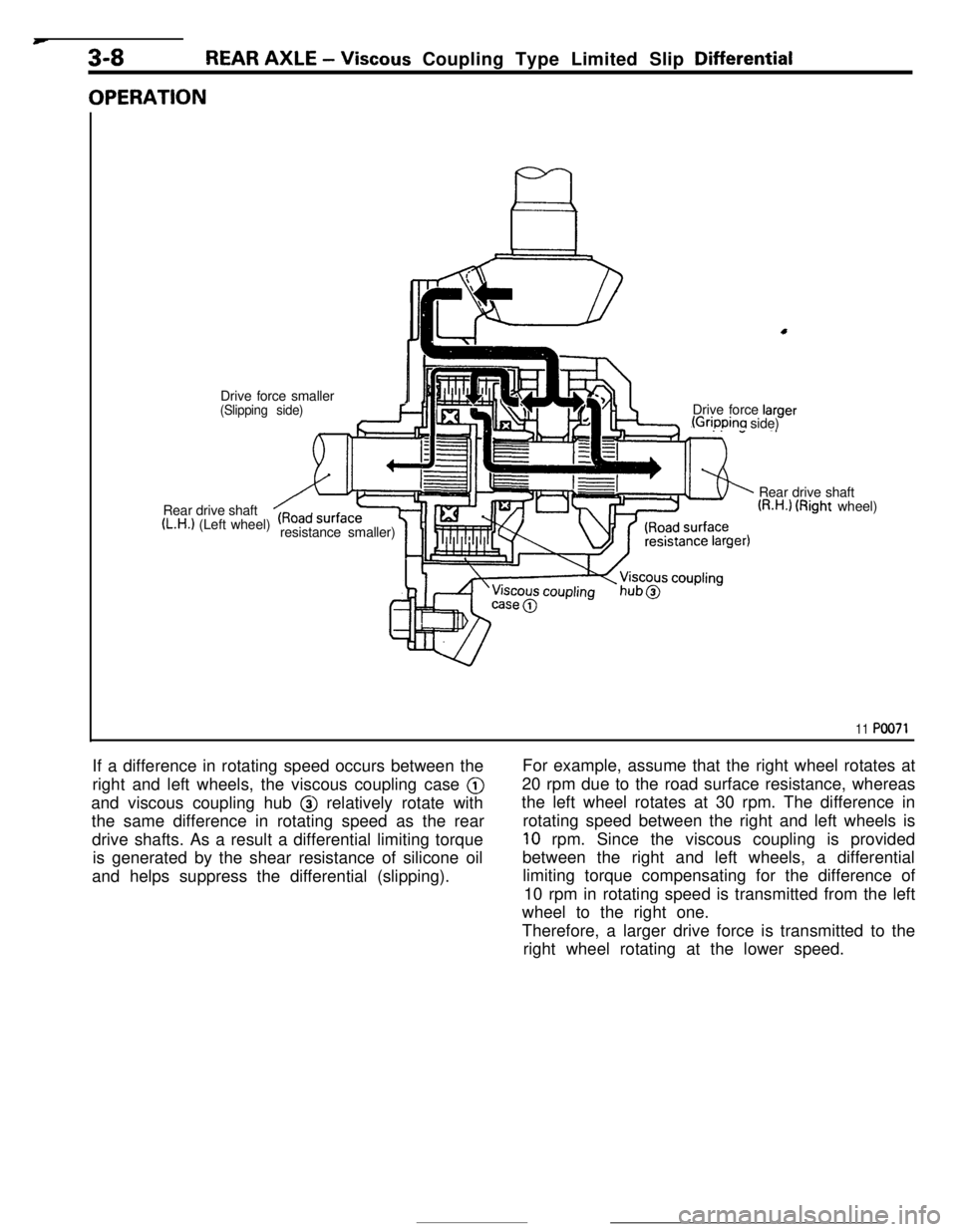
11 PO071If a difference in rotating speed occurs between the
right and left wheels, the viscous coupling case @
and viscous coupling hub @ relatively rotate with
the same difference in rotating speed as the rear
drive shafts. As a result a differential limiting torque
is generated by the shear resistance of silicone oil
and helps suppress the differential (slipping).For example, assume that the right wheel rotates at
20 rpm due to the road surface resistance, whereas
the left wheel rotates at 30 rpm. The difference in
rotating speed between the right and left wheels is
10 rpm. Since the viscous coupling is provided
between the right and left wheels, a differential
limiting torque compensating for the difference of
10 rpm in rotating speed is transmitted from the left
wheel to the right one.
Therefore, a larger drive force is transmitted to the
right wheel rotating at the lower speed.
Page 46 of 391
-. ..- ,..__ _. I-., . . . . -. . “-Ix.. ...~‘,.;;&;,-*~;
CLUTCH- Clutch Control6-3
-
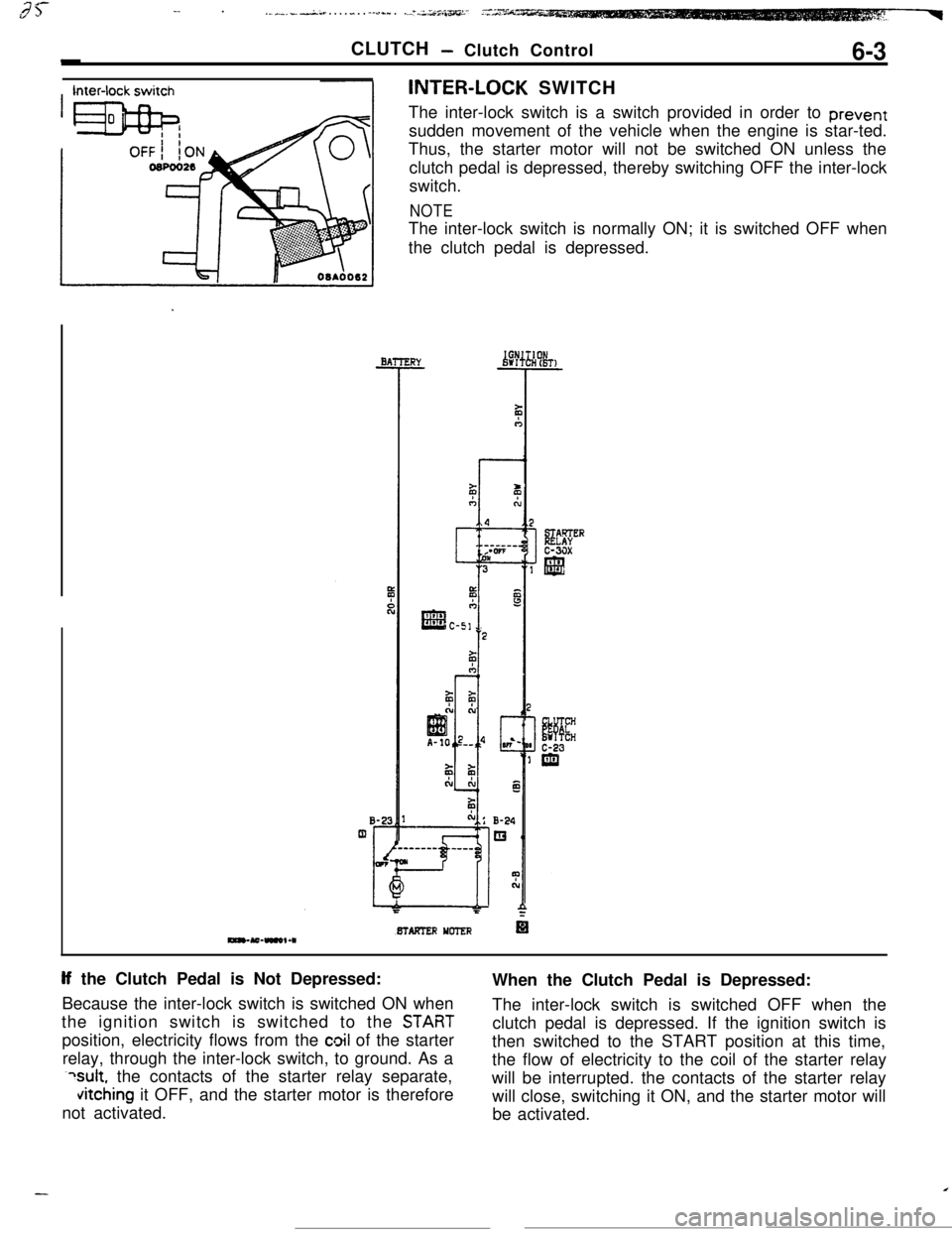
Inter-lock switchINTER-LOCK SWITCH
The inter-lock switch is a switch provided in order to prevent
sudden movement of the vehicle when the engine is star-ted.
BTAFTER YCTER
If the Clutch Pedal is Not Depressed:
Because the inter-lock switch is switched ON when
STABT
position, electricity flows from the cloil of the starter
relay, through the inter-lock switch, to ground. As a
?sult, the contacts of the starter relay separate,
vitching it OFF, and the starter motor is therefore
not activated.
Page 77 of 391
IGNITION SYSTEMELECTRICAL - Engine Electrical8-25
I
Sensors
Engine control unitlgnltlon switch
Battery
11 IPower transfstor
hhP 1
Ilgnltion coil
C To tachometerTerminal for engine
speed detectton
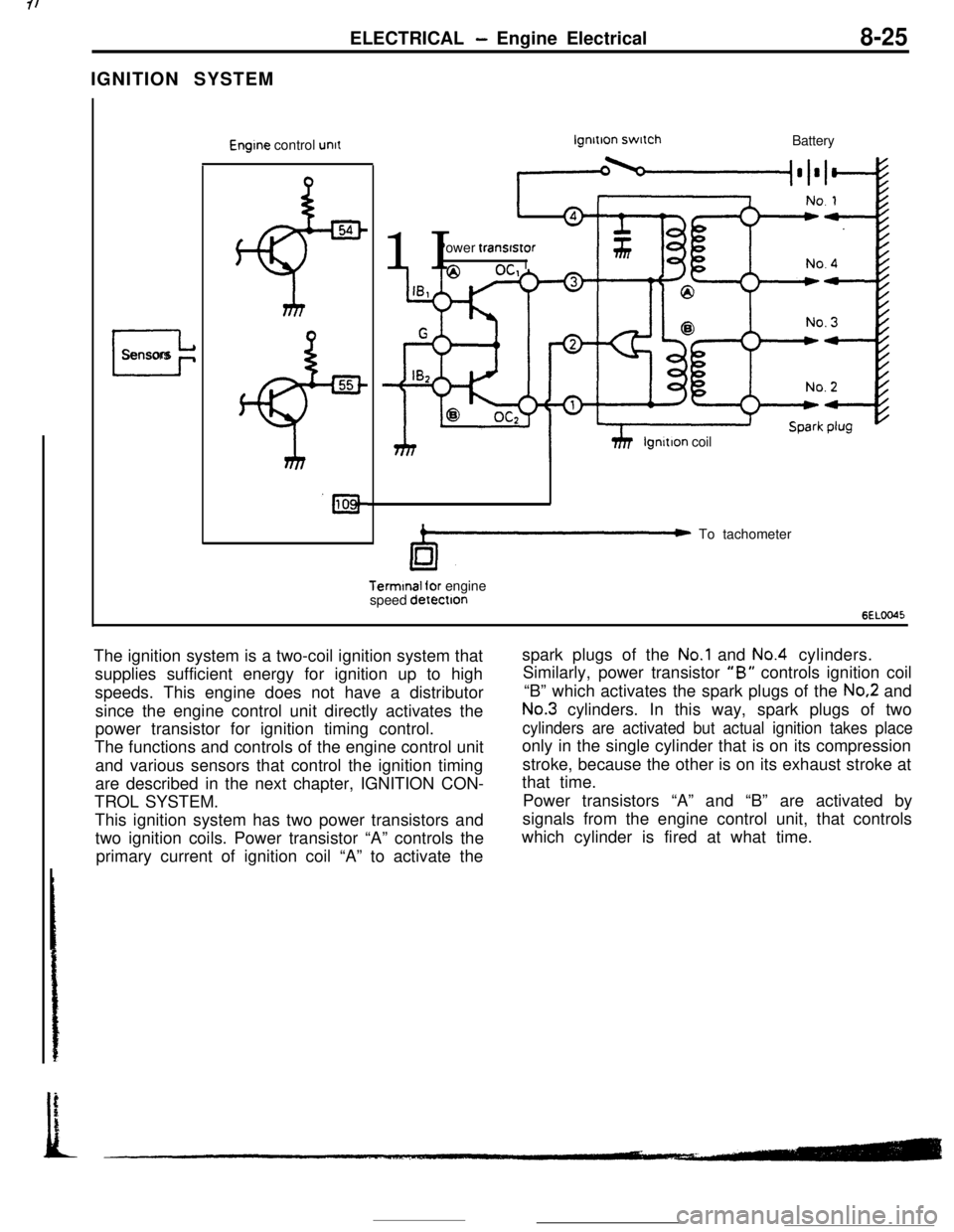
6ELOO45The ignition system is a two-coil ignition system that
supplies sufficient energy for ignition up to high
speeds. This engine does not have a distributor
since the engine control unit directly activates the
power transistor for ignition timing control.
The functions and controls of the engine control unit
and various sensors that control the ignition timing
are described in the next chapter, IGNITION CON-
TROL SYSTEM.
This ignition system has two power transistors and
two ignition coils. Power transistor “A” controls the
primary current of ignition coil “A” to activate thespark plugs of the
No.1 and No.4 cylinders.
Similarly, power transistor
“B” controls ignition coil
“B” which activates the spark plugs of the
No.2 and
No.3 cylinders. In this way, spark plugs of two
cylinders are activated but actual ignition takes placeonly in the single cylinder that is on its compression
stroke, because the other is on its exhaust stroke at
that time.
Power transistors “A” and “B” are activated by
signals from the engine control unit, that controls
which cylinder is fired at what time.
Page 78 of 391
8-26ELECTRICAL - Engine Electrical
No.:
4Signal unit for
, tachometer
71
x
No. 3
6EL0025
Capa &orCylinderNo. mark
6EL0057
To No. 1spark plug
To No. 4
spark plug
To No. 3spark plug
To No. 2spark plug
6EL005t
OC,IB, G
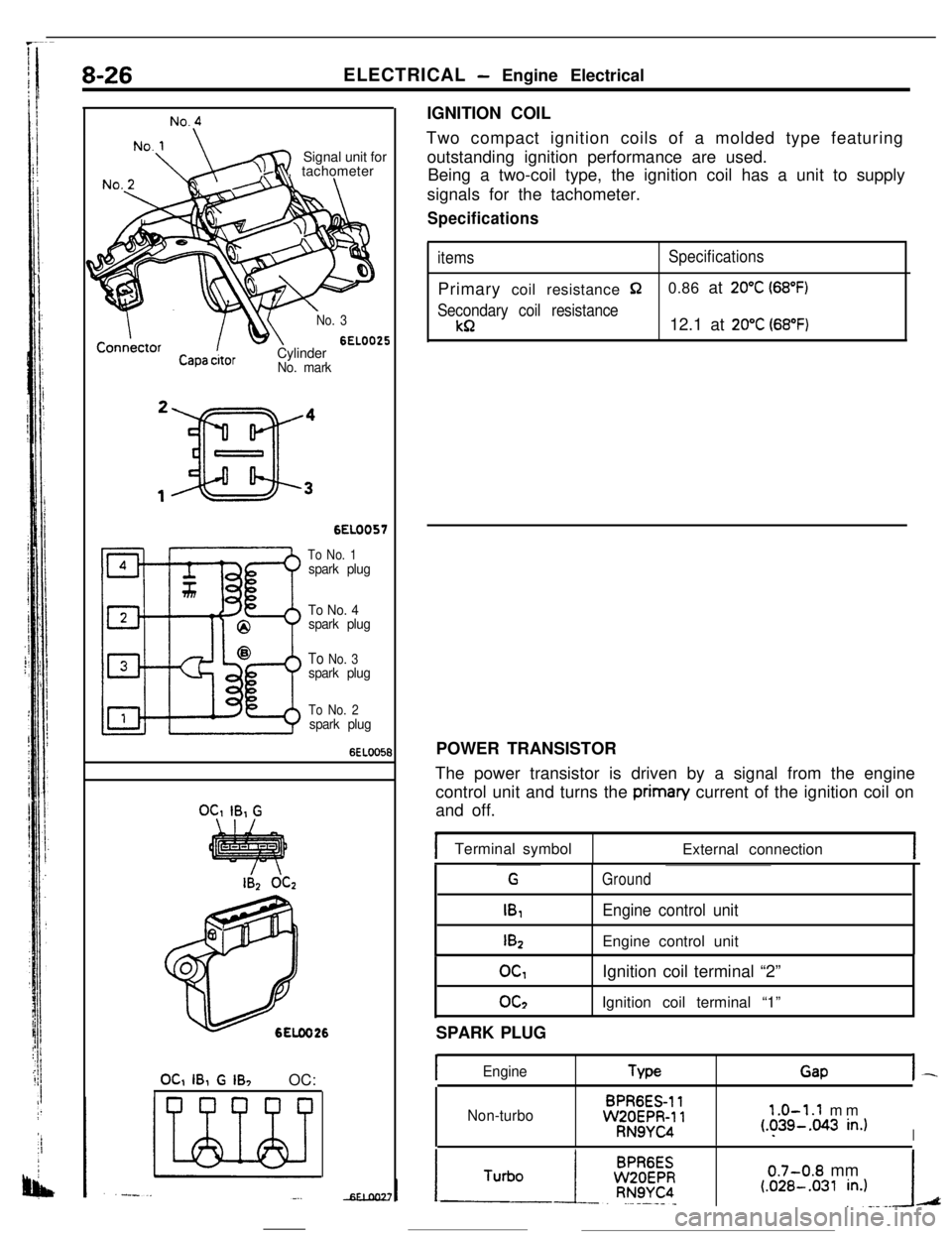
OC, IB, G IB, OC:IGNITION COIL
Two compact ignition coils of a molded type featuring
outstanding ignition performance are used.
Being a two-coil type, the ignition coil has a unit to supply
signals for the tachometer.
Specifications
itemsSpecificationsPrimary coil resistance
$20.86 at 20°C (68°F)
Secondary coil resistance
kR12.1 at 20°C (68°F)POWER TRANSISTOR
The power transistor is driven by a signal from the engine
control unit and turns the priman/ current of the ignition coil on
and off.
Terminal symbol
External connection
G
IB,
I&
Ground
Engine control unitEngine control unit
OGoc2Ignition coil terminal “2”
Ignition coil terminal “1”
SPARK PLUG
IEngineTypeGapI-
Non-turboBPR6ES-11WZOEPR-11RN9YC4
1.0-1.1 mm(.?39-.043 in.)I
0.7-0.8 mm(.OZB-.031 in.)A
Page 79 of 391
-----. _-- ___ELECTRICAL
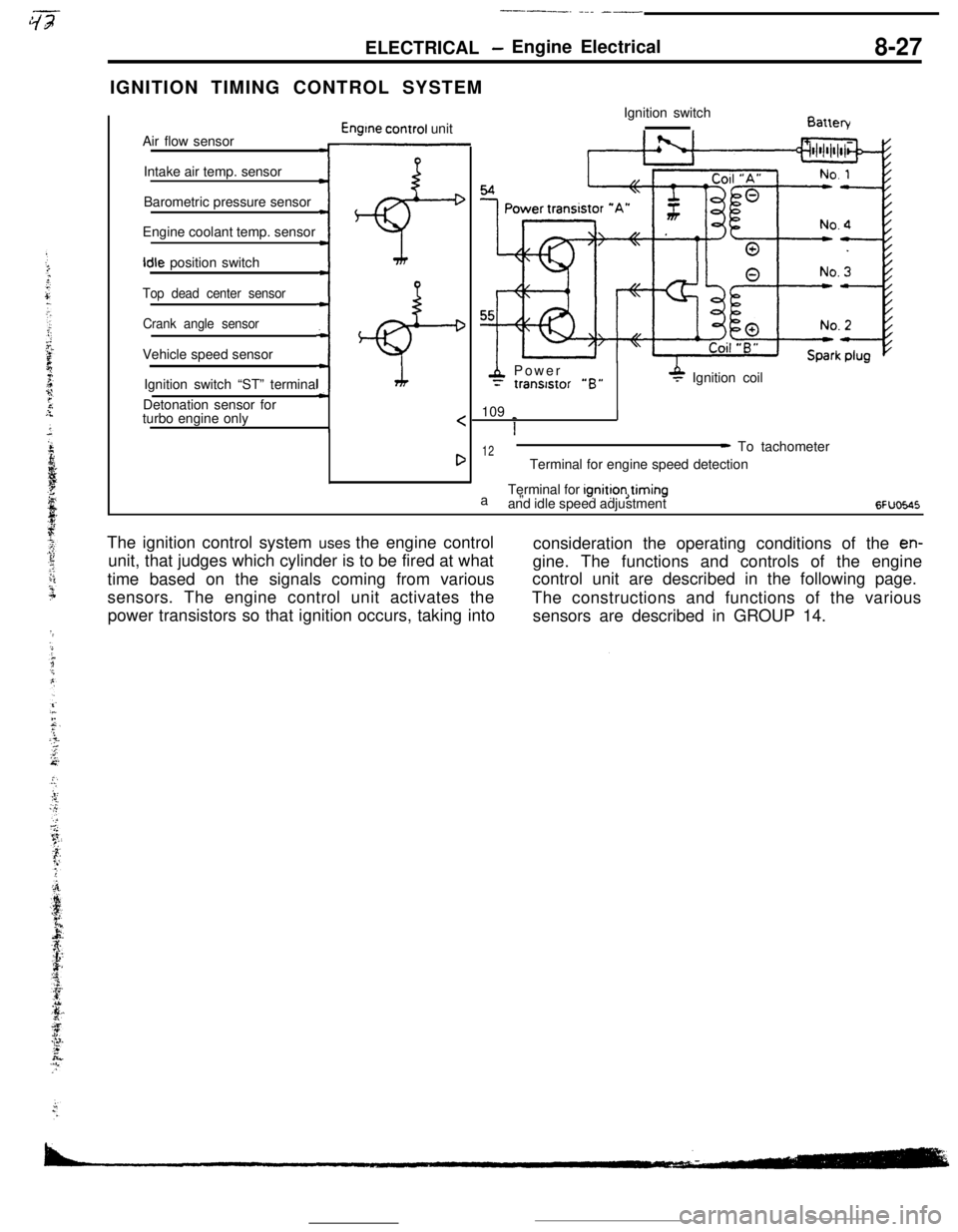
- Engine Electrical8-27IGNITION TIMING CONTROL SYSTEM
Air flow sensor
Engtne control unit
Intake air temp. sensor
Barometric pressure sensor
Engine coolant temp. sensorIdle position switch
:+
Top dead center sensor
Crank angle sensorVehicle speed sensor
;+Ignition switch “ST” terminal
Detonation sensor for
turbo engine only
4 Power= tranststor “B”P Ignition coil
109
_
I
1
12a”- To tachometer
Terminal for engine speed detection
Terminal for ignition,timing
and idle speed adjustment
6FUoE.45The ignition control system uses the engine control
consideration the operating conditions of the
en-unit, that judges which cylinder is to be fired at what
gine. The functions and controls of the engine
time based on the signals coming from variouscontrol unit are described in the following page.
sensors. The engine control unit activates the
The constructions and functions of the various
power transistors so that ignition occurs, taking into
sensors are described in GROUP 14.
Page 80 of 391
8-28ELECTRICAL- Engine Electrical
IGNITION TIMING CONTROL
Reading of Input signallgnitlon power
distribution control
(selection of power
transistor actlvatlon)Control mode
I II II IControl mode
dectsion data
Basic energlzatlon
I’
Engine control unitPower
Powertranststor “A”tranststor “B”
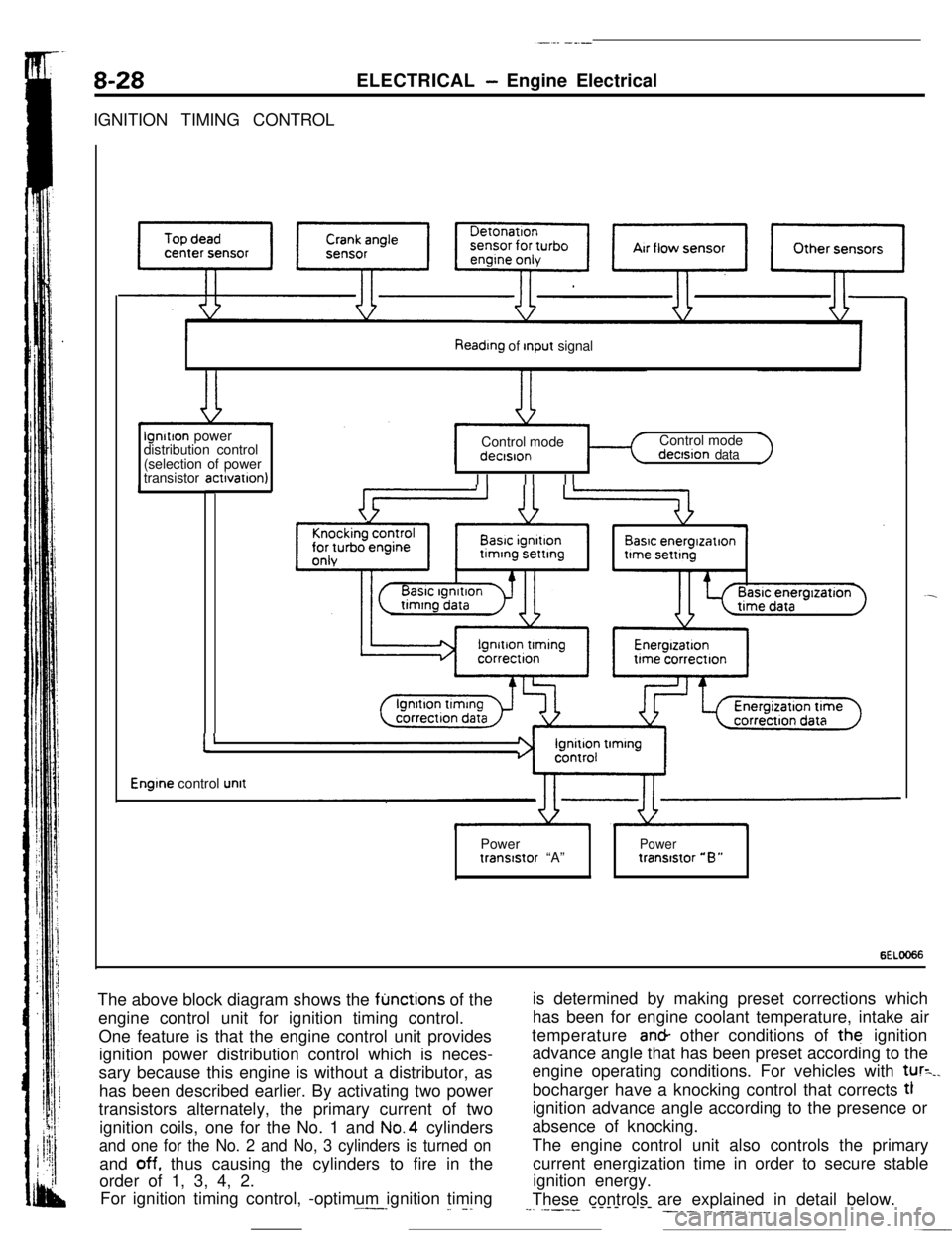
6ELOO66The above block diagram shows the
fljnctions of the
engine control unit for ignition timing control.
One feature is that the engine control unit provides
ignition power distribution control which is neces-
sary because this engine is without a distributor, as
has been described earlier. By activating two power
transistors alternately, the primary current of two
ignition coils, one for the No. 1 and No.4 cylinders
and one for the No. 2 and No, 3 cylinders is turned onand
off. thus causing the cylinders to fire in the
order of 1, 3, 4, 2.
For ignition timing control, -optimum ignition timing.^--_
_. -.is determined by making preset corrections which
has been for engine coolant temperature, intake air
temperature an& other conditions of the ignition
advance angle that has been preset according to the
engine operating conditions. For vehicles with
tur=_.bocharger have a knocking control that corrects tl
ignition advance angle according to the presence or
absence of knocking.
The engine control unit also controls the primary
current energization time in order to secure stable
ignition energy.
These controls are explained in detail below.
--. .----- ---- --- ___. .-. ___.,.__
Page 82 of 391
8-30ELECTRICAL - Engine Electrical
Ignition Advance Angle Control
While
cranking
Fixed angle(5”BTD.C)Engme coolantBarometnc‘-Intake air 1temperaturepressuretemperaturesensorsensor, sensor
Dunng normal operatlon4i+
Advance angle map valueEngine
coolantBarometricIntake airaccording to engine speed4and intake air volumetemperature- pressure__c temperature 4
correctioncorrectloncorrectton
Durtng ignition tlmmg adjustment
Fixed angle(5”BTDC)
c
=ower transistor
-$To ignition
coil
s
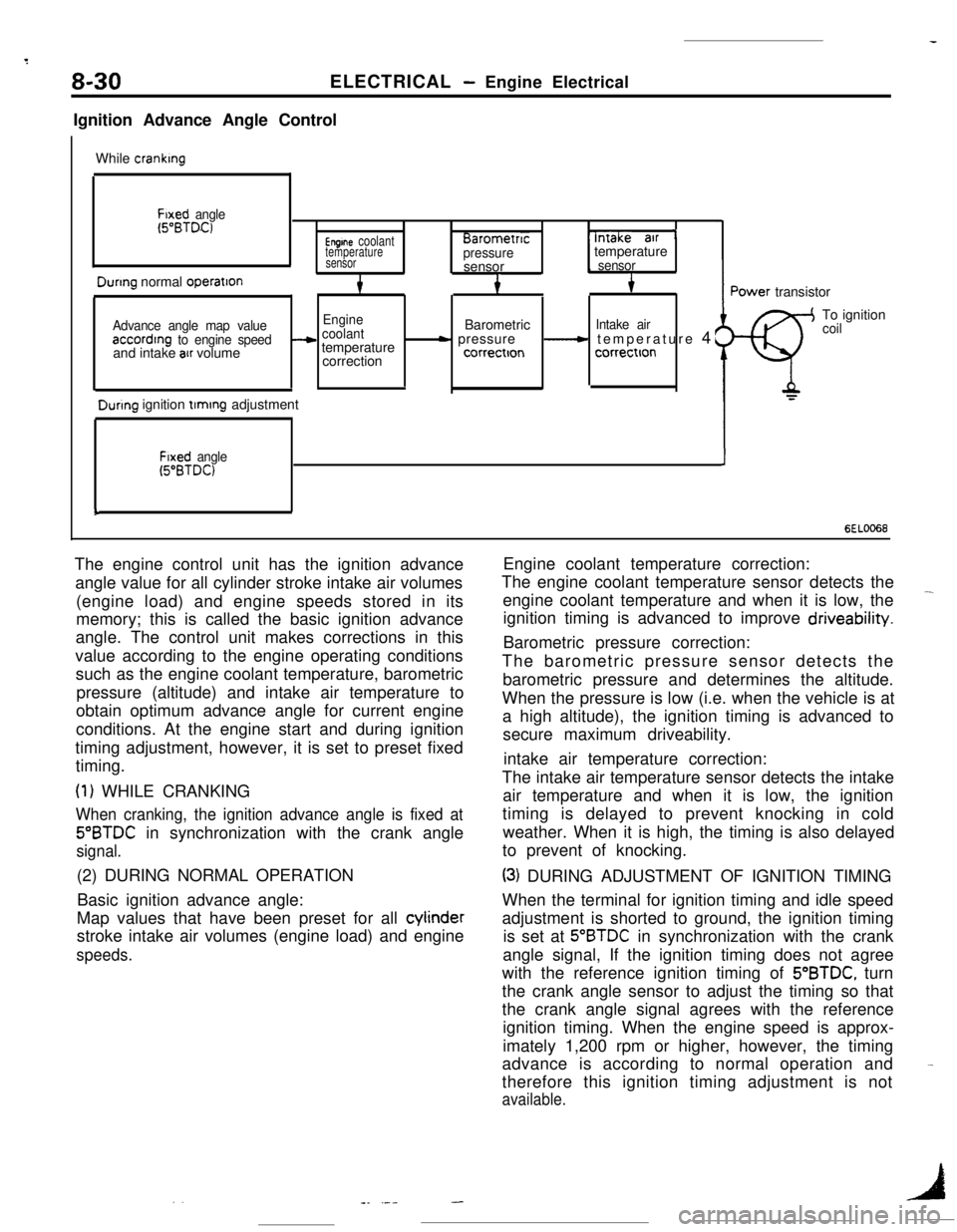
6EL0066The engine control unit has the ignition advance
angle value for all cylinder stroke intake air volumes
(engine load) and engine speeds stored in its
memory; this is called the basic ignition advance
angle. The control unit makes corrections in this
value according to the engine operating conditions
such as the engine coolant temperature, barometric
pressure (altitude) and intake air temperature to
obtain optimum advance angle for current engine
conditions. At the engine start and during ignition
timing adjustment, however, it is set to preset fixed
timing.
(1) WHILE CRANKING
When cranking, the ignition advance angle is fixed at
5”BTDC in synchronization with the crank angle
signal.(2) DURING NORMAL OPERATION
Basic ignition advance angle:
Map values that have been preset for all cylinder
stroke intake air volumes (engine load) and engine
speeds.Engine coolant temperature correction:
The engine coolant temperature sensor detects the
engine coolant temperature and when it is low, the
-ignition timing is advanced to improve driveability.
Barometric pressure correction:
The barometric pressure sensor detects the
barometric pressure and determines the altitude.
When the pressure is low (i.e. when the vehicle is at
a high altitude), the ignition timing is advanced to
secure maximum driveability.
intake air temperature correction:
The intake air temperature sensor detects the intake
air temperature and when it is low, the ignition
timing is delayed to prevent knocking in cold
weather. When it is high, the timing is also delayed
to prevent of knocking.
(3) DURING ADJUSTMENT OF IGNITION TIMING
When the terminal for ignition timing and idle speed
adjustment is shorted to ground, the ignition timing
is set at
5”BTDC in synchronization with the crank
angle signal, If the ignition timing does not agree
with the reference ignition timing of 5’BTDC, turn
the crank angle sensor to adjust the timing so that
the crank angle signal agrees with the reference
ignition timing. When the engine speed is approx-
imately 1,200 rpm or higher, however, the timing
advance is according to normal operation and
therefore this ignition timing adjustment is not
available.
-
. .1-_ .---
Page 83 of 391
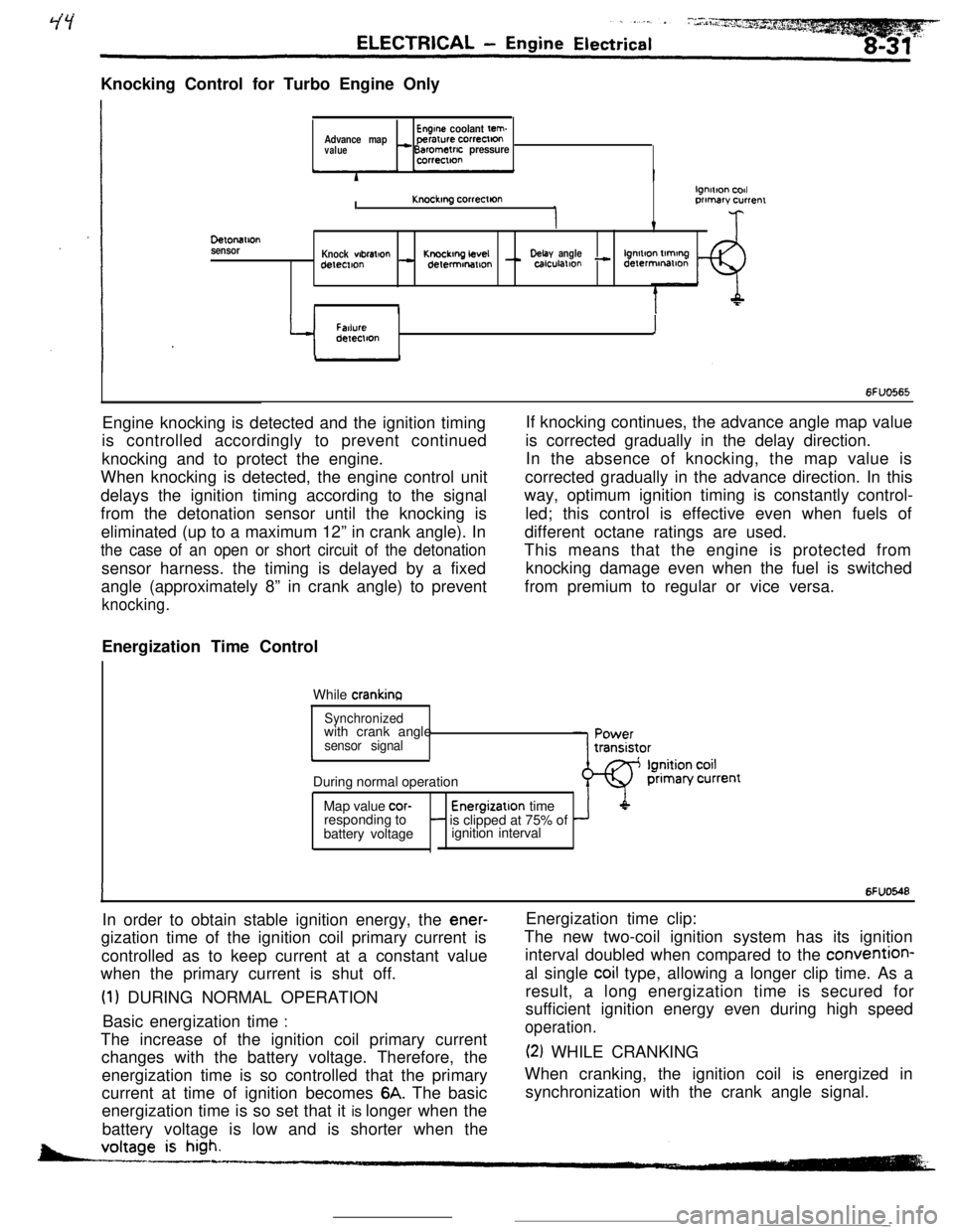
Knocking Control for Turbo Engine OnlyEngine coolant tern.Advance mapperarure correctton
value- Barometric pressurecorrectton
DelonaIlon
sensorI
lgnmon codKnockmg correcllonprimary currenr
v
Knock wbral+onKnockmg LevelDelay anglelgnmon tlmtngdetemon- delermonmon - calculallon - derermmatlon
II
Y
FatlureIdeIeclton
6FUO565Engine knocking is detected and the ignition timing
is controlled accordingly to prevent continued
knocking and to protect the engine.
When knocking is detected, the engine control unit
delays the ignition timing according to the signal
from the detonation sensor until the knocking is
eliminated (up to a maximum 12” in crank angle). In
the case of an open or short circuit of the detonationsensor harness. the timing is delayed by a fixed
angle (approximately 8” in crank angle) to prevent
knocking.Energization Time Control
While
crankinaIf knocking continues, the advance angle map value
is corrected gradually in the delay direction.
In the absence of knocking, the map value is
corrected gradually in the advance direction. In this
way, optimum ignition timing is constantly control-
led; this control is effective even when fuels of
different octane ratings are used.
This means that the engine is protected from
knocking damage even when the fuel is switched
from premium to regular or vice versa.
Synchronizedwith crank angle
sensor signalcDuring normal operation
Map value
cor-Energizatlon time
responding to- is clipped at 75% of
battery voltageignition interval
IIn order to obtain stable ignition energy, the
ener-gization time of the ignition coil primary current is
controlled as to keep current at a constant value
when the primary current is shut off.
(1) DURING NORMAL OPERATION
Basic energization time
:The increase of the ignition coil primary current
changes with the battery voltage. Therefore, the
energization time is so controlled that the primary
current at time of ignition becomes
6A. The basic
energization time is so set that it is longer when the
battery voltage is low and is shorter when the
6FUO548Energization time clip:
The new two-coil ignition system has its ignition
interval doubled when compared to the convention-
al single
coil type, allowing a longer clip time. As a
result, a long energization time is secured for
sufficient ignition energy even during high speed
operation.
(2) WHILE CRANKING
When cranking, the ignition coil is energized in
synchronization with the crank angle signal.
-
Page 87 of 391
=--Y
jl
1 /
i "
_. ---“._ _ _ ._ ..-..+_LI_y_--- -
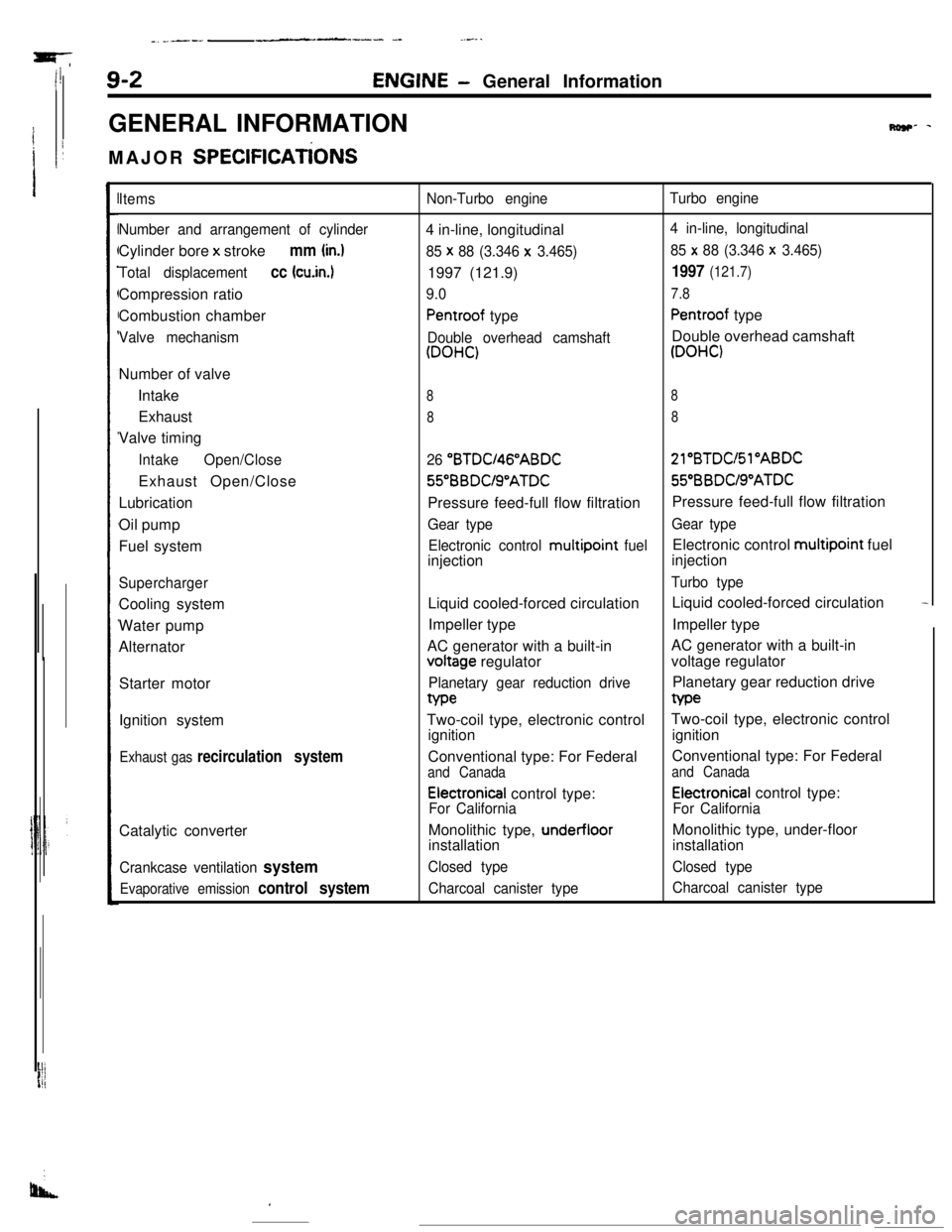
9-2ENGINE- General Information
GENERAL INFORMATION
MAJOR
SPEClFlCATiONS
Row- -
Items
Number and arrangement of cylinderCylinder bore x stroke
mm (in.)
Total displacementcc (cu.in.1Compression ratio
Combustion chamber
Valve mechanismNumber of valve
Intake
Exhaust
Valve timing
IntakeOpen/CloseExhaust Open/Close
Lubrication
Oil pump
Fuel system
SuperchargerCooling system
Water pump
Alternator
Starter motor
Ignition system
Exhaust gas recirculation systemCatalytic converter
Crankcase ventilation system
Evaporative emission control system
Non-Turbo engineTurbo engine4 in-line, longitudinal
4 in-line, longitudinal
85 x
88 (3.346 x 3.465)85 x 88 (3.346 x 3.465)1997 (121.9)
1997 (121.7)
9.07.8
Pentroof typePentroof type
Double overhead camshaftDouble overhead camshaft
(DOHC)(DOHC)
88
88
26 “BTDU46”ABDC21”BTDC/Sl”ABDC56BBDUS”ATDC55”BBDUS”ATDC
Pressure feed-full flow filtrationPressure feed-full flow filtration
Gear typeGear type
Electronic control multipoint
fuelElectronic control multipoint fuel
injectioninjection
Turbo typeLiquid cooled-forced circulationLiquid cooled-forced circulation
-Impeller typeImpeller type
AC generator with a built-involtage regulatorAC generator with a built-in
voltage regulator
Planetary gear reduction drivePlanetary gear reduction drivetype
Two-coil type, electronic controlTwo-coil type, electronic control
ignitionignition
Conventional type: For FederalConventional type: For Federal
and Canadaand Canada
Electronical control type:Electronical control type:
For CaliforniaFor CaliforniaMonolithic type,
under-floorMonolithic type, under-floor
installationinstallation
Closed typeClosed type
Charcoal canister typeCharcoal canister type
I