oil MITSUBISHI ECLIPSE 1990 Service Manual
[x] Cancel search | Manufacturer: MITSUBISHI, Model Year: 1990, Model line: ECLIPSE, Model: MITSUBISHI ECLIPSE 1990Pages: 391, PDF Size: 15.27 MB
Page 8 of 391
o-4GENERAL - Technical Features
BASIC CONSTRUCTION
The 4WD vehicles are equipped with
2.OL DOHC
16-valve turbocharged engine and incorporate new
technologies such as full time 4WD of center
differential type with viscous coupling differential
limiting for excellent running stability and excellent
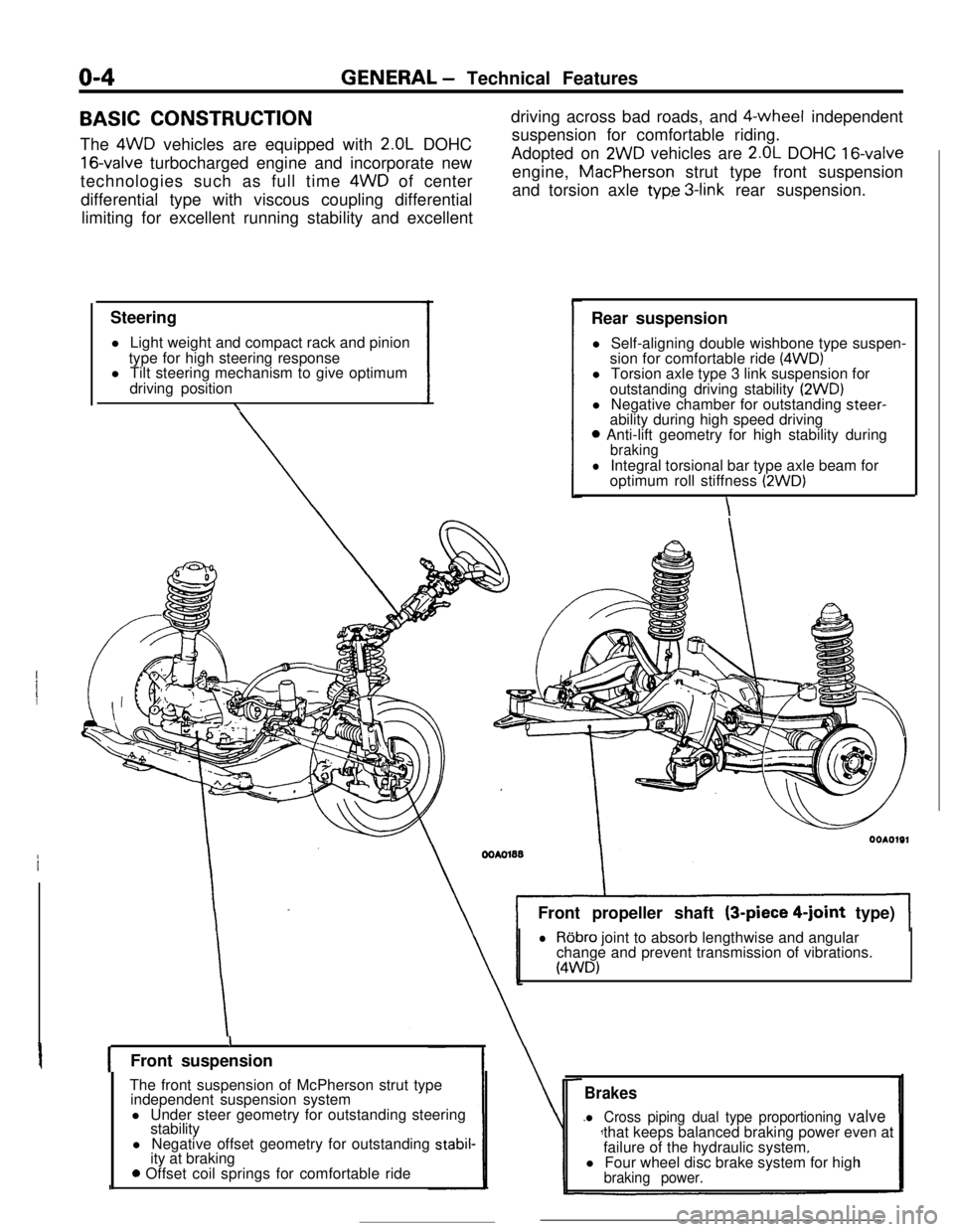
Steering
l Light weight and compact rack and pinion
type for high steering response
l Tilt steering mechanism to give optimum
driving position
\driving across bad roads, and $-wheel independent
suspension for comfortable riding.
Adopted on
2WD vehicles are 2.OL DOHC 16-valveengine, MacPherson strut type front suspension
and torsion axle
typ.e 3-link rear suspension.
Rear suspension
l Self-aligning double wishbone type suspen-
sion for comfortable ride
(4WD)l Torsion axle type 3 link suspension for
outstanding driving stability
(2WD)l Negative chamber for outstanding steer-
ability during high speed driving
0 Anti-lift geometry for high stability duringbraking
lIntegral torsional bar type axle beam for
optimum roll stiffness (2WD)
\Front propeller shaft (3-piece
4-joint type)
lRobro joint to absorb lengthwise and angular
change and prevent transmission of vibrations.
(4WD)
IFront suspension
The front suspension of McPherson strut type
independent suspension system
l Under steer geometry for outstanding steering
stability
l Negative offset geometry for outstanding
stabil-ity at braking
0 Offset coil springs for comfortable ride
Brakes
l Cross piping dual type proportioning valvethat keeps balanced braking power even at
failure of the hydraulic system.
l Four wheel disc brake system for high
braking power.
Page 9 of 391
GENERAL - Technical Featureso-5ENGINE
The engines are the transverse-mounted engine
especially for front-engine/front-wheeldrive orfront-engine/4-wheel drive models, the
2.OL DOHC
16-valve engine with high-performance, silent-
operation,low-vibration,low-noise,low-fuel-
consumption features, an engine that fully displays
the most
up-todate engine technology.
SPECIFICATIONS
Engine model
Displacement
cc (cu.in.1
h$xo$put (SAE net)Max. torque (SAE net)
ft.Ibs./rpm
4G63Non-Turbo1997(122)135/6000125/5000
4663Turbo1997(122)195/6000203/3000
FEATURESHigh performance and low fuel consumption
l The rocker arm reduces the valve-actuation torque as well as fuel consumption.
l Air-intake efficiency improved through the adoption of the optimum air-intake system layout.
l Improved response and fuel consumption has been achieved by electronic control multipoint
fuel injection.
l Water-cooled turbocharger.
Quiet operation
l Noise and vibration have been decreased by the adoption of roller rocker arms.
l Noise generated by the valve mechanism has been decreased by the hydraulic auto lash adjusters.
l Vibrations have been decreased by the adoption of bearing caps with beams which increase the
rigidity of the crankshaft support points.
-Serviceability
l Complete self-diagnosis functions.
l Enhanced reliability through the adoption of gold-plated connector terminals.
l Use of an auto tensioner achieves maintenance-free, automatic adjustment of timing belt
tension.
l Use of the auto lash adjusters achieves maintenance-free, automatic adjustment of valve clearance
.o The 2coil ignition system without a distributor supplies sufficient ignition energy even during
high speed operation.
Page 10 of 391
O-6GENERAL - Technical Features
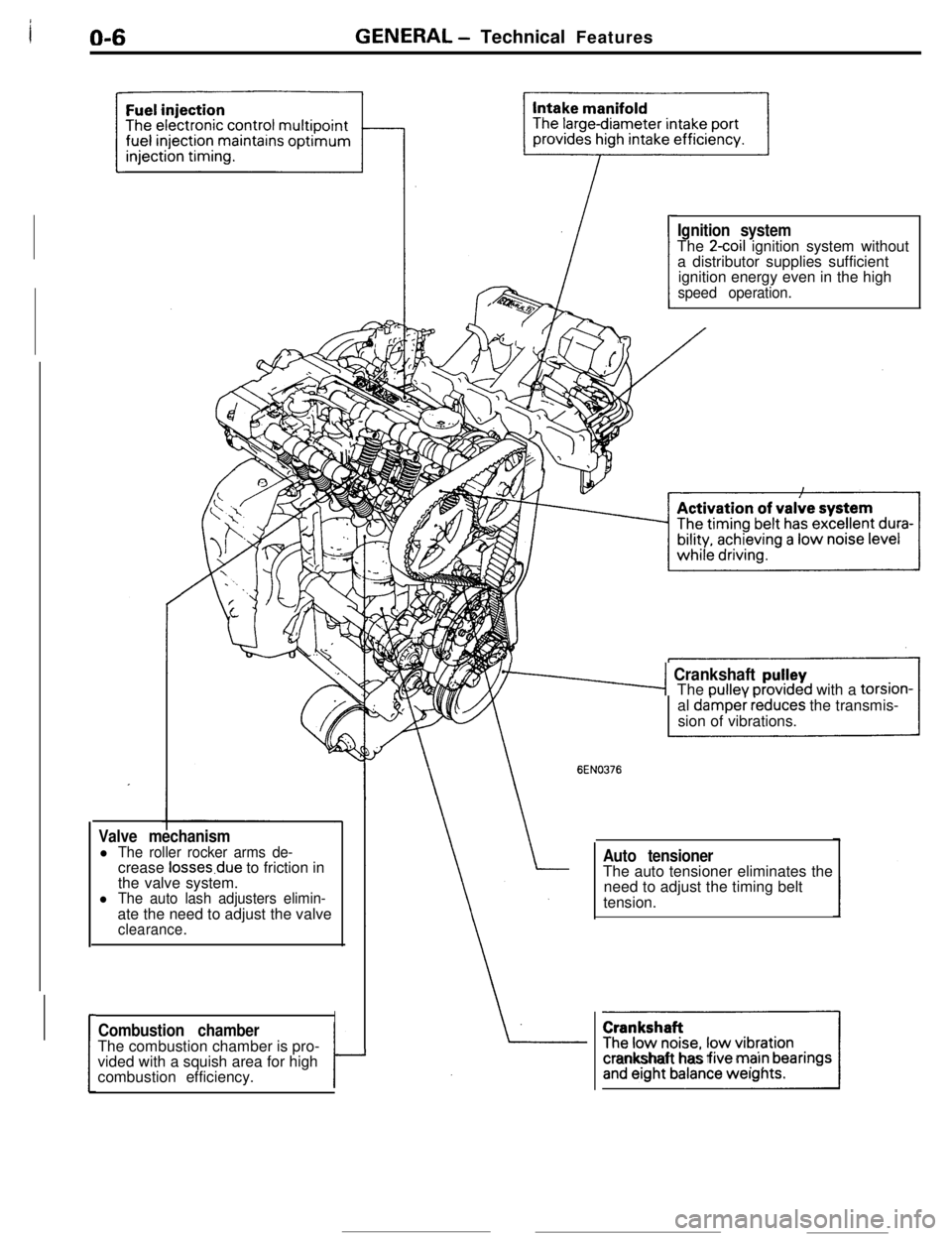
Valve mechanisml The roller rocker arms de-crease losses.due to friction in
the valve system.
l The auto lash adjusters elimin-ate the need to adjust the valve
clearance.
ICombustion chamberThe combustion chamber is pro-
vided with a squish area for high
combustion efficiency.
tJ
Ignition systemThe 2coil ignition system without
a distributor supplies sufficient
ignition energy even in the high
speed operation.
76-4 Crankshaft pu!leyThe oullev orovrded with a torsion-
al
da’mper ieduces the transmis-
sion of vibrations.
EN0376
Auto tensionerThe auto tensioner eliminates the
need to adjust the timing belt
tension.
]Icrankshaft has five marn bearings
Page 20 of 391
2-2
t
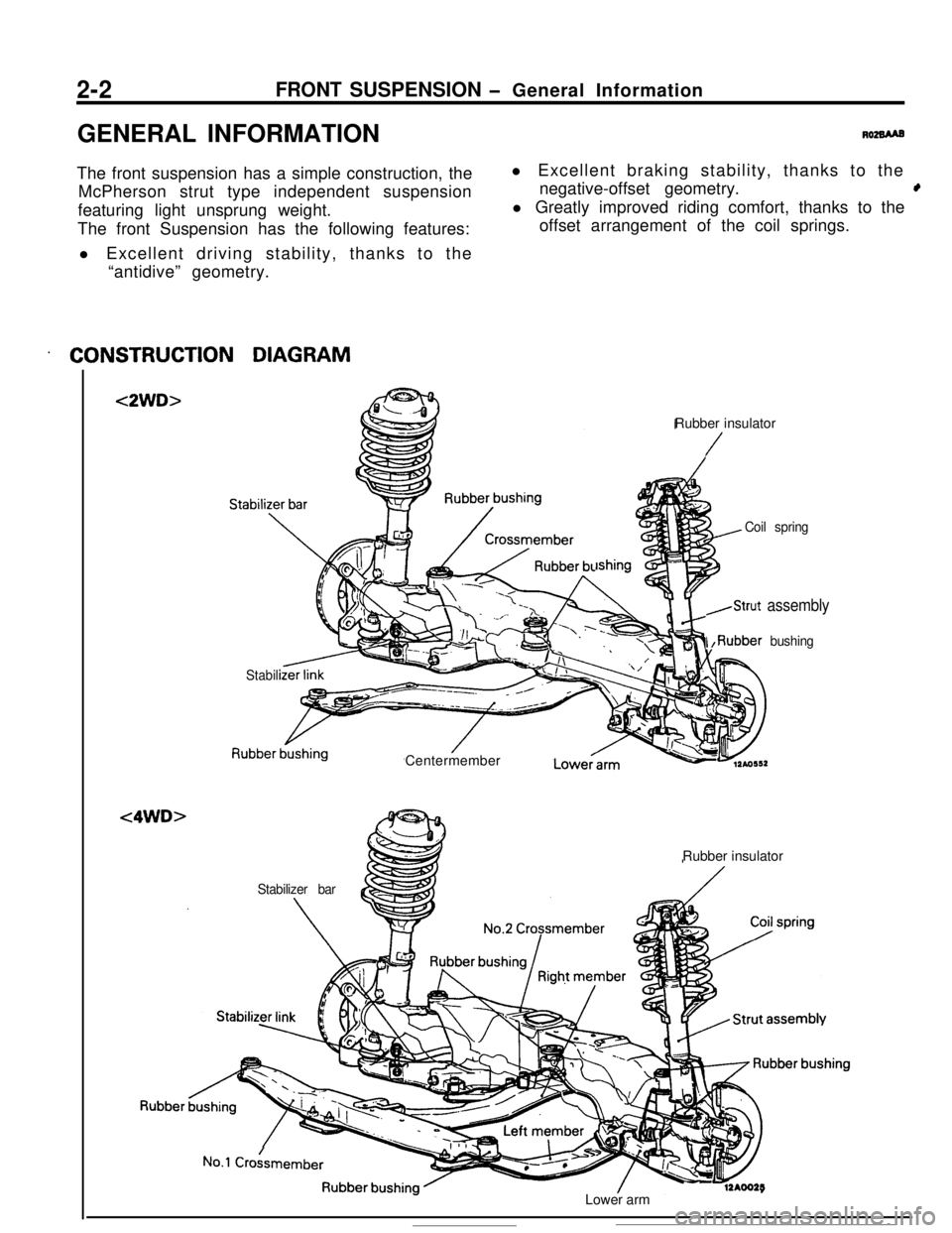
featuring light unsprung weight.
. CONSTRUCTION DIAGRAM
<2WD>
<4WD>
Rubber insulator
/
lshing
Coil spring
,Strut assembly
I ,Rubber bushing
Stabili
Lowecarm
Rubber insulator
No.1 Crokmember
- -12AOO25Lower arm
Page 21 of 391
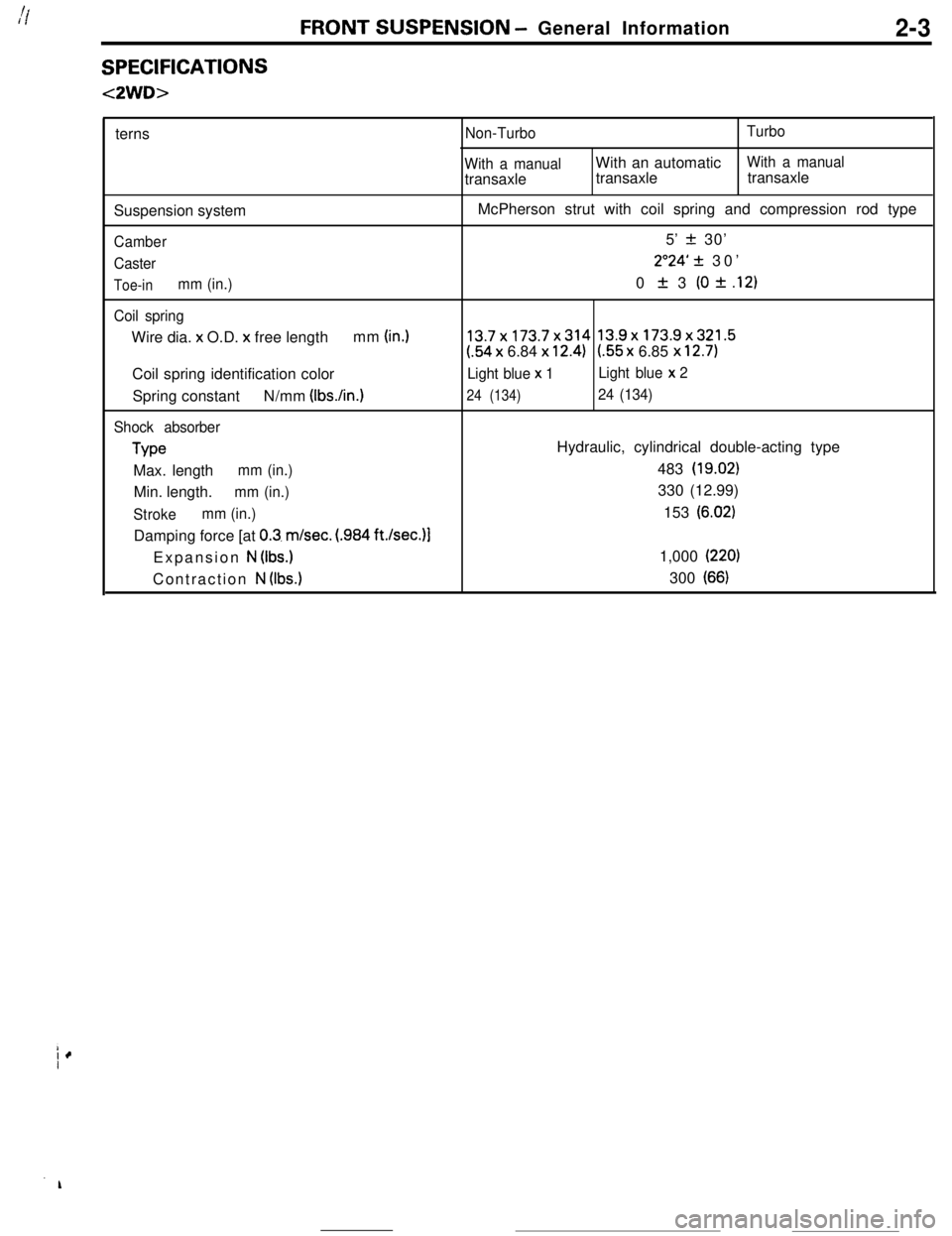
FRONT SUSPENSION - General Information2-3
SPECIFICATIONS
<2WD>terns
Suspension system
Camber
Caster
Toe-inmm (in.)
Coil springWire dia. x O.D.
x free lengthmm (in.)Coil spring identification color
Spring constantN/mm (IbsAn.)
Shock absorber
TypeMax. length
mm (in.)Min. length.
mm (in.)
Strokemm (in.)Damping force [at
0.3. m/set. (.984 ft./sec.)l
Expansion
N (Ibs.)Contraction
N (Ibs.)
Non-TurboTurbo
With a manualWith an automatic
With a manualtransaxletransaxletransaxle
McPherson strut with coil spring and compression rod type
5’
z!z 30’
2”24’ 31 30’
0
It 3 (0 * .12)
13.7x173.7x314 13.9x173.9x321.5
(.54 x 6.84 x 12.4)l.55 x 6.85 x 12.7)
Light blue x 1Light blue x 2
24 (134)24 (134)Hydraulic, cylindrical double-acting type
483
(19.02)330 (12.99)
153
(6.02)1,000
(220)300
(66)
Page 22 of 391
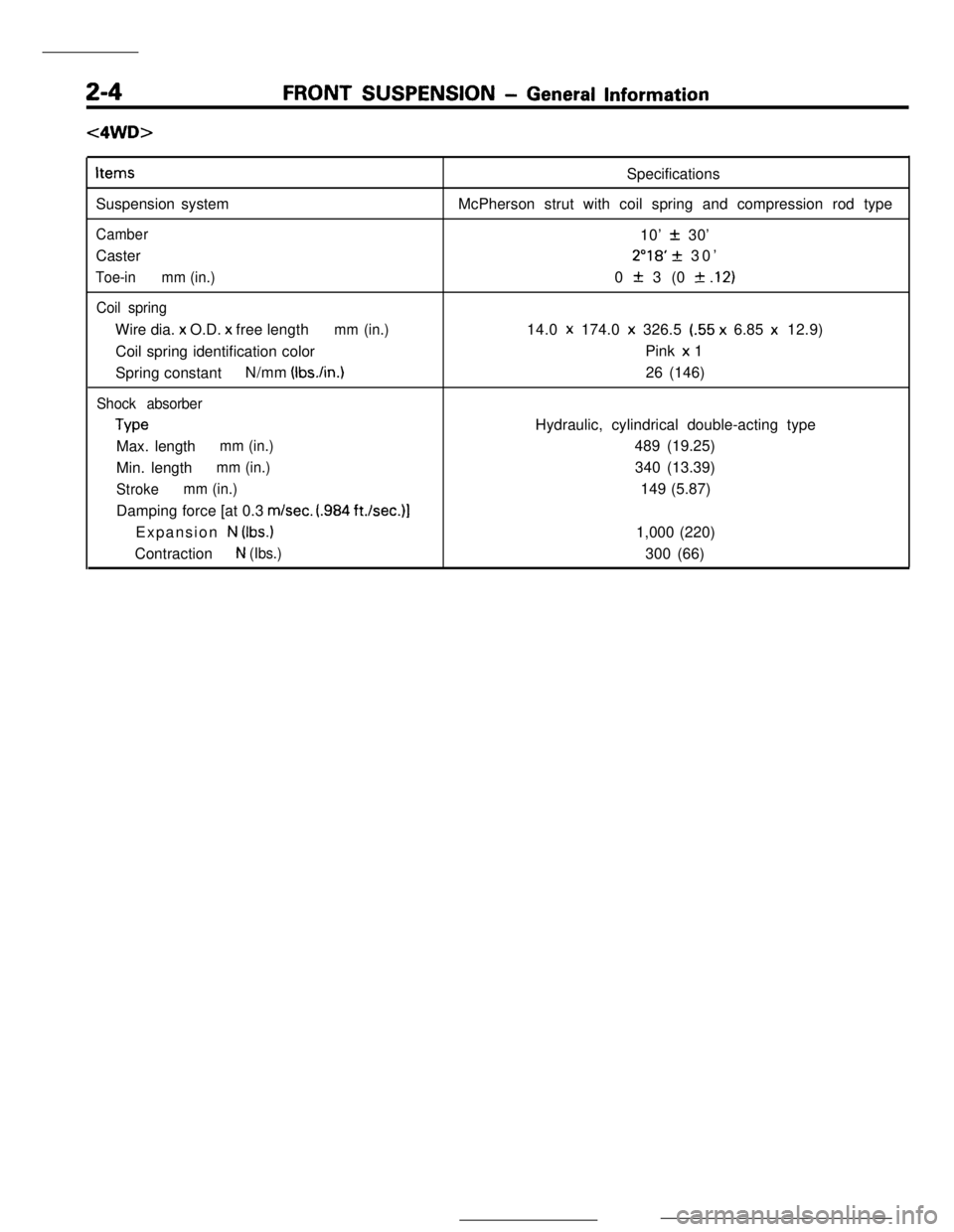
FRONT SUSPENSION - General Information
c4WD>Items
Suspension system
CamberCaster
Toe-inmm (in.)
Coil springWire dia. x O.D. x free length
mm (in.)Coil spring identification color
Spring constantN/mm
(Ibs./in.)
Shock absorber
TypeMax. length
mm (in.)Min. length
mm (in.)
Strokemm (in.)Damping force [at 0.3
m/set. (.984 ft./set.)]Expansion
N (Ibs.)Contraction
N (Ibs.)Specifications
McPherson strut with coil spring and compression rod type
10’
+- 30’
2”18’ + 30’
0
zk 3 (0 f .l2)14.0 x 174.0
x 326.5 (.55 x 6.85 x 12.9)
Pink x 1
26 (146)
Hydraulic, cylindrical double-acting type
489 (19.25)
340 (13.39)
149 (5.87)
1,000 (220)
300 (66)
Page 24 of 391
----2-6
FRONT SUSPENSION - Offset Spring
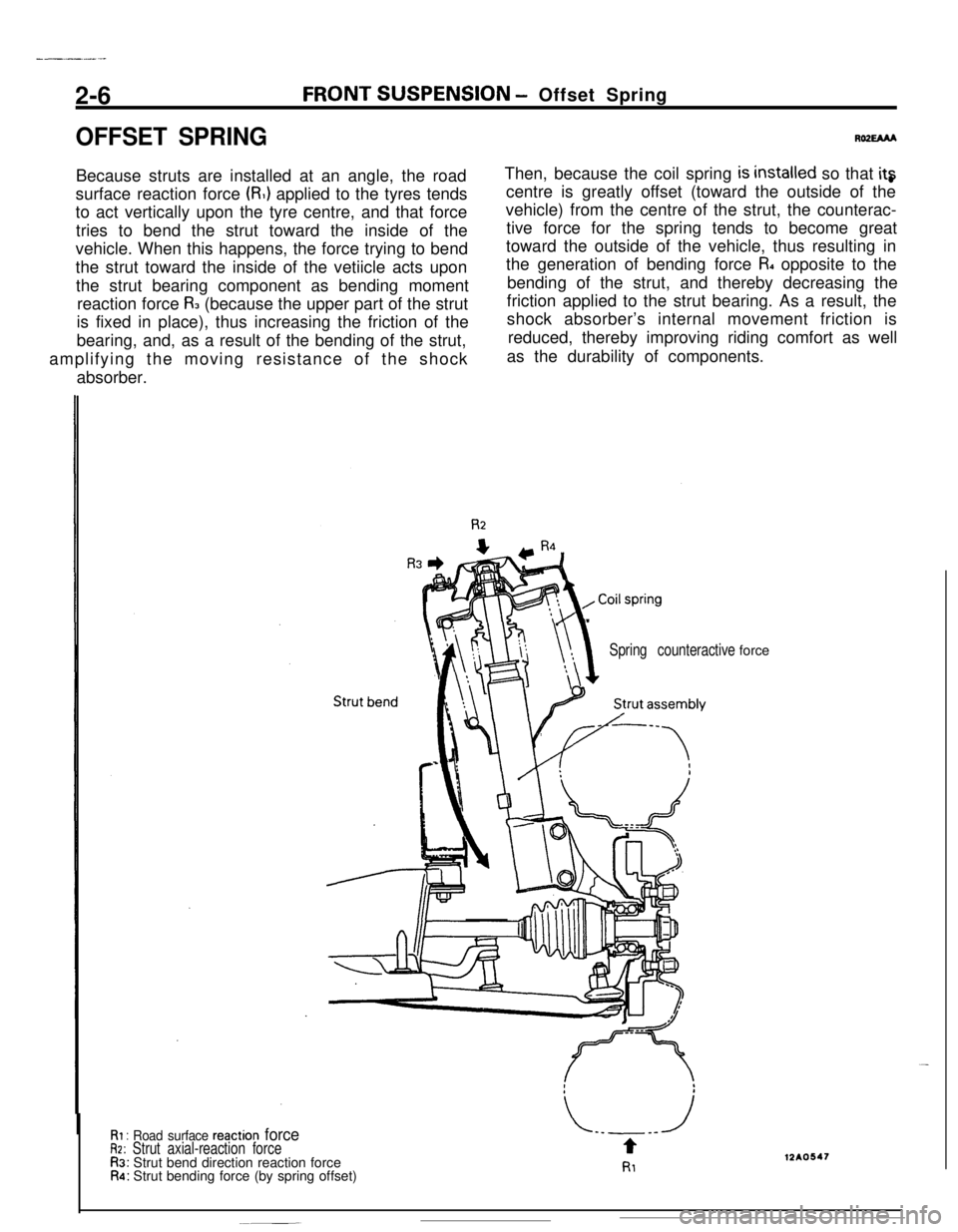
OFFSET SPRINGBecause struts are installed at an angle, the road
surface reaction force
(RI) applied to the tyres tends
to act vertically upon the tyre centre, and that force
tries to bend the strut toward the inside of the
vehicle. When this happens, the force trying to bend
the strut toward the inside of the vetiicle acts upon
the strut bearing component as bending moment
reaction force
FL (because the upper part of the strut
is fixed in place), thus increasing the friction of the
bearing, and, as a result of the bending of the strut,
amplifying the moving resistance of the shock
absorber.Ro2EMA
Then, because the coil spring
is installed so that itscentre is greatly offset (toward the outside of the
vehicle) from the centre of the strut, the counterac-
tive force for the spring tends to become great
toward the outside of the vehicle, thus resulting in
the generation of bending force
FL opposite to the
bending of the strut, and thereby decreasing the
friction applied to the strut bearing. As a result, the
shock absorber’s internal movement friction is
reduced, thereby improving riding comfort as well
as the durability of components.
Spring counteractiveforce
RI : Road surface reaction forceR2: Strut axial-reaction forceR3: Strut bend direction reaction forceR4: Strut bending force (by spring offset)
Page 27 of 391
FRONT SUSPENSION - Front Axle2-9
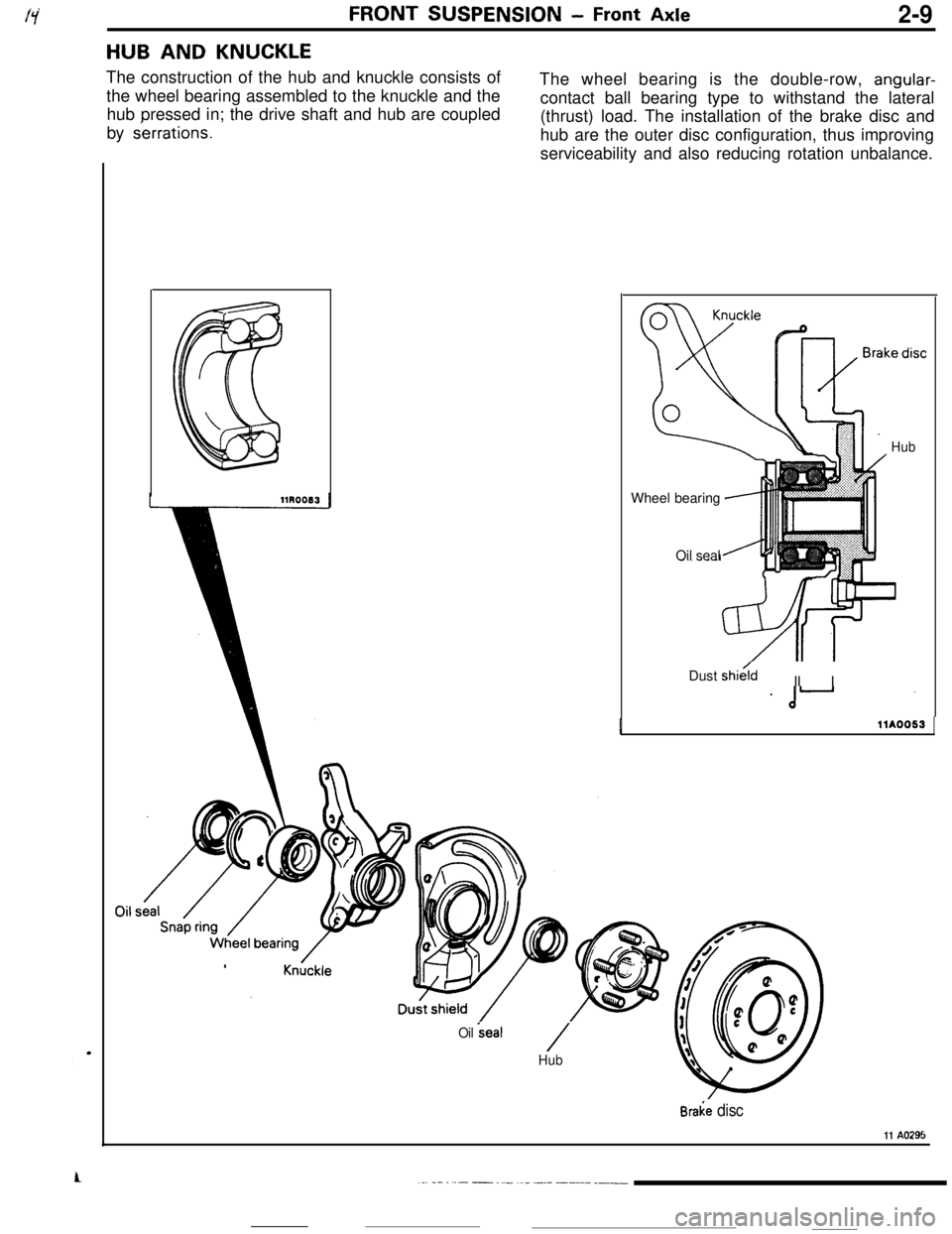
HUB AND KNUCKLEThe construction of the hub and knuckle consists of
The wheel bearing is the double-row,
angular-the wheel bearing assembled to the knuckle and the
contact ball bearing type to withstand the lateral
hub pressed in; the drive shaft and hub are coupled
(thrust) load. The installation of the brake disc and
by
&rations.hub are the outer disc configuration, thus improving
serviceability and also reducing rotation unbalance.
Wheel bearing
Oil seal
HubDust shi&d
II I
IllA0053
Oil seal/HubBraie
disc
11 A0295
..~ -- . ..- - . .._ ~._ __.- ----_ .__
Page 32 of 391
REAR AXLE- Viscous Coupling Type Limited Slip Differential3-a
DIFFERENTIALROlEAM
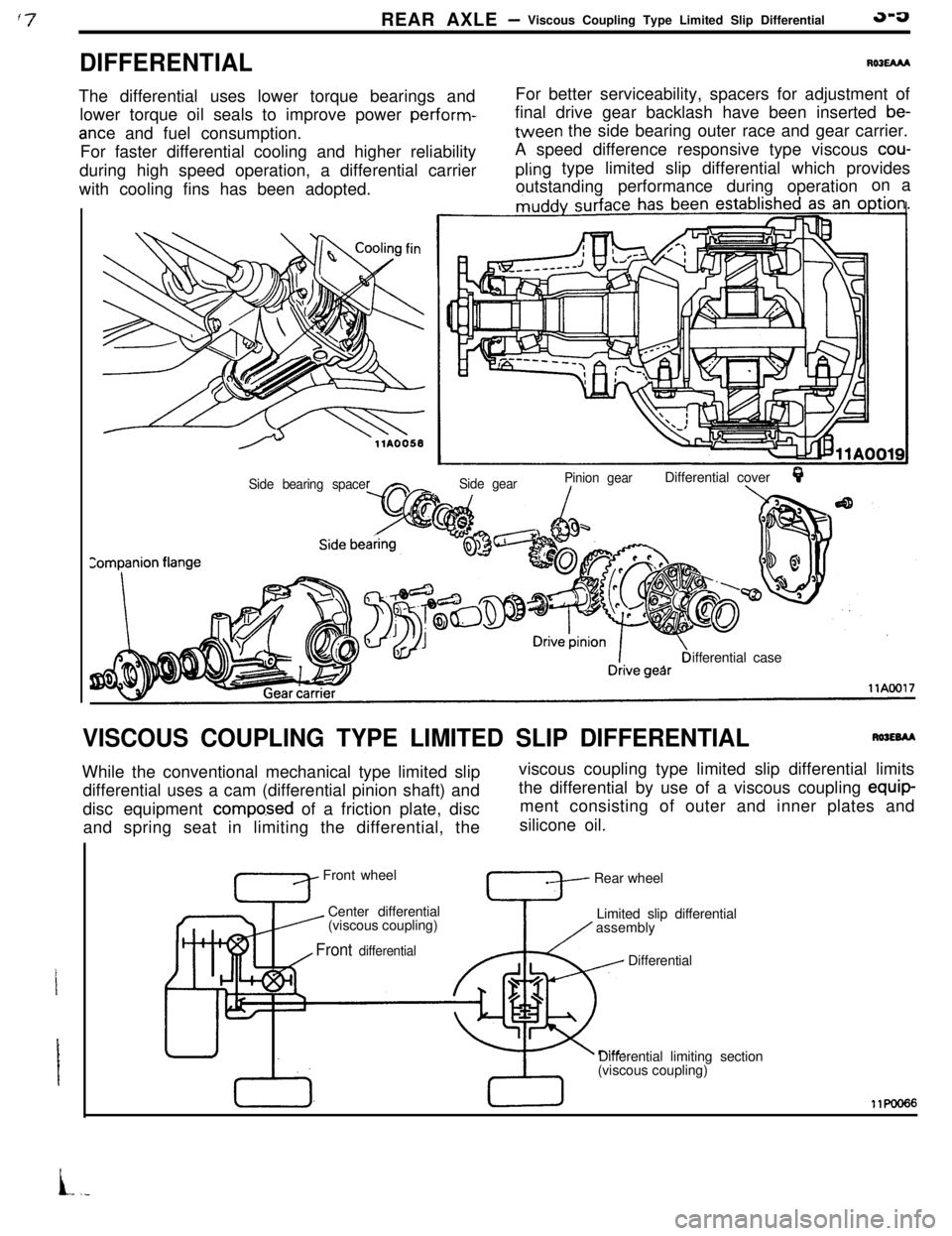
The differential uses lower torque bearings and
lower torque oil seals to improve power perform-
ante and fuel consumption.
For faster differential cooling and higher reliability
during high speed operation, a differential carrier
with cooling fins has been adopted.For better serviceability, spacers for adjustment of
final drive gear backlash have been inserted
be-tween the side bearing outer race and gear carrier.
A speed difference responsive type viscous
cou-
pling type limited slip differential which provides
outstandingperformance during operationon a
Side gearPinion gearDifferential coverQ./\Side bearing spaceifferential case
VISCOUS COUPLING TYPE LIMITED SLIP DIFFERENTIALRWEBAAWhile the conventional mechanical type limited slip
differential uses a cam (differential pinion shaft) and
disc equipment
compo.sed of a friction plate, disc
and spring seat in limiting the differential, theviscous coupling type limited slip differential limits
the differential by use of a viscous coupling equip-
ment consisting of outer and inner plates and
silicone oil.
Front wheel
Center differential
’ (viscous coupling)Rear wheel
Limited slip differential
assembly
Front differential, I
TDifferential
Differential limiting section
(viscous coupling)11KmI66
L.-
Page 33 of 391
3-6REAR AXLE - Viscous Coupling Type Limited Slip Differential
Is
Side gear (L.H.)
Side gear (R.H.)1Differential case B
Pinion shaft
Thrust
washer
Viscous cokpling
3r
Side gear U3.H.)Differential case
B
, ,,Differential cover
I
‘Gear cagierPir
,Drive pinionfront bearing
Driv& pinionDrive gear
Bearing caprear bearing
ICokpanion flangellAo337
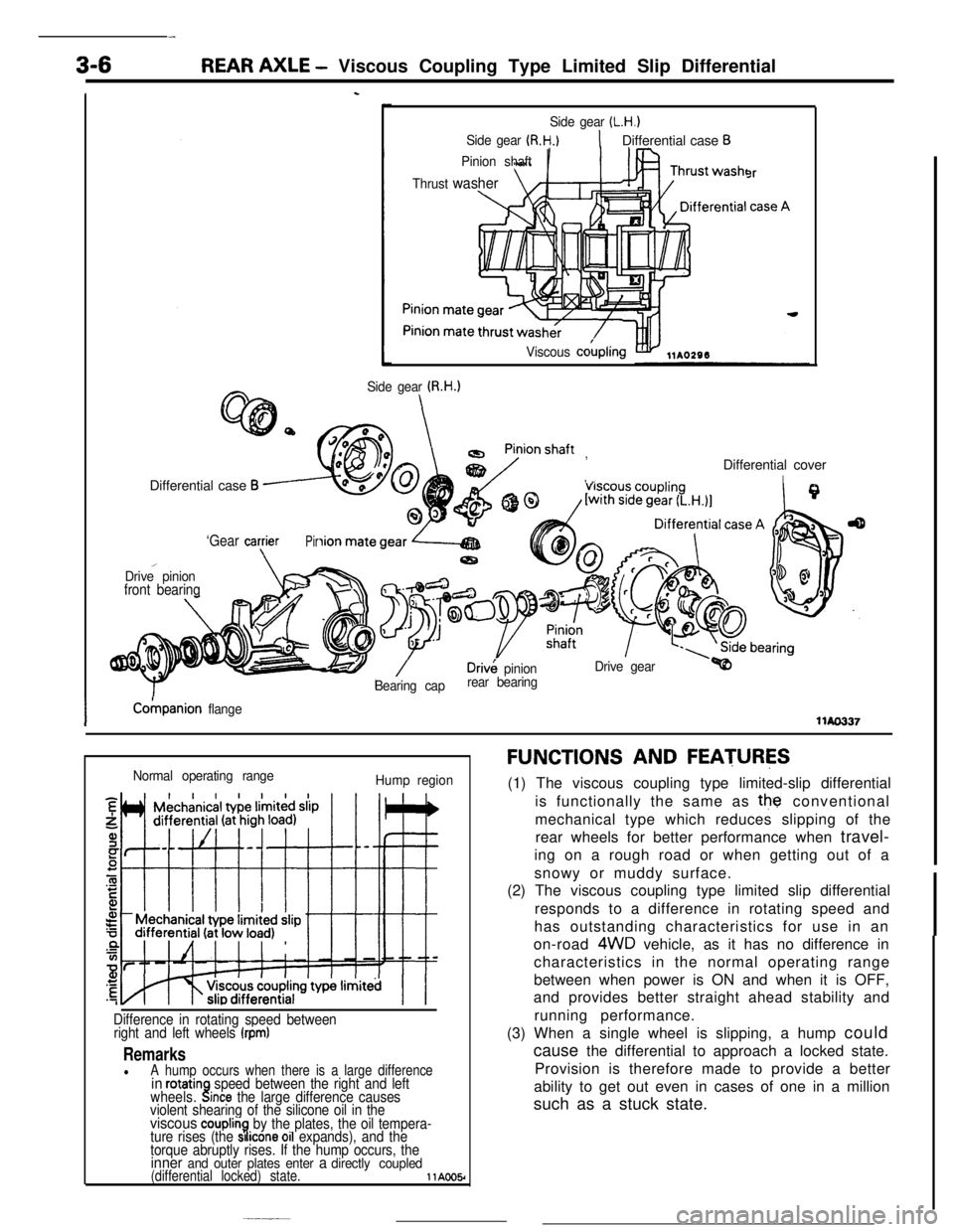
Normal operating range
Hump region
Difference in rotating speed between
right and left wheels (rpm)
RemarkslA hump occurs when there is a large differencein rotatinwheels..!speed between the right and leftlnce the large difference causes
violent shearing of the silicone oil in the
viscous couplin7.by the plates, the oil tempera-
ture rises (the SI Icone 011 expands), and the
torque abruptly rises. If the hump occurs, the
inner and outer plates enter a directly coupled(differential locked) state.llAOO5r
FUNCTIONS AND FEATURES(1) The viscous coupling type limited-slip differential
is functionally the same as
the conventional
mechanical type which reduces slipping of the
rear wheels for better performance when travel-
ing on a rough road or when getting out of a
snowy or muddy surface.
(2) The viscous coupling type limited slip differential
responds to a difference in rotating speed and
has outstanding characteristics for use in an
on-road
4WD vehicle, as it has no difference in
characteristics in the normal operating range
between when power is ON and when it is OFF,
and provides better straight ahead stability and
running performance.
(3) When a single wheel is slipping, a hump could
cause the differential to approach a locked state.
Provision is therefore made to provide a better
ability to get out even in cases of one in a million
such as a stuck state.