brake light MITSUBISHI ECLIPSE 1991 Owner's Guide
[x] Cancel search | Manufacturer: MITSUBISHI, Model Year: 1991, Model line: ECLIPSE, Model: MITSUBISHI ECLIPSE 1991Pages: 1216, PDF Size: 67.42 MB
Page 192 of 1216
5-52BRAKES - Service Adjustment Procedures
16LO312lOWOO
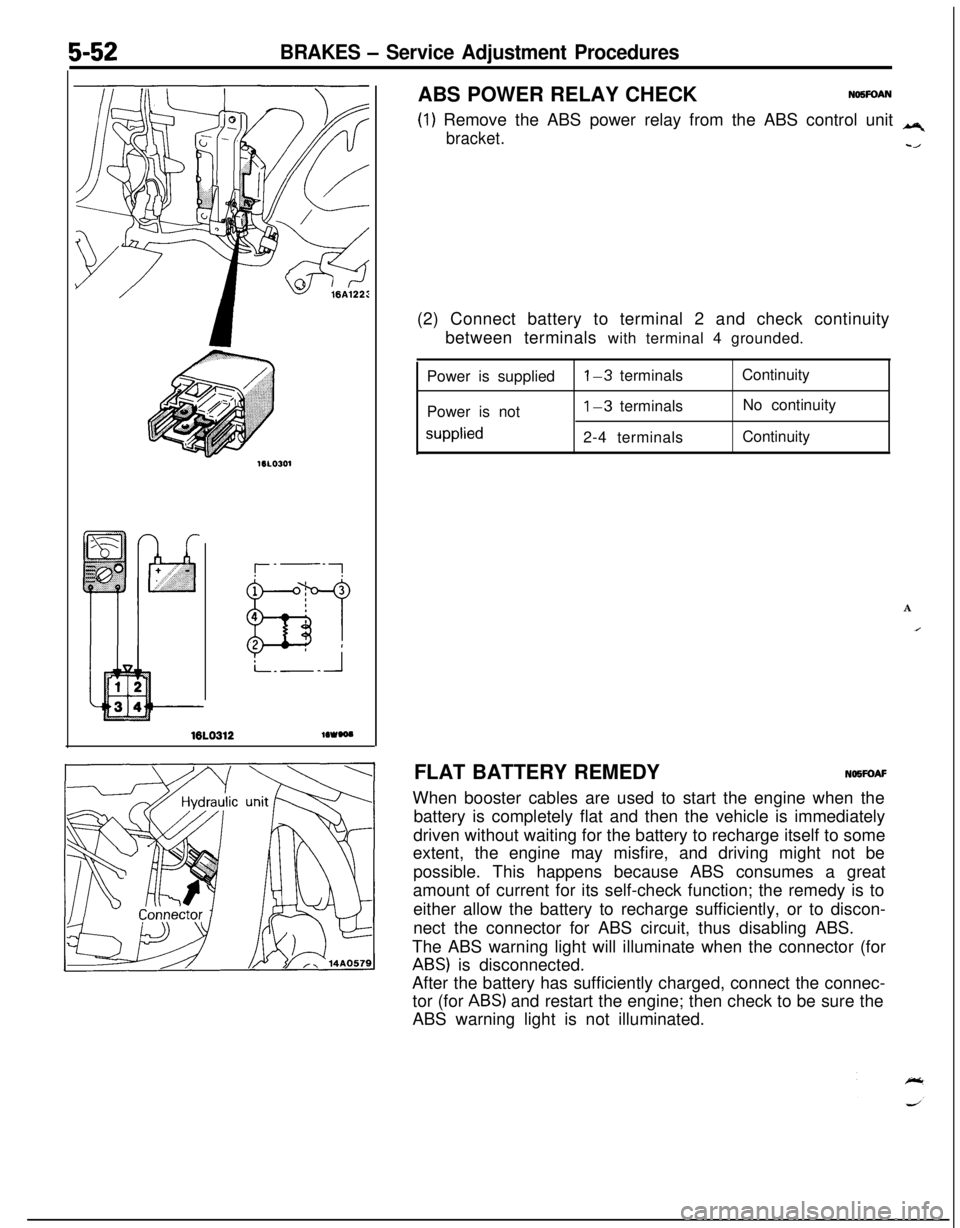
(1) Remove the ABS power relay from the ABS control unit q
bracket.-/ABS POWER RELAY CHECK
NO5FOAN(2) Connect battery to terminal 2 and check continuity
between terminals with terminal 4 grounded.
Power is supplied
Power is not
supplied
l-3 terminals
1-3 terminals
2-4 terminalsContinuity
No continuity
Continuity
A
IFLAT BATTERY REMEDYNOWOAF
When booster cables are used to start the engine when the
battery is completely flat and then the vehicle is immediately
driven without waiting for the battery to recharge itself to some
extent, the engine may misfire, and driving might not be
possible. This happens because ABS consumes a great
amount of current for its self-check function; the remedy is to
either allow the battery to recharge sufficiently, or to discon-
nect the connector for ABS circuit, thus disabling ABS.
The ABS warning light will illuminate when the connector (for
ABS) is disconnected.
After the battery has sufficiently charged, connect the connec-
tor (for
ABS) and restart the engine; then check to be sure the
ABS warning light is not illuminated.
Page 193 of 1216
BRAKES - Brake Pedal5-53
BRAKE PEDAL
-I REMOVAL AND INSTALLATION
.Pre-removal Operation
aRemoval of Knee Protector
(Refer to GROUP 23%Instrument Panel.)
ORemoval of Lap Cooler Duct and Shower
Duct (L.H.)(Refer to GROUP 23-Instrument Panel.)l Removal of Steering Column Assembly andColumn Support
(Refer to GROUP
19-Steering Wheel andShaft.)*Removal of Relay Box (Indoor)
NO5OA--Post-installation Operation
l installation of Relay Box (Indoor)l Installation of Steering Column Assembly andColumn Support
(Refer to GROUP 19-Steering Wheel and
Shaft.)@Installation of Lap Cooler Duct and Shower
Duct
(L.H.)(Refer to GROUP 23-Instrument Panel.)l Installation of Knee Protector(Refer to GROUP 23-Instrument Panel.)aBrake Pedal Adjustment
(Refer to P.5-41.)20-25 Nm
,‘14-18 ft.lbs.
IO-15 Nm /7-11 ft.lbs.
/
11-17 Nm
8-12 ftlbs.6-9
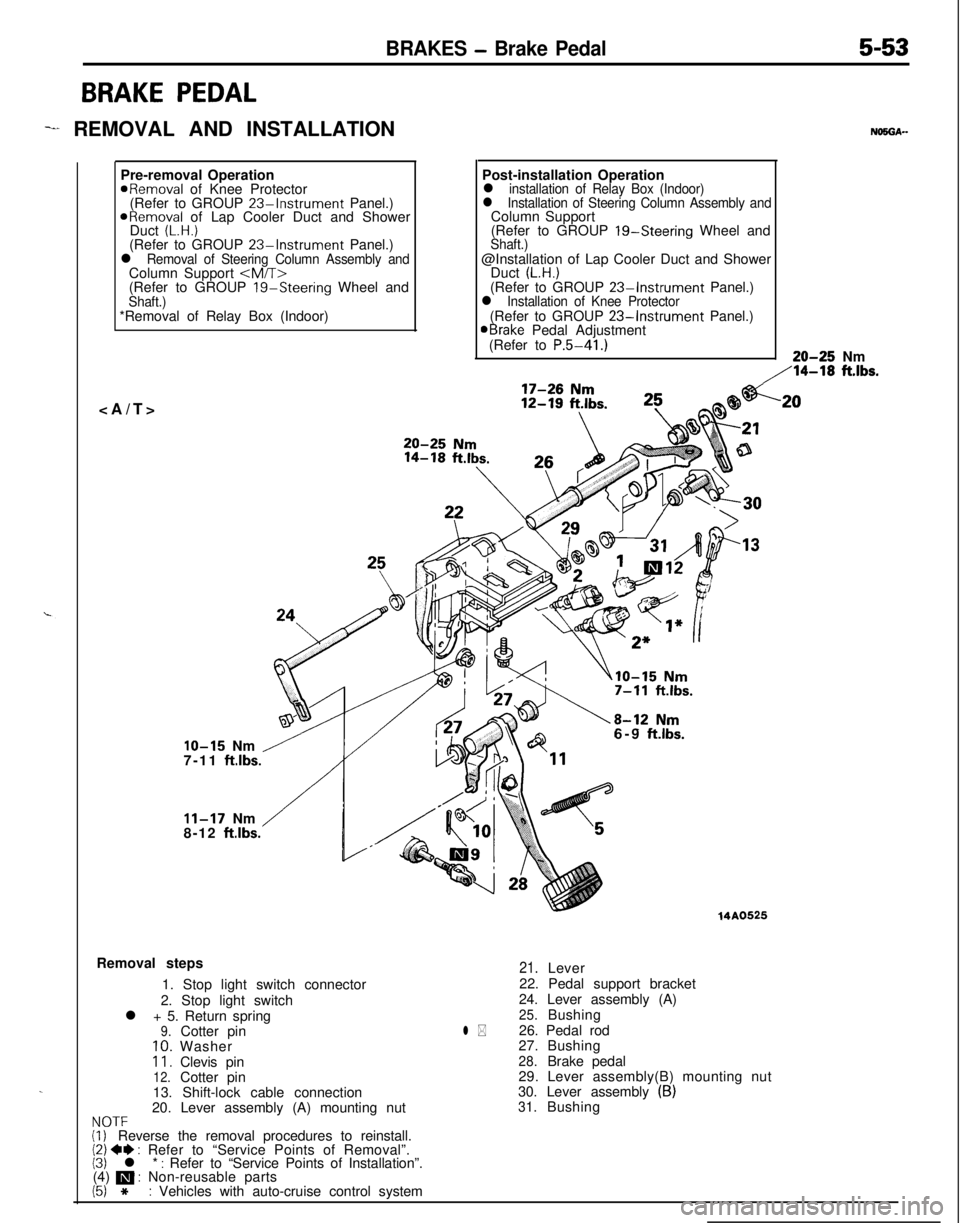
ftlbs.Removal steps
1. Stop light switch connector
2. Stop light switch
l + 5. Return spring
9.Cotter pin10.Washer11.Clevis pin12.Cotter pin
13. Shift-lock cable connection
20. Lever assembly (A) mounting nut
NOTF(i, Reverse the removal procedures to reinstall.(2) 4I) : Refer to “Service Points of Removal”.(3) l * : Refer to “Service Points of Installation”.
(4) m : Non-reusable parts
(5) *: Vehicles with auto-cruise control system
14A0525
l *
21.Lever
22. Pedal support bracket
24. Lever assembly (A)
25.Bushing
26. Pedal rod
27.Bushing
28.Brake pedal
29. Lever assembly(B) mounting nut
30. Lever assembly
(B)31.Bushing
.20
Page 194 of 1216

5-54BRAKES -Brake Pedal
IO-15 Nm
7-11 ft.lbs.
\
20-25 Nm
14-18 ft.lbs.I17-26 Nm
12-19 ft.lbs.
18-12 Nm
- 6-9 ft.lbs.- /-
117-11 ft.lbs.
13clutch switch Stop light switchconnectorStop light switch
Clutch switch connector andInter lock switch connector
Return springReturn spring
Clip
Turn over spring
Cotter pin
Washer
Clevis pin
1::16.
1::19.
22.
23.
W 25.
4*26.I)4 27.28.
Brake booster push rod
Pedal and bracket assembly
Clutch pedal mounting nut
Lever assembly
Clutch pedal bracketInter lock switch
Pedal support bracket
Clutch pedal
Bushing
P,;$;d
Brake pedal
14AG451
Fyfeverse the removal procedures to reinstall.
(2) 4* : Refer to “Service Points of Removal”.
(3) l 4 : Refer to “Service Points of Installation”.# m : Non-reusabje parts*: Vehicles with auto-cruise control system
SERVICE POINTS OF REMOVAL
NO5GBAHa
26. REMOVAL OF PEDAL RODUsing a plastic hammer, remove the pedal rod from the
pedal support bracket.
Page 195 of 1216
BRAKES - Brake Pedal5-55
14L0142No continuity
Continuity
mm
t.16 in.)
14LO171
:Vehicles with auto-cruiseontrol svstem>
14A0256
14ll0050
INSPECTIONNoMicAll Check the bushing for wear.
l Check the brake pedal for bend or twisting.
l Check the brake pedal return spring for ‘damage.
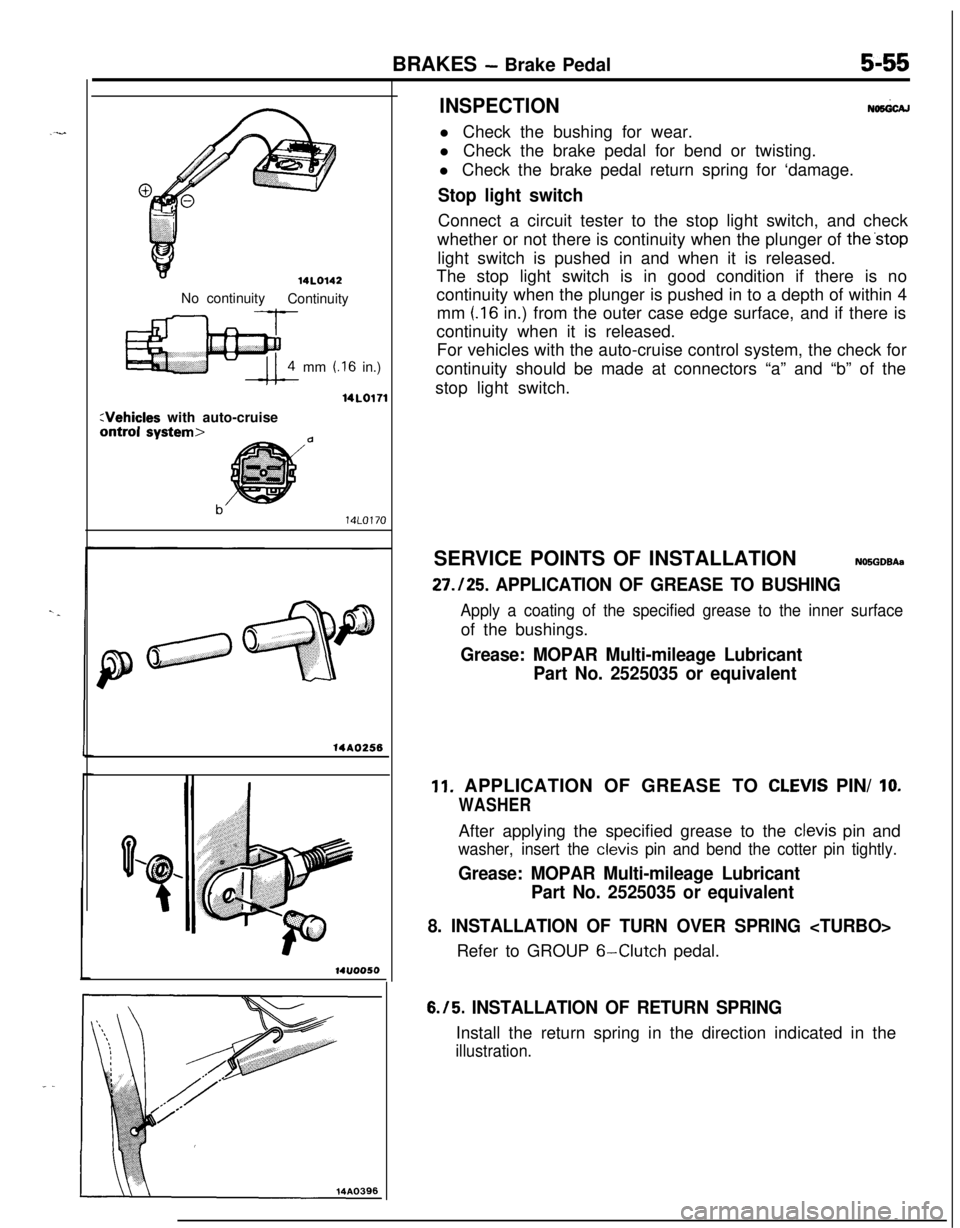
Stop light switchConnect a circuit tester to the stop light switch, and check
whether or not there is continuity when the plunger of the’stop
light switch is pushed in and when it is released.
The stop light switch is in good condition if there is no
continuity when the plunger is pushed in to a depth of within 4
mm
(.I6 in.) from the outer case edge surface, and if there is
continuity when it is released.
For vehicles with the auto-cruise control system, the check for
continuity should be made at connectors “a” and “b” of the
stop light switch.
SERVICE POINTS OF INSTALLATIONN05GDBAa
27.125. APPLICATION OF GREASE TO BUSHING
Apply a coating of the specified grease to the inner surfaceof the bushings.
Grease: MOPAR Multi-mileage Lubricant
Part No. 2525035 or equivalent
11. APPLICATION OF GREASE TO CLEVIS PIN/ IO.
WASHERAfter applying the specified grease to the
clevis pin and
washer, insert the clevis pin and bend the cotter pin tightly.
Grease: MOPAR Multi-mileage Lubricant
Part No. 2525035 or equivalent
8. INSTALLATION OF TURN OVER SPRING
6-Clutch pedal.
6.15. INSTALLATION OF RETURN SPRINGInstall the return spring in the direction indicated in the
illustration.
Page 233 of 1216
CLUTCH - Specifications/Special Tool6-3
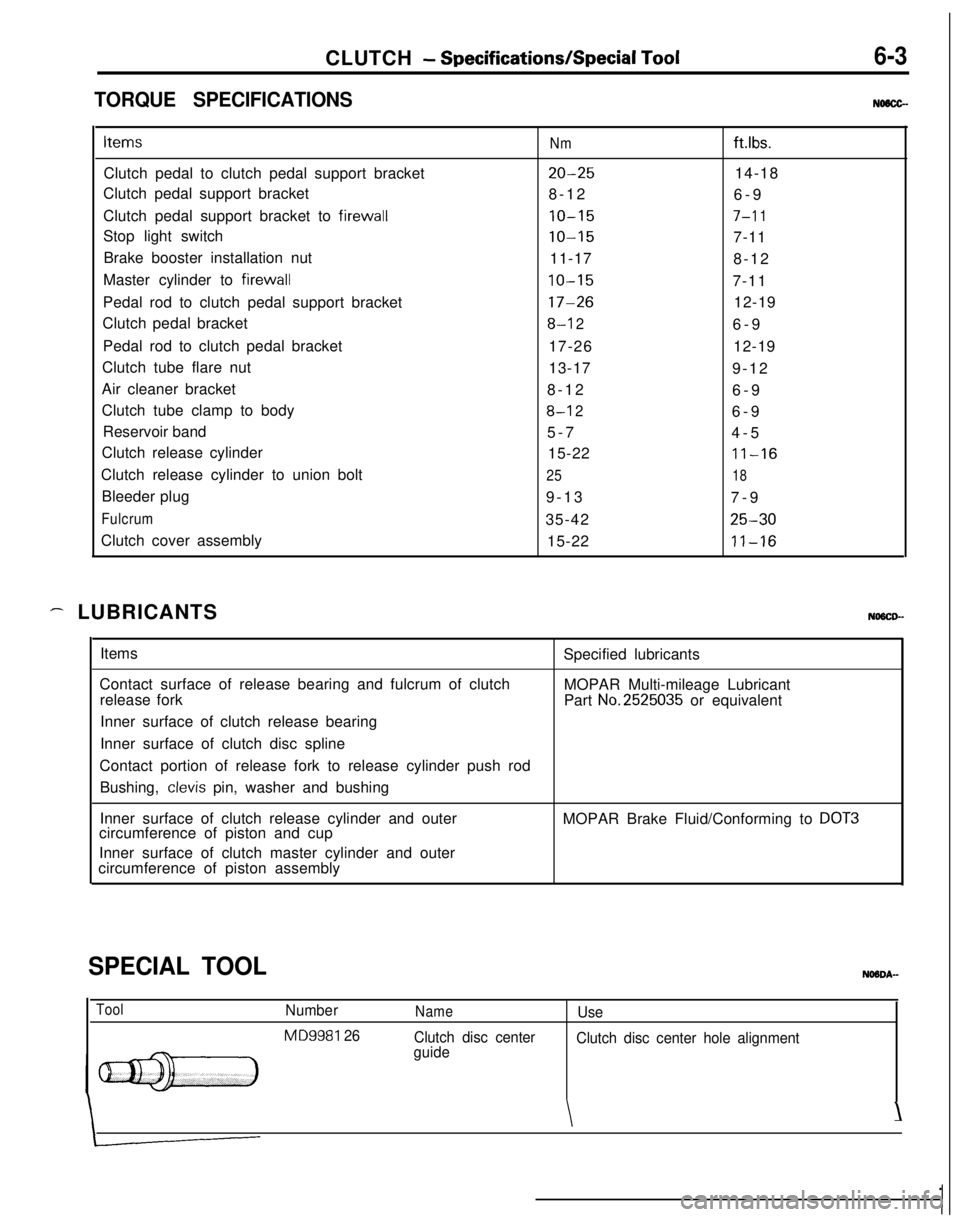
TORQUE SPECIFICATIONSNMCC-Items
Nmftlbs.Clutch pedal to clutch pedal support bracket
20-2514-18
Clutch pedal support bracket
8-12
6-9
Clutch pedal support bracket to firewall
10-157-l 1Stop light switch
10-157-11
Brake booster installation nut
11-17
8-12
Master cylinder to firewall
10-157-11
Pedal rod to clutch pedal support bracket
17-2612-19
Clutch pedal bracket
8-l 26-9
Pedal rod to clutch pedal bracket
17-2612-19
Clutch tube flare nut
13-17
9-12
Air cleaner bracket
8-12
6-9
Clutch tube clamp to body
8-l 26-9
Reservoir band
5-7
4-5
Clutch release cylinder
15-22
11-16Clutch release cylinder to union bolt
2518Bleeder plug
9-13
7-9
Fulcrum35-4225-30Clutch cover assembly
15-22
11-16
- LUBRICANTSNOSCD-Items
Contact surface of release bearing and fulcrum of clutch
release fork
Inner surface of clutch release bearing
Inner surface of clutch disc splineSpecified lubricants
MOPAR Multi-mileage Lubricant
Part
No.2525035 or equivalent
Contact portion of release fork to release cylinder push rod
Bushing,
clevis pin, washer and bushing
Inner surface of clutch release cylinder and outer
circumference of piston and cupMOPAR Brake Fluid/Conforming to
DOT3Inner surface of clutch master cylinder and outer
circumference of piston assembly
SPECIAL TOOL
ToolNumber
MD9981 26
NameUse
Clutch disc center
guideClutch disc center hole alignment
\\
Page 237 of 1216
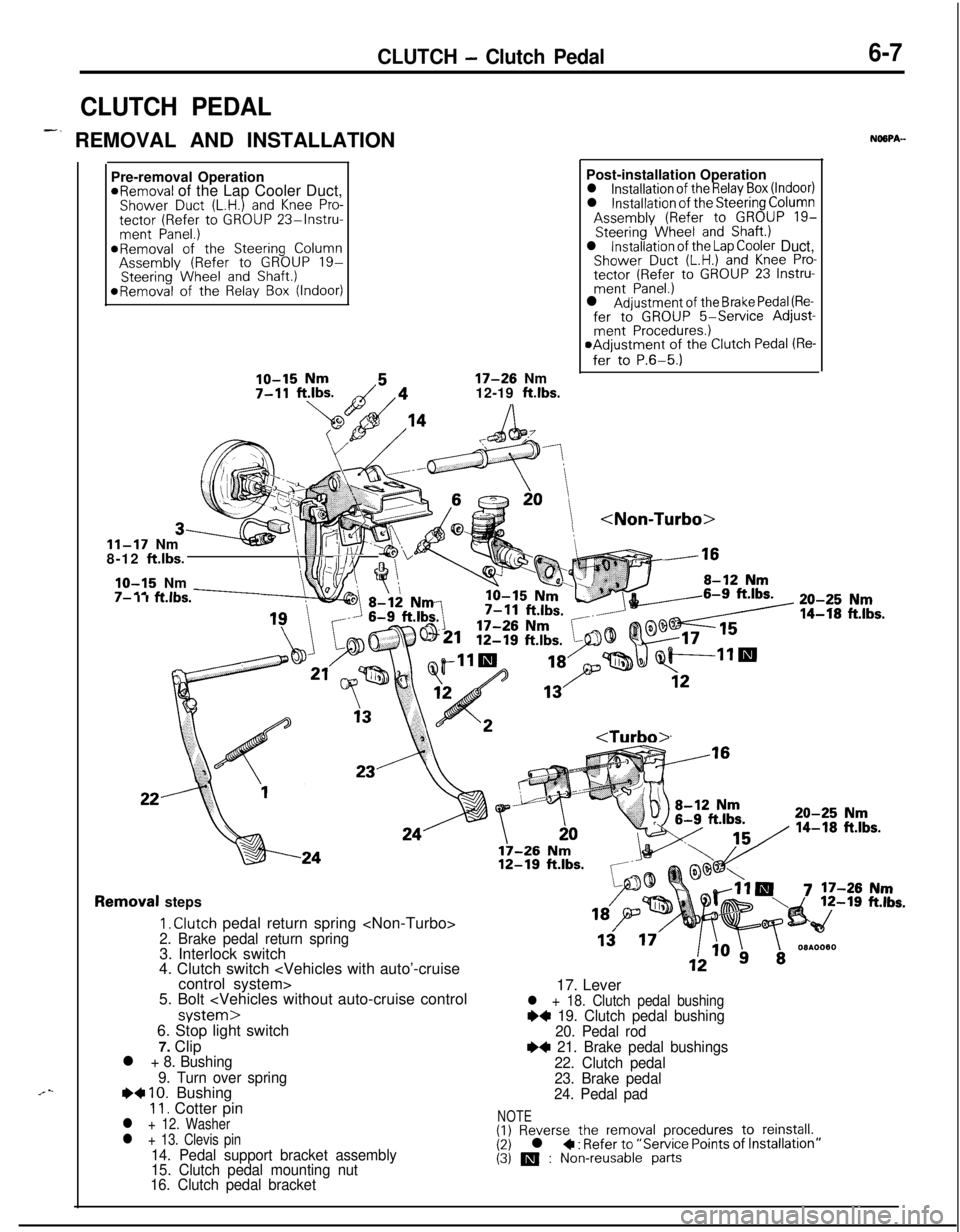
CLUTCH - Clutch Pedal6-7
CLUTCH PEDAL
-. REMOVAL AND INSTALLATIONNOSPA-
.“-Pre-removal Operation
*Removal of the Lap Cooler Duct,Shower Duct (L.H.) and Knee Pro-tector (Refer to GROUP 23%lnstru-ment Panel.)*Removal of the Steering ColumnAssembly (Refer to GROUP 19-Steering Wheel and Shaft.)*Removal of the Relay Box (Indoor)
17-26 Nm
12-19 ft.lbs.
11-17 Nm
8-12 ft.lbs.
IO-15 Nm’ tl(i/\:/ Fl/Yv .1-m.---I- I I KIDS.Post-installation Operation
l installation of the Relay Box (Indoor)l installation of the Steering ColumnAssembly (Refer to GROUP 19-Steering Wheel and Shaft.)l installation of the Lap Cooler Duct,Shower Duct (L.H.) and Knee Pro-tector (Refer to GROUP 23 Instru-ment Panel.)l Adjustment of the Brake Pedal (Re-fer to GROUP 5-Service Adjust-ment Procedures.)aAdjustment of the Clutch Pedal (Re-
fer to P.6-5.)
:k -16
20-25 Nm
14-f8 ft.lbs.
Removal steps
I, Clutch pedal return spring
4. Clutch switch
5. Bolt
7. Clip
l + 8. Bushing
9. Turn over spring
e+ IO. Bushing11. Cotter pinl + 12. Washerl + 13. Clevis pin14. Pedal support bracket assembly
15. Clutch pedal mounting nut
16. Clutch pedal bracket17. Lever
l + 18. Clutch pedal bushing~~ 19. Clutch pedal bushing
20. Pedal rod
e+ 21. Brake pedal bushings
22. Clutch pedal
23. Brake pedal
24. Pedal pad
NOTE(1) Reverse the removal procedures to reinstall.(2) l + : Refer to “Service Points of (3) m : Non-reusable parts
Page 565 of 1216
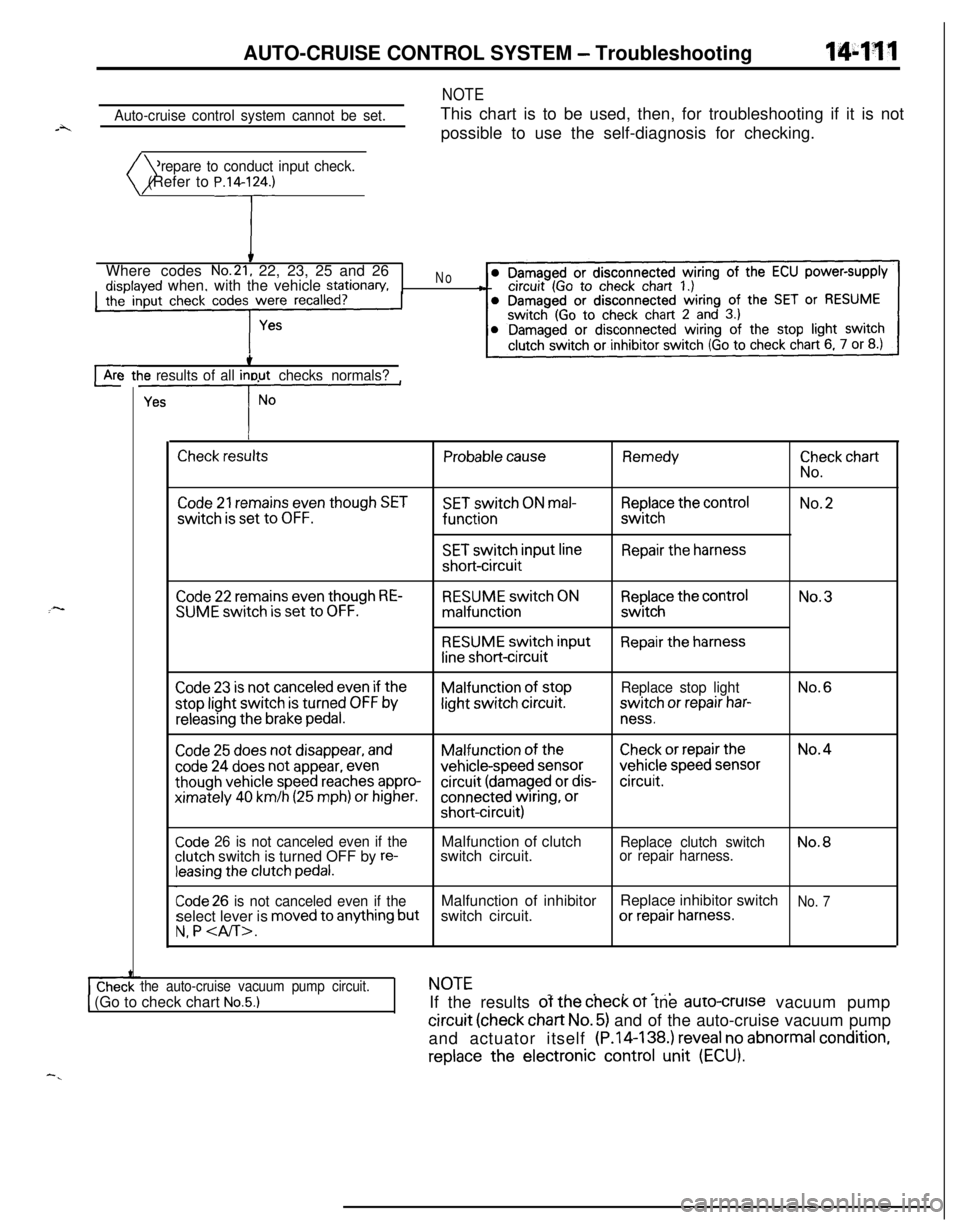
AUTO-CRUISE CONTROL SYSTEM - Troubleshooting144w
Auto-cruise control system cannot be set.
NOTEThis chart is to be used, then, for troubleshooting if it is not
possible to use the self-diagnosis for checking.
Prepare to conduct input check.
)( (Refer to P.14lrWhere codes
No.21, 22, 23, 25 and 26disolaved when, with the vehicle stationary,the’ input check codes were recalled?
‘#
No-8
cArc-3 ttie results of all inout checks normals?
L--y--
I
Check resultsProbable causeRemedy
ii”,:” chart
Code 21 remains even though SETSET switch ON mal-Replace the controlNo.2switch
is set to OFF.functionswitch
SET switch input lineRepair the harnessshort-circuit
:-Code 22 remains even though RE-SUME switch is set to OFF.RESUME switch ONmalfunction
RESUME switch input
line short-circuit
Replace the controlswitch
Repair the harnessNo.3
Code 23 is not canceled even if theMalfunction of stopReplace stop lightNo.6stop light switch
is turned OFF bylight switch circuit.switch or repair har-
releasing the brake pedal.ness.
Code 25 does not disappear, andMalfunction of theCheck or repair theNo.4
code 24 does not appear, evenvehicle-speed sensorvehicle speed sensor
though vehicle speed reaches appro-circuit (damaged or dis-circuit.ximately
40 km/h (25 mph) or higher.connected wiring, orshort-circuit)
Code 26 is not canceled even if theclutch switch is turned OFF by re-leasing the clutch pedal.Malfunction of clutch
switch circuit.
Replace clutch switchNo.8or repair harness.
Code 26 is not canceled even if theMalfunction of inhibitorReplace inhibitor switchNo. 7select lever is moved to anything butswitch circuit.or repair harness.
N, P
the auto-cruise vacuum pump circuit.NOTE_. . . e_,1 (Go to check chart No.5.)IIf the results of the check oT tne auro-crutse vacuum pump
circuit (check chart No. 5) and of the auto-cruise vacuum pump
and actuator itself (P.14-138.) reveal no abnormal
condition,replace
the electronic control unit (ECU).
-.
Page 566 of 1216
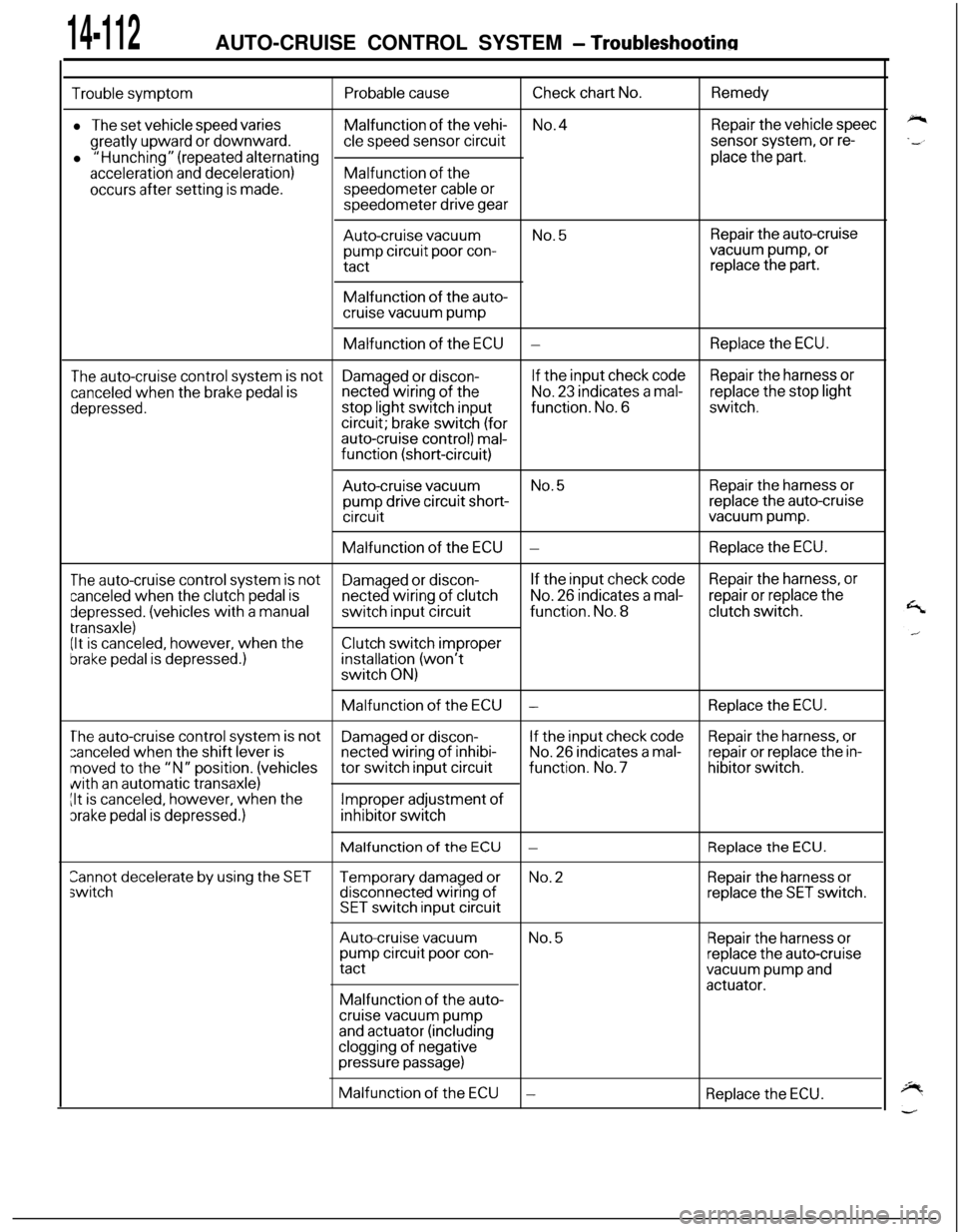
14-112AUTO-CRUISE CONTROL SYSTEM - Troubleshootina
Trouble symptomProbable causeCheck chart No.Remedy
l The set vehicle speed variesMalfunction of the vehi-No.4Repair the vehicle speec
greatly upward or downward.cle speed sensor circuitsensor system, or re-l “Hunching”
(repeated alternatingplace the part.
acceleration and deceleration)Malfunction of the
occurs after setting is made.speedometer cable orspeedometer drive gearAuto-cruise
vacuumNo.5Repair the auto-cruise
pump circuit poor con-vacuum pump, ortactreplace the part.Malfunction of the
auto-
cruise vacuum pumpMalfunction of the
ECU-Replace the ECU.
The auto-cruise control system is notDamaged or discon-If the input check codeRepair the harness or
canceled when the brake pedal isnetted wiring of theNo. 23 indicates a mal-replace the stop light
depressed.stop light switch inputfunction. No. 6switch.circuit; brake switch (forauto-cruise control) mal-function (short-circuit)Auto-cruise
vacuumNo. 5Repair the harness or
pump drive circuit short-replace the auto-cruisecircuitvacuum pump.Malfunction of the
ECU-Replace the ECU.
The auto-cruise control system is notDamaged or discon-If the input check codeRepair the harness, or
canceled when the clutch pedal isnetted wiring of clutchNo. 26 indicates a mal-repair or replace the
depressed. (vehicles with a manualswitch input circuitfunction. No. 8clutch switch.
transaxle)(It is canceled, however, when theClutch switch improper
brake pedal is depressed.)installation (won’tswitch ON)Malfunction of the
ECU-Replace the ECU.
The auto-cruise control system is notDamaged or discon-If the input check codeRepair the harness, orcanceled when the shift lever isnetted wiring of inhibi-No. 26 indicates a mal-repair or replace the in-
moved to the “N” position. (vehiclestor switch input circuitfunction. No.7hibitor switch.llvith an automatic transaxle)
[It is canceled, however, when theImproper adjustment of
Drake pedal is depressed.)inhibitor switchMalfunction of the
ECU-Replace the ECU.
Cannot decelerate by using the SETTemporary damaged orNo. 2Repair the harness orswitchdisconnected wiring ofreplace the SET switch.SET switch input circuitAuto-cruise
vacuumNo.5Repair the harness orpump circuit poor con-replace the auto-cruisetactvacuum pump andactuator.Malfunction of the auto-cruise vacuum pump
and actuator (includingclogging of negativepressure passage)Malfunction of the
ECU-Replace the ECU.
Page 571 of 1216
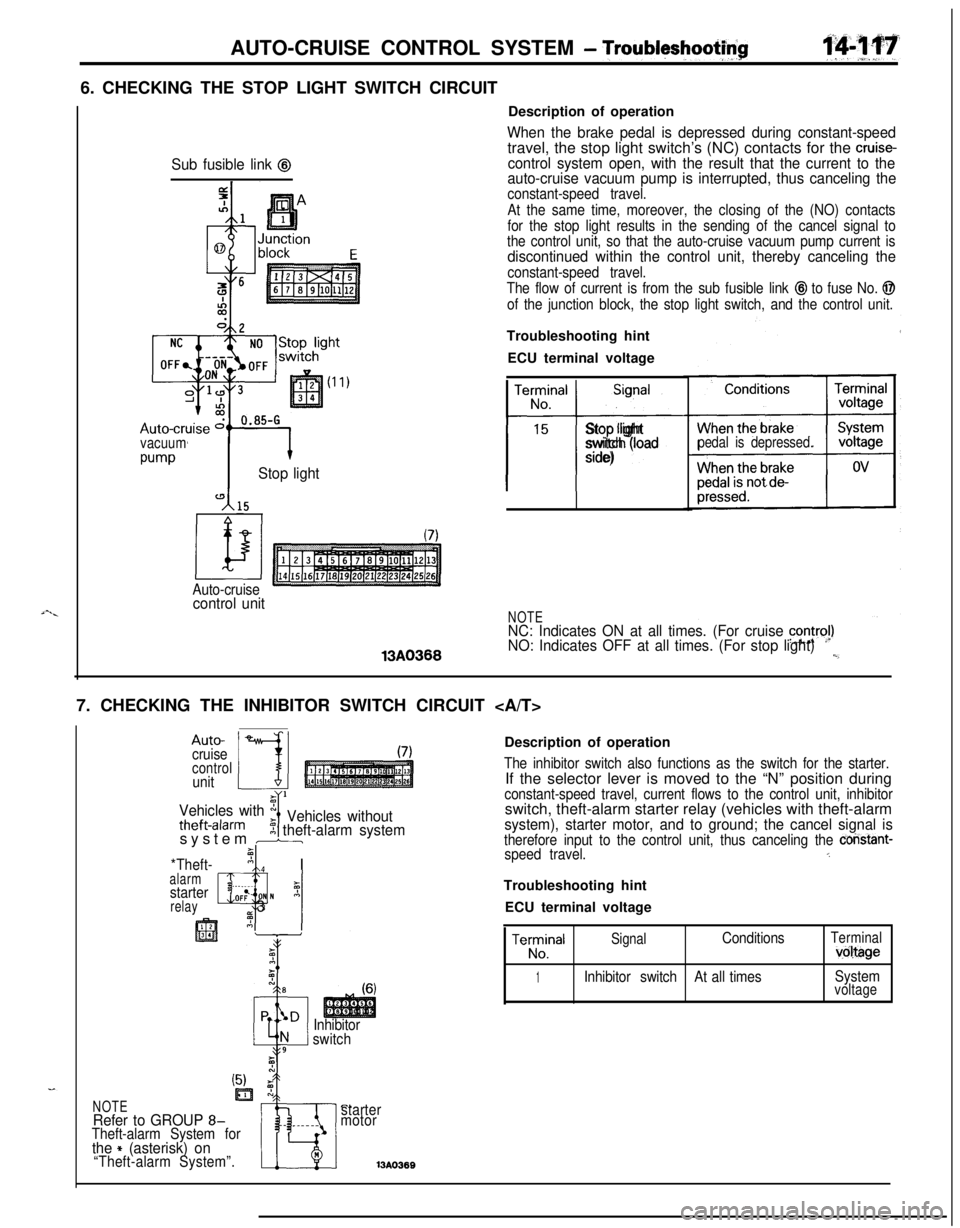
i-._AUTO-CRUISE CONTROL SYSTEM
- Troubltyshootf$6. CHECKING THE STOP LIGHT SWITCH CIRCUIT
Sub fusible link @
vacuum
w-vStop light
Auto-cruisecontrol unit13A0366Description of operation
When the brake pedal is depressed during constant-speedtravel, the stop light switch’s (NC) contacts for the cruise-control system open, with the result that the current to the
auto-cruise vacuum pump is interrupted, thus canceling the
constant-speed travel.
At the same time, moreover, the closing of the (NO) contacts
for the stop light results in the sending of the cancel signal to
the control unit, so that the auto-cruise vacuum pump current is
discontinued within the control unit, thereby canceling the
constant-speed travel.
The flow of current is from the sub fusible link
@I to fuse No. @
of the junction block, the stop light switch, and the control unit.Troubleshooting hint
ECU terminal voltage
TerminalSignal
No.
15
t-i-
Stop light
switch (load
side)pedal is depressed.
NOTENC: Indicates ON at all times. (For cruise contra!)NO: Indicates OFF at all times. (For stop light)l,_7. CHECKING THE INHIBITOR SWITCH CIRCUIT
Auto-
cruise
controlunit
Vehicles with x
theft-alarmIVehicles without5 theft-alarm systemsystem br
*Theft-’ nI Ialarm, ._I
starterz
relayQlOF: N A_ 3
Inhibitor
switchDescription of operation
The inhibitor switch also functions as the switch for the starter.If the selector lever is moved to the “N” position during
constant-speed travel, current flows to the control unit, inhibitorswitch, theft-alarm starter relay (vehicles with theft-alarm
system), starter motor, and to ground; the cancel signal istherefore input to the control unit, thus canceling the constant-speed travel.5Troubleshooting hint
ECU terminal voltage
TeE!alSignalConditionsTerminalvoltage
1Inhibitor switchAt all timesSystemvoltage
C.starter
motor13A036BNOTERefer to GROUP 8-Theft-alarm System forthe + (asterisk) on“Theft-alarm System”.
Page 578 of 1216
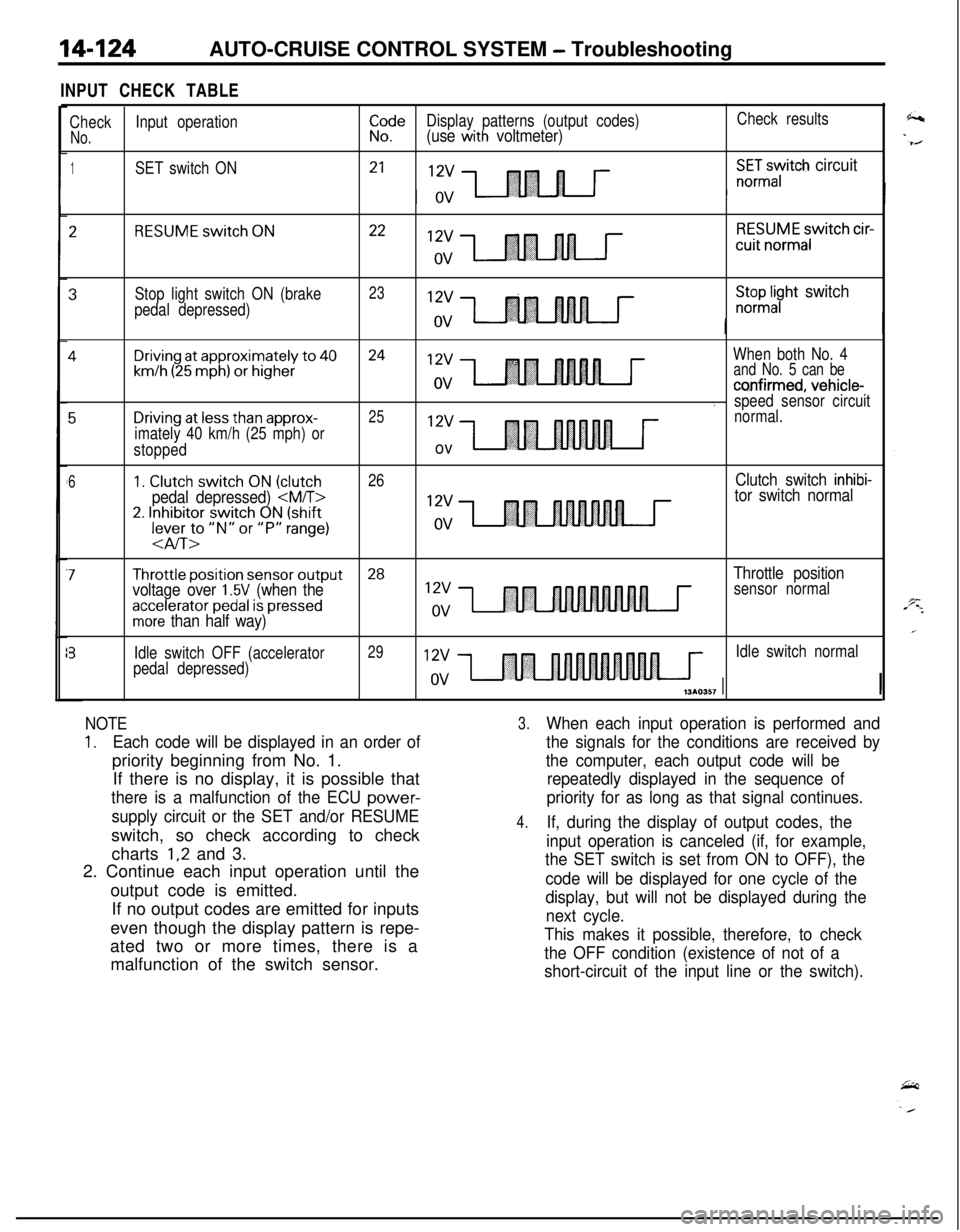
14-124AUTO-CRUISE CONTROL SYSTEM - Troubleshooting
INPUT CHECK TABLE
CheckInput operationiI!eDisplay patterns (output codes)Check results
No.(use with voltmeter)
1SET switch ON21X:Gayitch circuit
2RESUME switch ON2212vRESUME switch cir-cuit
normalov
3Stop light switch ON (brake23
pedal depressed)
;;pl;yht switch
4Driving at approximately to 4024When both No. 4
km/h (25 mph) or higherand No. 5 can be
co,nfirmed, vehicle-.speed sensor circuit
5Driving at less than approx-2512vnormal.
imately 40 km/h (25 mph) or
stopped
ov
61. Clutch switch ON (clutch26Clutch switch inhibi-
pedal depressed)
2. Inhibitor switch ON (shift12vlever to “N” or “P” range)ov
-aIT>
7Throttle position sensor output28
voltage over 1.5V (when theThrottle positionsensor normal
accelerator pedal is pressedmore than half way)
?Idle switch OFF (accelerator29Idle switch normal
pedal depressed)
NOTE
1.Each code will be displayed in an order ofpriority beginning from No. 1.
If there is no display, it is possible that
there is a malfunction of the ECU power-
supply circuit or the SET and/or RESUMEswitch, so check according to check
charts
1,2 and 3.
2. Continue each input operation until the
output code is emitted.
If no output codes are emitted for inputs
even though the display pattern is repe-
ated two or more times, there is a
malfunction of the switch sensor.
3.When each input operation is performed and
the signals for the conditions are received by
the computer, each output code will be
repeatedly displayed in the sequence of
priority for as long as that signal continues.
4.If, during the display of output codes, the
input operation is canceled (if, for example,
the SET switch is set from ON to OFF), the
code will be displayed for one cycle of the
display, but will not be displayed during the
next cycle.
This makes it possible, therefore, to check
the OFF condition (existence of not of a
short-circuit of the input line or the switch).