check engine MITSUBISHI GALANT 1989 Service Repair Manual
[x] Cancel search | Manufacturer: MITSUBISHI, Model Year: 1989, Model line: GALANT, Model: MITSUBISHI GALANT 1989Pages: 1273, PDF Size: 37.62 MB
Page 350 of 1273

13-208FUEL SYSTEM
No.
43
Diagnostic trouble codeOn-board
diagnostic Check item (Remedy) Memory
Output signal pattern item
EGRl Harness and connector Retained
H
nia>l EGR valve
l EGR solenoid
L 12A0105
l EGR valve control vacuum
44 Ignition coil,
l Harness and connector Retained
Hl Ignition coil
LUUULnl-lM-
Ignition
power l Ignition power transistor
transistor 12A0105
unit
-Normal --
stateH
Lnm 12A0104
NOTEReplace the engine control module if a diagnostic trouble code is output\
although the inspection reveals that there is no
problem with the check items.
TROUBLESHOOTING TABLE
NOTE
* : The failsafe/back-up function is in operation.
Diagnostic On-boardtroublediagnosticcode No.itemDiagnostic content
Major causeRemarks (trouble
phenomenon, etc.)
-EngineThe engine control module-l Engine stop
control itself is abnormal. l Impossible start
module
11Heated Though the air/fuel mixture (1) The heated oxygen sensor is l Deterioration of
oxygen ratio closed loop control is
troubled.exhaust gas
sensor operated, the signal voltage of
(2) Open-circuit, short-circuit or purifying
the heated oxygen sensor improper connector contactperformance*
does not vary (to be lean/rich). occurs in the heated oxygen
sensor circuit.
(3) The fuel pressure is improper. l Deterioration of
(4) The injector is troubled. exhaust gas
(5) Air is sucked through the purifying
gasket clearance, etc. performance*
(6) The engine control module is l Abnormal start
troubled. l Unstable idling
l Abnormal acceleration
12;zc$rne air Though the engine is running,
(1) Volume air flow sensor is l Abnormal
the signal
frequency of the
troubled. acceleration*
sensor volume air flow sensor is
(2) Open-circuit, short-circuit or l Improper idling
1 OHz or less.
improper connector contact revolution speed*
occurs in the volume air flow l Unstable idling*
sensor circuit.
(3) The engine control module is troubled.
TSB Revision
Page 354 of 1273
13-212
FUEL SYSTEM
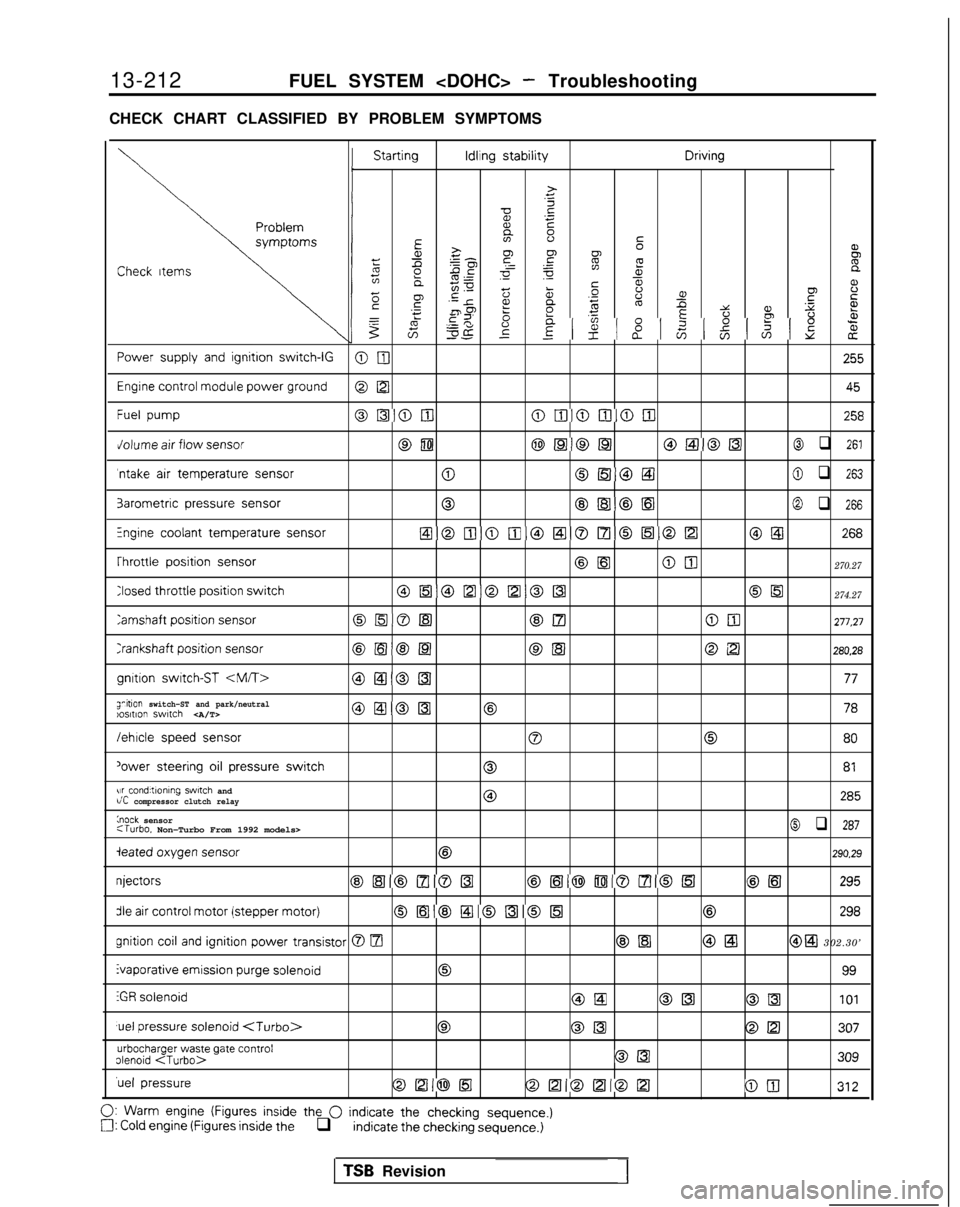
CHECK CHART CLASSIFIED BY PROBLEM SYMPTOMS Starting Idling
stability Driving
>
.c
zx .-
E
EE 2-80’
52FCheck
Itemsz gp ~ =
gif8e
5;ms00 a,L%a‘;E
2
F5i5 .-
5scp ‘-re,t2aDo’6%.fP .xz YPfbz 2 ‘5 uE22
%il= 5
8
8 8gzzg-c$z8
z
Power
supply
and
ignition switch-IGOnI
255
Engine
control
module power ground
@ [ZI
45
Fuel
pumpoI51oulolIioDloiIl258
Jolume
air
flow sensorcam@Ea@@l@EilO[41@ q 261
‘ntake
air
temperature sensor0OlEiiOEtl@ q 263
3arometric
pressure
sensor0@lB@El@ q 266
Fngine coolant temperature sensorEloiIlomoaol7loEloDO@ 268
Throttle
position
sensor
@[email protected]
Closed throttle
position
switch0[51@D@D0[[email protected]
Tamshaft position
sensorOrnOlsl@Elam277,27
Crankshaft
position
sensor@El@[email protected]
gnltion
switch-ST
anitlon switch-ST and park/neutral)os,t,on switch @ElODl@ 78
/ehlcle
speed
sensor
00
80
‘ower
steering
oil
pressure
switch081
w conditlonlng swtch andr/C compressor clutch relay0285
knock sensor:Turbo. Non-Turbo From 1992 models>@ q 287
ieated oxygen
sensor
@290.29
njectors
@,[Hl@lzl@lz3@,161@Di080151@El
295
die air
control
motor (stepper
motor)0[63@!zl@al0863298 gnition
coil
and ignition
power transistor 0 m@El @El@ a 302.30’ Evaporative emission
purge
solenoid
0
99
iGR
solenoid@LaOK3@II3101
uel
pressure
solenoid
urbocharger waste gate contrololenoid
309
‘uel
pressureOD@l5l@D@D012100
312
0:
Warm
engine (Figures
inside
the 0 indicate the checking sequence.)a: Cold engine (Figures
inside
the q indicate
the checking
sequence.)
TSB Revision1
Page 358 of 1273

< 1989 models>
KTROLIGNITION POWER MFIUNIT TRANSISTORRELAY
,nr ,nrc n TD CT nv c!crw.fl\“l.I”mL c)I‘\ IAl””ULtll”JR\"/\")
13216FUEL SYSTEM
CIRCUIT DIAGRAM (CONTINUED)
< 1989 models>
KTROLIGNITION POWER MFIUNIT TRANSISTORRELAY
,nr ,nrc n TD CT nv c!crw.fl\“l.I”mL c)I‘\ IAl””ULtll”JR"/\2
,PTAKB *,A VOLUkz! FLOWIBOR
1.25-R
LI: CRANKSHAFT1 POSITION SENSORg AND CAMSHAFT
. POSITION SENSORa
A-57
\//1 I,t“3"5"4 "6 "1‘$1 '"3*54
t5Gk3s 6mI
z3m1,
WI
wm=-i !QIIII1*I
z-l t
' I
- ____-- J,-----3 I
m
ENGINE
%%&TURE
A-55 m“‘3
1 “&a,. YYI..d”..73 nnLxD-C”OXYGEN SENSORCHECK CONNECTOR
B c-14KX35-AC-H052SA-NY
TSB Revision
Page 373 of 1273
FUEL SYSTEM
4:
;zs1.25-R10
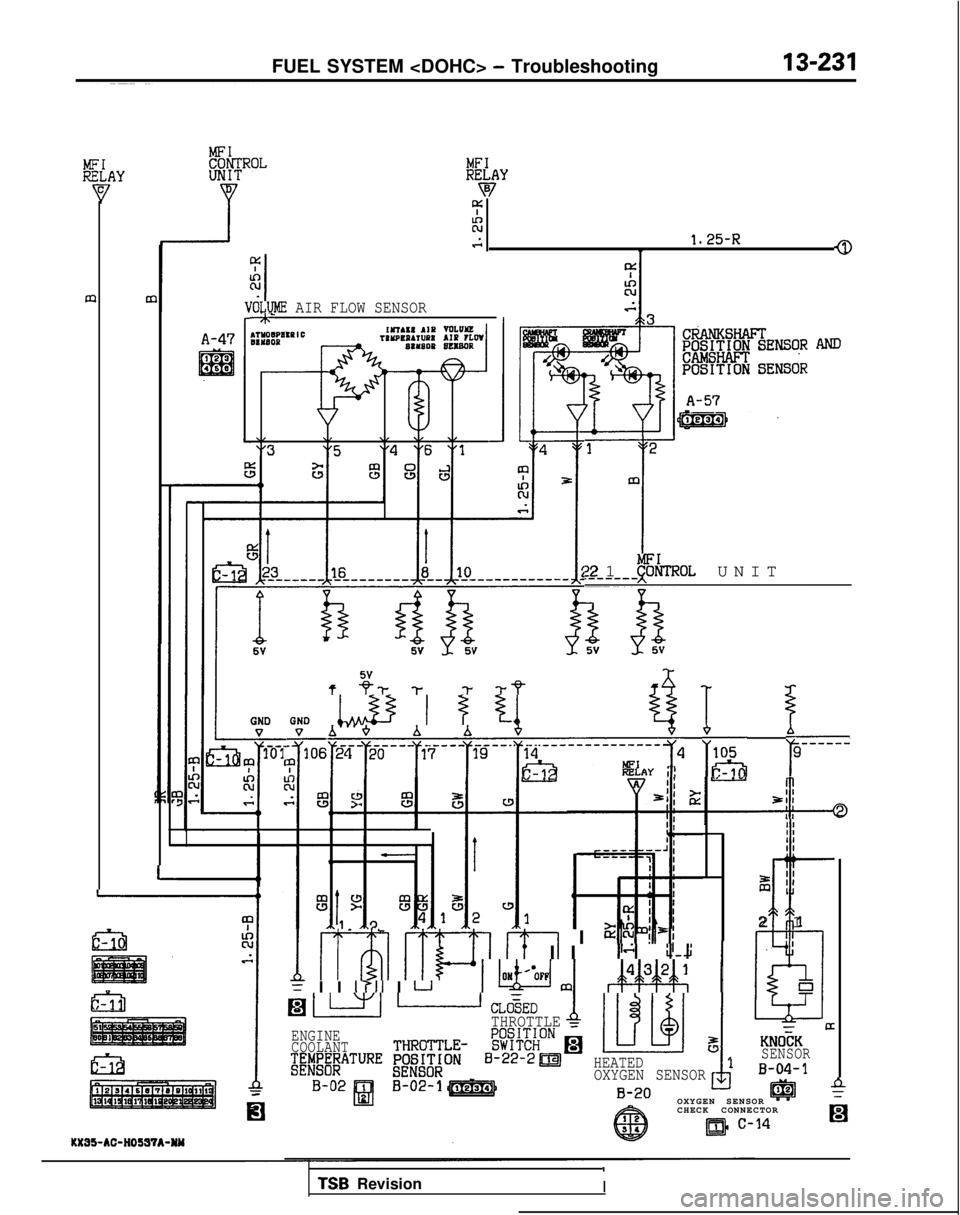
'1;rOLUK!Z AIR FLOW SENSOR
ANDA-47
12
m
I1221 t%TE!OL UNI
T
“? I@ 1 Yi Y
qEqsrp---~--~g---[~---------;;-~4 iuY&ii’------
1 mi mi E I
wT”ill’li
I II’-1 q-1’ I
f I I IT-11 I l-ijdrnl &$$$I I
i IIIII
z III
a
2 1
0
KNOCK
u
SENSOR
EII WI- CLiiEDdTHROTTLE =ENGINE
COOLANTTHROTTLE-l'#;&ON
##@ATURE @&ONB-22-2mEl %HEATED
OXYGEN SENSOR
1
1iB-04-1
B-02 Il!dB-02-1-B-20OXYGEN SENSORg@ e
CHECK CONNECTOR
m c-14H
l-
L
xX35-Ac-n0537wiu
,
TSB RevisionI
Page 387 of 1273
FUEL SYSTEM
cl989 models> -a’i\.-upI t
SERVICE ADJUSTMENT PROCEDURES
CURB IDLE SPEED INSPECTION
MlSFHAB
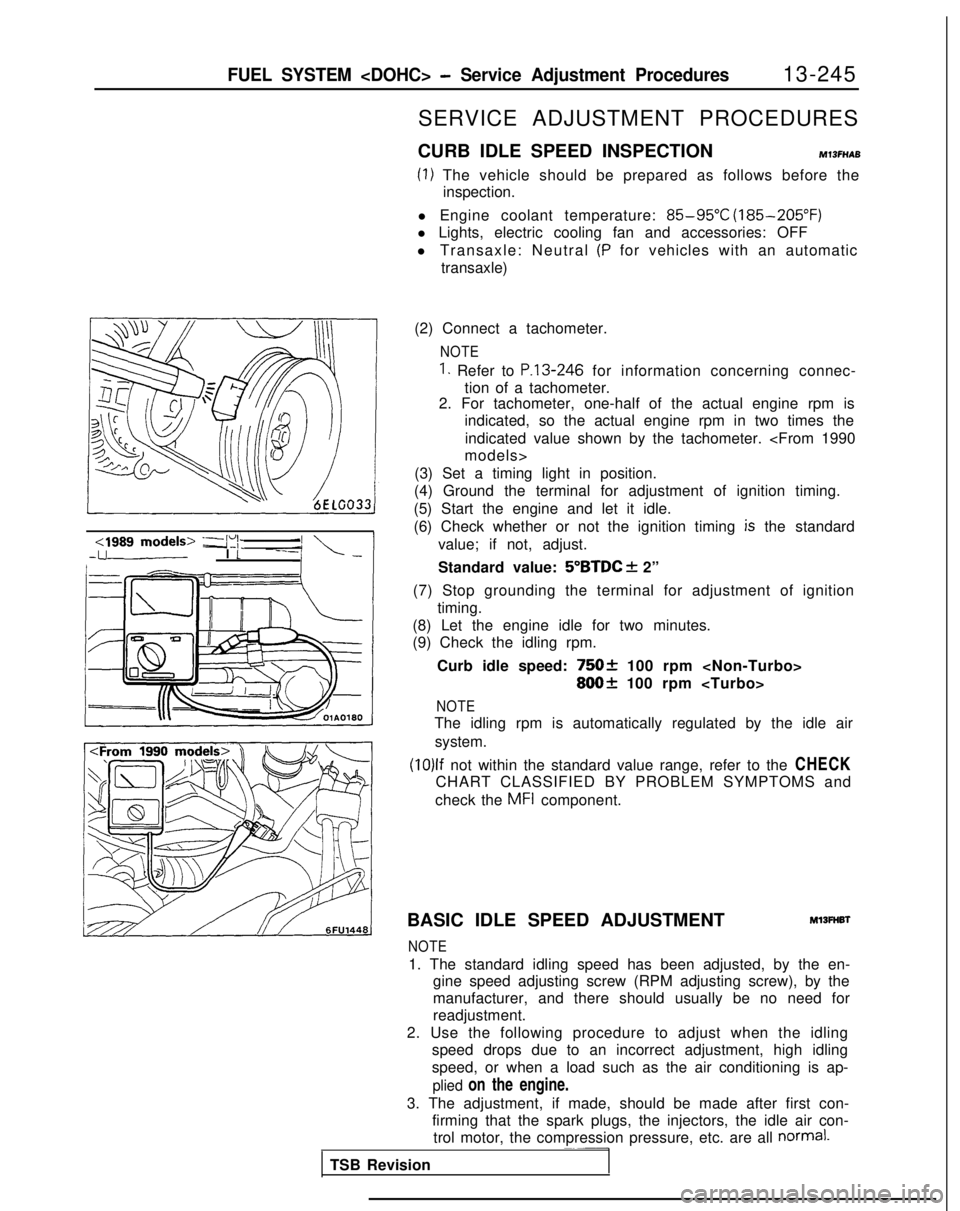
(1) The vehicle should be prepared as follows before the inspection.
l Engine coolant temperature:
85-95°C (185-205°F)
l Lights, electric cooling fan and accessories: OFF
l Transaxle: Neutral
(P for vehicles with an automatic
transaxle)
(2) Connect a tachometer.
NOTE
1. Refer to P.13-246 for information concerning connec-
tion of a tachometer.
2. For tachometer, one-half of the actual engine rpm is
indicated, so the actual engine rpm in two times the
indicated value shown by the tachometer.
(3) Set a timing light in position.
(4) Ground the terminal for adjustment of ignition timing.
(5) Start the engine and let it idle.
(6) Check whether or not the ignition timing
is the standard
value; if not, adjust.
Standard value:
5”BTDC f 2”
(7) Stop grounding the terminal for adjustment of ignition timing.
(8) Let the engine idle for two minutes.
(9) Check the idling rpm.
Curb idle speed:
75Ok 100 rpm
800+ 100 rpm
NOTE
The idling rpm is automatically regulated by the idle airsystem.
(10)lf not within the standard value range, refer to the CHECK
CHART CLASSIFIED BY PROBLEM SYMPTOMS and
check the
MFI component.
BASIC IDLE SPEED ADJUSTMENT
Ml3FHBl
NOTE
1. The standard idling speed has been adjusted, by the en- gine speed adjusting screw (RPM adjusting screw), by the
manufacturer, and there should usually be no need for
readjustment.
2. Use the following procedure to adjust when the idling speed drops due to an incorrect adjustment, high idling
speed, or when a load such as the air conditioning is ap-
plied on the engine.
3. The adjustment, if made, should be made after first con- firming that the spark plugs, the injectors, the idle air con-trol motor, the compression pressure, etc. are all
normal.~~-
TSB Revision
Page 389 of 1273
FUEL SYSTEM
NOTE
For rpm, one-half of the actual engine rpm is indicated,
so the actual engine rpm in two times the indicated
value shown by the tachometer.
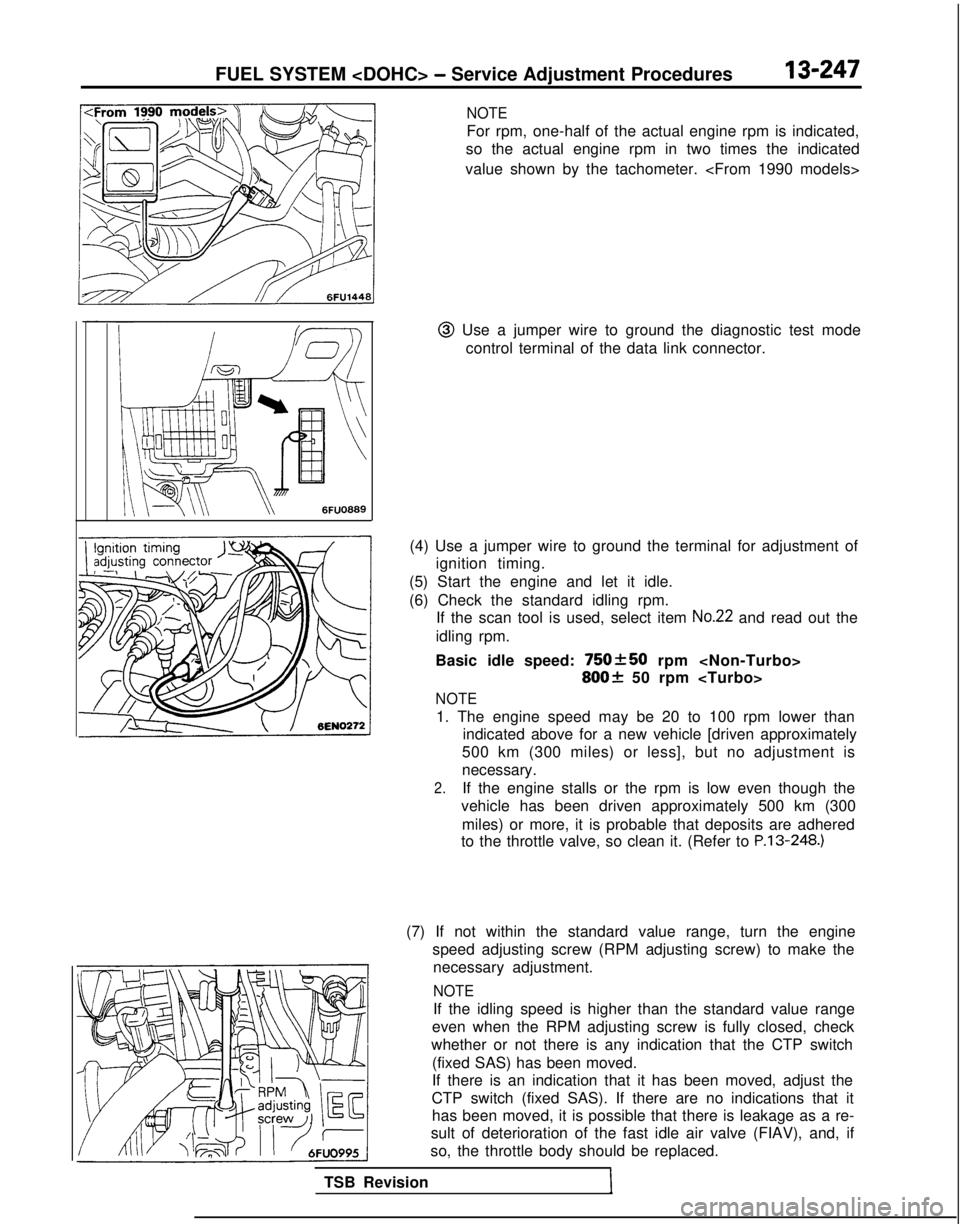
@I Use a jumper wire to ground the diagnostic test mode control terminal of the data link connector.
(4) Use a jumper wire to ground the terminal for adjustment of ignition timing.
(5) Start the engine and let it idle.
(6) Check the standard idling rpm. If the scan tool is used, select item
No.22 and read out the
idling rpm.
Basic idle speed:
750+50 rpm
800f 50 rpm
NOTE
1. The engine speed may be 20 to 100 rpm lower than indicated above for a new vehicle [driven approximately
500 km (300 miles) or less], but no adjustment is
necessary.
2.If the engine stalls or the rpm is low even though the
vehicle has been driven approximately 500 km (300
miles) or more, it is probable that deposits are adhered
to the throttle valve, so clean it. (Refer to P.13-248.)
TSB Revision
1
(7) If not within the standard value range, turn the engine speed adjusting screw (RPM adjusting screw) to make thenecessary adjustment.
NOTE
If the idling speed is higher than the standard value range
even when the RPM adjusting screw is fully closed, check
whether or not there is any indication that the CTP switch
(fixed SAS) has been moved.
If there is an indication that it has been moved, adjust the
CTP switch (fixed SAS). If there are no indications that it has been moved, it is possible that there is leakage as a re-
sult of deterioration of the fast idle air valve (FIAV), and, if
so, the throttle body should be replaced.
Page 390 of 1273
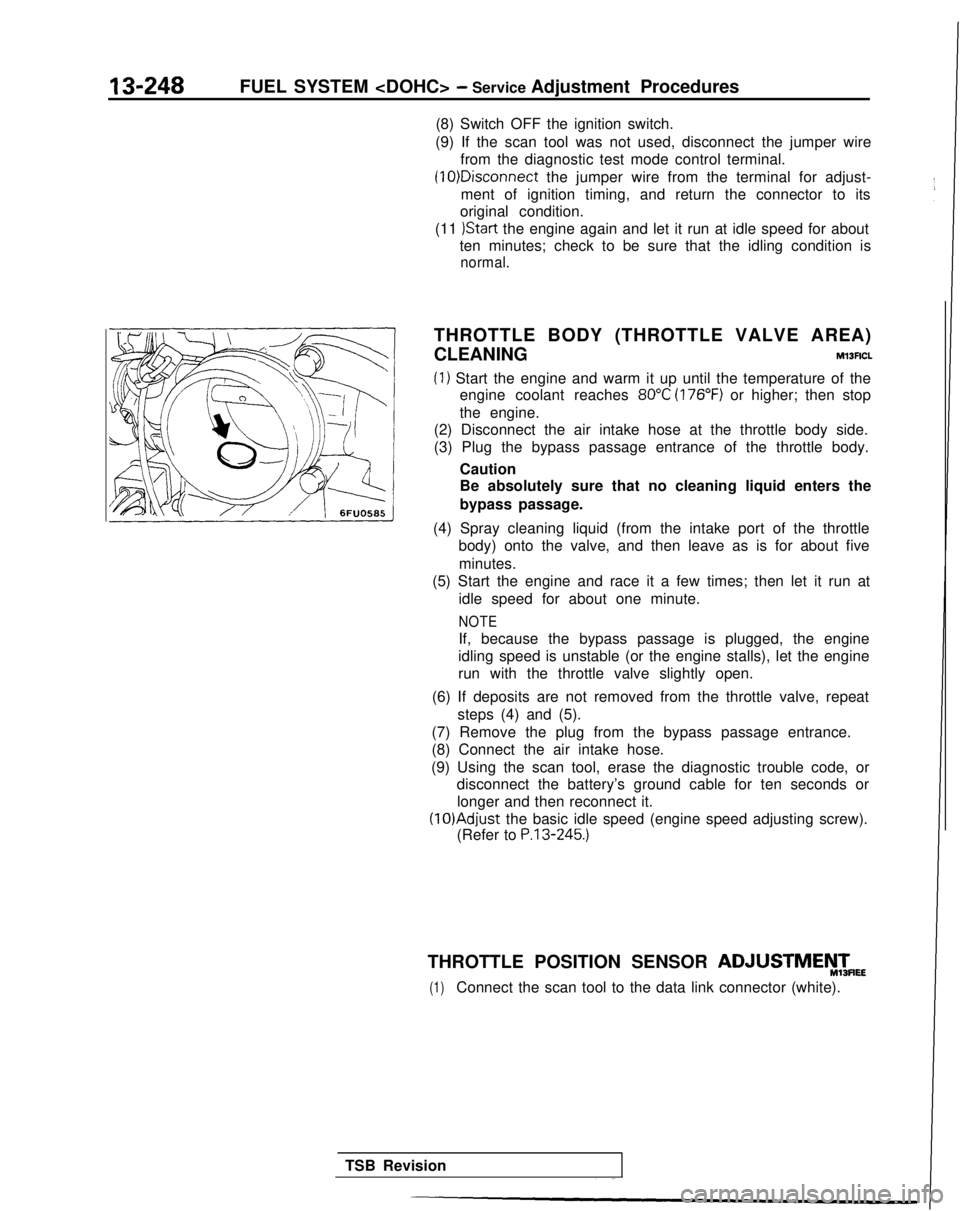
13-248FUEL SYSTEM
(8) Switch OFF the ignition switch.
(9) If the scan tool was not used, disconnect the jumper wire from the diagnostic test mode control terminal. (10)Disconnect
the jumper wire from the terminal for adjust-
ment of ignition timing, and return the connector to its
original condition.
(11
)Start the engine again and let it run at idle speed for about
ten minutes; check to be sure that the idling condition is
normal.
THROTTLE BODY (THROTTLE VALVE AREA)
CLEANING
Ml3ACL
(1) Start the engine and warm it up until the temperature of the engine coolant reaches
80°C (176°F) or higher; then stop
the engine.
(2) Disconnect the air intake hose at the throttle body side.
(3) Plug the bypass passage entrance of the throttle body.
Caution
Be absolutely sure that no cleaning liquid enters the
bypass passage.
(4) Spray cleaning liquid (from the intake port of the throttle body) onto the valve, and then leave as is for about five
minutes.
(5) Start the engine and race it a few times; then let it run at
idle speed for about one minute.
NOTE
If, because the bypass passage is plugged, the engine
idling speed is unstable (or the engine stalls), let the engine
run with the throttle valve slightly open.
(6) If deposits are not removed from the throttle valve, repeat steps (4) and (5).
(7) Remove the plug from the bypass passage entrance.
(8) Connect the air intake hose.
(9) Using the scan tool, erase the diagnostic trouble code, or disconnect the battery’s ground cable for ten seconds or
longer and then reconnect it. (lO)Adjust
the basic idle speed (engine speed adjusting screw).
(Refer to
P.13-245.)
THROTTLE POSITION SENSOR ADJUSTMEyTmEE
(1)Connect the scan tool to the data link connector (white).
TSB Revision
Page 391 of 1273
FUEL SYSTEM
13-249
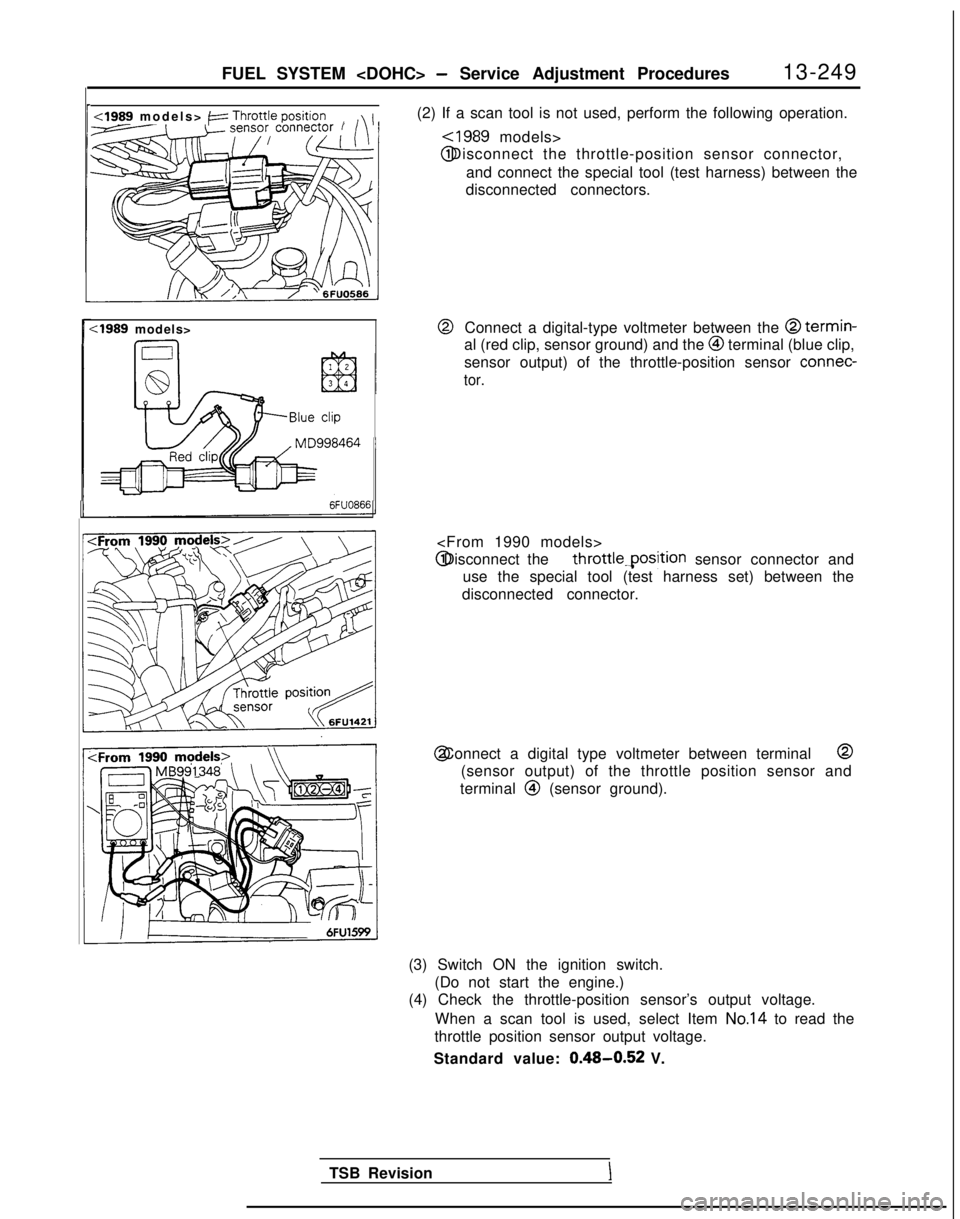
<1989 models> /zz Throttle position
(2) If a scan tool is not used, perform the following operation.,-
~1989 models> @ Disconnect the throttle-position sensor connector,
and connect the special tool (test harness) between the
disconnected connectors.
:1989 models>@Connect a digital-type voltmeter between the @ termin-
al (red clip, sensor ground) and the @I terminal (blue clip,
sensor output) of the throttle-position sensor connec-
tor.
Blue
clip
throttle.position sensor connector and
use the special tool (test harness set) between the
disconnected connector. @ Connect a digital type voltmeter between terminal @
(sensor output) of the throttle position sensor and
terminal
@ (sensor ground).
(3) Switch ON the ignition switch. (Do not start the engine.)
(4) Check the throttle-position sensor’s output voltage.
When a scan tool is used, select Item
No.14 to read the
throttle position sensor output voltage.
Standard value:
0.48-0.52 V.
TSB Revision
I
Page 393 of 1273
FUEL SYSTEM
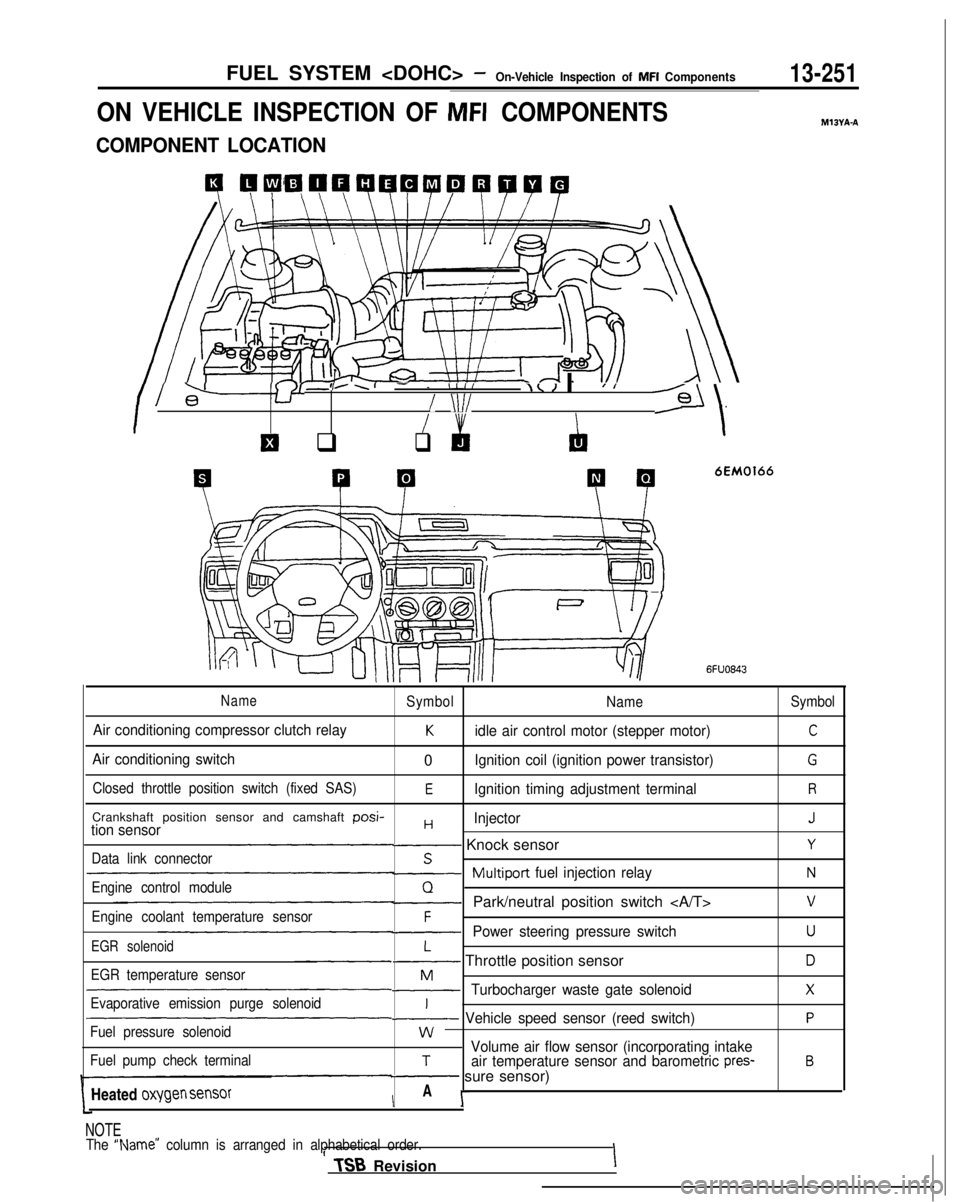
ON VEHICLE INSPECTION OF MFI COMPONENTS
COMPONENT LOCATION
4 QCiW41QQWPQWQ
I l-+-Y8’
-,..I- - IIII\< I IJ I
/ \lI/--Gl/
El q
I &
q
‘\
P P
6EM0166
MIBYA-A
6FUO843
NameSymbol
NameSymbol
Air conditioning compressor clutch relayKidle air control motor (stepper motor)C
Air conditioning switch0Ignition coil (ignition power transistor)G
Closed throttle position switch (fixed SAS)EIgnition timing adjustment terminalR
Crankshaft position sensor and camshaft posi-HInjectorJtion sensor- Knock sensorYData link connectorS~Multiport
fuel injection relayNEngine control moduleQ-Park/neutral position switch vEngine coolant temperature sensorF-Power steering pressure switchUEGR solenoidL- Throttle position sensorDEGR temperature sensorM-Turbocharger waste gate solenoidXEvaporative emission purge solenoidI~ Vehicle speed sensor (reed switch)PFuel pressure solenoidwVolume air flow sensor (incorporating intakeFuel pump check terminalTair temperature sensor and barometric pres-B- sure sensor)
Heated
oxygen sensorIA I-
NOTE
The “Name” column is arranged in alphabetical order.II TSB
RevisionI
Page 397 of 1273
FUEL SYSTEM
COMPONENTS INSPECTION PROCEDURE-
Using Scan ToolMlsYsAGa
Refer to P.13-41.
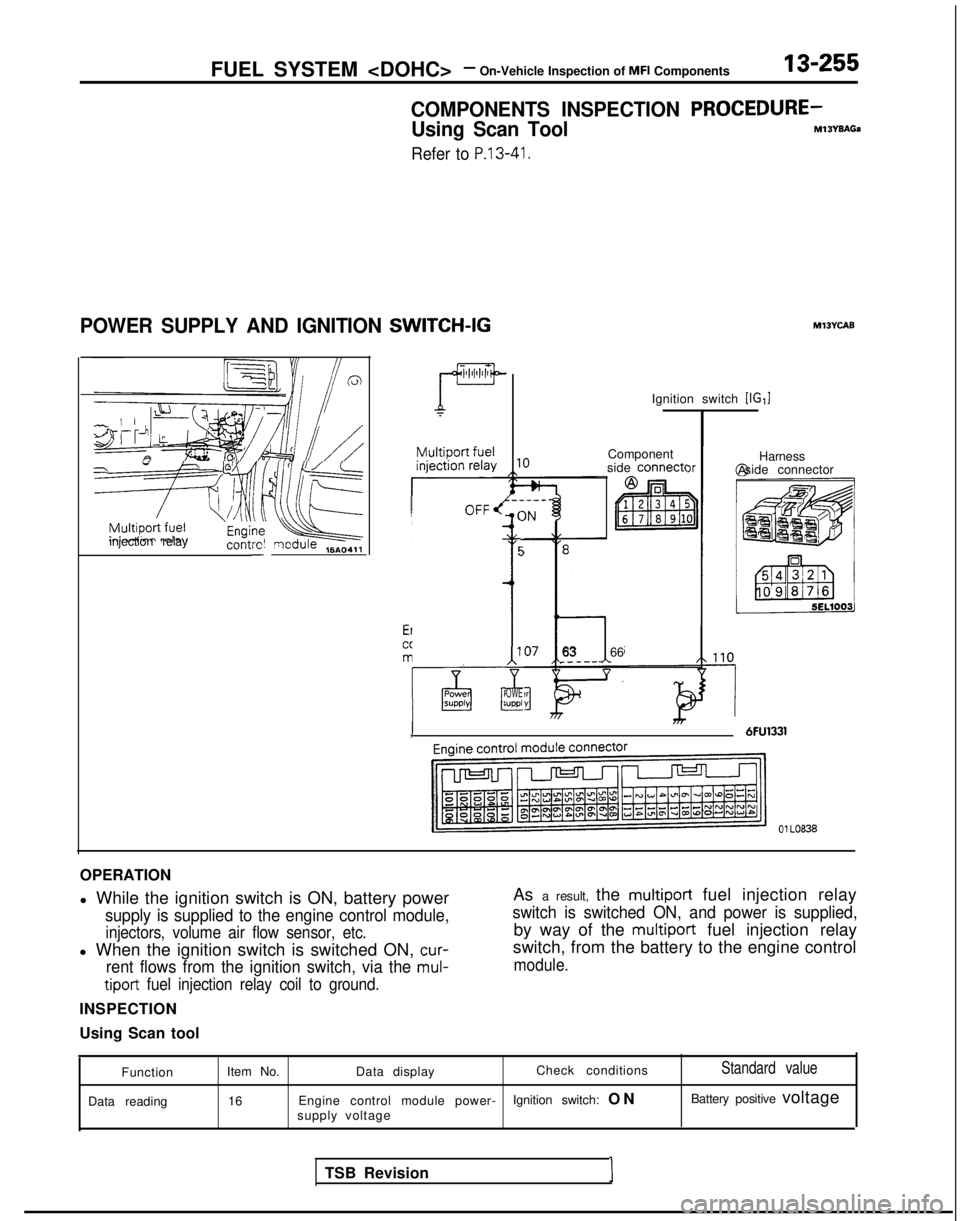
POWER SUPPLY AND IGNITION SWITCH-IG
zT=f?Qjkeinjection relay
contrc! qcdule ,6A04,,-
----_OFF/ (IN
t5
’ i
4
-
‘OWE;uppl-
Ignition switch [IG,]
Component
side
connect<
763 66.----
1 6FU1331, )r
Ml3YcAB
Harness
@ side connector
01 LO838
OPERATION
l While the ignition switch is ON, battery power
supply is supplied to the engine control module,
injectors, volume air flow sensor, etc.
l When the ignition switch is switched ON, cur-
rent flows from the ignition switch, via the mul-
tiport
fuel injection relay coil to ground.
INSPECTION
Using Scan tool As a result, the
multiport fuel injection relay
switch is switched ON, and power is supplied,
by way of the multiport fuel injection relay
switch, from the battery to the engine control
module.
Function
Data reading Item No.
Data display Check conditionsStandard value
16
Engine control module power- Ignition switch: O
N
Battery positive voltage
supply voltage
TSB Revision I