sensor MITSUBISHI GALANT 1989 Service Repair Manual
[x] Cancel search | Manufacturer: MITSUBISHI, Model Year: 1989, Model line: GALANT, Model: MITSUBISHI GALANT 1989Pages: 1273, PDF Size: 37.62 MB
Page 1013 of 1273
![MITSUBISHI GALANT 1989 Service Repair Manual 33B-74 ACTIVE-ELECTRONIC CONTROL SUSPENSION - Troubleshooting[27]
ACTIVE-ECS RELATED DIAGNOSTIC/SERVICE DATA OUTPUT CIRCUIT
ECU
IGz
8’i- 1
F-19
F-16
mi
_-___- ____79
-I I
58 E
0
___--
1
_-___---
g7](/img/19/57312/w960_57312-1012.png "MITSUBISHI GALANT 1989 Service Repair Manual 33B-74 ACTIVE-ELECTRONIC CONTROL SUSPENSION - Troubleshooting[27]
ACTIVE-ECS RELATED DIAGNOSTIC/SERVICE DATA OUTPUT CIRCUIT
ECU
IGz
8’i- 1
F-19
F-16
mi
_-___- ____79
-I I
58 E
0
___--
1
_-___---
g7")
33B-74 ACTIVE-ELECTRONIC CONTROL SUSPENSION - Troubleshooting[27]
ACTIVE-ECS RELATED DIAGNOSTIC/SERVICE DATA OUTPUT CIRCUIT
ECU
IGz
8’i- 1
F-19
F-16
mi
_-___- ____79
-I I
58 E
0
___--
1
_-___---
g7
3
.-
13
t
r
16131817\I/ (1989
models)
Vehicle-speed
sensor (meter) c-43
Serial/on-board
diagnostic outputconnector
C-l 8
p!5iE&qSimulatedvehicle-
-1
speed
input
12AO479
TSB Revision
Page 1015 of 1273
33B-76 ACTIVE-ELECTRONIC CONTROL SUSPENSION - Troubleshooting
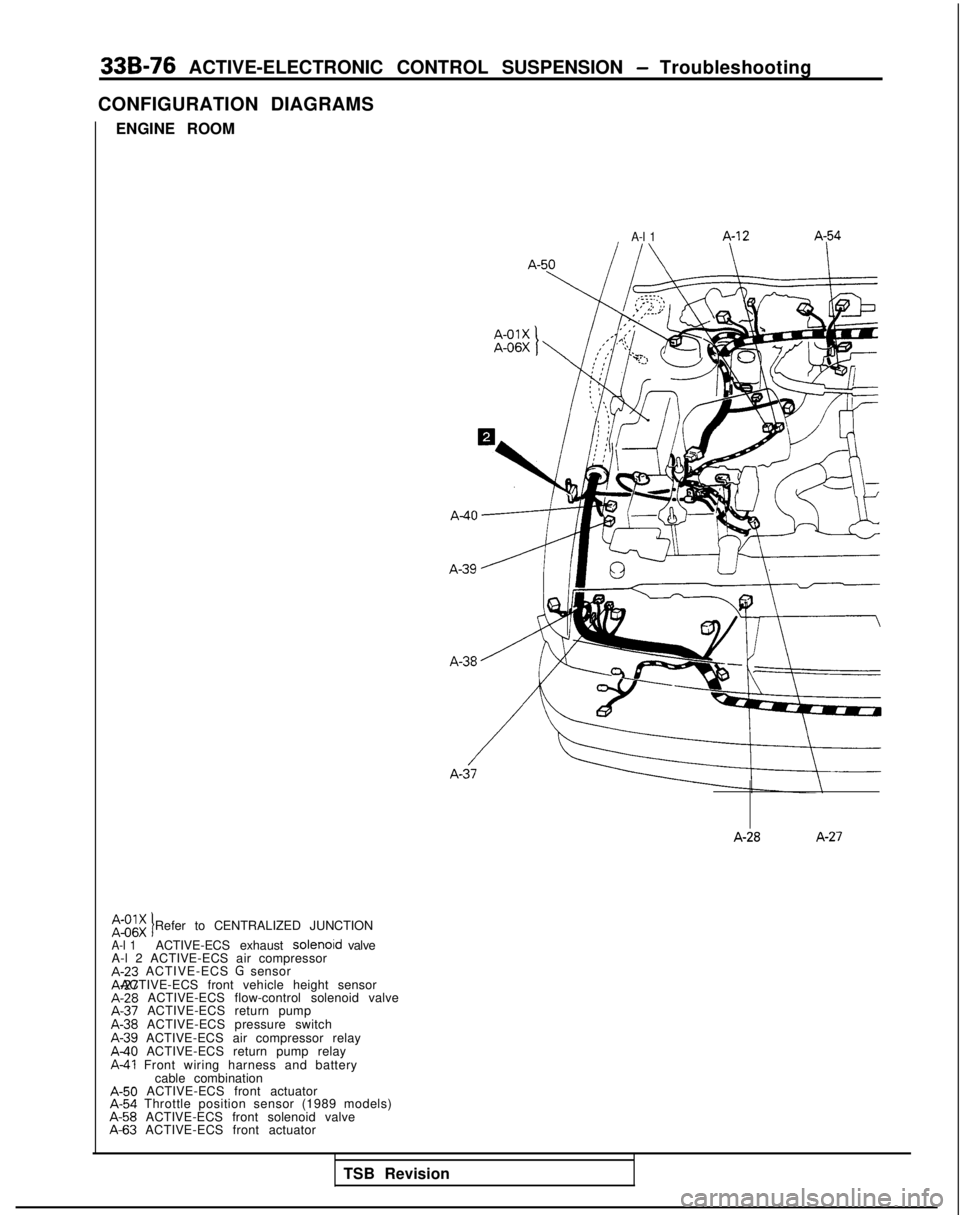
CONFIGURATION DIAGRAMS ENGINE ROOM
A-l 1 A-12 A-54
A-28
A-27
2:;. Refer to CENTRALIZED JUNCTIONIA-l 1ACTIVE-ECS exhaust solenoid valve
A-l 2 ACTIVE-ECS air compressor A-23
ACTIVE-ECS
G sensor A-27 ACTIVE-ECS front vehicle height sensor
A-28
ACTIVE-ECS flow-control solenoid valve A-37
ACTIVE-ECS return pump A-38
ACTIVE-ECS pressure switch A-39
ACTIVE-ECS air compressor relay
A40 ACTIVE-ECS return pump relayA-41 Front wiring harness and battery
cable combination A-50
ACTIVE-ECS front actuator A-54
Throttle position sensor (1989 models) A-58
ACTIVE-ECS front solenoid valve A-63
ACTIVE-ECS front actuator
TSB Revision
Page 1017 of 1273

336-78 ACTIVE-ELECTRONIC CONTROL SUSPENSION - Troubleshooting
Concentrated junction
Dedicated fuses
@I-@ A-01X Headlight relayA-06X ACTIVE-ECS solenoidvalve power source relay
‘\
I,BR/LB
A-01X
\
8383mB
Sub fusible link 0-a
/
16A0567
ENGINE AND TRANSAXLE
B-l 5 Alternator
B-21 Backup light switchB-02-1 Throttle posltion
sensor (From 1990 models)
Ground point (detailed view)
36A0308
TSB Revision
Page 1025 of 1273
33B-86 ACTIVE-ELECTRONIC CONTROL SUSPENSION - ~~u,:~%i?:~~~~
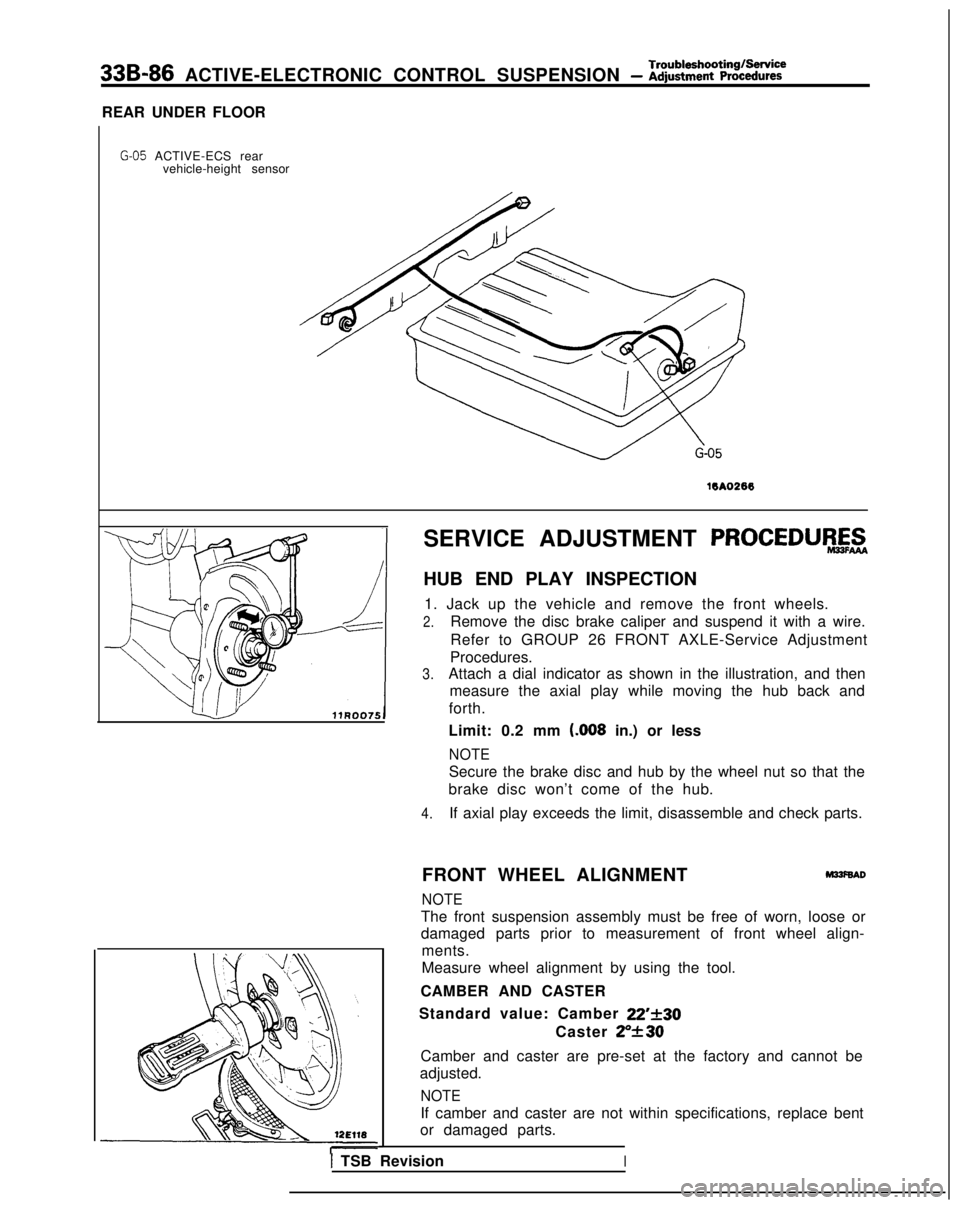
REAR UNDER FLOOR
G-05 ACTIVE-ECS rear vehicle-height sensor
16A0266
SERVICE ADJUSTMENT PROCEDURAZ
HUB END PLAY INSPECTION
1. Jack up the vehicle and remove the front wheels.
2.Remove the disc brake caliper and suspend it with a wire.
Refer to GROUP 26 FRONT AXLE-Service Adjustment
Procedures.
3.Attach a dial indicator as shown in the illustration, and then measure the axial play while moving the hub back and
forth.
Limit: 0.2 mm t.008
in.) or less
NOTE
Secure the brake disc and hub by the wheel nut so that the
brake disc won’t come of the hub.
4.If axial play exceeds the limit, disassemble and check parts.
FRONT WHEEL ALIGNMENT
M33f6AD
NOTE
The front suspension assembly must be free of worn, loose or
damaged parts prior to measurement of front wheel align- ments.
Measure wheel alignment by using the tool.
CAMBER AND CASTER
Standard value: Camber
22’f30
Caster ZY30
Camber and caster are pre-set at the factory and cannot be
adjusted.
NOTE
If camber and caster are not within specifications, replace bent
or damaged parts.
I TSB RevisionI
Page 1027 of 1273
338-88 ACTIVE-ELECTRONIC CONTROL SUSPENSION - ~~~%.,~Rment
With voltmeter
!//ii’12A0476
L
edge surface17AOOW(Right
Front) (Left
Rear)
12A0224 J3. When vehicle-height adjustments are made frequently
After stopping the engine, open the hood and allowthe compressor to cool; then restart the engine.
4. When the vehicle is driven on winding roads in the
mountains continuously for 18 minutes or longer.
To protect the return pump from damage, stop the
engine and then restart it.
*: Applicable to 1989 models only.
CHECKING BY ON-BOARD DIAGNOSTIC
1.Regardless of whether or not the alarm light is illuminated,
check the diagnostic output codes at the diagnostic termi-
nal.
2. If a malfunction code is output to the diagnostic terminal, perform the troubleshooting procedures according to the
output code.
NOTE
Diagnostic trouble codes are entered into the memory, even if
the ignition is at the OFF position, so that it is possible to check
for the existence of malfunctions that occurred previously.
NORMAL VEHICLE HEIGHT CHECK AND ADJUST-
MENT
1. Park the vehicle on a flat surface.
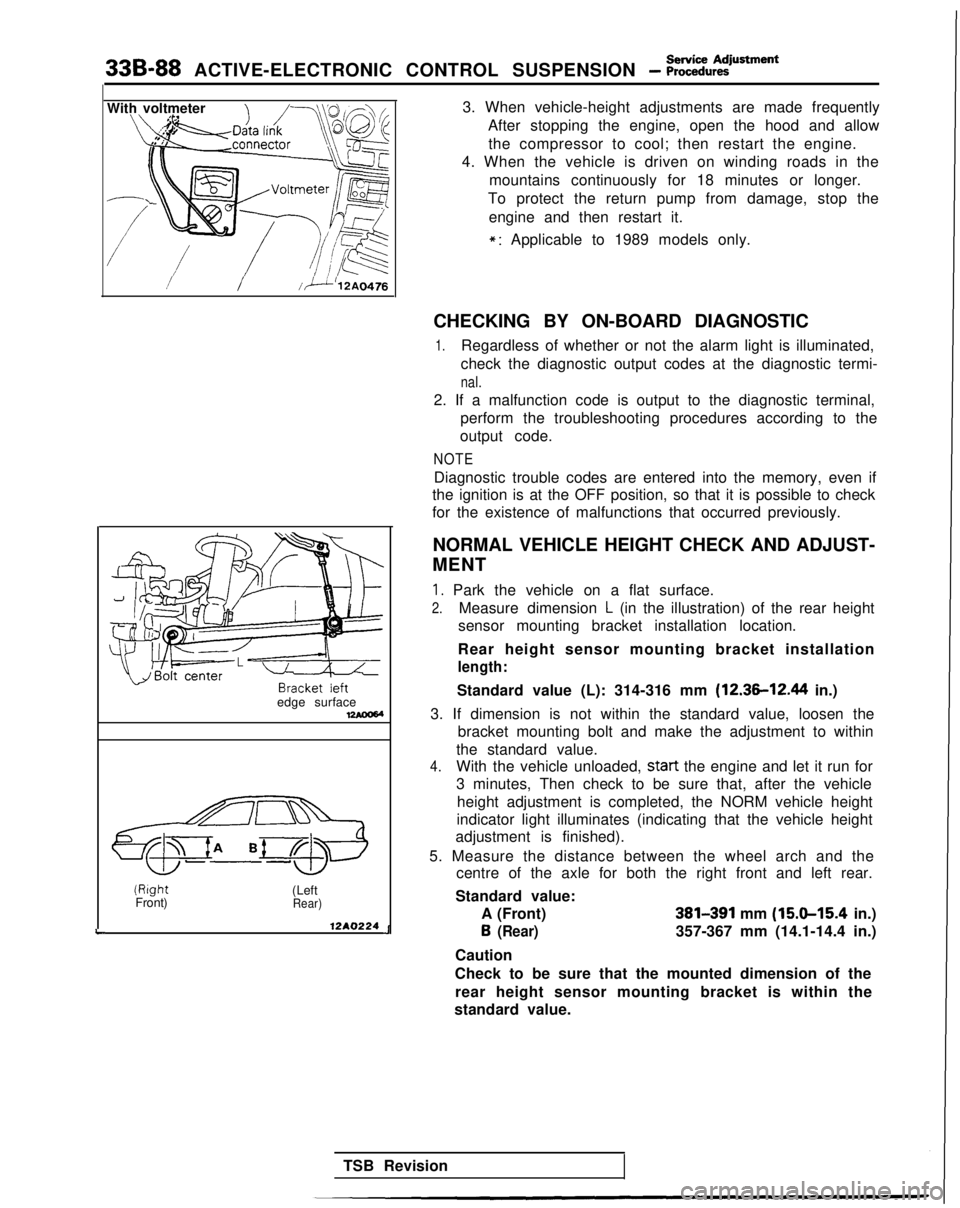
2.Measure dimension L (in the illustration) of the rear height
sensor mounting bracket installation location.
Rear height sensor mounting bracket installation
length:
Standard value (L): 314-316 mm (12.36-12.44 in.)
3. If dimension is not within the standard value, loosen the bracket mounting bolt and make the adjustment to within
the standard value.
4.With the vehicle unloaded, start
the engine and let it run for
3 minutes, Then check to be sure that, after the vehicle
height adjustment is completed, the NORM vehicle height
indicator light illuminates (indicating that the vehicle height
adjustment is finished).
5. Measure the distance between the wheel arch and the centre of the axle for both the right front and left rear.
Standard value: A (Front)
381391 mm (15.9-15.4 in.) 6
(Rear)357-367 mm (14.1-14.4 in.)
Caution
Check to be sure that the mounted dimension of the rear height sensor mounting bracket is within the
standard value.
TSB Revision
Page 1028 of 1273
ACTIVE-ELECTRONIC CONTROL SUSPENSION - ~~:i%,~:iustment 33B-89
Without
disconnecting
:he air tubing
Remaining
pressure
P =
120 kPa
(17 psi)
By disconnecting the
fir tubing
normal
condition
P ‘=.0
Front
tear (From 1990
model!
rmzIIconditlui
12AO281
Vehicle-height switch 6. If the vehicle height is not within the standard value,
loosen the turnbuckles of the front and rear height sensor
rods, and then make the adjustment by changing the
length of the rods. The vehicle height becomes higher
when the rods are lengthened.
Caution 1. Both the front and rear heights must be checked, because, even though only the front or the rear is
adjusted, the other height (rear or front) is also
changed.
2. The adjustments of the vehicle height must be made
while the engine is idling (vehicle stopped).
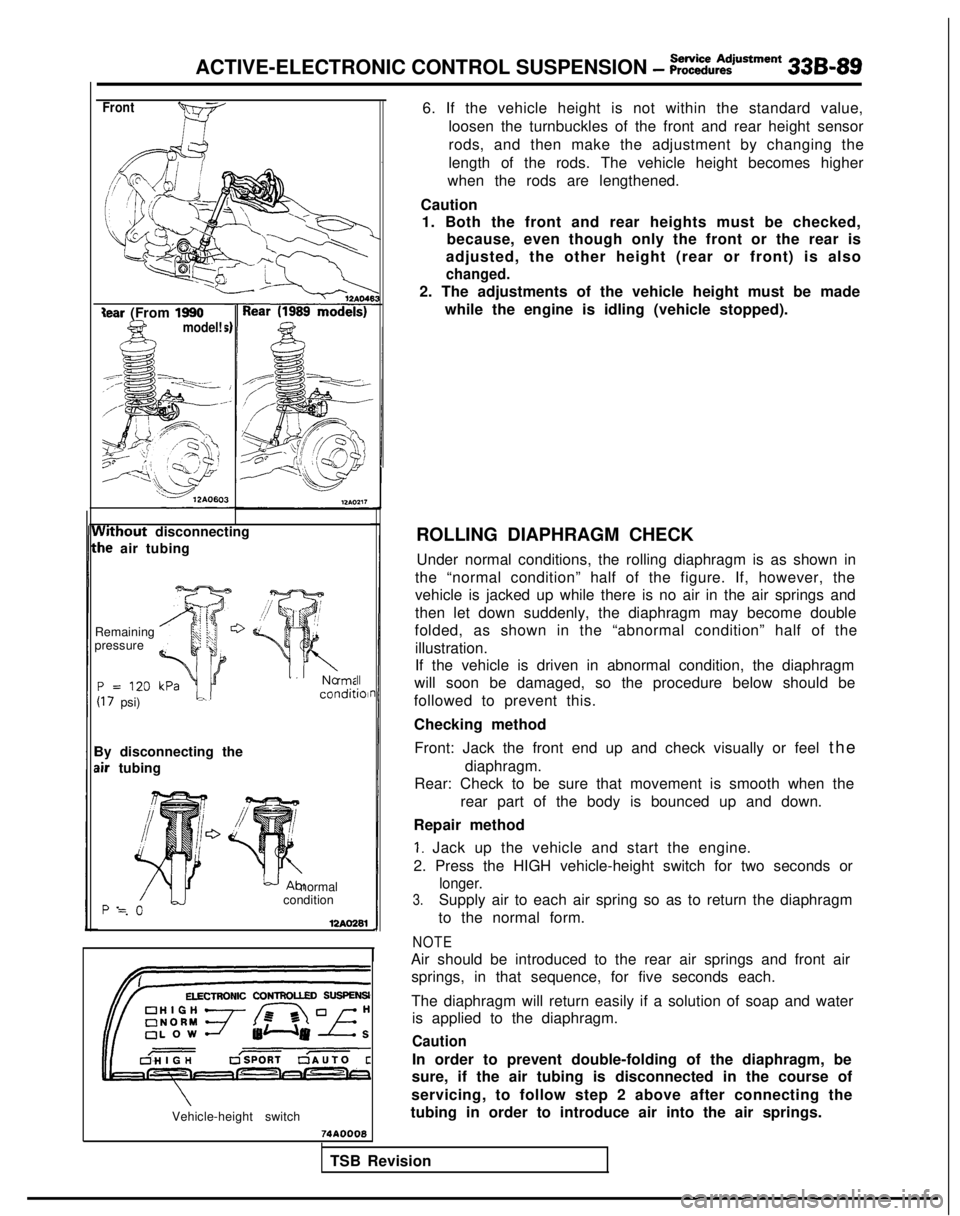
ROLLING DIAPHRAGM CHECK Under normal conditions, the rolling diaphragm is as shown in
the “normal condition” half of the figure. If, however, the
vehicle is jacked up while there is no air in the air springs and
then let down suddenly, the diaphragm may become double
folded, as shown in the “abnormal condition” half of the
illustration.
If the vehicle is driven in abnormal condition, the diaphragm
will soon be damaged, so the procedure below should be
followed to prevent this.
Checking method
Front: Jack the front end up and check visually or feel th
e
diaphragm.
Rear: Check to be sure that movement is smooth when the
rear part of the body is bounced up and down.
Repair method
1. Jack up the vehicle and start the engine.
2. Press the HIGH vehicle-height switch for two seconds or
longer.
3.Supply air to each air spring so as to return the diaphragm
to the normal form.
NOTE
Air should be introduced to the rear air springs and front air springs, in that sequence, for five seconds each.
The diaphragm will return easily if a solution of soap and water is applied to the diaphragm.
Caution
In order to prevent double-folding of the diaphragm, be
sure, if the air tubing is disconnected in the course of
servicing, to follow step 2 above after connecting the
tubing in order to introduce air into the air springs.
74AOOQ8
TSB Revision
Page 1035 of 1273
338-96
ACTIVE-ELECTRONIC CONTROL SUSPENSION - ;;~:;u~:iusment
Low-pressure
switch
PressurekPa (psi)
I
OFF
t
140 (20)
70 (10)
ON
12AO226
12A04P
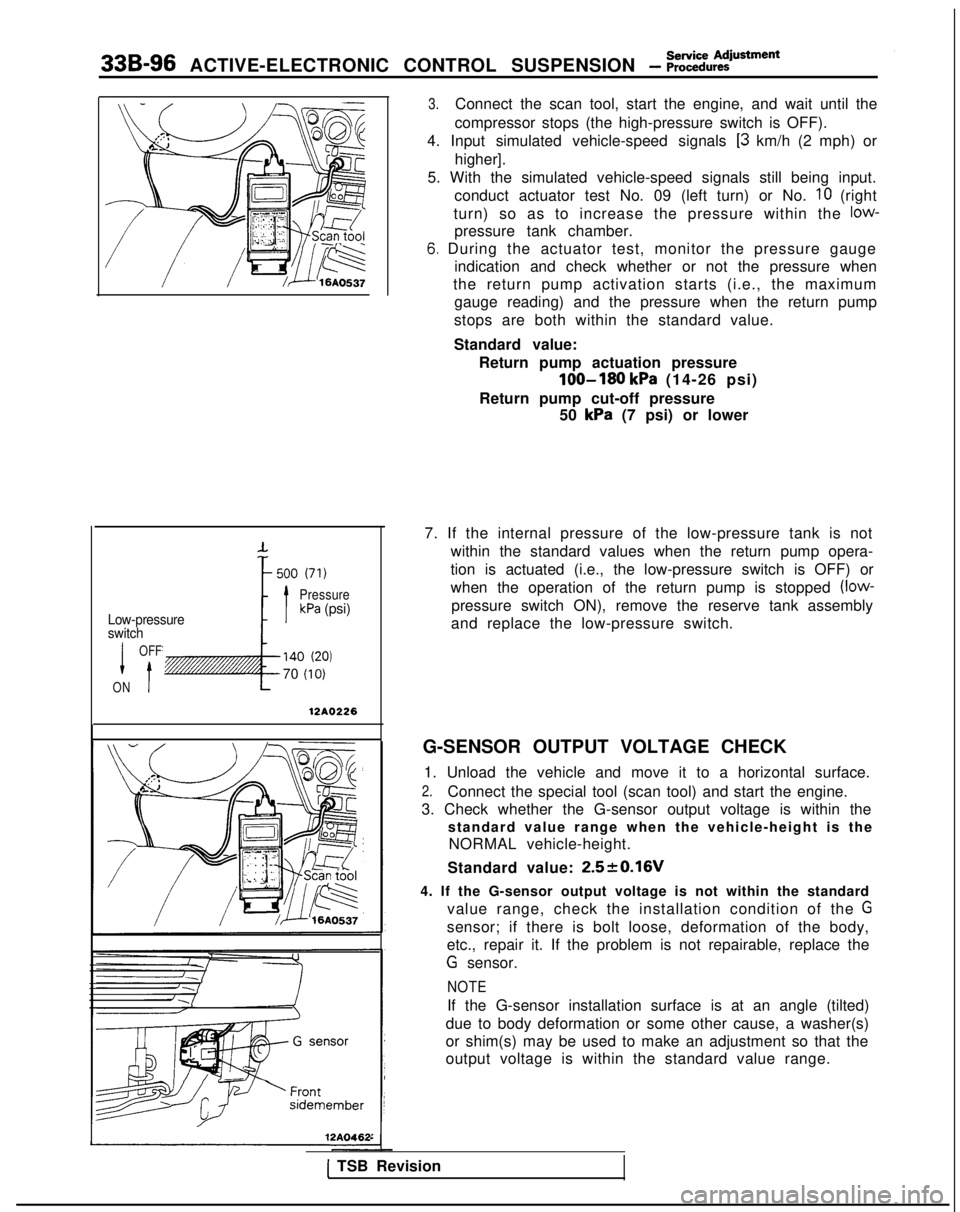
3.Connect the scan tool, start the engine, and wait until the
compressor stops (the high-pressure switch is OFF).
4. Input simulated vehicle-speed signals
[3 km/h (2 mph) or
higher].
5. With the simulated vehicle-speed signals still being input. conduct actuator test No. 09 (left turn) or No.
IO (right
turn) so as to increase the pressure within the
low-
pressure tank chamber.
6. During the actuator test, monitor the pressure gauge indication and check whether or not the pressure when
the return pump activation starts (i.e., the maximum gauge reading) and the pressure when the return pump
stops are both within the standard value.
Standard value: Return pump actuation pressure
loo-180 kPa (14-26 psi)
Return pump cut-off pressure 50
kPa (7 psi) or lower
7. If the internal pressure of the low-pressure tank is not within the standard values when the return pump opera-
tion is actuated (i.e., the low-pressure switch is OFF) or
when the operation of the return pump is stopped
(low-
pressure switch ON), remove the reserve tank assembly
and replace the low-pressure switch.
G-SENSOR OUTPUT VOLTAGE CHECK 1. Unload the vehicle and move it to a horizontal surface.
2.Connect the special tool (scan tool) and start the engine.
3. Check whether the G-sensor output voltage is within the standard value range when the vehicle-height is theNORMAL vehicle-height.
Standard value:
2.520.16V
4. If the G-sensor output voltage is not within the standard value range, check the installation condition of the
G
sensor; if there is bolt loose, deformation of the body,
etc., repair it. If the problem is not repairable, replace the
G sensor.
NOTE
If the G-sensor installation surface is at an angle (tilted)
due to body deformation or some other cause, a washer(s)
or shim(s) may be used to make an adjustment so that the
output voltage is within the standard value range.
1 TSB Revision
Page 1036 of 1273
ACTIVE-ELECTRONIC CONTROL SUSPENSION - Strut Assembly33B-97
STRUT ASSEMBLYM33zOAC
REMOVAL AND INSTALLATION
6
40-50 Nm
29-36 ft.lbs.
Right side
17-26 Nm 12-19
ftlbs.
12A0230
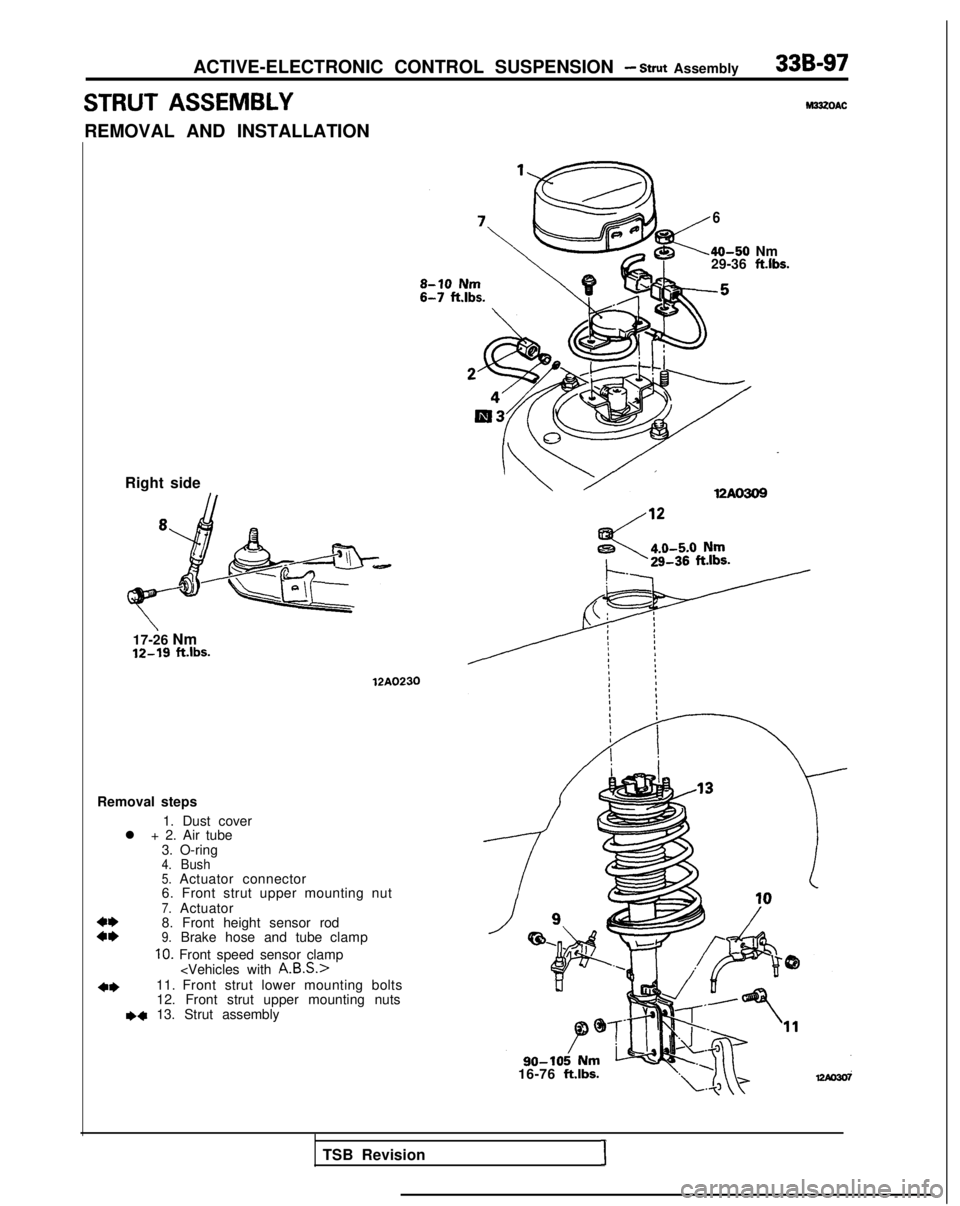
Removal steps
1. Dust cover
l + 2. Air tube
3. O-ring
4.Bush5.Actuator connector
6. Front strut upper mounting nut
7.Actuator
4*8. Front height sensor rod::9.Brake hose and tube clamp
10. Front speed sensor clamp
4*11. Front strut lower mounting bolts12. Front strut upper mounting nuts
+a 13. Strut assembly
16-76
ft.lbs.
TSB Revision1
Page 1037 of 1273
33B-98ACTIVE-ELECTRONIC CONTROL SUSPENSION - Strut Assembly i
SERVICE POINTS OF REMOVALM33lBAE
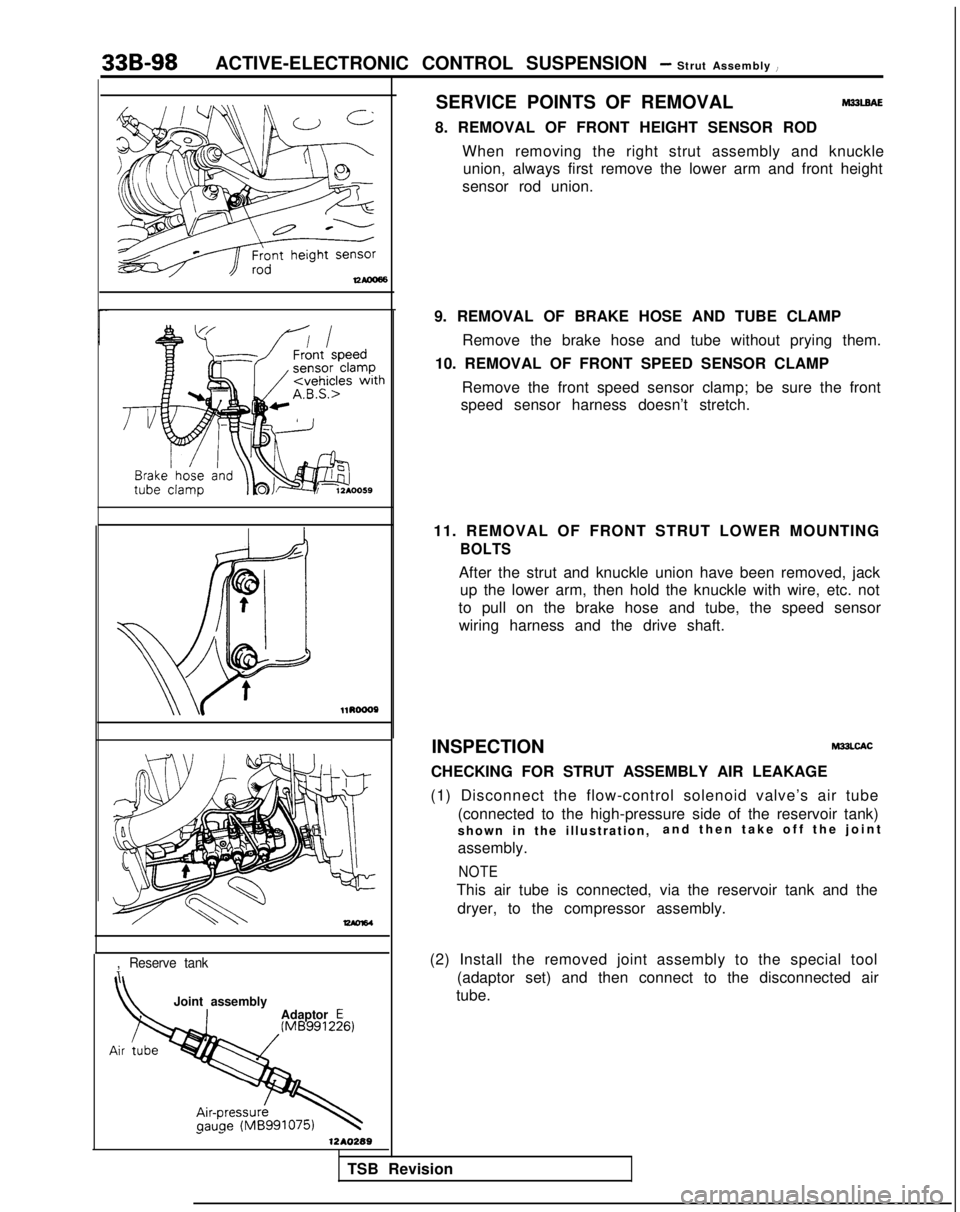
8. REMOVAL OF FRONT HEIGHT SENSOR RODWhen removing the right strut assembly and knuckleunion, always first remove the lower arm and front height
sensor rod union. l1RoooP
-
,Reserve tank
Joint assembly
Adaptor E
1 -1210289
9. REMOVAL OF BRAKE HOSE AND TUBE CLAMP
Remove the brake hose and tube without prying them.
10. REMOVAL OF FRONT SPEED SENSOR CLAMP
Remove the front speed sensor clamp; be sure the front
speed sensor harness doesn’t stretch.
11. REMOVAL OF FRONT STRUT LOWER MOUNTING
BOLTS
After the strut and knuckle union have been removed, jack up the lower arm, then hold the knuckle with wire, etc. not
to pull on the brake hose and tube, the speed sensor wiring harness and the drive shaft.
INSPECTION
M33LCAC
CHECKING FOR STRUT ASSEMBLY AIR LEAKAGE
(1) Disconnect the flow-control solenoid valve’s air tube (connected to the high-pressure side of the reservoir tank)
shown in the illustration, and then take off the join
t
assembly.
NOTE
This air tube is connected, via the reservoir tank and the dryer, to the compressor assembly.
(2) Install the removed joint assembly to the special tool (adaptor set) and then connect to the disconnected air
tube.
TSB Revision
Page 1042 of 1273
ACTIVE-ELECTRONIC CONTROL SUSPENSION - f:::,%tmb’y’ 33B-103
pF&O-rin
g
81210311
2. INSTALLATION OF O-RING/l. JOINT
Apply a coating of rubber grease to the O-ring, install it tothe joint, and then install to the piston rod.
LOWER ARM
REMOVAL AND INSTALLATION .
35-45 Nm
25-33
ft.lbs.
.-- ~~69-87 .ft.lbs.*
eLII-uu. . ..“a. 80-100
Nni*
1.
35-45 Nm 17
'
- /I MJJNA-A
58-72
ft.lbs.* 9
---. .- ..__.
SO-100 Nm12A0316
1058-72ft.lbs.
\ 17-26 Nm
12-18 ft.lbs.
lZA0230
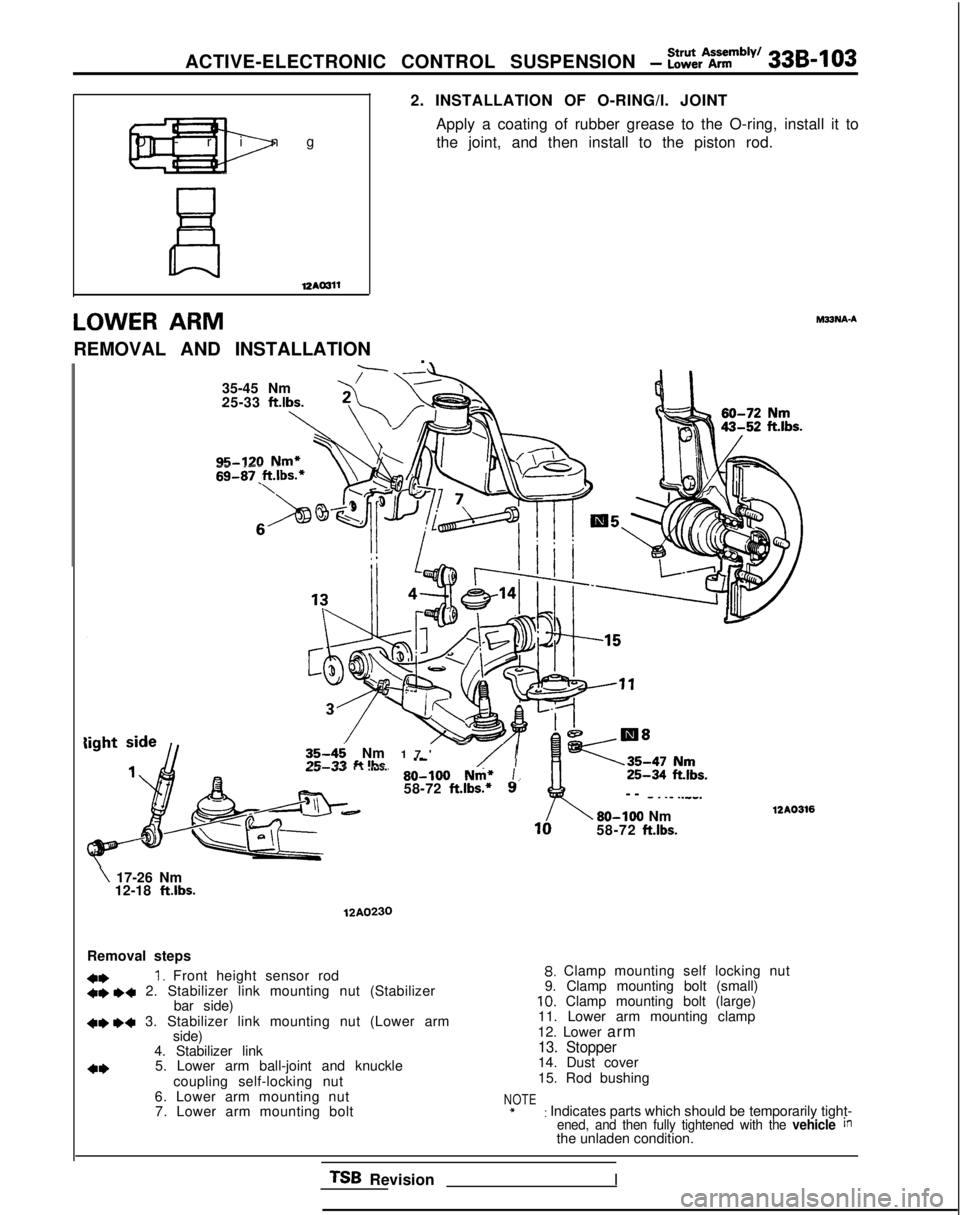
Removal steps
4*1. Front height sensor rod+e I)+ 2. Stabilizer link mounting nut (Stabilizer
bar side)
+e I)* 3. Stabilizer link mounting nut (Lower armside)
4. Stabilizer link
4*5. Lower arm ball-joint and knuckle
coupling self-locking nut
6. Lower arm mounting nut 7. Lower arm mounting bolt
8. Clamp mounting self locking nut
9. Clamp mounting bolt (small)
10. Clamp mounting bolt (large)
11. Lower arm mounting clamp
12. Lower arm
13. Stopper14. Dust cover
15. Rod bushing
NOTE*: Indicates parts which should be temporarily tight-ened, and then fully tightened with the vehicle inthe unladen condition.
TSB RevisionI