service MITSUBISHI LANCER EVOLUTION 2007 Service Repair Manual
[x] Cancel search | Manufacturer: MITSUBISHI, Model Year: 2007, Model line: LANCER EVOLUTION, Model: MITSUBISHI LANCER EVOLUTION 2007Pages: 1449, PDF Size: 56.82 MB
Page 820 of 1449
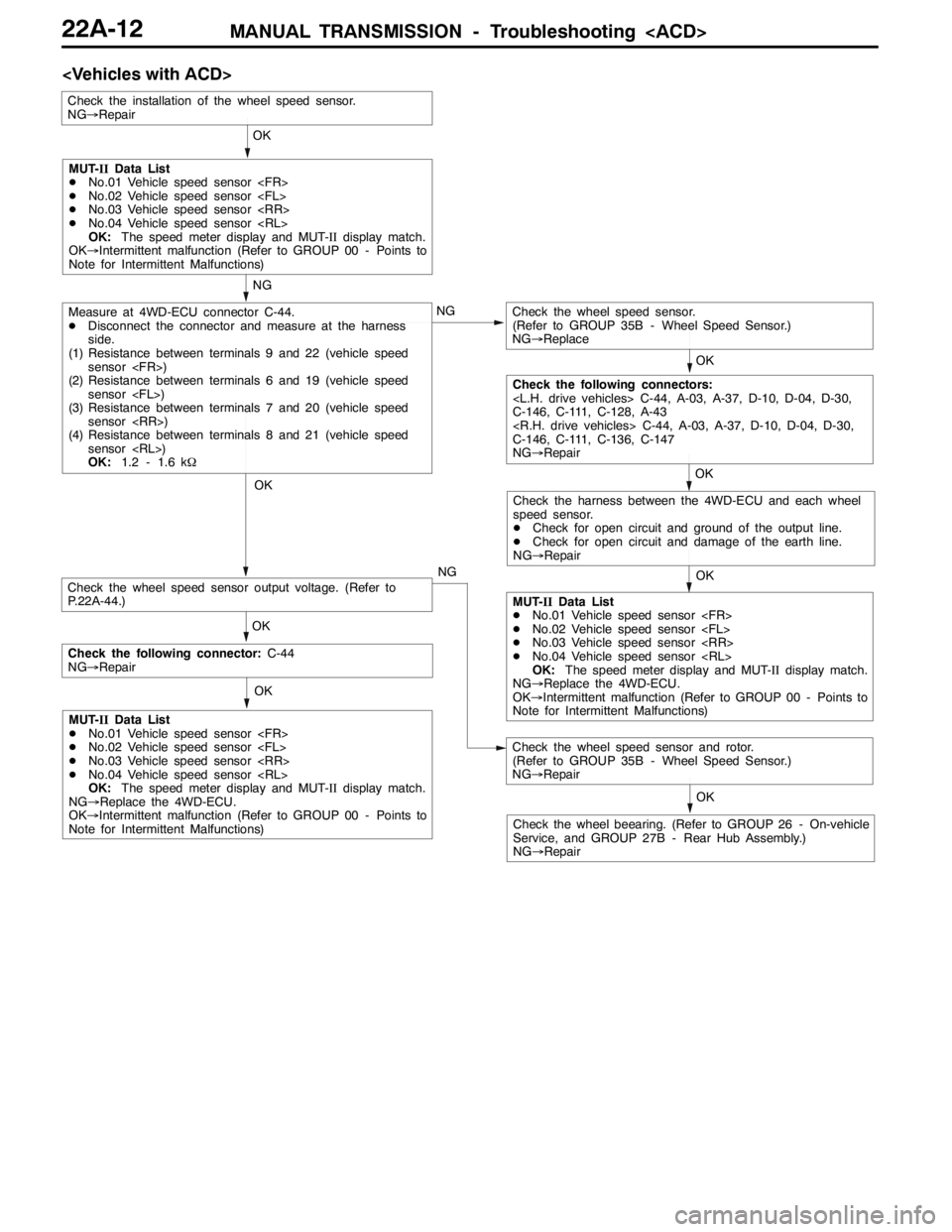
MANUAL TRANSMISSION - Troubleshooting
OK OK NG
OK NG
OK OK
OK
NG
Measure at 4WD-ECU connector C-44.
DDisconnect the connector and measure at the harness
side.
(1) Resistance between terminals 9 and 22 (vehicle speed
sensor
(2) Resistance between terminals 6 and 19 (vehicle speed
sensor
(3) Resistance between terminals 7 and 20 (vehicle speed
sensor
(4) Resistance between terminals 8 and 21 (vehicle speed
sensor
OK:1.2 - 1.6 kΩCheck the wheel speed sensor.
(Refer to GROUP 35B - Wheel Speed Sensor.)
NG→Replace
Check the installation of the wheel speed sensor.
NG→Repair
Check the wheel speed sensor and rotor.
(Refer to GROUP 35B - Wheel Speed Sensor.)
NG→Repair
Check the wheel beearing. (Refer to GROUP 26 - On-vehicle
Service, and GROUP 27B - Rear Hub Assembly.)
NG→RepairOK
MUT-IIData List
DNo.01 Vehicle speed sensor
DNo.02 Vehicle speed sensor
DNo.03 Vehicle speed sensor
DNo.04 Vehicle speed sensor
OK:The speed meter display and MUT-IIdisplay match.
OK→Intermittent malfunction (Refer to GROUP 00 - Points to
Note for Intermittent Malfunctions)
Check the following connectors:
C-146, C-111, C-128, A-43
C-146, C-111, C-136, C-147
NG→Repair
Check the harness between the 4WD-ECU and each wheel
speed sensor.
DCheck for open circuit and ground of the output line.
DCheck for open circuit and damage of the earth line.
NG→Repair
MUT-IIData List
DNo.01 Vehicle speed sensor
DNo.02 Vehicle speed sensor
DNo.03 Vehicle speed sensor
DNo.04 Vehicle speed sensor
OK:The speed meter display and MUT-IIdisplay match.
NG→Replace the 4WD-ECU.
OK→Intermittent malfunction (Refer to GROUP 00 - Points to
Note for Intermittent Malfunctions) OK
Check the following connector:C-44
NG→Repair
MUT-IIData List
DNo.01 Vehicle speed sensor
DNo.02 Vehicle speed sensor
DNo.03 Vehicle speed sensor
DNo.04 Vehicle speed sensor
OK:The speed meter display and MUT-IIdisplay match.
NG→Replace the 4WD-ECU.
OK→Intermittent malfunction (Refer to GROUP 00 - Points to
Note for Intermittent Malfunctions)
Check the wheel speed sensor output voltage. (Refer to
P.22A-44.)
Page 821 of 1449
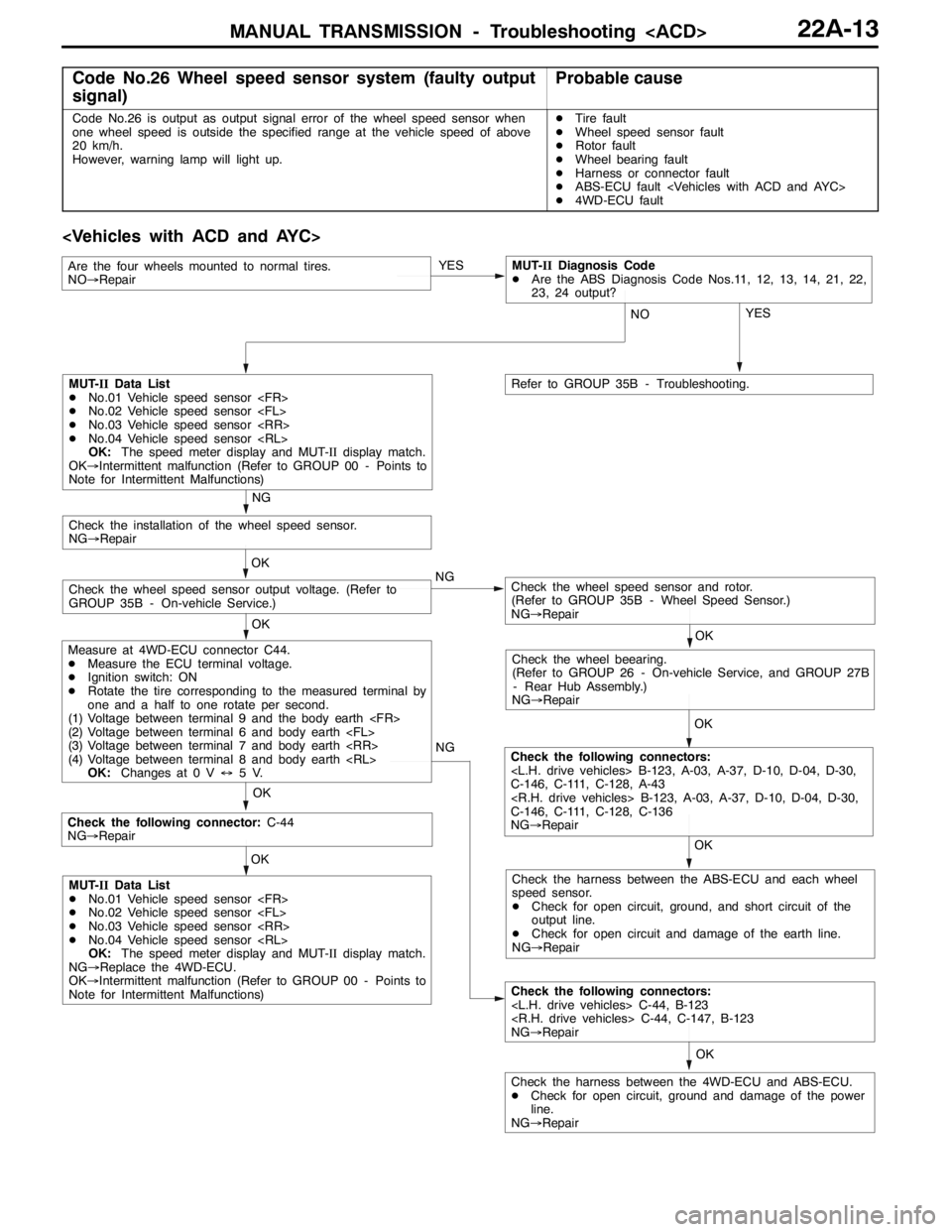
MANUAL TRANSMISSION - Troubleshooting
Code No.26 Wheel speed sensor system (faulty output
signal)Probable cause
Code No.26 is output as output signal error of the wheel speed sensor when
one wheel speed is outside the specified range at the vehicle speed of above
20 km/h.
However, warning lamp will light up.DTire fault
DWheel speed sensor fault
DRotor fault
DWheel bearing fault
DHarness or connector fault
DABS-ECU fault
D4WD-ECU fault
OK NG
OK
Check the following connector:C-44
NG→Repair
Check the following connectors:
NG→Repair OK
Check the harness between the 4WD-ECU and ABS-ECU.
DCheck for open circuit, ground and damage of the power
line.
NG→RepairYES
OK OK
Check the wheel speed sensor and rotor.
(Refer to GROUP 35B - Wheel Speed Sensor.)
NG→RepairCheck the wheel speed sensor output voltage. (Refer to
GROUP 35B - On-vehicle Service.)OK
Check the installation of the wheel speed sensor.
NG→Repair
NG
OK
Check the wheel beearing.
(Refer to GROUP 26 - On-vehicle Service, and GROUP 27B
- Rear Hub Assembly.)
NG→Repair
OK
Check the following connectors:
C-146, C-111, C-128, A-43
C-146, C-111, C-128, C-136
NG→Repair NG
MUT-IIData List
DNo.01 Vehicle speed sensor
DNo.02 Vehicle speed sensor
DNo.03 Vehicle speed sensor
DNo.04 Vehicle speed sensor
OK:The speed meter display and MUT-IIdisplay match.
OK→Intermittent malfunction (Refer to GROUP 00 - Points to
Note for Intermittent Malfunctions)
Measure at 4WD-ECU connector C44.
DMeasure the ECU terminal voltage.
DIgnition switch: ON
DRotate the tire corresponding to the measured terminal by
one and a half to one rotate per second.
(1) Voltage between terminal 9 and the body earth
(2) Voltage between terminal 6 and body earth
(3) Voltage between terminal 7 and body earth
(4) Voltage between terminal 8 and body earth
OK:Changes at 0 V↔5V.
MUT-IIData List
DNo.01 Vehicle speed sensor
DNo.02 Vehicle speed sensor
DNo.03 Vehicle speed sensor
DNo.04 Vehicle speed sensor
OK:The speed meter display and MUT-IIdisplay match.
NG→Replace the 4WD-ECU.
OK→Intermittent malfunction (Refer to GROUP 00 - Points to
Note for Intermittent Malfunctions)Check the harness between the ABS-ECU and each wheel
speed sensor.
DCheck for open circuit, ground, and short circuit of the
output line.
DCheck for open circuit and damage of the earth line.
NG→Repair YES
NO
Refer to GROUP 35B - Troubleshooting.
Are the four wheels mounted to normal tires.
NO→RepairMUT-IIDiagnosis Code
DAre the ABS Diagnosis Code Nos.11, 12, 13, 14, 21, 22,
23, 24 output?
Page 822 of 1449
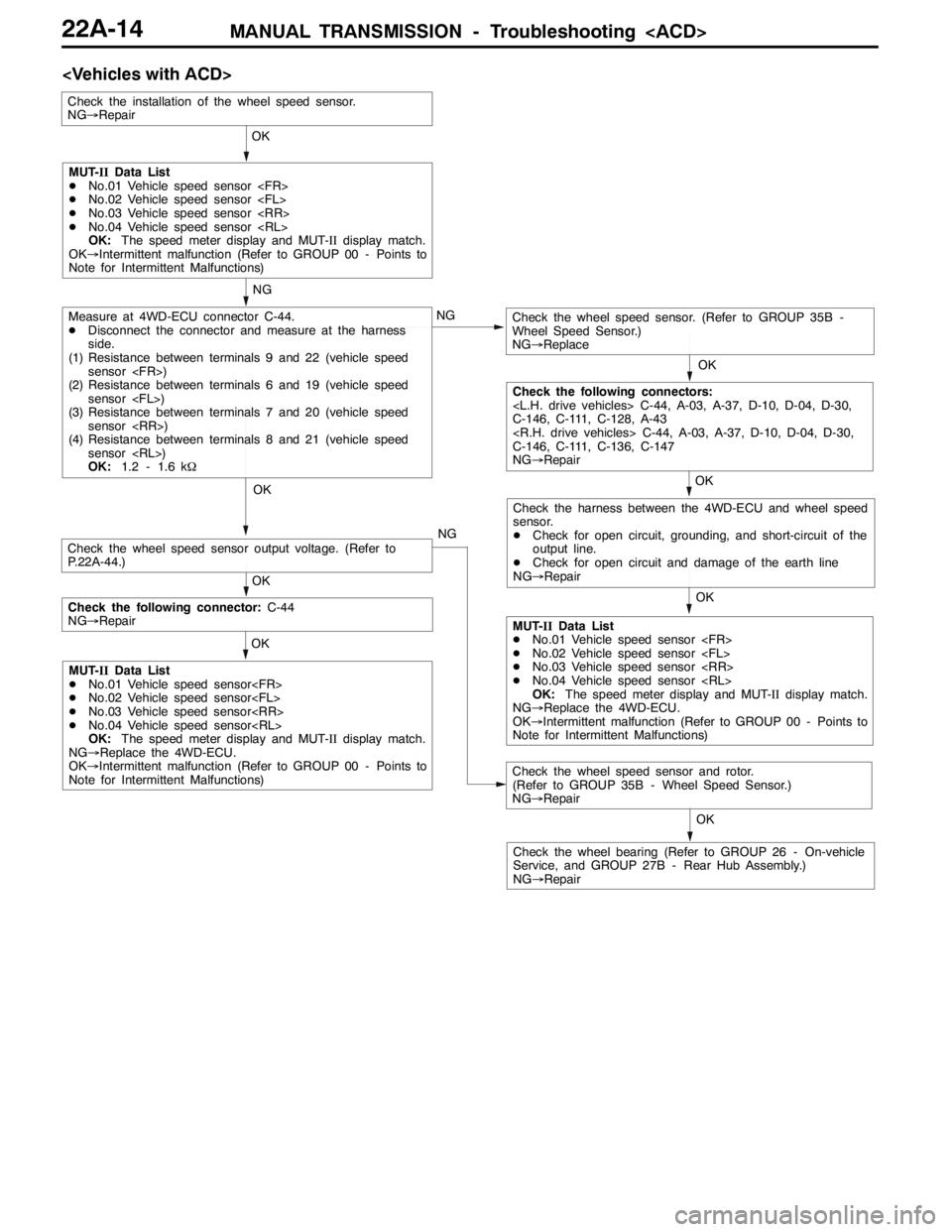
MANUAL TRANSMISSION - Troubleshooting
OK OK NG
OK NG
OK OK
OK
NG
Measure at 4WD-ECU connector C-44.
DDisconnect the connector and measure at the harness
side.
(1) Resistance between terminals 9 and 22 (vehicle speed
sensor
(2) Resistance between terminals 6 and 19 (vehicle speed
sensor
(3) Resistance between terminals 7 and 20 (vehicle speed
sensor
(4) Resistance between terminals 8 and 21 (vehicle speed
sensor
OK:1.2 - 1.6 kΩCheck the wheel speed sensor. (Refer to GROUP 35B -
Wheel Speed Sensor.)
NG→Replace
Check the installation of the wheel speed sensor.
NG→Repair
Check the wheel speed sensor and rotor.
(Refer to GROUP 35B - Wheel Speed Sensor.)
NG→Repair
Check the wheel bearing (Refer to GROUP 26 - On-vehicle
Service, and GROUP 27B - Rear Hub Assembly.)
NG→RepairOK
MUT-IIData List
DNo.01 Vehicle speed sensor
DNo.02 Vehicle speed sensor
DNo.03 Vehicle speed sensor
DNo.04 Vehicle speed sensor
OK:The speed meter display and MUT-IIdisplay match.
OK→Intermittent malfunction (Refer to GROUP 00 - Points to
Note for Intermittent Malfunctions)
Check the following connectors:
C-146, C-111, C-128, A-43
C-146, C-111, C-136, C-147
NG→Repair
Check the harness between the 4WD-ECU and wheel speed
sensor.
DCheck for open circuit, grounding, and short-circuit of the
output line.
DCheck for open circuit and damage of the earth line
NG→Repair
MUT-IIData List
DNo.01 Vehicle speed sensor
DNo.02 Vehicle speed sensor
DNo.03 Vehicle speed sensor
DNo.04 Vehicle speed sensor
OK:The speed meter display and MUT-IIdisplay match.
NG→Replace the 4WD-ECU.
OK→Intermittent malfunction (Refer to GROUP 00 - Points to
Note for Intermittent Malfunctions) OK
Check the following connector:C-44
NG→Repair
MUT-IIData List
DNo.01 Vehicle speed sensor
DNo.02 Vehicle speed sensor
DNo.03 Vehicle speed sensor
DNo.04 Vehicle speed sensor
OK:The speed meter display and MUT-IIdisplay match.
NG→Replace the 4WD-ECU.
OK→Intermittent malfunction (Refer to GROUP 00 - Points to
Note for Intermittent Malfunctions)
Check the wheel speed sensor output voltage. (Refer to
P.22A-44.)
Page 826 of 1449
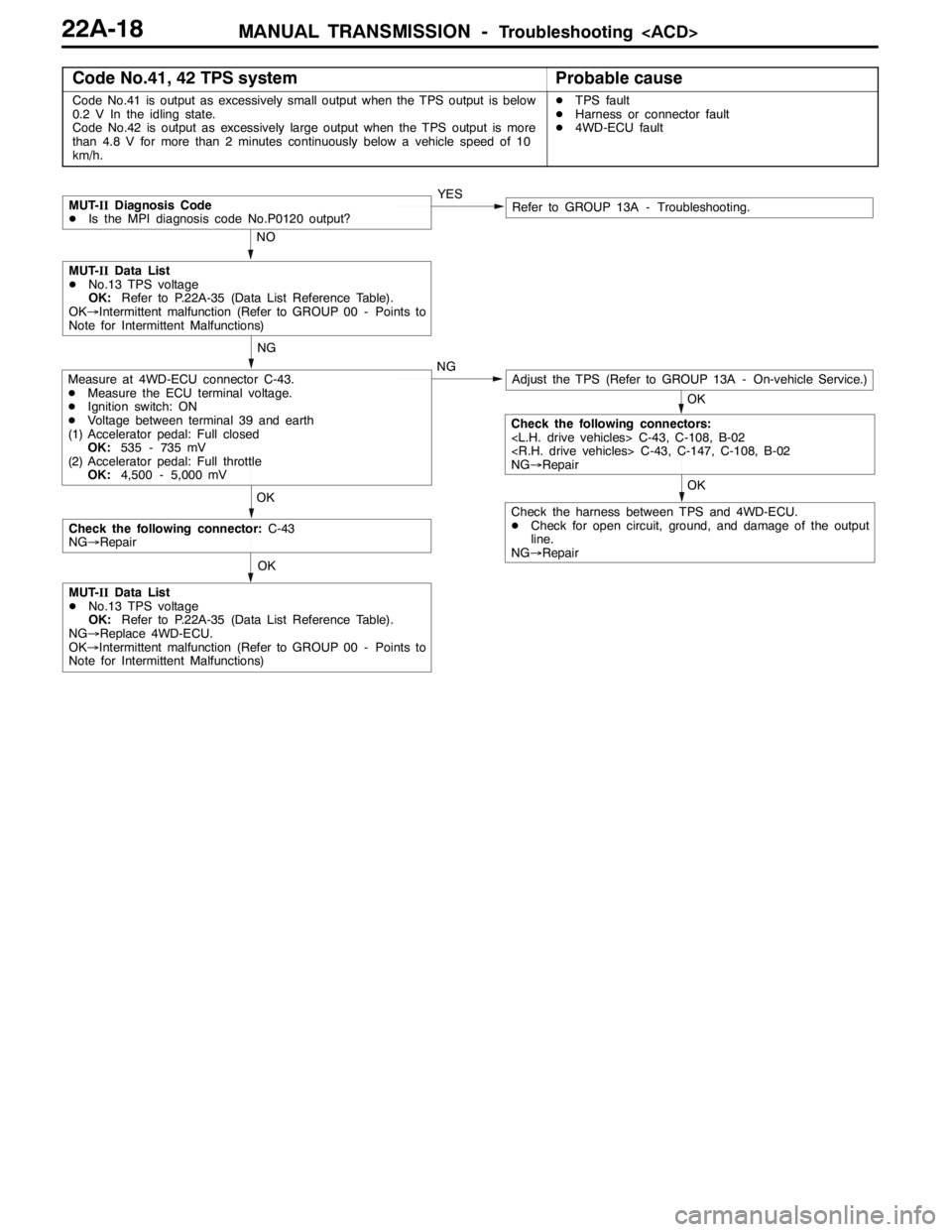
MANUAL TRANSMISSION -Troubleshooting
Code No.41, 42 TPS systemProbable cause
Code No.41 is output as excessively small output when the TPS output is below
0.2 V In the idling state.
Code No.42 is output as excessively large output when the TPS output is more
than 4.8 V for more than 2 minutes continuously below a vehicle speed of 10
km/h.DTPS fault
DHarness or connector fault
D4WD-ECU fault
OKOK
NG
NG
NO
Measure at 4WD-ECU connector C-43.
DMeasure the ECU terminal voltage.
DIgnition switch: ON
DVoltage between terminal 39 and earth
(1) Accelerator pedal: Full closed
OK:535 - 735 mV
(2) Accelerator pedal: Full throttle
OK:4,500 - 5,000 mV
Check the following connectors:
NG→Repair
MUT-IIData List
DNo.13 TPS voltage
OK:Refer to P.22A-35 (Data List Reference Table).
OK→Intermittent malfunction (Refer to GROUP 00 - Points to
Note for Intermittent Malfunctions)
OK
Check the following connector:C-43
NG→Repair
MUT-IIData List
DNo.13 TPS voltage
OK:Refer to P.22A-35 (Data List Reference Table).
NG→Replace 4WD-ECU.
OK→Intermittent malfunction (Refer to GROUP 00 - Points to
Note for Intermittent Malfunctions)
Check the harness between TPS and 4WD-ECU.
DCheck for open circuit, ground, and damage of the output
line.
NG→RepairOK
Adjust the TPS (Refer to GROUP 13A - On-vehicle Service.)
YESRefer to GROUP 13A - Troubleshooting.MUT-IIDiagnosis Code
DIs the MPI diagnosis code No.P0120 output?
Page 833 of 1449
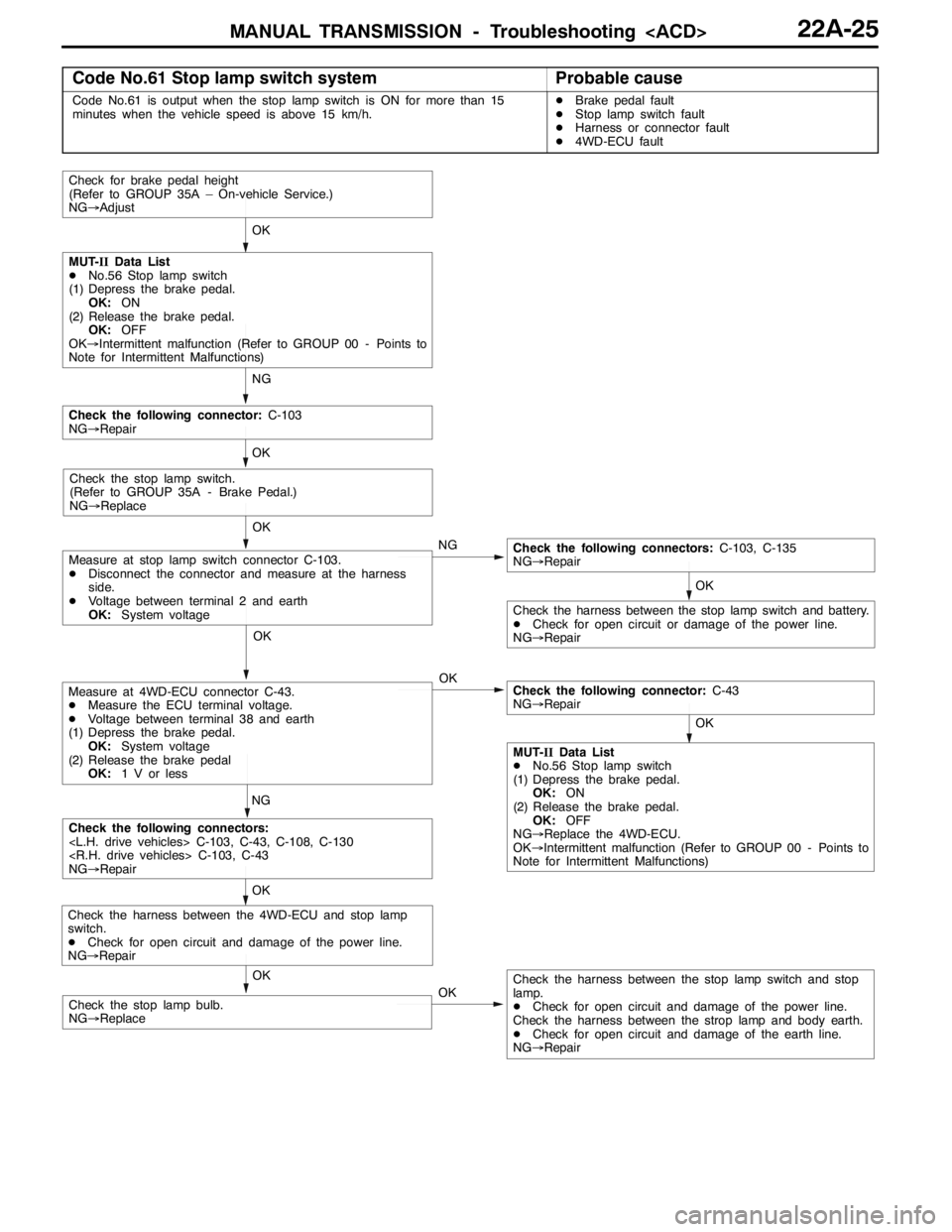
MANUAL TRANSMISSION - Troubleshooting
Code No.61 Stop lamp switch systemProbable cause
Code No.61 is output when the stop lamp switch is ON for more than 15
minutes when the vehicle speed is above 15 km/h.DBrake pedal fault
DStop lamp switch fault
DHarness or connector fault
D4WD-ECU fault
OK
OK
OK
NG
OK
Check for brake pedal height
(Refer to GROUP 35A – On-vehicle Service.)
NG→Adjust
NG
MUT-IIData List
DNo.56 Stop lamp switch
(1) Depress the brake pedal.
OK:ON
(2) Release the brake pedal.
OK:OFF
OK→Intermittent malfunction (Refer to GROUP 00 - Points to
Note for Intermittent Malfunctions)
OK
Check the following connector:C-103
NG→Repair
Check the stop lamp switch.
(Refer to GROUP 35A - Brake Pedal.)
NG→Replace
NG
OK
Check the following connectors:C-103, C-135
NG→Repair
Check the harness between the stop lamp switch and battery.
DCheck for open circuit or damage of the power line.
NG→Repair
OK
Measure at stop lamp switch connector C-103.
DDisconnect the connector and measure at the harness
side.
DVoltage between terminal 2 and earth
OK:System voltage
Measure at 4WD-ECU connector C-43.
DMeasure the ECU terminal voltage.
DVoltage between terminal 38 and earth
(1) Depress the brake pedal.
OK:System voltage
(2) Release the brake pedal
OK:1 V or less
OK
Check the following connectors:
NG→Repair
OKCheck the harness between the stop lamp switch and stop
lamp.
DCheck for open circuit and damage of the power line.
Check the harness between the strop lamp and body earth.
DCheck for open circuit and damage of the earth line.
NG→Repair
Check the harness between the 4WD-ECU and stop lamp
switch.
DCheck for open circuit and damage of the power line.
NG→Repair
Check the following connector:C-43
NG→Repair
MUT-IIData List
DNo.56 Stop lamp switch
(1) Depress the brake pedal.
OK:ON
(2) Release the brake pedal.
OK:OFF
NG→Replace the 4WD-ECU.
OK→Intermittent malfunction (Refer to GROUP 00 - Points to
Note for Intermittent Malfunctions)
OK
Check the stop lamp bulb.
NG→Replace
Page 835 of 1449
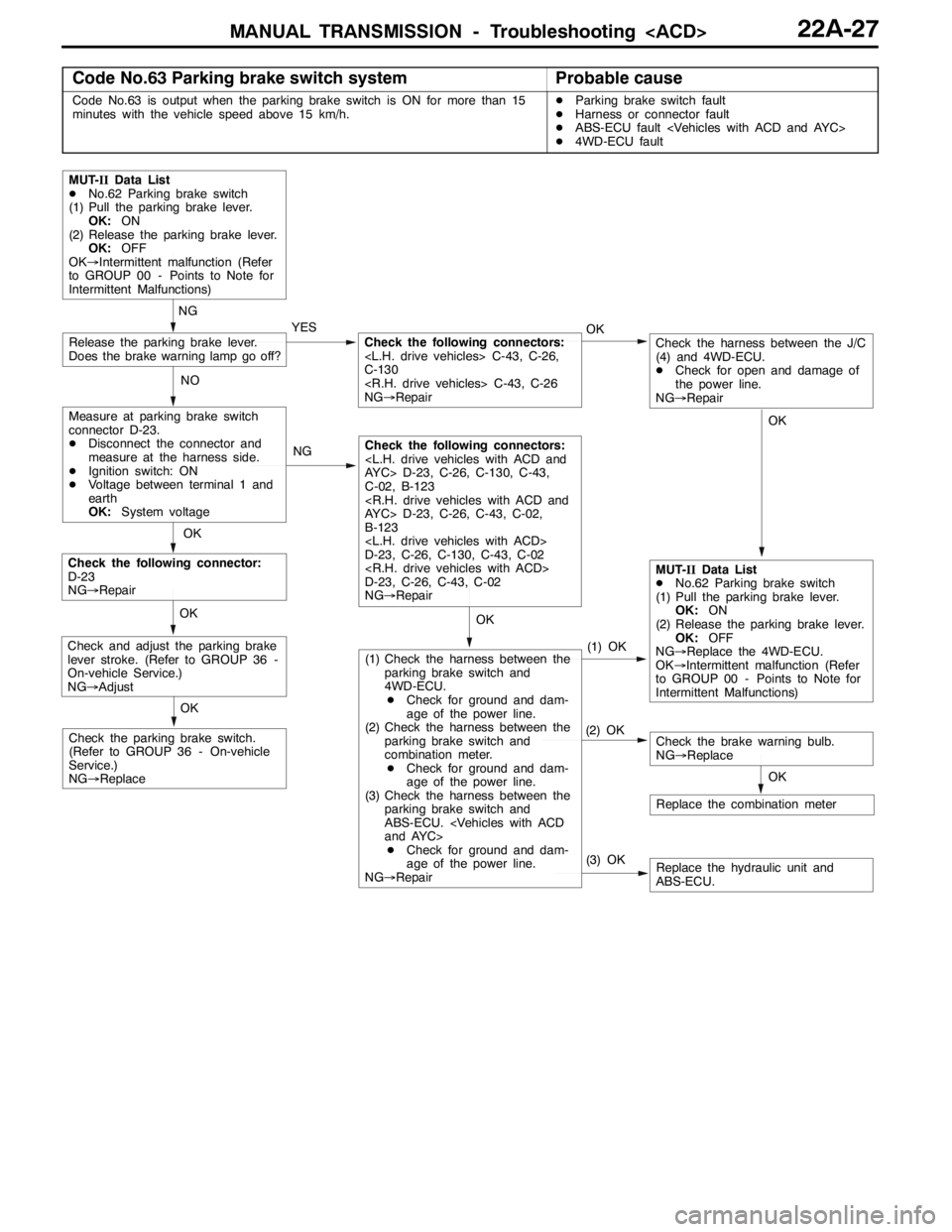
MANUAL TRANSMISSION - Troubleshooting
Code No.63 Parking brake switch systemProbable cause
Code No.63 is output when the parking brake switch is ON for more than 15
minutes with the vehicle speed above 15 km/h.DParking brake switch fault
DHarness or connector fault
DABS-ECU fault
D4WD-ECU fault
OK
NG
YES
NG
(3) OK(1) OKReplace the hydraulic unit and
ABS-ECU.
MUT-IIData List
DNo.62 Parking brake switch
(1) Pull the parking brake lever.
OK:ON
(2) Release the parking brake lever.
OK:OFF
OK→Intermittent malfunction (Refer
to GROUP 00 - Points to Note for
Intermittent Malfunctions)
Measure at parking brake switch
connector D-23.
DDisconnect the connector and
measure at the harness side.
DIgnition switch: ON
DVoltage between terminal 1 and
earth
OK:System voltage
Release the parking brake lever.
Does the brake warning lamp go off?
OK
Check the following connector:
D-23
NG→Repair
OK
Replace the combination meter
OK
Check the brake warning bulb.
NG→ReplaceCheck the parking brake switch.
(Refer to GROUP 36 - On-vehicle
Service.)
NG→Replace
OK
Check and adjust the parking brake
lever stroke. (Refer to GROUP 36 -
On-vehicle Service.)
NG→Adjust
MUT-IIData List
DNo.62 Parking brake switch
(1) Pull the parking brake lever.
OK:ON
(2) Release the parking brake lever.
OK:OFF
NG→Replace the 4WD-ECU.
OK→Intermittent malfunction (Refer
to GROUP 00 - Points to Note for
Intermittent Malfunctions) NOOK
Check the following connectors:
C-130
NG→Repair
Check the following connectors:
C-02, B-123
B-123
D-23, C-26, C-130, C-43, C-02
D-23, C-26, C-43, C-02
NG→Repair
(2) OK
(1) Check the harness between the
parking brake switch and
4WD-ECU.
DCheck for ground and dam-
age of the power line.
(2) Check the harness between the
parking brake switch and
combination meter.
DCheck for ground and dam-
age of the power line.
(3) Check the harness between the
parking brake switch and
ABS-ECU.
DCheck for ground and dam-
age of the power line.
NG→Repair
OK
Check the harness between the J/C
(4) and 4WD-ECU.
DCheck for open and damage of
the power line.
NG→Repair
Page 848 of 1449
MANUAL TRANSMISSION - On-vehicle Service MANUAL TRANSMISSION - On-vehicle Service22A-40
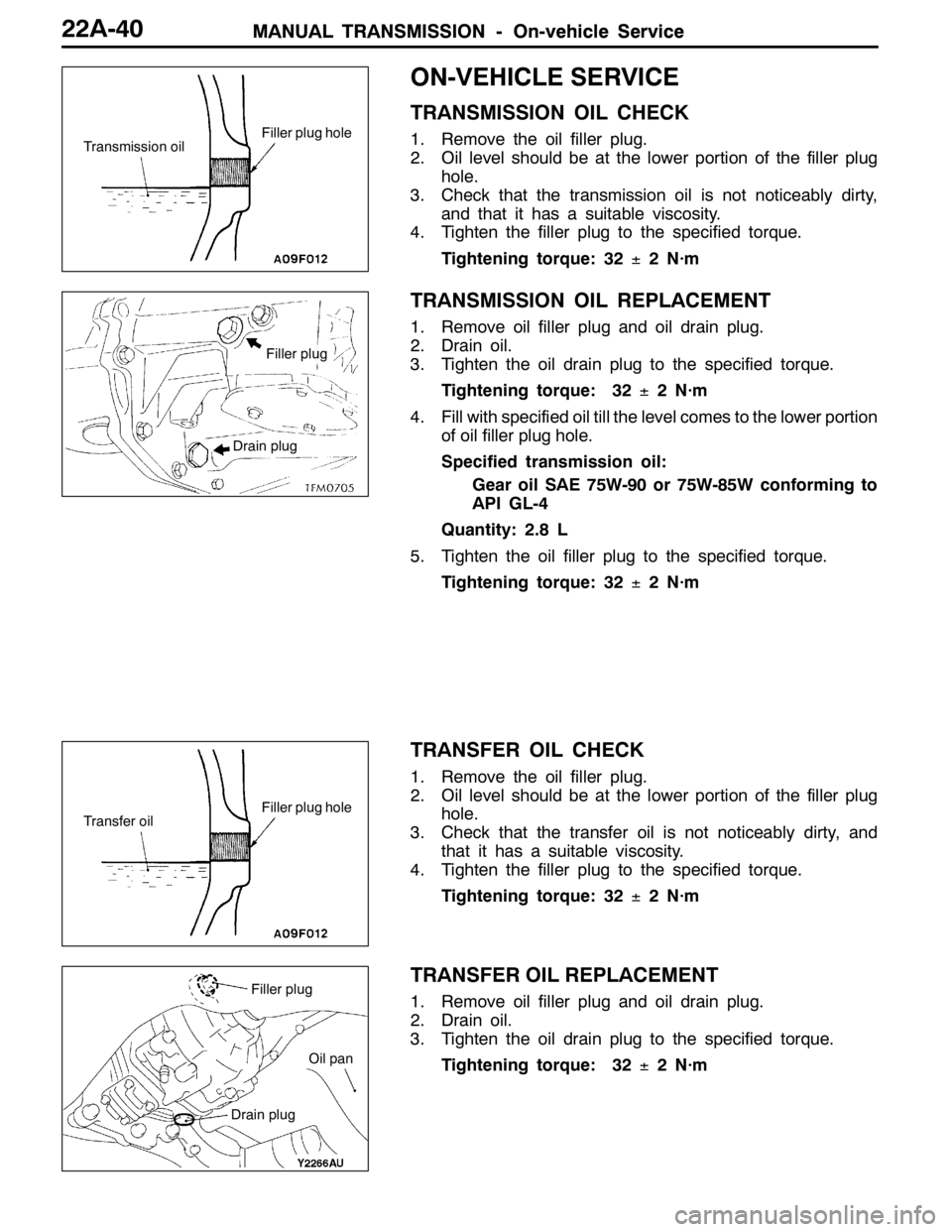
ON-VEHICLE SERVICE
TRANSMISSION OIL CHECK
1. Remove the oil filler plug.
2. Oil level should be at the lower portion of the filler plug
hole.
3. Check that the transmission oil is not noticeably dirty,
and that it has a suitable viscosity.
4. Tighten the filler plug to the specified torque.
Tightening torque: 32±2 N·m
TRANSMISSION OIL REPLACEMENT
1. Remove oil filler plug and oil drain plug.
2. Drain oil.
3. Tighten the oil drain plug to the specified torque.
Tightening torque: 32±2 N·m
4. Fill with specified oil till the level comes to the lower portion
of oil filler plug hole.
Specified transmission oil:
Gear oil SAE 75W-90 or 75W-85W conforming to
API GL-4
Quantity: 2.8 L
5. Tighten the oil filler plug to the specified torque.
Tightening torque: 32±2 N·m
TRANSFER OIL CHECK
1. Remove the oil filler plug.
2. Oil level should be at the lower portion of the filler plug
hole.
3. Check that the transfer oil is not noticeably dirty, and
that it has a suitable viscosity.
4. Tighten the filler plug to the specified torque.
Tightening torque: 32±2 N·m
TRANSFER OIL REPLACEMENT
1. Remove oil filler plug and oil drain plug.
2. Drain oil.
3. Tighten the oil drain plug to the specified torque.
Tightening torque: 32±2 N·m
Transmission oilFiller plug hole
Filler plug
Drain plug
Transfer oilFiller plug hole
Filler plug
Drain plug
Oil pan
Page 849 of 1449

MANUAL TRANSMISSION - On-vehicle Service22A-41
4. Fill with specified oil till the level comes to the lower portion
of oil filler plug hole.
Specified transfer oil:
MITSUBISHI Genuine Gear Oil Part No.8149630
EX, CASTROL HYPOY LS (GL-5, SAE 90),
SHELL-LSD (GL-5, SAE 80W - 90) or equivalent
Quantity:
0.55 L
0.6 L
5. Tighten the oil filler plug to the specified torque.
Tightening torque: 32±2 N·m
FLUID CHECK
1. Remove the maintenance lid located in the luggage
compartment.
2.
If the vehicle has been run, leave it for 90 min. or more
in an ordinary temperature (10_C–30_C) to allow the
accumulator internal pressure to drop.
NOTE
If the ambient temperature is 10_C or less, allow more
time to leave the vehicle to stand idle.
Set the MUT-IIto the 16-pin diagnosis connector. Turn ON
the ignition switch, perform MUT-IIactuator test (Item
No.03), forcibly drive the hydraulic unit and remove the
pressure in the accumulator.
Caution
Turn the ignition switch to the “LOCK”(OFF) position
before connecting or disconnecting the MUT-II.
NOTE
(1) In the actuator test (Item No. 03: Oil Level Check
Mode), the directional valve of the hydraulic unit is
moved to the left and right for 20 times, and then
the differential is cleared automatically. Drive can also
be cleared forcibly using the Clear key of the MUT-II.
(2) If the function has been stopped by fail-safe, the
hydraulic unit cannot be cleared forcibly.
3. Check that the fluid level in the oil reservoir is in the
range between MAX and MIN.
4. If the fluid level is lower than MIN, add the specified
fluid.
Specified fluid: Dia Queen ATF SP III
5. Reinstall the maintenance lid.
Page 850 of 1449
MANUAL TRANSMISSION - On-vehicle Service22A-42
BLEEDING
1. Lift up the vehicle.
2. Set the MUT-IIto the 16-pin diagnosis connector.
Caution
Turn the ignition switch to the “LOCK”(OFF) position
before connecting or disconnecting the MUT-II.
3. Turn the ignition switch to the “ON” position.
4. Set the steering wheel in the straight-ahead position.
5. Perform the MUT-IIactuator test (Item No.02), and forcibly
drive the hydraulic unit.
NOTE
(1) The actuator test (Item No.01: Bleeding Mode) will
be performed for 5 minutes, after which it will be
cleared automatically. Drive can also be cleared during
forced driving using the clear key of the MUT-II.
(2) If the hydraulic unit function has been stopped by
fail-safe, the hydraulic unit cannot be forcibly driven.
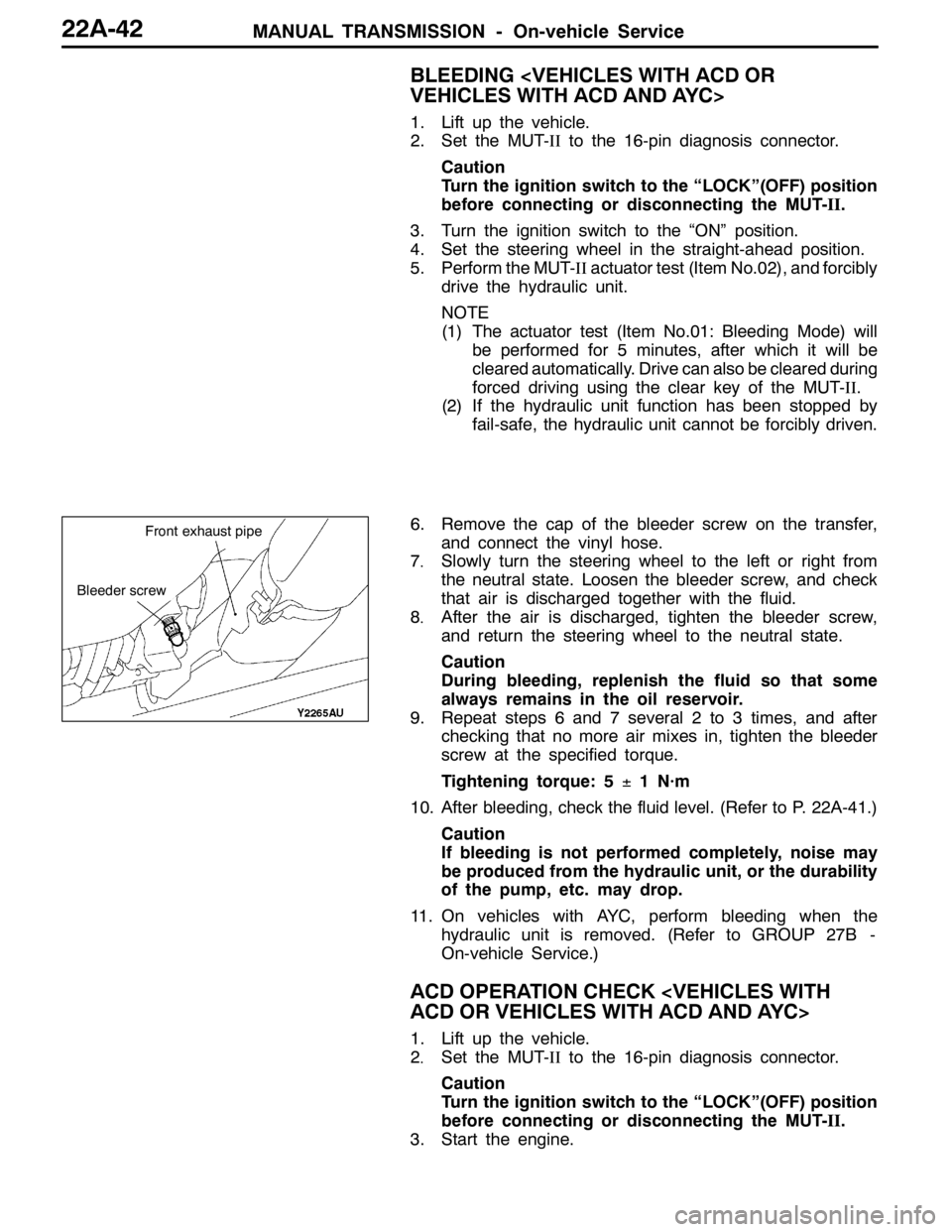
6. Remove the cap of the bleeder screw on the transfer,
and connect the vinyl hose.
7
.Slowly turn the steering wheel to the left or right from
the neutral state. Loosen the bleeder screw, and check
that air is discharged together with the fluid.
8
.After the air is discharged, tighten the bleeder screw,
and return the steering wheel to the neutral state.
Caution
During bleeding, replenish the fluid so that some
always remains in the oil reservoir.
9. Repeat steps 6 and 7 several 2 to 3 times, and after
checking that no more air mixes in, tighten the bleeder
screw at the specified torque.
Tightening torque: 5±1 N·m
10. After bleeding, check the fluid level. (Refer to P. 22A-41.)
Caution
If bleeding is not performed completely, noise may
be produced from the hydraulic unit, or the durability
of the pump, etc. may drop.
11. On vehicles with AYC, perform bleeding when the
hydraulic unit is removed. (Refer to GROUP 27B -
On-vehicle Service.)
ACD OPERATION CHECK
1. Lift up the vehicle.
2
.Set the MUT-IIto the 16-pin diagnosis connector.
Caution
Turn the ignition switch to the “LOCK”(OFF) position
before connecting or disconnecting the MUT-II.
3. Start the engine.
Bleeder screw
Front exhaust pipe
Page 851 of 1449

MANUAL TRANSMISSION - On-vehicle Service22A-43
4. Set the gear to the 2nd gear or above, operate the MUT-II,
and check from the service data (Item No.09) that the
wheel speed is within 10 km/h to 20 km/h.
NOTE
(1) Set the steering wheel to the neutral position
(2) The ACD may continue operating (operation sounds
can be heard) when the steering wheel is steered,
this is not a system fault. In this case, set the steering
wheel to the neutral position, and perform the following
operations to stop the ACD.
DRelease the clutch.
DSet the gear to “N”.
DStop the engine
5. Perform the MUT-IIactuator test (Item No.05), and forcibly
drive the transfer.
NOTE
(1) The actuator test (Item No. 05: ACD Operation Check
Mode) is performed for 1 minute, after which it will
be cleared automatically. Drive can also be cleared
during forced driving using the clear key of the MUT-II.
(2) If the hydraulic unit function has been stopped by
fail-safe, the transfer cannot be forcibly driven.
6. Check that the front and rear wheel speeds satisfy the
following in the MUT-IIactuator test (Item No.05).
The front wheel will be faster than the back wheels by
more than 2 km/h.
NOTE
If the above are not satisfied, check the oil pressure as
the system may be faulty.
HYDRAULIC PRESSURE CHECK
1. Lift up the vehicle.
2. Set the MUT-IIto the 16-pin diagnosis connector.
Caution
Turn the ignition switch to the “LOCK”(OFF) position
before connecting or disconnecting the MUT-II.
3. Disconnect the hydraulic unit and transfer connector
assembly, and connect the special tool to the hydraulic
unit.
4. Turn the ignition switch to “ON”.
5. Perform the MUT-IIactuator test (Item No.05), and forcibly
drive the hydraulic unit.
NOTE
(1) The actuator test (Item No. 05 ACD Operation Check
Mode) is performed for 1 minute, after which it will
be cleared automatically. Drive can also be cleared
during forced driving using the clear key of the MUT-II.
MD998330
MB991705