service MITSUBISHI LANCER EVOLUTION 2007 Service Repair Manual
[x] Cancel search | Manufacturer: MITSUBISHI, Model Year: 2007, Model line: LANCER EVOLUTION, Model: MITSUBISHI LANCER EVOLUTION 2007Pages: 1449, PDF Size: 56.82 MB
Page 738 of 1449

ENGINE ELECTRICAL -Charging System16-6
This test determines whether the alternator output
current is normal.
(1) Before the test, always be sure to check the
following.
DAlternator installation
DBattery (Refer to GROUP 54 - Battery.)
NOTE
The battery should be slightly discharged.
The load needed by a fully-charged battery
is insufficient for an accurate test.
DAlternator drive belt tension
(Refer to GROUP 11 - On-vehicle Service.)
DFusible link
DAbnormal noise from the alternator while
the engine is running.
(2) Turn the ignition switch to the “LOCK” (OFF)
position.
(3) Disconnect the negative battery cable.
(4) Disconnect the alternator output wire from the
alternator “B” terminal. Connect a DC test
ammeter with a range of 0 - 100 A in series
between the “B” terminal and the disconnected
output wire. (Connect the (+) lead of the
ammeter to the “B” terminal. Connect the ( - )
lead of the ammeter to the disconnected output
wire.)
Caution
Never use clips but tighten bolts and nuts
to connect the line. Otherwise loose
connections (e.g. using clips) will lead to
a serious accident because of high current.
NOTE
An inductive-type ammeter which enables
measurements to be taken without
disconnecting the alternator output wire should
be recommended.
(5) Connect a voltmeter with a range of 0 - 20 V
between the alternator “B” terminal and the
earth. (Connect the (+) lead of the voltmeter
to the “B” terminal, and then connect the ( - )
lead of the voltmeter to the earth.)
(6) Connect the negative battery cable.
(7) Connect a tachometer or the MUT-II.
(Refer to GROUP 11 - On-vehicle Service.)
(8) Leave the hood open.
(9) Check that the reading on the voltmeter is equal
to the battery voltage.
NOTE
If the voltage is 0 V, the cause is probably
an open circuit in the wire or fusible link between
the alternator “B” terminal and the battery (+)
terminal.(10)Turn the light switch on to turn on headlamps
and then start the engine.
(11) Immediately after setting the headlamps to high
beam and turning the heater blower switch to
the high revolution position, increase the engine
speed to 2,500 r/min and read the maximum
current output value displayed on the ammeter.
Limit: 70 % of normal current output
NOTE
DFor the nominal current output, refer to the
Alternator Specifications.
DBecause the current from the battery will
soon drop after the engine is started, the
above step should be carried out as quickly
as possible in order to obtain the maximum
current output value.
DThe current output value will depend on
the electrical load and the temperature of
the alternator body.
DIf the electrical load is small while testing,
the specified level of current may not be
output even though the alternator is normal.
In such cases, increase the electrical load
by leaving the headlamps turned on for
some time to discharge the battery or by
using the lighting system in another vehicle,
and then test again.
DThe specified level of current also may not
be output if the temperature of the alternator
body or the ambient temperature is too
high. In such cases, cool the alternator and
then test again.
(12)The reading on the ammeter should be above
the limit value. If the reading is below the limit
value and the alternator output wire is normal,
remove the alternator from the engine and
check the alternator.
(13)Run the engine at idle after the test.
(14)Turn the ignition switch to the “LOCK” (OFF)
position.
(15)Remove the tachometer or the MUT-II.
(16)Disconnect the negative battery cable.
(17)Disconnect the ammeter and voltmeter.
(18)Connect the alternator output wire to the
alternator “B” terminal.
(19)Connect the negative battery cable.
Page 739 of 1449
ENGINE ELECTRICAL -Charging System16-7
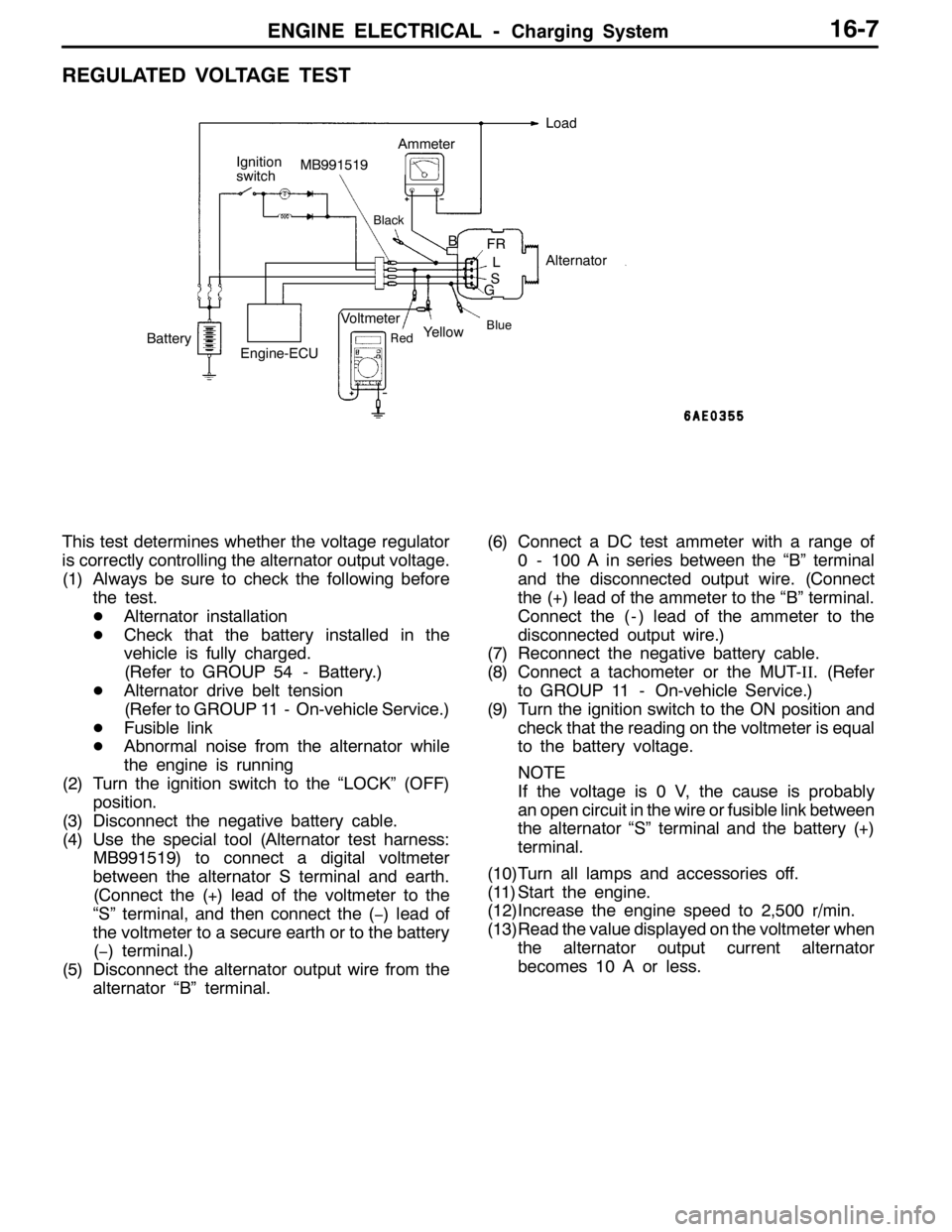
REGULATED VOLTAGE TEST
B
BlueRed
Ignition
switchLoad
FR
L
S
GMB991519
Alternator
BatteryVoltmeterAmmeter
Yellow
Engine-ECU
Black
This test determines whether the voltage regulator
is correctly controlling the alternator output voltage.
(1) Always be sure to check the following before
the test.
DAlternator installation
DCheck that the battery installed in the
vehicle is fully charged.
(Refer to GROUP 54 - Battery.)
DAlternator drive belt tension
(Refer to GROUP 11 - On-vehicle Service.)
DFusible link
DAbnormal noise from the alternator while
the engine is running
(2) Turn the ignition switch to the “LOCK” (OFF)
position.
(3) Disconnect the negative battery cable.
(4) Use the special tool (Alternator test harness:
MB991519) to connect a digital voltmeter
between the alternator S terminal and earth.
(Connect the (+) lead of the voltmeter to the
“S” terminal, and then connect the (−) lead of
the voltmeter to a secure earth or to the battery
(−) terminal.)
(5) Disconnect the alternator output wire from the
alternator “B” terminal.(6) Connect a DC test ammeter with a range of
0 - 100 A in series between the “B” terminal
and the disconnected output wire. (Connect
the (+) lead of the ammeter to the “B” terminal.
Connect the ( - ) lead of the ammeter to the
disconnected output wire.)
(7) Reconnect the negative battery cable.
(8) Connect a tachometer or the MUT-II. (Refer
to GROUP 11 - On-vehicle Service.)
(9) Turn the ignition switch to the ON position and
check that the reading on the voltmeter is equal
to the battery voltage.
NOTE
If the voltage is 0 V, the cause is probably
an open circuit in the wire or fusible link between
the alternator “S” terminal and the battery (+)
terminal.
(10)Turn all lamps and accessories off.
(11) Start the engine.
(12)Increase the engine speed to 2,500 r/min.
(13)Read the value displayed on the voltmeter when
the alternator output current alternator
becomes 10 A or less.
Page 742 of 1449

ENGINE ELECTRICAL -Charging System16-10
EXAMPLES OF ABNORMAL WAVEFORMS
NOTE
1. The size of the waveform patterns differs largely, depending on the adjustment of the variable knob
on the analyzer.
2. Identification of abnormal waveforms is easier when there is a large output current (regulator is not
operating). (Waveforms can be observed when the headlamps are illuminated.)
3. Check the conditions of the charging warning lamp (illuminated/not illuminated). Also, check the charging
system totally.
Abnormal waveformsProblem
causeAbnormal waveformsProblem
cause
Example 1Open diodeExample 4Short in
stator coil
Example 2Short in diodeExample 5Open
supplementa-
ry diode
Example 3Broken wire
in stator coil
At this time, the charging warning lamp
is illuminated.
ALTERNATOR
REMOVAL AND INSTALLATION
Caution
If the vehicle is equipped with the Brembo disc brake, during maintenance, take care not to contact
the parts or tools to the caliper because the paint of caliper will be scratched.
Pre-removal and Post-installation Operation
DUnder Cover Removal and Installation (Refer to GROUP 51 - Front Bumper.)
DDrive Belt Tension Check (Refer to GROUP 11A - On-vehicle Service.)
DStrut Tower Bar Removal and Installation (Refer to GROUP 42.)
DCrossmember Bar Removal and Installation (Refer to GROUP 32 - Engine Roll Stopper, Centermember.)
DFront Exhaust Pipe Assembly Removal and Installation (Refer to GROUP 15.)
Page 744 of 1449
ENGINE ELECTRICAL -Charging System16-12
REMOVAL SERVICE POINTS
AA"DELIVERY PIPE, INJECTOR, AND FUEL
PRESSURE REGULATOR ASSEMBLY REMOVAL
After loosening the installed parts, set the related parts
aside to make some space for removing the alternator.
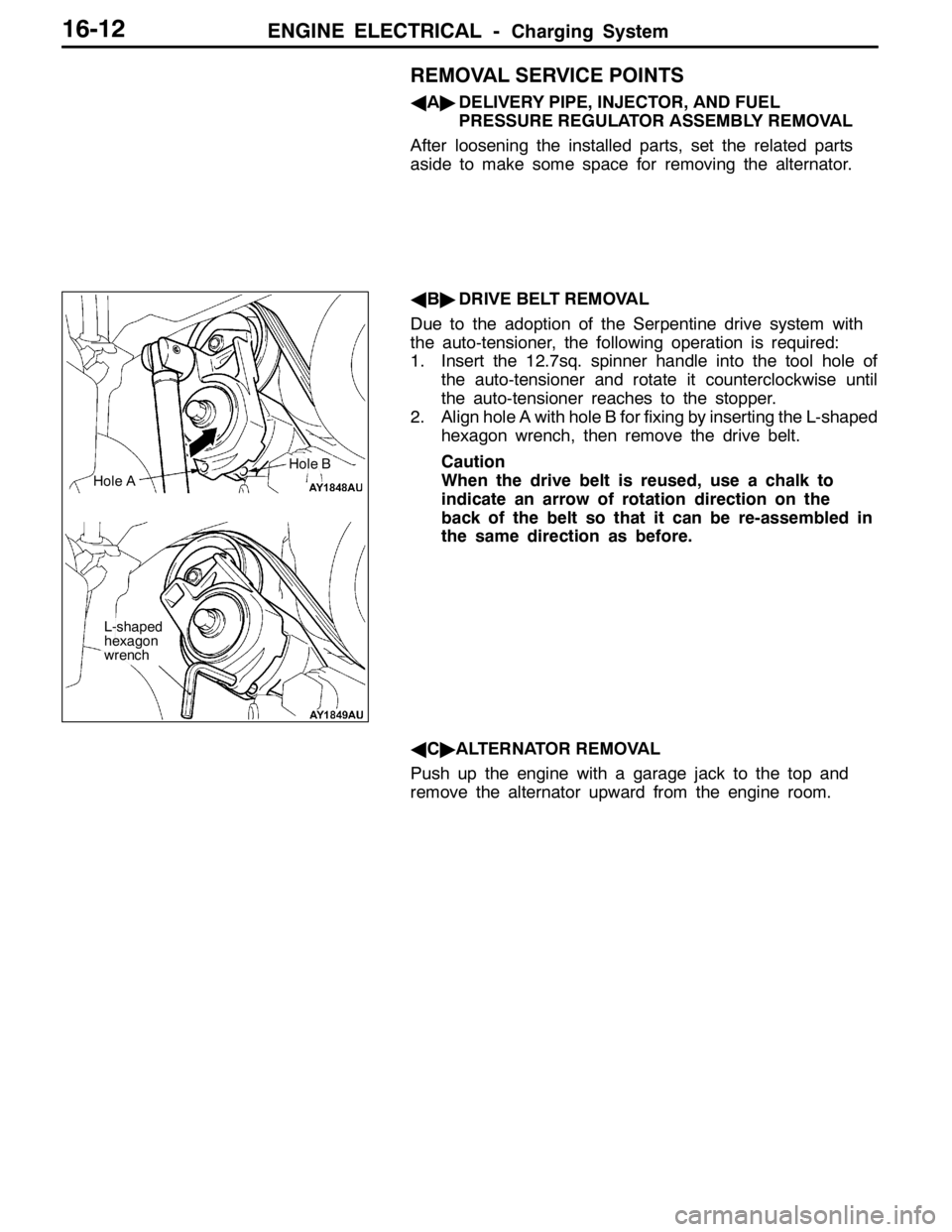
AB"DRIVE BELT REMOVAL
Due to the adoption of the Serpentine drive system with
the auto-tensioner, the following operation is required:
1. Insert the 12.7sq. spinner handle into the tool hole of
the auto-tensioner and rotate it counterclockwise until
the auto-tensioner reaches to the stopper.
2. Align hole A with hole B for fixing by inserting the L-shaped
hexagon wrench, then remove the drive belt.
Caution
When the drive belt is reused, use a chalk to
indicate an arrow of rotation direction on the
back of the belt so that it can be re-assembled in
the same direction as before.
AC"ALTERNATOR REMOVAL
Push up the engine with a garage jack to the top and
remove the alternator upward from the engine room.
Hole A
L-shaped
hexagon
wrench
Hole B
Page 746 of 1449

ENGINE ELECTRICAL -Charging System16-14
DISASSEMBLY SERVICE POINTS
AA"FRONT BRACKET ASSEMBLY REMOVAL
Insert a flat tip screwdrivers or the like in the clearance between
the front bracket assembly and stator core, to pry open and
separate the stator and front bracket.
Caution
Do not insert a screwdriver too far, or the stator coil gets
damaged.
AB"ALTERNATOR PULLEY REMOVAL
Face pulley side upward, fix the rotor with a work bench
and remove the pulley.
Caution
Use care not to damage the rotor.
AC"STATOR/REGULATOR ASSEMBLY REMOVAL
1. Unsolder the stator with a soldering iron (180 to 250
W). Complete this work within four seconds not to transfer
heat to the diode.
2. When removing rectifier from the regulator assembly,
remove the soldered sections to rectifier.
Caution
(1) Use care to make sure that the heat of the soldering
iron is not transmitted to the diodes for a long period.
(2) Use care that no undue force is exerted to the
lead wires of the diodes.
REASSEMBLY SERVICE POINTS
"AAREGULATOR ASSEMBLY INSTALLATION
After installing the regulator assembly, insert a wire into the
hole provided on the rear bracket while pressing in the brush
to fix the brush.
NOTE
The brush is fixed when a wire is inserted, making rotor
installation easier.
SolderedRectifier
assembly
Soldered
Wire
Rear bracket
BrushWire
Page 749 of 1449

ENGINE ELECTRICAL -Starting System16-17
STARTING SYSTEM
GENERAL INFORMATION
If the ignition switch is turned to the “START”
position, current flows in the pull-in and holding
coils provided inside magnetic switch, attracting
the plunger. When the plunger is attracted, the
lever connected to the plunger is actuated to
engage the starter clutch.
On the other hand, attracting the plunger will turn
on the magnetic switch, allowing the B terminaland M terminal to conduct. Thus, current flows to
engage the starter motor.
When the ignition switch is returned to the “ON”
position after starting the engine, the starter clutch
is disengaged from the ring gear.
An overrunning clutch is provided between the
pinion and the armature shaft, to prevent damage
to the starter.
SYSTEM DIAGRAM
Pull-in coilHolding coil
Ignition
switch
BatteryArmature
Brush
YokePlunger
Lever
Over-running
clutch
Pinion shaft
STARTER MOTOR SPECIFICATIONS
ItemsSpecifications
TypeReduction drive with planetary gear
Rated output kW/V1.2/12
No. of pinion teeth8
SERVICE SPECIFICATIONS
ItemsStandard valueLimit
Pinion gap mm0.5 - 2.0-
Commutator outer diameter mm29.428.8
Commutator runout mm0.050.1
Commutator undercut mm0.50.2
Brush length mm-7.0
Page 754 of 1449

ENGINE ELECTRICAL -Starting System16-22
DISASSEMBLY SERVICE POINTS
AA"MAGNETIC SWITCH REMOVAL
Disconnect field coil wire from “M” terminal of magnetic switch.
AB"ARMATURE/BALL REMOVAL
Caution
When removing the armature, take care not to lose the
ball (which is used as a bearing) in the armature end.
AC"SNAP RING/STOP RING REMOVAL
1. Press stop ring off snap ring with a suitable socket.
2. Remove snap ring with snap ring pliers and then remove
stop ring and overrunning clutch.
STARTER MOTOR PARTS CLEANING
1. Do not immerse parts in cleaning solvent. Immersing the
yoke and field coil assembly and/or armature will damage
insulation. Wipe motor assembly with a cloth only.
2. Do not immerse drive unit in cleaning solvent. Overrunning
clutch is pre-lubricated at the factory and solvent will wash
lubrication from clutch
3. The drive unit may be cleaned with a brush moistened
with cleaning solvent and wiped dry with a cloth.
“B” terminal“S” terminal
“M” terminalField coil
wire
Socket
Overrunning
clutch Stop ring
Pinion gear
Snap ring pliers
Overrunning
clutch Pinion gear Snap ring
Page 755 of 1449

ENGINE ELECTRICAL -Starting System16-23
REASSEMBLY SERVICE POINT
"AASTOP RING/SNAP RING INSTALLATION
Using a suitable pulling tool, pull overrunning clutch stop ring
over snap ring.
INSPECTION
COMMUTATOR CHECK
1. Place the armature in a pair of “V” blocks and check
the runout with a dial indicator.
Standard value: 0.05 mm
Limit: 0.1 mm
2. Measure the commutator outer diameter.
Standard value: 29.4 mm
Limit: 28.8 mm
3. Check the undercut depth between segments.
Standard value: 0.5 mm
Limit: 0.2 mm
BRUSH HOLDER CHECK
Confirm that the spring is activated when the brush is pressed
into the brush holder by hand.
Replace the brush holder if the spring is not activated.
Stop ringOverrunning
clutchStop ring
Snap ring
Undercut
Segment
Mica
Page 759 of 1449

ENGINE ELECTRICAL -Ignition System16-27
IGNITION COIL SPECIFICATIONS
ItemsSpecifications
TypeMolded 2-coil
SPARK PLUG SPECIFICATIONS
ItemsSpecifications
NGKIGR7A-G
DENSOVW22PR-DA7
SERVICE SPECIFICATIONS
IGNITION COIL
ItemsStandard value
Secondary coil resistance kΩ8.5 - 11.5
SPARK PLUG
ItemsStandard valueLimit
Spark plug gap mm0.6 - 0.70.75
RESISTIVE CORD
ItemsLimit
Resistance kΩmax. 22
SPECIAL TOOL
ToolNumberNameUse
MD998773Detonation sensor
wrenchDetonation sensor removal and installation
Page 760 of 1449

ENGINE ELECTRICAL -Ignition System16-28
ON-VEHICLE SERVICE
IGNITION COIL (WITH BUILT-IN POWER
TRANSISTOR) CHECK
Check by the following procedure, and replace if there is
a malfunction.
SECONDARY COIL RESISTANCE CHECK
Measure the resistance between the high-voltage terminals
of the ignition coil.
Standard value: 8.5 - 11.5 kΩ
PRIMARY COIL AND POWER TRANSISTOR
CONTINUITY CHECK
NOTE
1. An analogue-type circuit tester should be used.
2. Connect the negative ( - ) prove of the circuit tester to
terminal 1.
Caution
This test must be performed quickly (in less than 10
seconds) to prevent coil from burning and power
transistor from breakage.
1.5V power across 2 - 3Continuity across 1 - 2
When energizedYe s
When not energizedNo
RESISTIVE CORD CHECK
Measure the resistance of the all spark plug cables.
1. Check cap and coating for cracks.
2. Measure resistance.
Limit: Max. 22 kΩ