service MITSUBISHI LANCER EVOLUTION 2007 Service Repair Manual
[x] Cancel search | Manufacturer: MITSUBISHI, Model Year: 2007, Model line: LANCER EVOLUTION, Model: MITSUBISHI LANCER EVOLUTION 2007Pages: 1449, PDF Size: 56.82 MB
Page 722 of 1449
INTAKE AND EXHAUST -Intake Manifold15-16
INTAKE MANIFOLD
REMOVAL AND INSTALLATION
Pre-removal and Post-installation Operation
DAir Duct Removal and Installation (Refer to P.15-8.)
DStrut Tower Bar Removal and Installation
(Refer to GROUP 42.)
DUnder Cover Removal and Installation
(Refer to GROUP 51 - Front Bumper.)
DEngine Coolant Draining and Supplying
(Refer to GROUP 14 - On-vehicle Service.)
DThrottle Body Removal and Installation (Refer to
GROUP 13A - Throttle Body.)DCrossmember Bar Removal and Installation (Refer
to GROUP 32 - Engine Roll Stopper, Centermember.)
DFront Exhaust Pipe Removal and Installation (Refer
to GROUP 15 - Exhaust Pipe and Main Muffler.)
DSecondary Air Control Valve Bracket Removal and
Installation (Refer to P.15-14.)
DEngine Oil Draining and Supplying
1
2
3 4
5 6 7
8 10
11
1214
13
15
16 17
18
9
11±1 N·m3.0±0.5 N·m
13±1 N·m
(Engine oil)
(Engine oil) 5.0±1.0 N·m
14 8
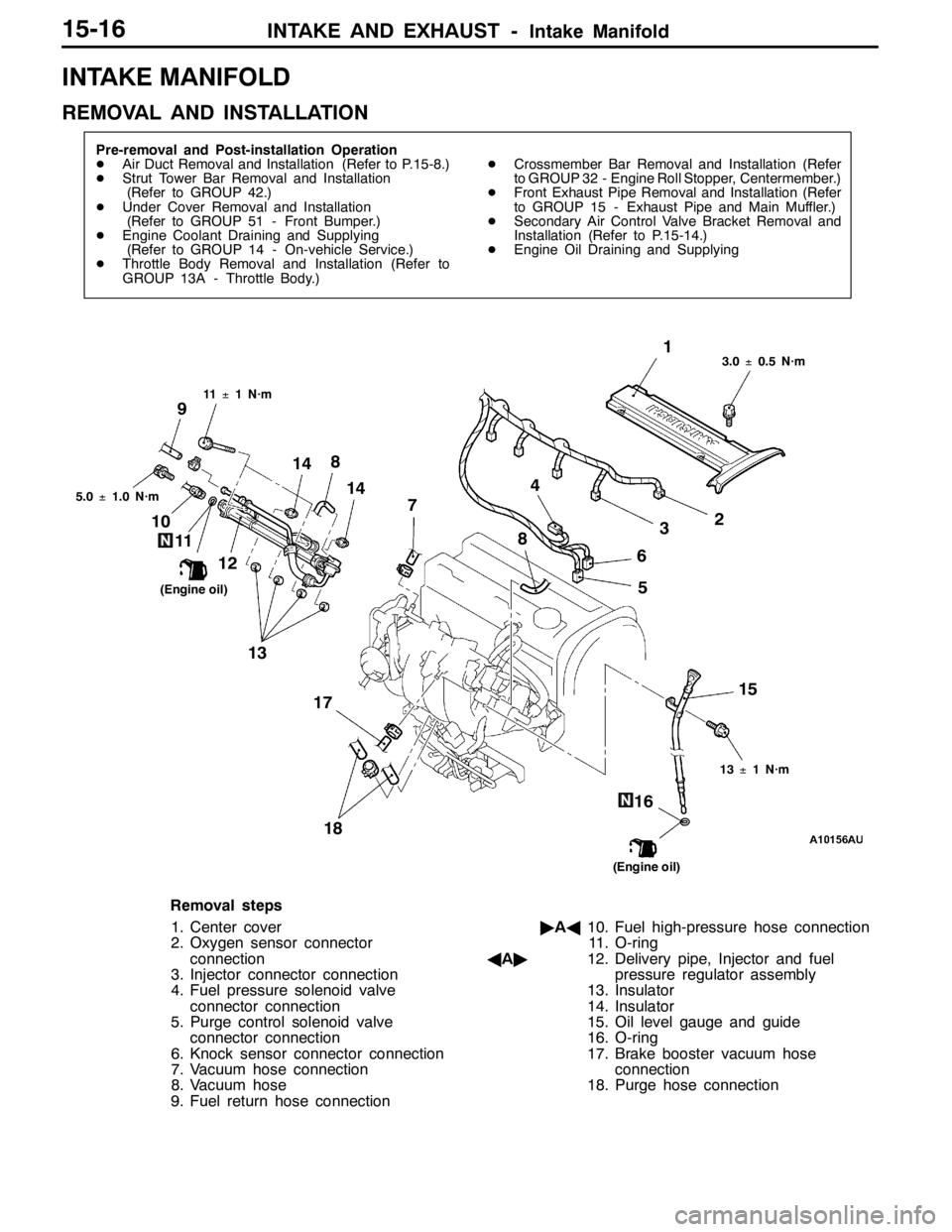
Removal steps
1. Center cover
2. Oxygen sensor connector
connection
3. Injector connector connection
4. Fuel pressure solenoid valve
connector connection
5. Purge control solenoid valve
connector connection
6. Knock sensor connector connection
7. Vacuum hose connection
8. Vacuum hose
9. Fuel return hose connection"AA10. Fuel high-pressure hose connection
11. O-ring
AA"12. Delivery pipe, Injector and fuel
pressure regulator assembly
13. Insulator
14. Insulator
15. Oil level gauge and guide
16. O-ring
17. Brake booster vacuum hose
connection
18. Purge hose connection
Page 723 of 1449

INTAKE AND EXHAUST -Intake ManifoldINTAKE AND EXHAUST -Intake Manifold15-17
28 2325
26
2719
20 2221
23
24
30
23
29
20±2 N·m
20±2 N·m5.0±1.0 N·m
20±2 N·m
9.0±1.0 N·m
22±4 N·m 20±2 N·m 36±6 N·m
9.0±1.0 N·m
31±3 N·m 9.0±1.0 N·m 11±1 N·m
19. Vacuum hose
20. Fuel pressure solenoid valve
21. PCV hose
DAlternator (Refer to GROUP 16.)
22. Vacuum hose and Vacuum pipe
assembly connecting bolt
23. Vacuum tank, EGR solenoid valve,
Secondary air control solenoid
valve, Vacuum hose assembly24. Intake manifold stay
25. EGR valve
26. EGR gasket
27. Alternator brace stay
28. Intake manifold
29. Intake manifold gasket
30. Purge control solenoid valve
assembly
REMOVAL SERVICE POINTS
AA"DELIVERY PIPE, INJECTOR AND FUEL
PRESSURE REGULATOR ASSEMBLY REMOVAL
The delivery pipe must be removed with the injector and
fuel pressure regulator attached.
Caution
Take care not to drop delivery pipe, injector, or fuel
pressure regulator assembly when removing those parts.
Page 724 of 1449

INTAKE AND EXHAUST -Intake Manifold15-18
INSTALLATION SERVICE POINTS
"AAFUEL HIGH-PRESSURE HOSE CONNECTION
1. Apply a drop of new engine oil to the O-ring.
Caution
Be sure not to let engine oil enter the delivery pipe.
2. While turning the injector, high-pressure fuel hose and
fuel pressure regulator to the right and left, install the
delivery pipe, while being careful not to damage the O-ring.
After installing, check that the hose turns smoothly.
3. If it does not turn smoothly, the O-ring may be trapped,
remove the injector, high-pressure fuel hose or fuel
pressure regulator and then re-insert it into the delivery
pipe and check once again.
4. Tighten the high-pressure fuel hose to the specified torque.
Tightening torque: 5.0±1.0 N⋅m
INSPECTION
Check the following points; replace the part if a problem is
found.
INTAKE MANIFOLD CHECK
1. Check for damage or cracking of any part.
2. Check for obstruction of the negative pressure (vacuum)
outlet port, and for obstruction of the water passage or
gas passage.
3. Using a straight edge and thickness gauge, check for
distortion of the cylinder head installation surface.
Standard value: 0.15 mm
Limit: 0.20 mm
Page 726 of 1449
INTAKE AND EXHAUST -Exhaust ManifoldINTAKE AND EXHAUST -Exhaust Manifold15-20
REMOVAL SERVICE POINT
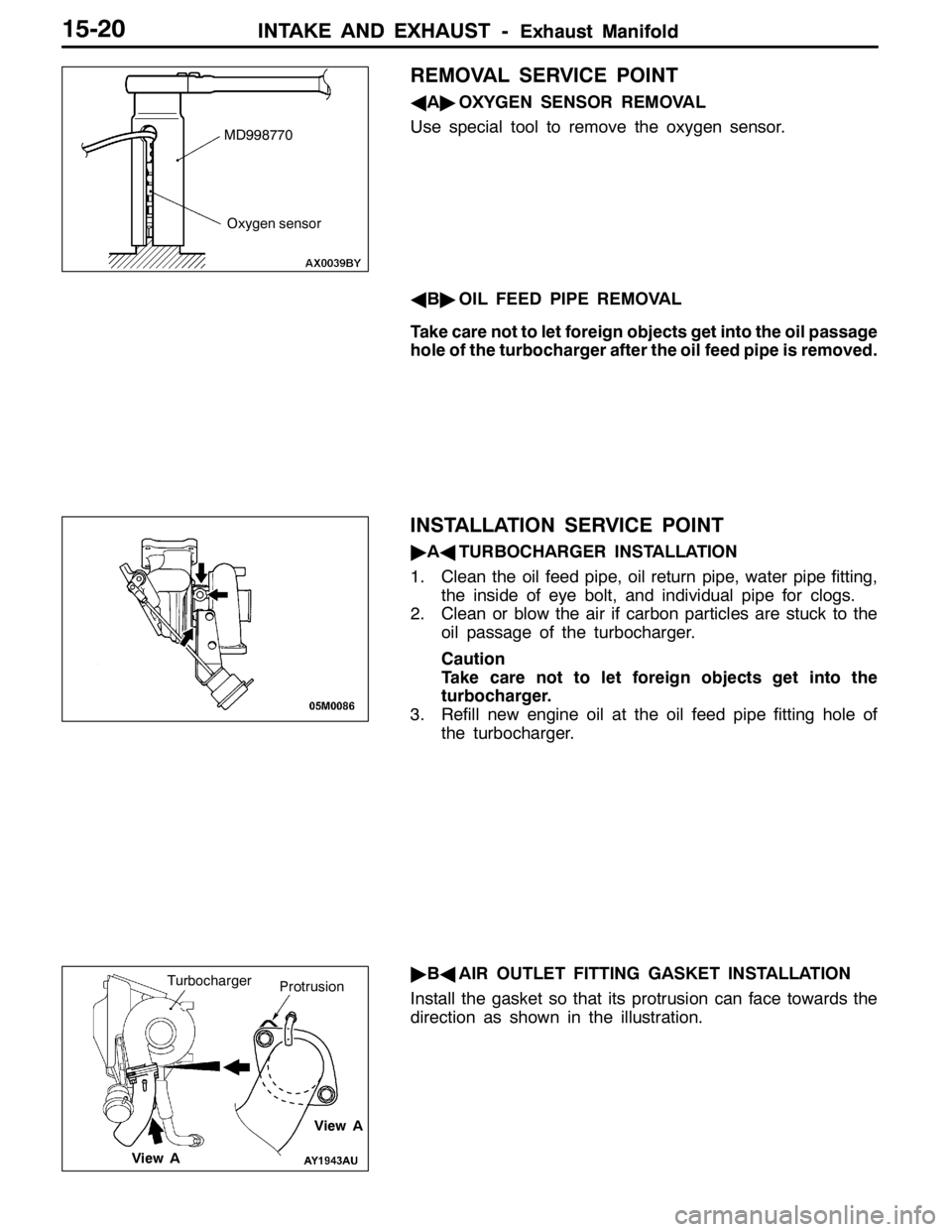
AA"OXYGEN SENSOR REMOVAL
Use special tool to remove the oxygen sensor.
AB"OIL FEED PIPE REMOVAL
Take care not to let foreign objects get into the oil passage
hole of the turbocharger after the oil feed pipe is removed.
INSTALLATION SERVICE POINT
"AATURBOCHARGER INSTALLATION
1. Clean the oil feed pipe, oil return pipe, water pipe fitting,
the inside of eye bolt, and individual pipe for clogs.
2. Clean or blow the air if carbon particles are stuck to the
oil passage of the turbocharger.
Caution
Take care not to let foreign objects get into the
turbocharger.
3. Refill new engine oil at the oil feed pipe fitting hole of
the turbocharger.
"BAAIR OUTLET FITTING GASKET INSTALLATION
Install the gasket so that its protrusion can face towards the
direction as shown in the illustration.
MD998770
Oxygen sensor
View A
View A
TurbochargerProtrusion
Page 729 of 1449
INTAKE AND EXHAUST -Turbocharger15-23
DISASSEMBLY SERVICE POINTS
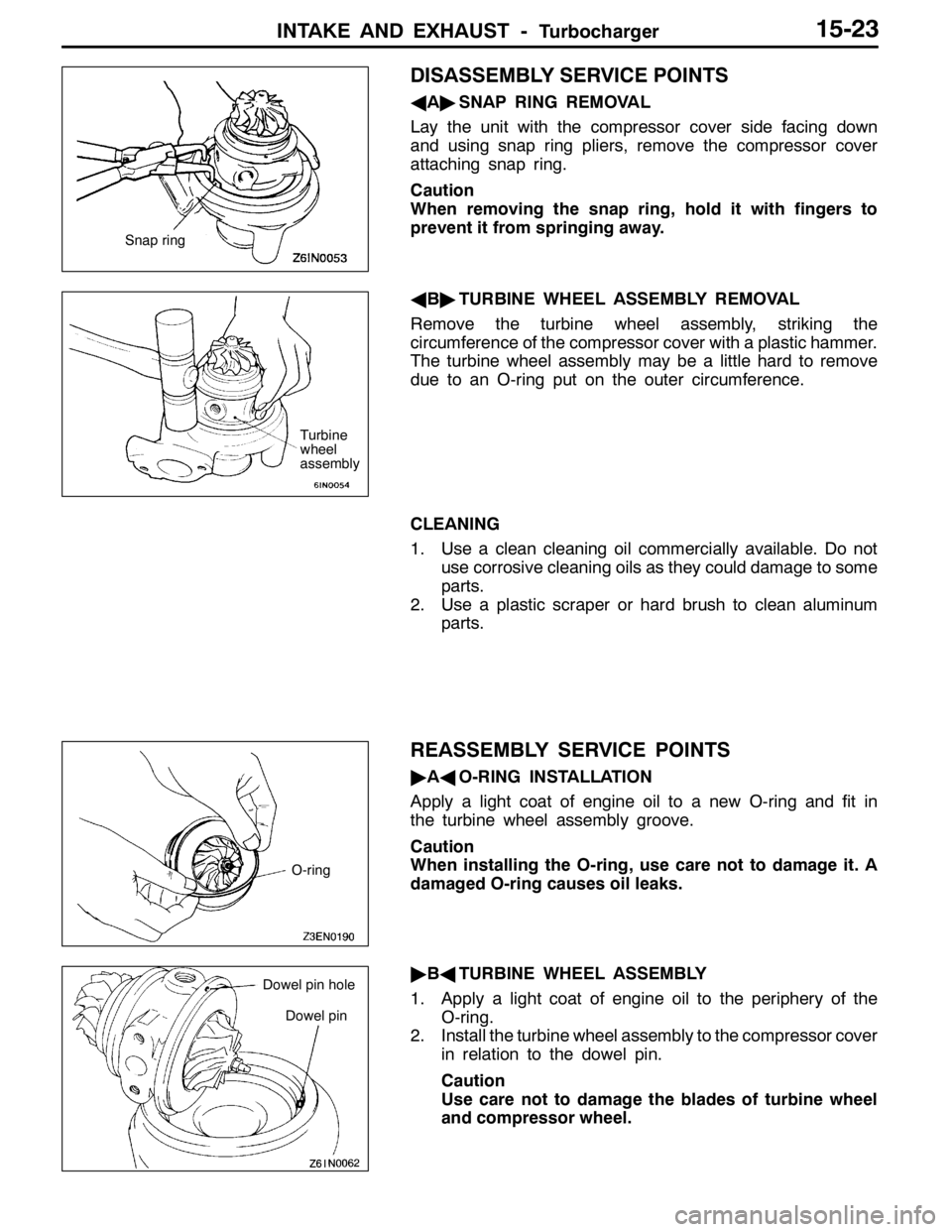
AA"SNAP RING REMOVAL
Lay the unit with the compressor cover side facing down
and using snap ring pliers, remove the compressor cover
attaching snap ring.
Caution
When removing the snap ring, hold it with fingers to
prevent it from springing away.
AB"TURBINE WHEEL ASSEMBLY REMOVAL
Remove the turbine wheel assembly, striking the
circumference of the compressor cover with a plastic hammer.
The turbine wheel assembly may be a little hard to remove
due to an O-ring put on the outer circumference.
CLEANING
1. Use a clean cleaning oil commercially available. Do not
use corrosive cleaning oils as they could damage to some
parts.
2. Use a plastic scraper or hard brush to clean aluminum
parts.
REASSEMBLY SERVICE POINTS
"AAO-RING INSTALLATION
Apply a light coat of engine oil to a new O-ring and fit in
the turbine wheel assembly groove.
Caution
When installing the O-ring, use care not to damage it. A
damaged O-ring causes oil leaks.
"BATURBINE WHEEL ASSEMBLY
1. Apply a light coat of engine oil to the periphery of the
O-ring.
2. Install the turbine wheel assembly to the compressor cover
in relation to the dowel pin.
Caution
Use care not to damage the blades of turbine wheel
and compressor wheel.
Snap ring
Turbine
wheel
assembly
O-ring
Dowel pin
Dowel pin hole
Page 732 of 1449
INTAKE AND EXHAUST -Exhaust Pipe and Main Muffler15-26
EXHAUST PIPE AND MAIN MUFFLER
REMOVAL AND INSTALLATION
Pre-removal and Post-installation Operation
DUnder Cover Removal and Installation (Refer to GROUP 51 - Front Bumper.)
DCrossmember Bar Removal and Installation (Refer to GROUP 32 - Engine Roll Stopper, Centermember.)
91
2 3
5
8
11
6 12
10
3
7
12
13±2 N·m
50±5 N·m13±2 N·m49±10 N·m
59±10 N·m13±2 N·m
45±5 N·m4
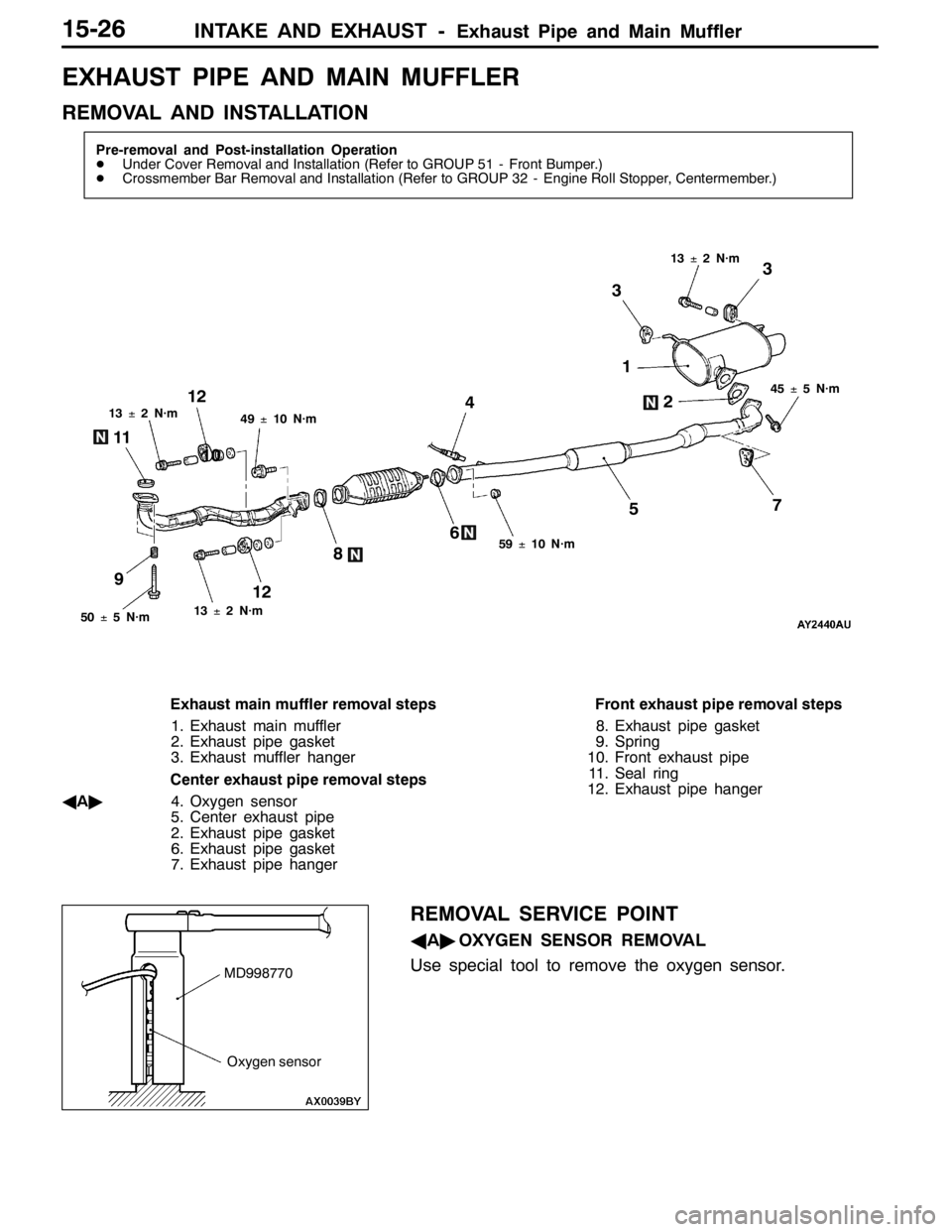
Exhaust main muffler removal steps
1. Exhaust main muffler
2. Exhaust pipe gasket
3. Exhaust muffler hanger
Center exhaust pipe removal steps
AA"4. Oxygen sensor
5. Center exhaust pipe
2. Exhaust pipe gasket
6. Exhaust pipe gasket
7. Exhaust pipe hangerFront exhaust pipe removal steps
8. Exhaust pipe gasket
9. Spring
10. Front exhaust pipe
11. Seal ring
12. Exhaust pipe hanger
REMOVAL SERVICE POINT
AA"OXYGEN SENSOR REMOVAL
Use special tool to remove the oxygen sensor.
MD998770
Oxygen sensor
Page 733 of 1449

16-1
ENGINE
ELECTRICAL
CONTENTS
CHARGING SYSTEM 2................
GENERAL INFORMATION 2................
SERVICE SPECIFICATIONS 3...............
SPECIAL TOOL 3..........................
ON-VEHICLE SERVICE 4...................
Alternator Output Line Voltage Drop Test 4......
Output Current Test 5........................
Regulated Voltage Test 7.....................
Waveform Check Using An Analyzer 8..........
ALTERNATOR 10..........................
STARTING SYSTEM 17................
GENERAL INFORMATION 17...............
SERVICE SPECIFICATIONS 17..............
ON-VEHICLE SERVICE 18..................
STARTER 18..............................
IGNITION SYSTEM 26.................
GENERAL INFORMATION 26...............
SERVICE SPECIFICATIONS 27..............
SPECIAL TOOL 27.........................
ON-VEHICLE SERVICE 28..................
Ignition Coil (With Built-in Power Transistor)
Check 28...................................
Resistive Cord Check 28.....................
Spark Plug Check, Cleaning and Replacement 29
Camshaft Position Sensor Check 29...........
Crank Angle Sensor Check 29................
Detonation Sensor Check 29..................
Waveform Check Using An Analyzer 30........
IGNITION COIL 34.........................
CAMSHAFT POSITION SENSOR 35.........
CRANK ANGLE SENSOR 35................
DETONATION SENSOR 37.................
Page 735 of 1449

ENGINE ELECTRICAL -Charging System16-3
ALTERNATOR SPECIFICATIONS
ItemsSpecifications
TypeBattery voltage sensing
Rated output V/A12/90
Voltage regulatorElectronic built-in type
SERVICE SPECIFICATIONS
ItemsStandard valueLimit
Alternator output line voltage drop (at 30 A) V-max. 0.3
Regulated voltage ambient
tempatvoltageregulatorV
-20_C14.2 - 15.4-
temp. atvoltage regulatorV
20_C13.9 - 14.9-
60_C13.4 - 14.6-
80_C13.1 - 14.5-
Output current-70 % of normal output current
Rotor coil resistanceΩApprox. 3 - 5-
Protrusion length of brush mm-2
SPECIAL TOOL
ToolNumberNameUse
MB991519Alternator test
harnessChecking the alternator (S terminal voltage)
Page 736 of 1449
ENGINE ELECTRICAL -Charging System16-4
ON-VEHICLE SERVICE
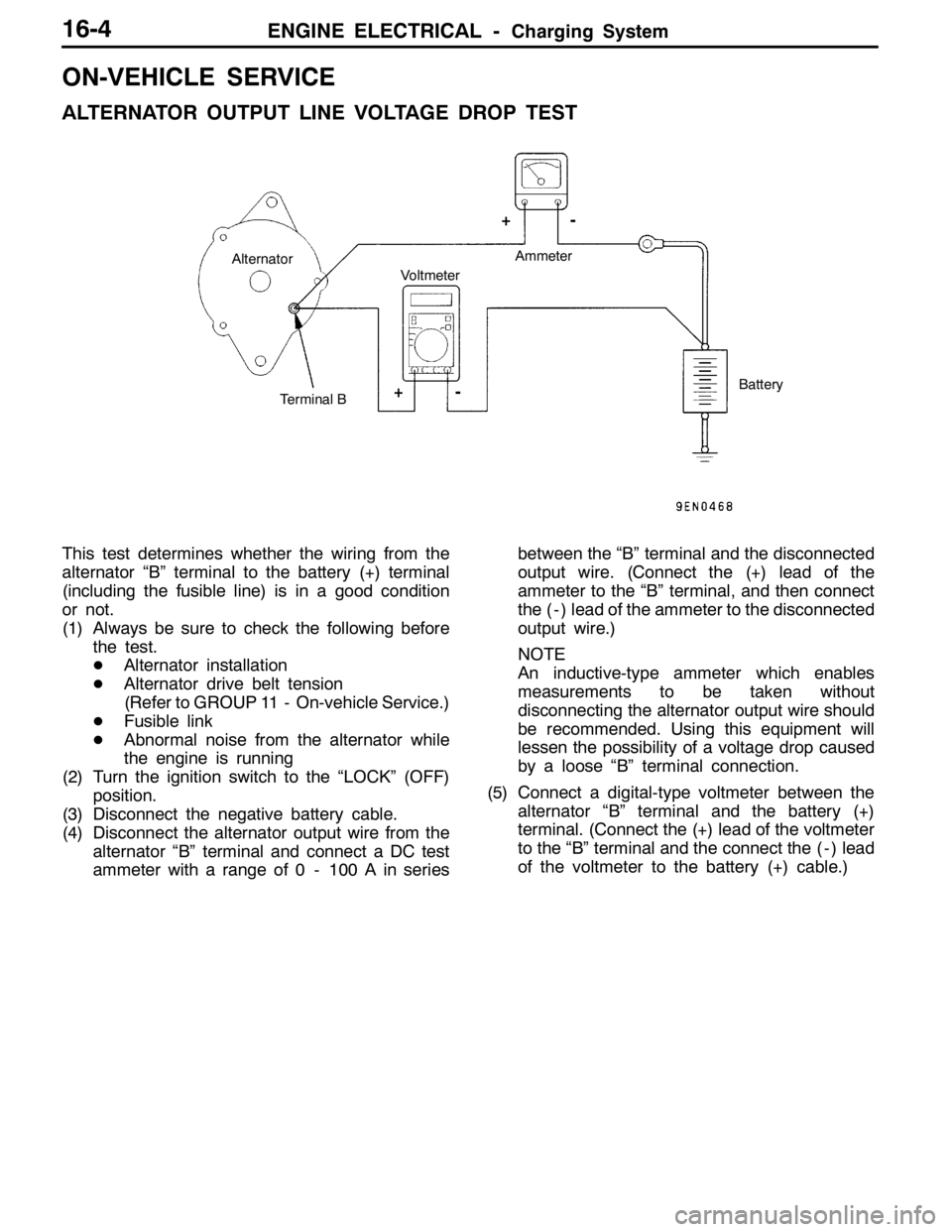
ALTERNATOR OUTPUT LINE VOLTAGE DROP TEST
Alternator
Terminal BVoltmeterAmmeter
Battery
+-
+-
This test determines whether the wiring from the
alternator “B” terminal to the battery (+) terminal
(including the fusible line) is in a good condition
or not.
(1) Always be sure to check the following before
the test.
DAlternator installation
DAlternator drive belt tension
(Refer to GROUP 11 - On-vehicle Service.)
DFusible link
DAbnormal noise from the alternator while
the engine is running
(2) Turn the ignition switch to the “LOCK” (OFF)
position.
(3) Disconnect the negative battery cable.
(4) Disconnect the alternator output wire from the
alternator “B” terminal and connect a DC test
ammeter with a range of 0 - 100 A in seriesbetween the “B” terminal and the disconnected
output wire. (Connect the (+) lead of the
ammeter to the “B” terminal, and then connect
the ( - ) lead of the ammeter to the disconnected
output wire.)
NOTE
An inductive-type ammeter which enables
measurements to be taken without
disconnecting the alternator output wire should
be recommended. Using this equipment will
lessen the possibility of a voltage drop caused
by a loose “B” terminal connection.
(5) Connect a digital-type voltmeter between the
alternator “B” terminal and the battery (+)
terminal. (Connect the (+) lead of the voltmeter
to the “B” terminal and the connect the ( - ) lead
of the voltmeter to the battery (+) cable.)
Page 737 of 1449

ENGINE ELECTRICAL -Charging System16-5
(6) Reconnect the negative battery cable.
(7) Connect a tachometer or the MUT-II.
(Refer to GROUP 11 - On-vehicle Service.)
(8) Leave the hood open.
(9) Start the engine.
(10)With the engine running at 2,500 r/min, turn
the headlamps and other lamps on and off
to adjust the alternator load so that the value
displayed on the ammeter is slightly above 30
A.
Adjust the engine speed by gradually
decreasing it until the value displayed on the
ammeter is 30 A. Take a reading of the value
displayed on the voltmeter at this time.
Limit: max. 0.3 V
NOTE
When the alternator output is high and the value
displayed on the ammeter does not decrease
until 30 A, set the value to 40 A. Read the
value displayed on the voltmeter at this time.
When the value range is 40 A, the limit is max.
0.4 V.(11) If the value displayed on the voltmeter is above
the limit value, there is probably a malfunction
in the alternator output wire, so check the wiring
between the alternator “B” terminal and the
battery (+) terminal (including fusible link).
If a terminal is not sufficiently tight or if the
harness has become discolored due to
overheating, repair and then test again.
(12)After the test, run the engine at idle.
(13)Turn off all lamps and the ignition switch.
(14)Remove the tachometer or the MUT-II.
(15)Disconnect the negative battery cable.
(16)Disconnect the ammeter and voltmeter.
(17)Connect the alternator output wire to the
alternator “B” terminal.
(18)Connect the negative battery cable.
OUTPUT CURRENT TEST
Charging warning lampVoltmeter
Ammeter
Ignition switch
Alternator relayLoad
Battery
Engine-ECUAlternatorFR
L
S
G
+ -+-
B