brake MITSUBISHI MIRAGE 2017 6.G User Guide
[x] Cancel search | Manufacturer: MITSUBISHI, Model Year: 2017, Model line: MIRAGE, Model: MITSUBISHI MIRAGE 2017 6.GPages: 305, PDF Size: 8.67 MB
Page 80 of 305
Free-hand Advanced Securi
ty Transmitter (F.A.S.T.-key) (if so equipped)
Features and controls 5-17
5
4. Press and hold the clut
ch pedal all the way
down (manual transaxle). 5. On vehicles equipped with manual trans- axle, place the gearshift lever in the “N”On vehicles equippe
d with continuously
variable transmission (CVT), make sure the selector lever is in the “P” (PARK)position.
6. Press the engine switch. 7. Confirm that all warning lights and warn-ing displays are functioning properly.
After several attempts
, you may experience
that the engine still does not start. 1. Make sure that all electric devices, such as lights, air conditi
oning blower and rear
window defogger, are turned off.
2. While depressing the brake pedal {contin- uously variable transmission (CVT)} orthe clutch pedal (manual transaxle), press the accelerator peda
l halfway and hold it
there, then crank the engine. Release theaccelerator pedal, immediately after the engine starts. 3. If the engine still wi
ll not start, the engine
could be flooded with too much gasoline. While depressing the brake pedal (CVT) or the clutch pedal (manual transaxle), push the accelerator pedal all the way down and hold it there, then press theengine switch to crank the engine. If the engine does not start after 5 to 6 seconds, push the engine switch to stop crankingthe engine, and release the accelerator pedal. Put the operation mode in OFF. Wait a few seconds, and then press theengine switch to cr
ank the engine again
while depressing the brake pedal (CVT) or the clutch pedal (manual transaxle), butdo not push the accelerator pedal. If the engine fails to start, repeat these proce- dures. If the engine sti
ll will not start, con-
tact your local Mitsubishi Motors dealer or a repair facility of your choice for assistance.
Startability of conti
nuously variable trans-
mission (CVT) vehicles with an ambient temperature of -4 °F (-20 °C) or lower
NOTE
After the engine has not started for a while, the brake pedal effort needed to start theengine may become grea
ter. If this occurs,
depress the brake pedal more firmly than usual.NOTE
For vehicles equipped with a manual trans- axle, the engine will not start unless the clutch pedal is fully depressed (Clutch inter- lock). This is a safety feature.
NOTE
On vehicles equippe
d with continuously
variable transmission (C
VT), the engine can
only be started when th
e selector lever is in
the
Page 81 of 305
Free-hand Advanced
Security Transmitter (F.A.S
.T.-key) (if so equipped)
5
When the ambient temperature is -4 °F (-20 °C) or lower, it may not be possible to startfrom a standstill even with the selector lever in the “D” (DRIVE) or “R” (REVERSE) position.This phenomenon occurs
because the trans-
axle has not warmed up sufficiently; it does not indicate a problem.
If this occurs, place
the selector lever in the “P” (PARK) position and let the engine idle
for at least 10 minutes.
The transaxle will wa
rm up, and you will be
able to start normally. Do not leave the vehicle during warm-upoperation.
N00568200014
1. Stop the vehicle.2. Fully engage the parking brake while depressing the brake pedal. 3. On vehicles with
a manual transaxle,
press the engine switch to stop the engine, and then move the gearshift lever to the 1st (on a uphill) or “R” (Reverse) (on adownhill) position. On vehicles equippe
d with continuously
variable transmissi
on (CVT), move the
selector lever to th
e “P” (PARK) position,
and then press the engine switch to stop the engine.
N00568301054
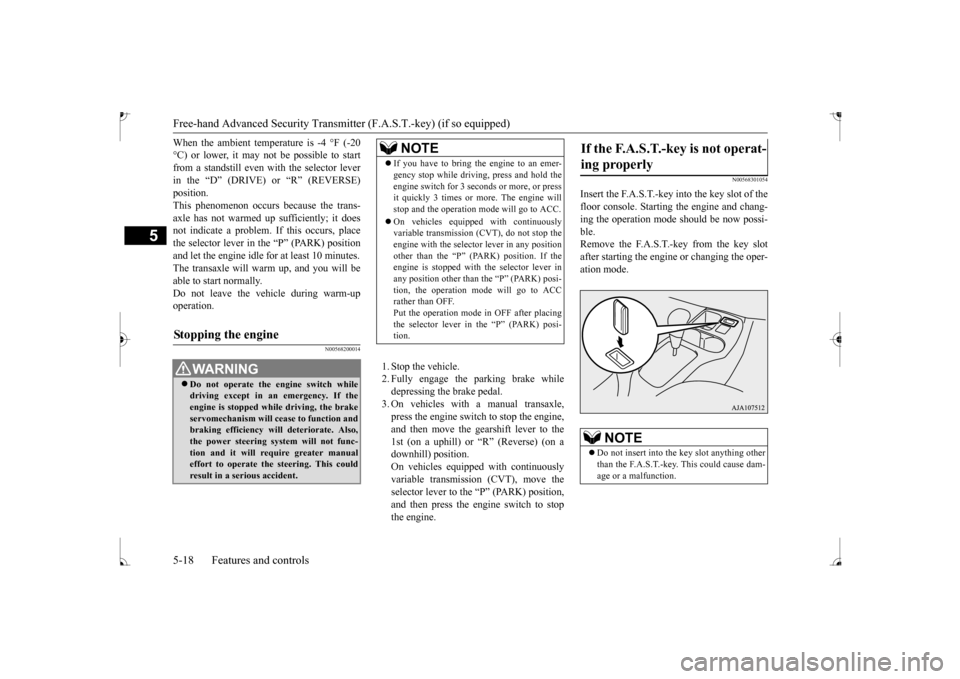
Insert the F.A.S.T.-key into the key slot of thefloor console. Starting the engine and chang-ing the operation mode
should be now possi-
ble. Remove the F.A.S.T.-key from the key slotafter starting the engine or changing the oper- ation mode.
Stopping the engine
WA R N I N G Do not operate the en
gine switch while
driving except in an emergency. If the engine is stopped while driving, the brakeservomechanism will ce
ase to function and
braking efficiency will deteriorate. Also, the power steering system will not func-tion and it will require greater manual effort to operate the steering. This could result in a serious accident.
NOTE
If you have to bring the engine to an emer- gency stop while driving, press and hold theengine switch for 3 sec
onds or more, or press
it quickly 3 times or more. The engine will stop and the operation mode will go to ACC. On vehicles equippe
d with continuously
variable transmission (CVT), do not stop the engine with the select
or lever in any position
other than the “P” (PARK) position. If the engine is stopped with
the selector lever in
any position other than the “P” (PARK) posi-tion, the operation mode will go to ACC rather than OFF. Put the operation mode
in OFF after placing
the selector lever in the
Page 94 of 305
Parking brake
Features and controls 5-31
5
N00551400043
Wind buffeting can be described as the per- ception of pressure on the ears or a booming or rumbling sound. Your vehicle may exhibit wind buffeting when driving with one or bothrear door windows down or partially opened. This is a normal occurrence that can be mini- mized. If the buffeting
occurs with the rear
door windows open, open the front door win- dows as well as the rear door windows to minimize the condition.
N00511400399
To park the vehicle, first bring it to a com- plete stop, fully engage the parking brake, and then move the gearshift lever to 1st (on auphill) or “R” (Reverse) (on a downhill) posi- tion for vehicles equipped with a manual transaxle, set the selector lever to “P”
cles equipped with a
continuously variable transmission (CVT).
If the battery termin
als are disc
onnected or
the fuse for electric
window is replaced, the
safety mechanism will be cancelled and thedoor window will not
automatically
open/close completely. If the window is open,
repeatedly raise the
driver’s door window switch until the win- dow has been fully cl
osed. Following this,
release the switch, raise the switch onceagain and hold it in this
condition for at least
1 second, then release it. You should now be able to operate the driver’s door window inthe normal fashion.
What to do if you hear wind buffeting when driving
NOTE
Parking brake
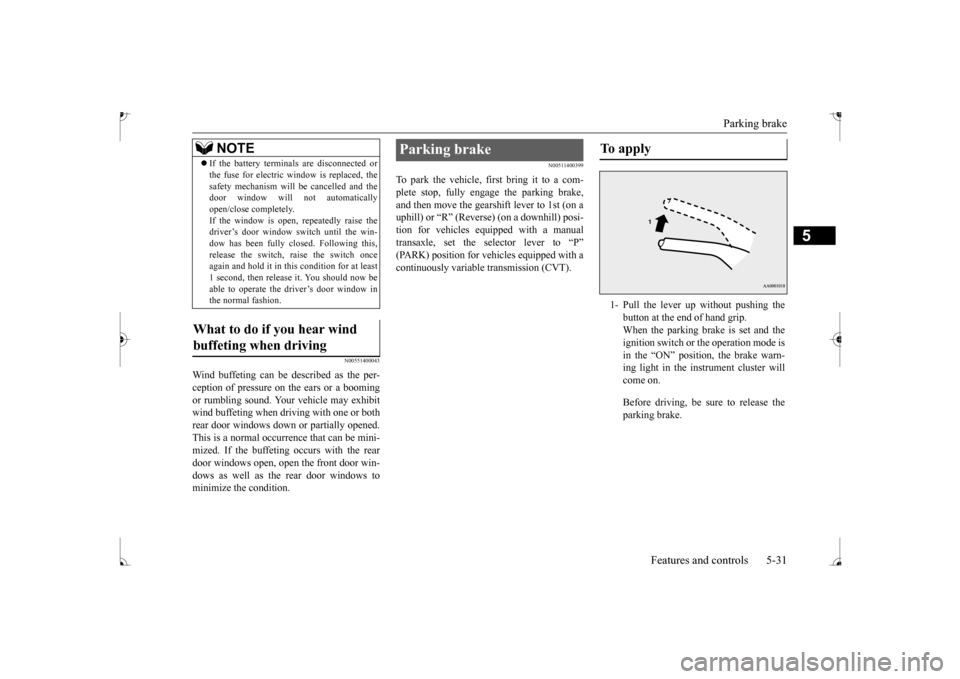
To apply 1- Pull the lever up without pushing the
button at the end of hand grip. When the parking brake is set and theignition switch or the operation mode is in the “ON” position, the brake warn- ing light in the instrument cluster willcome on. Before driving, be sure to release the parking brake.
BK0235100US.book 31 ページ 2015年11月20日 金曜日 午後3時12分
Page 95 of 305
Steering wheel height adjustment 5-32 Features and controls
5
When parking on a hill, set the parking brake, and turn the front wheels toward the curb on a downhill, or away from
the curb on an uphill.
N00511500231
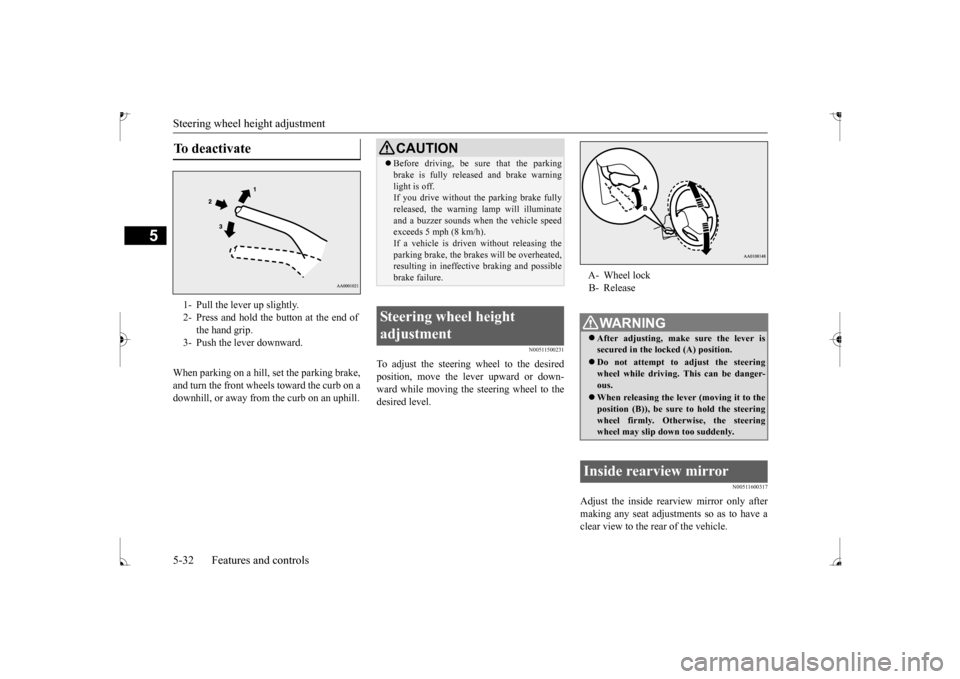
To adjust the steering wheel to the desired position, move the lever upward or down-ward while moving the steering wheel to the desired level.
N00511600317
Adjust the inside rearview mirror only after making any seat adjustme
nts so as to have a
clear view to the rear of the vehicle.
To deactivate 1- Pull the lever up slightly. 2- Press and hold the button at the end of
the hand grip.
3- Push the lever downward.
CAUTION Before driving, be sure that the parking brake is fully released and brake warninglight is off.If you drive without the parking brake fully released, the warning lamp will illuminate and a buzzer sounds when the vehicle speedexceeds 5 mph (8 km/h). If a vehicle is driven without releasing the parking brake, the brak
es will be overheated,
resulting in ineffective braking and possible brake failure.
Steering wheel height adjustment
A- Wheel lock B- ReleaseWA R N I N G After adjusting, make sure the lever is secured in the locked (A) position. Do not attempt to adjust the steering wheel while driving. This can be danger-ous. When releasing the leve
r (moving it to the
position (B)), be sure to hold the steering wheel firmly. Otherwise, the steering wheel may slip down too suddenly.
Inside rearview mirror
BK0235100US.book 32 ページ 2015年11月20日 金曜日 午後3時12分
Page 98 of 305
Ignition switch
Features and controls 5-35
5
For information on ope
rations for vehicles
equipped with the Free-hand Advanced Secu-rity Transmitter (F.A
.S.T.-key), refer to
“Free-hand Advanced
Security Transmitter
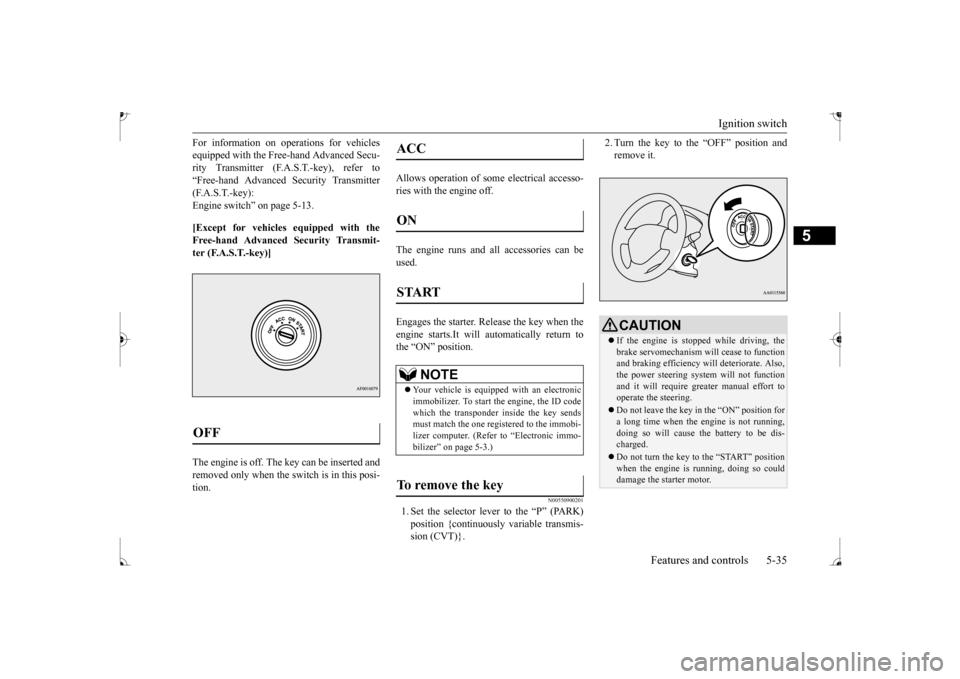
(F.A.S.T.-key):Engine switch” on page 5-13. [Except for vehicles equipped with the Free-hand Advanced Security Transmit- ter (F.A.S.T.-key)] The engine is off. The key can be inserted and removed only when the switch is in this posi- tion.
Allows operation of some electrical accesso- ries with the engine off. The engine runs and all accessories can be used. Engages the starter. Release the key when the engine starts.It will automatically return tothe “ON” position.
N00550900201
1. Set the selector lever to the “P” (PARK)position {continuously variable transmis-sion (CVT)}.
2. Turn the key to the “OFF” position and remove it.
OFF
ACC ON START
NOTE
Your vehicle is equippe
d with an electronic
immobilizer. To start
the engine, the ID code
which the transponder inside the key sends must match the one regi
stered to the immobi-
lizer computer. (Refer to “Electronic immo- bilizer” on page 5-3.)
To remove the key
CAUTION If the engine is stopped while driving, the brake servomechanism
will cease to function
and braking efficiency will deteriorate. Also,the power steering system will not function and it will re
quire greater manual effort to
operate the steering. Do not leave the key in
the “ON” position for
a long time when the engine is not running,doing so will cause th
e battery to be dis-
charged. Do not turn the key to the “START” position when the engine is running, doing so could damage the starter motor.
BK0235100US.book 35 ページ 2015年11月20日 金曜日 午後3時12分
Page 99 of 305
![MITSUBISHI MIRAGE 2017 6.G User Guide Starting the engine 5-36 Features and controls
5
N00512601816
[For vehicles equipped with the Free-hand Advanced Security Transmitter (F.A.S.T.- key)]For information on operation for vehicles equipped](/img/19/7514/w960_7514-98.png "MITSUBISHI MIRAGE 2017 6.G User Guide Starting the engine 5-36 Features and controls
5
N00512601816
[For vehicles equipped with the Free-hand Advanced Security Transmitter (F.A.S.T.- key)]For information on operation for vehicles equipped")
Starting the engine 5-36 Features and controls
5
N00512601816
[For vehicles equipped with the Free-hand Advanced Security Transmitter (F.A.S.T.- key)]For information on operation for vehicles equipped with the Free-hand Advanced Secu- rity Transmitter (F.A.S.T.-key), refer to“Free-hand Advanced Se
curity Transmitter
(F.A.S.T.-key): Starting and stopping the engine” on page 5-16. [Except for vehicles equipped with the Free-hand Advanced Security Transmit- ter (F.A.S.T.-key)] Do not operate the starter motor continu- ously for longer than 15 seconds as this could run the battery down or damage thestarter motor. If the engine does not start, turn the ignition switch back to the “OFF”
conds, and then try
again. Trying repeatedly with the engine or starter motor still turning will damage the starter mechanism. If the engine will not start because the bat- tery is weak or discharged, refer to “Jump-starting the engine” (on page 8-2)for instructions.
A longer warm up period will only con- sume extra fuel. The engine is warmed upenough for driving when the low coolant temperature indi
cator goes out.
Refer to “Low coolant temperature indi-cator” on page 5-71.
This model is equipped with an electronically controlled fuel injection system. This is a sys- tem that automatically controls fuel injection.
There is usually no need to depress the accel- erator pedal when starting the engine.The starter should not be run for more than 15 seconds at a time. To prevent battery drain, wait a few secondsbetween attempts to restart the engine. 1. Make sure all occupants are properly seated with seat belts fastened. 2. Insert the ignition key.3. Make sure the parking brake is applied. 4. Press and hold the brake pedal down with your right foot. 5. Press and hold the clutch pedal all the way down (manual transaxle). 6. On vehicles equippe
d with manual trans-
axle, place the gearshift lever in the “N” On vehicles equippe
d with continuously
variable transmission (CVT), make surethe selector lever is in the “P” (PARK) position.
Starting the engine Tips for starting
WA R N I N G Never run the engine in
a closed or poorly
ventilated area any longer than is neededto move your vehicle out of the area. Car- bon monoxide gas, which is odorless and extremely poisonous, could build up andcause serious injury or death.CAUTION Do not push-start the vehicle.Do not run the engine at high rpms or drive at high speeds until the engine has had a chance to warm up. Release the ignition sw
itch as soon as the
engine starts. Otherwise, the starter motorwill be damaged.
Starting the engine
NOTE
On vehicles equipped
with manual transaxle,
the starter will not ope
rate unless the clutch
pedal is fully depresse
d (Clutch interlock).
BK0235100US.book 36 ページ 2015年11月20日 金曜日 午後3時12分
Page 100 of 305
Manual transaxle (if so equipped)
Features and controls 5-37
5
7. Turn the ignition switch to the “ON” posi- tion and make certain that all warning lights are functioning properly beforestarting the engine. 8. Turn the ignition switch to the “START”
ng the accelerator
pedal. Release the
key when the engine
starts.
After several attempts, you may experience that the engine still does not start. 1. Make sure that all electric devices, such as lights, air conditio
ning blower and rear
window defogger, are turned off.
2. While depressing the brake pedal {contin- uously variable transmission (CVT)} orthe clutch pedal (manual transaxle), press the accelerator peda
l halfway and hold it
there, then crank th
e engine. Release the
accelerator pedal, immediately after the engine starts. 3. If the engine still will not start, the enginecould be flooded with too much gasoline. While depressing the brake pedal (CVT) or the clutch pedal (manual transaxle), push the accelerator pedal all the way down and hold it there, then crank theengine for 5 to 6 seconds. Return the igni- tion switch to the “OFF” position and release the accelerator pedal. Wait a fewseconds, and then crank the engine again for 5 to 6 seconds while depressing the brake pedal (CVT) or the clutch pedal(manual transaxle), but do not push the accelerator pedal. Re
lease the ignition key
if the engine starts. If the engine fails tostart, repeat these procedures. If the engine still will not
start, contact your
local Mitsubishi Motors dealer or a repairfacility of your choi
ce for assistance.
When the ambient temperature is -4 °F (-20 °C) or lower, it may not be possible to startfrom a standstill even with the selector lever in the
Page 102 of 305
Continuously variable transmission (CVT) (if so equipped)
Features and controls 5-39
5
At high altitude locati
ons, upshift as listed
below.
N00513000096
It is recommended th
at you downshift to a
lower gear when needed to maintain the desired speed, according to the table. Avoid downshifting at
too high a speed. The
engine may suffer damage. To maintain a safe speed and prolong brake life, shift down to 2nd or 1st when descend-ing a steep hill. Downshifting is also important to avoid “lug- ging” the engine at too low a speed, such aswhen turning a corner or when driving up a steep hill.
N00513100244
Do not use the gearshift lever as a han- drest. This can result
in premature wear of
the transaxle shift forks. The table above shows the maximum rec- ommended driving speed for in each gear. Do not drive near or at these speeds forprolonged periods of time.
N00560200050
The CVT will automatically and continuouslychange its gear ratio depending on road anddriving conditions. This helps achieve smooth driving and excellent fuel efficiency. The transmission prevents unnecessary upshifts even when the accelerator pedal isreleased and ensures smooth driving. According to the conditions, the transmission will automatically shift to a lower gear ratio to achieve stronger engine braking. This may help reduce your need
to use the service
brake.
N00560301087
As an additional safe
ty precaution, models
equipped with a continuously variable trans- mission have a shift-lock device that holds
Shift point
Upshift speeds
1st gear to 2nd gear 15 mph (24 km/h)2nd gear to 3rd gear 25 mph (40 km/h)3rd gear to 4th gear 40 mph (64 km/h)4th gear to 5th gear 45 mph (72 km/h)Downshifting
Recommended downshifting speed
Downshifting speed
Shift point
Under 20 mph (32 km/h)
Shift down from cur- rent gear to 2nd gear.
20 to 30 mph (32 to
48 km/h)
Shift down from cur- rent gear to 3rd gear.
Driving precautions
Maximum possible driving speed
Shift points
Maximum possible driving
speed
1st gear 28 mph (45 km/h)2nd gear 53 mph (85 km/h)3rd gear 78 mph (125 km/h)4th gear 105 mph (170 km/h)Downshifting speed
Shift point
Continuously variable transmission (CVT)
(if so
equipped)DRIVING UPHILL
DRIVING DOWNHILL
Selector lever operation
BK0235100US.book 39 ページ 2015年11月20日 金曜日 午後3時12分
Page 103 of 305
Continuously variable transmission (CVT) (if so equipped) 5-40 Features and controls
5
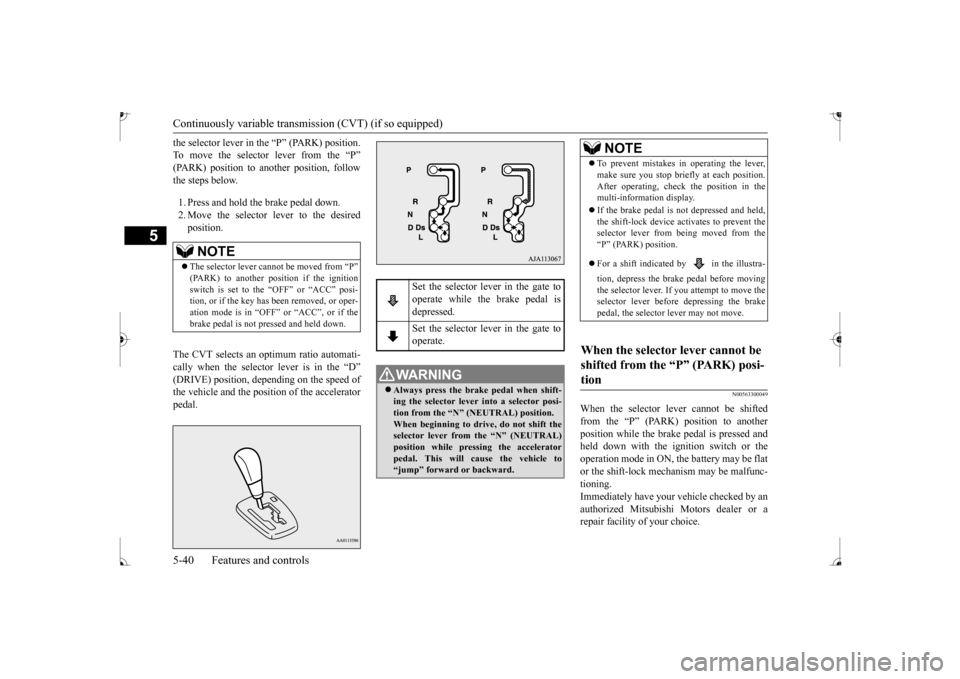
the selector lever in the “P” (PARK) position. To move the selector lever from the “P”
nother position, follow
the steps below. 1. Press and hold the brake pedal down. 2. Move the selector
lever to the desired
position.
The CVT selects an optimum ratio automati- cally when the selector lever is in the “D” the vehicle and the position of the acceleratorpedal.
N00563300049
When the selector lever cannot be shiftedfrom the “P” (PARK) position to another position while the brake pedal is pressed and held down with the ignition switch or theoperation mode in ON, th
e battery may be flat
or the shift-lock mechanism may be malfunc- tioning.Immediately have your
vehicle checked by an
authorized Mitsubishi Motors dealer or a repair facility of your choice.
NOTE
The selector lever cannot
be moved from “P” ition if the ignition
switch is set to the “OFF” or “ACC” posi- tion, or if the key has been removed, or oper-ation mode is in “OFF” brake pedal is not pressed and held down.
Set the selector lever in the gate to operate while the brake pedal is depressed. Set the selector lever in the gate to operate.
WA R N I N G Always press the brake pedal when shift- ing the selector lever into a selector posi- tion from the
Page 104 of 305
Continuously variable transmission (CVT) (if so equipped)
Features and controls 5-41
5
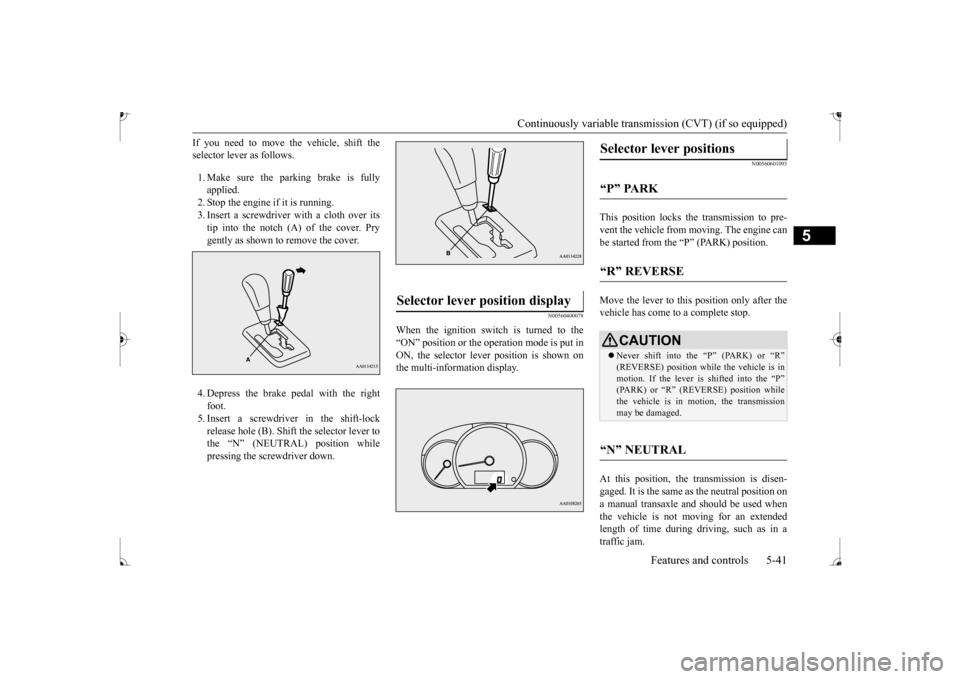
If you need to move the vehicle, shift the selector lever as follows. 1. Make sure the parking brake is fully applied. 2. Stop the engine if it is running. 3. Insert a screwdrive
r with a cloth over its
tip into the notch (A) of the cover. Pry gently as shown to remove the cover. 4. Depress the brake pe
dal with the right
foot. 5. Insert a screwdriver in the shift-lock release hole (B). Shift the selector lever tothe “N” (NEUTRAL) position while pressing the screwdriver down.
N00560400078
When the ignition switch is turned to the “ON” position or the ope
ration mode is put in
ON, the selector leve
r position is shown on
the multi-information display.
N00560601093
This position locks the transmission to pre- vent the vehicle from m
oving. The engine can
be started from the “P” (PARK) position. Move the lever to this position only after the vehicle has come to a complete stop. At this position, the
transmission is disen-
gaged. It is the same
as the neutral position on
a manual transaxle and should be used when the vehicle is not moving for an extended length of time during driving, such as in atraffic jam.
Selector lever position display
Selector lever positions
“P” PARK
“R” REVERSE
CAUTION Never shift into the “P” (PARK) or “R” motion. If the lever is shifted into the “P”the vehicle is in motion, the transmission may be damaged.
“N” NEUTRAL
BK0235100US.book 41 ページ 2015年11月20日 金曜日 午後3時12分