ignition MITSUBISHI MONTERO 2000 Service Repair Manual
[x] Cancel search | Manufacturer: MITSUBISHI, Model Year: 2000, Model line: MONTERO, Model: MITSUBISHI MONTERO 2000Pages: 1839, PDF Size: 29.19 MB
Page 991 of 1839

AUTOMATIC TRANSMISSION -Troubleshooting
Ter-
minal
No.Check itemInspection conditionsStandard value
1Shift actuatorTransfer shift lever position: 2H®4H5.6 V®11.0 V®
5.6 V
3Shift actuatorTransfer shift lever position: 4H®2H5.6 V®11.0 V®
5.6 V
5Accelerator pedal positionAccelerator pedal: Fully closed (engine stopped)0.985 - 1.085 V
sensor (APS)Accelerator pedal: Fully open (engine stopped)4.0 V or higher
7Front propeller shaft speed
sensorMeasure the voltage between terminals 7 and 18 using
an oscilloscope.
Engine: 2 000 r/min
Shift range: 4thOscilloscope check
procedure (Refer to
P. 23-69
9Rear propeller shaft speed
sensorMeasure the voltage between terminals 9 and 18 using
an oscilloscope.
Engine: 2 000 r/min
Shift range: 4thOscilloscope check
procedure (Refer to
P. 23-69
11Diagnosis outputWhen normal (no diagnosis codes are output)0 V and 5 V alterna-
tes
13Power supplyIgnition switch: OFF0V
Ignition switch: ONSystem voltage
18Sensor earthAt all times0.5 V or less
20Transfer lever switch 2HTransfer shift lever position: 2HSystem voltage
Transfer shift lever position: Other than the above0V
21Transfer lever switch 4HTransfer shift lever position: 4HSystem voltage
Transfer shift lever position: Other than the above0V
22Transfer lever switch 4HLcTransfer shift lever position: 4HLcSystem voltage
Transfer shift lever position: Other than the above0V
23Transfer lever switch 4LLcTransfer shift lever position: 4LLcSystem voltage
Transfer shift lever position: Other than the above0V
24Diagnosis control––
25EarthAt all times0V
26EarthAt all times0V
31Backup power supplyAt all timesSystem voltage
32Inhibitor switch NSelector lever position: NSystem voltage
Selector lever position: Other than the above0V
33Inhibitor switch PSelector lever position: PSystem voltage
Selector lever position: Other than the above0V
34Stop lamp switchBrake pedal: DepressedSystem voltage
Brake pedal: Released0V
35EarthAt all times0V
37Rear wheel indicator lampOther than during transfer selectionSystem voltage
38Front wheel indicator lampDuring 4WDSystem voltage
39Earth <6G7>At all times0V
www.WorkshopManuals.co.uk
Purchased from www.WorkshopManuals.co.uk
Page 993 of 1839

AUTOMATIC TRANSMISSION -
Troubleshooting
TROUBLESHOOTING
DIAGNOSIS FUNCTION
Input signal check procedure
Connect the MUT-II
or a voltage meter to the diagnosis connector, and check the inhibitor switch (reverse)
input signal.
(Refer to GROUP 00 - Guide to Troubleshooting and Inspection Procedures.)
INSPECTION CHART CLASSIFIED BY TROUBLE SYMPTOMS
Trouble SymptomInspection
procedure
No.Reference
page
When the ignition switch is at a position other than the LOCK position, the selector lever
can be moved from the P to the R position even though the brake pedal is not depressed.123-92
When the ignition switch is at a position other than the LOCK position, the selector lever
cannot be moved from the P to the R position even though the brake pedal is being
depressed.223-92
The ignition switch is at the LOCK position, but the selector lever can be moved from the
P to the R position when the brake pedal is depressed.323-93
The selector lever cannot be easily moved from the P to the R position.423-93
The selector lever cannot be moved from the R to the P position.523-93
The ignition key cannot be turned to the LOCK position when the selector lever is at the P
position.623-93
The ignition key can be turned to the LOCK position even when the selector lever is at a
position other than the P position.723-93
INSPECTION PROCEDURES FOR TROUBLE SYMPTOM
Inspection procedure 1
When the ignition switch is at a position other than the
LOCK position, the selector lever can be moved from the
P to the R position even though the brake pedal is not
depressed.
Probable cause
The cause is probably a malfunction of the selector lever assembly lock cam or
of the shift lock cable unit.DMalfunction of lock cam
DMalfunction of shift lock cable unit
Check by referring to the probable causes.
Inspection procedure 2
When the ignition switch is at a position other than the
LOCK position, the selector lever cannot be moved from
the P to the R position even though the brake pedal is
being depressed.
Probable cause
The cause is probably a malfunction of the selector lever assembly, transmission
control cable, shift lock cable unit or the ignition key cylinder lock bar.DMalfunction of selector lever assembly
DMalfunction of transmission control cable
DMalfunction of shift lock cable unit
DMalfunction of lock bar
Check by referring to the probable causes.
www.WorkshopManuals.co.uk
Purchased from www.WorkshopManuals.co.uk
Page 994 of 1839

AUTOMATIC TRANSMISSION -Troubleshooting
Inspection procedure 3
The ignition switch is at the LOCK position, but the
selector lever can be moved from the P to the R position
when the brake pedal is depressed.
Probable cause
The cause is probably a malfunction of the shift lock cable unit or of the ignition
key cylinder lock bar.DMalfunction of shift lock cable unit
DMalfunction of lock bar
Check by referring to the probable causes.
Inspection procedure 4
The selector lever cannot be easily moved from the P to
the R position.
Probable cause
The cause is probably a malfunction of the selector lever assembly, transmission
control cable, shift lock cable unit or the ignition key cylinder lock bar.DMalfunction of selector lever assembly
DMalfunction of transmission control cable
DMalfunction of shift lock cable unit
DMalfunction of lock bar
Check by referring to the probable causes.
Inspection procedure 5
The selector lever cannot be moved from the R to the P
position.
Probable cause
The cause is probably a malfunction of the selector lever assembly or of the
transmission control cable.DMalfunction of selector lever assembly
DMalfunction of transmission control cable
Check by referring to the probable causes.
Inspection procedure 6
The ignition key cannot be turned to the LOCK position
when the selector lever is at the P position.
Probable cause
The cause is probably a malfunction of the selector lever assembly, shift lock
cable unit or the ignition key cylinder lock bar.DMalfunction of selector lever assembly
DMalfunction of shift lock cable unit
DMalfunction of lock bar
Check by referring to the probable causes.
Inspection procedure 7
The ignition key can be turned to the LOCK position even
when the selector lever is at a position other than the P
position.
Probable cause
The cause is probably a malfunction of the shift lock cable unit or of the ignition
key cylinder lock bar.DMalfunction of shift lock cable unit
DMalfunction of lock bar
Check by referring to the probable causes.
www.WorkshopManuals.co.uk
Purchased from www.WorkshopManuals.co.uk
Page 1165 of 1839

POWER PLANT MOUNT - No.1 Crossmember32-7
No.1 CROSSMEMBER
REMOVAL AND INSTALLATION
Caution
1. Before removing the steering wheel and airbag module assembly, always refer to GROUP 52B
- Service Precautions, Airbag Module and Clock Spring. Also, set the front wheels so that
they are facing straight forward, and remove the ignition key. If you fail to do this, the SRS
clock spring will be damaged, causing the SRS airbag to be inoperative and serious injury.
2. *: Indicates parts which should be initially tightened, and then fully tightened after placing
the vehicle horizontally and loading the full weight of the engine on the vehicle body.
Pre-removal Operation
DUnder Cover Removal
DDrive Shaft Removal
(Refer to GROUP 26.)
DDifferential Carrier and No.2 Crossmember
Assembly Removal (Refer to GROUP 26 -
Freewheel Assembly and Differential Carrier.)
DUpper Arm Removal
(Refer to GROUP 33A.)
DLower Arm Removal
(Refer to GROUP 33A.)
DStabilizer Bar Removal
(Refer to GROUP 33A.)
DEngine Oil Cooler Removal<6G7>
(Refer to GROUP 12.)
DAir Cleaner Removal<4M4>
(Refer to GROUP 15.)
DIntercooler Removal<4M4>
(Refer to GROUP 15.)
DEngine Cover Removal
(Refer to GROUP 11A - Timing Belt.)
DRadiator Removal
(Refer to GROUP 14.)
DPower Steering Fluid Draining
(Refer to GROUP 37A - On - vehicle Service.)Post - installation Operations
DDifferential Carrier and No.2 Crossmember
Assembly Installation (Refer to GROUP 26 -
Freewheel Assembly and Differential Carrier.)
DDrive Shaft Installation
(Refer to GROUP 26.)
DLower Arm Installation
(Refer to GROUP 33A.)
DUpper Arm Installation
(Refer to GROUP 33A.)
DStabilizer Bar Installation
(Refer to GROUP 33A.)
DAir Cleaner Installation<4M4>
(Refer to GROUP 15.)
DIntercooler Installation<4M4>
(Refer to GROUP 15.)
DRadiator Installation
(Refer to GROUP 14.)
DEngine Oil Cooler Installation
(Refer to GROUP 12.)
DPower Steering Fluid Supplying
(Refer to GROUP 37A - On - vehicle Service.)
DPower Steering Fluid Line Bleeding
(Refer to GROUP 37A - On - vehicle Service.)
DPress the dust cover with a finger tocheck whether
the dust cover is cracked or damaged.
DChecking Steering Wheel Position with Wheels
StraightAhead
DFront Wheel AlignmentCheck and Adjustment
(Refer to GROUP 37A - On - vehicle Service.)
DUnder Cover Installation
DEngine Cover Installation
(Refer to GROUP 11A - Timing Belt.)
www.WorkshopManuals.co.uk
Purchased from www.WorkshopManuals.co.uk
Page 1217 of 1839
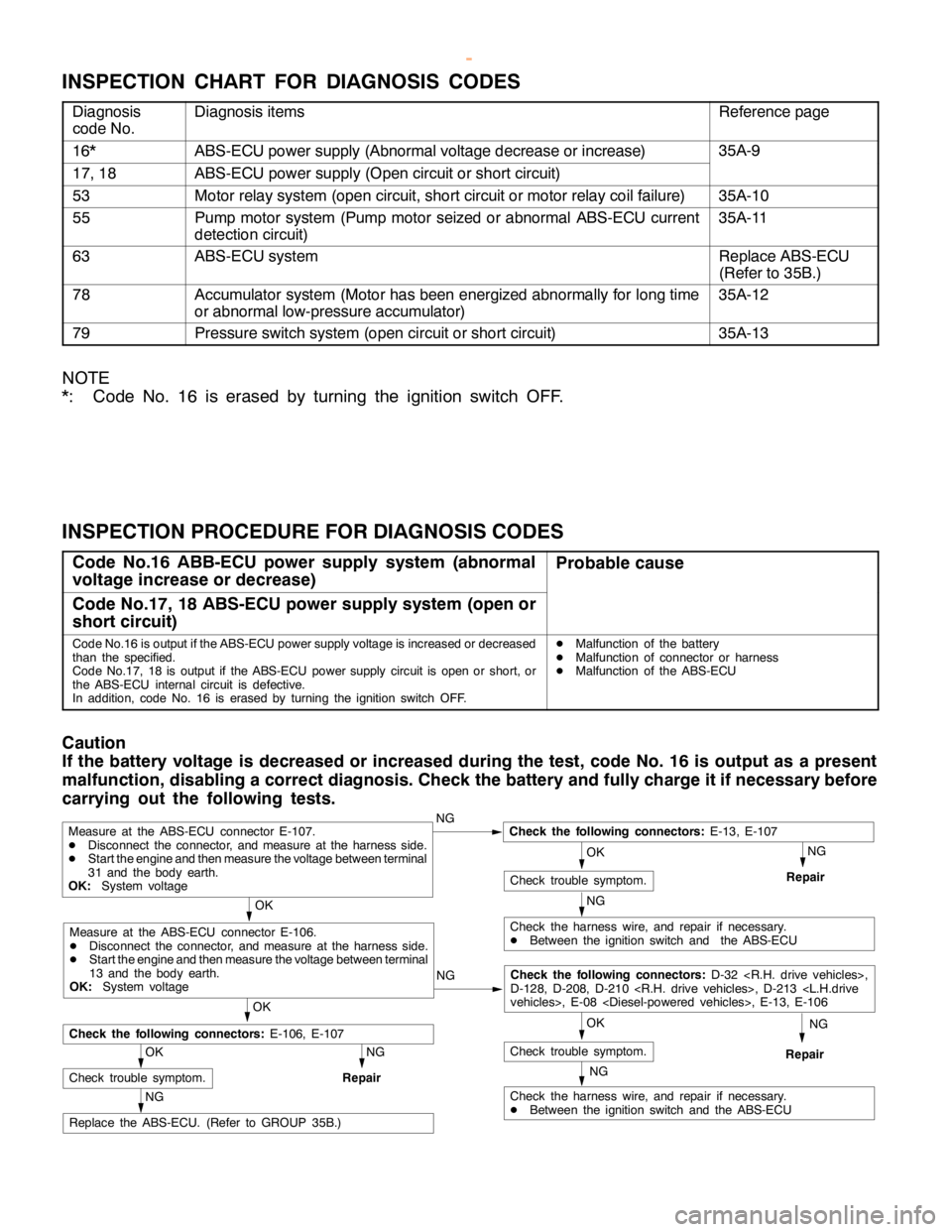
BASIC BRAKE SYSTEM -Troubleshooting35A-9
INSPECTION CHART FOR DIAGNOSIS CODES
Diagnosis
code No.Diagnosis itemsReference page
16*ABS-ECU power supply (Abnormal voltage decrease or increase)35A-9
17, 18ABS-ECU power supply (Open circuit or short circuit)
53Motor relay system (open circuit, short circuit or motor relay coil failure)35A-10
55Pump motor system (Pump motor seized or abnormal ABS-ECU current
detection circuit)35A-11
63ABS-ECU systemReplace ABS-ECU
(Refer to 35B.)
78Accumulator system (Motor has been energized abnormally for long time
or abnormal low-pressure accumulator)35A-12
79Pressure switch system (open circuit or short circuit)35A-13
NOTE
*: Code No. 16 is erased by turning the ignition switch OFF.
INSPECTION PROCEDURE FOR DIAGNOSIS CODES
Code No.16 ABB-ECU power supply system (abnormal
voltage increase or decrease)Probable cause
Code No.17, 18 ABS-ECU power supply system (open or
short circuit)
Code No.16 is output if the ABS-ECU power supply voltage is increased or decreased
than the specified.
Code No.17, 18 is output if the ABS-ECU power supply circuit isopen orshort, or
the ABS-ECU internal circuit is defective.
In addition, code No. 16 is erased by turning the ignition switch OFF.DMalfunction of the battery
DMalfunction of connector or harness
DMalfunction of the ABS-ECU
Caution
If the battery voltage is decreased or increased during the test, code No. 16 is output as a present
malfunction, disabling a correct diagnosis. Check the battery and fully charge it if necessary before
carrying out the following tests.
NG
NG
OK
NG
Replace the ABS-ECU. (Refer to GROUP 35B.)
OK
Check trouble symptom.
NG
Repair
NG
Check the harness wire, and repair if necessary.
DBetween the ignition switch and the ABS-ECU
OK
Check trouble symptom.
Measure at the ABS-ECU connector E-107.
DDisconnect the connector, and measure at the harness side.
DStart theengine and then measure the voltage between terminal
31 and the body earth.
OK:System voltageNGCheck the following connectors:E-13, E-107
Repair
OK
Check the following connectors:E-106, E-107
NG
Check the harness wire, and repair if necessary.
DBetween the ignition switch and the ABS-ECU
OK
Check trouble symptom.
Measure at the ABS-ECU connector E-106.
DDisconnect the connector, and measure at the harness side.
DStart theengine and then measure the voltage between terminal
13 and the body earth.
OK:System voltageNG
Check the following connectors:D-32
D-128, D-208, D-210
Repair
www.WorkshopManuals.co.uk
Purchased from www.WorkshopManuals.co.uk
Page 1218 of 1839
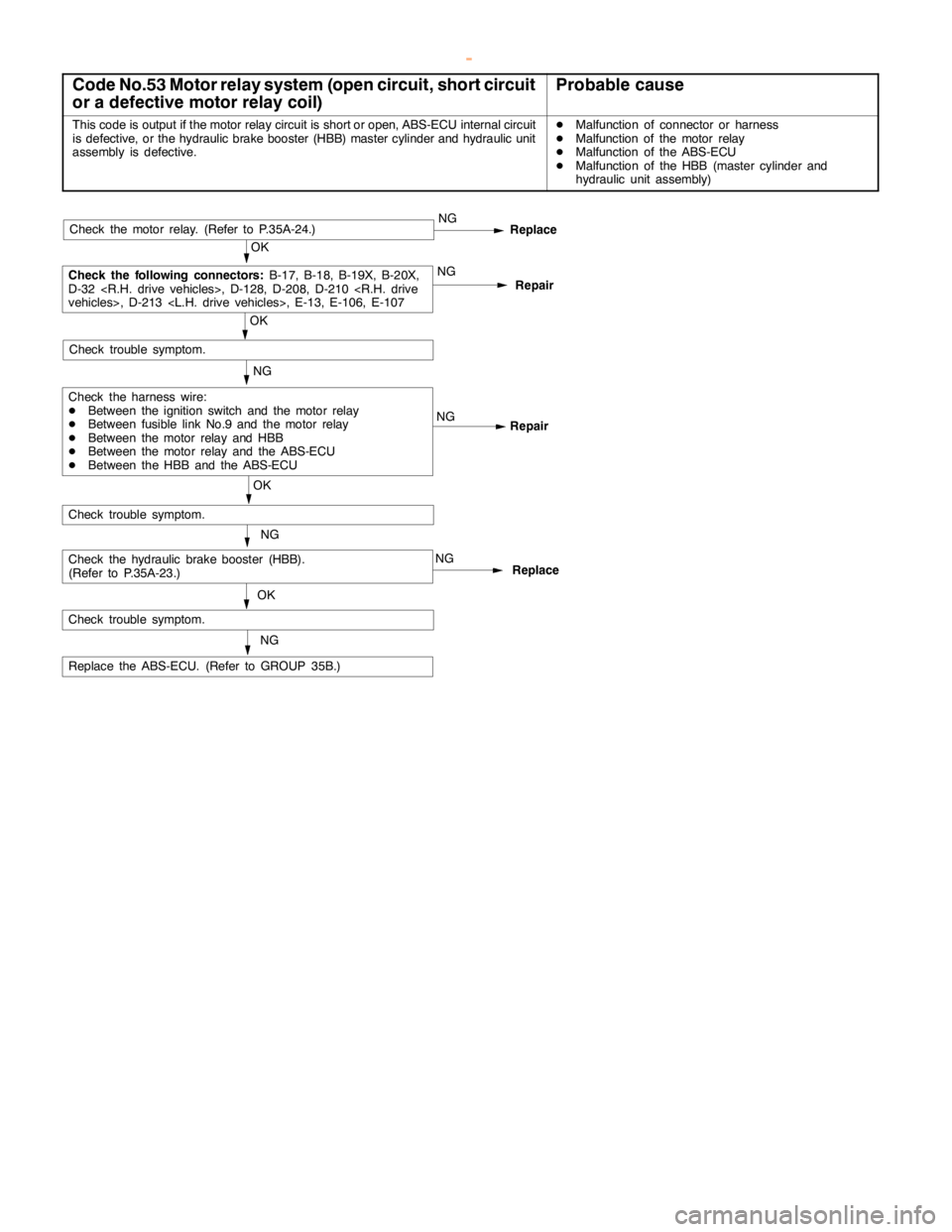
BASIC BRAKE SYSTEM -Troubleshooting35A-10
Code No.53 Motor relay system (open circuit, short circuit
or a defective motor relay coil)Probable cause
This code is output if the motor relay circuit is short or open, ABS-ECU internal circuit
is defective, or the hydraulic brake booster (HBB) master cylinder and hydraulic unit
assembly is defective.DMalfunction of connector or harness
DMalfunction of the motor relay
DMalfunction of the ABS-ECU
DMalfunction of the HBB (master cylinder and
hydraulic unit assembly)
NG
Replace the ABS-ECU. (Refer to GROUP 35B.)NG
Repair
NG
OK
Check trouble symptom.
Repair NGNG
OK
Check trouble symptom.
Replace
OK
Check the following connectors:
B-17, B-18, B-19X, B-20X,
D-32
Check the harness wire:
DBetween the ignition switch and the motor relay
DBetween fusible link No.9 and the motor relay
DBetween the motor relay and HBB
DBetween the motor relay and the ABS-ECU
DBetween the HBB and the ABS-ECU
Check trouble symptom.
NG
NG
Replace
OK
Check the motor relay. (Refer to P.35A-24.)
Check the hydraulic brake booster (HBB).
(Refer to P.35A-23.)
www.WorkshopManuals.co.uk
Purchased from www.WorkshopManuals.co.uk
Page 1221 of 1839
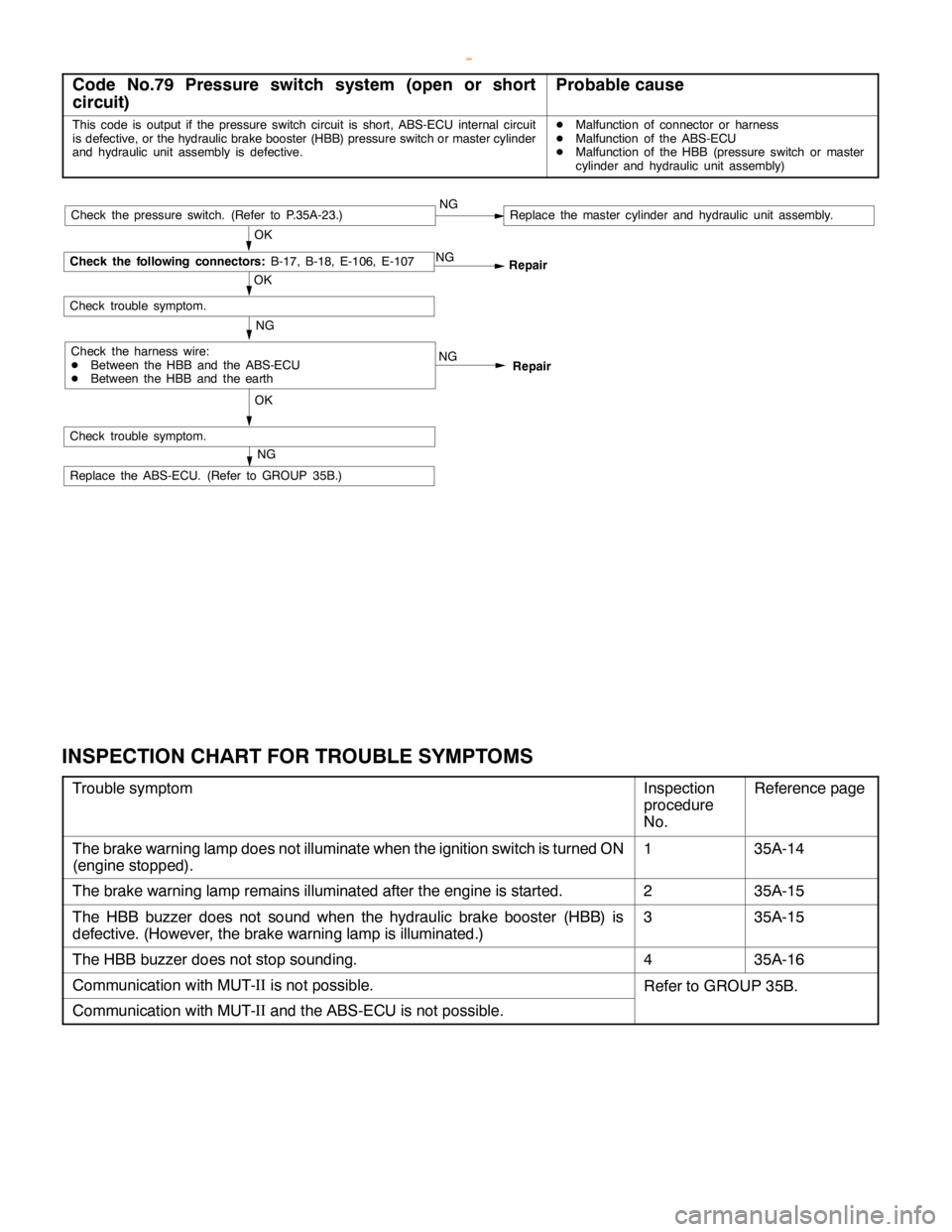
BASIC BRAKE SYSTEM -Troubleshooting35A-13
Code No.79 Pressure switch system (open or short
circuit)Probable cause
This code is output if the pressure switch circuit is short, ABS-ECU internal circuit
is defective, or the hydraulic brake booster (HBB) pressure switch or master cylinder
and hydraulic unit assembly is defective.DMalfunction of connector or harness
DMalfunction of the ABS-ECU
DMalfunction of the HBB (pressure switch or master
cylinder and hydraulic unit assembly)
NG
Repair
NG
OKRepair NG
OK
Check trouble symptom.
Check the following connectors:
B-17, B-18, E-106, E-107
Check the harness wire:
DBetween the HBB and the ABS-ECU
DBetween the HBB and the earthNG
Check trouble symptom.
Replace the ABS-ECU. (Refer to GROUP 35B.)
NG
OKCheck the pressure switch. (Refer to P.35A-23.)Replace the master cylinder and hydraulic unit assembly.
INSPECTION CHART FOR TROUBLE SYMPTOMS
Trouble symptomInspection
procedure
No.Reference page
The brake warning lamp does not illuminate when the ignition switch is turned ON
(engine stopped).135A-14
The brake warning lamp remains illuminated after the engine is started.235A-15
The HBB buzzer does not sound when the hydraulic brake booster (HBB) is
defective. (However, the brake warning lamp is illuminated.)335A-15
The HBB buzzer does not stop sounding.435A-16
Communication with MUT-II
is not possible.Refer to GROUP 35B.
Communication with MUT-II
and the ABS-ECU is not possible.
www.WorkshopManuals.co.uk
Purchased from www.WorkshopManuals.co.uk
Page 1222 of 1839
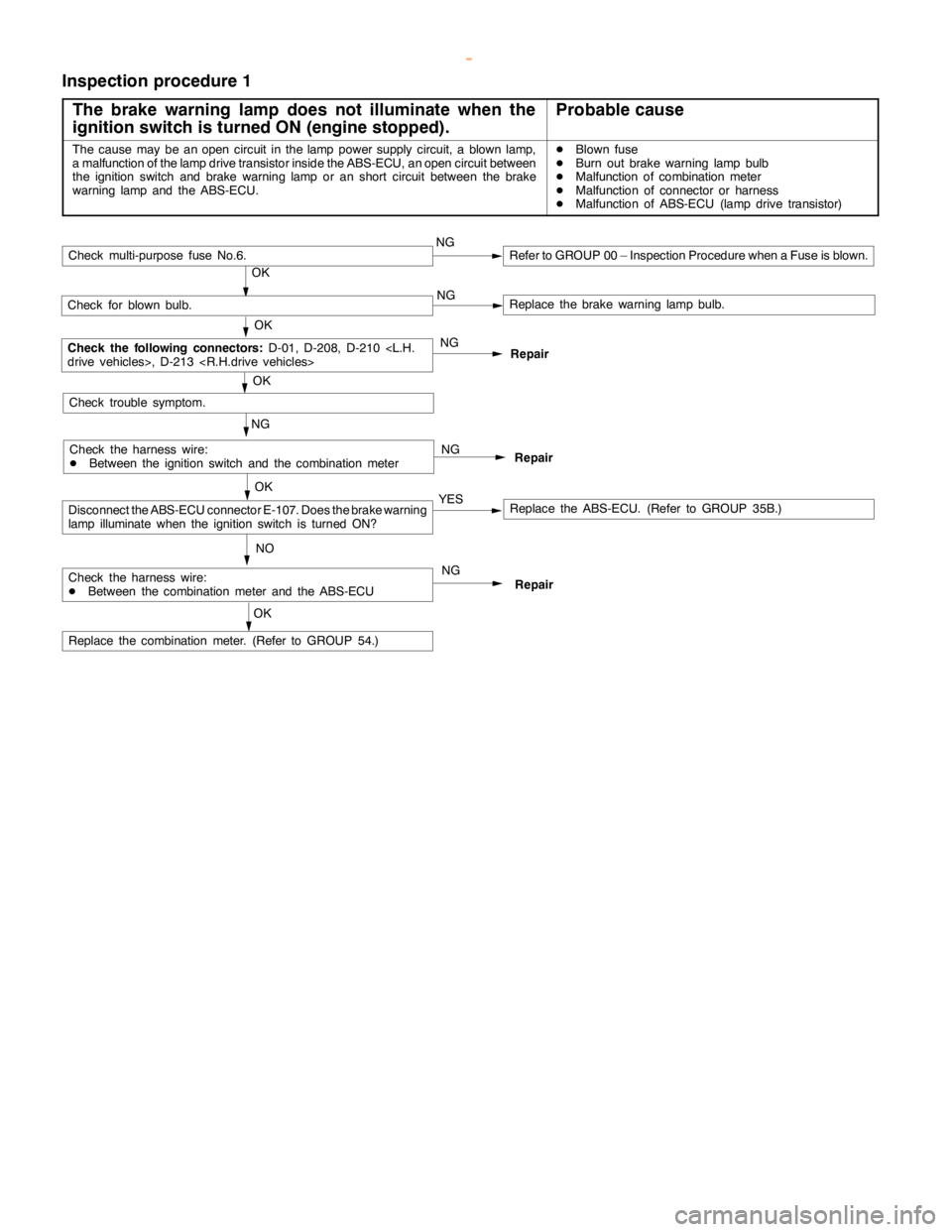
BASIC BRAKE SYSTEM -Troubleshooting35A-14
Inspection procedure 1
The brake warning lamp does not illuminate when the
ignition switch is turned ON (engine stopped).
Probable cause
The cause may be anopencircuit in thelamppower supply circuit, a blown lamp,
a malfunction of the lampdrive transistor inside the ABS-ECU, anopencircuit between
the ignition switch and brake warninglamp or anshort circuit between the brake
warning lamp and theABS-ECU.DBlown fuse
DBurn out brake warninglamp bulb
DMalfunction of combination meter
DMalfunction of connector or harness
DMalfunction of ABS-ECU (lamp drive transistor)
Repair NG NG
NO
Replace the ABS-ECU. (Refer to GROUP 35B.)
Repair
Repair
NG
OK
Check for blown bulb.Replace the brake warninglamp bulb.
OK
Check the following connectors:
D-01, D-208, D-210
NG
Replace the combination meter. (Refer to GROUP 54.)
OK
Check trouble symptom.
OK
YES
Check multi-purpose fuse No.6.NGRefer to GROUP 00 – Inspection Procedure when a Fuse is blown.
Check the harness wire:
DBetween the ignition switch and the combination meter
Check the harness wire:
DBetween the combination meter and the ABS-ECU
Disconnect the ABS-ECU connector E-107. Does the brake warning
lamp illuminatewhen the ignition switch is turned ON?
NG
OK
www.WorkshopManuals.co.uk
Purchased from www.WorkshopManuals.co.uk
Page 1223 of 1839
BASIC BRAKE SYSTEM -Troubleshooting35A-15
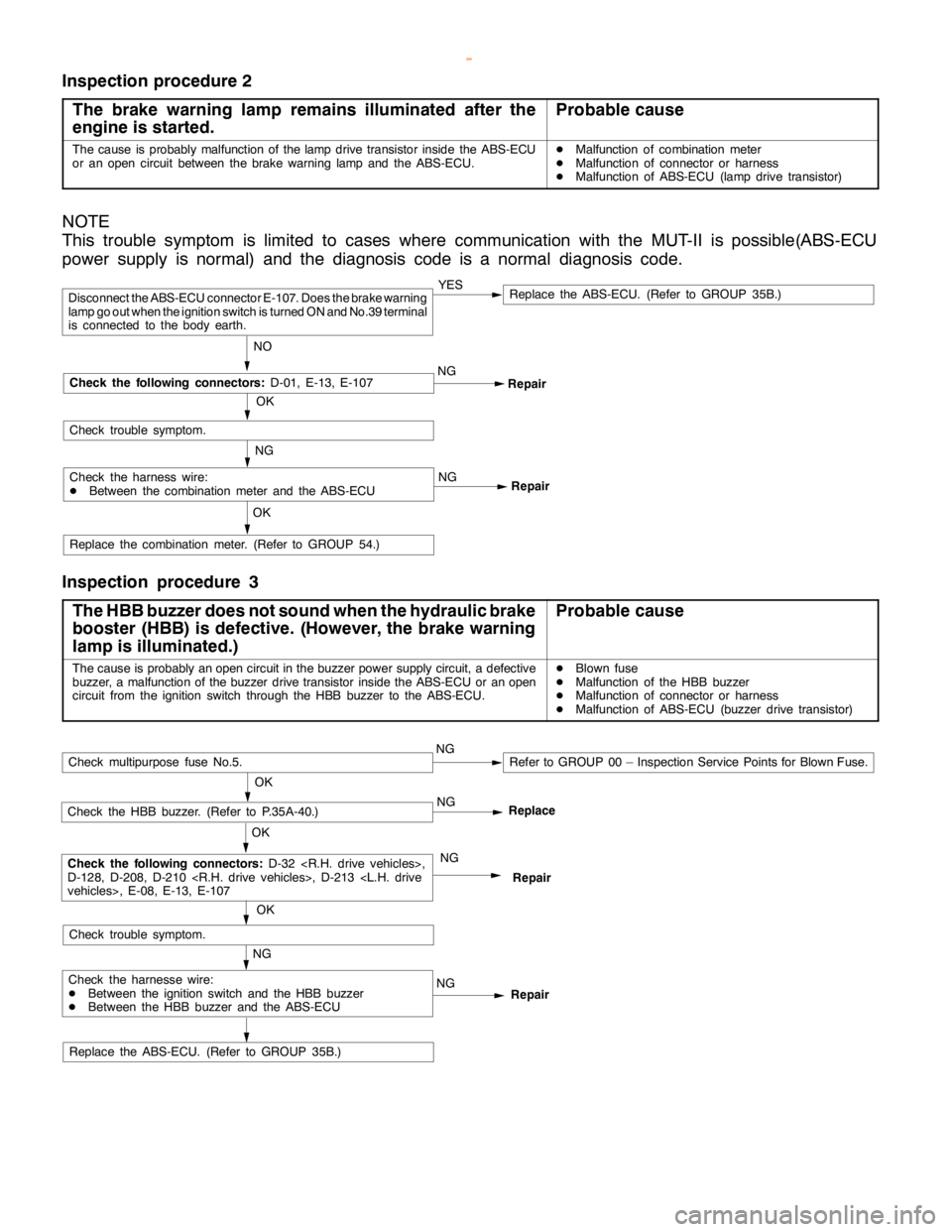
Inspection procedure 2
The brake warning lamp remains illuminated after the
engine is started.
Probable cause
The cause is probably malfunction of thelampdrive transistor inside the ABS-ECU
or an opencircuit between the brake warninglamp and theABS-ECU.DMalfunction of combination meter
DMalfunction of connector or harness
DMalfunction of ABS-ECU (lamp drive transistor)
NOTE
This trouble symptom is limited to cases where communication with the MUT-II is possible(ABS-ECU
power supply is normal) and the diagnosis code is a normal diagnosis code.
Repair NG
Repair
Replace the combination meter. (Refer to GROUP 54.)
OK
YESReplace the ABS-ECU. (Refer to GROUP 35B.)
NO
Disconnect the ABS-ECU connector E-107. Does the brake warning
lamp go outwhen the ignition switch is turned ON and No.39 terminal
is connected to the body earth.
OK
Check the following connectors:
D-01, E-13, E-107
Check trouble symptom.
Check the harness wire:
DBetween the combination meter and the ABS-ECUNG
NG
Inspection procedure 3
The HBB buzzer does not sound when the hydraulic brake
booster (HBB) is defective. (However, thebrake warning
lamp is illuminated.)
Probable cause
The cause is probably anopencircuit in the buzzer power supply circuit, a defective
buzzer, a malfunction of the buzzer drive transistor inside the ABS-ECU or anopen
circuit from the ignition switch through the HBB buzzer to the ABS-ECU.DBlown fuse
DMalfunction of the HBB buzzer
DMalfunction of connector or harness
DMalfunction of ABS-ECU (buzzer drive transistor)
Replace the ABS-ECU. (Refer to GROUP 35B.)
Repair NG
Repair
NG
OK
Check the HBB buzzer. (Refer to P.35A-40.)
OK
Check the following connectors:
D-32
D-128, D-208, D-210
NG
OK
Check trouble symptom.
Check multipurpose fuse No.5.NGRefer to GROUP 00 – Inspection Service Points for Blown Fuse.
Check the harnesse wire:
DBetween the ignition switch and the HBB buzzer
DBetween the HBB buzzer and the ABS-ECUNGReplace
www.WorkshopManuals.co.uk
Purchased from www.WorkshopManuals.co.uk
Page 1224 of 1839
BASIC BRAKE SYSTEM -Troubleshooting35A-16
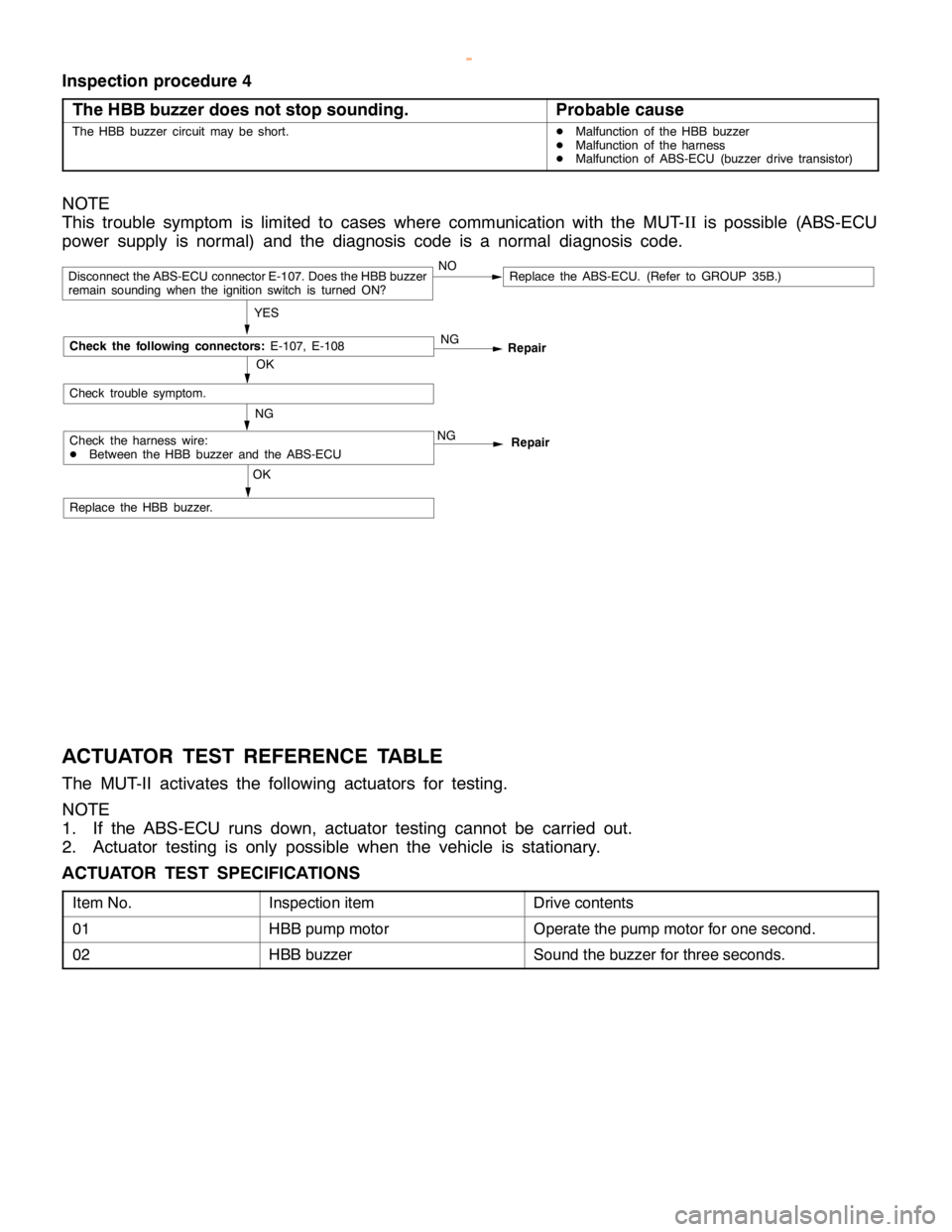
Inspection procedure 4
The HBB buzzer does not stop sounding.
Probable cause
The HBB buzzer circuit may be short.DMalfunction of the HBB buzzer
DMalfunction of the harness
DMalfunction of ABS-ECU (buzzer drive transistor)
NOTE
This trouble symptom is limited to cases where communication with the MUT-II
is possible (ABS-ECU
power supply is normal) and the diagnosis code is a normal diagnosis code.
OK
Repair NG
Repair
Replace the HBB buzzer.
OK
NG
YES
Replace the ABS-ECU. (Refer to GROUP 35B.)NODisconnect the ABS-ECU connector E-107. Does the HBB buzzer
remain sounding when the ignition switch is turned ON?
Check trouble symptom.
Check the harness wire:
DBetween the HBB buzzer and the ABS-ECUNG
Check the following connectors:
E-107, E-108
ACTUATOR TEST REFERENCE TABLE
The MUT-II activates the following actuators for testing.
NOTE
1. If the ABS-ECU runs down, actuator testing cannot be carried out.
2. Actuator testing is only possible when the vehicle is stationary.
ACTUATOR TEST SPECIFICATIONS
Item No.Inspection itemDrive contents
01HBB pump motorOperate the pump motor for one second.
02HBB buzzerSound the buzzer for three seconds.
www.WorkshopManuals.co.uk
Purchased from www.WorkshopManuals.co.uk