service MITSUBISHI MONTERO 2000 Service Workshop Manual
[x] Cancel search | Manufacturer: MITSUBISHI, Model Year: 2000, Model line: MONTERO, Model: MITSUBISHI MONTERO 2000Pages: 1839, PDF Size: 29.19 MB
Page 612 of 1839

DIESEL FUEL <4D5-stepIII>-General/General Information13E-2
GENERAL
OUTLINE OF CHANGE
An electronically-controlled injection pump has been added in order to comply with Regulation STEP
III. Due to this, the following service procedures have been added.
GENERAL INFORMATION
The electronically-controlled fuel injection system consists of sensors which detect the condition of the
diesel engine, an engine-ECU which controls the system based on signals from these sensors, and actuators
which operate according to control commands from the engine-ECU.
The engine-ECU carries out operations such as fuel injection rate control, fuel injection timing control
and idle up control. In addition, the engine-ECU is equipped with several self-diagnosis functions which
make troubleshooting easier in the event that a problem develops.
FUEL INJECTION RATE CONTROL
The fuel injection completion timing is controlled by means of a solenoid-type spill valve to ensure that
the optimum amount of fuel is supplied to the engine in accordance with gradual changes in the engine
running condition.
Before fuel injection starts, the solenoid-type spill valve is on (energized), so that the valve is closed.
As the plunger turns and rises, fuel is sent out under pressure, and when the fuel flow rate reaches
the target value for fuel injection, the solenoid-type spill valve turns off. When the solenoid-type spill
valve turns off, the fuel under high pressure inside the plunger is leaked out into the pump chamber
and fuel injection is completed.
FUEL INJECTION TIMING CONTROL
The position of the injection pump timer piston is controlled so that fuel injection is carried out at the
optimum timing in accordance with the engine running condition.
The timer piston position is determined by duty control of the timing control solenoid valve which is located
in the line between the high-pressure chamber and the low-pressure chamber of the timer piston.
The fuel injection timing is advanced by increasing the control duty of the timing control solenoid valve.
IDLE SPEED CONTROL
Controlling the fuel injection rate in accordance with the engine running condition maintains the idle speed
at the optimum condition.
SELF-DIAGNOSIS FUNCTION
DWhen an abnormality is detected in any of the sensors or actuators, the engine warning lamp illuminates
to warn the driver.
DWhen an abnormality is detected in any of the sensors or actuators, a diagnosis code number
corresponding to the problem which occurred is output.
DThe RAM data relating to the sensors and actuators which is stored in the engine-ECU can be read
using the MUT-II. In addition, the actuators can be force-driven under certain conditions.
OTHER CONTROL FUNCTIONS
1. Power Supply Control
When the ignition switch is turned to ON, the relay turns on and power is supplied to components
such as the timing control solenoid valve.
2. Intake Air Throttle Control
When the engine-ECU detects an abnormality in any of the sensors or actuators, the throttle valve
is half opened to restrict the amount of intake air in order to prevent the vehicle from running away.
3. A/C Relay Control
Turns the compressor clutch of the A/C ON and OFF
4. Condenser Fan Motor Relay Control
Controls the condenser fan motor relay based on the A/C switch, engine coolant temperature and
vehicle speed input signals.
5. Glow Control
Refer to GROUP 16.
6. EGR Control
Refer to GROUP 17.
www.WorkshopManuals.co.uk
Purchased from www.WorkshopManuals.co.uk
Page 614 of 1839

DIESEL FUEL <4D5-stepIII>-Service Specifications/Sealant13E-4
SERVICE SPECIFICATIONS
ItemStandard value
Fuel injection initial pressure kPa14,710 - 15,490
Accelerator pedal position sensor reference voltage V0.985 - 1.085
Accelerator pedal position sensor resistance kΩ3.5 - 6.5
Boost air temperature sensor (Intake air temperature
)itkΩ
When the temperature is 20_C2.3 - 3.0p(p
sensor) resistance kΩWhen the temperature is 80_C0.30 - 0.42
Engine coolant temperature sensor resistance kΩWhen the temperature is 20_C2.1 - 2.7gp
When the temperature is 80_C0.26 - 0.36
Fuel cut solenoid valve resistanceΩ6.8 - 9.2
Timing control valve resistanceΩ10.8 - 11.2
Timer piston position sensor resistanceΩConnector terminals No. 1 - No. 2160 - 168pp
Connector terminals No. 1 - No. 380 - 84
Connector terminals No. 2 - No. 380 - 84
Control sleeve position sensor resistanceΩConnector terminals No. 4 - No. 1211.2 - 12.4p
Connector terminals No. 4 - No. 85.6 - 6.2
Connector terminals No. 8 - No. 125.6 - 6.2
GE actuator (electronic governor) resistanceΩConnector terminals No. 6 - No. 100.64 - 0.72
Fuel temperature sensor resistance kΩConnector terminals No. 7 - No. 111.4 - 2.6
Pump speed sensor resistance kΩ1.36 - 1.84
Throttle solenoid valve resistanceΩ36 - 44
SEALANT
ItemSpecified sealant
Engine coolant temperature sensor3M Nut Locking Part No. 4171 or equivalent
www.WorkshopManuals.co.uk
Purchased from www.WorkshopManuals.co.uk
Page 634 of 1839
DIESEL FUEL <4D5-stepIII>-Troubleshooting13E-24
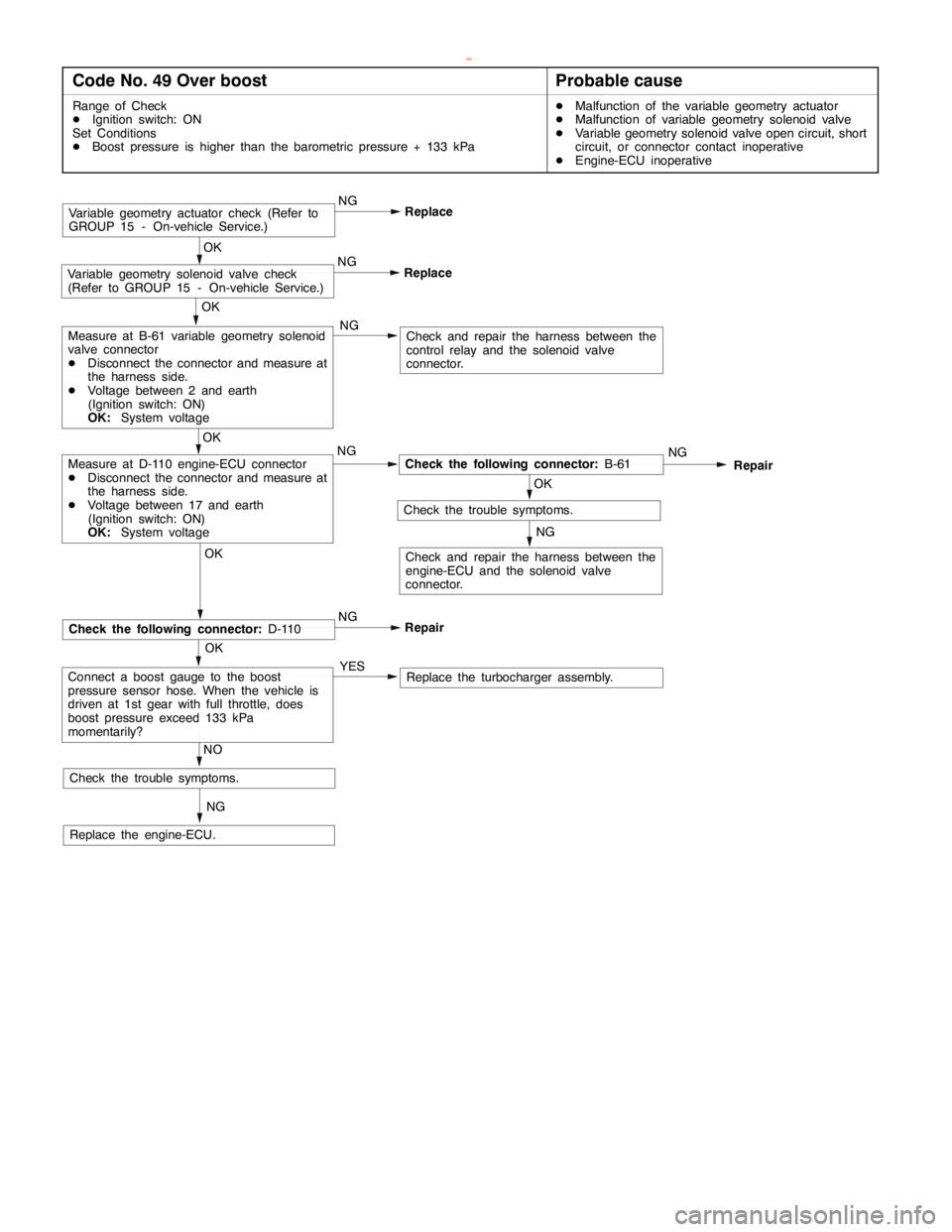
Code No. 49 Over boostProbable cause
Range of Check
DIgnition switch: ON
Set Conditions
DBoost pressure is higher than the barometric pressure + 133 kPaDMalfunction of the variable geometry actuator
DMalfunction of variable geometry solenoid valve
DVariable geometry solenoid valve open circuit, short
circuit, or connector contact inoperative
DEngine-ECU inoperative
OKOK
Check and repair the harness between the
control relay and the solenoid valve
connector.
Replace the engine-ECU.OK
ReplaceVariable geometry solenoid valve check
(Refer to GROUP 15 - On-vehicle Service.)
Check the trouble symptoms.NG
NG
Check the following connector:B-61NG
Repair
OK
Check the trouble symptoms.
NG
NGMeasure at D-110 engine-ECU connector
DDisconnect the connector and measure at
the harness side.
DVoltage between 17 and earth
(Ignition switch: ON)
OK:System voltageOK
Measure at B-61 variable geometry solenoid
valve connector
DDisconnect the connector and measure at
the harness side.
DVoltage between 2 and earth
(Ignition switch: ON)
OK:System voltage
Check and repair the harness between the
engine-ECU and the solenoid valve
connector.
ReplaceVariable geometry actuator check (Refer to
GROUP 15 - On-vehicle Service.)NG
OK
Repair
Check the following connector:D-110NG
NG
Replace the turbocharger assembly. YESConnect a boost gauge to the boost
pressure sensor hose. When the vehicle is
driven at 1st gear with full throttle, does
boost pressure exceed 133 kPa
momentarily?
NO
www.WorkshopManuals.co.uk
Purchased from www.WorkshopManuals.co.uk
Page 648 of 1839
DIESEL FUEL <4D5-stepIII>-Troubleshooting13E-38
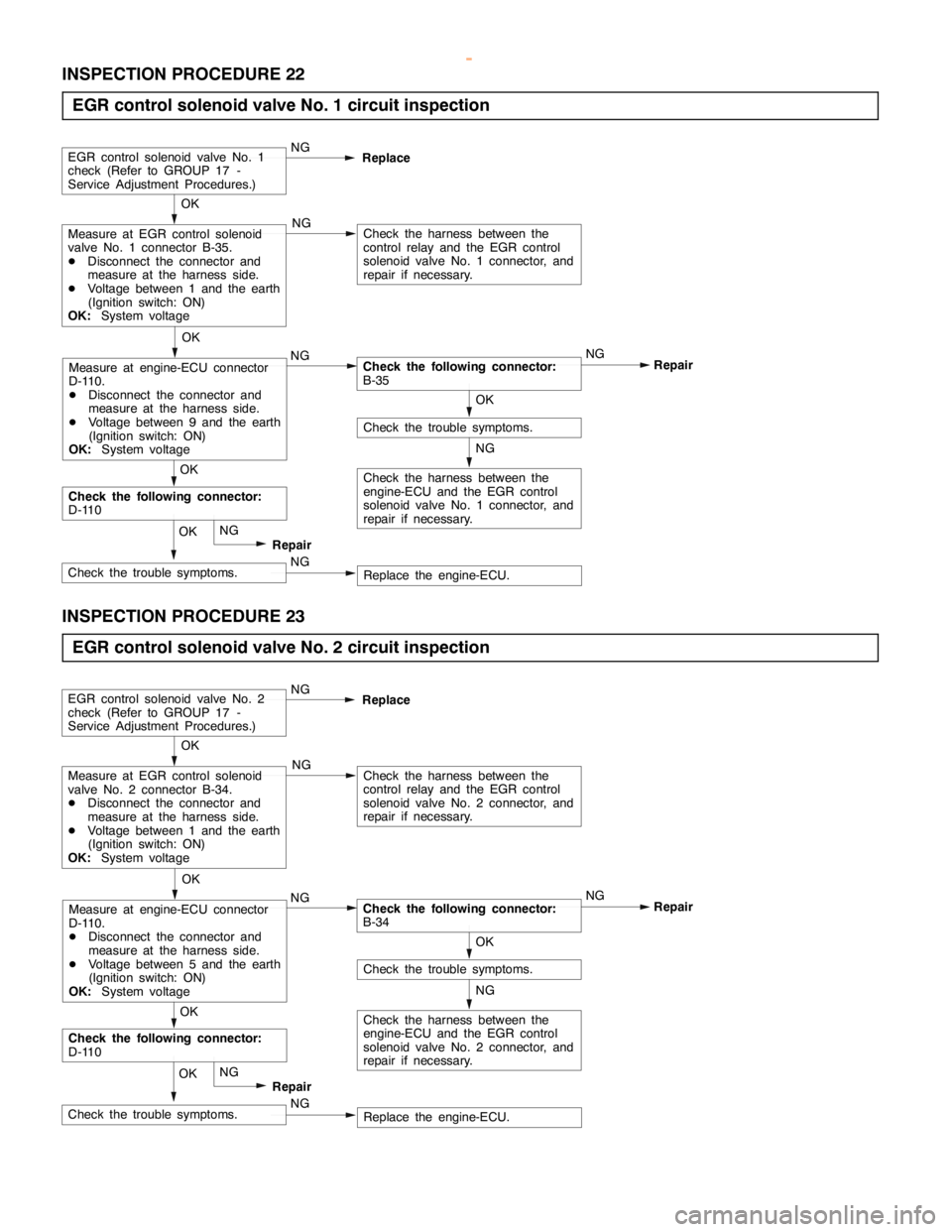
INSPECTION PROCEDURE 22
EGR control solenoid valve No. 1 circuit inspection
NG
Check the harness between the
engine-ECU and the EGR control
solenoid valve No. 1 connector, and
repair if necessary.
OK
Check the trouble symptoms.
OK
Measure at EGR control solenoid
valve No. 1 connector B-35.
DDisconnect the connector and
measure at the harness side.
DVoltage between 1 and the earth
(Ignition switch: ON)
OK:System voltage
NG
Check the following connector:
B-35NG
Repair NG
Check the harness between the
control relay and the EGR control
solenoid valve No. 1 connector, and
repair if necessary.
EGR control solenoid valve No. 1
check (Refer to GROUP 17 -
Service Adjustment Procedures.)NG
Replace
OK
Measure at engine-ECU connector
D-110.
DDisconnect the connector and
measure at the harness side.
DVoltage between 9 and the earth
(Ignition switch: ON)
OK:System voltage
NG
Replace the engine-ECU. NGCheck the trouble symptoms.OK
Repair
Check the following connector:
D-110OK
INSPECTION PROCEDURE 23
EGR control solenoid valve No. 2 circuit inspection
NG
Check the harness between the
engine-ECU and the EGR control
solenoid valve No. 2 connector, and
repair if necessary.
OK
Check the trouble symptoms.
OK
Measure at EGR control solenoid
valve No. 2 connector B-34.
DDisconnect the connector and
measure at the harness side.
DVoltage between 1 and the earth
(Ignition switch: ON)
OK:System voltage
NG
Check the following connector:
B-34NG
Repair NG
Check the harness between the
control relay and the EGR control
solenoid valve No. 2 connector, and
repair if necessary.
EGR control solenoid valve No. 2
check (Refer to GROUP 17 -
Service Adjustment Procedures.)NG
Replace
OK
Measure at engine-ECU connector
D-110.
DDisconnect the connector and
measure at the harness side.
DVoltage between 5 and the earth
(Ignition switch: ON)
OK:System voltage
NG
Replace the engine-ECU. NGCheck the trouble symptoms.OK
Repair
Check the following connector:
D-110OK
www.WorkshopManuals.co.uk
Purchased from www.WorkshopManuals.co.uk
Page 649 of 1839
DIESEL FUEL <4D5-stepIII>-Troubleshooting13E-39
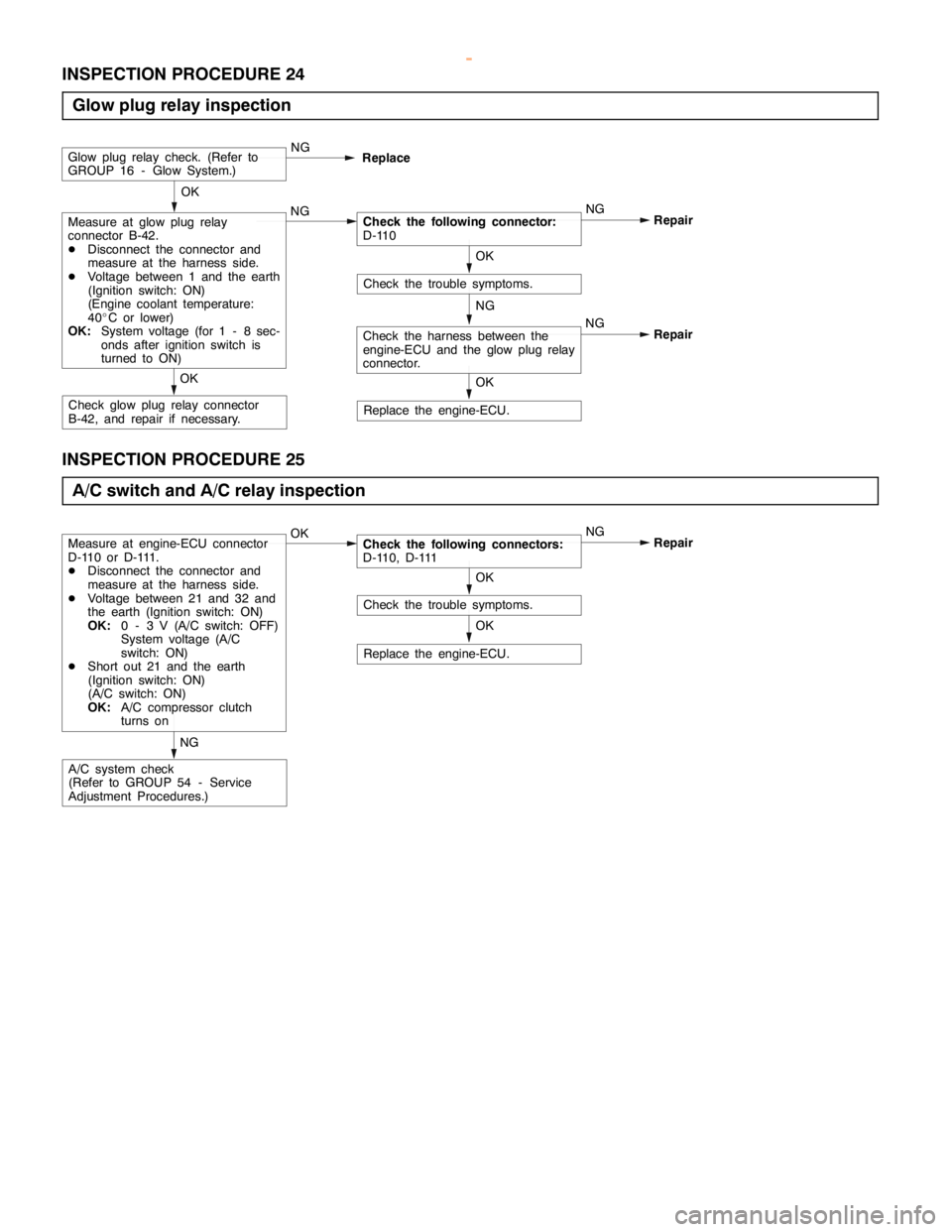
INSPECTION PROCEDURE 24
Glow plug relay inspection
NG
Replace the engine-ECU.
OK
Check the trouble symptoms.
OK
Measure at glow plug relay
connector B-42.
DDisconnect the connector and
measure at the harness side.
DVoltage between 1 and the earth
(Ignition switch: ON)
(Engine coolant temperature:
40_C or lower)
OK:System voltage (for 1 - 8 sec-
onds after ignition switch is
turned to ON)NGCheck the following connector:
D-110NG
Repair
Glow plug relay check. (Refer to
GROUP 16 - Glow System.)NG
Replace
Check glow plug relay connector
B-42, and repair if necessary.OK
OK
Check the harness between the
engine-ECU and the glow plug relay
connector.NG
Repair
INSPECTION PROCEDURE 25
A/C switch and A/C relay inspection
Replace the engine-ECU.
OK
Check the trouble symptoms.
Measure at engine-ECU connector
D-110 or D-111.
DDisconnect the connector and
measure at the harness side.
DVoltage between 21 and 32 and
the earth (Ignition switch: ON)
OK:0 - 3 V (A/C switch: OFF)
System voltage (A/C
switch: ON)
DShort out 21 and the earth
(Ignition switch: ON)
(A/C switch: ON)
OK:A/C compressor clutch
turns onOKCheck the following connectors:
D-110, D-111NG
Repair
A/C system check
(Refer to GROUP 54 - Service
Adjustment Procedures.)NGOK
www.WorkshopManuals.co.uk
Purchased from www.WorkshopManuals.co.uk
Page 678 of 1839

14-1
ENGINE COOLING
CONTENTS
GENERAL INFORMATION 2..................
SERVICE SPECIFICATIONS 2.................
LUBRICANT 2...............................
SEALANT 2..................................
ON-VEHICLE SERVICE 3.....................
Engine Coolant Leak Checking 3................
Radiator Cap Valve Opening Pressure Check
3 .............................................Engine Coolant Replacement 3..................
Concentration Measurement 5...................
COOLING FAN 6.............................
THERMOSTAT 8.............................
WATER PUMP 11............................
WATER HOSE AND WATER PIPE 15........
RADIATOR 20...............................
www.WorkshopManuals.co.uk
Purchased from www.WorkshopManuals.co.uk
Page 679 of 1839

ENGINE COOLING -General Information/
Service Specifications/Lubricant/Sealant14-2
GENERAL INFORMATION
The cooling system is designed to keep every part
of the engine at appropriate temperature in
whatever condition the engine may be operated.
The cooling method is of the water-cooled, pressure
forced circulation type in which the water pump
pressurizes coolant and circulates it throughout the
engine. If the coolant temperature exceeds the
prescribed temperature, the thermostat opens to
circulate the coolant through the radiator as well
so that the heat absorbed by the coolant may be
radiated into the air.The water pump is of the centrifugal type and is
driven by the drive belt from the crankshaft.
The radiator is the corrugated fin, down flow type.
ItemsSpecifications
RadiatorPerformance kJ/h6G7203,023
4D5, 4M4232,326
SERVICE SPECIFICATIONS
ItemsStandard valueLimit
High pressure valve opening pressure of radiator cap kPa74 - 10364
Range of coolant antifreeze concentration of radiator %30 - 60-
ThermostatValve opening temper-6G788±
2.0-
ature of thermostat_
C4D582±
1.5-
4M476.5±
2.0-
Full-opening tempera-6G7100-
ture of thermostat_
C4D595-
4M490-
Valve lift mm6G710 or more-
4D5, 4M48.5 or more-
LUBRICANT
ItemApplicable modelAmount (including
condense tank) L
MITSUBISHI GENUINE COOLANT or equivalentVehicles without rear heater9.0
Vehicles with rear heater10.5
SEALANT
ItemsSpecified sealantRemarks
Cylinder block drain plug3M Nut Locking Part No. 4171 or equivalentDrying sealant
www.WorkshopManuals.co.uk
Purchased from www.WorkshopManuals.co.uk
Page 701 of 1839

ENGINE COOLING -General14-2
GENERAL
OUTLINE OF CHANGES
Some service procedures have been established as the following changes have been made due to the
compliance with the Emission Regulation Step III.
DThe turbocharger has been changed to a Variable Geometry (VG) type. Due to this change, an
EGR cooler has been added and section ”Water hose and water pipe” has been changed. <4D5>
DThe section ”Water hose and water pipe” has been changed due to the addition of the EGR cooler.
<4M4>
www.WorkshopManuals.co.uk
Purchased from www.WorkshopManuals.co.uk
Page 707 of 1839

15-1
INTAKE AND
EXHAUST
CONTENTS
SERVICE SPECIFICATIONS 2.................
SEALANT 2..................................
SPECIAL TOOL 2............................
ON-VEHICLE SERVICE 2.....................
Intake Manifold Vacuum Check <6G7> 2.........
Turbocharger Supercharging Check <4D5> 2.....
Waste Gate Actuator Check <4D5> 3..........
Waste Gate Actuator Check <4M4> 3..........
AIR CLEANER 4.............................
INTERCOOLER<4D5, 4M4> 5.................
INTAKE MANIFOLD <6G7> 6.................
INTAKE MANIFOLD AND THROTTLE BODY
<4M4> 8.....................................EXHAUST MANIFOLD <6G7> 11..............
INTAKE MANIFOLD AND EXHAUST
MANIFOLD, TURBOCHARGER <4D5> 12...
TURBOCHARGER AND EXHAUST
MANIFOLD <4M4> 14.....................
TURBOCHARGER <4D5> 16.................
TURBOCHARGER <4M4> 19.................
EXHAUST PIPE AND MAIN MUFFLER
<6G7> 21...................................
EXHAUST PIPE AND MAIN MUFFLER
<4D5> 23...................................
EXHAUST PIPE AND MAIN MUFFLER
<4M4> 25...................................
www.WorkshopManuals.co.uk
Purchased from www.WorkshopManuals.co.uk
Page 719 of 1839

INTAKE AND EXHAUST -Intake and Exhaust Manifold,
Turbocharger <4D5>15-13
INSTALLATION SERVICE POINT
"
AA
TURBOCHARGER ASSEMBLY INSTALLATION
1. Check the internal surface, the eye bolt and the
mating surface of the oil pipe and water pipe for
clogging, and clean if necessary.
2. If deposits of carbon are accumulated on the
turbocharger oil passage, remove them and clean
using the compressed air.
Caution
Be careful not to allow foreign material to enter the
turbocharger.
3. Add clean engine oil through the oil feed pipe port
on the turbocharger.
INSPECTION
TURBOCHARGER ASSEMBLY CHECK
DVisually check the turbine wheel and the compressor
wheel for cracking or other damage.
DCheck whether the turbine wheel and the compressor
wheel can be easily turned by hand.
DCheck for oil leakage from the turbocharger assembly.
DCheck whether or not the waste gate valve remains open.
If any problem is found, replace the part after disassembly.
OIL PIPE AND OIL RETURN PIPE CHECK
Check the oil pipe and oil return pipe for clogging, bending,
or other damage. If there is clogging, clean it.
EXHAUST MANIFOLD CHECK
Damage or cracking of any part.
www.WorkshopManuals.co.uk
Purchased from www.WorkshopManuals.co.uk