Oil MITSUBISHI MONTERO 2000 Service Manual Online
[x] Cancel search | Manufacturer: MITSUBISHI, Model Year: 2000, Model line: MONTERO, Model: MITSUBISHI MONTERO 2000Pages: 1839, PDF Size: 29.19 MB
Page 721 of 1839

INTAKE AND EXHAUST -Turbocharger and Exhaust
Manifold <4M4>15-15
INSTALLATION SERVICE POINT
"
AA
TURBOCHARGER ASSEMBLY INSTALLATION
1. Check the internal surface, the eye bolt and the
mating surface of the oil pipe and water pipe for
clogging, and clean if necessary.
2. If deposits of carbon are accumulated on the
turbocharger oil passage, remove them and clean
using the compressed air.
Caution
Be careful not to allow foreign material to enter the
turbocharger.
3. Add clean engine oil through the oil feed pipe port
on the turbocharger.
INSPECTION
Check the following points; replace the part if a problem is
found.
EXHAUST MANIFOLD CHECK
1. Check for damage or cracking of any part.
2. Using a straight edge and a thickness gauge, check for
distortion of the cylinder head installation surface.
Standard value: 0.15 mm or less
Limit: 0.20 mm
TURBOCHARGER ASSEMBLY CHECK
DVisually check the turbine wheel and the compressor
wheel for cracking or other damage.
DCheck whether the turbine wheel and the compressor
wheel can be easily turned by hand.
DCheck for oil leakage from the turbocharger assembly.
DCheck whether or not the waste gate valve remains open.
If any problem is found, replace the part after disassembly.
OIL PIPE AND OIL RETURN PIPE CHECK
Check the oil pipe and oil return pipe for clogging, bending,
or other damage. If there is clogging, clean it.
EXHAUST MANIFOLD CHECK
Damage or cracking of any part.
www.WorkshopManuals.co.uk
Purchased from www.WorkshopManuals.co.uk
Page 735 of 1839

INTAKE AND EXHAUST -General Information/Service Specifications/Sealant15-3
At starting and driving at low speed, the duty control
value of the variable geometry solenoid valve is
increased to apply the vacuum pressure of the
vacuum pump to the variable geometry actuator.
Applying the vacuum pressure to the variable
geometry actuator pulls the actuator rod so that
it can move towards the direction of closing the
variable nozzle of the variable geometry
turbocharger. As closing the nozzle reduces the
exhaust gas mass, the speed of exhaust gas flow
will be increased and efficiency will be improved.
Since the characteristic of boost pressure becomes
a low speed type, boost pressure will suddenly
rise from low speed.
At driving at high speed, the duty control value
of the variable geometry solenoid valve is
decreased to reduce the vacuum pressure from
the vacuum pump so that the actuator rod can
return to the deactivated status and move towards
the direction of opening the nozzle of the variable
geometry turbocharger.Opening the nozzle allows the characteristic of
boost pressure to become a high speed type so
that the appropriate boost pressure can be
maintained.
Therefore, boost pressure can be controlled by
appropriate duty control of the variable geometry
solenoid valve. The engine-ECU calculates the
correct boost pressure based on the engine speed
and fuel injection amount. Furthermore, the duty
control of the variable geometry solenoid valve is
given feedback of the signals from the variable
geometry control pressure sensor and the boost
pressure sensor so that the variable nozzle opening
angle of the variable geometry turbocharger can
be quickly adjusted to obtain the desired boost
pressure.
SERVICE SPECIFICATIONS
ItemsStandard value
Variable geometry actuator activation vacuum
(Approximately 1 mm stroke) kPaApproximately 10.5 - 12.5
Variable geometry solenoid valve coil resistance
(at 20°C)Ω29 - 35
SEALANT
ItemSpecified sealantRemarks
Thread of the intake manifold mounting
bolts3M Stud Locking No.4170 or equivalentAnaerobic sealant
www.WorkshopManuals.co.uk
Purchased from www.WorkshopManuals.co.uk
Page 739 of 1839
I
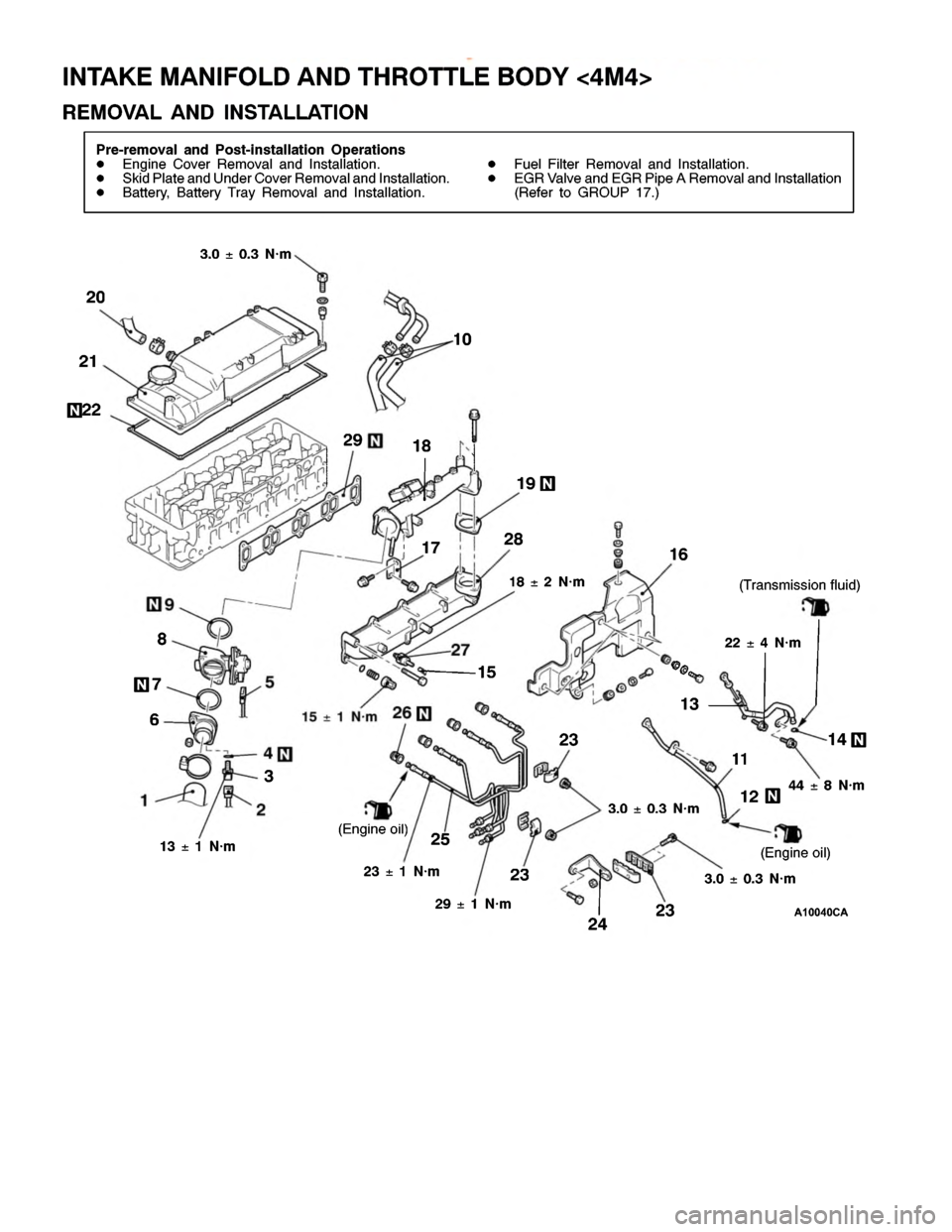
N TA KE MANIF O LD AND TH RO TTLE BO DY <4M 4>
R EM OVA L AND IN STA LLA TIO N (
E ngin e oil)
2 3
4 5
6 7 8
9 1
0 1
2
1
3
2 4 2
2
14
1
5 1
6
1
7
1
8
19
2 3 ±1 N·m
29 ±1 N·m 2
2 ±4 N·m
4 4 ±8 N·m (
T ra nsm is sio n flu id ) 2
0
2 1 1
25
2
6 2
7 2
8
1 3 ±1 N·m 1
8 ±2 N·m
1 5 ±1 N·m
23 2
9
3.0 ±0.3 N·m
3.0 ±0.3 N·m
2 3
2
3
3
.0 ±0.3 N·m
w
ww.W ork sh opM an uals .c o .u k
P urc h ased f r o m w ww.W ork sh opM an uals .c o .u k
Page 743 of 1839

k d h M i
f l
d T
h l
3
8
3 9 3
6
4
0
9.0 ±1.0 N·m
5
9 ±10 N·m
3 6. O il re tu rn pip e
3 7. O il re tu rn pip e gaske t
3 8. E xh aust m anif o ld 3
9. Turb och arg er gaske t
" AA 40. Turb och arg er asse m bly
I N STA LLA TIO N SER VIC E PO IN T
" AA TU RBO CHARG ER ASSEM BLY IN STA LLA TIO N
1 . Cle an th e alig nm ent su rfa ce s sh ow n in th e illu str a tio n.
2 . Supply cle an engin e oil fr o m th e oil pip e mountin g hole
o f th e tu rb och arg er asse m bly .
C au tio n
W hen cle an in g,ta ke care th at n o fo re ig n m ate ria lg ets
i n to th e en gin e co ola n t or oil passag es hole .
Page 745 of 1839

INTAKE AND EXHAUST -Turbocharger and Exhaust
Manifold <4M4>15-13
INSTALLATION SERVICE POINT
"AATURBOCHARGER ASSEMBLY INSTALLATION
1. Check the internal surface, the eye bolt and the
mating surface of the oil pipe and water pipe for
clogging, and clean if necessary.
2. If deposits of carbon are accumulated on the
turbocharger oil passage, remove them and clean
using the compressed air.
Caution
Be careful not to allow foreign material to enter the
turbocharger.
3. Add clean engine oil through the oil feed pipe port
on the turbocharger.
www.WorkshopManuals.co.uk
Purchased from www.WorkshopManuals.co.uk
Page 749 of 1839

16-1
ENGINE
ELECTRICAL
CONTENTS
CHARGING SYSTEM 2................
GENERAL INFORMATION 2................
SERVICE SPECIFICATIONS 3..............
SPECIAL TOOL 4.........................
ON-VEHICLE SERVICE 5..................
Alternator Output Line Voltage Drop Test 5....
Output Current Test 6.......................
Regulated Voltage Test 8....................
Waveform Check Using An Analyzer 11.......
ALTERNATOR 13.........................
STARTING SYSTEM 23................
GENERAL INFORMATION 23..............
SERVICE SPECIFICATIONS 24............
STARTER MOTOR 24.....................
IGNITION SYSTEM 37.................
GENERAL INFORMATION 37..............
SERVICE SPECIFICATIONS 38............
SPECIAL TOOL 38.......................
ON-VEHICLE SERVICE 38................
Ignition Coil (With Built-in Power Transistor)
Check 38...................................
Spark Plug Check and Cleaning 39...........
Ignition Failure Sensor Check 40.............
Camshaft Position Sensor Check, Crank angle
Sensor Check, Detonation Sensor Check 40...
IGNITION COIL <6G7> 41.................
CRANKSHAFT ANGLE SENSOR
<6G7> 42................................
CAMSHAFT POSITION SENSOR
<6G7> 42................................
DETONATION SENSOR <6G7> 43.........
GLOW SYSTEM 44....................
GENERAL INFORMATION 44..............
SERVICE SPECIFICATIONS 45............
ON-VEHICLE SERVICE 45................
Self-regulating Glow System Check 45........
Glow & EGR Control Unit Check 48..........
Engine ECU Check 49.......................
Glow Plug Relay Check 50..................
Glow Plug Check 51........................
Engine Coolant Temperature Sensor
Check 51...................................
GLOW PLUG 52..........................
www.WorkshopManuals.co.uk
Purchased from www.WorkshopManuals.co.uk
Page 787 of 1839

ENGINE ELECTRICAL -Ignition System16-39
Voltage: 1.5VTerminal No.
123
When current is
flowing
When current is
not flowing
SECONDARY COIL CHECK
NOTE
It is impossible to check the secondary coil through the
continuity check as a diode is integrated in the secondary
coil circuit of this ignition coil. So, check the secondary coil
in the following procedure.
1. Disconnect the ignition coil connector.
2. Remove the ignition coil and install a new spark plug
to the ignition coil.
3. Connect the ignition coil connector.
4. Earth the side electrode of the spark plug and crank
the engine.
5. Check that spark is produced between the electrodes of
the spark plug.
6. If no spark is produced, replace the ignition coil with a
new one and recheck.
7. If spark is produced with the new ignition coil, replace
the old one as it is faulty. If no spark is produced again,
the ignition circuit is suspected as faulty. Check the ignition
circuit.
SPARK PLUG CHECK AND CLEANING
Caution
1. The spark plug gap for iridium plugs should not be
adjusted.
2. Cleaning iridium plugs may result in damage to the
iridium tip. Therefore, if cleaning is necessary
because the plug is sooty, use a plug cleaner, and
do not clean the plug for more than 20 seconds in
order to preserve the electrodes. A wire brush should
never be used.
3. The spark plugs in GDI engines are special iridium
plugs in which the electrodes can become black even
when the plugs are working normally. Carbon which
may become deposited on these plugs burns off more
readily than with conventional plugs, and so should
not cause any problems with spark plug performance.
Judgement of whether a spark plug is operating
normally or not should be made by checking the
insulation resistance.
www.WorkshopManuals.co.uk
Purchased from www.WorkshopManuals.co.uk
Page 881 of 1839

22-1
MANUAL
TRANSMISSION
CONTENTS
GENERAL INFORMATION 2..................
LUBRICANTS 2..............................
SEALANTS 2................................
SPECIAL TOOL 2............................
TROUBLESHOOTING
ON-VEHICLE SERVICE 6.....................
Transmission Oil Check 6.......................
Oil Replacement 6.............................4WD Detection Switch Continuity Check
High/Low Detection Switch Continuity Check
TRANSMISSION CONTROL
TRANSMISSION CONTROL
TRANSMISSION ASSEMBLY 10..............
4WD INDICATOR-ECU/TRANSFER-ECU 17....
www.WorkshopManuals.co.uk
Purchased from www.WorkshopManuals.co.uk
Page 882 of 1839

G
EN ER AL IN FO RM ATIO N
I te m s S
pecif ic a tio ns T
ra nsm is sio n model V
5M T1 V
5M 31 E
ngin e model 4
D 5 4
D 5 4
M 4 6
G 7 T
yp e 5
-s p eed, flo or-s h if t G
ear ra tio 1
st 3
.9 18 3
.9 52 4
.2 34 2
nd 2
.2 61 2
.2 38 3
rd 1
.3 95 1
.3 98 4
th 1
.0 00 5
th 0
.8 29 0
.8 19 0
.7 61 0
.8 19 R
eve rs e 3
.9 25 3
.5 53 T
ra nsfe r ty p e 2
-s p eed G
ear ra tio H
ig h 1
.0 00 L
ow 1
.9 25 1
.9 00 S
pecif ie d lu bric a nts Q
uantit y L T
ra nsm is sio n oil H
yp oid gearo il S AE 75W -9 0 or7 5W -8 5W co nfo rm in g to
A PIG L-4 3
.2 T
ra nsfe r oil H
yp oid gearo il S AE 75W -9 0 or7 5W -8 5W co nfo rm in g to
A PIG L-4 2
.5 S
pecif ie d se ala nt R
em ark s O
il fille r plu g 3
M AT D Part N o. 8660 or equiv a le nt S
em i- d ry in g se ala nt O
il d ra in plu g 3
M AT D Part N o. 8660 or equiv a le nt S
em i- d ry in g se ala nt N
um ber N
am e U
se M
D998464 T
e st harn ess
( 4 P, sq uare ) I
n sp ectio n of le ve r posit io n se nso r
Page 886 of 1839
O
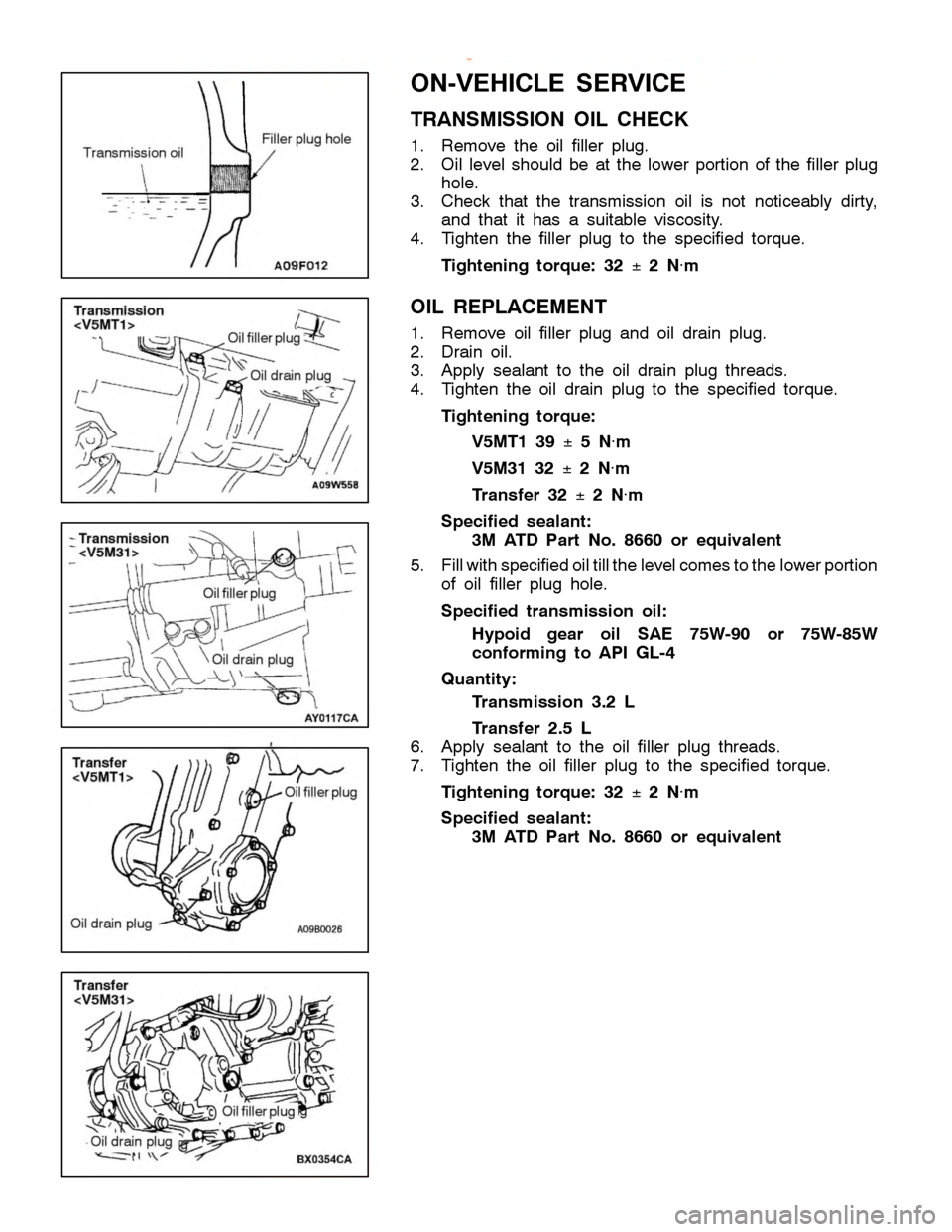
N-V EH IC LE SER VIC E
T R ANSM IS SIO N OIL CHEC K
1 . Rem ove th e oil fille r plu g.
2 . Oil le ve l sh ould be at th e lo w er portio n of th e fille r plu g
h ole .
3 . Check th at th e tr a nsm is sio n oil is not notic e ably dir ty ,
a nd th at it has a su it a ble vis co sit y .
4 . Tig hte n th e fille r plu g to th e sp ecif ie d to rq ue.
T ig hte n in g to rq ue: 32 ±
2 N×
m
O IL REPLA CEM EN T
1 . Rem ove oil fille r plu g and oil dra in plu g.
2 . Dra in oil.
3 . Apply se ala nt to th e oil dra in plu g th re ads.
4 . Tig hte n th e oil dra in plu g to th e sp ecif ie d to rq ue.
T ig hte n in g to rq ue:
V 5M T1 39 ±
5 N×
m
V 5M 31 32 ±
2 N×
m
T ra n sfe r 32 ±
2 N×
m
S pecif ie d seala n t:
3 M ATD Part No. 8660 or eq uiv ale n t
5 . Fill w it h sp ecif ie d oil till th e le ve lc o m es to th e lo w erp ortio n
o f oil fille r plu g hole .
S pecif ie d tr a n sm is sio n oil:
H yp oid gear oil SA E 75W -9 0 or 75W -8 5W
c o nfo rm in g to API G L-4
Q uan tit y :
T ra n sm is sio n 3.2 L
T ra n sfe r 2.5 L
6 . Apply se ala nt to th e oil fille r plu g th re ads.
7 . Tig hte n th e oil fille r plu g to th e sp ecif ie d to rq ue.
T ig hte n in g to rq ue: 32 ±
2 N×
m
S pecif ie d seala n t:
3 M ATD Part No. 8660 or eq uiv ale n t F
ille r plu g hole O
il d ra in plu g O
il fille rp lu g O
il d ra in plu g T
ra n sfe r
< V 5M T1> O
il fille rp lu g O
il d ra in plu g O
il fille rp lu g O
il fille rp lu g O
il d ra in plu g