charging NISSAN NAVARA 2005 Repair Service Manual
[x] Cancel search | Manufacturer: NISSAN, Model Year: 2005, Model line: NAVARA, Model: NISSAN NAVARA 2005Pages: 3171, PDF Size: 49.59 MB
Page 2597 of 3171

PG-68
HARNESS
Wiring Diagram Codes (Cell Codes)
EKS00LJ9
Use the chart below to find out what each wiring diagram code stands for.
Refer to the wiring diagram code in the alphabetical index to find the location (page number) of each wiring
diagram.
Code Section Wiring Diagram Name
A/C,A ATC Auto Air Conditioner
A/C,M MTC Manual Air Conditioner
ABS BRC Anti-lock Brake System
APP1PW EC Accelerator Pedal Position Sensor 1 Power
APP2PW EC Accelerator Pedal Position Sensor 2 Power
APPS1 EC Accelerator Pedal Position Sensor 1
APPS2 EC Accelerator Pedal Position Sensor 2
APPS3 EC Accelerator Pedal Position Sensor
ASC/BS EC ASCD Brake Switch
ASC/SW EC ASCD Steering Switch
ASCBOF EC ASCD Brake Switch
ASCIND EC ASCD Indicator
AT/IND DI A/T Indicator Lamp
AUDIO AV Audio
AUTO/L LT Auto Lignt System
BACK/L LT Back-up Lamp
BOOST EC Turbocharger Boost Sensor
CAN AT CAN Communication Line
CAN EC CAN Communication Line
CAN LAN CAN System
CHARGE SC Charging System
CHIME DI Warning Chime
CIGER WW Cigarette Lighter
CKPS EC Crankshaft Position Sensor
CMPS EC Camshaft Position Sensor
COMBSW LT Combination Switch
COMM AV Audio Visual Communication Line
COMPAS DI Compass
COOL/F EC Cooling Fan Control
D/LOCK BL Power Door Lock
DIFLOC RFD Rear Final Drive
DEF GW Rear Window Defogger
DTRL LT Headlamp — With Daytime Running Light System
ECMRLY EC ECM Relay
ECTS EC Engine Coolant Temperature Sensor
EGRVLV EC EGR Volume Control System
EMNT EC Electronic Controlled Engine Mount Control Solenoid Valve
F/FOG LT Front Fog Lamp
F/PUMP EC Fuel Pump
FRPS EC Fuel Rail Pressure Sensor
FTS AT A/T Fluid Temperature Sensor
Page 2834 of 3171

SC-1
STARTING & CHARGING SYSTEM
K ELECTRICAL
CONTENTS
C
D
E
F
G
H
I
J
L
M
SECTIONSC
A
B
SC
STARTING & CHARGING SYSTEM
PRECAUTIONS .......................................................... 3
Precautions for Supplemental Restraint System
(SRS)“AIRBAG”and“SEATBELTPRE-TEN-
SIONER” .................................................................. 3
Wiring Diagrams and Trouble Diagnosis .................. 3
PREPARATION ........................................................... 4
Special Service Tools ............................................... 4
BATTERY .................................................................... 5
How to Handle Battery ............................................. 5
METHODS OF PREVENTING OVER-DIS-
CHARGE ............................................................... 5
CHECKING ELECTROLYTE LEVEL .................... 5
SPECIFIC GRAVITY CHECK ............................... 6
Battery Test and Charging Chart .............................. 7
CHART I ................................................................ 7
CHART II ............................................................... 8
A: SLOW CHARGE ............................................... 9
B: STANDARD CHARGE .................................... 10
C: QUICK CHARGE ............................................ 12
Removal and Installation ........................................ 13
CHARGING SYSTEM ............................................... 14
System Description ................................................ 14
Wiring Diagram — CHARGE — ............................. 15
Trouble Diagnosis .................................................. 16
DIAGNOSIS PROCEDURE ................................ 16
PRE-DIAGNOSIS INSPECTION ......................... 16
DIAGNOSIS CHART BY SYMPTOM .................. 16
INSPECTION FLOW BY CHARGE WARNING
LAMP .................................................................. 16
CHARGE WARNING LAMP LINE INSPECTION... 17
VOLTAGE DETECTION LINE AND CHARGE
WARNING LAMP INSPECTION ......................... 18
INSPECTION OF INSUFFICIENT ALTERNA-
TOR POWER GENERATION .............................. 20
INSPECTION OF EXCESSIVE ALTERNATOR
POWER GENERATION ...................................... 20
DARK CURRENT INSPECTION ......................... 21
OPERATION PROCEDURE OF CURRENT
MEASUREMENT PROBE FOR CONSULT-II ..... 22
Removal and Installation ........................................ 23REMOVAL ........................................................... 23
INSTALLATION ................................................... 23
Disassembly and Assembly .................................... 23
LHD MODELS ..................................................... 23
RHD MODELS .................................................... 24
Disassembly ........................................................... 24
REAR COVER ..................................................... 24
REAR BEARING ................................................. 24
Inspection ............................................................... 25
ROTOR CHECK .................................................. 25
BRUSH CHECK .................................................. 25
PULLEY CHECK (WITH CLUTCH TYPE) ........... 25
STATOR CHECK ................................................. 25
Assembly ................................................................ 26
RING FITTING IN REAR BEARING .................... 26
REAR COVER INSTALLATION ........................... 26
STARTING SYSTEM ................................................. 27
System Description ................................................. 27
A/T MODELS ....................................................... 27
M/T MODELS ...................................................... 27
Wiring Diagram — START — ................................. 28
A/T MODELS ....................................................... 28
M/T MODELS ...................................................... 29
Trouble Diagnoses ................................................. 30
Removal and Installation ........................................ 31
REMOVAL ........................................................... 31
INSTALLATION ................................................... 31
Disassembly and Assembly .................................... 32
Inspection ............................................................... 32
MAGNETIC SWITCH CHECK ............................. 32
PINION/CLUTCH CHECK ................................... 33
BRUSH CHECK .................................................. 33
YOKE CHECK ..................................................... 34
ARMATURE CHECK ........................................... 35
Assembly ................................................................ 36
PINION PROTRUSION LENGTH ADJUST-
MENT .................................................................. 36
SERVICE DATA AND SPECIFICATIONS (SDS) ...... 37
Battery .................................................................... 37
Page 2838 of 3171
BATTERY
SC-5
C
D
E
F
G
H
I
J
L
MA
B
SC
BATTERYPFP:00011
How to Handle BatteryEKS00MZ7
CAUTION:
lIf it becomes necessary to start the engine with a booster battery and jumper cables, use a 12-volt
booster battery.
lAfter connecting battery cables, ensure that they are tightly clamped to battery terminals for good
contact.
lNever add distilled water through the hole used to check specific gravity.
METHODS OF PREVENTING OVER-DISCHARGE
The following precautions must be taken to prevent over-discharging a battery.
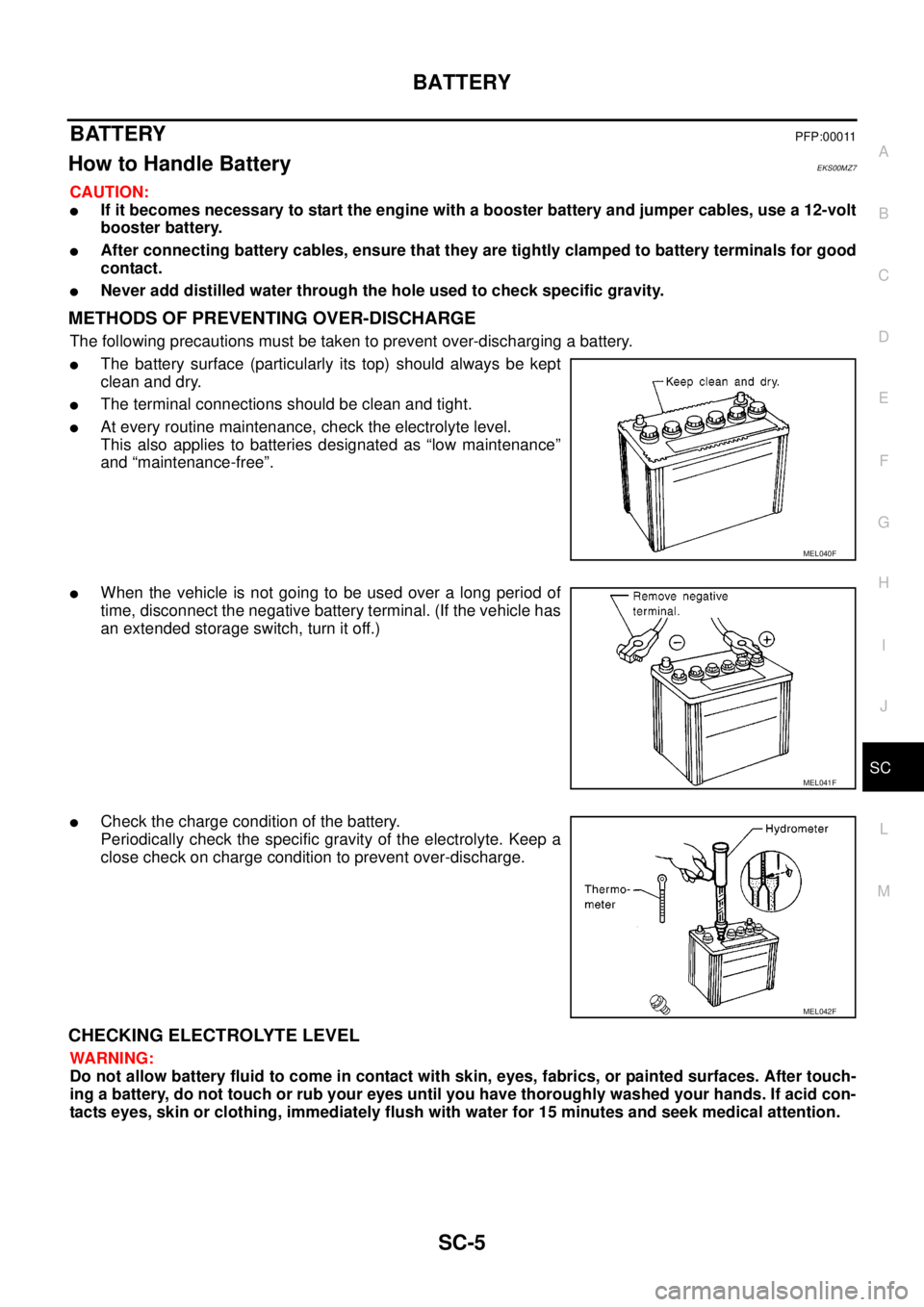
lThe battery surface (particularly its top) should always be kept
clean and dry.
lThe terminal connections should be clean and tight.
lAt every routine maintenance, check the electrolyte level.
This also applies to batteries designated as “low maintenance”
and “maintenance-free”.
lWhen the vehicle is not going to be used over a long period of
time, disconnect the negative battery terminal. (If the vehicle has
an extended storage switch, turn it off.)
lCheck the charge condition of the battery.
Periodically check the specific gravity of the electrolyte. Keep a
close check on charge condition to prevent over-discharge.
CHECKING ELECTROLYTE LEVEL
WARNING:
Do not allow battery fluid to come in contact with skin, eyes, fabrics, or painted surfaces. After touch-
ing a battery, do not touch or rub your eyes until you have thoroughly washed your hands. If acid con-
tacts eyes, skin or clothing, immediately flush with water for 15 minutes and seek medical attention.
MEL040F
MEL041F
MEL042F
Page 2839 of 3171
SC-6
BATTERY
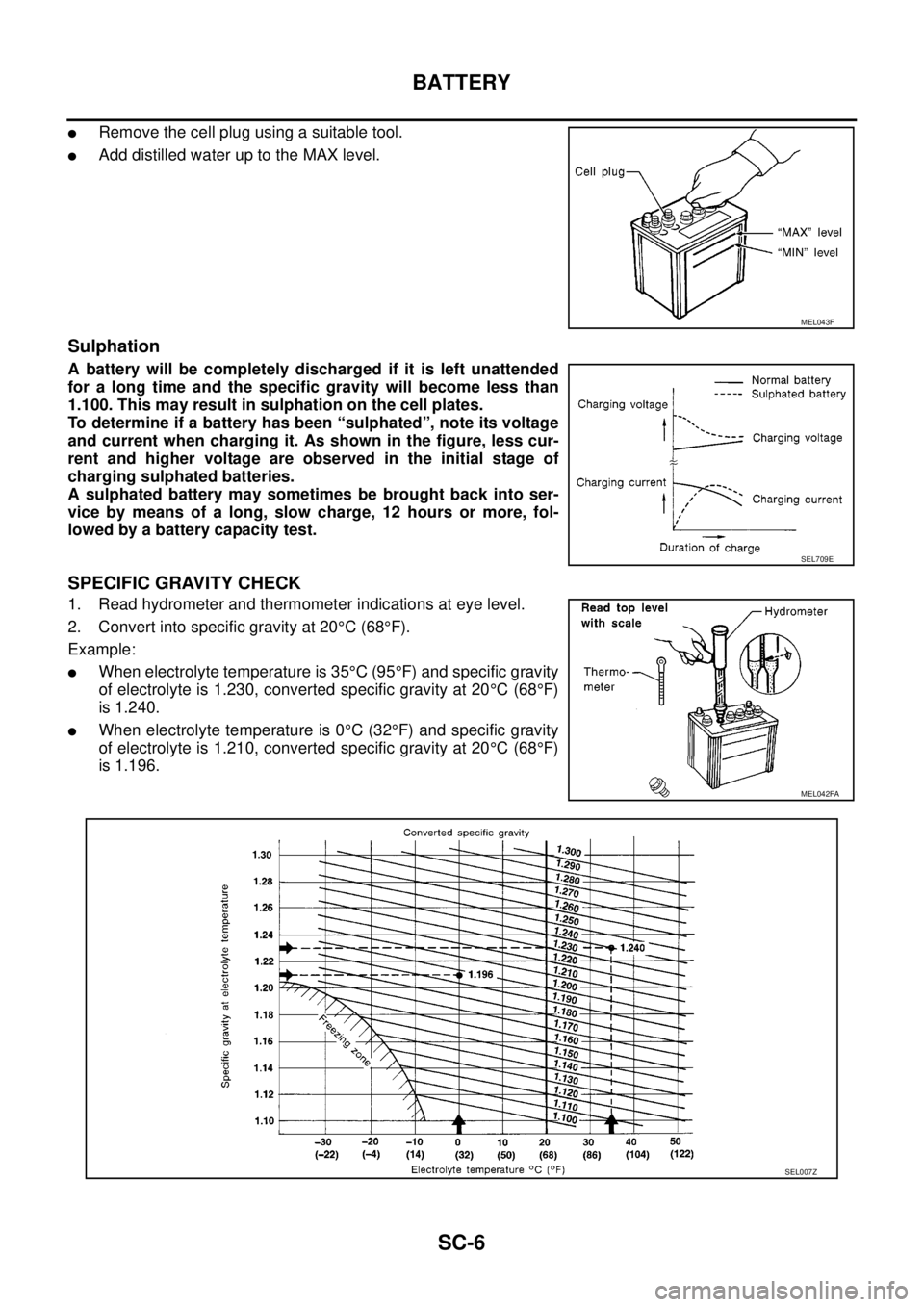
lRemove the cell plug using a suitable tool.
lAdd distilled water up to the MAX level.
Sulphation
A battery will be completely discharged if it is left unattended
for a long time and the specific gravity will become less than
1.100. This may result in sulphation on the cell plates.
To determine if a battery has been “sulphated”, note its voltage
and current when charging it. As shown in the figure, less cur-
rent and higher voltage are observed in the initial stage of
charging sulphated batteries.
A sulphated battery may sometimes be brought back into ser-
vice by means of a long, slow charge, 12 hours or more, fol-
lowed by a battery capacity test.
SPECIFIC GRAVITY CHECK
1. Read hydrometer and thermometer indications at eye level.
2. Convert into specific gravity at 20°C(68°F).
Example:
lWhen electrolyte temperature is 35°C(95°F) and specific gravity
of electrolyte is 1.230, converted specific gravity at 20°C(68°F)
is 1.240.
lWhen electrolyte temperature is 0°C(32°F) and specific gravity
of electrolyte is 1.210, converted specific gravity at 20°C(68°F)
is 1.196.
MEL043F
SEL709E
MEL042FA
SEL007Z
Page 2840 of 3171
BATTERY
SC-7
C
D
E
F
G
H
I
J
L
MA
B
SC
Battery Test and Charging ChartEKS00MZ8
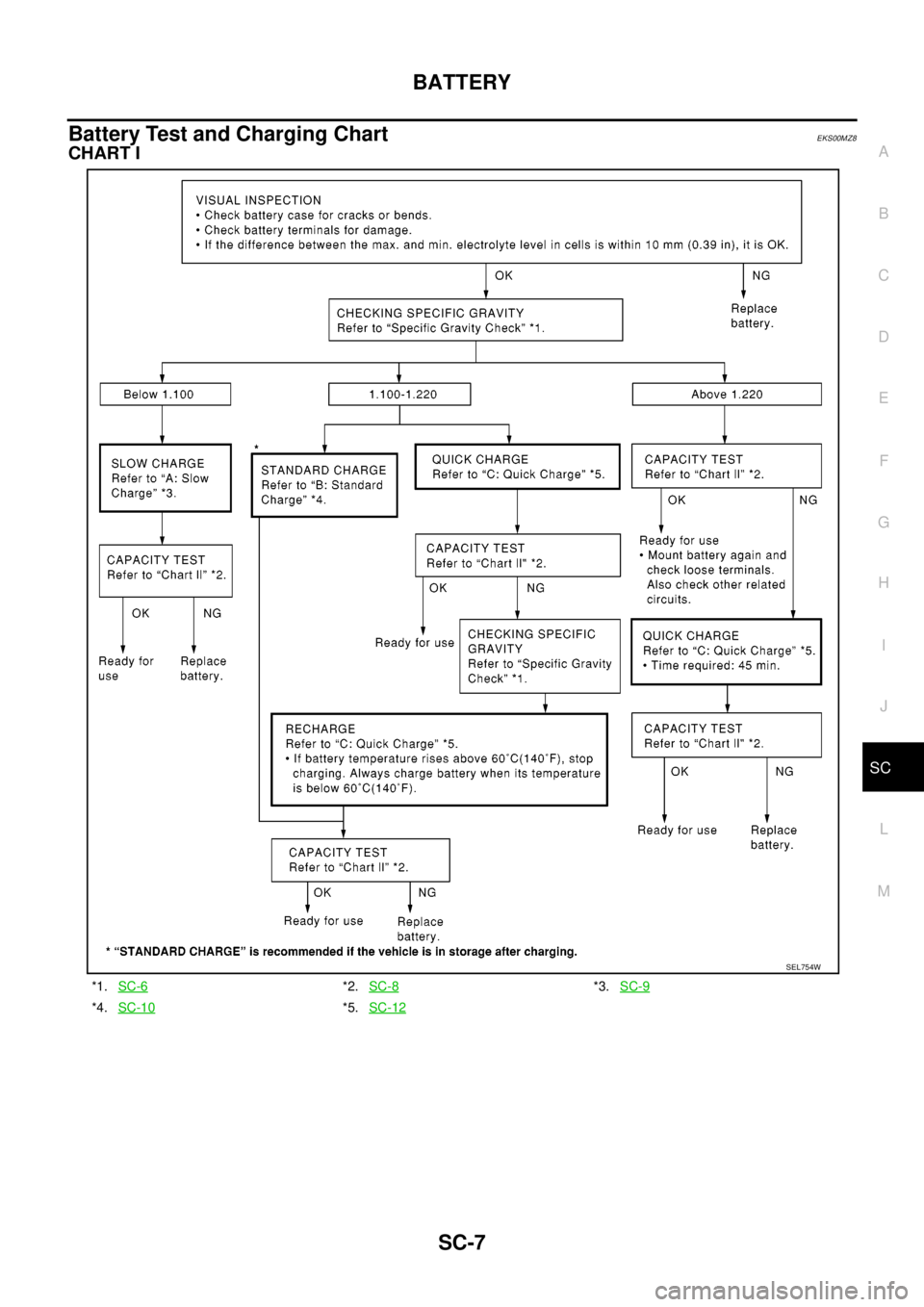
CHART I
*1.SC-6*2.SC-8*3.SC-9
*4.SC-10*5.SC-12
SEL754W
Page 2841 of 3171
SC-8
BATTERY
CHART II
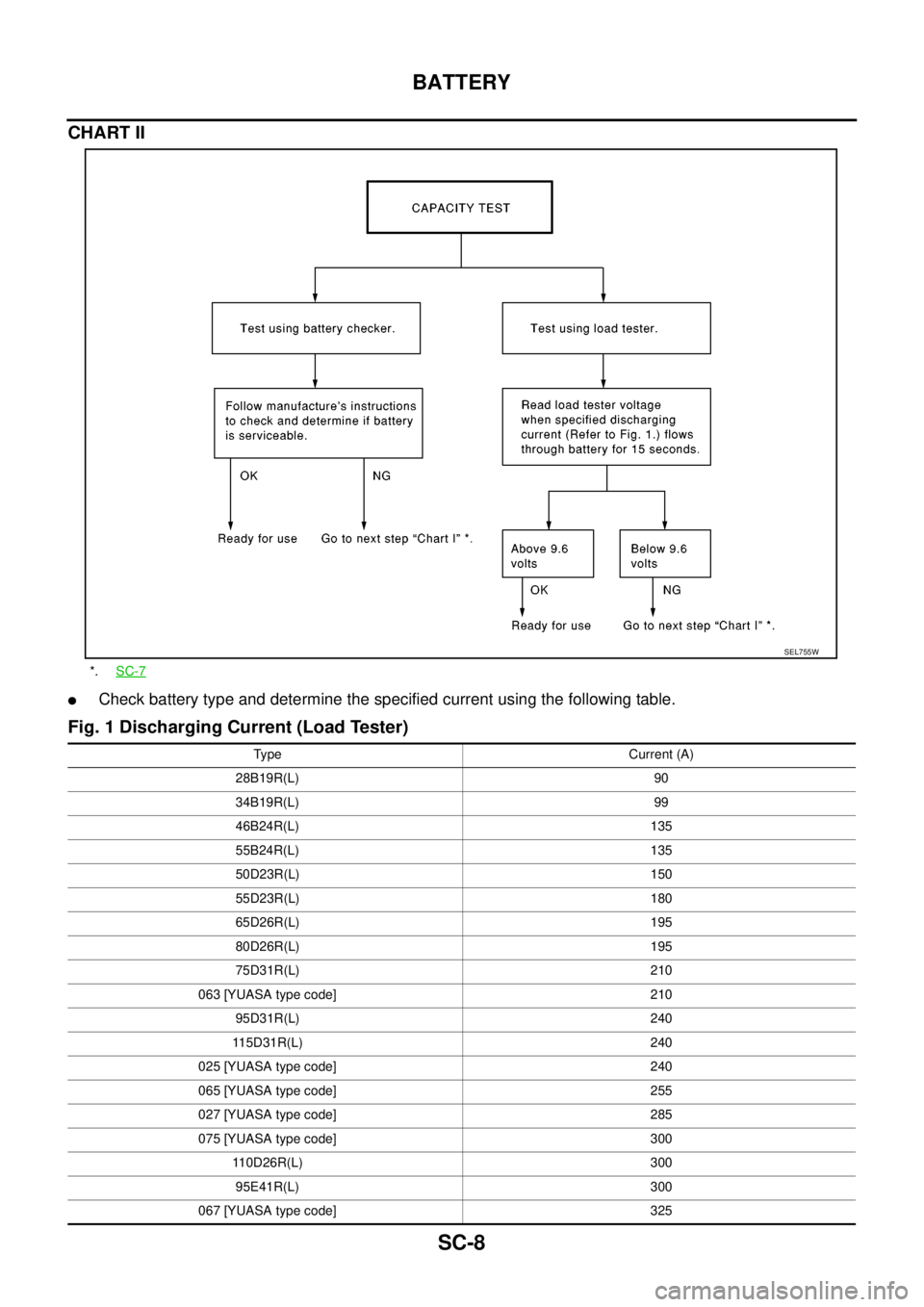
lCheck battery type and determine the specified current using the following table.
Fig. 1 Discharging Current (Load Tester)
*.SC-7
SEL755W
Type Current (A)
28B19R(L) 90
34B19R(L) 99
46B24R(L) 135
55B24R(L) 135
50D23R(L) 150
55D23R(L) 180
65D26R(L) 195
80D26R(L) 195
75D31R(L) 210
063 [YUASA type code] 210
95D31R(L) 240
115D31R(L) 240
025 [YUASA type code] 240
065 [YUASA type code] 255
027 [YUASA type code] 285
075 [YUASA type code] 300
110D26R(L) 300
95E41R(L) 300
067 [YUASA type code] 325
Page 2842 of 3171
BATTERY
SC-9
C
D
E
F
G
H
I
J
L
MA
B
SC
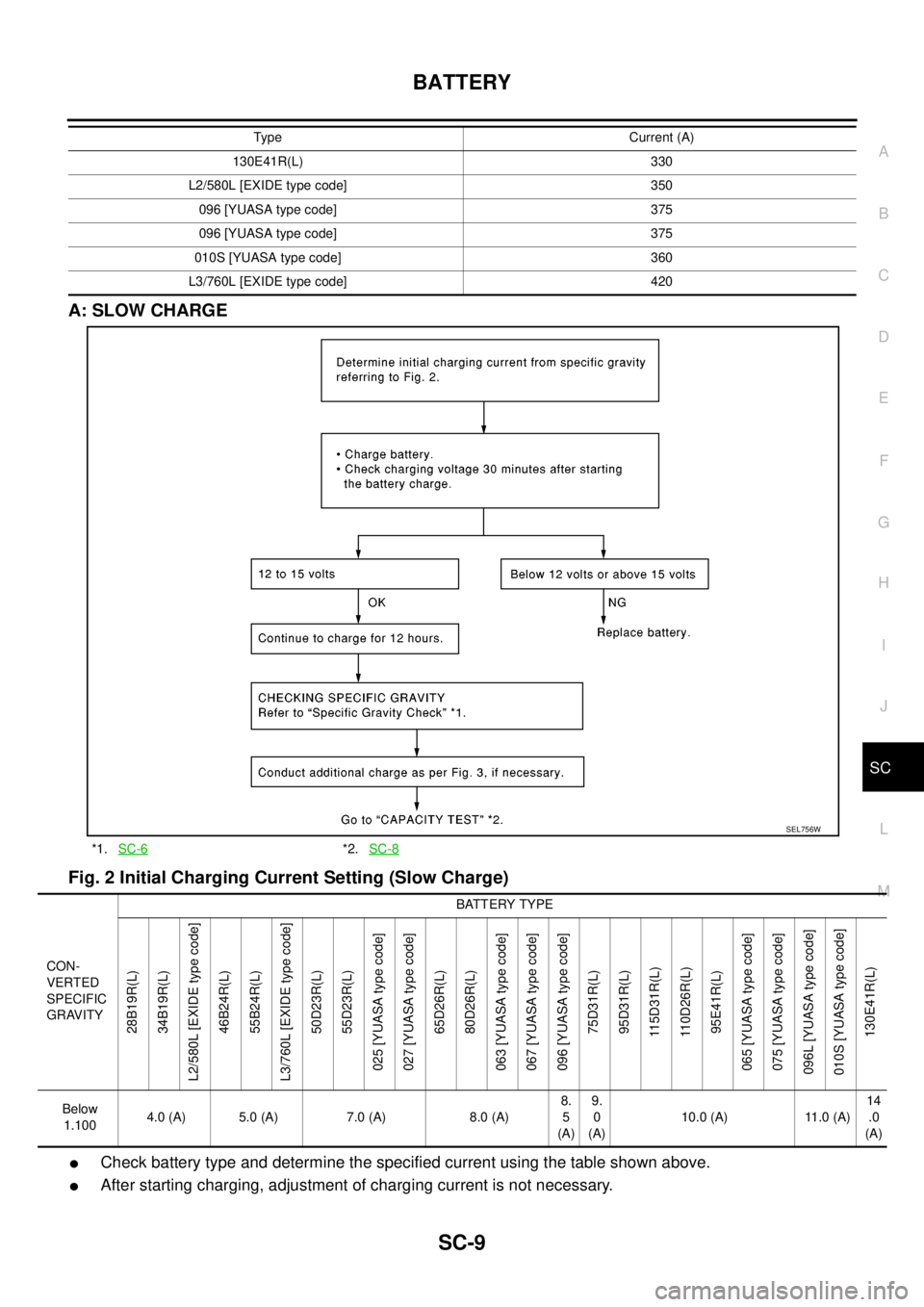
A: SLOW CHARGE
Fig. 2 Initial Charging Current Setting (Slow Charge)
lCheck battery type and determine the specified current using the table shown above.
lAfter starting charging, adjustment of charging current is not necessary.
130E41R(L) 330
L2/580L [EXIDE type code] 350
096 [YUASA type code] 375
096 [YUASA type code] 375
010S [YUASA type code] 360
L3/760L [EXIDE type code] 420Type Current (A)
*1.SC-6*2.SC-8
SEL756W
CON-
VERTED
SPECIFIC
GRAVITYBATTERY TYPE
28B19R(L)
34B19R(L)
L2/580L [EXIDE type code]
46B24R(L)
55B24R(L)
L3/760L [EXIDE type code]
50D23R(L)
55D23R(L)
025 [YUASA type code]
027 [YUASA type code]
65D26R(L)
80D26R(L)
063 [YUASA type code]
067 [YUASA type code]
096 [YUASA type code]
75D31R(L)
95D31R(L)
115D31R(L)
110D26R(L)
95E41R(L)
065 [YUASA type code]
075 [YUASA type code]
096L [YUASA type code]
010S [YUASA type code]
130E41R(L)
Below
1.1004.0(A) 5.0(A) 7.0(A) 8.0(A)8.
5
(A)9.
0
(A)10.0 (A) 11.0 (A)14
.0
(A)
Page 2843 of 3171
SC-10
BATTERY
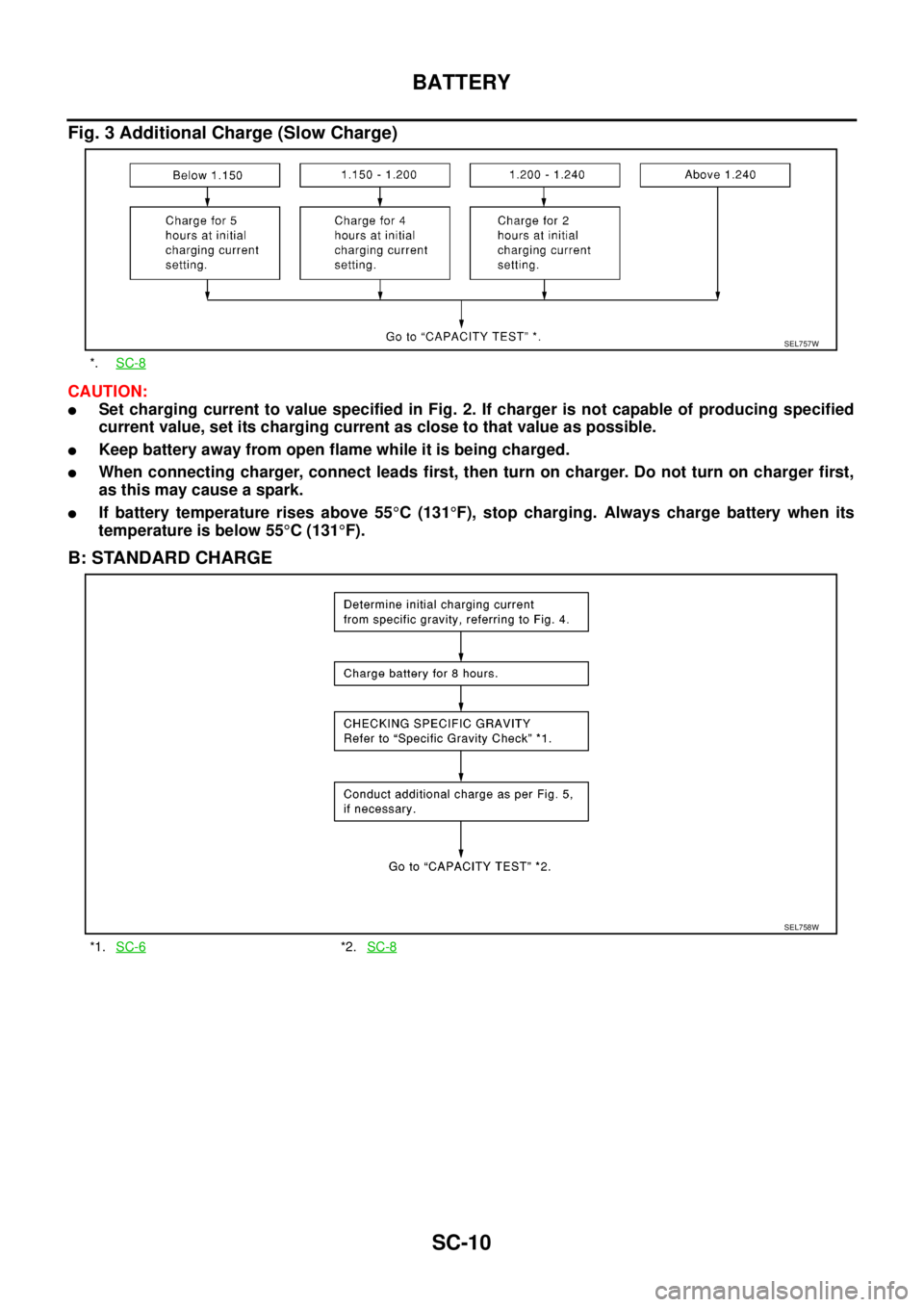
Fig. 3 Additional Charge (Slow Charge)
CAUTION:
lSet charging current to value specified in Fig. 2. If charger is not capable of producing specified
current value, set its charging current as close to that value as possible.
lKeep battery away from open flame while it is being charged.
lWhen connecting charger, connect leads first, then turn on charger. Do not turn on charger first,
as this may cause a spark.
lIf battery temperature rises above 55°C(131°F), stop charging. Always charge battery when its
temperature is below 55°C(131°F).
B: STANDARD CHARGE
*.SC-8
SEL757W
*1.SC-6*2.SC-8
SEL758W
Page 2844 of 3171
BATTERY
SC-11
C
D
E
F
G
H
I
J
L
MA
B
SC
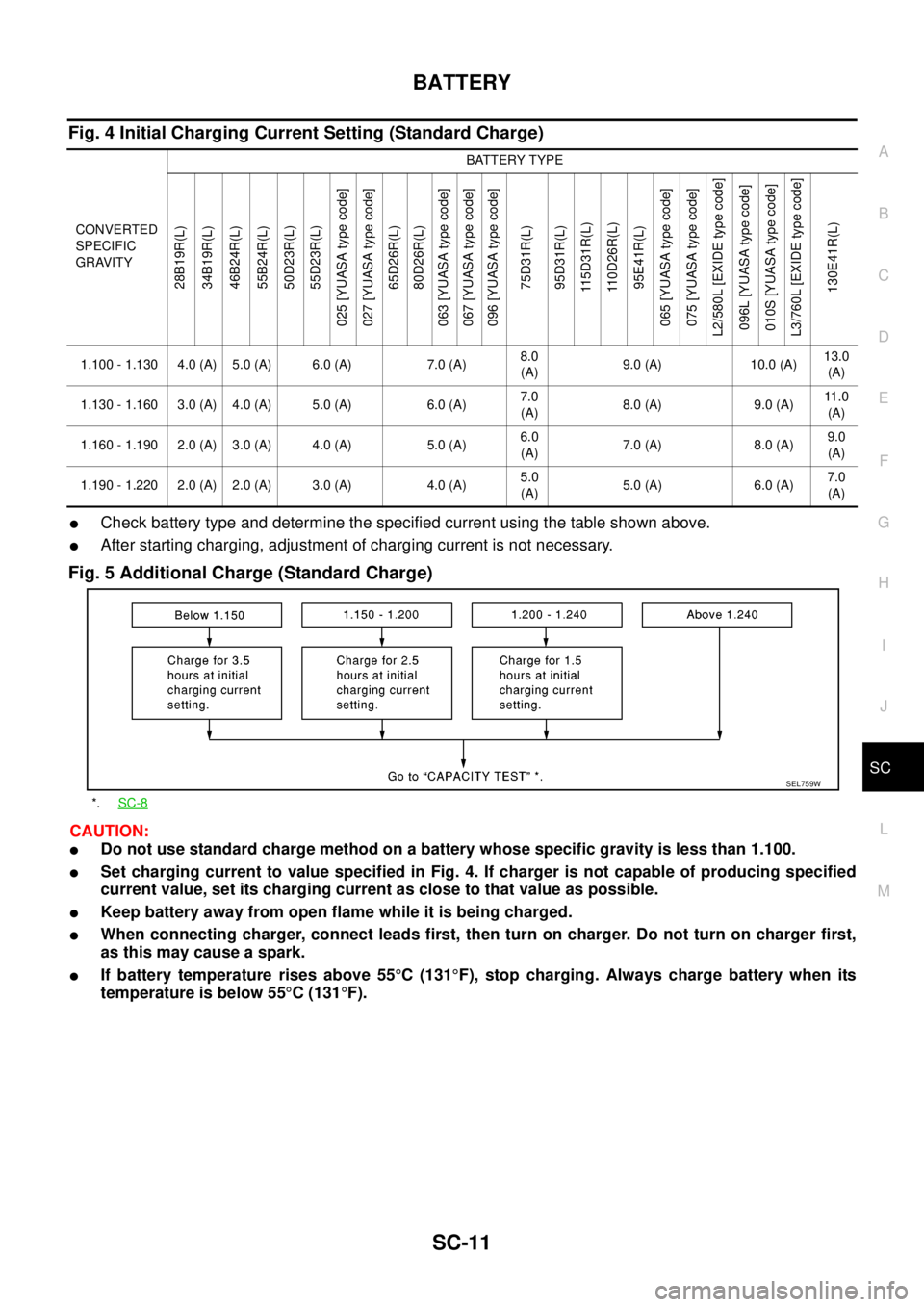
Fig. 4 Initial Charging Current Setting (Standard Charge)
lCheck battery type and determine the specified current using the table shown above.
lAfter starting charging, adjustment of charging current is not necessary.
Fig. 5 Additional Charge (Standard Charge)
CAUTION:
lDo not use standard charge method on a battery whose specific gravity is less than 1.100.
lSet charging current to value specified in Fig. 4. If charger is not capable of producing specified
current value, set its charging current as close to that value as possible.
lKeep battery away from open flame while it is being charged.
lWhen connecting charger, connect leads first, then turn on charger. Do not turn on charger first,
as this may cause a spark.
lIf battery temperature rises above 55°C(131°F), stop charging. Always charge battery when its
temperature is below 55°C(131°F).
CONVERTED
SPECIFIC
GRAVITYBATTERY TYPE
28B19R(L)
34B19R(L)
46B24R(L)
55B24R(L)
50D23R(L)
55D23R(L)
025 [YUASA type code]
027 [YUASA type code]
65D26R(L)
80D26R(L)
063 [YUASA type code]
067 [YUASA type code]
096 [YUASA type code]
75D31R(L)
95D31R(L)
115D31R(L)
110D26R(L)
95E41R(L)
065 [YUASA type code]
075 [YUASA type code]
L2/580L [EXIDE type code]
096L [YUASA type code]
010S [YUASA type code]
L3/760L [EXIDE type code]
130E41R(L)
1.100 - 1.130 4.0 (A) 5.0 (A) 6.0 (A) 7.0 (A)8.0
(A)9.0 (A) 10.0 (A)13.0
(A)
1.130 - 1.160 3.0 (A) 4.0 (A) 5.0 (A) 6.0 (A)7.0
(A)8.0(A) 9.0(A)11 . 0
(A)
1.160 - 1.190 2.0 (A) 3.0 (A) 4.0 (A) 5.0 (A)6.0
(A)7.0(A) 8.0(A)9.0
(A)
1.190 - 1.220 2.0 (A) 2.0 (A) 3.0 (A) 4.0 (A)5.0
(A)5.0(A) 6.0(A)7.0
(A)
*.SC-8
SEL759W
Page 2845 of 3171
SC-12
BATTERY
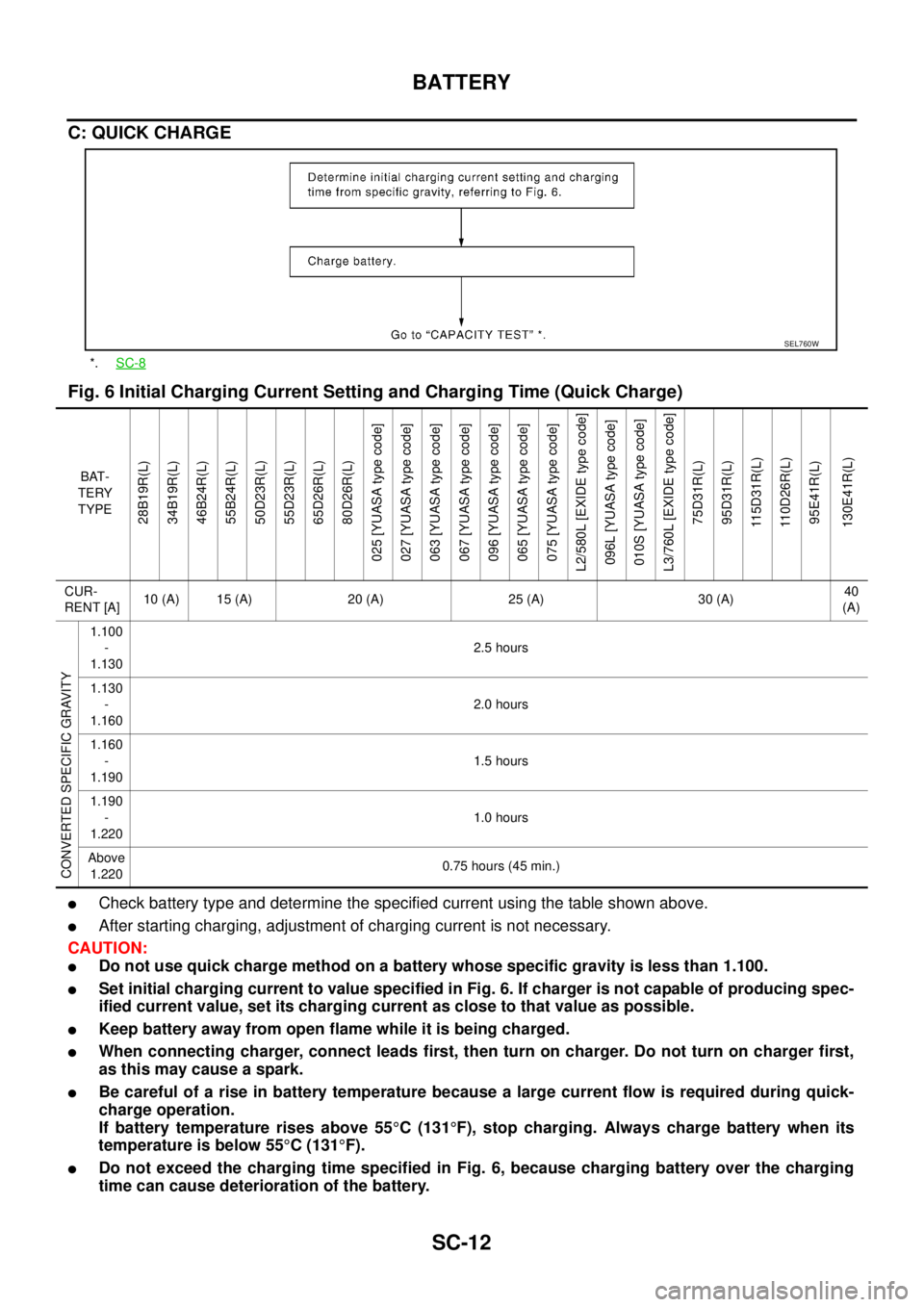
C: QUICK CHARGE
Fig. 6 Initial Charging Current Setting and Charging Time (Quick Charge)
lCheck battery type and determine the specified current using the table shown above.
lAfter starting charging, adjustment of charging current is not necessary.
CAUTION:
lDo not use quick charge method on a battery whose specific gravity is less than 1.100.
lSet initial charging current to value specified in Fig. 6. If charger is not capable of producing spec-
ified current value, set its charging current as close to that value as possible.
lKeep battery away from open flame while it is being charged.
lWhen connecting charger, connect leads first, then turn on charger. Do not turn on charger first,
as this may cause a spark.
lBe careful of a rise in battery temperature because a large current flow is required during quick-
charge operation.
If battery temperature rises above 55°C(131°F), stop charging. Always charge battery when its
temperature is below 55°C(131°F).
lDo not exceed the charging time specified in Fig. 6, because charging battery over the charging
time can cause deterioration of the battery.
*.SC-8
SEL760W
BAT-
TERY
TYPE
28B19R(L)
34B19R(L)
46B24R(L)
55B24R(L)
50D23R(L)
55D23R(L)
65D26R(L)
80D26R(L)
025 [YUASA type code]
027 [YUASA type code]
063 [YUASA type code]
067 [YUASA type code]
096 [YUASA type code]
065 [YUASA type code]
075 [YUASA type code]
L2/580L [EXIDE type code]
096L [YUASA type code]
010S [YUASA type code]
L3/760L [EXIDE type code]
75D31R(L)
95D31R(L)
115D31R(L)
110D26R(L)
95E41R(L)
130E41R(L)
CUR-
RENT [A]10 (A) 15 (A) 20 (A) 25 (A) 30 (A)40
(A)
CONVERTED SPECIFIC GRAVITY
1.100
-
1.1302.5 hours
1.130
-
1.1602.0 hours
1.160
-
1.1901.5 hours
1.190
-
1.2201.0 hours
Above
1.2200.75 hours (45 min.)