light NISSAN NOTE 2016 Service Repair Manual
[x] Cancel search | Manufacturer: NISSAN, Model Year: 2016, Model line: NOTE, Model: NISSAN NOTE 2016Pages: 3641, PDF Size: 28.72 MB
Page 2520 of 3641
![NISSAN NOTE 2016 Service Repair Manual PCS
IPDM E/R (INTELLIGENT POWER DISTRIBUTION MODULE ENGINE ROOM)
PCS-17
< ECU DIAGNOSIS INFORMATION > [IPDM E/R]
C
D
E
F
G H
I
J
K L
B A
O P
N
23 R
Combination lamp pow-
er supply OutputLighting switc](/img/5/57363/w960_57363-2519.png "NISSAN NOTE 2016 Service Repair Manual PCS
IPDM E/R (INTELLIGENT POWER DISTRIBUTION MODULE ENGINE ROOM)
PCS-17
< ECU DIAGNOSIS INFORMATION > [IPDM E/R]
C
D
E
F
G H
I
J
K L
B A
O P
N
23 R
Combination lamp pow-
er supply OutputLighting switc")
PCS
IPDM E/R (INTELLIGENT POWER DISTRIBUTION MODULE ENGINE ROOM)
PCS-17
< ECU DIAGNOSIS INFORMATION > [IPDM E/R]
C
D
E
F
G H
I
J
K L
B A
O P
N
23 R
Combination lamp pow-
er supply OutputLighting switch OFF
0V
Lighting switch 1ST Battery voltage
24
5W Daytime running light
relay 1 power supply OutputLighting switch OFF
0V
Lighting switch 1ST Battery voltage
25 G Headlamp HIGH (LH)
power supply OutputLighting switch other than
HI and PASS
0V
Lighting switch HI
Lighting switch PASS Battery voltage
27 Y Headlamp HIGH (RH)
power supply OutputLighting switch other than
HI and PASS
0V
Lighting switch HI
Lighting switch PASS Battery voltage
28 V A/C compressor power
supply
Output RUNA/C switch OFF
0V
A/C switch ON
(A/C compressor is operat-
ing) Battery voltage
29 L/W Throttle control motor
relay power supply OutputOFF
More than a few seconds
after turning ignition switch
OFF 0V
ON
OFF For a few seconds after
turning ignition switch OFF
Battery voltage
32 G/W Throttle control motor
relay control
OutputON
→
OFF 0V
↓
Battery voltage ↓
0 V
ON 0V
34 Y Ignition coil power sup-
ply
OutputOFF
or
ACC 0V
ON Battery voltage
35 BR NATS antenna amp
power supply
Output OFF
Battery voltage
36 SB Fuel injector power sup-
ply OutputOFF
or
ACC 0V
ON Battery voltage
39 L Timing control solenoid
valve power
supply
OutputOFF
More than a few seconds
after turning ignition switch
OFF 0V
ON
OFF For a few seconds after
turning ignition switch OFF
Battery voltage
40
4BR Starter relay coil power
supply Input ONSelect lever in any position
other than P or N
0V
Select lever P or N Battery voltage
43 GR Fuel pump relay control Output ON
RUN Approximately 1 second af-
ter turning the ignition
switch ON
0V
ON Approximately 1 second or
more after turning the igni-
tion switch Battery voltage
Te r m i n a l
Wire
color Circuit Input/
Output Ignition
switch Condition
Value
Revision: August 2015 2016 Versa Note
cardiagn.com
Page 2521 of 3641
![NISSAN NOTE 2016 Service Repair Manual PCS-18
< ECU DIAGNOSIS INFORMATION >[IPDM E/R]
IPDM E/R (INTELLIGENT POWER DI
STRIBUTION MODULE ENGINE ROOM)
47 R/W ECM power supply Output OFF
More than a few seconds
after turning ignition switch](/img/5/57363/w960_57363-2520.png "NISSAN NOTE 2016 Service Repair Manual PCS-18
< ECU DIAGNOSIS INFORMATION >[IPDM E/R]
IPDM E/R (INTELLIGENT POWER DI
STRIBUTION MODULE ENGINE ROOM)
47 R/W ECM power supply Output OFF
More than a few seconds
after turning ignition switch")
PCS-18
< ECU DIAGNOSIS INFORMATION >[IPDM E/R]
IPDM E/R (INTELLIGENT POWER DI
STRIBUTION MODULE ENGINE ROOM)
47 R/W ECM power supply Output OFF
More than a few seconds
after turning ignition switch
OFF 0V
ON
OFF For a few seconds after
turning ignition switch OFF
Battery voltage
48 O Generator C OutputOFF
or
ACC 0V
ON
50 P ECM relay control Output OFF
More than a few seconds
after turning ignition switch
OFF
0V
ON
OFF For a few seconds after
turning ignition switch OFF
Battery voltage
59 Y Cooling fan relay control Output Cooling fan OFF or LO op-
erated
Battery voltage
Cooling fan MID or HI oper-
ated 0V
60 B Ground — —— —
61 P CAN low Input/
Output ——
—
62 L CAN high Input/
Output ——
—
65 BR Cooling fan relay power
supply
OutputOFF
or
ACC 0V
ON Battery voltage
69
5GR Daytime running light
relay 1 control Output Battery voltage
0V
71
6W Front fog lamp relay
control OutputFront fog lamp switch OFF
Battery voltage
Front fog lamp switch ON 0V
73 SB Horn relay control Output Horn is not activated
Battery voltage
Horn is activated 0V
74 V Front wiper motor stop
position
Input ONFront wiper stop position
0V
Any position other than
front wiper stop position Battery voltage
80
1R PNP switch Input ONSelector Lever in P
0V
Selector lever in any posi-
tion other than P Battery voltage
81
1SB Push-button ignition
switch Input ONPress the push-button igni-
tion switch
0V
Release the push button ig-
nition switch Battery voltage
89
1B Ground — —— —
Te r m i n a l
Wire
color Circuit Input/
Output Ignition
switch Condition
Value
JMMIA0842GB
Revision: August 2015 2016 Versa Note
cardiagn.com
Page 2522 of 3641
![NISSAN NOTE 2016 Service Repair Manual PCS
IPDM E/R (INTELLIGENT POWER DISTRIBUTION MODULE ENGINE ROOM)
PCS-19
< ECU DIAGNOSIS INFORMATION > [IPDM E/R]
C
D
E
F
G H
I
J
K L
B A
O P
N
1: With Intelligent Key system
2: Without Intelligent Key](/img/5/57363/w960_57363-2521.png "NISSAN NOTE 2016 Service Repair Manual PCS
IPDM E/R (INTELLIGENT POWER DISTRIBUTION MODULE ENGINE ROOM)
PCS-19
< ECU DIAGNOSIS INFORMATION > [IPDM E/R]
C
D
E
F
G H
I
J
K L
B A
O P
N
1: With Intelligent Key system
2: Without Intelligent Key")
PCS
IPDM E/R (INTELLIGENT POWER DISTRIBUTION MODULE ENGINE ROOM)
PCS-19
< ECU DIAGNOSIS INFORMATION > [IPDM E/R]
C
D
E
F
G H
I
J
K L
B A
O P
N
1: With Intelligent Key system
2: Without Intelligent Key system
3: With M/T
4: With CVT
5: With daytime running light system
6: With front fog lamps
Fail-safeINFOID:0000000012433274
CAN COMMUNICATION CONTROL
When CAN communication with ECM and BCM is impossible, IPDM E/R performs fail-s
afe control. After CAN
communication recovers normally, it also returns to normal control.
If No CAN Communication Is Available With ECM
If No CAN Communication Is Available With BCM
IGNITION RELAY MALFUNCTION DETECTION FUNCTION
• IPDM E/R monitors the voltage at the contact circuit and excitation coil circuit of the ignition relay inside it.
• IPDM E/R judges the ignition relay error if the voltage differs between the contact circuit and the excitation
coil circuit.
• If the ignition relay cannot turn OFF due to contact seizure, it activates the tail lamp relay for 10 minutes to alert the user to the ignition relay malfunction when the ignition switch is turned OFF.
901L Ignition relay power
supply Input ONIgnition switch OFF or ACC
Battery voltage
Ignition switch ON 0V
Te r m i n a l
Wire
color Circuit Input/
Output Ignition
switch Condition
Value
Control part Fail-safe operation
Cooling fan • The cooling fan relay turn ON when the ignition switch is turned ON (Cooling fan HI operation)
• The cooling fan relay turn OFF when the ignition switch is turned OFF
A/C compressor A/C relay OFF
Generator Outputs the power generation command signal (PWM signal) 0%
Control part Fail-safe operation
Headlamp • Turns ON the headlamp low relay when the ignition switch is turned ON
• Turns OFF the headlamp low relay when the ignition switch is turned OFF
• Headlamp high relay OFF
•Parking lamp
• Side marker lamp
• License plate lamp
• Illumination
• Tail lamp • Turns ON the tail lamp relay when the ignition switch is turned ON
• Turns OFF the tail lamp relay when the ignition switch is turned OFF
Front wiper motor • The status just before activation of fail-safe control is maintained until the ignition switch is
turned OFF while the front wiper is operating at LO or HI speed.
• The wiper is operated at LO speed until the ignition switch is turned OFF if the fail-safe control
is activated while the front wiper is set in the INT mode and the front wiper motor is operating.
• Returns automatically wiper to stop position when ignition switch is turned ON if fail-safe control is activated while front wiper motor is operated and wiper stop in the other position than stop
position.
Front fog lamp Front fog lamp relay OFF
Horn Horn OFF
Ignition relay The status just before activation of fail-safe is maintained.
Starter motor Starter control relay OFF
Revision: August 2015 2016 Versa Note
cardiagn.com
Page 2537 of 3641
![NISSAN NOTE 2016 Service Repair Manual PCS-34
< SYSTEM DESCRIPTION >[POWER DISTRIBUTION SYSTEM]
SYSTEM
SYSTEM
POWER DISTRIBUTION SYSTEM
POWER DISTRIBUTION SYSTEM
: System DescriptionINFOID:0000000012433289
SYSTEM DIAGRAM
SYSTEM DESCRIPTIO](/img/5/57363/w960_57363-2536.png "NISSAN NOTE 2016 Service Repair Manual PCS-34
< SYSTEM DESCRIPTION >[POWER DISTRIBUTION SYSTEM]
SYSTEM
SYSTEM
POWER DISTRIBUTION SYSTEM
POWER DISTRIBUTION SYSTEM
: System DescriptionINFOID:0000000012433289
SYSTEM DIAGRAM
SYSTEM DESCRIPTIO")
PCS-34
< SYSTEM DESCRIPTION >[POWER DISTRIBUTION SYSTEM]
SYSTEM
SYSTEM
POWER DISTRIBUTION SYSTEM
POWER DISTRIBUTION SYSTEM
: System DescriptionINFOID:0000000012433289
SYSTEM DIAGRAM
SYSTEM DESCRIPTION
• PDS (POWER DISTRIBUTION SYSTEM) is the system that BCM contro ls with the operation of the push-
button ignition switch and performs the power distribution to each power circuit. This system is used instead
of the mechanical power supply changing mechanism wi th the operation of the conventional key cylinder.
• The push-button ignition switch can be operated when Intelligent Key is in the following condition:
- Intelligent Key is in the detection area of the inside key antenna.
- Intelligent Key backside is contacted to push-button ignition switch.
• The push-button ignition switch operation is input to BCM as a signal. BCM changes the power supply posi-
tion according to the status and operates the following relays to supply power to each power circuit:
- Ignition relay-1
- Ignition relay-2
- Accessory relay-1
- Accessory relay-2
- Blower motor relay NOTE:
The engine switch operation changes due to the conditions of brake pedal, selector lever and vehicle speed.
• The power supply position can be confirmed with the light ing of the indicators in the push-button ignition
switch.
IGNITION BATTERY SAVER SYSTEM
When all the following conditions are met for a period of time, the battery saver system will turn off the power
supply (ignition switch ON/ACC → OFF) to prevent battery discharge.
• Ignition switch is in the ACC or ON position
• Turn signal lamp is not in operation
• Selector lever is in the P (park) position
Reset Condition of Igniti on Battery Saver System
If any of the following conditions are met, the battery saver system is released.
• Ignition switch is not in the ACC or ON position
• Turn signal lamp is in operation
• Selector lever is not in the P (park) position
NOTE:
The ignition battery saver system can be temporarily di sabled, without using CONSULT, to prevent it from
functioning when performing trouble diagnosis. Refer to PCS-53, "
Work Procedure".
POWER SUPPLY POSITION CHANGE TABLE BY PUSH-BUTTON IGNITION SWITCH OPERA-
AWMIA3150GB
Revision: August 2015 2016 Versa Note
cardiagn.com
Page 2586 of 3641
PWO-6
< REMOVAL AND INSTALLATION >
CONSOLE POWER SOCKET
REMOVAL AND INSTALLATION
CONSOLE POWER SOCKET
Removal and InstallationINFOID:0000000012432101
CONSOLE POWER SOCKET or CIGARETTE LIGHTER (IF EQUIPPED)
REMOVAL
NOTE:
If unable to use the tool because of power socket location or access to the harness connector, then further
removal of interior components may be required. Refer to IP-18, "
Removal and Installation".
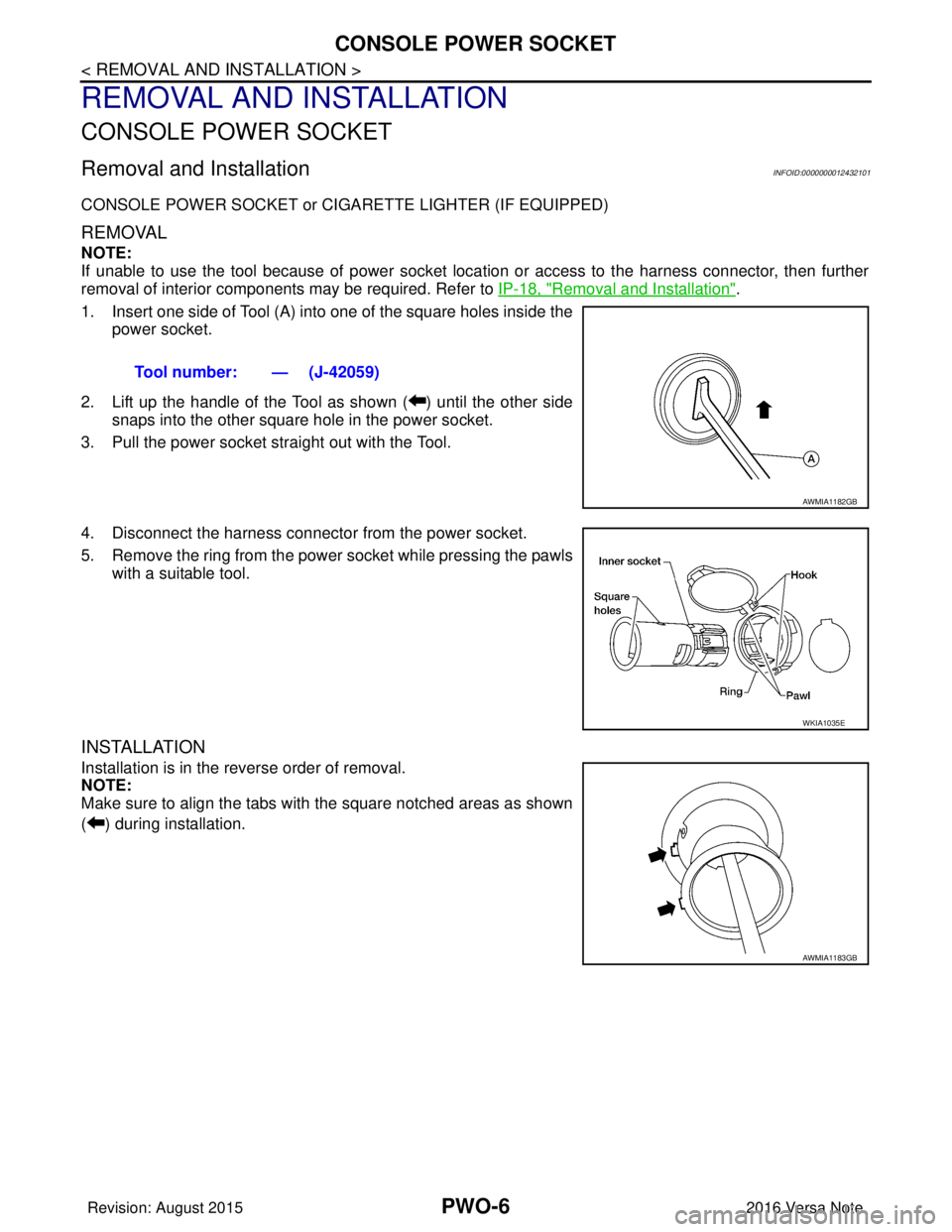
1. Insert one side of Tool (A) into one of the square holes inside the power socket.
2. Lift up the handle of the Tool as shown ( ) until the other side snaps into the other square hole in the power socket.
3. Pull the power socket straight out with the Tool.
4. Disconnect the harness connecto r from the power socket.
5. Remove the ring from the power socket while pressing the pawls with a suitable tool.
INSTALLATION
Installation is in the reverse order of removal.
NOTE:
Make sure to align the tabs with the square notched areas as shown
( ) during installation. Tool number: — (J-42059)
AWMIA1182GB
WKIA1035E
AWMIA1183GB
Revision: August 2015
2016 Versa Note
cardiagn.com
Page 2634 of 3641
PG
HARNESSPG-47
< WIRING DIAGRAM >
C
DE
F
G H
I
J
K L
B A
O P
N
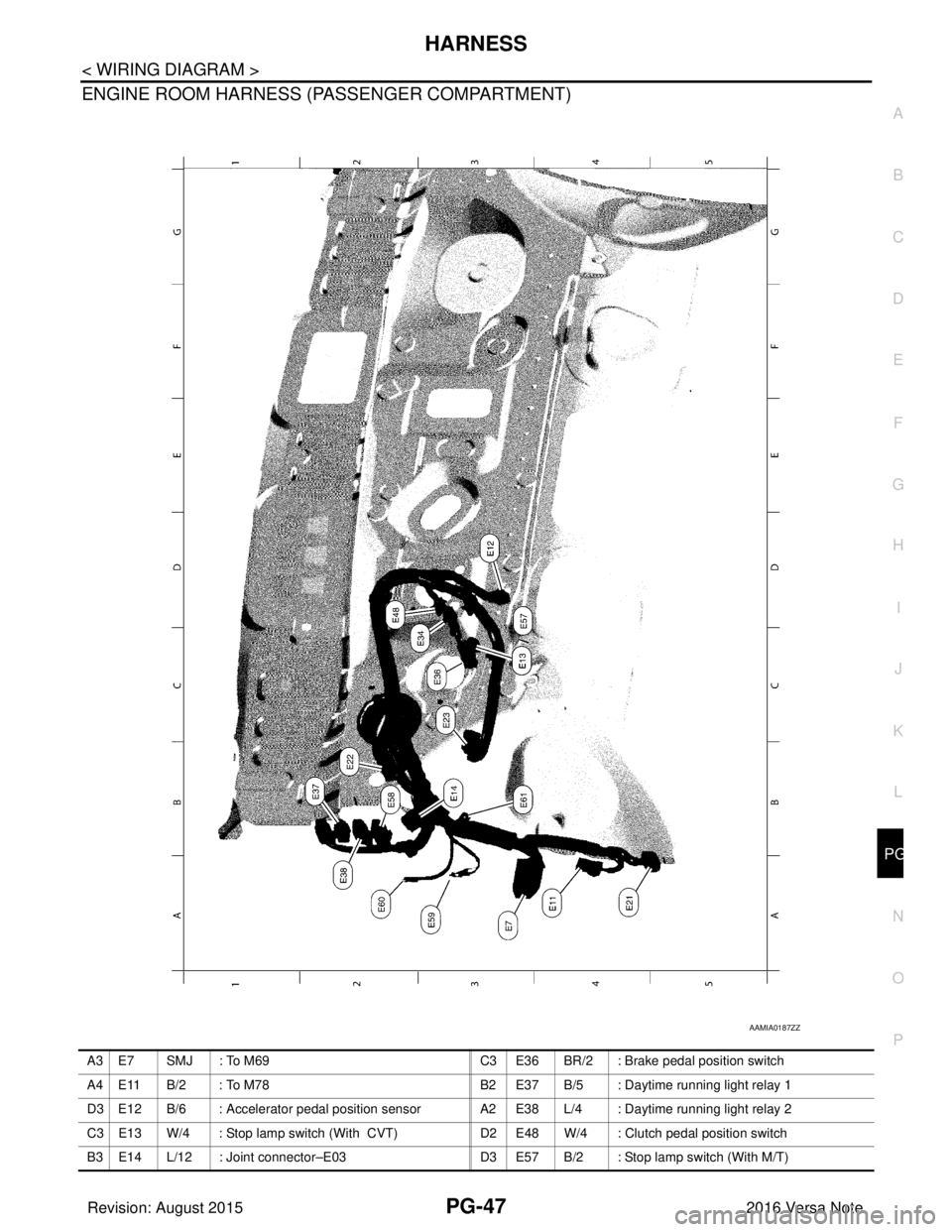
ENGINE ROOM HARNESS (PASSENGER COMPARTMENT)
AAMIA0187ZZ
A 3 E 7 S M J : To M 6 9
C 3 E 3 6 BR/2 : Brake pedal position switch
A4 E11 B/2 : To M78 B2 E37 B/5 : Daytime running light relay 1
D3 E12 B/6 : Accelerator pedal position sensor A2 E38 L/4 : Daytime running light relay 2
C3 E13 W/4 : Stop lamp switch (With CVT) D2 E48 W/4 : Clutch pedal position switch
B3 E14 L/12 : Joint connector–E03 D3 E57 B/2 : Stop lamp switch (With M/T)
Revision: August 2015 2016 Versa Note
cardiagn.com
Page 2751 of 3641
WT-8
< SYSTEM DESCRIPTION >
SYSTEM
SYSTEM
TIRE PRESSURE MONITORING SYSTEM
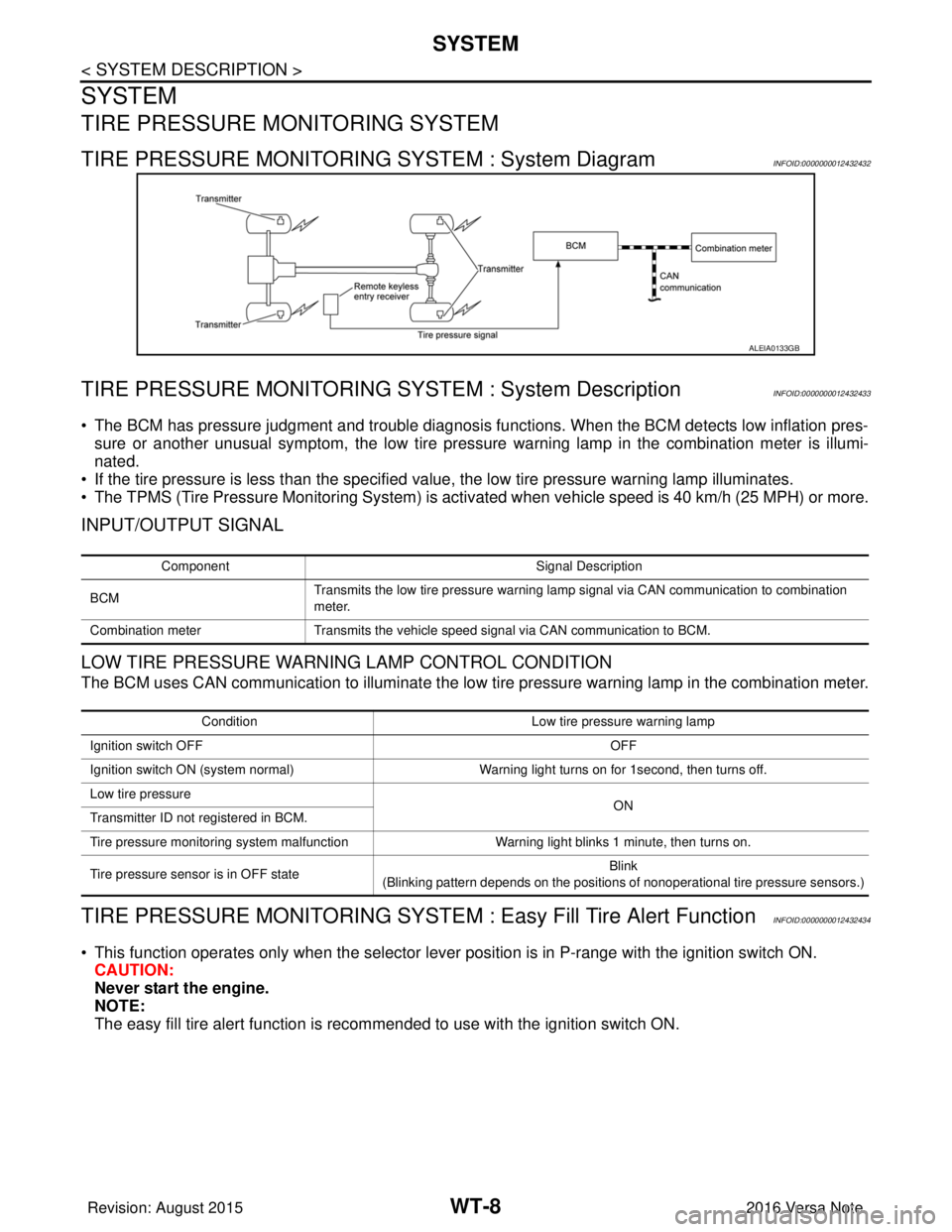
TIRE PRESSURE MONITORING SYSTEM : System DiagramINFOID:0000000012432432
TIRE PRESSURE MONITORING SY STEM : System DescriptionINFOID:0000000012432433
• The BCM has pressure judgment and trouble diagnosis functions. When the BCM detects low inflation pres-
sure or another unusual symptom, the low tire pressure warning lamp in the combination meter is illumi-
nated.
• If the tire pressure is less than the specified value, the low tire pressure warning lamp illuminates.
• The TPMS (Tire Pressure Monitoring System) is activated when vehicle s peed is 40 km/h (25 MPH) or more.
INPUT/OUTPUT SIGNAL
LOW TIRE PRESSURE WARNING LAMP CONTROL CONDITION
The BCM uses CAN communication to illuminate the low tire pressure warning lamp in the combination meter.
TIRE PRESSURE MONITORING SYSTEM : Easy Fill Tire Alert FunctionINFOID:0000000012432434
• This function operates only when the selector lever position is in P-range with the ignition switch ON.
CAUTION:
Never start the engine.
NOTE:
The easy fill tire alert function is reco mmended to use with the ignition switch ON.
ALEIA0133GB
Component Signal Description
BCM Transmits the low tire pressure warning lamp signal via CAN communication to combination
meter.
Combination meter Transmits the vehicle speed signal via CAN communication to BCM.
Condition Low tire pressure warning lamp
Ignition switch OFF OFF
Ignition switch ON (system normal) Warning light turns on for 1second, then turns off.
Low tire pressure ON
Transmitter ID not registered in BCM.
Tire pressure monitoring system malfunction Warning light blinks 1 minute, then turns on.
Tire pressure sensor is in OFF state Blink
(Blinking pattern depends on the positions of nonoperational tire pressure sensors.)
Revision: August 2015 2016 Versa Note
cardiagn.com
Page 2821 of 3641
SE-8
< SYMPTOM DIAGNOSIS >
SQUEAK AND RATTLE TROUBLE DIAGNOSES
SYMPTOM DIAGNOSIS
SQUEAK AND RATTLE TROUBLE DIAGNOSES
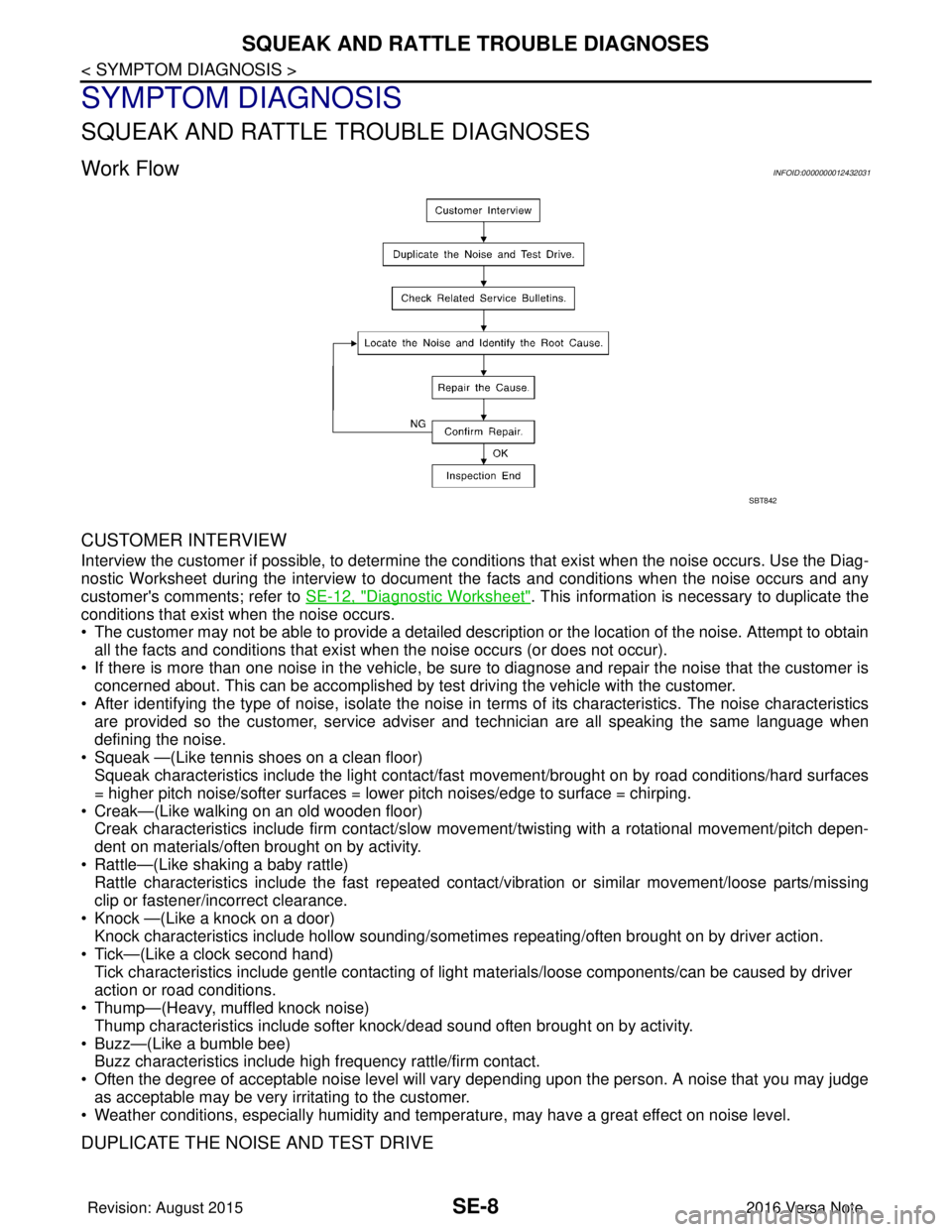
Work FlowINFOID:0000000012432031
CUSTOMER INTERVIEW
Interview the customer if possible, to determine the conditions that exist when the noise occurs. Use the Diag-
nostic Worksheet during the interview to document the facts and conditions when the noise occurs and any
customer's comments; refer to SE-12, "
Diagnostic Worksheet". This information is necessary to duplicate the
conditions that exist when the noise occurs.
• The customer may not be able to provide a detailed description or the location of the noise. Attempt to obtain
all the facts and conditions that exist w hen the noise occurs (or does not occur).
• If there is more than one noise in the vehicle, be sure to diagnose and repair the noise that the customer is
concerned about. This can be accomplished by test driving the vehicle with the customer.
• After identifying the type of noise, isolate the noise in terms of its characteristics. The noise characteristics
are provided so the customer, service adviser and technician are all speaking the same language when
defining the noise.
• Squeak —(Like tennis shoes on a clean floor) Squeak characteristics include the light contact/fast movement/brought on by road conditions/hard surfaces
= higher pitch noise/softer surfaces = lower pitch noises/edge to surface = chirping.
• Creak—(Like walking on an old wooden floor) Creak characteristics include firm contact/slow mo vement/twisting with a rotational movement/pitch depen-
dent on materials/often brought on by activity.
• Rattle—(Like shaking a baby rattle) Rattle characteristics include the fast repeated contac t/vibration or similar movement/loose parts/missing
clip or fastener/incorrect clearance.
• Knock —(Like a knock on a door) Knock characteristics include hollow sounding/someti mes repeating/often brought on by driver action.
• Tick—(Like a clock second hand) Tick characteristics include gentle contacting of light materials/loose components/can be caused by driver
action or road conditions.
• Thump—(Heavy, muffled knock noise)
Thump characteristics include softer k nock/dead sound often brought on by activity.
• Buzz—(Like a bumble bee) Buzz characteristics include hi gh frequency rattle/firm contact.
• Often the degree of acceptable noise level will vary depending upon the person. A noise that you may judge as acceptable may be very irritating to the customer.
• Weather conditions, especially humidity and temperat ure, may have a great effect on noise level.
DUPLICATE THE NOISE AND TEST DRIVE
SBT842
Revision: August 2015 2016 Versa Note
cardiagn.com
Page 2823 of 3641

SE-10
< SYMPTOM DIAGNOSIS >
SQUEAK AND RATTLE TROUBLE DIAGNOSES
INSTRUMENT PANEL
Most incidents are caused by contact and movement between:
1. Cluster lid A and the instrument panel
2. Acrylic lens and combination meter housing
3. Instrument panel to front pillar finisher
4. Instrument panel to windshield
5. Instrument panel pins
6. Wiring harnesses behind the combination meter
7. A/C defroster duct and duct joint
These incidents can usually be located by tapping or moving the components to duplicate the noise or by
pressing on the components while driving to stop the noise. Most of these incidents can be repaired by apply-
ing felt cloth tape or silicone spray (in hard to reach areas). Urethane pads can be used to insulate wiring har-
ness.
CAUTION:
Do not use silicone spray to isolate a squeak or rattle. If you saturate the ar ea with silicone, you will
not be able to recheck the repair.
CENTER CONSOLE
Components to pay attention to include:
1. Shift selector assembly cover to finisher
2. A/C control unit and cluster lid C
3. Wiring harnesses behind audio and A/C control unit
The instrument panel repair and isolation pr ocedures also apply to the center console.
DOORS
Pay attention to the:
1. Finisher and inner panel making a slapping noise
2. Inside handle escutcheon to door finisher
3. Wiring harnesses tapping
4. Door striker out of alignment causing a popping noise on starts and stops
Tapping or moving the components or pressing on them wh ile driving to duplicate the conditions can isolate
many of these incidents. You can usually insulate the areas with felt cloth tape or insulator foam blocks from
the NISSAN Squeak and Rattle Kit (J-50397) to repair the noise.
TRUNK
Trunk noises are often caused by a loose jack or loose items put into the trunk by the owner.
In addition look for:
1. Trunk lid bumpers out of adjustment
2. Trunk lid striker out of adjustment
3. The trunk lid torsion bars knocking together
4. A loose license plate or bracket
Most of these incidents can be repaired by adjusting, se curing or insulating the item(s) or component(s) caus-
ing the noise.
SUNROOF/HEADLINING
Noises in the sunroof/headlining area c an often be traced to one of the following:
1. Sunroof lid, rail, linkage or seals making a rattle or light knocking noise
2. Sun visor shaft shaking in the holder
3. Front or rear windshield touching headlining and squeaking
Again, pressing on the components to stop the noise while duplicating the conditions can isolate most of these
incidents. Repairs usually consist of insulating with felt cloth tape.
OVERHEAD CONSOLE (FRONT AND REAR)
Overhead console noises are often caused by the c onsole panel clips not being engaged correctly. Most of
these incidents are repaired by pushing up on the c onsole at the clip locations until the clips engage.
In addition look for:
Revision: August 2015 2016 Versa Note
cardiagn.com
Page 2986 of 3641
![NISSAN NOTE 2016 Service Repair Manual DIAGNOSIS SYSTEM (IPDM E/R)SEC-129
< SYSTEM DESCRIPTION > [WITHOUT INTELLIGENT KEY SYSTEM]
C
D
E
F
G H
I
J
L
M A
B
SEC
N
O P
ECU IDENTIFICATION
The IPDM E/R part number is displayed.
SELF DIAGNOSTIC R](/img/5/57363/w960_57363-2985.png "NISSAN NOTE 2016 Service Repair Manual DIAGNOSIS SYSTEM (IPDM E/R)SEC-129
< SYSTEM DESCRIPTION > [WITHOUT INTELLIGENT KEY SYSTEM]
C
D
E
F
G H
I
J
L
M A
B
SEC
N
O P
ECU IDENTIFICATION
The IPDM E/R part number is displayed.
SELF DIAGNOSTIC R")
DIAGNOSIS SYSTEM (IPDM E/R)SEC-129
< SYSTEM DESCRIPTION > [WITHOUT INTELLIGENT KEY SYSTEM]
C
D
E
F
G H
I
J
L
M A
B
SEC
N
O P
ECU IDENTIFICATION
The IPDM E/R part number is displayed.
SELF DIAGNOSTIC RESULT
Refer to PCS-20, "DTCIndex".
DATA MONITOR
ACTIVE TEST
Data Monitor The IPDM E/R input/output data is displayed in real time.
Active Test The IPDM E/R activates outputs to test components.
CAN Diag Support Mntr The result of transmit/receive diagnosis of CAN communication is displayed.
Direct Diagnostic Mode
Description
Monitor Item [Unit]Main
Signals Description
MOTOR FAN REQ [1/2/3/4] ×Indicates cooling fan speed signal received from ECM on CAN communication
line
AC COMP REQ [On/Off] ×Indicates A/C compressor request signal received from ECM on CAN commu-
nication line
TAIL&CLR REQ [On/Off] ×Indicates position light request signal
received from BCM on CAN communica-
tion line
HL LO REQ [On/Off] ×Indicates low beam request signal received from BCM on CAN communication
line
HL HI REQ [On/Off] ×Indicates high beam request signal received from BCM on CAN communication
line
FR FOG REQ [On/Off] ×Indicates front fog light request signal received from BCM on CAN communica-
tion line
FR WIP REQ [Stop/1LOW/Low/Hi] ×Indicates front wiper request signal received from BCM on CAN communication
line
WIP AUTO STOP [STOP P/ACT P] ×Indicates condition of front wiper auto stop signal
WIP PROT [Off/BLOCK] ×Indicates condition of front wiper fail-safe operation
IGN RLY1 -REQ [On/Off] Indicates ignition switch ON signal received from BCM on CAN communication
line
IGN RLY [On/Off] ×Indicates condition of ignition relay
PUSH SW [On/Off] Indicates condition of push-button ignition switch
INTER/NP SW [On/Off] Indicates condition of CVT shift position
ST RLY CONT [On/Off] Indicates starter relay status signal received from BCM on CAN communication
line
IHBT RLY -REQ [On/Off] Indicates starter control relay signal received from BCM on CAN communication
line
ST/INHI RLY [Off/ ST /INHI] Indicates condition of starter relay and starter control relay
DETENT SW [On/Off] Indicates condition of CVT shift selector (park position switch)
DTRL REQ [Off] Indicates daytime running light request signal received from BCM on CAN com-
munication line
THFT HRN REQ [On/Off] Indicates theft warning horn request signal received from BCM on CAN commu-
nication line
HORN CHIRP [On/Off] Indicates horn reminder signal received from BCM on CAN communication line
Test item Description
HORN This test is able to check horn operation [On].
FRONT WIPER This test is able to check wiper motor operation [Hi/Lo/Off].
Revision: August 2015 2016 Versa Note
cardiagn.com