tow NISSAN NOTE 2016 Service Owner's Manual
[x] Cancel search | Manufacturer: NISSAN, Model Year: 2016, Model line: NOTE, Model: NISSAN NOTE 2016Pages: 3641, PDF Size: 28.72 MB
Page 1102 of 3641
![NISSAN NOTE 2016 Service Owners Manual CYLINDER BLOCKEM-101
< UNIT DISASSEMBLY AND ASSEMBLY > [HR16DE]
C
D
E
F
G H
I
J
K L
M A
EM
NP
O
Install the rear oil seal after installing the oil pan (upper).
17. Install rear oil seal. Refer to EM-](/img/5/57363/w960_57363-1101.png "NISSAN NOTE 2016 Service Owners Manual CYLINDER BLOCKEM-101
< UNIT DISASSEMBLY AND ASSEMBLY > [HR16DE]
C
D
E
F
G H
I
J
K L
M A
EM
NP
O
Install the rear oil seal after installing the oil pan (upper).
17. Install rear oil seal. Refer to EM-")
CYLINDER BLOCKEM-101
< UNIT DISASSEMBLY AND ASSEMBLY > [HR16DE]
C
D
E
F
G H
I
J
K L
M A
EM
NP
O
Install the rear oil seal after installing the oil pan (upper).
17. Install rear oil seal. Refer to EM-74, "
REAR OIL SEAL : Removal and Installation".
18. Install flywheel (M/T models) or drive plate (CVT models).
M/T models
• Secure crankshaft with a stopper plate and tighten bolts crosswise over several times.
CVT models
• Secure crankshaft with a stopper plate and tighten bolts crosswise over several times.
CAUTION:
Do not damage or scratch and contact surface for clutch disc of flywheel.
19. Install knock sensor (1).
• Install connectors so that they are positioned toward the rearof the engine.
CAUTION:
• Do not tighten bolt while holding the connector.
• If any impact by dropping is applied to knock sensor,
replace it with a new one.
NOTE:
• Check that there is no foreign material on the cylinder block
mating surface and the back surface of knock sensor.
• Check that knock sensor does not interfere with other parts.
20. Install crankshaft position sensor (POS) (2) and O-ring (1) and then install the crankshaft position sensor cover (3) on the cylin-
der block (4).
• Tighten bolts with sensor inserted completely.
CAUTION:
• Avoid impacts such as a dropping.
• Do not disassemble.
• Keep sensor away from metal particles.
• Do not place the sensor in a location where it is exposedto magnetism.
• Do not reuse O-ring.
21. For the oil level gauge guide (1), secure in position (B) shown to the water inlet clip (A) after inserting to the cylinder block side.
22. Assembly of the remaining components is in the reverse order of disassembly.
Tool number : KV11105210 (J-44716)
Tool number : KV11105210 (J-44716)
: Engine front
: Engine front
PBIC3754E
JPBIA4202ZZ
PBIC3755E
Revision: August 2015
2016 Versa Note
cardiagn.com
Page 1749 of 3641
HEADLAMP AIMING ADJUSTMENTEXL-97
< PERIODIC MAINTENANCE >
C
DE
F
G H
I
J
K
M A
B
EXL
N
O P
PERIODIC MAINTENANCE
HEADLAMP AIMING ADJUSTMENT
InspectionINFOID:0000000012432828
PREPARATION BEFORE ADJUSTING
Before performing aiming adjustment, check the following:
• Ensure all tires are inflated to correct pressure.
• Place vehicle and screen on level surface.
• Ensure there is no load in vehicle other than the driver (or equivalent weight placed in driver's position).
• Coolant and engine oil filled to correct level, and fuel tank full.
• Remove cargo and/or luggage to maintain an unloaded vehicle condition.
• Confirm spare tire, jack and tools are properly stowed.
• Carefully wipe off any dirt from headlamp lens. CAUTION:
Do not use organic solvent (thinner, gasoline etc.)
• Place a driver or equivalent weight of 68.5 kg (150 lb) on the driver seat.
• By hand, bounce the front and rear of the vehicle to settle the suspension and eliminate any static load.
• Place the front tires in the straight ahead position.
• Confirm headlamp aiming switch is set to "0" (zero) position.
• Aim each headlamp individually and ensure other headlamp beam pattern is blocked from screen.
NOTE:
• For headlamp aiming details, refer to regulations in your area.
• By regulation, no means for horizontal aim adjustment is provided from the factory; only vertical aim is
adjustable.
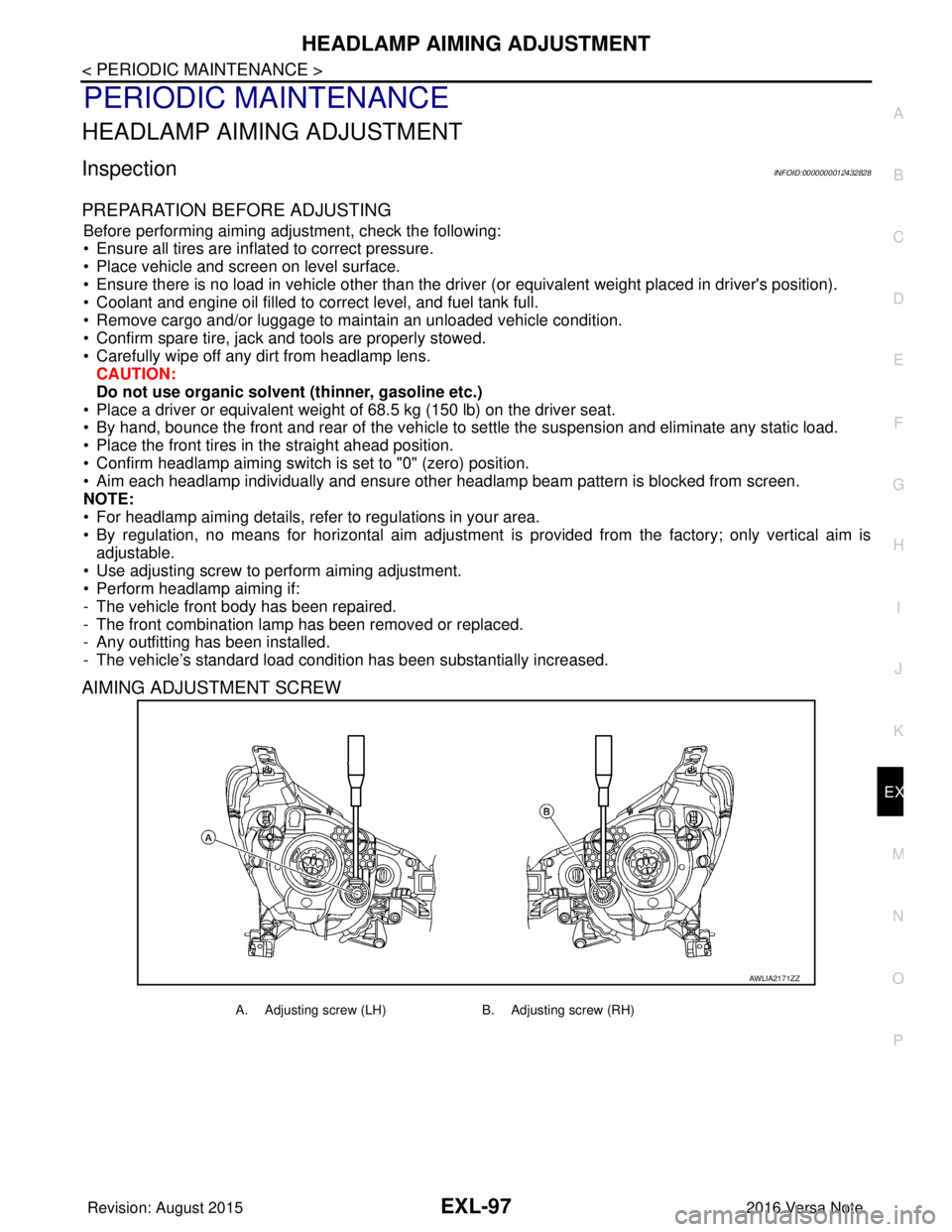
• Use adjusting screw to perform aiming adjustment.
• Perform headlamp aiming if:
- The vehicle front body has been repaired.
- The front combination lamp has been removed or replaced.
- Any outfitting has been installed.
- The vehicle’s standard load condition has been substantially increased.
AIMING ADJUSTMENT SCREW
AWLIA2171ZZ
A. Adjusting screw (LH) B. Adjusting screw (RH)
Revision: August 2015 2016 Versa Note
cardiagn.com
Page 1752 of 3641
EXL-100
< PERIODIC MAINTENANCE >
FRONT FOG LAMP AIMING ADJUSTMENT
FRONT FOG LAMP AIMING ADJUSTMENT
InspectionINFOID:0000000012432830
PREPARATION BEFORE ADJUSTING
Before performing aiming adjustment procedure, check the following:
• Ensure all tires are inflated to correct pressure.
• Place vehicle and screen on level surface.
• Ensure there is no load in vehicle other than the driver (or equivalent weight placed in driver's position).
• Coolant and engine oil filled to correct level, and fuel tank full.
• Remove cargo and/or luggage to maintain an unloaded vehicle condition.
• Confirm spare tire, jack and tools are properly stowed.
• Carefully wipe off any dirt from fog lamp lens. CAUTION:
Do not use organic solvent (thinner, gasoline etc.)
• Place a driver or equivalent weight of 68.5 kg (150 lb) on the driver seat.
• By hand, bounce the front and rear of the vehicle to settle the suspension and eliminate any static load.
• Place the front tires in the straight ahead position.
• Aim each headlamp individually and ensure other headlamp beam pattern is blocked from screen.
NOTE:
• For headlamp aiming details, refer to regulations in your area.
• By regulation, no means for horizontal aim adjustment is provided from the factory; only vertical aim is
adjustable.
• Use adjusting screw to perform aiming adjustment.
• Perform headlamp aiming if:
- The vehicle front body has been repaired.
- The front combination lamp has been removed or replaced.
- Any outfitting has been installed.
- The vehicle’s standard load condition has been substantially increased.
AIMING ADJUSTMENT SCREW
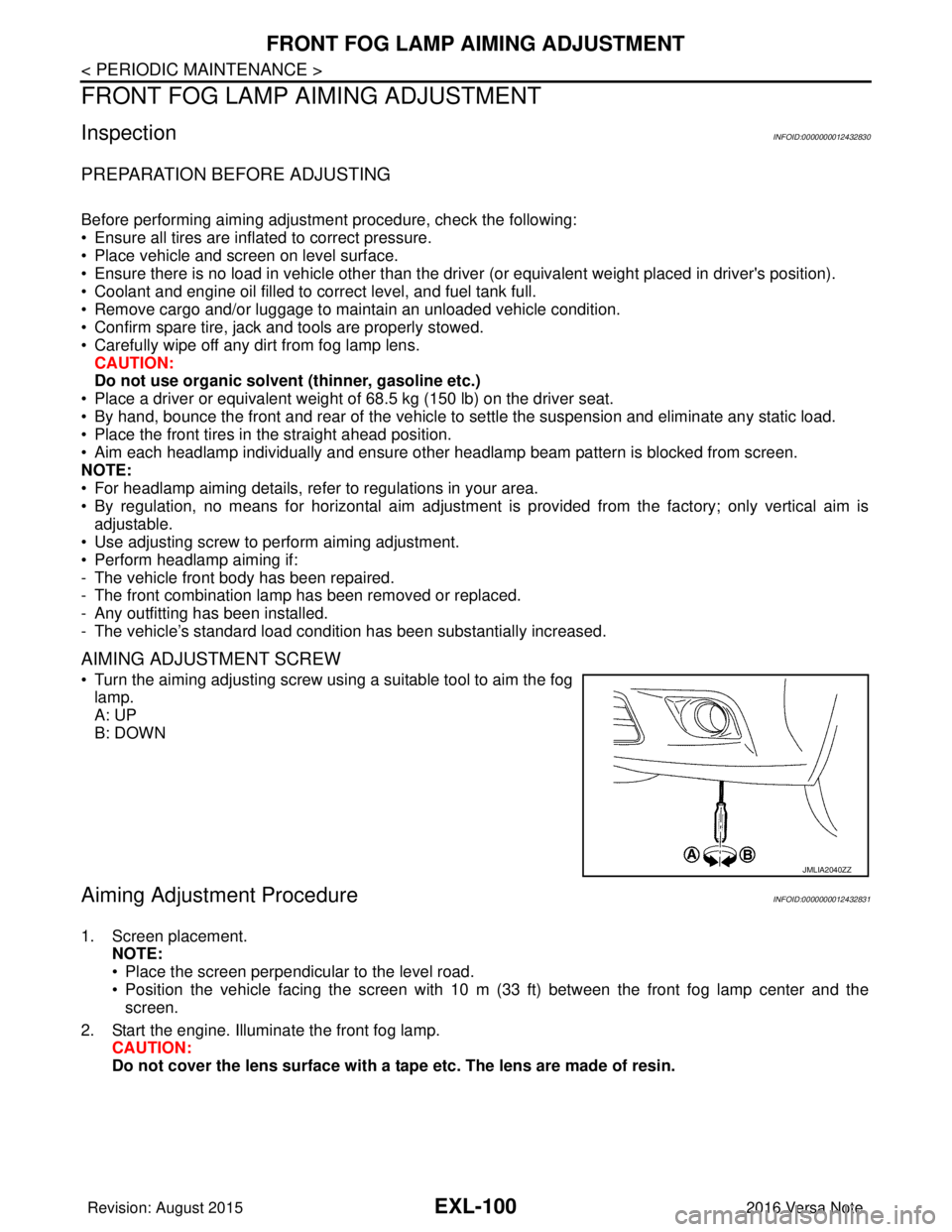
• Turn the aiming adjusting screw using a suitable tool to aim the fog
lamp.
A: UP
B: DOWN
Aiming Adjustment ProcedureINFOID:0000000012432831
1. Screen placement. NOTE:
• Place the screen perpendicular to the level road.
• Position the vehicle facing the screen with 10 m (33 ft) between the front fog lamp center and thescreen.
2. Start the engine. Illuminate the front fog lamp. CAUTION:
Do not cover the lens surface with a tape etc. The lens are made of resin.
JMLIA2040ZZ
Revision: August 2015 2016 Versa Note
cardiagn.com
Page 1790 of 3641
FRONT BUMPEREXT-23
< REMOVAL AND INSTALLATION >
C
DE
F
G H
I
J
L
M A
B
EXT
N
O P
REMOVAL AND INSTALLATION
FRONT BUMPER
Exploded ViewINFOID:0000000012432165
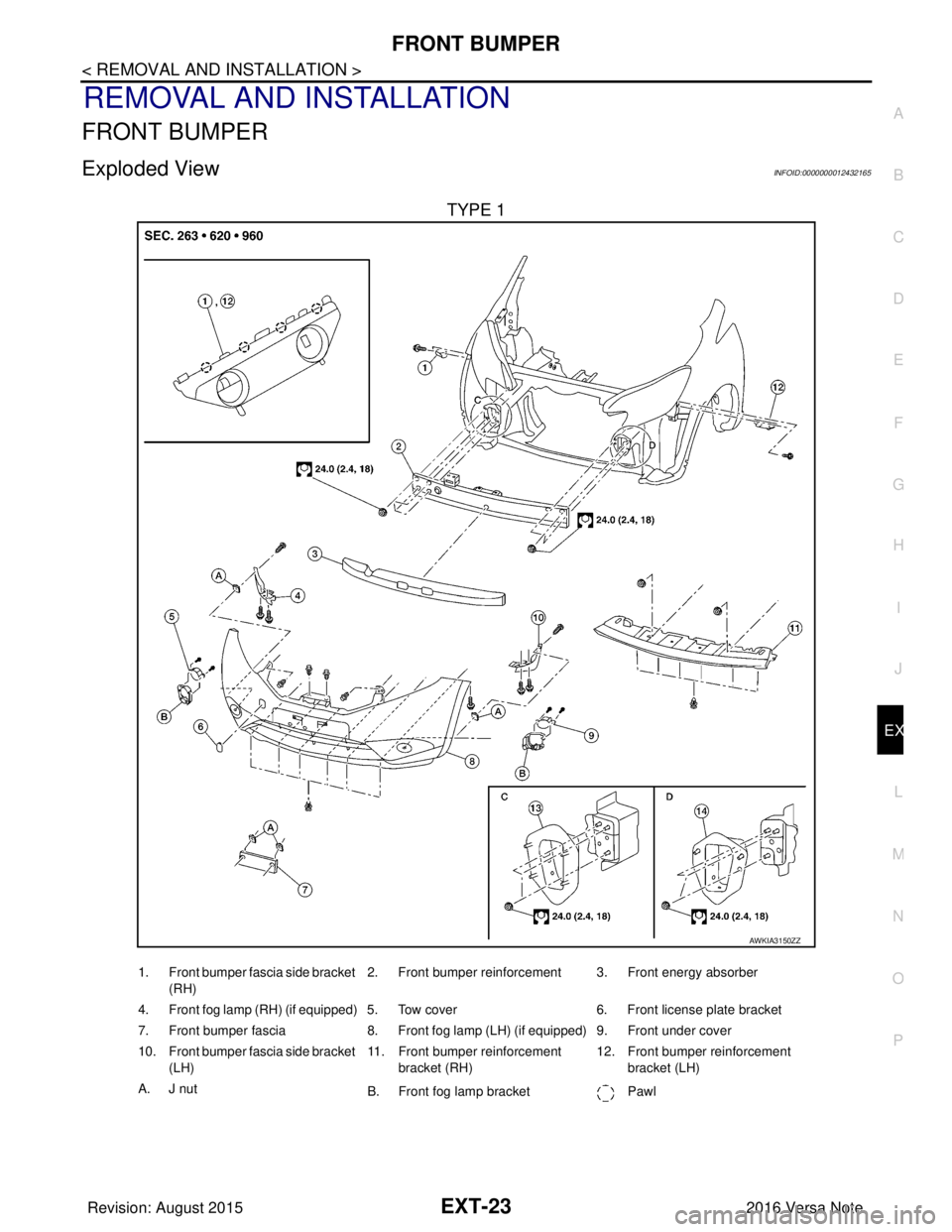
TYPE 1
AWKIA3150ZZ
1. Front bumper fascia side bracket (RH) 2. Front bumper reinforcement 3. Front energy absorber
4. Front fog lamp (RH) (if equipped) 5. Tow cover 6. Front license plate bracket
7. Front bumper fascia 8. Front fog lamp (LH) (if equipped) 9. Front under cover
10. Front bumper fascia side bracket (LH) 11. Front bumper reinforcement
bracket (RH) 12. Front bumper reinforcement
bracket (LH)
A. J nut B. Front fog lamp bracket Pawl
Revision: August 2015 2016 Versa Note
cardiagn.com
Page 1791 of 3641
EXT-24
< REMOVAL AND INSTALLATION >
FRONT BUMPER
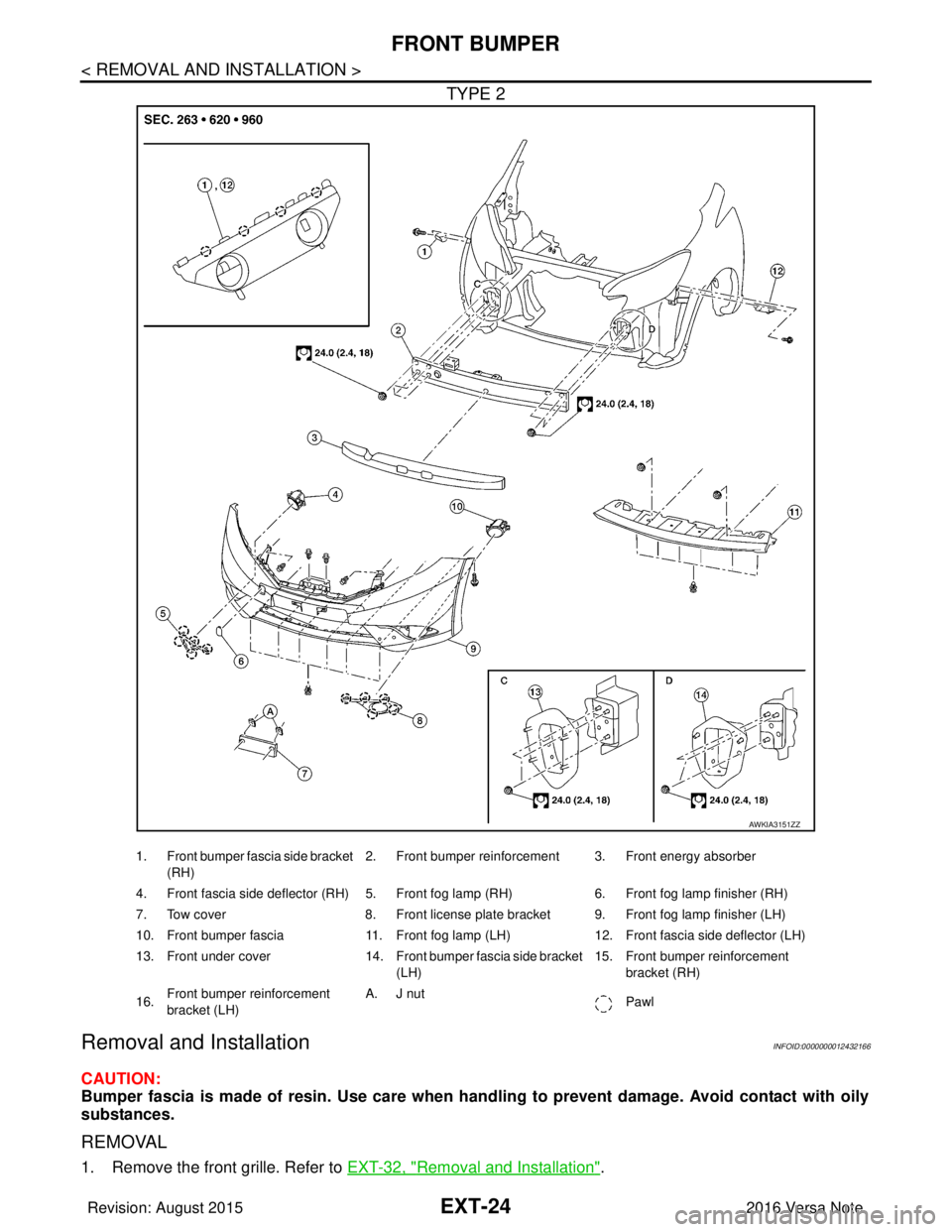
TYPE 2
Removal and InstallationINFOID:0000000012432166
CAUTION:
Bumper fascia is made of resin. Use care when handling to prevent damage. Avoid contact with oily
substances.
REMOVAL
1. Remove the front grille. Refer to EXT-32, "Removal and Installation".
AWKIA3151ZZ
1. Front bumper fascia side bracket
(RH) 2. Front bumper reinforcement 3. Front energy absorber
4. Front fascia side deflector (RH) 5. Front fog lamp (RH) 6. Front fog lamp finisher (RH)
7. Tow cover 8. Front license plate bracket 9. Front fog lamp finisher (LH)
10. Front bumper fascia 11. Front fog lamp (LH)12. Front fascia side deflector (LH)
13. Front under cover 14. Front bumper fascia side bracket
(LH) 15. Front bumper reinforcement
bracket (RH)
16. Front bumper reinforcement
bracket (LH) A. J nut
Pawl
Revision: August 2015 2016 Versa Note
cardiagn.com
Page 1792 of 3641
FRONT BUMPEREXT-25
< REMOVAL AND INSTALLATION >
C
DE
F
G H
I
J
L
M A
B
EXT
N
O P
2. Remove the four front bumper fascia upper clips.
3. Remove the front under cover. Refer to EXT-39, "
FRONT UNDER COVER : Removal and Installation".
4. Partially remove front fender protectors (LH/RH) at the front edge to access front bumper fascia bolts.
Refer to EXT-38, "
Exploded View".
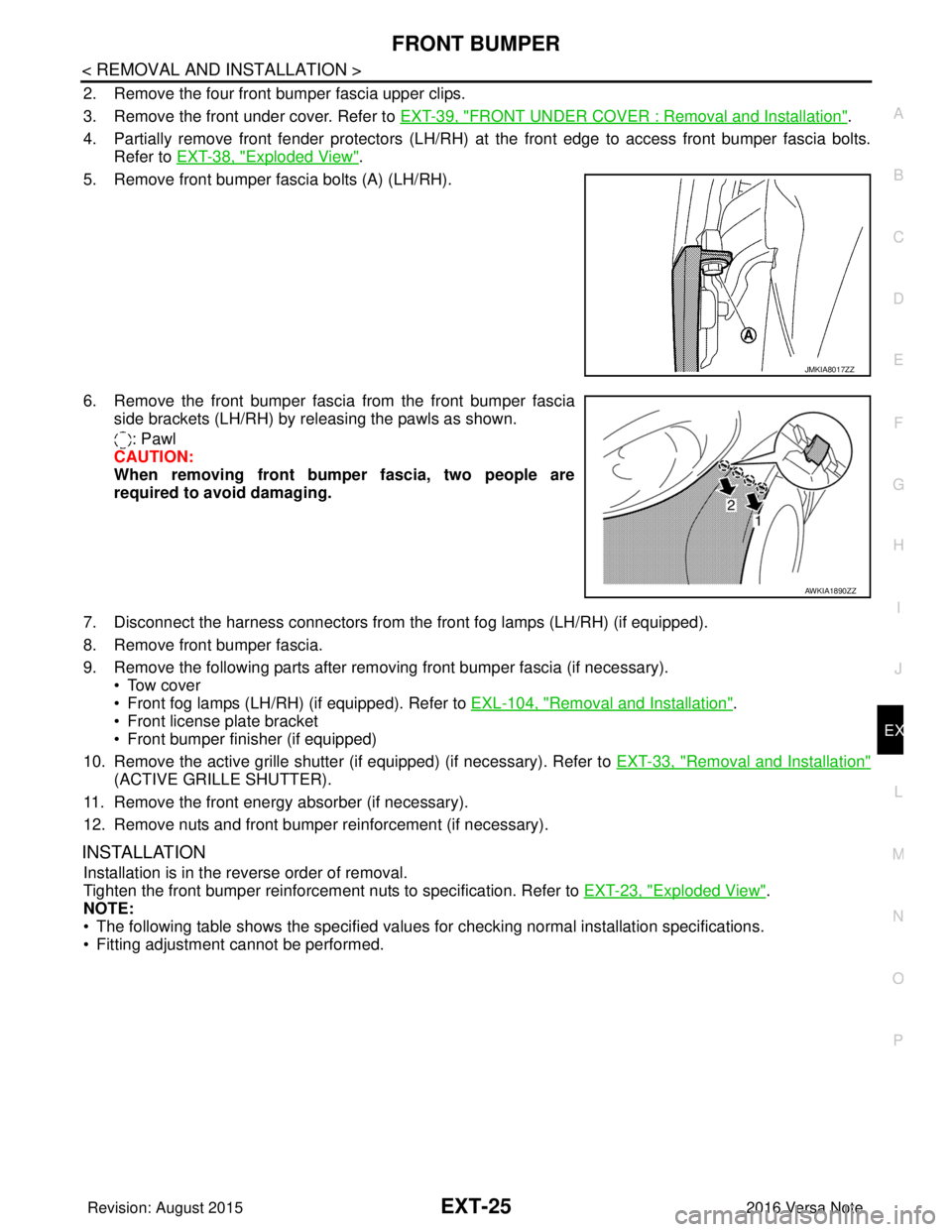
5. Remove front bumper fascia bolts (A) (LH/RH).
6. Remove the front bumper fasci a from the front bumper fascia
side brackets (LH/RH) by releasing the pawls as shown.
: Pawl
CAUTION:
When removing front bumper fascia, two people are
required to avoid damaging.
7. Disconnect the harness connectors from t he front fog lamps (LH/RH) (if equipped).
8. Remove front bumper fascia.
9. Remove the following parts after removing front bumper fascia (if necessary). • Tow cover
• Front fog lamps (LH/RH) (if equipped). Refer to EXL-104, "
Removal and Installation".
• Front license plate bracket
• Front bumper finisher (if equipped)
10. Remove the active grille shutter (if equipped) (if necessary). Refer to EXT-33, "
Removal and Installation"
(ACTIVE GRILLE SHUTTER).
11. Remove the front energy absorber (if necessary).
12. Remove nuts and front bumper reinforcement (if necessary).
INSTALLATION
Installation is in the reverse order of removal.
Tighten the front bumper reinforcement nuts to specification. Refer to EXT-23, "
Exploded View".
NOTE:
• The following table shows the specified values for checking normal installation specifications.
• Fitting adjustment cannot be performed.
JMKIA8017ZZ
AWKIA1890ZZ
Revision: August 2015 2016 Versa Note
cardiagn.com
Page 1810 of 3641
ROOF SIDE MOLDINGEXT-43
< REMOVAL AND INSTALLATION >
C
DE
F
G H
I
J
L
M A
B
EXT
N
O P
Removal
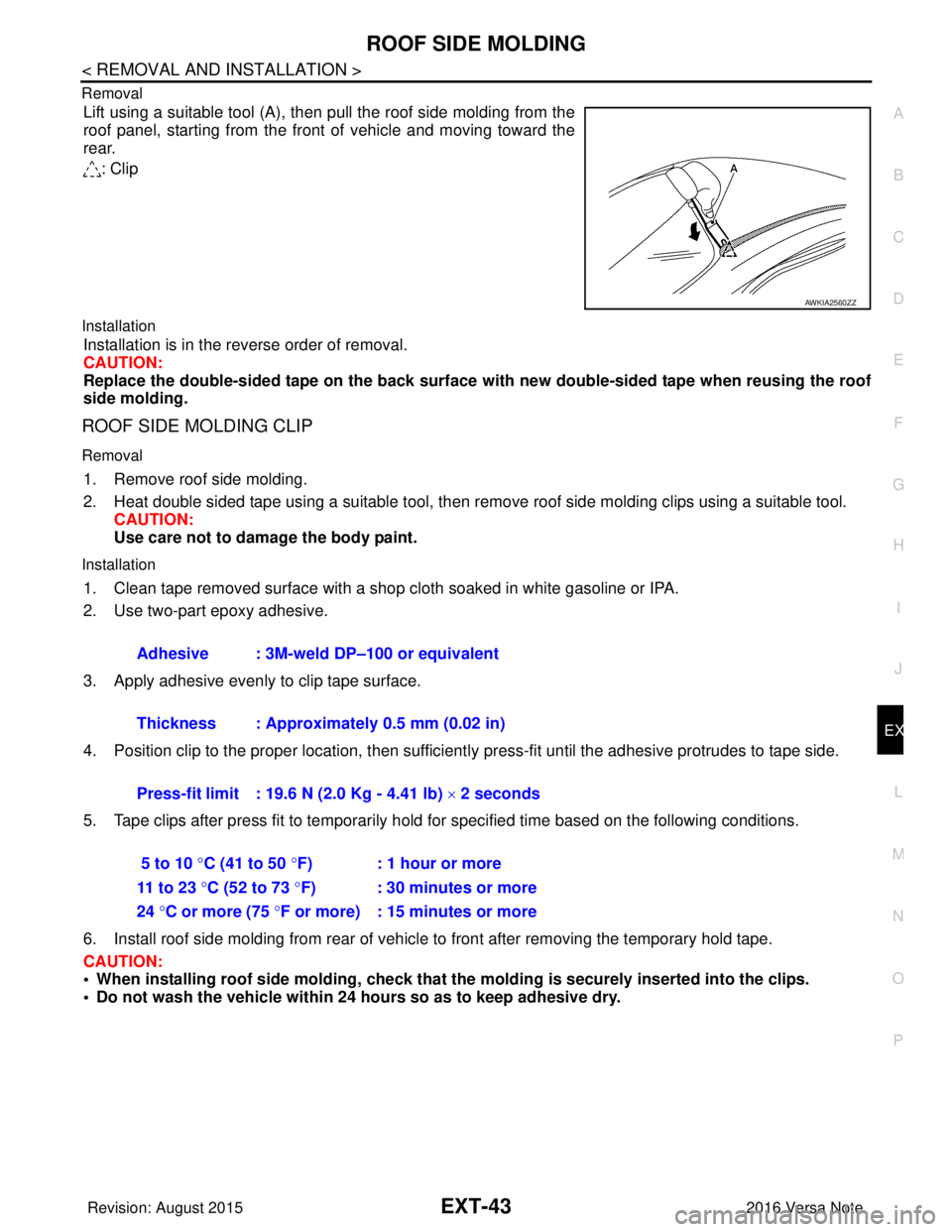
Lift using a suitable tool (A), then pull the roof side molding from the
roof panel, starting from the front of vehicle and moving toward the
rear.
: Clip
Installation
Installation is in the reverse order of removal.
CAUTION:
Replace the double-sided tape on the back surface with new double-sided tape when reusing the roof
side molding.
ROOF SIDE MOLDING CLIP
Removal
1. Remove roof side molding.
2. Heat double sided tape using a suitable tool, then remove roof side molding clips using a suitable tool.
CAUTION:
Use care not to damage the body paint.
Installation
1. Clean tape removed surface with a shop cloth soaked in white gasoline or IPA.
2. Use two-part epoxy adhesive.
3. Apply adhesive evenly to clip tape surface.
4. Position clip to the proper location, then sufficient ly press-fit until the adhesive protrudes to tape side.
5. Tape clips after press fit to temporarily hold for specified time based on the following conditions.
6. Install roof side molding from rear of vehicle to front after removing the temporary hold tape.
CAUTION:
• When installing roof side moldin g, check that the molding is securely inserted into the clips.
• Do not wash the vehicle within 24 hours so as to keep adhesive dry.
AWKIA2560ZZ
Adhesive : 3M-weld DP–100 or equivalent
Thickness : Approximately 0.5 mm (0.02 in)
Press-fit limit : 19.6 N (2.0 Kg - 4.41 lb) × 2 seconds
5 to 10 °C (41 to 50 °F) : 1 hour or more
11 to 23 °C (52 to 73 °F) : 30 minutes or more
24 °C or more (75 °F or more) : 15 minutes or more
Revision: August 2015 2016 Versa Note
cardiagn.com
Page 1814 of 3641

DOOR OUTSIDE MOLDINGEXT-47
< REMOVAL AND INSTALLATION >
C
DE
F
G H
I
J
L
M A
B
EXT
N
O P
Removal and InstallationINFOID:0000000012432189
FRONT DOOR OUTSIDE MOLDING
Removal
1. Lower front door glass fully.
2. Release the pawls using a suitable tool, then rotate front door outside molding toward the outside of the vehicle and lift up to remove.
Installation
Installation is in the reverse order of removal.
REAR DOOR OUTSIDE MOLDING
Removal
1. Lower rear door glass fully.
2. Release the pawl using a suitable tool, then rotate rear door outside molding toward the outside of the
vehicle and lift up to remove.
Installation
Installation is in the reverse order of removal.
4. Rear door panel 5. Rear door glass6. Front door glass
Pawl
Revision: August 2015 2016 Versa Note
cardiagn.com
Page 1889 of 3641

GI-1
GENERAL INFORMATION
C
DE
F
G H
I
J
K L
M B
GI
SECTION GI
N
O P
CONTENTS
GENERAL INFORMATION
HOW TO USE THIS MANU AL ......................3
HOW TO USE THIS MANUAL ....................... .....3
Description .......................................................... ......3
Terms ........................................................................3
Units ..........................................................................3
Contents ....................................................................3
Relation between Illustrations and Descriptions .......4
Components ..............................................................4
HOW TO FOLLOW TROUBLE DIAGNOSES .....6
Description ................................................................6
How to Follow Test Groups in Trouble Diagnosis ......6
Key to Symbols Signifying Measurements or Pro-
cedures ............................................................... ......
7
HOW TO READ WIRING DIAGRAMS ................9
Connector Symbols ............................................. ......9
Sample/Wiring Diagram -Example- .........................10
Connector Information .............................................12
ABBREVIATIONS .......................................... ....14
Abbreviation List .................................................. ....14
TIGHTENING TORQUE OF STANDARD
BOLTS ................................................................
19
Description .......................................................... ....19
Tightening Torque Table (New Standard Includ-
ed) ...........................................................................
19
RECOMMENDED CHEMICAL PRODUCTS
AND SEALANTS ................................................
22
Recommended Chemical Products and Sealants ....22
PRECAUTION ..............................................23
PRECAUTIONS .............................................. ....23
Description .......................................................... ....23
Precaution for Supplemental Restraint System
(SRS) "AIR BAG" and "SEAT BELT PRE-TEN-
SIONER" .................................................................
23
Procedures without Cowl Top Cover .......................23
Cautions in Removing Battery Terminal and AV
Control Unit (Models with AV Control Unit) .............
23
General Precautions ............................................ ....24
Three Way Catalyst .................................................25
Fuel ..........................................................................25
Multiport Fuel Injection System or Engine Control
System .....................................................................
26
Hoses ......................................................................26
Engine Oils ..............................................................27
Air Conditioning .......................................................27
LIFTING POINT .................................................28
Special Service Tool ................................................28
Garage Jack and Safety Stand ................................28
2-Pole Lift ................................................................29
Board-on Lift ............................................................30
TOW TRUCK TOWING .....................................31
Tow Truck Towing ...................................................31
Vehicle Recovery (Freeing a Stuck Vehicle) ...........31
VEHICLE INFORMATION ...........................33
IDENTIFICATION INFORMATION ....................33
Model Variation .................................................... ....33
Identification Number ...............................................34
Identification Plate ...................................................35
Engine Serial Number .............................................36
CVT Number ............................................................36
Manual Transaxle Number ......................................36
Dimensions ..............................................................36
Wheels & Tires ........................................................37
BASIC INSPECTION ...................................38
SERVICE INFORMATION FOR ELECTRICAL
INCIDENT ..........................................................
38
Work Flow ............................................................ ....38
Control Units and Electrical Parts ............................38
How to Check Terminal ...........................................39
Intermittent Incident ............................................. ....42
Circuit Inspection .....................................................44
Revision: August 2015 2016 Versa Note
cardiagn.com
Page 1919 of 3641
TOW TRUCK TOWINGGI-31
< PRECAUTION >
C
DE
F
G H
I
J
K L
M B
GI
N
O PTOW TRUCK TOWING
To w T r u c k To w i n gINFOID:0000000012433173
CAUTION:
• Never tow a CVT model with the rear wheels raised and the front wheels on the ground. This may
cause serious and expensive damage to the transaxle. If it is necessary to tow the vehicle with the
rear wheels raised, always use towin g dollies under the front wheels.
• Never tow a CVT model from the rear (that is b ackward) with four wheels on the ground. This may
cause serious and expensive damage to the transaxle.
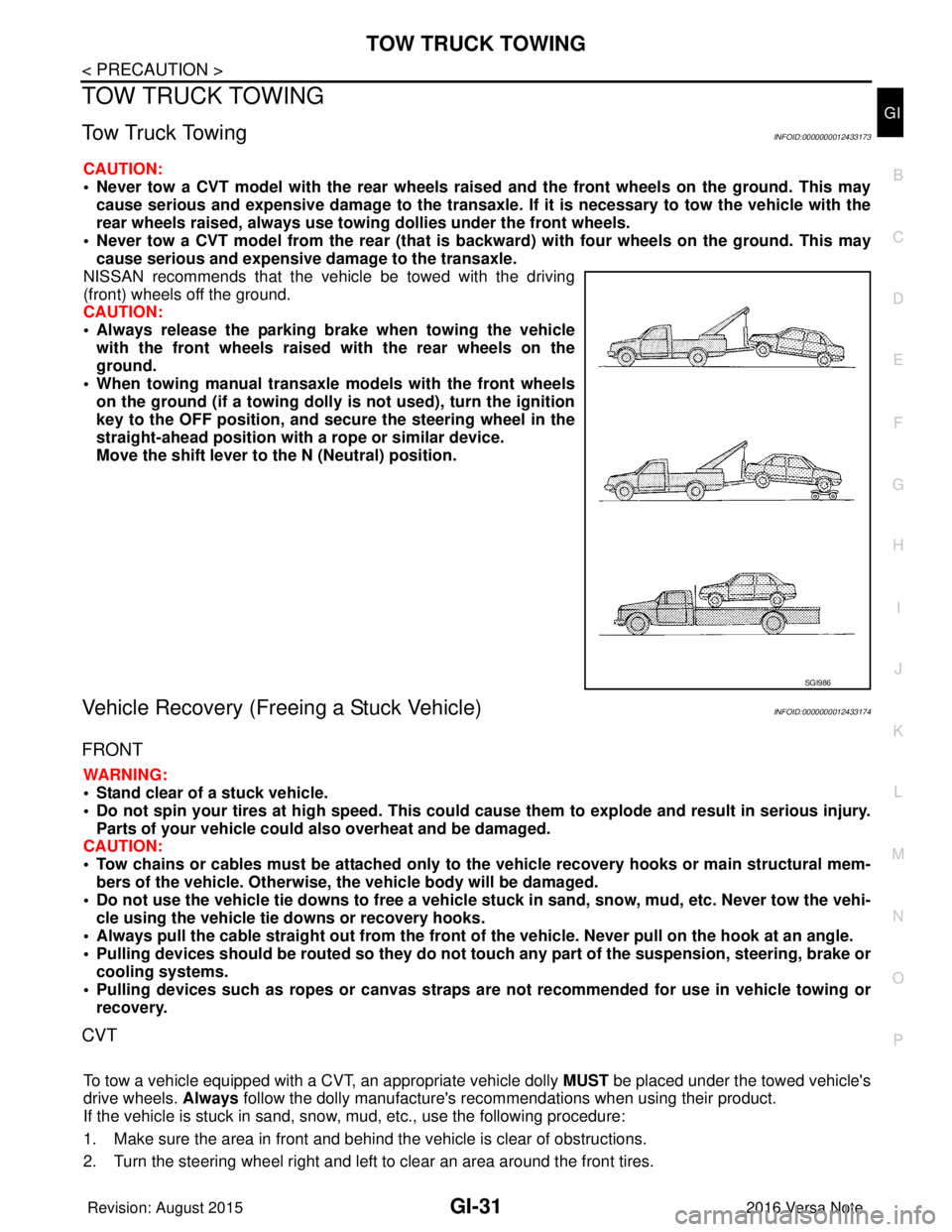
NISSAN recommends that the vehicle be towed with the driving
(front) wheels off the ground.
CAUTION:
• Always release the parking br ake when towing the vehicle
with the front wheels raised with the rear wheels on the
ground.
• When towing manual transaxle models with the front wheels on the ground (if a towing dolly is not used), turn the ignition
key to the OFF position, and secu re the steering wheel in the
straight-ahead position with a rope or similar device.
Move the shift lever to th e N (Neutral) position.
Vehicle Recovery (Freeing a Stuck Vehicle)INFOID:0000000012433174
FRONT
WARNING:
• Stand clear of a stuck vehicle.
• Do not spin your tires at high speed. This could cause them to explode and result in serious injury.
Parts of your vehicle could also overheat and be damaged.
CAUTION:
• Tow chains or cables must be attached only to the vehicle recovery hooks or main structural mem-
bers of the vehicle. Otherwise, the vehicle body will be damaged.
• Do not use the vehicle tie downs to free a vehicle stuck in sand, snow, mud, etc. Never tow the vehi-
cle using the vehicle tie downs or recovery hooks.
• Always pull the cable straight out from the front of the vehicle. Never pull on the hook at an angle.
• Pulling devices should be routed so they do not touch any part of the suspension, steering, brake or
cooling systems.
• Pulling devices such as ropes or canvas straps ar e not recommended for use in vehicle towing or
recovery.
CVT
To tow a vehicle equipped with a CVT, an appropriate vehicle dolly MUST be placed under the towed vehicle's
drive wheels. Always follow the dolly manufacture's re commendations when using their product.
If the vehicle is stuck in sand, snow , mud, etc., use the following procedure:
1. Make sure the area in front and behind the vehicle is clear of obstructions.
2. Turn the steering wheel right and left to clear an area around the front tires.
SGI986
Revision: August 2015 2016 Versa Note
cardiagn.com