clutch NISSAN NOTE 2016 Service Service Manual
[x] Cancel search | Manufacturer: NISSAN, Model Year: 2016, Model line: NOTE, Model: NISSAN NOTE 2016Pages: 3641, PDF Size: 28.72 MB
Page 1175 of 3641
![NISSAN NOTE 2016 Service Service Manual EC-48
< SYSTEM DESCRIPTION >[HR16DE]
OPERATION
• TCS system is operated
When the ECM detects any of the following conditions, the ECM will cancel the cruise operation and inform
the driver by blinki](/img/5/57363/w960_57363-1174.png "NISSAN NOTE 2016 Service Service Manual EC-48
< SYSTEM DESCRIPTION >[HR16DE]
OPERATION
• TCS system is operated
When the ECM detects any of the following conditions, the ECM will cancel the cruise operation and inform
the driver by blinki")
EC-48
< SYSTEM DESCRIPTION >[HR16DE]
OPERATION
• TCS system is operated
When the ECM detects any of the following conditions, the ECM will cancel the cruise operation and inform
the driver by blinking indicator lamp.
• Engine coolant temperature is slightly higher than t
he normal operating temperature, CRUISE indicator may
blink slowly.
When the engine coolant temperature decreases to the normal operating temperature, CRUISE indicator will
stop blinking and the cruise operation will be able to work by pressing SET/ − switch or RES/+ switch.
• Malfunction for some self-diagnoses regarding AS CD control: SET indicator will blink quickly.
• Speed limiter MAIN switch is pressed.(Set speed is cleared.)
• ASCD MAIN switch is pressed.(Set speed is cleared.)
COAST OPERATION
When the COAST/SET switch is pressed during the cruise control driving, decrease vehicle set speed until the
switch is released. And then ASCD will keep the new set speed.
RESUME OPERATION
When the ACCEL/RES switch is pressed after cancel operation other than pressing MAIN switch is performed,
vehicle speed will return to last set speed. To resume vehicle set speed, vehicle condition must meet following
conditions.
• Brake pedal is released
• Clutch pedal is released (M/T models)
• Selector lever is in other than P and N positions (CVT models)
• Vehicle speed is greater than 38 km/h (24 MPH) and less than 144 km/h (90 MPH)
Revision: August 2015 2016 Versa Note
cardiagn.com
Page 1188 of 3641
![NISSAN NOTE 2016 Service Service Manual DIAGNOSIS SYSTEM (ECM)EC-61
< SYSTEM DESCRIPTION > [HR16DE]
C
D
E
F
G H
I
J
K L
M A
EC
NP
O
*: The items are the same as those of 1st trip freeze frame data.
DATA MONITOR MODE
NOTE:
• The following](/img/5/57363/w960_57363-1187.png "NISSAN NOTE 2016 Service Service Manual DIAGNOSIS SYSTEM (ECM)EC-61
< SYSTEM DESCRIPTION > [HR16DE]
C
D
E
F
G H
I
J
K L
M A
EC
NP
O
*: The items are the same as those of 1st trip freeze frame data.
DATA MONITOR MODE
NOTE:
• The following")
DIAGNOSIS SYSTEM (ECM)EC-61
< SYSTEM DESCRIPTION > [HR16DE]
C
D
E
F
G H
I
J
K L
M A
EC
NP
O
*: The items are the same as those of 1st trip freeze frame data.
DATA MONITOR MODE
NOTE:
• The following table includes information (items) inapplicable to this vehicle. For information (items) applica-
ble to this vehicle, refer to CONSULT display items.
• For reference values of the following items, refer to EC-71, "
Reference Value".
Monitored Item
Freeze frame data item* Description
Detected DTC The engine control component part/control system has a trouble code, it is displayed as PXXXX.
(Refer to
EC-87, "
DTCIndex".)
FUEL SYS-B1 • “Fuel injection system status” at the moment a malfunction is detected is displayed.
• One mode in the following is displayed.
Mode2: Open loop due to detected system malfunction
Mode3: Open loop due to driving conditions (power enrichment, deceleration enleanment)
Mode4: Closed loop - using oxygen sensor(s) as feedback for fuel control
Mode5: Open loop - has not yet satisfied condition to go to closed loop
FUEL SYS-B2
CAL/LD VALUE [%]
The calculated load value at the moment a malfunction is detected is displayed.
COOLANT TEMP [ °C] or [ °F] The engine coolant temperature at the moment a malfunction is detected is displayed.
L-FUEL TRM-B1 [%] • “Long-term fuel trim” at the moment a malfunction is detected is displayed.
• The long-term fuel trim indicates much more gradual feedback compensation to the base fuel schedule than short-term fuel trim.
L-FUEL TRM-B2 [%]
S-FUEL TRM-B1 [%]
• “Short-term fuel trim” at the moment a malfunction is detected is displayed.
• The short-term fuel trim indicates dynamic or instantaneous feedback compensation to the base fuel schedule.
S-FUEL TRM-B2 [%]
ENGINE SPEED [rpm]
The engine speed at the moment a malfunction is detected is displayed.
VEHICL SPEED [km/h] or [mph] The vehicle speed at the moment a malfunction is detected is displayed.
ABSOL TH·P/S [%] The throttle valve opening angle at the moment a malfunct ion is detected is displayed.
B/FUEL SCHDL [msec] The base fuel schedule at the moment a malfunction is detected is displayed.
INT/A TEMP SE [° C] or [°F] The intake air temperature at the moment a malfunction is detected is displayed.
INT MANI PRES [kPa] These items are displayed but are not applicable to this model.
COMBUST CONDITION
Monitored item Unit DescriptionRemarks
IDLE REQUEST* YES/NO • Displays the idle request status sent from HPCM.
- YES: Idle request received
- NO: No idle request
MIL ON REQUEST* YES/NO • Displays the MIL ON request status sent from
HPCM.
- YES: MIL ON request received
- NO: No MIL ON request
ENGINE NO-LOAD* YES/NO • Displays the clutch 1 disengagement/engage-
ment status sent from HPCM.
- YES: Clutch 1 disengaged
- NO: Clutch 1 engaged
READY STATE* YES/NO • Displays the clutch 1 disengagement/engage-
ment status sent from HPCM.
- YES: READY state
- NO: Not in READY state
ENG SPEED rpmIndicates the engine speed computed from the sig-
nal of the crankshaft position sensor (POS) and
camshaft position sensor (PHASE). • Accuracy becomes poor if engine
speed drops below the idle rpm.
• If the signal is interrupted while the
engine is running, an abnormal value
may be indicated.
Revision: August 2015 2016 Versa Note
cardiagn.com
Page 1192 of 3641
![NISSAN NOTE 2016 Service Service Manual DIAGNOSIS SYSTEM (ECM)EC-65
< SYSTEM DESCRIPTION > [HR16DE]
C
D
E
F
G H
I
J
K L
M A
EC
NP
O
CRUISE LAMP ON/OFF
Indicates [ON/OFF] cond
ition of CRUISE lamp de-
termined by the ECM according to the inp](/img/5/57363/w960_57363-1191.png "NISSAN NOTE 2016 Service Service Manual DIAGNOSIS SYSTEM (ECM)EC-65
< SYSTEM DESCRIPTION > [HR16DE]
C
D
E
F
G H
I
J
K L
M A
EC
NP
O
CRUISE LAMP ON/OFF
Indicates [ON/OFF] cond
ition of CRUISE lamp de-
termined by the ECM according to the inp")
DIAGNOSIS SYSTEM (ECM)EC-65
< SYSTEM DESCRIPTION > [HR16DE]
C
D
E
F
G H
I
J
K L
M A
EC
NP
O
CRUISE LAMP ON/OFF
Indicates [ON/OFF] cond
ition of CRUISE lamp de-
termined by the ECM according to the input signals.
SET LAMP* ON/OFFIndicates [ON/OFF] condition of SET lamp deter-
mined by the ECM according to the input signals.
ALT DUTY %Indicates the duty ratio of the power generation
command value. The ratio is calculated by ECM
based on the battery current sensor signal.
BAT CUR SEN mVThe signal voltage of battery current sensor is dis-
played.
A/F ADJ-B1 —Indicates the correction of a factor stored in ECM.
The factor is calculated from the difference between
the target air-fuel ratio stored in ECM and the air-
fuel ratio calculated from A/F sensor 1 signal.
P/N POSI SW ON/OFFIndicates [ON/OFF] condition from the park/neutral
position (PNP) signal.
INT/A TEMP SE °C or ° F The intake air temperature (determined by the sig-
nal voltage of the intake air temperature sensor) is
indicated.
AC PRESS SEN VThe signal voltage from the refrigerant pressure
sensor is displayed.
CLUTCH P/P SW ON/OFF Indicates [ON/OFF] condition clutch pedal position
switch signals. Models other than M/T models always
display OFF.
VTC DTY EX B1 %• The control value of the exhaust valve timing con-
trol solenoid valve (determined by ECM accord-
ing to the input signals) is indicated.
• The advance angle becomes larger as the value
increases.
THRTL STK CNT
B1* ——
EVAP LEAK DIAG YET/CMPLT • Indicates the condition of EVAP leak diagnosis.
YET: EVAP leak diagnosis has not been per-
formed yet.
CMPLT: EVAP leak diagnosis has been per-
formed successfully.
EVAP DIAG READY ON/OFF • Indicates the ready condition of EVAP leak diag-
nosis.
ON: Diagnosis has been ready condition.
OFF: Diagnosis has not been ready condition.
A/F SEN1
DIAG1(B1) INCMP/CM-
PLT • Indicates DTC P015A or P015B self-diagnosis
condition.
- INCMP: Self-diagnosis is incomplete.
- CMPLT: Self-diagnosis is complete.
A/F SEN1
DIAG2(B1) INCMP/CM-
PLT • Indicates DTC P014C or P014D self-diagnosis
condition.
- INCMP: Self-diagnosis is incomplete.
- CMPLT: Self-diagnosis is complete.
A/F SEN1
DIAG3(B1) ABSNT/
PRSNT • Indicates DTC P014C, P014D, P015A or P015B
self-diagnosis condition.
- ABSNT: The vehicle condition is not within the di- agnosis range.
- PRSNT: The vehicle condition is within the diag-
nosis range.
HO2 S2 DIAG2(B1) INCMP/CM-
PLT • Indicates DTC P0139 self-diagnosis (slow re-
sponse) condition.
- INCMP: Self-diagnosis is incomplete.
- CMPLT: Self-diagnosis is complete.
EOP SENSOR mV The signal voltage of EOP sensor is displayed.
Monitored item Unit
DescriptionRemarks
Revision: August 2015 2016 Versa Note
cardiagn.com
Page 1201 of 3641
![NISSAN NOTE 2016 Service Service Manual EC-74
< ECU DIAGNOSIS INFORMATION >[HR16DE]
ECM
RESUME/ACC SW • Ignition switch: ONACCEL/RES switch: Pressed ON
ACCEL/RES switch: Released
OFF
SET SW • Ignition switch: ON COAST/SET switch: Presse](/img/5/57363/w960_57363-1200.png "NISSAN NOTE 2016 Service Service Manual EC-74
< ECU DIAGNOSIS INFORMATION >[HR16DE]
ECM
RESUME/ACC SW • Ignition switch: ONACCEL/RES switch: Pressed ON
ACCEL/RES switch: Released
OFF
SET SW • Ignition switch: ON COAST/SET switch: Presse")
EC-74
< ECU DIAGNOSIS INFORMATION >[HR16DE]
ECM
RESUME/ACC SW • Ignition switch: ONACCEL/RES switch: Pressed ON
ACCEL/RES switch: Released
OFF
SET SW • Ignition switch: ON COAST/SET switch: Pressed
ON
COAST/SET switch: Released OFF
BRAKE SW1
(ASCD brake switch) • Ignition switch: ON Brake pedal: Fully released
ON
Brake pedal: Slightly depressed OFF
BRAKE SW2
(Stop lamp switch) • Ignition switch: ON Brake pedal: Fully released
OFF
Brake pedal: Slightly depressed ON
VHCL SPD CUT • Ignition switch: ON NON
LO SPEED CUT • Ignition switch: ON NON
AT OD MONITOR • Ignition switch: ON OFF
AT OD CANCEL • Ignition switch: ON OFF
CRUISE LAMP • Ignition switch: ON MAIN switch: Pressed at the 1st time
→ at
the 2nd time ON
→ OFF
SET LAMP NOTE:
The item is indicated, but not used.
ALT DUTY • Engine: Idle 0 - 80%
BAT CUR SEN • Engine speed: Idle
• Battery: Fully charged
• Selector lever position: P or
N (CVT) or Neutral (M/T)
• Air conditioner switch: OFF
•No load Approx 2,500 - 3,500 mV
A/F ADJ-B1 • Engine running −0.330 - 0.330
P/N POSI SW • Ignition switch: ON Selector lever position: P or N (CVT) or
Neutral (M/T)
ON
Shift lever: Except above OFF
INT/A TEMP SE • Ignition switch: ON Indicates intake air tempera-
ture
AC PRESS SEN • Engine: Idle
• Both A/C switch and blower fan switch: ON (Compressor operates.) 1.0 - 4.0 V
CLUTCH P/P SW • Ignition switch: ON Clutch pedal: Fully released
OFF
Clutch pedal: Fully depressed ON
VTC DTY EX B1 • Engine: After warming up
• Selector lever position: P or N
(CVT) or Neutral (M/T)
• Air conditioner switch: OFF
•No load Idle
0% - 2%
2,000 rpm Approx. 0% - 90%
THRTL STK CNT B1 NOTE:
The item is indicated, but not used.
EVAP LEAK DIAG • Ignition switch: ON Depending on condition of
EVAP leak diagnosis
EVAP DIAG READY • Ignition switch: ON (READY) Depending on ready condi-
tion of EVAP leak diagnosis
A/F SEN1
DIAG1(B1) • DTC P015A and P015B self-diagnosis is incomplete.
INCMP
• DTC P015A and P015B self-diagnosis is complete. CMPLT
A/F SEN1
DIAG2(B1) • DTC P014C and P014D self-diagnosis is incomplete.
INCMP
• DTC P014C and P014D self-diagnosis is complete. CMPLT
Monitor Item
Condition Values/Status
Revision: August 2015 2016 Versa Note
cardiagn.com
Page 1209 of 3641
![NISSAN NOTE 2016 Service Service Manual EC-82
< ECU DIAGNOSIS INFORMATION >[HR16DE]
ECM
77
(P/W) 108
(B) Exhaust valve timing control
solenoid valve
Output[Engine is running]
• Warm-up condition
• Idle speed
BATTERY VOLTAGE
(11 - 14 V](/img/5/57363/w960_57363-1208.png "NISSAN NOTE 2016 Service Service Manual EC-82
< ECU DIAGNOSIS INFORMATION >[HR16DE]
ECM
77
(P/W) 108
(B) Exhaust valve timing control
solenoid valve
Output[Engine is running]
• Warm-up condition
• Idle speed
BATTERY VOLTAGE
(11 - 14 V")
EC-82
< ECU DIAGNOSIS INFORMATION >[HR16DE]
ECM
77
(P/W) 108
(B) Exhaust valve timing control
solenoid valve
Output[Engine is running]
• Warm-up condition
• Idle speed
BATTERY VOLTAGE
(11 - 14 V)
[Engine is running]
• Warm-up condition
• When revving engine up to 2,000rpm quickly 7 - 10 V
78
(BR) 63
(W) Sensor power supply
(Camshaft position sensor)
— [Ignition switch: ON]
5 V
81
(V) 108
(B) Power supply for ECM
(Back-up)
Input [Ignition switch: OFF]
BATTERY VOLTAGE
(11 - 14 V)
83
(P) —CAN-L Input/
Output ——
84
(L) —CAN-H Input/
Output ——
85
(V) 98
(LG) Refrigerant pressure sensor Input [Engine is running]
• Warm-up condition
• Both A/C switch and blower fan
switch: ON (Compressor oper-
ates) 1.0 - 4.0 V
88
(GR) — Data link connector
Input/
Output ——
92
(R) — Clutch pedal position switch Input [Ignition switch: ON]
• Clutch pedal: Fully released
0 V
[Ignition switch: ON]
• Clutch pedal: Fully depressed BATTERY VOLTAGE
(11 - 14 V)
93
(L) 108
(B) Ignition switch
Input[Ignition switch: OFF]
0 V
[Ignition switch: ON] BATTERY VOLTAGE
(11 - 14 V)
94
(Y) 95
(B) ASCD steering switch Input [Ignition switch: ON]
• ASCD steering switch: OFF
4 V
[Ignition switch: ON]
• MAIN switch: Pressed 0 V
[Ignition switch: ON]
• CANCEL switch: Pressed 1 V
[Ignition switch: ON]
• ACCEL/RES switch: Pressed 3 V
[Ignition switch: ON]
• COAST/SET switch: Pressed 2 V
95
(B) —
Sensor ground
(AS
CD steering
switch) ——
—
98
(LG) —Se
nsor ground
(Refrigerant pressure sen-
sor) ——
—
99
(LG) 108
(B) Stop lamp switch
Input[Ignition switch: OFF]
• Brake pedal: Fully released
0 V
[Ignition switch: OFF]
• Brake pedal: Slightly depressed BATTERY VOLTAGE
(11 - 14 V)
Terminal No.
Description
ConditionVa l u e
(Approx.)
+ – Signal nameInput/
Output
JSBIA0720GB
Revision: August 2015 2016 Versa Note
cardiagn.com
Page 1566 of 3641
![NISSAN NOTE 2016 Service Service Manual CLUTCH PEDAL POSITION SWITCHEC-439
< DTC/CIRCUIT DIAGNOSIS > [HR16DE]
C
D
E
F
G H
I
J
K L
M A
EC
NP
O
CLUTCH PEDAL POSITION SWITCH
Component Function CheckINFOID:0000000012431638
1.CHECK CLUTCH PEDAL](/img/5/57363/w960_57363-1565.png "NISSAN NOTE 2016 Service Service Manual CLUTCH PEDAL POSITION SWITCHEC-439
< DTC/CIRCUIT DIAGNOSIS > [HR16DE]
C
D
E
F
G H
I
J
K L
M A
EC
NP
O
CLUTCH PEDAL POSITION SWITCH
Component Function CheckINFOID:0000000012431638
1.CHECK CLUTCH PEDAL")
CLUTCH PEDAL POSITION SWITCHEC-439
< DTC/CIRCUIT DIAGNOSIS > [HR16DE]
C
D
E
F
G H
I
J
K L
M A
EC
NP
O
CLUTCH PEDAL POSITION SWITCH
Component Function CheckINFOID:0000000012431638
1.CHECK CLUTCH PEDAL PO
SITION SWITCH FUNCTION
With CONSULT
1. Turn ignition switch ON.
2. Select “ENGINE” using CONSULT.
3. Select “CLUTCH P/P SW” in “DATA MONITOR” mode.
4. Check “CLUTCH P/P SW” indication under the following conditions.
Without CONSULT
1. Turn ignition switch ON.
2. Check the voltage between ECM harness connector and ground.
Is the inspection result normal?
YES >> INSPECTION END
NO >> Go to EC-439, "
Diagnosis Procedure".
Diagnosis ProcedureINFOID:0000000012431639
1.CHECK CLUTCH PEDAL POSI TION SWITCH GROUND CIRCUIT FOR OPEN AND SHORT
1. Turn ignition switch OFF.
2. Disconnect clutch pedal position switch harness connector.
3. Check the continuity between clutch pedal position switch harness connector and ground.
4. Also check harness for short to power.
Is the inspection result normal?
YES >> GO TO 2.
NO >> Repair open circuit or short to power in harness or connectors.
2.CHECK CLUTCH PEDAL POSITI ON SWITCH INPUT SIGNAL CIRCUIT FOR OPEN AND SHORT
1. Disconnect ECM harness connector.
2. Check the continuity between clutch pedal posit ion switch harness connector and ECM harness connec-
tor.
3. Also check harness for short to ground and short to power.
Monitor item ConditionIndication
CLUTCH P/P SW Clutch pedal Fully released OFF
Fully depressed ON
ECM ConditionVoltage
+–
Connector TerminalConnector Terminal
E16 92
(Clutch pedal position switch signal) E16 108 Clutch pedalFully released Approx. 0V
Fully depressed Battery voltage
Clutch pedal position switch
Ground Continuity
Connector Terminal
E48 4Ground Existed
Clutch pedal position switch ECM
Continuity
Connector Terminal Connector Terminal
E48 3 E16 92 Existed
Revision: August 2015 2016 Versa Note
cardiagn.com
Page 1567 of 3641
![NISSAN NOTE 2016 Service Service Manual EC-440
< DTC/CIRCUIT DIAGNOSIS >[HR16DE]
CLUTCH PEDAL POSITION SWITCH
Is the inspection result normal?
YES >> GO TO 3.
NO >> Repair open circuit or short to ground or short to power in harness or conn](/img/5/57363/w960_57363-1566.png "NISSAN NOTE 2016 Service Service Manual EC-440
< DTC/CIRCUIT DIAGNOSIS >[HR16DE]
CLUTCH PEDAL POSITION SWITCH
Is the inspection result normal?
YES >> GO TO 3.
NO >> Repair open circuit or short to ground or short to power in harness or conn")
EC-440
< DTC/CIRCUIT DIAGNOSIS >[HR16DE]
CLUTCH PEDAL POSITION SWITCH
Is the inspection result normal?
YES >> GO TO 3.
NO >> Repair open circuit or short to ground or short to power in harness or connectors.
3.CHECK CLUTCH PEDAL POSITION SWITCH
Refer to EC-440, "
Component Inspection (Clutch Pedal Position Switch)".
Is the inspection result normal?
YES >> GO TO 4.
NO >> Replace clutch pedal position switch. Refer to CL-11, "
Exploded View".
4.CHECK INTERMITTENT INCIDENT
Refer to GI-42, "
Intermittent Incident".
>> INSPECTION END
Component Inspection (Clutc h Pedal Position Switch)INFOID:0000000012431640
1.CHECK CLUTCH PEDAL POSITION SWITCH-I
1. Turn ignition switch OFF.
2. Disconnect clutch pedal position switch harness connector.
3. Check the continuity between clutch pedal positi on switch terminals under the following conditions.
Is the inspection result normal?
YES >> INSPECTION END
NO >> GO TO 2.
2.CHECK CLUTCH PEDAL POSITION SWITCH-II
1. Adjust clutch pedal position switch installation. Refer to CL-12, "
Inspection and Adjustment".
2. Check the continuity between clutch pedal positi on switch terminals under the following conditions.
Is the inspection result normal?
YES >> INSPECTION END
NO >> Replace clutch pedal position switch. Refer to CL-11, "
Exploded View".
Clutch pedal position switch
ConditionContinuity
Connector Terminals
E48 3 and 4Clutch
pedalFully released Existed
Fully depressed Not existed
Clutch pedal position switch
ConditionContinuity
Connector Terminals
E48 3 and 4Clutch
pedalFully released Existed
Fully depressed Not existed
Revision: August 2015
2016 Versa Note
cardiagn.com
Page 1672 of 3641
EXL-20
< SYSTEM DESCRIPTION >
DIAGNOSIS SYSTEM (IPDM E/R)
DIAGNOSIS SYSTEM (IPDM E/R)
Diagnosis DescriptionINFOID:0000000012542316
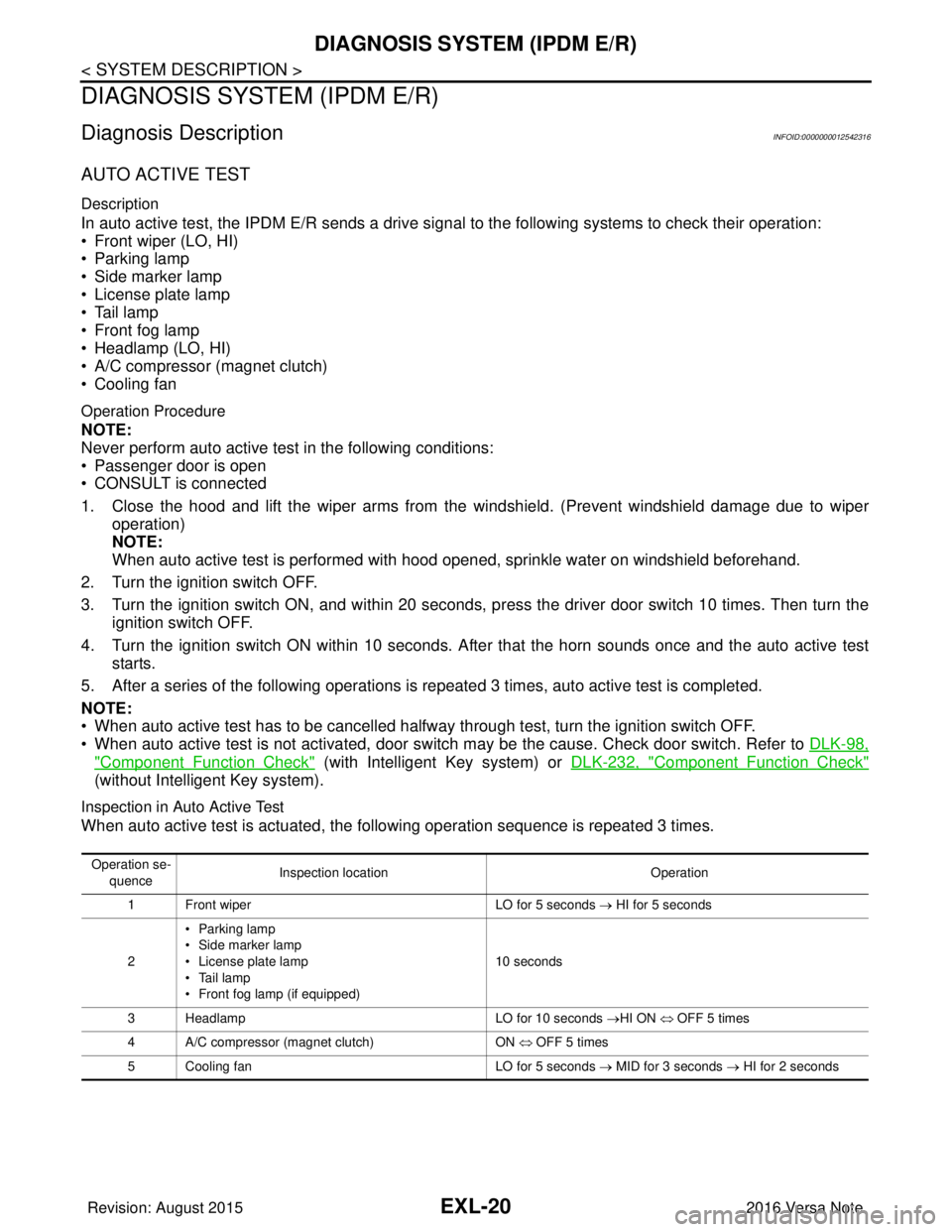
AUTO ACTIVE TEST
Description
In auto active test, the IPDM E/R sends a drive signal to the following systems to check their operation:
• Front wiper (LO, HI)
• Parking lamp
• Side marker lamp
• License plate lamp
• Tail lamp
• Front fog lamp
• Headlamp (LO, HI)
• A/C compressor (magnet clutch)
• Cooling fan
Operation Procedure
NOTE:
Never perform auto active test in the following conditions:
• Passenger door is open
• CONSULT is connected
1. Close the hood and lift the wiper arms from the windshield. (Prevent windshield damage due to wiper
operation)
NOTE:
When auto active test is performed with hood opened, sprinkle water on windshield beforehand.
2. Turn the ignition switch OFF.
3. Turn the ignition switch ON, and within 20 seconds, pr ess the driver door switch 10 times. Then turn the
ignition switch OFF.
4. Turn the ignition switch ON within 10 seconds. Af ter that the horn sounds once and the auto active test
starts.
5. After a series of the following operations is repeated 3 times, auto active test is completed.
NOTE:
• When auto active test has to be cancelled halfw ay through test, turn the ignition switch OFF.
• When auto active test is not activated, door swit ch may be the cause. Check door switch. Refer to DLK-98,
"ComponentFunctionCheck" (with Intelligent Key system) or DLK-232, "ComponentFunctionCheck"
(without Intelligent Key system).
Inspection in Auto Active Test
When auto active test is actuated, the following operation sequence is repeated 3 times.
Operation se-
quence Inspection location
Operation
1 Front wiper LO for 5 seconds → HI for 5 seconds
2 •Parking lamp
• Side marker lamp
• License plate lamp
• Tail lamp
• Front fog lamp (if equipped) 10 seconds
3 Headlamp LO for 10 seconds →HI ON ⇔ OFF 5 times
4 A/C compressor (magnet clutch) ON ⇔ OFF 5 times
5 Cooling fan LO for 5 seconds → MID for 3 seconds → HI for 2 seconds
Revision: August 2015 2016 Versa Note
cardiagn.com
Page 1673 of 3641
DIAGNOSIS SYSTEM (IPDM E/R)EXL-21
< SYSTEM DESCRIPTION >
C
DE
F
G H
I
J
K
M A
B
EXL
N
O P
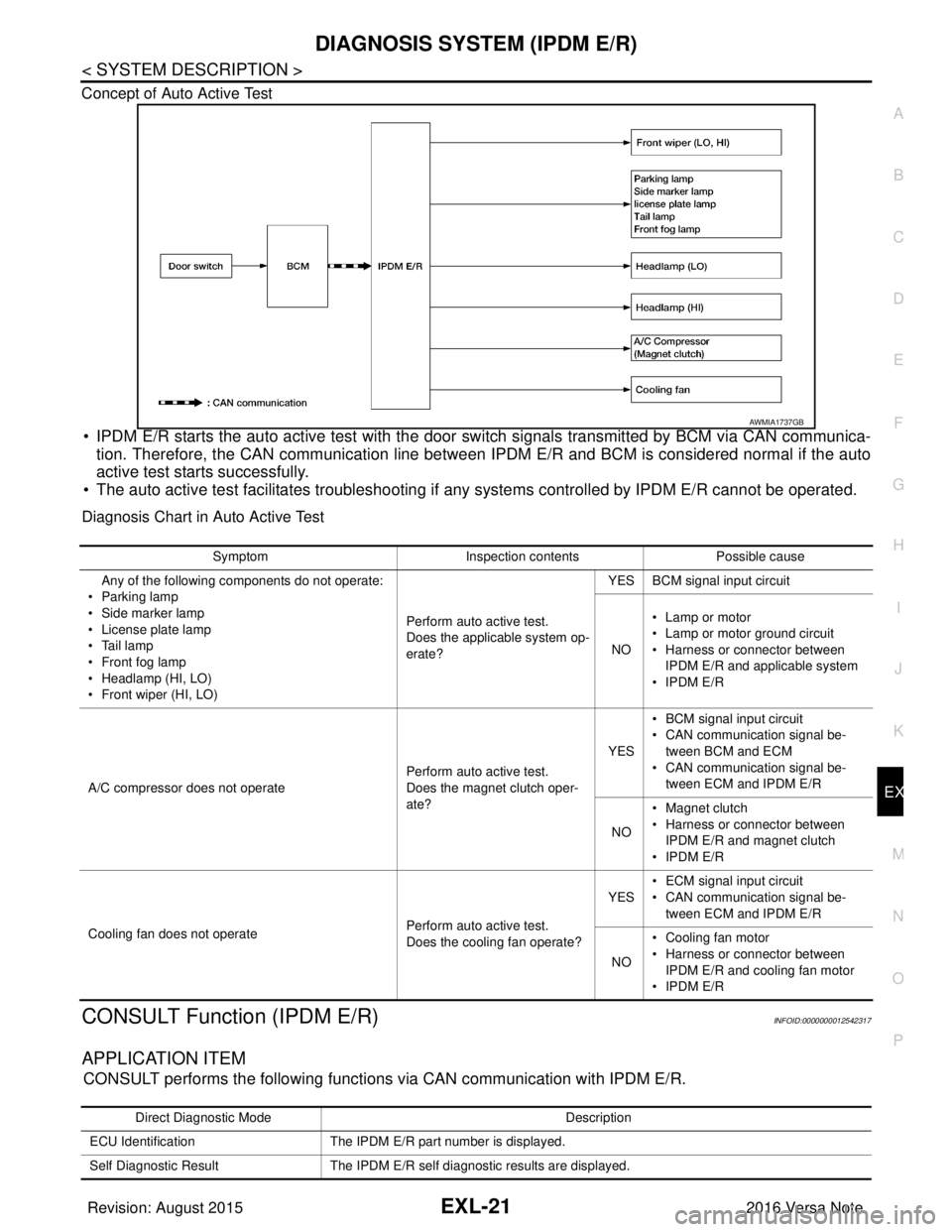
Concept of Auto Active Test
• IPDM E/R starts the auto active test with the door
switch signals transmitted by BCM via CAN communica-
tion. Therefore, the CAN communication line between IPDM E/R and BCM is considered normal if the auto
active test starts successfully.
• The auto active test facilitates troubleshooting if any systems controlled by IPDM E/R cannot be operated.
Diagnosis Chart in Auto Active Test
CONSULT Function (IPDM E/R)INFOID:0000000012542317
APPLICATION ITEM
CONSULT performs the following functions via CAN communication with IPDM E/R.
AWMIA1737GB
SymptomInspection contentsPossible cause
Any of the following components do not operate:
•Parking lamp
• Side marker lamp
• License plate lamp
•Tail lamp
•Front fog lamp
• Headlamp (HI, LO)
• Front wiper (HI, LO) Perform auto active test.
Does the applicable system op-
erate?YES BCM signal input circuit
NO • Lamp or motor
• Lamp or motor ground circuit
• Harness or connector between
IPDM E/R and applicable system
•IPDM E/R
A/C compressor does not operate Perform auto active test.
Does the magnet clutch oper-
ate?YES
• BCM signal input circuit
• CAN communication signal be-
tween BCM and ECM
• CAN communication signal be-
tween ECM and IPDM E/R
NO • Magnet clutch
• Harness or connector between
IPDM E/R and magnet clutch
•IPDM E/R
Cooling fan does not operate Perform auto active test.
Does the cooling fan operate?YES
• ECM signal input circuit
• CAN communication signal be-
tween ECM and IPDM E/R
NO • Cooling fan motor
• Harness or connector between
IPDM E/R and cooling fan motor
•IPDM E/R
Direct Diagnostic Mode Description
ECU Identification The IPDM E/R part number is displayed.
Self Diagnostic Result The IPDM E/R self diagnostic results are displayed.
Revision: August 2015 2016 Versa Note
cardiagn.com
Page 1785 of 3641
EXT-18
< SYMPTOM DIAGNOSIS >
SQUEAK AND RATTLE TROUBLE DIAGNOSES
If possible, drive the vehicle with the customer until the noise is duplicated. Note any additional information on
the Diagnostic Worksheet regarding the conditions or lo cation of the noise. This information can be used to
duplicate the same conditions when you confirm the repair.
If the noise can be duplicated easily during the test drive, to help identify the source of the noise, try to dupli-
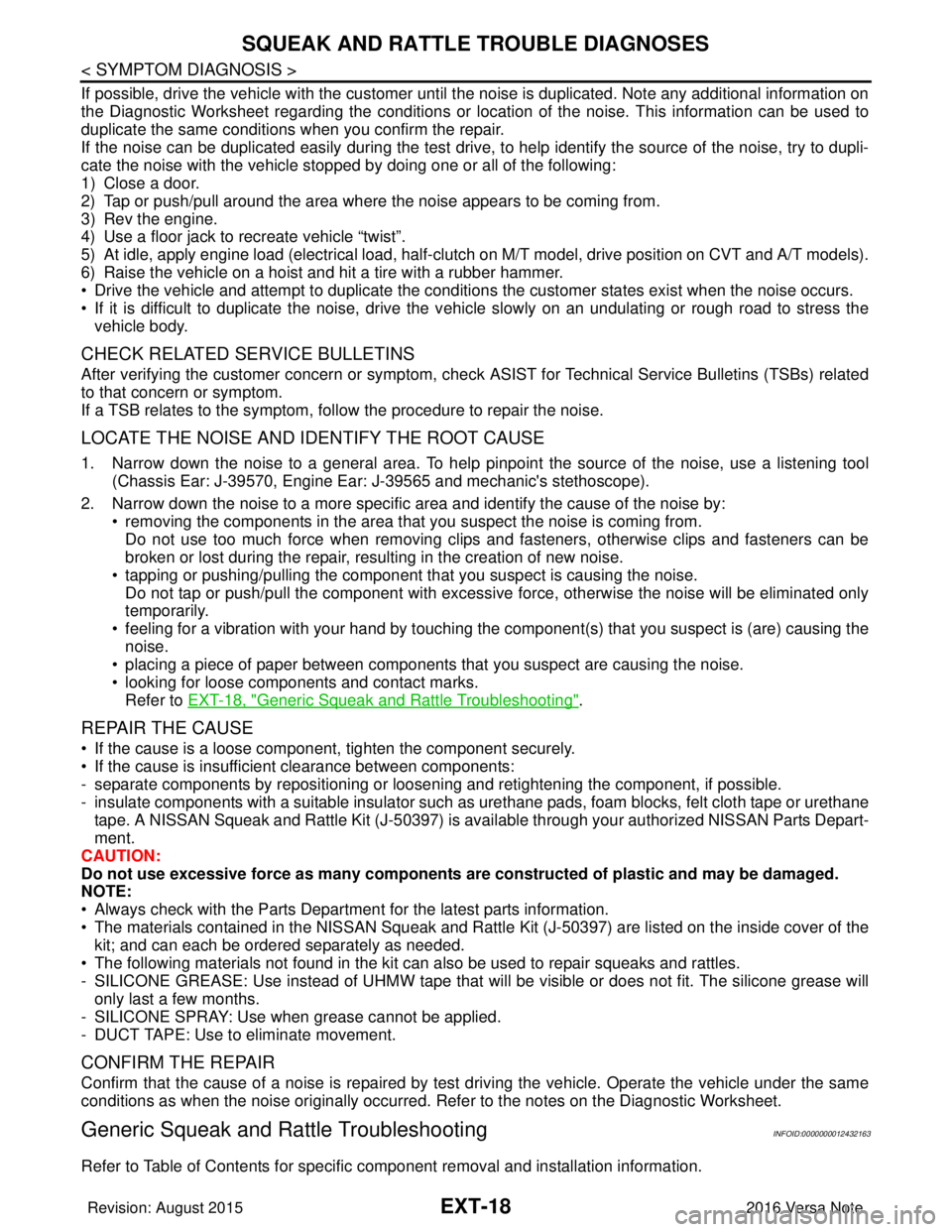
cate the noise with the vehicle stopped by doing one or all of the following:
1) Close a door.
2) Tap or push/pull around the area where the noise appears to be coming from.
3) Rev the engine.
4) Use a floor jack to recreate vehicle “twist”.
5) At idle, apply engine load (electrical load, half-clutch on M/T model, drive position on CVT and A/T models).
6) Raise the vehicle on a hoist and hit a tire with a rubber hammer.
• Drive the vehicle and attempt to duplicate the conditions the customer states exist when the noise occurs.
• If it is difficult to duplicate the noise, drive the v ehicle slowly on an undulating or rough road to stress the
vehicle body.
CHECK RELATED SERVICE BULLETINS
After verifying the customer concern or symptom, chec k ASIST for Technical Service Bulletins (TSBs) related
to that concern or symptom.
If a TSB relates to the symptom, follo w the procedure to repair the noise.
LOCATE THE NOISE AND IDENTIFY THE ROOT CAUSE
1. Narrow down the noise to a general area. To help pi npoint the source of the noise, use a listening tool
(Chassis Ear: J-39570, Engine Ear: J-39565 and mechanic's stethoscope).
2. Narrow down the noise to a more specific area and identify the cause of the noise by: • removing the components in the area that you suspect the noise is coming from.Do not use too much force when removing clips and fasteners, otherwise clips and fasteners can be
broken or lost during the repair, resulting in the creation of new noise.
• tapping or pushing/pulling the component that you suspect is causing the noise. Do not tap or push/pull the component with excessive force, otherwise the noise will be eliminated only
temporarily.
• feeling for a vibration with your hand by touching the component(s) that you suspec t is (are) causing the
noise.
• placing a piece of paper between components that you suspect are causing the noise.
• looking for loose components and contact marks.
Refer to EXT-18, "
Generic Squeak and Rattle Troubleshooting".
REPAIR THE CAUSE
• If the cause is a loose component, tighten the component securely.
• If the cause is insufficient clearance between components:
- separate components by repositioning or loos ening and retightening the component, if possible.
- insulate components with a suitable insulator such as urethane pads, foam blocks, felt cloth tape or urethane tape. A NISSAN Squeak and Rattle Kit (J-50397) is av ailable through your authorized NISSAN Parts Depart-
ment.
CAUTION:
Do not use excessive force as many components are constructed of plastic and may be damaged.
NOTE:
• Always check with the Parts Department for the latest parts information.
• The materials contained in the NISSAN Squeak and Rattle Kit (J-50397) are listed on the inside cover of the
kit; and can each be ordered separately as needed.
• The following materials not found in the kit can also be used to repair squeaks and rattles.
- SILICONE GREASE: Use instead of UHMW tape that will be visible or does not fit. The silicone grease will only last a few months.
- SILICONE SPRAY: Use when grease cannot be applied.
- DUCT TAPE: Use to eliminate movement.
CONFIRM THE REPAIR
Confirm that the cause of a noise is repaired by test driving the vehicle. Operate the vehicle under the same
conditions as when the noise originally occurred. Refer to the notes on the Diagnostic Worksheet.
Generic Squeak and Rattle TroubleshootingINFOID:0000000012432163
Refer to Table of Contents for specific component removal and installation information.
Revision: August 2015 2016 Versa Note
cardiagn.com