check engine NISSAN PRIMERA 1999 Electronic Repair Manual
[x] Cancel search | Manufacturer: NISSAN, Model Year: 1999, Model line: PRIMERA, Model: NISSAN PRIMERA 1999Pages: 2267, PDF Size: 35.74 MB
Page 658 of 2267
7) Start engine again and run it for at least 10 minutes at idle
speed.
8) Select ªMODE 7º with GST. The 1st trip DTC P0172 should be
detected at this stage, if a malfunction exists. If so, go to
ªDiagnostic Procedureº, EC-QG-218.
9) If it is difficult to start engine at step 8, the fuel injection sys-
tem has a malfunction.
10) Crank engine while depressing accelerator pedal.
If engine starts, go to ªDiagnostic Procedureº, EC-QG-218. If
engine does not start, remove ignition plugs and check for
fouling, etc.
DTC P0172 FUEL INJECTION SYSTEM FUNCTION
(RICH SIDE)QG16I18DE
DTC Confirmation Procedure (Cont'd)
EC-216
Page 660 of 2267
Diagnostic ProcedureNCEC0195
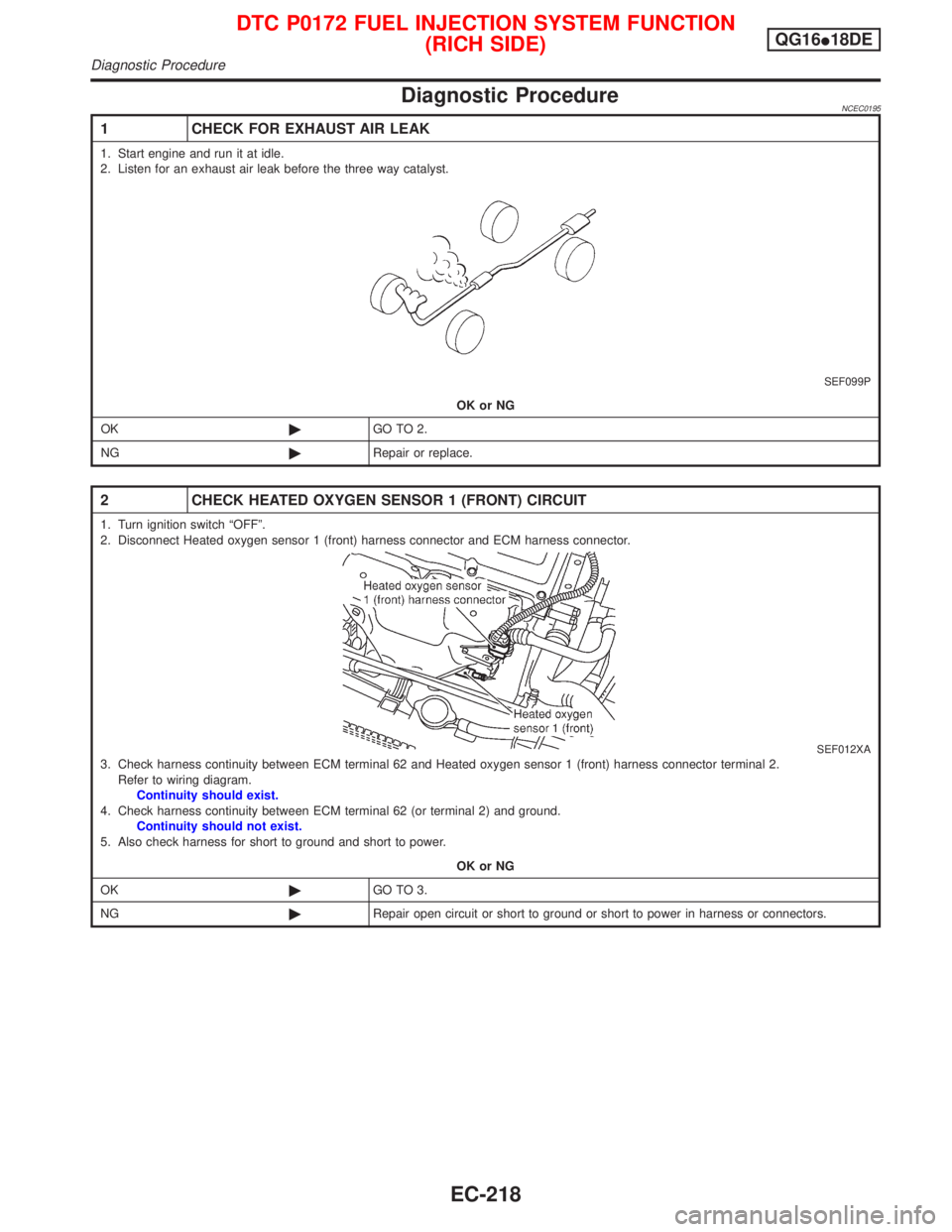
1 CHECK FOR EXHAUST AIR LEAK
1. Start engine and run it at idle.
2. Listen for an exhaust air leak before the three way catalyst.
SEF099P
OK or NG
OK©GO TO 2.
NG©Repair or replace.
2 CHECK HEATED OXYGEN SENSOR 1 (FRONT) CIRCUIT
1. Turn ignition switch ªOFFº.
2. Disconnect Heated oxygen sensor 1 (front) harness connector and ECM harness connector.
SEF012XA3. Check harness continuity between ECM terminal 62 and Heated oxygen sensor 1 (front) harness connector terminal 2.
Refer to wiring diagram.
Continuity should exist.
4. Check harness continuity between ECM terminal 62 (or terminal 2) and ground.
Continuity should not exist.
5. Also check harness for short to ground and short to power.
OK or NG
OK©GO TO 3.
NG©Repair open circuit or short to ground or short to power in harness or connectors.
DTC P0172 FUEL INJECTION SYSTEM FUNCTION
(RICH SIDE)QG16I18DE
Diagnostic Procedure
EC-218
Page 661 of 2267
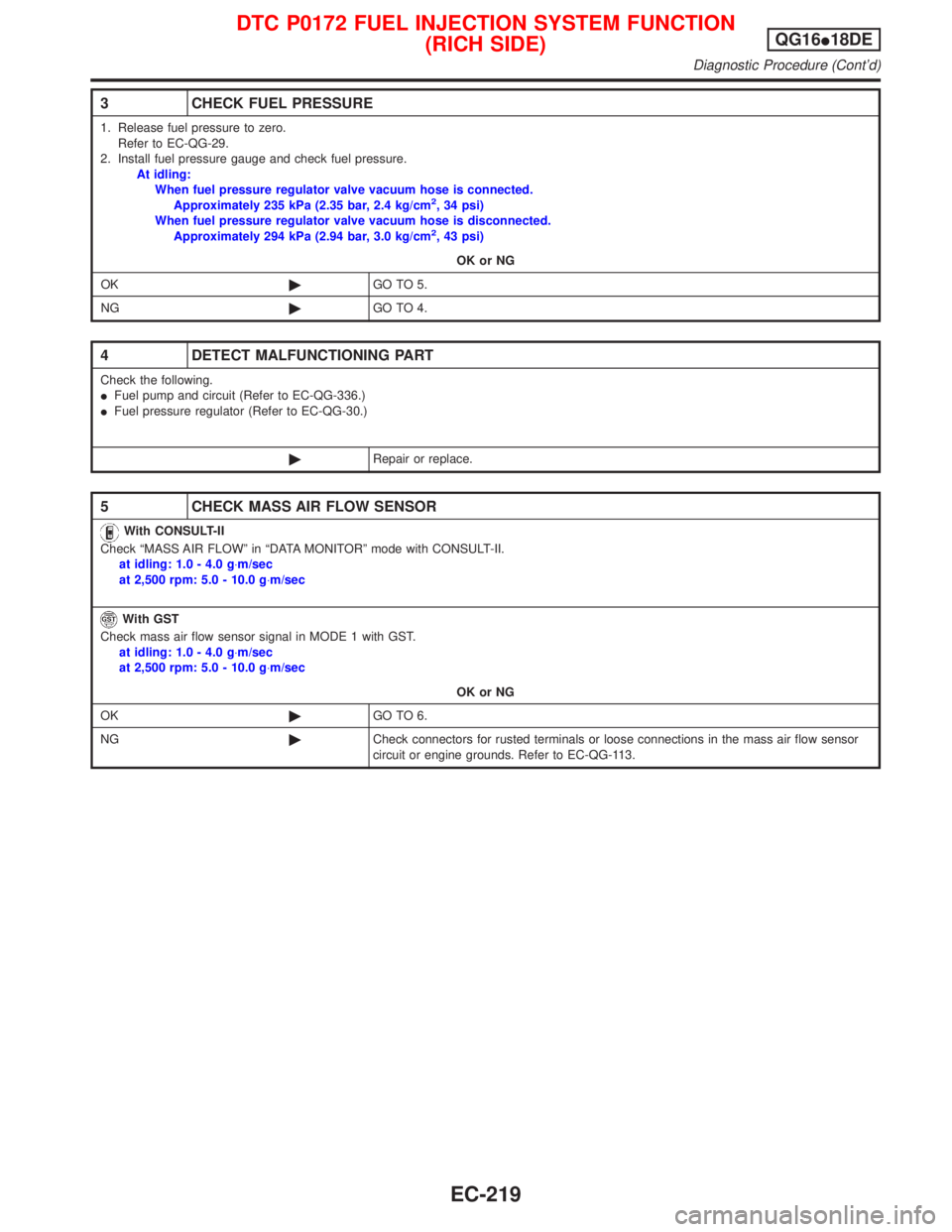
3 CHECK FUEL PRESSURE
1. Release fuel pressure to zero.
Refer to EC-QG-29.
2. Install fuel pressure gauge and check fuel pressure.
At idling:
When fuel pressure regulator valve vacuum hose is connected.
Approximately 235 kPa (2.35 bar, 2.4 kg/cm
2, 34 psi)
When fuel pressure regulator valve vacuum hose is disconnected.
Approximately 294 kPa (2.94 bar, 3.0 kg/cm
2, 43 psi)
OK or NG
OK©GO TO 5.
NG©GO TO 4.
4 DETECT MALFUNCTIONING PART
Check the following.
IFuel pump and circuit (Refer to EC-QG-336.)
IFuel pressure regulator (Refer to EC-QG-30.)
©Repair or replace.
5 CHECK MASS AIR FLOW SENSOR
With CONSULT-II
Check ªMASS AIR FLOWº in ªDATA MONITORº mode with CONSULT-II.
at idling: 1.0 - 4.0 g×m/sec
at 2,500 rpm: 5.0 - 10.0 g×m/sec
With GST
Check mass air flow sensor signal in MODE 1 with GST.
at idling: 1.0 - 4.0 g×m/sec
at 2,500 rpm: 5.0 - 10.0 g×m/sec
OK or NG
OK©GO TO 6.
NG©Check connectors for rusted terminals or loose connections in the mass air flow sensor
circuit or engine grounds. Refer to EC-QG-113.
DTC P0172 FUEL INJECTION SYSTEM FUNCTION
(RICH SIDE)QG16I18DE
Diagnostic Procedure (Cont'd)
EC-219
Page 662 of 2267
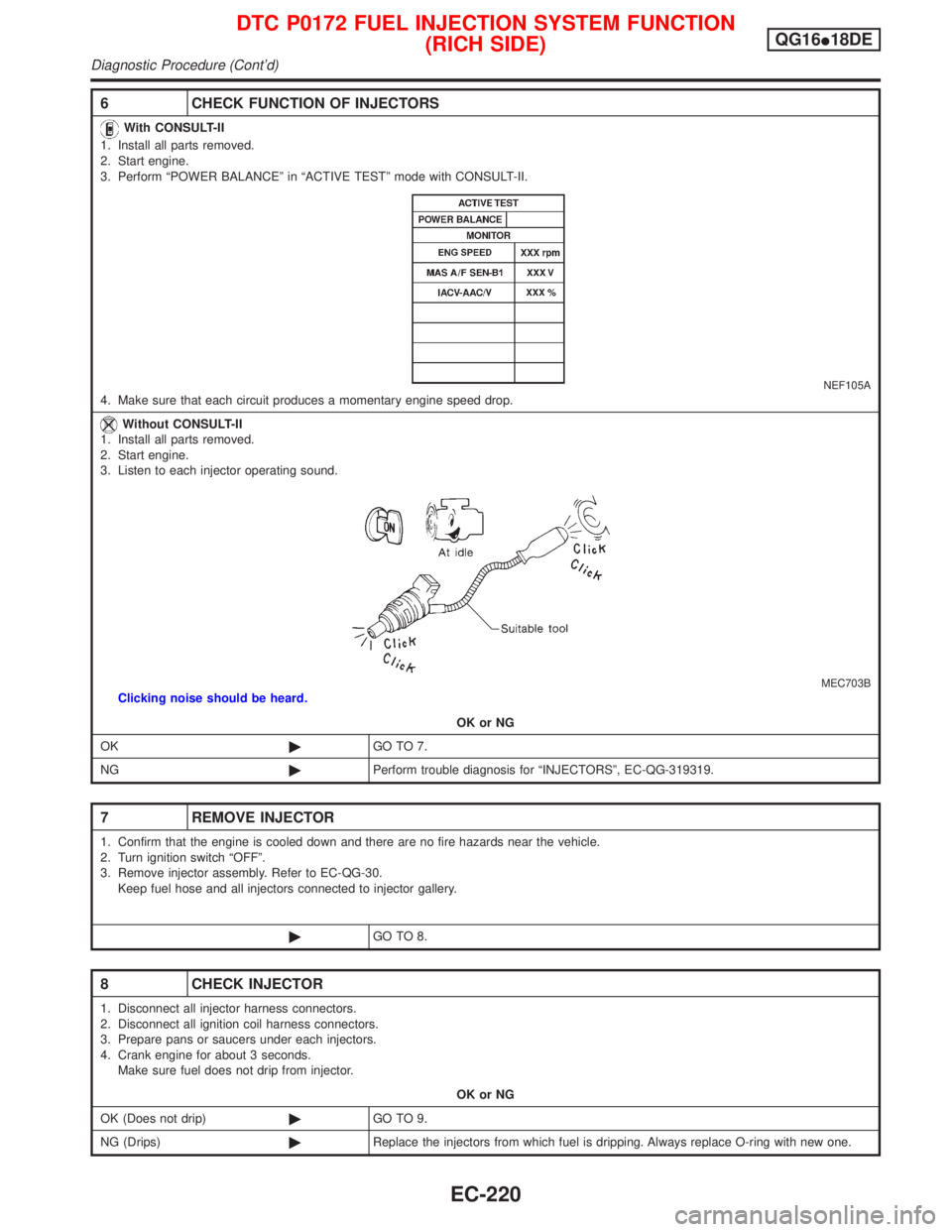
6 CHECK FUNCTION OF INJECTORS
With CONSULT-II
1. Install all parts removed.
2. Start engine.
3. Perform ªPOWER BALANCEº in ªACTIVE TESTº mode with CONSULT-II.
NEF105A4. Make sure that each circuit produces a momentary engine speed drop.
Without CONSULT-II
1. Install all parts removed.
2. Start engine.
3. Listen to each injector operating sound.
MEC703BClicking noise should be heard.
OK or NG
OK©GO TO 7.
NG©Perform trouble diagnosis for ªINJECTORSº, EC-QG-319319.
7 REMOVE INJECTOR
1. Confirm that the engine is cooled down and there are no fire hazards near the vehicle.
2. Turn ignition switch ªOFFº.
3. Remove injector assembly. Refer to EC-QG-30.
Keep fuel hose and all injectors connected to injector gallery.
©GO TO 8.
8 CHECK INJECTOR
1. Disconnect all injector harness connectors.
2. Disconnect all ignition coil harness connectors.
3. Prepare pans or saucers under each injectors.
4. Crank engine for about 3 seconds.
Make sure fuel does not drip from injector.
OK or NG
OK (Does not drip)©GO TO 9.
NG (Drips)©Replace the injectors from which fuel is dripping. Always replace O-ring with new one.
DTC P0172 FUEL INJECTION SYSTEM FUNCTION
(RICH SIDE)QG16I18DE
Diagnostic Procedure (Cont'd)
EC-220
Page 664 of 2267
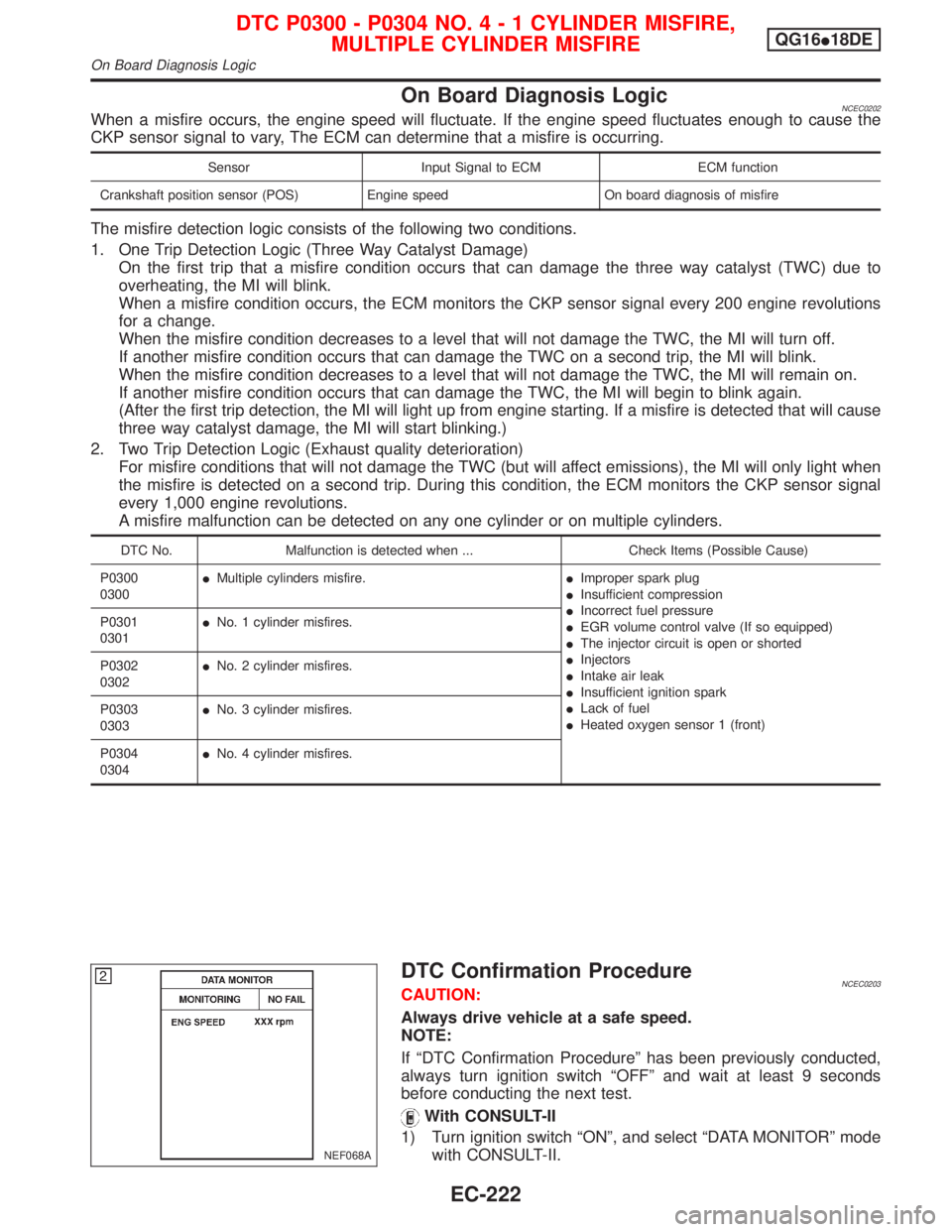
On Board Diagnosis LogicNCEC0202When a misfire occurs, the engine speed will fluctuate. If the engine speed fluctuates enough to cause the
CKP sensor signal to vary, The ECM can determine that a misfire is occurring.
Sensor Input Signal to ECM ECM function
Crankshaft position sensor (POS) Engine speed On board diagnosis of misfire
The misfire detection logic consists of the following two conditions.
1. One Trip Detection Logic (Three Way Catalyst Damage)
On the first trip that a misfire condition occurs that can damage the three way catalyst (TWC) due to
overheating, the MI will blink.
When a misfire condition occurs, the ECM monitors the CKP sensor signal every 200 engine revolutions
for a change.
When the misfire condition decreases to a level that will not damage the TWC, the MI will turn off.
If another misfire condition occurs that can damage the TWC on a second trip, the MI will blink.
When the misfire condition decreases to a level that will not damage the TWC, the MI will remain on.
If another misfire condition occurs that can damage the TWC, the MI will begin to blink again.
(After the first trip detection, the MI will light up from engine starting. If a misfire is detected that will cause
three way catalyst damage, the MI will start blinking.)
2. Two Trip Detection Logic (Exhaust quality deterioration)
For misfire conditions that will not damage the TWC (but will affect emissions), the MI will only light when
the misfire is detected on a second trip. During this condition, the ECM monitors the CKP sensor signal
every 1,000 engine revolutions.
A misfire malfunction can be detected on any one cylinder or on multiple cylinders.
DTC No. Malfunction is detected when ... Check Items (Possible Cause)
P0300
0300IMultiple cylinders misfire.IImproper spark plug
IInsufficient compression
IIncorrect fuel pressure
IEGR volume control valve (If so equipped)
IThe injector circuit is open or shorted
IInjectors
IIntake air leak
IInsufficient ignition spark
ILack of fuel
IHeated oxygen sensor 1 (front) P0301
0301INo. 1 cylinder misfires.
P0302
0302INo. 2 cylinder misfires.
P0303
0303INo. 3 cylinder misfires.
P0304
0304INo. 4 cylinder misfires.
DTC Confirmation ProcedureNCEC0203CAUTION:
Always drive vehicle at a safe speed.
NOTE:
If ªDTC Confirmation Procedureº has been previously conducted,
always turn ignition switch ªOFFº and wait at least 9 seconds
before conducting the next test.
With CONSULT-II
1) Turn ignition switch ªONº, and select ªDATA MONITORº mode
with CONSULT-II.
NEF068A
DTC P0300 - P0304 NO.4-1CYLINDER MISFIRE,
MULTIPLE CYLINDER MISFIREQG16I18DE
On Board Diagnosis Logic
EC-222
Page 665 of 2267
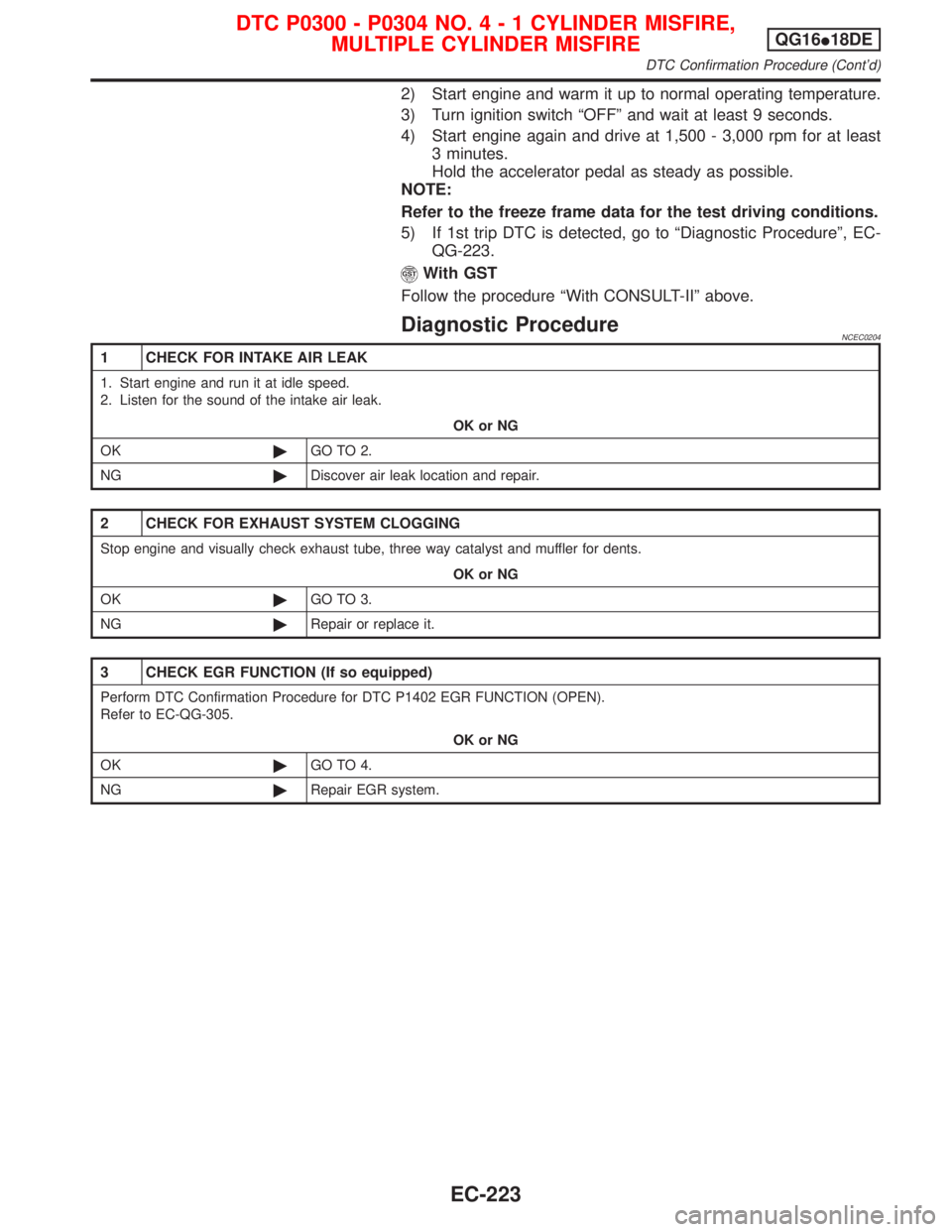
2) Start engine and warm it up to normal operating temperature.
3) Turn ignition switch ªOFFº and wait at least 9 seconds.
4) Start engine again and drive at 1,500 - 3,000 rpm for at least
3 minutes.
Hold the accelerator pedal as steady as possible.
NOTE:
Refer to the freeze frame data for the test driving conditions.
5) If 1st trip DTC is detected, go to ªDiagnostic Procedureº, EC-
QG-223.
With GST
Follow the procedure ªWith CONSULT-IIº above.
Diagnostic ProcedureNCEC0204
1 CHECK FOR INTAKE AIR LEAK
1. Start engine and run it at idle speed.
2. Listen for the sound of the intake air leak.
OK or NG
OK©GO TO 2.
NG©Discover air leak location and repair.
2 CHECK FOR EXHAUST SYSTEM CLOGGING
Stop engine and visually check exhaust tube, three way catalyst and muffler for dents.
OK or NG
OK©GO TO 3.
NG©Repair or replace it.
3 CHECK EGR FUNCTION (If so equipped)
Perform DTC Confirmation Procedure for DTC P1402 EGR FUNCTION (OPEN).
Refer to EC-QG-305.
OK or NG
OK©GO TO 4.
NG©Repair EGR system.
DTC P0300 - P0304 NO.4-1CYLINDER MISFIRE,
MULTIPLE CYLINDER MISFIREQG16I18DE
DTC Confirmation Procedure (Cont'd)
EC-223
Page 666 of 2267
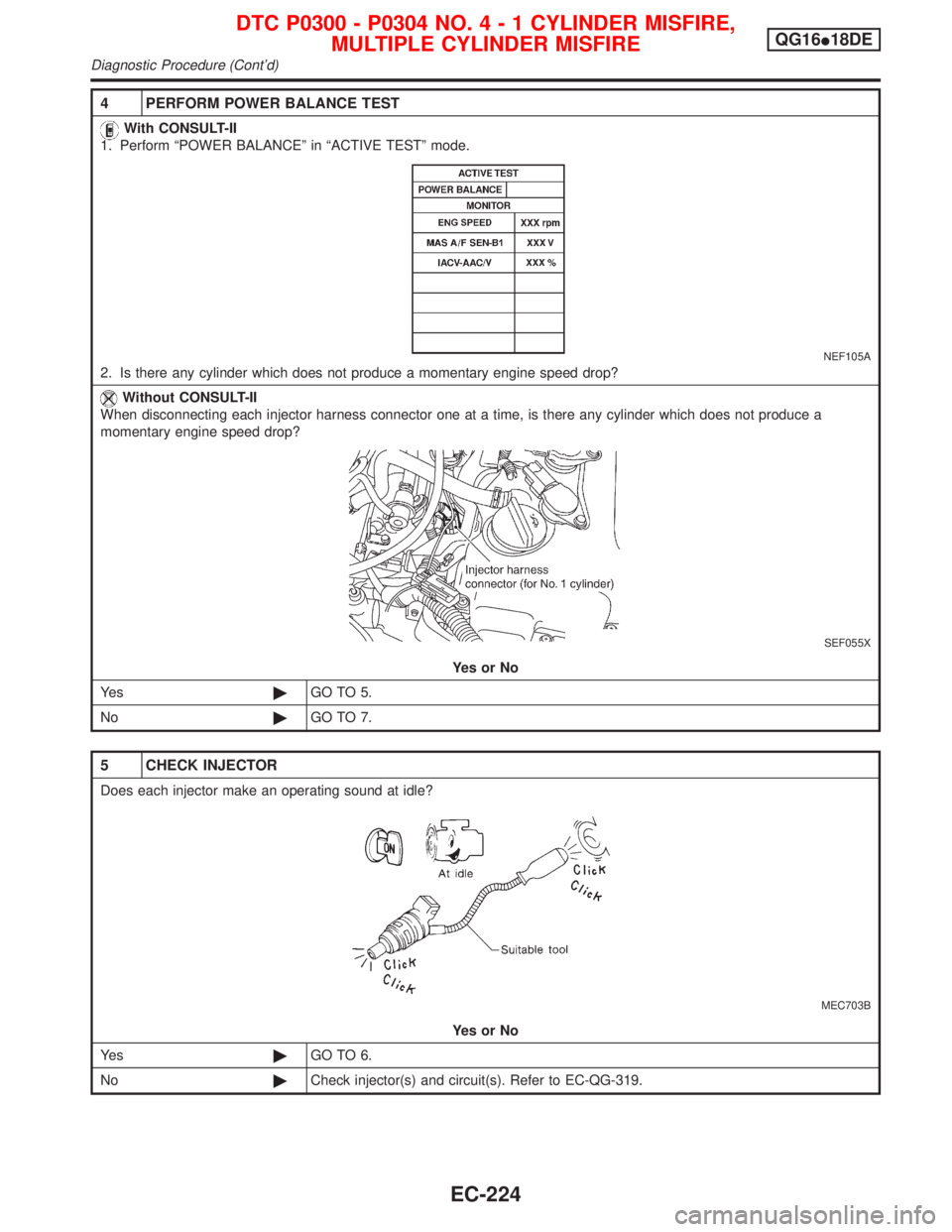
4 PERFORM POWER BALANCE TEST
With CONSULT-II
1. Perform ªPOWER BALANCEº in ªACTIVE TESTº mode.
NEF105A
2. Is there any cylinder which does not produce a momentary engine speed drop?
Without CONSULT-II
When disconnecting each injector harness connector one at a time, is there any cylinder which does not produce a
momentary engine speed drop?
SEF055X
YesorNo
Ye s©GO TO 5.
No©GO TO 7.
5 CHECK INJECTOR
Does each injector make an operating sound at idle?
MEC703B
YesorNo
Ye s©GO TO 6.
No©Check injector(s) and circuit(s). Refer to EC-QG-319.
DTC P0300 - P0304 NO.4-1CYLINDER MISFIRE,
MULTIPLE CYLINDER MISFIREQG16I18DE
Diagnostic Procedure (Cont'd)
EC-224
Page 667 of 2267
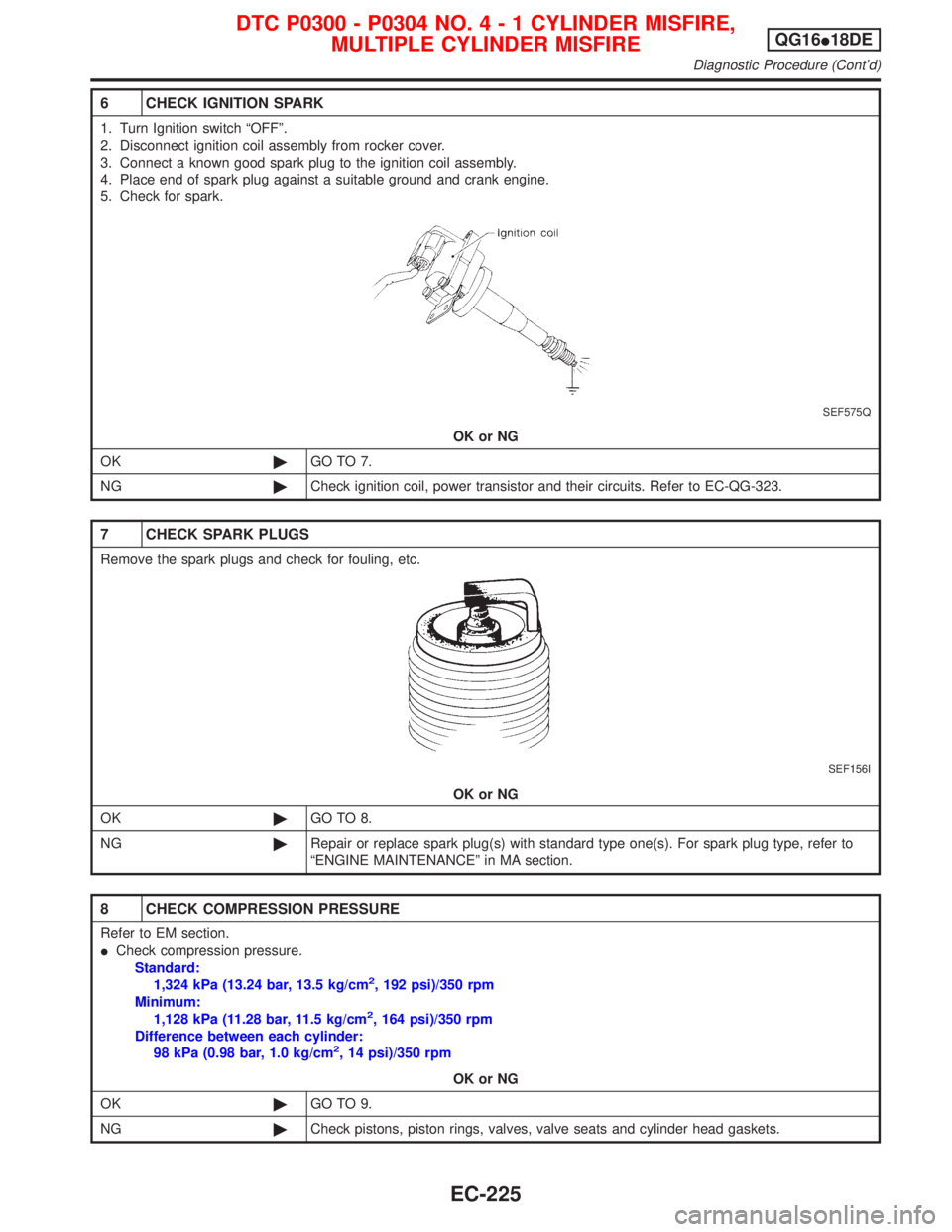
6 CHECK IGNITION SPARK
1. Turn Ignition switch ªOFFº.
2. Disconnect ignition coil assembly from rocker cover.
3. Connect a known good spark plug to the ignition coil assembly.
4. Place end of spark plug against a suitable ground and crank engine.
5. Check for spark.
SEF575Q
OK or NG
OK©GO TO 7.
NG©Check ignition coil, power transistor and their circuits. Refer to EC-QG-323.
7 CHECK SPARK PLUGS
Remove the spark plugs and check for fouling, etc.
SEF156I
OK or NG
OK©GO TO 8.
NG©Repair or replace spark plug(s) with standard type one(s). For spark plug type, refer to
ªENGINE MAINTENANCEº in MA section.
8 CHECK COMPRESSION PRESSURE
Refer to EM section.
ICheck compression pressure.
Standard:
1,324 kPa (13.24 bar, 13.5 kg/cm
2, 192 psi)/350 rpm
Minimum:
1,128 kPa (11.28 bar, 11.5 kg/cm
2, 164 psi)/350 rpm
Difference between each cylinder:
98 kPa (0.98 bar, 1.0 kg/cm
2, 14 psi)/350 rpm
OK or NG
OK©GO TO 9.
NG©Check pistons, piston rings, valves, valve seats and cylinder head gaskets.
DTC P0300 - P0304 NO.4-1CYLINDER MISFIRE,
MULTIPLE CYLINDER MISFIREQG16I18DE
Diagnostic Procedure (Cont'd)
EC-225
Page 668 of 2267
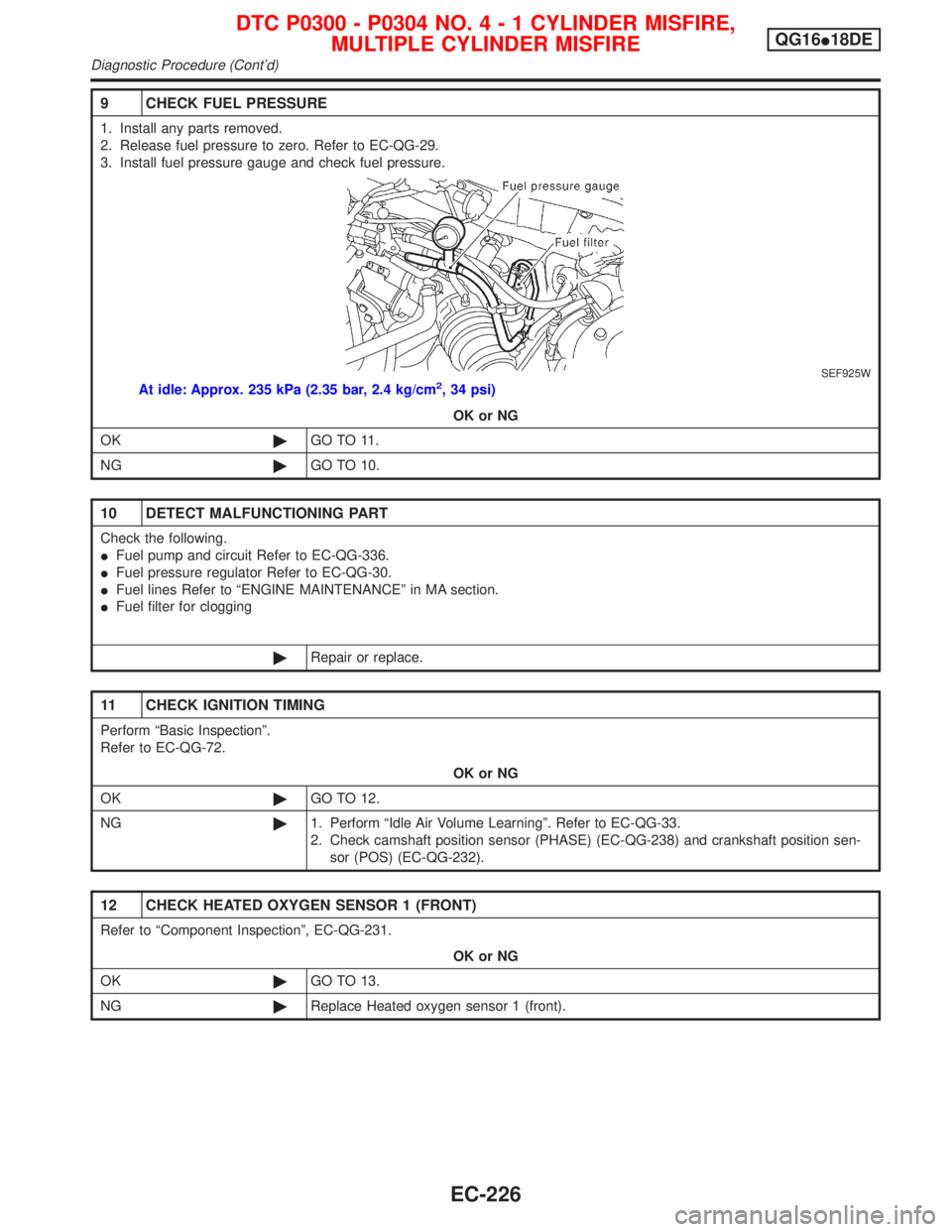
9 CHECK FUEL PRESSURE
1. Install any parts removed.
2. Release fuel pressure to zero. Refer to EC-QG-29.
3. Install fuel pressure gauge and check fuel pressure.
SEF925W
At idle: Approx. 235 kPa (2.35 bar, 2.4 kg/cm2, 34 psi)
OK or NG
OK©GO TO 11.
NG©GO TO 10.
10 DETECT MALFUNCTIONING PART
Check the following.
IFuel pump and circuit Refer to EC-QG-336.
IFuel pressure regulator Refer to EC-QG-30.
IFuel lines Refer to ªENGINE MAINTENANCEº in MA section.
IFuel filter for clogging
©Repair or replace.
11 CHECK IGNITION TIMING
Perform ªBasic Inspectionº.
Refer to EC-QG-72.
OK or NG
OK©GO TO 12.
NG©1. Perform ªIdle Air Volume Learningº. Refer to EC-QG-33.
2. Check camshaft position sensor (PHASE) (EC-QG-238) and crankshaft position sen-
sor (POS) (EC-QG-232).
12 CHECK HEATED OXYGEN SENSOR 1 (FRONT)
Refer to ªComponent Inspectionº, EC-QG-231.
OK or NG
OK©GO TO 13.
NG©Replace Heated oxygen sensor 1 (front).
DTC P0300 - P0304 NO.4-1CYLINDER MISFIRE,
MULTIPLE CYLINDER MISFIREQG16I18DE
Diagnostic Procedure (Cont'd)
EC-226
Page 669 of 2267
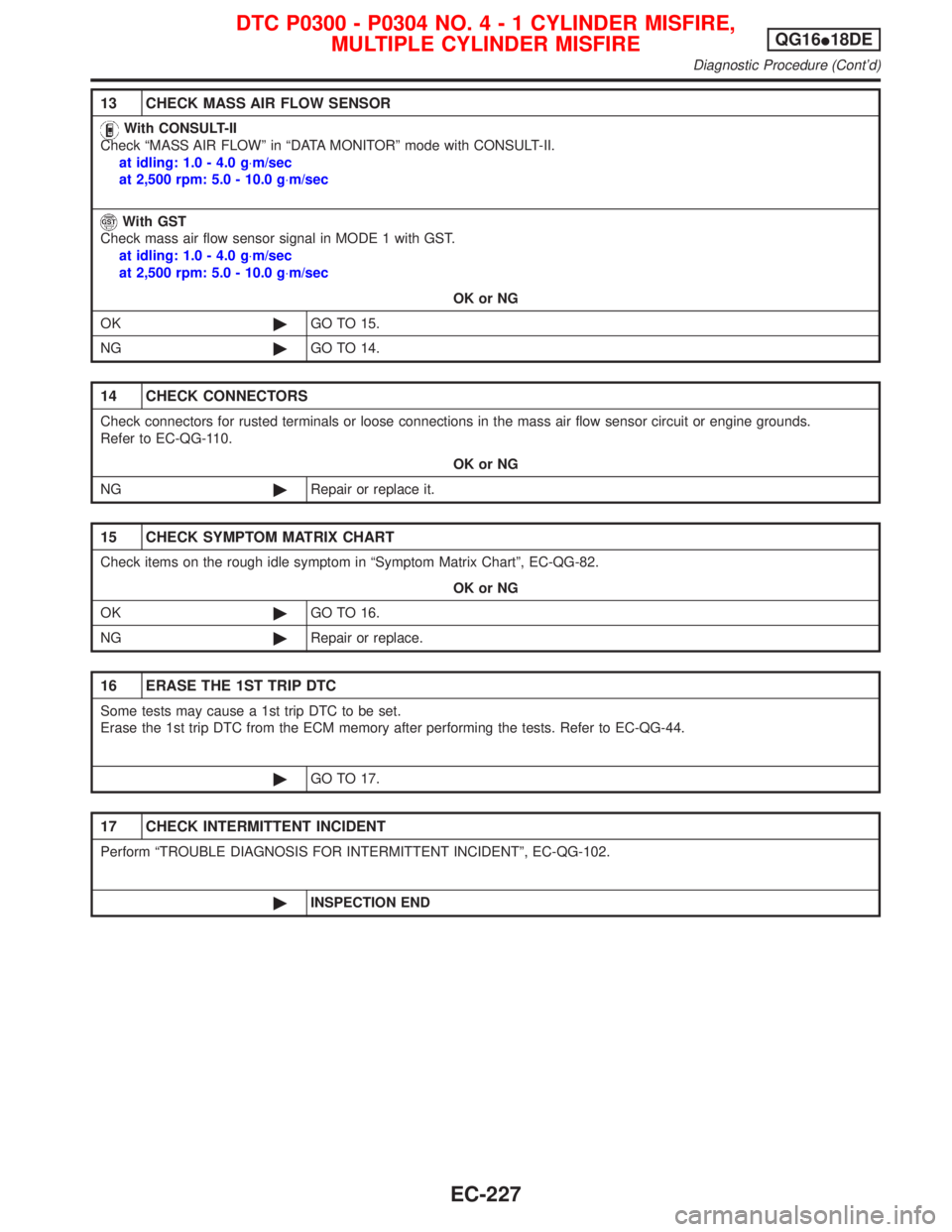
13 CHECK MASS AIR FLOW SENSOR
With CONSULT-II
Check ªMASS AIR FLOWº in ªDATA MONITORº mode with CONSULT-II.
at idling: 1.0 - 4.0 g×m/sec
at 2,500 rpm: 5.0 - 10.0 g×m/sec
With GST
Check mass air flow sensor signal in MODE 1 with GST.
at idling: 1.0 - 4.0 g×m/sec
at 2,500 rpm: 5.0 - 10.0 g×m/sec
OK or NG
OK©GO TO 15.
NG©GO TO 14.
14 CHECK CONNECTORS
Check connectors for rusted terminals or loose connections in the mass air flow sensor circuit or engine grounds.
Refer to EC-QG-110.
OK or NG
NG©Repair or replace it.
15 CHECK SYMPTOM MATRIX CHART
Check items on the rough idle symptom in ªSymptom Matrix Chartº, EC-QG-82.
OK or NG
OK©GO TO 16.
NG©Repair or replace.
16 ERASE THE 1ST TRIP DTC
Some tests may cause a 1st trip DTC to be set.
Erase the 1st trip DTC from the ECM memory after performing the tests. Refer to EC-QG-44.
©GO TO 17.
17 CHECK INTERMITTENT INCIDENT
Perform ªTROUBLE DIAGNOSIS FOR INTERMITTENT INCIDENTº, EC-QG-102.
©INSPECTION END
DTC P0300 - P0304 NO.4-1CYLINDER MISFIRE,
MULTIPLE CYLINDER MISFIREQG16I18DE
Diagnostic Procedure (Cont'd)
EC-227