check engine NISSAN PRIMERA 1999 Electronic Repair Manual
[x] Cancel search | Manufacturer: NISSAN, Model Year: 1999, Model line: PRIMERA, Model: NISSAN PRIMERA 1999Pages: 2267, PDF Size: 35.74 MB
Page 708 of 2267
4 CHECK EVAP CANISTER PURGE VOLUME CONTROL SOLENOID VALVE
Refer to ªComponent Inspectionº EC-QG-266.
OK or NG
OK©GO TO 5.
NG©Replace EVAP canister purge volume control solenoid valve.
5 CHECK INTERMITTENT INCIDENT
Perform ªTROUBLE DIAGNOSIS FOR INTERMITTENT INCIDENTº, EC-QG-102.
©INSPECTION END
Component InspectionNCEC0255EVAP CANISTER PURGE VOLUME CONTROL
SOLENOID VALVE
NCEC0255S01With CONSULT-II
1) Start engine.
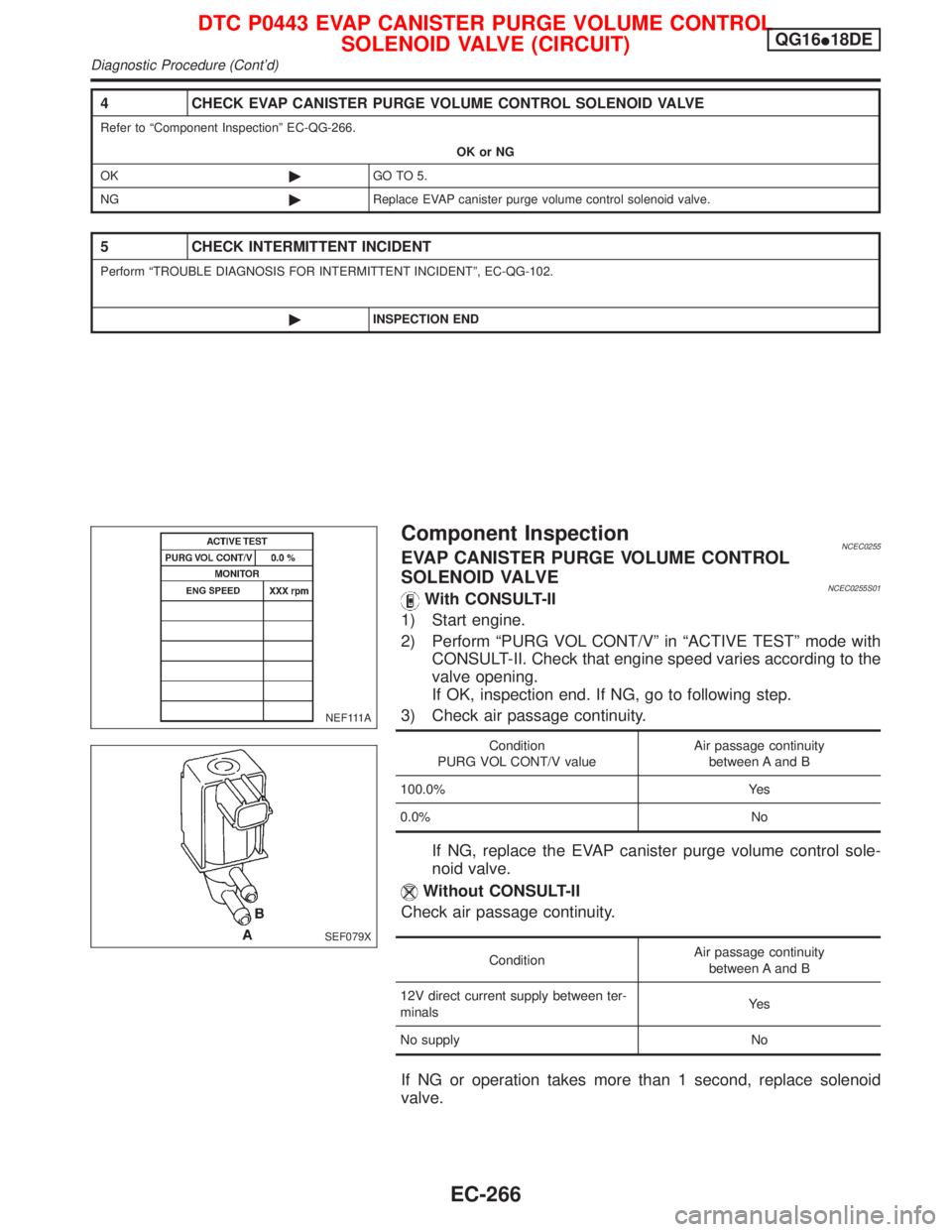
2) Perform ªPURG VOL CONT/Vº in ªACTIVE TESTº mode with
CONSULT-II. Check that engine speed varies according to the
valve opening.
If OK, inspection end. If NG, go to following step.
3) Check air passage continuity.
Condition
PURG VOL CONT/V valueAir passage continuity
between A and B
100.0% Yes
0.0% No
If NG, replace the EVAP canister purge volume control sole-
noid valve.
Without CONSULT-II
Check air passage continuity.
ConditionAir passage continuity
between A and B
12V direct current supply between ter-
minalsYe s
No supply No
If NG or operation takes more than 1 second, replace solenoid
valve.
NEF111A
SEF079X
DTC P0443 EVAP CANISTER PURGE VOLUME CONTROL
SOLENOID VALVE (CIRCUIT)QG16I18DE
Diagnostic Procedure (Cont'd)
EC-266
Page 709 of 2267

Component DescriptionNCEC0272MODELS WITH VEHICLE SPEED SENSOR
The vehicle speed sensor is installed in the transaxle. It contains a
pulse generator which provides a vehicle speed signal to the
speedometer. The speedometer then sends a signal to the ECM.
MODELS WITHOUT VEHICLE SPEED SENSOR
The ABS actuator and electric unit (control unit) provides a vehicle
speed signal to the speedometer. The speedometer then sends a
signal to the ECM.
ECM Terminals and Reference ValueNCEC0273Specification data are reference values and are measured between each terminal and ground.
CAUTION:
Do not use ECM ground terminals when measuring input/output voltage. Doing so may result in dam-
age to the ECM's transistor. Use a ground other than ECM terminals, such as the ground.
TER-
MINAL
NO.WIRE
COLORITEM CONDITION DATA (DC Voltage)
86 OR/WVehicle speed sensor or
ABS actuator and elec-
tric unit (control unit)[Engine is running]
ILift up the vehicle
IIn 2nd gear position
IVehicle speed is 40 km/h (25 MPH)2.0 - 3.0 V
SEF976W
On Board Diagnosis LogicNCEC0274
DTC No. Malfunction is detected when ... Check Items (Possible Cause)
P0500
0500IThe almost 0 km/h (0 MPH) signal from vehicle speed
sensor or ABS actuator and electric unit (control unit) is
sent to ECM even when vehicle is being driven.Models with vehicle speed sensor
IHarness or connector
(The vehicle speed sensor circuit is open or
shorted.)
IVehicle speed sensor
Models without vehicle speed sensor
IHarness or connector (The ABS actuator and
electric unit (control unit) is open or shorted.)
IABS actuator and electric unit (control unit)
DTC Confirmation ProcedureNCEC0275CAUTION:
Always drive vehicle at a safe speed.
NOTE:
If ªDTC Confirmation Procedureº has been previously conducted,
always turn ignition switch ªOFFº and wait at least 9 seconds
before conducting the next test.
TESTING CONDITION:
This procedure may be conducted with the drive wheels lifted
in the shop or by driving the vehicle. If a road test is expected
to be easier, it is unnecessary to lift the vehicle.
SEF080X
DTC P0500 VEHICLE SPEED SENSOR (VSS)QG16I18DE
Component Description
EC-267
Page 717 of 2267
CONSULT-II Reference Value in Data Monitor
Mode
NCEC0280
MONITOR ITEM CONDITION SPECIFICATION
IACV-AAC/VIEngine: After warming up
IAir conditioner switch: OFF
IShift lever: ªNº
INo-loadIdle 5 - 20 steps
2,000 rpm Ð
ECM Terminals and Reference ValueNCEC0281Specification data are reference values and are measured between each terminal and ground.
CAUTION:
Do not use ECM ground terminals when measuring input/output voltage. Doing so may result in dam-
age to the ECM's transistor. Use a ground other than ECM terminals, such as the ground.
TER-
MINAL
NO.WIRE
COLORITEM CONDITION DATA (DC Voltage)
6
7
15
16BR
Y/B
P
ORIACV-AAC valve[Engine is running]
IWarm-up condition
IIdle speed0.1 - 14V
On Board Diagnosis LogicNCEC0282
DTC No. Malfunction is detected when ... Check Items (Possible Cause)
P0505
0505IAn improper voltage signal is sent to ECM through the
valve.IHarness or connectors
(The IACV-AAC valve circuit is open.)
IIACV-AAC valve
DTC Confirmation ProcedureNCEC0283NOTE:
If ªDTC Confirmation Procedureº has been previously conducted,
always turn ignition switch ªOFFº and wait at least 9 seconds
before conducting the next test.
If the target idle speed is out of the specified value, perform
ªIdle Air Volume Learningº, EC-QG-33, before conducting
ªDTC Confirmation Procedureº. For the target idle speed, refer
to ªService Data and Specifications (SDS)º, EC-QG-355.
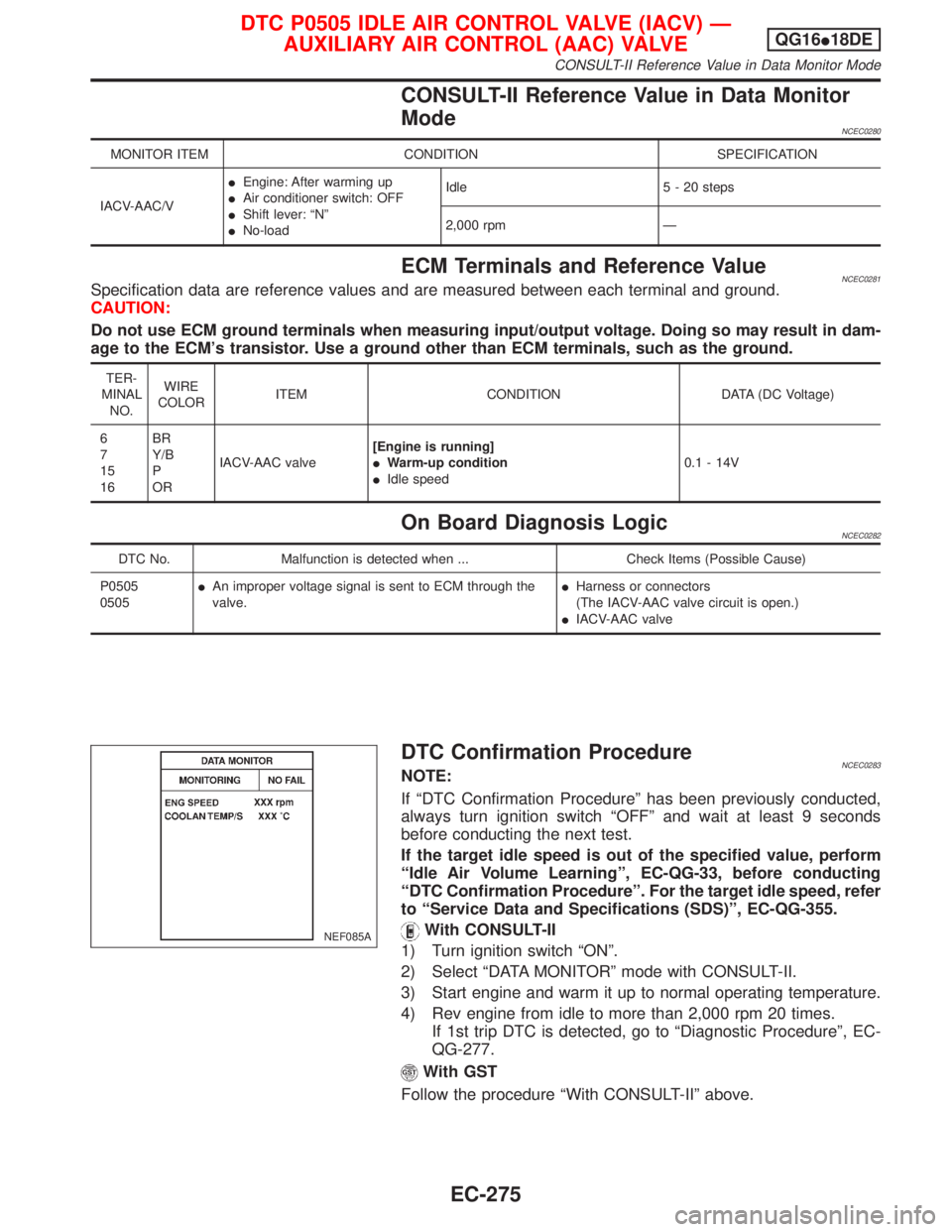
With CONSULT-II
1) Turn ignition switch ªONº.
2) Select ªDATA MONITORº mode with CONSULT-II.
3) Start engine and warm it up to normal operating temperature.
4) Rev engine from idle to more than 2,000 rpm 20 times.
If 1st trip DTC is detected, go to ªDiagnostic Procedureº, EC-
QG-277.
With GST
Follow the procedure ªWith CONSULT-IIº above.
NEF085A
DTC P0505 IDLE AIR CONTROL VALVE (IACV) Ð
AUXILIARY AIR CONTROL (AAC) VALVEQG16I18DE
CONSULT-II Reference Value in Data Monitor Mode
EC-275
Page 720 of 2267
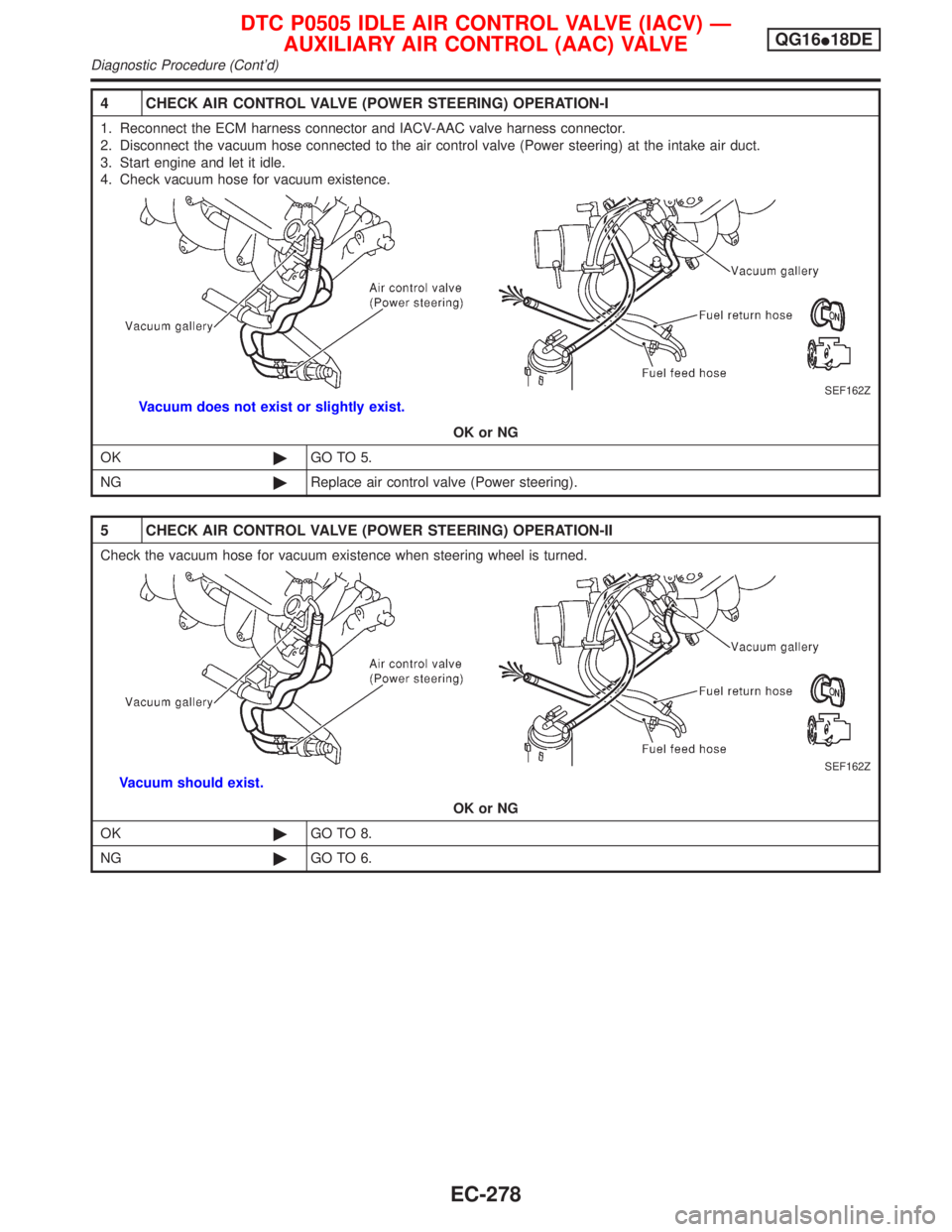
4 CHECK AIR CONTROL VALVE (POWER STEERING) OPERATION-I
1. Reconnect the ECM harness connector and IACV-AAC valve harness connector.
2. Disconnect the vacuum hose connected to the air control valve (Power steering) at the intake air duct.
3. Start engine and let it idle.
4. Check vacuum hose for vacuum existence.
SEF162Z
Vacuum does not exist or slightly exist.
OK or NG
OK©GO TO 5.
NG©Replace air control valve (Power steering).
5 CHECK AIR CONTROL VALVE (POWER STEERING) OPERATION-II
Check the vacuum hose for vacuum existence when steering wheel is turned.
SEF162Z
Vacuum should exist.
OK or NG
OK©GO TO 8.
NG©GO TO 6.
DTC P0505 IDLE AIR CONTROL VALVE (IACV) Ð
AUXILIARY AIR CONTROL (AAC) VALVEQG16I18DE
Diagnostic Procedure (Cont'd)
EC-278
Page 721 of 2267
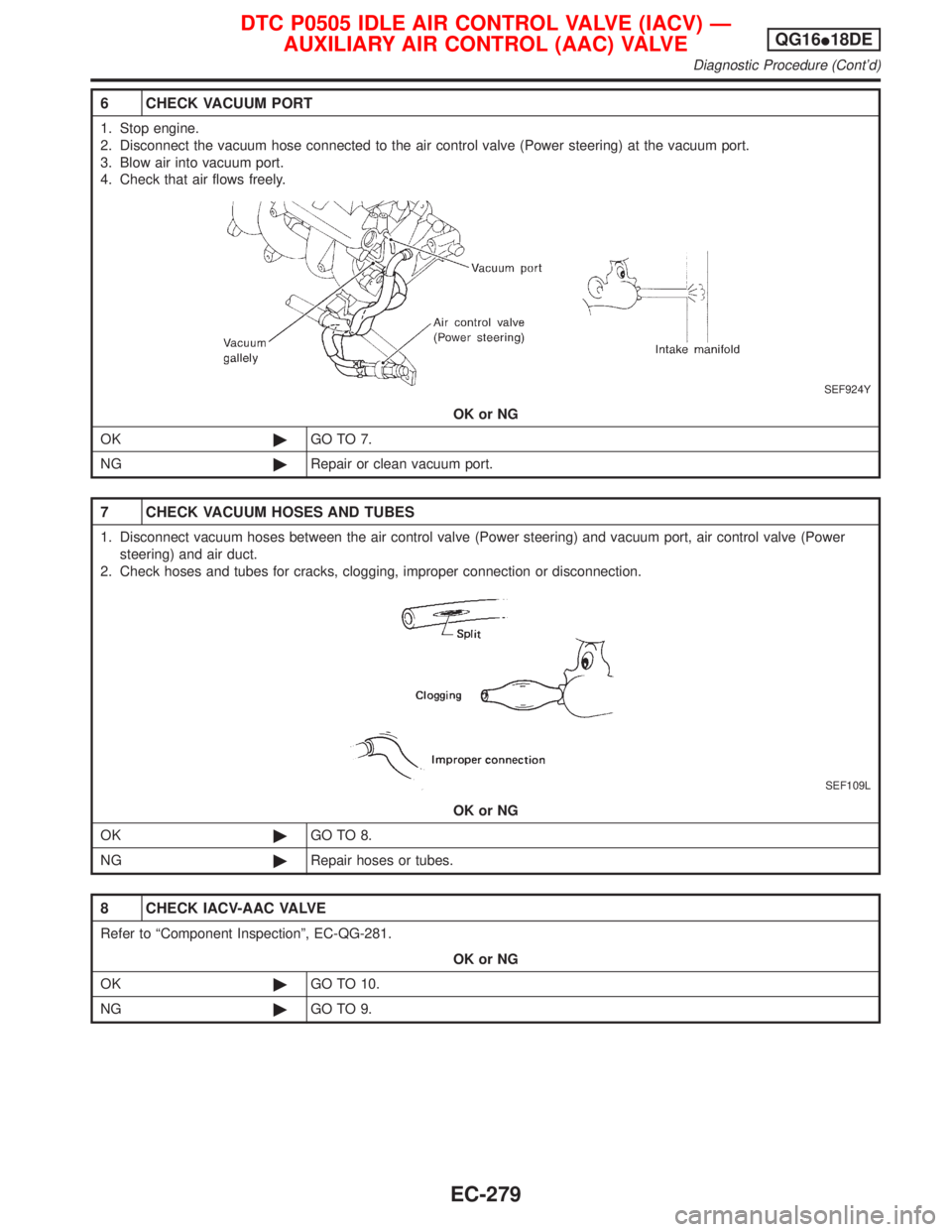
6 CHECK VACUUM PORT
1. Stop engine.
2. Disconnect the vacuum hose connected to the air control valve (Power steering) at the vacuum port.
3. Blow air into vacuum port.
4. Check that air flows freely.
SEF924Y
OK or NG
OK©GO TO 7.
NG©Repair or clean vacuum port.
7 CHECK VACUUM HOSES AND TUBES
1. Disconnect vacuum hoses between the air control valve (Power steering) and vacuum port, air control valve (Power
steering) and air duct.
2. Check hoses and tubes for cracks, clogging, improper connection or disconnection.
SEF109L
OK or NG
OK©GO TO 8.
NG©Repair hoses or tubes.
8 CHECK IACV-AAC VALVE
Refer to ªComponent Inspectionº, EC-QG-281.
OK or NG
OK©GO TO 10.
NG©GO TO 9.
DTC P0505 IDLE AIR CONTROL VALVE (IACV) Ð
AUXILIARY AIR CONTROL (AAC) VALVEQG16I18DE
Diagnostic Procedure (Cont'd)
EC-279
Page 722 of 2267
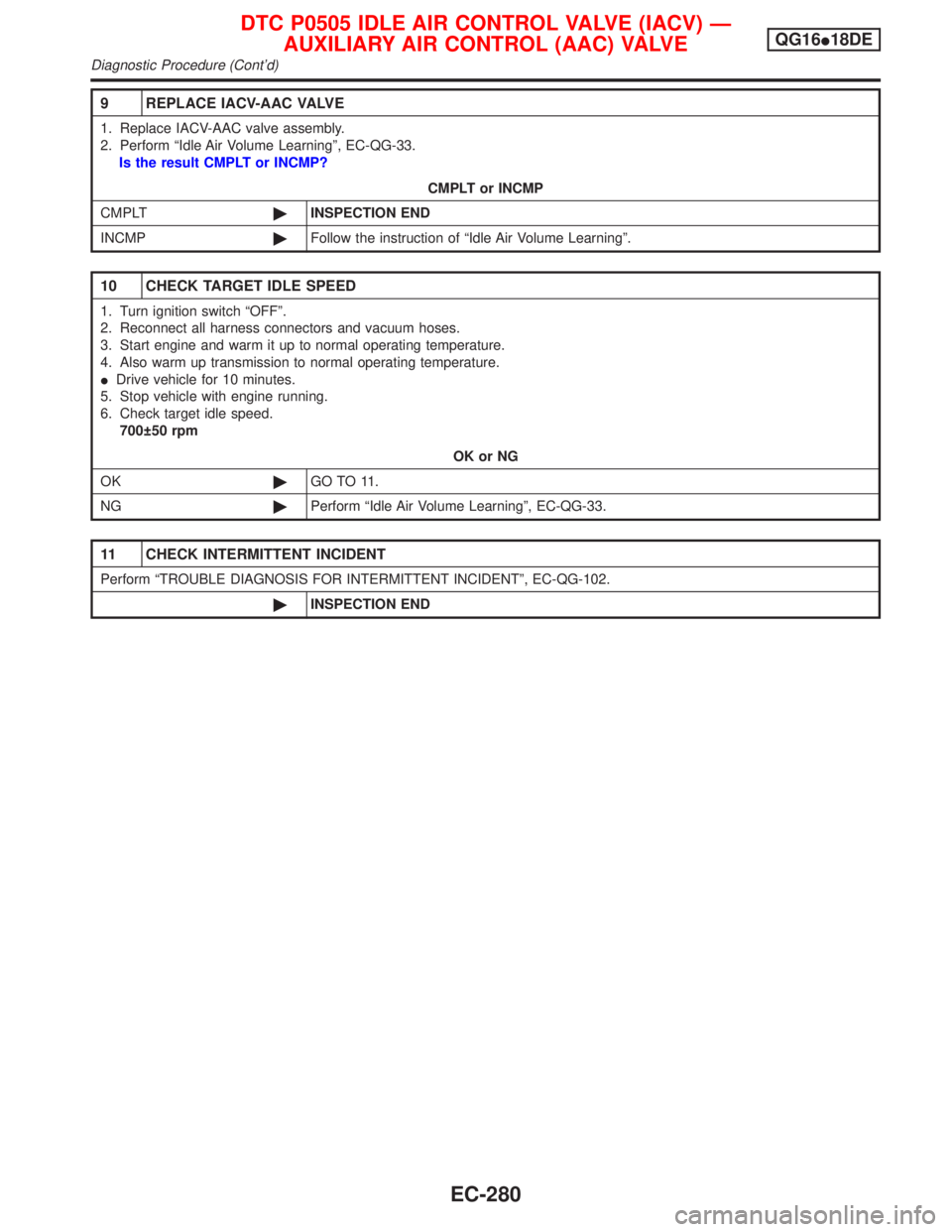
9 REPLACE IACV-AAC VALVE
1. Replace IACV-AAC valve assembly.
2. Perform ªIdle Air Volume Learningº, EC-QG-33.
Is the result CMPLT or INCMP?
CMPLT or INCMP
CMPLT©INSPECTION END
INCMP©Follow the instruction of ªIdle Air Volume Learningº.
10 CHECK TARGET IDLE SPEED
1. Turn ignition switch ªOFFº.
2. Reconnect all harness connectors and vacuum hoses.
3. Start engine and warm it up to normal operating temperature.
4. Also warm up transmission to normal operating temperature.
IDrive vehicle for 10 minutes.
5. Stop vehicle with engine running.
6. Check target idle speed.
700 50 rpm
OK or NG
OK©GO TO 11.
NG©Perform ªIdle Air Volume Learningº, EC-QG-33.
11 CHECK INTERMITTENT INCIDENT
Perform ªTROUBLE DIAGNOSIS FOR INTERMITTENT INCIDENTº, EC-QG-102.
©INSPECTION END
DTC P0505 IDLE AIR CONTROL VALVE (IACV) Ð
AUXILIARY AIR CONTROL (AAC) VALVEQG16I18DE
Diagnostic Procedure (Cont'd)
EC-280
Page 723 of 2267
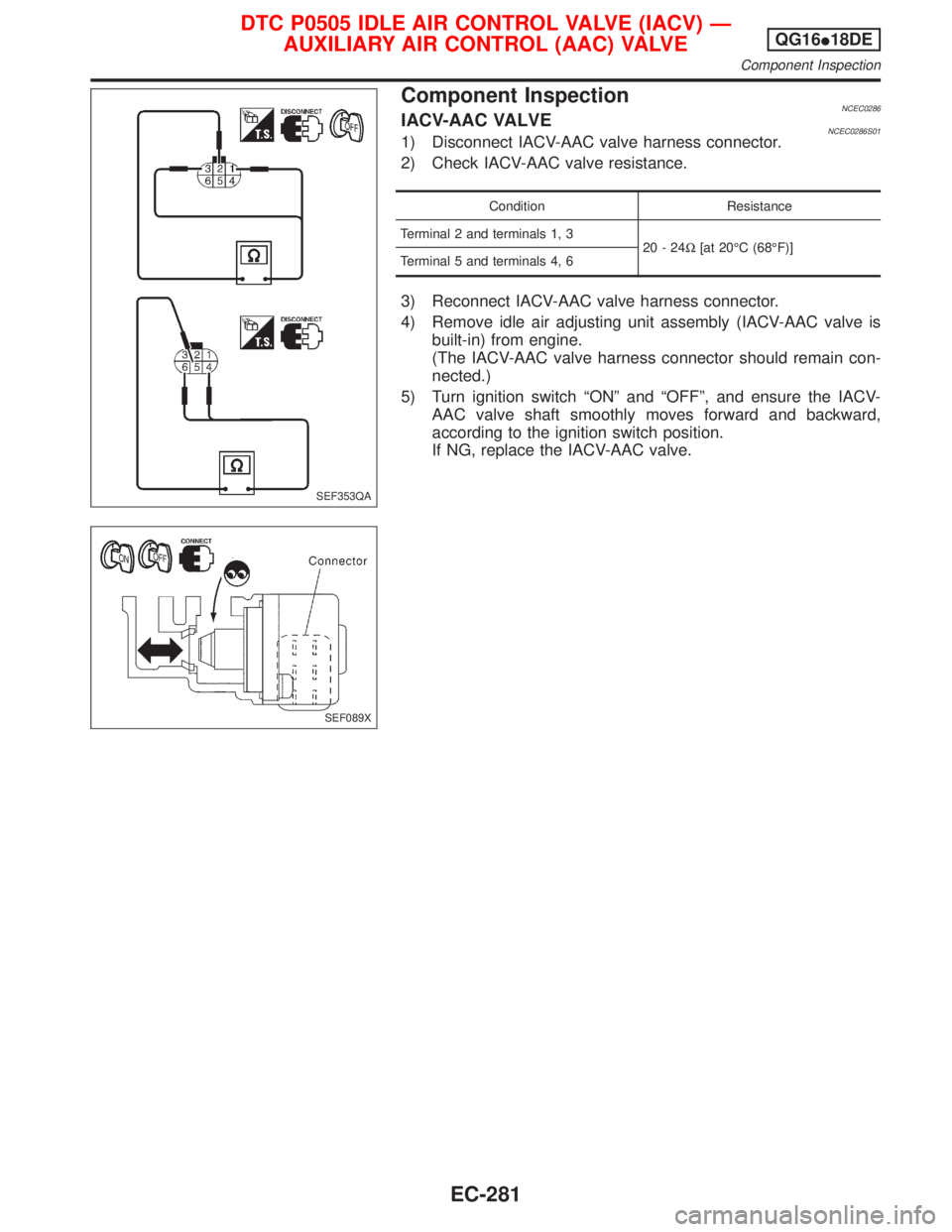
Component InspectionNCEC0286IACV-AAC VALVENCEC0286S011) Disconnect IACV-AAC valve harness connector.
2) Check IACV-AAC valve resistance.
Condition Resistance
Terminal 2 and terminals 1, 3
20-24W[at 20ÉC (68ÉF)]
Terminal 5 and terminals 4, 6
3) Reconnect IACV-AAC valve harness connector.
4) Remove idle air adjusting unit assembly (IACV-AAC valve is
built-in) from engine.
(The IACV-AAC valve harness connector should remain con-
nected.)
5) Turn ignition switch ªONº and ªOFFº, and ensure the IACV-
AAC valve shaft smoothly moves forward and backward,
according to the ignition switch position.
If NG, replace the IACV-AAC valve.
SEF353QA
SEF089X
DTC P0505 IDLE AIR CONTROL VALVE (IACV) Ð
AUXILIARY AIR CONTROL (AAC) VALVEQG16I18DE
Component Inspection
EC-281
Page 724 of 2267
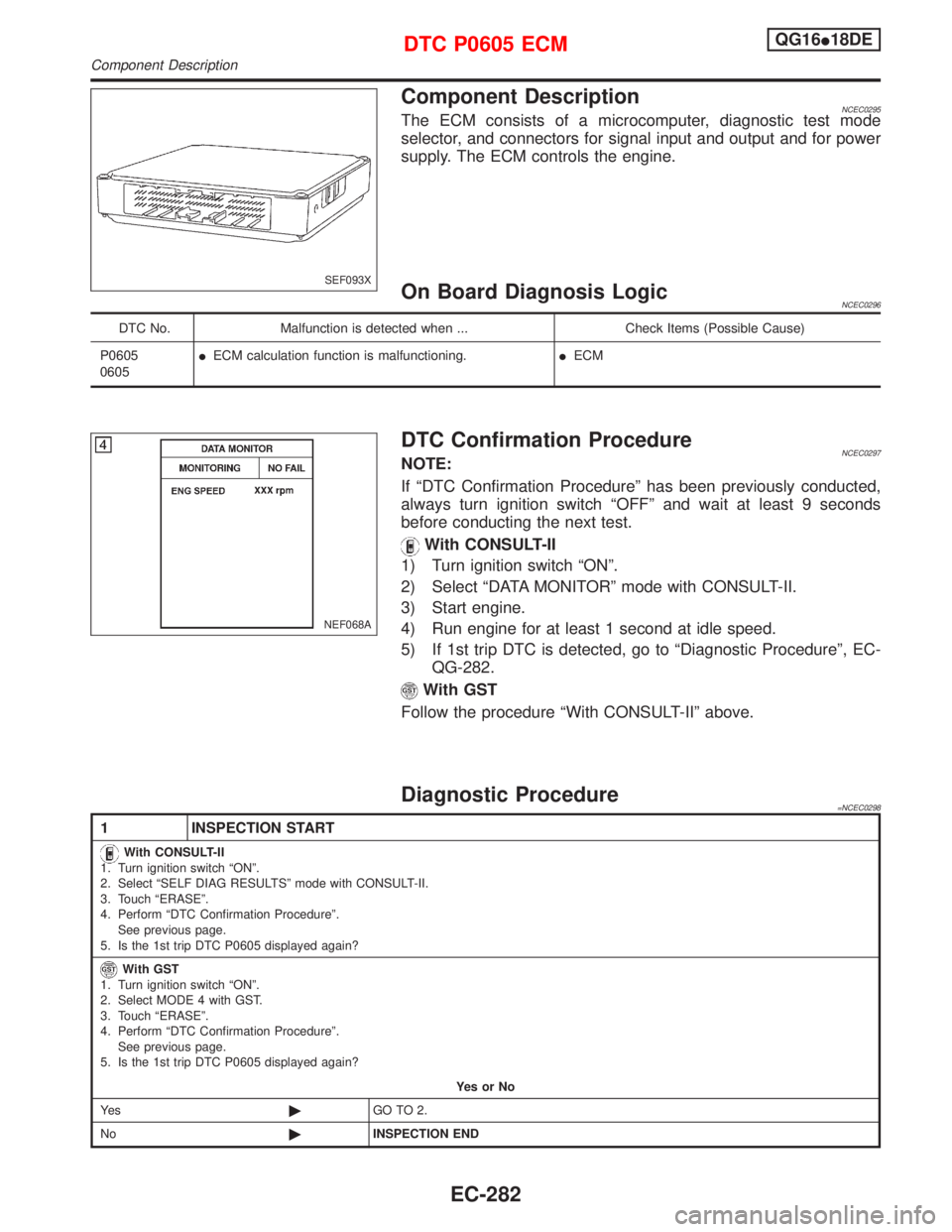
Component DescriptionNCEC0295The ECM consists of a microcomputer, diagnostic test mode
selector, and connectors for signal input and output and for power
supply. The ECM controls the engine.
On Board Diagnosis LogicNCEC0296
DTC No. Malfunction is detected when ... Check Items (Possible Cause)
P0605
0605IECM calculation function is malfunctioning.IECM
DTC Confirmation ProcedureNCEC0297NOTE:
If ªDTC Confirmation Procedureº has been previously conducted,
always turn ignition switch ªOFFº and wait at least 9 seconds
before conducting the next test.
With CONSULT-II
1) Turn ignition switch ªONº.
2) Select ªDATA MONITORº mode with CONSULT-II.
3) Start engine.
4) Run engine for at least 1 second at idle speed.
5) If 1st trip DTC is detected, go to ªDiagnostic Procedureº, EC-
QG-282.
With GST
Follow the procedure ªWith CONSULT-IIº above.
Diagnostic Procedure=NCEC0298
1 INSPECTION START
With CONSULT-II
1. Turn ignition switch ªONº.
2. Select ªSELF DIAG RESULTSº mode with CONSULT-II.
3. Touch ªERASEº.
4. Perform ªDTC Confirmation Procedureº.
See previous page.
5. Is the 1st trip DTC P0605 displayed again?
With GST
1. Turn ignition switch ªONº.
2. Select MODE 4 with GST.
3. Touch ªERASEº.
4. Perform ªDTC Confirmation Procedureº.
See previous page.
5. Is the 1st trip DTC P0605 displayed again?
YesorNo
Ye s©GO TO 2.
No©INSPECTION END
SEF093X
NEF068A
DTC P0605 ECMQG16I18DE
Component Description
EC-282
Page 726 of 2267
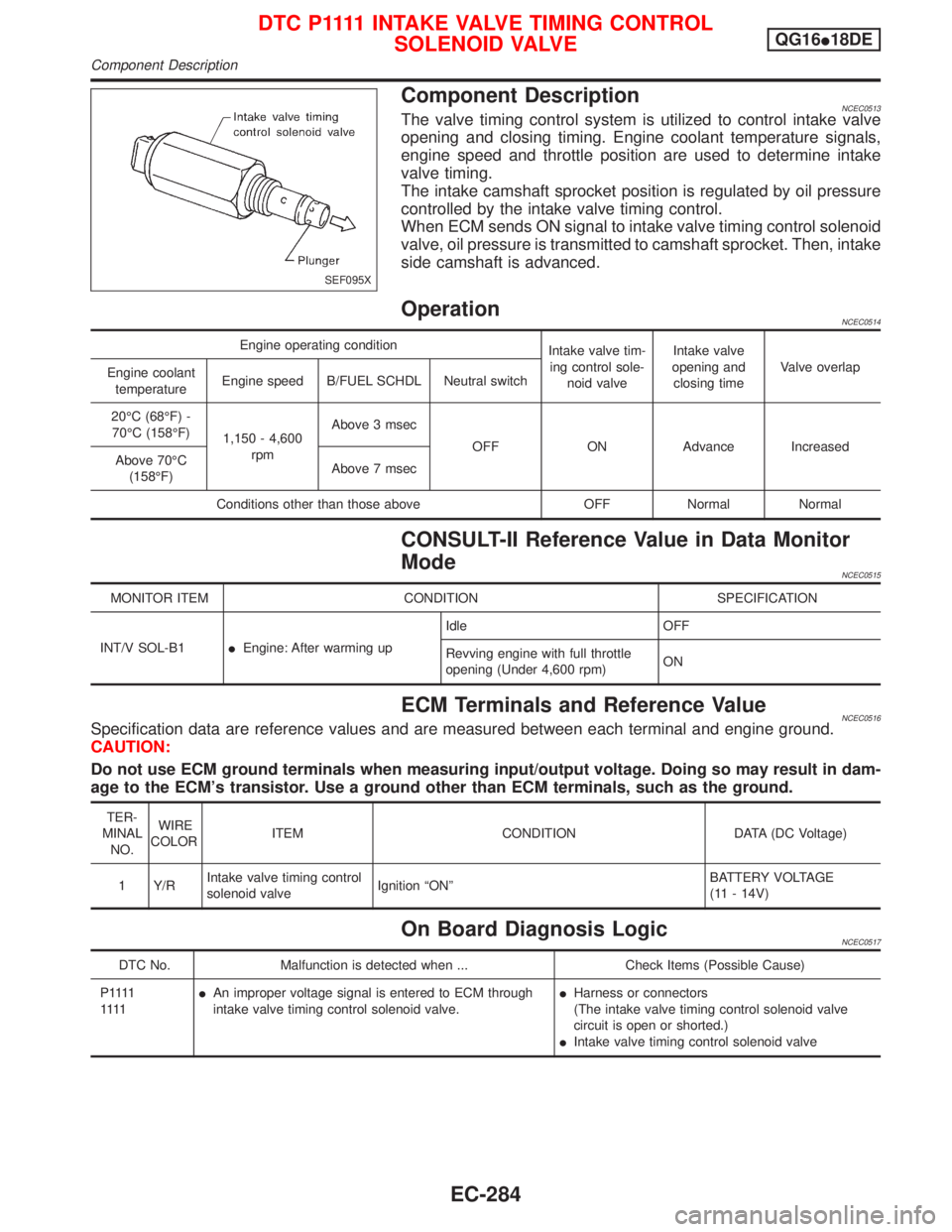
Component DescriptionNCEC0513The valve timing control system is utilized to control intake valve
opening and closing timing. Engine coolant temperature signals,
engine speed and throttle position are used to determine intake
valve timing.
The intake camshaft sprocket position is regulated by oil pressure
controlled by the intake valve timing control.
When ECM sends ON signal to intake valve timing control solenoid
valve, oil pressure is transmitted to camshaft sprocket. Then, intake
side camshaft is advanced.
OperationNCEC0514
Engine operating condition
Intake valve tim-
ing control sole-
noid valveIntake valve
opening and
closing timeValve overlap
Engine coolant
temperatureEngine speed B/FUEL SCHDL Neutral switch
20ÉC (68ÉF) -
70ÉC (158ÉF)
1,150 - 4,600
rpmAbove 3 msec
OFF ON Advance Increased
Above 70ÉC
(158ÉF)Above 7 msec
Conditions other than those above OFF Normal Normal
CONSULT-II Reference Value in Data Monitor
Mode
NCEC0515
MONITOR ITEM CONDITION SPECIFICATION
INT/V SOL-B1IEngine: After warming upIdle OFF
Revving engine with full throttle
opening (Under 4,600 rpm)ON
ECM Terminals and Reference ValueNCEC0516Specification data are reference values and are measured between each terminal and engine ground.
CAUTION:
Do not use ECM ground terminals when measuring input/output voltage. Doing so may result in dam-
age to the ECM's transistor. Use a ground other than ECM terminals, such as the ground.
TER-
MINAL
NO.WIRE
COLORITEM CONDITION DATA (DC Voltage)
1 Y/RIntake valve timing control
solenoid valveIgnition ªONºBATTERY VOLTAGE
(11 - 14V)
On Board Diagnosis LogicNCEC0517
DTC No. Malfunction is detected when ... Check Items (Possible Cause)
P 1111
1111IAn improper voltage signal is entered to ECM through
intake valve timing control solenoid valve.IHarness or connectors
(The intake valve timing control solenoid valve
circuit is open or shorted.)
IIntake valve timing control solenoid valve
SEF095X
D T C P 1111 I N TA K E VA LV ETIMING CONTROL
SOLENOID VALVEQG16I18DE
Component Description
EC-284
Page 729 of 2267
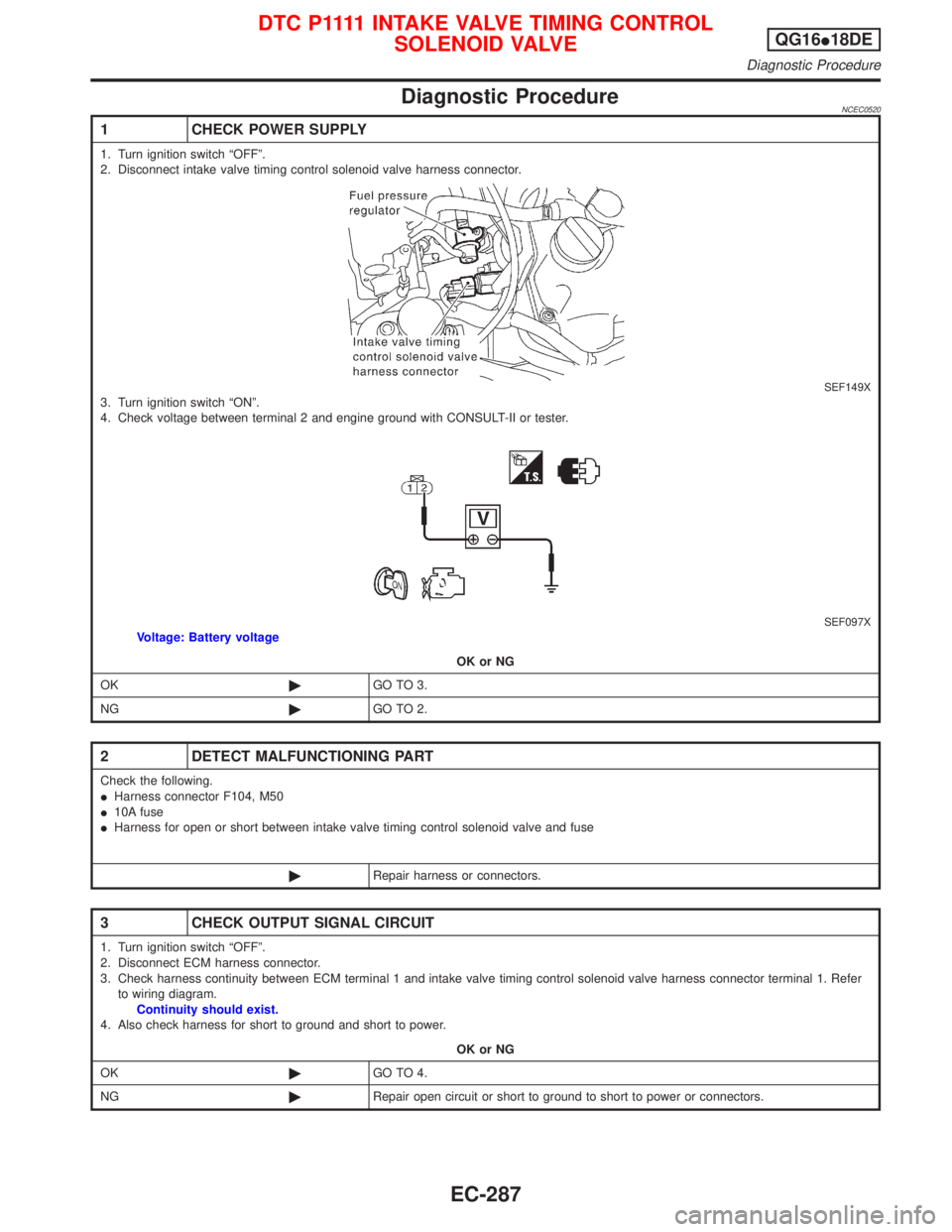
Diagnostic ProcedureNCEC0520
1 CHECK POWER SUPPLY
1. Turn ignition switch ªOFFº.
2. Disconnect intake valve timing control solenoid valve harness connector.
SEF149X3. Turn ignition switch ªONº.
4. Check voltage between terminal 2 and engine ground with CONSULT-II or tester.
SEF097XVoltage: Battery voltage
OK or NG
OK©GO TO 3.
NG©GO TO 2.
2 DETECT MALFUNCTIONING PART
Check the following.
IHarness connector F104, M50
I10A fuse
IHarness for open or short between intake valve timing control solenoid valve and fuse
©Repair harness or connectors.
3 CHECK OUTPUT SIGNAL CIRCUIT
1. Turn ignition switch ªOFFº.
2. Disconnect ECM harness connector.
3. Check harness continuity between ECM terminal 1 and intake valve timing control solenoid valve harness connector terminal 1. Refer
to wiring diagram.
Continuity should exist.
4. Also check harness for short to ground and short to power.
OK or NG
OK©GO TO 4.
NG©Repair open circuit or short to ground to short to power or connectors.
D T C P 1111 I N TA K E VA LV ETIMING CONTROL
SOLENOID VALVEQG16I18DE
Diagnostic Procedure
EC-287