check engine NISSAN PRIMERA 1999 Electronic Repair Manual
[x] Cancel search | Manufacturer: NISSAN, Model Year: 1999, Model line: PRIMERA, Model: NISSAN PRIMERA 1999Pages: 2267, PDF Size: 35.74 MB
Page 732 of 2267
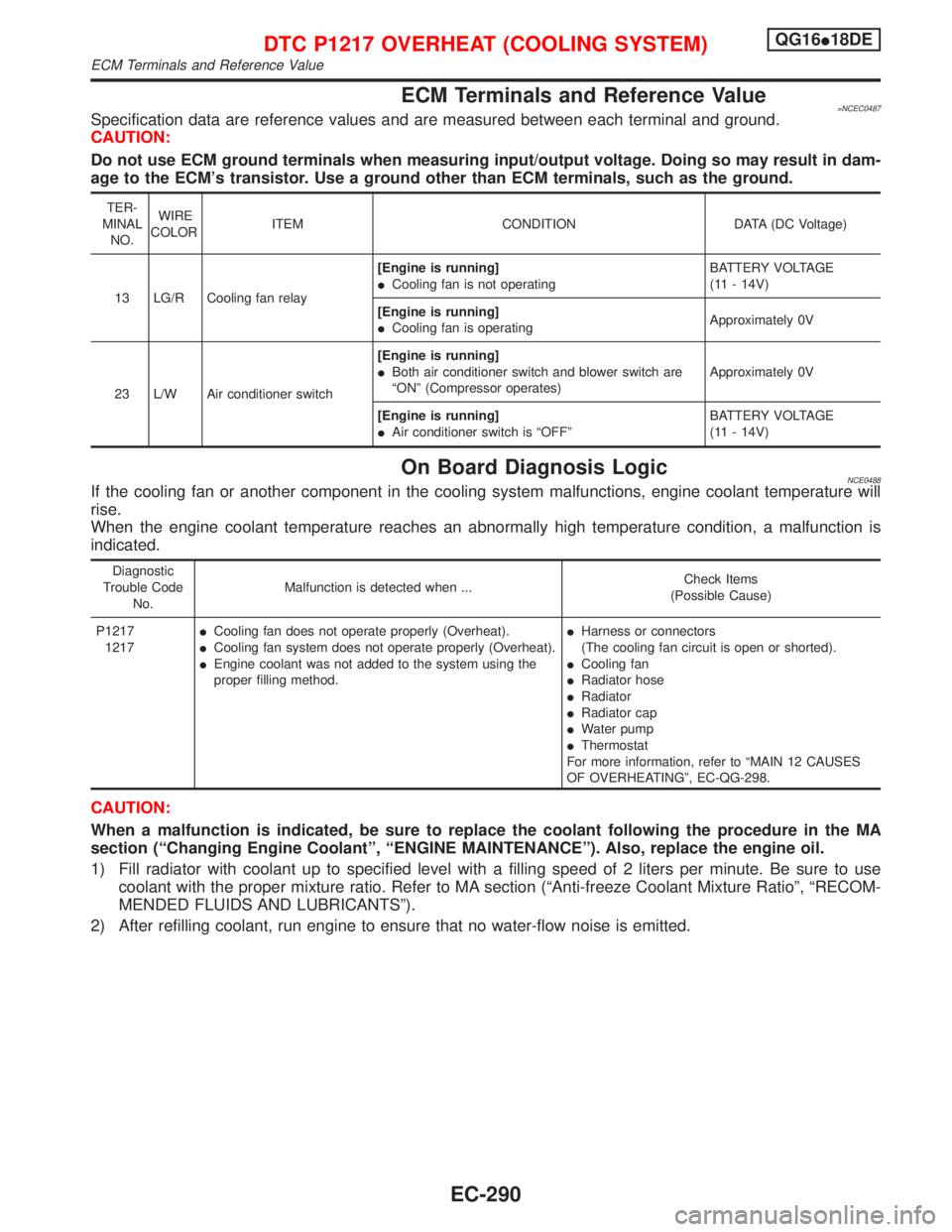
ECM Terminals and Reference Value=NCEC0487Specification data are reference values and are measured between each terminal and ground.
CAUTION:
Do not use ECM ground terminals when measuring input/output voltage. Doing so may result in dam-
age to the ECM's transistor. Use a ground other than ECM terminals, such as the ground.
TER-
MINAL
NO.WIRE
COLORITEM CONDITION DATA (DC Voltage)
13 LG/R Cooling fan relay[Engine is running]
ICooling fan is not operatingBATTERY VOLTAGE
(11 - 14V)
[Engine is running]
ICooling fan is operatingApproximately 0V
23 L/W Air conditioner switch[Engine is running]
IBoth air conditioner switch and blower switch are
ªONº (Compressor operates)Approximately 0V
[Engine is running]
IAir conditioner switch is ªOFFºBATTERY VOLTAGE
(11 - 14V)
On Board Diagnosis LogicNCE0488If the cooling fan or another component in the cooling system malfunctions, engine coolant temperature will
rise.
When the engine coolant temperature reaches an abnormally high temperature condition, a malfunction is
indicated.
Diagnostic
Trouble Code
No.Malfunction is detected when ...Check Items
(Possible Cause)
P1217
1217ICooling fan does not operate properly (Overheat).
ICooling fan system does not operate properly (Overheat).
IEngine coolant was not added to the system using the
proper filling method.IHarness or connectors
(The cooling fan circuit is open or shorted).
ICooling fan
IRadiator hose
IRadiator
IRadiator cap
IWater pump
IThermostat
For more information, refer to ªMAIN 12 CAUSES
OF OVERHEATINGº, EC-QG-298.
CAUTION:
When a malfunction is indicated, be sure to replace the coolant following the procedure in the MA
section (ªChanging Engine Coolantº, ªENGINE MAINTENANCEº). Also, replace the engine oil.
1) Fill radiator with coolant up to specified level with a filling speed of 2 liters per minute. Be sure to use
coolant with the proper mixture ratio. Refer to MA section (ªAnti-freeze Coolant Mixture Ratioº, ªRECOM-
MENDED FLUIDS AND LUBRICANTSº).
2) After refilling coolant, run engine to ensure that no water-flow noise is emitted.
DTC P1217 OVERHEAT (COOLING SYSTEM)QG16I18DE
ECM Terminals and Reference Value
EC-290
Page 733 of 2267

Overall Function CheckNCEC0489Use this procedure to check the overall function of the cooling fan.
During this check, a DTC might not be confirmed.
WARNING:
Never remove the radiator cap when the engine is hot. Serious
burns could be caused by high pressure fluid escaping from
the radiator.
Wrap a thick cloth around cap. Carefully remove the cap by
turning it a quarter turn to allow built-up pressure to escape.
Then turn the cap all the way off.
With CONSULT-II
1) Check the coolant level in the reservoir tank and radiator.
Allow engine to cool before checking coolant level.
If the coolant level in the reservoir tank and/or radiator is below
the proper range, skip the following steps and go to ªDiagnos-
tic Procedureº, EC-QG-294.
2) Confirm whether customer filled the coolant or not. If customer
filled the coolant, skip the following steps and go to ªDiagnos-
tic Procedureº, EC-QG-294.
3) Turn ignition switch ªONº.
4) Perform ªCOOLING FANº in ªACTIVE TESTº mode with CON-
SULT-II.
5) If the results are NG, go to ªDiagnostic Procedureº, EC-QG-
294.
Without CONSULT-II
1) Check the coolant level in the reservoir tank and radiator.
Allow engine to cool before checking coolant level.
If the coolant level in the reservoir tank and/or radiator is below
the proper range, skip the following steps and go to ªDiagnos-
tic Procedureº, EC-QG-294.
2) Confirm whether customer filled the coolant or not. If customer
filled the coolant, skip the following steps and go to ªDiagnos-
tic Procedureº, EC-QG-294.
3) Start engine.
Be careful not to overheat engine.
4) Set temperature control lever to full cold position.
5) Turn air conditioner switch ªONº.
6) Turn blower fan switch ªONº.
7) Run engine at idle for a few minutes with air conditioner oper-
ating.
Be careful not to overheat engine.
8) Make sure that cooling fan operates.
If NG, go to ªDiagnostic Procedureº, EC-QG-294.
SEF621WA
SEF111X
SEC163BA
DTC P1217 OVERHEAT (COOLING SYSTEM)QG16I18DE
Overall Function Check
EC-291
Page 736 of 2267
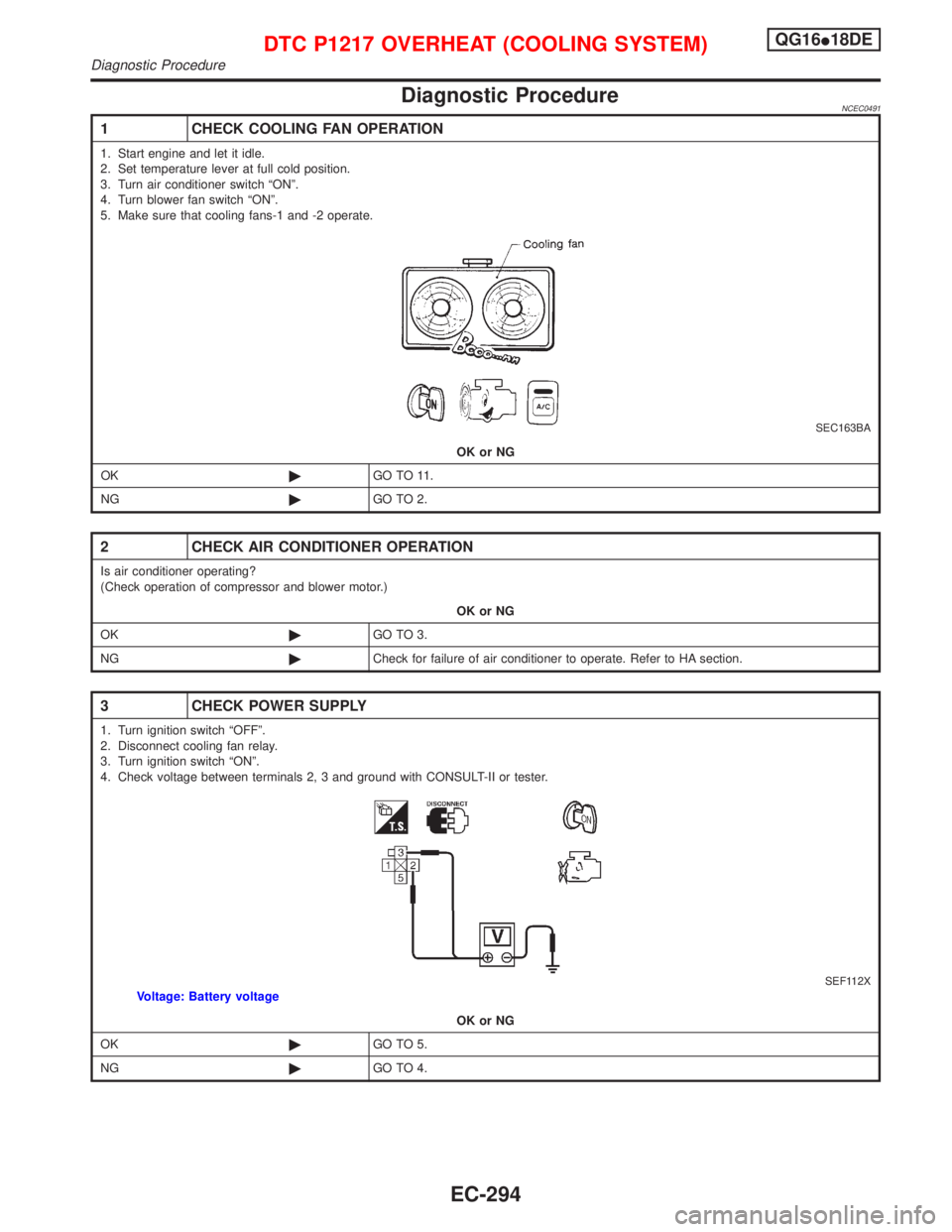
Diagnostic ProcedureNCEC0491
1 CHECK COOLING FAN OPERATION
1. Start engine and let it idle.
2. Set temperature lever at full cold position.
3. Turn air conditioner switch ªONº.
4. Turn blower fan switch ªONº.
5. Make sure that cooling fans-1 and -2 operate.
SEC163BA
OK or NG
OK©GO TO 11.
NG©GO TO 2.
2 CHECK AIR CONDITIONER OPERATION
Is air conditioner operating?
(Check operation of compressor and blower motor.)
OK or NG
OK©GO TO 3.
NG©Check for failure of air conditioner to operate. Refer to HA section.
3 CHECK POWER SUPPLY
1. Turn ignition switch ªOFFº.
2. Disconnect cooling fan relay.
3. Turn ignition switch ªONº.
4. Check voltage between terminals 2, 3 and ground with CONSULT-II or tester.
SEF112XVoltage: Battery voltage
OK or NG
OK©GO TO 5.
NG©GO TO 4.
DTC P1217 OVERHEAT (COOLING SYSTEM)QG16I18DE
Diagnostic Procedure
EC-294
Page 739 of 2267
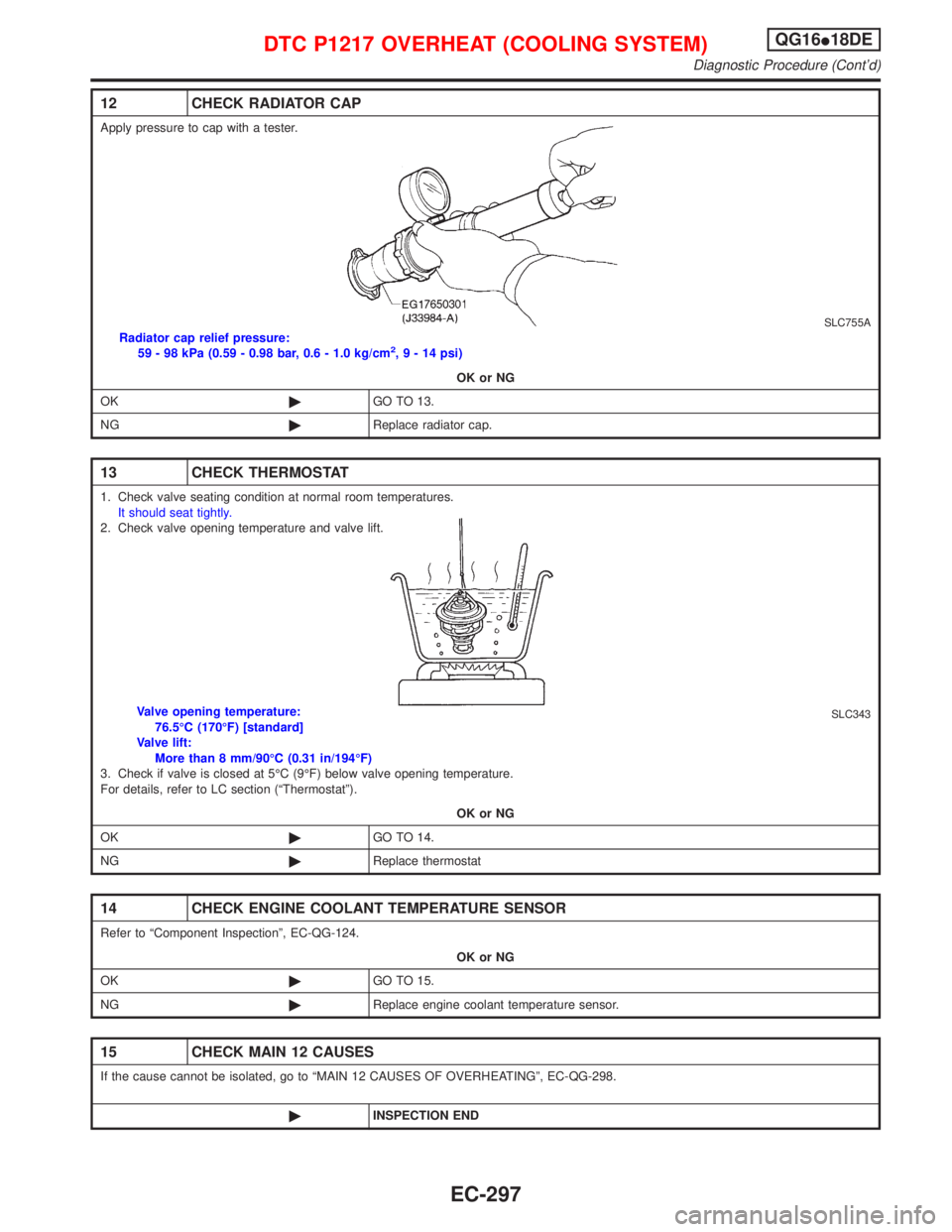
12 CHECK RADIATOR CAP
Apply pressure to cap with a tester.
SLC755ARadiator cap relief pressure:
59 - 98 kPa (0.59 - 0.98 bar, 0.6 - 1.0 kg/cm2,9-14psi)
OK or NG
OK©GO TO 13.
NG©Replace radiator cap.
13 CHECK THERMOSTAT
1. Check valve seating condition at normal room temperatures.
It should seat tightly.
2. Check valve opening temperature and valve lift.
SLC343Valve opening temperature:
76.5ÉC (170ÉF) [standard]
Valve lift:
More than 8 mm/90ÉC (0.31 in/194ÉF)
3. Check if valve is closed at 5ÉC (9ÉF) below valve opening temperature.
For details, refer to LC section (ªThermostatº).
OK or NG
OK©GO TO 14.
NG©Replace thermostat
14 CHECK ENGINE COOLANT TEMPERATURE SENSOR
Refer to ªComponent Inspectionº, EC-QG-124.
OK or NG
OK©GO TO 15.
NG©Replace engine coolant temperature sensor.
15 CHECK MAIN 12 CAUSES
If the cause cannot be isolated, go to ªMAIN 12 CAUSES OF OVERHEATINGº, EC-QG-298.
©INSPECTION END
DTC P1217 OVERHEAT (COOLING SYSTEM)QG16I18DE
Diagnostic Procedure (Cont'd)
EC-297
Page 740 of 2267
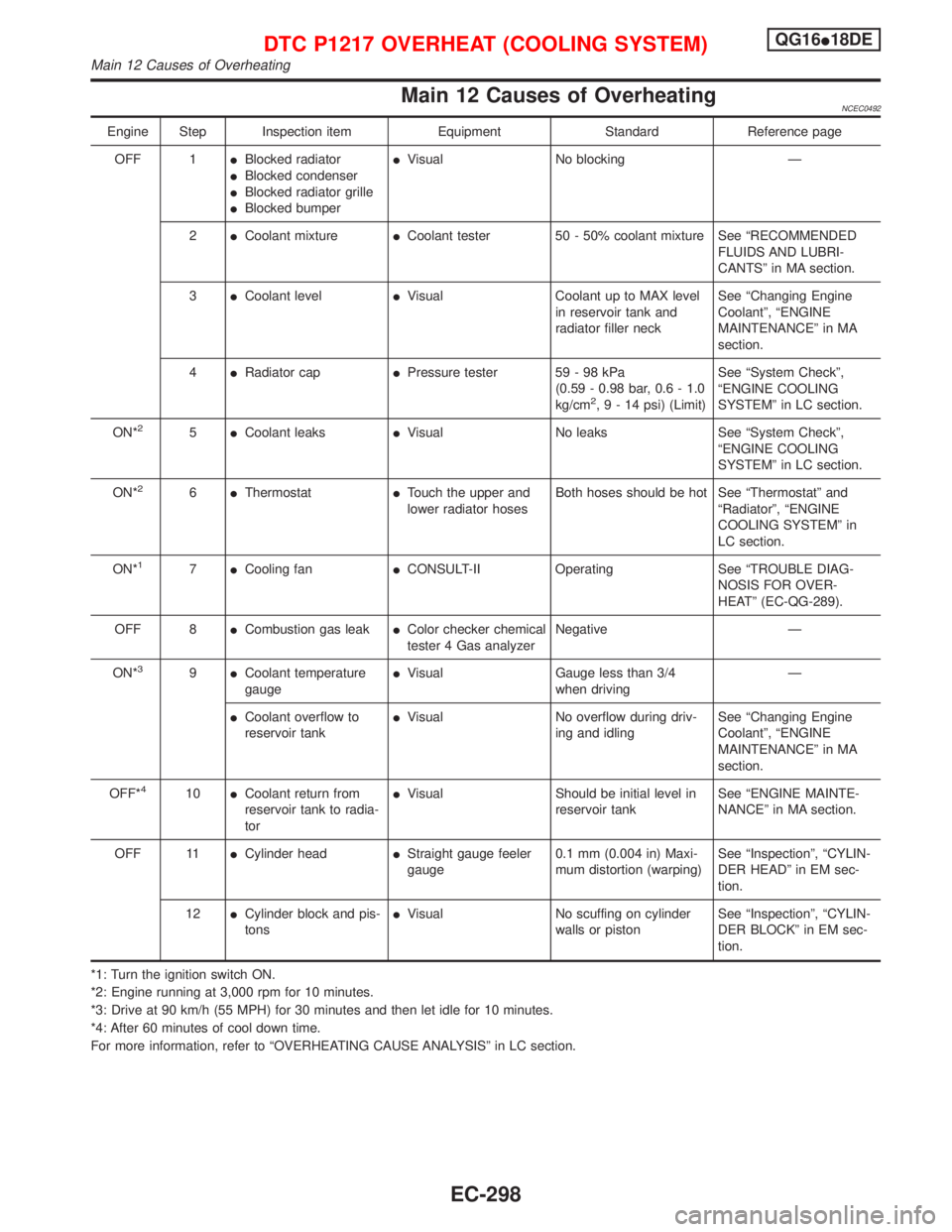
Main 12 Causes of OverheatingNCEC0492
Engine Step Inspection item Equipment Standard Reference page
OFF 1IBlocked radiator
IBlocked condenser
IBlocked radiator grille
IBlocked bumperIVisual No blocking Ð
2ICoolant mixtureICoolant tester 50 - 50% coolant mixture See ªRECOMMENDED
FLUIDS AND LUBRI-
CANTSº in MA section.
3ICoolant levelIVisual Coolant up to MAX level
in reservoir tank and
radiator filler neckSee ªChanging Engine
Coolantº, ªENGINE
MAINTENANCEº in MA
section.
4IRadiator capIPressure tester 59 - 98 kPa
(0.59 - 0.98 bar, 0.6 - 1.0
kg/cm
2,9-14psi) (Limit)See ªSystem Checkº,
ªENGINE COOLING
SYSTEMº in LC section.
ON*
25ICoolant leaksIVisual No leaks See ªSystem Checkº,
ªENGINE COOLING
SYSTEMº in LC section.
ON*
26IThermostatITouch the upper and
lower radiator hosesBoth hoses should be hot See ªThermostatº and
ªRadiatorº, ªENGINE
COOLING SYSTEMº in
LC section.
ON*
17ICooling fanICONSULT-II Operating See ªTROUBLE DIAG-
NOSIS FOR OVER-
HEATº (EC-QG-289).
OFF 8ICombustion gas leakIColor checker chemical
tester 4 Gas analyzerNegative Ð
ON*
39ICoolant temperature
gaugeIVisual Gauge less than 3/4
when drivingÐ
ICoolant overflow to
reservoir tankIVisual No overflow during driv-
ing and idlingSee ªChanging Engine
Coolantº, ªENGINE
MAINTENANCEº in MA
section.
OFF*
410ICoolant return from
reservoir tank to radia-
torIVisual Should be initial level in
reservoir tankSee ªENGINE MAINTE-
NANCEº in MA section.
OFF 11ICylinder headIStraight gauge feeler
gauge0.1 mm (0.004 in) Maxi-
mum distortion (warping)See ªInspectionº, ªCYLIN-
DER HEADº in EM sec-
tion.
12ICylinder block and pis-
tonsIVisual No scuffing on cylinder
walls or pistonSee ªInspectionº, ªCYLIN-
DER BLOCKº in EM sec-
tion.
*1: Turn the ignition switch ON.
*2: Engine running at 3,000 rpm for 10 minutes.
*3: Drive at 90 km/h (55 MPH) for 30 minutes and then let idle for 10 minutes.
*4: After 60 minutes of cool down time.
For more information, refer to ªOVERHEATING CAUSE ANALYSISº in LC section.
DTC P1217 OVERHEAT (COOLING SYSTEM)QG16I18DE
Main 12 Causes of Overheating
EC-298
Page 741 of 2267
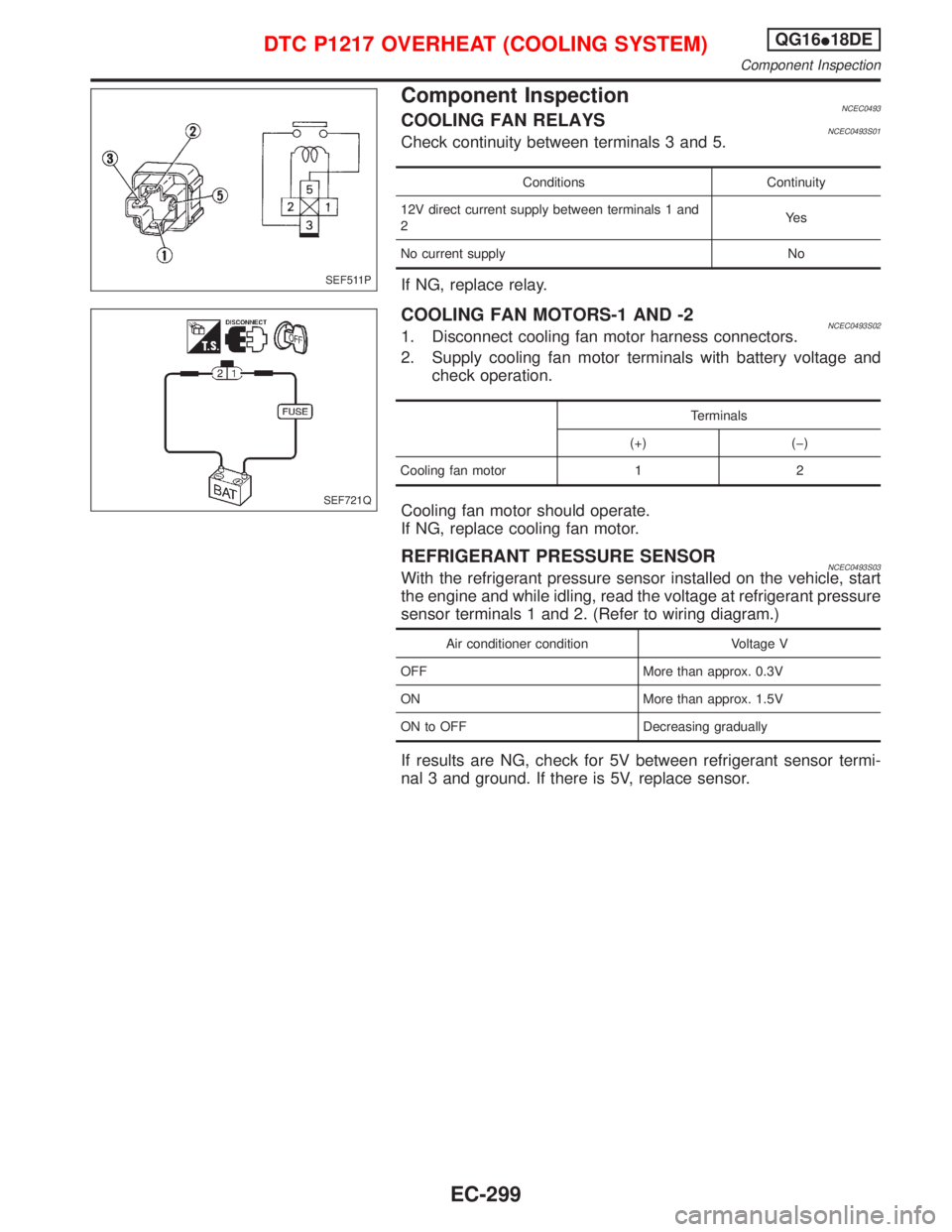
Component InspectionNCEC0493COOLING FAN RELAYSNCEC0493S01Check continuity between terminals 3 and 5.
Conditions Continuity
12V direct current supply between terminals 1 and
2Ye s
No current supply No
If NG, replace relay.
COOLING FAN MOTORS-1 AND -2NCEC0493S021. Disconnect cooling fan motor harness connectors.
2. Supply cooling fan motor terminals with battery voltage and
check operation.
Terminals
(+) (þ)
Cooling fan motor 1 2
Cooling fan motor should operate.
If NG, replace cooling fan motor.
REFRIGERANT PRESSURE SENSORNCEC0493S03With the refrigerant pressure sensor installed on the vehicle, start
the engine and while idling, read the voltage at refrigerant pressure
sensor terminals 1 and 2. (Refer to wiring diagram.)
Air conditioner condition Voltage V
OFF More than approx. 0.3V
ON More than approx. 1.5V
ON to OFF Decreasing gradually
If results are NG, check for 5V between refrigerant sensor termi-
nal 3 and ground. If there is 5V, replace sensor.
SEF511P
SEF721Q
DTC P1217 OVERHEAT (COOLING SYSTEM)QG16I18DE
Component Inspection
EC-299
Page 742 of 2267

Component DescriptionNCEC0342The EGR temperature sensor detects temperature changes in the
EGR passageway. When the EGR volume control valve opens, hot
exhaust gases flow, and the temperature in the passageway
changes. The EGR temperature sensor is a thermistor that modi-
fies a voltage signal sent from the ECM. This modified signal then
returns to the ECM as an input signal. As the temperature
increases, EGR temperature sensor resistance decreases. This
sensor is not used to control the engine system.
It is used only for the on board diagnosis.
EGR temperature
ÉC (ÉF)Voltage*
VResistance
MW
0 (32) 4.56 0.62 - 1.05
50 (122) 2.25 0.065 - 0.094
100 (212) 0.59 0.011 - 0.015
*: These data are reference values and are measured between ECM terminal 72
(EGR temperature sensor) and ground.
When EGR system is operating.
Voltage: 0 - 1.5V
CAUTION:
Do not use ECM ground terminals when measuring input/
output voltage. Doing so may result in damage to the ECM's
transistor. Use a ground other than ECM terminals, such as
the ground.
On Board Diagnosis LogicNCEC0343
DTC No. Malfunction is detected when ... Check Items (Possible Cause)
P1401
1401A) An excessively low voltage from the EGR tempera-
ture sensor is sent to ECM even when engine cool-
ant temperature is low.IHarness or connectors
(The EGR temperature sensor circuit is shorted.)
IEGR temperature sensor
IMalfunction of EGR function
B) An excessively high voltage from the EGR tempera-
ture sensor is sent to ECM even when engine cool-
ant temperature is high.IHarness or connectors
(The EGR temperature sensor circuit is open.)
IEGR temperature sensor
IMalfunction of EGR function
DTC Confirmation ProcedureNCEC0344Perform ªPROCEDURE FOR MALFUNCTION Aº first. If 1st trip
DTC cannot be confirmed, perform ªPROCEDURE FOR MAL-
FUNCTION Bº.
NOTE:
If ªDTC Confirmation Procedureº has been previously conducted,
always turn ignition switch ªOFFº and wait at least 9 seconds
before conducting the next test.
SEF599K
SEF068X
DTC P1401 EGR TEMPERATURE SENSOR
(IF SO EQUIPPED)QG16I18DE
Component Description
EC-300
Page 743 of 2267
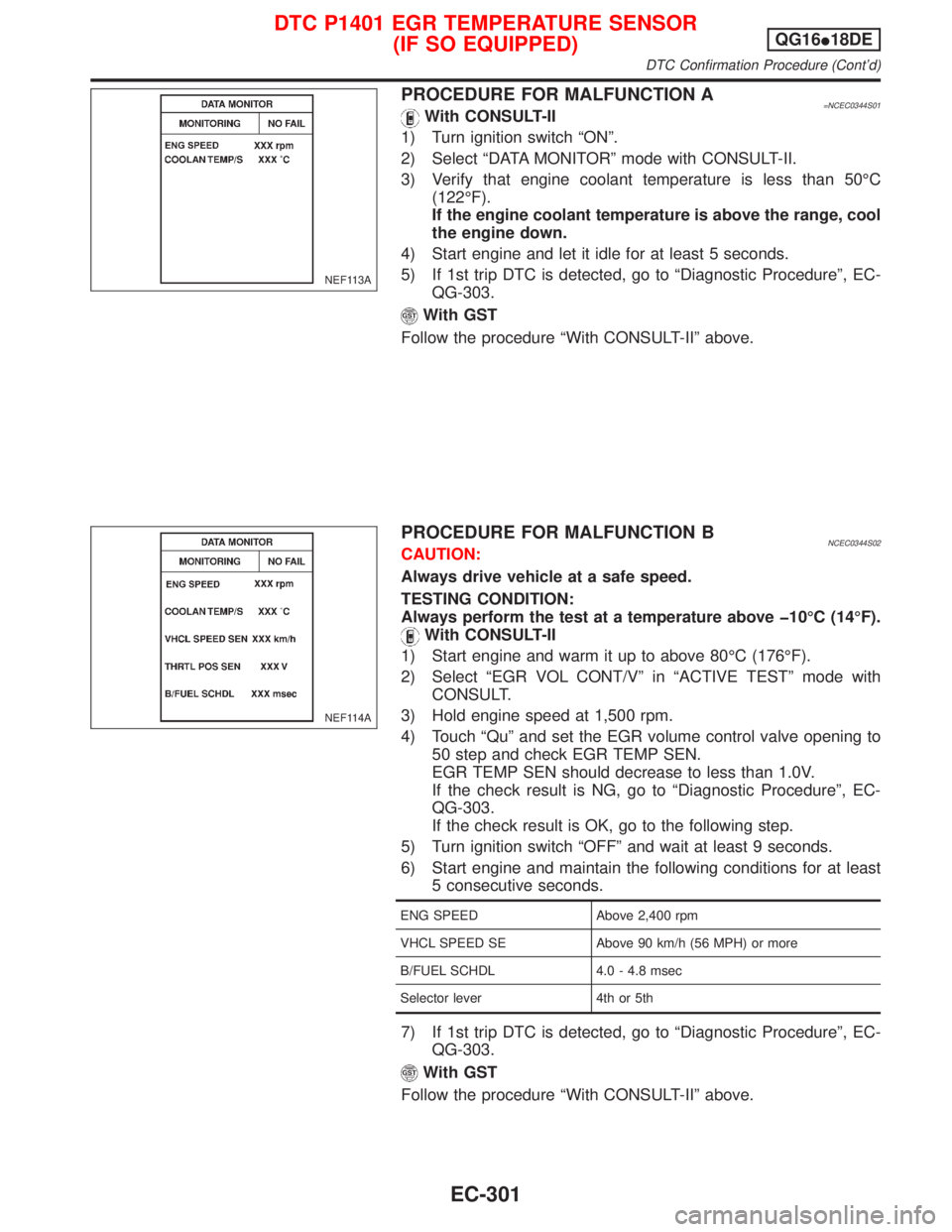
PROCEDURE FOR MALFUNCTION A=NCEC0344S01With CONSULT-II
1) Turn ignition switch ªONº.
2) Select ªDATA MONITORº mode with CONSULT-II.
3) Verify that engine coolant temperature is less than 50ÉC
(122ÉF).
If the engine coolant temperature is above the range, cool
the engine down.
4) Start engine and let it idle for at least 5 seconds.
5) If 1st trip DTC is detected, go to ªDiagnostic Procedureº, EC-
QG-303.
With GST
Follow the procedure ªWith CONSULT-IIº above.
PROCEDURE FOR MALFUNCTION BNCEC0344S02CAUTION:
Always drive vehicle at a safe speed.
TESTING CONDITION:
Always perform the test at a temperature above þ10ÉC (14ÉF).
With CONSULT-II
1) Start engine and warm it up to above 80ÉC (176ÉF).
2) Select ªEGR VOL CONT/Vº in ªACTIVE TESTº mode with
CONSULT.
3) Hold engine speed at 1,500 rpm.
4) Touch ªQuº and set the EGR volume control valve opening to
50 step and check EGR TEMP SEN.
EGR TEMP SEN should decrease to less than 1.0V.
If the check result is NG, go to ªDiagnostic Procedureº, EC-
QG-303.
If the check result is OK, go to the following step.
5) Turn ignition switch ªOFFº and wait at least 9 seconds.
6) Start engine and maintain the following conditions for at least
5 consecutive seconds.
ENG SPEED Above 2,400 rpm
VHCL SPEED SE Above 90 km/h (56 MPH) or more
B/FUEL SCHDL 4.0 - 4.8 msec
Selector lever 4th or 5th
7) If 1st trip DTC is detected, go to ªDiagnostic Procedureº, EC-
QG-303.
With GST
Follow the procedure ªWith CONSULT-IIº above.
NEF113A
NEF114A
DTC P1401 EGR TEMPERATURE SENSOR
(IF SO EQUIPPED)QG16I18DE
DTC Confirmation Procedure (Cont'd)
EC-301
Page 745 of 2267

Diagnostic ProcedureNCEC0347
1 CHECK POWER SUPPLY
1. Turn ignition switch ªOFFº.
2. Disconnect EGR temperature sensor harness connector.
SEF127X3. Turn ignition switch ªONº.
4. Check voltage between terminal 2 and ground with CONSULT-II or tester.
SEF128XVoltage: Approximately 5V
OK or NG
OK©GO TO 2.
NG©Repair harness or connectors.
2 CHECK GROUND CIRCUIT
1. Turn ignition switch ªOFFº.
2. Check harness continuity between EGR temperature sensor harness terminal 1 and engine ground. Refer to wiring diagram.
Continuity should exist.
3. Also check harness for short to ground and short to power.
OK or NG
OK©GO TO 4.
NG©GO TO 3.
3 DETECT MALFUNCTIONING PART
Check the harness for open or short between EGR temperature sensor and ECM.
©Repair open circuit or short to ground or short to power in harness or connector.
4 CHECK EGR TEMPERATURE SENSOR
Refer to ªComponent Inspectionº, EC-QG-304.
OK or NG
OK©GO TO 5.
NG©Replace EGR temperature sensor.
DTC P1401 EGR TEMPERATURE SENSOR
(IF SO EQUIPPED)QG16I18DE
Diagnostic Procedure
EC-303
Page 748 of 2267
CONSULT-II Reference Value in Data Monitor
Mode
NCEC0539Specification data are reference values.
MONITOR ITEM CONDITION SPECIFICATION
EGR TEMP SENIEngine: After warming up Less than 4.5V
EGR VOL CON/VIEngine: After warming up
IAir conditioner switch: ªOFFº
IShift lever: ªNº
INo-loadIdle 0 step
Revving engine up to 3,000 rpm
quickly10 - 55 step
ECM Terminals and Reference ValueNCEC0540Specification data are reference values, and are measured between each terminal and ground.
CAUTION:
Do not use ECM ground terminals when measuring input/output voltage. Doing so may result in dam-
age to the ECM's transistor. Use a ground other than ECM terminals, such as the ground.
TERMI-
NAL
NO.WIRE
COLORITEM CONDITION DATA (DC Voltage)
8
9
17
18W/B
SB
G/R
R/YEGR volume control valve[Engine is running.]
IWarm-up condition
IRev engine up from 2,000 to 4,000 rpm.0 - 14V
58 B Sensor's ground[Engine is running.]
IWarm-up condition
IIdle speed0V
72 PU EGR temperature sensor[Engine is running.]
IWarm-up condition
IIdle speedLess than 4.5V
[Engine is running.]
IWarm-up condition
IEGR system is operating.0 - 1.0V
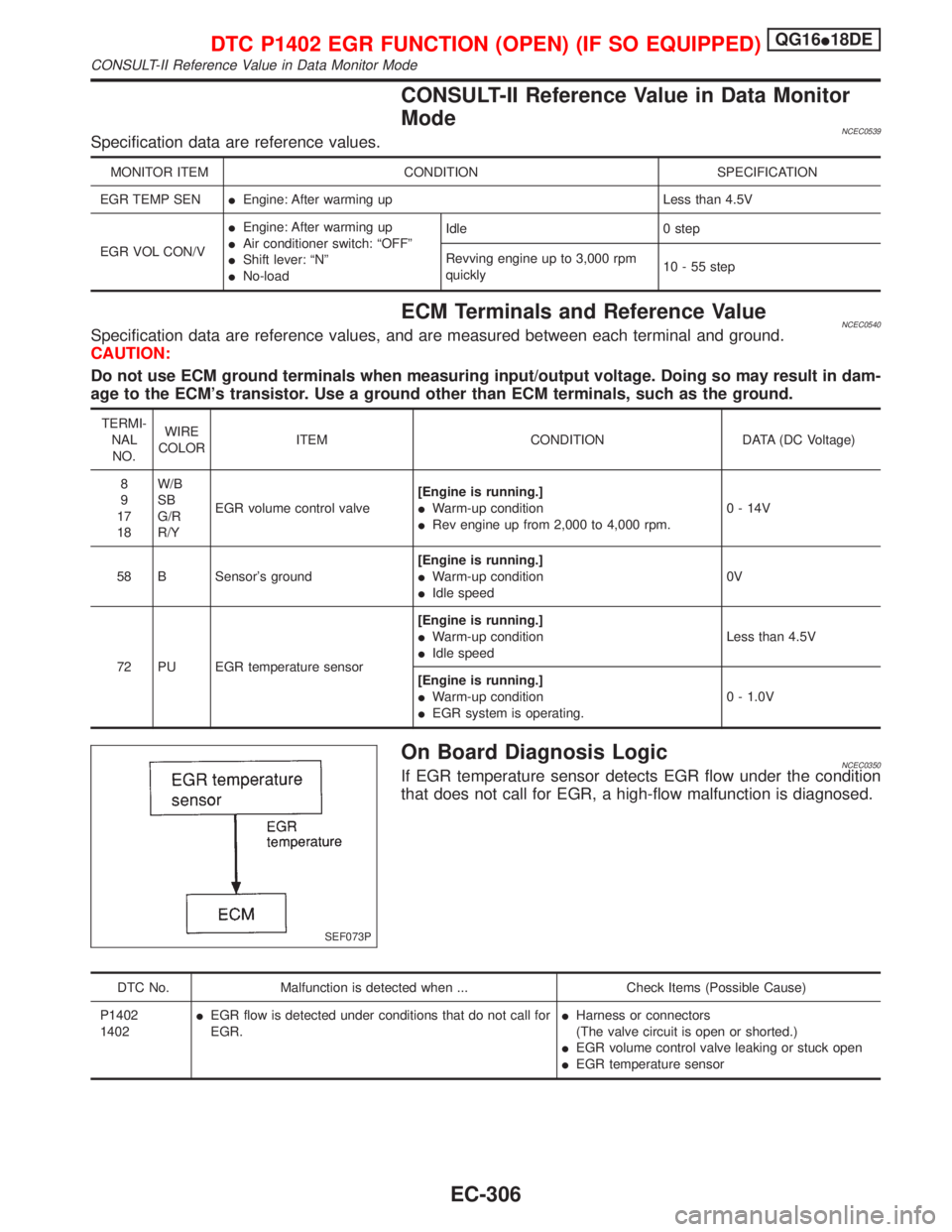
On Board Diagnosis LogicNCEC0350If EGR temperature sensor detects EGR flow under the condition
that does not call for EGR, a high-flow malfunction is diagnosed.
DTC No. Malfunction is detected when ... Check Items (Possible Cause)
P1402
1402IEGR flow is detected under conditions that do not call for
EGR.IHarness or connectors
(The valve circuit is open or shorted.)
IEGR volume control valve leaking or stuck open
IEGR temperature sensor
SEF073P
DTC P1402 EGR FUNCTION (OPEN) (IF SO EQUIPPED)QG16I18DE
CONSULT-II Reference Value in Data Monitor Mode
EC-306