service NISSAN PULSAR 1987 User Guide
[x] Cancel search | Manufacturer: NISSAN, Model Year: 1987, Model line: PULSAR, Model: NISSAN PULSAR 1987Pages: 238, PDF Size: 28.91 MB
Page 32 of 238

32
ROADSIDE TROUBLE SHOOTING
CAUTION: To prevent severe electrical shock extreme care must be taken w\
hen
working on or near the electronic ignition system as dangerous high tension voltages
are produced in both the primary and secondary circuits. See the text fo\
r
precautionary notes.
This section deals with the common causes of
engine failure to start, as inevitably there will come a
time when every driver will experience this problem
and will therefore need to call upon his own resources
to rectify the trouble. Roadside breakdowns other
than engine failure can be identified by reference to
the Trouble Shooting section on the particular com-
ponent affected.
1. TROUBLE SHOOTING
Trouble shooting is only a process of elimination
and provided the procedure is carried out correctly
and systematically an accur ate diagnosis of the trouble
can be made in the minimum amount of time.
For an internal combustion engine to run there
are three basic requirements, these are ignition, fuel
and compression. There are other factors of course
but as a rule an engine's failure to start can be
attributed to a fault in one of these three systems.
Reports from field engineers of motoring organi-
sations prove that the bigg est percentage of engine
breakdowns are in the order of ignition or electrical
failure first, followed by fuel, with mechanical or
compression failure the least common.
Should the engine fail to start, first check that
there is adequate fuel in the tank and if so. carry out
the following checking procedures in the order de-
scribed.
TO JUMP START A VEHICLE
NOTE: Jump starting a vehicle can be
dangerous if the procedure described below
is not performed correctly. If any doubt
exists, it is recommended that the services of
a competent mechanic be obtained.
The vehicles covered by this manual are
equipped with complex electronic circuitry
which can be damaged by voltage surges.
These voltage surges can be generated when
jump starting, or being jump started by
another vehicle. If av ailable use jumper
leads equipped with a surge protection de-
vice and follow the lead manufacturers in-
structions carefully, particularly regarding
the connection and disconnection of the
leads.
(1) Ensure that the booster battery is 12 volts
and the negative terminal is earthed.
(2) Ensure that the vehicles are not touching and
that the ignition and all accessories on both vehicles
are switched Off. (3) Ensure that the transmissions on both vehi-
cles are in Park or Neutral and the handbrakes are
firmly applied. (4) Remove the vent caps from the battery and
check the electrolyte level. Replenish with distilled
water as necessary.
View showing the correct jumper lead connections for
jump starting a vehicle. The leads shown are equipped
with a surge protection device.
Page 34 of 238
Roadside Trouble Shooting
ing the wiring from any component, ensure
that the ignition switch is off and the
negative battery terminal is disconnected to
prevent damage to the solid state circuitry.
(4) Open the electrode gap of a serviceable spark
plug to 6 mm. Securely earth the plug using a jumper
lead or by tying the plug to an earthed engine
component.
(5) Disconnect the high tension lead from a
spark plug and connect it to the test spark plug.
(6) Have an assistant operate the starter motor.
(7) Check that a spark, if any, jumps the gap on
the test spark plug. If the spark is satisfactory, proceed to operation
(8).
If there is no spark, proceed as follows:
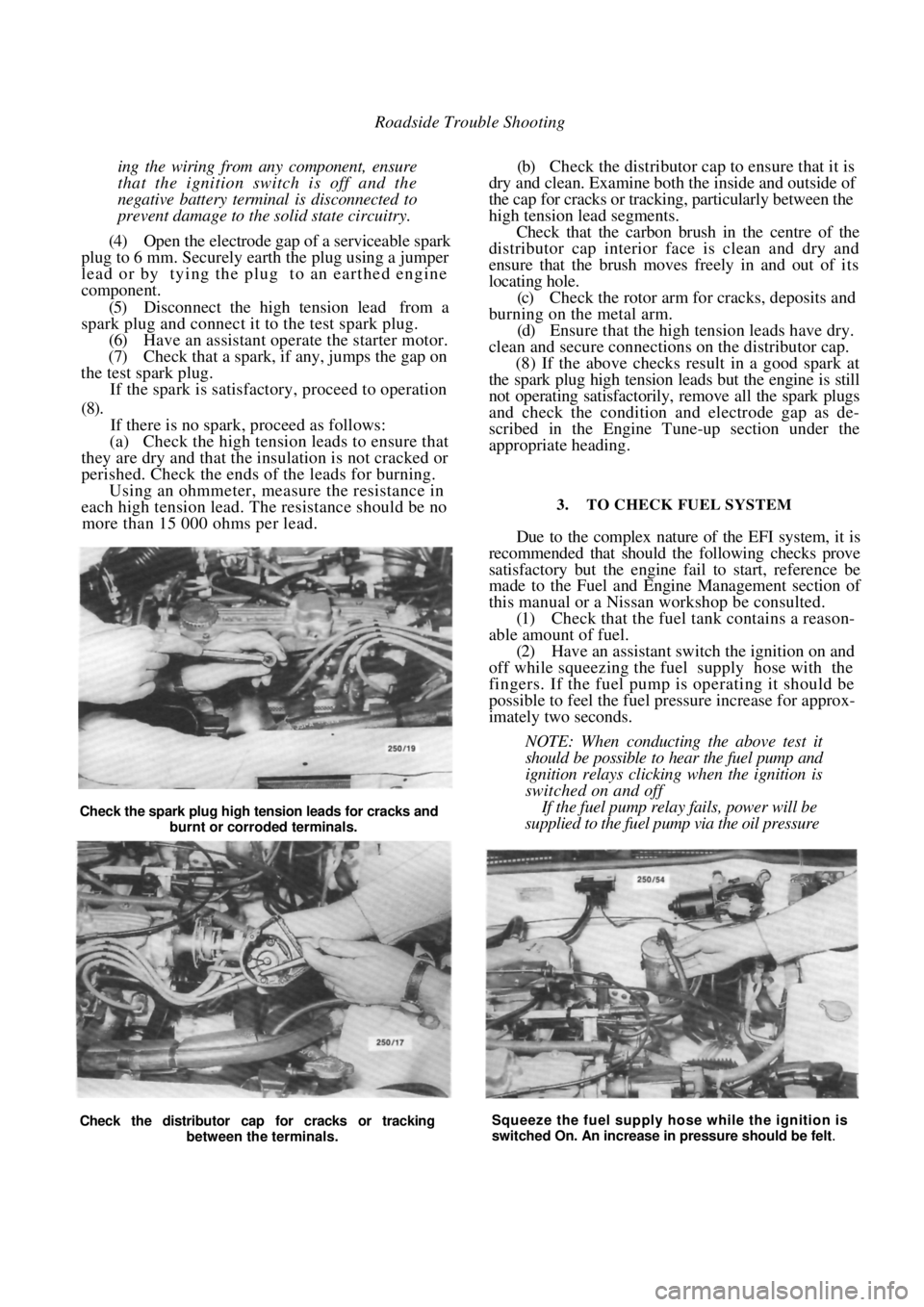
(a) Check the high tension leads to ensure that
they are dry and that the insulation is not cracked or
perished. Check the ends of the leads for burning. Using an ohmmeter, measure the resistance in
each high tension lead. The resistance should be no
more than 15 000 ohms per lead.
(b) Check the distributor cap to ensure that it is
dry and clean. Examine both the inside and outside of
the cap for cracks or tracki ng, particularly between the
high tension lead segments.
Check that the carbon brush in the centre of the
distributor cap interior fa ce is clean and dry and
ensure that the brush moves freely in and out of its
locating hole.
(c) Check the rotor arm for cracks, deposits and
burning on the metal arm. (d) Ensure that the high tension leads have dry.
clean and secure connections on the distributor cap. (8) If the above checks r esult in a good spark at
the spark plug high tension leads but the engine is still
not operating satisfac torily, remove all the spark plugs
and check the condition and electrode gap as de-
scribed in the Engine Tune-up section under the
appropriate heading.
3. TO CHECK FUEL SYSTEM
Due to the complex nature of the EFI system, it is
recommended that should the following checks prove
satisfactory but the engine fail to start, reference be
made to the Fuel and Engine Management section of
this manual or a Nissan workshop be consulted.
(1) Check that the fuel tank contains a reason-
able amount of fuel. (2) Have an assistant switch the ignition on and
off while squeezing the fuel supply hose with the
fingers. If the fuel pump is operating it should be
possible to feel the fuel pr essure increase for approx-
imately two seconds.
NOTE: When conducting the above test it
should be possible to hear the fuel pump and
ignition relays clicking when the ignition is
switched on and off
If the fuel pump relay fails, power will be
supplied to the fuel pump via the oil pressure
Check the distributor cap for cracks or tracking between the terminals. Squeeze the fuel supply hose while the ignition is
switched On. An increase in pressure should be felt.
Check the spark plug high tension leads for cracks and
burnt or corroded terminals.
Page 35 of 238
Roadside Trouble Shooting 35
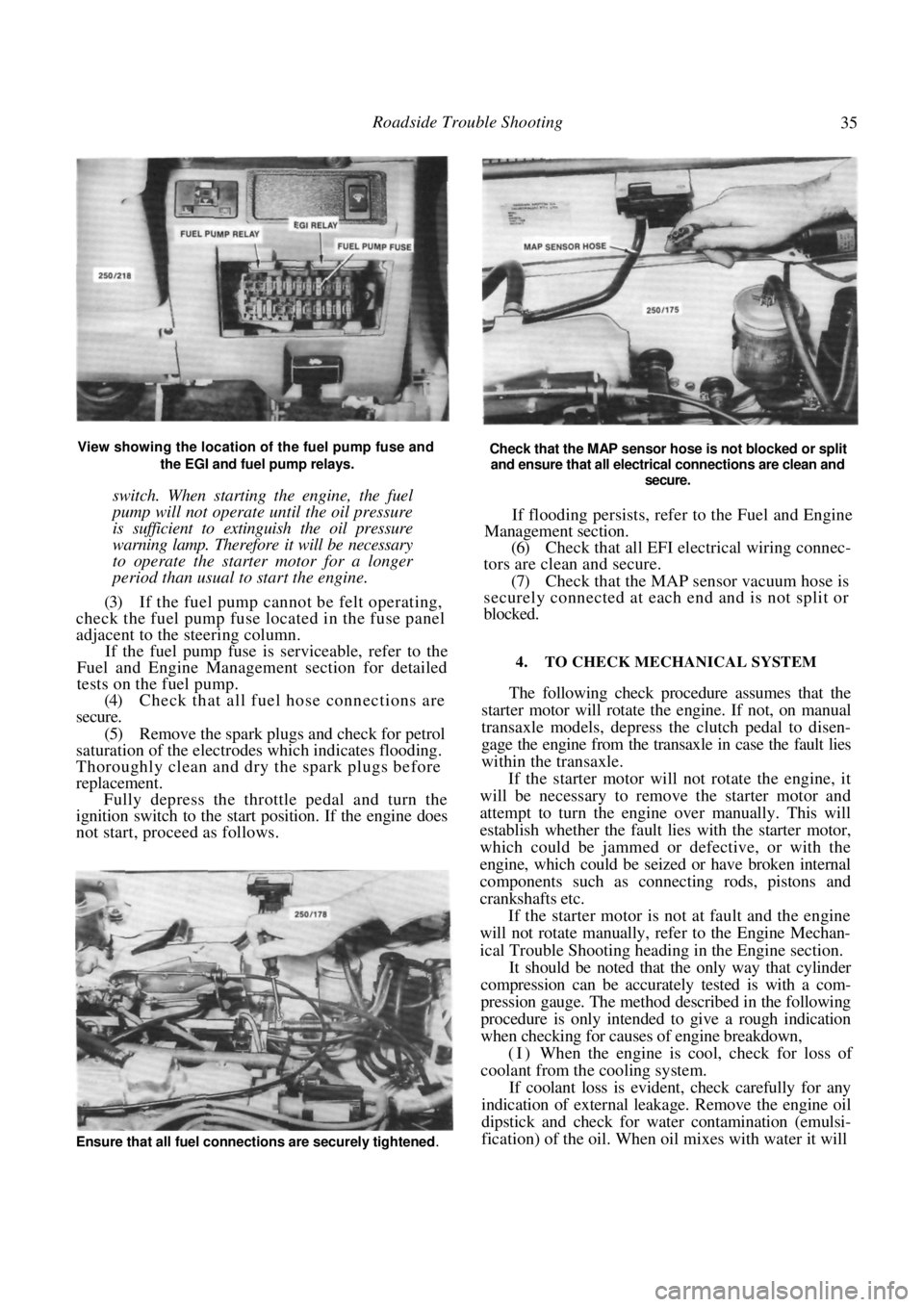
View showing the location of the fuel pump fuse and the EGI and fuel pump relays.
switch. When starting the engine, the fuel
pump will not operate until the oil pressure
is sufficient to extinguish the oil pressure
warning lamp. Therefore it will be necessary
to operate the starter motor for a longer
period than usual to start the engine.
(3) If the fuel pump cannot be felt operating,
check the fuel pump fuse located in the fuse panel
adjacent to the steering column.
If the fuel pump fuse is serviceable, refer to the
Fuel and Engine Management section for detailed
tests on the fuel pump.
(4) Check that all fuel hose connections are
secure.
(5) Remove the spark plugs and check for petrol
saturation of the electrodes which indicates flooding.
Thoroughly clean and dry the spark plugs before
replacement. Fully depress the throttle pedal and turn the
ignition switch to the start position. If the engine does
not start, proceed as follows.
Check that the MAP sensor hose is not blocked or split
and ensure that all electrical connections are clean and
secure.
If flooding persists, refer to the Fuel and Engine
Management section.
(6) Check that all EFI electrical wiring connec-
tors are clean and secure.
(7) Check that the MAP sensor vacuum hose is
securely connected at each end and is not split or
blocked.
4. TO CHECK MECHANICAL SYSTEM
The following check procedure assumes that the
starter motor will rotate the engine. If not, on manual
transaxle models, depress the clutch pedal to disen-
gage the engine from the tr ansaxle in case the fault lies
within the transaxle.
If the starter motor will not rotate the engine, it
will be necessary to remove the starter motor and
attempt to turn the engine over manually. This will
establish whether the fault lies with the starter motor,
which could be jammed or defective, or with the
engine, which could be seized or have broken internal
components such as connecting rods, pistons and
crankshafts etc.
If the starter motor is not at fault and the engine
will not rotate manually, refer to the Engine Mechan-
ical Trouble Shooting heading in the Engine section.
It should be noted that the only way that cylinder
compression can be accurately tested is with a com-
pression gauge. The method described in the following
procedure is only intended to give a rough indication
when checking for causes of engine breakdown,
(I) When the engine is cool, check for loss of
coolant from the cooling system.
If coolant loss is evident, check carefully for any
indication of external leakage. Remove the engine oil
dipstick and check for wate r contamination (emulsi-
fication) of the oil. When oil mixes with water it will
Ensure that all fuel connections are securely tightened.
Page 49 of 238
Engine 49
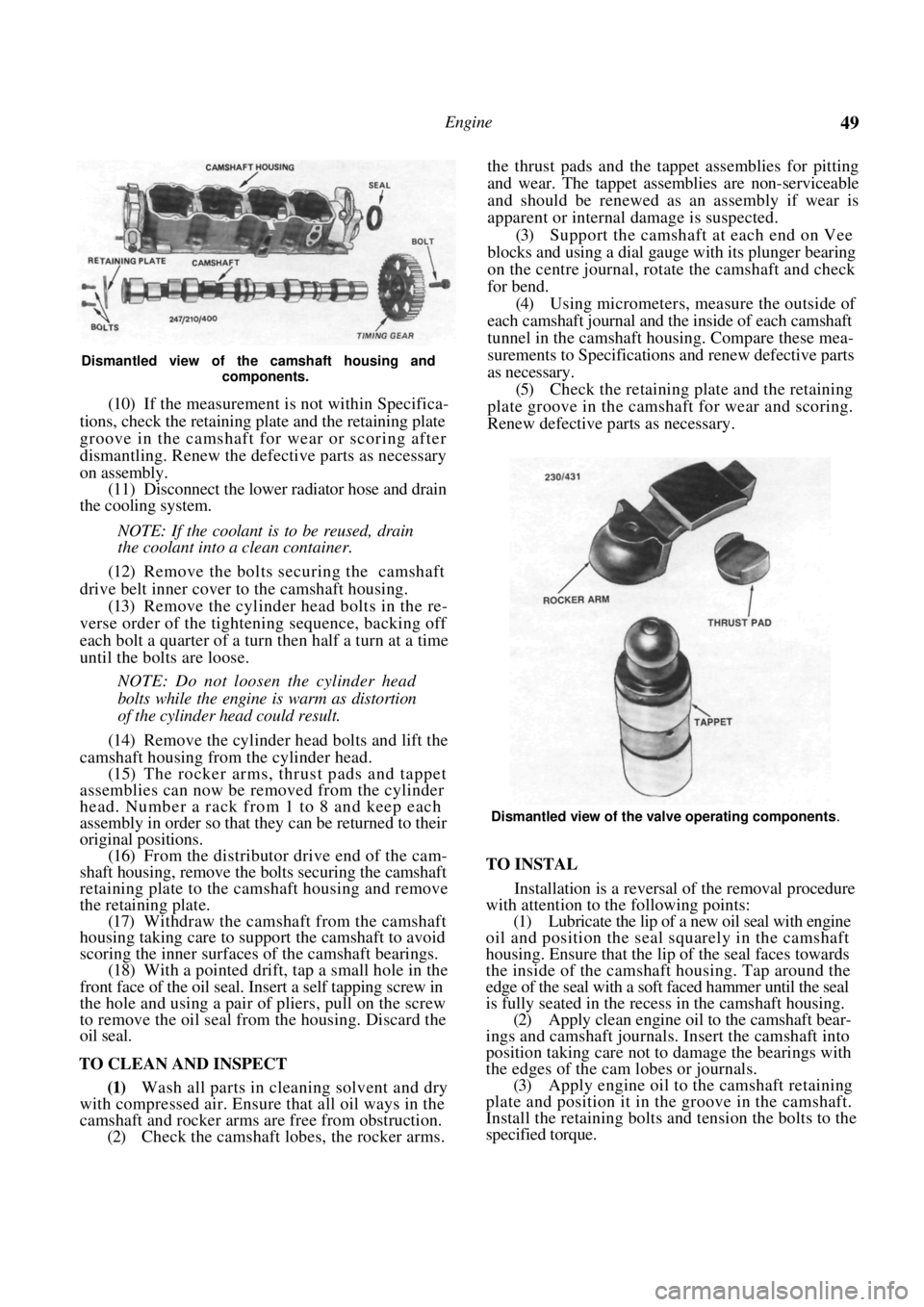
Dismantled view of the camshaft housing and components.
(10) If the measurement is not within Specifica-
tions, check the retaining plate and the retaining plate
groove in the camshaft for wear or scoring after
dismantling. Renew the defective parts as necessary
on assembly. (11) Disconnect the lower radiator hose and drain
the cooling system.
NOTE: If the coolant is to be reused, drain
the coolant into a clean container.
(12) Remove the bolts securing the camshaft
drive belt inner cover to the camshaft housing. (13) Remove the cylinder head bolts in the re-
verse order of the tighten ing sequence, backing off
each bolt a quarter of a turn then half a turn at a time
until the bolts are loose.
NOTE: Do not loosen the cylinder head
bolts while the engine is warm as distortion
of the cylinder head could result.
(14) Remove the cylinder head bolts and lift the
camshaft housing from the cylinder head. (15) The rocker arms, thrust pads and tappet
assemblies can now be removed from the cylinder
head. Number a rack from 1 to 8 and keep each
assembly in order so that they can be returned to their
original positions.
(16) From the distributor drive end of the cam-
shaft housing, remove the bolts securing the camshaft
retaining plate to the camshaft housing and remove
the retaining plate. (17) Withdraw the camshaft from the camshaft
housing taking care to supp ort the camshaft to avoid
scoring the inner surfaces of the camshaft bearings.
(18) With a pointed drift, tap a small hole in the
front face of the oil seal. Insert a self tapping screw in
the hole and using a pair of pliers, pull on the screw
to remove the oil seal from the housing. Discard the
oil seal.
TO CLEAN AND INSPECT
(1) Wash all parts in cleaning solvent and dry
with compressed air. Ensure that all oil ways in the
camshaft and rocker arms are free from obstruction.
(2) Check the camshaft lobes, the rocker arms. the thrust pads and the ta
ppet assemblies for pitting
and wear. The tappet assemblies are non-serviceable
and should be renewed as an assembly if wear is
apparent or internal damage is suspected.
(3) Support the camshaft at each end on Vee
blocks and using a dial gauge with its plunger bearing
on the centre journal, rotate the camshaft and check
for bend. (4) Using micrometers, measure the outside of
each camshaft journal and the inside of each camshaft
tunnel in the camshaft housing. Compare these mea-
surements to Specifications and renew defective parts
as necessary. (5) Check the retaining plate and the retaining
plate groove in the camshaft for wear and scoring.
Renew defective parts as necessary.
Dismantled view of the valve operating components.
TO INSTAL
Installation is a reversal of the removal procedure
with attention to the following points:
(1) Lubricate the lip of a new oil seal with engine
oil and position the seal squarely in the camshaft
housing. Ensure that the li p of the seal faces towards
the inside of the camshaft housing. Tap around the
edge of the seal with a soft faced hammer until the seal
is fully seated in the recess in the camshaft housing. (2) Apply clean engine oil to the camshaft bear-
ings and camshaft journals. Insert the camshaft into
position taking care not to damage the bearings with
the edges of the cam lobes or journals. (3) Apply engine oil to the camshaft retaining
plate and position it in the groove in the camshaft.
Install the retaining bolts and tension the bolts to the
specified torque.
Page 53 of 238
Engine 53
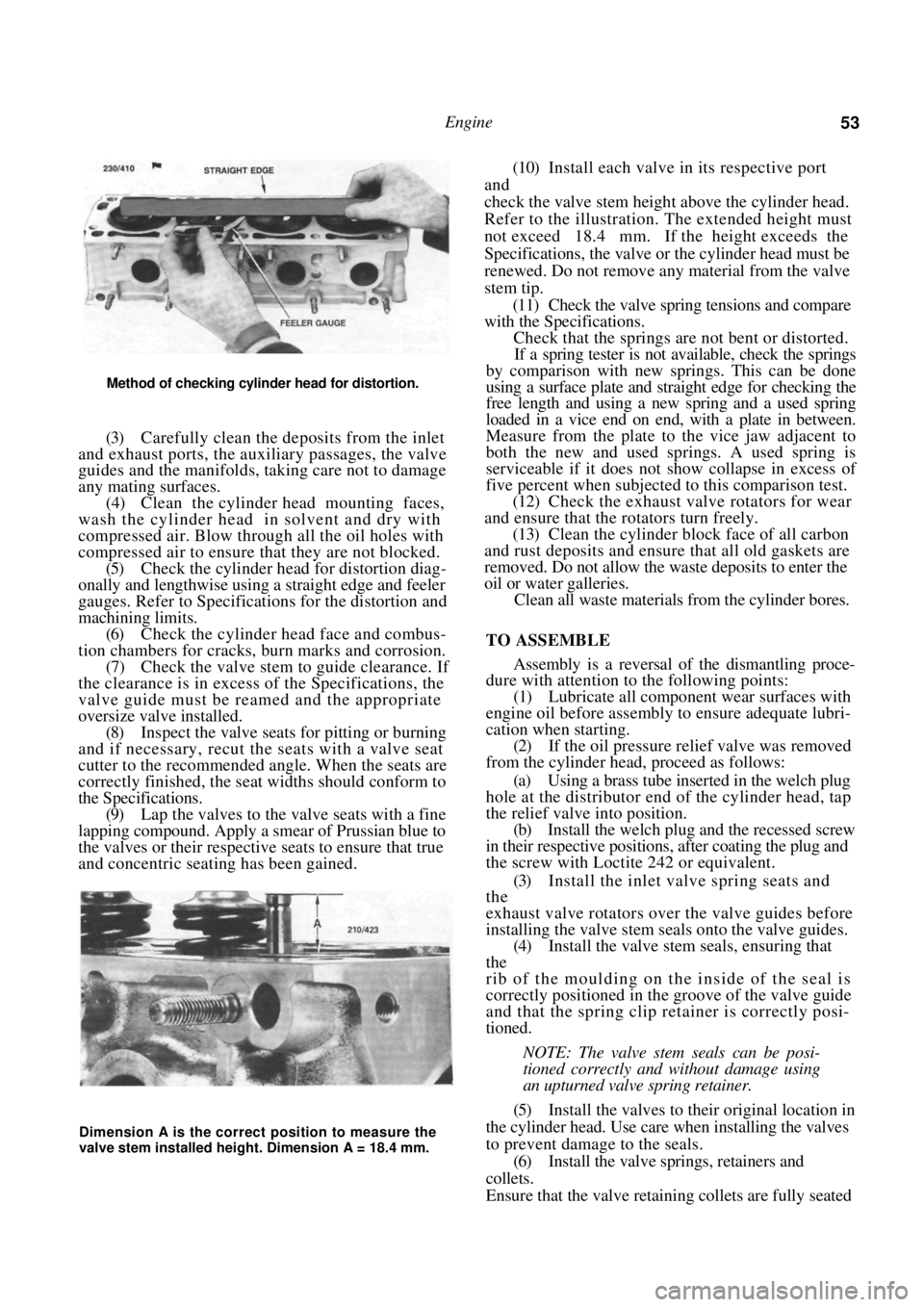
Method of checking cylinder head for distortion.
(3) Carefully clean the deposits from the inlet
and exhaust ports, the auxiliary passages, the valve
guides and the manifolds, taking care not to damage
any mating surfaces. (4) Clean the cylinder head mounting faces,
wash the cylinder head in solvent and dry with
compressed air. Blow through all the oil holes with
compressed air to ensure that they are not blocked. (5) Check the cylinder head for distortion diag-
onally and lengthwise using a straight edge and feeler
gauges. Refer to Specifications for the distortion and
machining limits. (6) Check the cylinder head face and combus-
tion chambers for cracks, burn marks and corrosion. (7) Check the valve stem to guide clearance. If
the clearance is in excess of the Specifications, the
valve guide must be reamed and the appropriate
oversize valve installed. (8) Inspect the valve seats for pitting or burning
and if necessary, recut the seats with a valve seat
cutter to the recommended angle. When the seats are
correctly finished, the seat widths should conform to
the Specifications. (9) Lap the valves to the valve seats with a fine
lapping compound. Apply a smear of Prussian blue to
the valves or their respective seats to ensure that true
and concentric seating has been gained.
(10) Install each valve in its respective port
and
check the valve stem height above the cylinder head.
Refer to the illustration. The extended height must
not exceed 18.4 mm. If the height exceeds the
Specifications, the valve or the cylinder head must be
renewed. Do not remove any material from the valve
stem tip.
(11) Check the valve spring tensions and compare
with the Specifications.
Check that the springs are not bent or distorted.
If a spring tester is not available, check the springs
by comparison with new springs. This can be done
using a surface plate and stra ight edge for checking the
free length and using a new spring and a used spring
loaded in a vice end on end, with a plate in between.
Measure from the plate to the vice jaw adjacent to
both the new and used springs. A used spring is
serviceable if it does not show collapse in excess of
five percent when subjected to this comparison test.
(12) Check the exhaust valve rotators for wear
and ensure that the rotators turn freely. (13) Clean the cylinder block face of all carbon
and rust deposits and ensure that all old gaskets are
removed. Do not allow the waste deposits to enter the
oil or water galleries. Clean all waste materials from the cylinder bores.
TO ASSEMBLE
Assembly is a reversal of the dismantling proce-
dure with attention to the following points:
(1) Lubricate all component wear surfaces with
engine oil before assembly to ensure adequate lubri-
cation when starting. (2) If the oil pressure relief valve was removed
from the cylinder head, proceed as follows:
(a) Using a brass tube inserted in the welch plug
hole at the distributor end of the cylinder head, tap
the relief valve into position. (b) Install the welch plug and the recessed screw
in their respective positions, after coating the plug and
the screw with Loctite 242 or equivalent.
(3) Install the inlet valve spring seats and
the
exhaust valve rotators over the valve guides before
installing the valve stem seals onto the valve guides.
(4) Install the valve stem seals, ensuring that
the
rib of the moulding on the inside of the seal is
correctly positioned in the groove of the valve guide
and that the spring clip retainer is correctly posi-
tioned.
NOTE: The valve stem seals can be posi-
tioned correctly and without damage using
an upturned valve spring retainer.
(5) Install the valves to their original location in
the cylinder head. Use care when installing the valves
to prevent damage to the seals.
(6) Install the valve springs, retainers and
collets.
Ensure that the valve retain ing collets are fully seated
Dimension A is the correct position to measure the
valve stem installed height. Dimension A = 18.4 mm.
Page 59 of 238

Engine 59
(5) If the engine is completely dismantled, thor-
oughly clean the cylinder block with solvent and
compressed air paying particular attention to the
oilways. Inspect the block for cracks and damage.
TO CHECK PISTON CLEARANCE
(1) Using an accurate cylinder measuring gauge,
measure and note the diameter of each bore as
previously described. (2) Measure each piston skirt using a microme-
ter as follows:
(a) On 1.6 liter models, measure each piston
skirt at a point 9 mm above the bottom skirt edge and
at right angles to the gudgeon pin axis. (b) On 1.8 liter models, measure each piston
skirt at a point 6 mm above the bottom skirt edge and
at right angles to the gudgeon pin axis.
(3) The difference between the bore and the
piston measurement is the piston clearance. If the
clearance exceeds the Specifications, renew the pistons
and rebore all the cylinders.
(4) Cylinders that have had new pistons installed
or that have been rebored should have the piston
clearance checked again.
and not engine or transmission oil, mineral spirits or
kerosene.
(2) Honing should be carried out by moving the
hone up and down fast enough to obtain a cross hatch
pattern. When hone marks intersect at 60 degrees, the
pattern is most satisfactory for correct seating of rings.
(3) After honing it is necessary that the block be
cleaned again to remove all traces of abrasives.
NOTE: When deglazing, the cylinder should
be honed only sufficiently to eliminate the
glazed condition. Excessive honing will in-
crease the bore size and alter the piston
clearance.
(4) When honing is complete, ensure that the
cylinder bore, crankcase area and oilways are thor-
oughly cleaned. (5) After the cylinder block has been cleaned and
dried, wipe the bores with a lint free cloth and smear
them with engine oil to prevent rusting.
NOTE: All abrasives must be removed from
the engine components after honing. A so-
lution of soap and water should be used with
a brush and the components thoroughly
dried. A bore can be considered clean when
it can be wiped clean with a white cloth and
the cloth remains clean. Oil the bores after
cleaning to prevent rusting.
TO FIT NEW PISTON RINGS AND INSTAL
PISTONS
Once the correct piston and the bore relationship
has been determined and the pistons cleaned or
renewed as necessary, proceed as follows:
(1) Place a ring into number one cylinder bore
and using an inverted piston push the ring down 50
mm into the cylinder bore. (2) Withdraw the piston and measure the gap in
the ring with feeler gauges. Adjust the end gap of the
ring by filing as necessary. See the Specifications for
the ring end gap.
Measuring the piston diameter using a micrometer. On
1.6 liter models, dimension A = 9 mm. On 1.8 liter
models, dimension A - 6 mm.
TO INSPECT AND DEGLAZE CYLINDER
BORES
Cylinder bores that are fit for further service with
the original pistons, but require re-ringing, should be
deglazed with a hone. Before honing the cylinder
bores with crankshaft insta lled, place plenty of clean
rag over the crankshaft to keep the abrasive materials
from entering the crankcase area.
(1) Deglaze the cylinder walls using a cylinder
surfacing hone equipped with suitable stones. Inspect
the cylinder walls after each 20 strokes. Use honing oil
Checking the piston ring end gap.
Page 72 of 238
72 Cooling and Heating Systems
(16) After the vehicle has been driven several
kilometers check the coolant level in the reserve tank
and top up if necessary.
TO REMOVE
(1) Drain the cooling system as previously de-
scribed.
(2) Loosen the hose clamps and disconnect the
hoses from the radiator. (3) If applicable disconnect the automatic trans-
axle oil cooler hoses from the left hand side radiator
tank. Plug the hoses and fitt ings to prevent the entry
of dirt and the loss of fluid.
(4) Disconnect the hose from the reserve tank at
the top of the radiator. (5) On models with air conditioning, remove the
hoses and support bracket bolts and move the bracket
and hoses away from the top of the radiator. (6) Remove the radiator support bracket bolts
from the radiator support pa nel and lift the radiator
from the lower mountings and out of the vehicle.
NOTE: A radiator that has been in use for
some time should not be allowed to stand
empty for any length of time. The radiator
should be immersed in a tank of coolant or
otherwise kept full. If applicable, ensure that
no coolant is allowed to enter the automatic
transaxle oil cooler in the left hand side tank
of the radiator.
Failure to observe this precaution may
result in overheating when the engine is put
back into service. This is caused by internal
deposits in the radiator drying and flaking
and so obstructing the circulation of the
coolant in the system.
TO FLUSH AND CLEAN
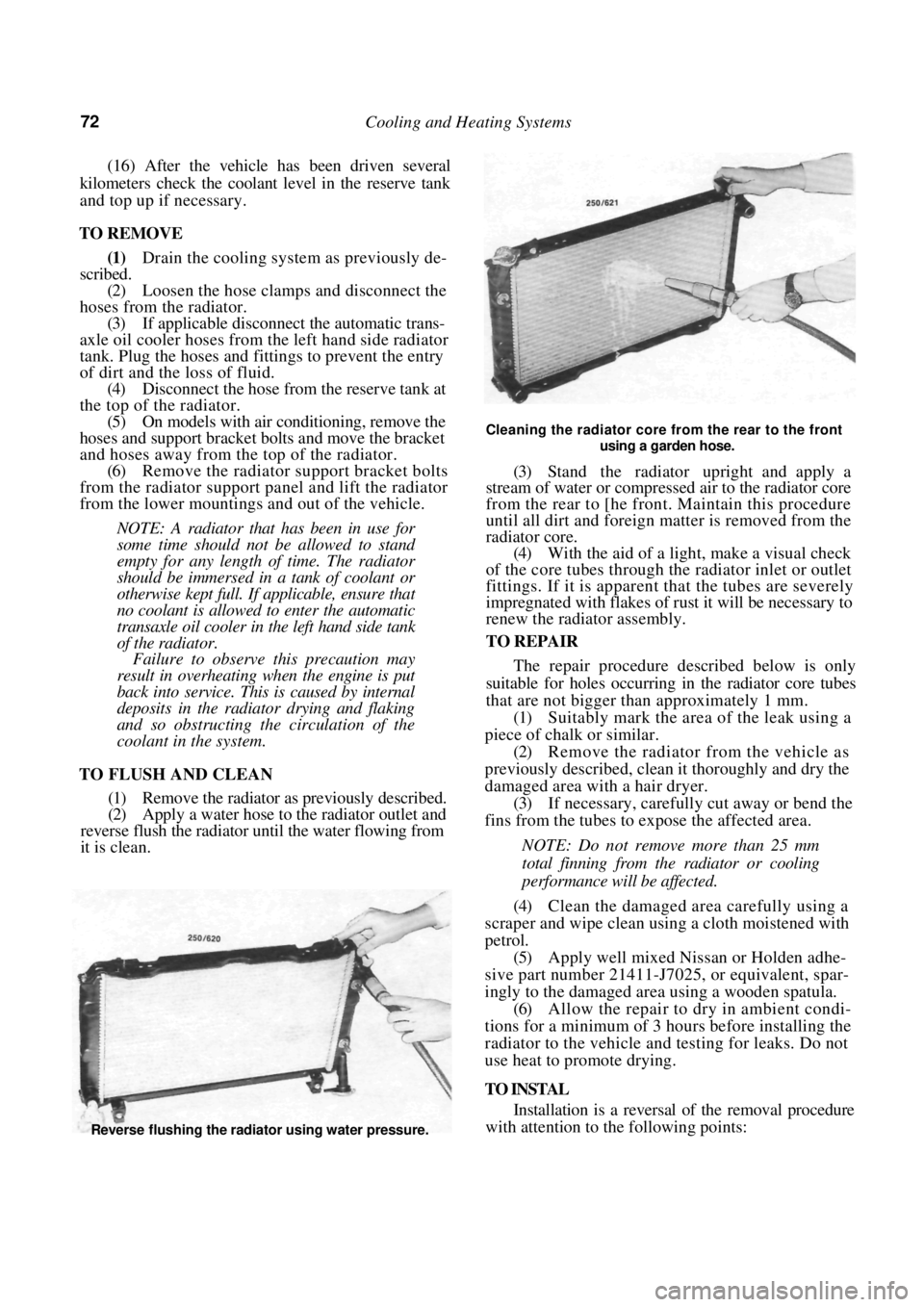
(1) Remove the radiator as previously described.
(2) Apply a water hose to the radiator outlet and
reverse flush the radiator until the water flowing from
it is clean.
Cleaning the radiator core from the rear to the front
using a garden hose.
(3) Stand the radiator upright and apply a
stream of water or compressed air to the radiator core
from the rear to [he front. Maintain this procedure
until all dirt and foreign matter is removed from the
radiator core.
(4) With the aid of a light, make a visual check
of the core tubes through the radiator inlet or outlet
fittings. If it is apparent that the tubes are severely
impregnated with flakes of rust it will be necessary to
renew the radiator assembly.
TO REPAIR
The repair procedure described below is only
suitable for holes occurring in the radiator core tubes
that are not bigger than approximately 1 mm.
(1) Suitably mark the area of the leak using a
piece of chalk or similar. (2) Remove the radiator from the vehicle as
previously described, clean it thoroughly and dry the
damaged area with a hair dryer. (3) If necessary, carefully cut away or bend the
fins from the tubes to expose the affected area.
NOTE: Do not remove more than 25 mm
total finning from the radiator or cooling
performance will be affected.
(4) Clean the damaged area carefully using a
scraper and wipe clean using a cloth moistened with
petrol.
(5) Apply well mixed Nissan or Holden adhe-
sive part number 21411-J7025, or equivalent, spar-
ingly to the damaged area using a wooden spatula.
(6) Allow the repair to dry in ambient condi-
tions for a minimum of 3 hours before installing the
radiator to the vehicle and testing for leaks. Do not
use heat to promote drying.
TO INSTAL
Installation is a reversal of the removal procedure
with attention to the following points:
Reverse flushing the radiator using water pressure.
Page 74 of 238
74 Cooling and Heating Systems
NOTE: Refer to the Fuel and Engine Man-
agement section for the correct procedure for
backprobing the control unit.
(3) In operation (1) if the cooling fan is station-
ary proceed as follows:
(a) Connect a jumper lead between the terminals
A and B of the diagnostic link connector. (b) if the fan runs, the fan circuit is satisfactory.
If the engine is overheating check the coolant temper-
ature sensor as described in the Fuel and Engine
Management section under the appropriate codes. (c) If the fan does not run, check the fuse (6) and
the fusible link (4) show n on the illustration.
(d) Backprobe terminal C1 at the electronic
control unit using an LED t est lamp connected to the
positive battery terminal. If no circuit exists, renew
the electronic control unit. (e) If the fuse and fusible links are serviceable,
ensure that power is available at the white and pink
wires from the fuse and fusible link of the cooling fan
relay. Repair any faults in the wiring to that point if
necessary. (f) Switch the ignition Off. disconnect the
cooling fan wiring connector at the radiator and
connect power to the fan. Renew the fan if it does not
run.
(4) On air conditioned models, remove the
jumper lead from the ALDL connector if still in-
stalled, start the engine and allow it to idle. Switch the
air conditioning on and ensu re that the cooling fan
runs.
If the cooling fan is opera ting as described above
but cooling system problems still exist, refer to the
Trouble Shooting heading at the start of this section.
TO REMOVE AND INSTAL COOLING FAN
(1) Disconnect the negative battery terminal.
(2) Disconnect the cooling fa n and, if applicable,
the air conditioning fan wiring connectors at the
upper edge of the radiator. (3) On models with air conditioning, remove the
compressor hose bracket bolt from the centre of the
radiator support panel.
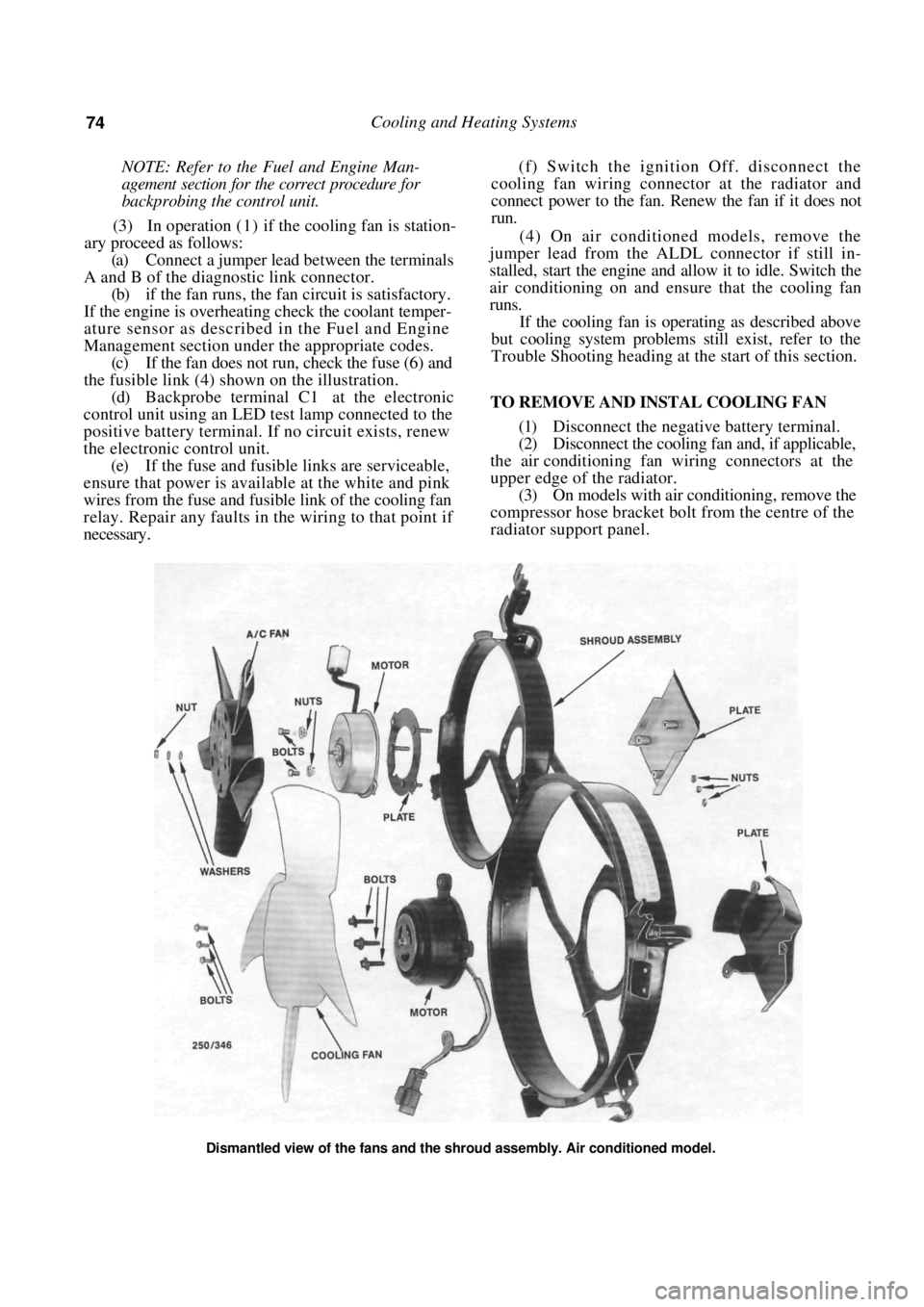
Dismantled view of the fans and the shroud assembly. Air conditioned model.
Page 75 of 238

Cooling and Heating Systems 75
(4) Remove the bolts retaining the fan shroud
assembly to the radiator and carefully move the
shroud assembly upwards and towards the engine to
release it from the lower mountings.
NOTE: On models with air conditioning, it
will be necessary to hold the air conditioning
compressor hoses toward s the engine to
allow clearance for removal of the shroud
assembly.
(5) If necessary, remove the fan from the fan
motor by removing the retaining bolts or on some
models the nut and washers.
(6) If necessary, remove the fan motor from the
shroud assembly by removing the retaining bolts or
nuts. Installation is a reversal of the removal procedure
with attention to the following points:
(1) Ensure all the fan motor and fan retaining
nuts and bolts are tightened securely. (2) Ensure that all the rubber mountings are in
good condition. Installation is a reversal of the removal procedure
with attention to the following points:
(1) Ensure that all sealing surfaces are clean.
(2) Renew the O ring on installation.
(3) Tighten the thermostat cover retaining bolts
securely.
(4) Fill the cooling system as previously de-
scribed ensuring that the heater control lever is in the
maximum heat position. Check for coolant leaks.
TO CHECK
NOTE: A visual examination of the thermo-
stat will often determine its serviceability
and make further testing unnecessary. For
instance, a thermostat with its valve fully-
open when removed from a cold engine is
obviously faulty and should be renewed.
Remove the thermostat from the thermostat
6. THERMOSTAT
Special Equipment Required:
To Check — Thermometer
TO REMOVE AND INSTAL
(1) Drain the cooling system as previously de-
scribed under the Radiator heading.
(2) On 1.6 liter models, remove the air cleaner
assembly. Refer to the Fuel and Engine Management
section if necessary. (3) Disconnect the top radiator hose from the
thermostat cover.
(4) Remove the bolts retaining the thermostat
cover to the thermostat housing. (5) Remove the thermostat cover, thermostat
and O ring from the thermostat housing.
NOTE: The thermostat and cover are ser-
viced as a unit and cannot be renewed
separately.
View of the thermostat removed from the vehicle and dismantled for testing. Line drawing showing the correct method to test the
thermostat.
(4) Progressively heat the mixture noting the
temperature reading on the thermometer as the ther-
mostat valve commences to open and when it is fully
open.
See the Specifications for opening and fully open
temperatures.
A thermostat which is not opening or is not open
at the specified temperatures should be renewed.
Page 81 of 238

Cooling and Heating Systems 81
continuous stream of bubbles indicates that the refriger-
ant charge is low.
A large number of bubbles or foam indicates that
the refrigerant charge is very low.
No bubbles or the presen ce of oil streaks in the
sight glass indicate that the system is completely
empty.
NOTE: If the outside air temperature is
high, a certain number of bubbles may be
observed in the sight gl ass, even though the
system is fully charged.
If the system requires recharging, the vehicle
should be taken to an authorized dealer for evacu-
ation, leak testing and recharging.
Do not operate the system if it is known that the
refrigerant charge is low as damage may result.
MAINTENANCE
The air conditioning system requires l i t t l e main-
tenance other than the following. Where applicable,
refer to the Lubrication an d Maintenance section for
the recommended service intervals.
(1) Check the refrigerant charge level in the
receiver/dryer sight glass. Recharge the system as
necessary. It is considered normal for the system to
require periodic recharging. (2) Inspect the air conditioner pipes and hoses
for leaks, deterioration and alignment. Evidence of oil
leakage is an indication of refrigerant leakage. Repair
or renew as necessary.
(3) Inspect the evaporator drain tube and the
condenser cooling fins for blockage. Clean as neces-
sary.
(4) Check the drive belt for deterioration and for
correct tension. Refer to the Engine Tune-up section
for the correct procedure.
(5) Operate the system at least once a week for
approximately 15 minutes to keep the compressor
seals lubricated.