fuel NISSAN ROGUE 2021 Owner´s Manual
[x] Cancel search | Manufacturer: NISSAN, Model Year: 2021, Model line: ROGUE, Model: NISSAN ROGUE 2021Pages: 556, PDF Size: 2.7 MB
Page 517 of 556
.If a methanol blend is used, it should
contain no more than 5% methanol
(methyl alcohol, wood alcohol). It
should also contain a suitable
amount of appropriate cosolvents
and corrosion inhibitors. If not prop-
erly formulated with appropriate
cosolvents and corrosion inhibitors,
such methanol blends may cause
fuel system damage and/or vehicle
performance problems. At this time,
sufficient data is not available to
ensure that all methanol blends are
suitable for use in NISSAN vehicles.
If any driveability problems such as en-
gine stalling and difficult hot-starting are
experienced after using oxygenate-blend
fuels, immediately change to a non-oxy-
genate fuel or a fuel with a low blend of
MTBE.
Take care not to spill gasoline during
refueling. Gasoline containing oxyge-
nates can cause paint damage.
E-15 fuel
E-15 fuel is a mixture of approximately
15% fuel ethanol and 85% unleaded gaso-
line. E-15 can only be used in vehicles
designed to run on E- 15 fuel. U.S. govern-
ment regulations require fuel ethanol
dispensing pumps to be identified with
small, square, orange and black label with
the common abbreviation or the appro- priate percentage for that region.
E-85 fuel
E-85 fuel is a mixture of approximately
85% fuel ethanol and 15% unleaded gaso-
line. E-85 can only be used in a Flexible
Fuel Vehicle (FFV). Do not use E-85 fuel in
your vehicle. U.S. government regulations
require fuel ethanol dispensing pumps to
be identified by a small, square, orange
and black label with the common abbre-
viation or the appropriate percentage for
that region.
Fuel containing MMT
MMT, or methylcyclopentadienyl manga-
nese tricarbonyl, is an octane boosting
additive. NISSAN does not recommend
the use of fuel containing MMT. Such fuel
may adversely affect vehicle perfor-
mance, including the emissions control
system. Note that while some fuel pumps
label MMT content, not all do, so you may
have to consult your gasoline retailer for
more details.
Aftermarket fuel additives
NISSAN does not recommend the use of
any aftermarket fuel additives (for exam-
ple, fuel injector cleaner, octane booster,
intake valve deposit removers, etc.) which
are sold commercially. Many of these
additives intended for gum, varnish or
deposit removal may contain active sol-
vent or similar ingredients that can be
harmful to the fuel system and engine.
Octane rating tips
Using unleaded gasoline with an octane
rating lower than recommended can
cause persistent, heavy “spark knock”.
(Spark knock is a metallic rapping
noise.) If severe, this can lead to engine
damage. If you detect a persistent
heavy spark knock even when using
gasoline of the stated octane rating, or
if you hear steady spark knock while
holding a steady speed on level roads, it
is recommended you have a NISSAN
dealer correct the condition. Failure to
correct the condition is misuse of the
vehicle, for which NISSAN is not respon-
sible.
Incorrect ignition timing will result in
spark knock, after-run and/or overheat-
ing, which may cause excessive fuel
consumption or engine damage. If any
of the above symptoms are encountered,
have your vehicle checked. It is recom-
mended you visit a NISSAN dealer for
servicing.
However, now and then you may notice
light spark knock for a short time while
accelerating or driving up hills. This is
not a cause for concern, because you
Technical and consumer information10-5
Page 518 of 556
10-6Technical and consumer information
get the greatest fuel benefit when there
is light spark knock for a short time
under heavy engine load.
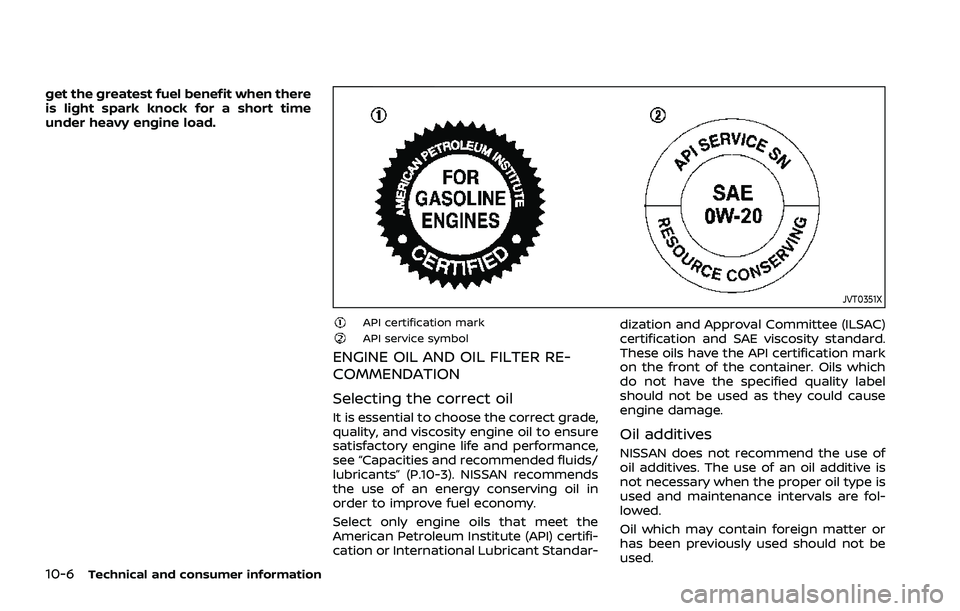
JVT0351X
API certification markAPI service symbol
ENGINE OIL AND OIL FILTER RE-
COMMENDATION
Selecting the correct oil
It is essential to choose the correct grade,
quality, and viscosity engine oil to ensure
satisfactory engine life and performance,
see “Capacities and recommended fluids/
lubricants” (P.10-3). NISSAN recommends
the use of an energy conserving oil in
order to improve fuel economy.
Select only engine oils that meet the
American Petroleum Institute (API) certifi-
cation or International Lubricant Standar-dization and Approval Committee (ILSAC)
certification and SAE viscosity standard.
These oils have the API certification mark
on the front of the container. Oils which
do not have the specified quality label
should not be used as they could cause
engine damage.
Oil additives
NISSAN does not recommend the use of
oil additives. The use of an oil additive is
not necessary when the proper oil type is
used and maintenance intervals are fol-
lowed.
Oil which may contain foreign matter or
has been previously used should not be
used.
Page 521 of 556
DIMENSIONS AND WEIGHTS
Overall length in(mm)182.9 (4,645)*1
183.5 (4,660)*2
Overall width in (mm)72.4 (1,840)
Overall height in (mm)67.9 (1,725)
Front tread in (mm)62.4 (1,585)
Rear tread in (mm)62.6 (1,590)
Wheelbase in (mm)106.5 (2,705)
Gross Vehicle
Weight Rating
(GVWR) lb (kg)
See the F.M.V.S.S. or
C.M.V.S.S. certifica-
tion label on the
driver’s side center
pillar.
Gross Axle
Weight Rating
(GAWR)
Front lb (kg)
Rear lb (kg)
*1: Without license plate
*2: With license plate
When planning to travel in another
country, you should first find out if the
fuel available is suitable for your vehicle’s
engine.
Using fuel with an octane rating that is
too low may cause engine damage. All
gasoline vehicles must be operated with
unleaded gasoline. Therefore, avoid tak-
ing your vehicle to areas where appro-
priate fuel is not available.
When transferring the registration of
your vehicle to another country, state,
province or district, it may be necessary
to modify the vehicle to meet local laws
and regulations.
The laws and regulations for motor
vehicle emission control and safety stan-
dards vary according to the country,
state, province or district; therefore, vehi-
cle specifications may differ.
When any vehicle is to be taken into
another country, state, province or dis-
trict and registered, its modifications,
transportation, and registration are the
responsibility of the user. NISSAN is not
responsible for any inconvenience that
may result.
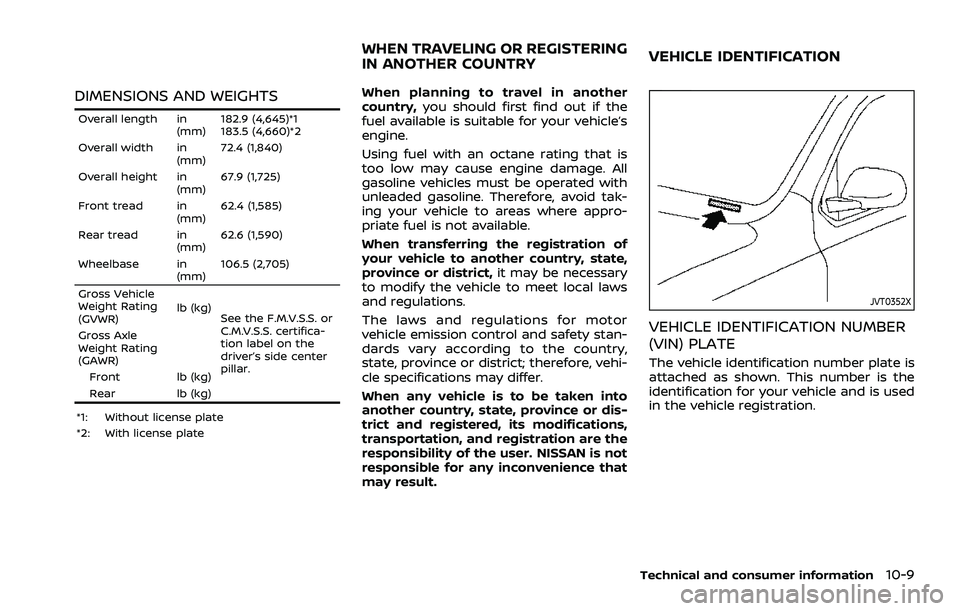
JVT0352X
VEHICLE IDENTIFICATION NUMBER
(VIN) PLATE
The vehicle identification number plate is
attached as shown. This number is the
identification for your vehicle and is used
in the vehicle registration.
Technical and consumer information10-9
WHEN TRAVELING OR REGISTERING
IN ANOTHER COUNTRYVEHICLE IDENTIFICATION
Page 536 of 556
10-24Technical and consumer information
vehicle.
. Determine the overall height of the
vehicle and trailer so the required
clearance is known.
Trailer towing tips
In order to gain skill and an understand-
ing of the vehicle’s behavior, you should
practice turning, stopping and backing up
in an area which is free from traffic.
Steering stability, and braking perfor-
mance will be somewhat different than
under normal driving conditions.
.Always secure items in the trailer to
prevent load shift while driving.
. Lock the trailer hitch coupler with a
pin or lock to prevent the coupler from
inadvertently becoming unlatched.
. Avoid abrupt starts, acceleration or
stops.
. Avoid sharp turns or lane changes.
. Always drive your vehicle at a moder-
ate speed. Some states or provinces
have specific speed limits for vehicles
that are towing trailers. Obey the local
speed limits.
. When backing up, hold the bottom of
the steering wheel with one hand.
Move your hand in the direction in
which you want the trailer to go. Make
small corrections and back up slowly.
If possible, have someone guide you when you are backing up.
Always block the wheels on both vehicle
and trailer when parking. Parking on a
slope is not recommended; however, if
you must do so:CAUTION
If you push the park button to
engage the P (Park) position before
blocking the wheels and applying
the parking brake, transmission da-
mage could occur.
1. Apply and hold the brake pedal.
2. Have someone place blocks on the downhill side of the vehicle and trailer
wheels.
3. After the wheel blocks are in place, slowly release the brake pedal until
the blocks absorb the vehicle load.
4. Apply the parking brake.
5. Push the park button to engage the P (Park) position.
6. Turn off the engine.
To drive away:
1. Apply and hold the brake pedal.
2. Start the engine. 3. Shift the transmission into gear.
4. Release the parking brake.
5. Drive slowly until the vehicle and
trailer are clear from the blocks.
6. Apply and hold the brake pedal.
7. Have someone retrieve and store the blocks.
. While going downhill, the weight of the
trailer pushing on the tow vehicle may
decrease overall stability. Therefore, to
maintain adequate control, reduce
your speed and shift to a lower gear.
Avoid long or repeated use of the
brakes when descending a hill, as this
reduces their effectiveness and could
cause overheating. Shifting to a lower
gear instead provides “engine braking”
and reduces the need to brake as
frequently.
. If the engine coolant temperature
rises to a high temperature, see “If
your vehicle overheats” (P.6-13).
. Trailer towing requires more fuel than
normal circumstances.
. Avoid towing a trailer for your vehicle’s
first 500 miles (800 km).
. For the first 500 miles (800 km) that
you do tow, do not drive over 50 MPH
(80 km/h).
Page 547 of 556
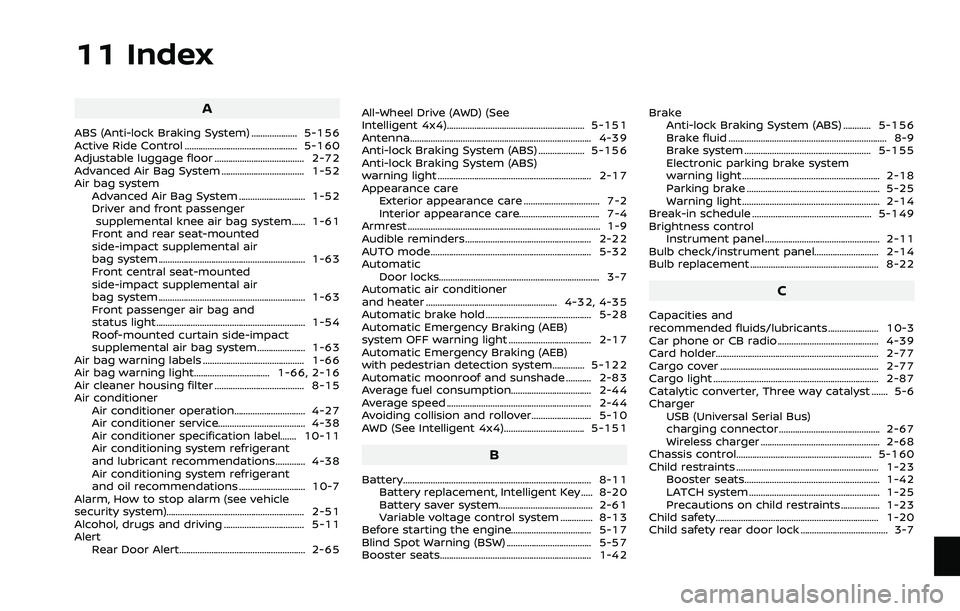
11 Index
A
ABS (Anti-lock Braking System) .................... 5-156
Active Ride Control ................................................. 5-160
Adjustable luggage floor ....................................... 2-72
Advanced Air Bag System .................................... 1-52
Air bag systemAdvanced Air Bag System ............................. 1-52
Driver and front passengersupplemental knee air bag system...... 1-61
Front and rear seat-mounted
side-impact supplemental air
bag system................................................................ 1-63
Front central seat-mounted
side-impact supplemental air
bag system................................................................ 1-63
Front passenger air bag and
status light................................................................. 1-54
Roof-mounted curtain side-impact
supplemental air bag system..................... 1-63
Air bag warning labels ............................................ 1-66
Air bag warning light................................. 1-66, 2-16
Air cleaner housing filter ....................................... 8-15
Air conditioner Air conditioner operation............................... 4-27
Air conditioner service...................................... 4-38
Air conditioner specification label....... 10-11
Air conditioning system refrigerant
and lubricant recommendations............. 4-38
Air conditioning system refrigerant
and oil recommendations ............................. 10-7
Alarm, How to stop alarm (see vehicle
security system)............................................................ 2-51
Alcohol, drugs and driving ................................... 5-11
Alert Rear Door Alert....................................................... 2-65 All-Wheel Drive (AWD) (See
Intelligent 4x4)............................................................ 5-151
Antenna........................................................................\
....... 4-39
Anti-lock Braking System (ABS) .................... 5-156
Anti-lock Braking System (ABS)
warning light ................................................................... 2-17
Appearance care
Exterior appearance care ................................. 7-2
Interior appearance care................................... 7-4
Armrest ........................................................................\
............ 1-9
Audible reminders....................................................... 2-22
AUTO mode...................................................................... 5-32
Automatic Door locks...................................................................... 3-7
Automatic air conditioner
and heater ......................................................... 4-32, 4-35
Automatic brake hold .............................................. 5-28
Automatic Emergency Braking (AEB)
system OFF warning light .................................... 2-17
Automatic Emergency Braking (AEB)
with pedestrian detection system.............. 5-122
Automatic moonroof and sunshade ........... 2-83
Average fuel consumption................................... 2-44
Average speed ............................................................... 2-44
Avoiding collision and rollover.......................... 5-10
AWD (See Intelligent 4x4)................................... 5-151
B
Battery........................................................................\
.......... 8-11 Battery replacement, Intelligent Key ..... 8-20
Battery saver system......................................... 2-61
Variable voltage control system .............. 8-13
Before starting the engine................................... 5-17
Blind Spot Warning (BSW) ..................................... 5-57
Booster seats.................................................................. 1-42 Brake
Anti-lock Braking System (ABS) ............ 5-156
Brake fluid ..................................................................... 8-9
Brake system ....................................................... 5-155
Electronic parking brake system
warning light ............................................................ 2-18
Parking brake .......................................................... 5-25
Warning light............................................................ 2-14
Break-in schedule .................................................... 5-149
Brightness control Instrument panel .................................................. 2-11
Bulb check/instrument panel............................ 2-14
Bulb replacement ........................................................ 8-22
C
Capacities and
recommended fluids/lubricants...................... 10-3
Car phone or CB radio ............................................ 4-39
Card holder....................................................................... 2-77
Cargo cover ..................................................................... 2-77
Cargo light ........................................................................\
2-87
Catalytic converter, Three way catalyst ....... 5-6
Charger USB (Universal Serial Bus)
charging connector............................................ 2-67
Wireless charger .................................................... 2-68
Chassis control........................................................... 5-160
Child restraints .............................................................. 1-23 Booster seats........................................................... 1-42
LATCH system ......................................................... 1-25
Precautions on child restraints................. 1-23
Child safety....................................................................... 1-20
Child safety rear door lock ...................................... 3-7
Page 548 of 556

11-2
ChimesSeat belt warning light
and chime.................................................... 1-15, 2-16
Chimes, Audible reminders.................................. 2-22
Circuit breaker, Fusible link ................................. 8-18
Cleaning exterior and interior ................... 7-2, 7-4
Clock ........................................................................\
.............. 2-46
Coat hook........................................................................\
.. 2-77
Cockpit ........................................................................\
............. 2-3
Cold weather driving ............................................. 5-172
Connection to Roadside Assistance ................ 6-2
Console box ..................................................................... 2-75
Continuously Variable Transmission
(CVT) fluid........................................................................\
....... 8-8
Continuously Variable Transmission (CVT)
position indicator ........................................................ 2-11
Conventional (fixed speed) cruise control
mode (with ProPILOT Assist)........................... 5-118
Coolant Capacities and
recommended fluids/lubricants............... 10-3
Changing engine coolant ................................. 8-5
Checking engine coolant level...................... 8-5
Corrosion protection .................................................... 7-7
Cover, Cargo cover..................................................... 2-77
Cruise control Conventional (fixed speed) cruise
control mode ....................................................... 5-118
Cruise control (with ProPILOT Assist)
(See Conventional (fixed speed) cruise
control mode)...................................................... 5-118
Cruise control (without
ProPILOT Assist)..................................................... 5-82
Intelligent Cruise Control (ICC) .................. 5-97
Cup holders...................................................................... 2-71 CVT, Driving with CVT (Continuously
Variable Transmission)............................................ 5-19
D
Daytime Running Lights (DRL) system....... 2-61
Defroster switch, Rear window and
outside mirror defroster switch....................... 2-55
Dimensions and weights....................................... 10-9
Display
Head Up Display (HUD) ..................................... 2-47
Vehicle information display.......................... 2-22
Drive belt ........................................................................\
.... 8-13
Drive Computer............................................................. 2-44
Drive Mode Selector .................................................. 5-30
Driver and front passenger supplemental
knee air bag..................................................................... 1-61
Driver Assistance systems.................................... 5-34 Common troubleshooting guide ............. 5-39
Driving Cold weather driving ..................................... 5-172
Drive Mode Selector ........................................... 5-30
Driving with CVT (Continuously
Variable Transmission)..................................... 5-19
Intelligent 4x4 ..................................................... 5-151
On-pavement and off-road driving ....... 5-10
Precautions when starting
and driving.................................................................... 5-5
Safety precautions .............................................. 5-12
E
Easy-Fill Tire Alert system......................................... 5-9
ECO mode ........................................................................\
. 5-32
ECO mode system
ECO Drive Report.................................................. 2-11
Economy, Fuel............................................................. 5-150 Elapsed time.................................................................... 2-44
Electric power steering........................................ 5-154
Electric power steering warning light ........ 2-17
Electric shift control system
warning light ................................................................... 2-15
Emergency Call (SOS) button ............................ 2-70
Emission control information label............ 10-11
Emission control system warranty ............ 10-28
Engine
Before starting the engine............................ 5-17
Break-in schedule ............................................ 5-149
Capacities and
recommended fluids/lubricants............... 10-3
Changing engine coolant ................................. 8-5
Changing engine oil and filter ...................... 8-6
Checking engine coolant level...................... 8-5
Checking engine oil level................................... 8-5
Coolant temperature gauge .......................... 2-9
Emergency engine shut off.............. 5-16, 6-3
Engine compartment
check locations ......................................................... 8-3
Engine cooling system ........................................ 8-4
Engine oil.....................................................................\
... 8-5
Engine oil and oil
filter recommendation ..................................... 10-6
Engine oil viscosity .............................................. 10-7
Engine serial number .................................... 10-10
Engine specifications......................................... 10-8
Engine start operation indicator.............. 2-34
If your vehicle overheats ................................ 6-13
Remote engine start.......................................... 3-19
Starting the engine............................................. 5-17
Event Data Recorders (EDR)............................. 10-30
Exhaust gas (carbon monoxide) ......................... 5-5
Explanation of scheduled
maintenance items ........................................................ 9-5
Page 549 of 556

F
F.M.V.S.S./C.M.V.S.S. certification label ...... 10-10
FilterAir cleaner housing filter ................................ 8-15
Changing engine oil and filter ...................... 8-6
Flashers (See hazard warning
flasher switch).................................................................... 6-2
Flat tire........................................................................\
............. 6-3
Flat towing..................................................................... 10-26
Floor mat cleaning ......................................................... 7-5
Fluid Brake fluid ..................................................................... 8-9
Capacities and
recommended fluids/lubricants............... 10-3
Continuously Variable Transmission
(CVT) fluid....................................................................... 8-8
Engine coolant........................................................... 8-4
Engine oil.....................................................................\
... 8-5
Window washer fluid ............................................ 8-9
Fog light switch ............................................................ 2-62
Forward Driving Aids ................................................ 5-34
Front manual seat adjustment ............................ 1-4
Front passenger air bag and status
light........................................................................\
................. 1-54
Front seat, Front seat adjustment .................... 1-4
Fuel Capacities and
recommended fluids/lubricants............... 10-3
Fuel economy...................................................... 5-150
Fuel information.................................................... 10-4
Fuel octane rating ............................................... 10-4
Fuel-filler door......................................................... 3-29
Gauge........................................................................\
..... 2-10
Fuel Efficient Driving Tips................................... 5-149
Fuses........................................................................\
.............. 8-18 Fusible links...................................................................... 8-18G
Garage mode system............................................... 3-27
Gauge........................................................................\
................ 2-5
Engine coolant temperature gauge......... 2-9
Fuel gauge ................................................................. 2-10
Odometer....................................................................... 2-8
Speedometer .............................................................. 2-8
Tachometer.................................................................. 2-9
General maintenance................................................... 9-2
Glove box ........................................................................\
... 2-75
H
Hazard warning flasher switch ............................ 6-2
Head restraints/headrests....................................... 1-9
Head Up Display (HUD) ............................................ 2-47
Headlights Bulb replacement ................................................. 8-23
Headlight switch ................................................... 2-55
Heated seats ................................................................... 2-63
Heated steering wheel ............................................ 2-63
Heater Heater and air conditioner
operation..................................................................... 4-27
High beam assist ......................................................... 2-59
Hill start assist system ......................................... 5-161
Hood release ................................................................... 3-22
Hook Coat hook................................................................... 2-77
Luggage hook ......................................................... 2-78
Horn........................................................................\
................ 2-63
I
Ignition switch ............................................................... 5-14
Ignition switch positions ....................................... 5-15
Immobilizer system.................................................... 2-51
Indicator Lights..................................................................\
............ 2-17
Vehicle information display.......................... 2-22
indicator light Electronic parking brake warning
light........................................................................\
.......... 2-15
Inside mirror .................................................................... 3-33
Inspection/maintenance (I/M) test ............ 10-29
Instrument brightness control ......................... 2-11
Instrument panel ............................................................. 2-4
Intelligent 4x4 ............................................................. 5-151
Intelligent Around View® Monitor....................... 4-9
Intelligent Auto Headlight system ................. 2-56
Intelligent Blind Spot
Intervention (I-BSI) ...................................................... 5-65
Intelligent Cruise Control (ICC) ......................... 5-97
Intelligent Driver Alertness (I-DA) ................. 5-141
Intelligent Forward Collision Warning
(I-FCW)........................................................................\
........ 5-132
Intelligent Key button operation light ........ 3-17
Intelligent Key system ................................................. 3-7 Key operating range ............................................. 3-9
Key operation .......................................................... 3-11
Remote keyless operation ............................ 3-15
Intelligent Lane Intervention (I-LI) .................. 5-51
Intelligent Trace Control..................................... 5-160
Interior light replacement..................................... 8-23
Interior light switch.................................................... 2-85
Interior lights................................................................... 2-85
ISOFIX child restraint ................................................ 1-25
11-3
Page 554 of 556
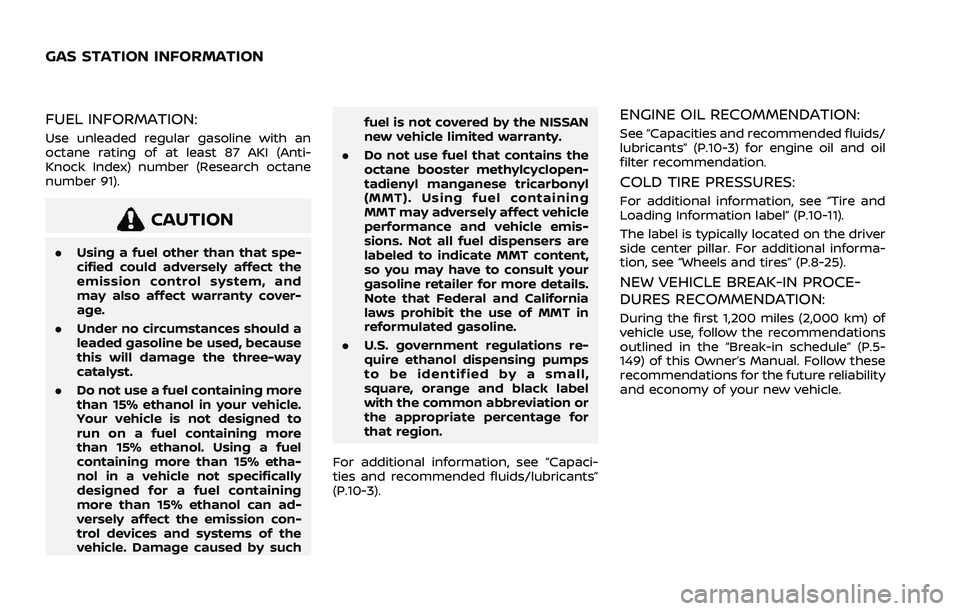
FUEL INFORMATION:
Use unleaded regular gasoline with an
octane rating of at least 87 AKI (Anti-
Knock Index) number (Research octane
number 91).
CAUTION
.Using a fuel other than that spe-
cified could adversely affect the
emission control system, and
may also affect warranty cover-
age.
. Under no circumstances should a
leaded gasoline be used, because
this will damage the three-way
catalyst.
. Do not use a fuel containing more
than 15% ethanol in your vehicle.
Your vehicle is not designed to
run on a fuel containing more
than 15% ethanol. Using a fuel
containing more than 15% etha-
nol in a vehicle not specifically
designed for a fuel containing
more than 15% ethanol can ad-
versely affect the emission con-
trol devices and systems of the
vehicle. Damage caused by such fuel is not covered by the NISSAN
new vehicle limited warranty.
. Do not use fuel that contains the
octane booster methylcyclopen-
tadienyl manganese tricarbonyl
(MMT). Using fuel containing
MMT may adversely affect vehicle
performance and vehicle emis-
sions. Not all fuel dispensers are
labeled to indicate MMT content,
so you may have to consult your
gasoline retailer for more details.
Note that Federal and California
laws prohibit the use of MMT in
reformulated gasoline.
. U.S. government regulations re-
quire ethanol dispensing pumps
to be identified by a small,
square, orange and black label
with the common abbreviation or
the appropriate percentage for
that region.
For additional information, see “Capaci-
ties and recommended fluids/lubricants”
(P.10-3).
ENGINE OIL RECOMMENDATION:
See “Capacities and recommended fluids/
lubricants” (P.10-3) for engine oil and oil
filter recommendation.
COLD TIRE PRESSURES:
For additional information, see “Tire and
Loading Information label” (P.10-11).
The label is typically located on the driver
side center pillar. For additional informa-
tion, see “Wheels and tires” (P.8-25).
NEW VEHICLE BREAK-IN PROCE-
DURES RECOMMENDATION:
During the first 1,200 miles (2,000 km) of
vehicle use, follow the recommendations
outlined in the “Break-in schedule” (P.5-
149) of this Owner’s Manual. Follow these
recommendations for the future reliability
and economy of your new vehicle.
GAS STATION INFORMATION