wheel NISSAN TEANA 2008 User Guide
[x] Cancel search | Manufacturer: NISSAN, Model Year: 2008, Model line: TEANA, Model: NISSAN TEANA 2008Pages: 5121, PDF Size: 69.03 MB
Page 560 of 5121
![NISSAN TEANA 2008 User Guide AV-416
< FUNCTION DIAGNOSIS >[BOSE AUDIO WITH NAVIGATION]
REAR VIEW MONITOR SYSTEM
PREDICTED COURSE LINE OPERATION PRINCIPLE
Detection Of Steering Rotation Direction
Camera control unit detects the ro](/img/5/57391/w960_57391-559.png "NISSAN TEANA 2008 User Guide AV-416
< FUNCTION DIAGNOSIS >[BOSE AUDIO WITH NAVIGATION]
REAR VIEW MONITOR SYSTEM
PREDICTED COURSE LINE OPERATION PRINCIPLE
Detection Of Steering Rotation Direction
Camera control unit detects the ro")
AV-416
< FUNCTION DIAGNOSIS >[BOSE AUDIO WITH NAVIGATION]
REAR VIEW MONITOR SYSTEM
PREDICTED COURSE LINE OPERATION PRINCIPLE
Detection Of Steering Rotation Direction
Camera control unit detects the rotation direction of steering according to the phase difference of two pairs of
pulse signals (sensor signal 1 and sensor signal 2) input from steering angle sensor.
Detection Of Steering Neutral Position
The sensor signal 3 input from steering angle sensor is generated at 1 pulse per 1 rotation of the steering
wheel. Camera control unit detects the steering neutral position from this pulse.
Correction Of Steering Neutral Position
Camera control unit corrects the steering neutral position during driving according to the vehicle speed signal
and sensor signal.
JSNIA0708GB
Page 813 of 5121
![NISSAN TEANA 2008 User Guide AV
CAMERA CONTROL UNIT
AV-669
< ON-VEHICLE REPAIR >[BOSE AUDIO WITH NAVIGATION]
C
D
E
F
G
H
I
J
K
L
MB A
O
P
CAMERA CONTROL UNIT
Exploded ViewINFOID:0000000003766017
Removal and InstallationINFOID:000](/img/5/57391/w960_57391-812.png "NISSAN TEANA 2008 User Guide AV
CAMERA CONTROL UNIT
AV-669
< ON-VEHICLE REPAIR >[BOSE AUDIO WITH NAVIGATION]
C
D
E
F
G
H
I
J
K
L
MB A
O
P
CAMERA CONTROL UNIT
Exploded ViewINFOID:0000000003766017
Removal and InstallationINFOID:000")
AV
CAMERA CONTROL UNIT
AV-669
< ON-VEHICLE REPAIR >[BOSE AUDIO WITH NAVIGATION]
C
D
E
F
G
H
I
J
K
L
MB A
O
P
CAMERA CONTROL UNIT
Exploded ViewINFOID:0000000003766017
Removal and InstallationINFOID:0000000003766018
REMOVAL
1. Remove rear wheelhouse finisher RH. Refer to INT-57, "Removal and Installation".
2. Remove camera control unit mounting screws, disconnect the camera control unit connector.
3. Remove camera control unit.
INSTALLATION
1. Installation is the reverse order of removal.
2. Perform predicted course line center position adjustment. Refer to AV-400, "
PREDICTED COURSE LINE
CENTER POSITION ADJUSTMENT : Special Repair Requirement".
JPNIA1049ZZ
1. Camera control unit
Page 874 of 5121
BCS
BCM (BODY CONTROL MODULE)
BCS-57
< ECU DIAGNOSIS >
C
D
E
F
G
H
I
J
K
L B A
O
P N
93
(Y)Ground ON indicator lamp Output Ignition switchOFF (LOCK indicator is
not illuminated)Battery voltage
ON or ACC 0 V
95
(L)Ground ACC relay control Output Ignition switchOFF 0 V
ACC or ON Battery voltage
96
(Y/R)GroundControl device (de-
tention switch) pow-
er supplyOutput — Battery voltage
97
(L/O)GroundSteering lock condi-
tion No. 1Input Steering lockLOCK status 0 V
UNLOCK status Battery voltage
98
(G/R)GroundSteering lock condi-
tion No. 2Input Steering lockLOCK status Battery voltage
UNLOCK status 0 V
99
(G/B)GroundSelector lever P po-
sition switchInput Selector leverP position 0 V
Any position other than P Battery voltage
100
(P/L)GroundPassenger door re-
quest switchInputPassenger door
request switchON (Pressed) 0 V
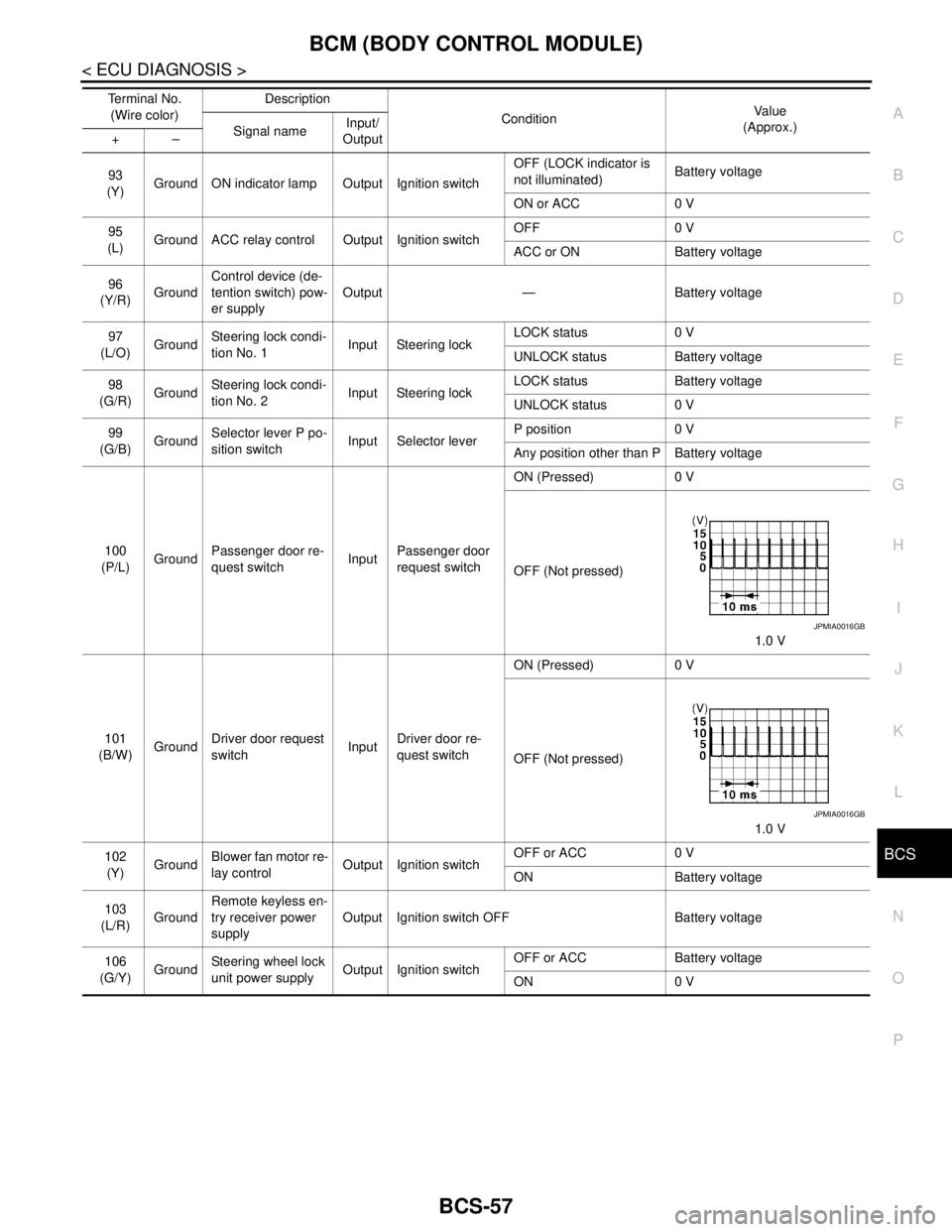
OFF (Not pressed)
1.0 V
101
(B/W)GroundDriver door request
switchInputDriver door re-
quest switchON (Pressed) 0 V
OFF (Not pressed)
1.0 V
102
(Y)GroundBlower fan motor re-
lay controlOutput Ignition switchOFF or ACC 0 V
ON Battery voltage
103
(L/R)GroundRemote keyless en-
try receiver power
supplyOutput Ignition switch OFF Battery voltage
106
(G/Y)GroundSteering wheel lock
unit power supplyOutput Ignition switchOFF or ACC Battery voltage
ON 0 V Te r m i n a l N o .
(Wire color)Description
ConditionVa l u e
(Approx.)
Signal nameInput/
Output +–
JPMIA0016GB
JPMIA0016GB
Page 897 of 5121

BR-1
BRAKES
C
DE
G H
I
J
K L
M
SECTION BR
A
B
BR
N
O P
CONTENTS
BRAKE SYSTEM
SYMPTOM DIAGNOSIS ..... ..........................3
NOISE, VIBRATION AND HARSHNESS
(NVH) TROUBLESHOOTING ........................ .....
3
NVH Troubleshooting Chart ................................ ......3
PRECAUTION ...............................................4
PRECAUTIONS .............................................. .....4
Precaution for Supplemental Restraint System
(SRS) "AIR BAG" and "SEAT BELT PRE-TEN-
SIONER" ............................................................. ......
4
Precaution Necessary for Steering Wheel Rota-
tion after Battery Disconnect .....................................
4
Precaution for Procedure without Cowl Top Cover ......5
Precaution for Brake System ....................................5
ON-VEHICLE MAINTENANCE .....................6
BRAKE PEDAL .............................................. .....6
Inspection and Adjustment .................................. ......6
BRAKE FLUID .....................................................9
Inspection ............................................................ ......9
Draining .....................................................................9
Refilling .....................................................................9
Bleeding Brake System ...........................................10
BRAKE MASTER CYLINDER ........................ ....11
Inspection ............................................................ ....11
BRAKE BOOSTER ............................................12
Inspection ............................................................ ....12
FRONT DISC BRAKE .................................... ....13
BRAKE PAD .......................................................... ....13
BRAKE PAD : Inspection and Adjustment ..............13
DISC ROTOR ......................................................... ....13
DISC ROTOR : Inspection and Adjustment ............13
REAR DISC BRAKE ...................................... ....15
BRAKE PAD .......................................................... ....15
BRAKE PAD : Inspection and Adjustment ...............15
DISC ROTOR ......................................................... ....15
DISC ROTOR : Inspection and Adjustment .............15
ON-VEHICLE REPAIR .................................17
BRAKE PEDAL ................................ .................17
Exploded View ..................................................... ....17
Removal and Installation .........................................17
Inspection and Adjustment ......................................18
BRAKE PIPING ................................ .................19
FRONT ................................................................... ....19
FRONT : Exploded View .........................................19
FRONT : Hydraulic Piping .......................................20
FRONT : Removal and Installation ..........................21
FRONT : Inspection .................................................21
REAR ..................................................................... ....22
REAR : Exploded View ............................................22
REAR : Hydraulic Piping ..........................................22
REAR : Removal and Installation ............................23
REAR : Inspection ...................................................23
BRAKE MASTER CYLINDER ..........................25
Exploded View .........................................................25
Removal and Installation .........................................25
Disassembly and Assembly .....................................26
Inspection ................................................................27
BRAKE BOOSTER ...........................................28
Exploded View ..................................................... ....28
Removal and installation .........................................28
Inspection and Adjustment ......................................29
VACUUM LINES ...............................................31
Exploded View .........................................................31
Removal and Installation .........................................31
Inspection ................................................................31
Page 899 of 5121
NOISE, VIBRATION AND HARSHNESS (NVH) TROUBLESHOOTING
BR-3
< SYMPTOM DIAGNOSIS >
C
D
E
G
H
I
J
K
L
MA
B
BR
N
O
P
SYMPTOM DIAGNOSIS
NOISE, VIBRATION AND HARSHNESS (NVH) TROUBLESHOOTING
NVH Troubleshooting ChartINFOID:0000000003811166
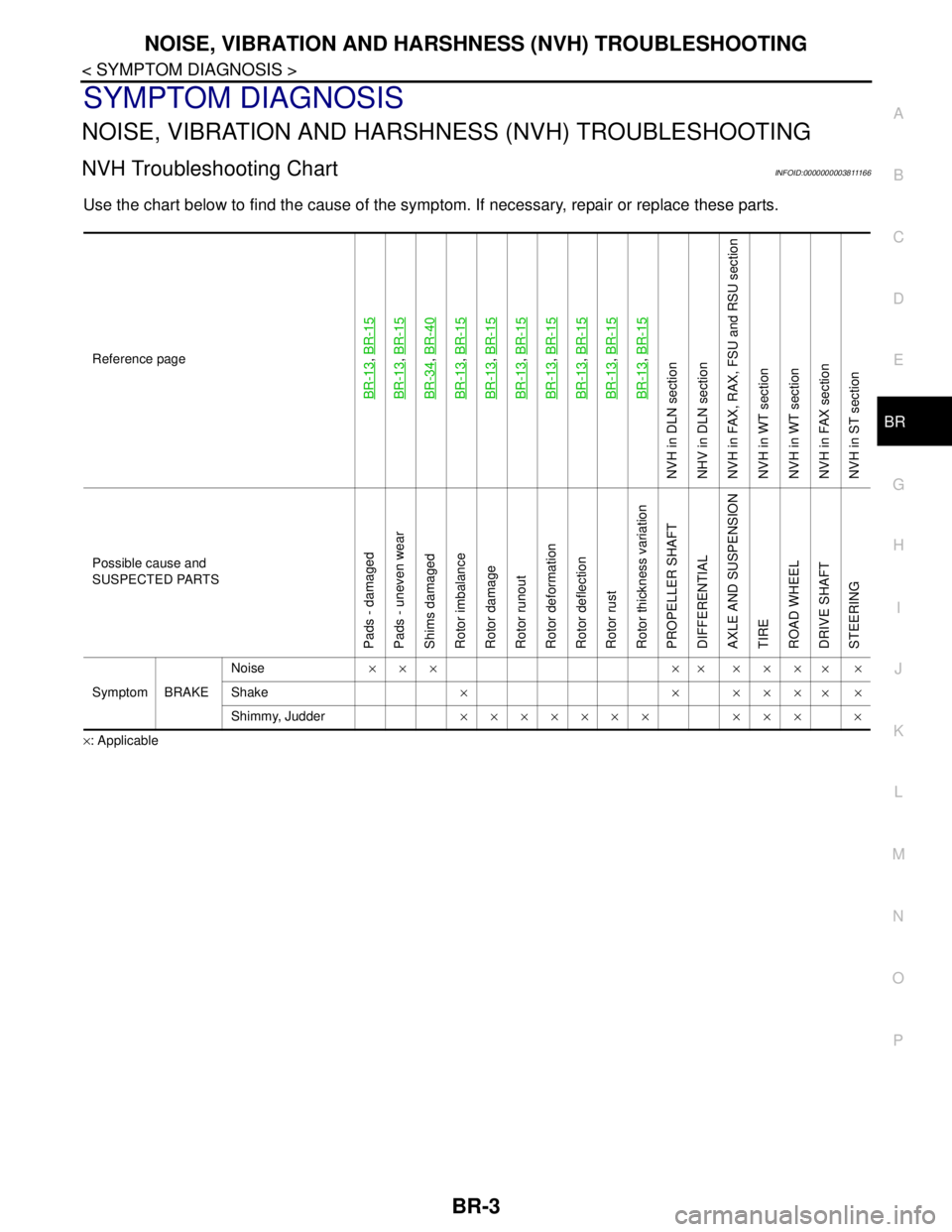
Use the chart below to find the cause of the symptom. If necessary, repair or replace these parts.
×: ApplicableReference page
BR-13
, BR-15
BR-13
, BR-15
BR-34
, BR-40
BR-13
, BR-15
BR-13
, BR-15
BR-13
, BR-15
BR-13
, BR-15
BR-13
, BR-15
BR-13
, BR-15
BR-13
, BR-15
NVH in DLN section
NHV in DLN section
NVH in FAX, RAX, FSU and RSU section
NVH in WT section
NVH in WT section
NVH in FAX section
NVH in ST section
Possible cause and
SUSPECTED PARTS
Pads - damaged
Pads - uneven wear
Shims damaged
Rotor imbalance
Rotor damage
Rotor runout
Rotor deformation
Rotor deflection
Rotor rust
Rotor thickness variation
PROPELLER SHAFT
DIFFERENTIAL
AXLE AND SUSPENSION
TIRE
ROAD WHEEL
DRIVE SHAFT
STEERING
Symptom BRAKENoise××× ×× ×××
××
Shake×××××
××
Shimmy, Judder××××××× ××× ×
Page 900 of 5121

BR-4
< PRECAUTION >
PRECAUTIONS
PRECAUTION
PRECAUTIONS
Precaution for Supplemental Restraint System (SRS) "AIR BAG" and "SEAT BELT
PRE-TENSIONER"
INFOID:0000000003890160
The Supplemental Restraint System such as “AIR BAG” and “SEAT BELT PRE-TENSIONER”, used along
with a front seat belt, helps to reduce the risk or severity of injury to the driver and front passenger for certain
types of collision. Information necessary to service the system safely is included in the “SRS AIRBAG” and
“SEAT BELT” of this Service Manual.
WARNING:
• To avoid rendering the SRS inoperative, which could increase the risk of personal injury or death in
the event of a collision which would result in air bag inflation, all maintenance must be performed by
an authorized NISSAN/INFINITI dealer.
Improper maintenance, including incorrect removal and installation of the SRS, can lead to personal
injury caused by unintentional activation of the system. For removal of Spiral Cable and Air Bag
Module, see the “SRS AIRBAG”.
Never use electrical test equipment on any circuit related to the SRS unless instructed to in this Ser-
vice Manual. SRS wiring harnesses can be identified by yellow and/or orange harnesses or harness
connectors.
Precaution Necessary for Steering Wheel Rotation after Battery Disconnect
INFOID:0000000003890161
NOTE:
Before removing and installing any control units, first turn the push-button ignition switch to the LOCK posi-
tion, then disconnect both battery cables.
After finishing work, confirm that all control unit connectors are connected properly, then re-connect both
battery cables.
Always use CONSULT-III to perform self-diagnosis as a part of each function inspection after finishing work.
If a DTC is detected, perform trouble diagnosis according to self-diagnosis results.
This vehicle is equipped with a push-button ignition switch and a steering lock unit.
If the battery is disconnected or discharged, the steering wheel will lock and cannot be turned.
If turning the steering wheel is required with the battery disconnected or discharged, follow the procedure
below before starting the repair operation.
OPERATION PROCEDURE
1. Connect both battery cables.
NOTE:
Supply power using jumper cables if battery is discharged.
2. Turn the push-button ignition switch to ACC position.
(At this time, the steering lock will be released.)
3. Disconnect both battery cables. The steering lock will remain released with both battery cables discon-
nected and the steering wheel can be turned.
4. Perform the necessary repair operation.
5. When the repair work is completed, re-connect both battery cables. With the brake pedal released, turn
the push-button ignition switch from ACC position to ON position, then to LOCK position. (The steering
wheel will lock when the push-button ignition switch is turned to LOCK position.)
6. Perform self-diagnosis check of all control units using CONSULT-III.
Page 906 of 5121
BR-10
< ON-VEHICLE MAINTENANCE >
BRAKE FLUID
2. Loosen the bleeder valve, slowly depress the brake pedal to the full stroke, and then release the pedal.
Repeat this operation at intervals of 2 or 3 seconds until all brake fluid is discharged. Then close the
bleeder valve with the brake pedal depressed. Repeat the same work on each wheel.
3. Perform the air bleeding. Refer to BR-10, "
Bleeding Brake System".
Bleeding Brake SystemINFOID:0000000003811176
CAUTION:
Turn the ignition switch OFF and disconnect the ABS actuator and electric unit (control unit) con-
nector or the battery negative terminal before performing the work.
Monitor the fluid level in the sub tank during the air bleeding.
Always use new brake fluid for refilling. Never reuse the drained brake fluid.
1. Connect a vinyl tube to the bleeder valve of the rear right brake.
2. Fully depress the brake pedal 4 to 5 times.
3. Loosen the bleeder valve and bleed air with the brake pedal depressed, and then quickly tighten the
bleeder valve.
4. Repeat steps 2 and 3 until all of the air is out of the brake line.
5. Tighten the bleeder valve to the specified torque.
Front disc brake: refer to BR-34, "
BRAKE CALIPER ASSEMBLY : Exploded View".
Rear disc brake: refer to BR-40, "
BRAKE CALIPER ASSEMBLY : Exploded View".
6. Perform steps 1 to 5 for the rear right brake → front left brake → rear left brake → and front right brake in
order.
7. Check that the fluid level in the sub tank is within the specified range after air bleeding. Refer to BR-9,
"Inspection".
Page 909 of 5121
FRONT DISC BRAKE
BR-13
< ON-VEHICLE MAINTENANCE >
C
D
E
G
H
I
J
K
L
MA
B
BR
N
O
P
FRONT DISC BRAKE
BRAKE PAD
BRAKE PAD : Inspection and AdjustmentINFOID:0000000003811179
INSPECTION
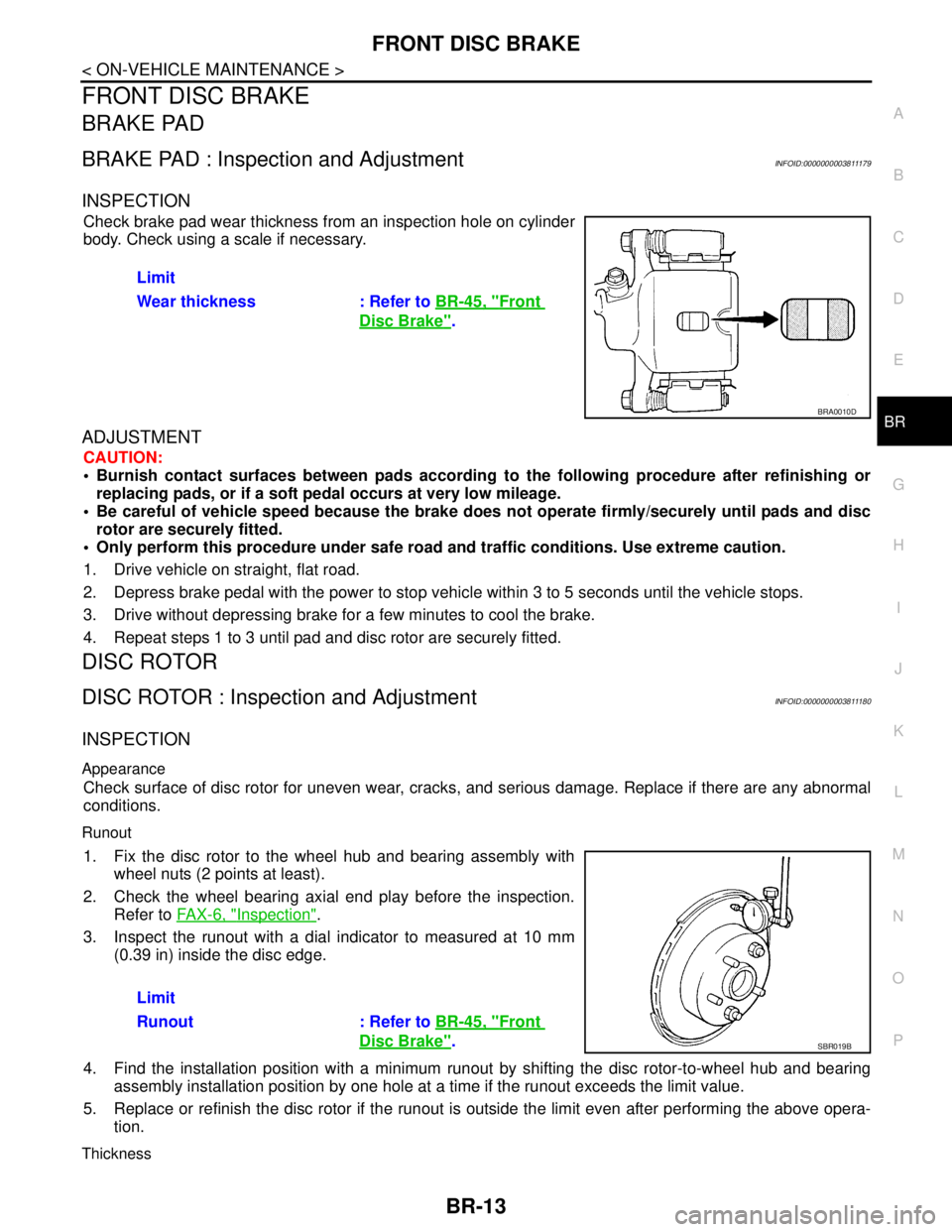
Check brake pad wear thickness from an inspection hole on cylinder
body. Check using a scale if necessary.
ADJUSTMENT
CAUTION:
Burnish contact surfaces between pads according to the following procedure after refinishing or
replacing pads, or if a soft pedal occurs at very low mileage.
Be careful of vehicle speed because the brake does not operate firmly/securely until pads and disc
rotor are securely fitted.
Only perform this procedure under safe road and traffic conditions. Use extreme caution.
1. Drive vehicle on straight, flat road.
2. Depress brake pedal with the power to stop vehicle within 3 to 5 seconds until the vehicle stops.
3. Drive without depressing brake for a few minutes to cool the brake.
4. Repeat steps 1 to 3 until pad and disc rotor are securely fitted.
DISC ROTOR
DISC ROTOR : Inspection and AdjustmentINFOID:0000000003811180
INSPECTION
Appearance
Check surface of disc rotor for uneven wear, cracks, and serious damage. Replace if there are any abnormal
conditions.
Runout
1. Fix the disc rotor to the wheel hub and bearing assembly with
wheel nuts (2 points at least).
2. Check the wheel bearing axial end play before the inspection.
Refer to FA X - 6 , "
Inspection".
3. Inspect the runout with a dial indicator to measured at 10 mm
(0.39 in) inside the disc edge.
4. Find the installation position with a minimum runout by shifting the disc rotor-to-wheel hub and bearing
assembly installation position by one hole at a time if the runout exceeds the limit value.
5. Replace or refinish the disc rotor if the runout is outside the limit even after performing the above opera-
tion.
Thickness
Limit
Wear thickness : Refer to BR-45, "
Front
Disc Brake".
BRA0010D
Limit
Runout : Refer to BR-45, "
Front
Disc Brake".SBR019B
Page 911 of 5121
REAR DISC BRAKE
BR-15
< ON-VEHICLE MAINTENANCE >
C
D
E
G
H
I
J
K
L
MA
B
BR
N
O
P
REAR DISC BRAKE
BRAKE PAD
BRAKE PAD : Inspection and AdjustmentINFOID:0000000003811181
INSPECTION
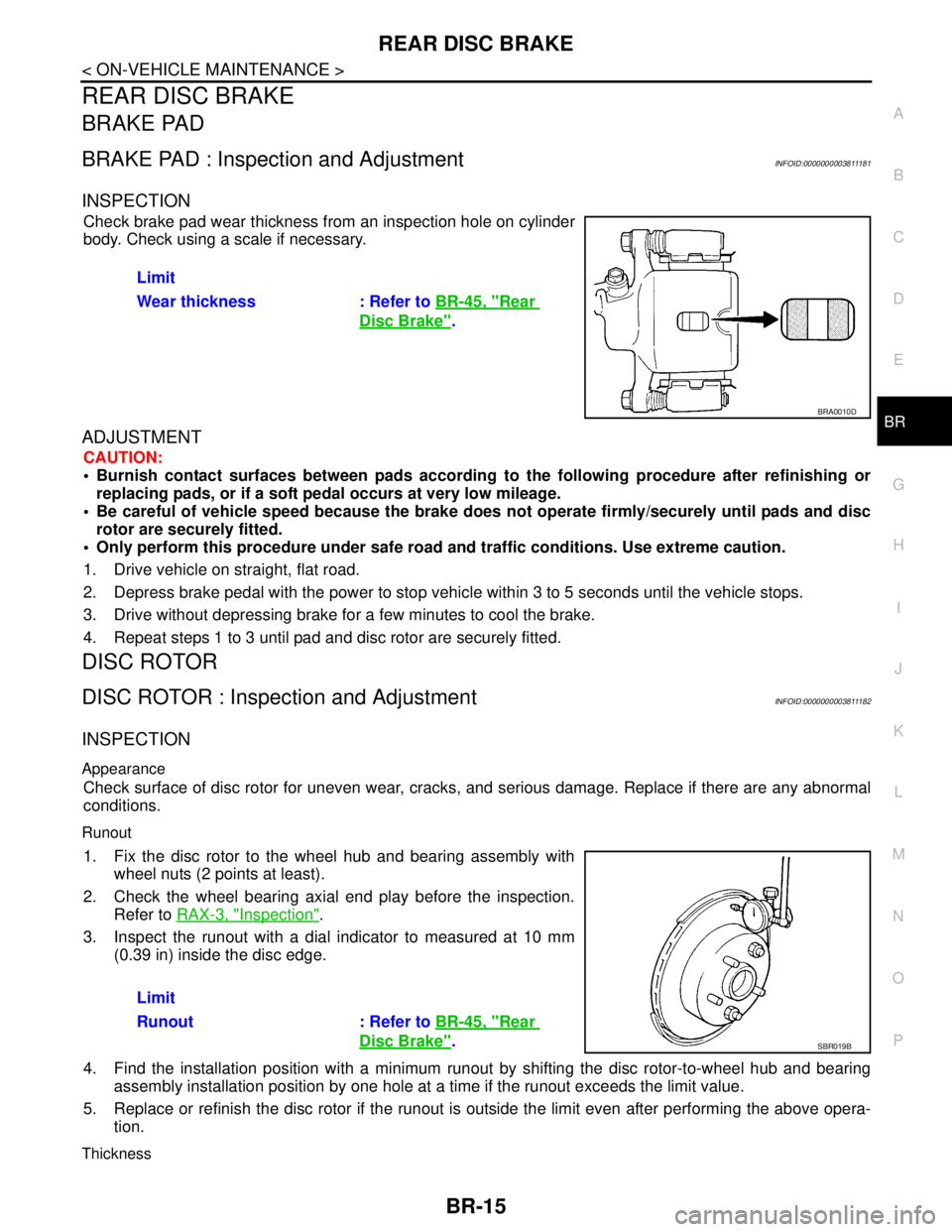
Check brake pad wear thickness from an inspection hole on cylinder
body. Check using a scale if necessary.
ADJUSTMENT
CAUTION:
Burnish contact surfaces between pads according to the following procedure after refinishing or
replacing pads, or if a soft pedal occurs at very low mileage.
Be careful of vehicle speed because the brake does not operate firmly/securely until pads and disc
rotor are securely fitted.
Only perform this procedure under safe road and traffic conditions. Use extreme caution.
1. Drive vehicle on straight, flat road.
2. Depress brake pedal with the power to stop vehicle within 3 to 5 seconds until the vehicle stops.
3. Drive without depressing brake for a few minutes to cool the brake.
4. Repeat steps 1 to 3 until pad and disc rotor are securely fitted.
DISC ROTOR
DISC ROTOR : Inspection and AdjustmentINFOID:0000000003811182
INSPECTION
Appearance
Check surface of disc rotor for uneven wear, cracks, and serious damage. Replace if there are any abnormal
conditions.
Runout
1. Fix the disc rotor to the wheel hub and bearing assembly with
wheel nuts (2 points at least).
2. Check the wheel bearing axial end play before the inspection.
Refer to RAX-3, "
Inspection".
3. Inspect the runout with a dial indicator to measured at 10 mm
(0.39 in) inside the disc edge.
4. Find the installation position with a minimum runout by shifting the disc rotor-to-wheel hub and bearing
assembly installation position by one hole at a time if the runout exceeds the limit value.
5. Replace or refinish the disc rotor if the runout is outside the limit even after performing the above opera-
tion.
Thickness
Limit
Wear thickness : Refer to BR-45, "
Rear
Disc Brake".
BRA0010D
Limit
Runout : Refer to BR-45, "
Rear
Disc Brake".SBR019B
Page 917 of 5121
BRAKE PIPINGBR-21
< ON-VEHICLE REPAIR >
C
DE
G H
I
J
K L
M A
B
BR
N
O P
FRONT : Removal and InstallationINFOID:0000000003811188
REMOVAL
CAUTION:
Never spill or splash brake fluid on painted surfaces. Brake fluid may seriously damage paint. Wipe it
off immediately and wash with wate r if it gets on a painted surface.
1. Remove tires.
2. Drain brake fluid. Refer to BR-9, "
Draining".
3. Loosen the flare nut with a flare nut wrenc h and separate the brake tube from the hose.
CAUTION:
Never scratch the flare nut and the brake tube.
Never bend sharply, twist or strong ly pull out the brake hoses and tubes.
Cover open end of brake tub es and hoses when disconnecting to prevent entrance of dirt.
4. Remove the union bolt and copper washers, and remove the brake hose from the brake caliper assembly.
5. Remove the lock plate and remove the brake hose.
INSTALLATION
CAUTION:
Never spill or splash brake fluid on painted surfaces. Brake fluid may seriously damage paint. Wipe it
off immediately and wash with wate r if it gets on a painted surface.
1. Assemble the union bolt and the copper washers to the brake hose. CAUTION:
Never reuse the copper washer.
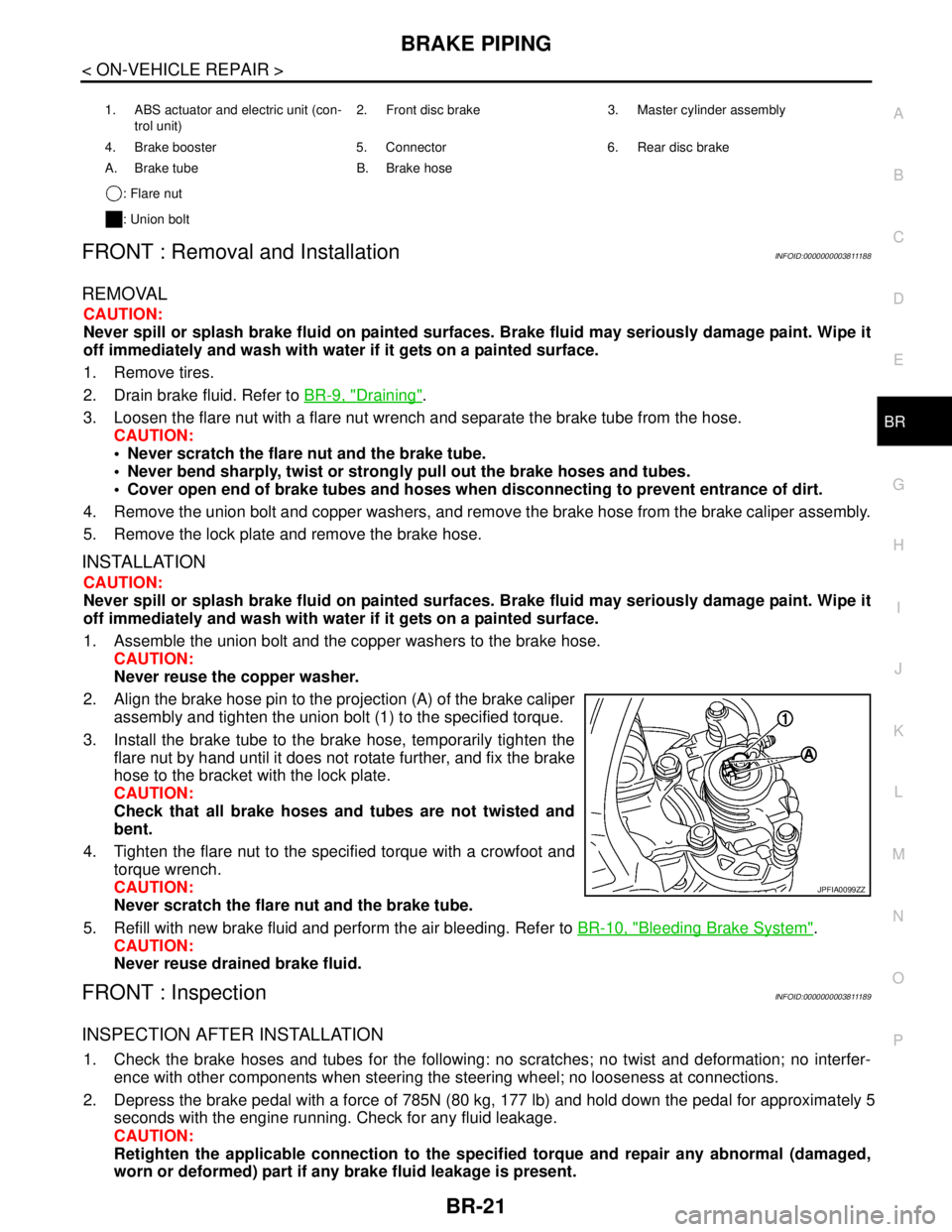
2. Align the brake hose pin to the projection (A) of the brake caliper assembly and tighten the union bolt (1) to the specified torque.
3. Install the brake tube to the brake hose, temporarily tighten the flare nut by hand until it does not rotate further, and fix the brake
hose to the bracket with the lock plate.
CAUTION:
Check that all brake hoses and tubes are not twisted and
bent.
4. Tighten the flare nut to the specified torque with a crowfoot and torque wrench.
CAUTION:
Never scratch the flare nut and the brake tube.
5. Refill with new brake fluid and perform the air bleeding. Refer to BR-10, "
Bleeding Brake System".
CAUTION:
Never reuse drained brake fluid.
FRONT : InspectionINFOID:0000000003811189
INSPECTION AFTER INSTALLATION
1. Check the brake hoses and tubes for the following: no scratches; no twist and deformation; no interfer-
ence with other components when steering the steering wheel; no looseness at connections.
2. Depress the brake pedal with a force of 785N (80 kg, 177 lb) and hold down the pedal for approximately 5
seconds with the engine running. Check for any fluid leakage.
CAUTION:
Retighten the applicable connect ion to the specified torque and repair any abnormal (damaged,
worn or deformed) part if any brake fluid leakage is present.
1. ABS actuator and electric unit (con-
trol unit) 2. Front disc brake 3. Master cylinder assembly
4. Brake booster 5. Connector 6. Rear disc brake
A. Brake tube B. Brake hose : Flare nut
: Union bolt
JPFIA0099ZZ