ABS NISSAN TEANA 2008 Service Manual
[x] Cancel search | Manufacturer: NISSAN, Model Year: 2008, Model line: TEANA, Model: NISSAN TEANA 2008Pages: 5121, PDF Size: 69.03 MB
Page 3729 of 5121
RAX-4
< ON-VEHICLE REPAIR >
REAR WHEEL HUB AND HOUSING
ON-VEHICLE REPAIR
REAR WHEEL HUB AND HOUSING
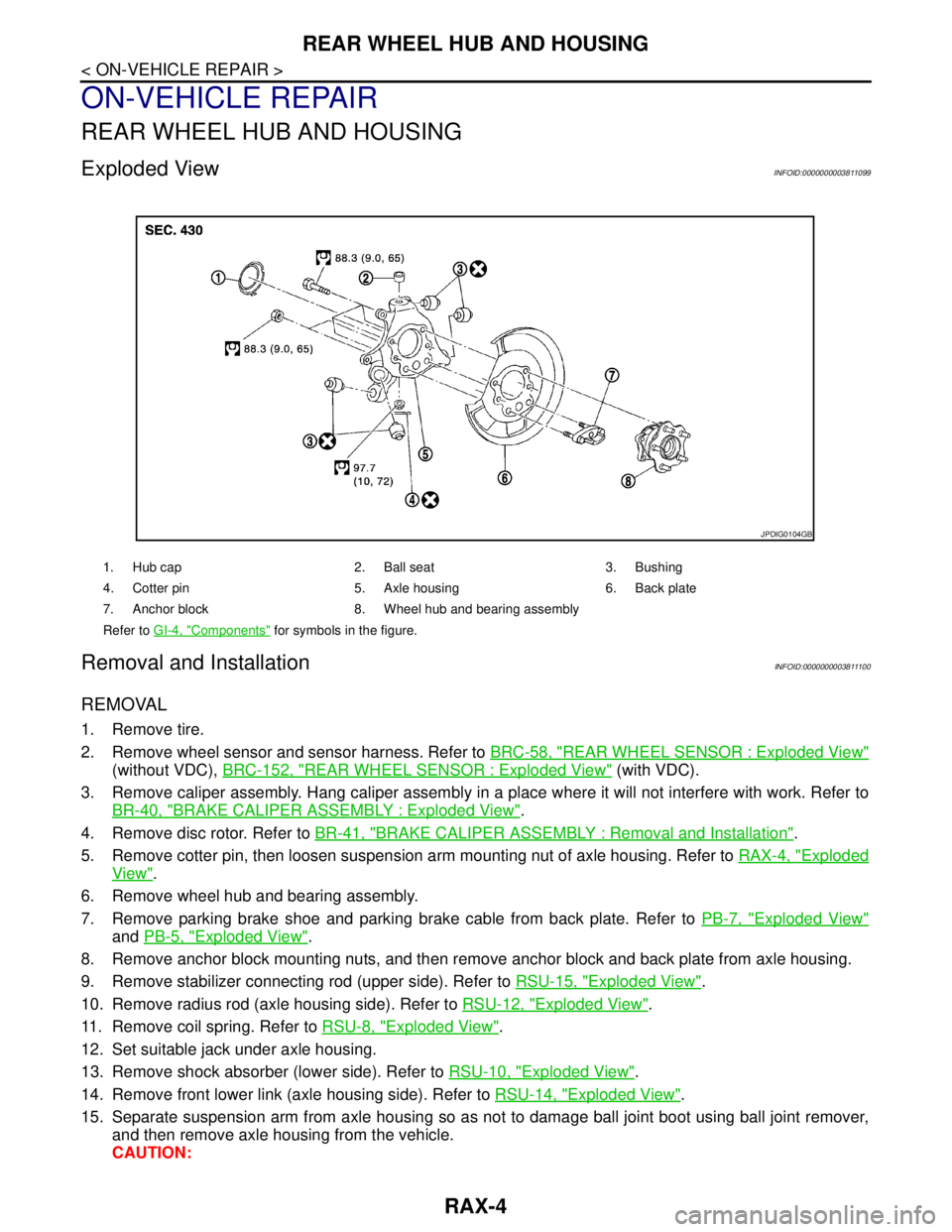
Exploded ViewINFOID:0000000003811099
Removal and InstallationINFOID:0000000003811100
REMOVAL
1. Remove tire.
2. Remove wheel sensor and sensor harness. Refer to BRC-58, "
REAR WHEEL SENSOR : Exploded View"
(without VDC), BRC-152, "REAR WHEEL SENSOR : Exploded View" (with VDC).
3. Remove caliper assembly. Hang caliper assembly in a place where it will not interfere with work. Refer to
BR-40, "
BRAKE CALIPER ASSEMBLY : Exploded View".
4. Remove disc rotor. Refer to BR-41, "
BRAKE CALIPER ASSEMBLY : Removal and Installation".
5. Remove cotter pin, then loosen suspension arm mounting nut of axle housing. Refer to RAX-4, "
Exploded
View".
6. Remove wheel hub and bearing assembly.
7. Remove parking brake shoe and parking brake cable from back plate. Refer to PB-7, "
Exploded View"
and PB-5, "Exploded View".
8. Remove anchor block mounting nuts, and then remove anchor block and back plate from axle housing.
9. Remove stabilizer connecting rod (upper side). Refer to RSU-15, "
Exploded View".
10. Remove radius rod (axle housing side). Refer to RSU-12, "
Exploded View".
11. Remove coil spring. Refer to RSU-8, "
Exploded View".
12. Set suitable jack under axle housing.
13. Remove shock absorber (lower side). Refer to RSU-10, "
Exploded View".
14. Remove front lower link (axle housing side). Refer to RSU-14, "
Exploded View".
15. Separate suspension arm from axle housing so as not to damage ball joint boot using ball joint remover,
and then remove axle housing from the vehicle.
CAUTION:
1. Hub cap 2. Ball seat 3. Bushing
4. Cotter pin 5. Axle housing 6. Back plate
7. Anchor block 8. Wheel hub and bearing assembly
Refer to GI-4, "
Components" for symbols in the figure.
JPDIG0104GB
Page 3781 of 5121

RF-50
< ECU DIAGNOSIS >
BCM (BODY CONTROL MODULE)
Display contents of CONSULT Fail-safe Cancellation
B2013: ID DISCORD BCM-S/L Inhibit engine cranking Erase DTC
B2014: CHAIN OF S/L-BCM Inhibit engine cranking Erase DTC
B2190: NATS ANTENNA AMP Inhibit engine cranking Erase DTC
B2191: DIFFERENCE OF KEY Inhibit engine cranking Erase DTC
B2192: ID DISCORD BCM-ECM Inhibit engine cranking Erase DTC
B2193: CHAIN OF BCM-ECM Inhibit engine cranking Erase DTC
B2557: VEHICLE SPEED Inhibit steering lockWhen normal vehicle speed signals have been received from ABS
actuator and electric unit (control unit) for 500 ms
B2560: STARTER CONT RELAY Inhibit engine cranking500 ms after the following CAN signal communication status has
become consistent
Starter control relay signal
Starter relay status signal
B2601: SHIFT POSITION Inhibit steering lock500 ms after the following signal reception status becomes consis-
tent
Selector lever P position switch signal
P range signal (CAN)
B2602: SHIFT POSITION Inhibit steering lock5 seconds after the following BCM recognition conditions are ful-
filled
Ignition switch is in the ON position
Selector lever P position switch signal: Except P position (battery
voltage)
Vehicle speed: 4 km/h (2.5 MPH) or more
B2603: SHIFT POSI STATUS Inhibit steering lock500 ms after the following BCM recognition conditions are fulfilled
Ignition switch is in the ON position
Selector lever P position switch signal: Except P position (battery
voltage)
Selector lever P/N position signal: Except P and N positions (0 V)
B2604: PNP SW Inhibit steering lock500 ms after any of the following BCM recognition conditions is ful-
filled
Status 1
- Ignition switch is in the ON position
- Selector lever P/N position signal: P and N position (battery volt-
age)
- P range signal or N range signal (CAN): ON
Status 2
- Ignition switch is in the ON position
- Selector lever P/N position signal: Except P and N positions (0 V)
- P range signal and N range signal (CAN): OFF
B2605: PNP SW Inhibit steering lock500 ms after any of the following BCM recognition conditions is ful-
filled
Ignition switch is in the ON position
- Power position: IGN
- Selector lever P/N position signal: Except P and N positions (0 V)
- Interlock/PNP switch signal (CAN): OFF
Status 2
- Ignition switch is in the ON position
- Selector lever P/N position signal: P or N position (battery volt-
age)
- PNP switch signal (CAN): ON
B2606: S/L RELAY Inhibit engine cranking500 ms after the following CAN signal communication status has
become consistent
Steering lock relay signal (Request signal)
Steering lock relay signal (Condition signal)
B2607: S/L RELAY Inhibit engine cranking500 ms after the following CAN signal communication status has
become consistent
Steering lock relay signal (Request signal)
Steering lock relay signal (Condition signal)
Page 3833 of 5121
RSU-1
SUSPENSION
C
DF
G H
I
J
K L
M
SECTION RSU
A
B
RSU
N
O PCONTENTS
REAR SUSPENSION
SYMPTOM DIAGNOSIS ..... ..........................2
NOISE, VIBRATION AND HARSHNESS
(NVH) TROUBLESHOOTING ........................ .....
2
NVH Troubleshooting Chart ................................ ......2
PRECAUTION ...............................................3
PRECAUTIONS .............................................. .....3
Precautions for Suspension ................................ ......3
PREPARATION ............................................4
PREPARATION .............................................. .....4
Special Service Tool ........................................... ......4
ON-VEHICLE MAINTENANCE .....................5
REAR SUSPENSION ASSEMBLY ................ .....5
Inspection ............................................................ ......5
WHEEL ALIGNMENT ..........................................6
Inspection ............................................................ ......6
Adjustment ................................................................7
ON-VEHICLE REPAIR ..................................8
REAR LOWER LINK & COIL SPRING .......... .....8
Exploded View .................................................... ......8
Removal and Installation ...........................................8
Inspection ..................................................................9
REAR SHOCK ABSORBER ..............................10
Exploded View .................................................... ....10
Removal and Installation .........................................10
Inspection ................................................................10
RADIUS ROD ................................... .................12
Exploded View ..................................................... ....12
Removal and Installation .........................................12
Inspection ................................................................12
FRONT LOWER LINK .......................................14
Exploded View .........................................................14
Removal and Installation .........................................14
Inspection ................................................................14
REAR STABILIZER ..........................................15
Exploded View .........................................................15
Removal and Installation .........................................15
Inspection ................................................................15
REMOVAL AND INSTALLATION ...............16
REAR SUSPENSION ARM ...............................16
Exploded View ..................................................... ....16
Removal and Installation .........................................16
Inspection ................................................................16
REAR SUSPENSION MEMBER .......................18
Exploded View ..................................................... ....18
Removal and Installation .........................................18
Inspection ................................................................19
SERVICE DATA AND SPECIFICATIONS
(SDS) ............... .............................................
20
SERVICE DATA AND SPECIFICATIONS
(SDS) .................................................................
20
Wheel Alignment ................................................. ....20
Ball Joint ..................................................................20
Wheel Height ...........................................................20
Page 3834 of 5121
RSU-2
< SYMPTOM DIAGNOSIS >
NOISE, VIBRATION AND HARSHNESS (NVH) TROUBLESHOOTING
SYMPTOM DIAGNOSIS
NOISE, VIBRATION AND HARSHNESS (NVH) TROUBLESHOOTING
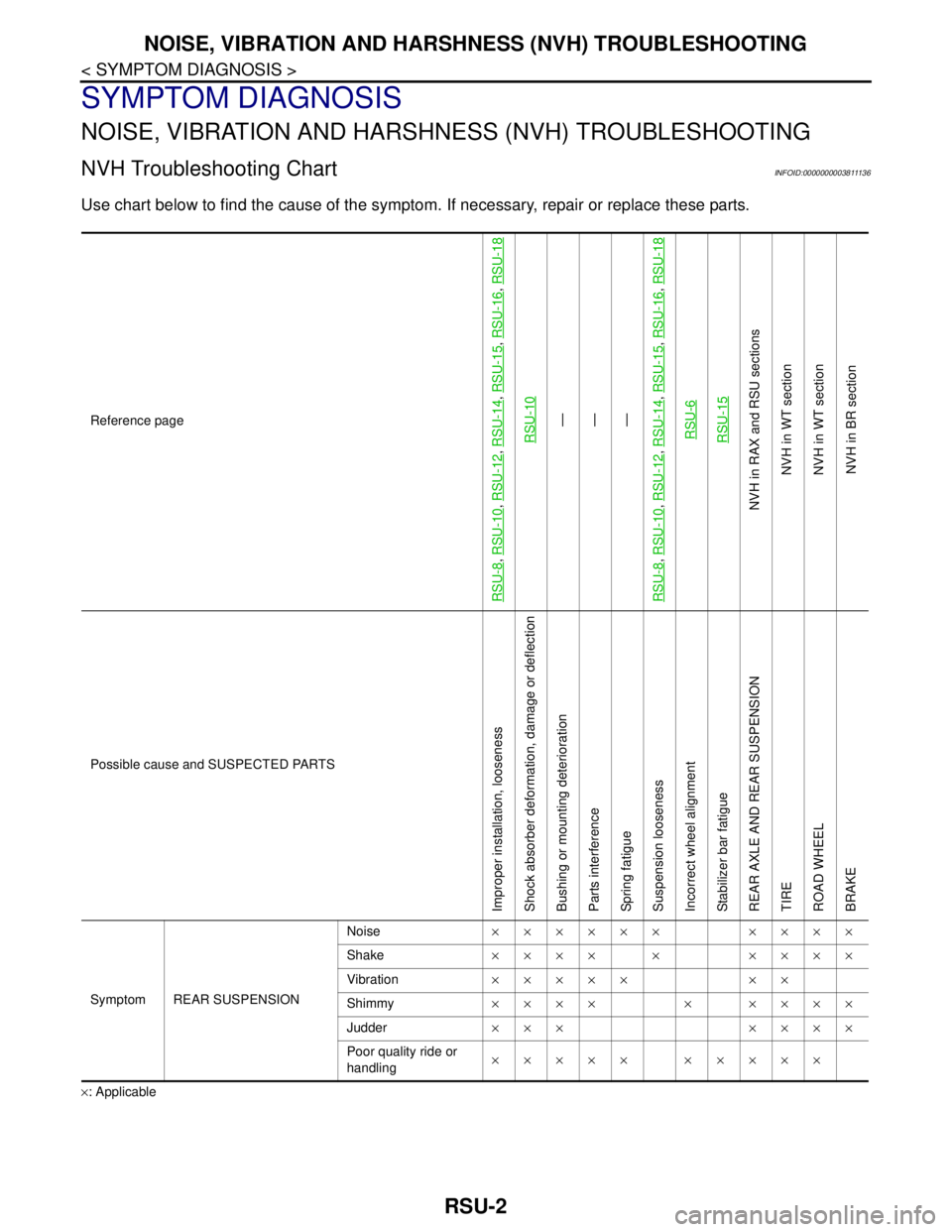
NVH Troubleshooting ChartINFOID:0000000003811136
Use chart below to find the cause of the symptom. If necessary, repair or replace these parts.
×: ApplicableReference page
RSU-8
, RSU-10
, RSU-12
, RSU-14
, RSU-15
, RSU-16
, RSU-18
RSU-10
—
—
—
RSU-8
, RSU-10
, RSU-12
, RSU-14
, RSU-15
, RSU-16
, RSU-18
RSU-6RSU-15
NVH in RAX and RSU sections
NVH in WT section
NVH in WT section
NVH in BR section
Possible cause and SUSPECTED PARTS
Improper installation, looseness
Shock absorber deformation, damage or deflection
Bushing or mounting deterioration
Parts interference
Spring fatigue
Suspension looseness
Incorrect wheel alignment
Stabilizer bar fatigue
REAR AXLE AND REAR SUSPENSION
TIRE
ROAD WHEEL
BRAKE
Symptom REAR SUSPENSIONNoise×××××× ××××
Shake×××× × ××××
Vibration××××× ××
Shimmy×××× × ××××
Judder ××× ××××
Poor quality ride or
handling××××× ×××××
Page 3837 of 5121
REAR SUSPENSION ASSEMBLY
RSU-5
< ON-VEHICLE MAINTENANCE >
C
D
F
G
H
I
J
K
L
MA
B
RSU
N
O
P
ON-VEHICLE MAINTENANCE
REAR SUSPENSION ASSEMBLY
InspectionINFOID:0000000003811139
MOUNTING INSPECTION
Make sure the mounting conditions (looseness, backlash) of each component and component conditions
(wear, damage) are normal.
SHOCK ABSORBER
Check for oil leakage and damage. Replace if necessary.
Page 3838 of 5121
RSU-6
< ON-VEHICLE MAINTENANCE >
WHEEL ALIGNMENT
WHEEL ALIGNMENT
InspectionINFOID:0000000003813442
DESCRIPTION
Measure wheel alignment under unladen conditions.
NOTE:
“Unladen conditions” means that fuel, engine coolant, and lubricant are full. Spare tire, jack, hand tools and
mats are in designated positions.
PRELIMINARY CHECK
Check the following:
Tires for improper air pressure and wear
Road wheels for runout: refer to WT-2, "
Inspection".
Wheel bearing axial end play: refer to RAX-3, "
Inspection".
Shock absorber operation
Each mounting point of axle and suspension for looseness and deformation
Each of lower link, upper link, rear suspension member, suspension arm and shock absorber for cracks,
deformation, and other damage
Vehicle height (posture)
CAMBER
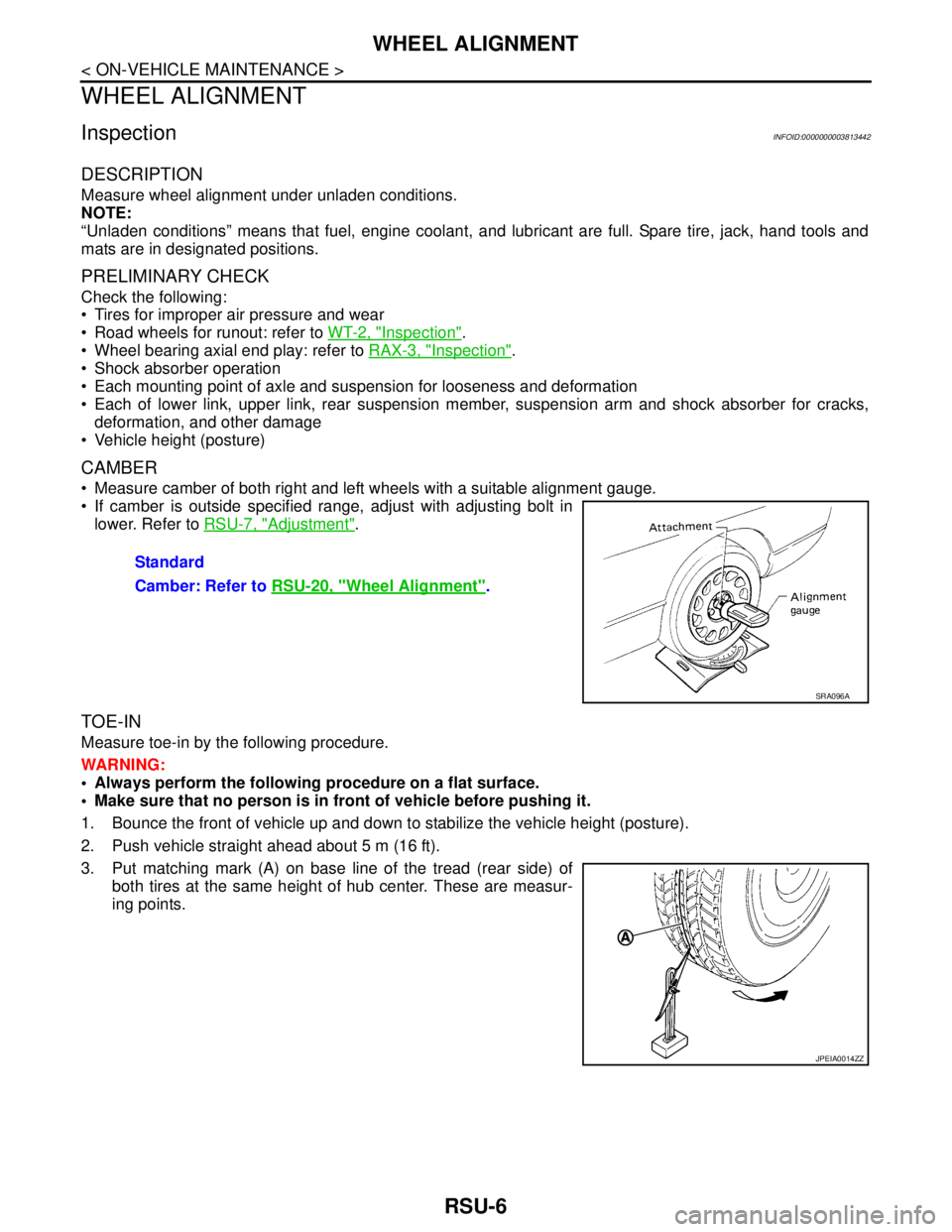
Measure camber of both right and left wheels with a suitable alignment gauge.
If camber is outside specified range, adjust with adjusting bolt in
lower. Refer to RSU-7, "
Adjustment".
TOE-IN
Measure toe-in by the following procedure.
WARNING:
Always perform the following procedure on a flat surface.
Make sure that no person is in front of vehicle before pushing it.
1. Bounce the front of vehicle up and down to stabilize the vehicle height (posture).
2. Push vehicle straight ahead about 5 m (16 ft).
3. Put matching mark (A) on base line of the tread (rear side) of
both tires at the same height of hub center. These are measur-
ing points.Standard
Camber: Refer to RSU-20, "
Wheel Alignment".
SRA096A
JPEIA0014ZZ
Page 3840 of 5121
RSU-8
< ON-VEHICLE REPAIR >
REAR LOWER LINK & COIL SPRING
ON-VEHICLE REPAIR
REAR LOWER LINK & COIL SPRING
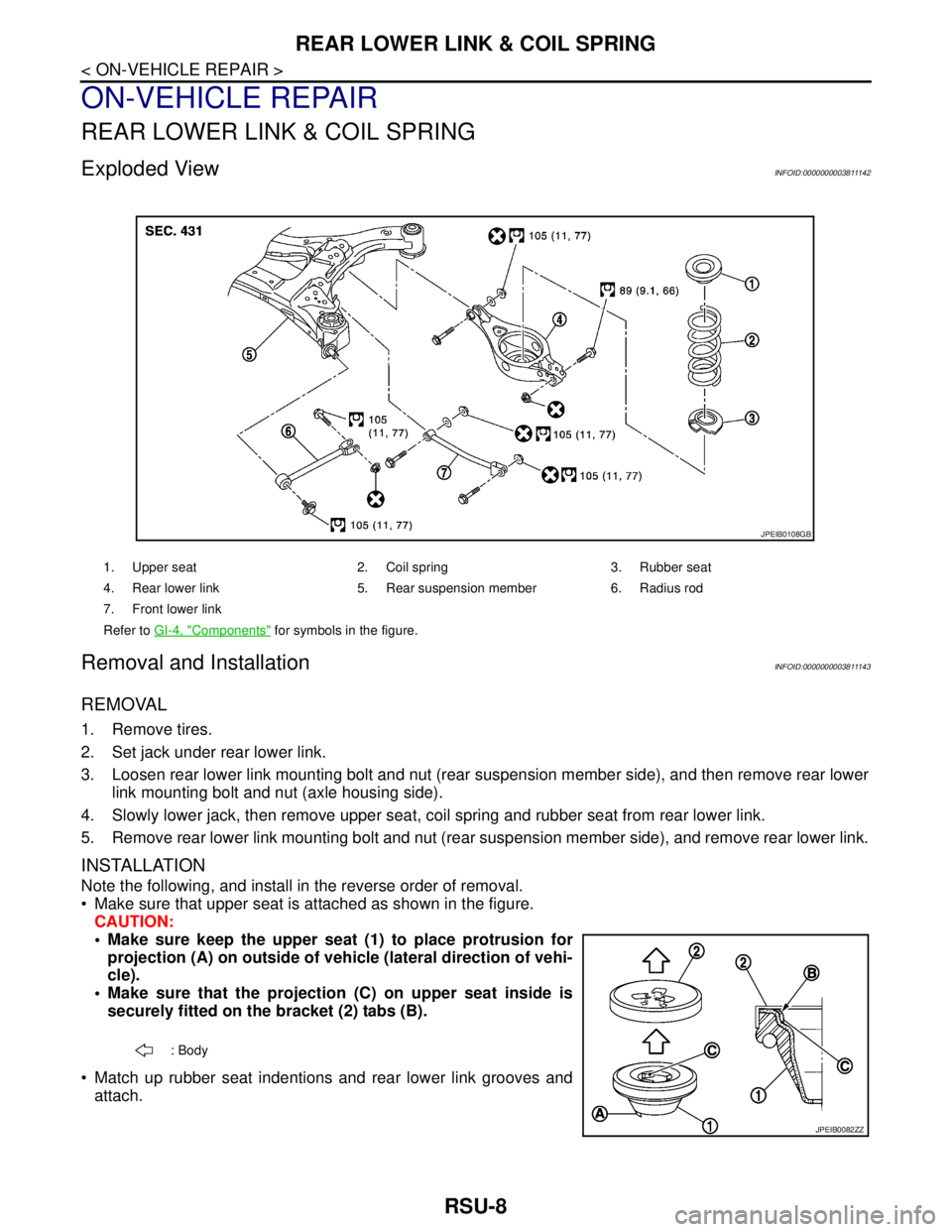
Exploded ViewINFOID:0000000003811142
Removal and InstallationINFOID:0000000003811143
REMOVAL
1. Remove tires.
2. Set jack under rear lower link.
3. Loosen rear lower link mounting bolt and nut (rear suspension member side), and then remove rear lower
link mounting bolt and nut (axle housing side).
4. Slowly lower jack, then remove upper seat, coil spring and rubber seat from rear lower link.
5. Remove rear lower link mounting bolt and nut (rear suspension member side), and remove rear lower link.
INSTALLATION
Note the following, and install in the reverse order of removal.
Make sure that upper seat is attached as shown in the figure.
CAUTION:
Make sure keep the upper seat (1) to place protrusion for
projection (A) on outside of vehicle (lateral direction of vehi-
cle).
Make sure that the projection (C) on upper seat inside is
securely fitted on the bracket (2) tabs (B).
Match up rubber seat indentions and rear lower link grooves and
attach.
1. Upper seat 2. Coil spring 3. Rubber seat
4. Rear lower link 5. Rear suspension member 6. Radius rod
7. Front lower link
Refer to GI-4, "
Components" for symbols in the figure.
JPEIB0108GB
: Body
JPEIB0082ZZ
Page 3842 of 5121
RSU-10
< ON-VEHICLE REPAIR >
REAR SHOCK ABSORBER
REAR SHOCK ABSORBER
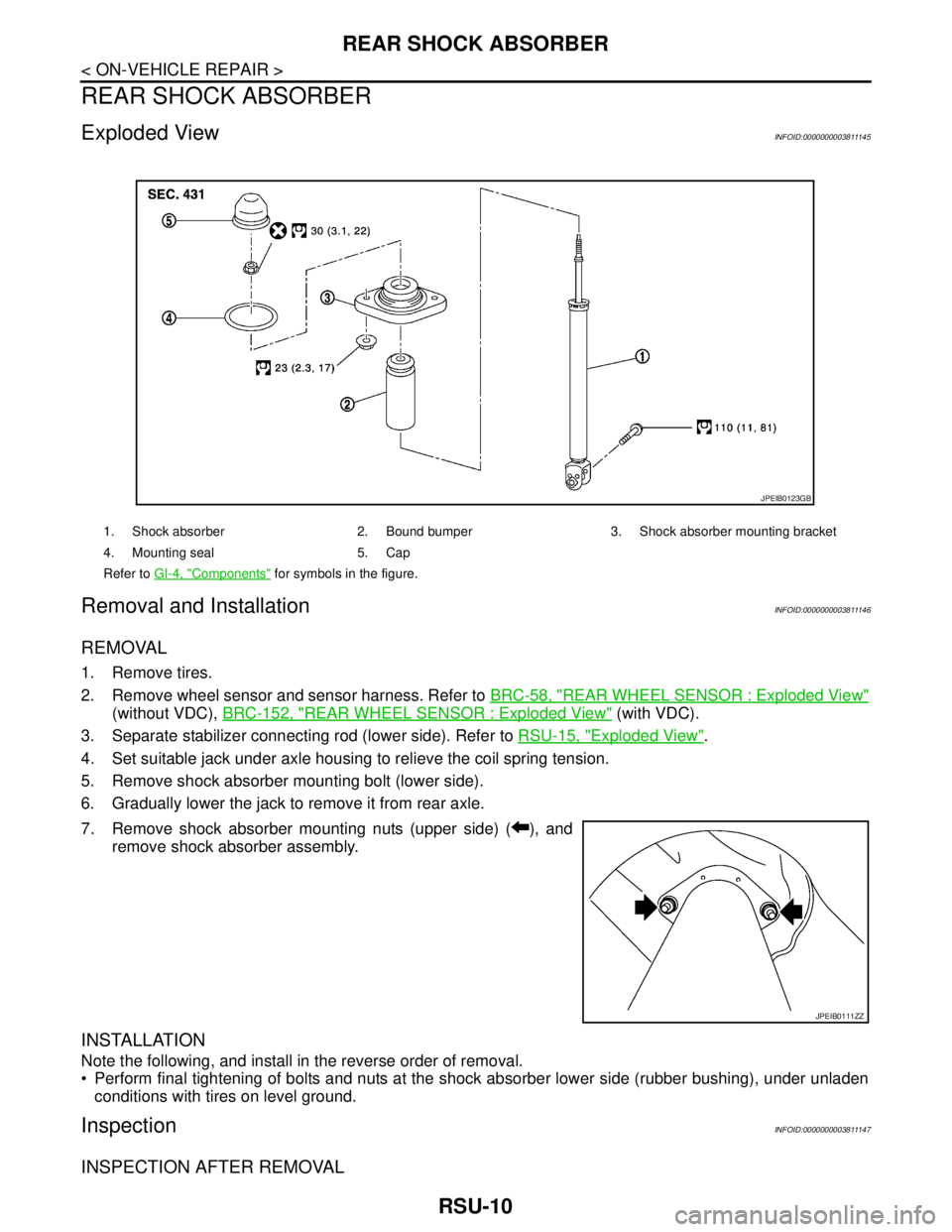
Exploded ViewINFOID:0000000003811145
Removal and InstallationINFOID:0000000003811146
REMOVAL
1. Remove tires.
2. Remove wheel sensor and sensor harness. Refer to BRC-58, "
REAR WHEEL SENSOR : Exploded View"
(without VDC), BRC-152, "REAR WHEEL SENSOR : Exploded View" (with VDC).
3. Separate stabilizer connecting rod (lower side). Refer to RSU-15, "
Exploded View".
4. Set suitable jack under axle housing to relieve the coil spring tension.
5. Remove shock absorber mounting bolt (lower side).
6. Gradually lower the jack to remove it from rear axle.
7. Remove shock absorber mounting nuts (upper side) ( ), and
remove shock absorber assembly.
INSTALLATION
Note the following, and install in the reverse order of removal.
Perform final tightening of bolts and nuts at the shock absorber lower side (rubber bushing), under unladen
conditions with tires on level ground.
InspectionINFOID:0000000003811147
INSPECTION AFTER REMOVAL
1. Shock absorber 2. Bound bumper 3. Shock absorber mounting bracket
4. Mounting seal 5. Cap
Refer to GI-4, "
Components" for symbols in the figure.
JPEIB0123GB
JPEIB0111ZZ
Page 3843 of 5121
REAR SHOCK ABSORBER
RSU-11
< ON-VEHICLE REPAIR >
C
D
F
G
H
I
J
K
L
MA
B
RSU
N
O
P
Check the following items, and replace the if necessary.
Shock absorber for deformation, cracks, damage.
Welded and sealed areas for oil leakage.
Piston rod for damage, uneven wear or distortion.
Seal of shock absorber mounting bracket for cracks, damage and come off.
INSPECTION AFTER INSTALLATION
Check wheel sensor harness for proper connection. Refer to BRC-58, "REAR WHEEL SENSOR : Exploded
View" (without VDC), BRC-152, "REAR WHEEL SENSOR : Exploded View" (with VDC).
Page 3844 of 5121
RSU-12
< ON-VEHICLE REPAIR >
RADIUS ROD
RADIUS ROD
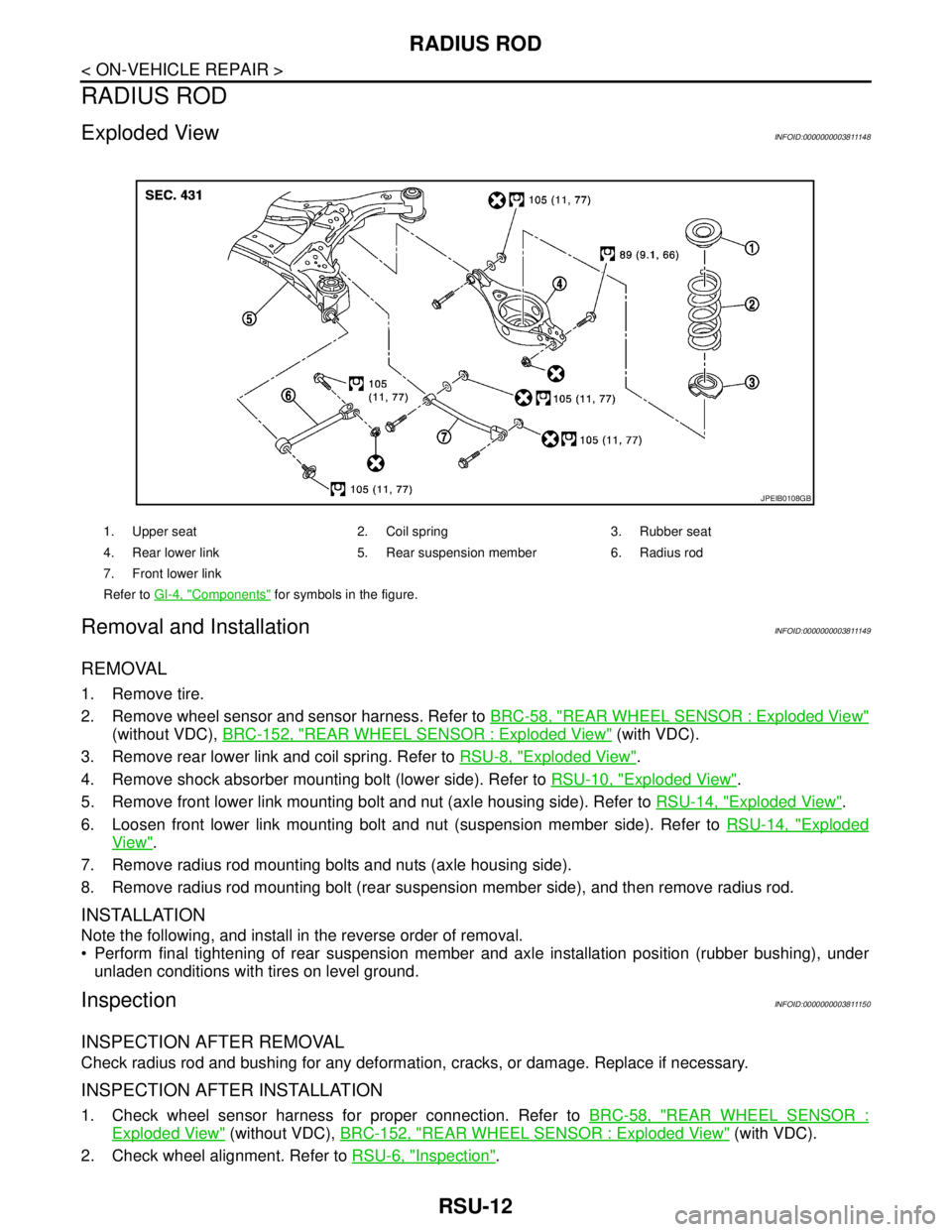
Exploded ViewINFOID:0000000003811148
Removal and InstallationINFOID:0000000003811149
REMOVAL
1. Remove tire.
2. Remove wheel sensor and sensor harness. Refer to BRC-58, "
REAR WHEEL SENSOR : Exploded View"
(without VDC), BRC-152, "REAR WHEEL SENSOR : Exploded View" (with VDC).
3. Remove rear lower link and coil spring. Refer to RSU-8, "
Exploded View".
4. Remove shock absorber mounting bolt (lower side). Refer to RSU-10, "
Exploded View".
5. Remove front lower link mounting bolt and nut (axle housing side). Refer to RSU-14, "
Exploded View".
6. Loosen front lower link mounting bolt and nut (suspension member side). Refer to RSU-14, "
Exploded
View".
7. Remove radius rod mounting bolts and nuts (axle housing side).
8. Remove radius rod mounting bolt (rear suspension member side), and then remove radius rod.
INSTALLATION
Note the following, and install in the reverse order of removal.
Perform final tightening of rear suspension member and axle installation position (rubber bushing), under
unladen conditions with tires on level ground.
InspectionINFOID:0000000003811150
INSPECTION AFTER REMOVAL
Check radius rod and bushing for any deformation, cracks, or damage. Replace if necessary.
INSPECTION AFTER INSTALLATION
1. Check wheel sensor harness for proper connection. Refer to BRC-58, "REAR WHEEL SENSOR :
Exploded View" (without VDC), BRC-152, "REAR WHEEL SENSOR : Exploded View" (with VDC).
2. Check wheel alignment. Refer to RSU-6, "
Inspection".
1. Upper seat 2. Coil spring 3. Rubber seat
4. Rear lower link 5. Rear suspension member 6. Radius rod
7. Front lower link
Refer to GI-4, "
Components" for symbols in the figure.
JPEIB0108GB