Ioni NISSAN TEANA 2008 Service Manual
[x] Cancel search | Manufacturer: NISSAN, Model Year: 2008, Model line: TEANA, Model: NISSAN TEANA 2008Pages: 5121, PDF Size: 69.03 MB
Page 931 of 5121
FRONT DISC BRAKE
BR-35
< ON-VEHICLE REPAIR >
C
D
E
G
H
I
J
K
L
MA
B
BR
N
O
P
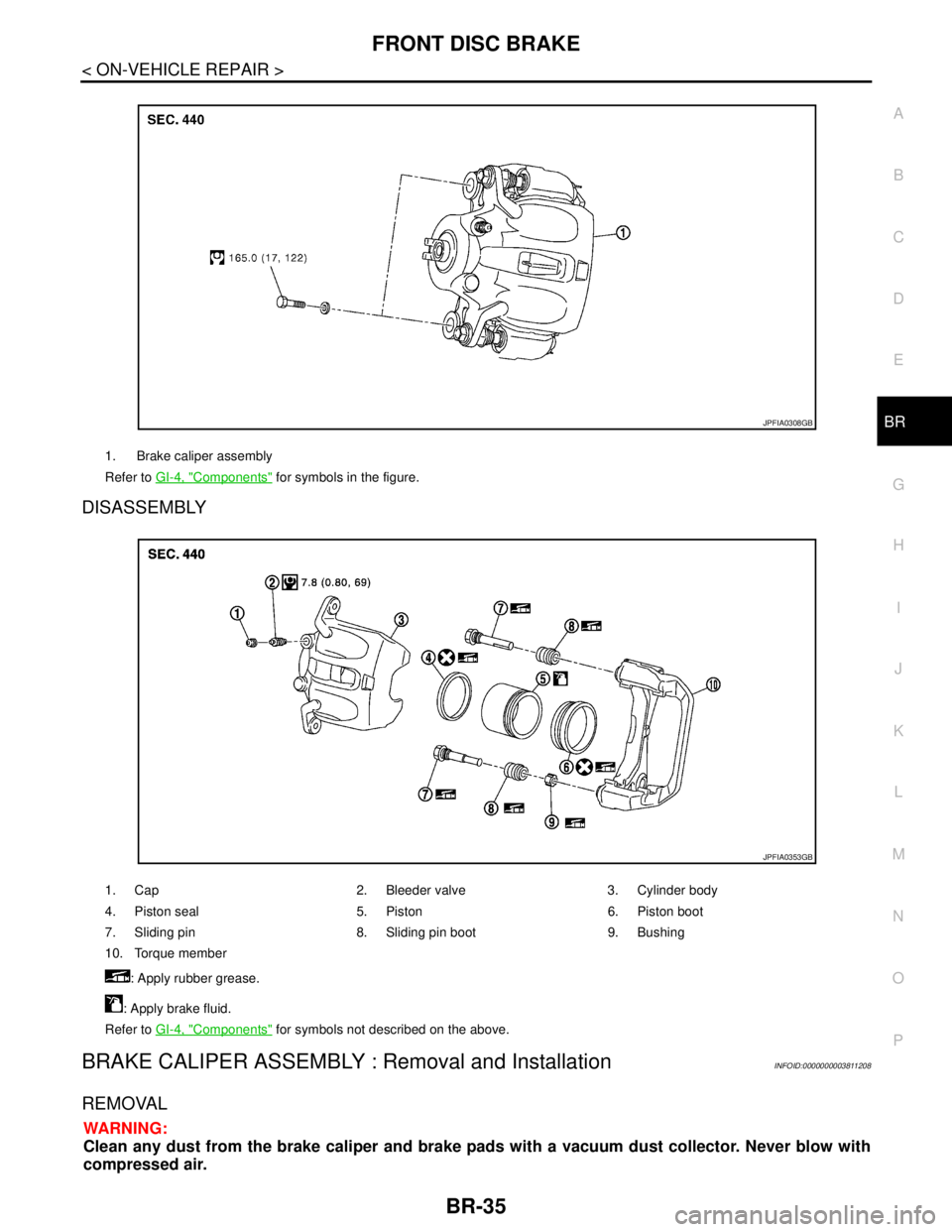
DISASSEMBLY
BRAKE CALIPER ASSEMBLY : Removal and InstallationINFOID:0000000003811208
REMOVAL
WARNING:
Clean any dust from the brake caliper and brake pads with a vacuum dust collector. Never blow with
compressed air.
1. Brake caliper assembly
Refer to GI-4, "
Components" for symbols in the figure.
JPFIA0308GB
1. Cap 2. Bleeder valve 3. Cylinder body
4. Piston seal 5. Piston 6. Piston boot
7. Sliding pin 8. Sliding pin boot 9. Bushing
10. Torque member
: Apply rubber grease.
: Apply brake fluid.
Refer to GI-4, "
Components" for symbols not described on the above.
JPFIA0353GB
Page 934 of 5121
BR-38
< ON-VEHICLE REPAIR >
FRONT DISC BRAKE
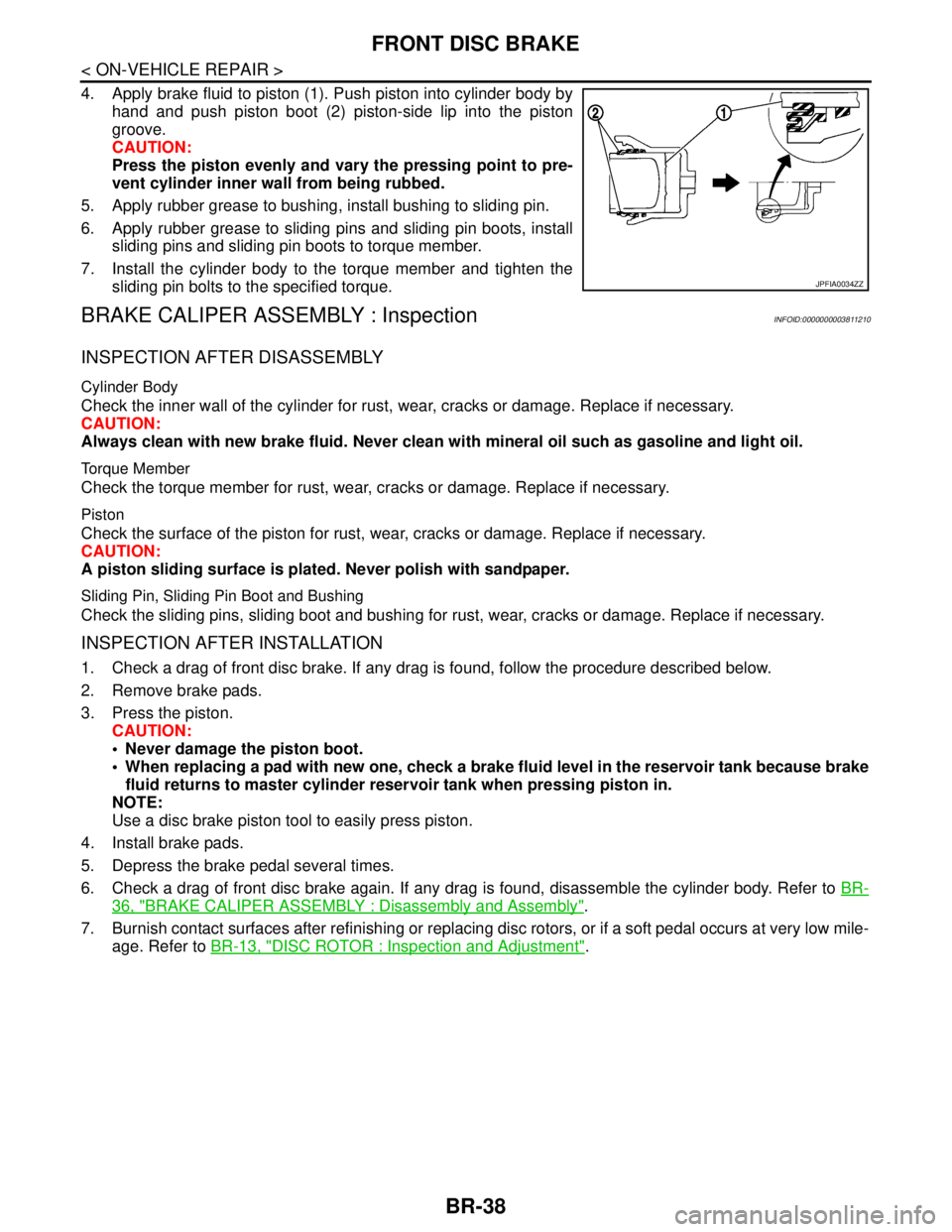
4. Apply brake fluid to piston (1). Push piston into cylinder body by
hand and push piston boot (2) piston-side lip into the piston
groove.
CAUTION:
Press the piston evenly and vary the pressing point to pre-
vent cylinder inner wall from being rubbed.
5. Apply rubber grease to bushing, install bushing to sliding pin.
6. Apply rubber grease to sliding pins and sliding pin boots, install
sliding pins and sliding pin boots to torque member.
7. Install the cylinder body to the torque member and tighten the
sliding pin bolts to the specified torque.
BRAKE CALIPER ASSEMBLY : InspectionINFOID:0000000003811210
INSPECTION AFTER DISASSEMBLY
Cylinder Body
Check the inner wall of the cylinder for rust, wear, cracks or damage. Replace if necessary.
CAUTION:
Always clean with new brake fluid. Never clean with mineral oil such as gasoline and light oil.
Torque Member
Check the torque member for rust, wear, cracks or damage. Replace if necessary.
Piston
Check the surface of the piston for rust, wear, cracks or damage. Replace if necessary.
CAUTION:
A piston sliding surface is plated. Never polish with sandpaper.
Sliding Pin, Sliding Pin Boot and Bushing
Check the sliding pins, sliding boot and bushing for rust, wear, cracks or damage. Replace if necessary.
INSPECTION AFTER INSTALLATION
1. Check a drag of front disc brake. If any drag is found, follow the procedure described below.
2. Remove brake pads.
3. Press the piston.
CAUTION:
Never damage the piston boot.
When replacing a pad with new one, check a brake fluid level in the reservoir tank because brake
fluid returns to master cylinder reservoir tank when pressing piston in.
NOTE:
Use a disc brake piston tool to easily press piston.
4. Install brake pads.
5. Depress the brake pedal several times.
6. Check a drag of front disc brake again. If any drag is found, disassemble the cylinder body. Refer to BR-
36, "BRAKE CALIPER ASSEMBLY : Disassembly and Assembly".
7. Burnish contact surfaces after refinishing or replacing disc rotors, or if a soft pedal occurs at very low mile-
age. Refer to BR-13, "
DISC ROTOR : Inspection and Adjustment".
JPFIA0034ZZ
Page 935 of 5121
REAR DISC BRAKE
BR-39
< ON-VEHICLE REPAIR >
C
D
E
G
H
I
J
K
L
MA
B
BR
N
O
P
REAR DISC BRAKE
BRAKE PAD
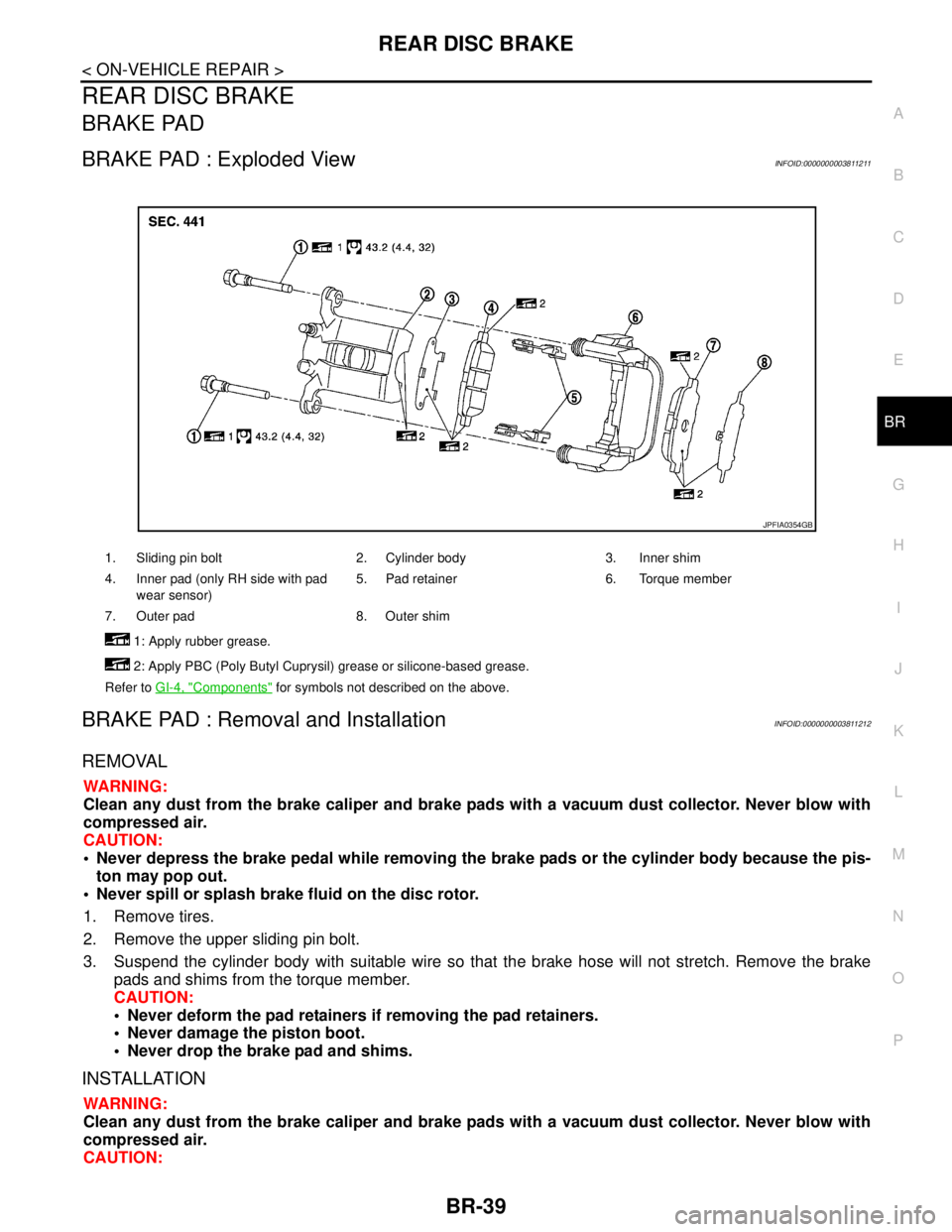
BRAKE PAD : Exploded ViewINFOID:0000000003811211
BRAKE PAD : Removal and InstallationINFOID:0000000003811212
REMOVAL
WARNING:
Clean any dust from the brake caliper and brake pads with a vacuum dust collector. Never blow with
compressed air.
CAUTION:
Never depress the brake pedal while removing the brake pads or the cylinder body because the pis-
ton may pop out.
Never spill or splash brake fluid on the disc rotor.
1. Remove tires.
2. Remove the upper sliding pin bolt.
3. Suspend the cylinder body with suitable wire so that the brake hose will not stretch. Remove the brake
pads and shims from the torque member.
CAUTION:
Never deform the pad retainers if removing the pad retainers.
Never damage the piston boot.
Never drop the brake pad and shims.
INSTALLATION
WARNING:
Clean any dust from the brake caliper and brake pads with a vacuum dust collector. Never blow with
compressed air.
CAUTION:
1. Sliding pin bolt 2. Cylinder body 3. Inner shim
4. Inner pad (only RH side with pad
wear sensor)5. Pad retainer 6. Torque member
7. Outer pad 8. Outer shim
1: Apply rubber grease.
2: Apply PBC (Poly Butyl Cuprysil) grease or silicone-based grease.
Refer to GI-4, "
Components" for symbols not described on the above.
JPFIA0354GB
Page 936 of 5121
BR-40
< ON-VEHICLE REPAIR >
REAR DISC BRAKE
Never depress the brake pedal while removing the brake pads or the cylinder body because the pis-
ton may pop out.
Never spill or splash brake fluid on the disc rotor.
1. Install the pad retainers to the torque member if the pad retainers has been removed.
CAUTION:
Securely assemble the pad retainers not to be lifted up from the torque member.
Never deform the pad retainers.
2. Apply PBC (Poly Butyl Cuprysil) grease or silicone-based grease to the mating faces between the brake
pads, the shims and pawls part of cylinder body, and install them to the brake pad.
CAUTION:
Always replace the shims together when replacing the brake pad.
3. Install cylinder body and brake pads to torque member.
CAUTION:
Never damage the piston boot.
When replacing pads with new one, check a brake fluid level in the reservoir tank because brake
fluid returns to master cylinder reservoir tank when pressing piston in.
NOTE:
Use a disc brake piston tool to easily press piston.
4. Install the upper sliding pin bolt and tighten it to the specified torque.
5. Depress the brake pedal several times to check that no drag feel is present for the rear disc brake. Refer
to BR-40, "
BRAKE PAD : Inspection".
BRAKE PAD : InspectionINFOID:0000000003811213
INSPECTION AFTER REMOVAL
Replace the shims if rust is excessively attached.
INSPECTION AFTER INSTALLATION
1. Check a drag of rear disc brake. If any drag is found, follow the procedure described below.
2. Remove brake pads.
3. Press the piston.
CAUTION:
Never damage the piston boot.
When replacing a pad with new one, check a brake fluid level in the reservoir tank because brake
fluid returns to master cylinder reservoir tank when pressing piston in.
NOTE:
Use a disc brake piston tool to easily press piston.
4. Install brake pads.
5. Depress the brake pedal several times.
6. Check a drag of rear disc brake again. If any drag is found, disassemble the cylinder body. Refer to BR-
42, "BRAKE CALIPER ASSEMBLY : Disassembly and Assembly".
7. Burnish contact surfaces after refinishing or replacing pads, or if a soft pedal occurs at very low mileage.
Refer to BR-15, "
BRAKE PAD : Inspection and Adjustment".
BRAKE CALIPER ASSEMBLY
BRAKE CALIPER ASSEMBLY : Exploded ViewINFOID:0000000003811214
REMOVAL
Page 937 of 5121
REAR DISC BRAKE
BR-41
< ON-VEHICLE REPAIR >
C
D
E
G
H
I
J
K
L
MA
B
BR
N
O
P
DISASSEMBLY
BRAKE CALIPER ASSEMBLY : Removal and InstallationINFOID:0000000003811215
REMOVAL
WARNING:
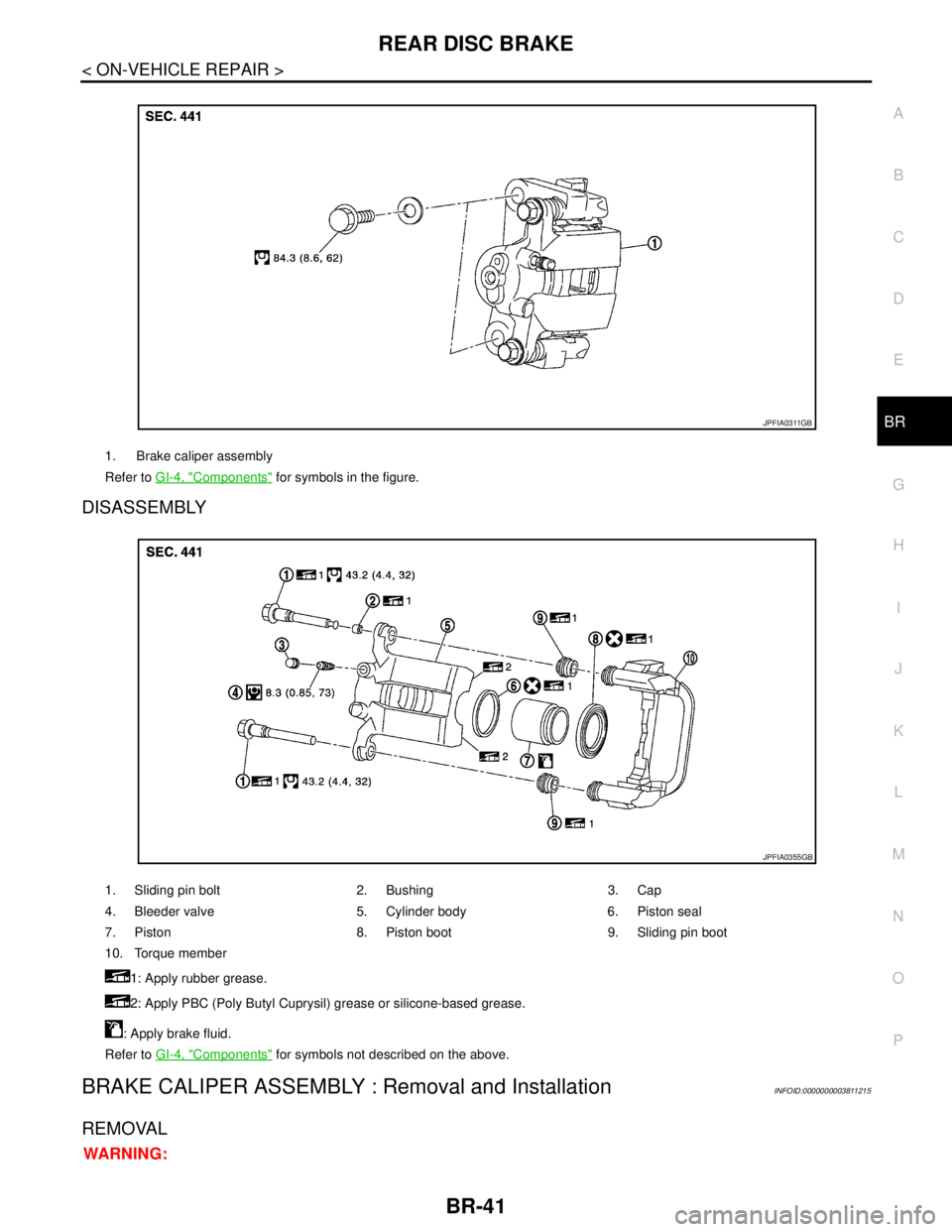
1. Brake caliper assembly
Refer to GI-4, "
Components" for symbols in the figure.
JPFIA0311GB
1. Sliding pin bolt 2. Bushing 3. Cap
4. Bleeder valve 5. Cylinder body 6. Piston seal
7. Piston 8. Piston boot 9. Sliding pin boot
10. Torque member
1: Apply rubber grease.
2: Apply PBC (Poly Butyl Cuprysil) grease or silicone-based grease.
: Apply brake fluid.
Refer to GI-4, "
Components" for symbols not described on the above.
JPFIA0355GB
Page 940 of 5121
BR-44
< ON-VEHICLE REPAIR >
REAR DISC BRAKE
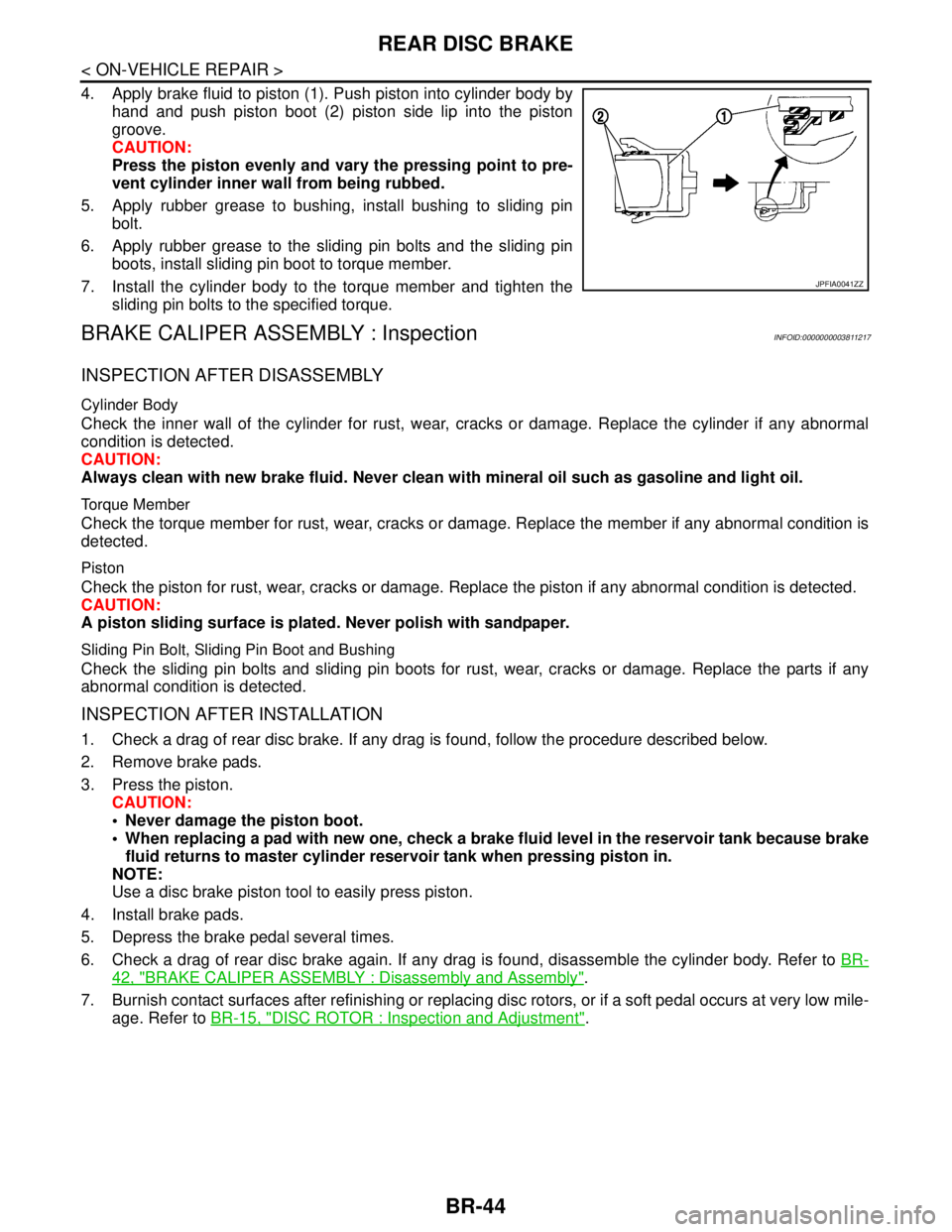
4. Apply brake fluid to piston (1). Push piston into cylinder body by
hand and push piston boot (2) piston side lip into the piston
groove.
CAUTION:
Press the piston evenly and vary the pressing point to pre-
vent cylinder inner wall from being rubbed.
5. Apply rubber grease to bushing, install bushing to sliding pin
bolt.
6. Apply rubber grease to the sliding pin bolts and the sliding pin
boots, install sliding pin boot to torque member.
7. Install the cylinder body to the torque member and tighten the
sliding pin bolts to the specified torque.
BRAKE CALIPER ASSEMBLY : InspectionINFOID:0000000003811217
INSPECTION AFTER DISASSEMBLY
Cylinder Body
Check the inner wall of the cylinder for rust, wear, cracks or damage. Replace the cylinder if any abnormal
condition is detected.
CAUTION:
Always clean with new brake fluid. Never clean with mineral oil such as gasoline and light oil.
Torque Member
Check the torque member for rust, wear, cracks or damage. Replace the member if any abnormal condition is
detected.
Piston
Check the piston for rust, wear, cracks or damage. Replace the piston if any abnormal condition is detected.
CAUTION:
A piston sliding surface is plated. Never polish with sandpaper.
Sliding Pin Bolt, Sliding Pin Boot and Bushing
Check the sliding pin bolts and sliding pin boots for rust, wear, cracks or damage. Replace the parts if any
abnormal condition is detected.
INSPECTION AFTER INSTALLATION
1. Check a drag of rear disc brake. If any drag is found, follow the procedure described below.
2. Remove brake pads.
3. Press the piston.
CAUTION:
Never damage the piston boot.
When replacing a pad with new one, check a brake fluid level in the reservoir tank because brake
fluid returns to master cylinder reservoir tank when pressing piston in.
NOTE:
Use a disc brake piston tool to easily press piston.
4. Install brake pads.
5. Depress the brake pedal several times.
6. Check a drag of rear disc brake again. If any drag is found, disassemble the cylinder body. Refer to BR-
42, "BRAKE CALIPER ASSEMBLY : Disassembly and Assembly".
7. Burnish contact surfaces after refinishing or replacing disc rotors, or if a soft pedal occurs at very low mile-
age. Refer to BR-15, "
DISC ROTOR : Inspection and Adjustment".
JPFIA0041ZZ
Page 948 of 5121
![NISSAN TEANA 2008 Service Manual DIAGNOSIS AND REPAIR WORK FLOW
BRC-7
< BASIC INSPECTION >[ABS]
C
D
E
G
H
I
J
K
L
MA
B
BRC
N
O
P
1.COLLECT THE INFORMATION FROM THE CUSTOMER
Get the detailed information from the customer about the sym](/img/5/57391/w960_57391-947.png "NISSAN TEANA 2008 Service Manual DIAGNOSIS AND REPAIR WORK FLOW
BRC-7
< BASIC INSPECTION >[ABS]
C
D
E
G
H
I
J
K
L
MA
B
BRC
N
O
P
1.COLLECT THE INFORMATION FROM THE CUSTOMER
Get the detailed information from the customer about the sym")
DIAGNOSIS AND REPAIR WORK FLOW
BRC-7
< BASIC INSPECTION >[ABS]
C
D
E
G
H
I
J
K
L
MA
B
BRC
N
O
P
1.COLLECT THE INFORMATION FROM THE CUSTOMER
Get the detailed information from the customer about the symptom (the condition and the environment when
the incident/malfunction occurred) using the diagnosis work sheet. Refer to BRC-8, "
Diagnostic Work Sheet".
>> GO TO 2.
2.PERFORM THE SELF-DIAGNOSIS
Check the DTC display with the self-diagnosis function.
Is there any DTC displayed?
YES >> GO TO 3.
NO >> GO TO 4.
3.PERFORM THE SYSTEM DIAGNOSIS
Perform the diagnosis applicable to the displayed DTC. Refer to BRC-48, "
DTC No. Index".
>> GO TO 7.
4.CHECK THE SYMPTOM THAT IS NOT CONSIDERED A SYSTEM MALFUNCTION
Check that the symptom is a normal operation that is not considered a system malfunction. Refer to BRC-54,
"Description".
Is the symptom a normal operation?
YES >> INSPECTION END
NO >> GO TO 5.
5.CHECK THE WARNING LAMP FOR ILLUMINATION
Check that the warning lamp illuminate.
• ABS warning lamp: Refer to BRC-40, "
Description".
Brake warning lamp: Refer to BRC-41, "
Description".
Is ON/OFF timing normal?
YES >> GO TO 6.
NO >> GO TO 2.
6.PERFORM THE DIAGNOSIS BY SYMPTOM
Perform the diagnosis applicable to the symptom.
>> GO TO 7.
7.REPAIR OR REPLACE THE MALFUNCTIONING PARTS
Repair or replace the specified malfunctioning parts.
>> GO TO 8.
8.MEMORY CLEAR
Perform self-diagnosis memory clear.
>> GO TO 9.
9.FINAL CHECK
Perform the self-diagnosis again, and check that the malfunction is repaired completely.
Is no other DTC present and the repair completed?
YES >> INSPECTION END
NO >> GO TO 3.
Page 950 of 5121
![NISSAN TEANA 2008 Service Manual ABS
BRC-9
< FUNCTION DIAGNOSIS >[ABS]
C
D
E
G
H
I
J
K
L
MA
B
BRC
N
O
P
FUNCTION DIAGNOSIS
ABS
System DiagramINFOID:0000000003766722
System DescriptionINFOID:0000000003766723
Anti-Lock Braking System](/img/5/57391/w960_57391-949.png "NISSAN TEANA 2008 Service Manual ABS
BRC-9
< FUNCTION DIAGNOSIS >[ABS]
C
D
E
G
H
I
J
K
L
MA
B
BRC
N
O
P
FUNCTION DIAGNOSIS
ABS
System DiagramINFOID:0000000003766722
System DescriptionINFOID:0000000003766723
Anti-Lock Braking System")
ABS
BRC-9
< FUNCTION DIAGNOSIS >[ABS]
C
D
E
G
H
I
J
K
L
MA
B
BRC
N
O
P
FUNCTION DIAGNOSIS
ABS
System DiagramINFOID:0000000003766722
System DescriptionINFOID:0000000003766723
Anti-Lock Braking System detects wheel revolution while braking, electronically controls braking force, and
prevents wheel locking during sudden braking. It improves handling stability and maneuverability for avoid-
ing obstacles.
Electrical system diagnosis by CONSULT-III is available.
JSFIA0257GB
Page 951 of 5121
![NISSAN TEANA 2008 Service Manual BRC-10
< FUNCTION DIAGNOSIS >[ABS]
ABS
Component Parts Location
INFOID:0000000003766724
Component DescriptionINFOID:0000000003766725
1. ABS warning lamp 2. Brake warning lamp 3.ABS actuator and electr](/img/5/57391/w960_57391-950.png "NISSAN TEANA 2008 Service Manual BRC-10
< FUNCTION DIAGNOSIS >[ABS]
ABS
Component Parts Location
INFOID:0000000003766724
Component DescriptionINFOID:0000000003766725
1. ABS warning lamp 2. Brake warning lamp 3.ABS actuator and electr")
BRC-10
< FUNCTION DIAGNOSIS >[ABS]
ABS
Component Parts Location
INFOID:0000000003766724
Component DescriptionINFOID:0000000003766725
1. ABS warning lamp 2. Brake warning lamp 3.ABS actuator and electric unit (con-
trol unit)
4. Front wheel sensor 5. Rear wheel sensor
A. Combination meter B. Engine room right side C. Steering knuckle
D. Rear axle
JSFIA0258ZZ
Component parts Reference
ABS actuator and electric unit (control unit)Pump
BRC-25, "
Description"Motor
Actuator relay (main relay)BRC-36, "
Description"
Solenoid valveBRC-32, "Description"
Wheel sensorBRC-16, "Description"
ABS warning lampBRC-40, "Description"
Brake warning lampBRC-41, "Description"
Page 952 of 5121
![NISSAN TEANA 2008 Service Manual EBD
BRC-11
< FUNCTION DIAGNOSIS >[ABS]
C
D
E
G
H
I
J
K
L
MA
B
BRC
N
O
P
EBD
System DiagramINFOID:0000000003767309
System DescriptionINFOID:0000000003766727
Electric Brake force Distribution is a fol](/img/5/57391/w960_57391-951.png "NISSAN TEANA 2008 Service Manual EBD
BRC-11
< FUNCTION DIAGNOSIS >[ABS]
C
D
E
G
H
I
J
K
L
MA
B
BRC
N
O
P
EBD
System DiagramINFOID:0000000003767309
System DescriptionINFOID:0000000003766727
Electric Brake force Distribution is a fol")
EBD
BRC-11
< FUNCTION DIAGNOSIS >[ABS]
C
D
E
G
H
I
J
K
L
MA
B
BRC
N
O
P
EBD
System DiagramINFOID:0000000003767309
System DescriptionINFOID:0000000003766727
Electric Brake force Distribution is a following function. ABS actuator and electric unit (control unit) detects
subtle slippages between the front and rear wheels during braking. Then is electronically controls the rear
braking force (brake fluid pressure) to reducing and reduces rear wheel slippage. Accordingly it improves
vehicle stability.
Electrical system diagnosis by CONSULT-III is available.
JSFIA0257GB